




Abstract
Journalism practitioners rarely apply research to their practice, and often decline to supply their time to support research. These issues indicate a research-practice gap in journalism. Yet efforts to characterize the gap are in their infancy. This study uses 16 semi-structured interviews with US journalism practitioners to understand, first, how practitioners characterize the applicability of research to their work; and second, how they describe the nature of and reasons for the research-practice gap in journalism. We applied the framework of institutional logics to understand the conflicts that might contribute to the gap at the intra-organizational and inter-organizational levels. The study found that journalists value the evidence research gives them, but do not see research as essential to their work. Participants identified three types of research-practice gaps corresponding to three stages in the research process: 1) researchers asking the wrong questions, 2) researchers communicating their findings poorly, and 3) institutional barriers keeping research from being applied in the newsroom. Participants’ statements point to the instantiation of professional, market, efficiency, and academic logics, which may affect how journalists experience the scholar-practitioner gap. Conflicting logics at the intra-organizational level limit journalists’ implementation of research findings while competing logics between organizations relate to the gaps of researchers asking the wrong questions and communicating findings poorly. While future studies should complement this work with other perspectives on the research-practice gap, this exploratory study lays the groundwork by characterizing the gap through journalists’ experiences and expertise.
Keywords
To hear many tell it, one of the major goals of journalism research is to influence journalistic practice. Bélair-Gagnon and Usher (2021) write that such scholars’ “main object of study, journalism, faces both real and existential threats to its continuation. Journalism research can help address these challenges and, in turn, improve journalism itself.” Yet journalism practitioners rarely seem to apply research to their practice (Wilner and Bélair-Gagnon, 2023) and often find themselves unable to supply their time and expertise to support research (Blanchett et al., 2023).
This research-practice gap is also challenging in other applied fields (Barge and Shockley-Zalabak, 2008). Fields such as public relations, social work, and behavioral sciences have used empirical research to document how practitioners see those gaps (Claeys and Opgenhaffen, 2016). In journalism, such efforts are fairly nascent—as is the wider understanding of the research-practice gap (Bélair-Gagnon and Usher, 2021; Zelizer, 2009). That literature primarily focuses on the discrepancies between journalism pedagogy and journalism practice (Frith and Meech, 2007). Literature focused on exploring the knowledge gap as it manifests between practitioners and scholars, meanwhile, is comparatively scant (c.f. Meier and Schützeneder, 2019). Likewise, documentation of the gap is seldom guided by or used to advance theory. Those who care about the future of journalism are left with a piecemeal understanding of how journalists experience a problematic gap between research and practice.
Using interviews with news organization members ranging from freelancers to senior editors, this US-focused exploratory article builds on this past work in several ways. It seeks to gain a richer understanding of how American journalists think about research, how they characterize the research-practice gap, and what they see as the reasons for the gap. We use the concept of institutional logic to understand the factors that lie behind the gap, according to our participants, and that may hinder or encourage change. The findings identify three types of researcher-practitioner gaps, related to three stages in the research and application process. These gaps come with different degrees of institutional attribution and balances of attribution to journalists versus academics. Although this exploratory study precludes drawing any theoretical conclusions, we do shed light on what needs to be explored further, in the way of both understanding the problem and generating solutions.
Literature review
Understanding the nature of academic-practice gaps
Scholars have noted the existence of researcher-practitioner knowledge gaps in fields such as psychology, management, and organizational communications (Barge and Shockley-Zalabak, 2008). Such gaps, also described as scholar-practitioner divides (Claeys and Opgenhaffen, 2016: 233), constitute a phenomenon whereby research findings fail to influence the practitioners whom the research aims to support and advise. While not all research has that aim, when research strives for this type of influence, a lack of impact represents a problem for researchers and possibly for practitioners as well.
Within research on this lack of impact, referred to as translational science (Leppin et al., 2020), one major strand has concentrated on describing what the gaps consist of and how they come about. Using terminology from management research (Shapiro et al., 2007), Claeys and Opgenhaffen (2016) refer to two knowledge gap types in crisis communication. “Lost in translation,” also known as the knowledge transfer problem, occurs when research aimed at influencing practice does not get effectively translated into publications or tools that practitioners can use in their day-to-day work. “Lost before translation,” also known as the knowledge production problem, occurs when practitioners view researchers’ work as irrelevant or unimportant (Claeys and Opgenhaffen, 2016; see also Shapiro et al., 2007; Van de Ven and Johnson, 2006).
Scholars have long recognized the challenges in viewing research information flows as unidirectional. Rather than considering practical application as something that follows scientific understanding, Kondrat (1992) suggests that practitioners and scholars each have their own forms of knowledge. Aram and Salipante (2003) elaborate on these knowledge forms, writing that practitioners are primarily interested in relevance, or how research questions and findings pertain to their specific, contextualized problems. Academics are committed to rigor, or the search for general laws, theories, and principles that transcend the particular. These actors have different approaches to knowledge because they have different purposes (Van de Ven and Johnson, 2006). Bridging the divide between the two broad categories of actors requires a clear-eyed assessment of the discontinuities between these types of knowledge (Kondrat, 1992). Closing this gap may require different research approaches such as engaged scholarship (Van de Ven and Johnson, 2006).
Gaps in the field of journalism studies
Still in its infancy, journalism studies research on the scholar-practitioner divide has often focused on the problem of researcher access to journalists and newsrooms. The literature details instances where journalism organizations have refused to participate or have withdrawn participation from research projects, particularly on the sensitive issues of race and equity (Bélair-Gagnon and Usher, 2021; Scire, 2022). Meanwhile, Blanchett et al. (2023) documented a variety of barriers to research participation, including journalists’ lack of time, concerns about public perceptions and confidentiality, and confusion about whether respondents “count” as journalists.
Other discourse on journalism’s knowledge gap has highlighted epistemological challenges to collaboration. After scholar Jacob L. Nelson wrote that “the audience engagement industry struggles with measuring success,” the founder and CEO of Hearken, the engagement platform he studied, challenged the timeliness of his findings. Their exchange raised questions of whether “data” means the same thing for journalists and researchers, and how such disagreements can make field research difficult (Schmidt, 2018).
Seldom, however, have scholars sought to document the wide scope of the research-practice gap in journalism. One exception, albeit not theory-driven, comes from Wilner and Bélair-Gagnon (2023). They found that participating journalists read about research between once a year and once a month, on average, but they use research to do their job less than once a year. Participants said research was often irrelevant to their work, and that researchers were “out of touch” with how journalism is practiced today.
We would note that, while this study focuses on mapping the research-practice gap in journalism, it is worth considering the connection of research and practice to education. The pedagogy-practice divide is expressed in many ways, including what some see as gaps between students’ preparation and modern journalism’s demands (Donsbach, 2014) and disagreement between practitioners and students on the need for journalism education (Frith and Meech, 2007). Addressing practice’s gap with either research or education will likely require holistic consideration of all three, as research can foster a more critically minded education that produces, in turn, better journalism (Harcup, 2012; Meier and Schützeneder, 2019).
Institutional logics
This article draws on institutional logics—the systems of values, beliefs, and norms that people, groups, and organizations refer to in order to make sense and evaluate and organize their activities—to better understand journalists’ experiences with the research-practice gap (Haveman and Gualtieri, 2017). According to this approach, key institutions of Western society—such as the capitalist market, democracy, and the bureaucratic state—have a central logic, or set of cultural elements or organizing principles which includes social practices and symbolic systems (Friedland and Alford, 1991). For example, capitalism’s institutional logic emphasizes the accumulation and monetization of human activity (Friedland and Alford, 1991). Collective identities of groups such as professions can also develop unique institutional logics (Thornton and Ocasio, 2008). The literature also emphasizes that within each field (such as academia, health care, or architecture) individuals and organizations struggle to fulfill competing institutional logics (Thornton and Ocasio, 2008).
The literature indicates that conflicting logics can play out in inter- and intra-organizational settings (Thornton and Ocasio, 2008). The former is somewhat rarer in the literature, although the issue has been explored in the management and business ethics spaces (Yin and Jamali, 2021). Notably, Fortin (2023) turned this framework to the study of the logic-driven tensions that arose in an academic-industry partnership. Looking at intraorganizational conflict, such competition can either spark or suppress innovation (Thornton and Ocasio, 2008).
Because “bridging the gap” suggests that academic research might change journalism, we focus on the handful of studies examining how competing logics enable or constrain change in journalism organizations. These papers identify logics that include professionalism, the market, management, technology, experimentation, audience, and efficiency (Bélair-Gagnon et al., 2020; Koivula et al., 2023; Lischka, 2020). Lischka (2020) found that news workers judge changes in the domains of the market, management, and technology according to the changes’ ability to fulfill professional goals. At the same time, the technology logic also triggers the professional logic to evolve. Koivula et al. (2023) found that while a market logic presses on journalists to learn more—which could help lay the groundwork for innovation—this imperative may also limit learning by emphasizing efficient work rather than long-term skill adoption.
The present study deals with the origins and nature of the researcher-practitioner divide from journalists’ point of view. Institutional logics provide a useful way of understanding the conflicts that may exist between journalists and academics; as well as the internal conflicts that may arise within journalism organizations. Both types of conflicting logics may affect news organizations’ ability to adopt research.
Such a lens lets scholars zoom out to examine how participants see themselves working in larger systems at the organizational and inter-organizational levels. As Bélair-Gagnon et al. (2020) write, “A study of actors’ interpretation of those logics in action helps shed light on institutional logics themselves and why certain innovations are cut back or fail” (p. 293).
In particular, we identify four logics that may help us to understand the gap as seen through journalists’ eyes: • Market: Consists of an orientation toward advertisers and audiences as consumers. Journalism has long been characterized by a struggle between profit and public interest, which Lischka (2020) characterizes as a conflict between market and professional logics. • Professional: Concerns how journalists ought to behave to uphold the standards of their profession, and can encompass components such as gatekeeping, objectivity, and the watchdog ideal of protecting and empowering citizens in a democracy (Koivula et al., 2023). • Efficiency: Consists of a “corporate mindset,” that of accomplishing more with limited resources (Bélair-Gagnon et al., 2020). • Academic: Motivation by the goal of producing scholarly knowledge and building academic reputations (Grossi et al., 2020).
This background raises important questions for research. This article asks: RQ1. How do journalists characterize the applicability of research to their work? RQ2. How do journalists characterize the nature of and reasons for the research-practice gap between scholars and journalists?
Methods
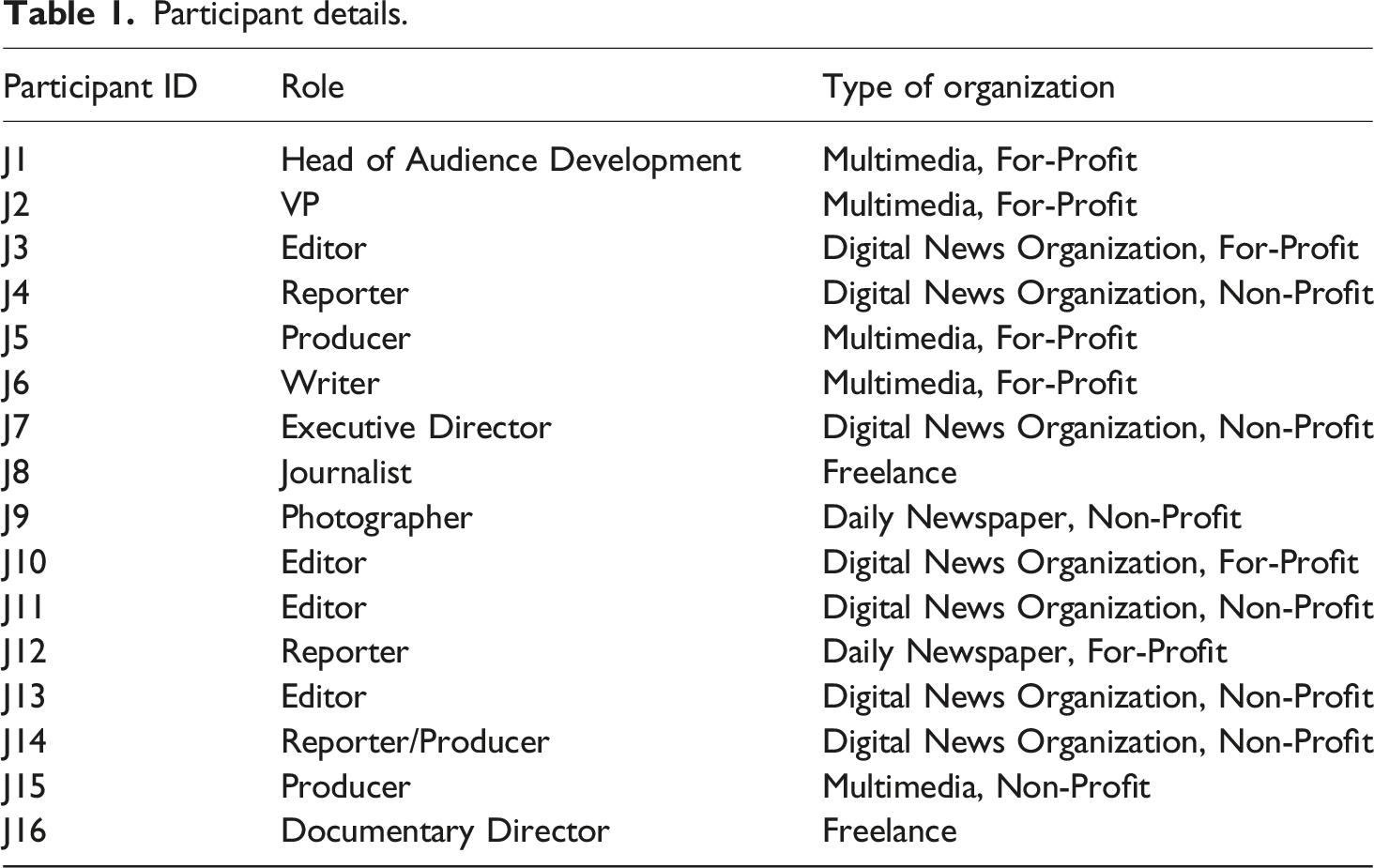
Participant details.
Summary of participant characteristics.
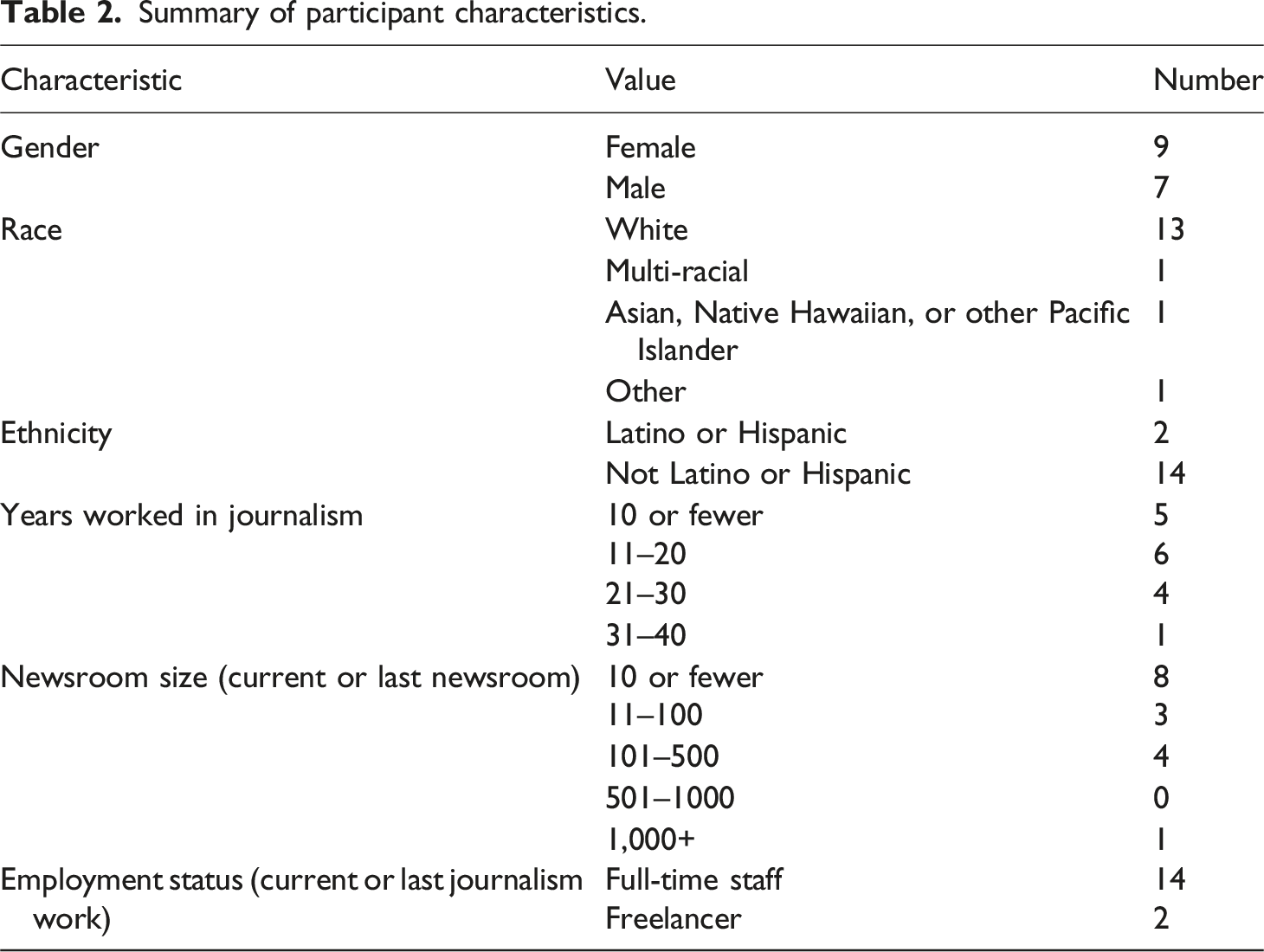
The participants for this study were identified through purposive and snowball sampling. Recruitment emails were sent to journalists who expressed interest in participating in an interview study through Nieman Lab, a news site for the media industry. In addition, calls for recruitment were posted on the Slack online messaging channels of Gather and Trusting News, both collaborative projects and platforms that support journalists and academics. These organizations were chosen as they connect academic research to journalism practice, therefore resulting in interested participants who were likely more able to reflect on their experiences with research. Participants were asked to fill out a survey to give demographic and professional details and to consent to the interview. Participants were also entered into a drawing to win one of two $100 gift certificates. Participation was limited to US residents working as journalists or leaving journalism within the last five years. Given the recent increase in layoffs and precarity in American journalism, we decided to include the perspectives of those who left journalism in the recent past to ensure diverse viewpoints.
Three authors conducted face-to-face interviews from October to December 2023 using Zoom video conferencing technology based on a standardized protocol. The protocol focused on exploring participants’ attitudes toward academic research and mapping perceived access issues. Questions included, “What comes to mind when you think about academic journalism research?,” “In what ways, if any, are you using academic journalism research to inform how you do your job?”, and, if applicable, “Why would you say you haven’t used journalism research to help you do your job?” Participants were also asked to offer potential solutions for bridging the gaps they described. All procedures were approved by the researchers’ institutional review boards (IRBs).
The interviews lasted an average of 51 minutes and data was digitally recorded, transcribed, and de-identified. The first and third authors analyzed the data using constant comparative techniques under a thematic analysis approach (Braun and Clarke, 2006; Clarke and Braun, 2017). The authors began with open coding modeled on a grounded theory approach (Strauss and Corbin, 1998), which centers on close reading of the transcripts and frequent memoing to capture emerging themes. After developing their code books, the coders compared their coding results—notably, no significant points of divergence were identified. To further classify the data, iterative axial coding was performed to combine the coded data and themes in new ways by grouping conceptually similar responses (Strauss and Corbin, 1998). Common codes included communication/translation issues, research relevance, institutional capacity, misaligned goals, and negative outgroup preconceptions. Building on these codes, all four authors worked to present the common themes described below.
Through this analysis, we found that participants’ responses expressed patterns that highlighted the role of different institutional logics. Therefore, while we did not initially code for the presence of particular logics, and did not group our findings in this way, we came to see institutional logics as a fitting framework that helped to more deeply analyze the findings.
Note that consistent with recommendations for best practices in qualitative research, we have sought to avoid quantification of participant responses. In rare cases, we have used semi-quantification terms such as “some” or “several.” No inferences should be drawn about the prevalence of viewpoints that we describe, beyond the sample presented.
Findings
We begin by examining participants’ impressions of scholarship, answering RQ1. Turning to RQ2, we then describe three major themes. These are first, “low-hanging fruit,” in which our participants suggest that researchers are asking the wrong questions. Second, “in a blacksmith’s house, a wooden knife” describes how participants perceive research to be poorly communicated. Third, “we can’t even identify the path” outlines the various institutional and professional-cultural factors that keep research from being adopted in the newsroom. In this way, the themes trace the stages that research may go through, and illustrate different types of research-practice gaps. The sequence of themes also shows a shift in emphasis: from placing personal responsibility on researchers, to acknowledging structural constraints imposed by academia, to placing most of the blame on institutional forces (and mostly on the journalism side).
Journalists’ views on research: helpful but not essential?
Overall, journalists described getting a variety of benefits out of reading about journalism research, from supporting decision-making and learning about new topics to effecting industry change. On the one hand, research can provide evidence to back up individual and organizational decision-making. An editor at a non-profit said, “I have my 41 years of gut dealing with audiences and readers and other editors and reporters, but I also need data. I need data for making decisions.” (J13). A freelance journalist (J8) explained: When I can take some of that research and talk to my editor about why we need to do stories differently, or maybe rethink our coverage… it helps me gain credibility. It helps the news organization expand its coverage and serve the community.
Others explained the benefits of research as broadening their point of view or helping to operate at the cutting edge. As a producer said, “[Research], for me at least, sheds light on areas I might not have even thought about” (J5). Ultimately, some said, research can help the journalism industry to effect change. “I don't know if you use the word reform or not, but effecting change should be the goal I think of both academia and journalism,” an editor said (J10). These quotes show that some participants believe journalism research can add real value to their work, and they point to the appropriateness of using an institutional logics framework, given that research is seen as a spur to organizational change.
However, several participants perceived that their work didn’t suffer from a lack of research. Despite valuing research’s insights on industry trends, a reporter said, “Research is not usually the thing that's giving me a hard time at my job… It's obviously mostly management, money, those kinds of issues” (J12). A digital reporter explained, It’s not a field where I'm like, oh, I need to be checking the research regularly the same way where the folks that I interview who are doctors or nurses, that is part of their job… I went to a journalism school. I had formal journalism training, but I feel like the most important part of that was the practice of journalism (J14).
These sentiments serve as a signpost as we detail the rest of our findings, reminding academics that while journalists can help identify reasons for the research-practice gap, they don’t necessarily feel the gap’s impacts personally.
“Low-hanging fruit”: asking the wrong questions
Addressing RQ2, our first theme reflects participants’ sentiment that journalism researchers may not be pursuing the right research questions. They indicated that asking the wrong questions reflects a researcher’s “disconnection” from (J4), even “ignorance” of the newsroom (J10), and called for research to be more practical and applicable.
Participants described researchers’ questions as misguided, given the pressures that journalism is under. Journalists said that researchers need to be more future-focused in choosing their research topics. “A lot of times there's a kind of reaction rather than being proactive, to study issues that matter,” a digital journalist said (J4). A broadcast producer said they saw research focus too much on ad revenue, which they considered too backward-looking (J5). They noted that too often, the problems researchers pursue are “low-hanging fruit,” suggesting that academics often research what’s most feasible rather than what will truly help an ailing industry. At the same time, participants described several areas where they thought research does or could practically support their work. These areas include engagement techniques (such as how to best write headlines, or how long to make stories), understanding audience needs and preferences, catering to diverse audiences, diversifying sources, building trust, addressing trauma and mental health, and examining issues in particular beats, particularly crime.
Additionally, participants indicated that researchers’ questions or approaches are often “too theoretical,” which can show a disconnect from the world of journalism. An editor said, “We're not really operating in a theoretical world because we're doing the work every single day for real… The world is a lot messier than theory” (J10). The editor argued that often research: …doesn’t get to the crux of these issues, shows maybe ignorance of how newsrooms work and how journalists do their jobs or the topics will be ... these far-flung topics that seem to be… of no interest except to maybe the researcher and two other people, and they're going to sit on a dusty shelf in a journal somewhere.
Similarly, an editor reflected, “I don't need the big philosophical questions answered… maybe it's fun to you know, at a cocktail party, talk about it. But for me, I need to know the practicalities of it” (J11). Rather than seeing theory as a framework that helps us make sense of the world, journalists indicated that theory represents an oversimplification of real-world problems, as well as an arcane pastime or intellectual indulgence.
Participants also described how journalism research had to be just right to be applied to their newsrooms. The research subjects had to be newsrooms of a certain size, with a certain revenue model, and a certain geography. A photographer shared, You're relying on small sample sizes, and it's qualitative, often interview-based, sometimes from other countries, sometimes the context is very specific… It's hard to sort of sell the idea that you have to make a big change because the study of you know, 35 people in Finland found this (J9).
The photographer recognized that much research comes with limited generalizability: what works in Finland might not work in the US. While this assessment may be correct, it poses difficult questions for researchers because most research does have to be grounded in the particularities of a single newsroom or single market. The photographer’s comments also point to a possible communications challenge for researchers, in conveying the benefits of qualitative methods.
“In a blacksmith’s house, a wooden knife”: miscommunication
For participants, the research communication ecosystem doesn’t seem to be working. As a digital journalist put it, “[i]n Spanish there’s a saying, ‘En casa de herrero, cuchillo de palo.’—in a blacksmith’s house, a wooden knife” (J4). That is, for the journalists we interviewed, scholars are supposed to be the most knowledgeable about communication, but they often fall well short of success. As one might for the blacksmith, participants recognized various reasons for these perceived lapses. These included structural factors, such as dissemination channels, which if inadequate can impede the communication process. At the same time, participants sometimes blamed individuals for outcomes such as boring or unclear writing.
Looking at the structures of research communication, our interviewees indicated that they didn’t tend to read journal articles. Instead, publications like Nieman Lab, Poynter, and the RQ1 newsletter on Substack serve as mediators, alerting journalists to the existence of research, summarizing that research, and signaling studies’ credibility. Participants also said they find out about research through mainstream news outlets such as National Public Radio (NPR), or through talking with colleagues at conferences including at the Online News Association (ONA) annual meeting.
While these communication mechanisms might be considered successful to the extent that participants seemed familiar with some journalism research, interviewees also noted roadblocks in the research communications system. Journalists noted that the process of hearing and learning about research is “almost serendipitous” (J1, a head of audience development) as research often just happens to cross their field of vision. “I miss stuff all the time,” a producer said (J5). Participants also noted the hindrance of paywalls keeping them from accessing journal articles.
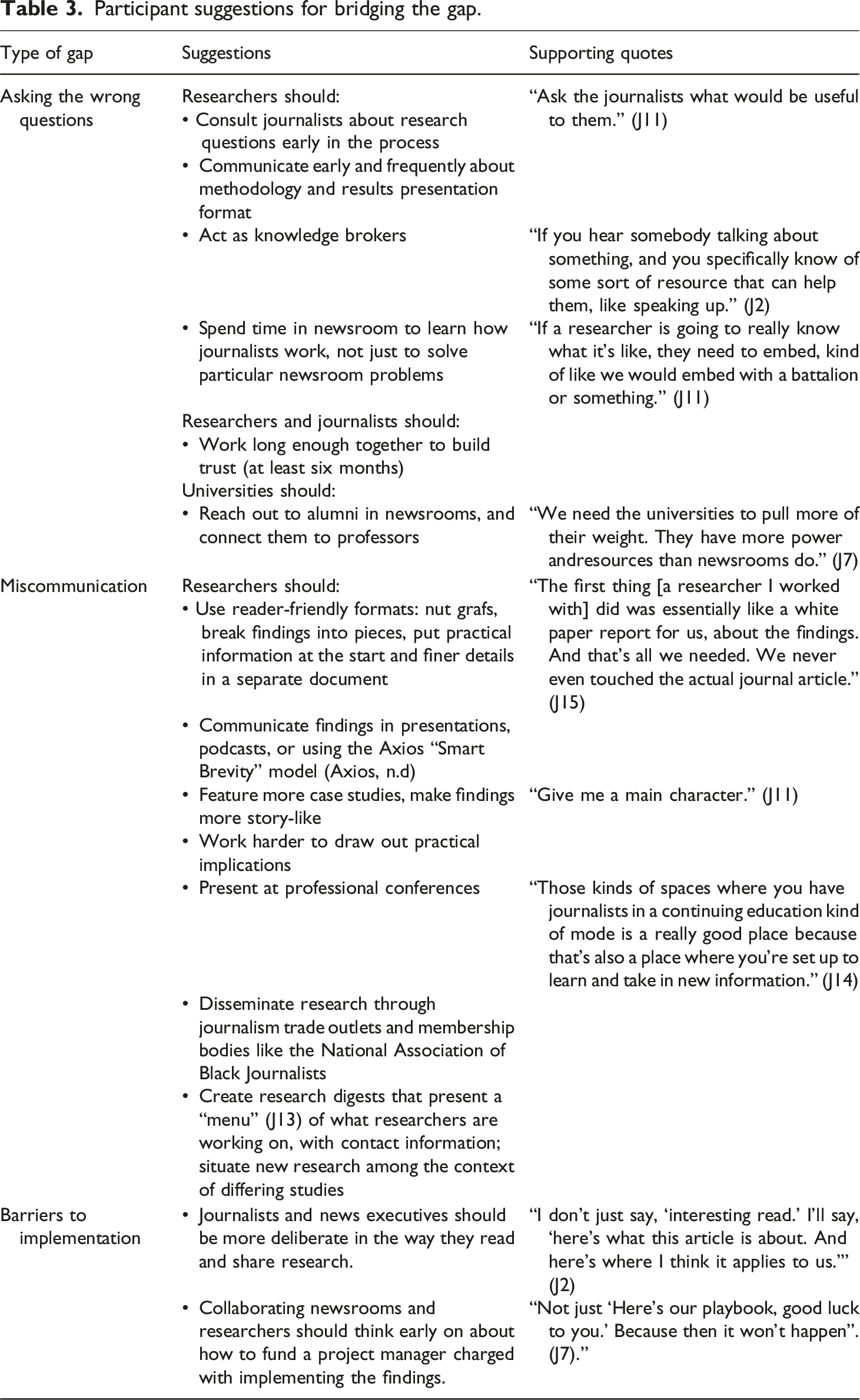
Participants said that because of their piecemeal view, it was hard to judge how far from comprehensive their research exposure might be. A reporter said, “I don't know how much is out there that I'm not seeing, or if it's really the important stuff that is bubbling up” (J14). An editor shared, “I just know there's work out there that can probably help us” (J13). Meanwhile, a freelance journalist said, “[Journalists are] trying to learn from other journalists, but I don't see them going to academic research. And I think in many cases, this research is helpful, but it's not reaching people because of the way it's communicated or distributed.” (J8) These insights help us to understand that journalists don’t tend to systematically or consistently seek out research. The first hurdle in communicating research may be simply making journalists aware that relevant papers exist. Doing so may require working with existing communications pathways, or forging new ones (see Table 3).
On top of these perceived access problems, participants also pointed to problems with academic writing. The major issues they saw were that papers were too long, or the important parts were buried; or that the writing was unclear, full of jargon, or boring. A reporter shared that they wanted to “skim over the parts… that don't necessarily apply to me so I can actually make it to the end” (J12). An editor said, “The way even the research I'm interested in is written and presented is just incredibly mind-numbing and hard to get through… If you're trying to reach the people that you're writing about, then you've got to find a way to convey it beyond academic jargon” (J10). Participants’ assessment of research reflected principles that appeared to derive from their own work, including the need to connect with audiences quickly, to avoid obfuscating language, and to be entertaining. Though journalists serve the role of audience members when it comes to academic research, they are not naive information consumers but bring numerous expectations about what makes work readable or interesting.
Participants blamed academics for unclear writing but also argued that researchers were trapped within the expectations of their institution. A head of audience development recalled grad school professors taking them to task for “writing too clearly” (J1). They added, “I think it’s gatekeeping. It’s the same reason that music writers will have their own terms and try to out-obscure each other on record reviews.” An executive director blamed the academic tenure system: If academic researchers … are simply fulfilling the check marks of the funding or the university… then they're doing a great job. But if they actually want this research to reach journalists… who are trying to figure out this new system of journalism that is going to be our future, we have some work to do (J7).
Participants’ comments indicate that while they expect more from individual academics (note the editor’s language that “you’ve got to find a way” [J10]), they also recognize that researchers work within a set of institutional expectations and norms. Journalists, however, appear dissatisfied with this status quo.
“We can’t even identify the path”: barriers to implementation
Journalists in the study noted individual, organizational, and institutional barriers that prevented them from implementing research findings in their work. On one level, participants expressed that researchers can seem out of touch, as scholars’ recommendations for change do not show an understanding of the constraints on news outlet capacities. An editor remarked, “It's frustrating when a lot of stuff feels like it's geared toward, ‘Oh, you have eight people to be your misinformation team’... These things you're describing are larger than my entire newsroom” (J3). Similarly, a reporter said, “It doesn't help anyone, if… they say, you know, we should cover women's sports more, but they don't understand that newsrooms are shrinking, and they're cutting things” (J6). These comments suggest that, in journalists’ view, some researcher recommendations are driven by ignorance.
However, participants also enumerated many barriers on the side of journalism outlets that limit journalists’ ability to read and consider the implications of research. One key barrier was lack of time. A digital reporter said, “For a small non-profit newsroom like ours… any time we take someone away from [reporting], that costs us” (J14). A VP reflected, “You're so busy putting out the news of the day. It's like, when do you have the time to focus on how you actually do your job?” They compared reading journalism research to getting a bird’s-eye view. “When you’re in the middle of the weeds, it’s extremely hard to get up on the balcony… We’re supposed to be the leaders of this newsroom, figuring out the path forward… [but] we can’t even identify the path” (J2). Time can be a barrier for any professional, but participants pointed to how journalism is a traditionally fraught endeavor, made more so by frequent downsizing, and that some newsrooms are even more constrained than others. Constantly being “in the middle of the weeds” means one doesn’t have the time to think more strategically about improvements to news processes.
Making such changes requires identifying the right people to read and implement the research, journalists said. Here, participants pointed to a lack of clarity over who the target audience of research is and a tension around who that audience ought to be. Several said research ought to target media executives and managers because they have more power to shape news practices. A photographer said, “If we want people to care about this, it has to sort of be people in managerial positions, looking over it and saying, this is concerning, we should change this, or oh, this is a really good idea” (J9). A reporter elaborated, If no one can show my bosses… if there was evidence that coverage of women's sports was beneficial for XYZ reason, then we probably cover more of it. And so in the absence of that, we're just gonna keep doing what we've been doing (J6).
At the same time, some participants spoke from their own experience to argue that managers simply don’t have time for reading research. An editor told us, “It is harder to fit things like this into my day, now that I have like 18 competing demands” (J3). A VP explained: “Since I became a managing editor… my time and ability to engage with the wider journalism world has just become smaller” (J2). These quotes point to a serious issue for academic research: While beat reporters and their ilk don’t have the time to act on research findings, neither do editors and managers.
Participants also pointed to conflicting institutional goals that put pressure on reporters and managers, making it hard for them to change practices. A documentary director described their fears about implementing recommendations to use more solutions-oriented journalism, saying such work feels a little like “activism.” “Should I always have this solutions mandate in the back of my mind? That feels a bit like a deeper mission and I'm not sure one that's my responsibility” (J16). Their comments highlight that journalists see their roles in particular ways, and sometimes research fails to make an impact because it appears to ask journalists to violate role boundaries, or even take on a new role.
A photographer pointed out that news leaders are trying to satisfy competing demands and run a profitable organization while serving people’s needs in a democracy. They surmised that in a research collaboration in their newsroom, this unarticulated tension created roadblocks to working with the researchers and implementing changes. The thing that was unclear was the newsroom's conception of what journalistic values or purposes it was trying to fulfill… There was no sort of a framework or articulation of how those sorts of competing interests should be reconciled. And it was very much people just being like, well, let's just try this out. Or let's try that out (J9).
This points to a tension that has plagued journalism for generations and has only intensified as revenue models shifted and newsroom closures became widespread. Today’s news executives face a difficult balancing act between two institutional imperatives, their responsibility to democracy and their need for financial sustainability. While some academics may argue that their research helps newsrooms address these challenges, J9 complexifies this picture by suggesting that news leaders find it difficult to engage in the necessary consideration or negotiation of the underlying logics.
In addition to these institutional barriers, participants saw a cultural barrier that kept research from being implemented. They said journalists and their organizations frequently adopt attitudes antithetical to change. A newspaper reporter said: “There’s sometimes a relationship of animosity from a newsroom looking at academics. For a lot of reasons. We're just kind of hostile people in general… because we're so burnt out, underpaid, overworked” (J12). An editor said that many newsrooms are “automatically dismissive” of academics, due to an arrogance that journalists “know everything they need to know.” They recalled how a large legacy news organization they worked at had held a skewed perspective on academics conducting research: That’s the kind of newsroom that just would look down at researchers and not want people nosing around and they would be insecure and want to protect their turf, and they would feel challenged in a way that they don't like (J10).
These comments show that journalists see their colleagues’ attitudes as a problem, one that reflects how journalism professionals have been socialized to think and perform in their roles. Rather than being isolated instances, such attitudes appear widespread and can occur more frequently at certain types of news organizations, such as large legacy operations.
Discussion
This paper asked how US journalists characterize the applicability of research to their work, and how they characterize the nature of and reasons for the research-practice gap in their field. It found that journalists value the evidence research gives them, but do not see research as essential to their work. We found three major themes, identifying three types of research-practice gaps: researchers asking the wrong questions, researchers communicating their findings poorly, and various institutional and cultural barriers keeping research from being applied in the newsroom. The sequence of themes relates to three key stages in the research process and shows participants shifting emphasis in how they attribute the causes or responsibility for these gaps, starting with individual agency and moving towards a more institutional attribution, and meanwhile shifting from the side of scholars and research institutions to the side of journalists and news organizations.
As such, our research builds upon existing literature seeking to taxonomize the types of research-practice gaps. Shapiro et al.’s (2007) distinction between the “lost in translation” and “lost before translation” gaps aligns with our communication theme and our research question theme, respectively. Yet the emergence of our implementation theme highlights a significant addition to Shapiro’s framework, one that we might label “lost after translation.” That is, even when research is presented in a form that journalists find useful, various constraints keep that research from being applied to practice.
Participants’ statements point to the instantiation of professional, market, efficiency, and academic logics, which all affect how journalists experience the research-practice gap. Participants were quicker to attribute individual actions to institutional logics on the journalism side than on the academic side. Additionally, while journalists’ explicit recognition of logics in their institutions points to some of the intra-institutional logics that might stymie innovation, their perceptions of academic missteps suggest inter-institutional logics that hinder collaboration and communication. Interestingly, despite the US’s uniquely long history of university-based journalism pedagogy and research, US journalists remain just as skeptical of academic research as many of their peers from other parts of the world (see Frith and Meech, 2007; Hirst, 2010).
Logics in journalism
Institutional logics are easiest to see at play in our third findings section. Here, participants explicitly called out the role of conflicting logics at the intra-organizational level, which limit journalists’ implementation of research findings. The photographer (J9) argued that it is difficult for news workers to implement changes when they are torn between professional and market logics. The documentary director (J16) indicated that a shift to solutions journalism threatened the conception of their role by compromising the professional logic (J16). In this way, the challenge to innovate often exacerbates existing tensions for journalists and causes them to oppose change. This dynamic is also highlighted by participants who emphasized that change needs to come from the top. In other words, rank-and-file journalists commit to professional logics that includes not rocking the boat, and fulfilling the duties they believe are expected of them.
Participants repeatedly emphasized time pressures, invoking a conflict between the efficiency logic on the one hand and professional or market logics on the other. A VP (J2) reflected how “putting out the news of the day” keeps journalists busy and is always the top concern. Yet, they asked ironically, “When do you have the time to focus on how you actually do your job?” That is, to make sure one is operating at 100% to equip participants in democracy, or to create a marketable product, one has to take time away from the work itself.
Academic conflict with journalistic logics
We can also infer the role of competing institutional logics between organizations. Participants talked about academic tendencies to ask easy research questions, pursue topics that are too theoretical, and write in an opaque way. In some cases, participants noted the existence of an academic logic (Grossi et al., 2020), whereby academic writing can seem like “gatekeeping” (J1). In other cases, participants indicated that their attribution was more personal—for example, when the editor said, “You’ve got to find a way to convey it beyond academic jargon” (emphasis added) (J10).
Participants indicated that they saw conflicts between what academics do and what logics journalists are governed by. Perhaps the most salient conflict identified was between journalists’ efficiency logic and academics’ tendencies to take up too much of journalists’ time. A reporter said they have to “skim over the parts… that don't necessarily apply” (J12) because while they have limited time, academic logic doesn’t seem to have recognized or responded to this constraint. It appears to journalists that academic logic isn’t about communicating with practitioners at all, but instead simply facilitates scholars “talking to each other” (director, J7). Likewise, journalists said they can’t take the time to deal with theoretical research questions—perhaps “at a cocktail party,” in an editor’s words (J11), but not on the job. The fact that researchers can spend their time pursuing such questions only appears to reinforce for these journalists how academic logics differ from the logics of their field. Academics’ disregard for understanding newsroom realities—as seen from the perspective of some journalists—suggests that practical impact is not prioritized within academic logic. A similar study with scholars would, however, help better understand how logics in academia do or don’t prioritize impact.
Participant suggestions for bridging the gap.
A key feature of this study is its focus on the experiences and perceptions of journalists - which, while not a limitation per se, should still be considered as just one side of the gap “story.” For example, journalists’ calls for research to be more “practical” and less “theoretical” could be counter-argued by academics, who over decades have defended and built on Kurt Lewin’s maxim that “there is nothing as practical as a good theory” (Lewin, 1943). Similarly, some academics would likely push back against the claim that they have failed to communicate clearly, pointing to participants’ admission that they expect studies to find them, and asking journalists to take on some responsibility for seeking relevant research. On top of this, our findings emphasize questions that other scholars have raised about the proper role or proportion of “practical” work within academia (e.g. Donsbach, 2014; Frith and Meech, 2007; Harcup, 2012). These questions are crucial as journalism continues to evolve and confronts deep crises.
Practical implications, limitations, and future research
This exploratory paper can aid journalists and researchers in several ways. In Table 3, we suggest ways that each of these gaps we found might be countered. Perhaps more importantly, we give voice to journalists’ perceptions of where and with whom responsibility for these gaps lies. These assessments therefore give us valuable information to help us understand who to fruitfully engage in crafting solutions, and how. These perceptions are also useful in understanding possible preconceptions about academics and their institution. Thus, academics can come to the task of bridging the gap with a more accurate picture of how their work is perceived, and what they might do to counteract those perceptions.
In terms of limitations, we recognize that the recruitment methods employed attracted participants who had some experience with consuming journalism research. This may have resulted in a response bias so that our participants’ attitudes toward research do not reflect those of most journalists. This approach was necessary to attract participants who had enough experience with research to reflect on. Relatedly, the perspectives of current and former journalism practitioners are represented here; while gathering these perspectives represents an essential first step, gathering other stakeholder perspectives—such as those of researchers, news executives, and non-editorial news staff—will prove essential to any effort at establishing a holistic view of the gap. Future research and practice could expand on our institutional logics analysis, seeking further understanding of how conflicts can be avoided and ameliorated. Finally, we recognize that our focus on US journalism represents only one piece of the greater puzzle, and future research will be needed to establish similarities and differences that exist in different cultural and national contexts.
Additionally, while not a limitation of this study per se, future research that draws from different theoretical frameworks is warranted. In particular, we noted that interviewees often used legitimizing discourse, language that seemed intended to demarcate their work from that of researchers, sometimes in an oppositional way. Although a thorough exploration of this discourse was outside of the scope of this article, future research examining this phenomenon through the lens of a more discourse-oriented theoretical framework such as institutional theory (see Roszkowska-Menkes, 2023) or critical discourse analysis (see Fairclough, 2012) could prove fruitful.
In sum, this study helps build a picture of the various gaps between academics and journalists. In the spirit of engaging across the research-practice gap, we worked to highlight the experiences and knowledge of journalists themselves. We have also highlighted the conflicting institutional logics, both intra-organizational and inter-organizational, that appear to underlie the journalist-research gaps. Much work remains to be done to address the gaps we identified, and more fundamentally, to understand them. Fittingly, this work will require the continued cooperation of academics and journalists, as we strive to fulfill our joint purpose of strengthening journalism.
Footnotes
Acknowledgments
The authors would like to thank the reviewers and editors for their constructive comments and attention to detail. They would also like to extend their gratitude to the interview participants, who gave selflessly of their time and who answered questions with impressive thoughtfulness.
Declaration of conflicting interests
The author(s) declared no potential conflicts of interest with respect to the research, authorship, and/or publication of this article.
Funding
The author(s) disclosed receipt of the following financial support for the research, authorship, and/or publication of this article: This study was funded by the Cowles Fellowship at the Hubbard School of Journalism and Mass Communication at the University of Minnesota-Twin Cities.
