




Abstract
Climate change is often used as a bargaining chip for global powers to achieve political goals. Strategy framing, particularly within international political contexts, can serve as a lens to unpack the relationship between countries’ substantial climate policy and underlying political appeals in news coverage. A survey experiment (n = 331) was conducted to investigate the effects of strategy framing in international politics on trust in government, nationalist sentiments, and climate action intentions against the backdrop of China-U.S. climate relationship. Results showed that perceived strategy framing had a direct, positive association and an indirect, negative association with trust in government through anxiety. Additionally, in comparison to issue framing, exposure to strategy framing incited heightened nationalist sentiments, which in turn promoted public engagement in climate-related activities. Moreover, internal and international political efficacy moderated the effects of strategy framing perceptions on outcomes. Findings offer insights for possible cognitive, emotional, and ideological mechanisms of strategy framing’s effects in international politics.
Introduction
The world’s two largest greenhouse gas emitters, China and the United States (U.S.), play critical roles in addressing global climate crisis. At the 2021 United Nations Climate Change Conference (COP26), both countries pledged to strengthen climate cooperation over the next decade (McGrath, 2021). Nevertheless, both countries also see climate change as a race for control over technology and resources and a bargaining leverage with political significance (McGrath, 2021). Therefore, climate issues are not merely of scientific concern but also can be framed strategically to achieve political appeals (Kashwan et al., 2022).
Commonly examined in Western domestic politics (e.g., elections), strategy framing emphasizes competitive components in campaigns and policymaking (e.g., politicians’ motives, tactics, personal styles) as opposed to substantive policies and actions. Recent work on China-U.S. trade war news (Liu et al., 2023) extended strategy framing from domestic to international contexts by taking countries, rather than individual politicians, as competitive actors. For example, climate efforts can be framed as competitions between China and the U.S. by highlighting national strategies and winning or losing in leading global climate initiatives. However, the effects of strategy framing in international politics remain unexplored, limiting theoretical understanding of its influence to only Western domestic politics.
Therefore, we conducted a survey experiment to (a) test the effects of strategy framing on trust in government, nationalist sentiments, and climate action intentions in China-U.S. climate context and (b) investigate the mediating role of anxiety in strategy framing effects. We also explored potential moderating factors, including internal and international political efficacy, on the associations between strategy framing perception and governmental trust as well as nationalist sentiments. In so doing, we extend recent theoretical developments on strategy framing in international politics. Our findings also shed light on strategy framing’s effects in one-party dominant systems (e.g., China) where competitive elements in domestic news are less common.
Rationale
Strategy framing in international politics
Framing refers to a perspective through which people understand and interpret their surrounding environments. Entman (1993) highlighted that to frame is to give salience to some aspects of reality to “define problem,” “diagnose causes,” “make moral judgments,” and “suggest remedies.” Framing has been extensively studied through analyses of news and governmental documents (e.g., Cappella and Jamieson, 1997; De Vreese and Semetko, 2002). Citizens can also frame their interpretations of public issues using media resources or personal experiences (Entman, 1993). In sum, framing refers to not only how an issue is presented, but also how the public perceive and interpret the issue.
In political communication, strategy (or game) framing has been widely studied in Western election campaigns and policy news. Specifically, politics is framed as a game in which presidential candidates compete for personal advantages rather than public benefits (Aalberg et al., 2012). According to Cappella and Jamieson (1997), strategy framing is typified by several features, including politicians’ personal motivations behind campaign or advocated policies, their tactics or strategies to achieve political goals, their personal styles or personalities, and usage of terminology and metaphors surrounding war and games. Issue framing, often studied as the antithesis of strategy framing, emphasizes substantial elements such as policy problems and solutions, politicians’ opinions on policy-making, and implications of policy or legislation.
Most studies on strategy framing focused on Western domestic politics (e.g., Aalberg et al., 2012; Cappella and Jamieson, 1997). In recent years, several scholars extended strategy framing to regional and international political news (e.g., Jackson, 2011; Liu et al., 2023). For example, Jackson (2011) analyzed the news over British membership of the European single currency, exemplifying how strategy framing can be adopted beyond individual politicians to collective entities in regional politics. Specifically, Jackson (2011) investigated the coverage of political strategy at four levels: “Brown/Blair relationship,” “intra-cabinet politics,” “intra-party politics,” and “inter-party/camp/lobby politics,” suggesting possible usage of strategy framing at different levels in international news (e.g., “Brown/Blair relationship” at the individual politician level vs “inter-party politics” at the party level). Importantly, Jackson (2011) suggested future research should explore which levels of political entities are strategically framed, and by whom.
Similarly, Liu et al. (2023) analyzed China-U.S. trade war news where countries were framed as competitors for their strategic interests. They underscored that interactions among different countries around specific policies (e.g., trade tariff, energy) are often framed and intertwined with underlying calculations and strategies driven by national interests. Indeed, theoretical frameworks such as the structural power theory (Strange, 1988) posit that a country’s ultimate aim for policymaking on trade, energy, transportation, and so on in international issues is to maintain or strive for its structural power domination in global affairs. The idea that countries compete and act strategically to gain power in international politics is parallel to the notion that politicians act strategically to gain personal advantage rather than public benefit in domestic politics, a crucial assumption underlying the use of strategy framing in campaign news. Consequently, countries can be framed as competitive and strategic actors in international news. Based on this, Liu and Boukes (2023) conceptualized national-level (or country-level) strategy framing as concerning (a) countries’ political motivations underpinning substantial policy issues for national interests, (b) tactics and strategies employed by governments/officials to achieve national motivations, (c) winning or losing in international race, and (d) soliciting support and sympathy from third-party countries or international communities. This approach is parallel to but also differs from strategy framing commonly examined in Western domestic politics, which focuses on politicians’ personal motives and styles, referred to as personal-level strategy framing in Liu and Boukes (2023). Despite the theoretical development (Liu and Boukes, 2023) and empirical evidence (Jackson, 2011; Liu et al., 2023) in extending the use of strategy framing from individual levels to collective entities, the effects of national-level strategy framing on public perceptions remain unexplored. This study addresses this gap by investigating the mechanism of such effects in China-U.S. climate change context.
Effects of strategy framing in international climate politics
Climate change is a global crisis that necessitates international coordination. However, addressing it involves industrial and technological policy adjustments and can affect a country’s economic competitiveness and thus its global status. Therefore, national initiatives to address climate change may be entangled with political maneuvers grounded in domestic priorities and strategic calculations (Kashwan et al., 2022). This applies notably to China and the U.S., where climate change is oftentimes considered with other issues such as economic expansion and technology advancement (McGrath, 2021). The tension between addressing global climate threats and pursuing national self-interests aligns with the logic of national-level strategy framing, offering an opportunity to examine its effects in global climate politics.
Prior research on strategy framing in domestic context showed that individuals often have lower trust in government after exposure to it (e.g., Zoizner, 2021), because politicians’ debates framed with strategic elements are viewed as self-interested, rather than a rational process for public good (Cappella and Jamieson, 1997). The competitive nature of politics under strategy framing can also create a perception that politics is meaningless, further eroding trust in the government’s intentions to meet public expectations (Valentino et al., 2001).
In international politics, climate change presents a collective challenge that affects all human beings, necessitating global efforts that transcend national or regional interests (e.g., Bakhtiari, 2018). Effective adaptations to climate change are contingent upon environmental policies in different countries (Kashwan et al., 2022). Strategically framing climate efforts as political maneuvers between countries may induce perceptions that environmental policies are developed based on political calculations (i.e., perceived strategy framing) rather than addressing the global crisis rationally and collectively as expected by the public. Such violation of public expectations may result in diminished governmental trust. In comparison, issue framing focuses on substantive environmental policies and joint efforts by both governments, which may align more closely with the anticipated roles of government. Put differently, strategy framing may decrease trust in government compared to issue framing by influencing individual perceptions. Accordingly, we propose:
H1: The negative effect of exposure to strategy framing on governmental trust is mediated by perceived strategy framing. Although strategy framing in international politics suggests that a country may not focus as much on solving the issue under consideration (e.g., climate crisis) as gaining political advantages, it does prioritize national interests in the competitions with other countries, which may increase nationalist sentiments. Nationalist sentiments refer to feelings elicited by national identification, which is often socially constructed based on individuals’ subjective membership of that “imagined community” (Kong and Yeoh, 1997). These sentiments are typically ideologically oriented and naturalized pervasively among citizens of a country (Billing, 1995). By reinforcing nationhood through antithetical discourses (e.g., “us” vs “them”) and framing international affairs from a state-centralism perspective, the public’s sense of belonging toward their country likely is intensified (Billing, 1995). Therefore, in comparison to focusing on substantial policies, framing climate issues as strategic competitions between the audiences’ own country (i.e., China) and an adversary country (i.e., the U.S.) has the potential to reinforce their national identification and subsequently arouse nationalist sentiments. Thus, we propose:
H2: The positive effect of exposure to strategy framing on nationalist sentiments is mediated by perceived strategy framing.
Mediating role of anxiety
Additionally, previous research indicated that individuals tend to negatively evaluate social events framed with strategy elements (Zoizner, 2021). This study focuses on the role of anxiety in examining the effect of strategy framing. Anxiety is increasingly recognized for its influence on the public’s attitude formation and behavior change. Generally, people who perceive low levels of certainty or sense of control over political issues tend to experience anxiety (Cassese and Weber, 2011). Consequently, strategy framing, compared to issue framing, may heighten anxiety, because such framing could cultivate a perception entailing continuing confrontations and calculations between parties involved without clear resolutions. Brader (2006), for example, found that campaign ads elicited anxiety through horse-race narratives in Western domestic politics. Therefore, we propose:
H3: The positive effect of strategy framing on anxiety is mediated by perceived strategy framing. Furthermore, emotions elicited by situational appraisals, such as sense of uncertainty, can influence cognitive and ideological attitudes (Wagner and Morisi, 2019). In China-U.S. climate competition context, anxiety associated with the government’s politicized climate policy may erode governmental trust. This is because, as Albertson and Gadarian (2015) noted, anxious citizens tend to trust political actors when threats come from outside the government, but they are less inclined to trust them when anxiety is due to internal risks such as governmental shortfall or failure. Additionally, anxiety related to strategy perception may also arise from the competition with the adversary country. Consequently, feelings of homeland attachment may be strengthened, leading to heightened nationalist sentiments. Therefore, we propose:
H4: Anxiety will mediate the association between perceived strategy framing and a) trust in government and b) nationalist sentiments.
Outcomes of trust in government and nationalist sentiments
Previous research explored the influence of trust in government on the public’s political behaviors (e.g., voting). It is unclear whether lower trust in government consistently produces negative outcomes (Zoizner, 2021). For example, Kleinnijenhuis et al. (2006) found that lower trust in party leaders reduced voting intention, whereas De Vreese and Semetko (2002) observed that strategy framing could decrease trust in government while stimulating political participation. In environmental communication, trust tends to promote positive climate attitudes and behaviors. For example, Krosnick et al. (2006) noted that trust in information sources about climate change, particularly governmental officials, contributed to intentions to address climate crisis. Accordingly, one’s willingness to participate in climate actions may be dampened if they have lower trust in government. Thus, we propose:
H5: Trust in government resulting from exposure to strategy framing versus issue framing will be positively associated with climate action intentions. Nationalist sentiments triggered by perceived strategy framing may also boost climate action intentions for several reasons. On one hand, nationalist sentiments induced by climate race may motivate citizens to contribute to climate risk reduction and facilitate global environmental leadership. On the other hand, nationalist sentiments may help bridge the psychological gap between national interest and the urgency of addressing climate issues. Indeed, despite enormous threats posed by climate change, many citizens, especially in China, often feel disconnected from global climate discussion (Wang and Zhou, 2020). Connecting climate actions with national interests may activate psychological proximity and motivate individuals to take actions. Thus, we propose:
H6: Nationalist sentiments resulting from exposure to strategy framing versus issue framing will be positively associated with climate action intentions.
Exploratory analysis: potential moderators on the effects of strategy framing
We also explore potential moderators for the effects of strategy framing on governmental trust and nationalist sentiments. Internal political efficacy, or “one’s beliefs about own competence to understand and to participate effectively in politics” (Niemi et al., 1991: p. 1408), is widely studied as a moderator for the association between strategy framing and governmental trust in Western domestic contexts. Previous research showed that individuals with lower internal political efficacy tend to have lower governmental trust after exposure to strategy framing compared to those with higher political efficacy (De Vreese, 2005). Extending research on political efficacy to global contexts, Lin (2022) defined international political efficacy as “the perception of an individual’s ability to understand and engage in international issues” (p. 1228), which may moderate the association between strategy framing perception and nationalist sentiment. Specifically, international political efficacy is linked to individuals’ awareness of and knowledge about international issues (Lin, 2022). People with lower levels of international political efficacy may be more susceptible to the influence of strategy framing due to limited policy-related knowledge. Given the exploratory nature of this analysis, we ask:
Methods
Procedure
A one-way (strategy vs issue frame) experiment was conducted online in August 2022. Participants over 18 years old and living in China were recruited via a Chinese panel platform (Credamo 1 ). They first read an introduction, provided informed consent, and responded to questions of internal and international political efficacy. They then read the experimental stimuli and answered questions about strategy and issue framing perceptions, anxiety, nationalist sentiments, trust in government, and climate action intention, followed by demographic questions. Upon completion, participants were compensated 15 RMB.
Power analysis was conducted using G*power 3.1 to estimate the minimum sample size required (Faul et al., 2009) 2 . Given recent concerns about data quality on crowdsourcing platforms, following restrictions were set: (a) participants’ credit scores on Credamo were higher than 80%; (b) their data adoption rates were higher than 80%; (c) they passed behavioral verification using text point-and-click; (d) each user could only participate once, and (e) participants from each IP address could only participate once. A pilot study (n = 100) was first conducted to test if the experimental message effectively primed participants’ strategy framing perception. Upon successful manipulation check, 240 additional questionnaires were distributed, yielding a total sample size of 340. Nine responses were dropped due to straight-lining and having a response time less than the first quarter of all participants’ response time. A total of 331 responses passed the quality check and were retained as the final sample.
Experimental stimuli
Participants were randomly assigned to either strategy or issue framing group. Two news messages (see Appendix A) were produced by a former Chinese journalist in accordance with Chinese news style, which was documented in prior content analysis (Liu et al., 2023).
Specifically, to maintain consistency between message conditions, both messages had a similar structure (e.g., identical news lead) and the same contextual information around the COP26 and carbon neutrality policy. They also included identical statements made by the U.S. and Chinese officials. Drawing on existing operationalizations of strategy framing from previous research (e.g., Cappella and Jamieson, 1997; De Vreese and Elenbaas, 2008), strategy framing message (699 Chinese characters) emphasized a country’s underlying political motivations behind climate negotiation. For instance, the message mentioned that both countries’ officials tried to “link climate change with human rights and trade frictions and viewed climate change as a bargaining chip for achieving the two countries’ political objectives and motives.” The message also contained war-related words and metaphors, such as “climate change war,” “leverage and bargaining chip,” and highlighted winning or losing in climate competition. In contrast, the message from issue framing group (554 Chinese characters) focused on policy initiatives conducted by both countries. For instance, it included a statement from a Chinese official indicating that “Beijing will step up efforts to formulate a national plan on methane,” alongside remarks from a U.S. official noting that “the joint statement inspires other countries to have ambition and determination to solve global warming.” The statements made by Biden and Xi in climate collaboration were also highlighted.
Participants
On average, participants were 30.38 years old (SD = 7.21, range = 18–57). Of the participants in the final sample (n = 331), male accounted for 36.3% (n = 120), and female accounted for 63.7% (n = 211). Majority of participants had obtained Bachelor’s degree (n = 241, 72.8%), followed by Master’s degree or above (n = 44, 12.4%), Associate’s degree (n = 39, 11.8%) and high school or below (n = 7, 2.1%). Participants’ relational status included married (n = 214, 64.7%), not married but in a relationship (n = 41, 12.4%), single (n = 74, 22.4%), and separated/divorce (n = 2, 0.6%). Participants’ monthly income ranged from 2000 RMB and below (n = 28, 8.5%), 2000-5000 RMB (n = 50, 15.1%), 5000-8000 RMB (n = 91, 27.5%), 8000-15000 RMB (n = 110, 33.2%), 15000-30000 RMB (n = 48, 14.5%), to 50000 RMB and above (n = 3, 0.9%). The sample was fairly geographically diverse, with participants living in 28 of China’s 34 provincial level administrative divisions. Most lived in urban areas (n = 270, 81.6%) as opposed to rural areas (n = 61, 18.4%).
Measures
Descriptive statistics and bivariate correlations of study variables.
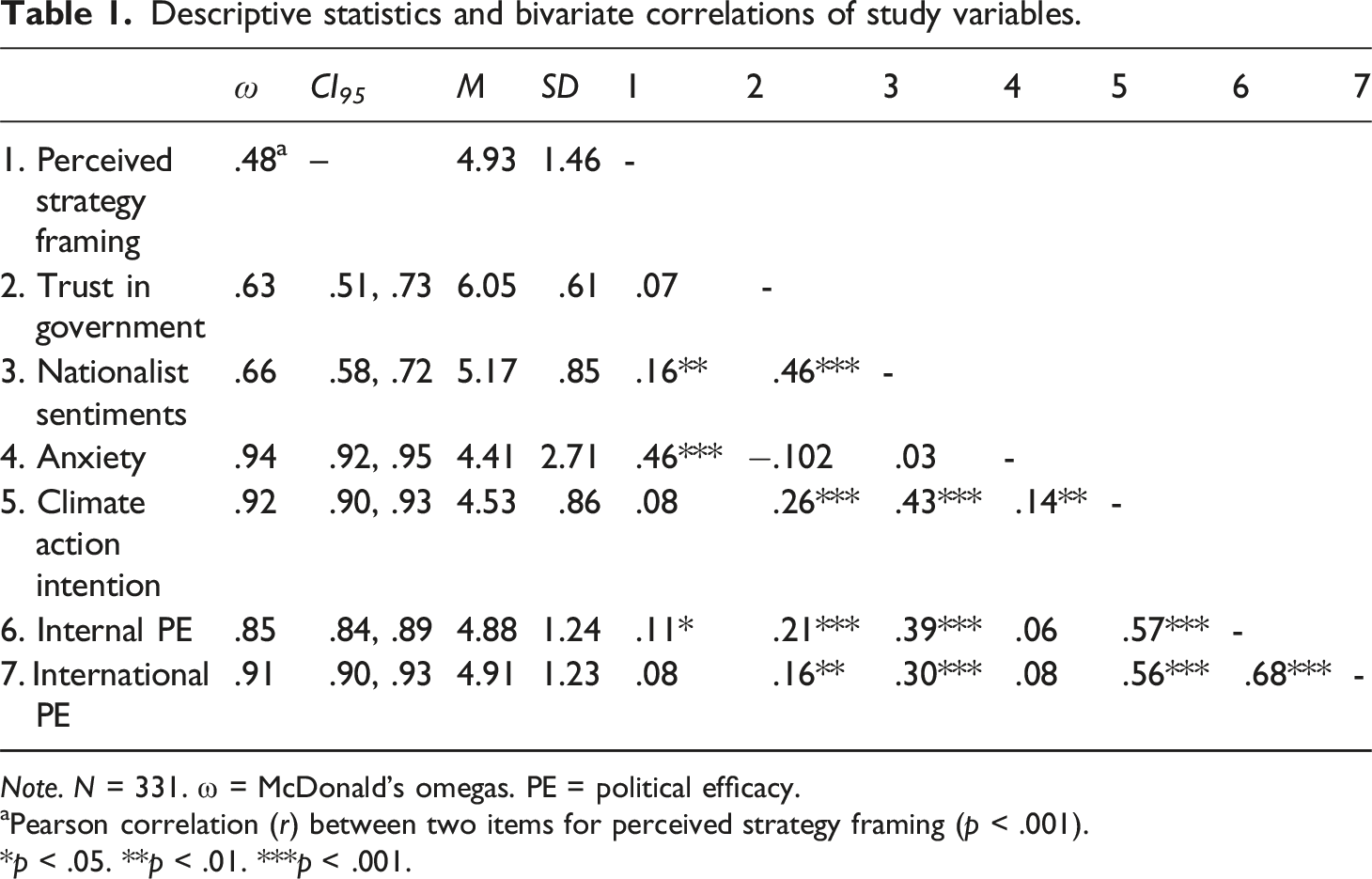
Note. N = 331. ω = McDonald’s omegas. PE = political efficacy.
aPearson correlation (r) between two items for perceived strategy framing (p < .001).
*p < .05. **p < .01. ***p < .001.
Perceived strategy framing and issue framing
Two items adapted from Aalberg et al. (2012) were used to measure perceived strategy framing and perceived issue framing. Respondents were asked to evaluate to what extent they agree following statement based on the message they read, including “The message mentioned China’s and U.S.’s strategies in dealing with global warming” and “The message mentioned China’s and U.S.’s political motivations behind global warming policy” for perceived strategy framing, and “The message mentioned the collaboration between China and the US regarding global warming” and “The message mentioned the possible solutions to the global warming risk” for perceived issue framing.
Anxiety
Three items adapted from Richins (1997) were used to measure anxiety (e.g., “How much did the message make you feel nervous/worried/tense?”). Participants rated their responses using a 10-point Likert scale (1 = Not at all to 10 = Extremely).
Trust in government
Three items adapted from Shi (2001) were used to assess trust in government. Participants responded to statements such as “You can generally trust decisions made by Chinese government regarding global warming” and “Chinese government can be trusted to do what is right regarding global warming without having to constantly check on them.”
Nationalist sentiments
Nationalist sentiments were assessed using five items adapted from Kosterman and Feshbach (1989). Participants responded to statements such as “In view of China’s moral and material superiority, it is only right that we should have the biggest say in deciding United Nations policy” and “The primary duty of every Chinese is to honour Chinese national history and heritage.” CFA results suggested that the five items formed a unidimensional factor: χ2(5) = 6.23, χ2/df = 1.25, CFI = 0.99, RMSEA = 0.03, SRMR = 0.03.
Climate action intention
11 items adapted from Adams (2018) were used to measure climate action intention. Using a six-point Likert scale (1 = Extremely unlikely to 6 = Extremely likely), participants responded to questions about the extent to which they would attend climate-related activities, such as “Distributing information offline about the issue of global warming” and “Attending an in-person informational session about global warming.” CFA results suggested that the 11 items formed a unidimensional factor: χ2(44) = 81.35, χ2/df = 1.85, CFI = 0.98, RMSEA = 0.05, SRMR = 0.05.
Internal Political Efficacy
Three items adapted from Niemi et al. (1991) were used to assess internal political efficacy. Participants rated the extent to which they agreed with the statements such as “I feel that I have a pretty good understanding of the important political issues facing our country” and “I think that I am better informed about politics and government than most people.”
International Political Efficacy
Five items adapted from Lin (2022) were used to measure international political efficacy. Sample items included “I know more about international issues about China than most people around me” and “I am interested in international issues and affairs about China.” CFA results suggested that the five items formed a unidimensional factor: χ2(5) = 7.79, χ2/df = 1.56, CFI = 0.99, RMSEA = 0.04, SRMR = 0.02.
Results
Manipulation check
A pilot study (n = 100) was conducted to evaluate the effectiveness of experimental manipulation. Results of independent-groups t test showed that participants who read strategy framing message reported higher levels of perceived strategy framing (M = 5.64, SD = 0.89, n = 50) than participants who read issue framing message (M = 4.16, SD = 1.15, n = 50), t(98) = 7.18, p < .001, Cohen’s d = 1.44. Participants who read issue framing message reported higher levels of perceived issue framing (M = 5.67, SD = 0.80, n = 50) than participants exposed to strategy framing message (M = 4.71, SD = 1.33, n = 50), t(98) = 4.34, p < .001, Cohen’s d = 0.87.
Substantive analyses
Following causal mediation analysis suggested by Tao and Bucy (2007), we incorporated both experimental manipulation and manipulation check in testing and treated the manipulation check (i.e., perceived strategy framing) as a mediator through which message conditions exerted predicted effect on targeted outcomes. Structural Equation Modeling (SEM) was used to test hypotheses in AMOS 26, with message condition as the exogeneous variable and strategy framing perception, anxiety, trust, nationalist sentiment, and climate action intention
3
as endogenous variables (see Figure 1). Mediation analyses were conducted with bias-corrected bootstrapping (with 5000 random samples). Structural Equation Model with Standardized Path Coefficients. Note. *p < .05. **p < .01. ***p < .001. Total effects of strategy framing on anxiety: b = 1.596, SE = 0.232, p = .02, on trust in government: b = 0.051, SE = 0.038, p = .136, on nationalist sentiments: b = 0.172, SE = 0.065, p = .008, on climate action intention: b = 0.161, SE = 0.041, p = .003.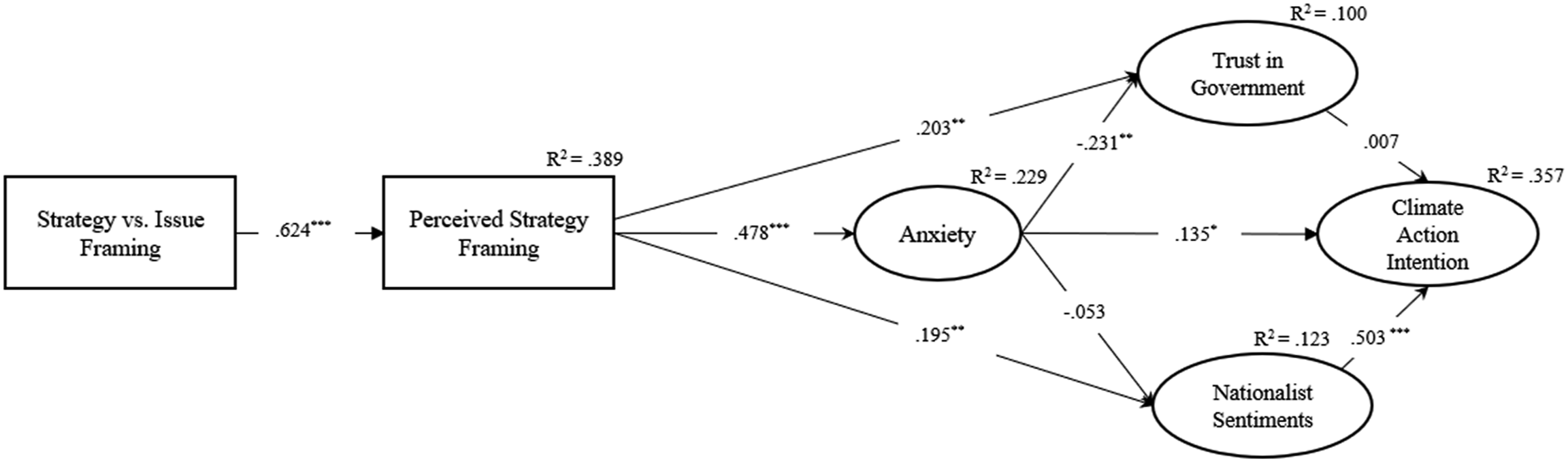
Specifically, a measurement model with all study variables was tested for fit. All factors were free to covary in the measurement model. The full information maximum likelihood estimator was used to handle missing data (Graham, 2009). The measurement model obtained acceptable fit: χ2(220) = 513.036, χ2/df = 2.332, RMSEA = 0.052 [95% CI = 0.046, 0.058], CFI = 0.944. Next, goodness-of-fit for the full structural model was examined. Demographic variables, including gender, age, educational level, marital status, annual household income, and residential area, were controlled as covariates and kept in the final model if they were significantly associated with study variables. Results suggested that the proposed structural model fit the data well: χ2(312) = 577.493, p < .001, χ2/df = 1.851, RMSEA = 0.051 [95% CI = 0.044, 0.057], CFI = 0.932.
H1 predicted that exposure to strategy framing would reduce trust in government through perceived strategy framing in comparison to issue framing. Results of mediation analyses showed that the mediation effect of strategy framing perception for message condition’s effect on trust in government was not statistically significant, b = 0.051, SE = 0.038, CI 95 = −0.014, 0.133, p = .136. H1 was not supported. Additionally, SEM results showed that the experimental condition produced higher strategy framing perception (b = 0.185, SE = 0.125, p < .001), which had a positive association with trust in government (b = 0.061, SE = 0.024, p = .010; see Figure 1 for model results with standardized path coefficients).
H2 predicted exposure to strategy framing would increase nationalist sentiments through perceived strategy framing. Results showed a significant mediation effect, b = 0.172, SE = 0.065, CI 95 = 0.071, 0.323, p = .008. H2 was supported.
H3 predicted exposure to strategy framing would increase anxiety through perceived strategy framing. Results indicated that the mediation effect was statistically significant, b = 1.596, SE = 0.232, CI 95 = 1.208, 2.090, p = .012. H3 was supported.
H4 proposed anxiety would mediate the associations between perceived strategy framing and (a) trust in government and on (b) nationalist sentiments. Results showed that anxiety served as a significant mediator for the association between strategy framing perception and trust in government, b = −0.033, SE = 0.011, CI 95 = −0.055, −0.013, p = .019. Additionally, perceived strategy framing had a significant direct effect on trust after accounting for the indirect effect through anxiety, b = 0.061, SE = 0.024, p = .010 (see Figure 1). In other words, anxiety partially mediated the association between strategy framing perception and trust in government. H4a was supported. With regard to H4b, the mediation effect of anxiety for perceived strategy framing’s association with nationalist sentiment was not significant, b = −0.014, SE = 0.025, CI 95 = −0.064, 0.037, p = .533. Strategy framing perception did exert a significant direct effect on nationalist sentiments, b = 0.109, SE = 0.042, p = .009. H4b was not supported.
H5 and H6 predicted that trust in government and nationalist sentiments would be positively associated with climate action intentions. Results suggested that governmental trust was not significantly associated with climate action intention (b = 0.013, SE = 0.185, p = .945). Nationalist sentiments showed a positive association with climate action intentions (b = 0.531, SE = 0.116, p < .001). H5 was not whereas H6 was supported.
Exploratory analyses
RQ was addressed using PROCESS Macro in SPSS (Hayes, 2022). Statistically significant interactions were probed with simple slope analyses at the mean and one SD above and below the moderator mean (Hayes, 2022). Results indicated a significant interaction effect between perceived strategy framing and internal political efficacy on trust in government (b = 0.04, SE = 0.02, p = .02, CI
95
= 0.007, 0.073, R
2
= 0.02; see Figure 2). Specifically, the association between perceived strategy framing and governmental trust was positive for participants with higher level of internal political efficacy (b = 0.07, SE = 0.03, p = .02, CI
95
= 0.01, 0.13), but not significant for participants with lower (b = −0.03, SE = 0.03, p = .37, CI
95
= −0.09, 0.03) and medium levels of internal political efficacy (b = 0.02, SE = 0.02, p = .37, CI
95
= −0.02, 0.06). Internal political efficacy as moderator for association between perceived strategy framing and trust in government.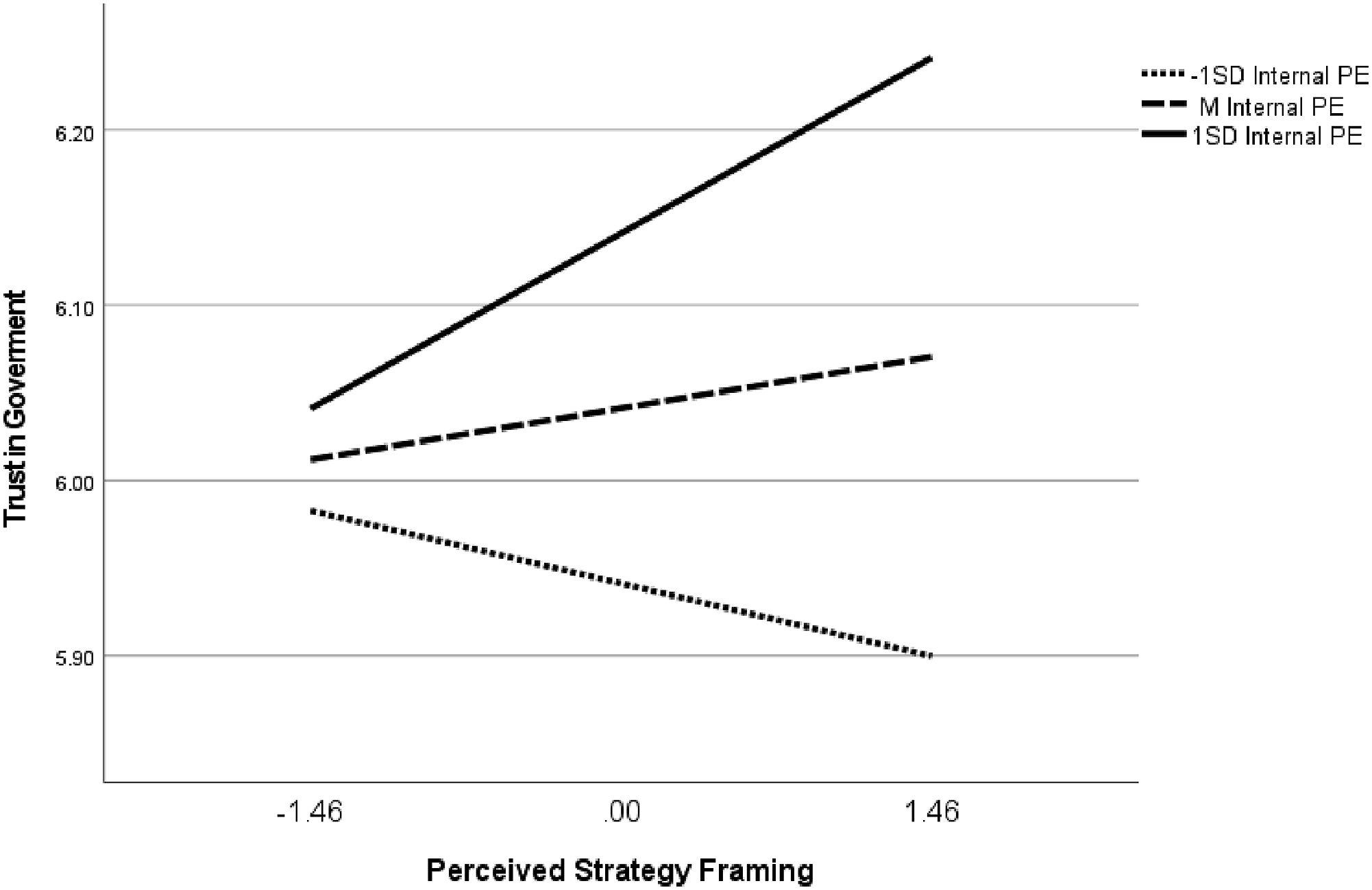
Additionally, international political efficacy significantly moderated the association between perceived strategy framing and nationalist sentiments (b = −0.04, SE = 0.02, p = .02, CI
95
= −0.08, −0.001, R
2
= 0.01; see Figure 3). Specifically, the positive association between perceived strategy framing and nationalist sentiments was stronger for people with lower levels of international political efficacy (b = 0.15, SE = 0.04, p = .0003, CI
95
= 0.07, 0.24) compared to those who reported medium level efficacy (b = 0.10, SE = 0.03, p = .001, CI
95
= 0.04, 0.16). For individuals with higher levels of international political efficacy, the association between perceived strategy framing and nationalist sentiments was not significant (b = 0.04, SE = 0.04, p = .26, CI
95
= −0.03, 0.12). International political efficacy as moderator for association between perceived strategy framing and nationalist sentiments.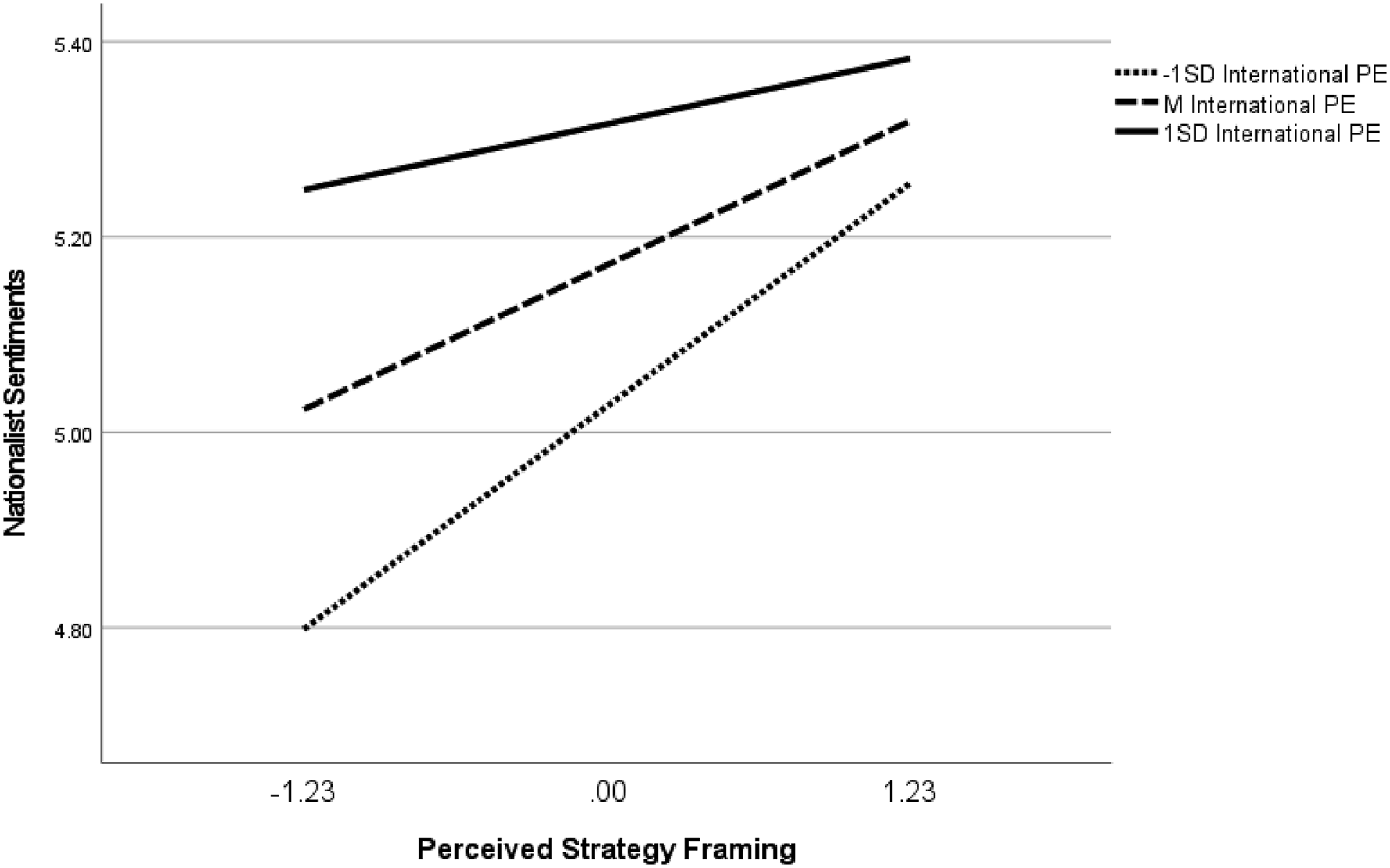
Discussion
This study investigated the effects of national-level strategy framing on trust in government and nationalist sentiments through anxiety against the backdrop of China-U.S. climate relationship. Results showed that, in comparison to issue framing, national-level strategy framing triggered more anxiety through perceived strategy framing, which subsequently reduced governmental trust. Perceived strategy framing also had a direct, positive association with trust in government as well as a positive association with nationalist sentiments. Internal and international political efficacy emerged as significant moderators for the effects of perceived strategy framing. We discuss theoretical and practical implications below.
Theoretical implications
First and foremost, results suggest that the effects of strategy framing in international politics are more sophisticated compared to those in Western domestic politics. For example, compared to the relatively homogenous negative effects of strategy framing on governmental trust in Western domestic politics, strategy framing in international politics could reduce trust through elevated anxiety while also having a direct positive effect on government trust, resulting in a nonsignificant total effect (see Figure 1). The complicacy of national-level strategy framing’s effects can be explicated through social identity theory, which advocates that an individual’s self-concept is shaped by their group memberships, alongside the associated emotional, evaluative, and other psychological aspects (Turner and Oakes, 1986). Specifically, self-concept can function at three levels of abstraction: self-categorization as human beings (the superordinate category), in-group versus out-group categorization (the self as a social category), and personal self-categorizations (the subordinate level). The prominence of these social identities can fluctuate based on various situational factors. In response to urgent global issues such as climate change that can threaten all human beings, individuals’ superordinate identity may become salient. As a result, strategically framing climate change (as opposed to highlighting concrete actions) may aggravate public anxiety and diminish governmental trust. This mirrors findings in Western domestic politics, where strategy framing reduces governmental trust among individuals concerned with the public good of a democratic society (Cappella and Jamieson, 1997). In this process, emotional responses such as anxiety serve as internal mental states that mediate the influence of framing perceptions on governmental trust, as emotions can mobilize and allocate cognitive resources for certain types of attitudes, influencing decision-making in alignment with the experienced emotions (Barrett, 1998).
Meanwhile, in international politics, in-group versus out-group categorization such as a robust national identity may also be at play (Rivenburgh, 2000). A strategically framed message that highlights the competition between their own country and another country might reinforce in-group identification, inter-group differentiation, and in-group bias (Turner and Oakes, 1986), thereby increasing governmental trust (i.e., a country’s political representation) and nationalist sentiments. This suggests a nuanced interplay between group identity and the effects of strategy framing, which deserves further investigation. Importantly, the in-group versus out-group identity also holds relevance to domestic politics. For example, Valentino et al. (2001) found that individuals with partisanship exhibited a propensity to dismiss information that portrayed their in-group leaders as acting contrary to policy goals. Future research should continue to theorize and empirically investigate the effects of strategy framing at the individual politician level (e.g., in election campaigns), domestic group level (e.g., within or between partisanship and other group membership identities), and the national/country-level (e.g., in international politics).
Moreover, nationalist sentiments were positively associated with climate action intentions, aligning with findings in Western campaign context. For example, Valentino et al. (2001) found that after exposure to strategy framing, individuals’ intentions to vote and fulfil civic duty were higher among individuals belonging to a major party whose ideological identity and party affiliation were activated. These findings could be explained by the participation calculus model, encompassing both self-interest and other-regarding considerations (Fowler and Kam, 2007). On the self-interest side, individuals may view political participation as fulfilling civic obligation or enhancing political efficacy (Riker and Ordeshook, 1968). On the other-regarding side, individuals with strong social identification may perceive participation as an opportunity to acquire benefits for their in-group, and better so if this occurs at the expense of outgroups (Fowler and Kam, 2007). In the China-U.S. climate competition context, individuals with stronger nationalist sentiments may perceive climate actions as instrumental to not only their allegiance to the authority, but also to the country’s position in global climate competition. Future research can examine whether and how individuals’ ideological identifications and feelings can be transformed into political participations in other contexts. It is worth noting that the associations between trust in government and nationalist sentiment with climate action intentions were cross-sectional in nature. Future studies could examine whether and how these two factors would directly influence climate action intentions.
Relatedly, these findings show that national-level strategy framing in international politics can function as a “double-edged sword.” On one hand, strategy framing addresses the news values of negativity, conflict, and relevance in foreign news coverage and attracts audiences’ interest towards foreign affairs (Galtung and Ruge, 1965). On the other hand, it risks oversimplifying complex international relationships into a zero-sum framework. This simplification may amplify political polarization, distort perceptions of international dynamics, and stoke ethnocentrism and nationalism.
Regarding the moderating effects, internal political efficacy moderated the association between perceived strategy framing and trust in government. Among individuals with lower and medium levels of internal political efficacy, there was no significant associations between perceived strategy framing and trust in government, and strategy framing perception exerted positive impact on trust in government among politically efficacious participants. This finding corroborates De Vreese’s (2005) work in Western domestic contexts that political efficacious individuals were less likely to express distrust. In this study, politically efficacious individuals were more likely to be part of China’s political system, possibly having greater confidence in the central government in handling of public issues even if realizing the government’s motive (Hu et al., 2015). Additionally, international political efficacy moderated the association between perceived strategy framing and nationalist sentiments. Specifically, people with lower international efficacy were more susceptible to the strategy framing’s effects than those with high and medium levels. It is possible that individuals with lower international efficacy have limited knowledge to analyze strategic information and rely more on their group affiliations to guide beliefs and actions, resulting in higher levels of nationalist sentiments (Lin, 2022).
Notably, this study was conducted in China with distinctive political climate, characterized by relatively high levels of governmental trust and nationalist sentiments. It is possible that in democratic countries, the negative effect of national-level strategy framing on governmental trust might be more pronounced, as citizens in these countries typically exhibit higher levels of skepticism towards the government. Additionally, in countries where the population share deeply ingrained in-group (e.g., national) identities, strategic framing focusing on a country’s national interests may resonate with the citizens’ identification and further amplify nationalist sentiments.
Furthermore, this study focused on climate relationships between China and the U.S., two powers known for rivalries across multiple domains. Effects of national-level strategy framing on public perceptions might vary in other contexts with no such great powers involved, although the logic behind national-level strategy framing might still hold true. Indeed, any country may weigh its own national interests against addressing shared challenges under consideration, irrespective of its relative power (Abdelal and Kirshner, 1999). Future research should further examine the ramifications of national-level strategy framing in countries with different political systems and sociocultural contexts to assess potential influence of country-level factors.
Practical implications
Although this study aims to enhance understanding about national-level strategy framing effects, findings also provide practical insights for climate communication. The positive relationship between nationalist sentiments and climate action intention suggests that policymakers can appeal to national pride to garner support for climate actions, especially in countries with strong national attachment and governmental involvement in environmental protection. However, perceived strategy framing can erode governmental trust if anxiety is activated. Thus, communicators should be cautious in utilizing such framing in climate communication, and strive for a balanced approach, leveraging moderate nationalism while mitigating potential trust issues. Additionally, as nationalist sentiments are less likely to be evoked among individuals with higher levels of international political efficacy, it is necessary to enhance citizens’ international political efficacy in response to possible negative impacts of polarized climate discourses.
Limitations
Several limitations of this study should be noted. First, although the hypotheses were grounded in theoretical considerations, we neglected to pre-register the study. Pre-registration of hypotheses in experimental studies, as an essential component of robust and transparent scientific practice, is recommended for future investigations. Second, anxiety was assessed using respondents’ self-reported measures. Future research could consider using objective measures of anxiety and other emotions. Last but not least, causal mediation effects are not always straightforward and can be contentious due to untestable assumptions and interference not included in the current study (e.g., Bullock et al., 2010). Future research could consider additional mediators and examine the effects of different manipulations of strategy framing to enhance the persuasiveness of causal mediation analysis.
Supplemental Material
Supplemental Material - Climate race or collaboration? Effects of strategy framing on trust in government, nationalist sentiments, and climate action intention in international politics
Supplemental Material for Climate race or collaboration? Effects of strategy framing on trust in government, nationalist sentiments, and climate action intention in international politics by Shujun Liu and Kai Kuang in Journalism
Footnotes
Declaration of conflicting interests
The author(s) declared no potential conflicts of interest with respect to the research, authorship, and/or publication of this article.
Funding
This project received support from Tsinghua University Scientific Research Program (2022THZWJC07) and Beijing Social Science Funding (23XCC18).

Supplemental Material
Supplemental material for this article is available online.
Notes
Author biographies
References
Supplementary Material
Please find the following supplemental material available below.
For Open Access articles published under a Creative Commons License, all supplemental material carries the same license as the article it is associated with.
For non-Open Access articles published, all supplemental material carries a non-exclusive license, and permission requests for re-use of supplemental material or any part of supplemental material shall be sent directly to the copyright owner as specified in the copyright notice associated with the article.
