




Abstract
A transformation in the political economy of local news provision has led to claims that an increasing number of local areas have become ‘news deserts’ – areas that are poorly served or not served at all by professional and dedicated news services (Abernathy, 2022). Such developments have raised widespread concerns about the future health of local democracy. One aspect of local news’ declining capacity that has received little attention to date is the impact on its role as political institution. This paper first examines the impact of changes on those most closely affected by the reduction or closure of UK local news media outlets – the consumers and sources of local news. Through empirical research in 2021-22, the authors explore Cook’s theory of the news media as political institution (2005), by examining local citizens’ experience of – and attitudes towards – their local news outlets, and the extent to which they believe these continue to perform an institutional role. Second, the paper seeks to explore the extent to which other information services – most notably social media and online communities - substitute for the institutional roles of local news outlets. The paper argues that the diminishing role of local news media as political institution has significant political and democratic implications which are not being addressed by policymakers, who are more concerned with the economic interests of corporate media owners than the broader democratic and societal interests of local communities.
Introduction
The political economy of local news provision has changed fundamentally in the last two decades, as news consumption has moved online, and revenues from print advertising have fallen. As a consequence, legacy local news outlets across many mature democracies have seen their incomes and profitability decline (Gulyás and Baines, 2020; Nielsen, 2015). This has been most fully documented in the US, but also identified in Canada, Australia, the UK and elsewhere (Pew Research Center, 2004-2022; Public Policy Forum, 2017; Australian Competition and Consumer Association, 2019; House of Lords, 2020). Accompanying this decline in revenue to legacy local news outlets have been newspaper closures, industry consolidation, centralisation of resources and capacity, reduction of editorial staff and relocation of journalists (Abernathy, 2022; Walker, 2021). This has led to claims that an increasing number of local areas have become ‘news deserts’, that is ‘communities where residents have very limited access to the sort of critical and credible local news and information that nurtures grassroots democracy and binds together our society’ (Abernathy, 2023: 290). Such that, by 2023, ‘it is undeniable that the Great Recession, big tech, and now, COVID, have created a mortal threat for geographically-specific newspapers’ (Usher, 2023).
The declining capacity of local news services to provide news and information to the public has raised widespread concerns about the future health of local democracy. These concerns have been substantiated by numerous studies which have found that, for example, citizen engagement in politics is lower in areas where local news provision has diminished (Hayes and Lawless, 2015; Shaker, 2014), and there is a reduced sense of local community in the absence of a local newspaper (Mathews, 2022). By contrast, greater provision of local news has been found to reduce political polarisation (Darr et al., 2021; Gentzkow et al., 2011).
These democratic concerns have prompted government inquiries, and recommendations for public intervention. In the UK, a major public inquiry (Cairncross, 2019) was followed by two Parliamentary inquiries, each of which recommended some form of policy action (House of Commons, 2023; House of Lords, 2020). Similar inquiries into the sustainability of local and regional news have been completed or are ongoing in the EU and Australia (European Commission, 2022; Parliament of Australia, 2021).
Despite these concerns and increasing political enthusiasm for intervention, there remains uncertainty about the nature and extent of any democratic deficit that may result from the reduction in the number and capacity of legacy news outlets. The definition of ‘news deserts’ itself remains fuzzy, with varying conceptual approaches to their study that ‘not only reflect different interpretations but also different methodologies and scales in research design’ (Gulyás et al., 2023: 286). Research has, for example, looked at news deserts from a spatial dimension (Wang, 2023), from the perspective of fulfilment of news needs (Napoli et al., 2018), on community impact (Smethers et al., 2021), and decline in geographical diversity of content (Vogler et al., 2023).
And, as has been noted elsewhere, the concept contains various normative assumptions, and can represent a nostalgia for democratic functions that may or may not have been fulfilled (Usher, 2023). Moreover, the provision of local news differs markedly by geographic location. The ‘discourse of decline’ is contested, and ‘in reality, the pattern is more varied, more complex, more nuanced, than it sometime appears’ (Gulyás and Baines, 2020: 9). Public policy interventions are further complicated by competing claims from incumbent local media corporations seeking to preserve their legacy privileges, hyperlocal news outlets seeking to establish themselves as credible journalistic forces, and technology platforms resisting government pressure to redistribute revenue to news publishers.
Theoretical framework: Local news media as a political institution
While the detrimental impact on democracy is well observed (see Abernathy 2023: 292), one aspect of local news’ declining capacity that has received little attention is the impact on its role as ‘political institution’, as conceived in Cook’s seminal account of American news media and government (2005). As Cook perceives it, news media deserve recognition as a political institution, essential to the functioning of the three constitutional branches of US government ‘because of their historical development, because of shared processes and predictable products across news organisations, and because of the way in which the work of newspersons is so intertwined’ with the work of official governmental tasks (2005: 2-3). Cook’s focus was the US and national news media, though his theorisation extends to local news media and to other democratic systems, as he writes: ‘the strong similarities of news processes and news content across modalities…, size of organization, national or local audiences, etc., point to the news media as a single institution’ (ibid: 84)
As with national news media, local news media act as ‘a coherent intermediary institution’ which, like a political party, is partially independent of government, but integral and necessary to it (ibid: 2). Just as at a national level, local political actors engage daily in the ‘negotiation of newsworthiness’ (ibid: 12), and local news outlets provide ‘a communications forum for elites’ (Davis, 2003) which ‘not only reflect authority; they reinforce if not confer it as well’ (ibid: 92). The news media’s institutional role at a local level is illustrated by ‘the increasing attention that political actors in other institutions give to newsmaking as a central part of their job’ (ibid: 165), seeing close engagement with news outlets ‘as the quasi-natural way to get things done’ (ibid: 71).
Arguably, the institutional role of the local news media goes beyond that set out in Cook’s conceptualisation. Local news media perform critical information functions for the public (Friedland et al., 2012; Napoli et al., 2017). They also ‘offer ‘geo-social’ identification, placing readers and their locality in the context of the world’ (Gulyás and Baines, 2020: 2), as well as shaping people’s ‘perceptions of belonging, identity, or community’ (Leupold et al., 2018: 960). If, as we contend here, local news media is recognised as a political institution, it follows that research should test the extent to which any one outlet, or outlets across a region or nation, are fulfilling their political functions.
If local news media have failed as a political institution, this has wider political and social implications given their vital contribution to local information ecologies; these are ‘networks of technologies, organizations, and everyday practices that enabled the circulation of civic information in twentieth-century communities’ (Thorson et al., 2020: 1248). The rise of the internet and social media has disrupted these ecologies, allowing institutions, news actors and news consumers to sidestep journalists and news outlets and become more active participants as news and information gatherers and disseminators (Firmstone and Coleman, 2015; Friedland et al., 2022), as well as transforming the routes to and interactions with local news via algorithms (Thorson and Battocchio, 2023).
This paper uses original empirical research and Cook’s conceptual framework to examine the extent to which local citizens and newsmakers believe local news media continue to perform their political institution role. It also explores to what extent other information services – most notably social media and online communities - substitute for the institutional roles of local news outlets. Our subsequent discussion then draws our findings together within the context of Cook’s framework. It then briefly sets the research in the context of contemporary public policy in the UK, suggesting that these policies are piecemeal initiatives prompted largely by corporate media interests rather than a holistic approach that takes account of the institutional political role played by local media.
The UK media landscape
Over the past 25 years, the rise of the internet and social media has led to a profound change in patterns of news production and consumption in the UK. In May 2023, paid national newspaper circulation dipped below 3 million for the first time, down from over 8 million in January 2012 (Enders Analysis, 2023). Lost revenue from print sales has been compounded by the migration of virtually all classified and much display advertising to online platforms, leading to title closures, redundancies, the ‘hollowing out’ of newsrooms, office closures and centralisation (House of Lords, 2020). Consolidation of titles has accelerated to the point that, as of August 2023, ‘71% of all local titles are controlled by just six companies, and the three largest publishers – Newsquest (22%), Reach (19%) and National World (15%) – each control a greater share of the market than the smallest 157 publishers combined’ (Media Reform Coalition, 2023: 16). The Media Reform Coalition calculates that over 2.5 million UK citizens live in news ‘deserts’, local authority areas without a single local newspaper; and a further 9 million live in areas with just one local paper (2023: 18). While the BBC provides a local journalism service through its network of 39 local stations, these are essentially regional in nature and cover much larger areas – both geographically and by population – than the local press. For the vast majority of people, social media and search platforms now provide instant access to local information about, for example, traffic and transport, entertainment listings, and restaurant reviews. The same services are increasingly displacing local newspapers and radio as platforms for news. Albeit that news publishers may be supplying the source information, two thirds of the UK public cite the internet as their main source of news, and 46% of adults say they use social media for news (Ofcom, 2022). As we discovered in our research, new online news and information ecologies are emerging which are still little studied and poorly understood.
Research questions and methodology
Our study, which was conducted for the Charitable Journalism Project, 2 sought to answer two research questions focusing on the role of local news as political institution and the repercussions of its depletion.
RQ1: How well do UK publics believe their local news outlets perform their role as political institution, based on their own experience?
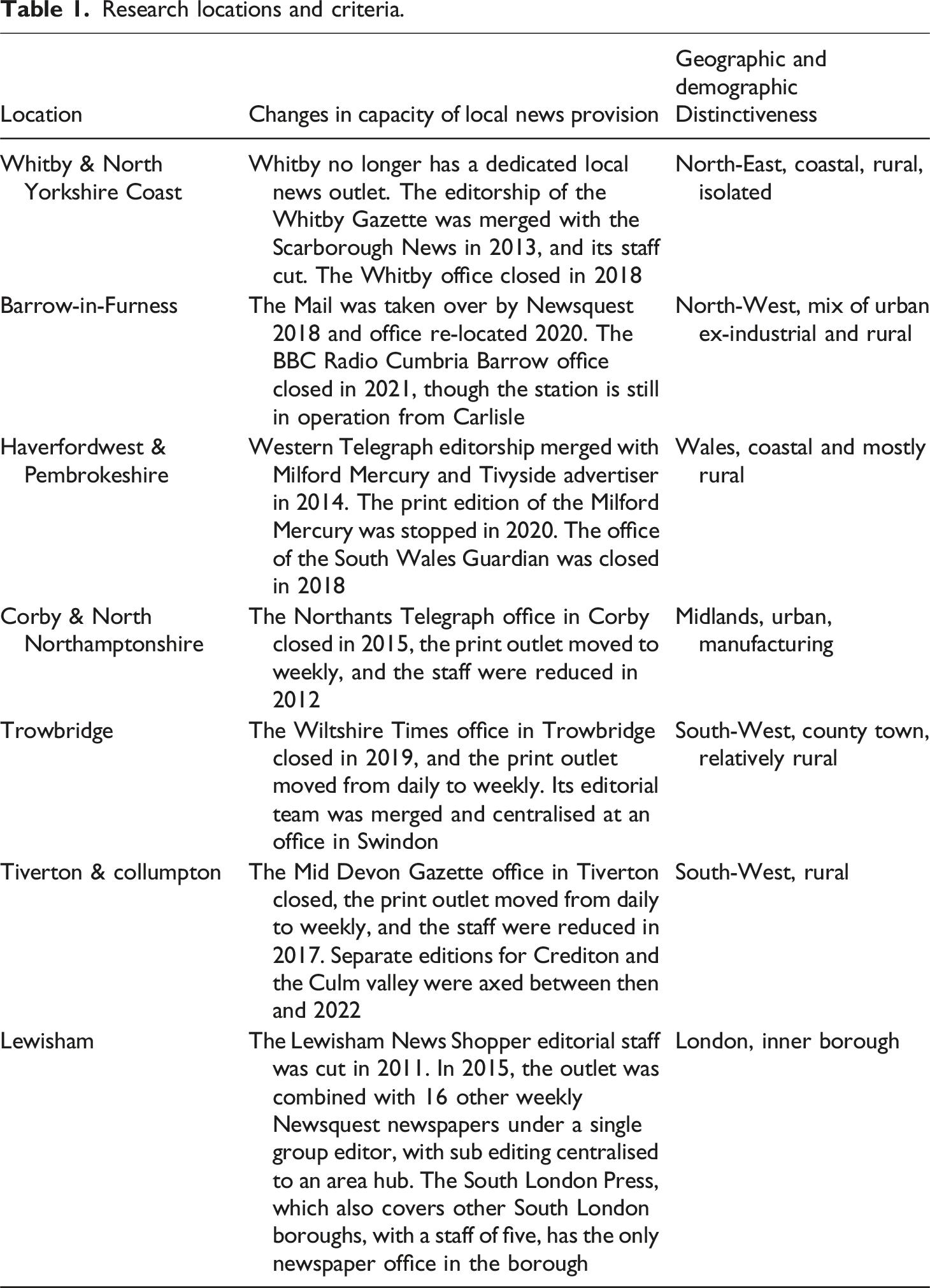
RQ2: To what extent have the institutional roles of local news outlets been substituted by other sources? To explore these questions, we identified seven distinct local areas within the UK where the institutional capacity of local news outlets had changed significantly over the last decade, identified on the basis of four criteria affecting local news provision: closure or merger of dedicated local news outlet; closure of local news office; reduction in editorial staff; de-localisation of content creation (i.e. the creation of content in a central facility outside the local area). In addition to these criteria, areas were chosen to represent a geographical spread across England and Wales, and a demographic spread across urban and rural communities. A full explanation of the seven areas selected and how they conformed to the criteria for the study are presented in Table 1 below. In each location we conducted between eight and 13 key informant interviews (72 key informant interviews in total). A key informant was defined as someone who holds a position of influence within the local community and has had some engagement with the local press. This included those in senior positions in local authorities, charities, arts groups, community groups, news organisations or the commercial sector. Respondents were identified through a combination of recent local news coverage, contact with local authorities, and a snowballing technique which involved asking respondents to recommend further relevant informants. We also interviewed nine local journalists in order to understand better how resource and other constraints have impacted their ability to carry out their traditional role in serving communities. Semi-structured interviews were carried out by phone, online, and in person, and lasted between 20 minutes and two hours. All respondents contributed their time on condition of anonymity and according to a consent agreement. Fieldwork took place between October 2021 and May 2022. In addition, we conducted focus groups in Whitby, Trowbridge, and Lewisham (four in Whitby, three in Lewisham, and two in Trowbridge), comprising 80 participants in total. To qualify for selection, participants had to be long-standing local residents and news consumers, criteria that were established through a questionnaire that asked respondents about their interest in local news and their participation in the local community. Six of the nine groups were mixed age, two were composed of young people (18-45 years old) and one comprised school children aged 14-18. Participants were recruited both through a professional recruitment service and through adverts with local charities. Each group had between three and 15 participants, was conducted either online or in person, and lasted a minimum of one hour. A group discussion guideline was prepared in advance, and all nine focus groups covered the following themes: • attitudes towards news provision and plurality in their local area; • most salient local issues and the nature and extent of their reporting; • effects of a decline in news plurality on political participation, • alternative sources of news and information and their adequacy. While we must be cautious about generalising from qualitative research of this nature, focus groups ‘are now an established research method within communication, media and cultural studies’ and have been influential in changing paradigms around patterns of audience consumption and reception (Deacon et al., 2021: 69). Other studies of local news have demonstrated the value of this approach. For example, focus groups from three different communities in the US north-east were used as a means of assessing how local news practices are evolving (McCollough et al., 2017). Another study organised six focus groups in Sweden to understand ‘the place of hyperlocal information within an integrated context of everyday local time, space, and affect’ (Örnebring and Rowe, 2022: 24). Focus groups were used to explore public attitudes to alternative media in one UK city (Harcup, 2015), and qualitative research was critical to informing one of the first UK studies on the democratic consequences of the absence of local news (Howells, 2015). Focus groups were also the basis for a 2010 study of what UK citizens want from local news and how they assess its importance (Fenton et al., 2010). Beyond these, UK studies on local media have tended to focus on the number of local news outlets, the consolidation of local news ownership, and the implications for news plurality at the local level (Barnett and Townend, 2015; Media Reform Coalition, 2023; Ramsay and Moore, 2016).
Research locations and criteria.
Findings
How well do UK publics believe their local news outlets perform their role as political institution, based on their own experience?
Role of local news outlets in community cohesion and holding power to account
For most focus group participants, and many of the key informants, local newspapers (and their online equivalents) were no longer perceived as playing critical local functions. Communities that identified closely with a single title reported that it had once been a unifying force for the community: acting as ‘community glue’, allowing the community to talk to itself, giving it a voice in the wider world, and enabling proper scrutiny of local power and authority through the work of reporters who worked and were embedded in the town. The absence of a central unifying communication channel, in the form of a sympathetic and well-resourced local newspaper, left an institutional vacuum for some participants.
This was in part driven by the physical absence of the newspaper and its journalists. Some participants were aware that their local newspaper office had closed, and that journalists were no longer working in the area. For example, one said: I am looking at the building that used to be the [newspaper] offices. You could go in and talk to a journalist and, you know, order your photos of whatever. That is closed now. So, they don’t even have a physical presence now… there is no investigation, no corroboration of facts… It’s frightening actually (key informant).
As this respondent suggested, there was a widespread belief that local newspapers and their websites were no longer fulfilling their proper journalistic role. They were not, for example, reporting on local council meetings. One local councillor said ‘There was a full council meeting in the town hall. I guess for operational reasons the [local newspaper] can’t send anybody. So, important local democracy decisions are not being reflected. In the past that would never ever happen’ (key informant, Barrow). Nor, another participant said, were they providing a space for moderated debate, or allaying local rumours: ‘Journalism and media should be a mediating voice and they’re not’ (key informant, Barrow).
A number of participants commented on how little original local content their local news outlets now contained, suggesting that local newspapers customarily recycled press releases as news stories without verification: ‘The Wiltshire Times is very “corporate press release”… if you have a corporate line it’s there’ (key informant, Trowbridge). A key informant who worked in PR said: ‘I feed them [The Whitby Gazette] stuff and I can get it in easily as I know the house style’ (key informant, Whitby).
Respondents in one area described the content on their local newspaper website as: ‘surrounded by a hundred flashing adverts with all the substance removed’ (key informant, Whitby). The comments sections below the articles were also a source of concern: ‘The Mail’s [formerly North West Evening Mail] website has become an absolute toxic battleground. Because they let people say anything’ (key informant, Barrow).
One of the journalist interviewees acknowledged this institutional failing but argued that lack of funding and staff made it impossible to continue reporting at the same level as before. Speaking about the near bankruptcy of Northamptonshire County Council – which only broke as a national story in early 2018 when the Council imposed financial controls and banned all non-statutory expenditure – one journalist told us: If we’d have been at all those meetings… it would have been mentioned, that there were very serious financial issues. If anyone had looked at the accounts and spoken to councillors on a daily basis we would have known it was going to happen… [but] We didn’t have the staff. Simple as that (key informant, Corby).
Overall, most local news outlets were no longer seen as an integral part of the local community. One informant in Whitby said: The Whitby Gazette is not a source of living, social, current news. It is mainly stuff fitted in between the adverts, that increasingly people have provided themselves… There is nobody collecting and coordinating, there is nobody to speak to, there is nobody reporting on community groups as there used to be (key informant, Whitby).
Role of local news outlets in providing accurate knowledge and information
Amongst key informants and research participants, we found frustration about the limited news and information published by local news outlets, and real concern about the resulting ignorance of specific local developments.
Councillors and local government officials informed us that reporting of their activities had declined in quantity and quality in recent years: ‘We have an overview and scrutiny committee. It scrutinises the decisions of the executive arm. A lot of it is pretty juicy stuff… The local news organisation doesn’t have the numbers to send a reporter’ (key informant, Barrow). Another said: ‘I don’t know if they’ve got anyone there [at the local news outlet] who still understands local government’ (key informant). Key informants were convinced that this absence of local authority reporting had resulted in a significant lack of public understanding of changes which deeply affected people’s lives. They also reported occasions when council leaders made erroneous statements which were reported as fact, without challenge. One Whitby focus group respondent described a council meeting (streamed live online) in which extensive holiday let fraud had been admitted but never reported. Others expressed frustration about the lack of reporting about local planning developments and building plans. One participant said she had taken to phoning the council office every morning to check its building schedule in case it would disrupt her work. If there are any events that will cause road closures, because I work for a scaffolding company, those things are very important to us. It’s harder now than it was. I would keep an eye on the Gazette… Now we have to ring the council in the morning (focus group, Whitby).
Healthcare and the National Health Service (NHS) featured as a particular area of knowledge deficit. An informant in Lewisham was amazed by the lack of information about the failure of the local Clinical Commissioning Group (the body which runs the NHS locally): I couldn’t find any mentions on the web or in local journalism that the Lewisham CCG had been put into special measures. It spent £500m a year of public money, much more than Lewisham Council. I found that absolutely astonishing (key informant, Lewisham).
There was a sense in some areas that crime was under-reported. In Lewisham, focus group members talked about a ‘crime wave’ in the area that they only knew about through word-of-mouth. In Trowbridge, respondents claimed that (unverified) drug trafficking by children across county lines was significantly under-reported: ‘County lines is a huge thing in Trowbridge…. If people don’t know about it then how can we safeguard [the children]?’ (focus group, Trowbridge). Journalists told us that lack of reporting was down to limited staff and resources, combined with recalcitrance on the part of public authorities. One journalist in Northamptonshire said: ‘In Corby we have awful problems with knife crime. Terrible problems. And I know what is happening, but I don’t have time to go and gather all the facts. So, I can’t report it’ (key informant, Corby).
Equally, we were told that the police had stopped arranging briefings or communicating directly with reporters, preferring to publish press releases or put information out on social media. One journalist said: ‘By the early 2000s you were getting more PR people involved. The police briefings wouldn’t happen, you got press releases instead’ (key informant, Whitby). A former police officer told us: ‘In my day if you had a bad accident or whatever, the local reporter turned up…. Now I very much doubt there’s a bobby on the beat knows his local press man at all’ (key informant, Mid-Devon).
An NHS worker said: In the past we have used the Whitby Gazette about changes to our services… (but the Gazette) is now produced in Scarborough and has become much less relevant to Whitby… many people have stopped reading it… Putting something on Facebook would be more effective than putting it in the Gazette.
Local journalists had similar difficulties with the NHS: The NHS are the ones we have the most trouble with, in terms of being quite obstructive…a huge amount of reports are just not being made public at all…But they know that there is not one specialist health reporter in the county (key informant, Corby).
Both key informants and focus group participants explicitly linked lack of local knowledge about issues of public interest directly with the deficiency in local reporting.
Role of local news outlets in fostering democratic participation and engagement
There was evidence across our respondents of a democratic disconnect and a sense of isolation from the local community. This disenchantment and powerlessness was partly attributed to an absence of local news and information: There’s a whole group of people at the moment who are disengaged and not coming out of their houses. They don’t even know what’s going on out there. For some they don’t know anything beyond WhatsApp or social media (key informant, Lewisham).
The lack of regular access to a local news outlet meant, for some participants, a lack of voice and of fair representation: If you don’t have a voice, you don’t have any say about where you live and how your area is going to change. You know it can have huge consequences for so many people and you know people would just be disenfranchised (focus group, Lewisham).
Local voices are only represented when there is significant public discontent, or when those voices are extreme: ‘It has been devastating here. What’s happened to the Mail has had a really negative effect on this community. It has [contributed to] the rise of the right here’ (key informant, Barrow). Several informants expressed concerns about the deleterious impact on democratic accountability and participation. One remarked: And that is how [the] council will get away with doing what they want and spending what they want, feathering their own nests. It is dangerous as far as I’m concerned, the downfall of local newspapers is dangerous for democracy (key informant, Corby).
Another said: ‘The paper can’t help democratic participation because people just don’t care. They care about things like the bins not being collected’ (key informant, Corby). One local reporter was explicit about the political institutional repercussions of traditional journalism outlets closing down, arguing that, without journalists reporting on local authorities, political participation will simply disappear: ‘We [local reporters] are kind of the middle man. And without us, I don’t see how the majority of people could ever try to engage with local democracy. I just don’t think it will happen’ (key informant, Corby).
To what extent have the institutional roles of local news outlets been substituted by other sources? Many older respondents volunteered their views spontaneously about long-standing local newspaper titles, declaring without exception that that the usefulness of their content had declined in both printed and online versions (in contrast to the 14-18 year old group which had little knowledge of local newspapers). Many also stressed the importance of word of mouth as a conduit for news and information, particularly in the smaller communities. Our overwhelming impression from all the communities in this study was that local news and information was now filtered primarily through online platforms, predominantly Facebook, which acted both as carriers of news and information and as a filter for access to local institutions. If there’s something going on, the first place I look is the [Facebook] ‘I love SE4’ group… a lot of it’s trash to be honest, but a lot of it’s very useful. A couple of weeks ago there was these fireworks going on for 30 or 40 minutes… I was just kind of wondering what was going on and everyone had the answers (focus group, Lewisham). How local news and information was filtered through platforms depended on the nature of the platform. Twitter (now ‘X’), for example, was the second most widely reported platform, and its facility for direct communication between strangers was used by some as a means of communicating with those in authority (and to some extent holding them to account): Whenever I’ve got a bee in my bonnet or something I’m not happy with within the Council, I always tweet at my local councillor person… I tweeted him literally two weeks ago about the whole roadworks thing and he said that he’d get someone to look into it. (Focus group, Lewisham). Social media could be used for information sharing, which included campaigning and organising, sharing information about local health provision, and raising money for charity I helped by posting announcements [on the ‘Spotted in Trowbridge’ Facebook page] clearing up confusion around test centres (key informant, Trowbridge) The Afghan refugee appeal was entirely carried by social media… We didn’t have time to contact the local paper to get something in. We just took to Twitter… Some people came and said their daughter or mum saw it on social media and told them (key informant, Corby) Nextdoor was mentioned less often than other online platforms, though the higher degree of user authentication and its ‘messageboard’ format (easier retention and cataloguing of posts) seemingly made it attractive for detailed hyperlocal campaigning. A councillor noted that a successful campaign against a local development was organised on Nextdoor and that ‘the rhetoric was getting quite aggressive towards us…’ (key informant, Lewisham). Perhaps the most significant consequence of this greater dependence on online platforms is the virtual disappearance of those traditional editorial and gatekeeping functions played by local journalists and publishers. Our respondents displayed an acute awareness of both the negative and positive consequence of this profound shift in local filters. On the negative side, there were multiple references to the dangers of misinformation that often feature in debates about the threat to democracy at national and global levels. One Citizens’ Advice worker told us: We spend a fair amount of time fighting off Facebook rumours. Housing allowance is a good example. We’ll have a client who comes in and says ‘I need to apply for social housing.’ We say ‘you need to go through this process, be on the waiting list, bid for a property’ and they say ‘but if I’d come from Syria and I was a refugee I’d get given a house automatically no questions asked’ and we ask ‘where did you hear this?’ They say ‘I saw it on a Facebook site.’ (key informant, Trowbridge) Another key informant said: I was working with a group of young college students with mild learning disabilities, one of whom was absolutely adamant that a church was going to be knocked down in Milford Haven and a mosque was going to be built in its place. He wasn’t looking at the source material, it was a nasty Britain First type Facebook group (key informant, Pembrokeshire). On the positive side, our study revealed some evidence of citizen journalist initiatives, moderated by local people through social media platforms. The Facebook group ‘Spotted in Trowbridge’ had (at the time of the study) around 31,000 ‘followers’, representing a significant proportion of all Trowbridge residents. Contributions from local residents are moderated before posting, and vary from job seeking requests to crime reports and links to news websites. The moderators (who work under anonymity) are in regular communication with Wiltshire Police. Their policy prioritised freedom of speech and speed: We are quick. We don’t wait for hours on end before checking in and publishing the information sent to us… The people want to be heard and, provided it is done with respect, we allow them to have their voice… Even if it’s not said with complete respect, we allow people to comment as they wish (key informant, Trowbridge) This enabling of citizens who can speak directly to their communities is arguably more democratic than the traditional gatekeeping process whereby journalists (and other local contributors) are moderated by publishers who may have their own commercial, political or idiosyncratic agendas. On the other hand, given that many sites, including Facebook, only allow access by members, this can result in subdivisions of local groups which are loosely or barely moderated and where unsubstantiated rumours about controversial or divisive events can proliferate (and, of course, be debunked). Thus, in Whitby, during the ‘Black Lives Matter’ protests of 2020, a rumour spread that Whitby’s statue of Captain Cook was under threat of removal. Some respondents reported that the rumour was completely unfounded and had spread on social media. Yet focus groups showed that other residents had believed the threat to be real. The issue escalated into an argument on social media, which resulted in the founding of a group which was restricted to members: It was a febrile atmosphere. There was a lot of people got involved. Two lots of agitators… someone set up a Facebook page to protect the statue and it got about 3,000 followers very quickly, and then became a closed, private group (focus group, Whitby) Despite the democratisation potential of local online community groups, social media sites were generally considered to be deficient as a source of local news and information by both key informants and focus group participants. This was in part due to the difficulty of verifying claims, and in part because online posts were felt to be dominated by personal complaints which made sporadic useful local news stories easy to miss or difficult to find. One participant, for example, said: I joined a [Facebook] group called Corby Chats Back which has quite a lot of local news… [though] you get a lot of negativity on Facebook pages. A lot of moaning (key informant, Corby). When councillors, MPs or others in positions of authority were discussed, it was usually to denounce them as dishonest or corrupt. A key informant told us: ‘If you see anything mentioned on Facebook about a councillor it is usually that we are all corrupt… we are always on the fiddle and stuff’ (key informant, Whitby). Overall, there was a very clear sense that the democratic and information functions of traditional publishers were sorely missed, and that in the eyes of local communities their role as political institutions had not been replaced either by those newspapers’ own websites or by other online and electronic sources. Instead, a slightly anarchic online local information sharing ecology seems to be developing which, to some extent, may reflect the polarisation and misinformation reported in communication systems at national and global level (Bennett and Livingston, 2018).
Discussion and policy implications
Our research supports many of the claims made in previous reports about the expansion of ‘news deserts’ and the impact of changes to local media environments, and how this impact varies between different communities and demographic groups. However, by exploring public experience of – and attitudes towards – local news as political institutions, this research provides new evidence of the nature and impact of the reduced capacity of local news organisations on local stakeholders and citizens.
Our study also provides new testimonial evidence on sources of news in the local online ecologies, and the extent to which new digital technologies, notably social media services, are performing the functions previously performed by local news outlets. Our study found widespread use of social media and message boards, supplemented by local information sites provided by institutions such as local authorities, libraries, schools, and businesses, and increasingly less reliance on journalist-curated services. While useful in providing some local information and facilitating access to local authorities, these sources were much less useful as a provider of verified news, and are often vectors for unsubstantiated rumours. They do not fill the gap left by local news media as a political institution, but they do have distinct and novel functions which require further research.
With respect to Cook’s theoretical framework, the evidence gathered from these seven UK localities indicates that members of the public and local newsmakers do not believe local media is sufficiently performing its role as a political institution. For the public, it is failing in four key respects. It is not providing regular, eye-witness reporting of local politics. It is not felt to be representing the voice of the local community to those in authority. It is not acting as ‘community glue’, nor is it providing the main forum for public debate (which had shifted to other online locations). For the stakeholders, there are three further ways in which local news media is not working as a functioning political institution. The absence of local journalists from political meetings means there is no opportunity to negotiate newsworthiness or integrate newsmaking to policymaking. Local news media is no longer conferring authority, since there is little direct observation or evaluation of political sources. Nor are local news outlets sufficiently scrutinising or challenging those in authority.
These attitudes about the diminishing role of local news media as a political institution, significant in themselves, also suggest that the institutional role of the local press will decline further and faster, as both public and stakeholders change their behaviour and seek out substitutes. The substitutes they have found to date – most notably local social media groups and pages – perform certain specific tasks but fail to fill the broader roles necessary for these services to be considered institutional. The depletion of the local news media as a political institution therefore has wider implications for the current and future health of local political ecosystems.
When this evidence is put in the context of contemporary public policy interventions, it helps illuminate deficiencies within these interventions, in particular how they tend to take fragmentary and functional approaches to the news and information needs of communities that do not account for the role of local news as a political institution. Recent examples in the UK include the Local Democracy Reporting Service, which top-slices £8 million from BBC licence fee revenue to pay for around 165 journalism posts dedicated to reporting on local councils (BBC n.d; Barnett and Greenslade, 2020); and new plans to ensure that news publishers receive compensation from the major tech platforms (Enders Analysis, 2023: 12). This follows similar initiatives that were implemented in Australia in 2021 (Australian Competition and Consumer Commission, 2019) and Canada in 2023 (Enders Analysis, 2023: 9-11), despite concerns about the bulk of revenues flowing to the largest publishers (Brevini and Ward, 2022).
In both cases, these initiatives were promoted by powerful corporate publishers anxious about journalism’s failing business model. Arguments have therefore been dominated by narrow questions around economic sustainability of traditional media, rather than the broader political institutional role played by local news organisations and how this might be addressed. 1
In not considering the role of local news as political institution, these policy interventions are therefore unlikely to address the broader consequences of institutional decline and issues associated with ‘news deserts’ (however defined). They will not, for example, ensure that local communities have news providers that give citizens ‘geo-social’ identification, or engender a sense of place, belonging, cohesion or community (Gulyás and Baines, 2020; Leupold et al., 2018). They will not guarantee that local news institutions ‘occupy a central place in the society and polity’, are ‘intertwined’ with the work of local government, or fulfil the critical information needs of local citizens (Cook, 2005).
Conclusion
This paper attempts to add nuance to the perceived impacts of ‘news deserts’, and to explore Cook’s theory of news media as political institutions at a local level. We identified common themes, including perceptions of institutional local news failure, marked knowledge gaps and ‘democratic disconnect’ in stakeholders’ accounts. Assessing relevant policy initiatives to meet these needs, we argued that policy initiatives tend to take a fragmentary and functional approach, and therefore fail to address various negative consequences of the decline of local news as political institution.
Footnotes
Declaration of conflicting interests
The author(s) declared the following potential conflicts of interest with respect to the research, authorship, and/or publication of this article: The authors of this paper are affiliated to the Charitable Journalism Project (Charity Number: 1195041), which supported this research.
Funding
The author(s) disclosed receipt of the following financial support for the research, authorship, and/or publication of this article: JRSST Charitable Trust.
