



Abstract
In Zimbabwe, the comatose economy has had an impact on the media industry. Since 2000, media houses have been shutting down due to lack of financial support or poor business environment. For some news organisations, they have been retrenching their staff as a cost cutting measure. This has also led to retrenched journalists to write for other publications as freelance journalists. This study examines the state of freelance journalism in Zimbabwe. It aims to assess their role and contribution to the media industry, challenges they face, and also the survival strategies they are adopting. This qualitative study is informed by Bourdieu’s field theory. It used in-depth interviews while thematic analysis was employed in analyzing data. Findings demonstrates that freelance journalists are contributing to the growth of media industry in Zimbabwe by writing on specialised beats like science reporting. Besides such contributions, findings further demonstrated that freelance journalism is seen as ‘curse’ as journalists are easily harassed by the state agents who rarely recognizes someone not working for an established organisation.
Introduction and context
The practice and profession of journalism is in a precarious position owing to various forces, but chief among them are low readership due to lack of trust in the media by audiences (Moyo et al., 2019; Waisbord, 2019). Second, a drop in revenue and poor performing economies that negatively affect the media’s advertising revenue (Mackenzie and McKinlay, 2021). The combination of the above factors and many others has resulted in newsrooms to retrench their workforce which include journalists while some resorted to maintaining a few journalists. As a result, journalists now outnumber the job market. In Zimbabwe, the leading media stable, Zimbabwe Newspapers Group (1980) (Zimpapers), and the state broadcaster, Zimbabwe Broadcasting Corporation (ZBC), in 2013, owing to economic hardships, retrenched close to 200 journalists (Chuma et al., 2020; Machivenyika, 2013). Against this background, some seasoned journalists instead of throwing in the towel and retiring, they had to remain in the field as freelance journalists. For this reason, the profession of journalism, globally, can hardly be explored today without recognizing the large number of journalists who work as freelancers rather than as organizational media direct employees. Freelance journalists play a vital role in the journalism industry by producing specialised stories that the majority of the staff reporters could not provide reporting (Norback, 2022; Templeman, 2009). Meehan (2001) posits that while the number of freelance journalists has increased sharply throughout the past two decades, there remains a dearth of research available on their role and contribution within the media sector. Ironically, a corpus of research has been dedicated on citizen journalism (Chuma 2010; Moyo, 2009; Mutsvairo and Salgado, 2020). Perhaps, the reason has been that citizen journalists were ‘disruptive’ and ‘threatening the status quo’ within the field of journalism. If the ‘destructive forces’ received such an academic attention, what about those who have sustained the field? Hanusch (2015) argues that while there has been a gradual increase in the interest on freelance journalism from industry players, academic work has been scarce. Norback (2022: 1142) adds that while available literature has highlighted that freelance journalists are working to make ends meet, and remain vulnerable to political and economic forces, “more research is needed on how freelance journalists negotiate precarity to maintain a career, and on how career progression can be achieved.” This study looks at this under researched area by examining the state of freelance journalism in Zimbabwe.
In Zimbabwe, the comatose economy has had an impact on the media industry. Since 2000, media houses have been shutting down due to lack of financial support or poor business environment. For some news organisations, they have been retrenching their staff as a cost cutting measure. This has also led to retrenched journalists to write for other publications as freelance. Despite a declining number of staff writers at major publications and a growing reliance on freelancers, there has been a complete blackout of research dedicated on Zimbabwean freelance journalists’ welfare and their role and contributions to the news industry. It is the role of freelance journalism which is at heart of this study that seeks to examine the contribution of freelance journalists to the journalism industry and how they are (or are not) adapting to the changing media landscape. The study is guided by the following objectives: ❖ To examine the challenges faced by freelance journalists in Zimbabwe. ❖ To identify ways which freelance journalists use to mitigate challenges faced in the journalism industry in the country.
Media systems in Zimbabwe
Zimbabwe’s has a bifurcated media system broadly defined along the two forms of journalism and these are oppositional and patriotic journalisms (Chuma, 2010). Oppositional journalism ─ practiced by the private press ─ is critical to the state, government and the ruling party. Some of the papers are fall under oppositional journalism are NewsDay, Daily News, The Standard and Zimbabwe Independent. There has been increase in the number of platform publishers and digital media start-up that too form part of the oppositional journalism and these are The Newshawks, ZimLive and the Centre for Innovation and Technology (CITE). On the other hand, patriotic journalism is practiced by media houses that are controlled by the state and these are the publications under the Zimpapers stables together with the state broadcaster, ZBC. Some of the publications under Zimpapers are The Herald, The Chronicle, The Sunday News, and Sunday Mail (Ranger, 2005; Tshuma et al., 2022). Patriotic journalism hail and praise the state and the ruling party, ZANU-PF. It is, however, critical of opposition political parties, and any individual who is deemed not to be patriotic and critical of the state (Chiumbu, 2004; Matsilele and Ruhanya 2021; Ndzinisa et al., 2021). Despite this difference, the media environment has been hard hit by the economic hardships which resulted in newsrooms resorting to retrenchments.
Second, private and state-controlled publications have resorted to merging desks and minimizing the number of journalists as one of the cost cutting measures. To supplement their number of stories needed, freelance journalists are sought after, as it is easy to pay them as opposed to full-time members. Third, Zimbabwe’s repressive state has been hard on journalists who are critical of it. According to the 2023 Reporters without Border report, Zimbabwe is ranked one of the worst countries on press freedom in the Southern region. The country is ranked 126 of the 180 countries. Journalists from the private and freelance journalists have on several occasions been arrested and detained. Unlike journalists from the private press whom their employees can engage company lawyers to represent them, freelance journalists are left hanging out to dry. Moyo and Munoriyarwa (2024), in their study on freelance journalists in Zimbabwe and South Africa, argue that the gig labour practices in the field have severe consequences not only on labour practices but also on journalism practices. They argue that “opportunities for investigative, public interest journalism content that advances democracy may be passed up as freelancers’ chase content that is financially beneficial” (Moyo and Munoriyarwa 2024: 489).
Understanding the field of freelance journalism
There are different names given to journalists working outsides the established newsrooms, and these are: freelancers, temporary workers, and atypical workers. According to the International Federation of Journalists, the term atypical workers describe “relational types of employment that are not permanent or full time” (Walters et al., 2006: 6). Freelancers are a sub-category of atypical workers and are “typically … self-employed, [selling] their services and work to a variety of employers without a long-term commitment to any of them” (Walters et al., 2006: 6). This concept also includes stringers and correspondents. In Zimbabwe, the term freelance often describes journalists without any permanent contracts, yet they work for several news organisations— locally and internationally. In this study, the concept of freelancers is limited to self-employed journalists who take on assignments for several employers. This analysis will not consider temporary workers and journalists on short-term contracts.
However, the number of freelance journalists is growing locally and internationally (Edström and Ladendorf, 2012: 711). According to Deuze and Fortunati (2011: 111), the percentage of freelancers is significantly higher among newcomers in the media industry and those working in television and online. Despite such a revelation, attention given to freelancers has been less (Wahl-Jorgensen and Hanitzsch, 2009: 12). Many studies, locally and internationally, on journalism have not adequately incorporated freelance journalism into their discussions (Das, 2007; Moyo, 2009). Mathisen (2017) argues that the few studies that have probed the field of freelancers— some studies conducted in Europe, the United States, and Australia—have focused on role perceptions, working conditions, and job satisfaction among self-employed journalists, as well as the subsequent ethical challenges. Among those studies, findings have, however, demonstrated the power of freelance journalists. Freelance journalism has become a key “employment alternative in the current media landscape, with news organizations often relying on these independent professionals to reduce organizational budgets” (Marín-Sanchiz, 2023:1) as they are the “jack of all trades” (Norback, 2022: 1141). Despite their use and importance in the journalism and media industry, the setback has been that freelance journalists have limited career progression (Hayes and Silke, 2018).
In Zimbabwe, since 2000, media houses and media startups have been closing due to lack of financial support or poor business environment. Various pieces of legislation such as the Access to Information and Protection of Privacy Act (2002), Broadcasting Services Act (2001) and the Interceptions of Communications Act (2007) have constrained the media environment leading, in some cases, to a closure of media houses. Therefore, an academic inquiry into the study of freelance journalism remains critical in societies where freelance journalism seems to be the only viable route for many.
Theory
This study is informed by Bourdieu’s field theory. A field is “an independent social universe” (Bourdieu, 1993: 163) with given rules that players in the field should abide by. The heteronomous and autonomous poles are key features that are used to unpack the field theory. The former is about external factors within the journalism field, and these include economic, political and cultural influences. In relation to the study, freelance journalists are affected by several socio-economic and political issues that relates to laws and policies relating to their field. On the autonomous pole are influences derived from factors inside the field. In the field, there is a doxa and a habitus. The doxa is explained as ‘consciously or unconsciously’ shared set of rules that underlie the field; habitus, is the “particular traditional trajectory by which an agent arrived at that position” (Benson and Neveu, 2005: 3) that determine agents’ practices and perceptions of the field. Issues in the doxa include journalistic ethics, values and norms that “justify the authority and legitimacy of journalism” (Wang, 2018: 474). Habitus is the set of factors that “affects the agents of the field to make sense of the rules of game” (Wang, 2018: 475; Willig, 2013). Habitus involves individual agency, which is shaped by journalists’ experience, perception, and judgment on conditions inside and outside the field. Habitus often functions as a dynamic factor to drive changes in the field (Wang, 2018). Thus, it is in the autonomous pole, internal factors, that can be used by the media to resist given pressures. Therefore, freelance journalists with a lot of experience in the field are bound to interpret and behave differently. The dynamics between the internal and external influences determine an important feature of the field –each field exists semi-autonomously (Wang, 2018). This theory is advantageous because it helps to understand “the relations between the newsroom and the journalistic field, and between the journalistic field and the field of power” (Schultz, 2007: 192). Therefore, theory was chosen because it helps in unearthing or showing micro and macro newsroom practices that influence broader journalistic practices. Second, some of the theories which might have been used in this study like sociology of news and political economy pay attention to structure or take the researcher outside the workspaces to focus mainly on external factors affecting the work of journalists. Our choice of the field theory emanates from its strength in that it helps to bridge the gap between agency and structure (Benson and Neveu, 2005; Bourdieu, 2005; Willig, 2013).
Methodology
The sample of journalists interviewed.
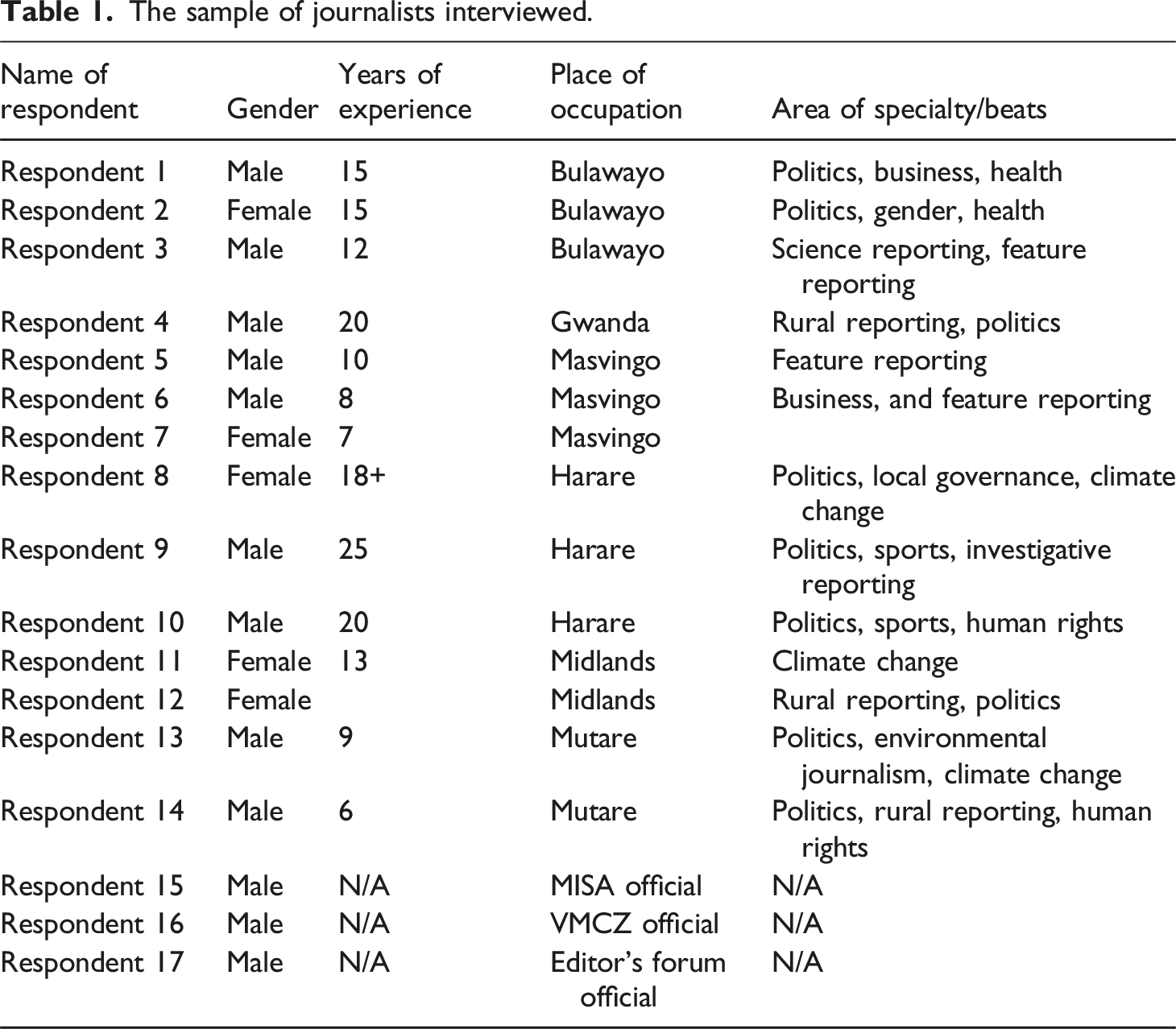
Thematic analysis was used to analyse interview data. In doing thematic analysis, we followed six key stages as recommended by Braun and Clark (2009: 13). The first point of reference was to familiarize ourselves with data, that is, going through my interview transcripts. These scripts, however, were highly coded to protect the identity of the respondents as per their request. The study moved on to develop codes to help come up with key characteristic of the data. The next stage was to closely look at codes with the aim of identifying patterns that were emerging. After that, the study reviewed the themes. At this stage, an analysis of the themes that were coming out of the data was done, and they (themes) included freelancing as a curse in Zimbabwe, survival strategies of freelance journalists and contribution of freelance journalists to the media industry. The last stage involved writing up the information. Braun and Clark (2009) note that this stage involves extracting powerful quotes or examples that speak to chosen themes. The next section presents and discusses findings which are organised around three themes, and these are: role and contribution of freelance journalists to the media industry; freelance journalism as a curse, and survival strategies of freelance journalists.
Findings
This section discusses the study’s findings which are structured into three thematic areas which are: • Contribution of freelance journalists to the media industry • Freelancing as a ‘curse’: Challenges faced by freelance journalists • Survival strategies of freelance journalists
Contribution of freelance journalists to the media industry
Freelance journalists are contributing to the media industry in Zimbabwe by mainly producing multimedia stories that are people centered than government or institutional centred. More so, the contribution of freelance journalists is that they are writing on specialised beats such as financial reporting and climate change. A freelance journalist based in the Midlands province said: Most of the newsrooms produce common stories on politics and sports. I like writing on other untapped fields like climate change. I have realised that most newsrooms don’t produce such stories more often because they require more time which they don’t usually have.
Freelance journalists are not constrained by institutional structures and institutions. Rather, they have the leeway to write their own news stories without being constrained by editorial policies and other institutional dynamics. Thus, freelance journalists have individual agency which enables them to navigate the journalism field, or “social universe” (Bourdieu, 1993: 163). In this regard, the practice of freelance journalists is not overly determined by editorial policies and other newsroom structures. Rather, freelance journalists have the agency to shape and reproduce the structures in newsrooms. Another freelance journalist based in Bulawayo added: Freelancers are the lifeblood of this media industry. Sometimes we provide stories from rural areas something which these established media houses are slowly failing to do. Secondly, we provide specialised content, for example, on science and health.
Giddens’ (1976) conceptualization of the duality of structure and agency provides a framework for making sense of the intersection between freelancers and newsrooms. Freelance journalists are navigating between structural constraints and their individual agency. These structures both enable and hinder the work of freelance journalists. Most newsrooms in Zimbabwe are grappling with financial instability and economic hardships. A shrinkage in advertising and a reduction in consumer spending power have affected the sustainability of news organisations. Given the declining sales and other revenue streams of income (MISA-Zimbabwe, 2021), some newsrooms are struggling to stay afloat. This socio-economic environment has provided an opportunity for freelance journalists to contribute to the journalism industry by covering geographical areas which tend to be overlooked by mainstream news organisations due to institutional constraints. Given that socio-political factors have a bearing on the operations of social actors in a field (Bourdieu, 1993), the role of freelance journalists should be understood within milieu prevailing in the country.
Freelance journalists have their role perceptions within the journalism field. Given the concerns that mainstream news organisations tend to be elitist and urban-centric, freelance journalists self-identify as serving marginalized communities such as rural areas. Thus, this freelance habitus shapes the operations and role perceptions of these media workers. They serve as alternative public spheres as they report on issues that are excluded (science, health etc.), and communities that are marginalized (rural areas). To add more, with this study having been conducted at the height of the Covid-19 pandemic, an official from MISA Zimbabwe said: Due to the ravages of Covid-19 more media houses are relying heavily on freelance journalists to contribute towards their story generation, hence the need for freelance journalists to remain resolute in sharing the Zimbabwean stories playing the check and balance monitorial role.
Some freelance journalists are photojournalists who produce photographs for both local, regional and international media. For local media, most journalists do not have modern camera or equipment to capture good photographs. Most of us invested in good cameras because media houses are in need of good photographs. Most of the photographs that people see are from us (freelance journalists) because we have the skill and equipment to produce one.
As such, freelance journalists possess “cultural capital” (Maares and Hanusch, 2022: 745) which relate to technical expertise and skills. Scholarship show the porous nature of the boundaries of traditional journalism (Hermida and Young, 2019). Given their technical expertise, freelance journalists are able to influence and shape the journalism ecology in the country. Therefore, insights above show that freelance journalists provide diversity to the media industry in the country. Despite the above-mentioned contributions, freelance journalists indicated that their journalistic roles are affected by the repressive environment that seeks to ensure all the journalists tow the government line. A freelance journalist based in Mashonaland East said: Zimbabwean freelance journalists face serious threats from those in positions of power who want to use us as mere pawns in the game of politics. Despite such threats, we always try to play our monitorial role because we have the duty to serve our community well.
A Masvingo based freelance journalist echoed: The state has been trying to turn many of us into lapdogs deciding what stories we should or should not write. Their move has never been successful because our agenda has always been to serve the community. For me I specialize in feature stories that are very in-depth and there is no newsroom or media house either locally or internationally that can reject such stories. In fact, they are in need of them because their journalists have no time to spend days working on a single story.
As such, journalists’ responses validate the field theory’s assertion that a field is made up of rules that all players are expected to abide by. In this case, journalists are arguing that they have to abide by the ideas of journalism and refuse to act in an unethical manner. Ethics which freelance journalists have raised constitute what Bourdieu calls the doxa which are part of the ‘rules’ of the journalism field (Benson and Neveu, 2005). In this case, the field theory helps in understanding factors and forces that are influence freelance journalists’ choices as they report news. Placing too many barriers in the way the media functions and operates limits the information that is imparted to the public. Members of the public need information about matters of governance. Lack of access to adequate information hinders popular participation in political and other purposes. Uninformed people cannot make informed decisions and political choices. Freelance journalist informs the citizen about what is happening around them as they are alternative views of the mainstream journalists. Freelance journalists play a critical role in the development of a country and its citizens. Just like mainstream journalist, our role as freelancers is to inform the citizens about what is happening around them. Most news stories from mainstream media houses are official centered. For us, we talk to people, and let them speak for themselves.
The media reflect the political order in which they are situated, and the logic and rationale for their facilitating public life is primarily that of civic democracy. Journalism can, therefore, be understood as a subfield within the broader field of cultural production—it is thus a separate field with its practices and rationalities and the public or citizens as another field (Willig, 2013). It is evident that freelance journalists are contributing to democracy by navigating newsroom institutional constraints such as gatekeeping practices. In a country where politics and mainstream media are polarized, freelance journalists are emerging as having relative autonomy. Freelance journalists have to negotiate the dynamics of structure and agency. On the one hand, they are writing stories for news organisations which have their editorial policies. In this way, freelance journalists have to align their stories along the editorial stance of the news outlets that they are writing for. On the other hand, freelance journalists operate as having some form of agency and autonomy as they can decide on which news outlet to submit their story. In a way, unlike journalists attached to news organisations, they have a leeway to navigate a journalism landscape whose boundaries are porous and permeable (see Tshuma et al., 2024; Hermida and Young, 2019; Maares and Hanusch, 2022). However, freelance journalists face a myriad of challenges as discussed in the next section.
Freelancing as a ‘curse’: Challenges faced by freelance journalists
Being a freelancer comes with a dark side. In this study, journalists argued that “freelance journalism is a curse” owing to a number of challenges that professionals face while on duty. Respondents further indicated that the safety of a freelance journalist depends on the story one writes. Respondents spoke of repressive media laws that were hindering them from freely writing stories because of the fear of the government. Some of the laws which freelance journalists said affect their operations include Official Secrets Act (OSA), Public Order and Security Act (POSA) and the recent promulgation of the Freedom of Information Act which repealed the Access to Information and Protection of Privacy Act (AIPPA). Thus, this affects freelance journalists in their duty to do normative media roles.
A freelance journalists based in Gwanda said: As freelancers we are sometimes denied access to information in some cases especially when it involves an official source. In some cases, we are denied access to cover certain government gathering because officials view us as the other or inferior. Anyone who does not represent well know papers is seen as bogus.
As such, the journalism field is also exclusionary as those deemed operating outside the boundaries of mainstream media are denied access to information. Whilst freelance journalists may possess cultural capital such as knowledge and technical expertise to conduct their duties, they tend to lack symbolic capital. They are not recognized in certain spaces due to lack of institutional support. Bourdieu (1993) regards symbolic capital (recognition, prestige etc.,) for a social actor to operate in the field.
Another freelance journalist from Harare said: Freelance journalism is sometimes a curse because of the challenges we face. State security agents don’t recognize our status. More so, when we are arrested, few people come to our rescue. We are on our own. However, we thank MISA who have been assisting us many ways.
A respondent from Midlands said: When you are operating in rather remote areas, it is worse as government and state security agencies take your role of exposing the bad as ‘an enemy of state”. Freelance journalists are interpreted as regime change agents, we are victims of police harassment and name calling.
Thus, the findings demonstrate that the media in Zimbabwe is broadly affected by government stringent regulation frameworks. The findings further show that this has hindered freelance journalists from doing their monitorial role of monitoring those in power and also exposing the wrongdoings or the people who have abused their power.
Respondents indicated that it was scary to be a freelance journalist because in most cases they were treated as ‘enemies of the state’. A freelance journalists based in Masvingo said: To us freelance journalists, Freedom of Information Act have narrowed our way of reporting and have brought self-censorship among us. We are seen as the enemy of the state because we don’t tow the government line.
Another respondent based in Bulawayo added: These laws have seriously stifled and muzzled the freedom of information and freedom of journalists hence hindering some of from practicing investigative journalism related to politics, as it has intimidated the majority of freelance journalist to such an extent that we are afraid of publishing some of the events taking place in Zimbabwe for fear of arrest.
Giving a different dimension is a Masvingo based journalist who said: Our working environment is not conducive as there is now a new system required for one to cover events of government officials like the president. In such events, press cards don’t work; journalists have to submit names in order to cover such events. In most cases, journalists are involved through their newsrooms and for us with no newsrooms we are left behind.
Freelance journalists face similar challenges faced by journalists working with private press as they are also regarded by the government as agents of regime change. The challenge faced by journalists perceived to be practicing ‘oppositional journalism’ is well documented (Chuma, 2010; Ndlovu, 2018; Ndlovu and Sibanda, 2022), and with freelancers being treated as such. This present their working conditions to be ‘toxic’. Such findings show that freelance journalists as part of the broader journalism field are affected by factors external or outside the field. Writing on the field theory, and its importance in understanding the journalism practices, Schultz (2007: 192) argues that the theory helps in showing “the relations between the newsroom and the journalistic field, and between the journalistic field and the field of power”. In this paper, the politically volatile environment in the country has implications on the operations of freelance journalists who some have argued that being a freelance journalist is a ‘curse’. However, some respondents indicated that the repressiveness of media laws is based on the type of beat they chose. For journalist who work on political related beats they tend to be largely affected by the repressive system while those working on ‘soft beats’ like entertainment and sports are spared from harassment.
A respondent from Harare said: I operate in a relatively safe environment since I am not mainly focused on political stories but focused on rural reporting, development stories and business stories. Most of my work rarely angers the state. I am into safe beats.
To ensure that freelance journalists write freely and play their roles as reporters without any worries, media bodies such as VMCZ, Zimbabwe National Editors Forum, MISA Zimbabwe and Zimbabwe Union of Journalists have litigated against repressive media laws. They continue to conscientise the public on the fact that access to information and freedom of expression is enshrined in the Zimbabwe constitution, the supreme law of the land.
On the other hand, despite the hardships associated with being a freelance journalist, none of the participants indicated their desire to leave the profession. The responses from the participants showed that low payment rates and irregular income proved freelancing as a curse in Zimbabwe. Low and/or static work rates were a recurring theme during the interview process. Participants spoke of work rates which were too low. One participant said the income freelance journalist received was just too little. As we speak, some freelance journalists are failing to even put food on their table, in the end, media owners are paying freelance journalists next to nothing due to the non-performance of the economy leading to reduction of revenue flows into these companies, thereby affecting the quality of stories published or broadcast by media houses.
A freelance journalist from Bulawayo shared similar sentiments: The economy is not performing well so the money we are getting is not enough. It’s bad for permanent employees and for us it’s worse. Writing for local clients in times like these is very bad because the money is not enough. This has affected the way we as freelancers do our work because we must work extra hard, that is, writing many stories so as to receive more income.
The above views indicate that remuneration has greatly affected freelance journalists in playing their roles. However, freelance journalists indicated that they are ‘saved’ by their regional and international clients who pay them in forex. A respondent said: In terms of wages, freelance journalists are some of the least-paid personnel, as we receive peanuts from both the privately owned and publicly owned media when we freelance for local clients. Partly due to Covid-19 and the economic downturn that the country is facing, freelance journalists are poorly paid. The money becomes better when you write for international clients as these pay in forex currency.
Participants further said they were affected in multiple ways by the irregular income associated with their chosen careers. Relying on an income that was not constant had the potential to cause stress and financial problems. Regular bills such as rentals payments could cause anxiety, particularly for those with dependents. In Zimbabwe, media is undervalued and generally the owners do not pay much citing viability challenges under harsh economic times as few companies are advertising. The participants further added that those who were affected by the financial challenges are those who did freelancing for local clients. However, notable is that freelance journalists have decided to pursue international clients and do beats that are not being done by mainstream journalists to try and solve their financial challenges. This argument was summed up by one participant from Masvingo: “Personally, I make more money when I do international stories particularly investigative beat that I am well versed in”.
Zimbabwean state agents and government stands as an external shock— capital― that hinder the practice of freelance journalists (Benson and Neveu, 2005; Bourdieu, 1990). The fear of being ‘punished’ by the state constitutes what Benson and Neveu (2005: 3) calls the “external shocks” which are political issues that, in this case, include harassment and arrests of freelance journalists. Thus, self-censorship can be seen as the ‘strategic ritual’ of the habitus within the field that journalists are using to remain safe. Such laws which hinder free access and gathering of information fall within the doxa that determines the ‘rules and regulations that governs the conduct of journalist’ (Craft et al., 2016). Bennett and Serrin (2005) posits that it is the role of media practitioners to bring forth the issues specifically dealing with how government is performing, timely pointing out problems that people should know about. Amid the challenges mentioned above, MISA-Zimbabwe is one of the organisations that is giving freelance journalists a shoulder to lean on, and this has resulted in them (freelance journalists) being able to be accommodated within Zimbabwe Media Commission (ZMC) activities including accreditation.
Survival strategies of freelance journalists
The weak economy and edgy authorities make lives of journalists difficult in the landlocked Southern African country of Zimbabwe. It is not only the bouts of harassment at the hands of the militia, but low wages are also impacting the freelance journalists’ working conditions. From the analysis of interview data, most freelance journalists in Zimbabwe have come up with different ways to earn extra income as freelancing gives them low income.
A respondent from the Zimbabwe National Editors Forum said: As far as I know there is no financial security for freelancers saves to say the onus is on them to strive to be self-sustaining by looking for more freelance work regionally and international.
Most freelance journalist depended on international clients to get better wages. A freelance journalists based in Harare:
One cannot complain when they go international because that is manna from heaven to freelancers. Freelancing for an international client gives you that peace of mind because you know what you will earn will cater for almost all your needs.
Another respondent argued: “it’s not everyone who has gigs. You have to get contracts with big companies to earn big.” The analysis further shows that data provided by participants showed that participants have resorted to side hustle that is the jobs that help you stay on the job however due to the competition of getting international gigs. Thus, the freelancers who do not make it to the international clients come up with other options of survival. To support these other participants, some respondents gave the following comments. The payments are not enough to sustain one's welfare most freelancers have side jobs to sustain their wellbeing. I do wedding videos for extra income.
Another respondent said: But most freelance journalists have ventured into personal businesses of buying and selling while a few have become media trainers and consultants.
On the other hand, freelance journalists are forced by the situation to choose the beats they specialize on. Freelance journalists choose their beats based on two major reasons, that is, first either the beat has a lot of money or second, because they fear for their safety due to the regulation of repressive media laws. A respondent from the editor’s forum said: “I support that they dabble in specialized beats such as science, data, ICT and agriculture.” The more powerful the beat is, the better rewarding it is resulting in more income for survival because beats are part of symbolic assets. The respondent added: “Every other journalist goes for the usual politics, sports, entertainment which is easy journalism. Employers want something different, innovative if not spectacular: what is not produced by their general reporters.” A respondent from VMCZ raised a different view: “Freelance journalists should choose whatever beat they want and not worry about their safety because MISA-Zim runs a Media Defence fund and under this fund there are lawyers who stand for journalist who faces injustices with freelancers included”.
Some respondents argued that being an all-rounder helps because the net gets wider, and this increases the sources of revenue. A journalists based in Midlands said: I have migrated from ‘officialdom story writing’ where mostly government officials are sources of news but focusing on people centered stories. This means I do a lot of stories with an underlining of investigative approach on health, girls and women affairs, environment, climate change, food security, education, arts, culture, tourism, corruption, sports among others. I am an all-rounder journalist. With that I mind, downtrodden members of the society are primary and secondary sources while officials will be there to give their side of the story. Though I used to do stories on politics, I am now focusing on developmental journalism that has marginalized communities as real voices.
Three quarters of the participants agree with this notion basing their argument on the fact that being an all-rounder is the only way to survive in the economic situation of Zimbabwe. Freelance journalists freelance for many organizations at the same time so as to gain recognition from new clients and to survive. Some journalists are engaged by non-governmental organisations to provide content on certain subjects like children’s rights, climate change and women’s rights. For this, they get more money for survival. This view can be summed up in one of the participant’s interview extracts. One of the participants said: My local clients include Newsday, The Standard under Alpha Media Holdings, The NewsHawks, and Radio Voice of the People. Regionally and internationally, I also write for The Africa Report, BBC, Reuters, Al Jazeera, New Internationalist and The Sunday Times. I have some organizations for example Gender Media Connect I work with as they promote female Members of Parliament female voices, and the stories are well paid. I have good working relationship with regional organizations like Panos Institute Southern Africa on investigative series on ending child marriages. I’m freelancing for all these clients because as a freelancer I don’t bargain for my salary so having many clients puts me in a position of that I’m certain that at the end of every month I will receive something.
This shows that symbolic capital can derive from the recognition social actors receive, which can contribute to a positive and even prestigious reputation (Matsilele and Tshuma, 2023). As a rule, the more capital one possesses, the more power they may wield. The respondents have shown that this is being done in a bid to survive.
To add more, the view that economic issues affect freelance journalists’ performance, validates the journalistic field theory with Bourdieu’s (2005) arguing that the economic influence makes the journalistic field weak in autonomy because the economic pressure is a very powerful force at the heteronomous pole that “can distort the whole space, cause the whole space to be organized in relation to itself” (Benson and Neveu, 2005: 43). This is applicable to the freelance journalists in Zimbabwe who are forced to do or report on the beats that pay them well. The heteronomous pole which has external forces or factors affecting the filed, has led to journalists looking into their habitus and device new means for survival. Bourdieu’s field theory supports this by explaining that on the heteronomous pole are pressures external to the field. Bourdieu pays particular attention to the economic influence, but political, cultural, as well as influences from other fields also play a role (Benson and Neveu, 2005). Newsroom hierarchies that management can “use to reward those who have performed well and punish or discipline those who have not” (Becker and Vlad, 2009: 66). Such a strategy shows the application of the doxa in the digital age. Doxa constitute the “journalistic gut feeling” (Schultz, 2007: 45). This demonstrates that journalists must come up with different measures to cope within the ‘field.’ This field is the site where various actors struggle over discursive authority in conversations about the meaning and role of journalism in society (Hanitzsch and Vos, 2017).
Discussion of findings
Locally, freelance journalists are by nature of not being formally working for state-controlled media houses framed and seen as part of oppositional journalism (Chuma, 2010; Tshuma, 2021). This is despite the fact that some of the freelance journalist contribute stories to the state-controlled media. Moving on, our findings affirm earlier studies position and argument that freelance journalists are operating in risky environments. In this study, we note that a journalist is defined or seen as only someone who works for an established media house. Coupled with state suspicion of journalistic work, freelance journalists are at risk of being harassed. However, challenges of being faced by freelance journalists in Zimbabwe are not universal. Bourdieu (2005) indicate that ‘journalistic experience’ is a strategic resource that journalists use to navigate and make sense of their work spaces. For this reason, senior journalists have learnt the art of evading state oppression by working on ‘safe beats’ like climate change and health that rarely attract the wrath of the state. For that reason, media laws that are deemed to be draconian rarely affect such journalists’ as such laws are mainly used on journalists who write political stories critical of the state. Informed by the field theory, such actions to navigate the field constitute the habitus which involves individual agency, which is shaped by journalists’ experience, perception, and judgment on conditions inside and outside the field (Benson and Neveu, 2005).
More so, it is undeniable that freelance journalistic work does not escape the scrutiny of economic and financial influence on their work as they, like employed journalists, have to put food on the table. Given that “mixing of commercial and editorial elements contravenes notions of editorial independence that have long been regarded as the cornerstone of journalistic autonomy” (Josephi and O’Donne, 2023: 146), freelance journalists argued that they do adhere to journalistic ethics, as their work has to be of “quality journalism” if they are be trusted by different media houses. Thus, our findings mirror similar studies on freelance journalism in Austria where scholars found that financial motives “do not necessarily detract from a freelance journalist’s commitment to the norms, practices and values of journalism” (Josephi and O’Donne, 2023: 148; Gollmitzer, 2014; Ornebring, 2018).
Conclusion
This study examined the state of freelance journalism in Zimbabwe. Findings demonstrate that the media in Zimbabwe is largely supported by freelance journalist. The contribution of freelance journalists comes in many forms, but their main contribution is that they write on specialised beats like science reporting and investigative reporting. Hence, their role is to complement the weaknesses of the mainstream media. They serve marginalized communities such as rural areas, and also beats such as climate change which tend to be overlooked in mainstream media. The porous and malleable journalism environment in the country enable freelance journalists to navigate and negotiate the constraints of newsroom practices. On the one hand, freelance journalists are constrained by the gatekeeping practices and editorial policies of mainstream newsrooms. On the other hand, freelance journalists possess a certain level of autonomy as they have the agency of selecting a news outlet to publish their stories.
The study further noted that the country’s poor economic performance affects freelance journalists who are left with little means of survival owing to poor remuneration. However, the ‘curse’ of being freelance journalists, as argued by journalists, is their constant harassment by police. The struggles of journalists working for the private press are also faced by freelance journalists in Zimbabwe. Given the repressive environment in the country, the challenges faced by freelance journalists may persist. At the same time, freelance journalism will continue shaping and influencing the operations of traditional newsrooms. Whilst the newsroom structures can constrain and inhibit the operations of freelance journalists, it is important to note that the freelancers have relative autonomy which can serve to support traditional newsrooms. Freelance journalists are navigating the dualities of structure and agency in Zimbabwean newsrooms.
Footnotes
Declaration of conflicting interests
The author(s) declared no potential conflicts of interest with respect to the research, authorship, and/or publication of this article.
Funding
The author(s) received no financial support for the research, authorship, and/or publication of this article.
