




Abstract
In times of crisis, journalism’s own history needs to be reflected upon, both from within and from outside the newsroom. This paper attempts both. From a scientific perspective, we examined the process of the digitalization of journalism and then asked journalists from different generations to reflect on this process. Based on data gathered from these semi-structured interviews with German journalists, our paper presents their evaluation on the evolution from analog to digital journalism—from retired male reporters who wrote most of their articles on typewriters to young female data journalists. The interviews with journalists—including local newspaper reporters, public broadcasting services and news magazines’ editors, freelancers and former German Democratic Republic (GDR) journalists—are part of a larger funded research project on German journalism. Their analysis reveals a common problematization of the growing pace of news production and the hybridization of media formats. The qualitative data confirm data from quantitative surveys on journalism and can help international journalism research to get an in-depth understanding on how journalists perceive the changes over the last decades in their trade.
Keywords
“Journalism: Theory, Practice, Criticism”—Special Issue: “Histories of Digital Journalism in Europe: Evolutions, Hybridizations, Problematizations”. Guest editors: C.W. Anderson, Annika Sehl, and Alessio Cornia.
Introduction
Digital journalism first started in Europe, with the German website Spiegel Online being launched on the 25th of October 1994, 1 day before the American website of Time magazine. The process of defining digital working routines in European publishing houses is still ongoing, and its historical genesis went hand in hand with conflicts in times of growing financial uncertainties (Brüggemann et al., 2016) and the globalization of communication. The aim of this paper is to find out how the process of digitalization is seen by the journalists themselves and how German journalists from different generations reflect on the digitalization of journalism.
The complexities of the digital media environment constitute the political, technological, and intellectual ecosystem of journalism nowadays. We focus on Europe and Germany in particular as the interviews for this paper were conducted with female and male journalists from German media outlets within a larger research project funded by the German Research Foundation (DFG). We develop our research questions (RQs) based on a literature review. Before presenting our findings, we describe the data gathering and data analysis processes, where we concentrate on analyzing the interviews regarding changes over time. We then discuss our findings on change and continuity in light of the reviewed literature.
Historical background
German journalism saw mostly rough times until the end of World War II (Birkner and Keute, 2023). Afterwards, the new, more decentralized media landscape, shaped by the Allies, was, at least in the West, fitting a democratic system. But it took some time, until the 1960s and the so-called Spiegel affair, to set up the rules for politics being controlled by the press (Birkner and Mallek, 2020). Only since the 1960s can the German media system be counted among the democratic corporatist model according to Comparing Media Systems by Hallin and Mancini (2004). While defending their models and their criteria, the authors had to admit that the multiple changes in the global media environments must be considered when researching media systems nowadays (Hallin, 2020; Hallin and Mancini, 2017; Mancini, 2020). According to Brüggemann and colleagues (2014, see also Humprecht et al., 2022), Germany can be considered as prototypical for the central cluster within the democratic corporatist model, which was formed after empirically revisiting the framework of Hallin and Mancini. The central cluster is characterized by strong public broadcasting, high levels of political parallelism in the press, high levels of journalistic professionalism, and high levels of state intervention regarding ownership regulation but low levels concerning press subsidies.
The computerization of German society from the 1950s onward has been documented by historians in recent years (Bösch, 2018, 2019). German journalism researcher Weischenberg wrote about the Electronic Newsroom (1978) and Journalism in the Computer Society (1982). More than a decade later, Spiegel Online was launched as the first news website on the World Wide Web, whose history is also well researched, thanks especially to Brügger (2012a, 2012b, 2018; Brügger and Schroeder 2017).
It was only 1 year after the start of the first news pages on the internet when German journalist Riehl-Heyse (1995: 7) wrote that “perhaps the constant lamentations about the decline of journalism are getting a little tiring by now”. In the same year, Austrian journalist Thurnher (1995) suspected the end of journalism due to blurring boundaries toward public relations. These laments in 1995 were not related to the start of online news, but they tell us a lot about the crisis of journalism in the 21st century because, from a certain point of view, that crisis has always been omnipresent and was mostly articulated by the older generations of journalists.
Literature review and RQs
We must consider the developments of journalism from the mid-1990s until today together with the constant and ongoing discussions about the crisis of journalism (Alexander et al., 2016). For the first decade of journalism on the internet, in journalism practice as well as in journalism research, there was a clear distinction between journalism on the one hand and at that time a new phenomenon called, for example “online journalism” (Altmeppen et al., 2000; Boczkowski, 2004) or “internet journalism” (Neuberger and Quandt, 2019) on the other. In Germany, the in-house fight between the journalists working for the printed magazine Der Spiegel and the journalists working for Spiegel Online was observed within the trade with both concern and mockery (Hamann, 2012). During this time, investigations in the United States specified from the form of news (Barnhurst and Nerone, 2001) to the form of online news (Barnhurst, 2012). This distinction has been overcome in the last decade.
Nowadays, in international journalism research, aside from discussions about “X journalism” (Loosen et al., 2022), digital journalism has become the umbrella term for journalism in the digital age: “Digital journalism, in a broad sense, refers to all sorts of journalism that use digital technologies for researching, producing, and publishing news” (Salaverría, 2019: 1; see also Scott, 2005; Steensen and Westlund, 2020). It is important to consider Zelizer’s (2019: 343) notion that “journalism is about more than digital technology” and that “digital journalism constitutes the most recent of many conduits over time that have allowed us to imagine optimum links between journalism and its publics” (Zelizer, 2019: 349). Zelizer (and others) reminds us also about the persistence of journalism in times of transformation. While there are multiple changes observable in the general framework of journalism, it seems there is also a notable stability observable within journalism, including in Germany (Seethaler et al., 2019). Besides other significant changes like platformization of journalism, technologization and automation, the literature identifies two decicive areas of chance. The linkage between journalism and its public(s) and the surrounding economic conditions have changed in multiple ways. We selected these two areas and wanted to know from journalists from different generations how they perceive these changes and whether changes in the relation(s) with the audience(s) and the financial situation in journalism had an impact on their working routines and self-perception. So, in the following, we will describe fundamental developments indicated by the literature in the impact of digitalization on journalism regarding (a) its audience(s) and (b) its financial situation and how this has influenced (c) the working routines and (d) the self-perception of journalists.
Audience relations
First, in an “evolving digital media ecosystem” (Holliman, 2011; e.g., Colapinto, 2010; Mazzoleni, 2017; Scolari, 2012), or in a “hybrid media system” (Chadwick, 2017), the journalistic interrelations with the audience completely changed. What used to be framed as “a dispersed and anonymous audience” (Schudson, 2003: p. 11) has become multifaceted and more autonomous—a challenge to journalism and journalism research (Loosen and Schmidt, 2017). On the one hand, people and politicians can directly interact with journalists on social media platforms (Pérez Dasilva et al., 2018; Usher 2016), extending the journalist–audience relationship (Wilhelm et al., 2021). But audiences can also interact directly with, for example, politicians and athletes, circumventing journalism as the gatekeeper (Boehmer, 2016; Hull and Lewis, 2014; Kalnes, 2009; Kalsnes, 2016; Picone, 2019; Thorsen, 2013). Moreover, “the people formerly known as the audience” (Rosen, 2008) can participate, and can themselves become publishers and citizen journalists (Singer et al., 2011). So, our first RQ addresses journalism’s relation(s) to the public(s):
RQ1: How do journalists from different generations perceive changes in the relation(s) to their public(s) over time?
Economic conditions
The anonymous audience has become more autonomous, including in terms of payment; therefore, the economic side of media communication has also changed profoundly: “The incorporation of digital media into the overall matrix has forced the 20th century mass media to accommodate themselves with the new media landscape” (Finnemann, 2011: 87). This new media ecosystem comes with new financial challenges and uncertainties that have been described as a crisis of journalism (Alexander et al., 2016; Blumler, 2010; Brüggemann et al., 2016). Refunding the circulation of journalistic content on the internet is still the biggest issue in this area (Bjerke and Kjos Fonn, 2015), at least in the commercial sector. Through audience analysis, journalists are constantly reminded that they work for for-profit companies and need to bring their stories to large audiences. This size-oriented audience metric remains the most important measure of economic success (Nelson and Tandoc, 2019). While many media companies are experimenting with paywalls (Carson, 2015; Sjøvaag, 2016), in the sector of freelance journalism, new forms such as entrepreneurial journalism (Casero-Ripollés et al., 2016) have evolved. Schudson (2008: 4) wrote that we “see the deterioration of the economic structure that has sustained news gathering since the late nineteenth century.” In our second RQ we ask the following:
RQ2: How do journalists from different generations perceive changes in economic circumstances over time?
Working conditions
Goyanes and Rodríguez-Gómez (2021: 64) emphasize that economic uncertainties and the resulting personnel reductions lead to a lack of time that “prevents a distribution of the workload commensurate with the volume and quality of production that is demanded.” This could lead to a reduction in journalistic quality and promote dissatisfaction among employed journalists (Goyanes and Rodríguez-Gómez, 2021; Reinardy, 2011). Then, the resulting more intense exchange with the public(s), especially due to social media, of course, influences the working routines within the newsrooms and for individual journalists (Daum and Scherer, 2018; Tandoc and Vos, 2016; Thurman et al., 2019). We know from journalism research how metrics are already transforming the work of journalists. Petre (2021), for example, indicates that it is necessary to look into specific newsrooms as the application of metrics likely differs between popular press and quality papers. Moreover, algorithms also have an impact on journalistic autonomy (Anderson, 2011). Agarwal and Barthel (2015) showed that technological change leads to a redefinition of journalistic working routines. However, there is a lack of studies on how journalists from different generations perceive the emergence of new working routines. So, we ask the following third RQ:
RQ3: How do journalists from different generations perceive changes to their working routines over time?
Journalistic self-perception
Thanks to the impressive work of many international researchers in the field of journalism research, we have quantitative data about the situation of journalists in 67 countries around the globe, and there will be more (https://www.worldsofjournalism.org/). The data for Germany were analyzed by Steindl et al. (2017, see also Hanitzsch et al., 2016), together with those for Switzerland and Austria by Hanitzsch et al. (2019). According to Hanitzsch et al. (2016: 2), most German journalists want to report things as they are, to provide analyses of current affairs, to be detached observers, and to provide the kind of news that attracts the largest audience. They usually do not see themselves in the role of supporting government policy or convening a positive image of political leadership. Regarding journalists’ perceptions of change in Germany, Switzerland, and Austria, Seethaler et al. (2019: 254) sum up: “Change seems to take place mainly in the journalistic environment. Continuity, on the other hand, can be found—with astonishing clarity—in the professional (self-) perception of the journalists we interviewed.”
So, last but not least, we were interested in how these changes (a) in relation(s) to the public(s), (b) in the economic basis of their trade and (c) in their working routines had an impact on (d) the self-perception of the interviewed journalists (Hartley, 2013; Olausson, 2017). The influence of new media technologies as well as the changing relationship to the audience due to the digital transformation must be considered here. Accordingly, it should be asked to what extent established role concepts remain suitable for describing journalistic self-perceptions (Sprengelmeyer et al., 2022). This leads to our fourth RQ:
RQ4: How do journalists from different generations perceive changes in their self-perception over time?
Method
To get an in-depth understanding of the way the journalists evaluate change, our paper is based on data gathered from personal semi-structured qualitative interviews with German journalists from different generations. To be able to reflect the change in journalism and the journalists’ view of this change, three interviewee cohorts were first formed: (1) Young professionals: journalists who are younger than 40 years old. (2) Senior professionals: journalists who are 40 and older but still actively working. (3) Retired professionals: journalists who have retired and are therefore no longer actively involved in professional life.
Based on this segmentation of the different generations, the interview partners were subsequently selected. Accordingly, the sample selection follows the principle of selective sampling with the aim of compiling a balanced sample that is suitable for the underlying questions (Conlon et al., 2020; Coyne, 1997). These premises resulted in the following distribution: The sample is composed of 5 women and 10 men between the ages of 25 and 84. Of these, 5 were between 25 and 37 years old at the time of the interview (young professionals), 6 between 41 and 60 (senior professionals), and 4 between 69 and 84 (retired professionals). Due to the fact that we included retired journalists, the average age of our sample is 51 years compared to the average age of German journalists which is 46 years according to Hanitzsch et al. (2016). To cover a field of journalistic work environments as broad as possible, both journalists who work or have worked for newspapers and magazines (7) and journalists who work or have worked for radio (2) or television stations (5) were included in the sample. When categorizing the media forms, the medium in its original (analog) form was considered in each case in addition to the fact that nowadays these categories are somehow disappearing in the era of digital journalism. In the interviews, as will be shown in our findings, it became clear that the boundaries between analog and digital, between print and online, for example, can no longer be sharply drawn and that digitalization is leading to a restructuring of the working environment with an increasing demand on journalists to also work multi- and cross-medially (Lauerer et al., 2019). Obviously, the classifications of media outlets from the 20th century have become outdated in some, but not all, cases in the 21st century. In addition, journalists were interviewed from both public broadcasting and commercial media companies to analyze whether there are different perceptions of the economic circumstances. When we take a closer look at gender and time, we can clearly see that there has been a shift from male to female journalists, including in our small sample, especially among the young professionals, which is also visible in the quantitative data on journalism in Germany (Steindl et al., 2017: 414).
Profile of the interviewees.
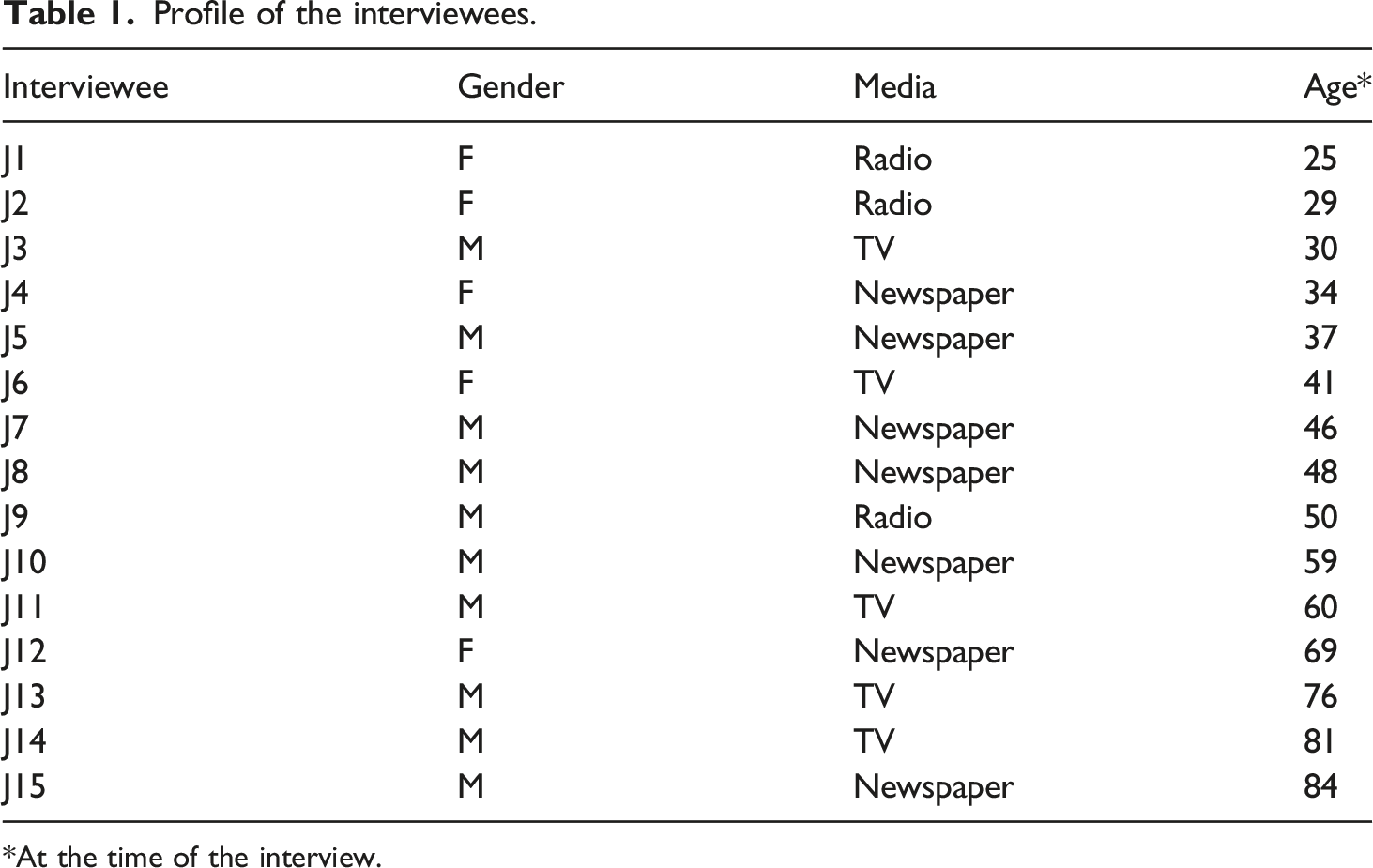
At the time of the interview.
To minimize bias due to social desirability, several strategies were used to create the interview guide, which was based on the research questions. However, the general design of the study and the focus on change and past experiences in professional life can already reduce answers that are biased by social desirability. However, since such bias is particularly important to consider in questions about journalistic self-perception, following Bergen and Labonté (2020), respondents were asked both whether their own self-perception had changed over the course of their professional lives and whether they perceived changes in this regard among third parties.
Findings
RQ1: How do journalists from different generations perceive changes in the relation(s) to their public(s) over time?
The relation to the public has become, as expected from the literature review, more complex and less unidirectional. So, relations with the public(s) are characterized by all interviewees from the generation of young professionals by greater interaction with the audience, especially through social media: “I don’t think we’ve ever been as out in the field and as close to the reader as we are now, especially through social media” (J4). This result is also described by Hanitzsch et al. (2016) as one of the most important changes in German journalism.
The exchange with the audience is seen as an immanent part of journalistic work and as a responsibility of the editorial boards. While on one hand this process is described as “democratization” (J5) and as a move away from “top-down attitudes” (J1), on the other hand, negative aspects of this reduction in distance, up to and including “shitstorms” (J5), are also noted. This development is also described by the senior professionals. Thus, interviewee J7 emphasizes that journalists “are attacked very personally, from more or less anonymous areas, but sometimes also very, very openly by people who don't hide much at all that they have total hatred for the person who wrote it”. This fact is underscored in particular by the retired journalists in our sample. They observe that the individual journalist nowadays must deal with sometimes unjustified criticism in social media. The retired professionals also see increased contact with audiences and the ability to engage in dialogue because of digital changes. Furthermore, they emphasize that young people in particular use digital channels to obtain information these days instead of newspapers, indicating that not only the relationship to the audience has changed but also the audience itself: Through cross- and multimedia and the different playout channels of a medium, the audience circle is expanded. Thus, a radio station, for example, can now reach not only the listeners via its homepage and social media, but also people outside the broadcast area.
In the interviews, it became clear across the generations of journalists that the relationships with the audience have also changed due to a stronger anticipation of the recipients' behavior and a greater relevance of the audience's interests. This occurs in the online segment by using modern analysis tools and algorithms. However, the now available insights into the number of hits and clicks on certain articles also lead to a change in journalistic content, which was particularly underscored by senior professionals J7 and J8: “Things that you used to think were necessary and absolutely newsworthy are being omitted where you've noticed that the hits on these texts are not recognizable in either the print or online business” (J7). Newspaper journalist J8 makes a similar argument, emphasizing that the number of hits on certain content directly influences the placement of articles on the front page and on the newspapers’ websites. Retired professional J13 also notes a change in this area: While audience ratings were considered a trade secret at the beginning of his journalistic career, they have increasingly become a comprehensive yardstick for judging the success and failure of produced formats. The expectations and reactions of the recipients have thus become an important part of journalistic work. However, this is also directly related to the economic considerations of the media houses.
RQ2: How do journalists from different generations perceive changes in economic circumstances over time?
Of the young professionals’ generation, one interviewee (J4) perceives increasing economic pressure in her own field of work, while other interviewees perceive increasing monetization pressure in journalism as a whole. However, the interviewees do not relate this perception much to their own professional situation. They rather explain it by the comparatively secure basis in public broadcasting (J1, J2, J3) or by the good financial resources at their company (J5). But one interviewee (J4) emphasizes that increasing economic pressure is not only related to the financial situation in the present but also to the question of which products can be used to finance journalistic work in the future.
Except for J9, the senior professionals also barely relate the increasing economic pressure within the industry to their own professional situation. Newspaper journalist J10 says that “the economic pressure has always been there. It has just shifted, and that has to do with the fact that the market is simply bigger.” The retired professionals, on the other hand, perceive a higher economic pressure now than they experienced when working in the field. TV journalist J13, for example, emphasizes that increasing economic pressure is the cause of changes in working methods. In particular, he criticizes the increasing pressure to monetize and lower wages in public broadcasting as this impedes independent reporting: “This also gives rise to the fear of journalists, as material and existential worries, to dare to do something” (J13). In addition, the retired journalists criticize in retrospect that in the past they started to put the news on the web for free: “What is free is not worth anything” (J13).
RQ3: How do journalists from different generations perceive changes to their working routines over time?
Regarding the changing structures of the journalistic work, which are closely linked to the technical changes in the work equipment and the digital transformation in general, the interview partners, both young and senior as well as the retired professionals, highlight above all the increasing importance of social media as part of journalistic work as well as the development of different formats for different playout channels in terms of cross- and multimedia. It can also be deduced from the quantitative data that German journalists see social media as having the greatest influence on news production in recent years and that the importance of technical skills for journalistic work has increased sharply (Hanitzsch et al., 2016: 5). This digital transformation has driven the restructuring of newsrooms and the emergence of new professional fields and positions, such as social media managers. One young professional (J4) described it as an increasing psychological burden that there is constant pressure to adapt to new digital channels although this restructuring cannot be understood as a completed process.
Other interviewees see the increasing media convergence as a challenge but also as a positive added value, as can be seen from the example of J8: “We have gained freedom because we are no longer bound to newspapers printed once a day, but have become more versatile in terms of time, channels, and storytelling methods. I already perceive that as a freedom.”
The interviewed journalists relate the changes in working routines across generations on the one hand to changed work equipment and on the other hand to the changes in working structures. Concerning the equipment and the associated technical framework, the retired and the senior journalists in particular describe the change from analog, linear journalism with black-and-white films in their cameras and typewriters on their desks to the use of computers and laptops in the 1990s and the associated digitalization of journalistic work as well as the successively increasing development of special journalistic formats in digital journalism.
Alternatively, the design options for journalistic contributions have also been adapted to these digital logics. Interviewee J3, who works for a television station, emphasizes that the style of TikTok videos in terms of faster editing techniques and the use of music, which is frequently used on TikTok, influences the design of the coverage. A radio journalist (J2) makes a similar argument, emphasizing that the scope for content creation is increased by moving topics from radio to social media. The radio journalist from the generation of senior professionals (J9) goes even further and explains that social media, to which he attributes the function of a teaser, are served first when a report is made, the homepage second, and the radio program third. Mattoni and Ceccobelli (2018) argue that audiences are much more fragmented today and that, because of this, media organizations need to produce content that can be shared on many platforms to reach these audiences.
Furthermore, the interviewees emphasize that the digital transformation also leads to growing competitive pressure. Indeed, German journalists consider that competition has intensified during the last years (Hanitzsch et al., 2016: 5). Thus, companies and politicians and other public figures no longer have to rely on journalists to disseminate their press releases; instead, they can share the relevant information with the public via their own social media channels or other digital distribution channels: Institutions, clubs, associations, cities, state governments and so on, all of which can nowadays disseminate information themselves, on all channels, they are no longer dependent on us to bring their information to the readers, and this naturally ensures that we have to think and work in a completely new way in the editorial offices, because we cannot be sure that the reader will only read it with us. (J4)
Especially the senior and retired professionals note an acceleration of workflows, which is increased by media convergence and the ability of almost anyone to disseminate stories and announcements. Newspaper journalist J7, for example, describes “to be the first on the market” as the overriding aim, referring not only to the audience but also to aggregators such as Google News because it is important “that Google carries our own program and not that of the competitor.” J7 attributes a very important role to intermediaries such as Google: Optimizing journalistic content for Google is described as an exceedingly time-consuming part of the job.
The retired journalists criticize above all the acceleration of working processes because of the digital transformation. They emphasize that the need for actuality nowadays leaves little time to conduct good research and to think critically about the content for the audience. This acceleration of working routines results in erroneous and unverified information, which can lead to fake news. In their eyes, this lack of time in today's world distracts journalists from the real work. According to the study’s quantitative data, many German journalists indeed consider the time limitation as highly influential in their work (Hanitzsch et al., 2016). Furthermore, some retired journalists highlight the dependence on “clicks” online. They take a critical view on how journalists are adapting to the digital sphere, and they are observing “more of the same” content wise and a decline in quality in journalism (J13).
RQ4: How do journalists from different generations perceive changes in their self-perception over time?
In their self-perception, the young professionals see themselves as a “fourth estate” (J1) and “detached observers” (J3) with the task of providing the public with independent information and acting as a corrective. Journalists’ self-perception of being detached observers is consistent with the results of Hanitzsch et al. (2016) quantitative survey in Worlds of Journalism. According to this, 82.5% of German journalists see themselves in the role of detached observer. However, the result of young journalists seeing themselves as the “fourth estate” is relatively surprising since the majority of German journalists (90.7%) want to report things as they are, and only 47% think they should monitor political leaders (Hanitzsch et al., 2016). We will know more about this with the third wave of data from the Worlds of Journalism Study. However, a change in self-perception is only of secondary importance in the generation of young professionals in our interviews, and they relate the change more to their general development in professional life and the discovery of their strengths and weaknesses.
One development mentioned by both young and senior professionals is the merging of editorial and marketing departments as a consequence of the changing economic conditions and the commercialization of the field. Thus, the interviewees increasingly see themselves as marketers of their self-produced journalistic content: The journalist has become much more of a marketer of his or her own work, which is a bit of a cultural break from the way journalists used to see themselves. To the point of: We carry our own name, our own face much more strongly to the market, and we are also active on social media under our own name. That's certainly a second important point, that marketing and editorial work much more closely together. (J8)
These expanded requirements for journalistic working routines also cause changes in the self-image of the senior professionals. TV journalist J11 emphasizes that he sometimes notices a superficiality in his own reporting in view of the increasing workload, while radio journalist J9 describes himself as a “maid-of-all-work” in view of the growing profile of activities. These differentiations of the professionals’ work and the requirements for journalists to be as broadly positioned as possible to be able to serve different output channels are mentioned by the majority of the young and senior professionals. This development was also observed in the quantitative data as 74% of German journalists want to provide the news that attracts the largest audience (Hanitzsch et al., 2016).
The retired journalists report that their self-image and the demands they place on themselves have not changed over time. The digital sphere brings new opportunities and thus new constraints. Retired television journalist J13 emphasizes that journalists are becoming more like service providers because nowadays the quota plays a bigger role than it did when it was a trade secret.
Discussion
So, how do German journalists from different generations reflect on the digitalization of journalism? The interviews indicate that the digital transformation of journalism can be understood as a multidimensional process in terms of the new, deeper exchange with the audience, in terms of economic affordances, and in terms of working techniques. As a consequence, at least some of the interviewed journalists also report changes in their self-perception. Our findings show that many journalists see themselves as marketers of their own work. Accordingly, there is a merging of production and distribution caused by the usage behavior of increasingly fragmented audiences. The reactions and expectations of recipients are also increasingly influencing journalistic content—especially through the use of online metrics (Nelson and Tandoc, 2019; Welbers et al., 2016). Thus, topics are initiated or discarded by the audience and their reactions even though they were originally considered newsworthy. In combination with the increased demands of cross- and multimedia, this leads to a redistribution of resources such that a further step would be to investigate whether these changed demands influence journalistic quality (Lischka, 2018; Spyridou and Veglis, 2016).
Following Humprecht et al. (2022), journalists' interaction with audiences, increased opportunities for participation, and online audience responsiveness in the digital age are hallmarks of the dimension of journalistic professionalism, which the authors adopted from Hallin and Mancini (2004) and further developed to reflect developments in the digital age. Within the democratic-corporatist model, in which Humprecht et al. (2022) count the Nordic countries—Finland, Norway, Sweden, and Denmark—as well as the German-speaking countries—Germany, Switzerland, and Austria—and the Netherlands, the respective media systems of these European states are characterized by a high degree of journalistic professionalism. In this regard, the extent of journalistic professionalism in German journalism exceeds that of other countries in the democratic-corporatist model (Humprecht et al., 2022). Accordingly, the inclusion of the audience and the responsiveness of journalists to the public as a component of journalistic professionalism in the digital age can also be confirmed in our study as a component of the German media system. Those who have already left the trade, the retired journalists, criticize the acceleration of working processes and the development toward cross- or multimedia. They see the changes in the relationships with the audience rather negatively as this means more work effort that should rather be put into researching the content. Above all, they criticize the trend toward adapting content to social media through clicks or consumers’ usage habits. However, it can be said that our data also revealed a certain consistency, especially in the self-perception of the journalists. The interviews confirm the previous quantitative data that German journalists continue to see themselves as detached observers. Most German journalists see journalistic ethics as a very influential factor (Hanitzsch et al., 2016), and it could be assumed that these ethics have remained stable over time, despite the change that is connected with digitalization. As observed by Nelson and Tandoc (2019: 1962): “Journalists balance their adherence to their dominant and traditional norms and practices with the need to adjust to changes brought by technology.”
It is essential to point out that our qualitative study has limitations regarding the comparatively small sample of 15 interviews and the focus on journalism in Germany. The 15 interviewed journalists can only provide their own personal views. The young professionals, in particular, have of course had a much shorter period of time regarding changes within their professional lives than the other two generations. This can be explained by the fact that this generation is just at the beginning of its professional career and, compared with the other respondents, may have experienced fewer processes of change over time. Nevertheless, qualitative research designs are suitable for investigating journalists’ self-perceptions, roles, norms, and routines even if these self-reports cannot rule out a discrepancy with the interviewed persons’ actual behavior (Agarwal and Barthel, 2015). Nevertheless, as previously outlined, our qualitative study was able to confirm certain findings from other quantitative studies.
Conclusion
The world of journalism is changing, and journalists are aware of these changes in their trade. Still, especially the self-perception of journalists has remained mostly consistent, as German journalists in general consider journalism ethics to be very influential and these ethics have remained stable despite digitalization (Hanitzsch et al., 2016). It seems as if the attitude towards the changes in journalism is a question of age. The younger they are, the less the journalists consider these changes a crisis, probably since they have never lived in the “good old days.” As shown through the quote by Riehl-Heyse (1995: 7) in the introduction, lamenting the crisis of current journalism may be as old as journalism itself, including forgetting about the crises of the past. Of course, younger professionals see the problems of self-marketing and the acceleration of news publishing, but they evaluate these changes less as a crisis and more as challenges and even chances.
The younger journalists we interviewed were more able to value the benefits of the digitalization of society, media, and journalism. They appreciate the fact that in the age of digitalization, people outside the original distribution and broadcasting areas can also be addressed by online offerings. This creates new opportunities, especially for local newspapers and local radio stations (Lechtenberg, 2018). This attitude toward changes as opportunities instead of as a crisis could be fruitful for journalism research as well: not to look back and see the dawn of journalism in the future, but to research current trends and develop perspectives for the future. Digital journalism will not be the end of journalism history (Hallin, 2009).
Footnotes
Declaration of conflicting interests
The author(s) declared no potential conflicts of interest with respect to the research, authorship, and/or publication of this article.
Funding
The author(s) disclosed receipt of the following financial support for the research, authorship, and/or publication of this article: This study is part of the project The Century of Journalism. The History of Journalism in Germany from WW I to Digitalization funded by the German Research Foundation (DFG) (BI 1918/3-1).
