Abstract
As the state of U.S. local journalism continues to deteriorate, contributing to growing news deserts and the proliferation of mis- and disinformation, alternative models for sustaining local news are increasingly paramount. One such alternative to the failing commercial model that deserves more attention, we argue, is the American public media system. While less robust than its international counterparts, the U.S. public media system tends to be less reliant on market support, less subject to commercial pressures, and more devoted to a universal service mission. This study explores to what extent the American public media system may serve to lessen the severity of the local journalism crisis. Drawing on interviews and conversations with two dozen public media practitioners and analysts, our research examines how public media could be reimagined and repurposed to better serve local information needs. We conclude that a renewed investment in the existing system in tandem with structural reforms presents a possible pathway towards a more sustainable future for local news.
As the U.S. local journalism crisis continues to worsen — with news deserts expanding and commercial print media in various stages of structural collapse — the market’s limitations in supporting the journalism that democratic society requires are increasingly evident (Pickard, 2020). Given this context, a potential alternative to failing commercial models that deserves more attention is the U.S. public media system, which tends to be less reliant on market support, less subject to commercial pressures, and more devoted to a universal service mission.
The current American public media system includes more than 1,500 public radio and television stations across the country, many of which are locally owned and operated. Further, many of these stations already serve as a source of local news and information in their communities (Shapiro et al., 2022) — especially in rural areas not well-served by broadband internet services (Corporation for Public Broadcasting, nd-a). Indeed, many public media stations across the country are already assuming greater responsibilities for local reporting in their communities. For example, some stations are acquiring legacy newspapers (Morell, 2022) or providing statewide reporting services (Schaffer, 2013). It is also noteworthy that the public media system itself enjoys uniquely high levels of trust among its audience (Ali et al., 2021). Nonetheless, bolstering public media’s local reporting capacity has thus far been given inadequate attention as a potential solution to the journalism crisis.
Any such analysis must consider various logistical, political, financial, and cultural constraints that present impediments to public media’s capacity to produce local journalism. Traditionally, much of the system’s emphasis has been on national programming — as well as cultural fare, such as jazz and classical music — and less on the production and distribution of local news (McCauley, 2005; Mitchell, 2016). Additionally, vast resource disparities persist between stations throughout the system, which complicates the capacity to produce costly original local journalism (Patterson, 2023). While a handful of well-resourced stations support entire newsrooms of reporters and editors dedicated to covering their respective locales, many smaller stations employ only one news director — or no journalists whatsoever (Lincoln, in press). Moreover, local news is often seen as the province of print media and commercial broadcasting, thus seeming counter-intuitive for many Americans that public media could step into the vacuum created by a receding newspaper industry.
Our study begins to ascertain what restructuring is necessary for American public media to meet such a challenge. Drawing from extensive interview data with public media practitioners, we examine how American public media could be reimagined and repurposed to better serve local information needs. We argue that, despite some constraints, a renewed investment in the system — and specifically in its ability to provide local journalism — presents one potential pathway towards a more sustainable future for local news. This reinvestment, we suggest, would enable the system to fulfill part of its founding mission: to guarantee all Americans access to the informational content that a commercial system is unlikely to ever provide.
Local journalism in crisis
In the last two decades, the commercial business model that previously supported local journalism has proven untenable. As advertising revenues have declined precipitously (Barthel, 2021), thousands of local news outlets have shuttered. Since 2005, the U.S. has lost nearly a third of its newspapers — approximately 2,900 publications — and almost two-thirds of its newspaper journalists (Abernathy and Stonbely, 2023). Importantly, while the concept of “local” is notoriously difficult to define (Ali, 2017), the present study takes up a definition used by Napoli et al. (2017) that understands local news as geographically determined. Specifically, the authors defined local journalism as “the journalistic sources that reside within, and are oriented around serving,” a given community (p. 378).
The disappearance of local newspapers has created news deserts, or communities without access to the sort of credible, comprehensive news and information that feeds democracy at a grassroots level (Abernathy and Stonbely, 2023). Even worse, repeated cycles of closures, layoffs, and cutbacks have resulted in the hollowing out of local news outlets, with many becoming “ghost newspapers” — publications that are mere shells of their former selves both in terms of reporting capacity and in readership. According to research by Abernathy and Stonbely (2023), approximately 55 million Americans live in one of the 204 counties that are presently considered to be news deserts or in one of the 1,562 counties with just a single source of local news. The market’s inability to support journalism and provide socially necessary public goods and services is a form of “market failure,” which typically requires policy interventions to correct (Pickard, 2020).
The stakes involved in such media market failures are considerable. Numerous studies demonstrate that the decline of commercial local journalism has consequences for individual communities, and for the health of American democracy more broadly. Extensive empirical research has shown how the closure of local news outlets leads to decreases in civic engagement (Shaker, 2014), weakened community ties (Mathews, 2022), and increases in political polarization (Darr et al., 2018). Existing research has also documented the effects of the loss of the traditional watchdog role of local journalism — a study by Gao et al. (2020) found that when local news outlets close, local governments experience greater municipal borrowing costs, which affects communities’ overall financial health. Research has also shown that the disappearance of high-quality, reliable local news leaves communities vulnerable to the spread of mis- and disinformation (Aufderheide, 2020). Finally, research shows that gaps in critical local news and information do not impact communities equally. For example, Hamilton and Morgan (2018) demonstrated how such gaps strongly correlate with socioeconomic factors, meaning that low-income communities are disproportionately harmed.
With a considerable body of scholarship documenting both the crisis in local journalism and its negative consequences, scholars, journalists, and industry professionals have looked to alternative models to sustain local news. One such alternative that should be seriously considered, we argue, is the existing American public media system.
The history and political economy of U.S. public media
When Americans think of public media, national entities like National Public Radio (NPR) and its television counterpart, the Public Broadcasting Service (PBS), typically come to mind. But the extent of the public media system is much more expansive, consisting of over 1,000 public radio stations (NPR, nd-a) and more than 300 public television stations (PBS, nd) across the country. About 75 of these stations are joint licensees, meaning that they hold licenses to broadcast both radio and television. These figures do not account for the many other noncommercial, listener-supported community media entities that could broadly be considered public media, like the Pacifica Network or college- and university-based broadcast stations. Additionally, national entities like American Public Media (APM), the Public Radio Exchange (PRX), American Public Television (APT), and the National Educational Telecommunications Association (NETA) comprise the larger public media system.
Throughout this paper, we primarily use the term “public media,” rather than “public broadcasting,” which has historically been used to refer to the national network of producers, distributors, and member stations. We argue that public media is a more accurate descriptor of the modern network, given that the system is no longer limited to terrestrial broadcast platforms and is engaged in podcasting, digital news, and online audio and video streaming.
The modern American public media system was founded just over 50 years ago, though its pre-history extends back decades earlier (Pickard, 2017; Shepperd, 2023). The early history of the current public media system can be traced back nearly a hundred years to debates over the role, function, and ownership of the emerging U.S. broadcasting system (McChesney, 1993). While the Communications Act of 1934 ensured that the system would be dominated by commercial broadcasters, defining their social responsibilities remained contested terrain throughout the 1940s and beyond (Pickard, 2015). At the same time, tireless media reformers like Charles Siepmann (Pickard, 2016) and a loosely associated grassroots group of educational broadcasters continued to advocate for the existence of noncommercial broadcasting through the mid-20th century (Mitchell, 2016; Shepperd, 2023). Thanks to these decades-long efforts, a network of noncommercial television stations was formalized at the recommendation of an influential report from the Carnegie Commission on Educational Television, which informed the Public Broadcasting Act of 1967. This legislation established the Corporation for Public Broadcasting (CPB) and served as the basis for the founding of PBS in 1969 and NPR in 1970.
The modern American public media system, however, differs from its counterparts abroad in several important ways. To start, the U.S. public media system is highly dependent on private funding from individual donors, philanthropic foundations, and corporate sponsors (Aufderheide, 1996). This is partially due to the relatively small proportion of public funding that the system receives when compared to its counterparts in other industrialized countries. While American taxpayers pay about $3.16 per person annually to fund public media, countries like Denmark, Germany, and Norway pay upwards of $100 per capita (Benson et al., 2017; Neff and Pickard, 2021).
Relatedly, the mechanism by which the system is funded in the U.S. differs considerably from its global counterparts. There are three primary models by which public service media are funded around the world: 1) license fees, 2) license fees complemented by commercial revenues, and 3) commercial revenues complemented by general tax revenues (Benson et al., 2017: p. 6). The American model stands on its own for its combination of general tax revenues — in the form of a federal appropriation totaling $475 million as of fiscal year 2023 (Corporation for Public Broadcasting, nd-b), which is approved by Congress and distributed by the CPB — philanthropic funding, and corporate underwriting. In recent years, corporate sponsorship has become NPR’s largest source of revenue, now accounting for 39% of its approximately $300 million annual budget (NPR, nd-b).
In addition to being comparatively under-resourced and uniquely funded, the American public media system currently reaches a relatively small proportion of the country’s population compared to its global counterparts. While the CPB claims that 98% of Americans live within range of a public media station, a recent study suggests that a much smaller proportion of Americans receive local news from their closest station (Lincoln, in press). Further, recent audience data from NPR estimates its total weekly audience at about 53 million people, or around 16% of the country’s total population listening on a weekly basis (Shapiro et al., 2022). Similarly, PBS estimates its total monthly audience at approximately 65 million people, or just under 20% of the country’s total population (PBS, 2021). In both cases, the networks’ audience reach falls substantially below the aim of universal, or near-universal, reach generally considered to be the standard for public service media (Schulz et al., 2019).
Despite these discrepancies, the American public media system remains an essential component of the United States’ larger news and information infrastructure. For one, public media is a highly-trusted source for news — a recent study argued that PBS “stands out as a rare, potentially unique space where viewers from across the political spectrum come for news and information” (Ali et al., 2021). Additionally, unlike much of the U.S. journalism industry, public media journalism is expanding. In their study, Shapiro et al. (2022) found that the number of public media journalists has grown from just over 3,600 in 2016 to more than 4,100 in 2021 (p. 12). Relatedly, public media journalists are filling gaps left behind by a retreating newspaper industry, especially public service reporting, such as statehouse coverage (Corporation for Public Broadcasting, 2022). Finally, and more broadly, numerous studies show that well-funded, independent public media systems are correlated with healthier, stronger democracies, and confer upon societies a wide range of benefits (Aufderheide, 2020: pp. 215-216; Neff and Pickard, 2021).
Such social benefits notwithstanding, the American public media system also has long-standing and well-recognized flaws. Scholars and practitioners alike have often critiqued the system’s failure to serve communities of color (Berkman, 1980), instead favoring audiences that are predominantly white, wealthy, and more profitable in terms of donations and corporate sponsorship (Chávez, 2021). Scholars have also critiqued the decentralized structure of the American public media system. As Rowland (2016) argued, the system has “many internally competing interests, without well-defined leadership and lacking any coherent internal capacity to think through and make major reforms and advancement” (p. 277), making it highly resistant to structural change.
Nonetheless, various models have been proposed to reinvent the U.S. public media system. Jolly and Goodman (2021) advocated for what they called a “full stack” approach to public media, borrowing the concept of a technology stack. The authors envisioned a “layered, interconnected network comprised of information infrastructures” (p. 4) operating according to civic principles that would include five distinct layers: 1) community anchor institutions, 2) the physical network, 3) distribution, 4) protocols & standards, and 5) content (p. 11). A prerequisite of such an approach, the authors argued, would require substantially increasing federal funding for public media and expanding the existing system to include the emerging network of digital nonprofit newsrooms across the country.
In a report for the Day One Project, Ross (2021) proposed one strategy through which this first step might be accomplished. With an eye towards reviving local public service journalism, Ross recommended that the executive branch work with Congress to accomplish two specific policy priorities. First, passing legislation that would expand the CPB’s purview to become the “Corporation for Public Media,” thereby making nonprofit digital newsrooms eligible for funding. Second, doubling the system’s annual federal allocation to just under $900 million — with 75% of the annual budget going towards local public service journalism — and appropriating the system’s public funds 10 years in advance to prevent political interference.
Many of these policy proposals (see also: Goodman, 2009; Shapiro et al., 2022) envision public media as a viable solution to the myriad problems facing local news and information infrastructures but diverge both in identifying specific challenges and the strategies for resolving them. Drawing on interviews with public media practitioners, this study aims to contribute to these ongoing debates and begins to explore how American public media could be reimagined and reformed to potentially help confront the local journalism crisis.
Research questions & methods
The present study is guided by two key questions:
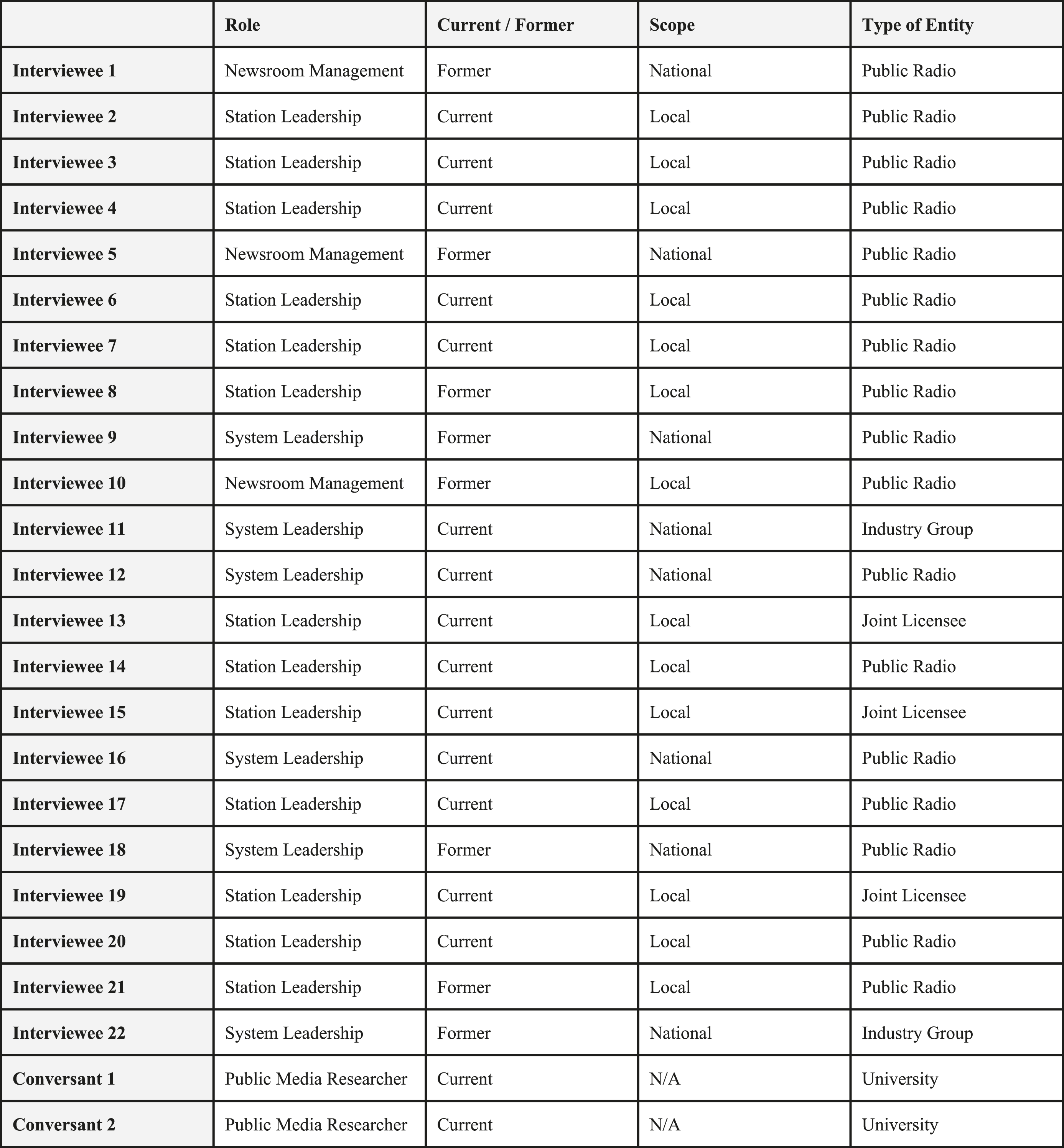
To begin to answer these questions, we conducted a first stage of 22 in-depth interviews with current and former public media professionals. Participants came from across the system, including from local member stations, national entities, and industry groups. 1 The majority of our participants were in station leadership or newsroom management roles, and most came from either public radio stations or joint licensees. The reasoning behind our participant selection was twofold. First, when compared with print journalists, public media practitioners in the United States have been relatively understudied. While scholars like Patterson (2023) have conducted survey-based research among public media employees, existing interview-based literature on American public media practitioners — and particularly public media leaders, such as station executives and newsroom managers — is very limited. Second, as other scholars have noted (Aufderheide, 2020; Shapiro et al., 2022), public radio has generally been more active in the provision of local journalism than its public television counterpart. Thus, we chose to focus our research on participants from public radio and joint licensee stations that are involved in the production and distribution of local news in their communities. In addition to newsroom managers and station executives, we spoke with several participants who were instrumental in the founding of American public media, who offered a historical perspective on the system and its evolution over the course of more than five decades. Finally, in a second stage of conversations, we spoke with two longtime scholars of American public media who contributed their perspectives on the current state of public media journalism.
Interview participants were identified through a combination of purposive and snowball sampling, and then contacted via email. Interviews were semi-structured and an interview guide was developed to address key themes. Broadly, participants were asked about their station’s (or organization’s) efforts to contribute to the local journalism ecosystem in their region, the role of public media in the larger journalism industry, obstacles to the provision of local news by public media, and the future of the system. All the first-stage interviews were conducted via Zoom, and transcripts of interview data were generated from audio recordings of the conversations. We separated the interview data according to several thematic categories (Braun and Clark, 2006), which are outlined below.
Data
An analysis of our interview data revealed five overarching themes. The first three can generally be understood as opportunities for public media journalism, while the fourth and fifth themes present structural impediments to the system’s provision of original local reporting.
Theme 1 — renewed focus on localism
Many of the practitioners we interviewed felt strongly that public media outlets should focus more on local journalism. One current station leader, for example, felt that “local news is the place where there is the most need, certainly in this community, and this environment, but nationally as well, in my opinion. And so that’s where we need to focus our resources.”
Others stressed that a commitment to geographic place and to local community required journalistic endeavors. “You’ve got to say, ‘Well, what’s the purpose of this organization?’ The purpose of the organization should be serving the local community,” another current station leader observed. The interviewee went on to add that, when compared to other news outlets in their communities, public media stations have the advantage of local ownership: “Let's call it the power of local control. These are not, you know, NPR-owned and -operated. We are, in one form or another, local community-based organizations in that we’re not part of a chain.” As a result, they argued, public media member stations are, as news organizations, “focused on the local community in a way that if you're owned by [national newspaper chain] Gannett or [hedge fund] Alden [Global Capital] is unlikely to be the case.”
Indeed, in recent years, many member stations across the country have begun to take advantage of their local position by providing more locally-oriented programming to their communities. According to our interview participants, this return to the public media system’s bedrock of localism has proven promising thus far: “Early indicators are that the theory holds. If you invest in real, civic news and make it available where people are, people will follow with their funds,” another station leader told us.
Interview participants revealed that a renewed focus on localism across public media has come partially out of opportunity, but also partially out of necessity. As one interviewee put it: We’re living in a time when you don’t have to go through your member station to get every bit of NPR content. So, the days of the local public radio station being the gatekeeper for NPR are over. And if you haven’t been building your local brand, then you’re behind.
This sentiment — that the survival of local member stations depends on their ability to provide a local service to their communities — was echoed by a former station leader: “that geographic monopoly is gone when you can stream any station you want. So, we had to provide an important local service to be able to sustain ourselves in the long term.”
However, stations’ and communities’ definitions of what constitutes a “local” service are open for debate. As one interviewee, a former station leader, noted: When we’ve surveyed our audiences and asked them about how they even describe ‘local,’ everybody describes local differently. And I think that’s always been the challenge in media in general. We can say local, but local can be so many different things.
As noted previously, “local” is a contested concept, but public media practitioners generally felt that stations’ understanding of what constitutes local should ultimately be defined by their communities. A current station leader observed that “there will always be a need for local, you know, ‘capital l’ local news gathering in the smaller markets. But the service you’re providing to your audience should meet their definition of what local means.”
Despite a renewed focus on localism and consensus around the need for public media to provide more robust local news to their communities, a recurring theme emerging from our discussions was that the greatest barrier to providing such services was insufficient resources. We discuss the disparities in resources across the system in detail below.
Theme 2 — existing network of stations and readymade infrastructure
According to our interview participants, the public media system’s single greatest strength as a potential pathway towards a more sustainable future for local news is its existing network of local member stations. Nearly all public media practitioners we spoke with through this research referred to the system’s robust infrastructure, which includes thousands of reporters on the ground in locales across the country, as well as national and international news services.
Owing to the system’s broadcast roots, the existing network also reaches rural and remote communities that may not have access to other sources of news and information — or even to broadband internet services. According to one current national system leader we spoke with, “public media covers more of the country than any other media out there. It covers from Alaska to reservations to very low-populated areas, like really uniquely.” While some gaps remain, among our interviewees, there was a sense that such a robust and wide-reaching system would be challenging — if not impossible — to replicate today. One current station leader observed, “we’ve already got people in all these places … It’s something you couldn’t really recreate. You couldn’t afford to recreate it.”
Additionally, participants felt that this established network of local journalists represents a competitive advantage for public media over other national news organizations that do not have the same robust local reporting capacity. As one current leader noted, CNN does not have a local station in virtually every community that is connecting that community with each other and to national news. Neither does The New York Times, The Washington Post and so on. If we can harness the power of the national local connection, we will deliver even better service for our communities.
Another station leader remarked that even small stations with very limited local reporting capacity can offer an on-the-ground, community-based perspective that strengthens the larger system. “Even when you have station communities that don’t have reporters, they still have human beings there who know the local issues, who are talking about the local issues,” they observed. “They’re with people across every political spectrum. And they are in the conversation, whether it’s personally or from a station point of view.”
Despite the existing system’s potential, there was also a recurring theme from public media professionals that their network of local stations is highly underutilized. As a result, they felt, the system is presently unable to live up to its promise. According to a current station leader, the system “should be one of the most powerful countervailing forces against misinformation and disinformation and confusion and ignorance. There’s a compelling need. There’s a resource base to build on. It’s in the one addressing the other that opportunity lies.”
Other public media practitioners we spoke with attributed the network’s underutilization to the system’s national entities, and specifically, to NPR. One current station leader expressed deep frustration with NPR’s attitude towards its member stations, explaining that they felt the national organizations do not fully appreciate the system’s unique potential: I’ve said to [NPR] very clearly, ‘First of all, you're missing an opportunity. But secondly, if you guys don't see the opportunity in this, I'm kind of waiting for The Washington Post to call me or The New York Times, because one day those guys are going to realize the thing that they're really missing is a very deep ability to cover local communities.’
While NPR has more recently begun emphasizing the collective value of its “NPR Network” (Falk, 2022), this sentiment was just one example of a larger recurring theme regarding weaknesses in the system’s leadership, which we expand on below.
Theme 3 — Public media journalism filling gaps & providing public service journalism without commercial pressures
Our interviews with public media professionals confirmed that local stations are already stepping in to fill the voids left behind by the disappearance of local newspapers. Multiple interviewees noted that, in recent years, their stations have become the largest newsrooms in their communities and, in some cases, their states. “More and more public radio stations are becoming the primary source of local news and information,” one station leader said. “I mean, with nine or 10 full time daily beat reporters, we’re the biggest newsroom in the state. We have the only investigative unit that I’m aware of.”
Particularly for stations that previously considered themselves a secondary source of news in their communities compared to the local newspaper, this newfound prominence also comes with a greater sense of responsibility. One participant observed that, “either by growth or attrition, we’re going to be the largest news operation in the state. And that takes on a very different level of significance and importance.” An interviewee from a member station in a major metropolitan area expressed a similar sentiment. “We have to think of ourselves as operating in the center of the media ecosystem. And that’s going to require us to operate in different ways,” they said. “And some of it is that we’re going to have to give some thought as to the health of the whole ecosystem rather than just the health of [the station].”
Public media stations are also filling topical — not solely geographical — gaps in their media ecosystems. Several participants mentioned that they began investing in coverage of certain topics when it became clear that their local newspapers were no longer able to provide sufficient coverage due to compounding layoffs and cutbacks. As a result, multiple public media stations have become the sole local source of news and information on topics including arts and culture, the environment, education, and state government. One interviewee, a station leader in a major metropolitan market, discussed how investing in a health reporter proved fortuitous at the onset of the COVID-19 pandemic: “Building the capacity in those areas positioned us to really step up and be a really important service during the pandemic,” they stated.
One reason public media can provide coverage on topics and locales not covered by newspapers and other for-profit media is because public media are not as beholden to the same commercial logics. While many stations rely on corporate sponsorship to some extent, one interviewee put it this way: “We don't buy dinner with clicks … which means that we can focus on public service journalism, which doesn’t always get the biggest audience, but sometimes can make the biggest impact.” Another interviewee observed that, unlike their commercial counterparts, public media are committed to universal service and to building solidarity among their communities: “We’re supposed to be — in ways that commercial entities just aren’t built — really focused on everybody.” As a result, they argued, public media has “an obligation, to really help stitch this place together in healthier ways and more equitable ways and to be, in many respects, a kind of countervailing force to all the divisive stuff going on in our society.”
Public media’s newfound prominence in their local media ecosystems and their relative freedom from commercial pressures does not negate the need to address historical weaknesses, particularly in serving low-income communities and communities of color. This includes reimagining strategies to reach communities that are ostensibly within public media’s coverage areas, but do not see themselves represented in public media. As one station leader observed, “Another opportunity for public media overall is to fill gaps in their cities. Like it’s just … sitting there in so many places. It’s hard. It’s really hard to do right.” Another current station leader suggested that the system may need to reevaluate its provision of news and information to reach those previously underserved communities: “Public media has never been great at serving the public,” they said. “So it’s really been for me, how do we close that gap and how do we fill in voids in the local information ecosystem? Like, how do we think beyond what is ‘news’?”
Addressing public media’s drawbacks while further reimagining its role in providing local news would require systemic change. The remaining two themes from our interview data focus on structural impediments to realizing public media’s potential to provide local journalism to all members of society.
Theme 4 — insufficient & uneven resources
Across the board, the most prevalent theme in our conversations with public media practitioners was a lack of sufficient resources to realize the system’s potential and its founding mission. Given that resources are distributed highly unevenly across the system, some member stations — often those located in major metropolitan areas — may have dozens of reporters and editors in their newsroom, while small-town and rural stations may only have one news director on staff running the station’s entire news operation (Lincoln, in press). As one station leader at a mid-size member station argued, “we have to agree that public media, in terms of news and information, is not even all over the country.”
One station leader felt that disparities in local news provision are due to challenges in drumming up financial support. “Local news and reporting are not easy to, you know, raise sustainable money [around],” they said. These concerns are particularly pressing for stations operating in small-town and rural communities. Another leader at a small member station noted that “in general, in rural places — and here being one of them — there are just less resources.” They voiced concerns about hitting a ceiling of audience support based merely on the community’s size and available resources: “If you’re in a rural place, the population is less dense,” they said. “But a question for us is, like, is there a plateau?”
These pervasive resource disparities are exacerbated, according to our interviewees, by a lack of system-wide coordination and collaboration. As a result, stations must focus on their own financial sustainability. According to one former member station leader, “just on a day-to-day practical level, the people who run local news stations and local organizations, they are just absolutely consumed by trying to keep their own organizations going.” Further, as one national system leader observed, “there’s a lot of duplication of effort … like building 243 different wheels to get the car to the same destination.” While efforts have been made to improve collaboration across the system (Corporation for Public Broadcasting, nd-c), some station leaders noted that the impacts of those efforts were not yet being felt in their organizations.
Theme 5 — structural leadership void
Perhaps the most troubling theme that emerged from our conversations with public media practitioners was an absence of leadership at the system’s upper echelons. As one former station leader succinctly put it, “the system is so dispersed, it’s so fragmented, that making systemic change is incredibly difficult because there’s no leader. There’s nobody running this.” Other interviewees described it as a “paucity of leadership” and “deep structural impediments,” observations supported by Rowland’s (2016) analysis. While the dispersed nature of the public media network was intentional — thus ensuring that the system’s power remained in the hands of stations that are locally-owned and -operated, as opposed to being dominated by national entities — the system’s structure also presents a barrier to implementing significant overhauls. As a former station leader opined, “until the people at the top of the system are willing to or are forced to figure out how to work out the business rules, how to work out the business alignment, I’m not sure things can be substantially better.”
Those familiar with American public media might assume that the national distribution entities, like NPR and PBS, would assume leadership responsibilities. As one current member station leader argued, this is a misconception: There’s no leadership organization for public media. And if you’re a listener, you think NPR is that … And they're not! And so there’s no one at the top being like, ‘Oh, we should be doing this.’ There's like hundreds of stations doing this and they’re treading water.
As this comment illustrates, the relationship between NPR and its member stations has long been both misunderstood and contentious. One current system leader illustrated the complexity of this relationship: “We need NPR to be a strong and healthy organization in order for us to survive,” they said. “But I’m also aware that … all the stations must put all their eggs in the NPR basket because NPR doesn’t want all these stations to be doing their own thing. So, everybody’s disincentivized to be innovative.” In other words, the system has historically been mired by conflicting interests between NPR and its member stations — primarily those of the financial nature, which are exacerbated by insufficient resources across the system — leaving the network without clear system leadership.
Altogether, our interview data from conversations with public media practitioners reveal both public media’s potential opportunities to better serve local information needs, as well as the structural impediments to the system’s provision of local journalism.
Analysis
Our analysis brings into focus public media’s unmet potential to achieve its original normative objectives to ensure that all members of society have access to a baseline level of news, information, and high-quality cultural fare. While a commercial system is not well-suited to satisfy all such democratic requirements, the worsening local journalism crisis — and the systemic market failures driving it — makes these under-served informational needs even more acute. Our analysis points to both the opportunities and constraints for public media to fulfill their historic mission while also rising to this new challenge.
Our interview data lend empirical support to the argument that public media remain an under-utilized resource for addressing local communication and information needs. While deeply ingrained norms and cultural practices — as well as failures in leadership at various levels of the public media system — account for some of the limitations in serving this public service role of localism, most of their impediments arguably stem from basic material conditions: most public broadcasting stations simply lack the necessary resources for maintaining local reporters and consistently producing high-quality news and information. This is especially true for rural areas and smaller towns who cannot depend on capital from engaged, well-resourced audiences and foundations to reliably fund original newsgathering in their communities.
Meanwhile, the CPB does have a dedicated fund to support local journalism initiatives. The fund was launched in 2010 to counter the decline of commercial local newspapers and foster collaboration among public media stations across the country (Jensen, 2010). According to Kathy Merritt, CPB’s senior vice president of radio and journalism, this work has primarily focused on journalism capacity building, to address the aforementioned disparities. “Across our universe of stations that we have, we decided on the collaboration front,” she said. “Are there ways that we can help [stations] by working together to accomplish things they couldn’t necessarily do on their own?” (2021, personal communication). Since then, CPB says that they have provided more than $42 million in funding to help launch 41 local and regional collaborations (Corporation for Public Broadcasting, nd-c), including NPR’s regional reporting hubs (Falk, 2021). More recently, CPB announced that it would provide $2.25 million to eight public media newsrooms to support coverage of state governments (Falk, 2023), with a focus on filling gaps in statehouse reporting identified through a 2022 study (Corporation for Public Broadcasting, 2022). Nonetheless, the general sentiment among our interviewees was that further investment in the system to provide local journalism is required to meet communities’ critical information needs.
One possible impediment to a renewed commitment to local journalism is the historical ambiguity regarding public media’s relationship to “localism,” which Jack Mitchell — NPR’s first employee, and former chair of its board of directors — noted during our interview is “the bedrock of public broadcasting” (2022, personal communication). But he also noted how that principle became somewhat dislodged as more of a top-down approach took hold whereby programming decisions were determined by NPR instead of local member stations. Mitchell was skeptical that local stations could confront gaps in coverage in news deserts without increased funding: If it’s subsidized by a government or a major foundation or the Corporation for Public Broadcasting, then anything is possible with enough money. If it depends on advertising or underwriting support, then it’s harder because it’s no easier for public broadcasting to do it than any other commercial broadcaster. (2022, personal communication)
Bill Siemering, NPR’s first programming director, also referenced these early historical struggles over defining the organization’s mission, which led to a focus on delivering national news to local communities instead of generating original reporting from local stations (2022, personal communication).
Finally, it must be underscored that because so much of public media’s revenue is dependent on private capital — especially corporate underwriting — its current funding model presents structural vulnerabilities connected to market failures, fluctuations, and ideologies. To give a recent stark example of this structural weakness, NPR laid off 10% of its staff to make up for a $30 million gap in its budget caused by a slowdown in advertising and a significant decline in corporate sponsorships (Robertson, 2023). Allowing our public media to be subjected to the mercy of these market dependencies should raise red flags: it defeats the purpose of having a public media system, which, by definition, is meant to be non-commercial.
This economic precarity was not foreordained. The broadcast historian Robert Avery (2017) notes how a particular funding model was a key recommendation in the original Carnegie Commission report (which served as a blueprint for what became public broadcasting) that was never implemented. In its original vision, the Carnegie Commission called for guaranteed and insulated long-term financial support based on a trust fund that drew public monies from a 2-5 percent excise tax on television sets. Instead, public broadcasting has been subjugated to an annual appropriation process and paltry federal support, forcing public media outlets to seek out private underwriting from corporations, foundations, and individuals. Perhaps the lesson here is to return to the original sin of American public media — a funding model doomed to economic and political weakness — and finally support the system in line with global norms (Neff and Pickard, 2021).
Conclusion
Drawing on interviews with practitioners, our analysis draws attention to American public media’s unmet potentials and structural constraints that prevent the system from focusing more on providing local news and information to all members of society. This predicament is especially noteworthy given that local journalism is rapidly disappearing, causing profound democratic deficits across the United States. However, public media’s deficiency to serve its historical mission or meet contemporary challenges was neither inevitable nor is it necessarily permanent. With the right policy interventions, adequate resources, and accountable, systemwide leadership, a revitalized public media system could still fulfill its necessary role. Empowered to do so, public media outlets could support dedicated journalists to cover vitally important issues neglected by the crumbling newspaper industry — from covering school boards and state legislatures to investigating how the climate crisis is affecting local communities and what we should do about it.
Guaranteeing the resources needed to confront this void remains a daunting task, though ambitious proposals are beginning to emerge (e.g., Pickard, 2023). Regardless, we shrink from this challenge at our own peril. Growing bodies of research show the detriments to democracy caused by losing local news; the potential benefits that public media confer upon democratic societies; and how the U.S. is a global outlier given its paltry federal expenditures toward public media (Pickard, 2020). Remedying these problems may require that we treat our public media as we do our public education system: to directly peg such systems to the mercies of unfettered market forces would be the height of folly.
Ultimately, the U.S. public media system is a critical information and communication infrastructure whose potential capacity remains grossly underutilized. The local journalism crisis provides us with an opportunity to redefine public media’s role in democratic society — and to finally support it with the resources required to serve that essential role. A landmark reinvestment would ameliorate the strained relationship between national entities and their member stations, but radically democratizing public media’s current leadership structure is also necessary to fully realize the system’s potential. In the meantime, as the health of local journalism only worsens, the question remains: Can we as a democratic society empower public media to confront this historic challenge? Understanding public media’s democratic potential, as well as the system’s current limitations, is a first step towards answering this key question.
Footnotes
Declaration of conflicting interests
The author(s) declared no potential conflicts of interest with respect to the research, authorship, and/or publication of this article.
Funding
The author(s) received no financial support for the research, authorship, and/or publication of this article.

Note
Appendix
Interview participant summary.