




Abstract
It is frequently claimed that mainstream news organisations are in crisis and becoming ever more marginalised in the contemporary high-choice media environment. Such claims frequently conflate different challenges facing the industry, resulting in over-generalised claims about the prospects for established news brands. In this article, we identify four related crises: reach, resource, reputation and relevance. Through the analysis of each, we show that many claims about the displacement of mainstream news are overstated, but that the interactive aspects of these crises are presenting particularly significant challenges for local news production and news organisations orientated towards impartiality norms.
Keywords
Introduction
Doubts about the power of mainstream news media have long existed. They are at the core of free-market media theories that celebrate the sovereign will of the consumer in the media consumption mix. They are also evident in a ‘limited effects’ orthodoxy that emerged with experiments and voting surveys in the mid-20th century and which is still accepted as axiomatic in many quarters of political science. These views have attracted strong criticism but more recently a new scepticism about the power of mainstream news media has emerged that begins from a different premise. It proposes that the influence of legacy news providers is draining away due to the emergence of social media and other digital information networks.
This view is frequently expressed by leading industry insiders who look back with nostalgia to the days of a lower choice media environment. The ex-editor of UK The Sun newspaper, Kelvin MacKenzie (2020), recently lamented ‘the days of newspapers are drawing to a close and as their circulations collapse, so does their power’. Professional doom-mongering is also evident in the ways mainstream news media tend to report industry analysis of emerging trends in news consumption (e.g. ‘TikTok, TikTok. . . Time Running Out for the Old Style BBC’, The Sun, 23/1/2021: 15).
Compatible claims can be found within media research. For example, Habermas (2022) recently stated that ‘we need to get clear about the revolutionary character of the new media. For this is not just a matter of an expansion of the range of media previously available, but of a caesura in the development of the media in human history comparable to the introduction of printing’ (p. 158). While others may avoid such epochal declarations there has been a reordering of research priorities that suggests Habermas and others’ displacement thesis is gaining momentum. As a recent review of leading communication journals concluded: ‘Scholars seem to pay comparatively little attention to what is actually more stable, persistent, or durable over time’ (Driessens, 2023: 2). With regard to news production, Hallin et al. (2023: 5) note ‘a profound change in the sociology of news from seeing news as produced by organizations, institutions or a profession with clear boundaries, to seeing it as produced by networks of heterogenous actors’.
While aspects of this shift have merit, there are risks in under-estimating the durability and significance of legacy news institutions at the heart of contemporary information ecosystems. The news industries in most democracies have confronted significant challenges over recent decades. Some of these have been created by digitalisation while others have deeper roots, but these do not constitute an existential threat for the most well-established news brands. Rather than asking ‘Will legacy news organisations survive?’ we should be asking ‘How are the most powerful news organisations securing their economic survival and with what democratic implications?’ An important step in this re-focusing is to recognise that what is often portrayed as a singular crisis is actually a series of linked but distinctive challenges: reach, resource, reputation and relevance. From this vantage point it is easier to appreciate that these crises are not as terminal as some suppose.
The crisis of reach
Claims about the crisis of reach rest on assumptions that fewer people are accessing legacy news output and, those that are, are ageing. Plenty of evidence appears to support this prognosis. Long term declines in printed newspaper circulations have accelerated over recent years. For example, in the 5 years before the pandemic, press circulation declined by an estimated 33% in the UK, 23% in Germany, 36% in the US and 39% in Australia. Television news consumption has been more resilient, but it is claimed that viewing figures are buoyed up by the loyalty of older viewers. Assorted surveys appear to indicate people are increasingly gravitating towards social media for their news (e.g. Newman et al., 2023; Nordicom, 2023; Ofcom, 2023). There are, however, three reasons why it is mistaken to see this as a zero-sum displacement process.
First, what does it mean to state that people get their news from social media? Social media are platforms not publishers and this distinction has been crucial in enabling tech companies to avoid statutory regulation. Content curation has enormous significance and we do not deny the importance of algorithmic gatekeeping. Nevertheless, news platforming remains a distinct and different phenomenon to the opinion informing rationales of news publishing. We need to consider what sources of information are being accessed through social media platforms.
Second, there is a need to adopt an institutional perspective when considering the reach of legacy news organisations. They are brands that exist online and offline whose masthead value becomes clear when digital reach is factored in. According to a recent estimate, 29.1 million UK adults accessed at least one established national newspaper per day (Pamco, 2023). Furthermore, many leading news brands are internationalising their reach. In 2023, four UK providers (BBC, Mail, Sun and Guardian) were listed in the top 20 most popular news sites in the USA, collectively accounting for 10% of all the traffic to those listed (Majid, 2023). News consumption surveys also provide ample evidence about the enduring primacy of legacy media, notwithstanding their propensity to conflate publishers and platforms. The Reuters Institute shows that, across 49 national and regional contexts, a legacy news outlet was the top-ranking outlet for reach in 53% of cases in 2023 and in 11 cases the first 5 ranked outlets were all legacy news outlets (Newman et al., 2023).
Third, many legacy news providers command a significant presence across social media. From a publishers’ perspective, platforms are ‘unavoidable partners’ (Turvill, 2022) and news organisations distribute and adapt their content via them to drive people to their sites to generate advertising revenue and monetise vertically integrated publishing opportunities (Meese and Hurcombe, 2020). Recent estimates suggest that more than three quarters of online legacy news content is accessed via ‘side-door routes’ such as social media, search and mobile aggregators (Newman et al., 2023: 11). From a platform perspective, social media have long harvested and aggregated legacy news content to populate users’ newsfeeds, much to the frustration of mainstream media organisations and regulators who are now seeking ‘carriage fees’ via new remuneration packages. From a user perspective, following the social media accounts of recognised news sites is a popular choice and this additional exposure occurs serendipitously, as such engagement frequently involves sharing and commenting upon information originating from legacy news sources (Tran, 2022).
The most recent Reuters Institute global news analysis provides relevant insights that amplify this third point (Newman et al, 2023: 13–14). Respondents confirmed information from mainstream news outlets was the most prominent source they ‘pay attention to’ on Twitter and Facebook, and these sources retain prominence behind ‘personalities (including celebrities and influencers)’ on YouTube, Instagram and Snapchat. Legacy news sources are only relegated to third place on TikTok (a situation many established news organisations are addressing). Furthermore, it is important to appreciate that these are not mutually discrete categories: the perorations of Influencers, celebrities and ordinary people are often informed by legacy news content, representing a modern exemplar of the two-step flow of communication.
These factors show that claims about a growing crisis of reach across the legacy news industry are overstated. As a recent 18 nation survey of news performance concluded: ‘media reach remains high’ (Tomaz and Trappel, 2022: 26). That said, digital adaptation has diminished the public profile of some established news providers. Local publishers have particularly struggled to cultivate an online presence and major reductions in circulations can be taken as indicative of their declining voice (Cairncross, 2019). The reach of the US local press has, for instance, reduced by 40% among daily titles and 54% for weeklies since 2015, even with online circulations included (Matsa and Worden, 2022). The crisis of reach in the legacy news industry is therefore partial not universal. It is the national rather than regional news brands that are proving best positioned to consolidate their domestic presence in the new digital markets and even exploit emerging transnational opportunities. The retention of reach in the new digital mediascape, however, is not the same as the retention of revenue, which leads us to the second crisis confronting legacy news providers.
The crisis of resource
In the pre-digital era, high advertising revenues, limited competition and stable circulations combined to deliver generous operating margins. The online revolution obliterated this business model. Newspapers lost considerable advertising revenue to digital platforms, alongside reductions in circulation income. In the UK, latest figures show newspaper advertising revenue declined by 48% between 2011 and 2021, as social media advertising expenditure increased 264% between 2017 and 2022 (see Statista, 2022: 13 and 24). Similar patterns pertain elsewhere.
The reduction in advertising income and loss of circulation revenue has proven calamitous for local commercial news providers, particularly with the migration of classified advertising online. In Sweden, local newspapers are estimated to have lost 71% of advertising income between 2011 and 2021 (Nordicom, 2022) while UK revenues have declined 67% during the same period (Statista, 2022). In the USA there was a 74% fall between 2013 and 2020 (Matsa and Worden, 2022). Unsurprisingly, more than 2155 American newspapers closed between 2004 and 2020 (Abernathy, 2020) and newsroom employment reduced by 56% (Walker, 2021). In 2019, the merger of Gannett and GateHouse media groups consolidated ownership of 20% of all US newspapers: the most dramatic manifestation of a wider pattern of corporate acquisition and concentration of control. In this transformative cycle, the strength of the regional newsnet has weakened, alternatively producing ‘news deserts’ devoid of local titles (Abernathy, 2020), or ‘ghost newspapers’, with thin editorial resources and diminished community connectivity (LeBrun et al., 2022).
We must avoid, however, generalising from the dire conditions facing local newspapers as being representative of the challenges facing legacy news production per se. Television news for example has weathered the digital turn reasonably well. In the UK, television advertising revenue increased by 11% between 2004 and 2020 (WARC, 2023: 12). In the US, TV news employment rose by 5% between 2008 and 2020 (Walker, 2021). In terms of major newspaper publishers, there have even been some significant stories of financial recovery, notably The New York Times which recorded an annual revenue of $2.3 billion in 2022 (up 11.3% from the previous year) and an operating profit of $348 million largely through increased digital subscriptions (Robertson, 2023). In France, the online readership of Le Monde quadrupled between 2016 and 2021, with editorial staff on permanent contracts growing by 68% between 2010 and 2021 (Dreyfus and Fenoglio, 2022). In the UK, The Guardian has reported consecutive revenues of £250 million in the past 2 years (Guardian Media Group, 2022: 4). In Germany, Die Zeit increased its total sales by 28.4% between 2019 and 2022 to €291.1 million (Pimpl, 2023).
What the examples of recent legacy media success demonstrate is that they tend to involve the most prestigious providers; existential threats are borne by smaller outlets. Larger news organisations have begun to adapt through a range of methods: new subscription models, increased digital advertising revenues, diversifying into other news formats, placing high quality journalism behind paywalls and so on. Survival ultimately comes down to atypical capacities related to deep pockets and brand loyalties. This resilience contrasts with the fortunes of several heralded digital-only entrants. For example, Buzzfeed closed its news section in May 2023 after a decade of growth then decline. Ten days later, Vice Media, once valued at billions of dollars, filed for bankruptcy.
The financial uncertainty surrounding digital news has been further shaped by the battle between publishers and tech companies over remuneration packages for content. Google and Facebook may have launched various licencing deals, philanthropic initiatives and ad revenue sharing schemes since 2015 that have provided millions of dollars to news publishers, but collectively these have neither satisfied the publishers nor removed the prospect of government regulation (Turvill, 2022). This was starkly demonstrated in 2021 when Facebook temporarily blocked all news content on its Australian feeds in response to the Canberra government’s proposal to impose a ‘fairer’ negotiation process over the value of news content. This standoff represents just the preliminary skirmish in a tightening global regulatory environment. In August 2023, Facebook and Google started blocking news content from their Canadian platforms in response to the passing of the Canadian Online News Act, which comes in to force at the end of 2023.
These actions have been justified by claims that publishers need platforms more than is the reverse case, given news content accounts for a very low percentage of sharing on platforms whereas new sites gain a large percentage of traffic via these means (Bossio, 2021). Critics argue that this calculus ignores the qualitative significance of authoritative news content to these platforms and that blocking threats are a negotiating tactic rather than a serious long-term prospect. According to David Chavern of the News Media Alliance: ‘Quality news drives engagement and also acts as an answer to many misinformation issues. They want it and need it. . . but they also want to minimise any compensation they may have to pay for it’ (Turvill, 2022). Time will show how this standoff plays out but the claim that platforms need the respectability conferred by trusted news brands is striking when it is frequently asserted that the reputational stock of journalists and news producers has never been lower. We identify this as the third crisis facing the legacy news industry.
The crisis of reputation
There are two dimensions to the crisis of reputation: the growing intensity of attacks upon news organisations’ integrity by political sources and declining public trust in mainstream media provision.
There is nothing new about criticism of journalists by politicians. Complaints, rebuttals and censorship have been a cornerstone of robust news management for centuries. What has intensified over recent years is the tendency for these to extend beyond criticism of what news organisations do towards an existential critique of what they are. These attacks are most evident in populist discourses, in which mainstream news organisations are excoriated as bastions of liberal elitism, at once demeaning and denying the interests of ordinary people. For many years such claims were marginalised, but electoral successes by bona fide populists and ‘strategic populist ventriloquism’ by established political actors for opportunistic purposes, have propelled these accusations into the political mainstream of many nations (Smith et al, 2021). Where such critiques gain leverage, it is striking that their principal targets tend to be serious news providers, in particular public service media. Intra-media competition has given further traction to these critiques, with powerful commercial operations often amplifying attacks on competitors along populist lines both for reasons of ideological congeniality and vested self-interest (e.g. the pursuit of media deregulation and privatisation).
Recent criticisms of the media have been emboldened by claims that public faith in legacy news providers has collapsed. This is the second component of the crisis of reputation and there seems to be plenty of evidence of mustering distrust. A recent 28 nation survey found ‘journalists’ to be among the least trusted professional groupings, alongside such motivated reasoners as ‘civil servants’, ‘bankers’, ‘business leaders’, ‘advertising executives’, ‘government ministers’ and ‘politicians generally’ (Ipsos, 2022). Other comparative research suggests that approximately only 4 in 10 people on average trust most news most of the time, with some nations recording double-digit declines in trust over the past 5 years (Newman et al., 2023). However, there is a complex picture behind these headline figures. The latter study also shows that levels of media trust are high in several democracies and in some cases have even increased over recent years (e.g. Germany, Greece, Sweden, the Netherlands and Finland). Public scepticism is also differentiated if we consider trust in individual sectors or outlets. For instance, trust in ‘news I use’ is consistently higher than ‘trust in news overall’, suggestive of a third person effect of scepticism about media that we don’t use (Gallup/Knight Foundation, 2020: 10). More generally, broadcast news, local news media and quality newspapers are consistently deemed far more trustworthy and reliable than other commercial news media, search functions, social media, video sites, messaging applications and online-only media (Jennings and Curtis, 2020; Ofcom, 2022; Park et al., 2022). There are, therefore, disconnections in the crisis of trust. Public confidence in legacy media sources is variable and, in many national contexts, in decline. Nevertheless, journalistic impartiality is still highly valued and news audiences are more likely to trust those news publishers that adhere to these normative values, despite political attacks (e.g. public service news providers) or material declines in their operational resources (local news publishers). However, just as some have suggested that citizens are disengaging from mainstream news, so a linked proposition has gained traction that powerful political sources no longer need to pursue media attention to influence public discourse. In short, it is claimed that the relevance of mainstream news media in the management of public opinion and debate is diminishing.
The crisis of relevance
The historical significance of legacy news outlets pivoted on their privileged access to domains of political, cultural and economic authority. Elites exchanged information with news organisations for publicity. The proliferation of new digital modalities has apparently disrupted, even fractured, this reciprocal arrangement. The concept of ‘disintermediation’ is deployed widely to describe the removal of intermediaries from supply chains but has obvious applicability within the field of media and communication research (Katz, 1988). In its cruder versions, it is assumed that we now live in a world in which powerful sources can side-line professional gatekeepers and communicate directly with citizens and consumers. This is said to have flattened and widened the communicative environment creating a new era of disintermediated democracy ripe for exploitation by populist actors. Donald Trump is often cited as an exemplar in chief (Morini, 2020). Renowned for his vituperative disdain for established news organisations, it has been suggested his garrulous and confrontational use of social media meant he ‘did not have to rely on media reporting and serious journalism – he was his own journalist’ (Wodak, 2022: 793).
These claims about Trump among others represent an oversimplification of contemporary conditions. Just as digitalisation has redefined rather than removed mediators in e-commerce (Wigand, 2020), so we need to appreciate how mediation has changed rather than vanished from the new information ecosystem. There is no question that new digital affordances have transformed political communication, with social media now integral to any form of promotionalism. Even so, legacy media still play a key role in channelling public discourse and widening as well as accelerating the circulation of content via digital networks. This was manifestly evident during Trump’s presidency, whereby his messaging was as much designed to engage journalists working in the Washington belt way as it was to mobilise disaffected citizens in nearby ‘rust belt’ states. Statistical comparison between Trump’s formal media engagements during his term and his five presidential predecessors reveal the main differences occurred in the nature of the interactions rather than their number (Kumar, 2020).
Trump consistently favoured informal exchanges over policy speeches and announcements, believing these to be highly effective for shaping the wider media agenda. In turn, mainstream news coverage of Trump’s unfiltered use of social media and unscripted interactions increased the reach of his messaging, oxygenated controversies, burnished his insurgent credentials, fuelled allegations of media victimisation, and diverted journalistic attention away from problematic opponents and policy terrains (Klein, 2018). If the concept of disintermediation has relevance to Trump’s tenure it is more appropriately applied to describe how his combative messaging signalled a new form of discursive governance that bypassed policy consultants, communication specialists, experts, executive agencies and media officers (Şahin et al., 2021).
A further challenge to the disintermediation argument is the significant continued investment governments and legislatures make in centralising news media relations in their communication operations. The most telling example of this is the retention of long-established news corps arrangements with membership typically governed by established accreditation procedures. Although these have been adapted to permit the entry of new digital news-providers, this has had only a marginal impact on the profile of these collectives For example, only 15% of all media organisations accredited to the EU press corps between 2002 and 2022 were online-only news outlets (Council of the European Union, 2022: 34). Table 1 compares which news organisations within five leading Anglosphere democracies enjoy official sanctioned access to their respective legislatures. In all contexts, media outlets founded in the pre-digital era command greatest organisational access and numerical presence.
Journalists’ access to legislature in anglosphere democracies by year of news outlet establishment.
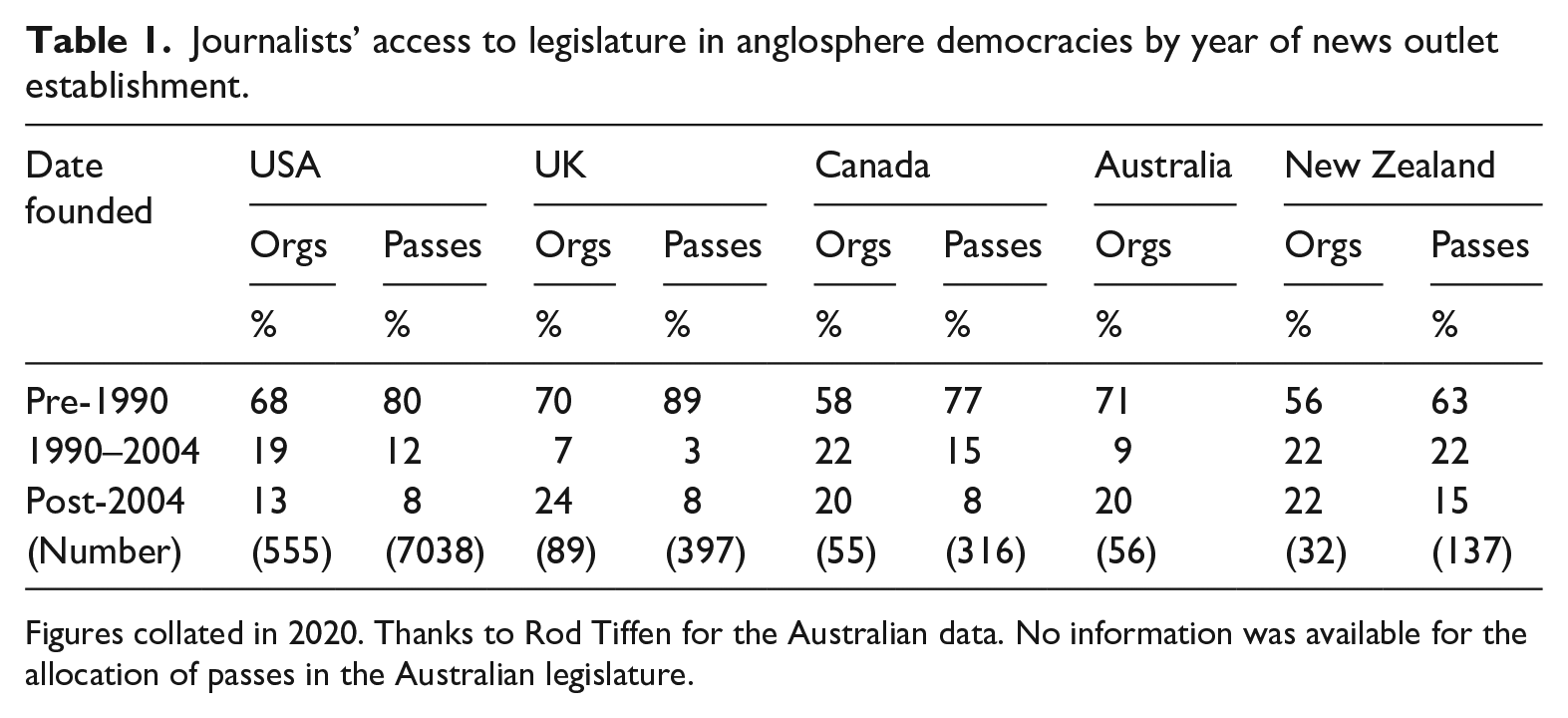
Figures collated in 2020. Thanks to Rod Tiffen for the Australian data. No information was available for the allocation of passes in the Australian legislature.
News corps fulfil multiple functions, a lot of which are designed to facilitate ‘above the line’ coverage (e.g. promoting policy announcements, responding to breaking news stories, reacting to the political interventions of others). Their greater significance, however, lies in the organisational framework they provide for ‘below the line’ messaging: activities that include flying policy kites, providing informal briefings, rebutting criticism and planting stories. This kind of information provision typically operates outside of collective briefings, via informal interactions, and requires oblique or non-attribution of sources. Seymour-Ure (2003) described this as ‘the paradox, mutually convenient to governments and journalists, that upon secrecy rests openness. Governments can put out more information, and media can report more, if this is done unattributably’ (p. 151). The enduring relevance of this observation was confirmed by a recent survey of journalists working in the Brussels news corps in which respondents identified ‘off-the-record press briefings organised by EU Institutions’ as by far the information they valued most highly (Council of the European Union, 2022: 20).
Political elites still need media elites, and vice versa. They do so for the mutual benefits that the confidential distribution and co-production of information delivers. It is simply not the case that ‘the political backstage. . . seems to be gone forever’ (Morini, 2020: 23). A clear sign of this ongoing elite entanglement is the ease with which individuals continue to move through the ‘revolving doors’ between political and journalistic domains. Another is the ‘open door’ between senior legacy media executives and influential political figures. In the UK alone, Boris Johnson met senior representatives of Rupert Murdoch’s News Corp 40 times in the first 14 months of his premiership (Tobitt, 2021).
Concluding comments
The purpose of this article has been to challenge claims that legacy news providers are becoming politically and culturally irrelevant in a contemporary high-choice media environment. By so doing, we are not seeking to deny the considerable challenges that confront legacy news providers. In many areas, operating margins remain tight, political pressures are intensifying, and public confidence is wavering. What needs to be appreciated is that these and other crises are being experienced at different scales across the mainstream news industry.
Overall, local and regional media are confronting the greatest pressures in terms of reach and resource, but they have higher reputational status with the public. Public service news media retain reach and public repute but find themselves under growing reputational attack from political sources and media competitors and this is beginning to threaten established resource streams. Large commercial media brands are extending their reach and stabilising their resource base, through a combination of editorial retrenchments, new business models, takeovers and other commercial enterprises. However, it is their partisan proclivities, particularly among the most market orientated organisations, that seem to be the focus of growing public distrust.
These factors generate two trends across the established news sector. First, the combination of crises is proving particularly challenging for news media orientated towards impartiality norms – that is, local news organisations, who have long recognised the commercial imperative of optimising market reach in a limited geographic space, and public service media, whose statutory regulation compels the observation of internal diversity norms (Deacon and Stanyer, 2021). Second, there is a weakening of the spatial orientations of legacy news organisations. Many surviving local news providers are being hollowed out and their community connectivity is weakening. At the same time many national news organisations are seeking to internationalise their reach. Much has been written about the negative democratic implications of the former trend, but to date there has been no consideration about the political implications of the latter. One possible consequence could be in enhancing the political relevance of leading national news-brands for powerful elites. There is certainly scant evidence that national governments and politicians are routinely bypassing mainstream media in their communication strategies. Established news organisations remain important referents and accelerants in the formulation and communication of public policy and links between political elites and media elites remain strong. If disintermediation is occurring, it is at local level and largely the product of necessity, as the tensile strength of the local newsnet weakens.
