



Abstract
The journalism-audience relationship is a key research topic within communication and journalism studies. Digitalization, which has transformed the relationship, has made it even more relevant to both journalism practice and research. There is a large body of literature that examines how the relationship between journalism and its audience has changed, what the mutual expectations are, and how the audience can actively participate in journalism. However, profound theoretical conceptualizations of the journalism-audience relationship are scarce, especially in relation to a digital media environment. Based on a systematic theoretical review, we compare different theoretical conceptualizations of the journalism-audience relationship in the digital age that are currently in use, and how they can be characterized and classified. Our analysis identifies six main theoretical approaches: (1) discursive, (2) expectation-based, (3) network-oriented, (4) technological, (5) parasocial, and (6) strategic-organizational conceptualizations. The literature review provides insights into how the multifaceted relationship between journalism and its audience is captured and described, and raises important questions for future research.
The relevance of the journalism-audience relationship
The relationship between journalism and its audience is a key construct. There is consensus that journalism is highly dependent on its relationship to its audiences and meaningful only in interaction with them (Loosen et al., 2020), and that the audience is a “constitutive part of journalism” (Loosen and Schmidt, 2016: p. 4). While the journalism-audience relationship 1 has always been a topic of interest (Larsson, 2013), its relevance has been strengthened by digitalization (Heise, 2014; Loosen et al., 2020). Loosen and Schmidt (2016) thus call the journalism-audience relationship “paradoxically […] both classical and emerging in the field of journalism research” (p. 4). Within the past years, an ‘audience turn’ emerged in journalism research—exemplified by a special issue of ‘Digital Journalism’ on ‘Advancing the Audience Turn in Journalism’, only recently published (Hess et al., 2022). In addition, several ‘relationship studies’, have been conducted in recent years that look at both sides of the relationship, such as analyzing the mutual expectations of journalists and their audience (e.g., Heise et al., 2014; Loosen et al., 2020; Schmidt and Loosen, 2015).
Despite its relevance for both journalism research and practice, the journalism-audience relationship has thus far rarely been theoretically modeled in a comprehensive way (Meusel, 2014). Moreover, there are few comprehensive theoretical frameworks that take into account current conditions such as the increased potential for interaction and participation in the digital age (e.g., Loosen and Schmidt, 2012; Meusel, 2014; Wilhelm et al., 2021). To the best of our knowledge, there is no current systematic review of how the journalism-audience relationship is being modeled in journalism studies, particularly in relation to the digital age. This article fills this gap by systematically mapping and comparing theoretical conceptualizations of the journalism-audience relationship in the digital age and deriving implications for future modeling of the relationship. To achieve this, we conducted a theoretical review based on a systematic analysis of peer-reviewed journal articles, edited volumes and books on the journalism-audience relationship published since 2000 in German and English.
Literature review and research questions
Digitalization has induced vast changes both for journalism, its audience, and the relationship between them (Schmidt and Loosen, 2015). Previously, the journalism-audience relationship was characterized mainly by top-down communication, and news outlets had limited knowledge of who their audience was or what their preferences were (Engelke, 2019; Wilhelm et al., 2021). Digitalization has fundamentally changed this: New technologies facilitate interpersonal exchanges between journalists and recipients (Engelke, 2019). News consumers have various ways of interacting with journalists and expressing their expectations (Holton et al., 2016). Audience metrics provide insights into how the audiences use and expect journalism (Vulpius, 2022). Journalistic work routines increasingly prioritize audience engagement, as exemplified by the acquisition of news content from the public through social media platforms or the distribution of news through social media to reach a wider and more diverse audience (also known as ‘Networked Journalism’, cf. Van der Haak et al., 2012). Artificial intelligence has opened up new possibilities for building trust and a stronger relationship with audiences (Robertson and Ridge-Newman, 2022). The journalism-audience relationship thus has inevitably grown closer and we have witnessed a shift to an open, more egalitarian relationship (Wilhelm et al., 2021). While in the past the audience was mostly seen as a target group from the production side, but mostly neglected in the production process for reasons of quality and independence, today the audience has a rather different role, with journalists seeking their audiences’ wishes and preferences in order to sustain their business (Costera Meijer and Groot Kormelink, 2019). Concepts such as participatory journalism (e.g., Singer et al., 2011), reciprocal journalism (e.g., Lewis et al., 2014), or audience engagement (e.g., Bruns, 2017) reflect these changes. However, some of the initial enthusiasm has given way to disillusionment: Studies show that few audience members are actually interested in participating in journalism (Loosen et al., 2020), and dark participation (Quandt, 2018), such as hate speech or attacks on journalists, has emerged as a problem—leading, in turn, to stricter content moderation or even the removal of interactive features (Engelke, 2023).
These developments necessitate a theoretical and analytical redefinition of the journalism-audience relationship (Kramp and Loosen, 2018). Despite its relevance as one of the key concepts in journalism studies, “comprehensive theoretical clarifications of the relation between journalism and audience still appear to be lacking” (Heise, 2014: p. 161).
Our analysis sheds light on which research threads consider the journalism-audience-relationship in the digital age. Thus, our first research question is:
Which research threads consider the journalism-audience relationship in the digital age? In order to map the conceptualizations of the journalism-audience relationship, the commonalities they share, the theoretical approaches that are used to model them, and the gaps in research, we also ask:
Which conceptualizations of the journalism-audience relationship in the digital age can we distinguish?
Which theoretical approaches do the conceptualizations of the journalism-audience relationship in the digital age refer to? How can we classify them?
Methodological approach
To answer these questions, we conducted a systematic theoretical literature review (Paré et al., 2015). Such a review presents a rule-based way for systematizing and analyzing scientific knowledge on a topic of interest, reflecting the status quo and identifying research gaps (Paré et al., 2015; Snyder, 2019). Although our theoretical review is qualitative in nature, it is based on a systematic literature search aimed at comprehensiveness.
Strategy of literature search
We performed a systematic database search of the literature from 2000 to March 2022 2 . Journal articles, edited volumes, and book chapters in English or German, the native language of the research team, were included. We searched two databases to find as many relevant publications as possible: SCOPUS and Google Scholar. 3
Based on a preliminary analysis of 30 publications, a list of terms describing the relationship was compiled as keywords for searching the databases. When these initial keywords were subjected to a first test run in the form of a Google Scholar search, it became apparent that some keywords identified largely irrelevant literature and were therefore excluded from further searches.
Building on the updated keywords, we conducted a SCOPUS search using the search string ‘journalis* OR news* OR nachrichten* AND recipient* OR rezipie* OR publi* OR audience* AND relationship* OR beziehung*’ 4 , identifying 3,422 potentially relevant publications that we reviewed for relevance. Two criteria were used to select our sample: (1) the presence of keywords from the three categories journalism, audience, and relationship in the title, abstract, or keywords, and (2) an apparent focus on the journalism-audience relationship in the abstract. After completing this manual review, 76 relevant publications remained in the sample. Based on the Google Scholar search, an additional 38 sources were added to the sample, resulting in a total sample of 104 accessible publications.
Code book and coding process
All sources were coded and analyzed using a qualitative, inductive-deductive content analysis following Mayring (2021). In addition to formal categories such as publication type, methodological approach, and general topic, the codebook consisted of three main sections reflecting the key concepts: journalism, audience, and their relationship. Subcategories were derived both deductively from our theoretical assumptions and research questions and inductively from the material (see Table 1 in the supplementary materials).
After an initial coding of all publications, we identified those that specifically offer an elaborate theoretical modeling of the journalism-audience relationship and used these as the basis for our theoretical review. Our study thus combines the advantages of a systematic, comprehensive analysis of a research field with the in-depth insights of a theoretical review. Coding was performed by the project leader. The codings were then discussed by the project team to ensure reliability. The software MAXQDA was used to support the coding process.
Results
Our review firstly shows that the journalism-audience relationship is increasingly relevant within journalism studies. In particular, since 2010, there has been a quasi-steady increase in publications on the topic—indicating a steadily growing importance within the field. The first ten years of our sample (2000-2010) account for only 19.2% (n = 20) of the publications. The vast majority of publications were published in the second half of our sample period (80.8%; n = 84), peaking in the last full year we considered, 2021 (13.5%; n = 14, see Figure 1). Number of publications between 2000 and April 2022.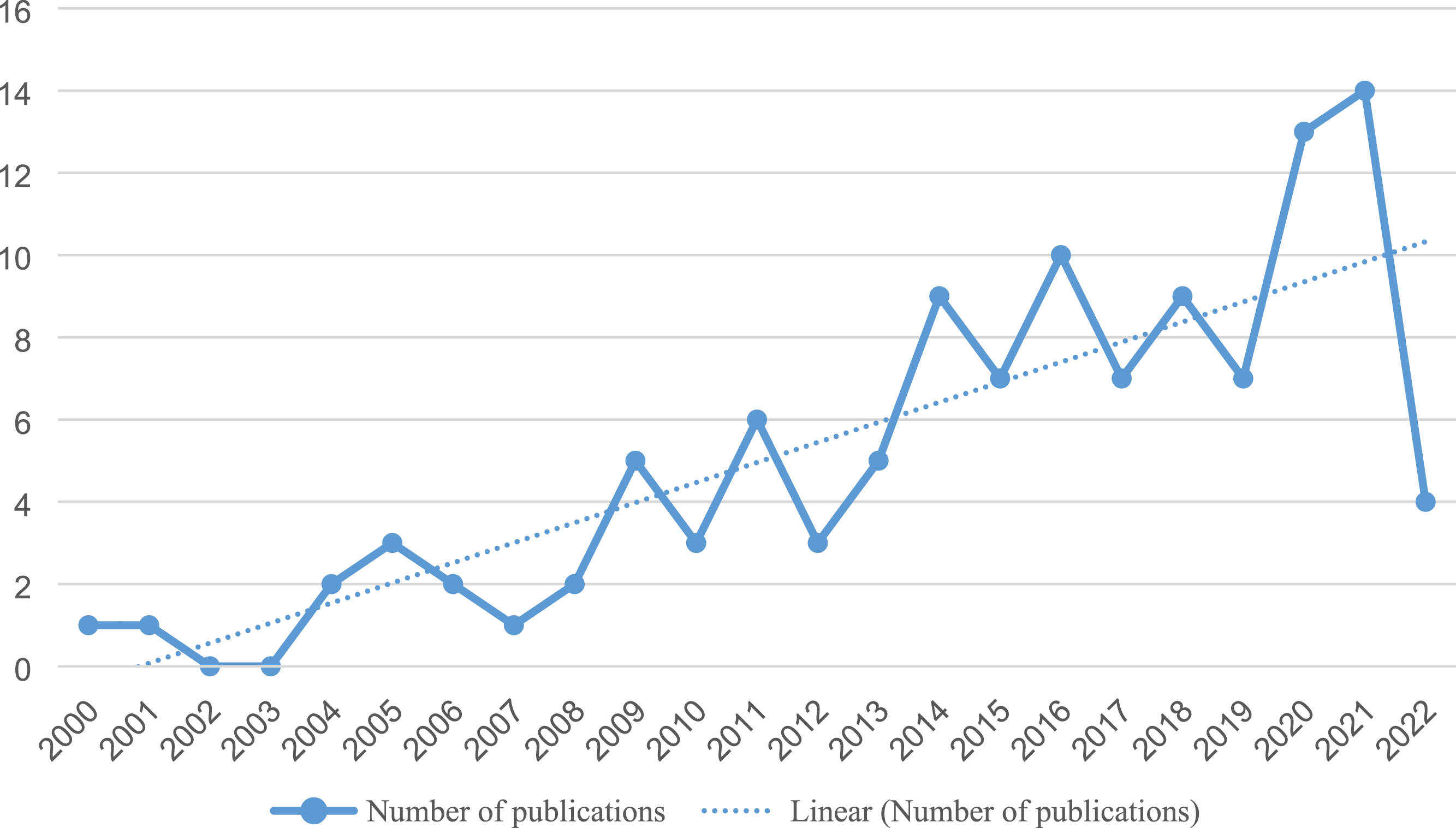
Research threads on journalism-audience relationship
To map the diverse field, we first asked which research threads address the journalism-audience relationship in the digital age (RQ1). In addition to the publications that focus primarily on the journalism-audience relationship (see the next chapter), the remaining publications in our sample can be mapped into the following overarching research threads (which are not necessarily to be understood as distinct): • Audience engagement: These publications deal with the concepts of ‘Audience Engagement’ or ‘Engaged Journalism’, which have gained growing attention in the past years. They ask how journalism can build and intensify a deeper bond with its audiences—an evident link to the journalism-audience relationship (e.g., Bruns, 2017; Ferrucci et al., 2020). • Expectations within the journalism-audience relationship: This thread analyzes how and which (mutual) expectations shape the journalism-audience relationship and to what extent these expectations are confirmed. Consequently, these publications deal with expectations as a constituent part of the journalism-audience relationship (e.g., Loosen et al., 2020; Wilhelm et al., 2021). • Media trust: These publications focus on the trust relationship between journalism and audiences. Trust is understood as a goal and as an indicator of the functionality of the relationship (e.g., Müller, 2018; Xia et al., 2020). • Participation: This thread deals with audience participation in journalism, and thus the extent to which audiences actively participate in journalistic processes (Engelke, 2019). These publications primarily address changes within the journalism-audience relationship, such as reciprocity or the distribution of power (e.g., Wang, 2016).
5
• Journalistic roles: This thread is concerned with journalistic role models and conceptions. It analyzes how journalists define their own role(s) and perform them in their work (e.g., Mellado and Van Dalen, 2017; Xia et al., 2020). Less frequently, audiences’ perceptions of journalistic roles are analyzed (e.g., Loosen et al., 2020). While this thread is clearly communicator-oriented, there is usually at least an indirect focus on the relationship. • Digitalization: These publications analyze digitalization and its impact on journalism. Relevant questions revolve around the changes taking place within journalism and how they affect the journalism-audience relationship. The journalism-audience relationship often frames the publication and appears as an overarching construct that is being transformed by the developments brought about by digitalization (e.g., Fincham, 2021; Spyridou et al., 2013). • X-Journalism: Following Loosen et al.’s (2022) term, we subsume in this thread publications that revolve around new reporting patterns within journalism. Examples include ‘Engaged Journalism’, ‘Public Journalism’, or ‘Constructive Journalism’. These publications deal with new forms of journalism, which are usually accompanied by a specific mode of relationship between journalism and the audience (e.g., Lough and McIntyre, 2021).
Several overarching research threads deal with the journalism-audience relationship in varying degrees of detail and depth: While the relationship is often used as an anchor to emphasize the relevance of the publication—without further elaboration in the following—there are only a few publications in our sample that deal with the relationship as a main topic and develop a theoretical framework that defines this relationship. In the following, we shed more light on these publications, their conceptual approaches to the journalism-audience relationship in the digital age, and the theoretical approaches used (RQ2). Furthermore, we classify them into overarching categories (RQ3).
Conceptualizations of the journalism-audience relationship
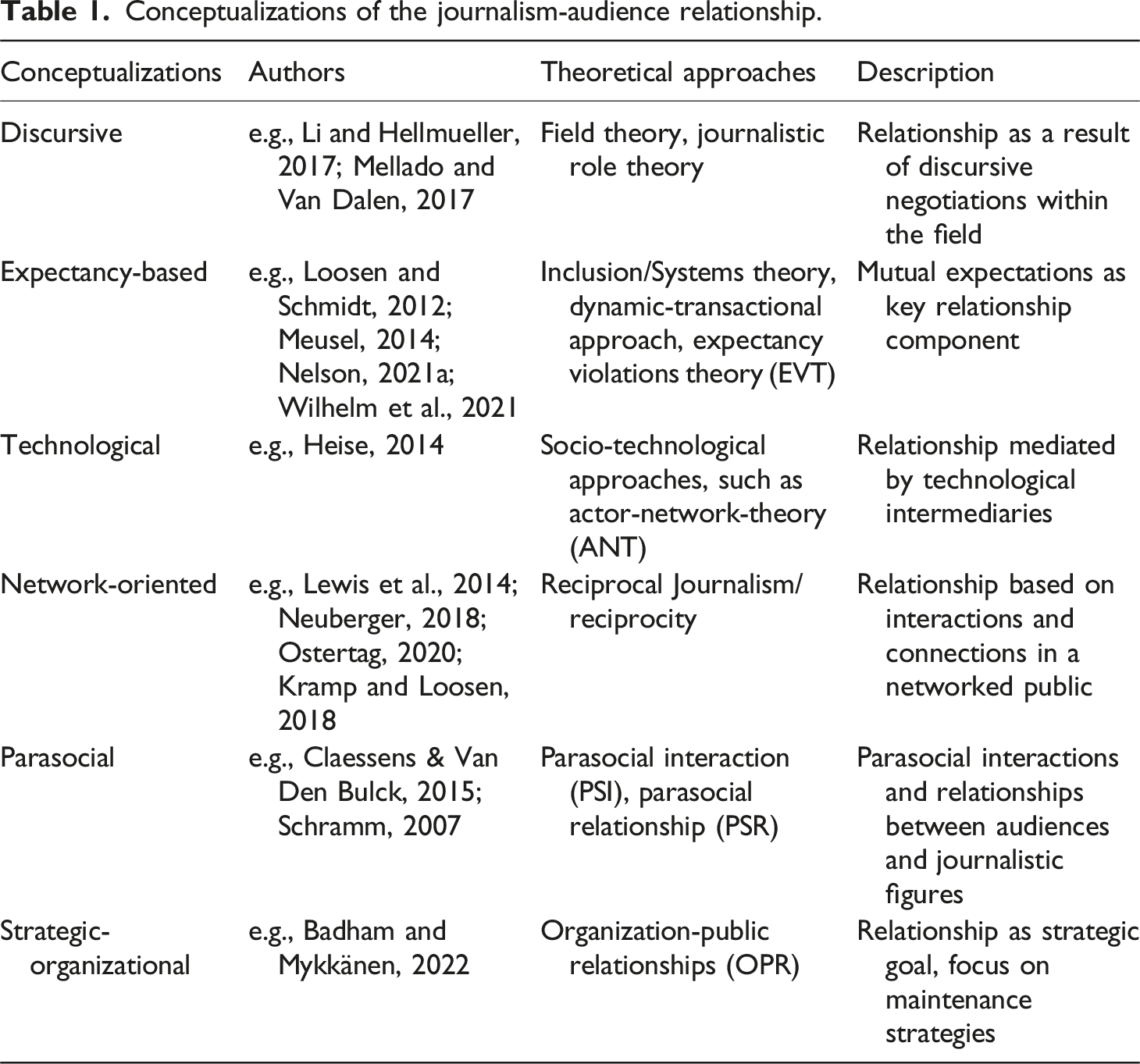
Conceptualizations of the journalism-audience relationship.
Discursive conceptualizations
In their study of participatory journalism, Li and Hellmueller (2017) draw on Bourdieu's field theory (1986) to describe the journalism-audience relationship. They conceptualize the collocutors as engaged in ongoing negotiations of their respective positions, as well as the power relations within the journalistic field. The relationship between both actors is determined and shaped by these processes (Li and Hellmueller, 2017).
In a similar vein, the journalism-audience relationship is also regularly addressed in the context of journalistic roles (e.g., Mellado and Van Dalen, 2017). Here, roles are seen as discursive constructions of journalistic identity that determine the positioning of journalism and journalists in society. Journalistic roles—and subsequently the journalism-audience relationship—can be understood as adaptive and discursively constructed. They are “outcomes of dynamic social negotiations” (Mellado and Van Dalen, 2017: p. 214), the result of power assessments between the collocuters involved. Discursive conceptualizations of the journalism-audience relationship are also closely related to the concept of boundary work (Carlson, 2016).
In sum, discursive conceptualizations see the journalism-audience relationship as the result of negotiations and power relations within the journalistic field (for this concept, see also Hanitzsch and Örnebring, 2019; Hanitzsch and Vos, 2017). Key components are boundary work (Carlson, 2016) and how journalism defines and differentiates itself from its audience. Accordingly, underlying theories are oriented towards social capital and professional self-image, such as Bourdieu's field theory (1986) or journalistic role theories.
Expectation-based conceptualizations
One of the most prominent conceptualizations of the journalism-audience relationship is the ‘heuristic model of audience inclusion in journalism’ by Loosen and Schmidt (2012: p. 874; see also Glück, 2021; Loosen and Schmidt, 2016; Schmidt and Loosen, 2015; Wang, 2016). In this conceptualization, inclusion theory and the dynamic-transactional approach by Früh and Schönbach (1982) are combined to model the journalism-audience relationship as a reflexive social relationship, characterized by a certain inclusion distance. With recourse to systems theory (Luhmann, 1995), audiences and journalists are seen as role-bearers within the journalistic system—journalists take the performance role, recipients the audience role. Audience inclusion in its minimal form takes place through the reception of journalistic selections, the acceptance of the journalistic communication offers (Heise et al., 2014). As a result of digitalization, complementary forms of audience inclusion have emerged (e.g., in form of participatory elements; Reimer et al., 2014). These inclusion forms are framed by mutual ‘inclusion expectations’ (Loosen and Schmidt, 2012). These expectations, in turn, determine the inclusion distance, which is key to the framework: the more congruent the expectations, the smaller the inclusion distance; the more divergent the expectations, the larger the distance. Thus, the journalism-audience relationship is characterized by mutual expectations and perceptions, and reciprocal images (Loosen and Schmidt, 2012).
Meusel (2014) also focuses on mutual expectations. In her conceptualization, she takes a critical stance on the thus far dominant para-interactionist view 6 of the journalism-audience relationship as mostly imaginary: Based on a social constructivist approach and Weber’s (1978) concept of social relationships, Meusel (2014) pleads for a shift away from a mass communication-oriented, top-down, one-sided conception towards an understanding of the journalism-audience relationship as a social one that is based on mutual expectations. She draws on Weber’s (1978) conception of social relationships as the “behavior of a plurality of actors insofar as, in its meaningful content, the action of each takes account of that of the others and is oriented in these terms” (p. 26). In that, social action within journalism is not solely limited to journalist-audience interactions—rather, all journalistic communications, including production and reception, are to be understood as social action in Weber’s sense. Meusel (2014) highlights the necessary recourse to generalized social expectations that enable, guide, and stabilize these mutual communications and are in turn (re)produced and institutionalized by them.
Expectations also play a key role in the Expectancy Violations Theory (EVT), originally by Burgoon and Jones (1976), which was applied to the journalism-audience relationship (Wilhelm et al., 2021; Lee, 2015). In the Journalist-Audience-Expectancy Model (JAEM), the journalism-audience relationship is defined as “recurring interactions” between journalism and audience, defining interactions as “reciprocal interrelated social action” (Wilhelm et al., 2021: p. 1006). The EVT posits that collocutors each have expectations about the interaction counterpart, the interaction, and the relationship (Burgoon and Jones, 1976). In journalism, expectations focus on three components: the media product and processes, the interaction counterpart, and the interaction with them (Wilhelm et al., 2021). These expectations can be confirmed or violated and lead to positive or negative outcomes, as each expectancy confirmation and violation is evaluated individually and in dependence on moderating factors such as the previous relationship—and can consequently be perceived positively or negatively, varying from case to case (Burgoon and Jones, 1976). Expectancy violations or confirmations can thus lead to a re-evaluation and updating of expectations as well as to follow-up processes such as integration or alienation. Expectations are thus once again the main building blocks of the journalism-audience relationship (Wilhelm et al., 2021). Compared to other expectation-based approaches, however, this conceptualization differs from previous models in its strong focus on interactions.
Another strand of journalism studies focuses on the concept of ‘imagined audiences’ (e.g., Coddington et al., 2021; Ferrucci et al., 2020; Nelson, 2021a). This approach assumes that there is no comprehensive knowledge of audiences within newsrooms, so journalists develop their own ideas about their ‘imagined audience’—the people they believe they are communicating with (Nelson, 2021a). This constructed image of the audience, which is adjusted accordingly when confronted with new information, guides journalistic expectations (Coddington et al., 2021: p. 1030). As in many conceptualizations analyzed, the journalism-audience relationship is primarily determined by two components: the assumed expectations of the audience and the degree to which these are met (Nelson, 2021a). 7
Technological conceptualizations
Heise (2014) takes a technological approach to conceptualizing the journalism-audience relationship. She emphasizes the role of “bridging technologies” (p. 155) that have been neglected in other conceptualizations. In response, she argues for the explicit inclusion of technologies as structuring mediators and facilitators when modeling the multifaceted journalism-audience relationship. The concept of bridging technologies refers to “technological objects as interfaces between journalism and audience” (Heise, 2014: p. 155). Building on socio-technical approaches such as those of Fortunati and Sarrica (2010) and actor-network theory (e.g., Primo and Zago, 2015; Spyridou et al., 2013), Heise (2014) postulates that bridging technologies restructure the journalistic profession and act as mediators and negators of power within the journalistic field and journalism’s relationships with audiences. In her conceptual model of the journalism-audience relationship mediated by bridging technologies, Heise (2014) includes both human (journalism and audience) and non-human (media technologies) actors, their relationships and interactions with each other, as well as their functions, roles and characteristics, and their mutual influence within the relationship.
Network-oriented conceptualizations
Lewis et al. (2014) introduce the concept of ‘reciprocal journalism’ as an analytical framework of the journalism-audience relationship in the networked public sphere. 8 Reciprocal journalism can be understood as “a way of imagining how journalists might develop more mutually beneficial relationships with audiences across three forms of exchange—direct, indirect, and sustained types of reciprocity” (Lewis et al., 2014: p. 229). Reciprocity is defined as an exchange between two or more interactants that has mutual benefit as its stated goal (Kligler-Vilenchik and Tenenboim, 2020; Lewis et al., 2014). To contribute to relationship building, such an exchange does not necessarily have to take place between two identical interactants (direct reciprocity), but can also take place in an indirect or generalized form (indirect reciprocity; Lewis et al., 2014, referring to Molm, 2010). In journalism, both forms of reciprocity are possible: direct reciprocity occurs when journalists and audiences engage in a ‘one-to-one’ exchange, such as through reader emails. Indirect reciprocity involves such “exchanges that are witnessed by others and intended for community benefit, in a one-to-many fashion” (Lewis et al., 2017: p. 166). Lived and sustained reciprocity is assumed to have multiple benefits: mutual trust, a sense of community, and sustainable connections (Coddington et al., 2018; Kligler-Vilenchik and Tenenboim, 2020; Lewis et al., 2020). Particularly in digital media environments there are multiple possibilities for reciprocity that open up areas for relationship building—reciprocity may thus “well be influential in rethinking the relationship between journalists and audiences” (Coddington et al., 2018: p. 1042).
Ostertag’s (2020) conceptualization of the journalism-audience relationship draws on practice theory and understands journalism “as relational social practices” that are “rooted in reciprocal relationships between news communicator and news consumer, around news content” (p. 2853). According to this understanding, the journalism-audience relationship is based on social exchange: media provide audiences with information and news; audiences offer attention and appreciation in return. A key component of this relationship is a mutual “sense of reciprocity, and the mutual support and dependency between communicator and consumer around news content” (Ostertag, 2020: p. 2853). Each relationship party provides important services to the other that are needed and valued by the counterpart—which in turn generates mutually positive feelings and motivations that “foment an ongoing, symbiotic social relationship of mutual support and dependency that both spans boundaries of time and place, while manifesting within particular historical and cultural contexts” (Ostertag, 2020: p. 2857).
Similarly, Kramp and Loosen (2018) suggest the social-constructivist concept of ‘communicative figurations’ as analytical framework to analyze the journalism-audience relationship. Communicative figurations are characterized by three main factors: (1) specific actor constellations, defining the structural basis of the figuration, (2) a shared frame of relevance that provides a common orientation, and (3) communicative practices that the figuration emerges on and that are related to a specific media repertoire (Kramp and Loosen, 2018; see also Hepp and Hasebrink, 2017). Based on these constitutive factors, the concept of communicative figurations helps to analyze how journalists and audiences form a relationship and how digitalization has altered this relationship—for example, in terms of a differentiation of media and communicative practices, a new sense and form of connectivity, or the ubiquity of interaction and audience feedback (Kramp and Loosen, 2018).
Another conceptualization of the journalism-audience relationship is the “theory of the dynamic and integrated networked public sphere” (authors' translation), which Neuberger (2018) applies to the journalism-audience relationship. According to this framework, the networked public sphere is constituted by senders and recipients (‘nodes’) that connect with each other and establish relationships (‘edges’) through acts of communication. In the context of journalism, acts of communication in their basic form are established through the sending and receiving of content, and more intensively through mutual interactions—similar to Meusel’s (2014) conceptualization. The notion of a networked media system and a broad understanding of actors as nodes not only allows for an inclusion of technology as acting and mediating entities—in the spirit of bridging technologies addressed by Heise (2014)—but also epitomizes the “decentralized and egalitarian structure of the Internet”, especially “in contrast to traditional, that is, hierarchical and unidirectional journalism” (Neuberger, 2018: p. 56, authors’ translation).
Parasocial conceptualizations
Another conceptualization of the journalism-audience relationship with a long history within journalism studies is that of parasocial relationships. Auter et al. (2005) describe parasocial relationships as a “mock-interpersonal relationship” (p. 189) between audience members and ’personae’ within media offerings. The basic assumption is that media consumers ‘interact’ with actors appearing in these media. Due to their similarity to interpersonal social interactions, these interactions are referred to as parasocial interactions (Auter et al., 2005). Through these parasocial interactions, audiences move from a passive state of reception to an active role and relationship with media content and its actors. If such rather short-lived parasocial interactions occur repeatedly, parasocial relationships can develop (Claessens & Van Den Bulck, 2015; Schramm, 2007). Although these relationships are often compared to ‘classical’ social relationships, especially in terms of their emotional effects, some differences are obvious, such as their lack of reciprocity (Auter et al., 2005; Claessens & Van Den Bulck, 2015).
Strategic-organizational conceptualizations
In their analysis of the journalism-audience relationship, Badham and Mykkänen (2022) refer to the theory of Organization-Public Relationships (OPR), which originated in public relations research. This research thread is primarily concerned with how relationships between organizations and their publics, or applied to journalism, relationships between journalism and audiences, are cultivated and what strategies can be used to maintain and strengthen them (e.g., disclosure, information dissemination, engagement; Badham and Mykkänen, 2022). Audiences are conceptualized as one of the media’s stakeholders with whom relationships must be cultivated and maintained. As with networked conceptualizations, mutual benefit is seen as a key component and goal of the journalism-audience relationship (Badham and Mykkänen, 2022). To model the relationship, organization-public relationships are defined as “the state which exists between an organization and its key publics in which the actions of either entity impact the economic, social, political and/or cultural well-being of the other entity” (Ledingham and Bruning, 1998: p. 62). Badham and Mykkänen (2022) also discuss ‘relationship antecedents’, which are the various motives, needs, perceptions and norms that precede the relationship, and ‘relationship outcomes’, which are the products of the relationship, such as loyalty and satisfaction with the organization’s products (see also, Broom et al., 1997).
Discussion and conclusion
This study provides an overview and mapping of the diverse theoretical conceptualizations of the journalism-audience relationship in the digital age.
The journalism-audience relationship is a topic of increasing interest within journalism studies, as our literature review showed. Current developments (such as audience skepticism or declining revenues) as well as societal issues (such as digitalization or the COVID19-pandemic) contribute to the focus on the journalism-audience relationship. However, few publications in our sample provide a comprehensive theoretical framework for this relationship.
To map the conceptualizations, we distinguished six overarching categories: (1) discursive, (2) expectation-based, (3) network-oriented, (4) technological, (5) parasocial and (6) strategic-organizational conceptualizations. While all conceptualizations share the goal of theorizing the journalism-audience relationship, they use different approaches and place different emphases on what is relevant in defining the relationship. This underscores the importance for journalism scholars to reflect on the perspective they use to conceptualize the journalism-audience relationship.
Whilst all conceptualizations start from a perspective of institutional journalism 9 , they present diverging understandings of the audience, leading to different understandings of the audience’s importance, which in turn influences journalistic production processes. Expectation-based and networked conceptualizations entail a focus on audiences as equal actors that need to be adequately considered in journalistic production. Discursive conceptualizations also award the audiences greater power, as their perceptions and discourses shape what journalism is and how it differs from other societal actors. Strategic-organizational conceptualizations see audiences as stakeholders and their loyalty as a functional goal. Parasocial conceptualizations do not assume that audiences have much influence on journalism, as they focus solely on parasocial interactions.
While many conceptualizations include the reconfiguration of the journalism-audience relationship through digitalization to some extent (such as expectation-based conceptualizations in form of reconfigured expectations between journalists and audience or networked conceptualizations in form of increased chances for reciprocity), technological conceptualizations in particular focus on the intervening role of new technologies and thus set a different focus than the other conceptualizations found. The technological conceptualizations point most strongly to the digital changes within the journalism-audience relationship. However, the other conceptualizations have also been affected by digitalization, though not to such an obvious degree. Digital conditions, including increased mutual visibility (Wilhelm et al., 2021), have changed the presence of audience expectations within journalism, strengthened their role in discursive debates about what constitutes journalism, and expanded the realm of actors in the networked public sphere.
Despite the theoretical richness of the conceptualizations found, there remain questions and research gaps concerning the journalism-audience relationship. Firstly, there are unanswered questions regarding the technological mediation of the relationship, for example third-party mediators that act as intermediaries of journalistic content. Third-party mediators can be platforms such as Facebook, Instagram, or TikTok, but also technologies from tech companies that are not originally in the media business, such as voice assistants. In her conceptualization, Heise (2014) addresses the potentials of technological intermediaries in the journalism-audience relationship. In recent years, however, there has been a further proliferation of such mediators. This has increased the need for more in-depth analysis. Network-oriented approaches offer promising frameworks.
Secondly, the potential for interpersonal interaction in a masspersonal setting induced by digitalization is rarely reflected in the conceptualizations of the journalism-audience relationship. Their interplay, moderating factors (e.g., technology, peer-to-peer communication), and the consequences of such interplay are seldomly conceptualized in depth. However, the increasing possibilities for interpersonal interactions between journalists and audiences imply various changes in the journalism-audience relationship that need to be included in future theoretical modeling (as shown, e.g., by Loosen and Schmidt, 2012; Wilhelm et al., 2021).
Thirdly, there are opportunities for further research on organizational affiliations and involvement of journalists and audiences. For example, journalists are commonly affiliated with media organizations. These often provide guidance on audience relationships in form of editorial policies, offer or withhold support for interactions, or institutionalize units that specialize in managing the journalism-audience relationship. Such organizational context can influence interactions. Questions therefore arise about the interplay between these aspects. This also applies to audiences when members are, for example, involved in networks or organizations that aim to destabilize journalistic media. Moreover, the dynamics between journalists and engaged audiences, particularly when audiences take on roles such as intermediaries or sources (e.g., in initiatives like HARO Help a Reporter Out, #JournoRequest), offer an avenue for future research and valuable insights into (networked) journalism-audience relationships.
Fourthly, expectations seem to play a key role in describing the journalism-audience relationship. Many conceptualizations draw at some point on the concept of mutual expectations that shape journalism-audience interactions. Thus far, research has focused on which expectations prevail towards journalism and its work. Few studies, however, have asked what expectations are held about audiences and interactions. Further research is therefore needed, as the nature of these expectations will be highly relevant in determining the state of the journalism-audience relationship, its effects, and outcomes.
Our systematic literature review is not without limitations. It is defined by its sampling procedure and limited to German and English publications. In addition, we used a limited number of keywords in our search. Despite a wide variety of concepts describing the journalism-audience relationship in other words, an initial search using all these keywords yielded an unmanageable number of results, suggesting that our keywords needed further specification. Therefore, it is possible that we missed publications that used different wording to describe the journalism-audience relationship. By using the keywords journalism and audience (rather than terms such as user or public, which were included in our first list of keywords), our analysis primarily captures conceptualizations that stem from institutional journalism. Other (non-institutional or non-professional) actors engaged in the journalistic production, such as influencers or citizen journalists, and their audience relationships are therefore not included in this overview. Consequently, our classification cannot be considered exhaustive. However, it offers impulses for further research, such as the inclusion of audience-centric approaches or of approaches that do not start from the perspective of institutional journalism.
A well-functioning journalism-audience relationship is of high societal and democratic relevance, in particular with regard to challenges arising from digitalization, such as hate speech or misinformation. Our analysis provides insights into the different ways in which this relationship can be defined and conceptualized. This has implications for the impact of technologies, as well as the understanding of audiences—and for how the journalism-audience relationship can be strengthened. Our findings offer not only a mapping of existing frameworks from the perspective of institutional journalism, but also various starting points for future research.
Supplemental Material
Supplemental Material - The journalism-audience relationship in the digital age: A theoretical literature review
Supplemental Material for The journalism-audience relationship in the digital age: A theoretical literature review by Bernadette Uth, Helena Stehle, Claudia Wilhelm, Hanne Detel, Nicole Podschuweit in Journalism.
Footnotes
Acknowledgements
We would like to thank Isabell Klawitter and Mareike Pfitzner for their support in the sampling phase and their helpful feedback in all stages of the project as well as Sinah Marie Pohlücke and Johanna Heckert for their support in proof reading and feedbacking the paper. All authors have agreed to the submission in this current form. The article is currently not being considered for publication by any other print or electronic journal.
Declaration of conflicting interests
The author(s) declared no potential conflicts of interest with respect to the research, authorship, and/or publication of this article.
Funding
The author(s) disclosed receipt of the following financial support for the research, authorship, and/or publication of this article: This work was supported by the Federal Ministry of Education and Research (Berlin, Germany): 01UL2005A, 01UL2005B and 01UL2005C.

Supplemental Material
Supplemental material for this article is available online.
Notes
Author biographies
References
Supplementary Material
Please find the following supplemental material available below.
For Open Access articles published under a Creative Commons License, all supplemental material carries the same license as the article it is associated with.
For non-Open Access articles published, all supplemental material carries a non-exclusive license, and permission requests for re-use of supplemental material or any part of supplemental material shall be sent directly to the copyright owner as specified in the copyright notice associated with the article.
