




Abstract
Expectancy research in journalism studies is characterized by a heterogeneous use of terms related to expectations, reflecting the complexity and ambiguity of the expectation construct. To enable a systematization and classification of different expectation concepts, we develop a taxonomy comprising seven criteria: Whereas the (1) dimension specifies the content of expectations and (2) dimensionality indicates the degree of complexity of the concept, the criteria (3) perspective and (4) object specify whose expectations are being addressed and to whom they are directed. The (5) level of expectation distinguishes between first- and second-order expectations. The (6) level of analysis helps locating expectation concepts, either at the micro, meso, or macro level. Finally, the (7) mode allows for classifying expectations as prescriptive, probabilistic, or valuative. An exemplary application of the taxonomy to the expectation concept of journalistic roles reveals the focus points of previous research and research gaps. Besides, the taxonomy can be used in further theory building and in developing measures of expectation concepts.
In digital media environments, private and public as well as personal and professional contexts are blurred and therefore create an overlap of previously distinct role identities that are shaped by divergent expectations on both sides (Davis and Jurgenson, 2014). This also applies to encounters of journalists and audience members. Research has referred to these overlaps as context collapse, which can be either intentional or unintentional (Davis and Jurgenson, 2014; Poerksen and Detel, 2014) and may lead to expectancy violations on both sides (Lee, 2015; Wilhelm et al., 2021). As Lee (2015) showed, audience expectations of journalists being professional and objective are likely to be violated if journalists disclose private information about themselves on social media. The question of the extent to which role identities collide in digital news environments reveals a fundamental issue of expectancy research which can already be traced back to earlier decades before digitization: the high degree of heterogeneity in the use of terms related to expectations. To date, there is a lack of a common understanding on the expectations journalists and audience members have of each other.
Consequently, in order to achieve greater consistency in the use of terms and to comprehensively investigate the content and nature of expectations of journalism and audience, the endeavor of this article is to develop an analytical tool for a systematic and integrative analysis of expectations in the journalist-audience relationship. We therefore posit the following research question: How can expectation concepts that refer to a journalistic context be systematized and classified? To answer this research question, we propose a taxonomy of expectation concepts in journalism and related audience research that can be used to get a more comprehensive picture of the state of research and a systematic mapping of the voids. In doing so, this article aims at an integrative understanding of the term in order to contribute to a better structuring and positioning of research on expectations.
Expectancy research in the field of journalism studies examines beliefs, predictions, or demands of journalistic actors and their audience (members) regarding (1) the performance and behavior of journalistic actors (e.g., Fawzi and Mothes, 2020; Gil De Zúñiga et al., 2018a; Hermans and Gyldensted, 2019; Peifer, 2018) as well as audiences’ behavior that is their participation or engagement (e.g., Loosen et al., 2020; Schmidt and Loosen, 2015; Spyridou, 2019), (2) the content, layout, design and distribution of journalistic reporting (e.g., Eldridge II and Steel, 2016; Peifer, 2018), and (3) the relationship between journalists and their audience members (e.g., Lee, 2020; Lewis et al., 2020). The present work aims at developing a fundamental theoretical basis for this field of research. Therefore, we first elaborate the conceptual understanding of expectations in order to derive an integrative definition from it. In a further step, we briefly review expectation research in journalism and related audience research over the last two decades to assess research foci and theoretical foundations of the used expectation-related terms. In the main body of the article, we develop a taxonomy for classifying and describing the concept of expectation in journalistic contexts. We then apply this taxonomy to one of the most commonly used expectancy concepts that is journalistic roles. Finally, we discuss the criteria of the taxonomy and its contribution to the research field as well as possible applications.
Expectations in research on journalism and its audience
Research on expectations comes from adjacent yet distinct fields with different explanatory approaches (e.g., role theory, uses-and-gratifications approach), which also suggests divergences in the understanding of the term. That is, conceptions differ as to whether and to what extent expectations are based on norms, experiences, or needs. In the field of journalism research, it is more common to speak of roles or norms (e.g., Hanitzsch and Vos, 2017; Mellado, 2020; Singer, 2007). In audience research, expectations are often related to demands, preferences, or motives. That is, audiences are assumed to evaluate journalism or media products based on their needs and experiences (e.g., Culver and Lee, 2019; Spyridou, 2019; Van der Wurff and Schoenbach, 2014). However, all these terms, for example, journalistic roles, media trust, or audience demands, have in common that they describe types of expectations in the context of journalism-audience relationship even though their foundations may differ.
Norm-based expectations refer to joint values people follow in order to fulfill their roles in society appropriately (Van der Wurff and Schoenbach, 2014), for example, the fulfillment of journalistic roles or being an informed citizen. In contrast, media trust is defined as “the willingness of the audience to be vulnerable to news content based on the expectation that the media will perform in a satisfactory manner” (Hanitzsch et al., 2018: 7), it shows “how individuals perceive and evaluate news media” (Matthes and Kohring, 2007: 231). Apart from what journalists and audiences expect based on norms and needs, they also develop expectations based on their own individual experiences, that is, they make judgements based on what they see the counterpart is doing (Vos et al., 2019: 1011). Consequently, these expectations are commonly referred to as views, beliefs, or perceptions.
Despite the diversity of expectation-related concepts and especially with a view to a stronger consideration of the audience side, the term expectation seems to establish itself (e.g., Banjac and Hanusch, 2020; Riedl and Eberl, 2020). Therefore, in an integrative, reciprocal examination of expectation-related concepts in journalism and related audience research, which we propose here, it seems appropriate to us to use expectations as an umbrella term, since it can be either norm-, experience-, or needs-based.
A brief review of expectancy research in journalism studies
In journalism studies, the investigation of expectations has gained increasing importance in recent years: The number of journal articles on the topic has constantly grown over the last two decades (Wilhelm et al., 2022). In the journalistic context, expectations may refer to (1) (self)perceptions of the journalistic roles, (2) audiences’ demands, preferences, or beliefs, and (3) notions of how both sides interact with each other (Dvir-Gvirsman and Tsuriel, 2022; Schmidt and Loosen, 2015; Van der Wurff and Schoenbach, 2014; Wilhelm et al., 2021).
Expectations as (self)perceptions of journalistic roles
A great body of expectancy research in journalism addresses journalists’ self-expectations of how they should work as well as their anticipated expectations of society and the public about their work and products, so-called expected expectations (Luhmann, 1995 [1984]). These journalistic roles are strongly influenced by societal and professional norms and range from traditional functions such as being a watchdog, disseminator, mobilizer, or entertainer (e.g., Geiß et al., 2013; Hallin and Mellado, 2018; Raemy et al., 2021; Vos et al., 2019; Weaver et al., 2019) to expectations of journalistic behavior such as professionalism, accuracy, and transparency (Gearhart et al., 2020; Lee, 2015; Loosen et al., 2020). In light of an increasing potential for audience participation in journalism and changing business models in the course of digitization, the journalist’s role also involves engagement with the audience (Holton et al., 2016; Gil De Zúñiga et al., 2018b; Loosen et al., 2020) and taking care of the verification of their digital content (Thomson et al., 2022). New audience-oriented roles are emerging, for example, with a focus on managing audience data and metrics (Ferrer-Conill and Tandoc, 2018).
Research on journalist’s professional roles is related to role theory, deriving from symbolic interactionism (Banjac and Hanusch, 2020; Hanitzsch and Vos, 2017). Hence, this research suggests that expectations and role conceptions are closely linked as expectations primarily shape roles by setting a script for social behavior in human relations (Biddle, 1986).
Expectations as audiences’ demands, preferences, or beliefs
Expectations of journalism and news media from the audience side are commonly captured as audiences’ demands, preferences, or beliefs, i.e., how journalists, news media, and their products are valued and perceived by the audience (e.g., Costera Meijer, 2013; Culver and Lee, 2019), deriving from their needs and previous experiences. Thus, they entail the audience’s perceptions and evaluations of performance and importance of journalism (e.g., Fawzi and Mothes, 2020; Gil De Zúñiga et al., 2018a; Hermans and Gyldensted, 2019; Peifer, 2018; Van der Wurff and Schoenbach, 2014). Audience demands or preferences are often also referred to as gratifications, specifying audience members’ needs and goals motivating them to use journalistic media and content (e.g., Eldridge II and Steel, 2016; Peifer, 2018). In addition, media trust is a frequently studied expectation concept that captures audience perceptions and evaluations of the media, i.e., an openness and favorable attitude by the audience toward the media (e.g., Fawzi 2019; Fletcher and Park, 2017; Hanitzsch et al., 2018; Kohring and Matthes, 2007). The term also describes audience members’ beliefs about how journalists typically act and will act in future based on previous experiences (e.g., Culver and Lee, 2019; Lee, 2015; Peifer, 2018). In sum, research on audience demands, preferences and beliefs focuses on perceptual and evaluative aspects of audience expectations of media and journalism that base on their needs and previous experiences.
Expectations as a reciprocal construct
Rather than understanding expectations as a unilateral construct, some studies followed interpersonal communication research and defined expectations as being mutual and a key component shaping relationships (Olkkonen, 2015; Wilhelm et al., 2021). In addition, a few studies have attempted to shed light on both the journalistic and the audience side (Riedl and Eberl, 2020; Schmidt and Loosen, 2015) and implemented new models and concepts of journalism (Lewis et al., 2014; Loosen and Schmidt, 2016). Particularly with regard to the possibilities of interaction and active participation of the audience that have emerged in the digital age, a few current studies focus not only on ‘classical’ expectations toward journalists, the media product, and the production process, but also on reciprocal expectations regarding interaction (e.g., Diehl et al., 2019; Heise et al., 2014; Lewis et al., 2020).
The brief review of literature on journalist and audience expectations demonstrates once more that previous research is characterized by a heterogeneity in the use of terms that cover central aspects of expectations. In many cases, there is no clear theoretical positioning and delineation of the research: Contrasting the conceptualization and theoretical background of journalistic roles, expectation concepts that refer to audience preferences and beliefs are frequently atheoretical and rather inconsistent in their use of the term expectation. While journalistic roles clearly focus on expectations in the sense of normative requests, audience demands, preferences, and beliefs can also involve notions of expectations that are not necessarily normative and more strongly influenced by individual needs or previous experiences.
Proposal of a taxonomy of expectation concepts
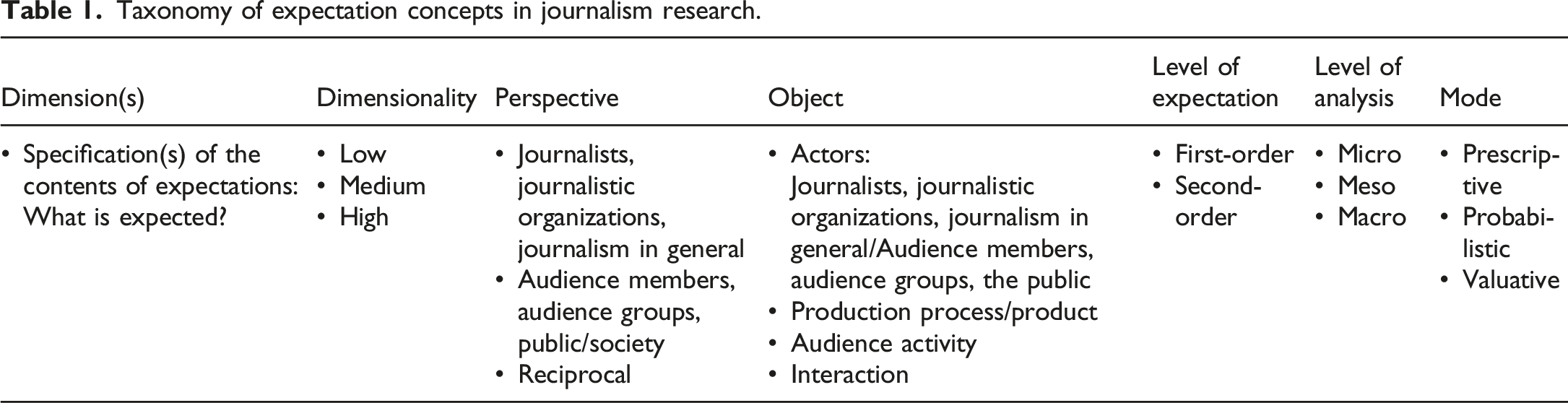
Taxonomy of expectation concepts in journalism research.
The nature of expectation concepts
The heterogeneity of terms used in research to cover expectations in a journalistic context we criticized earlier is reflected in the varying scope of the concepts and terms that are used to refer to expectations in a narrower or broader sense. In a narrower sense, expectations encompass demands, beliefs, views, or preferences that individuals or groups have towards other individuals, groups, objects, behaviors, and interactions. For example, audience members might expect journalists to be objective. In a broader sense, concepts such as media trust, journalistic roles, media performance, or media quality are specifications or represent bundles of expectations or their outcome. For example, the expectation/perception of diversity is one element to assess media performance (McQuail, 1992). Consequently, we argue that expectation concepts vary in their dimensionality. We therefore distinguish between expectation concepts and subordinate expectation dimensions. The former are understood as latent, sometimes higher-order, multidimensional constructs. They comprise different expectation dimensions.
Dimensions and dimensionality
Expectation dimensions are specifications of the expectation concepts, i.e., they tell us what is expected (e.g., objectivity). For example, the concept of journalistic roles includes specifications such as watchdog, analyst, or educator, which can be considered expectation dimensions of the expectation concept journalistic role. Dimensions of media performance are, e.g., diversity and freedom; and audience members have different preferences that are to be met by media content such as information, entertainment, or participation.
Expectation concepts are theoretical, latent (not directly observable) constructs. As such, an expectation concept may be conceptualized as consisting of one or many expectation dimensions and subdimensions. Figure 1 illustrates that the theoretical conceptualization and operationalization of a particular expectation can differ in the degree of dimensionality: If the expectation at hand is conceptualized by the researcher as comprising only one specific expectation, the researcher’s concept of the expectations is considered to be of low dimensionality. Conceptualizations comprising more than one dimension indicate a medium level of dimensionality, whereas higher-order conceptualizations signify a high level of dimensionality. This is exemplified in Figure 1: For instance, although it can be measured by multiple items, media trust is more often conceptualized one-dimensionally (e.g., Fawzi, 2019). Audience demands, on the other hand, are usually conceptualized as encompassing several components (e.g., van der Wurff and Schoenbach, 2014); journalistic roles can even be conceptualized as being further differentiated into subcomponents (e.g., Raemy et al., 2021). Hence, the degree of dimensionality (high vs low) of an expectation concept can vary, as researchers may prefer a more or less complex theoretical conceptualization or operationalization of the concept in a specific study context. Dimensionality of expectation concepts. Note. Examples adapted from Fawzi (2019), Raemy et al. (2021), van der Wurff and Schoenbach (2014).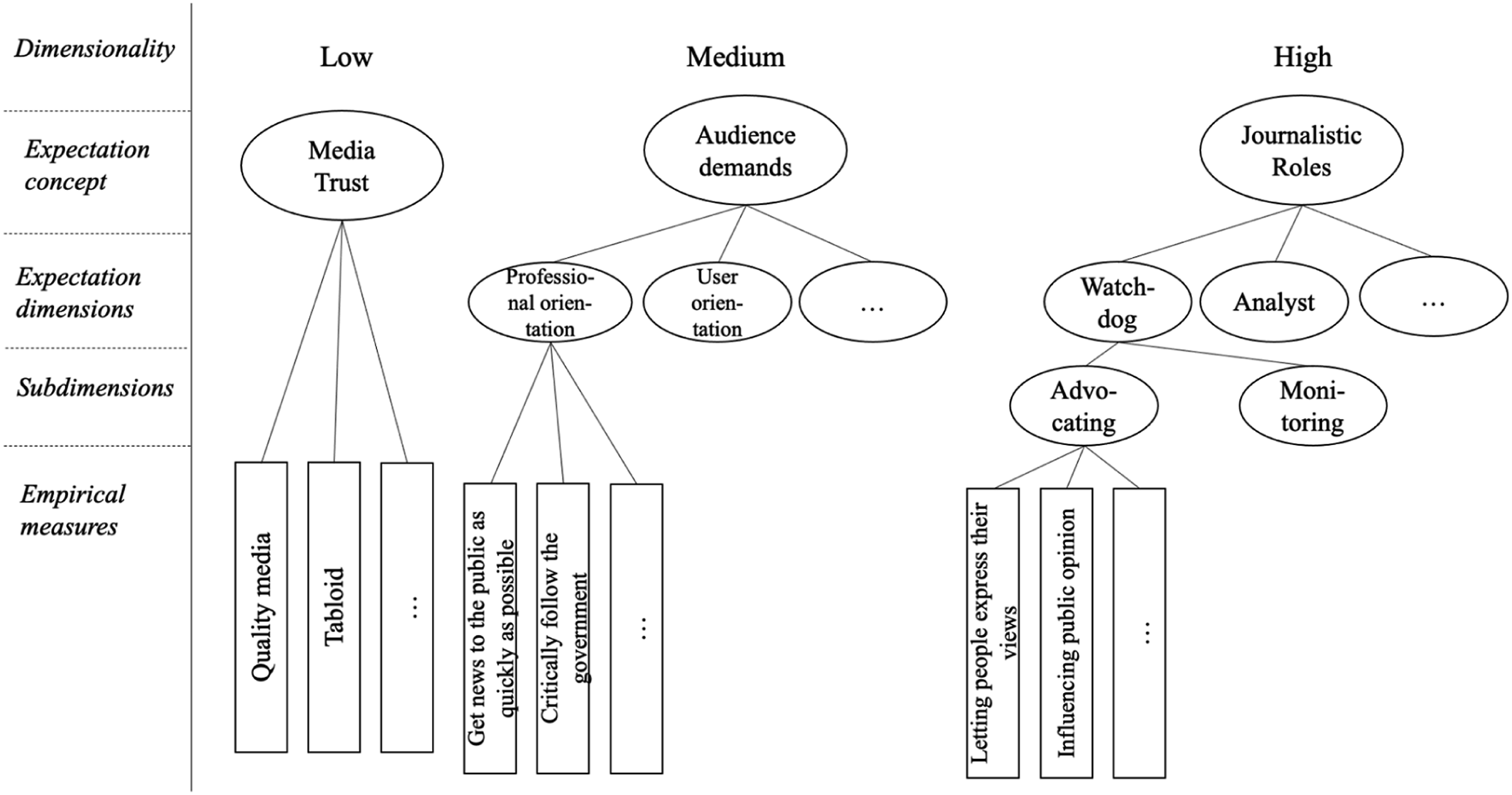
Accordingly, expectation concepts differ in the dimensions, i.e., the specifications of expectations they encompass, and in the degree of their abstractness, depending on whether they are understood and conceptualized as one single expectation, a bundle of expectations, or even more complex expectation structures.
Perspective
When analyzing expectations in a journalistic context, it should be clear from which perspective the expectations are formulated as this results in significant differences with regard to the expectation dimensions. Thus, the criteria perspective of the concept implies that journalism – individual journalists, media organizations, or journalism in general – as well as the audience – individual audience members, audiences as groups, the public or society as a whole – can be expecting entities. Journalistic roles are an example for a multi-perspectival expectation concept, as not only the audience side can share these expectations but also individual journalists, journalistic organizations, or journalism in general. An example for a mono-perspectival expectation concept could be gratifications as an expectation concept which primarily addresses the perspective of the audience.
Objects
In a journalistic context, expectations are directed toward different actors and the journalistic product and process. In digital media environments, however, interaction and participation have become increasingly possible and therefore add a new focus of expectations (Lee, 2015, 2020). Hence, despite the expecting subjects, different expectation objects or properties expectations refer to can be distinguished (Wilhelm et al., 2021): (1) Actors (journalists, journalistic organizations, journalism in general; audience members, audience groups, the public), (2) production process and product, and (3) the interaction between journalists and audience members. Thus, journalistic role concepts such as being a watchdog may refer to expectations journalists, audiences, or the public have of journalists – thus, the latter are expectation objects. The process of production may be expected to be transparent, and, based on previous experience, journalists may perceive their audience as hostile. In the case of media trust, the news media or journalism in general, media types, media organizations, journalists and media content are the objects of expectations (Strömbäck et al., 2020). In the sense of a stronger involvement of the audience side, audience activities (4) such as selection, engagement in formats of participatory journalism, follow-up actions or follow-up communication can be considered as a further object of expectation (Heise et al., 2014; Spyridou, 2019). For example, informed members of the audience can be expected to participate more in public discourse and their acquired knowledge can be expected to have an impact on their political participation.
Level of expectation
Accounting for the level of expectation, first- and second-order expectations can be distinguished. Expectations that relate directly to an object can be classified as first-order expectations, for example, when the audience expects responsiveness from the journalist. Expectations that in turn relate to expectations of the object can be classified as second-order expectations, for example, when journalists expect the audience to expect responsiveness from them. The latter are also termed expected expectations (e.g., Heise et al., 2014).
Level of analysis
Expectation concepts can refer to different levels of abstraction. They can be general, for example, when they are directed toward a community or group, or particularized, if they relate to individuals and their specific behavior (Burgoon, 1993). The perspective and object of expectation concepts can be located at the same level of analysis as well as at different ones. Thus, in a journalistic context, on a micro level, users or audience members, journalists or editorial staff members direct their individual expectations on each other, a specific media product, or the interaction. In this case, both perspective and object of expectations would be allocated on the micro level (micro-micro). For example, reciprocal expectations on the micro level shape interactions between journalists and audience members online. On a meso level, media organizations or audience groups are objects of, for example, micro-level expectations by individual audience members (micro-meso). Meso-level expectations can be formulated in the statutes of a media organization or formulated by the audience council of public media institutions and are directed to individual journalistic behavior or specific media content (meso-micro). In addition, journalism as an essential part of democratic societies (e.g., the role as Fourth Estate) is an object of political and societal expectations from the perspective of national political actors and the public (macro-macro) or from the perspective of specific social groups (e.g., political activists; meso-macro).
Modes
In interpersonal communication research, research on expectations in social interactions distinguishes between predictive, that is, what one believes that others will do, and prescriptive expectations, that is, what is the social norm (Burgoon, 2015; Nicholls and Rice, 2017). As outlined above, depending on the theoretical approach on which the expectation concept is based, expectation dimensions in the journalism-audience relationship are either more likely to be based on norms, previous experiences, or needs. In order to clarify the divergent conceptualizations, three different expectation modes (Biddle, 1986) can be distinguished: 1 First, most expectation dimensions, especially toward journalism, are prescriptive. As such, they encompass norms related to roles or behaviors and conduct, for example, professionalism, detachment, balance, and diversity. Second, expectation dimensions can be predictive or, more precisely, probabilistic. They express beliefs, views, concepts, or perceptions about objects, processes, and events. As such, they are “subjective probabilities” (Biddle, 1986: 69), what one believes is likely to happen or not. When publishing an article on a controversial issue such as immigration policy or the right to abortion, a journalist may expect a higher amount of uncivil user comments, as she/he has experienced greater incivility in the past when reporting about these issues. Third, they can also be valuative, indicating preferences or attitudes toward expectation objects. Thus, this mode does not only include evaluations of objects (or expressing an attitude towards them) but can also refer to the value ascribed to them in the sense of a preference (Biddle, 1986: 69). For example, audiences may favor entertaining news content or value responsiveness when interacting with journalists. Prescriptive expectations are more likely to operate on the macro or meso level as they base on societal and group-related norms whereas probabilistic and valuative expectations are more likely to be grounded on individual micro-level experiences and needs (Burgoon, 1993).
In some cases, the different modes of expectation can turn out to be contrary in their result. This can be illustrated by the following example: A journalist expects, based on her prior experiences, that the audience will react to her article on a critical topic with a large number of incisive comments. At the same time, the media outlet may have the prescriptive expectation that the audience will behave politely and civilly in debates.
Application of the taxonomy
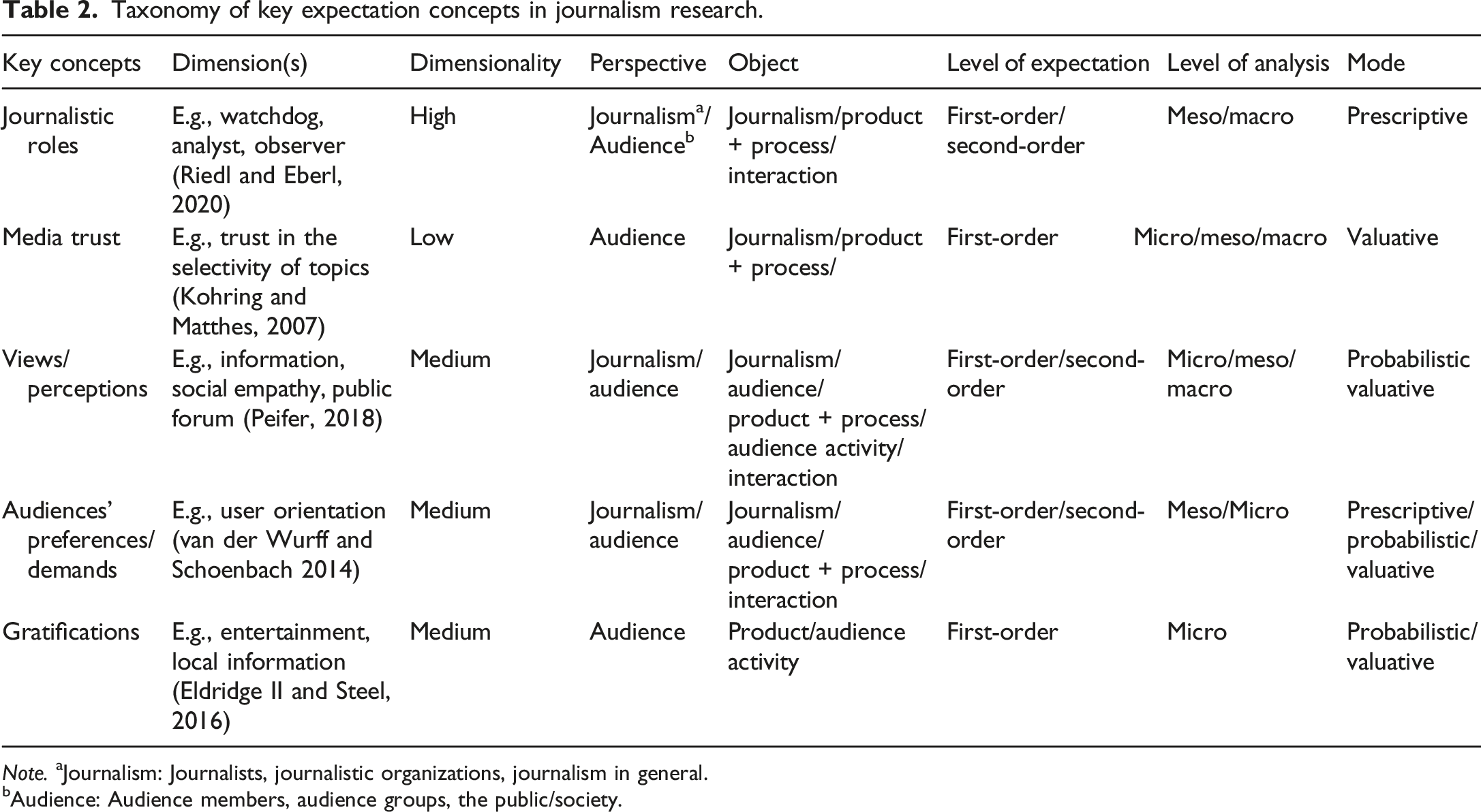
Taxonomy of key expectation concepts in journalism research.
Note. aJournalism: Journalists, journalistic organizations, journalism in general.
bAudience: Audience members, audience groups, the public/society.
Exemplary application: Classification of the expectation concept journalistic roles
To exemplify how the taxonomy can be used, we apply it to one key expectation concept in journalism research (Table 2), namely journalistic role. In doing so, we demonstrate how the taxonomy can serve to identify research gaps, revealing research foci as well as blind spots. If necessary, we refer to other expectation concepts in order to position the concept in the broader field of expectancy research.
With regard to the degree of dimensionality, the concepts differ strongly: Whereas media trust is often conceptualized as a one-dimensional construct, which is measured by one or more items (e.g., Fawzi and Mothes, 2020; Hanitzsch et al., 2018; Karlsson et al., 2017; Tsfati and Cappella, 2003), the expectation concept journalistic roles is a multi-dimensional construct (e.g., Mellado, 2015). Thus, journalists are expected to fulfill multiple roles that are described in expectation dimensions such as watchdog (e.g., Poindexter et al., 2006; Vos et al., 2019) or analyst (e.g., Riedl and Eberl, 2020; Truyens and Picone, 2021). Moreover, it is sometimes considered a higher-order construct, because the various roles include different subordinate aspects such as being an advocating or monitoring watchdog (Raemy et al., 2021). These multidimensional and higher-order conceptualizations of journalistic roles indicate a high level of theorizing but also standardization compared to less or even a-theoretical concepts of views/perceptions and audiences’ preferences/demands as there are established and well-studied sets of journalistic roles and respective definitions (e.g., Abdennour et al., 2021; Baugut and Scherr, 2021; Heider et al., 2005; Heise et al., 2014; Holton et al., 2016; Mellado, 2015; Poindexter et al., 2006; Raemy et al., 2021; Truyens and Picone, 2021; Van der Wurff and Schoenbach, 2014; Vos et al., 2019).
Journalistic roles mainly describe expectations from the perspective of both the journalist and the audience side. In particular, roles describe what the public, society, and the journalists themselves expect how journalists should work. Empirically, this is operationalized by asking about the importance of the respective tasks in journalists' own work. The multi-perspectivity is increasingly taken into account methodically, in which both journalists and audience members are interviewed about journalistic roles (Heise et al., 2014; Riedl and Eberl, 2020). In a further step, these perspectives are examined with regard to overlaps and discrepancies. The development of new dimensions is also conceivable, for example, if the audience's perspective is taken into account to a greater extent. In empirical studies, the perspective of the expectation concept is regularly made explicitly or implicitly clear by the methodological approach that is chosen. For example, because individual journalists or those responsible for journalistic organizations are interviewed (e.g., Hujanen, 2016) or a quantitative survey of the audience is conducted (e.g., Poindexter et al., 2006). However, in theory sections of empirical journal articles, the perspective is sometimes less evident or multiple perspectives are taken into account (e.g., Koch et al., 2021: 4), although the question whose expectations are taken into account makes a significant difference to the analysis.
With respect to the object of expectations, journalistic roles apparently focus on expectations toward the journalistic side, that is, the actors (e.g., Karlsson et al., 2017; Peifer, 2018; Riedl and Eberl, 2020). In digital media environments, audience members have become much more visible and active in the news production process. Concepts such as participatory journalism (e.g., Karlsson et al., 2015), audience turn (e.g., Costera Meijer, 2020), and affective publics (e.g., Papacharissi, 2015) illustrate these developments. This change is not sufficiently reflected in previous research, and expectations toward audiences and the resulting consequences for journalistic roles as well as expectations toward the mutual interaction have played little role to date (Wilhelm et al., 2021). However, the concept has been expanded in a few studies to include more recent roles that incorporate constructive as well as participatory elements and audience engagement (e.g., Loosen et al., 2020).
Regarding the level of expectation, journalistic roles can act as first-order as well as second-order expectations. The latter are a central part of the concept that assumes journalists to anticipate role conceptions of society and the public.
In expectancy research, studies which clearly indicate the level of analysis on which level expectations are located are scarce (e.g., Strömbäck et al., 2020; Tenenboim and Kligler-Vilenchik, 2020). Journalistic roles are mainly analyzed on meso and macro levels because the associated expectations are directed either to a journalistic organization (e.g., many people expect public service media to offer a higher information quality than other media organizations, Sehl, 2020) or toward journalism in general (e.g., Fourth Estate, Garnier et al., 2020). In theory, journalistic role expectations predominantly address journalists as representatives of journalism as an essential societal institution, that is, journalism as a whole should take a controlling, informing or otherwise specified role (e.g., Tandoc Jr. and Duffy, 2016). However, empirically, individual journalists are asked about the importance of different journalistic tasks (e.g., monitor political leaders, provide information) in their own work. Also, in digital media environments new journalistic roles are allocated on the micro level, e.g., addressing their participatory or engaging role (Heise et al., 2014).
Regarding expectation mode, journalistic roles are usually prescriptive in nature. That is, they include notions about how journalism should be and what journalists should do. This could be different from what they are actually doing in their daily work, which aligns with the distinction between (prescriptive) role conceptions and role performance (Mellado, 2015). Whether they also include valuative components, for example, whether audiences prefer entertainers over mobilizers, seems to be a question of the perspective from which expectations are held. To sum up, the application of the taxonomy to journalistic roles revealed the multidimensionality and complexity of this expectation concept in relation to other expectation concepts such as audience preferences/demands and gratifications. So far, it strongly focuses on prescriptive meso- and macro-level expectations toward journalism as an expectation object. In contrast, journalistic roles that address micro-level expectations related to participation and interaction, which are gaining further relevance in digital media environments (e.g., Lee, 2015, 2020; Wilhelm et al., 2021), still remain understudied (Van der Wurff and Schoenbach, 2014). The example of journalistic roles shows that expectation concepts and their dimensions can be formulated from different perspectives. Here, discrepancies in the meaning and weighting of expectation dimensions can also be examined and new questions can be developed accordingly. They thus form the starting point for further theoretical development of the expectation concept.
Discussion
Expectations have been a central subject of journalism research ever since. However, this research has so far been characterized by some deficits: There is a heterogeneity in the use of terms related to expectations. In addition, there is often a lack of clear definition and delineation of the various expectation concepts examined in research. Consequently, it has hardly been possible to gain a systematic overview of this field of research. The present taxonomy starts at this point and enables for a more systematic review of the literature and builds the ground for future empirical studies in this field.
In the taxonomy, we propose seven criteria to structure the analysis of expectations: The criteria (1) dimension and (2) dimensionality account for the observation that expectation concepts differ in their theoretical complexity, containing diverging specific expectations and being either unidimensional, multidimensional or even multidimensional higher-order constructs. These differences reveal discrepancies in the focus and degree of theoretical foundation and also the standardization of empirical measurement. Expectations are held from different (3) perspectives, that is, journalists and media organizations, audiences and audience members, the society and its subareas and groups. Their expectations may be directed toward journalists, audiences, media product and production process, and also interactions taking place in digital news environments. Hence, expectations target different (4) objects. According to the (5) level of expectation, a distinction must be made between first-order and second-order expectations. Added to this, the expectation objects are allocated on different (6) levels of analysis, that is, macro, meso, and micro level. For example, expectations toward journalist-audience interactions require a micro-level perspective, whereas general trust in the media is a macro-level expectation. Finally, the variety of terms used that relate to expectations in the journalism-audience relationship, at least in a broader sense, signifies that expectations can base on different (7) modes. They can be either prescriptive, probabilistic, or valuative.
The taxonomy can be applied at three different stages of the research process. In the stage of literature review, it can be used to systematically analyze the state of research regarding expectation concepts. It can help to reveal the main areas of previous research but also research gaps. In the stage of theoretical modeling, it helps to identify deficits in theoretical conceptualization and in the definition of the concepts. It further enables for thorough assessment of measurement in the stage of empirical investigation. As an example, we applied the taxonomy to the concept of journalistic roles. It showed that journalistic roles is indeed a well-defined, multi-dimensional and multi-perspective construct with a strong focus on prescriptive expectations at the meso and macro level. The state of research to date still leaves much room for the study of journalistic roles at the micro level, which include participatory and interactional elements expanding the journalistic role repertoire. Such a contribution seems essential against the backdrop of a changed journalism-audience relationship, especially in digital media environments.
The presented taxonomy indeed has some limitations. By using expectation as an umbrella term, we relied on a broader definition of the term in order to include a great variety of expectation-related concepts. This can be a strength, but it can also result in some ambiguities and biases arising from very different understandings of the terms in the literature. Following Biddle (1986), we have tried to account for these variations by distinguishing between different modes of expectation. The taxonomy can also be used to classify or identify second-order expectations, i.e., expected expectations. Another question that can be raised is whether the criteria we propose in the taxonomy are sufficient for a comprehensive analysis of the expectation concepts. Future research is encouraged to further develop the taxonomy by adding criteria such as the research tradition the concept is based on.
The taxonomy we developed in the course of our review of research on expectations in a journalistic context offers a series of starting points for future research. Besides applying the taxonomy to prepare literature analyses in order to identify research gaps, it can be used in theory building to develop a consistent terminology, to facilitate multilevel modeling, and to clarify distinct concepts of expectations in the journalist-audience relationship. Furthermore, it enables a more theory-based operationalization of expectation concepts and dimensions.
Conclusion and outlook
By providing a taxonomy of expectation concepts in journalism, this article contributes to a better understanding of the complexity of the expectation construct and its multiple meanings. In addition, it helps researchers to allocate their work in the area of expectancy research in journalism studies and to reflect their own position in the field.
The criteria of our taxonomy served as a guiding principle to analyze the literature on expectations in journalism research and to structure our results. In doing so, they shed light on deficiencies in research regarding (1) theory and consistency in the study of expectations, (2) differentiation between distinct modes of expectations, (3) a reciprocal perspective, and (4) a specification of the level of analysis. Moreover, the taxonomy proposed here can be applied not only to expectation concepts, but also to the study of particular expectation dimensions (e.g., the journalistic role of the watchdog).
The need for a joint analysis of journalism and audience expectations and their theoretical foundation is of growing importance in the digital age (Wilhelm et al., 2021). The boundaries between the use and production of media content are becoming increasingly blurred (Lewis, 2012). At the same time, interactions between both sides in digital media environments are becoming a central part of the production process (Karlsson et al., 2015; Lewis et al., 2014; Nip, 2006). Those who criticize this development must also address the shared and conflicting expectations on both sides (Lee, 2015; Lewis, 2012; Lewis et al., 2020). Our taxonomy can provide a theory-driven basis for this.
Footnotes
Declaration of conflicting interests
The author(s) declared no potential conflicts of interest with respect to the research, authorship, and/or publication of this article.
Funding
The author(s) received no financial support for the research, authorship, and/or publication of this article.
