



Abstract
This study builds on the hierarchy of influences model and the concept of the chilling effect to investigate how strategic lawsuits against public participation (SLAPPs) affect journalism, directly and indirectly. Based on the semi-structured interviews with Slovenian journalists and editors targeted by SLAPPs, and with their newsroom colleagues, it reveals inconsistencies between the respondents’ expressed awareness of the impact of SLAPPs on their work and their perception of the broader impacts. By examining how SLAPPs interact with the various professional and personal circumstances of journalists and editors, and with the political, economic and regulatory context, toward a potentially deterring outcome, the article contributes evidence on factors that strengthen or mitigate the possible chilling effect of SLAPPs, for both targeted and non-targeted journalists and editors. The research findings add to the empirical knowledge of the emerging body of research on SLAPPs in anticipation of European and national anti-SLAPP regulation.
Introduction
Intimidating journalists with the purpose of silencing is a tactic usually associated with authoritarian regimes. Several studies have, however, confirmed that unwarranted interference has affected journalism also in democratic European Union (EU) and Council of Europe Member States (Clark and Grech, 2017; Hiltunen, 2019; Löfgren Nilsson and Örnebring, 2016). Silencing attempts can appear in various forms of harassment and intimidation, including (the threat of) legal action, such as civil lawsuits, criminal charges, and convictions as a consequence of information published (Coughtrie and Ogier, 2020; MFRR, 2022). Although a legitimate instrument of the right to judicial protection, there is a growing concern that lawsuits are being misused as a means to silence journalists in matters of public interest. According to the European Commission’s, 2021 Rule of Law Report (2021: 19), this is especially the case for SLAPPs (Strategic Lawsuits against Public Participation), “a particularly harmful form of harassment and intimidation used against those involved in protecting the public interest” (European Commission, 2022b). The Council of Europe confirmed that in 2022, SLAPPs “continued to be used as a tool to silence critical media and journalists throughout Europe” (Platform to Promote the Protection of Journalism and Safety of Journalists, 2022: 18–19). EU Member State Slovenia is no exception: according to a report by the Coalition Against SLAPPs in Europe (CASE) it ranks second among 29 European jurisdictions in its number of strategic lawsuits against journalists per 100,000 people (Bonello Ghio and Nasreddin, 2022: 23).
The EU lags behind the United States in anti-SLAPPs legislation (Škrinjar and Trček, 2023: 17); only in April 2022, after the resolution of the European Parliament (2021), did the European Commission (2022b) publish a proposal for an anti-SLAPPs directive. International organisations that advocate freedom of expression and journalists’ rights (e.g., CASE, 2023), however, found that the common position version of the directive, endorsed by EU Member States in June 2023 (Council of the EU, 2023), was heavily watered down. The European Commission’s Recommendation, published alongside the first proposal of the anti-SLAPPs directive, encourages EU Member States to align their rules with the proposed EU law also when dealing with domestic cases, and take further measures, including those that aim for a “better understanding of the nature and extent of the impact of manifestly unfounded or abusive court proceedings against public participation” (European Commission, 2022a).
Yet the nature and extent of the impact of SLAPPs in journalism have not yet been sufficiently researched. Reports on the implications of abusive lawsuits have mainly been limited to descriptions of particular cases (e.g., Williams et al., 2020; Perrone, 2020; Bayer et al., 2021; Index on Censorship, 2021; (Article 19, 2022); Bonello Ghio and Nasreddin, 2022). While scholarly contributions point to the potential chilling effect of SLAPPs as their most concerning or discussed feature, and often an indisputable fact (Bayer et al., 2021: 27; Rosà and Pierobon, 2020; Shapiro, 2010: 25), it appears that researchers have not yet explored it adequately in the context of SLAPPs. Although often taken for granted, the chilling effect “clearly means different things to different people” (Townend, 2014: 7), and is difficult to measure (Bedi, 2021). In-depth research on the impact of SLAPPs on their targets remains scarce, and evidence on how SLAPPs affect other, non-targeted journalists is even rarer.
The present study addresses this research gap by examining how SLAPPs affect journalism both directly and indirectly, beyond the journalists explicitly targeted. In the context of the EU’s anti-SLAPPs directive and the consequent adaptation of Member States’ national legislations, the study provides insight into journalists’ and editors’ assessments of the impact of abusive lawsuits on their life and work in Slovenia, where defamation is still criminalised and can be punished by a prison sentence (Kazenski zakonik KZ-1, 2023) and the number of total and per capita lawsuits against journalists is high (Bayer et al., 2021; Bonello Ghio and Nasreddin, 2022). The inclusion of non-targeted journalists highlights the broader impact of SLAPPs, and is necessitated by the fact that Slovenia (along with Malta and Serbia), is one of the countries in which the majority of lawsuits are filed by the same plaintiff against the same targets. This means the number of defendants is relatively low, despite the high number of cases (Bonello Ghio and Nasreddin, 2022). The significant resonance of SLAPPs in the Slovenian journalistic community, backed by examples in the literature (Shapiro, 2010; Baumbach, 2018), led us to infer that their impact is not necessarily limited to those directly affected.
To investigate this, we conducted semi-structured interviews with 18 journalists and editors from six media publishers and broadcasters. Half the interviewees were defendants in over 60 lawsuits that met the SLAPP criteria (Canan and Pring, 1988; Bayer et al., 2021; Bonello Ghio and Nasreddin, 2022), and the other half were their colleagues in newsrooms or media outlets who have not been targeted by SLAPPs. Based on the key research question of how SLAPPs affect journalism, we first provide the conceptual background of research into SLAPPs and their impact on freedom of expression. Following an account of the research methodology, we present our findings through the lens of the hierarchy of influences model, and with reference to public policies and organisational and professional measures that can prevent attempts to silence journalists through SLAPPs.
SLAPPs as an influencing factor on journalists and their work
The performance of journalists is “an outcome of dynamic negotiations influenced by different internal and external constraints that potentially inhibit, but can also enable the practice of journalism” (Mellado et al., 2017: 8). The hierarchy of influences model (Shoemaker and Reese, 1996; Reese and Shoemaker, 2016) explains that news work is influenced from the micro to macro level by journalists’ (1) individual characteristics; (2) work routines; (3) organisational-level concerns; (4) institutional issues; and (5) larger social systems. This model “takes into account the multiple forces that simultaneously impinge on media and suggests how influence at one level may interact with that at another” (Shoemaker and Reese, 2014: 1). These five domains, which range from individual to systemic levels of influence, are the most prevalent in conceptual models and empirical evidence (e.g., Hanitzsch, 2010; Hanitzsch and Mellado, 2011). In the Worlds of Journalism Study (Hanitzsch, 2019: 104–109), five larger domains of influence are supported by different determinants: (1) the political domain is articulated by pressures from politicians, government officials, pressure groups and business representatives; (2) the economic domain by profit expectations, advertising considerations, audience research and data; (3) the organisational domain by pressure from managers of news organisations, supervisors, editors, owners, and editorial policy; (4) the procedural domain by access to information, journalism ethics, media laws and regulation, news-gathering resources, and time constraints; and (5) personal networks by friends, acquaintances, family, professional peers, and colleagues in other media.
Lawsuits, specifically SLAPPs, initiated by powerful individuals against journalists and news media are a source of influence that originates from the “extra-media level” (Shoemaker and Reese, 1996), that is, “the social institution level” (Reese and Shoemaker, 2016), which involves influences from outside the news media organisation. This level considers how news media organisations operate in structured relationships with other institutions, including the government, the state, influential news sources, interest groups, public relations, advertising and other media organisations (Reese, 2001; Reese and Shoemaker, 2016).
A SLAPP is “a form of a retaliatory lawsuit intended to deter freedom of expression on matters of public interest […] used against public watchdogs with an active role in the protection of democracy and the rule of law” (Borg-Barthet et al., 2021: 5–7). A SLAPP’s primary goal “is not to win on the merits, but rather to discourage the defendant from exercising their right to free speech by threatening excessively expensive litigation” (Harrison, 2020: 1253). Extra-legal outcomes of SLAPPs include “the personal costs of psychological trauma and of undermined belief in political participation, the ripple effect on other citizens’ political involvement, and the diversion of resources from the original issue in dispute” (Canan and Pring, 1988: 390). In Slovenia’s legal system, not only the financial costs are at stake when it comes to SLAPPs. A study found that among the lawsuits against Slovenian journalists recognised as SLAPPs by its authors, 62% were based on the Criminal Code, and the most frequently charged crime was slander (89%), followed by insult (7%) and defamation (4%) (Škrinjar and Trček, 2023: 10–11). These criminal offences qualify as such only if committed intentionally; and if they are committed via the media or similar public platforms, they are punished with a larger fine or imprisonment of up to 6 months (for insult and defamation) or 1 year (for slander) (Kazenski zakonik KZ-1, 2023).
Much of the past and recent literature on SLAPPs identifies intimidation and the chilling effect on public participation as key issues of concern. SLAPPs have several specific features: their basis is mostly meritless, frivolous or highly exaggerated; their intent and aim are to intimidate, censor and exert a chilling, silencing effect, and to exhaust and deplete the respondent both financially and psychologically; the demanded solutions are usually disproportionate; there is a disparity in power and resources between the claimant and the respondent; and the litigation tends to result in an extended, stretched process (van Den Brandt, 2021: 9–10).
The chilling effect as a potential outcome of SLAPPs
A chilling effect is in essence “an act of deterrence” (Schauer, 1978: 689), which happens when a potential consequence precludes an individual from undertaking a certain action (Youn, 2013: 1481). In journalism, the term can refer to overt censorship, ambiguous legislation or high legal costs, which cause uncertainty and fear among journalists (Townend, 2017: 73). The European Court of Human Rights (ECtHR) has used it predominantly in cases related to freedom of expression where the applicants were journalists (Pech, 2021: 2), stating that in some media cases a specific restriction or sanction has an actual or potential chilling effect on freedom of expression and media freedom (ECtHR, 2022). “If journalists are not allowed to work, or are hindered in their work because of captivity or of fear of captivity, or the media are closed down due to the extent of the sanction, or if sources do not dare to come forward by fear of disclosing, the public is debarred from receiving important information” (Baumbach, 2018: 112). Despite the lack of conceptual clarity and methodological challenges in scholarly efforts to critically assess the chilling effect (Bedi, 2021; Townend, 2017), the ECtHR takes it particularly seriously in cases of criminal conviction, where domestic authorities silence journalists in sensitive but important issues of public interest (Baumbach, 2018: 112).
Previous research into the impact of “ordinary” freedom of expression-related lawsuits and judicial decisions on journalists provided some evidence of the occurrence of the chilling effect. Anderson and Murdock (1981) found that US editors believed they were no less aggressive, but might be more careful as result of recent (at the time) Supreme Court decisions. Hansen and Moore (1990) suggested that even the threat of a libel suit had a lasting chilling effect on community newspapers, and Voakes’ (1999) survey of journalists who had been sued for invasion of privacy indicated that although there was little evidence of a chilling effect, most felt changed by the experience. A survey in South Korea (SA, 2009) showed that in an effort to avoid lawsuits, journalists can strongly self-censor, especially when writing on sensitive issues. Mohamed (2020), however, found that when the media covered certain issues in an activist spirit, the widely assumed chilling effect of libel could lose its impact. Interviews with Colombian journalists revealed that lawsuits and threats of judicial processes led to self-censorship, and the modification or exclusion of material related to specific topics (Barrios and Miller, 2021). Online surveys among digital and online journalists in England and Wales (Townend, 2014) exposed a spectrum of interpretations of the chilling effect, from respondents apparently unaffected by libel because of their ignorance and lack of awareness of the potential risks, to excessive self-censorship that resulted from the respondents’ legal knowledge and experience.
We can assume that the potential chilling effect of SLAPPs on journalists is greater than that of “ordinary” lawsuits. SLAPPs usually target individual journalists rather than organisations, and leave them isolated, exposed, and often facing demands for excessively high damages (Bonello Ghio and Nasreddin, 2022). Because defendants may spend months or years defending a suit, and accumulate significant legal fees even if they ultimately win, the threat of such a lawsuit is often enough to silence them (Hartzler, 2007: 1241). The evidence suggests this effect is not limited to SLAPP defendants; journalists who are aware of SLAPPs and wish to avoid a lawsuit might also cease to participate in public issues (Shapiro, 2010: 16). Journalists informed about a SLAPP may be deterred from speaking out in matters of public interest, and consequently the public is deprived of its right to information (Rucz, 2022: 6). Therefore, the chilling effect of SLAPPs has the potential to afflict society as a whole (Baumbach, 2018: 112). According to (Canan, 1989), each SLAPP is not just the story of a legal dispute between opposing hostile parties, but a window on the relationship between democratic structures and judicial rules.
Research questions and method
Interviewees.
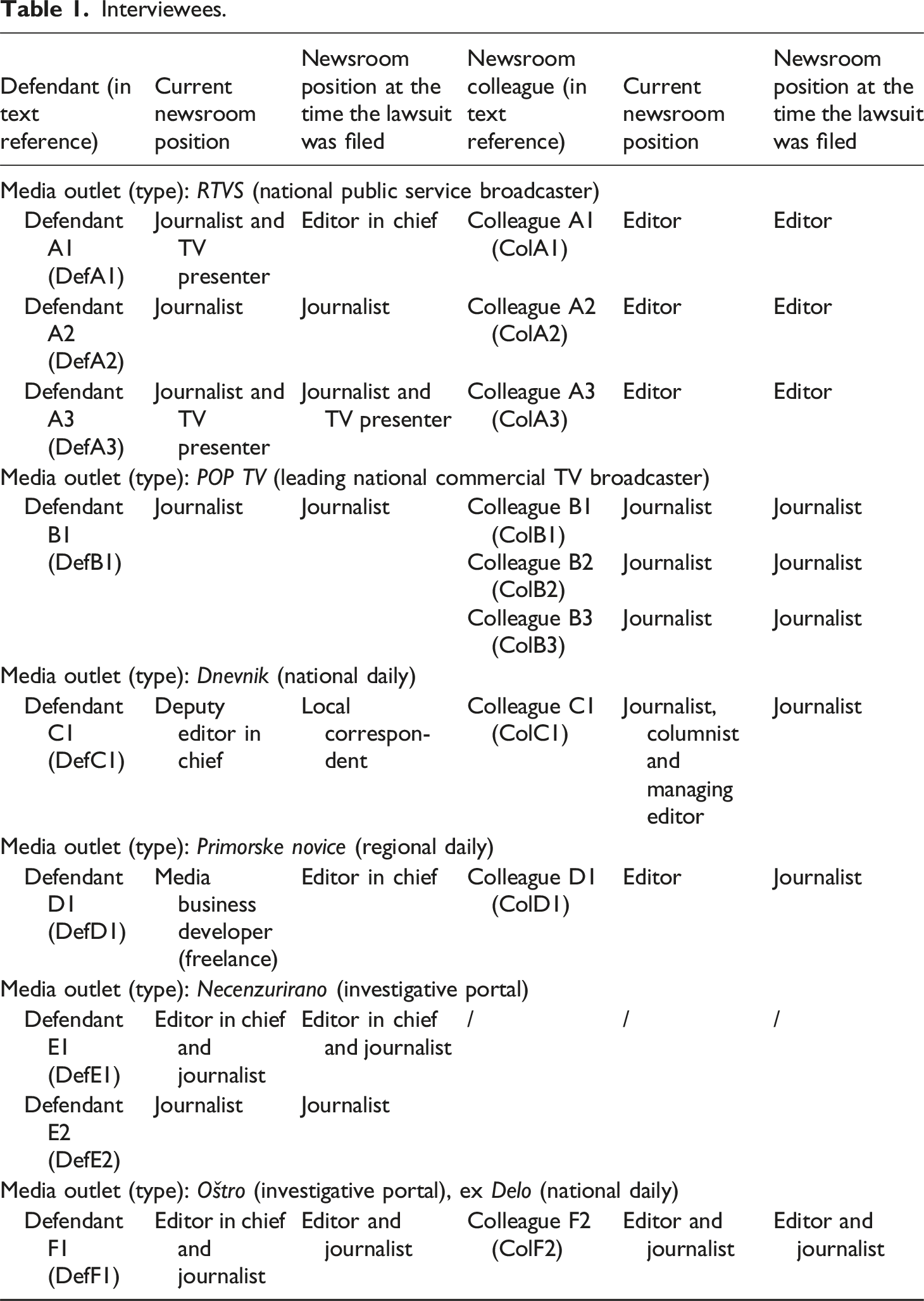
The main research question was: How do SLAPPs affect journalism? The research was conducted through two sub-questions: (1) How do journalists or editors that are directly involved in SLAPPs as defendants assess the impact of these lawsuits on their journalistic or editorial work? (2) How do journalists or editors from the same newsroom or media outlet as SLAPP defendants assess the impact of the legal proceedings against their colleagues on their own journalistic or editorial work?
Our first step was to find potential study participants by identifying lawsuits with SLAPPs characteristics, using criteria suggested in the literature (e.g., Canan and Pring, 1988; Bayer et al., 2021; Bonello Ghio and Nasreddin, 2022): (1) the lawsuit targets public participation in matters of public interest; (2) there is an apparent power imbalance between the plaintiff and the defendant; and (3) the purpose is to silence the journalist(s). Since there are no official statistics on SLAPP cases in Slovenia, we contacted the Slovenian Association of Journalists, which systematically monitors attacks on journalists (DNS, 2022), and the Slovenian Union of Journalists. A recent Transparency International and Oštro inquiry into lawsuits against journalists in Slovenia (Škrinjar and Trček, 2023) was helpful. We also used the snowball sampling approach to ask sued journalists whether they were aware of other similar cases. We conducted an information-oriented selection of cases (Flyvbjerg, 2006: 230), looking for maximum variation in the type of news media outlets (e.g., a small non-profit news Web site, a large public broadcaster, a regional daily newspaper); the defendant’s newsroom position (e.g., journalist, editor); the defendant’s gender, age and education; and the defendant’s employment status (e.g., regularly employed, on contract, precarious).
We formed a sample of six media organisations, whose journalists and editors were involved in more than 60 cases that according to our assessment met the SLAPP criteria quoted above. The disputed news articles covered topics of public interest, such as ownership of companies in tax havens, church financial scandals, local corruption, financing of political parties from abroad, or government procurement of inadequate equipment during the COVID-19 crisis. The plaintiffs included government actors, local politicians, parliamentarians, church officials and businessmen. The circumstances indicated that the purpose was to silence the journalist(s) since the lawsuits were filed against individual journalists rather than a media organization; the requested remedies were unusually disproportionate; the plaintiff engaged in procedural manoeuvres designed to drive up costs; the arguments relied upon did not appear to have a solid foundation as the news articles provided evidence of the controversial claims and complied with professional journalistic norms. During the research, the number of SLAPPs targeting our sample was constantly changing as on the one hand, one of the plaintiffs kept filing new lawsuits, and on the other hand, the court consolidated related cases. In the period from March 2020 to June 2023, a plaintiff filed a total of 51 SLAPPs against the journalists of the investigative portal Necenzurirano regarding 20 published articles authored by either three (most cases) or two and one authors (a few cases) who appeared as defendants. For each of the media organisations included, we selected one to three sued journalists and/or editors, and one to three of the defendant’s newsroom colleagues, depending on the nature and size of the organisation. In the case of Necenzurirano, all current and ex-members of the newsroom were targeted by SLAPPs, so the editor and journalist we interviewed were both being sued.
To address the research question, we used the method of semi-structured interview, which suits the purpose of our study (Galletta, 2013: 24). In the interview guide, we outlined two sets of questions to cover the main topics (King and Horrocks, 2010: 35): one for defendants, and the other for their newsroom colleagues. We systematically guided interviewees through the chronological sequence of events related to the lawsuit, with the goal of assessing the impact of a particular SLAPP on their personal and professional lives. To minimize social desirability bias, we (1) offered confidentiality (Trainou, 2020: 91) (but no interviewee opted to remain anonymous); and (2) asked follow-up verification and closure questions (Savin-Baden and Howell Major, 2013: 366). The interviews were conducted in Slovenian by one of the authors (Tanja Kerševan), between November 2022 and July 2023. They averaged 40 min in length, and were voice-recorded and transcribed. All interviewees provided an informed consent statement prior to the interview. Interviews were analysed by both authors according to two key stages, as suggested by Ritchie et al. (2006: 221–257): managing the data, and making sense of the evidence through descriptive and explanatory accounts.
Results
Four major themes emerged in how interviewees assessed the impact of SLAPPs: (1) a reluctance among journalists/editors to recognise the direct impacts of SLAPPs on their work; (2) differences in the perceived chilling effects of SLAPPs according to the journalist’s/editor’s employment status, and the type and resources of the media organisation; (3) impacts on the journalist’s/editor’s private life; and (4) systemic factors related to the societal, political, economic and regulatory frameworks in which the media operate.
The chilling-effect taboo
When asked about the chilling effect, interviewees often denied experiencing it, but their answers were nuanced. In both groups, answers that the nature of their work made respondents more cautious by default prevailed. Many (e.g., DefD1, DefE1, DefF1, ColB1, ColD1) stated that they accepted the possibility of intimidating lawsuits as part of their job.
Second, both groups said they modified their work processes only slightly when targeted by a lawsuit (or made aware of the possibility of one), claiming to be at most a little more cautious than usual (i.e., double-checking and documenting the facts even more meticulously, and including more sources), and occasionally consulting lawyers before publication: “But actually, when we realised what these threats were about, we knew that we simply couldn’t escape. If you write about it, you’ll get a lawsuit for every sentence, so it doesn’t make any difference” (DefA3). Some were warier in their choice of language: “There is no self-censorship that prevents us from working on certain topics, no such self-censorship. But you’re certainly more prudent and pay more attention when processing individual topics. Maybe you’re more careful with the tone of the language” (DefB1). Others claimed that pressure from lawsuits pushed them to deepen the investigation of the controversial topic: “No, I can’t stop. It intrigues me even more, and I persist even more” (DefF1).
Third, two kinds of perceived chilling effect emerged from the responses: “happening to me” and “happening to others”. The “happening to me” effect was reported both by sued and non-sued journalists and editors, as some admitted that SLAPPs made them reassess whether they could devote enough time to a certain topic: “I don’t think it is the case with me already, but sometimes you ask yourself, ‘OK, should I go for it, do I really need another problem on top of everything else?’ Basically yes, it does have an impact” (DefE1). Some questioned the format: “You wonder if the daily news is a suitable format when the subjects involved are exerting pressure on such a scale. In such cases, the topic is better suited for an in-depth dossier which requires a very, very long time to prepare correctly” (ColA1). As for the “happening to others” effect, one defendant stated that after dozens of SLAPPs were filed against him and two of his colleagues by the same plaintiff, other journalists avoided reporting on that plaintiff and related matters of public interest: “No one dares to touch him. He even advertises himself in the media. He got his way. He got his way! All he has to do now is keep twisting that knife in the years to come. That’s why I think SLAPPs are the perfect weapon” (DefE1). One respondent (editor) argued that the effects of the more than 50 SLAPPs against one newsroom are present among Slovenian journalists, and affect “all of us, if not overtly then subconsciously” (ColA2).
Fourth, censorship-like outcomes outside the scope of influence of interviewees were reported as a material consequence of SLAPPs, for example: “The plaintiff was lucky I had to leave the Delo newspaper, and was forced to establish my own investigative media outlet and deal with other things” (DefF1). This statement is linked to the case of an investigative journalist who was prevented from reporting on a matter of public interest due to external circumstances that arose as a result of SLAPPs. Another two respondents (DefA1, DefA2) stopped reporting on a certain topic (at least for the duration of legal proceedings) at the advice of the company’s lawyer. The next two sections present the respondents’ perceptions of the chilling effect in more detail, and explore their links to organisational and personal factors, such as employer support and resources, and individual professional experiences.
Newsrooms and media companies: Moral, legal and financial support
Defendants reported two types of newsroom reactions to SLAPPs: solidarity and scepticism. In some newsrooms, colleagues stuck together when one or more of them were targeted: “This absolutely did not scare us as a newsroom. We continued to work on these topics in the same way we had before” (ColB1). In other newsrooms, there was indifference or even scepticism: “You could have written that differently, he’s not so terrible, why do you always attack him?” (DefC1).
Both sued and non-sued editors at the public service broadcaster viewed editors as internal shields against pressures on journalists (e.g., DefA1, ColA2). Along with journalists at the leading commercial broadcaster (e.g., DefB1, ColB1, ColB2, ColB3), they pointed to significantly different work circumstances for journalists/editors in small media outlets, which lack resources and internal legal support: “Colleagues from online portals […] have to deal with it themselves. This is a key problem, and it makes them an easier target” (ColA2). Even in media companies that have in-house lawyers or provide external legal support, all the sued journalists and editors reported spending a significant amount of time compiling evidence and preparing legal responses: “At the end of the day, these lawsuits are an individual matter […] When you prepare the material for your defence, you have to do everything by yourself” (DefC1). Although the procedures themselves are long, the deadlines for each phase are not, so defendants have to respond within a short period, and their daily work suffers: “This is additional work, and it disrupts our normal working processes” (DefB1).
Several interviewees (e.g., Def A1, DefA3, DefC1, DefE2) observed that younger journalists were less resilient to pressure than their more experienced colleagues, largely because media organisations “invest[ed] less in their training” (ColC1). Younger journalists would sometimes refuse to cover a certain topic, or would even leave the profession completely: “A young colleague, who was slandered on Twitter by prominent ministerial staff for reporting on a legislative topic, came to me and said, ‘I don’t want to cover it anymore. I just can’t do it’” (DefA1).
Special challenges arise in local journalism, where the degrees of separation are few: “If the mayor of Koper sues you and you go to the kindergarten to pick up your kid, he has a child there too, and you meet him” (DefC1). Journalists from smaller newsrooms and freelancers are also at a disadvantage because they do not have the support of a media company: “If someone who works part-time for a media outlet, in print or an online newspaper, is attacked by a high-profile person, they can destroy her/him financially” (DefE1).
Some respondents (e.g., ColD1, ColF1, DefE1) also cited the role of their employers in addressing SLAPPs: “Management and editorial staff must be in the same boat. Media employers should do more to change the law, and not leave everything to NGOs or individuals who fight SLAPPs on their own initiative” (ColF1). Some indicated that since “media owners and directors see every lawsuit as a cost” (DefE1), journalists are often left on their own, and even pressured to avoid reporting on matters that could lead to SLAPPs.
Journalists’ personal well-being and private lives
In addition to professional maturity, many respondents emphasised the importance of personality traits: “If this scares you, if, God forbid, it stops you, or makes you self-censor, it’s a bit a matter of character, I think. On one hand, it’s a purely internal experience, but it’s also important what kind of organisation stands behind you” (ColB1). Consequently, the personal qualities of editors are also important: “Editors have to be mature. They have to understand the importance of public media and what it means to step into this ring, and defend journalistic and editorial autonomy and public interest, and the public itself, on all fronts” (DefA1). Some journalists mentioned colleagues who had stopped covering certain topics: “It seems to me that it greatly depends on personality. Some [colleagues] feared revenge and retaliatory measures from the outside. It wasn’t about the internal factors, like fear of losing their jobs, but more about an external factor related to the person or organisation they were reporting on” (DefA2).
Such factors can be linked to private and family life: “The problem is not you; you’re used to it. The problem is your family and parents, who are not. Some of them wonder how such a thing is even possible. And, of course, at some point, the question follows: do you need this?” (DefE1). This was a sentiment echoed by many respondents: “I’m used to it all. But people who are close to me worry about what might happen: prison, and things like that. I’m more phlegmatic, I’m not emotional enough to react to such things. Of course I’m worried, but it’s not like I’m out of my mind right now” (DefE2). Family members sometimes fear the most extreme consequences: “Let’s say, my mother […] worries ‘What will he do to you?’ From what she’s heard in the media, she thinks they’ll force me off the road, or do I don’t know what” (DefC1). Already the fact that the journalist, their family member, has to go to court scares them; they fear for the safety of their family: “Not everyone has contact with the justice system, so most people are afraid of it. The fear of your relatives also migrates to you. It affects you, you talk about these things. Even at home, you spend a lot of energy explaining that in journalism this has become an integral part of our profession” (DefB1).
The media landscape and (self-)regulatory framework
The impacts of SLAPPs on the media and the journalistic community as a whole were common themes. Both sued and non-sued interviewees (e.g., DefA1, DefD1, ColD1, DefE1, DefF1, DefF2) argued that journalism and the media and journalism must sweep its doorstep (e.g. DefA1, DefD1, ColD1, DefE1, DefF1, DefF2) and called for a return to professional principles and improved self-regulation: “Let’s admit our mistakes and build journalism again as a guild, so it will be fit for purpose. We need to draw a line between what is bad journalism and what is journalism as it should be” (DefF1). Most interviewees emphasised the importance of professional standards and the safeguards they provide. Some (e.g., DefC1, ColA2, ColA3, ColB1, ColB2, ColD1, ColF1) noted that when a case is, or could potentially be, taken to court, journalists and editors feel less pressure if they have respected professional norms. It was claimed, however, that there was increasingly less time for fact-checking and consistent adherence to standards, and sometimes less willingness to do so: “If journalistic standards were respected in the preparation of the article, then these lawsuits are really intended to silence the journalists, but since I am a member of the journalistic Court of Honour, I know that many complaints about the work of journalists are justified” (ColC1).
Some journalists (e.g. ColA3, DefE1) mentioned that the effects of SLAPPs should be considered in the combination of aspects ranging from the institutional to legal and intertwined with economic factors and audience habits, the crisis of the media industry and the role of digital platforms and social media, in which the state appears clueless: “This country does not have any media policy” (DefE1). Many pointed to the need to revise media legislation (e.g., DefA2, DefC1, ColA1); decriminalise defamation (e.g., DefC1, ColB1); establish mechanisms to accelerate court procedures for the early dismissal of SLAPPs as a procedural safeguard (e.g., DefE1, ColD1); and increase the awareness (and media literacy) of the judiciary (e.g., DefA1, DefB1, DefF1, ColF1).
Some respondents argued that the way to SLAPPs was paved by politicians and their smear campaigns: “Our SLAPPs are the result of public discourse, in which journalists are freely insulted. I’m not going to repeat some of the names we have been called” (DefE1). Others (DefA2, ColA3) recognised SLAPPs as just another tool to exert pressure on journalists and journalism by those in power: “This is a very sophisticated and perverted way for someone who has the power to get on the back of someone who is doing his job and trying to give something back to society […] Maybe that’s why the quality of our society is worse than it should be” (ColF1).
Discussion and Conclusion
This article expands the literature on the impact of SLAPPs on journalism by drawing on evidence from interviews with Slovenian journalists and editors affected by abusive lawsuits. Its key contributions are to shed light on the interplay between factors that shape the impact of SLAPPs on the work of journalists and editors, and to identify measures that could be adopted at different levels, from procedural to systemic, to prevent or limit the chilling effect.
First, we identified the hesitation of journalists and editors to publicly acknowledge the chilling effect of SLAPPs on their work. Although we were attentive to disparities in the perceptions of directly involved (sued) journalists and editors and their non-involved (non-sued) colleagues, the results showed that they did not differ significantly. Most sued journalists and editors were reluctant to admit that SLAPPs had directly impacted their approach to work, or made them modify or refrain from reporting on related issues. Their non-sued colleagues mostly claimed that they were not affected by the SLAPPs, as they perceived the possibility of legal proceedings as a part of the job. Both sued and non-sued interviewees were much more ready to elaborate on the potential chilling effects of SLAPPs on colleagues in the newsroom or other media, especially junior staff, freelancers and those working in small media outlets (such as local or online investigative media), and to point to the significant impact of SLAPPs on the professional community as a whole. These findings reflect the phenomenon of the “third-person effect hypothesis”, which predicts that people expect a greater impact of communication on others than on themselves (see Davison, 1983: 3). The self-other perceptual gap can be explained by the message desirability factor (e.g. Sun et al., 2008). Namely, we were looking for evidence that had a potentially damaging effect on the image of the professional integrity of journalists/editors. There is a chance that the interviewees gave socially desirable answers; they were more open and willing to discuss the chilling effect on others or in general than on themselves (Townend, 2017).
The perception of the tangible censorship-like effects of SLAPPs on their journalistic work was higher among the group of defendants. This is because one was encouraged by superiors to resign, and consequently withdrew from the front line of investigative journalism as a result of SLAPPs (DefF1), and two others ceased to cover the public interest topic that induced the lawsuit, following legal advice (DefA1, DefA2). Although the interviewees mainly denied the presence of the chilling effect (which was an anticipated limitation of our method), it could be inferred indirectly through their responses to other questions, which indicated its less obvious or extreme consequences. These included being more cautious and having their working processes disrupted, as well as negative impacts on family life and personal well-being. These are the factors that may eventually affect their willingness to cover certain topics properly, or at all.
This leads us to our second key finding: our evidence shows that it is impossible to assess the impact of SLAPPs in isolation, without taking personal, organisational or systemic-level influences into account. Crucially, it is at these levels where negative implications can potentially be controlled or curbed. A journalist’s/editor’s perception of a lawsuit’s impact encompasses a variety of considerations, such as: Can I afford the lawsuit financially? Will my employer provide me with legal protection? Do my colleagues and family members support me? Does engaging with time- and energy-consuming legal proceedings impinge on my everyday work? Is my editor supportive? Do the political and legal conditions in my country, including media laws and limitations of press freedom, make it possible for the plaintiff to win? These and similar questions, identified in the responses of the interviewees, indicate the specific role of the factors shaping the potential influence of a SLAPP: (1) at the procedural level: professional standards and norms, work resources and procedures, including time limits and the possibility of verification of the collected information; (2) organisational factors, such as the specifics of the company’s editorial policy, the integrity of the newsroom, and the availability of legal resources; (3) influences relating to an individual’s personality or personal network; and (4) systemic factors, such as societal, political and economic contexts and regulatory frameworks.
If the support within the media organisation is strong (i.e., the intra-media influence is absent or lower), the impact of SLAPPs is less pronounced. If the journalist is pressured by the family (individual influence), the probability that the SLAPP will have a chilling effect is greater. The findings show that the impact of SLAPPs could be modified (lowered) with policy and organisational intervention in these areas, such as improving journalists’ working conditions and social safety; providing legal support at the company or professional community level; investing in education for journalists and the judiciary; strengthening the professional integrity of journalists; decriminalising defamation; introducing procedural safeguards to allow the early dismissal of SLAPPs; revising media legislation and improving funding for the media; and last but not least, preventing smear campaigns against journalists.
The findings of this study come with some limitations related to its qualitative method, and the size of its sample (18). Direct observation with the presence of researchers in newsrooms would enable a more detailed analysis of the impact of SLAPPs on internal decision-making processes. Further, the research methodology could be complemented by a quantitative study, with a higher number of respondents and a legal analysis of SLAPP cases, as the differences in their characteristics (e.g., the number of suits filed against a particular journalist, the legal basis for the action, and the type and status of the plaintiff) could impact the perceived effects on the respondents. Such approaches may be implemented in future research.
Since the views of political actors and civil society on the EU anti-SLAPP directive vary, this research remains relevant even after the directive’s adoption, because significant differences are possible in its transposition, especially in terms of its impact on national policies. Due to the widely assumed damaging impact of SLAPPs on society through negative implications for individual fundamental rights, democratic public participation and the rule of law (Bayer et al., 2021), interfering with freedom of expression, which is an essential foundation of democratic society (ECtHR, 1976), it is scientifically and socially relevant to further explore the nature of SLAPPs’ impact on journalists in more detail, to reveal their (potential) chilling effect in “its subjectivities and complexities” (Townend, 2014). A continuous insight would contribute to a greater understanding and awareness of the scale of the SLAPP problem, and consequently to adopting and adapting the “necessary legislative and/or other measures to prevent the frivolous, vexatious or malicious use of the law and legal process to intimidate and silence journalists”, as recommended by the European Commission (2022a).
Footnotes
Declaration of conflicting interests
The authors declared no potential conflicts of interest with respect to the research, authorship, and/or publication of this article.
Funding
The author(s) disclosed receipt of the following financial support for the research, authorship, and/or publication of this article: This research was supported by ARIS – the Slovenian Research Agency (grant no. J5 3110).
