




Abstract
This paper presents the results of a feminist analysis of news media reports related to Scottish cases in which women killed following domestic abuse. The findings show that problematic narratives have prevailed within the reporting of cases of this type and that, at a time when knowledge and understanding of domestic abuse was improving in Scotland, news media presentations of women who kill following abuse were worsening. It is argued that the reporting landscape was changed by an especially high-profile case of this type, and that judicial statements also exert a significant influence on how cases of this type are reported. It is concluded that more must be done to ensure that reporting of these cases follows national guidelines related to the reporting of violence against women, especially since reporting is likely to influence public perceptions and understandings of the subject matter.
Introduction
Cases in which women kill following domestic abuse are both uncommon and highly significant: women do not kill very often, but when they do, they tend to kill their male partners or ex-partners following male perpetrated abuse (Caman et al., 2016; Gillespie, 1989). As such, the way in which law and society responds to such cases is highly significant.
This paper critically examines news reports related to cases of this type. It considers how violence against women is reported in general terms before looking specifically at how women who kill their abusers are presented in news media. It sets out the legal and policy framework in the jurisdiction which is the focus of the enquiry (Scotland) before presenting the results of a feminist analysis of 558 news reports related to 62 Scottish cases of this type, comparing the findings from one particularly high-profile case, Galbraith v HM Advocate, with others in the study group. It is worth considering the reporting of Galbraith’s trial and appeal in isolation for two reasons: first, it has been the most high-profile case of this type in Scotland, receiving significantly more reporting than any other case. Second, following her conviction, Galbraith moved to make an order under the Contempt of Court Act 1981 prohibiting reporting of proceedings until after her appeal or completion of any retrial (Galbraith v HM Advocate (No. 1) 2001 SLT 465). 1 Following a comparison between Galbraith and other cases of this type, there is an examination of judicial statements and their relationship to reporting.
The findings suggest that problematic narratives have prevailed within the reporting of cases of this type and, that at a time when knowledge and understanding of domestic abuse was improving in Scotland, news presentations of women who kill following abuse were worsening. It is argued that the reporting landscape has been changed by Galbraith, and that judicial statements also exert a significant influence on how cases of this type are reported. It is concluded that more must be done to ensure that reporting of these cases follows national guidelines related to the reporting of violence against women, especially since reporting is likely to influence public perceptions and understandings of the subject matter.
Violence against women and the media
In the preface to their edited collected Feminism, Media and the Law, Fineman and McCluskey refer to the “historic antipathy” which has existed between feminism and the media, linking this to the perpetuation of women’s inequality (1997: v). A number of studies have pointed to the important role that the media can play in informing the public’s understanding of violence against women. Daly and Chasteen rely on the work of Surette to conclude that newspapers, as a specific form of media, may affect people’s understanding and factual knowledge of crime more than television and that some people may be more susceptible to media influences than others (1997: 239). Writing from a UK perspective, Monckton Smith has posited that “the media form the main source of people’s information about social issues”, and that although it may impact public knowledge it may also reflect dominant values at the time (2012: 64). For her, the amount of media attention a case is given determines its ‘news value’ and the way in which it will be reported. Her research suggests that “news media reporting draws from ideals and stereotypes of race, class and gender” (2012: 72). Sutherland et al. espouse a similar view when discussing mainstream Australian media (2019: 502). They recognize that aspects of Australian media are changing for the better but conclude that, despite a readiness to engage with the topic, reporting which promotes better public understandings of violence against women is not always the norm (2019: 507–508). In earlier US research, it was found that one of the problems which may arise within reporting of violence against women is a propensity to emphasise homicide (McManus and Dorfman, 2005). McManus and Dorfman’s study found that violence against women news reports were approximately five times more “murder-centric” than other types of reporting (2005: 52). Most violence against women is non-fatal, however, internationally women’s experiences of homicide are inextricably linked to domestic abuse, regardless of whether they are the victim or perpetrator of homicide (UNODC, 2018).
Recent work on Irish news reporting of three high-profile familicide-suicides found coverage to be “episodic in character, linked to dramatisation and more simplistic explanatory frames, rather than evidence-based analysis of potential causal factors for these incidents” (Galvin et al., 2021). Misleading and patriarchal explanatory frameworks were identifiable, and it was found, in keeping with previous work, that there exists a need for journalists to connect domestic abuse to broader social issues, as opposed to representing isolated events.
Presentations of women who kill
It has long been recognized that women who kill face particular difficulties in the way they are presented in both law (Nicolson, 1995) and media (Easteal et al., 2015). Looking at a variety of cases in which women have killed, Easteal et al. found a tendency for the media to downplay information that might contextualize a woman’s actions as well as a tendency to emphasize a woman’s appearance and sexuality (2015). Their study found that the propensity for sensationalism commonly substitutes social context. In cases where women kill their abusers, domestic violence was not found to be the core focus of reporting: there was no presentation of the issue as a social problem caused by gender inequalities and no reference to support agencies or information. Although the problem of simplifying complex issues was not found to be unique to reporting on cases in which women kill, Easteal et al. consider that the media is capable of acting as an agent of social and even legal change. However, they also recognize that identifying the relationship between the media, public opinion and legal outcomes is not straightforward (2015).
Within the context of UK cases where women have killed following domestic abuse, Clifford has conducted a historic examination of twentieth century Daily Express stories (2009). She points out that that the history of this type of reporting is rooted in three academic fields: (i) women’s studies, (ii) press history and (iii) research into crime in the news (2009: 19). Her research found that a dominant narrative emerged from the male gaze and masculine perspective, even at a time when efforts were being made to draw female readership (2009: 9). Although her focus on the Daily Express arose from funding criteria, the paper served as an interesting example given its conservative nature, which she considered was challenged by cases in which women’s relationships and responses to abuse did not conform to traditional norms.
More recently, as part of the Centre for Women’s Justice report Women Who Kill, a news media analysis of 119 news stories was undertaken. The report specifically focused on cases in which women had killed their abusers in England and Wales, informed by the activism of Justice for Women, which is part of the Centre for Women’s Justice. Analysis revealed that a key theme amongst reporting on cases of this type was the vilification of women as well as a tendency to frame their motivation for killing as either jealousy or arising from something trivial (2021: 131). In almost all reports, she is presented as being worthy of hatred and/or scorn. This is achieved through a variety of reporting mechanisms, such as the use of visceral language regarding the murder weapon and/or method; personal characteristics/personality traits; as if they have somehow escaped punishment; a comment on their lifestyle; and a mockery of why they resorted to killing the men in the first place (2021:130).
The use of graphic detail and sensationalism was also found to be present (2021: 130). Adherence to the mad/bad dichotomy was observed with it being commented that such presentation removes the opportunity for women to be presented as rational and/or defending herself (2021: 132). Race and ethnicity were also found to be “used in a clear attempt to capitalise on pre-existing reader prejudices” (2021: 133). Only two cases had been reported in a way which portrayed the defendant in a sympathetic manner (2021: 134). Comparative analysis of cases in which men had killed found that graphic detail was used less frequently. Ultimately the report concludes that pre-existing sexist attitudes remain at the heart of media coverage of women who kill. The Centre recommend media training for journalists and better collaboration between experts on violence against women and those in a position to disseminate information on cases (2021: 137).
The legal and policy framework in Scotland
Across the UK, the Contempt of Court Act 1981 ensures that justice is not prejudiced by media reporting. The Judicial Proceedings (Regulation of Reports) Act 1926 also limits the reporting of matrimonial cases, many of which will involve allegations of domestic abuse.
Since 1991, the work of UK journalists has been informed by the Press Complaints Commission (PCC), which acts as a voluntary, self-regulatory body (Hughes, 2011). Since 2001, broadcasting communications have also been regulated by Ofcom who themselves are guided by the provisions of the Communications Act 2003. Ofcom’s remit covers many of the same issues as the PCC (Hughes, 2011). Historically in Scotland, the media have been advised against interviewing or photographing witnesses in criminal cases and the accused until they have either been found guilty or the charges have been dropped (Hughes, 2011).
In 2011, Scottish charity ‘Zero Tolerance’ published Media Guidelines on Violence Against Women. Three years later, the Home Office for England and Wales published their Violence Against Women Action Plan which included a commitment to: …work closely with media regulators and stakeholders across industry to ensure that suitable media content protections are maintained (HM Government, 2011: 19, ref 15).
The work of Zero Tolerance in this area has since been supported by the Scottish Government as part of Equally Safe - the national strategy for responding to violence against women and girls. In 2019, a revised document was produced in which they advise on reporting related to rape and sexual assault, domestic abuse, harmful traditional practices, commercial sexual exploitation and online abuse. In the guide, Political Editor of the Sunday Post, Judith Duffy, is quoted as saying: It is not about dictating how a story should be written, but recognising that too often language is still being used to trivialise and sensationalise – when it can have the power to help change attitudes in society (Zero Tolerance, 2019: 5).
Their best practice tips are to: • Be considerate. • Don’t blame the victim. • Name the crime. • Describe the perpetrator appropriately (man, perpetrator, offender as opposed to beast, respected professional). • Use victim or survivor to describe the woman. • Get quotes from experts and survivors. • Use statistics to put the story in context. • Don’t use images which contribute to harmful stereotypes or objectify women. • Include helplines.
Although the guidelines relate to violence against women broadly, homicide is only referenced in the context of women being killed. This is understandable given that this is the more common type of intimate partner homicide which occurs ((UNODC, 2018)), but it perhaps inadvertently places those cases in which women kill following abuse outside the remit of the guidelines.
Method
This work sought to answer four main research questions: 1. What are the common themes identifiable in news reporting on cases involving women who kill their abusers? 2. Do these themes align with the facts of these cases and criminal justice responses or do they diverge in significant ways that may lead to or embed misperceptions? 3. Has there been a change in how cases of this type have been reported? 4. Does news media coverage of court proceedings of such cases conform to ethical guidelines?
It was hypothesised that cases of this type would be subject to sensationalist reporting and that, at times, there would be divergence from ethical guidelines. It was also anticipated that any change to reporting would be for the better given improved legal responses to domestic abuse in Scotland and improved public understanding of the nature and effects of domestic abuse.
In order to address these research questions, thematic analysis of news reports relating to 62 cases in which women had killed following domestic abuse in Scotland between 1990 and 2018 was undertaken. The cases included were part of an existing data set held by the researcher, referenced in previous research (McPherson, 2021).
In total, 558 articles were included for analysis. These articles appeared across 41 different sources which included local newspapers, national newspapers and national online news reporting. The fewest news reports attributed to a case was one and the most was 164 (attributed to Galbraith v HM Advocate). There was an average of nine stories per case.
It is not suggested that these 558 articles account for every piece of reporting on these cases. However, it is suggested that they represent the most dominant news reports related to these cases consumed within the jurisdiction. A number of the cases in the study group pre-date internet use (BBC online was not launched until 1997), meaning that print newspapers were significant to the study. In recent research by Ofcom, the most used platform for news by those aged over 16 were: television, internet, radio and print newspaper, with print newspapers being used by 32% of participants (2021: 3). Furthermore, in recent research on public perceptions of women who kill following abuse, 84.2% of survey participants indicated that they consume news through online newspapers or news providers and 11.2% of participants indicated that they consume news through print newspapers (McPherson, 2023). 2
Although the cases included in this study had already been identified through previous work, additional search variables were used to identify additional news reports: the accused’s name alongside terms such as ‘murder’, ‘culpable homicide’, the name of a specific court (e.g., Glasgow High Court). Lexis Nexis ‘News Search’ was utilised alongside traditional search engines. Results were contained to news articles which would be subject to reporting regulations and guidelines. No social media was included for this reason, although it is recognized that further work which includes this form of media, and others such as television and radio media, may be useful.
Given its significance to the jurisdiction, the Galbraith case was used as a comparative case study within the analysis and cases were analysed in three groups: (i) reports for cases which occurred before the Galbraith case (1990–1999), (ii) reports related to the Galbraith case in 1999 and (iii) reports for cases which followed the Galbraith case (2000–2018).
Main themes identified across four areas of reporting (in descending order).
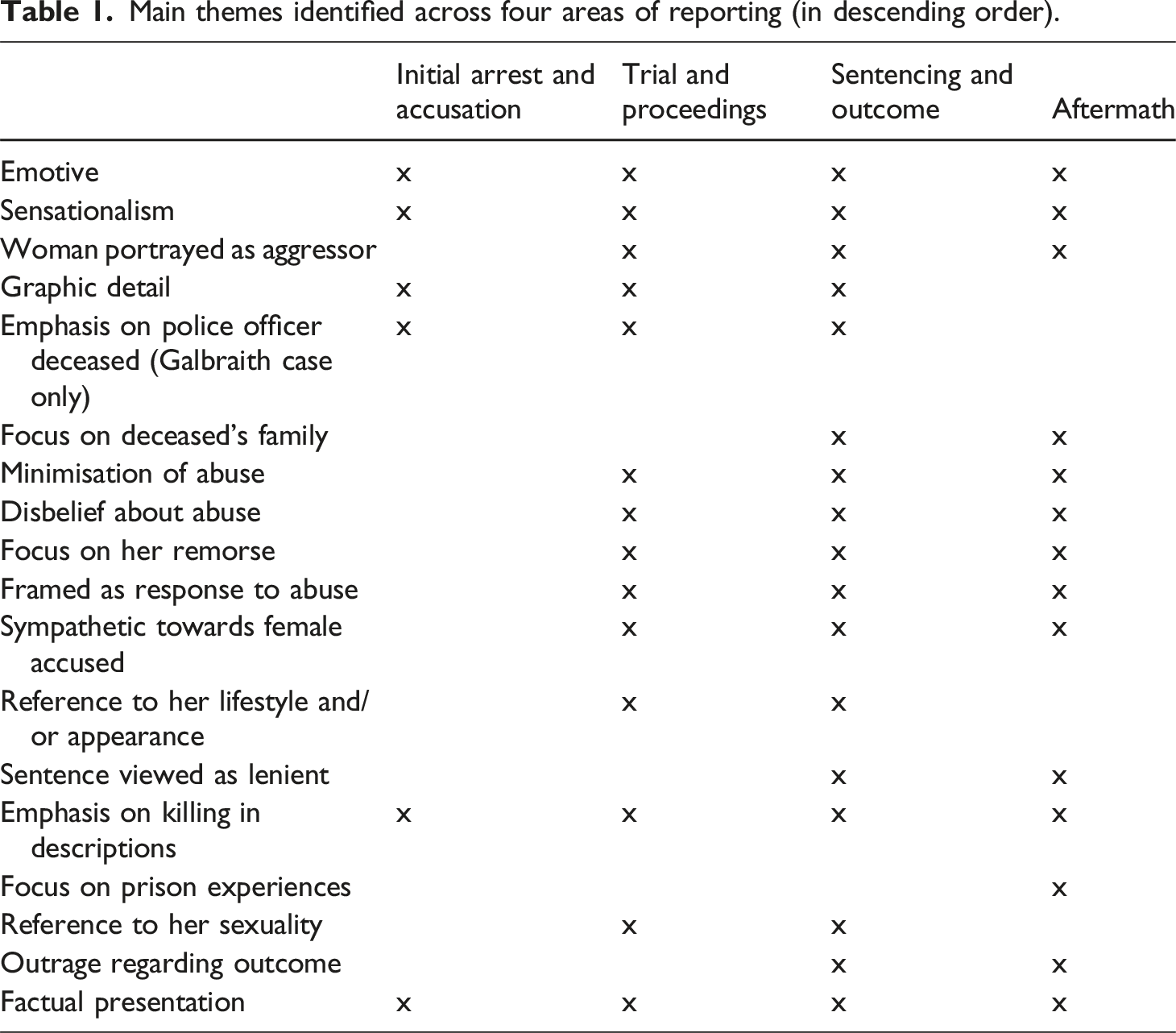
These themes were also relevant to headline analysis although headlines were analysed separately. Recent survey research conducted found that 91.2% of participants consumed news through headlines (McPherson, 2023), 3 suggesting that this is an important category to be considered in its own right. For online news, the headlines used for analysis were the ones used when the story is clicked on (which can be different from the home page headline). For headlines, the three main themes were a ‘factual presentation’, ‘framed as a response to domestic abuse’ and ‘emotive’.
The process of thematic analysis was guided by the work of Braun and Clark (2006) and involved familiarisation with the data, the generation of initial codes, searching for and reviewing themes, generating clear definitions for the themes and reporting on them.
Reports were analysed through a critical feminist lens. Due to the limitations associated with criminal justice data, news reports have become a very important source of information for feminist researchers studying women who kill (Gillespie, 1989; McPherson, 2021; Sheehy 2014). As such, the use of a feminist critical lens is not only appropriate for an analysis of news reports on cases of this nature, but vital.
Galbraith
The facts of the Galbraith case invited press attention for several reasons. First, there was a trial which is unusual in the context of cases of this type (most are resolved by way of a guilty plea to culpable homicide (McPherson, 2021). Second, a firearm was used to kill Ian Galbraith, something which is not typical of homicide in Scotland (Scottish Government, 2022). In addition, and contrary to most cases in which women kill abusive partners (Chan, 2001), Kim Galbraith did not immediately admit to the Police that she was responsible for the death. Instead, she claimed that intruders had broken into their property, raping her and killing her husband. In order to support this story, Galbraith had placed footprints next to an open window, rubbed prophylactics on herself, cut her underwear, hidden jewellery and destroyed credit cards. Later, she further admitted to cutting the brake pipe on her husband’s car some 2 months earlier. Following her conviction for murder in June 1999, Galbraith appealed. The appeal itself was legally significant, recognizing for the first time in Scots law that battered woman syndrome could satisfy the mental abnormality required of diminished responsibility (Galbraith v HM Advocate (No. 2) 2002 JC 1). The case was, therefore, both legally and socially significant in Scotland.
The nature of press reporting on the trial led Kim Galbraith’s solicitor to take the unusual step of writing to The Herald to address comments by a member of the UK Men’s Movement which had been published in the newspaper, specifically: the wrongful reporting that Galbraith had taken out a life insurance policy on her husband before his death, that a campaign to free Galbraith had been launched by the expert witness who gave evidence on behalf of the defence, and the view that the expert witness and support groups held a “pathological bias in favour of women” (Q4). The solicitor’s intervention was highly unusual and gives some insight into the legal team’s view of the intemperate nature of news media reports related to the case. Attitudes towards reporting are further evidenced by the order later sought by Galbraith under the Contempt of Court Act (Galbraith v HM Advocate (No. 1) 2001 SLT 465).
Analysis of reporting around Galbraith’s case identified three main themes: (i) a focus on the fact that the deceased was a police officer, (ii) sensationalism and (iii) disbelief about the accused’s account of abuse.
Focus on the fact that the deceased was a police officer
This first theme was unique to the Galbraith case. It was often evident in the headline used. For example: ‘Dead constable’s wife charged’, ‘Wife of shot policeman tells of ordeal in bedroom’, ‘Trial begins for wife accused of killing PC husband’. Of the headlines associated with the 164 reports analysed for this case, 42 made reference to Ian Galbraith being a police officer or ‘cop’ (25.6%).
Sensationalism
Much of the sensationalism around the reporting of Galbraith’s trial focused on the sexual abuse she had suffered. Whilst some reporting on this matter was ostensibly sympathetic to Kim Galbraith, it was nevertheless explicit and provocative in nature: Mrs
Disbelief about the accused’s account of abuse
“I’ve often wondered why some people were so convinced I was such a liar and couldn’t possibly have gone through what I had in our relationship.” (Kim Galbraith, as quoted in The Daily Mail, 2003)
Disbelief about Galbraith’s account was no doubt influenced by the initial untrue version of events she provided to the police. However, this view was exacerbated further by the perceived extreme nature of the sexual abuse claims, coupled with witnesses’ lack of knowledge about abuse in the relationship: As the case went to court those stories of sustained sexual abuse became more elaborate, as Galbraith concocted a seemingly far-fetched life of torture, accusing her husband of raping her at gunpoint with hairdryers and coat hangers and eventually forcing her to have sex with prostitutes. Describing the moments after the shooting, Mrs Galbraith told a Glasgow High Court jury she had been forced into an extreme act by violent sexual abuse that had left her fearing for her life. Her story appeared to gain credence when it emerged that a police search of the family cottage had unearthed Nazi armbands and a lavish photo album dedicated to images of Adolf Hitler, as well as a pornographic video showing violent sexual acts between a dark-haired woman and a gang of men. But in court, friends and acquaintances insisted there were no outward signs of anything sinister between the couple, culminating in a dramatic testimony by Julie Ogston, who told the court her ex-husband had never harmed her (Q4).
Following her conviction for murder, some reports openly described Galbraith as a “lying wife” and “ice queen” (The Mirror, 2002), a “cold-blooded killer” (repeating the words used by the prosecutor in the case), “scheming” (this word appeared nine times across all reports) and “evil” (this word appeared 30 times across all reports).
Other cases within the study group
Within the remaining 61 cases, some of which occurred before Galbraith and others which occurred afterwards, the three main themes which were evident were: (i) graphic detail; (ii) women being portrayed as aggressors and (iii) sensationalism. However, some themes demonstrated a greater understanding (or at least neutrality) towards the woman, as discussed below:
Factual presentation
Most reports that focused on the initial arrest and accusation were short and factual, usually following a standard format: the name of the deceased, the name and age of the woman arrested and the court in which she had initially appeared. Typically, in such reports, reference is made to the fact that the accused had made ‘no plea or declaration’ 4 at their first court appearance, which was standard. Normally, at this stage in criminal proceedings, the accused person is still in the process of obtaining legal aid, and disclosure of relevant materials has not yet been made to defence lawyers. As such, the reporting of cases at the initial arrest and accusation stage was fairly typical of reporting in all homicide cases within the jurisdiction, with many reports appearing as a generic ‘placeholding’ story until more detail becomes known. In a small jurisdiction with relatively few homicides (Scottish Government, 2022), it is usual that most are subject to some news reporting (McPherson, 2021).
Framed as a response to abuse
It was common, especially pre-Galbraith, for reporting to frame the fatality as one preceded by the deceased’s violence and abuse towards to the accused. Typically, this happened if there was evidence of the deceased’s abusive behaviour including injuries to the accused and previous reports to the police or previous convictions. Where such evidence appeared to have been presented to the court, reporting was largely factual and framed around the narrative of the accused as the victim of domestic abuse.
Minimisation
However, even where it was accepted that the deceased had acted violently, there was a tendency towards framing the final confrontation as a “row”. This word is used 40 times in reports for those cases occurring between 1990 and 1999 and 65 times across stories and headlines from 2000 to 2018. Other words such as “volatile” and even “mutually destructive” were also used in some reports. Transforming abusive, coercively controlling relationships into ‘toxic’ relationships in which both parties are mutually to blame is a common way in which women’s experiences of abuse are minimised, and it is often a tool used by men when confronted with allegations of abuse.
Disbelief about the accused’s account of abuse
Although some sensationalism was evident in cases pre-Galbraith, in the post-Galbraith landscape, this was commonplace and was especially evident from the very first case which followed Galbraith’s original conviction for murder in June 1999 - HM Advocate v Early. Early was charged with murder in December 1999 and the reporting of her case is markedly different from all of the cases in the study group up until that point. It is the first time that reporting is openly hostile to a woman’s claims of abuse; the first time (other than in relation to Galbraith) the word “evil” is used by a reporter to describe a female accused in this context (there is one story previously where a quote is included from a family member who uses the word evil to describe the accused); reference was made to a “heavyweight killer”, under the headline ‘Life Behind Bars for Chocoholic’ (The Mirror (2000)) and it was said that: Early…claimed she had acted in self-defence. But the jury decided she was a cold, calculating murderer who endlessly bullied her victim for food and money. Early was also unveiled as an evil and manipulative woman who falsely claimed David, 23, had raped her on the night she killed him last December. The callous killer even pulled down David's trousers to support her false rape claim (The Mirror 2000).
Whilst it is true to say that the jury rejected Early’s position of self-defence, there was of course no finding that she had pulled down his trousers or that they had decided she had bullied her partner for food or money. As such, this reporting is not only inappropriate, but also misleading. Early is also one of the few women in Scotland to be convicted of murder for killing her partner or ex-partner (McPherson, 2021).
Sensationalism
Following from Galbraith, sensationalist reporting was particularly evident in another case involving an allegation of rape. In a later case following Early, the accused claimed that the deceased had raped her immediately before the fatality. Related to this context, the fatality occurred when the accused was in her underwear. Of the 10 stories analysed, six made reference to this fact in the headline, including ‘Slain in undies’ (Scottish Sun), ‘Pink pants killer jailed for 16 years’ (Daily Record) and ‘Boyfriend slain by knife killer in undies’ (The Sun). All 10 stories referenced the fact that the accused was in her underwear at the time, with nine of the stories detailing that she was wearing “pink pants and a black bra”. This detail serves only to sexualise an accused who has made a claim of sexual violence. 5
Reference to sexuality
Sensationalism through reference to the accused’s sexuality was also apparent. One of the cases examined in the period following Galbraith involved a same-sex couple. In 10 of the 14 headlines, reference is made to the accused being a lesbian (and in one case a “lesbo”) or gay. In the most problematic report, it is stated: A RAGING lesbian stabbed her lover to death after the victim branded her a “mummy’s girl.” [the accused] plunged a knife into the heart of [the deceased] during a furious domestic bust-up. And it emerged her own SISTER was fatally stabbed by her boyfriend 11 years ago. A court heard yesterday how she ordered [the deceased] out of her home… before the taunt. Stormy [deceased] was said to have told her: “You going to get your mummy to help. You are a mummy’s girl.” A jury heard how [the deceased] believed [the accused] was cheating on her with men during their stormy relationship (The Sun, 1999, 2012; capitalisations in original).
The reference to the death of the accused’s sister is both irrelevant and highly offensive; it tells us nothing of the case or the accused, although presumably is included to infer that she is from a dysfunctional family. Sadly, all it confirms is the unfortunate wide-spread prevalence of violence against women. In addition to blatant homophobia, the piece quoted above minimises abuse through the word “stormy” and subheading of the story (‘Jibe Sparked Killing’).
Judicial statements
The analysis undertaken revealed that judicial statements are likely to play an influential role in how cases are reported. Some key themes are revisited below:
Sympathy towards the female accused
Within the study group, a correlation was found between the tone of judicial statements about the accused and the tone of reports related to sentencing and outcome and the aftermath of the case. Pre-Galbraith, reference is made to judicial statements in 14 cases. In 13 of the cases, the judicial statements were supportive of the woman’s account and the news reporting which followed reflected that. For example: A judge yesterday deferred sentence on a grandmother who stabbed her violent husband to death when he started to attack her again. Lord Mayfield said in the High Court at Glasgow that he was entirely satisfied that [the accused] had suffered years of violence from her husband…She had struck only when attacked again. He added: “It so happens you had a knife in your hands for domestic purposes, and I am satisfied you had no intention of killing your husband” (The Herald, 1994).
In a post-Galbraith case in which the woman’s claims of rape were treated as true in reporting, the Crown accepted that the rape had occurred and accepted a guilty plea to culpable homicide. The sentencing judge also commented that she had taken into account the accused’s “unfortunate background and her victim’s violent behaviour towards her over many years” (BBC, 2002). Judicial statements related to the accused’s position appeared to be an influential factor in how the case was reported as did the fact that the accused was disabled (which was emphasised in reporting). These appeared to counterbalance factors which had a negative impact on the reporting of other cases (the fact that the accused suffered from addiction and the fact that she had previous convictions).
Minimisation of abuse
The Galbraith case was anomalous in that sensationalist reporting in sentencing stages did not appear to be mitigated by the statements made by the trial judge at the time of the original verdict: Lord Osborne, who said he had been “both surprised and dismayed” that the jury had convicted her of murder rather than the less serious offence of culpable homicide. “I had no difficulty in regarding her evidence of the circumstances of her marriage and the experiences she described as credible,” the judge said. “Although, of course, the decision was one for the jury and not for me, I cannot avoid the conclusion that justice was probably not done in this case” (The Herald, 2001).
This perhaps relates to the fact that the outcome was decided by the jury and not Lord Osborne.
Following Galbraith’s successful appeal which quashed her conviction for murder and ordered a retrial, the Crown accepted a guilty plea to culpable homicide on the basis of diminished responsibility, which was satisfied by reference to battered woman syndrome. Although her conviction for culpable homicide did not demand the same attention as the original trial, it was also subject to media attention. Many reports included reference to the sentencing statements of Lady Smith which described Galbraith's actions as “shocking events involving violence that is of a staggering degree”, and included the following: Your plea of culpable homicide has been accepted on the basis that you were of an abnormal mental condition and preoccupied that you were being sexually abused by your husband, of which there is no objective evidence (Q4).
Lady Smith’s comments, coupled with the renewed legal understanding of Galbraith’s actions (as amounting to culpable homicide rather than murder) undoubtedly fueled the sense that Galbraith’s account of abuse was questionable (despite the fact that the abnormality of mind required for diminished responsibility was satisfied with reference to battered woman syndrome), and that Galbraith had ‘gotten away with murder’.
Following Galbraith, supportive judicial statements towards the accused appear to be less frequent, and certainly this follows evidence on the same cases in the study group that sentencing for cases of this type was increasing during this time period (McPherson, 2021). However, in one case where it was said that “This is possibly the worst example of how a husband can mistreat a wife that I have ever heard of” (The Mirror, 2001), reporting on the case was sympathetic to the woman.
In 2010, written sentencing statements began to be published by the Scottish judiciary in cases which are considered to be of particular public interest. In one case which involved two co-accused (all convicted of murder), the judge openly rejected the woman’s claim of abuse in their sentencing statement: I have already observed – but it bears repeating – that you have been convicted of one of the most appalling killings it has been my misfortune to encounter in theses courts. Because of your lies and deceit, whatever reason truly lies behind the murder…will never be known. But what can be said with certainty is that he died a cruel and hideous death and must surely have died in pain and terror (Sentencing statement of HM Advocate v Rahim and Gul, 2012).
Graphic detail
The fatality referenced above had involved extremely high levels of violence, but this was emphasised within the reporting, with frequent reference made to near decapitation and graphic descriptions of what had occurred: A married Pakistani couple who almost decapitated a man in front of a 12-year-old girl have had their minimum sentences cut by appeal judges who said cultural issues were not properly considered by the trial judge…The brutal attack was witnessed by a 12-year-old girl who told how the two attackers sent her to the kitchen of the flat for a knife, then ordered her to get a bigger blade. She was also made to bring a hammer used in the incident (The Herald, 2014).
This can be contrasted with another case with more than one co-accused which involved high levels of violence. Here, all provided an account of the deceased’s violence within the home. Additionally, Scottish Women’s Aid had commented in support of the accused and a criminal psychologist had also commented on the long-term effects of domestic abuse within a family. The judge had indicated in their sentencing statement that they accepted that the deceased had a controlling personality and that the accused had suffered abuse at his hands. These facts seemed to balance the high levels of violence used and involvement of other parties, which in other cases, gave rise to graphic and sensationalist reporting.
In only one case between 1990 and 1999 was there reference to a judicial statement which was not supportive of the accused. In HM Advocate v Walker, Lord Dawson is reported as saying “You subjected the deceased to a vicious attack which far outweighed any provocation you had suffered” (The Herald, 1996). Sensationalism and graphic presentation of violence were evident in the reporting of her conviction, something which was not commonplace at that time (Scotland on Sunday, 1996, 1997).
Discussion
Because of the hidden nature of domestic abuse and issues women may have revealing their relationship history, it might be that evidence of domestic abuse is not readily available to journalists. However, as Monckton Smith recognizes, “it cannot be assumed that a failure to report a history of abuse indicates that there wasn’t one, or even that journalists were unaware of it” (2012: 81). Against the backdrop of increased knowledge and awareness of domestic abuse in Scotland, and recent policy guidelines related to the reporting of violence against women, it is disappointing to not only see sensationalist presentations of cases of this type, but a worsening of that tendency following the Galbraith case. It may be that the challenging facts of Galbraith changed attitudes on cases of this type amongst the media, public and even judiciary, but alternatively or additionally, this may be part of a general tendency in Scots law to ignore cases in which women kill following domestic abuse and exclude them from current legal and policy development (McPherson, 2021). Previous analysis conducted on the cases included in the current study found that no woman was admonished or placed on probation after 2006 and that the average length of a custodial sentence for those convicted of culpable homicide between 1990 and 2006 was 4.6 years, whereas this average increased to 5.6 years between 2007 and 2018 (McPherson, 2021). This would suggest that a change in judicial attitudes was also evident in the post-Galbraith landscape. Yet, such a change was occurring against the backdrop of increased knowledge and awareness of domestic abuse in Scotland at the same time (McPherson, 2021).
The results also show particular problems for women who have alleged rape since Galbraith. Although women are entitled to use self-defence against a rape in Scots law, this defence position has never been accepted. This can be related to broader problems about women’s access to self-defence (McPherson, 2022) but it has also previously been said that there exists an assumption in Scots law that a sexual attack will be from a stranger rather than an intimate partner, due to the misconceptions which exists about domestic abuse and sexual violence (McPherson, 2022). Given this, it is perhaps unsurprising that hostility is evident in news reports of cases in which a woman claims to have been raped.
Criticism of news media reporting must be placed in context and in particular, journalism norms and expectations as well as the political economy (Berrington and Jemphrey, 2003). Challenges faced by journalists include: increased publication of public opinion and false information online; a focus on profit from media owners; a perceived lack of concern for quality journalism; and technology monopolies already controlling the internet (American Press Institute, 2015). Berrington and Jemphrey discuss the fact that the press industry in the UK also continues to reflect white, male, middle-class power structures and is further constrained by stereotypical male perceptions of women (2003). They note the tendency towards sensationalism in the context of tragedies and stories which are already dramatic “to give the story maximum impact, often at the expense of those most closely affected by the incident” (2003: 143). This aligns with the findings of the current study which found sensationalism and emotive presentations to be main themes in reporting in cases involving women who kill following abuse, and adds to the body of literature which has found the same (Centre for Women’s Justice, 2021; Easteal et al., 2015). Domestic abuse has been said to be both a cause and consequence of women’s historical inequality (Stark, 2009) and so the fact that a patriarchal press industry is unable to properly represent women’s experiences of domestic abuse is unsurprising. The worsening of reporting tendencies at a time when knowledge and understanding of domestic abuse is improving would suggest that the patriarchal power structures within the press industry are particularly difficult to overcome.
Although guidelines such as those offered by Zero Tolerance exists, they are utilised at the discretion of individual journalists and editors; journalists in Scotland are not obliged to adhere to them. Similarly, whilst training courses exist on court reporting, such courses are not mandatory for journalists and with increasing numbers of journalists working as freelancers (rather than in an office for one editor), completion of such courses is not commonplace. This is likely to relate to existing structures within the industry and the prevailing culture, but it is imperative that attention is paid to this issue; crime reporting fulfils a key notion of journalism: reporting in the public interest, and can be linked to the constitutional principle that justice should be seen to be done (Chamberlain et al., 2021).
News reporting of cases of this type is extremely significant, both in terms of shaping public understandings and opinion, but also in terms of feminist research itself. Internationally, news reports have played a separate and important role for feminist resources looking at cases in which women have killed following domestic abuse. Because such cases are commonly resolved by way of a guilty plea to a reduced homicide charge, they tend not to be subject to legal appeal and as such are not the subject of formal legal reporting (Gillespie, 1989; McPherson, 2021, 2022; Sheehy, 2014). In Scotland, national datasets record how many people are killed by their intimate partner or ex-partner (Scottish Government, 2022) but they do not record domestic abuse as a motive and other publications reference homicide cases, but without distinguishing between the gender of the accused and victim. Furthermore, at the time of writing, Domestic Homicide Reviews are not yet implemented in Scotland. In combination, this means that it can be very difficult to ascertain how many cases of intimate partner homicide were preceded by domestic abuse. Similar problems of case identification exist in other jurisdictions and as a result, news reports of cases of this type have long been used by feminist researchers to ascertain details about cases in which women kill following domestic abuse (Gillespie, 1989; McPherson, 2021, 2022; Sheehy, 2014). This means that news reports have an especially significant role to play in cases of this type.
Conclusion
This research illuminates news media reporting on cases related to the most common context in which women kill in a jurisdiction which has been internationally leading in its legal responses to domestic abuse (Scott, 2018). This analysis is presented at a time when there may be forthcoming law reform for those who kill following domestic abuse.
The findings show a tendency towards sensationalism. Unfortunately, this tendency has become more emphasised following Galbraith. The findings also show that judicial statements can be very influential in how the news media reports on cases of this type.
Effort must now be made to bring cases of this type back into the fold of reporting guidelines on violence against women. It would appear that when women kill, even against a background of abuse, that cases become divorced from the landscape of violence against women reporting guidelines. Training for journalists on this issue may serve to explicitly highlight that such cases are another facet of women’s experiences of violence at the hands of men, regardless of their use of violence in response. Specifically, this would point out that, contrary to other cases involving domestic abuse, the accused is the victim/survivor. Such training could be embedded into existing modules on court reporting and may be better focused towards editors rather than journalists in the first instance. Consideration may also have to be given to whether such training should be mandatory.
Footnotes
Acknowledgments
I would like to thank Clare Marsh for her research assistance on this project and comments on an earlier draft of this work, the anonymous reviewers for the constructive and helpful feedback and Dani Garavelli for her guidance related to training practices.
Declaration of conflicting interests
The author(s) declared no potential conflicts of interest with respect to the research, authorship, and/or publication of this article.
Funding
The author(s) disclosed receipt of the following financial support for the research, authorship, and/or publication of this article: This work was supported by the Royal Society of Edinburgh [Research Re-boot (Covid-19) Grant 2021].
