




Abstract
Provocation has been the subject of long-term, international scrutiny and is currently under consideration by the Scottish Law Commission as part of their review of homicide and defences to murder. This article reflects on how provocation is used in practice in Scottish courts and considers two aspects of potential reform in particular: where the basis of the plea is infidelity and where the plea is used in the context of someone killing an abuser. It is recognised that reform of the plea now appears inevitable (and required) but this article cautions against complete abolition or expansion of the plea. The discussion is informed by critical feminist analysis of both reported and unreported cases and seeks to better illuminate how the plea is currently operating in practice.
Introduction
Provocation has been the subject of longstanding feminist commentary and concern. Discussions about how best to reform the plea have taken place internationally over a number of years and Scotland is currently in the process of considering its own legal reform. In 2021, the Scottish Law Commission published its discussion paper on homicide. In this article, the partial defence of provocation is discussed and in particular, whether the plea is ‘fit for purpose in today's society’. 1 This article reflects on the plea as it enters into a stage of likely reform and presents information on pleas of provocation which have been put before the Scottish courts in recent years. It presents information on cases in which provocation on the basis of infidelity have been considered by the courts; cases in which men have pled provocation on the basis of violence; cases in which women have used it following abuse and other contexts in which women have raised the plea on the basis of violence. The article then goes on to discuss potential reform of the plea. When discussing potential reform of the plea, two particular contexts are focused on (contexts which the Scottish Law Commission highlighted as potentially problematic): where the basis of the plea is sexual infidelity and where there is a killing following domestic abuse. This article relies on both reported and unreported cases in its analysis, concluding that whilst reform of provocation is much needed, we should be extremely cautious about abolishing the plea altogether or expanding it as both may have unintended negative consequences for women.
This research adds to ongoing discussions about how best to reform provocation in Scotland as well as the growing body of literature in the UK on cases in which women kill following abuse, a subject which has implications for women's access to justice more broadly.
Provocation in Scots law
Provocation is one of two recognised partial defences to murder in Scots law (the other being diminished responsibility). If accepted, a verdict of culpable homicide follows. Although the plea is a recognised partial defence to murder, it can also operate as mitigation in non-fatal circumstances. For example, in the context of attempted murder, a verdict of assault to severe injury under provocation would be competent. 2 The plea has a close relationship with self-defence, often being used as an alternative to that defence position and allowing for mitigation where the requirements of the full defence of self-defence cannot be met. However, it has recently been made clear that whilst elements of self-defence and provocation might overlap, provocation does not arise from self-defence. 3
Chalmers and Leverick have previously called provocation one the most controversial doctrines of criminal law, but they note that in Scotland, there has been a relative lack of controversy out with Drury
4
which set out the modern definition of the plea.
5
More recently, the Appeal Court has clarified that four requirements must be met before the plea can be successful:
6
A recognised provocation (physical violence or sexual infidelity). A loss of self-control resulting from this recognised provocation. An immediate retaliation to the recognised provocation. Which results in either: (a) a response which is not grossly disproportionate to the provoking act, in the case of physical violence or (b) a reaction expected of the ordinary person, in the case of sexual infidelity. Words of insult, however strong, or any mere insulting or disgusting conduct, such as jostling, or tossing filth in the face, do not serve to reduce the crime from murder to culpable homicide.
11
In the recent case of Smith, it was recognised that these elements have a tendency to overlap and should not be examined in isolation.
7
Where evidence exists to support each of the elements, the Appeal Court directed that the issue is whether an alternative verdict of culpable homicide, based on provocation, should be left open to a jury.
8
The case also reiterated that verbal insults or abuse are insufficient for the plea of provocation to be established under Scots law.
9
This is in contrast to England and Wales and other jurisdictions,
10
but follows from Macdonald's view that:
The Appeal Court has left open the possibility that third-party provocation can be recognised 12 (as is the case with self-defence 13 ).
In examining provocation, the Scottish Law Commission recognised that there are at least two contexts in which the plea may not be ‘fit for purpose’: (i) sexual infidelity and (ii) cases where a victim of abuse goes on to kill their abuser. 14 Implicit in this recognition is the fact that the plea itself is highly gendered: operating to protect male interests and reflecting male experiences – a criticism which has long been levelled at the criminal law more generally. 15 This article now explicitly considers this claim, with particular reference to unreported cases which have gone before the Scottish courts in recent years.
The use of Unreported Cases in Legal Research
Typically, legal research makes use of reported judgments from appeal courts. Such sources are obviously vital in helping us to ascertain what the law is at any given time, and how it has developed, but it is limited – especially in the context of feminist research. For the most part, reported judgments only represent those matters which have been subject to appeal, often after trial. Yet, most criminal cases are resolved by way of plea negotiations with the Crown and this is even more true of cases which involve a female accused. 16 There is a history amongst feminist researchers, especially those looking at cases where women have been killed following domestic abuse, of identifying ‘unreported cases’ through media reporting and sentencing statements. 17 There are, of course, limitations to this – mainly that defences and legal terms may be wrongly reported by the media. The facts of cases, and particularly details relating to the presence of domestic abuse, may also be obscured in such reporting. 18 However, this limitation is also true of reported precedent. For example, in Drury, in response to the advocate deputy’s position at the appeal hearing that the trial judge was wrong in accepting that Drury and his victim, Marilyn McKenna, had an ongoing relationship and as such wrong in allowing provocation on the basis of sexual infidelity to be considered by the court, the Lord Justice General noted that ‘some form of relationship had continued between the parties’ 19 and that this relationship was of such a character that Drury ‘was justified in expecting [McKenna] to be faithful and that she had offered fidelity’. 20 The reality was that the relationship had ended and Drury was engaging in post-separation abuse which included stalking. McKenna had made numerous reports to the police about his behaviour and had obtained an interim interdict prohibiting Drury from contacting her. 21
Therefore, due to the ever-present possibility of error, and the particular tendency towards misunderstanding domestic abuse, we should be cautious of treating official legal documents as an accepted reality, especially in the context of violence against women. Examining unreported cases provides a different, and valid, insight into the landscape of defences and lived realities. 22 Furthermore, the use of unreported cases provides empirical evidence which is otherwise unavailable; the Scottish Courts and Tribunals Service do not make available data relating to the use of criminal defences (either at trial or in cases where a plea is accepted on the basis of a relevant plea), therefore, limited ‘official’ records are available on how defences are used in practice. 23 It is hoped that this insight can supplement, in a practical way, discussion about how best to reform the plea.
Provocation by Infidelity
The arguments against recognising sexual infidelity as a basis for the plea of provocation are well rehearsed and clear. 24 In their 2021 discussion paper, the Scottish Law Commission indicated that they are minded to recommend the abolition of sexual infidelity as a recognised ground for provocation. 25 Certainly, it would be surprising if this is not part of the reform which follows the Scottish Law Commission's review of homicide and defences to murder. Such reform would bring Scotland into line with the rest of the UK and would be consistent with Scotland's policy and legal response to violence against women, parts of which have been considered world leading. 26
Although this aspect of provocation has received significant attention, particularly from feminist commentators, a review of cases, both reported and unreported, would suggest that it is not commonly put before the Scottish courts.
Historically, eleven reported cases have been commonly cited in the discussion of this aspect of the plea. 27 Only one of these involves a female accused. 28 My own research has identified three recent unreported cases in which the plea has been put before the court. Interestingly, in the one case in which the plea appears to have been accepted, the accused (Grant) and the deceased were both women. Media reports suggested that the deceased had revealed to Grant that she was pregnant with Grant's partner. 29 The Crown accepted a guilty plea to a reduced charge of culpable homicide, presumably on the basis of provocation, but this is not confirmed by reporting.
The outcomes of these reported and unreported cases are summarised in Table 1.
Scottish cases in which provocation by infidelity appears to have been put before the court.

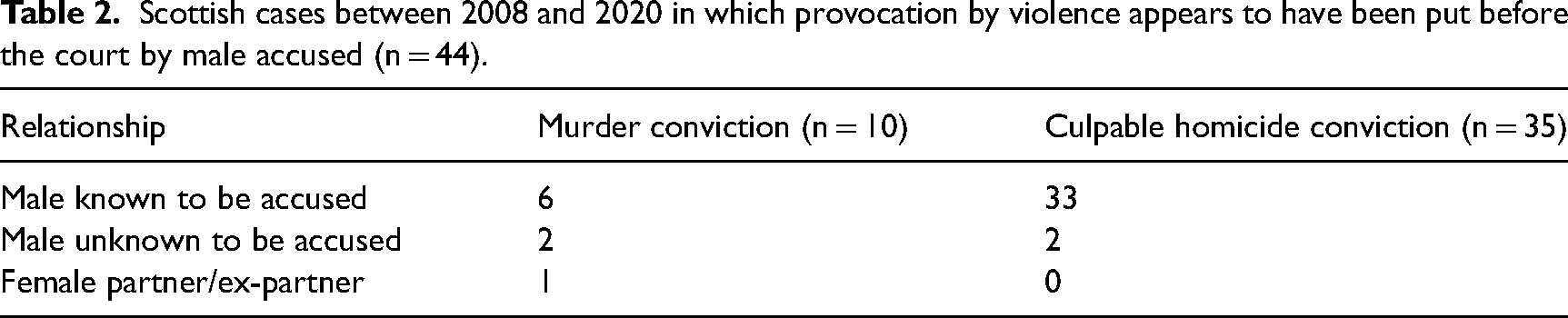
Scottish cases between 2008 and 2020 in which provocation by violence appears to have been put before the court by male accused (n = 44).
The cases which have been identified show that the plea is primarily utilised by male accused, but that where women have sought to rely on the plea, they have a higher likelihood of it being accepted. In the three cases where women did appear to rely on provocation by infidelity, the deceased was the woman's male partner in only one of the cases. In the other two, it was her partner's lover who was killed. This was the context for only two of the men who utilised the plea. The plea can be utilised in cases where it is the paramour, rather than partner, who is killed, but it is interesting to note that, even in a very small sample of cases, this is more typical of cases involving a female accused.
Drury – the leading authority on the plea, as well as the definition of murder more broadly – has, rightly, been the subject of extensive academic concern 30 and feminist critique. 31 As suggested, one of the troubling elements of the case was the reframing of post-separation abuse and stalking as evidence of an ongoing relationship. Such mischaracterisation was also evident in Rutherford, where in a paragraph which states the parties were separated, concludes ‘there was no indication that the relationship was at an end’. 32 These cases are typical of abusive relationships in which sexual jealousy and control are evident. Elsewhere, I have discussed the fact that in order to move on from a landscape in which domestic abuse has been fundamentally misunderstood and mischaracterised for so long, there will need to be a concerted effort to make clear the link which exists between intimate partner femicide and domestic abuse. 33
Following Clinton, 34 Scotland will also need to ensure that abolition of this basis of the plea does, in fact, mean abolition in practice and there is a commitment to eradicating any mitigation which has its basis in sexual jealousy and coercive control. Horder has reflected on this very issue, following Clinton, commenting that the removal of infidelity as a basis for the plea in England and Wales may be viewed as nothing more than ‘gesture politics’. 35
It is considered that attending to this very obviously problematic aspect of provocation will be an easier task for Scots law than reforming the other basis of the plea, especially given the Scottish Law Commission's initial support for the abolition of infidelity as recognised grounds.
Men's use of Provocation by Violence
In homicide cases occurring in Scotland between 2008 and 2020, provocation appears to have been pled by male accused in 44 cases (Table 2). This is likely to be a conservative estimate since it is often unclear why some pleas have been accepted by the Crown. However, examining the contexts of these cases provides insight into how the plea is used in practice. In most of these cases, the deceased was also male, and commonly known to the accused:
In an additional 24 cases heard during the same period, the court returned a verdict of culpable homicide in cases in which self-defence was raised, suggesting that provocation may have operated successfully. In all 24 cases, the deceased was male.
In the case where the male accused attempted to advance the plea in response to killing his female partner, the case went to trial. Following his conviction for murder, it was reported that he had been subject to civil protection orders granted to the deceased and that he had eight previous convictions for domestic abuse against her. 36 Clearly, this was an intimate partner femicide in which the accused attempted to make counter allegations against the female victim.
Although previous research has pointed to problems with men's use of diminished responsibility in cases of intimate partner femicide, 37 the present landscape in Scotland is not suggestive of one in which provocation by violence as a plea is misused by men who kill their female partners. As such, Scotland would have to be cautious of any reform which may allow for the plea to be used in this context more often. This will be discussed further below.
Women's use of Provocation: Killings Following Abuse
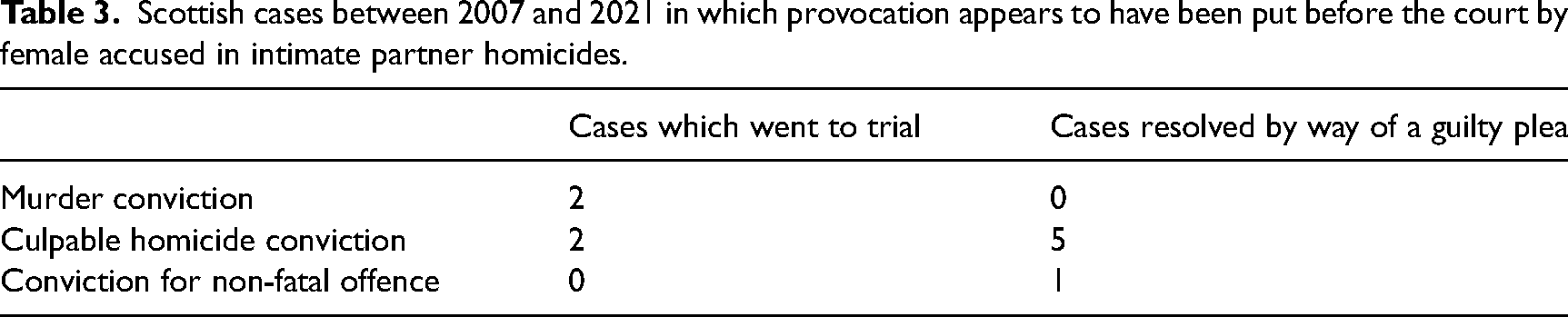
In cases identified between 2007 and 2021, 10 women appeared to plead provocation in relation to intimate partner homicides (one same-sex couple and nine male deceased). The results are shown in Table 3.
Scottish cases between 2007 and 2021 in which provocation appears to have been put before the court by female accused in intimate partner homicides.
There are fundamental difficulties in assessing how many domestic homicides are preceded by male-perpetrated domestic abuse. Where one party is deceased, their account will never be heard and it is a common tactic of male abusers to make false counter allegations and claim that they have been the victim of abuse, especially when the abuse comes to light. 38 Despite these difficulties, when discussing the context of cases arising from previous abuse, it is appropriate to talk about women killing their partners following domestic abuse – a category for which there is a growing body of empirical evidence within the UK 39 as well as indications from homicide statistics.
Scotland's homicide statistics are in keeping with international homicide trends: women are most commonly killed by their partners or ex-partners. Over the 10-year period 2011–2012 to 2020–2021, 41.1% of all femicides involved women being killed by their current or ex-partners – the single largest category of those accused of killing women. 40 In a larger study of Scottish homicide cases, not a single claim was identified in which a male accused said his killing was in response to domestic abuse perpetrated by the female victim. 41
Women are far less likely to kill than men, but where they do, they are most commonly accused of killing their partner or ex-partner. Over the 10-year period 2011–2012 to 2020–2021, 40.4% of all women accused of homicide (murder or culpable homicide) were accused of killing a current or ex-partner. 42 There are a number of cases where a woman's account of abuse at the hands of the male deceased is rejected, and two cases in which her previous assaults are on the male accused are cited in reporting: HM Advocate v Bruce 43 and HM Advocate v Middleton. 44 In Bruce's sentencing appeal, it was noted that ‘[t]here was a history of some domestic violence directed towards both the appellant and the deceased by each other’. 45 Although Middleton's previous convictions were referred to in sentencing, the offence itself did not appear to be aggravated by domestic abuse. 46 Therefore, it is not a given that either of these cases, or others, could be categorised as cases in which women have been killed in response to their ongoing abuse.
In terms of the defences used by women who kill following abuse, previous empirical work has found provocation to be the most commonly used defence position. 47 Concerns have been raised that provocation is agreed upon as a basis for accepting a guilty plea to culpable homicide, even in circumstances where it would appear that the women have acted in self-defence. 48 The problem of women's access to self-defence is a key issue amongst literature on women who kill following domestic abuse, but putting this aside, it would appear that provocation is the main vehicle through which cases of this type are resolved in Scotland.
The Scottish landscape evidences both cases where the plea has operated out with its scope, in order to benefit women and where the facts are such that provocation cannot be accommodated.
The case of Walker v HM Advocate is an example of the first point.
49
Walker pled guilty to culpable homicide on the basis of provocation from the deceased, who was her abusive male partner. Shortly before the killing, she had been seized by the throat and a threat had been made to her 14-year-old son. Walker left the room to go to the kitchen where she took a knife which was used to stab her partner in the chest. It is then narrated that she ‘went back to the kitchen for a larger knife with which she killed him, leaving it embedded in his heart’. The reported appeal concerned her sentence of 6 years imprisonment. In refusing the appeal against sentence, it was noted that it was: …difficult to strike a balance between the background of abuse and the degree of violence used to cause death. W had been shown considerable leniency already as the charge had been reduced from murder to culpable homicide.
50
Clearly proportionality of response was an issue here. The courts have not given an exact meaning to the terms imminence or immediacy when discussing threats and responses in the context of self-defence of provocation, 51 but the immediacy of Walker's loss of control may also have been presented as a problem had the facts been put to trial. The explicit recognition that Walker had been shown ‘leniency’ gives insight into the approach taken at that time by the Scottish courts: Recognition that the mental and physical abuse she suffered played a significant part in her plea of provocation being accepted by the Crown. However, in strict legal terms, with reference to the authority on provocation at that time, Walker's claim of provocation was problematic.
Without such an approach being taken, Walker might have been convicted of murder – an outcome which would have undoubtedly been far worse for her, given the mandatory life sentence associated with such a conviction. The case is an example of provocation – and the Crown's discretion – operating to the benefit of women who kill their abusers.
The more recent case of Graham v HM Advocate 52 demonstrates that such ‘leniency’ is not guaranteed. Findings elsewhere on increased terms of imprisonment in cases where women kill would also suggest that the Scottish courts have taken a less lenient approach to such cases in recent years. 53 Graham's circumstances could not easily be characterised by provocation and the restrictive approach taken towards mental abnormality when coupled with addiction and intoxication, ultimately led to her being convicted of murder – even after intervention from the Scottish Criminal Cases Review Commission. 54 As such, Graham v HM Advocate is a good example of a case which would have benefited from a specific defence recognising the effects of domestic abuse on an individual.
Women's use of and access to provocation has changed over time in the UK, particularly in cases which involve the killing of an abusive partner. Discussing the law of treason, Lockwood notes the absence of provocation claim in cases in early modern England where women were killed following abuse.
55
At that time, such cases were treated as treason: It seems evident that although the statute regarding petty treason had not changed, the jurors, by accepting provocation as a legitimate defence, were interpreting the law in the same way that the legal handbooks had done since the 1630 s.
56
The change to viewing petty treason as type of murder ‘made possible a new range of defences’, according to Lockwood and these were able to ‘mitigate the harshness of the law’. 57 Lockwood notes the change in attitudes alongside the ‘advent’ of provocation; questions were being raised about the authority of the monarch and whether resistance or rebellion could ever be justifiable. Women were increasingly able to cite ‘the rhetoric of the unnatural tyranny of their husband as a defence in court’. 58 Although the killing itself was not legitimised, it was no longer considered to be treason. For Lockwood, this shift represents a larger change in attitudes towards marital relations and a more equitable view of female criminality. 59 Less attention has been paid to women's use of provocation in other contexts, in both historic and contemporary research. In keeping with women's experiences of homicide generally, other contexts are less common, but they are nevertheless interesting to consider.
Women's use of Provocation in Other Contexts
Although the main context in which both women kill and plead provocation is intimate partner homicide, some cases have been identified in which it has been pled in other contexts. Table 4 provides an overview of these cases.
Scottish cases between 2007 and 2021 in which provocation by violence appears to have been put before the court by female accused.

Three of these four cases were resolved without trial by way of a guilty plea being tendered to culpable homicide. One went to trial.
In a further five cases which went to trial, a verdict of culpable homicide was returned in cases where self-defence appeared to have been led, suggesting that provocation may have operated successfully. Two of these cases involved the killing of a male known to the accused and three involved the killing of a female known to the accused.
One of these cases involved siblings Irene and Peter Singleton, who both appealed their convictions for the murder of another male. The appeal considered the issue of provocation in more detail. The Court noted that there was no ‘direct testimony which suggested that either appellant suffered from a loss of self-control at any stage, or that such loss of control was brought about by violence on the part of the deceased’. 60 The degree of violence used by the appellants was also deemed to be grossly excessive, 61 thereby posing problems for the use of provocation.
Another similarly involved an appeal against conviction for murder on the basis of the trial judge's directions on provocation. Tracy Meikle had lodged a special defence of self-defence following the killing of another female. She accepted being responsible for the deceased's injuries, caused by stabbing, but was unable to recall the assault because of her levels of intoxication at the time. 62 On appeal, it was argued that the direction given to the jury failed to cover the possibility that, in the absence of self-defence being satisfied, Meikle may have lacked the necessary mens rea for murder. Instead, it was argued that the jury was led to believe provocation could be the only basis for a finding of culpable homicide. It was held that, despite the fact that Meikle had not mentioned provocation, she had invited the jury to see the whole picture of the killing, which included reference to being in fear of an attack from the deceased. It was commented that: ‘Regardless of the terminology used, a submission of that nature amounted to provocation’. 63
Overall, these findings suggest that, although women may experience problems in accessing self-defence, they are generally able to access provocation with some success.
Reforming Provocation
Over 20 years ago, Juliette Casey considered a proposal for reform of provocation in Scots law, specifically looking at the use of expert evidence on battered women syndrome. 64 Her research involved interviews with advocates. Most were not keen to contest provocation at that time, noting the inherent flexibility in Scots law ‘which they considered obviated the need to challenge the black letter of law’. 65 Despite this, there was almost unanimous recognition that not every delayed response killing should result in a conviction for murder. 66 The case of R v Thornton 67 was cited as an example of circumstances which, although coming close to murder in Scots law, would have had a better chance of avoiding such a conviction. 68 At that time, Casey considered the law of provocation to be more subjective in England and Wales than Scotland. 69 The participants in her research were also of the view that the plea was operating as institutional writers Hume and Alison suggested: allowing for culpable homicide on the basis of provocation in cases of unjustifiable self-defence (a position closer to the Australian concept of excessive self-defence). 70
More recently, Cairns reflected on the possibilities for reform of provocation in Scots law, following the announcement from the Scottish Law Commission that homicide and defences to murder would be subject to review under their tenth programme. At the time, Cairns pointed out that Scotland was ‘late’ to reform the plea but that in itself was not necessarily negative, allowing as it did an opportunity to reflect on: the difficulties involved in the effort to integrate feminist arguments into the reform process in a meaningful and effective way- of what reform measures might work and of what measures are doomed to failure.
71
However, to presuppose a feminist ambition or commitment from the Scottish Law Commission is perhaps optimistic and not necessarily borne out by their previous examinations of defences. 72
For Cairns, the ‘narrowness’ of provocation brings into focus the gendered nature of the plea – but she concludes that it is not narrowness alone which makes the plea problematic. 73 She recognises that an expansion of the plea, beyond infidelity and violence, may make it more available to women who kill (although empirical evidence discussed suggested that this is not problematic in practice), but it could also have the unintended consequence of allowing the plea to be used by men who kill in response to a verbal threat made by their female partners to end a relationship. 74 To allow words alone to form the basis of a provocation plea could allow more men access to the defence following intimate partner femicide, but to exclude words alone risks downplaying the impact of emotional and verbal abuse that women experience as part of domestic abuse. This also creates potential tension with the approach to domestic abuse taken elsewhere in the criminal law. 75 Although it should be noted that previous research has suggested that women who kill their abusive partners usually do so during direct confrontation – often involving quite high levels of violence 76 , it must also be remembered that currently men do not appear to be abusing the plea with any regularity. Expansion could, therefore, create a problem which does not currently exist in Scotland. This is something we should be especially concerned about with any proposed reform of the plea.
Cairns has noted reform could be centred around the removal of immediacy as a requirement. However, as has been shown in other jurisdictions, this too can lead to an abuse of the plea by men who kill in jealousy and as part of coercive control. 77 For Cairns, the closer the plea of provocation conforms to a justificatory model of criminal responsibility, the stronger the argument is for abolishing reference to a loss of self-control, which is ‘psychologically shaky and deeply troublesome from a feminist perspective’. 78 Another potential way of framing the test is that of an ‘emotional disturbance’ – as adopted by several US states. 79
Ultimately, caution should be applied before reform of the plea takes place. Reform and certainly abolition of the plea altogether – may leave women in a worse position than they are currently in. The introduction of a new defence has been considered by Scottish Law Commission. In England and Wales, this new defence essentially replaced provocation but problems associated with the loss of control defence have been recognised 80 and it has not been a panacea for women who kill following abuse. 81 The Scottish Law Commission discussed the option of a bespoke defence, although it is unclear whether this would be in addition to the abolition of provocation or whether a new defence would operate alongside some narrower version of the plea. The Commission did ask whether such a defence should operate as a full or partial defence. 82 To introduce a specific defence of this type, but to only have this operate as a partial defence, would further disincentivise women from making claims of self-defence. International literature on women who kill following domestic abuse has shown that pre-trial decision-making can also play a detrimental role in allowing women's experiences, and their claims of legitimate, defensive action, to be heard. These include: consulting with an all-male legal team; consulting in open spaces (in prison); additional evidential expectations being placed on the accused to ‘prove’ their position; potential limitations about what evidence can be led at trial due to character evidence restrictions; vulnerability/ perceived or actual difficulties related to giving evidence at trial; loss of specialisation (such as that which would be found in sheriff court proceedings if the woman was a complainer); understanding of domestic abuse amongst the legal profession/misconceptions about domestic abuse (family and friends would know; why didn’t you leave?); previous partners would also have experienced the same patterns of abuse); a criminal justice system which incentivises trial avoidance for all accused through mandatory life sentence and sentence discounts for early guilty pleas. 83 These problems are likely to continue to impact any new defence and so a new defence would not help or facilitate access to justice. If such a defence were to be introduced, it is suggested that it should operate as a full or partial defence, but not simply as a partial defence since this may do more harm than good.
Conclusion
Discussion around the reform of provocation is longstanding and international. Reform of the plea in other jurisdictions has clearly evidenced the unintended consequences which may be experienced by broadening the grounds on which it can be based. To remove the plea altogether would likely leave women in a worse position than they are currently as empirical evidence suggests that women who kill following domestic abuse are able to utilise the plea commonly – although often this is a result of prosecutorial discretion. A new ‘custom made’ defence for women who kill may be helpful for those women who cannot access the plea, but caution must be exercised to ensure that women who are acting in self-defence are not faced with further barriers to a full defence. The removal of infidelity as a basis of the plea appears inevitable (and much needed), but it may in fact be the case that allowing for an even narrower plea to continue operating may be the best solution for now.
Footnotes
Acknowledgements
The author would like to thank Professor James Chalmers for his feedback and comments on an earlier draft of this paper.
Declaration of Conflicting Interests
The author declared no potential conflicts of interest with respect to the research, authorship, and/or publication of this article.
Funding
The author received no financial support for the research, authorship, and/or publication of this article.