



Abstract
News organizations try to improve the relationship with their audiences by seeking interaction with them - also known as participatory journalism. But not everyone participates; many news consumers do not surpass reading, watching, or listening to news. The explanations for lagging participation are scattered and not yet comprehensively integrated in an overarching overview. This study provides a more in-depth account of the different motivations of Dutch younger (<30) and older (<50) news users not to use the participatory tools that news websites offer. In this paper the motivations of these different groups are uncovered and compared. Our thematic analysis indicates that both groups are mostly driven by similar motivations. The main motivation both generations bring forward is their aversion towards the online community. Reluctance because of expertise (younger audience members) or career implications (older audience members) seem to be the most important difference between the two groups.
Introduction
As early as the 1990s, critics stated that journalists should counter audience alienation by involving them in the journalistic production process (Drok, 2015). Although user participation in journalism had always existed, the adoption of online media made it easier for journalists and audiences to interact. In 2003, Bowman and Willis coined ‘participatory journalism’ as a scientific term (Bowman and Willis, 2003). This opened a rich scholarly tradition researching how and why people add value to journalism and how this challenged the relationship between news organizations and their audiences (Ahva, 2017; Borger et al., 2013; Kalogeropoulos et al., 2017).
While academia has focused on the democratizing or empowerment potential of audience participation and the quality it could bring to journalistic content, scholarly work on the production perspective shows that support of audience engagement by journalists was initially quite low. Research uncovered the following reasons: the clash with the professional value of autonomy, the fact that it is very time-consuming, and the alleged low news value and subjective bias of user contributions (Drok, 2015; Ugille, 2017).
Interest in participation rose when news organizations came under economic pressure in a digitalized media landscape. Audience engagement generates free content and fits the evolving revenue model, in which money is generated from subscriptions and clicks and reading minutes (online traffic), linked to advertisements (Borger et al., 2013). The way to reach, attract or keep an audience and increase their loyalty is welcomed in an age in which the viability of news organizations is more precarious than ever.
However, according to Vos and Ryan (2023), the discourse among journalists has shifted from audience engagement as vital for their future to concerns about their wellbeing, threatened by online harassment and other forms of ‘dark participation’ (Bélair-Gagnon et al., 2022; Holton et al., 2021). Journalists are experiencing burnout and different forms of social media fatigue (Bossio and Holton, 2021). Other recent studies show restraints from journalists due to their reliance on popularity and visibility online (Miller and Nelson, 2022; Quandt et al., 2022).
Despite the optimistic beliefs and the prevailing strategic-economic interests in, but also new reluctance to audience participation, research on the user perspective shows that the role of most news consumers remains moderate. Many audience members mostly read, watch and listen to news (e.g., Costera Meijer et al., 2015; Engelke, 2019). They rarely interact with news organizations – except for leaving behavioral traces in user data. The more effort interaction costs, the less likely it is that audience members will embrace it (in line with Kushner, 2016).
While our understanding of the motivations for news users to participate is quite nuanced (e.g., Borger et al., 2016; Engelke, 2019; Kalogeropoulos et al., 2017), the knowledge about motivations for non-use of interactive possibilities is scattered – most of what we know is derived from studies about social media use or is a by-product of studies researching people’s motivations for participating on news websites. In the area of journalism, four specific motivations for non-use of interactive opportunities stand out: (1) a limited generation gap shows that older news users are less likely to make use of interactive options on news websites (Hujanen and Pietikäinen, 2004; Picone, 2011; Taneja et al., 2018), (2) the perceived ‘untouchable character’ of news as a product of the expertise of journalists (Hujanen and Pietikäinen, 2004), (3) the threshold that opinions are redundant because others have already expressed them (Picone, 2011), or (4) a lack of self-confidence of audience members (Hujanen and Pietikäinen, 2004; Picone, 2011).
A more in-depth uncovering of reasons for people not to make use of the available interactive tools is relevant– especially since some of the studies mentioned are quite dated or solely based on a student perspective. In academia, the study of non-use gained traction around the turn of the century, when researchers – especially in the area of Science and Technology studies - realized that when access to information is digitized, it is vital to understand who does and who does not have access and why (e.g., Rice and Katz, 2003; Wyatt, 2003). A better understanding of the digital divide is one result of these studies (Norris, 2001). Later, the focus in research shifted from access to skills and use – even if there is access, not everybody can or wants to use digital opportunities (see DiMaggio et al., 2004). Our current study fits well within this paradigm.
From a more practical perspective, a better understanding of why people do not participate might help news organizations to reach parts of the audience that are reluctant to participate. This is an important ambition in the quest to improve both the quality of news and the relationship between news organizations and their audiences. When the negative experiences of journalists with audience engagement become more prominent it is important to realize that these experiences stem from interaction with a minority of participating news users. Understanding the experiences and motivations of the non-participating audience, who have something to offer and may not have wrong intentions, could generate, apart from economic interests, more optimism towards participation. Engagement with their audience remains crucial for news organizations – to improve their stories and increase their relevance in an ever-changing media environment.
To further explore the limited generation gap, we have interviewed both younger news users (<30 years old) and older news users (>50 years old). Older news users are digital immigrants, and they form the largest current audience of news organizations (Digital News Report Nederland, 2022). The younger group belongs to a generation who grew up with social media and are generally hard to reach for incumbent news organizations. It will be interesting to see to what extent their motivations not to participate differ, which role technology plays and if these two groups need a differential approach in engagement strategies.
Our research question is the following: What are the different motivations of younger and older news users not to use the participatory tools that online news platforms offer? This study will focus on Dutch news consumers. They form a relevant research population, as the Netherlands has relatively high-quality journalistic news brands and 97% of its population has internet access (Centraal Bureau voor de Statistiek, 2020; Reporters without borders, 2022).
Literature review
Defining participatory journalism
Participatory journalism is the involvement of citizens in the journalistic production process through participatory channels (Domingo et al., 2008; Picone, 2011). Participatory journalism is closely related to reciprocal journalism as it (ideally) fosters a two-way connection between journalists and audiences (Lewis et al., 2014), but should not be confused with citizen journalism – citizens involved in news production outside of professional practices (Abbott, 2017).
In academic literature, participation is often linked to empowerment of citizens being able to influence news agendas (Reese, 2019; Timmermans et al., 2011), the quality it can bring and the new journalistic revenue model, but also to the concerns voiced by journalists. In comprehensive literature reviews, Engelke (2019), Borger et al. (2013) and Gajardo and Costera Meijer (2022) show that research is quite limited in understanding the role of the audience in news production. Our first goal in the literature review is to analyze which levels of participation can be discerned. We define four distinctive levels of participation (Figure 1). This is relevant as there are different degrees of non-participation, depending on the extent to which news user can influence or modify journalistic content, the resources required, such as knowledge, time, and technological expertise, and the required (creative) effort (Loosen and Schmidt, 2012; Picone et al., 2019). Our distinction starts from the perspective of the user and therefore contrasts with the existing production-oriented approaches (Domingo et al., 2008; Gajardo and Costera Meijer, 2022; Jönsson & Ornebring, 2011). The four levels of participation in journalism.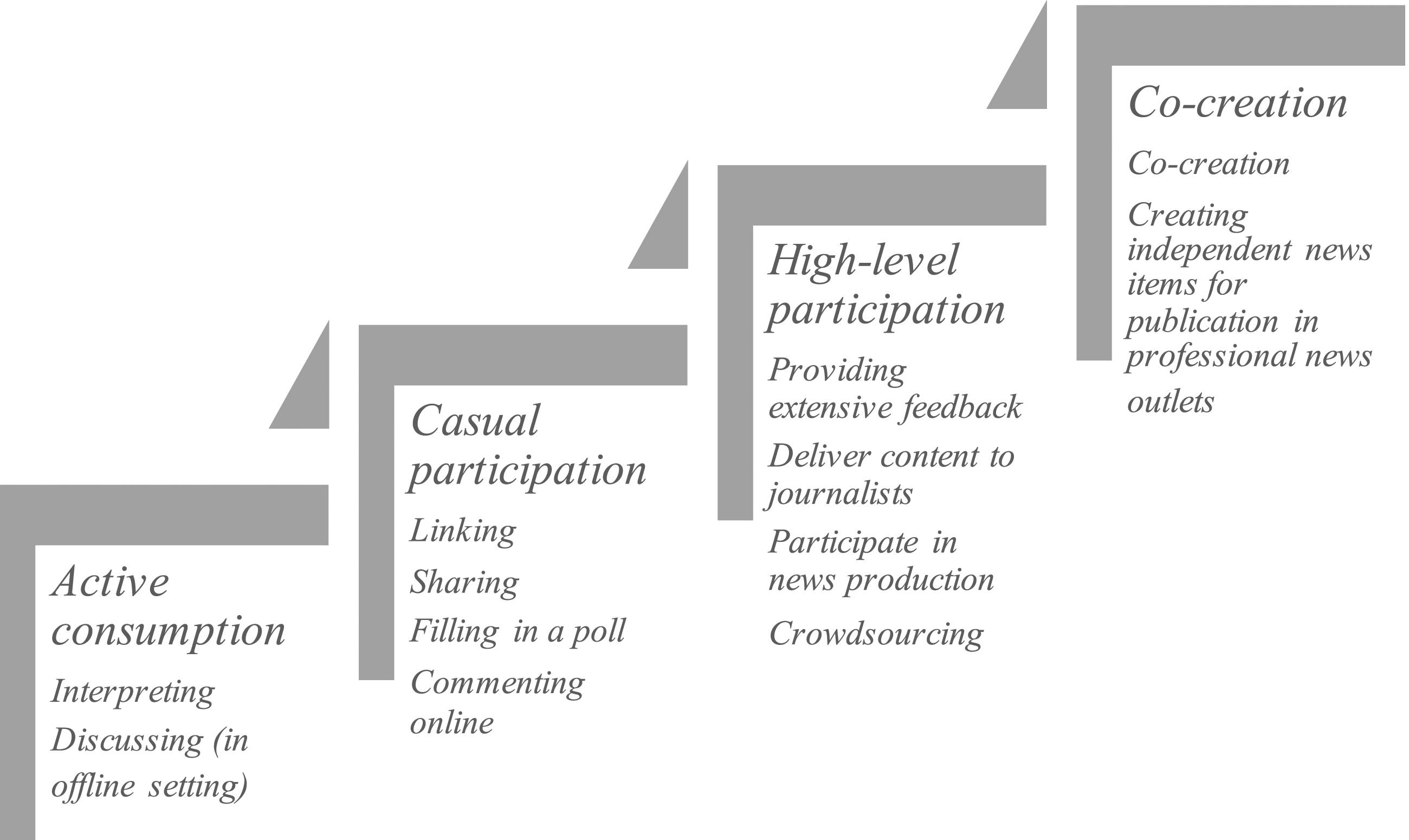
The first level, active consumption, involves interpreting and discussing the news with acquaintances, family and friends (Bobkowski et al., 2019). This hardly requires any effort or resources. There is virtually no control over the journalistic content. We expect most news users to be active on this level. Level two, casual participation, includes the small acts of engagements (SAOE) of publicly sharing and commenting on news content online (Picone et al., 2019). These offer little control, but also require little effort to integrate into the daily routine. Also filling in polls and rating news content are part of this level (Scacco et al., 2016). The third level, high-level participation, requires some creative effort, but users still experience limited control (Spyridou, 2019). They provide multimedia and collaborative content on request (crowdsourcing), such as ideas for a journalistic story, photos, or (analyzed) information (Aitamurto, 2016; Singer et al., 2011). At level four, co-creation, users are involved in journalistic writing and/or addition processes (co-creation) for professional news outlets (Ahva, 2017; Spyridou, 2019). This level requires the most commitment and allows for the most control over journalistic content.
Given the ladder-like shape of Figure 1, a comparison with Arnstein’s (2019) ladder of citizen participation is quickly made. There is a difference in approach though; our hierarchy of participation is based on effort instead of a normative ‘betterness’. In addition, our levels -inspired by the U&G approach - contain a more user-based premise (Ruggiero, 2000).
Explaining non-use
While studying participatory journalism literature, it is striking that although many people participate, even more do not. This finding is a by-product of participatory journalism studies and reinforced by more general studies about participation on social media. Several studies refer to a reluctant audience paradigm; the audience is regarded as reserved, lazy, anxious, or reactive (Bergström, 2008; Spyridou, 2019). The relevance of engaged users – as outlined in the introduction of this paper – justifies a further study into these instances of non-use, because the explanations for this are scattered.
A partial explanation for non-use is the digital generation gap: older people are more reluctant to adopt to innovations due to having less technical skills, while young adults are supposedly more innovative because they grew up with digital technologies (Chen and Chan, 2013; Kopaničová and Klepochová, 2016). This difference can be amplified by infrastructural residues (legacy effect): older news users stay loyal to their news consumption habits (Taneja et al., 2018). Research in journalism has shown a limited generation gap in online news use/production (Hujanen and Pietikäinen, 2004; Picone, 2011; Taneja et al., 2018). Nonetheless, younger generations also do not seem to participate in online journalism often (Hujanen and Pietikäinen, 2004; Katz and Aspden, 1998; Taneja et al., 2018).
To complicate the discussion surrounding age, Hoelig (2016) shows that participation in journalism might be more related to the preferences of a certain type of individual than to access to the internet - internet users in countries with high internet access, such as the Netherlands, tend to be less early adaptive than people in countries with low internet penetration. This discussion surrounding the influence of age on the way people perceive participatory journalism seems unfinished and it will be relevant to further study the way younger and older news users express their motivations to participate or not.
Another possible motivation is uncovered by Hujanen and Pietikäinen (2004). When they interviewed young Fins about their interactive behavior with Finnish news, the youngsters attributed their lack of interaction to the ‘untouchable character’ of news – they saw it as a finalized product based on the expertise of journalists. They were not convinced their own viewpoints could be of added value.
Lastly, based on a study of Flemish news users and how they casually ‘produse’ news (a combination between producing and using), Picone (2011) uncovered that news consumers experience several thresholds that withhold them from participating. The respondents to the diary and interview study reported that they believed their opinions were redundant because others already expressed them (Picone, 2011), or they indicated a lack of self-confidence - they did not consider themselves knowledgeable enough. This last threshold is in line with the findings of Hujanen and Pietikäinen (2004).
To sum up, while the news users in our research have access to internet and participatory tools, they do not make use of it. Following the classification of Wyatt (2003), they fall in the category of resisters or rejecters – they can participate but have personal reasons not to use these interactive opportunities. Wyatt calls these reasons voluntary or ‘intrinsic’. The motivations for non-participation on the various levels of participation still need to be further developed.
Analyzing motivations
In this study we try to map the voluntary/intrinsic reasons for people not to participate in journalism. Reasons can also be conceptualized as stimuli, participatory factors, or motivations. To connect to the U&G approach, we will use the latter. In this study we will group together internal inputs, socio-physiographic dimensions such as values, attitudes, personal characteristics, and preferences that demotivate a person to participate. To create a more solid classification of possible motivations or stimuli to participate or not, we broadened our scope to include research on the non-use of the internet and social networking sites, and motivational research about reasons to participate in journalism. A thematic analysis of these motivations led to five main motivational categories that serve as our conceptual framework.
Motivational category 1: Having traditional role expectations
First, people can have traditional role expectations about journalism (Springer et al., 2015). They might feel that they cannot add any value to professional journalism, because journalists are the experts (Bergström, 2008; Larsson, 2012). Many under-30s seem to hold this view (Hujanen and Pietikäinen, 2004). In addition, news users could feel that they need to be asked to participate before they would consider it (Picone, 2011). We also classify infrastructural residues here (Taneja et al., 2018). Thanks to their reputation, the (older) public tends to remain faithful to traditional newspapers. They are less inclined to engage with news platforms or participation opportunities (Taneja et al., 2018).
Motivational category 2: A feeling of aversion towards the online community
Although people are often motivated by social needs (Spyridou, 2019), social factors can also be motivations for users not to participate. This falls apart in four sub-motivations: Non-participants may be demotivated by the feeling of
Motivational category 3: Having a negative attitude towards online participation
Third, a negative attitude towards technologies can influence non-participation (Reisdorf and Groselj, 2017). This motivation was mainly found in research on SNS use, but it may also be relevant for participatory journalism as it takes place online. Five sub-motivations emerge, based on various values, attitudes, and stimuli: People sometimes refuse media use out of a normative
Motivational category 4: Having privacy concerns
Fourth, non-users, especially the over-65s, may be concerned about privacy (Chen and Chan, 2013; Quan-Haase and Elueze, 2018; Satchell and Dourish, 2009; Stieger et al., 2013; Spyridou, 2019). People could fear exposure and misuse of personal information (Baumer et al., 2013; Gross and Acquisti, 2005), or fear that personal data will end up with third parties such as employers or strangers (Gross and Acquisti, 2005).
Motivational category 5: Uncertainty about skills
Lastly, non-users can feel insecure about their skills to participate, on a technical or content level. We discern two sub-motivations: People might feel a
Method: Qualitative thematic analysis
A qualitative method was chosen as the research was aimed at understanding non-participation in-depth. Semi-structured interviews enabled identifying the motivations for non-participation (Brennen, 2017). Although surveys are a common method in motivation research (Bergström, 2008; Cho et al., 2003; Ruggiero, 2000), surveys are less open to personal input. The research received ethical approval of Erasmus University Rotterdam.
16 interviews were conducted, eight with younger (<30 years) and eight with older (>50 years) respondents. Targeted and quota sampling was used to select for certain properties, mainly age (from 21 to 28 years old and from 51 to 67 years old). The number of men and women is equalized by generation. The respondents needed to make use of at least one interactive Dutch online news platform, for at least 6 months. The respondents are voluntarily non-participants (Wyatt, 2003). They do not use participation possibilities, except for participation level one and online liking (level two), as these were expected to be used often (Picone et al., 2019). To approach potential respondents, a social media call was posted, with the required respondent profile. Interested people were called to verify if they were suitable by going through the requirements. Via them, other potential respondents were targeted (snowball sampling) (Robinson, 2014).
Before the interview, the respondents were read a consent form. Due to the Corona pandemic, the conversations were held online. This method reduced the geographical constraints of face-to-face interviews. However, physical proximity makes bonding easier. While having access to the visual cues of participants via video-calling, important information may have been lost via the respondents' body language. Despite its cons, it proved a good alternative as it allowed participants to share their screen easily (Irani, 2019). While they navigated through their preferred news websites, they explained why they did not use the offered participation opportunities.
The interviews lasted on average 58 min, and were recorded, transcribed, and analyzed in Atlas.ti, following the steps of qualitative content analysis: (1) open coding, (2) axial coding, and (3) selective coding (Boeije, 2010). The fragments were deductively labeled based on our classification of possible motivations, the sensitizing concepts. We used both concept-driven and data-driven coding to ensure the openness of analysis.
Results
The thematic analysis revealed 10 participatory thresholds – some are in line with the theory, some are different or bring a nuance to our understanding of non-use of journalistic interactive opportunities. As explained before, we consider motivations to be a broad category of perceptions, attitudes, feelings, values, and preferences. We conceptualized and grouped these motivations based on the subject that they were directed towards – this created five broader motivational categories. These are, in order of importance: (1) the other user, (2) the platform, (3) the self, (4) the news content, and (5) the news organization.
Theme 1: The other user – negative attitude towards online community
The respondent’s primary motivation for not participating is their negative attitude towards the online community and online conversations. This motivational category links to the second level of journalistic participation: discussing and commenting online.
First, both generations mention being reluctant of polarization, being quickly categorized in camps ‘for’ or ‘against’ something, and the feeling of being vulnerable because of online cancel culture. They feel uncomfortable due to possible hostile and insulting reactions. This is also a known reason for not participating on SNS (Baker and White, 2011). Respondent 9 (woman, aged 51) explains: (…) If you follow the debates every now and then, you think: what a horrible way to discuss. Instead of all of us wanting to get closer to each other, we are only busy bringing each other down (…).
Because of this fear of negative responses, respondent nine does not feel eager to participate in journalism online.
Second, most respondents mention the impossibility of a nuanced debate online. They experience limited room for constructive discussion (because of name-calling and a lack of substantiation) and find the reactions of low quality. Respondent 7 (male, aged 23) describes: “(…) it is not a nice community to talk to at all (…) people are very shortsighted (…).” Because of the experienced lack of nuance online, the respondents evaluate participation as unpleasant, meaningless and a waste of time and energy. Those debates, respondent 8 (man, aged 23) says, are: (…) Often also racist, discriminatory, misogynistic (…) And I don’t get any new value or knowledge from that, that’s how it feels. So, then I ask myself: why would I participate in such a debate?
Moreover, the interviewees mention the difficulty of giving context to a like, share or comment online, followed by misinterpretations. They specify the limited writing space and the absence of mimicry, intonation, and intentions of the publisher. All these factors influence their negative attitude. Respondent 8 (male, aged 23) explains this as follows: (…) you talk in a vacuum, you don't know who he is, what his background is, (…) where he comes from and why he has certain ideas or opinions.
Third, both generations mention that everything has already been said. They express an aversion to the number of opinions online and feel that their contribution will only (re)confirm an existing opinion (in line with Loosen and Schmidt, 2012). Respondent 14 (man, aged 59) illustrates this as follows:
Everything has already been said ten thousand times (…). And I’m not going to just repeat things and show that I also have an opinion. (..) I’m not adding anything (…).
Theme 2: The platform – loss of privacy and irrevocable contributions
The second main motivation connects to users’ perceptions about the interaction platform. It can be divided into three sub-motivations which are linked to a loss of control over anything that is uploaded online. The respondents link these motivations to all online participation levels.
First, both generations mention a perceived loss of control over their privacy. They describe the online public sphere as a black box - it is unclear what happens to their contribution and personal information. Some fear, like research about Facebook-dropouts has shown, that their data will end up with third parties and will be exposed and misused. Respondent 13 (male, aged 51) confirms this: “The internet is a very loose cannon where you have absolutely no control over your message or what happens to the discussion.” While research suggests that older respondents have privacy concerns (Quan-Haase and Elueze, 2018), these are not particularly prevalent among the over-50s.
Second, most under-30s feel hindered in participation because of the irrevocability of their contribution. Some point to their orienting phase of life and ever-changing opinions, as respondent 5 (male, aged 21) formulates: “In 50 years, you might get something thrown in your face about what you said back then.” The inability to delete personal input does not make participation attractive.
Theme 3: The self – image control and other priorities
The third overarching theme is connected to the perceptions people have of themselves and how they manage their time. This applies for participation level two, three and four. As the literature review has shown, the reasons to create content online are mainly connected to self-presentation and self-actualization (Shao, 2009). In a journalistic setting, this might not apply.
Most respondents indicate that they want to keep control over their professional image. The over-50s express concerns about their current professional image. They want to create a congruent and neutral image of themselves. Respondent 14 (male, aged 59) illustrated this as follows: (…) my business network is also on Instagram. (…). I am aware that I have an exemplary function and (…) in my profession, in that respect, I must be careful with my image.
The under-30s are concerned about their upcoming career, as respondent 1 (female, aged 23) describes: “(…) I think I want to keep myself out of harm’s way for the future (…).” They are engaged in cautious self-realization and do not want to participate because they are still in an orientation phase. Self-expression can be recognized in the older non-participants, as they do not want to damage their current position in society.
Despite their non-participation, both generations indicate that they do appreciate discussing. They desire reciprocity, including (influence on) other people’s perspectives and social confirmation. While they want to participate for democratic reasons, they do not want to inform, mobilize, or activate others (as was shown by Ahva, 2017; Kümpel et al., 2015), but value mutual understanding in a discussion.
Respondents are interested in participation but indicate that they withdraw from participating because they have other priorities. The younger interviewees prioritize studies and personal life, as respondent 7 (man, aged 23) illustrates: “(…) I’m busy with all kinds of other things. (…) I’ll do it when I have the time.” Older respondents prioritize work, as respondent 15 (male, aged 61) describes: “(…) time is scarce when you work, then it is difficult to maintain quality.” Three of them consider participation after their retirement.
Theme 4: The content – perceived lack of professional skills
The respondents indicate that they think they lack the skills to contribute to journalistic content. This applies to the two higher participation levels. The perceived lack of skills has two different explanations which differ per generation. The younger respondents cite their orientating stage of life as a reason. Respondent 1 (female, age 23) illustrates this as follows: (…) but that does mean that you must be sure of your opinion. (…) Look, I have an opinion, but I'm also a bit undecided sometimes.
They feel that they do not yet have anything valuable to add to journalism and public discourse. They may consider participation when they have developed their expertise (this is in line with Hujanen and Pietikäinen, 2004 and Picone, 2011). Respondent 8 (man, aged 23) puts it as follows: Maybe it will come. (…). If I perhaps focus on a field or become very actively involved with a subject. But I am also still studying, and I have the feeling that this is an orientation phase, (…).
While Katz and Aspden argue (1998) that young people are more likely to stop using the internet because of disinterest, most of our younger interviewees express that their lack in knowledge prevents them from participating now.
The older non-participants, different from what existing research shows, see themselves as not having the same (amount of) skills as professional journalists do. Therefore, they do not consider producing journalistic content as their task but that of professionals, as respondent 10 (female, age 54) states: (…) editors are editors, they do their job. The old news reporting no longer exists. (…) all they have to do is provide context, they are very good at that.
Many respondents view news as a product of journalistic expertise and therefore doubt their own relevance. Opposed to Hujanen and Pietikäinen (2004), we discovered this argument mainly among the over-50s. In addition, four respondents describe participatory journalism as a new phenomenon - they continue their old habits in news use in the online sphere. However, they see the interactive nature, and not technology, as something new.
Finally, the respondents do not mention a lack of technical, internet or digital skills. Therefore, we can conclude that the generation gap, based on a lack of such skills, does not exist within our research context. Instead, the differences between the two generations can be understood by their different stages of life.
Theme 5: The news organization – feeling uninvited or rejected
The last main motivational category describes the discouraging feeling of respondents who miss interaction with news organizations. This is only addressed by a minority of respondents and only applies to the over-50s. This theme contains two sub-motivations and respondents indicate that this applies to the highest two participation levels.
First, the older respondents mention that they experience a lack of activating journalism. They indicate that, if asked directly by a journalist or news organization, they would like to participate, as respondent 14 (man, aged 59) illustrates: “(…) the moment I’m triggered, interaction arises, then I feel more involved and I feel more space to respond to things.”
Secondly, the older interviewees feel not being taken seriously. Some have sent information to journalistic editors, which was disregarded, as respondent 16 (man, aged 67) describes. He participated in weekly audience polls, but never received any follow-up: (…) my personal involvement decreased. (…) the format and the recurring question whether I would like to be approached, but nothing happens with it. (…) at a certain point I had the feeling that I started answering things twice, while in my opinion not much had changed. (…).
There is no fear of editorial rejection, but rather the lack of reciprocity and the feeling of not being taken seriously. Therefore, older respondents feel that participation makes little sense.
Conclusion and discussion
Audience engagement in journalism is a relevant topic – it enables news organization to remain relevant, improve the loyalty of their audience, stay economically viable and improve the quality of their news production. News organizations have acknowledged both benefits and challenges while they allowed their audiences a role in news production. Many are still experimenting and have not yet fully satisfactorily integrated participatory journalism in their production processes. They keep struggling, for example, with dark participation of (a small part of) their audience, or the challenges of activating the ‘silent’ part of their audience in a relevant way. Uncovering motivations for news audiences to participate will therefore remain very relevant in the coming years.
For the past 20 years, researchers have uncovered a rich pallet of user activities and motivations for participating in news production and explored the added value of user participation and its impact. Indirectly, many of these studies also showed that, although many people participate, there are more people who do not. While in academia, the study of non-users has gained attention since the turn of the century, little is known about the reasons for non-participation in journalism. These ‘silent’ audience members could add a more diverse and nuanced sound to the production and discussion of news.
The respondents in our study do consume and discuss the news, but do not move beyond participation level one in their activities. Our analysis showed various motivations for this. We grouped these motivations into five categories: the other user, the platform, the self, the content, and the news organization. The most important discouragement for participation is the perception that the internet does not provide a safe space for interaction. This is mainly connected to the way other users shape the culture of these online spaces. Cancel culture, polarization and the abundance of unsubstantiated opinions all contribute to this unsafe and vulnerable feeling. Another important discouraging motivation is the way platforms treat private information and enable users to manage their input. Third, audience members prefer to control their image and indicate that they have other priorities. Fourth, connected to content, people doubt their skills and are hesitant to engage with journalists who are considered experts. Lastly, when they do not feel invited, or when the interaction is not reciprocated, audiences also are discouraged to participate.
How do these findings relate to the various levels of participation as presented in the theoretical section? During the interviews we made notes of how the discussed motivations related to each level of participation. In the results we indicated these levels. The second level of participation is mainly connected to the most important overall motivation: the internet is not considered a safe space for nuanced discussion. This motivation resembles the aversion people in earlier research have expressed towards participating online in general, and it seems to be a broad concern over generations. The thresholds to casual participation can be mostly found in this same motivation category, but also includes the fear of losing control over data and comments. News users link their privacy concerns primarily to their professional self. Younger users do not want to damage their future professional self (self-actualization) while older users do not want to damage their current professional self (self-expression). In addition, news users prioritize other things over participating at this level.
Especially in the high-level participation and co-creation levels, perceived expertise is a hindrance for participation – many interviewees still consider journalists to know better. The under-30s do not (yet) consider themselves knowledgeable enough, and older people look up to journalists’ expertise. In addition, audience members feel demotivated to participate in high-level participation and co-creation because they are not actively approached and do not receive feedback. Combined with the fear of losing control and having other priorities, it seems that news users express most thresholds for the levels of participation that require more effort.
It needs to be underlined that people do not express very strong negative opinions against participation – people very often would like to play a more active role but prioritize other activities in their busy schedules. The characterization of non-participants as ‘the lazy public’ by Spyridou (2019) should thus be nuanced.
One of the goals of this research was to critically assess the differences in two age groups - especially regarding the role of technology therein. The analysis showed indeed some interesting differences between older and younger news users, but also provided a strong indication that technological skills are not the determining factor. The most important differences between age groups are explained by life phase; younger people more often mention their lack of expertise and are afraid that their contribution will remain visible. Older respondents indicate that they have a professional role online and the journalists are the experts. This nuances earlier studies on the role of technological skills in participatory practices and the adoption curve of innovations.
Practical implications
When we put the user- and journalistic perspectives next to each other, we can find similarities in the causes of reluctance, such as dark participation and the risk of reputational damage (Bossio and Holton, 2021; Bélair-Gagnon et al., 2022). Journalists could take a pioneering role in creating conditions for interaction, favorable for both parties, to ensure a useful and sustainable relationship.
Given the experienced unsafe online environment, news organizations could work on further facilitating nuanced and safe discussion. Some Dutch news websites already use user profiles, overnight closure, or algorithmic filters to achieve this. News organizations could communicate more clearly to their users how they create a safer environment for participation.
News organizations already engaging with or considering audience contribution should understand the importance of reciprocity. They could encourage news users by approaching them directly and communicate the added value of participation more clearly.
These measures are conducive to the empowerment of news users, but also to the job satisfaction of journalists and the viability of news organizations.
Research reflection and further research
This study focused on a limited number of Dutch non-participants in two age groups of which almost all respondents were highly educated. The results thus provide indications that should be further explored. Follow-up research should focus on more interviews with more diverse respondents. Also an analysis of the ‘middle group’; non-users aged between 30 and 50, could be an interesting addition. Finally, this research shows that news consumers are both citizens and professionals, which influences their willingness to participate. Follow-up research could investigate how people deal with their different (online) identities.
Footnotes
Declaration of conflicting interests
The author(s) declared no potential conflicts of interest with respect to the research, authorship, and/or publication of this article.
Funding
The author(s) received no financial support for the research, authorship, and/or publication of this article.
