




Abstract
This paper utilizes a nationally representative survey to gauge the ways in which media users engage with their local newspapers by using features that allow for sharing, liking, and commenting. The main results indicate that significant predictors for different types of news engagement vary, but that age and education emerge as two of the more interesting varieties. Implications are discussed—for instance, how both psychological and behavioral experiences constitute the concept engagement and how our results challenge the technology-optimistic argument that social media presence on a newspaper website promotes audience engagement in the journalistic process.
Keywords
Attempting to halt declining readership and reverse falling revenues, newspapers are increasingly trying to improve reader online experiences by utilizing the opportunities made possible by the participatory features often found on a variety of online platforms. Indeed, utilizing the possibilities for audiences to share, comment, or like news articles must today be considered as part of the standard digital repertoire for news organizations (e.g., Almgren & Olsson, 2016).
With a few exceptions (such as Bobkowski et al., 2019), the bulk of research into online user engagement with news has seemingly been aimed toward national or indeed legacy news media actors (Kalogeropoulos et al., 2017; Powers, 2018; Sjøvaag et al., 2018). Considering the roles that local news media have held and continue to hold for their respective audiences and communities (e.g., Lie, 2018; Nygren et al., 2017; Olsen & Solvoll, 2018; Wadbring & Bergström, 2017), one might expect more users to engage in participatory practices within local newspapers (e.g., Almgren & Olsson, 2016). In order to address the apparent dearth of research about user engagement with local news media, this article explores to what extent the users embrace the interactive opportunities on local newspaper sites and what roles they are playing as either distributors or co-producers.
A better understanding of how users’ participatory practices function in relation the social features employed by their online newspapers is important for researchers and for the broader media industry as well as for society at large (as suggested by Lawrence et al., 2017). Indeed, the argument has been made that social features as employed by online newspapers could take on pivotal roles in maintaining and possibly expanding the long-held role of such news media actors as providers of arenas for exchange of opinions and communication between citizens (e.g., Hess & Waller, 2016; Skogerbø & Winsvold, 2011). With regard to the economic situation of the newspaper industry, an active audience could prove useful as co-producers of certain contents and services in terms of interactions with, and reactions to, already posted content (e.g., Wikström & Ellonen, 2012). Taking these issues into account, we argue that the strong position of newspapers in Norway lays the groundwork for what we can refer to as a critical case (Flyvbjerg, 2006), a study of particular interest in relation to the research question investigated, which is audience engagement.
So far, research has challenged the general assumption that audience engagement will increase in an almost automatic fashion once audience members are given access to various participatory tools (e.g., Larsson, 2012). With a handful of notable exceptions (such as Borger et al., 2016; Meijer & Kormelink, 2015; Spyridou, 2018), rather few studies have conducted audience-oriented research pertaining to these issues. Consequently, previous research on user participatory practices in relation to online newspapers is somewhat ambiguous, providing scarce understanding of the actual uses of participatory features. Findings from an audience survey—such as the one presented here—will offer a more nuanced perspective on this research area, going beyond the potential role of user participation (Manosevitch & Tenenboim, 2016) or broad overviews of what features online newspapers are offering to their users (Stroud et al., 2016).
As we shall see, however, the role of the audience appears to be shifting toward a distributive variety, where industry representatives prioritize urging audiences to share already existing news stories with their own networks rather than encouraging them to provide their own journalistic contributions (e.g., Krumsvik, 2018). Our results indicate that user news interest had a strong influence on the practice of sharing, while age and education emerged as significant predictors for users who were likely to contribute to content production. Both with regard to sharing and commenting, we saw an age difference as comparably older respondents shared and commented by means of email and by the comment sections typically offered by newspapers on their own web sites. Comparably younger respondents, however, utilized social media for these purposes.
Literature Review
The implementation of social plugins and so-called web 2.0 technologies certainly carries with it the potential for new relationships between users, the journalistic product and the journalists. These relationships have been described as user generated content (Manosevitch & Tenenboim, 2016), user involvement (Krumsvik, 2013), participatory journalism (Domingo et al., 2008) and the more general term “user engagement” (Ksiazek et al., 2016). All these concepts “imply some level of public participation in news-making, but are non-specific as to where this occurs and to what extent it matters to the final product” (Scott et al., 2015, p. 737). Features of participating differ in their degree of openness and in terms of who has control in each of the stages in the news production process (Domingo et al., 2008; Kiousis, 2002; Krumsvik, 2013). In addition, Kiousis (2002) emphasizes feedback and multiway communication as core components of interactivity conceptions.
A large body of scholarship has examined how newspapers handle users’ participatory practices on news sites—in economic as well as in societal terms. The transformation from passive consumption to active participation has been suggested as being of critical importance to sustain newspaper relevance and thus survival (Wikström & Ellonen, 2012) as well as to establish that news websites serve as a platform for participation in the public sphere (e.g., Manosevitch & Tenenboim, 2016). According to Krumsvik (2018), promotion and business development gain significance at the expense of conventional focus on user participation to ensure the social and societal commitments often adopted by the news media sector.
While digital technology at least potentially contributes to the empowerment of audience members (Morlandstø & Mathisen, 2016), the attempts made at inviting readers to take larger roles in news rooms are still relatively few and far between (Manosevitch & Tenenboim, 2016). In addition, such attempts are largely controlled by journalists and other media professionals (e.g., Almgren & Olsson, 2016; Scott et al., 2015), suggesting a somewhat conservative journalistic culture (Domingo et al., 2008). Thus, the influx of digital news media has largely been received by news media professionals in ways that do not necessarily correspond to a “new type of civic culture” (Givskov & Trenz, 2014, p. 57), making novel digital platforms less “central to news consumption [than] often assumed” (Meijer & Kormelink, 2015, p. 664).
As for research on the economic benefits of users’ participatory practices on news sites in online newspapers, a few tendencies can be identified. Indeed, several benefits would seem to appear if news professionals do succeed in engaging their audiences. For instance, such benefits include enhanced value proposition (Manosevitch & Tenenboim, 2016), improved customer relationship (Wikström & Ellonen, 2012), brand loyalty (Lischka & Messerli, 2016), the ability to harness accumulated information about users and their interactions (Krumsvik, 2018), and an increase of traffic to the website (Kalsnes & Larsson, 2018; Lawrence et al., 2017). However, many of these studies have focused on what features the websites simply offer, thus largely ignoring the perspective of audiences. Moreover, as discussed above, this research has mainly been directed toward national media actors and not the locals.
On a related point, we can point to the ample amount of research available that offers insights into the employment of participating features on news websites. The findings reported from such projects can largely be understood along three dimensions: newsroom perceptions of audience access and participation (e.g., Domingo et al., 2008; Lawrence et al., 2017; Lie, 2018; Morlandstø & Mathisen, 2016; Scott et al., 2015; Stroud et al., 2016), the role of social plugins in news websites (e.g., Givskov & Trenz, 2014; Manosevitch & Tenenboim, 2016; Wikström & Ellonen, 2012) and the actual use and appreciation of such services in relation to online news media (e.g., Almgren & Olsson, 2016; Bobkowski et al., 2019; Borger et al., 2016; Kalsnes & Larsson, 2018; Krumsvik, 2018; Larsson, 2011; Meijer & Kormelink, 2015; Spyridou, 2018; Vanhaeght, 2018).
For the first group of studies, these research projects have indicated that audience access to the newsroom poses a challenge to the roles of gatekeepers and agenda-setters traditionally held by journalists. An early study found that news production processes exhibited little openness, restricting user roles to simply ranking, and commenting in relation to already published journalistic content (Domingo et al., 2008). Eight years later, hints of continued skepticism about audience roles remain (Stroud et al., 2016, p. 353). Indeed, journalists view readers’ comments as a “necessary evil” (Canter, 2013, p. 617), supporting the argument of Larsson (2012), Lawrence et al. (2017), Borger et al. (2016), Morlandstø and Mathisen (2016), and Scott et al. (2015) that strong journalistic control emanating from historical precedence and an understanding of professional roles will have a constraining effect on audience engagement. However, local newspapers might be more likely to allow users to comment on articles than national newspapers because of their role as a local marketplace and social arenas (Almgren & Olsson, 2016).
For the second group of studies, details of the actual news production process suggest that audiences have modest roles as contributors, both as producers and distributors. Givskov and Trenz (2014) found traces of “reactive online usage” through polling, tipping, and online surveys that supported arguments suggesting lazy, skeptical, or reluctant audience members (Spyridou, 2018), limited willingness to participate (Borger et al., 2016), and news as a social experience offline, but not online (Meijer & Kormelink, 2015). As local news sites have a proximity to their users (Almgren & Olsson, 2016; Lie, 2018; Morlandstø & Mathisen, 2016; Olsen & Solvoll, 2018), we might expect more engagement within local news sites compared to national news sites.
From the perspective of participants, few studies actually provide empirical evidence that supports the oft-repeated argument that news is increasingly becoming a social experience—and that “people en masse actively [want to] contribute to news through sharing, recommending etc.” (Meijer & Kormelink, 2015, p. 675). The often reported low levels of use of interactive features could be seen as suggesting that it takes time for users to adapt to these new opportunities (Larsson, 2011), that audiences are shy, lazy, and fearful about expressing themselves to each other (Hujanen & Pietikäinen, 2004; Spyridou, 2018) or simply that they do not have the urge to participate in media production (Kalogeropoulos et al., 2017; Krumsvik, 2018; Vanhaeght, 2018). In terms of sharing, Bobkowski et al. (2019) found that one in three respondents use social media to share news articles, while three in four share news stories by discussing them with friends and family.
Moreover, we might suspect demographic variables, such as age, to play a part here. In a more general sense regarding the use of information and communication technologies, Djerf-Pierre et al. (2016) point out that “age is a key factor for adoption” (p. 4). Indeed, while younger generations are often singled out as being early adopters of new technologies and ways of doing things (e.g., Rogers, 2010), usage studies have also shown that skepticism to participation is also present among comparably younger news consumers. Such users might feel that their contributions have no place among the professionally prepared news products already offered (e.g., Hujanen & Pietikäinen, 2004; Larsson, 2012). Studies have also indicated that such users feel the need to essentially curate their personal social media feeds and that excessive sharing would clutter their online profiles (e.g., García-Perdomo et al., 2018; Trilling et al., 2017).
Building on the classic study of Shaw and Riffe (1979), contemporary literature on demographic differences suggests readership, as a type of low engagement, increases with age. In terms of sharing activity, the literature is inclusive about gender differences, but people with high news interest are more likely to share news stories (Kalogeropoulos et al., 2017; Picone, 2016). Numerous studies comment about great potential for deliberation associated with this form of user interactivity. Commenting is also largely related to news interest, and women are more likely to comment in social media than men (Kalogeropoulos et al., 2017). Men would comment significantly more often than women within the commentary section of the newspapers (Stroud et al., 2016; Ziegele et al., 2013). In addition, Springer et al. (2015) found that commenters were significantly older men. As already mentioned, few studies focus on local newspapers or hyperlocal news websites. One exception is Bobkowski et al.’s (2019) survey study from the United States, which found readers with higher education to share hyperlocal news via each other, both in person, through e-mails and on social media. Readers with little education used social media more than their highly educated neighbors to share news. Based on this overview of research, the aim of the study presented here is to provide further insight into audience’s participatory practices in relation to social media features as employed by online local newspapers, with particular focus on demographic differences.
Method
The study draws on data from a survey (N = 1,586) administered by a large Norwegian higher education institution. Three researchers from the institution developed and tested the survey questions, while a market research agency conducted the data collection by means of an online survey tool. Specifically, the survey was distributed in September and October of 2016 via a national web panel (Norstat) consisting of 81,000 panelists age 15 and older. Results were weighted for gender, age, geography and education in line with national census data. Different data from the survey have previously been featured in other scholarly work (Olsen & Solvoll, 2018). However, the study at hand marks the first instance where this survey is employed to look specifically at issues of online audience engagement in local newspapers. The portions of the survey used here included items on both traditional and digital media consumption. Specifically, we asked if a variety of activities in relation to such themes had been undertaken during the last week or during the last 6 months.
Norway serves here as a critical case of international interest for three reasons. First, Norwegian society is characterized by a 99% internet penetration rate (Newman et al., 2019). Half of the population read the newspapers’ online version daily, and 70% of the population used their mobile when accessing news (Nordicom, 2019). Second, the case offers valuable insight into local newspaper markets, as 198 newspapers are published regionally and locally among the 5.3 million inhabitants. Third, the newspaper situation in Norway represents a case for successful implementation of digital paywalls, as Norway is a country with high percentage of consumers (34%) willing to pay for online news (Newman et al., 2019).
We examined three types of participating features as identified in the reviewed literature (e.g., Bobkowski et al., 2019; Givskov & Trenz, 2014; Stroud et al., 2016). In particular, we utilized Krumsvik’s (2013, 2018) model of user involvement identifying the donation strategy as including users in the production of content, the distribution strategy as encouraging users to share news stories and the deliberation strategy as reacting and interacting with content in terms of commenting. In our analysis, donation was operationalized by the question “have you written a letter to the editor of your local newspaper regarding a local news theme.” For distribution, three measurements were identified: “have you shared a local news story on social media such as Facebook,” “have you shared a local news story via email,” and “have you talked to someone face-to-face about local news.” While this latter item does not relate to the digital theme under scrutiny here, we nevertheless included it to provide contrast to the other measurements, as in Bobkowski et al.’s (2019) study. For deliberation, two items were included in our study: “have you commented in relation to a local news story on social media” and “have you commented in relation to a local news story on the website of your local newspaper.” Krumsvik (2013, 2018) also includes a fourth element, data gathering strategy. Data gathering can be seen as an underlying result of the activity undertaken by audiences as they donate, distribute, deliberate, and otherwise engage with regard to the web presences of local media. As such, this type of strategy generates what could be referred to as indirect data, given that it essentially involves capturing the digital traces that users inevitably leave behind as they engage online. As such, it can be considered to be the effect or indeed sum of all services being employed by audiences, since this allows the news actors to harness their data. With this in mind, we considered this particular strategy as problematic with regard to gauging the data at hand and it was excluded from the survey. Future studies might find better ways to address this mode of audience engagement.
The items mentioned above will serve as dependent variables in the analyses to come. As for independent variables, the literature on audience engagement suggests a series of such measurements that could serve as suitable predictors for a study such as the present one—age, gender, education, size of region where respondents live, interest in local news, and whether or not the respondent’s household had a subscription to a local newspaper. While this study did not test a hypothesis, the basis and motivation for this study is nevertheless based on what previous research has found with regard to news engagement (e.g., Bobkowski et al., 2019; Chung, 2008; Jennings & Zeitner, 2003; Kalogeropoulos et al., 2017; Larsson, 2011; Reader et al., 2004; Springer et al., 2015; Ziegele et al., 2013).
Results
Descriptive Findings
Of the sample (N = 1,586), 69% of our respondents have read an online local newspaper without interacting or engaging with the website. In terms of the donation strategy, 3% of our respondents indicated they have written a letter to a newspaper about a subject. Men and older respondents are slightly more active than women and younger respondents. One in four indicated they have shared a news article in social media or by email, indicating support of the distribution strategy. Sharing is motivated by news interest and more common among men than women. Older people share using email, while younger people are sharing local news stories in social media. Offline, 67% indicated they distribute news stories by talking to other people about them. Twelve percent of the respondents indicated they have applied a deliberation strategy, in terms of commenting on a local news article in social media or in the newspaper. Young people (15–19 years old) are most active in commenting in social media. The most passive group is the 30 to 39 age stratum followed by the age group, 20 to 29 years old.
Analysis was undertaken by means of a series of logistic regressions, tracing the influences of the independent variables on the dependent varieties as described in the previous section. Beginning with the donation strategy, Table 1 shows the influences of the independent variables on the indicator variable for donation, as employed here.
Results for the Donation Strategy
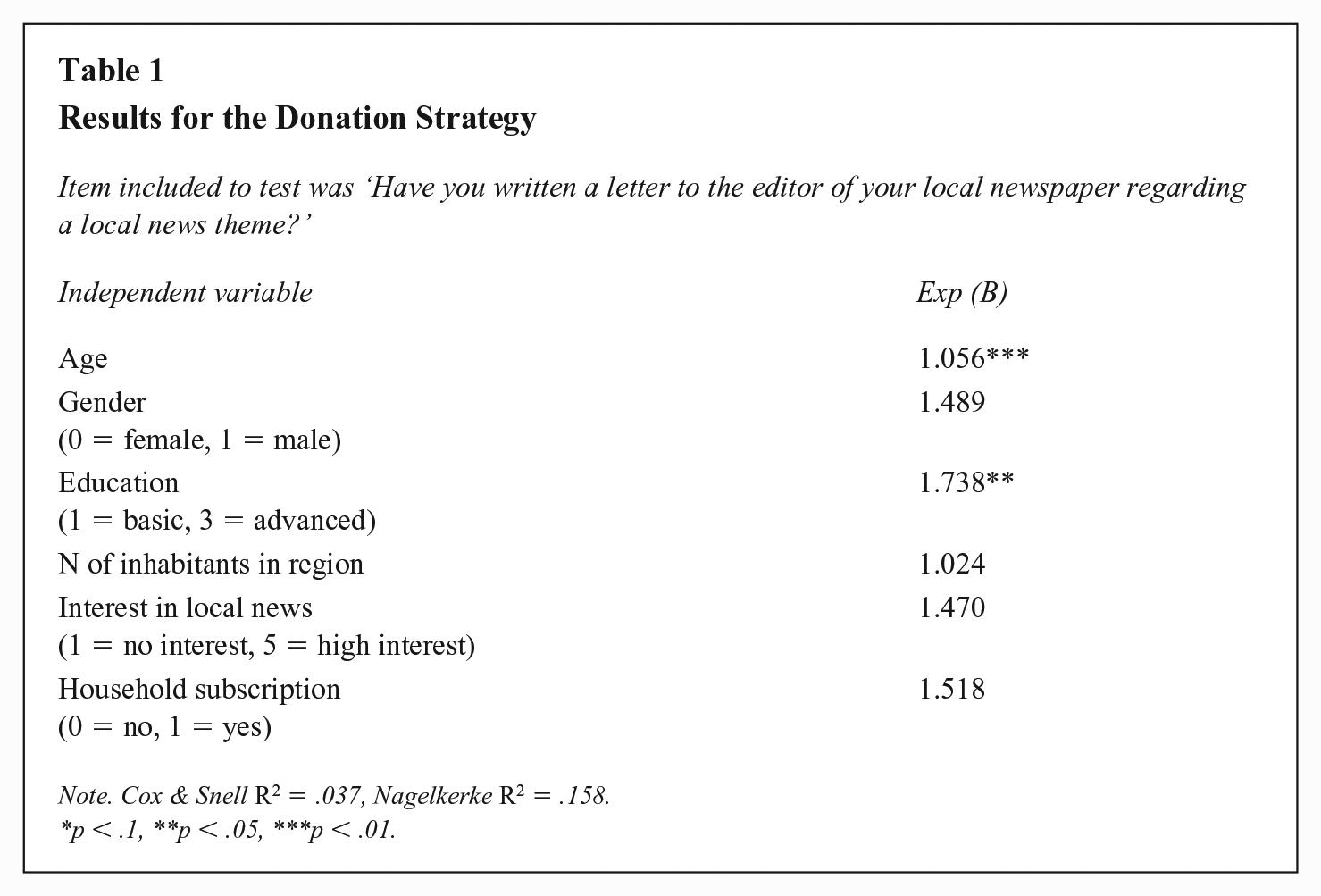
Note. Cox & Snell R2 = .037, Nagelkerke R2 = .158.
*p < .1, **p < .05, ***p < .01.
Table 1 finds two of our predictors emerging as significant: age and education. Specifically, comparably older people are more likely to engage by means of writing letters to the editor, Table 1 also confirms that the higher a person’s education level, the more likely he or she is to write a letter to the editor.
In Table 2, we grouped the responses about sharing as a distribution strategy of viral marketing to invite potential users to also consume newspaper content. As Table 2 indicates, news interest is a major predictor of sharing news, face-to face, by using emails and in social media. People very interested in local news share the most in social media. Older people also share news stories, but they prefer to share using email and not social media. News interest is also a predictor of using email to share a news story, while the number of inhabitants in the county has a significant, negative effect on sharing using email, which means that people in more populated counties use email less. Talking about news with other people, face to face, is particularly common among men and people living in smaller counties.
Results for the Distribution Strategy
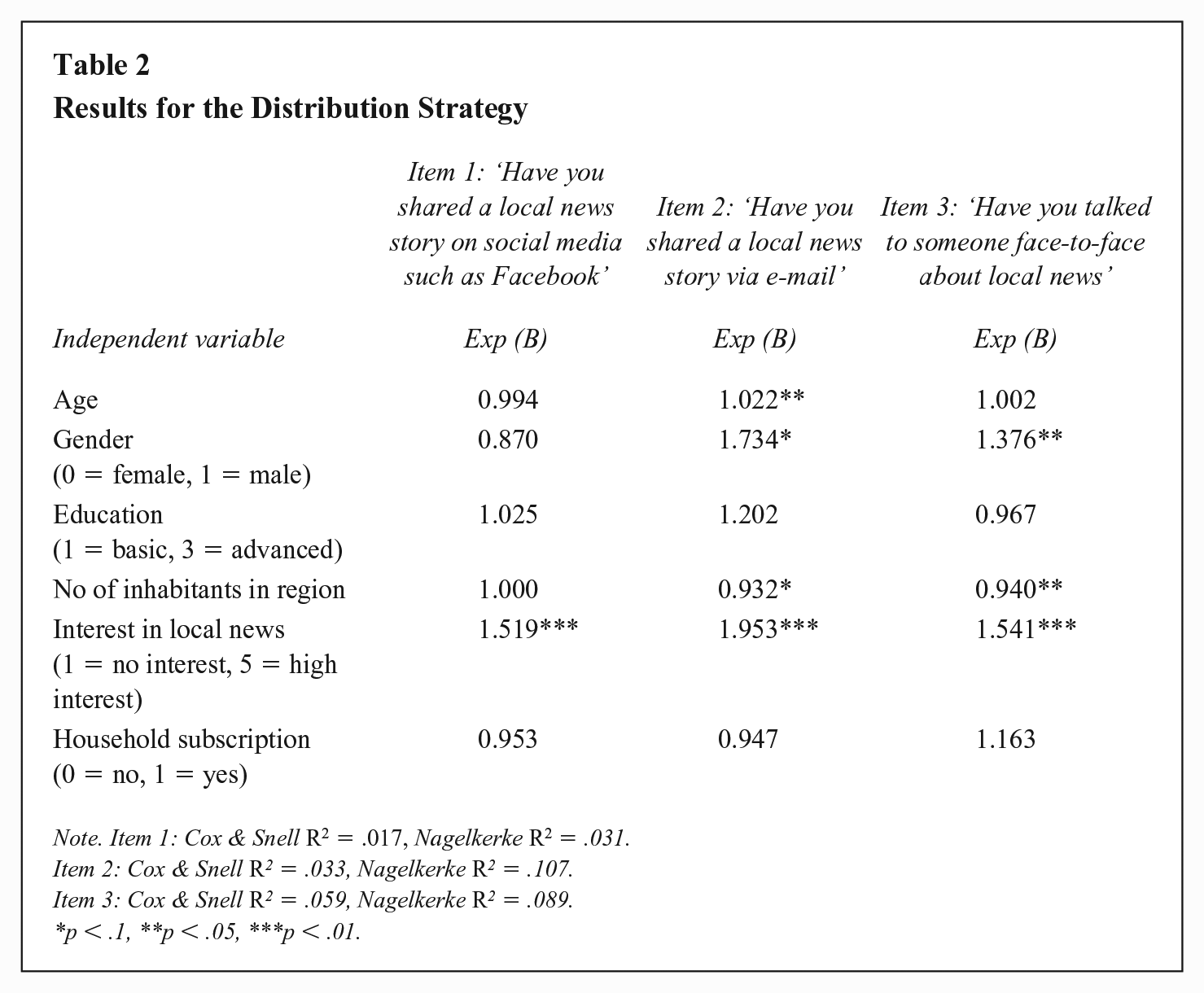
Note. Item 1: Cox & Snell R2 = .017, Nagelkerke R2 = .031.
Item 2: Cox & Snell R2 = .033, Nagelkerke R2 = .107.
Item 3: Cox & Snell R2 = .059, Nagelkerke R2 = .089.
*p < .1, **p < .05, ***p < .01.
Table 3 indicates two findings, that younger people who indicated they are interested in local news also indicated they use social media to comment on a news article, and that men in smaller counties indicated they use the comment sections in the newspapers to comparably higher extents than other users.
Results for the Deliberation Strategy
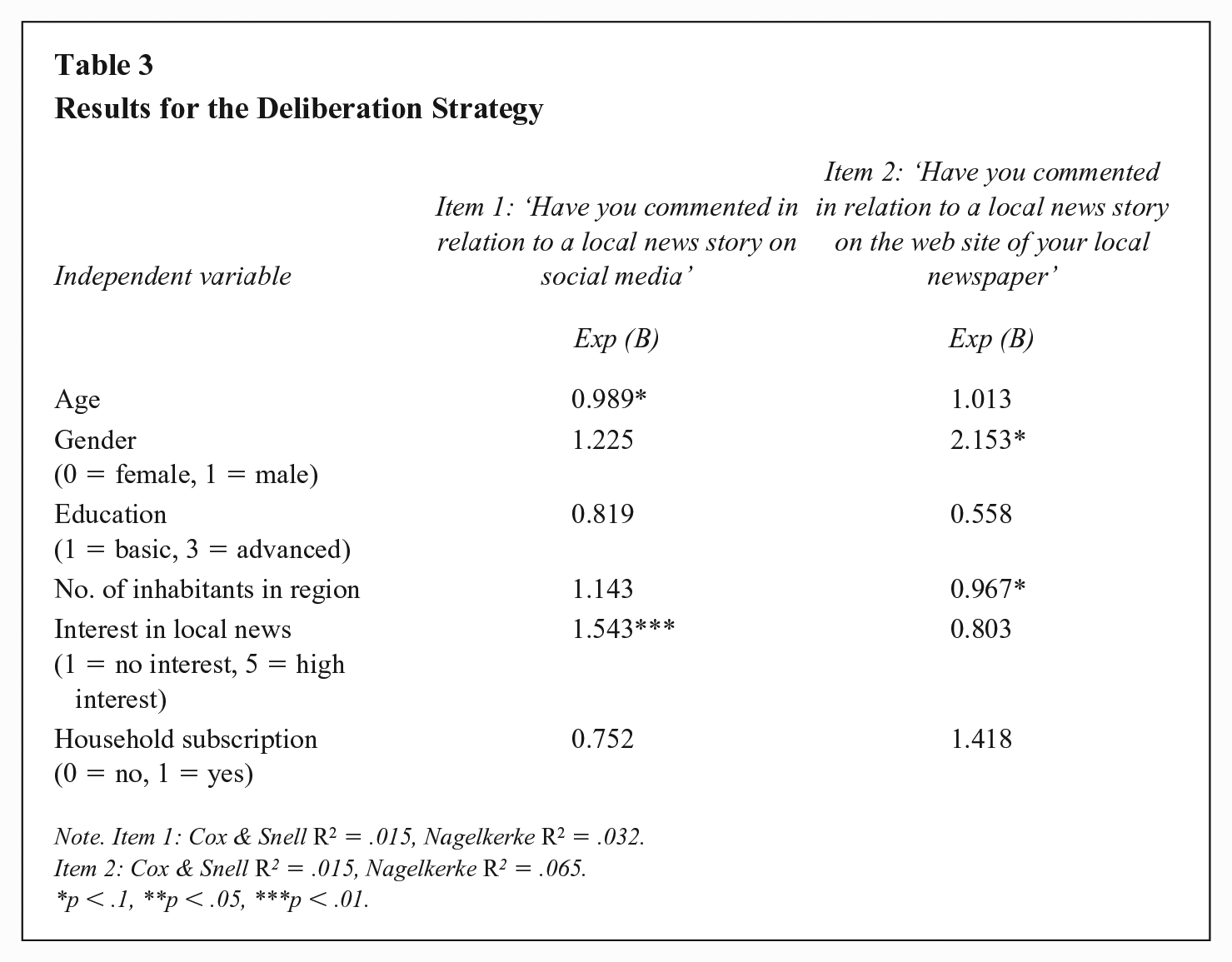
Note. Item 1: Cox & Snell R2 = .015, Nagelkerke R2 = .032.
Item 2: Cox & Snell R2 = .015, Nagelkerke R2 = .065.
*p < .1, **p < .05, ***p < .01.
Discussion
This study provides empirical insights into the growing field of research on audience participation in online local news. As shown in the results sections, the study presents insights that question the previously discussed technology-optimistic perspective that is often at play regarding these issues. For our quantitative analysis, we developed six indicators to recognize three features of participating practices, those of donation, deliberation, and distribution (Krumsvik, 2013, 2018), and used them as dependent variables. Independent variables included demographics and interest in local news, in addition to subscription to a local newspaper.
The donation strategy refers to initiatives of user contribution in terms of letters to the editor. We found little support for this way of voicing one’s own opinion among our respondents—only 3%, which was similar to findings from a Danish study (Nielsen, 2010) but less, compared to up to 7%, in a study among three American local news sites (Pew Research Center, 2015). In line with Nielsen (2010) and Reader et al. (2004), our results indicated that mainly comparably older respondents indicated they participate by writing traditional letters to the editor. In general, users were reluctant to actively involve themselves in this offline mode of participation. Our findings complement previous northern European audience studies in which patterns of moderate use of interactive features were found (Almgren & Olsson, 2016; Borger et al., 2016; Givskov & Trenz, 2014; Larsson, 2011; Meijer & Kormelink, 2015). The uncovered low status of donation echoes a familiar challenge for local newspapers in general; they are mainly able to engage older customers and struggle to involve the younger generation. By utilizing social media features, the newspapers have aimed at being a special place for interaction, particularly for younger people, without necessarily succeeding.
The distribution strategy refers to viral effects when users share news stories. Sharing news stories is less common in most other European countries (Newman et al., 2017). Our analysis demonstrates that news interest has a positive effect on news sharing, as suggested by Kalogeropoulos et al. (2017) and Picone (2016). As argued by Bobkowski et al. (2019: 161), the literature provides few clues about the demographics of who might share local news through email and social media. Our findings offer some insight into this: Younger adults use social media to share news stories, while older users prefer email. Also, in less populated regions, users share news stories by using email or simply by talking to others face-to-face, supporting the findings of Bobkowski et al. (2019). Again, our findings suggest two patterns of news use: a traditional pattern in which older people and users in less populated regions use traditional media for sharing, and an emergent pattern in which younger people prefer social media features for sharing, as suggested by Lie (2018) and Almgren and Olsson (2016). Our analysis indicates a minor rural–urban gap in the news use of Norwegians: users in sparsely populated districts prefer using email or face-to-face distribution strategies in addition to a deliberation strategy within the newspapers’ comment sections, while users in heavily populated areas prefer social media for sharing and also commenting.
Deliberation enables users to react and interact with the produced and distributed content, referring to the newspapers’ role as a forum for public debate. Participation in terms of commenting varies greatly by country, lower in the United Kingdom and Germany and in some Northern European countries such as Denmark (Newman et al., 2017) and Sweden (Almgren & Olsson, 2016). Our results confirm this Scandinavian trend of users being reluctant to express themselves. In addition, our research supports the findings of Stroud et al. (2016), Springer et al. (2015) and Ziegele et al. (2013) that males would write comments significantly more often than females. However, our findings point to two patterns of news use: a traditional pattern of commenting on the local newspaper website in less populated regions and an emergent pattern of commenting in social media among younger users and users with high news interest. The latter confirms the findings of Kalogeropoulos et al. (2017).
The use of social media channels for commenting on news stories may be taken as a positive signal for the media business, suggesting they have found a way to engage younger users in their pursuit for increasing newspaper readership. However, previous studies suggest that new communication technologies have not changed the usage of journalism radically (Hujanen & Pietikäinen, 2004; Scott et al., 2015; Spyridou, 2018; Wikström & Ellonen, 2012), neither in terms of low-involvement participation (such as liking and sharing), to high-involvement participation (e.g., commenting, producing and curation). In these studies, the full-time editorial staff and the passive consumer are merely two extremes of a continuum model distinguishing between those who have access to and control over tools that allow them to get actively involved in the content production and those who have less impact on the online content production. These concepts illustrate that engagement is comprised of both psychological and behavioral experiences (Solem & Pedersen, 2016) and that clicking “like” on a news story is less demanding than, for instance, commenting on a news story.
Furthermore, how much and what type of participation is enough in order for us as researchers, or indeed media industry professionals, to consider the user to be engaged? Some user participation is useful for the newspapers in providing them with data and helping with distribution, but too much of other types of participation, like co-production, might be problematic. Abusive comments, defamation, and brand damage are three key problematic factors in newspapers’ comment threads (Canter, 2013). Not only is it difficult to find a moderation policy, the value of comments is also questionable.
In terms of practical implications, our study challenges the technology-optimist perspective that social media presence on a newspaper website necessarily leads to engaged and social media users and that news media company strategies for user involvement were optimistic (Kalsnes & Larsson, 2018). This has also been recognized by Scandinavian newsrooms: the hype around social media in Swedish journalism might be coming to an end (Djerf-Pierre et al., 2016), while the deliberation strategy has declined in Norwegian newsrooms (Krumsvik, 2018). The development suggests that instead of being co-producers of content, the users may play a more important role as distributors for the newspapers. This stresses the argument made by Bobkowski et al. (2019) and Kiousis (2002) that interactivity levels can vary across technology, communication settings and individuals’ perceptions, and perhaps online newspapers are not the right medium for interactivity.
We provide empirical evidence for better understanding audience practices and how media firms can make sense of the various participatory forms. Platformization, the extension of social media platforms into the rest of the web, provides both opportunities as well as challenges for newspapers. The reasoning behind both the donation and distribution strategies is that they will improve traffic (Krumsvik, 2018; Larsson, 2012) and help explore opportunities of having social media platforms work for them (Ebbesson 2015) to increase reach and build relationship. Within a business model perspective, the relatively strong position of distribution is good news. When users share and distribute news stories they help the newspapers in boosting both traffic and brand loyalty. However, the implementation of paywalls limits the audiences’ possibilities for sharing news stories (Olsen & Solvoll, 2018). In addition, the study of Lischka and Messerli (2016) found that while sharing tends to increase satisfaction, which in turn enhances loyalty, commenting deteriorates satisfaction and trust.
This study has limitations that should be acknowledged. First, we studied local newspapers in Norway, a small country with high readership and subscription, heavily subsidized press structure and high willingness to pay for online news (Olsen & Solvoll, 2018). This suggests that researchers wishing to make our results transferable to another context must carefully accept these national characteristics. Second, our survey questions did not ask about the respondents’ reasons or motivations for their (lack) of participating practice. We found that news interest was a major predictor of sharing news, but further research is needed on typologies of user types (Larsson, 2011), types of motivations (Spyridou, 2018), and what kind of news users interact with (hard news versus soft news, local, national or international, and so on). Unfortunately, we do not have data about what type of news stories were being shared in our case. More knowledge into this field could help the newspapers to determine a better formula for their news mix and how to monetize shared stories to increase revenue. Furthermore, we welcome studies offering fruitful discussion and conceptualizing of user participation and engagement while dealing with bridging media- and user-centric perspectives.
