




Abstract
Extant research in media and migration has been largely apolitical, focusing on how migrants use media to culturally connect with their homeland and keep their family ties. However, in times of increasing international conflicts and polarisation, such as the years leading up to the Russia's war against Ukraine in 2022, migrant audiences find themselves in a situation when the coverage of national and international politics in the homeland and host country media can differ dramatically. Against this backdrop, this study investigated how Russian speakers living in Germany create and navigate their transnational news repertoires. Grounded in 42 semi-structured interviews with the Russian speakers of the 1 and 1.5 generations in Germany, conducted between May and October 2021, this article identifies three types of transnational news repertoires: (1) politically-motivated news repertoire, (2) truth seeking-motivated news repertoire and (3) situation-motivated news repertoire. The results show that all the news repertoires of all participants are transnational. I argue that in the context of international conflict, not only language but also the participants' political beliefs play an essential role in their news choice. Future research on migrants in political communication should distinguish research not only along with the language of the media outlets but also along with the political ideologies that they project.
After the Russian invasion of Ukraine in February 2022, Russian speakers in Europe have been divided about what version of events to believe—that of the Russian state or Western sources. This divide existed before, and can be traced back to 2013–2014 when the Euromaidan protests took place, Russia annexed Crimea, and armed conflict in Donbas began. Ever since, the narratives of Russian state-sponsored media about international and national events have strongly contradicted the narratives of Western media (Breyton, 2022). Against this backdrop, this article analyses the question of how do Russian speakers living abroad select which news sources to follow?
In order to answer this question, this study adopts a single case study design, focusing on Germany as a “typical” (Lindlof and Taylor, 2011:115) case of a Western European country featuring a community of Russian-speaking migrants. From the perspective of political relevance, studying Germany makes sense because it is home to one of Western Europe’s largest communities of approximately 3 million inhabitants born in the countries of the former Soviet Union (Panagiotidis, 2017).
However, until now, political communications research on the homeland media used by the migrants remained very limited (for an exception on the Baltic countries, see Vihalemm and Juzefovičs, 2020). This type of research is especially relevant when the information dynamics (Sun and Yu, 2020) in the migrant’s home and host societies differ—for example, when a person from an authoritarian state, where press freedom is limited, emigrates to a democratic country, where the patterns of journalistic freedom are arguably at the opposite end of the pole.
While Russian state-sponsored media is considered to have a significant reach within the Russian-speaking communities in Germany (Decker, 2020), to date, no academic study has convincingly proven or refuted this statement. Previous German-language studies on the media use of Russian-speaking migrants (Hepp et al., 2011; Trebbe et al., 2010) focused on the language of the media but did not consider their sponsorship and ideological leaning. The narratives on Russian state-sponsored media are ideologically different from those on oppositional media. This study classifies the media choices of Russian speakers in Germany based on their ideological leaning. To do so, I use the concept of news repertoires, defined by Lee and Yang (2014), as subsets of news media platforms that individuals select among vast available choices (Lee and Yang, 2014: 601).
To fill the aforementioned research gaps, this study formulated two research questions: (1) What are the rationales of Russian speakers in Germany for constructing their news repertoires? (2) How do they navigate between Russian and German media in their news repertoires, and when do they resort to the Russian state-sponsored media?
To answer these questions, this article is structured as follows. First, I review the existing literature on migrant audiences and political communication, Russian-speaking audiences in general and in Germany, and the concept of news repertoires. Second, I describe the method used, the sampling frame and the data analysis process. Third, I present the findings. Finally, I elaborate on how the findings further the discussions on (1) transnational news repertoires and (2) migrant audiences.
Political communication and migrant audiences: overview of the field
Literature on migrants and media has grown steadily in the last decades, pursuing various themes and orientations. Scholars examined the role of media in maintaining and transforming the identities of the migrants (Lorenzana, 2016), the role of different technological devices and social media platforms in keeping in touch with the homeland (Golan and Babis, 2017), the depiction of migrants in the media and political campaigns (Schmuck et al., 2017) and the use of news and media for migrant integration (Alencar and Deuze, 2017). However, a theme yet to be explored in-depth is how migrants’ exposure to media from different communication environments, that is, from authoritarian or democratic, influences their media choices.
So far, only two studies have provided insights into how media from different communication fields can influence migrant populations. Sun and Yu (2020) analyzed the role of WeChat, a Chinese social media platform, in political communication and citizenship making for Mandarin speakers during the 2019 federal elections in Australia. Based on a mixed-methods approach, which combined online surveys, ethnographic observations and interviews, the authors found that when people from an authoritarian society migrate to a democratic society, they experience a clash of their old and new media logics and must learn to navigate parallel media systems. Thus, the rationale of this study is similar to that of Sun and Yu (2020)—it was inspired by the discussions in the media about the political influence that WeChat, and through it, the Communist Party of China, might have on the Australian Federal Elections, therefore bringing attention to the question of how the homeland states attempt to influence their populations abroad.
Tai (2016) examined how exposure of Chinese migrants in the US to Western media changed their attitude towards and trust in the official Chinese narrative. She found that the longer the migrants were exposed to Western media, the more they criticized the Chinese government. The magnitude of the change was connected to the specific official narrative of the Chinese government and its framing in official media. However, the opposite remains to be seen—that is, how the homeland media from an authoritarian state influences the political perceptions and beliefs of its people who had migrated to a democratic country. This article contributes to filling this gap by studying the roles and uses of the Kremlin-sponsored media among Germany’s Russophone audiences with different news repertoires.
Russian-speaking audiences and the Russian authoritarian leadership
The Russian ruling elites conceptualize Russians or Russophones living abroad as sootechestvenniki (compatriots) and have developed policies for this group that are often summarised in literature under the umbrella term Russian world. Within this doctrine, the Russian language is considered one of the most salient markers of the ‘compatriots’ group identity instead of ethnicity or nationality (Cheshkin and Kachuyevski, 2018). Fabrykant (2019) claimed that two key characteristics of this doctrine are the crucial role of the Russian language as the defining element of Russian identity and the geopolitical way of thinking (Fabrykant, 2019: 7). Scholars have demonstrated that in the last years, the Kremlin has used strategic communication instruments, such as the media, not only to consolidate its political authority at home but also to achieve its international relations goals. This tendency is reflected in Russia’s Doctrine of Information Security (Szostek, 2020). Considering this media instrumentalization by the Kremlin, I argue that Russian-language media can be considered among the most critical elements of how Russia’s ruling elites attempt to reach compatriots.
The influence of the Russian state-sponsored media on the audiences and their interaction is a subject of several studies. Crilley et al. (2022), who examined the audiences of RT (Russian state-sponsored international broadcaster) on Twitter, showed that its audiences were highly heterogeneous, thus challenging the pre-existing assumption that the audiences of RT, just like the broadcaster itself, are anti-Western and fringe. At the same time, Szostek (2018), who interviewed students at the Russian university, found that the anti-Western narratives from the Kremlin-sponsored media resonated even among the respondents, who claimed not to get the news from the state-sponsored media. She also describes the phenomena of “believing the message, while disbelieving the messenger” (Szostek, 2018) to describe the attitude towards the Russian state-sponsored media. Unlike the abovementioned studies, the present contribution analyzes another type of audience – not the Russian audiences in Russia, as Szostek (2018), or not the foreign audiences of the international Russia-sponsored broadcasters (Crilley et al., 2022). Instead, it focuses on the Russian-speaking migrant audience in Germany, which is at the crossroads between authoritarian and democratic media contexts and can immerse itself in both.
Some scholars claim that the anti-Western narratives from the Kremlin-sponsored media outlets strongly influence Russian-speaking audiences in Western states (Decker, 2020) due to such audience’s natural language affinity to Russia. Szostek (2020) argued that while Russian-speaking audiences can be considered more receptive to the Kremlin-disseminated narratives, they are not automatically vulnerable to such narratives. She adds that this claim of vulnerability is obscured by the heterogeneous character of such media, the general distrust in them by Russophones, and the role of personal memories, connections and opinions in nurturing the political perceptions of Russophones.
Vihalemm and Juzefovičs (2020) examined how Russian speakers in Estonia and Latvia navigated political information on the Russia-Ukraine conflict in 2014. They identified six media repertoires of the Russophones, which differed according to the Russian speakers’ (1) degree of plurality of information—that is, number of sources and (2) degree of trust in Russian, Ukrainian and Western media. While the authors studied political information repertoires of the Russian speakers in relation to one event, the 2014 Russian-Ukrainian conflict, this article focuses on stable news use patterns by examining the everyday news repertoires of Russian speakers in Germany. Besides, this article analyses when and why Russian-speaking audiences with different media repertoires use Kremlin-sponsored media, which has also not been previously addressed.
Russian speakers in Germany: the context
Several frameworks have attempted to conceptualize migrants from countries of the former Soviet Union as follows: post-Soviet migrants (Panagiotidis, 2020), Russian speakers (Vihalemm et al., 2020) or Russian diaspora. Approximately 3 million migrants from the countries of the former Soviet Union (Panagiotidis, 2017: 25) make up around 3.5% of Germany’s population, making them the biggest immigrant group with voting rights (Panagiotidis, 2020). Due to the emphasis on the Russian language and media as the main uniting factors of the group (Vihalemm et al., 2020), I chose to refer to them as Russian speakers or Russophones not in the sense of unity but as the Kremlin’s target audience.
Russian-speaking migrants were considered well integrated into German society; they largely disappeared from Germany’s public discourse after the 1990s (Panagiotidis, 2020). A series of occurrences in the last years triggered concerns regarding the Russian government’s influence on the Russian-speaking groups in Germany and Europe. Among those was the divide among Russian speakers about what to believe regarding the events in Ukraine in 2013–2014, support of part of the Russlanddeutsche (Russian Germans)—the ethnic Germans from the former Soviet Union—for AfD, a populist right-wing party (Goerres et al., 2018), which is discussed in the media as having potentially close connections with the Russian ruling elites (Tagesschau, 2021) and, arguably, the most significant event, the so-called “Lisa case”. The “Lisa case” happened in 2016, when Kremlin-sponsored media released the fabricated story that ‘Lisa’, a 13-year-old girl in Berlin, was assaulted by Arab migrants, which caused the Russian-speaking community in the country to hold street protests across Germany (Braghiroli and Makarychev, 2018).
The “Lisa case” demonstrated that media are the main instruments of the Russian government in reaching Russophone populations, making the study of Russian speakers' news media diets highly relevant politically. Golova (2020) pointed out, however, that empirical evidence of the media use of Russian speakers in Germany is surprisingly thin.
Trebbe et al. (2010), a survey study based on approximately 300 phone interviews, measured the use of Russian- and German-language media by Russian Germans aged 12–29 and concluded that the young Russian Germans were well integrated into German society and did not live in a Russian language bubble, as many of them watched German-language TV and used German-language internet sites more frequently than Russian-language media. However, this study did not determine the political leaning of the media that the young Russian Germans used (Trebbe et al., 2010). The Boris Nemtsov Foundation (2016) also surveyed 606 Russian Germans about their media use to understand better their experience of integration but focused only on the language of the media, without asking about the specific media outlets and their political leaning.
Hepp et al. (2011) conducted 30 semi-structured interviews with the members of Russian diaspora in Germany to explore how cultural identities influence media choices and identified three related patterns of media choices: origin-country-oriented, ethno-oriented and world-oriented. Hepp et al. (2011) criticized exsisting studies on migrants and media as often merely assessing if migrants’ media choices contribute to their integration or segregation (Hepp et al., 2011: 250). The authors proposed paying closer attention to the media spaces in which migrants integrate themselves and from which they separate themselves.
This study is the first to consider migrants’ media use from a political communications perspective. In a situation of international conflict and divide between the Russian and German information fields, I argue for the importance of considering the political leanings and ideology of the content of migrants’ media choices, which are largely independent of the language or the geographical origin of the media outlet.
While the interviews for this article were conducted before Russia attacked Ukraine in February 2022, as news repertoires show stable patterns of news use, the findings of this study are still relevant for understanding the types of news repertoires of Russian speakers in Germany after 2014 and provide insights on how the recent ban of the Russian state-sponsored media in Germany in 2022 affects audiences with different news repertoires (Von Blazekovic, 2022).
The transnational dimension of news repertoires
Studies of news repertoires have analyzed how they are maintained and reformed over time (Peters and Schrøder, 2018), cross-media news consumption (Peters et al., 2021), motivations for the construction of news repertoires (Swart et al., 2016; Szostek, 2018), and the relationship between news repertoires and political engagement (Kim and Schwarze, 2021). An aspect that remains a largely unexplored area in research on news repertoires is their transnational dimension. One exception is the study of Van Damme et al. (2017), which was the first to introduce the term ‘transnational news repertoires’. The authors’ methodological approach was also the first to identify national news repertoires in nine European countries and then look for similarities and differences among them, which led to the identification of eight transnational audience repertoire clusters. In contrast to the study of Van Damme et al. (2017), I use the concept of transnational news repertoires to explore the strategies of Russian-speaking audiences in Germany when building news repertoires, the roles attributed to the local (German) and transnational media, and the motivations to include or avoid media sources of national or homeland (Russian or other) origin.
Besides, most previous studies predominantly focused on national populations. This is one of the few studies to focus on news repertoires of migrants (for exceptions, see Hepp et al., 2011; Vihalemm and Juzefovičs, 2020). Inspired by Szostek (2018), in this study, I conceptualize news repertoires in the sense of specific news sources, that is, specific news outlets, TV channels, websites, newspapers and most importantly, various combinations, roles and motivations attributed to their use.
Method
This study is based on 42 semi-structured interviews with Russian speakers conducted between May and October 2021. Following the purposeful sampling strategy, the respondents were chosen according to the following criteria: they belonged to the first generation (1G) and the 1.5 generation (1.5 G) of migrants, were German citizens and moved to Germany before 2016, meaning they have spent at least the last 5 years in Germany (criterion sampling). The rationale behind these criteria was the following.
Generation 1G refers to the migrants who came to the host society mostly on their own after age 18. Generation 1.5 G is the adolescents and young adults who moved to the host country in their formative years—in this study, between 10 and 18 years—mostly accompanied by their families (Prashizky and Remennick, 2015: 18). I limited the sample to these two generations to ensure that study participant’s first language was Russian and thus they could read and use Russian effortlessly, arguably making them the primary consumers of Russian-language media in Germany (Simonsen, 2018: 122). According to the 2015 micro-census, approximately 64% of migrants with post-Soviet background in Germany were at least 10 years old when they migrated; that is, the 1G and 1.5 G migrants represent the largest groups of migrants with a post-Soviet background in Germany (Panagiotidis, 2017: 25).
The sample was limited to German citizens because as these migrants have a right to vote, it means that they could translate their political beliefs into political actions. Targeting the participants that spent at least 5 years in Germany ensured that their media choice was potentially less dependent on their language knowledge, which is the case with newcomers. Within this pre-defined group, participants were recruited using maximum variation sampling (Lindlof and Taylor, 2011). The recruited sample varied widely in terms of gender, age, year of migration, education level, country of origin and also political orientation (for details, see Appendix 1). This sampling strategy ensured that as many different data variations were generated as possible. The interviews continued until the theoretical saturation (Lindolf and Taylor, 2011:257) was achieved, and new interviews did not generate any novel knowledge.
While the results of this study cannot serve as a base for the generalizations about all Russian speakers abroad, many of the findings are plausibly generalizable to how Russian-speaking audiences of the 1G and 1.5 G (i.e. those migrants who were born outside the host society) navigate news in other Western European democracies. The results of this study can also provide valuable insights for studying the news navigation of the migrants from authoritarian states in democratic contexts (e.g. Chinese migrants in Western states).
Structure of interviews
The interviews lasted between 40 and 95 minutes each. They were divided into five sections: questions about participants' demographic information and questions related to their news repertoires, news trust, navigation of German and Russian media environments and attitudes to the Russian state-sponsored media.
All 42 interviews, except for five, were done online on Zoom. Interviews were conducted in Russian because the participants’ first language is Russian, and the researcher is a native Russian speaker. Before the interviews, I obtained the informed consent of the participants. All the interviews were digitally recorded and fully transcribed. To guarantee the respondents’ anonymity and the interviews’ confidentiality, the interviewees were given pseudonyms, and all of the names in the text below are not the participants' real names.
Data analysis
The data were analyzed using MAXQDA software and loosely followed the grounded theory framework outlined by Lindlof and Taylor (2011). The process of data analysis went parallel with the process of data collection. In the process of data collection, the growing number of transcripts were repeatedly subjected to comparative reading and then inductively coded, with particular attention paid to specific outlets that the participants used, the frequency of their use and the reasons for it. In this open coding process, three media use patterns emerged across the data. Finally, to produce a deeper meaning of the categories found in the data, they were integrated and dimensionalized.
Findings
This article answered the research questions—on the rationales of the Russian speakers in Germany for constructing their news repertoires, on how they navigate between Russian and German media in their news repertoires and when they resort to the Kremlin-sponsored media—by describing the three types of news repertoires that I found in the data. Some participants in the sample reported consuming news in languages other than Russian and German – three participants used sources in Ukrainian, and 13 participants reported using English-language media. There was no particular distribution of these respondents across the news repertoire types. However, the role of media in these languages was only to give additional insight. They were used to cross-check the information found in the German and Russian language media, improve language skills or follow events abroad in primary sources, as reported by participant Gennadiy (1G, age 44), who used the English-language source CNN to follow the presidential elections in the US in 2020.
Types of news repertoires of the Russian - speaking audiences in Germany.
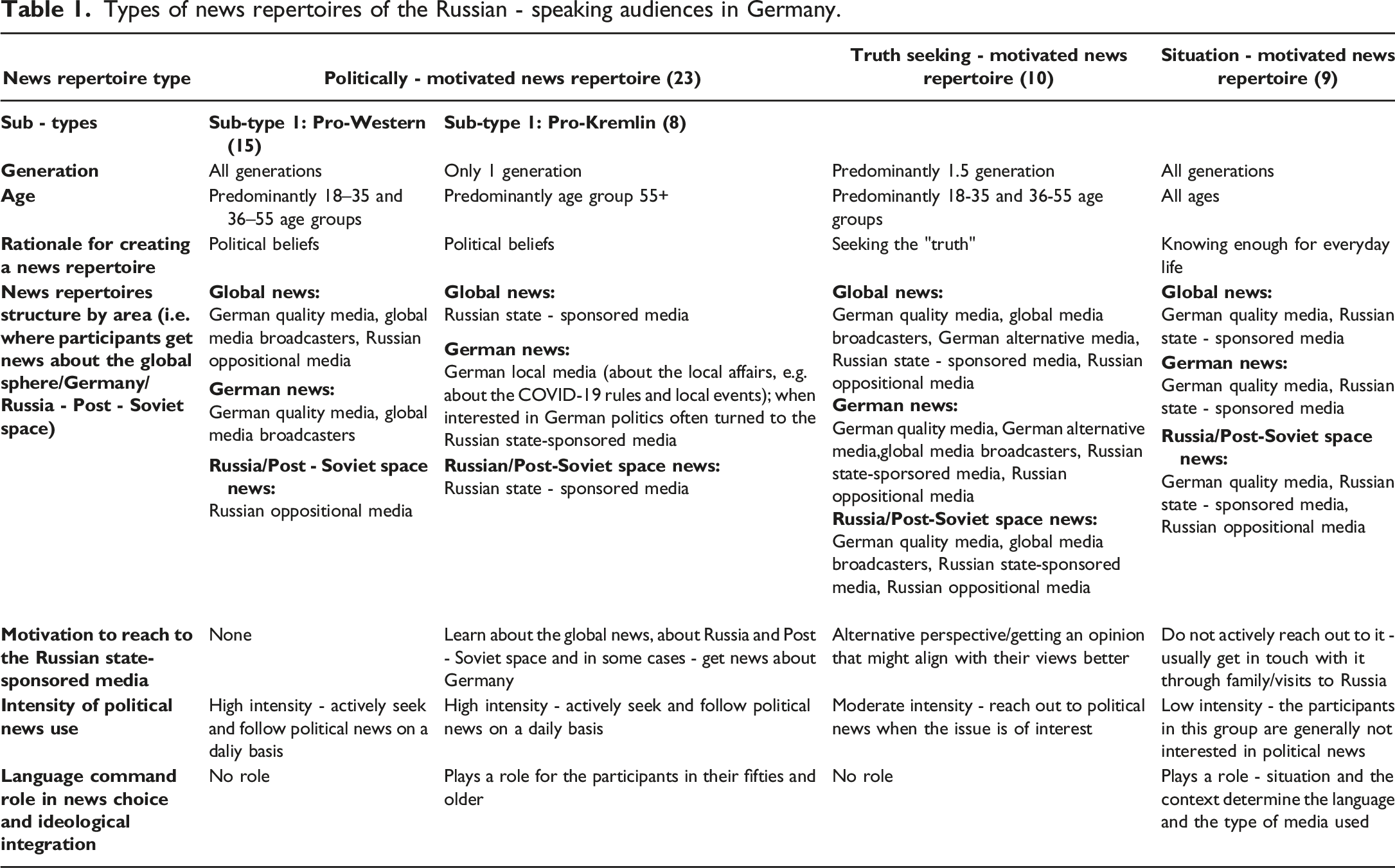
1. Type 1: Politically-motivated news repertoire • Subtype 1: Pro-Western news repertoire • Subtype 2: Pro-Kremlin news repertoire
2. Type 2: Truth seeking-motivated news repertoire
3. Type 3: Situation-motivated news repertoire
Type 1: Politically-motivated news repertoire (23 interviewees)
In this type of news repertoire, the participants' political beliefs were their main criteria for their news choices, not their linguistic competence.
The people with this news repertoire were very much aware of their chosen news outlets’ ownership and political leanings, which determined their news choice. They had a very high intensity of political news use, which means they actively sought and used political news daily.
Below, I introduce the two subtypes in this category. While I acknowledge that labelling the subtypes pro-Western and pro-Kremlin—and the Russian-language media that oppose the Kremlin’s views as ‘oppositional’—can be considered problematic as these labels are vague and Western-centred, I have decided to use them as previous studies used similar labels (Szostek, 2018; Vihalemm and Juzefovičs, 2020).
Subtype 1: Pro-Western (15 interviewees)
The people in this group were mostly young—in their 20s and 30s—and based their news consumption heavily on the internet, including online versions of the newspapers and their accounts on social media. The unifying factors in this group were the attention to the origin and the sponsorship of the news sources, that is, the consciousness in their choice of what to read, the prevailing choice of Western-oriented media and the avoidance or very sceptical approach to Russian state-sponsored sources.
They based their choice of news mainly on the sources, which were either German-quality news or oppositional Russian-language sources (e.g., sources that promoted an opposition point of view to the Russian government, such as Meduza, Dozhd or Echo Moscow).
German-quality news and Russian-language oppositional news were used and valued differently by the people in this group. While the German-quality news sources were used daily, which covered German and global news, the oppositional Russian-language sources were used to get more in-depth analytics and insider views on what was happening in Russia and the post-Soviet space and on selected issues to get additional insights on global affairs.
The attitudes to the Russian state-sponsored news in this group were very negative. They ranged from avoidance to occasional contact with it, as explained by participant Alexei (1G, age 40), only to become aware of the Kremlin’s upcoming policies and the views of the world: If I watch the [Russian Kremlin-controlled] federal TV, I only watch to see what the people are being brainwashed about, out of curiosity, just to know what kind of agenda is there. Even seasoned journalists watch federal channels to know what metodichka (guideline) is to come. They can even produce special forecasts about what happens next based on the guideline. I can only get through announcements, though; I will never get through this hour-long brainwashing.
Even in cases of purposeful avoidance, the participants reported situations of accidental contact with the Russian state-sponsored news, often in a family environment, such as when the participants are visiting their parents, and the TV plays in the background or when the parents send them the YouTube videos from Russian TV on WhatsApp.
Subtype 2: Pro-Kremlin (8 interviewees)
All eight participants with this news repertoire subtype were from 1G, with majority of them in their 50s and tended to source their news from television (6 out of 8 participants). Their common feature is their geopolitical worldview; they see international relations as a battlefield where the powers are mutually antagonistic (Fabrykant, 2019). This worldview informed their attitude towards the media, which they consider equally corrupt and controlled worldwide. This is why even though all the people in this group were aware of the Kremlin’s sponsorship and control over the Russian major mass media and television, it did not stop them from using such news sources in light of their geopolitical view, as indicated by the following quote from Nina (1G, age 64): State news, such as First Channel, are, of course, censored. It is the right thing to do because if you do not do this, what happens on the internet will be on television. They have to be censored for the basic principles of what is good and what is bad to be respected.
While participants of this group did not completely exclude the German quality media and Russian oppositional media from their media diets, their use remained very limited. These sources were never used to learn about the world and complex events, such as the conflict in Ukraine. For example, a few participants reported that they would sometimes turn to the Russian-language oppositional media if they were unsatisfied with how the issues in Russia were covered in the Russian state-sponsored media. To learn about the local German affairs and events in their region, they would sometimes turn to the local German newspapers. Simultaneously, all the people in this group agreed that they would not use German media to read about events in Russia or in the post-Soviet space, as they consider the coverage of Russia by the German quality media ‘Russophobic’, ‘superficial’ and ‘wrong’. A typical example is given in the following quote again of Nina: ‘I have just stopped reading German media after I understood that all the articles are biased, and one cannot find the truth about Russia in the German media’.
Their motivations to choose the Russian state-sponsored media ranged from it being their moral duty and/or its news being close to their personal opinions to it being the ‘lesser evil’ (Anastasia, 1G, age 69). ‘Lesser evil’ in this context means that in this geopolitically influenced media landscape, they choose the Russian state-sponsored media because they can identify the inaccurate information, as it is so apparent, which makes them suitable sources of information. This is indicated in the quote of Gennadiy (1G, age 44): The Russian media cannot afford to lie because otherwise, there would be a worldwide outcry. They can just manipulate a little bit, maybe hold something back or depict something in a more favourable light for them, but they cannot afford a blatant lie. If only they had the reach and coverage of the Western media… As I understand it, Russia’s leadership understood that there is no way out, they are coming up close to their borders, and they were forced to turn on the propaganda mouthpiece on full blast [The respondent talks about North Atlantic Treaty Organization (NATO) “coming closer” to the borders of Russia - author].
Type 2: Truth seeking-motivated news repertoire (10 interviewees)
Most participants with this news repertoire belonged to the 1.5 G, were younger than 55 and sourced most of their news from the internet. The unifying rationale of this group for building their news repertoire is their belief that finding the truth is in the hands of the audience, as no single news source can provide entirely truthful information. As expressed by one of the participants in this group, ‘We are from Russia, we know how to read between the lines’ (Christina, 1.5 G, age 40), which addresses this general principle of looking for the truth between the lines and not trusting a single source. The language factor did not determine the news choice of the participants—it enabled them to look for information across several languages and media fields. People in this group did not actively look for political news daily; only when they were interested in an issue would they go to great lengths to ‘find the truth’ about it, as expressed by participant Oleg (1.5 G, age 29): I will check different sources if this event can impact my life or interests me. Of course, I do not open German websites only; I will check the German website, then the Russian website, then the American one, then the Chinese [The respondent talks about checking international broadcasters of different origins - author].
While for more casual events, such a transnational filter would typically not be applied, the people in this group frequently checked news about politics in the Russian and German media or at least within news outlets of different political orientations in the global, German and Russian/Post-Soviet news domains. The people in this group use various news sources in Russian and German media, both government-owned and oppositional media. At the same time, for many of them, German-quality media are the primary sources of news on events in the world, in Germany and in Russia—and while many of them do not trust German media, they still turn primarily to the German-quality sources and then compare them with other news sources, not the other way around.
Russian state-sponsored media are considered providers of alternative opinions, which might be more aligned with the person’s views. The participants resorted to the Kremlin-sponsored media when they were curious to learn about the “other side” or strongly disagreed with how the issue was covered in the German-quality media or the Russian oppositional media. This is indicated in the answer of participant Nikita (1.5 G, age 33) to why he reaches out to the Kremlin-sponsored media: ‘Just to have another perspective. German mainstream media report the events very one-sidedly and trusting them is … wrong’. He further explained his news choice strategy: I always compare the sources, which is why my sources are so diverse. I read Süddeutsche Zeitung and then RT because they have totally different opinions about the same matter. Later, I will figure out the right opinion for myself [Süddeutsche Zeitung is a German-quality media outlet - author].
To sum up, for the people in this group, it is vital to check news sources from different information fields (authoritarian and democratic) and across different languages due to their general distrust of the media and belief that all media are corrupt everywhere.
Type 3: Situation-motivated news repertoire (9 interviewees)
In this group, there was no specific tendency regarding which generation or age group prevailed, and the preferred means of getting the news was random and dependent on the situation. The primary rationale for this group’s creation of a news repertoire was to know enough to navigate life. Unlike the people in the two other groups, this group did not actively try to curate their news use, and their news choices were underpinned by the convenience of using a media outlet in a specific situation. The language factor played a role in this group, as many of the participants in this group preferred news in the language that felt easier for them—as told by Alexandra (1.5 G, age 37): ‘Of course, if I see something in Russian and it looks interesting, I can read it; but if I have a choice, it is easier for me to read in German’. The context also determined their news choice—for example, when they were in a German context, they consumed German-language media and vice versa. This can be illustrated by the response of Natalia (1.5 G, age 33) to where she gets the news: All my most important sources are German; I live in Germany, they are the primary ones, they are everywhere…. As for Russian television, I watch it only when we are visiting my parents-in-law; usually, we drop in for a cup of tea, and I watch the Russian news.
Checking the news across German and Russian media was a much rarer phenomenon for this group. It was not motivated by mistrust, as in the previous news repertoire type, but by a desire to acquire more details about the matter. The intensity of their political news use was significantly lower than in the other groups—they did not seek political news but had what was more like a ‘news finds me’ attitude, and many identified themselves as ‘apolitical’.
The participants with this news repertoire did not base their news choice on the news brand, its sponsorship or its political leaning—they did not label and hierarchize news outlets and include or exclude them based on this hierarchy. Moreover, the people in this group generally had much higher trust in news. For them, the important factors in seeing a news outlet as credible were the size (if it was big, it did not matter whether it is German-quality media, Russian state-sponsored media or Russian oppositional media), the convenience of use of that specific outlet in a specific situation (e.g., when they are in Russia or Germany or with their Russian-speaking relatives in Germany) and the way the article is written—whether it is entertaining, useful or not.
However, this does not mean that the members of this group were not aware of the lack of press freedom in Russia—some of them mentioned it and claimed that the situation with censorship and independent media in Russia was much worse than in Germany. Nevertheless, unlike in the pro-Western news repertoire type, this conclusion did not lead to the avoidance or exclusion of the Russian state-sponsored media. One of the reasons for this behaviour is that the consumption of Russian state-sponsored media happens in the family circle; that is, it became a part of family time. Moreover, due to the ‘apolitical’ stance of many people in this group and the lack of active curation of their news use, the phenomenon of disbelief but continued consumption often occurred, as demonstrated in a quotation of Lika (1.5 G, age 31) on her experience of watching popular political shows on Russian state television despite her disagreement with its positions: I was recently watching the First Channel or Rossiya 1. I always confuse Solovyev with Kiselev, but they always show that everything is bad for some reason. If someone interviews someone, then everything is bad. After you watch it, you would never want to go to Europe. But I also watch it because my relatives watch it and my mom says, ‘Let’s watch it together. I am forced to. I: You disagree with their positions, but you continue to watch it. Why? R: I do not even know why.
Discussion and conclusion
In this study, I suggest another approach to studying transnational news repertoires. While Van Damme et al. (2017) used this concept to describe the shared patterns of news use across European borders, I argue for expanding the concept of transnational news repertoires as a lens to describe the audience’s experiences of using news outside national media sphere. Namely, in this study, I define transnational news repertoires as repertoires that include news not only from one national context but also from abroad, from different media fields and in different languages.
Using this approach, I suggest three types of transnational news repertoires of Russian speakers in Germany: politically-motivated, truth seeking-motivated and situation-motivated repertoires. The presence of different repertoires among the Russian-speaking audiences also confirms the claims of Szostek (2020) and Vihalemm and Juzefovičs (2020) that Russian-speaking audiences are very heterogeneous and their knowledge of Russian does not predetermine their positive stance towards the Russian state-sponsored media. Concerning previous literature on migrant audiences and their news repertoires, two findings of this article are especially relevant contributions.
The first contribution is that migrant audiences, especially those that come from states with different information dynamics (e.g. authoritarian and democratic), build their news repertoires differently from the national audiences (i.e. audiences without migration background). For example, unlike national audiences (e.g., Peters et al., 2021), they organize their news repertoires along the geographical domains of news and use different news sources to learn about the events in these domains. As a result, transnationality plays out differently across these news repertoires. This finding further develops the argument of Swart et al. (2016), who, in their study of Dutch audiences, introduced the geographical focus of news repertoires (regional, national and international). However, the categories of Swart et al. (2016) reflected only the dominant tendency of users’ news repertoires, that is, whether the users mainly relied on international, regional or national news sources.
In contrast, this article vividly illustrates that Russian-speaking migrant audiences organize their news repertoires differently in three news types—global, German and Russian/post-Soviet news—thus creating a sort of mosaic structure where different media sources are used to get news about each of these geographical areas. The degree of transnationality of news use—understood here as how often the participants reach out to the news from abroad—also varied across the three geographic domains. To learn what is happening in Russia or the post-Soviet space, the vast majority of the participants turn more often to the different types of news from Russia. In contrast, for the domain of German news, only the minority, such as the pro-Kremlin participants, said they regularly turn to the Kremlin-sponsored media.
However, as visible from the results, the reach of the Russian state-sponsored media across the groups was significant, even though only the group with the pro-Kremlin news repertoires consumed it frequently and purposefully, and the truth seeking-motivated repertoire group – purposefully, but occasionally. Similar to the study of Crilley et al. (2022), this finding does not mean that the audiences whom the Kremlin-sponsored media reached always had similar views or supported it. On the contrary, in groups other than the pro-Kremlin news repertoire type, participants occasionally accessed Kremlin-sponsored media due to varying reasons – be that the interest in seeing what kind of narratives the propaganda promotes, a desire to find an “alternative” opinion, or, the most frequent case, coming in contact with it though family. It echoes the study of Szostek (2018) that even users who do not use the Russian state-sponsored media deliberately can be reached by it occasionally, usually through the familial environment.
The second contribution that this study makes is that in addition to accounting for the language of the media consumed by the migrants (Boris Nemtsov Foundation, 2016; Hepp et al., 2011; Trebbe et al., 2010), I argue for the necessity of analyzing the political orientation and the sponsorship of the media in studies of the media consumption of migrant audiences.
Previous studies (Boris Nemtsov Foundation Survey, 2016; Trebbe, 2010) assessed the news use and integration practices of Russian-speaking migrant audiences in terms of their language knowledge (i.e., whether they consume more German- or Russian-language media and if they consume more of the German, they are deemed better integrated in Germany). However, as the Russian-language media field is very varied and the narratives and stories promoted in the Russian state-sponsored and Russian oppositional media outlets are vastly different (Szostek, 2018), accounting only for the language of the media cannot provide insights into the types of political content that the migrant audiences select. Moreover, unlike Russian-language state-sponsored media, Russian-language oppositional media may have an ideological integrative function for Russian speakers in German society by promoting democratic values and narratives, which offer alternatives to the content of Russian state-sponsored media.
For example, the lack of German-language knowledge in the pro-Western and pro-Kremlin groups led to two vastly different news navigation strategies. In the case of insufficient German skills, the pro-Western participants turn to the German state-sponsored media in the Russian language (as, for example, Deutsche Welle) or to the international media to learn about events in Germany, while the pro-Kremlin participants substituted the German media with the Russian-language state-sponsored media. However, the people in their 50s and older in the pro-Kremlin subtype lacked German language skills and, thus, used Russian-language media. Similarly, two participants with a pro-Kremlin news repertoire, whose high language competence allowed them to freely use German-quality media, still chose to use Russian state-sponsored media to inform themselves, as they saw such media as offering content that is closer to their opinions and political imaginaries.
This study is not without limitations. First, the qualitative design of this study permitted the identification of three types of news repertoires among 1G and 1.5 G Russophone audiences. However, based on the results of this study, little can be said about how common these three types of news repertoires are among Russian-speaking migrants in Germany and what type is dominant.
Another limitation of this study was that it was conducted before Russia attacked Ukraine in February 2022, which potentially deepened the divide among the Russian-speaking audiences. Therefore, this study cannot account for the possible change in the news repertoires of the Russian speakers in a turbulent war period and after the ban on the Kremlin-sponsored media in the European Union (EU) as of February 2022. At the same time, the results of this study allow speculation about whom will the EU ban affect most among the Russian-speaking audiences in Germany.
In the sample, two groups used Kremlin-sponsored media intentionally– that was the group with pro-Kremlin news repertoire, which used it frequently, and the truth-seeking-motivated repertoire group, which used it occasionally. Following EU sanctions from June 2022, the streaming of the three main Russian state-sponsored TV channels in Europe (European Council, 2022) is prohibited, which is likely to affect the group with pro-Kremlin news repertoires, who are older, not very internet savvy, and rely on broadcasting in their media use. The truth-seeking repertoire group, which primarily used internet sources to get the news, are, from my perspective, less likely to be strongly affected by the ban, as the EU has primarily banned access to the Russian state-sponsored channels directed at international audiences (RT and Sputnik) and a few domestic media websites (European Council, 2022), while majority of Russian domestic media is as of summer 2022 accessible online in Germany. Besides, this internet-savvy audience can use circumvention strategies to access Kremlin-sponsored media, such as VPNs. Yet, this requires further investigation.
Footnotes
Acknowledgments
I owe thanks to participants of the study for sharing their experiences of news use with me. I am also very grateful to Prof. Florian Töpfl for his continuous feedback in the process of writing the manuscript, and to the comments of two anonymous reviewers, who have helped to improve the article further.
Declaration of conflicting interests
The author(s) declared no potential conflicts of interest with respect to the research, authorship, and/or publication of this article.
Funding
The author(s) disclosed receipt of the following financial support for the research, authorship, and/or publication of this article: This article has received funding from the European Research Council (ERC) under the European Union’s Horizon 2020 research and innovation programme (Grant agreement No. 819025).

Author Biography
Total number of respondents
42
Gender
Male
18
Female
24
Generation
1 Generation
25
1.5 Generation
17
Age
18–35 years
13
36–54 years
19
55 + years
10
Period of migration
1990–1999
15
2000–2010
16
2011–2016
11
Education
Secondary
13
Higher
29
Country of origin
Russia
25
Kazachstan
8
Ukraine
6
Azerbaijan
1
Belarus
1
Estonia
1
Number of participants in news repertoire types
Type 1: Politically-motivated news repertoires
23
Subtype 1: Pro-Western news repertoires
15
Subtype 2: Pro-Kremlin news repertoires
8
Type 2: Truth seeking-motivated news repertoires
10
Type 3: Situation-motivated news repertoires
9