



Abstract
Extant research on migrants’ media use and trust has delivered mixed evidence on whether, and in which ways, migrants stay loyal to their homeland news media and/or develop trust in host-society media, particularly when the narratives of the two types of media clash. To advance this strand of research, this study scrutinizes how an audience group with migration background, who lived the first part of their lives under authoritarian rule but then relocated to a democracy, negotiates trust in their multilingual, transnational news environments. Specifically, we conducted semi-structured interviews with forty-two Russian-speaking first-generation migrants living in Germany in 2021. As we find, distinct understandings of the concept of “truth” played a pivotal role in how our participants negotiated trust in their transnational news environments. We distinguish broadly two understandings of “truth”: (1) “truth” as a category grounded in factual evidence and (2) “truth” as a non-evidence based category grounded in values, emotions, or identities. Illustrative for the second understanding, some participants felt a strong moral obligation to believe Kremlin-sponsored media as they perceived these organizations as representing their homeland, independently of whether their news coverage was factually accurate or not. The two understandings of “truth” also affected how and where participants sought for what they considered the “truth.” In the “Discussion” section, we argue that particularly the non-evidence-based truth-understandings formulated by our participants, and the ensuing truth-seeking strategies are conducive to the reach and persuasive impact of Kremlin-sponsored content among Russian speakers living abroad.
Introduction
It is well-documented that Russia’s leading state-sponsored media frequently spread untrue information on purpose if it serves the Kremlin’s political goals (Erlich and Garner 2021; Roudakova 2017). To illustrate this in one recent high-profile example, Kremlin-controlled media kept denying any intent of Russia to attack Ukraine not only before the launch of the full-scale invasion on February 24, 2022 1 but even several weeks into the subsequent war. 2 Even though the coverage of these media is thus consistently penetrated by factually false information and even blatant lies, extant academic research demonstrates that large segments of the domestic audience, living within Russia’s repressive political context and its monopolized media environment, continue to trust these media in a specific sense (Alyukov 2022; Szostek 2018; Toepfl 2014). In addition, academic research indicates that the same holds true for some segments of the Russian-speaking communities living abroad, for instance, in Germany (Ryzhova 2024), even though these individuals inhabit democratic “high-choice media environment[s]” (Van Aelst et al. 2017:3). This study aims to address this puzzle by asking: Why, and in what sense, do some Russian speakers who live in high-choice democratic media environments keep trusting Kremlin-sponsored media for political news, despite their frequent reliance on false information?
To address this question, we conducted semi-structured interviews with forty-two individuals born outside Germany (so-called first-generation migrants) whose first language was Russian, who had lived in Germany for at least 5 years at the time of the interview, and who held German citizenship. We conducted the interviews in 2021, shortly before Russia’s full-scale invasion of Ukraine. We refer to this group as “Russian speakers” because very few participants self-identified as “Germans” despite having German citizenship. 3 We consider them to be a “typical case” (Seawright and Gerring 2008: 299) of a migrant group who lived the first part of their lives under authoritarian rule but then translocated to a liberal democracy (see the “Methods” section for a detailed justification for this argument). Following this research logic, we expect our findings on participants’ understandings of the “truth” as a concept, and how these understandings are related to how our participants negotiate trust in the media of their host and origin countries, to generalize—at least in important aspects—to migrant groups who have translocated from other repressive contexts (e.g., China, Iran, or Turkey) to other democracies (e.g., the United States or France).
The research on how audiences develop trust in news mainly focuses on national populations in democracies (e.g., Nelson and Lewis 2021), with only a few exceptions dedicated specifically to scrutinizing the news trust of national audiences under authoritarian rule (e.g., Alyukov 2022; Müller 2013; Szostek 2018; Toepfl 2014). The related strand of research scrutinizing migrants’ use of and trust in the homeland and host-society media offers mixed evidence on whether migrants stay loyal to their homeland media and its narratives or develop trust in the host-society media (e.g., Luqiu and Kang 2021; Nguyễn et al. 2023; Smets 2018; Vihalemm and Juzefovičs 2021). This article builds upon and advances such research by highlighting the key role that distinct understandings of “truth” as a concept play in how these transnational news audiences negotiate trust (or distrust) in media outlets of different geographical and ideological origin. As our findings demonstrate, “truth” (Russian: pravda) was a key condition for trusting news media, even among participants who consumed Kremlin-controlled media. Among the interviewees, we broadly discerned two understandings of “truth”: (1) as a category grounded in factual evidence and (2) as a non-evidence-based category grounded in values, emotions, or identities.
In this article, we illustrate how these distinct understandings of “truth” are embedded in how our participants make sense of media “trust.” We argue that attending to fundamental differences in news audiences’ understandings of what is “truthful” coverage is pivotal (even if some of these understandings may be entirely unrelated to factual evidence), for instance, with regard to developing effective measures aimed at increasing trust in quality media and countering disinformation, which frequently rely on evidence-based fact-checking as a key strategy.
News Trust among National Audiences: An Overview of the Literature
Existing research on trust in the news and/or the media is diverse, and many studies have applied and measured these concepts differently. The latter is a consequence of two factors. First, the concept of media trust is polysemic and can refer to different facets of media (Strömbäck et al. 2020), leading to contrasting conceptualizations of what media trust is and how to measure it. Knudsen et al. (2021) pointed out that most studies on news trust are based on surveys with closed-ended questions that do not adequately account for audiences’ interpretations of trust in news and media. That said, a vibrant body of research has recently produced nuanced findings, grounded in qualitative methodologies and mixed methods, on what news trust means to audiences in high-choice media environments, in what sense these audiences trust, and how their understanding of news trust shapes their choices of news media (Arguedas et al. 2022; Lehaff 2022; Nelson and Lewis 2021; Pasitselska 2022; Schmidt et al. 2019; Schwarzenegger 2020; Swart and Broersma 2021; Toff et al. 2021). These studies have shown that audiences do not view themselves as passive consumers but embrace, to various degrees, the role of truth seekers. For example, Nelson and Lewis (2021), in their study based on sixty qualitative interviews with a diverse national sample, found that US audiences view the news as inherently untrustworthy and consider themselves better equipped than journalists to identify the truth. Schwarzenegger (2020) showed how German audiences navigate the news with the help of three different “personal epistemologies” (p. 362). Toff et al. (2021) argued that audiences in Brazil, India, and the UK focus surprisingly little on journalistic practices when assessing news trustworthiness, instead relying on shortcuts, such as brand reputation and stylistic differences.
With regard to Russian-speaking national audiences, Szostek (2018) found, after conducting twenty semi-structured interviews with students in Moscow in 2014, that these students were aware of and dissatisfied with the “propagandistic nature of state-controlled news content” (Szostek 2018: 68). This resulted in a preference for comparing multiple sources “to build a personal understanding of what is ‘really going on’” (Szostek 2018: 68; see also Toepfl 2014). Pasitselska (2022) drew on data from fourteen focus groups and fifteen individual interviews in Eastern Ukraine conducted in Russian and Ukrainian, with the aim of investigating how these audiences negotiated practices for assigning trust to different sources. She distinguished three “verification practices, each based on a different notion of pragmatic trust: Reliance on ideologically close sources; skepticism toward individual sources while trusting media as an institution; or institutional distrust and cynical disillusionment” (Pasitselska 2022: 179).
News Use and Trust among Migrant Audiences
Only very few studies on migrants and media have been dedicated to which media and news migrant audiences trust (for a short overview, see Smets 2018), especially when they are torn between two media ecologies (e.g., authoritarian and democratic) that propagate conflicting narratives about key political events (Yin 2015). These studies provide different answers to the question of whether and in what sense migrant audiences remain loyal to their homeland media when its narratives collide with those of the host society media. Luqiu and Kang (2021), for instance, identified the persisting loyalty among the Chinese diaspora in Western liberal societies to WeChat—a platform tightly connected to the Chinese government and seemingly influenced by its propaganda and censorship mechanisms (Luqiu and Kang 2021: 452). They argued that the mere existence of free information flows and various media choices in pluralist media environments did not lead many within the Chinese diaspora to choose host society information sources (Luqiu and Kang 2021: 460). In the case of the Vietnamese diaspora in the United States, diasporic individuals favored ethnic media over host society media (Cunningham and Nguyen 1999: 498). In contrast, in his study of young Kurds in London, Smets (2018) found that the respondents had little trust in their homeland media (i.e., Kurdish and Turkish) when learning about politics, saw them as incompatible with the values of democratic debate and pluralism and were highly positive about mainstream European/British media institutions.
Vihalemm and Juzefovičs (2023), in their study of Russian speakers in two Baltic countries, argued that many segments of the Russian-speaking populations “feel solidarity with ex-Soviet territories and subscribe to Russia’s geopolitical narratives” (p. 5) because many were Soviet-era settlers and their descendants (Vihalemm and Juzefovičs 2023: 5). In another study on Russian speakers living abroad and their trust in news about the Russian–Ukrainian war in 2014, Vihalemm and Juzefovičs (2021) proposed six types of political news repertoires that differ according to the plurality of information and reliance on Russian, Ukrainian, and Western media. However, news trust was measured as news consumption in this study, although some news considered untrustworthy by these audiences was still included in their media repertoires. Vihalemm and Juzefovičs (2021) also found that Russian speakers were highly confident that they could identify objective information by working with several texts rather than relying on unspoken clues. In a related study, Ryzhova (2024) showed that the news repertoires of Russian speakers in Germany are diverse. While most said to come in touch with Russian state-sponsored news only indirectly through their family and relatives, only a few claimed to consume Kremlin-sponsored media purposefully and regularly.
Based on this brief overview of the literature, at least some migrant audiences appear to continue trusting their homeland media, although (1) their homeland media operate under repressive authoritarian rule and (2) their host society offers a wide choice of alternative news sources (e.g., Luqiu and Kang 2021; Vihalemm and Juzefovičs 2023). Going beyond the aforementioned studies, however, we not only investigate which media the migrant group trusts but also aim to take a step further and explore in depth how our participants approach trusting homeland and host-society media. As qualitative audience research on news trust indicates, audiences often use the term “truth” when they justify why they trust (or distrust) certain media (see Pasitselska 2022; Swart and Broersma 2021; Szostek 2018; Toff et al. 2021). Building upon and deepening this research, we specifically address the pivotal role those different understandings of “truth” play in how our migrant audience developed trust in different news outlets and distinct segments of their multilingual, transnational media environments.
Context: Cultural Differences in Understandings of “Truth” and “Trust”
As argued earlier, the concept of “truth” represents one important element of how audiences negotiate trust or distrust in the news (media). That said, understandings of the concepts of news “trust” and “truth” can be assumed to differ significantly between national and cultural contexts (Schmidt et al. 2019). To contextualize our study, we provide in this section a brief overview of how “truth” and “news trust” have been discussed in journalism research on the media landscapes of Germany and the authoritarian Soviet Union and its successor states where the participants of our study lived the first part of their lives.
Since the collapse of communism in 1989, reunified Germany’s media ecology has been characterized by a high degree of press freedom protected by constitutional guarantees (Reporters without Borders 2022). In response to media criticism in recent years, journalists in legacy quality media have explicitly emphasized their adherence to professional norms, roles, and practices such as objectivity and truth-telling (i.e., “doing good journalism,” as argued by Koliska and Assmann 2021: 2743). In contrast, in the Soviet Union and many of its successor states, mass communication remains largely monopolized by authoritarian political elites. In Russia, for instance, following a brief phase of what could be called a “pluralization” of journalism after the collapse of the Soviet Union in the 1990s, the re-emergence of censorship under Vladimir Putin (Roudakova 2017: 3) has led to most of the Russian-language news outlets mentioned by our interviewees being owned and/or controlled by a closely-knit network of political and economic elites (so-called “oligarchs”) around Putin. As for the role of the “truth” concept in Russian journalism, Roudakova (2017) argued that its value has drastically devolved since the late 1990s, inspired by state-sponsored cynicism to discredit Western ideas and practices that President Putin has pursued since his tenure. As Roudakova (2017: 218) argues, Russia’s state-sponsored media treat factual accuracy as superfluous, with the goal of convincing audiences that everybody lies.
Methods
Selecting and Recruiting Interviewees
We began by using criterion sampling (Lindlof and Taylor 2011: 112), recruiting only individuals born outside Germany whose first language was Russian, who had lived in Germany for at least 5 years at the time of the interviews (2021) and had German citizenship. Within this group, we deployed a strategy of maximum variation sampling (Lindlof and Taylor 2011: 113) by recruiting participants who varied widely in terms of age, level of education, urban and rural contexts, migration history (Russian Germans, individuals who came for work or family circumstances), time of arrival in Germany, and country of origin. Among others, our sample included Russian speakers who had migrated from Russia (twenty-five), Kazakhstan (eight), the occupied territories of Ukraine (two), and Ukraine (four; for full information, see Supplemental Information file). Thus, our sample included four Ukrainian participants who had migrated from a democratic context but were born in the Soviet Union.
The recruitment process was organized in parallel with several points of entry. First, the Russian speakers’ largest Facebook and Vk.com (a Russian social network platform) communities in Germany were identified, and study announcements were repeatedly posted in these groups from May to October 2021. Second, snowball sampling was organized through the personal contacts of the earlier participants, the researchers, and the research assistants. Third, relevant organizations working with Russian speakers in Germany were contacted but did not generate feedback. Finally, a German recruiting agency specializing in targeting Russian speakers was commissioned to target hard-to-reach groups of Russian speakers—that is, those who do not use social media and the older generation. We ended the recruiting process when our findings were theoretically saturated (Lindlof and Taylor 2011: 256)—that is, when newly collected data would add little value to the concepts we had developed. In total, we conducted forty-two semi-structured interviews.
Interview Guide and Situation
The forty-two interviews, lasting between forty-five and ninety minutes, were conducted in Russian via video calls between May and October 2021 by one of the authors of this study, a native Russian speaker. These interviews were part of a larger research project that additionally maps the stocks of news literacy knowledge and news diets of participants. The analysis in this article was based on a block of questions that initially aimed to investigate the sense in which participants trusted or distrusted political news disseminated by German- and Russian-language news outlets. In the initial interviews, however, we were struck by how prominently different notions of “truth” were featured in our participants’ discourses about news trust. Therefore, we decided to systematically include probing questions about how participants understood the concept of “truth” and how this concept was related to news trust. In the interviews, we aimed not to impose definitions of the concepts of “truth” or “trust” on our participants but aspired to explore their understandings of them.
Data Analysis, Data Processing, and Research Ethics
The data analysis began in parallel with the data collection, following a grounded theory approach (Corbin and Strauss 1990; Lindlof and Taylor 2011) that considered conceptualizations of “media trust” and “truth seeking” discussed in the literature as “sensitising concepts” (Lindlof and Taylor 2011: 78). During the initial stages of open coding the first interviews, it became clear that truth as a concept was an important pathway to news trust for these audiences. Thus, we adapted our interview protocol accordingly. Based on the initial results of open coding, we carried out selective coding in the second part of the analysis by coding and unifying all the categories around “truth” as our core category. We then developed the typology and categories using grounded theory techniques such as constant comparison, considering broader structural conditions, and looking at exceptional cases (Corbin and Strauss 1990). We obtained prior approval for this research from our university’s ethics commission. As required by the ethics protocol, all participants endorsed informed consent forms that complied with the European Union’s General Data Protection Regulation. Interviewees were guaranteed anonymity and high levels of data protection. Accordingly, all interviews were audio-recorded and fully transcribed. All names cited in this article are pseudonyms.
Findings
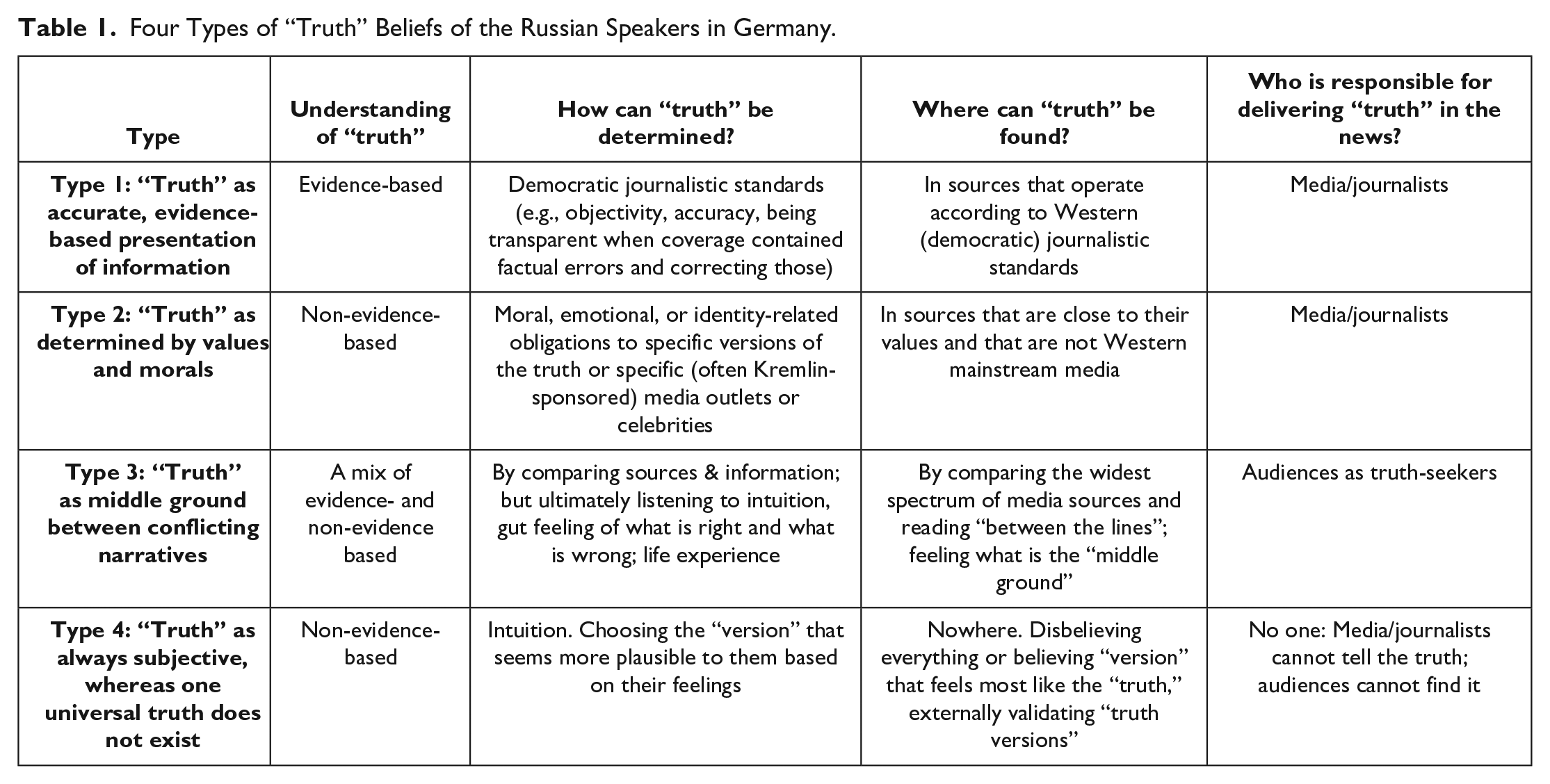
Among the interviewees, we broadly identified two distinct understandings of “truth”: (1) “truth” as a category grounded in factual evidence and (2) “truth” as a non-evidence-based category grounded in values, moral beliefs, or identities. These two understandings were connected to where four subtypes of participants sought the “truth,” what heuristics they used to identify it and who they believed was responsible for delivering the “truth” in the news (for an overview of our findings, see Table 1).
Four Types of “Truth” Beliefs of the Russian Speakers in Germany.
Type 1: “Truth” as an Accurate, Evidence-Based Presentation of Information
The eleven participants in this group held an understanding of “truth” based on factual evidence and the accuracy of information. Drawing on this notion, these participants looked for “truth” exclusively in media outlets that relied on fact-based journalism and operated according to democratic journalistic standards. As media that follow democratic journalistic standards, we broadly categorized outlets that Benkler et al. (2018) defined in the United States context as “professional-norms-oriented media” (p. 236) and excluded niche media that “traffic in politically motivated falsehoods, coupled with the persistent attacks on mainstream media and other evidence-based institutions and expertise” (p. 236). In this definition, the professional norms-oriented outlets mentioned by our participants included German high-quality media; Russian-language opposition media, such as meduza.io; and British and American media, such as the BBC and CNN.
Participants in the first group, to further elaborate on their news trust strategy, named the following as key factors of whether a media outlet is to be trusted: “transparency and objectivity” and “several steps of fact-checking the information” (Igor, 35, designer); “neutrality of the information—not opinions, but facts—when there are no interest in manipulating someone” (Maxim, 27, PhD student); and “reputation” and “trusting professional journalists” (Anna, 50, administrative advisor). One participant explained:
For me, what’s really important is the strength of the arguments and the evidence. I know people who watch and listen to the news because they match their opinions. They find proof that they are right. For me, it’s easy to change my mind if the arguments are factual and logical or if the reasons are serious. (Ivan, 40, clerk)
These participants also often named “honesty” a factor in this strategy. As Liliya (27, lawyer) explained, “It means how honestly and accurately he [the journalist] works with the information, with his own failures and with the other’s opinions.” For this group, the responsibility for providing a forum for debate in which the truth can emerge lies primarily with the media industry, including news outlets and journalists, as truth is the accurate and evidence-based delivery of facts. As for the media they did not trust, this group unanimously named Russia’s state-sponsored media. They attributed their mistrust of Russian news outlets to their “constant lying and telling of fake news” (Nikolay, 44, system administrator). One participant said:
When the German news media reports something that’s not true, I’m more inclined to think it’s a journalistic mistake because they later debunk it themselves and try to make up for it. In the Russian news [i.e. Kremlin-sponsored news], you never see this. They lie once, twice or three times; they just continue lying. They insist on their lies and never allow them to be refuted. Even if they do, it will once again be a lie. (Gennadiy, 33, IT)
Type 2: “Truth” as Determined by Values and Morals
The eight participants in this group believed in the existence of what they referred to as “truth,” but their understanding of “truthful” coverage was not tied to the factual accuracy of specific claims. Instead, for them, “truthful” reporting was determined by how well the news narratives matched their values and beliefs—what they considered morally right and wrong. Drawing on this match or the lack of it in their understanding of “truth,” these participants developed and justified their strong distrust of Western mainstream media sources, primarily German quality media sources and American and British international media. The media outlets they considered trustworthy, since they projected what was “truthful”—understood as a “morally right stance”—had to be independent of the “Western elites.” These included Russian state-sponsored media, so-called “alternative” German media (e.g., Anti-Spiegel) and international non-professional norm-orientated media (e.g., Breitbart). As Lydia (69, pensioner) explained,
I find truth in the Russian-language YouTube because I know that you cannot find this truth anywhere else. . . . What they conceal here [in Germany], the media in Russia just writes it.
Their trust was based on affectionate, emotional factors, such as intuition, identity (including the moral obligation to believe a specific “truth”) and personal sympathy toward the journalists and presenters. The identity part of trust in specific media outlets and news is illustrated by the following quote:
I consider myself Russian, although I am a Russian German, but we were brought up there [the participant left Russia when she was in her thirties]. Justice, honesty, friendship and brotherhood—all these are inherent in us, and that’s why we read and watch what is closer to us. Of course, this is Russian state television. (Regina, 67, pensioner)
Another facet of the identity reasoning for trusting specific media was that it is a moral obligation (i.e., the idea that if you are Russian, you must believe a specific version of the truth):
I trust the Russian [state-sponsored] media more. First of all, because I lived [in Russia] for 40 years, I think it’s bad to speak badly about your motherland. It’s not good. It educated you; it gave you friends. I don’t want to speak badly about it. Also, things are more evident from the outside. I see how much they [Russia] try there and how much aggression they get from the Western world. But really, if enemies surround your house and you have a gun, you would, of course, defend yourself. (Alyona, 64, former teacher)
Other aspects of the affectionate reasoning implemented by these participants were their sympathies toward specific personas and affection for pro-Kremlin journalists and politicians and for the moral dimension of their rhetoric:
Solovyov, Kiselev and Margarita Simonyan [high-profile TV presenters working for Russian state-sponsored media] think as I think. We are likeminded. I listen to them, and I would also say it like them or think that [what they said] is right . . . because it [what they say] is about universal values—not about their personal promotion, but about universal values. (Regina, 67, pensioner)
Moreover, while participants viewed alleged control over the media in the German and Western contexts negatively, in the context of Russia and within this paradigm of affectionate reasoning, they viewed censorship as positive.
As a result, this moral and identity dimension of trusting specific sources made the “truth” not a question of the accuracy and objectivity of the media but one of what is morally “right” and “wrong.” Intuition was also often mentioned as an ultimate argument for why one stance is true and another is not. Irina (51, housewife) related how she trusted the news and what “intuitive” meant to her:
Do I understand it correctly that this [trust] is at some kind of intuitive level?
Yes, . . . but also, you already have Menschenkenntnisse [knowledge of people]. You understand people more than in your youth. That’s why it’s at this intuitive level and at the level of sympathy. If someone tells me about someone—for example, Putin—that he has houses here and palaces there, I say, “So what? It’s not a big deal. There were tsars before who had everything, and others had nothing. It doesn’t really touch me.”
The responsibility for deciding on what is true is transferred to the media, which projects the “morally right” stance, with evidence or factual accuracy not being so substantial. The participants’ heuristics for identifying the “truth” were following the sources they felt were truthful, projected the “right” ideas and were outside the Western mainstream media.
Mistrust of the Western—and specifically German—quality news media was primarily attributed to its negative reporting about Russia and the events connected to it, which was felt by participants as an attack on their identity as having some sort of connection to Russia, and to its projection of different values. German media was named “Russophobic” (Irina, 51, housewife) and “anti-Russian propaganda” (Igor, 44, unemployed) and blamed for “intoxicating people with lies about Russia” (Jan, 29, engineer) and “demonizing Russia” (Konstantin, 48, journalist). In this way, the participants with this understanding of “truth” equated coverage of Russian leadership with their sentiments for the country. Four participants mentioned another reason for their mistrust of German media—that it was “too tolerant” (Irina, 1.5 Gen) of migration and LGBTQ+ rights.
Type 3: “Truth” as the Middle Ground Between Conflicting Narratives
The fourteen participants in this group combined a superficial evidence-based understanding with an underlying non-evidence-based understanding. At the most abstract level, they conceived of “truth” as the “middle ground” between two conflicting narratives. To identify the “truth” in a matter, these participants indiscriminately consulted the widest variety of outlets with different ideological orientations and geographical origins. Their media diets included German mainstream media (e.g., ARD, ZDF, and SZ), German alternative media (e.g., Junge Freiheit), Russian state-sponsored media (e.g., First Channel, RT, and Lenta.ru) and Russian opposition media (e.g., Meduza.io, Novaya Gazeta, and Dozhd). With regard to their search for the “truth,” they emphasized the importance of finding evidence in the news (superficial evidence-based understanding) but also held the view that when this evidence is incomplete or contradictory, one has to rely on intuition, “reading between the lines” or one’s “feelings” (underlying non-evidence-based understandings). Participants in this group did not treat the “evidence” presented by quality media and Kremlin-sponsored propagandistic outlets differently. In their search for the “truth,” this did not matter:
I also use the website Russia Today. It is, of course, a pro-government site with a one-sided interpretation of the information. However, local [German] websites, such as Die Zeit and FAZ, also have a one-sided interpretation of the information. This does not mean that I believe them. The truth is somewhere in the middle. (Igor, 33, healthcare worker)
As this quote illustrates, grounded in this truth understanding, these participants did not develop trust in specific news outlets but in their own capacity as “truth-seekers,” with “truth” typically found between two conflicting positions. To sort out the “truth” from “lies,” they claimed to deploy a combination of evidence-based and affective judgments. On the one hand, when deciding whether to trust the source, they frequently looked for a “plurality of opinions” (Yaroslav, 45, businessman) and “neutrality.” However, as a final crucial point in identifying “truth,” they referenced their life experiences, feelings and intuition. In the words of Kristina (31, translator and language instructor):
Every time you get the information, you filter it and think, ‘Maybe, it’s not fully as it is.’ Yes, you rely on this information; you take it as the information source, but you don’t consider it the truth. At first, you take it and then you filter it.
And how do you filter it?
I turn on my analytical consciousness and analyze it, juxtapose it against my human experience, and think, ‘Was it really like that or not?’
For these participants, the audience is responsible for identifying the “truth,” not the journalists. Their mistrust of media in general, whether German mainstream, Russian opposition or Russian state-sponsored media, is often tied to an underlying belief that the press can never be independent due to it being inevitably financed by a third party and that media never act in the interest of the public—“He who pays the piper calls the tune,” in the words of Anatoliy (56, self-employed).
Type 4: “Truth” as Always Subjective, while One Universal “Truth” Does Not Exist
The nine participants in this subgroup held a non-evidence-based understanding of the “truth,” according to which “truth” was equated to the framing or interpretation of a course of events. As such, “truth” emerged as always political. In this understanding, one universal, unified “truth” cannot exist, but only multiple versions of it. One participant said:
I understand that every country is pursuing its interests, and for this reason, information in the media cannot be objective. For example, you watch interviews with the Russian president and the American president, and they have their countries and their truths. And both will be talking, and both will tell the truth from their points of view, but both have their own interests in what they want to pursue. (Daniel, 38, controller)
Within this understanding, factual accuracy plays no role in determining whether news coverage is true. Many “truths” exist, and they always follow the political interests of the actors who finance an outlet or journalist. For these participants, a universal truth cannot exist either in democratic media or in media sponsored by authoritarian states. Consequently, they—as the audience—will never be able to identify the truth. These participants mitigate their perception of truth with trust in the media by disbelieving everything and choosing the “version” of the truth that seems most plausible or externally authorizing it. Referring to the subjective nature of truth, one participant answered the question of whether truth can be found in the media as follows:
What is truth; what is objectivity? For one person, one thing is truth; for another, something else. This is why reporting the news independently, without any position, is difficult, and from my perspective, impossible. Even when a person reads the news, they bring their personality into the interpretation of the news, and this is why the truth and objectivity of the news are not possible. (Natalia, 56, manager)
As neither the media nor audiences can find the “truth,” these participants would either strategically avoid trusting anything or choose the subjective truth. Specifically, the first strategy was to avoid political news, as the participants felt “helpless to influence anything” (Lilia, 31, social worker) and did not want to get upset. The second strategy was affective in nature—to choose the version of the “truth” that aligned better with their views or felt intuitively more truthful in the media. Raisa (49, economist) said, “We will never know the truth and how it really is. I sometimes have a sixth sense. I will not lie that it is [determined by] my logic and so on. It is my instinct.”
In most cases, these participants did not believe in the media’s capacity to deliver truthful information, similar to the Type-3 participants. However, unlike the Type-3 participants, these participants also did not believe in their capacity as an audience or in the need to find the “truth.” In the words of Alina (48, self-employed):
I am a very apolitical person. I do not dig the news for the truth because I do not believe that my small voice will change anything in big politics or that my opinion is necessary. What I think—how I think—does not have any weight in the world.
But how do you dъistinguish truth from untruthful information?
I don’t think I do. I think I remain lost.
Discussion
This study analyzed how Russian-speaking audiences in Germany, who are case migrant audiences who transferred from an authoritarian to a democratic media environment, developed trust in their transnational news environments. These audience members are different from their non-migrant counterparts in their home countries due to their unrestricted access to democratic media in pluralistic environments. Therefore, the findings about comparable national audiences under authoritarian rule (in our case, Russian-speaking audiences in Russia and other repressive Post-Soviet contexts) may not be generalizable to these migrant audiences. At the same time, the selected group differs also from national audiences in democratic environments, as migrant audiences from authoritarian states are arguably exposed to content disseminated by state-sponsored media of their home countries and, at times, even forcefully targeted by their foreign communication efforts. In our case study, Russian speakers were explicitly conceptualized by Russia’s leadership as “compatriots” and as one of the key targets of Russia’s foreign communication (Cheskin and Kachuyesvki 2019). In the following sections, we discuss how the results of this study relate to, and advance research on how trust in news media is developed by non-migrant audiences (in democratic and authoritarian settings) and by (Russian-speaking) migrant audiences.
The Consequences of “Truth” Understandings: Comparing Migrant and Non-Migrant Audiences
By explicitly distinguishing and theorizing two understandings of the concept of “truth” (evidence-based vs non-evidence-based, see Table 1) and systematizing their consequences, this study adds to the increasingly nuanced knowledge generated in recent research on how audiences develop trust in news media (see e.g., Pasitselska 2022; Schwarzenegger 2020; Swart and Broersma 2021; Toff et al. 2021). More specifically, our study advances this research by describing how four types of participants (who differ according to how they combine and apply the two distinct “truth” understandings) negotiate which media outlets to (dis)trust. The analytical distinction between these two “truth” understandings and their consequences, despite being described in this article as grounded in the experiences of a migrant group, may also serve as an inspiration for future research on national populations. For instance, the truth-seeking strategies of German audiences with high competence–confidence, as identified by Schwarzenegger (2020: 371), appear to be broadly comparable to those of the participants who fell into the third type in this study. Both types believe that their capacity to identify the “truth” is superior to that of journalists and rely on strategies such as personal beliefs, finding the “truth between the lines” and “gut feeling.” In a similar vein, in their four-country cross-national analysis, Toff et al. (2021) pointed out that “editorial processes and practices of journalism were rarely central to how people thought about trust” and that “only a small number in each country expressed confidence in their understanding of how journalism works” (Toff et al. 2021: 8). This observation is in line with our finding that only participants who belonged to Type 1 referred to professional journalistic standards in developing media trust. Future research could explore the distinct understandings of what constitutes the “truth” in the minds of these audiences, how distinct “truth” understandings affect their truth-seeking strategies, and how the sense-making of national audiences differs from that of migrant groups.
At the same time, this study’s findings revealed peculiar elements for which it appears difficult to find parallels in research on national audiences (Schwarzenegger 2020; Toff et al. 2021). For instance, a unique facet of how our participants who fell into Type 2 identified the “truth” was to believe Kremlin-sponsored media, not due to the accuracy of its reporting but because they felt a moral obligation to believe it for “patriotic reasons.” For this group, believing the media of their native country meant expressing feelings of belonging to their homeland and supporting its values, no matter whether the information in these media was factually correct. By contrast, these participants associated trusting German media, which often showed Russia, in their opinion, in a hostile light, with supporting attacks on their “motherland” (independent of whether they came from Russia or not). Consequently, knowing that Russia’s elites control these outlets did not stop these participants from trusting Kremlin-sponsored news outlets but pushed them toward them.
Advancing Research on Russian-Speaking Audiences Across the Globe
In this section, we discuss how our findings relate to the observations made by other scholars about Russian-speaking audiences residing in Russia and other post-Soviet states (e.g., Pasitselska 2022; Roudakova 2017; Szostek 2018; Toepfl 2014). As described in studies by Pasitselska (2022), Szostek (2018) and Vihalemm and Juzefovičs (2023), also all four types of Russian speakers in Germany interviewed for this research shared a widespread belief that trusting one source is inadvisable. Moreover, we observed a clear pattern of distrust toward media institutions, as discussed in the works of Toepfl (2014) and Vihalemm and Juzefovičs (2023), which in our study was shared, to a different extent, by the participants who fell into Types 2, 3 and 4. Similar to the participants in the studies of Szostek (2018) and Toepfl (2014), audiences with the truth perception of Type 3 in our research frequently applied the practice of cross-checking a multitude of sources and “reading between the lines”. Besides, for the participants who fell into Type 4, we saw the importance of explicitly relying on personal contacts or eyewitnesses to verify media reports, as discerned by Pasitselska (2022).
Implications for Increasing Trust in Journalism and Countering Disinformation
Among our interviewees, non-evidence-based notions of the “truth” (Types 2–4) prevailed over evidence-based notions (Type 1). In total, more than half (thirty-four out of forty-two) participants reported that they relied, at least partly, on their “intuition,” “life experience,” “sixth sense,” “knowing the people,” or moral “feelings” in determining whether news was truthful. In our case study, such non-evidence-based notions of “truth” were highly conducive to the reach of Kremlin-sponsored media content. These findings also have practical implications. For instance, they raise the question of whether German journalists’ strategies to counter the lack of trust in quality media are efficient. As Koliska and Assmann (2021) pointed out, German journalists and editors primarily attempt to restore trust in their work by “doing good journalism”—that is, increasing the accuracy of evidence-based reporting. However, for audience groups for whom the “truth” primarily needs to “feel” right, these strategies may be bound to fail. Likewise, campaigns to counter disinformation that rely almost exclusively on evidence-based fact-checking may have little effect and should be supplemented with messages targeted at audience groups that hold non-evidence-based truth understandings. For instance, news literacy interventions could be developed specifically for groups who have migrated from authoritarian states (particularly if the latter are known to target their diaspora with propagandistic messages). Such educational materials could highlight knowledge about media control in the authoritarian home countries and explicitly discuss differences in the ownership, control and patterns of reporting of the host country news media in comparison to the home country media. Our qualitative data indicate that non-evidence-based truth understandings and low trust in host society media may potentially be correlated with variables such as perceived discrimination in the host society, feelings of belonging, insufficient knowledge about news production (and other areas of news literacy knowledge), and age of arrival in the host society. Future research could systematically interrogate these preliminary indications. However, researchers need to be aware that these factors are often interrelated and mutually reinforce each other. For example, participants who fell into Type 2 (holding non-evidence-based truth understandings) tended to rely heavily on Kremlin-sponsored media. These media outlets consistently propagated and reinforced not only non-evidence-based truth understandings but also the ideas that Russian speakers living abroad are “compatriots” (feelings of belonging) and that democratic host societies are “Russophobic” (perceived discrimination).
Limitations and Promising Paths for Future Research
This study is, of course, not without limitations. First, as it is a qualitative study, it is not representative, and we learned little about the size of each of the four types in the community of Russian speakers with migrant backgrounds living in Germany. That said, in our sample, highly educated and self-identified Kremlin-critical participants were overrepresented, as we found it challenging to recruit pro-Kremlin and uneducated participants, despite our use of several entry points and strategies. Despite this overrepresentation, we had no difficulty identifying individuals who fell within Types 2–4 and achieving theoretical saturation for these categories. Second, our sampling strategy targeted only so-called first-generation migrants who were not born in Germany. Consequently, our findings are not unreservedly generalizable to second-generation Russian speakers. That said, it can plausibly be assumed that key aspects of our findings will generalize to truth understandings and their role in negotiating trust in transnational news environments among migrant groups who translocated from other repressive contexts (e.g., China, Russia, or Iran) to other democracies (e.g., France or the United States). By one or several of the pathways for the future indicated in the previous pages, scholars can aim to answer the overarching question of why, in what sense and for what reasons do different segments of migrant and national audiences develop trust in news media controlled by foreign authoritarian elites that frequently not only aim to foster anti-democratic attitudes but also spread false information on purpose.
Supplemental Material
sj-docx-1-hij-10.1177_19401612241257872 – Supplemental material for The Consequences of Evidence- Versus Non-Evidence-Based Understandings of the “Truth”: How Russian Speakers in Germany Negotiate Trust in Their Transnational News Environments
Supplemental material, sj-docx-1-hij-10.1177_19401612241257872 for The Consequences of Evidence- Versus Non-Evidence-Based Understandings of the “Truth”: How Russian Speakers in Germany Negotiate Trust in Their Transnational News Environments by Anna Ryzhova and Florian Toepfl in The International Journal of Press/Politics
Footnotes
Declaration of Conflicting Interests
The author(s) declared no potential conflicts of interest with respect to the research, authorship, and/or publication of this article.
Funding
The author(s) disclosed receipt of the following financial support for the research, authorship, and/or publication of this article: This article has received funding from the European Research Council (ERC) under the European Union’s Horizon 2020 research and innovation program [Grant agreement No. 819025]. It is part of the ERC consolidator project on “The Consequences of the Internet for Russia’s Informational Influence Abroad” ( ).
).
Supplemental Material
Supplemental material for this article is available online.
Notes
Author Biographies
References
Supplementary Material
Please find the following supplemental material available below.
For Open Access articles published under a Creative Commons License, all supplemental material carries the same license as the article it is associated with.
For non-Open Access articles published, all supplemental material carries a non-exclusive license, and permission requests for re-use of supplemental material or any part of supplemental material shall be sent directly to the copyright owner as specified in the copyright notice associated with the article.
