




Abstract
This article contributes to the conceptualization of international conflict mediatization through the lenses of ‘audience logic’ instead of the usual ‘media logic’ perspective. The former is defined here as beliefs about the workings of the media system that are held by audiences and constructions of their own identities as media users. The empirical analysis is about strategies used by Baltic Russian-speakers in making sense of media and news during the Russia-Ukraine conflict during 2013–2019. The authors propose elaborating the conceptualization of the audience and further inquiry into the resources for audience empowerment to alter today’s asymmetrical publics/elites power dynamics.
Keywords
Introduction
Hjarvard et al. (2015) employ the notion of ‘mediatized conflict’ to describe the process by which ‘conflicts are not only represented and played out in media-saturated social environments but also that media have a profound impact on conflicts themselves’ (p. 3). The role of the media in times of conflict has been mostly approached from the ‘media logic’ perspective: focussing on the study of relations between military, political and media elites or (digital) activist groups (e.g. Cottle, 2006; Hjarvard et al., 2015; Hoskins and O’Loughlin, 2015; Robinson et al., 2017a). Changes in the perceptions of the media system by audiences and their own role as media users during international conflicts have rarely been scrutinized, although authors have called for more investigation (Carruthers, 2008; Mejias and Vokuev, 2017; Nygren et al., 2018, to name just a few). We also see this pattern in the recent research on the Russia-Ukraine conflict, where the investigation of media production dominates (e.g. Lichtenstein et al., 2019; Roman et al., 2017) with the study of media audiences being neglected (see Szostek’s, 2018a, 2018b explorations of media use and media-related perceptions among Ukrainian and Russian audiences as a rare example). The authors of this study ask ‘how audiences do things with conflicts’ to paraphrase Cottle’s (2006) inquiry into ‘how the media do things with conflicts’ (p. 9, emphasis in the original text).
We aim to contribute by conceptualizing the role of ‘lay publics’ as performative actors of conflict mediatization which has so far been somewhat under-conceptualized. We follow the call by Schrøder (2017), who stresses the need for ‘audiencisation’ – the recognition of ‘audience logics’ as a constitutive part of mediatization studies. For him, ‘audiences play a formative role in the processes through which the media institution is a driving force in wider processes of socio-cultural change’ (Schrøder, 2017: 93). Such a view of mediatization is supported by the latest explorations of the ways in which citizens use social media networks (e.g. Demir, 2015; Mejias and Vokuev, 2017; Sabatovych, 2019; Smets, 2018), suggesting that individuals reflect and revise their positions and opportunities in the interplay between political power and media systems, which in turn shapes the further development of the mediatization of violent international conflicts.
We believe that because of its contested position and assumed potential for altering institutionally prescribed normativities, a closer examination of the Baltic Russian-speaking population (the case is explained below) may reveal new aspects of exercising audience membership amid an international mediatized conflict.
Based on qualitative studies among Estonian and Latvian Russian-speaking audiences in the context of the Russia-Ukraine conflict, the authors aim to identify how audiences relate to media and journalism and define their own roles and possibilities amid the internationally tense relationships between their symbolic/historical home country and current country of residence. More specifically, we ask:
How Estonian and Latvian Russian-speaking audience members perceive the media ecosystem in the Russia-Ukraine conflict?
How Estonian and Latvian Russian-speaking audience members perceive their options to exercise audience membership in the selection and combination of information sources, news interpretation and communication with other audience members?
The study case
The empirical evidence presented here is based on two case studies of the Russian-speaking minority residing in the NATO member-countries of Estonia and Latvia neighbouring Russia, and their extensive following of Russian state-aligned media. The conflict between Russia and Ukraine, defined here as a political confrontation between two countries following the 2014 annexation of Crimea by Russia, and the ensuing tense Russia-West relations, represents a hybrid war that is the focal point of the current inquiry. During a hybrid war, not only physical attacks but also information manipulations are important instruments of the power struggle. It has been argued that information warfare is central to hybrid warfare as enacted by Russia in Ukraine (see, e.g. Snegovaya, 2015). The hybrid war does not involve merely the media coverage of the actual conflict situation, but any harm done to the adversary via the help of media communication.
The nature of the Russia-Ukraine conflict has raised concerns about the ‘soft power and non-military means of influence as tools of destabilization’ as exercised by Russia in the Baltics (Winnerstig, 2014: 143). The Baltic Russian-speakers, a significant number of them not having citizenship of either Latvia or Estonia or any other country, have been conceived as the ‘central targets’ of these activities by Russia (Winnerstig, 2014: 4). The presence of large stateless populations in Estonia and Latvia, similarly writes Lanoszka (2016), constitutes the greatest vulnerability of the Baltic countries to Russian hybrid warfare (p. 176). According to Lanoszka (2016), both countries are vulnerable to opportunistic inciting of ethnic tensions by Russia, which could destabilize them (p. 192). With reference to the ‘high level of integration of many in the Baltics and their relatively high standard of living relative to that of Russians on the other side of the border’, Radin (2017: 23), however, concludes that ‘Russia will have difficulty provoking large-scale protests or separatist movements’ (Radin, 2017: 2).
In the Latvian media, the Russia-Ukraine conflict was represented as ‘Ukraine’s efforts to gain independence from Russia, integrate into the EU, promote political reforms, and democratize’ with the actions of Russia framed as aggression against Ukraine in order to retain its influence (Bērziņa, 2016b: 190). The fear of recurring Russian imperialism was very much present in the framing of the Russia-Ukraine conflict provided by the Latvian media (Fengler et al., 2020). Similarly, in the Estonian media discourse, concerns about the enlargement of the geopolitical aggression of Russia against its neighbour countries dominated (Ojala and Kaasik-Krogerus, 2016). In this discourse, the fear of losing its position as a European country and of falling back into the (post-)Soviet region was present in the background (Ojala and Kaasik-Krogerus, 2016). What is more, these anxieties shaped the discussions of internal issues in the Baltics. Thus, against the backdrop of the fear about Estonia being next after Crimea in Russia’s ambitions, the debate about the national language policy was framed as a state security issue for Estonia (Siiner and L’nyavskiy-Ekelund, 2017).
Much scholarly attention has recently been devoted to the study of the impact of Russia’s propagandistic messages on the hearts and minds of Baltic Russian-speaking audiences (see, e.g. Bērziņa, 2016a, 2016b; Kaprāns and Mieriņa, 2019a, 2019b). While, for these audiences, the conflict between Russia and Ukraine is a physically distant one, they are, nevertheless, socially and historically involved in the conflict between Russia and Ukraine. Since most of the Baltic Russian-speakers are Soviet-era settlers and their descendants, and because Russian state media consumption is part of their daily media activities, large segments of the Russian-speaking population feel solidarity with the ex-Soviet territories and subscribe to Russia’s geopolitical narratives (see, e.g. Bērziņa, 2016a, 2016b; Kaprāns and Mieriņa, 2019a, 2019b).
The influence of Russian propaganda as a problem is grounded in the peculiarities of the local media systems in Estonia and Latvia. In these countries, the media systems have been ethno-linguistically separated during the Soviet period and maintained the separation after Estonia and Latvia regained their independence in the early 1990s. This also involves ethno-linguistically defined media consumption, where Russian-speakers and members of the ethno-linguistic majority prefer media channels in their mother tongue. Estonian and Latvian media systems can be characterized as very close to ‘institutional completeness’ (Moring and Godenhjelm, 2011: 184) because although Russian-language media services are provided, they are far from being ‘functionally complete’, defined by the extent to which the Russian-speaking audiences lean on these services in their media use (for further accounts of the developments in offer and demand, see Jõesaar et al., 2014; Juzefovičs, 2017; Kaprāns and Juzefovičs, 2019; Rožukalne, 2014; Šulmane, 2010; Vihalemm et al., 2012). The Russian television channels are followed extensively and intensively among the Russian-speaking audiences 1 (Appendix 3) and are considered to be trustworthy sources of news about the Russia-Ukraine conflict (Appendix 4). The local public broadcasters that provide information in Russian are followed also, but less extensively and intensively 2 (Appendix 3). They are associated with the ‘voice’ of the power elites (Juzefovičs, 2017) and are also less trusted in the context of the Russia-Ukraine conflict (Appendix 4). The survey data reveals that one part of the Russian-speaking audience also follows Western and Russian alternatives, opposition media channels, which makes their media diets ideologically pluralist 2 (Appendix 3). In general, Russian-speaking audiences like to think of themselves as independent media users who have to look after themselves and obtain information from various official and unofficial (i.e. personal network-based) sources (Dougherty and Kaljurand, 2015; Vihalemm and Hogan-Brun, 2013).
In the context of the Russia-Ukraine conflict, these audiences have been critical about Estonian and Latvian public discourses that portray them as being manipulated by Russia (Juzefovičs and Vihalemm, 2020; Vihalemm and Juzefovičs, 2021, 2022). Their standing can be characterized accurately through the concept of transnationalism, according to which populations with a migrant background maintain connections and participate in the social life of the former homeland via long-distance communication networks and virtual arenas (Schiller et al., 1992; Vertovec, 1999). The authors stress that despite their physical residence in a certain society, transnational people may perform social acts and feel a sense of belonging to several societies (Levitt, 2011; Schiller and Levitt, 2007). Estonian and Latvian Russian-speakers are active users of global and Russian social media networks (Appendix 3), and they have social media contacts in Russia and elsewhere in the world 3 . Scholars also argue that transnational populations have richer cultural grounds to resist institutionalized norms as compared to uni-national populations (Lacroix, 2014) and at least some segments of transnational populations have greater social agency because of their integration into transnational social networks and organizations through which ideas, practices and resources are exchanged and organized (Castells, 1996; Levitt, 2011; Schiller et al., 1992). This is also the case for the Baltic Russian-speakers with the population segments with the greatest social agency also being the most transnational (Vihalemm et al., 2020). With all this in mind, we consider that the Russian-speaking audiences form a crucial subject for the investigation of ‘audience logics’ operating in a media scene marked by conflict.
Building the conceptual framework for interpreting ‘audience logics’ within a mediatized conflict
We agree with the scholars who have prioritized the concept of mediatization over the notion of mediation to stress the ‘active performative involvement and constitutive role’ of the media in war and conflict (Cottle, 2006: 9, emphasis in the original). Yet, the obvious shortcoming of these accounts of mediatization are their preoccupation with the power of the media, neglecting what Schrøder (2017) has labelled ‘audience logics’ to stress the agency of audiences in transforming the workings of the media. For Schrøder (2017), audiences exercise their power via ‘selection and use of news media technologies, genres and brands’ guided by the ‘interests, preferences, objectives and norms’ of the audience members (pp. 103–104). As Schrøder (2017) notes, ‘there is little recognition of the ways in which these individual practices may aggregate into a cumulative collective force, which shapes media institutions and the media landscape as such, as well as their interrelations with other societal domains’ (p. 88). In our study, we aim to shed light on the transformations of audiences’ normative understandings that guide their use of the media in extreme situations, such as conflict, and discuss the ‘weak signals’ of their collective formative power on the media landscape.
One of the few conceptualizations of the shifting dynamics of the relationship between elites and the lay public during an international conflict is offered through the periodization of war mediatization provided by Hoskins and O’Loughlin (2015). While not being interested in the study of war mediatization itself, we find that the general frame offered in this taxonomy can be used for the structuring of the existing, albeit scarce, scholarship on the role of audiences in the context of international conflict, and the Russia-Ukraine conflict in particular. Use of this structural frame helps us to understand the general logic of the mediatization and audience investigations in the context of conflict mediatization and build bridges for common discussions rather than building separate concepts. In so doing, we have followed Schrøder’s (2019) call for ‘a theoretical and empirical cross-fertilization’ of mediatization research and audience studies (p. 162). For Schrøder’s (2019), ‘any analysis of mediatization processes should, in principle, incorporate associated audience activities. . .considering how this audience activity exerts a formative influence, however small, on media and thereby on the relationship between the media and other societal institutions’ (p. 164). What we have mapped are shifting conceptualizations of audiences over different stages of war mediatization that sheds also some, albeit limited, light on the workings of ‘audience logics’. Based also on the terminology offered by Hartley (2008), we have developed an adapted taxonomy (Table 1).
Framework for the analysis of publics/elites interplay during a mediatized conflict.
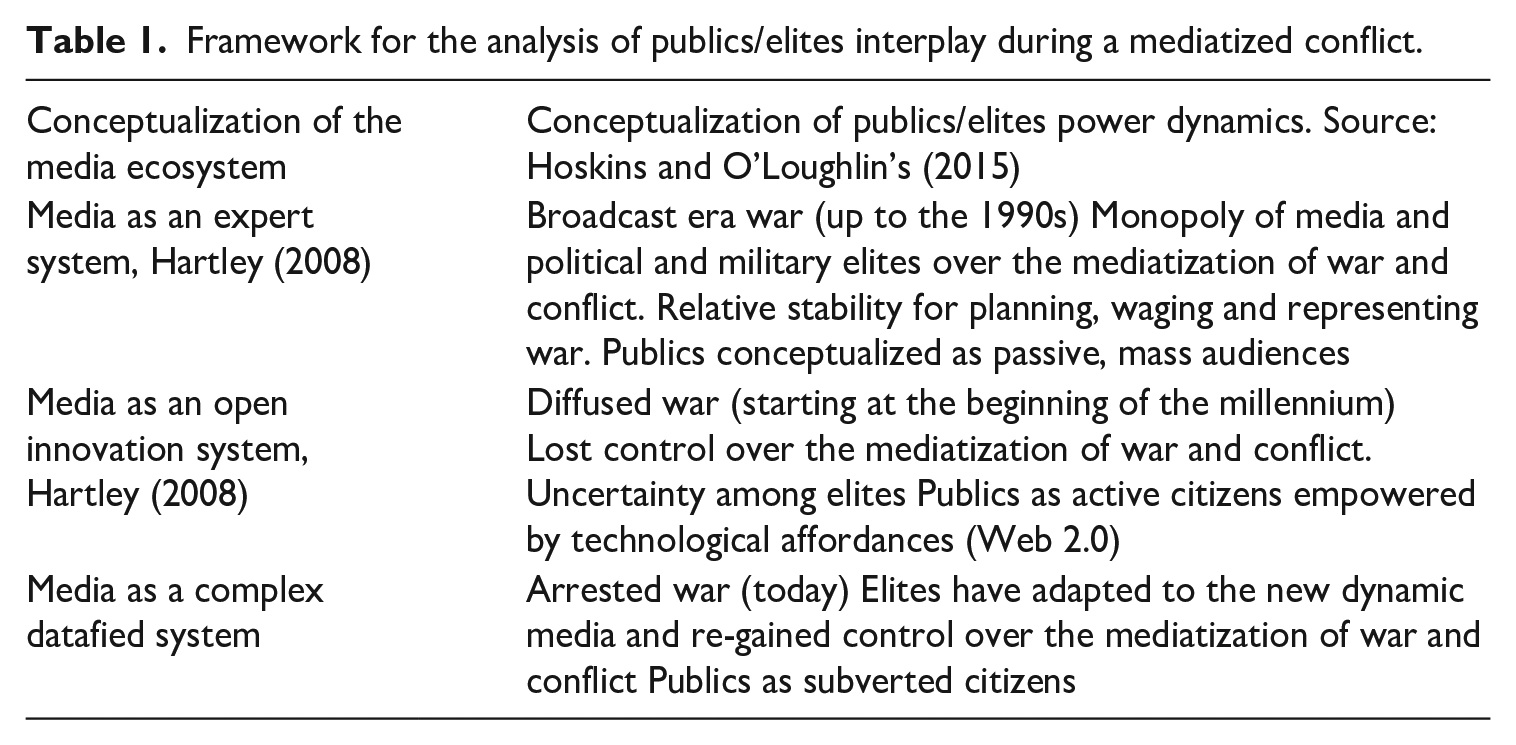
The approach to the media as an expert system, to borrow the terminology introduced by Hartley (2008), coincides with Hoskins and O’Loughlin’s (2015) first phase of war mediatization, which they have labelled as the ‘broadcast-era war paradigm’ and which refers to the period up to the 1990s. This approach is characterized by an elitist, top-down take on media/audience dynamics, where powerful media and political and military elites have control over the information flows and representations of war and conflict, and where the members of ‘lay publics’ have been conceptualized as a passive, mass audience, having limited agency ‘to challenge a discernible and dominant Western mainstream media’s representation of warfare’ (Hoskins and O’Loughlin, 2015: 1324–1325). In short, in line with this approach, ‘media logics’ dominate over ‘audience logics’, to employ Schrøder’s (2017) terminology.
It is especially during this period that the field of media and conflict research has been dominated by the study of media production and the representation of war, while audience research has been limited to the study of the ‘. . .impact media have on the public attitudes towards the conflict’ (for an overview, see, e.g. Bratić, 2006). Such a view of audiences in the field of war and conflict studies has not changed much, even after the ‘cultural turn’ in audience research that introduced the idea of ‘active audiences’, where media reception is conceived of as a complex process with audience members decoding media messages in manifold ways, including oppositional readings (Hall, 1980).
With the proliferation of digital media in the early 2000s, ‘journalism has transferred from a modern expert system to contemporary open innovation – from “one to many” to “many to many” communication’ (Hartley, 2008: 10). This marked the arrival of what Hoskins and O’Loughlin (2015) have termed the ‘diffused war paradigm’, which is characterized by the uncertainty of the previously powerful media and political and military elites because of the rivalry with ‘lay publics’, as ‘digital content enabled more of war and its consequences to be recorded, archived, searched, and shared’ (p. 1320). As Hjarvard et al. (2015) stress, control over information and its leaks became more complex and the opportunities for various activists to gain visibility, contest the power elites and mobilize support increased. Researchers report the rising expectations of publics to have a say in what was previously elitist diplomacy- and security-related matters (Abdul-Nabi, 2015; Nohrstedt and Ottosen, 2015; Robinson et al., 2017b). The participative war paradigm (Merrin, 2019) has also increased interest in audience research in the field of media and conflict studies (Smets, 2018), with some of the recent scholarship on the Russia-Ukraine conflict echoing this pattern: for example, Wiggins (2016) study on the consumption of Russian and Ukrainian internet users, (re-)production and distribution of memetic social media content as a form of political endorsement and critique, and Boichak and Jackson’s (2020) study of the utilization of Facebook by Ukrainian activists as a tool of public mobilization.
The earlier celebratory accounts of technology-enabled citizen participation in the representation of war and conflict have recently been questioned due to the ongoing developments on the media scene that we have labelled as a ‘complex datafied media system’, which corresponds to Hoskins and O’Loughlin’s (2015) ‘arrested war paradigm’. According to Hoskins and O’Loughlin (2015), this term marks the condition when elites have adapted to the conditions of the digital media environment and retaken control over the representation of war and conflict and have ‘subverted’ the citizen: the ‘amateur combat image is. . .quickly absorbed and utilized as a weapon of propaganda and warfare’ (p. 1327) and an ‘image-uploading eyewitness or Twitter commentator. . .commodified’ (p. 1329). Based on a case study of the Russia-Ukraine conflict, Mejias and Vokuev (2017) see propaganda and disinformation as co-produced by the states and citizens. Similarly, as Pendry (2017) reports, Ukrainian amateur journalists conceive of themselves as ‘information warriors’ who provide information both to the general public and the Ukrainian military (2017). The study by Cottiero et al. (2015) provides another vivid illustration of the arrested war paradigm: they demonstrate that it is not only Russian internet users who take over the messages of the Russian state broadcaster, the Kremlin also gets inspiration from the content produced by net citizens for the production of its geopolitical narratives. Likewise, concerns have been raised about the risks of such affordances of digital media as the algorithmic curation of news consumption being exploited by elites. In the context of the Russia-Ukraine conflict coverage in Russian and Ukrainian media, Makhortykh and Bastian (2022) argue that ‘although [news] personalization can be used for challenging state control over information consumption, there is a profound danger of instrumentalizing personalization for reinforcing it’ (p. 16).
As stated above, this study aims to explain audience perceptions of the media ecosystem and of themselves as participants in different moments of the mediatization of hybrid warfare – at the beginning of the conflict and a couple of years later.
Methodology
To indicate transformations in media practices and media-related attitudes among the Baltic Russian-speakers during the Russia-Ukraine conflict and the ensuing Russia-West tensions, we draw on two sets of data: focus groups from 2014 to 2015, and individual interviews from 2017 to 2019 supplemented by focus groups. This material is not part of one research project but comes from two different studies with different participants. For this reason, we are unable to make individual-level comparisons between the two periods, but generally examine how audience members have reflected on the media and themselves as media users at the beginning of the Russia-Ukraine conflict, in 2014, marked by the annexation of Crimea by Russia and the ensuing violent confrontation between Ukraine and pro-Russian Kremlin-backed separatists in the eastern region of Donbas (for further details, see, e.g. Taradai, 2019), and in 2017–2019 marked with the ensuing Russia-West tensions and intense mediation of some cases like the Skripal family poisoning.
The first data set comprises focus group discussions with 113 respondents of varied demographic and socio-economic backgrounds: 80 in Latvia and 33 in Estonia (Appendix 1). The series of focus groups were carried out in: Tallinn (four groups) and Kohtla-Järve (one) in Estonia, and Rīga (five), Daugavpils (two), Liepāja (one) and Rēzekne (one) in Latvia. The places for the interviews in both countries included capital cities and cities with large Russian-speaking populations who are not linguistically assimilated. In Estonia, the focus groups were carried out as part of a University of Tartu research project. In Latvia, the focus groups were commissioned by the State Chancellery of Latvia from the research company SKDS. With permission from the State Chancellery of Latvia, the authors of this article could use the transcripts of the Latvian focus groups for secondary analysis.
The 2015 Estonian focus groups were conducted by the researchers, who belonged to the research team at the University of Tartu. The 2014 Latvian group discussions were conducted by the public opinion research agency, SKDS. Although the number of groups in both countries was different, the socio-demographic and residence structure of the two samples enabled juxtapositions in the qualitative text analysis because the sampling strategy – a heterogeneous sample – was the same in both studies (Appendix 1). Both group discussion plans in Latvia and Estonia had a similar section about their own news media use, interest in news and politics, trust in news media, opinions about the local and international news media coverage of the Russia-Ukraine conflict, trust in particular media channels, and changes in habits of following Ukraine-related news. In the group conversations, the period was not specified, the participants were asked to describe spontaneously what came to their mind about the ‘events in Ukraine’ in general. In their spontaneous associations, the participants did not think about this in terms of the Russia-Ukraine conflict as distinct from the Ukraine crisis. In rare cases, it appeared from the context that they also meant the Maidan protests, but we did not include this in our own reflections on the Russia-Ukraine conflict.
In discussing the news about the events in Ukraine, the Latvian participants (where the groups were conducted in November 2014) discussed the Maidan protests, the annexation of Crimea, the tensions in the Donbas region, the clashes in Odesa city on 2 May 2014 between pro-Russian and pro-Ukrainian activists, and the shooting down of the Malaysian passenger aeroplane MH17 in Ukraine. In Estonia (where the groups were conducted in January and March 2015), the focus groups discussed the annexation of Crimea, MH17, the Minsk negotiations, the EU sanctions against Russia and a speech by Lavrov at the Munich Security Conference in February 2015 (For further details of the study design of this first stage of data collection, see Vihalemm et al., 2019.).
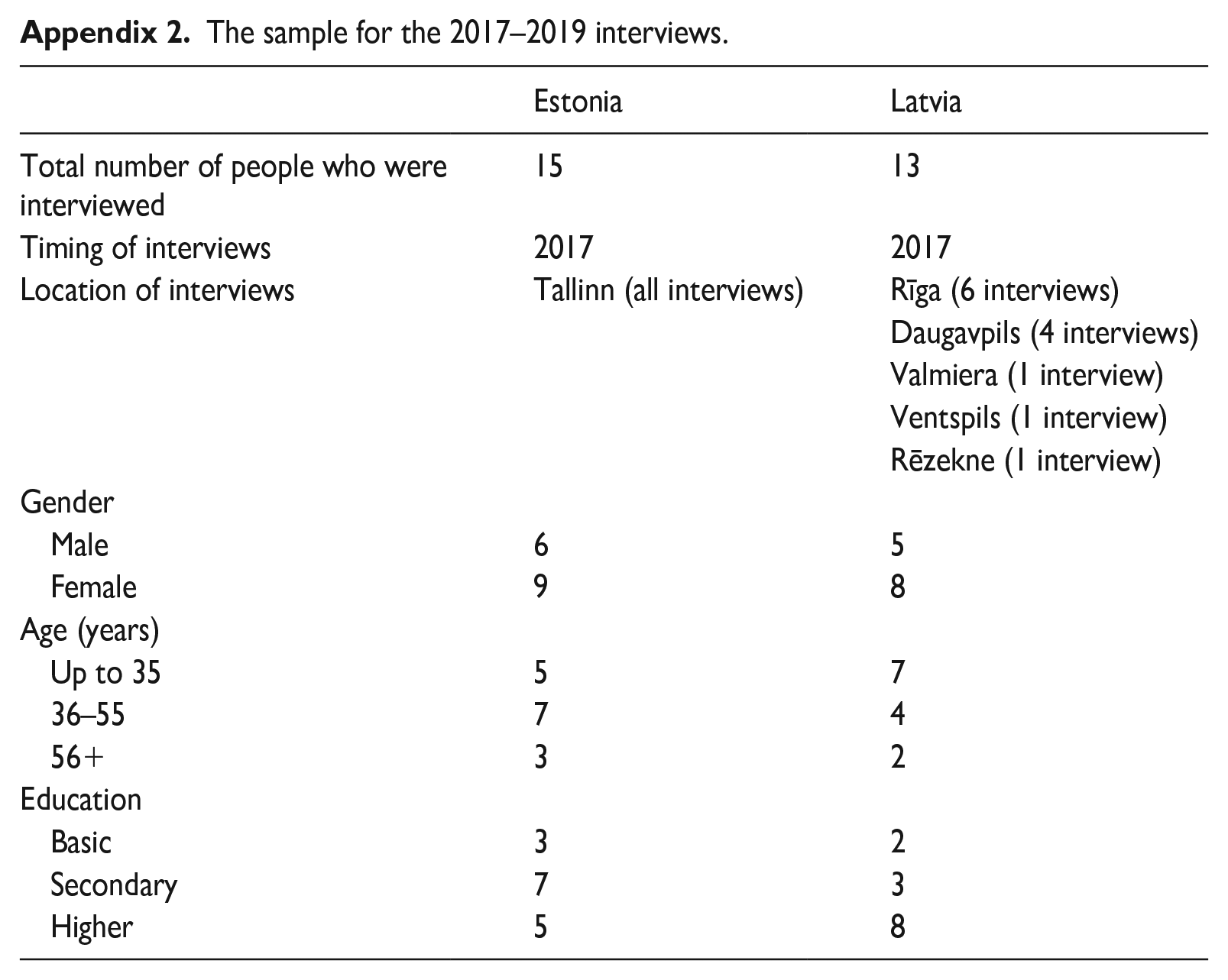
The second data set involves individual interviews with 28 informants: 13 in Latvia and 15 in Estonia; again people of various demographic and socio-economic backgrounds were recruited (Appendix 2). In the Estonian case, all the participants were from the capital city, Tallinn. In Latvia, the participants were from the capital city, Rīga, and from cities with a large Russian-speaking population: Daugavpils, Rēzekne, Ventspils and Valmiera. They were at first interviewed one by one in 2017 with those informants who followed political information in the media on a regular basis being interviewed again in 2018 (six in Latvia and eight in Estonia) and 2019 (four in Latvia and three in Estonia) about different episodes of the Russia-Ukraine conflict and the ensuing tensions between Russia and the West (namely, the controversies around the 2017 Eurovision Song Contest and the 2018 Pyeongchang Olympic Games, the 2018 Skripal family poisoning and the Kerch Strait incident later in the same year), which were reflected in the local and international media. This strategy allowed us to obtain situation-specific knowledge of practices and sentiments as held by these respondents, and also to monitor how these might have changed over the 3-year period (For further details of the study design of the second stage of data collection see Vihalemm and Juzefovičs, 2021.). Prior to these individual interviews, the participants of the study were invited to make voluntary screen recordings from their computers and/or mobile phones. This allowed us to observe the various digital practices these informants were involved in on a (nearly) day-to-day basis over the period of 10 days (2017), 2 (2018) and 3 weeks (2018). In the follow-up interviews, the informants were asked to reflect on the recorded episodes as selected by the researchers. These reflections inspired further talk about the informants’ media practices and media-related perceptions. In addition, to see how media-related attitudes are communicated in group settings, a series of focus groups were carried out in 2018: two groups in Tallinn, one in Rīga and one in Daugavpils.
Thematic analysis of the interview texts was used to examine the recurring topics that emerged after an initial close reading of the transcripts. We coded the interview texts into four broad categories of codes: (1) characterizations of the roles of the media system or journalism in times of international conflict; (2) strategies of media use and news selection about the Russia-Ukraine conflict; (3) strategies, terms and stories used in presenting themselves as media users during the Russia-Ukraine conflict; and (4) self-reported dynamics in their engagement in following the news related to the Russia-Ukraine conflict.
To analyse how audience members understood the media system and journalism in the context of international conflicts, we draw on the normative theoretical taxonomies of the media system and related traditions of journalism offered by Christians et al. (2009) and Hallin and Mancini (2004). To be more specific, we identified the parts of the texts that fit the subcodes for corporativist, libertarian-individualist, social responsibility and citizen participation media traditions and/or the subcodes for the roles of journalism – advocacy, watchdog and facilitative.
According to Christians et al. (2009), the ‘corporativist tradition’ has media elites with close links to political, economic and cultural elites, and the media are expected to be cooperative and less critical in matters that are defined as of national interest. Audience research papers report that this tradition is supported by the preference among audiences for media coverage that supports and glorifies their own nation-state in the conflict (e.g. Ginosar and Konovalov, 2015; Hale et al., 2018; Melki and Kozman, 2021). At the same time, some audiences – especially ethnic minorities – may reject the national hegemonic media discourse by turning to the internet and social media for alternative coverage of the conflict (i.e. Hale et al., 2018; Kalyango and Vultee, 2012). Such an approach is in line with the ‘libertarian-individualist tradition’ (Christians et al., 2009). This is based on the idea that a free market of expression best serves the public interest. This tradition assumes the rational capacity and conscious choice of an individual consumer as the mechanism of regulation. In contrast, according to Christians et al. (2009), the ‘social responsibility tradition’ is based on the ideal of the media as a public service institution and its collaborative (watchdog) role.
The ‘citizen participation tradition’, according to Christians et al. (2009), is an approach where the media belongs to the people in the form of community media and alternative private media. In the context of war and conflict, this tradition reflects the notion of audience activism held by Keeble et al. (2010), where audiences are conceptualized not as passive consumers of professional media texts but as contributors to the alternative digital mediasphere. Empirical evidence shows that cosmopolitan audiences who use social media for cross-cultural communications seek allies or inspiration from other movements in regard to conflict resolution (Demir, 2015).
According to the second broad category – strategies of political news media use and news selections about the Russia-Ukraine conflict – audience members were divided into three subgroups: (1) stable, partisan audiences with a politically uniform news media menu; (2) dynamic, plural audiences with a politically heterogeneous varied media menu; and (3) apolitical audiences who are not following political news (The audience typology is explained more detail in Vihalemm et al., 2019 and Vihalemm and Juzefovičs, 2021.).
Inspired by Hallin and Mancini’s (2004) conceptual framework, we define the practice of seeking content that is ideologically close to one’s geopolitical convictions and rejecting content that conflicts with one’s geopolitical orientations as ‘audience partisanship’. This is usually accompanied by strong geopolitical allegiance, which we conceptualize as ‘audience political parallelism’. The concept of ‘pluralism’ as suggested by Hallin and Mancini is also of relevance for us in understanding the media(-related) practices and attitudes of audiences. For Hallin and Mancini, pluralism is initially defined as covering different opinions and perspectives within one media channel (internal pluralism) or at the level of the national media system (external pluralism). We suggest expanding this conceptualization of pluralism by including the practice of audience members striving to ‘put the puzzle together’ – collecting different pieces of information from different sources of news that may come from beyond the national borders and may be exercised within a transnational media sphere.
The third broad category – self-presentations as a media user during the Russia-Ukraine conflict – consisted of two main subcodes, ‘citizen’ and ‘consumer’, which were, in turn, split into sub-subcodes describing the feeling of deliberation versus subversion. These codes are based on theoretical concepts of the interplay between publics/elites during a mediatized international conflict and are explained above (see the section called ‘Building the conceptual framework for interpreting “audience logics” within a mediatized conflict’).
The fourth broad category was the dynamics of engagement with following the news about the Russia-Ukraine conflict. The following subcodes were identified: (1) increase; (2) stability; and (3) decrease of engagement; however, the empirical analysis provided no evidence about increase of engagement. A specific subcode related to both the second and third categories was non-participation.
Results
How the media system and journalism is understood
The understanding of the media ecosystem according to the corporativist model,
4
where the media are expected to serve the interests of the power elite, was widespread among the Baltic Russian-speakers. For instance, 80 per cent of the Russian-speaking population in Estonia and Latvia thought that journalists provided biased coverage of the geopolitical crisis in line with the interests of their ‘clients’ (BRAS, 2019). The same beliefs were echoed in our qualitative empirical material. Therefore, with reference to the use of the military term ‘camps’ to classify opposite poles in ‘information warfare’, the informant quoted below discursively constructs the normality of state control over the media: There is Russian propaganda and on the other side there is anti-Russian propaganda. Two camps. . .there is an information war going on. . .. The state owns its mass media; it has always been so, and this is how it is today. (Roman, 47,
5
Liepaja, 2014)
In the excerpt below, a respondent with pro-Kremlin geopolitical leanings and more trust in Russian than Western sources of news explicitly ‘normalizes’ media partisanship as an inevitable by-product in times of geopolitical turbulence. For her, this not only explains but also justifies the corporativist tradition and the abandonment of the media’s collaborative (watchdog) role: Of course, I don’t want to say that everything there (in the Russian media) is one hundred per cent true. They also report some things for their own benefit of course. And it’s normal, as these days the truth is crammed into a corner, far far away. (Antonina, 63, Tallinn, 2018)
The audience views of the functioning of media and journalism seemed to be even more consistent with an authoritarian, politically instrumentalized type of media system during the later years. During 2014–2015, we observed instances of a very straightforward rejection of the corporativist media model and a preference for the social-responsibility tradition. Therefore, in the excerpt below, we see a reference to the media’s collaborative (watchdog) ideals and the representation of media partisanship as something abnormal: There is no point in expecting that the Russian mass media will be independent if the government pays their salaries. In my opinion, this is bad because the media should exist primarily in opposition in order to identify mistakes in the actions of the ruling coalition. (Daniil, 18, Tallinn, 2015)
In contrast, during 2017–2019, many responses (regardless of the ideological leanings of the informants) were characterized by an acceptance of the fact that autonomous journalism was impossible in times of geopolitical conflict and that the corporativist media ecosystem and advocacy role of journalism were the reality one had to accept.
Audiences seem to compensate for the deficit of media channels offering internal pluralism (Hallin and Mancini, 2004) with the possibility of external media pluralism. The encounters with a range of different (national/corporate) discourses and information as offered within the digital international media space was seen as an inevitable solution to resist subordination to the corporativist media system. Such a recourse to the international media space also marked the shift from the perceived role of ‘subverted citizen’ (Hoskins and O’Loughlin, 2015) to the self-image of transnational consumer-citizens who had given up on the legitimate expectations of the media as a public service and had invested intellectual capital and time in access to a transnational mediascape in order to satisfy the need for missing information. This was clearly revealed in the vernacular discourse of informants who used the metaphor of a marketplace of ideas to defend the media’s facilitative role in providing an arena for public deliberation: I think that there is no such thing as the truth; there are only viewpoints. Now fighting is going on in Donetsk. . .. There could be completely different viewpoints on this one event. And the fact that each channel reports the news from its point of view – I think that is what democracy is all about. You watch one channel, you watch another one. . .and you form your own opinion. . .. (Andrei, 37, Riga, 2014)
Note that Andrei mixed elements of both the corporativist and libertarian-individualist media models. On the local/national level, the political instrumentalization of media was presented as normal, while at the international level, diversity and free expression of competing ideologies were seen as a compensatory mechanism. However, the audience members did not idealize the transnational mediascape as a free market. Instead, they were reflexive regarding the complexities brought about by mediatized warfare in modern digital environments. The common discourse among the audiences included the terms ‘fake news’ and ‘disinformation’. Likewise, many reported an awareness of internet trolls, discussed conspiracy theories, and reflected on the optimization of search engines and the algorithmic selection of news on social media sites as signs of the appropriation of the digital media by political and media elites. For example: ‘I live in my own Facebook bubble. The algorithm probably shows what I read most often’, said Anna (33, Riga, 2018).
This approach to the functioning of the current media system motivated some audience members to reject a search for ‘absolute truth’ and instead stimulated them to work out strategies for the validation of information as screened from their personal heterogeneous media menus. These audience members accepted that there was no free market of objective information offered but only ‘always-provisional and heterogeneously constructed’ (Hoskins and O’Loughlin, 2015: 1333) information configurations. They searched for online cross-border personal contacts in order to validate the representations mediated by journalists and fellow social media users.
Although some of the audience members turned to social media sites in search of ‘authentic’ voices, the strong belief in citizens as potential active producers of independent information and citizen journalism as an alternative media system did not emerge from the interviews. Fellow social media users were seen as non-professional media practitioners who had limited access to information and who were unskilled at processing it. This indicates the limited approval of the citizen participation tradition of media among audience members. Some informants built up validation mechanisms consisting of multiple interpersonal online social networks covering different locations and people of different social status: I have friends in Ukraine. I can ask what people in Ukraine think [about what is happening in their country], people from different regions, not only from Kiev. . .. I also ask people from Russia what their television says. I might ask friends from Germany what the media says there. . .. Then I am able to form some idea of what is happening there [in Ukraine]. . . .It is better to ask people, to speak with people, instead of using the mass media. (Sergei, 24, Rezekne, 2014).
This strategy principally involved the same individualist-liberal view of the media system transferred to the social media environment with the accompanying responsibility of the individual to validate the digital configurations of information and representations.
Self-perception as a media user
The following section focuses on how the audience members position themselves vis-à-vis the mediatized conflict. The overall scepticism regarding corporativist media institutions on the national level and reliance on the rather demanding liberal-individualistic media system understanding on the international level required the normative role of the expert media user – reflective, analytical and active. Yet, in practice, such an approach could turn out to be too demanding, as pointed out by some informants, and was exercised only from time to time, with audience members opting for a layman media user self-positioning strategy in the meantime: I believe that an ordinary, average person who watches one or two channels is unable to find any reliable information because that is really difficult. It’s not an easy job to find information and then check it to determine what can and cannot be trusted. (Anna, 33, Riga, 2017)
Even if a smart, expert media user role was not necessarily exercised as part of day-to-day media practices, such a position supported civic dignity vis-à-vis Russian propaganda, and securitization and essentialization discourses on the part of the Estonian and Latvian ethno-linguistic majorities. Many of our informants referred to their habit of following ideologically different news sources, and constructed their skills of ‘reading between the lines’ as being formed during the Soviet period, when people illegally listened to Western radio. From this position, the description of the stereotypical collective beliefs of the Russian-speaking minority as manipulated by the Russian state-controlled media seems inappropriate: ‘I like to read alternative opinions. . .. Estonians, they all say that we (Russians) all are zombies because we watch our TV channels. This sounds quite scary’, said Irina (59, Tallinn, 2018).
In contrast, a layman media user self-positioning approach was characterized by a self-reported lack of expertise in sorting out the sensitive geopolitical issues in the context of politically instrumentalized media. This created civic defiance and demotivated the taking of ideological sides, but not necessarily abandoning the conflict-related information flows. For example: Naturally, we are carefully following what is going on in Ukraine, because it really is very disturbing. This geo-politics is difficult to get orientated to and evaluate. Anyway, we understand now that all this is going on for money, for someone’s ambitions or desires, and the people are just raw material. (Julia, 31, Tallinn, 2014)
A third type of self-positioning (in addition to expert and disillusioned) – that of the non-expert user – was what we term a ‘bystander’ position. This could have been employed in order to avoid any conflict in the multi-ethnic/multinational contexts of everyday life and to maintain social capital. In the following excerpt, the normalization of ideological pluralism and a personally varied media menu is paired with the conscious strategy of ‘keeping calm’ because of working in an ethnically mixed area: I don’t worry much about it [the conflicting news messages], maybe because at work we have a [ethno-linguistically] mixed staff. . .. I watch one, a second and a third [channel]. . .and draw my own conclusions. It’s normal that there are pro-Russian and American [channels]. . . .I have learned to react to all in a calm manner. (Elizaveta, 36, Riga, 2015)
When our informants in the interviews conducted during the early phases of the Russia-Ukraine conflict (2014–2015) admitted to trying to escape the complex, emotionally disturbing information about the conflict, there was still a need to comprehend and to become accustomed to the situation. In the later interviews (2017 and 2019), when the conflict between Russia and Ukraine had turned into an enduring ideological stand-off between Russia and the West and had become ‘the new normal’, the layman self-positioning was less often employed and was replaced by the expert or ‘bystander’ self-positioning.
Temporality of involvement in mediatized conflict
In general, from the audience members’ perspective, the mediatized conflict seemed to have a different temporality than the perspective held by the political actors involved in the conflict. While the interest in following the news related to the Russia-Ukraine conflict in 2014–2015 was high, and it was sensed as an extraordinary course of events that had recruited followers to the related information flow, by 2017–2019, the audience members had become bored with the conflict, which had lasted for a long period without major developments or a resolution. As the following quotation expresses well, the (elite-orchestrated) journalist-expert debates were rejected because of the (perceived) lack of novelty and efficacy in them: People work in television, apparently they get paid money for it, and they sing the same song all the time. People stand, babble aimlessly, and their babbling doesn’t affect anything. Nothing at all! So, I don’t see any reason to watch this. (Valeria, 49, Tallinn, 2017)
The efforts on the part of the audience members to consolidate their ideological positions demotivated them from keeping up with the further flow of information. The excerpt below provides a good illustration: In my opinion, there is already nothing new to hear about this. What is being done in Ukraine and what will happen next is clear to me. I have already formed my opinion, and lately I don’t see anything happening that would change my mind about what’s happening there. (Boris, 77, Rezekne, 2019)
Therefore, the audience members played a constitutive role in the maturation of the mediatized conflict when the geopolitical turmoil had lost its extraordinariness and had turned into a routine news topic. This process was interactive, where the practices of ‘lay publics’, professional and citizen journalists and activists and elites evoked each other. As a result, the Russia-Ukraine conflict lost its prominent position in the news media agenda, although the war continued and generated a great deal of damage.
Involvement in mediatized conflict and audience membership: Typology
In this section, we synthesize the various elements of audience membership during the mediatized political conflict, as discussed earlier in the matrix typology. The typology (Table 2) was created on the basis of an analysis of the interconnections of the different approaches used by the audience members to make sense of the media system, as well as to position themselves as citizens and consumers vis-à-vis the media system. In order to address the modes of political engagement of the audience members, we used a three-part background variable that should be applicable for any geopolitical turbulence: (1) stable, partisan position; (2) dynamic, plural position; and (3) apolitical, non-participating position.
Typology of Russian-speaking audiences of Latvia and Estonia. 1
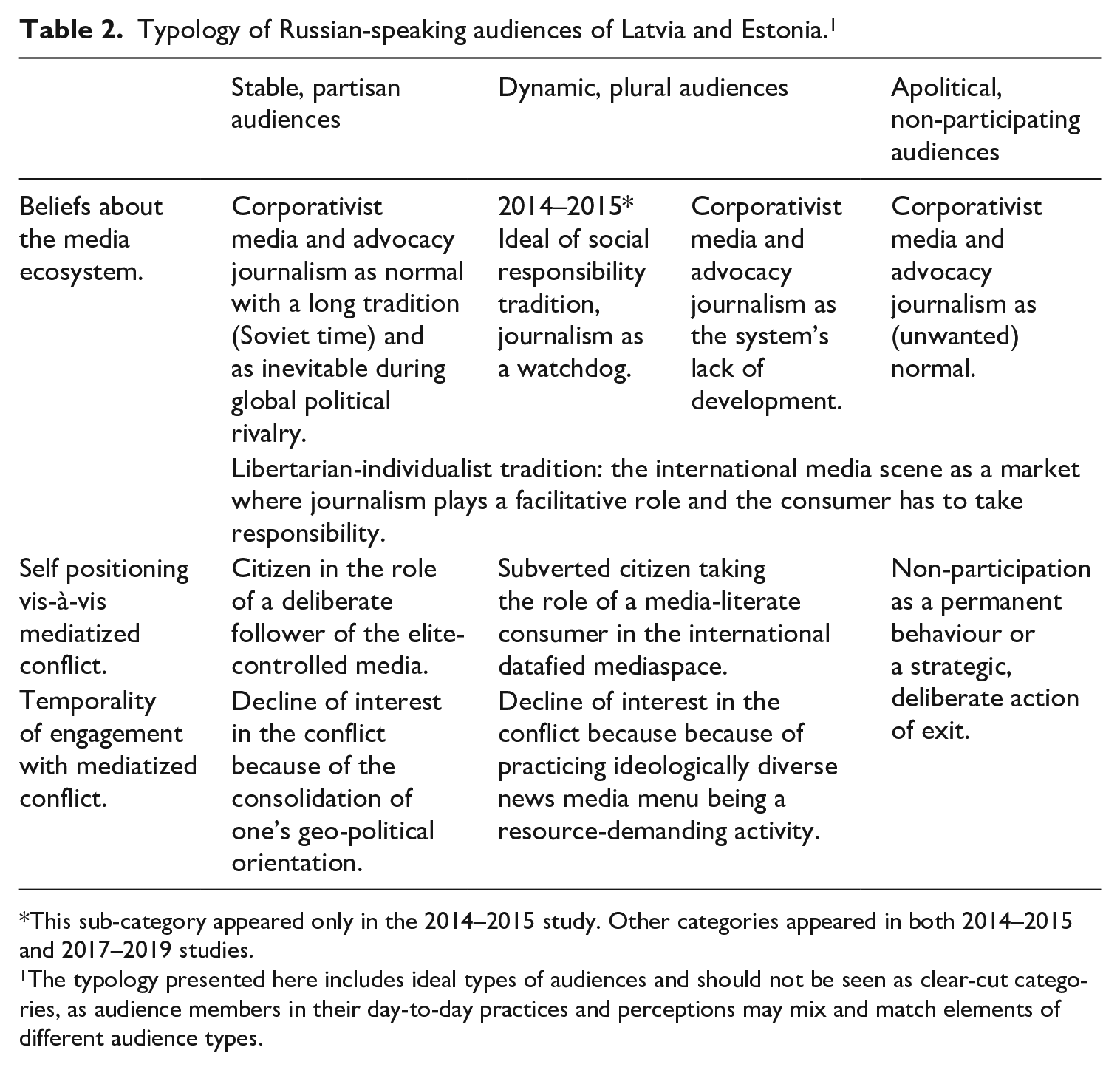
This sub-category appeared only in the 2014–2015 study. Other categories appeared in both 2014–2015 and 2017–2019 studies.
The typology presented here includes ideal types of audiences and should not be seen as clear-cut categories, as audience members in their day-to-day practices and perceptions may mix and match elements of different audience types.
Partisan audiences can be described as loyal and stable in their sympathy for one of the adversaries in the conflict, as well as in their regular, even dutiful, following of news that echoes the information-motivated mode of news consumption as conceptualized by Lee (2013) and deliberate tactics to avoid information that is in conflict with their own ideological convictions. In contrast to partisan audiences, members of dynamic audiences seek pluralism and thereby create heterogeneous news media repertoires that include alternative, oppositional news sources. The interest of dynamic audiences in news and politics may fluctuate from enthusiasm for searching for information and constructing self-analysis to temporary withdrawal. The permanent avoidance of political content in the media – especially contradictory information during a political crisis – is typical of apolitical audiences, who may still access political information accidentally, for instance, via social media groups or pages that mix political and non-political content. The latter case well exemplifies Lee’s (2013) entertainment-motivated news consumption, though political content is not searched for deliberately.
The first type, labelled as stable, partisan audiences, is in line with the broadcast era characterized by elite-dominated media and advocacy journalism. In our case, the respondents representing this type held either pro-Kremlin or pro-Western beliefs, but might follow ideologically plural channels, even if, ‘[i]n my opinion, there is already nothing new to hear about this. What is being done in Ukraine and what will happen next is clear to me. I have already formed my opinion, and lately I don’t see anything happening that would change my mind about what’s happening there’, to quote 45-year-old Vladimir from Tallinn (2019) However, while holding pro-Kremlin geopolitical sentiments, Vladimir also used Western media to follow the Kerch Strait incident. His interest in knowing the adversary’s line of argumentation was motivated by the perceived fallacy of its persuasion, which was used to buttress personal ideological beliefs. This represents a specific form of opinion-motivated news consumption described by Lee (2013) as ‘the need to seek assistance in forming opinions on certain issues, to expose one to other viewpoints, and for views from like-minded individuals’ (p. 304), and indicates that opinion-affirmative news consumption can form a synergistic combination with ideologically plural news sources. A partisan audience does not necessarily entail an ideologically homogeneous media diet.
These audience members considered the elite-controlled media system to be normal in the conflict-rich political order of the world. For the audience members, the global media ecosystem was expected to serve as a transnational arena where elites competed for people’s hearts and minds, thus combining elements of the corporativist media tradition and the media’s advocacy role with the libertarian-individualist media tradition and the media’s facilitative role. The engagement of these audiences was stable, but they might get bored because of the consolidation of their opinions. The consolidation of the audience members’ own ideological positions demotivated them from keeping up with the further flow of information from – according to their conviction – elite-orchestrated media as the following quote exemplifies: People work in television, apparently they get paid money for it, and they sing the same song all the time. People stand, babble aimlessly, and their babbling doesn’t affect anything. Nothing at all! So, I don’t see any reason to watch this. (Valeria, 49, Tallinn, 2017)
This appears to be a specific mode of being bored exercised among the partisan audiences who consider the elite-controlled media system to be a normal part of the media ecosystem. This is different from the feelings of weariness generated by distressful, conflicting media reports conceptualized as compassion fatigue (for further discussion, see Höijer, 2004), which is more typical of apolitical audiences.
The second type – dynamic, plural audiences – is characterized by disillusionment with the media’s social responsibility tradition and journalism’s watchdog role, which is imagined to have been prevalent in some earlier ‘peace time’ period. These ideals are seen as being abandoned and replaced by the consolidation of a type of media system that serves the interests of the political and military elites. They have unwillingly ‘normalized’ the corporativist tradition and advocacy role of media, which, in contrast, is not only accepted but even expected by partisan audiences. This disappointment motivates members of dynamic audiences to take the consumer-citizen role and be responsible for composing one’s own media menu from ideologically diverse pieces of information on the international media scene. At the heart of this self-responsibilization strategy lies a belief that, faced with the dysfunctionality of the media to provide an accurate picture of reality, it is the responsibility of the audience members themselves to sort out the complex and contradictory flows of information (for further discussion, see Vihalemm and Juzefovičs, 2022). These audiences prefer to avoid any explicit ideological taking of sides, and instead position themselves somewhere between the geopolitical antagonisms and exercise weak audience political parallelism. Yet, these audiences at some point may shift to partisan or apolitical types of audiences. This appeared to be the case with 59-year-old Irina from Tallinn (2019), who positioned herself as ‘a dabbler in politics’ and ‘an observer’ who ‘simply follows how the events develop’, but ‘does not delve deeply into what’s happening’. This approach allowed her not to exit from following geopolitics, but also avoid taking sides explicitly in the geopolitical battles: ‘Everyone has their own interests, which they defend. . .everyone has their own truth’. The representatives of this audience type see themselves not as citizens having certain rights and duties in the public sphere but rather as consumers with certain needs (to maintain civic dignity in resistance to the political indoctrination of the media), and they try to invest their intellectual and social capital to satisfy their needs within the available structures (e.g. the international media market) and rules (e.g. the datafied media system). This position is rather demanding in terms of time, intellectual work and social relationships, so some of the audience members may exit from the scene temporarily (by not following certain events) or permanently (by rejecting political news completely).
Apolitical, non-participating audiences position themselves as having no power to change the course of events, as 23-year-old Maksim from Daugavpils (2017) explained: ‘My interest will not help either one or the other. That’s why I don’t go there. My intervention, by discussion with someone HERE, will not in any way help those people who are THERE! I don’t see the point!’
This is similar to the compassion fatigue described by Höijer (2004), but the participants in our study stressed their powerlessness to change the course of events rather than emotional tiredness from encounters with violence and human tragedy, developing immunity to human suffering. What we learnt from our study is that the non-expert or bystander position vis-à-vis the adversaries in conflicts cannot necessarily be interpreted as abandoning the following of political news as a citizenship exercise. Likewise, the rise of the apolitical audience type does not necessarily mean the dissolution of citizenship. For these audiences, news avoidance may be as much a pre-existing permanent behaviour as a strategic, deliberate action of exit to deal with distress and complexity during times of crisis. In the latter case, news avoidance is not necessarily a rejection of citizenship ideals. While withdrawing from keeping up with the crisis-related news agenda, these audiences are not necessarily apathetic towards the crisis itself. What is more, non-participation may be short-lived as audiences may constantly opt in and out of following news about the crisis. Furthermore, as already noted, even in the case of permanent non-participation, news avoidance is not necessarily absolute, as the audience still may encounter news and politics incidentally. So, what the findings of the present study demonstrate is that the practices of (non-)following the news are multifaceted, and this has often been overlooked in the earlier survey-based inquiries into the study of interconnections between news consumption/avoidance and civic participation (see, e.g. Ksiazek et al., 2010; Molyneux, 2018). Our qualitative observations invite a more nuanced approach, where there is more room for various forms of news media practices and civic engagement.
Conclusions
Drawing on two case studies of Baltic Russian-speaking audiences during the Russia-Ukraine conflict, this paper has aimed to provide an audience-focused perspective on the study of the mediatization of conflict. Following Schrøder’s (2017) invitation to ‘audiencize’ mediatization research, our intention was to shift the focus from an inquiry into ‘media logics’ to the investigation of ‘audience logics’. When Hoskins and O’Loughlin (2015) conclude that political, military and media elites have adapted to the arrival of Web 2.0 and digital activism in mediatized warfare, and have developed tools to govern publics as ‘subverted citizens’ – a condition they refer to as the current era of ‘arrested war’ – our qualitative studies of Baltic Russian-speaking audiences illuminate ‘weak signals’ about audiences adapting, in turn, to the elite-governed media ecosystem in times of ‘arrested war’.
The results of the study suggest that the ‘logics’ of audiences directing the choices they make in building their news media repertoires are affected by their understanding of the ‘degeneration’ of the media ecosystem during the conflict. Juxtaposing their reflections about the media ecosystem in 2014 and 2015 with those in 2017, 2018 and 2019, we hypothesize that the mediatized Russia-Ukraine conflict has fuelled the consolidation of critical perceptions among these audiences on the manipulative nature of today’s complex datafied media ecosystem.
The media coverage of the Russia-Ukraine conflict has contributed to the formation of critical views of the media ecosystem among audience members and a specific hybrid understanding of the media system, where elements of Christians et al.’s (2009) individualist-liberal tradition (at the transnational level) and the corporativist tradition (at the national level) blended together, and where consumer and citizen roles of audiences became mixed. At the national level, we saw a ‘normalization’ of the political instrumentalization of the media, which was compensated for by the use of opportunities in the transnational mediascape. The latter was conceived of as a plural marketplace of ideas, where journalists and technological agents, such as news aggregators, were expected to fulfil facilitative roles and where consumers enjoyed the freedom to make choices from among the various, competing constructions of reality and ideologies on offer, while at the same time taking responsibility as a citizen for the choices made. In other words, when journalists are seen as failing to live up to their professional standards, it is the citizen’s responsibility to do the analytical work themselves to sort out the representations of reality as provided by media institutions. In short, the ideal of a critical, reflective media user is taken on in response to what is seen as the deficit of a social responsibility tradition in the media, as stated by Christians et al. (2009).
Media scepticism, though, is not exclusive to the Baltic Russian-speakers, as recent studies conducted elsewhere both in post-Communist Eastern European (Szostek, 2018a, 2018b) and Western societies (Wagner and Boczkowski, 2019; Wenzel, 2020) report much the same approach taken by audiences vis-à-vis media institutions during times of political complexity and uncertainty. However, extensive experience with the totalitarian media system, among other issues, adds some peculiarities to the media-society relations in post-Communist societies characterized by enduring high levels of distrust towards both media and political institutions (for further discussion, see Vihalemm and Juzefovičs, 2022). We believe that media scepticism, if it does not provide any tangible, effective tools for resistance, at least offers certain audience members a role in altering the imbalance in the relationships between publics and elites.
We hope that our investigation of Baltic Russian-speaking audiences following local and international media reflections of the Russia-Ukraine conflict will lead to further explorations of the role audiences play in the mediatization of international conflict, both as mediators of conflict and as agents of the mediatization process itself. As we have demonstrated, ‘lay publics’ should not be treated as merely passive objects of elite-run information manipulations but should be seen as active participants in the mediatization of a conflict. Yet, it is beyond the scope of this paper to address the role played by audiences as actors shaping the ways in which the media operates and modern warfare is conducted. It is the task of future studies to provide an analysis of how the media and military, and political elites, respond to the practices and perceptions of audiences.
Footnotes
Appendix
The sample for the 2017–2019 interviews.
| Estonia | Latvia | |
|---|---|---|
| Total number of people who were interviewed | 15 | 13 |
| Timing of interviews | 2017 | 2017 |
| Location of interviews | Tallinn (all interviews) | Rīga (6 interviews) |
| Daugavpils (4 interviews) | ||
| Valmiera (1 interview) | ||
| Ventspils (1 interview) | ||
| Rēzekne (1 interview) | ||
| Gender | ||
| Male | 6 | 5 |
| Female | 9 | 8 |
| Age (years) | ||
| Up to 35 | 5 | 7 |
| 36–55 | 7 | 4 |
| 56+ | 3 | 2 |
| Education | ||
| Basic | 3 | 2 |
| Secondary | 7 | 3 |
| Higher | 5 | 8 |
Funding
The author(s) disclosed receipt of the following financial support for the research, authorship, and/or publication of this article: This research was supported by Estonian Research Council grant PUT1624.
