




Abstract
In this study we argue that we are entering a period with increasingly complex and dialectical relations between cross-continental and national sentiments and actions. This situation—characterized by multiple centers of political power and conflicts—requires journalism studies to sharpen its skills when examining cross-border journalism using concepts such as foreign, international, global, and transnational journalism, and to be analytically sensitive to their differences and their potentially dynamic relations. This article examines the theoretical definitions and practical use of these four cross-border journalism concepts during the period 2010–2020 in a selected number of academic journals. We critically discuss their potential contribution to future research on global challenges occurring in a paradoxical world where globalization appears to be moving forward and backward simultaneously.
Keywords
Cross-border journalism is perhaps the oldest form of modern journalism broadly defined as journalism “covering transnational and cross-continental relations generated by trade, technology, population, politics, armed conflicts […]” (Berglez, 2013, p. 2). Back in 1728, Ben Franklin’s Pennsylvania Gazette resembled the very few other U.S. paper of the day, printing mostly foreign news without dealing with local conversations (Schudson, 2013), while local papers focusing on local news became common only from the 1870s (Weber, 1976).
Throughout history, cross-border journalistic practices have played key roles in shaping and simultaneously be shaped by society, politics, and history. One can think of the effects of transnational broadcasting during the late 1930s when Great Britain and Germany used radio broadcast to influence public opinion particularly in the United States (Seib, 2006). Or the fall of the Berlin Wall in 1989, and the continuous development toward free movement across borders and cross-continental integration that has shaped both the practice and importance of cross-border journalism.
In the first two decades of the 21st century, new forms of cross-border journalism emerged in the literature initiated in 2001 when Stephen Reese hinted at a distinct concept of journalistic professionalism arising at the global and transnational level, which may be better suited to meet the “normative standards we would wish for” in a global world (Reese, 2001: 173). Scholarly work on global journalism (Reese, 2001) and transnational journalism engages with forms of cross-border journalism that might not be located either at the international level, national dimension, or the domain of community neighborhood (Archetti, 2019). One example of this includes online local news in English produced in non-English-speaking countries such as France for a diverse audience such as citizens, residents, immigrants, people visiting France and so on (e.g., The Local).
We interpret these developments in the last two decades as a call for conceptual work on distinctive formations of cross-border journalism. Therefore, in this article, we explore if and how the field of journalism studies has developed a conceptual toolbox that makes it theoretically well-equipped to analyze cross-border journalism processes simultaneously. Because of its historical relevance for the profession of journalism, we theorize cross-border journalism as the umbrella concept that incorporates the various formations of journalistic processes crossing borders of nation-states. Here we are particularly interested in the interpretation and connotation of “crossing” such as foreign, international, transnational, and global journalism. The aim is to connect previously disconnected studies that examine cross-border journalism such as foreign correspondents or fixers (Palmer, 2019) into a coherent conceptual framework to be able to explain the vast amount and diversity of cross-border journalistic realities (such as The Local).
We propose moving away from the ontological question and debate of whether the world is primarily global or national (Beck 2005) and toward an understanding of the foreign, global, international, and transnational as existing societal structures that can operate to different extents and in different ways in different contexts. This begs the question: How can we conceptually bring those discussions into a coherent framework of cross-border journalism realities? What are analytical tools that can help us conceptualize various formations of cross-border journalism?
The aim is to provide a typology and conceptual definitions that can potentially guide future studies researching cross-border journalism. Based on an examination of academic journals between 2010 and 2020, we follow Reese’s (2022) suggestion to use a typology as a form of classification. We map out the conceptual dimensions of cross-border journalism including international, transnational, global and foreign journalism. The manuscript’s goal goes beyond a literature review because it empirically analyses the existing literature (rather than merely describing what is discussed in the literature), hence trying to make a conceptual contribution to understand the significance of the four concepts. We further strengthen this argument by including a conceptual definition of each concept in the conclusion sections of the article.
Analytical tools to conceptualize cross-border journalism
Previous conceptual work in cross-border journalism (Archetti, 2019; Reese, 2001) identifies essential analytical tools for a theoretical analysis of foreign, international, global, and transnational journalism. We focus on thematic diversity within concepts and the use of space, power and identity, three fundamental cognitive categories that are assumed to influence the scholarly use of the concepts (cf. Van Ginneken, 2005).
We aim to use these analytical categories to build conceptual typologies and definitions of cross-border journalism that will facilitate and improve their further applications in empirical research.
Thematic diversity
The normative point of departure is that, ideally, these four concepts ought to represent four different dimensions, sides, meanings, etc. of “cross-border reality”, thereby making them relevant in scholarly work. Theoretically speaking, the four concepts should ideally be able to capture the complexity of today’s cross-border realities, in terms of a wide range of cross-border themes, by demonstrating thematic diversity. In other words, if the four journalistic concepts—foreign, international, global and transnational journalism—can be applied in various thematic contexts, their theoretical status in journalism studies will be more robust and long-lasting. For example, how much of the realities of international journalism are captured if scholarly discussions focus heavily on one main theme associated with the concept? Put differently, we would like to see these concepts being applied to a diversity of overarching themes (e.g., ethics, practices, history), rather than being overly concentrated around a single theme, such that the theme comes to define the very concept. We thus pose a first research question:
Conceptual relations between the macro- and meso-theoretical levels
Consequently, the core or closely related meanings of “globalization” (from sociology), “international relations” (from international politics) and transnationalization (from cultural studies and sociology), as well as of “foreign affairs” quite easily find their counterparts in journalism studies. Ideally, there is a logical correspondence between how, for example, the terms international relations and international journalism are defined and applied in research. Given that international relations are about relations between nation-states, international journalism ought to refer to journalism that covers such relations. However, if there is a great deal of disagreement on the macro-theory level about how to define globalization, internationalization, transnationalization and foreign affairs, this is likely to influence the definitions of their journalistic counterparts. Under such circumstances, the conceptual uncertainty at the macro-level is likely to be reproduced at the meso-level, potentially leading to unwanted overlaps, in which the concepts to a greater or lesser extent refer to the same things. This indicates a need for journalism scholars to solve potential conceptual issues themselves by finding well-functioning definitions, without obvious support from political science and sociology.
The relations to macro-theory (sociology, political science, etc.) is also a risk factor for a lack of distinctions or constructive cross-fertilization. Hence, hierarchical relationships between journalistic concepts and the (macro-)theoretical traditions they represent might lead to the outcome that one concept is viewed as overdetermining, i.e. colonizing, the meaning of another concept. Discourse theorists refer to this in terms of logics of equivalence and difference (Laclau and Mouffe 1985; Glynos and Howarth 2007: 106). Concept A becomes symbolically equivalent to concept B, although B de facto represents something different from A. Consequently, the difference between concept A and concept B is suppressed, a situation that could also be understood as a hierarchical relation in which A dominates over B. For example, due to the above-described asymmetrical relation, phenomena that ought to be conceptualized as global might come to be represented as (only) international. Or, a practice that should be understood as global journalism instead becomes associated with international journalism, due to the authority of an international way of understanding cross-border journalism.
Furthermore, apart from the fact that everyone might interpret and understand definitions quite differently, we may have different theoretical ambitions and purposes regarding the concepts, which will also affect how they are defined and increase the risk of conceptual overlap. This could be understood in terms of an umbrella vs. an operationalization perspective. In the earlier case, a concept such as foreign journalism is applied to topics that involve processes outside the nation. In the latter case, there is instead an ambition to define and properly operationalize the concepts used, and thus to outline their relevance for the analysis. Consequently, both actions are natural dimensions of scientific work, and one cannot simply say that an umbrella use of concepts is necessarily always a negative thing for research. Problems might arise, however, if an umbrella usage of the concepts becomes too dominant, as it might become normalized and delay the formulation of more detailed definitions that, in turn, could highlight the various concepts’ differences and facilitate their use in explaining different aspects of cross-border realities. Considering these considerations, we formulate a second research question to guide this study:
Space, power, and identity
Further, this study requires relevant analytical variables for comparisons. Here, we suggest that the journalism concepts could be analysed in terms of how space, power and identity are handled (Berglez, 2013; Tanikawa, 2019; van Ginneken, 2005). More precisely, we assume that the construction of space, power and identity in the selected articles are embedded in how the concepts of cross-border journalism are defined in the overall theoretical framework of the study, in the methods used, and so forth. We consider these three social and political categories as fundamental for the understanding of journalism in a general sense. For example, what is local journalism if not a particular way of representing space (a delimited “local” place usually situated within nation-states), power (the local authorities, municipalities, etc.) and identity (journalism’s contribution to a local “we” in contrast to other collective formations) (see Franklin 2006). These categories are equally important for understanding not only domestic/national journalism but also the similarities and differences between different types of cross-border journalism in scholarly work, we would argue. So far, these three categories have been used to theoretically distinguish global journalism and foreign correspondence (Berglez, 2013; cf. Tanikawa 2019), but they have not been applied on the four concepts of global, foreign, transnational, and international journalism. Clear distinctions between the concepts presuppose that space, power and identity represent different things in each of the four concepts, although there is no guarantee that this will be the case, i.e., there is a risk of overlaps. We presuppose that different research contributions could focus on space, power and identity in the following ways (from political economic, cultural studies, network theoretical, etc. perspectives): Space: analytical focus on, for example, one common world, the nation/nation-state, relations between cities in the world, relations between two or more nation-states, etc.; and/or Power: analytical focus on global institutions, national governments, transnational NGOs, etc.; and/or Identity: analytical focus on citizens, residents, travelers, transnational networks, a national or global we, etc.; and/or
We pose a third research question:
Methodology
To shed light on the scholarly discussion of forms of cross-border journalism we decided to focus on a qualitative discourse analysis initiated by a quantitative descriptive overview to set the stage of the earlier.
Selection of articles
We initially looked at the representation of the four concepts in manuscripts across 11 high-impact journals and narrowed down our search based on the frequency of the occurrence of the four concepts. 1 Our empirical material consists of articles from two scholarly journals focusing on journalism, Journalism and Journalism Studies, and two journals focusing on international communication, International Communication Gazette and Global Media and Communication. We aim for credible qualitative findings and theoretical saturation within the interpretive process, rather than seeking representative results.
We ran a search on each journal’s website separately for the period 2010–2020 employing four search terms: international journalism/journalist OR global journalism/journalist OR foreign correspondence/correspondent OR transnational journalism/journalist. We ended up with a total of 73 articles: 24 in Journalism; 37 in Journalism Studies; six in International Communication Gazette; and six in Global Media and Journalism. 2
In the second step, we closely read the title, abstract and keywords of each article and checked whether any of the four search terms appeared there. If not, the article was eliminated from the list. After eliminating book reviews and introductions to special issues, we ended up with a sample of 55 articles for further analysis.
Analysis strategy
To answer our first research question—To what extent the four cross-border journalism concepts occur in connection with themes in academic journals—we conducted a content analysis across the four journals. We focused on the following variables: the presence of global, foreign, international, or transnational journalism (coded as binary variables for each concept) and the main theme of the article. The variable to code for “main theme” was inductively developed after both authors read a sample of 30 articles 3 and then came up with overarching themes for each published article. When there were competing overarching themes, we picked the theme that occurred first in the keywords, thinking that the authors of the articles must perceive those themes as most crucial for their work.
Based on this initial overview of all articles, we proceed with the discourse analysis by strategically collecting those articles that exhibited relevant cases of conceptual and definitional similarities, distinctions, and overlaps. Both authors read through the 55 articles and chose articles that were relevant for a deeper study of similarities/differences/overlaps. We ended up with a sample of 31 articles for our qualitative analysis. We first read through all articles separately and then compared our lists. Our examination of distinctions, overlaps and cross-fertilizations was guided by the use of discourse analysis (Richardson 2007; cf. Wodak and Meyer 2012), by means of which the articulations of the cross-border journalism concepts were studied. To begin with, it is crucial to analyze the scientific discourse and its elements of argumentation, here involving the (scientifically oriented) argumentation for the relevance of the use of concept in relation to what one is doing and/or seeking to accomplish (e.g., the empirical analysis, the model, etc.).
We applied selection criteria and reflective questions including: does the article make an important theoretical contribution in its use of any of the four concepts? Does the article discuss any of the concepts in more depth by providing a theoretical definition or empirical operationalization regarding space, power, or identity? Does the article offer a novel way of distinguishing between two, three or more concepts of cross-border journalism?
In sum, our discourse analysis (Richardson, 2007) focuses on how the use of the four concepts appears through (1) scientific causal reasoning/argumentation (concept A is applied/studied/defined as a consequence of…), which could be more or less explicitly articulated in the article (Richardson 2007: 164–165); and (2) coherence and relations between the use of concept(s),thematic diversity, macro-level theorization and the space/power/identity categories, in order to understand the risk of conceptual overlaps reproduced by incoherent application of the categories.
Findings
Descriptive findings
Our initial analysis reveals that the concept of foreign journalism is mentioned the most (n = 29; 52.7% of all articles analyzed), followed by international ( n =14) and global journalism (n = 14; both 25.5%), while the concept of transnational journalism occurs the least (n = 8; 14.5%). 4
To answer our first research question about the thematic diversity of concepts, we uploaded our dataset to Kumu,
5
a metrics engine, to visualize a social network analysis (SNA) metrics of our concepts and themes (See Figure 1). We used this to organize and visualize the connection between themes, articles and the four concepts. We validated our initial results that foreign journalism is the central concept and is closely connected to the main themes of fixers, history, work practices, network, and war. The network shows the close relationship between foreign journalism and fixers and work practices. Whereas the theme of war seems to be uniquely related to foreign journalism and does not show any other conceptual relationship, the theme of work practices seems to function as a dominant theme that connects foreign with international journalism. Cross-border journalism network and themes. For better visual, see: https://embed.kumu.io/da35a005f643ddc98e25aaf569dd5ec5#concept-theme-network.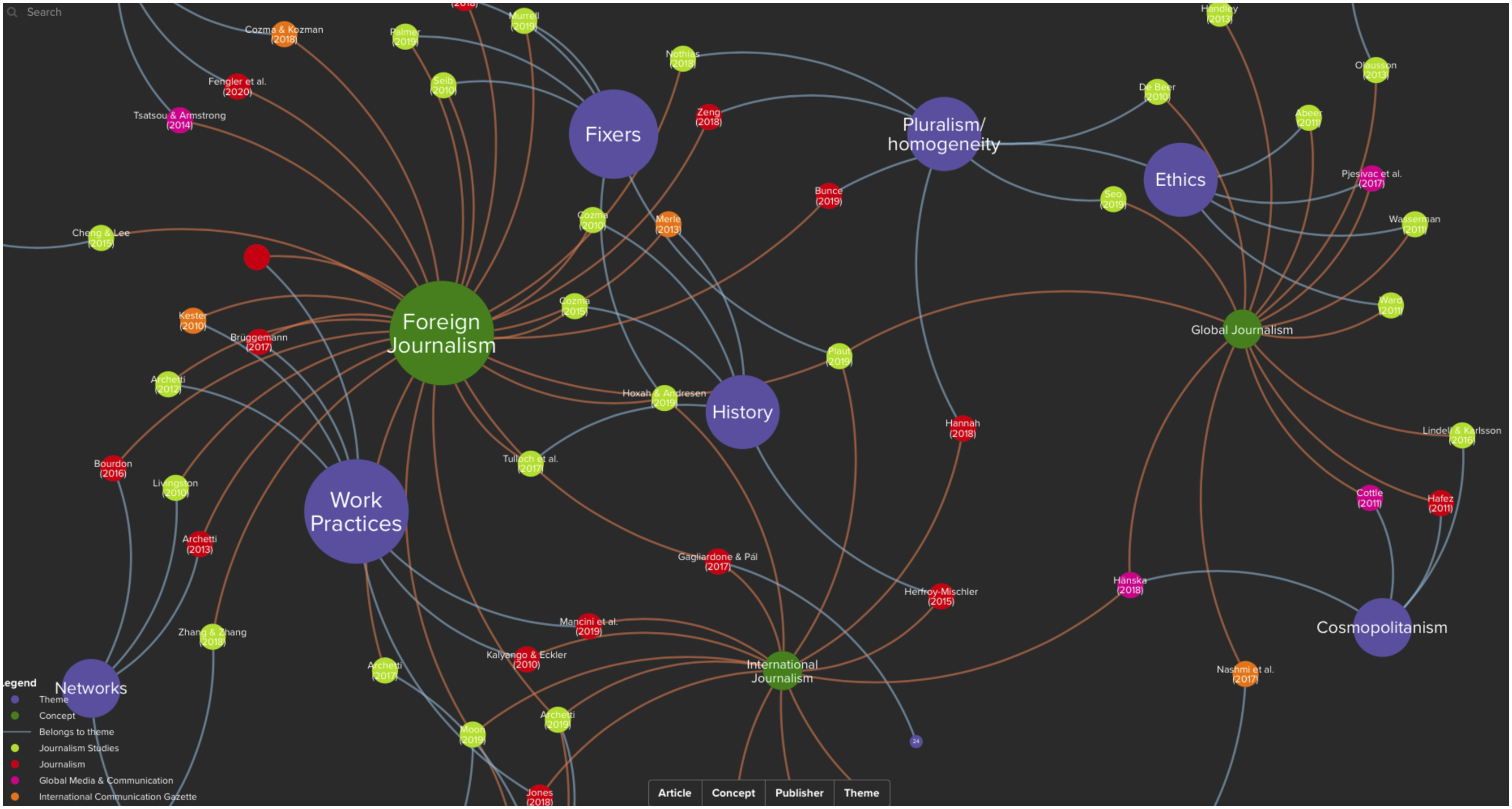
Meanwhile, the themes of pluralism/homogeneity and ethics bridge foreign and global journalism but are most defining of the concept of global journalism. There are some spare themes at the periphery of the map such as education, which connects international journalism with transnational journalism, and languages, which connects transnational journalism with foreign journalism (see Figure 1).
These first descriptive results provide us with two important considerations as we transition to the qualitative analysis: First, we can identify a hierarchy of importance in the use of the concepts—foreign journalism is the most prominent concept, whereas transnational journalism is the least prominent concept from a quantitative perspective—and second, we can identify thematic-distinctions and co-occurrences. Regarding this second point, we identify a thematic distinction among the concepts that seems stronger than its actual overlap. For example, global journalism is most often discussed in the thematic context of “ethics.” Meanwhile, the themes of fixers, history, and work practices are defining of foreign journalism. Here, we also see a connection between foreign journalism and international journalism when looking at the theme “work practices”. Overall, we can identify more concept-specific themes than concept-connecting themes when looking at priority themes. The following findings from the qualitative analysis will shed light on conceptually and empirically oriented distinctions between the four concepts and hence provide a more in-depth look at theoretical and empirical advancement of the four concepts.
Meta-article theme: Structuring of co-occurrence of concepts across time
The first theme that emerged from the qualitative analysis is more of a meta-article-level theme than a discourse-level theme: As we were discursively analyzing the articles, we noticed an increased awareness over time of the use of multiple concepts in individual studies. This initial assumption was tested with the full dataset, which we had coded for the occurrence of each concept in the title, abstract, and keywords. Our initial observation was validated; the use of multiple concepts did increase over time. More specifically, after 2017 one finds the first occurrence of the inclusion of double concepts (two concepts). Later in 2019, one finds the inclusion of triple concepts—the discussion of three concepts of cross-border journalism simultaneously (see Figure 2). This meta-article theme does not tell us much about the qualitative distinctions between the concepts, and our further analysis will provide more insights into what the multiple use of concepts means conceptually. Yet, it does tell us about the importance of using cross-border journalism as an umbrella concept and to keep in mind the existence of the four sub-concepts when conducting an analysis of cross-border journalism. Inclusion of multiple concepts in single articles.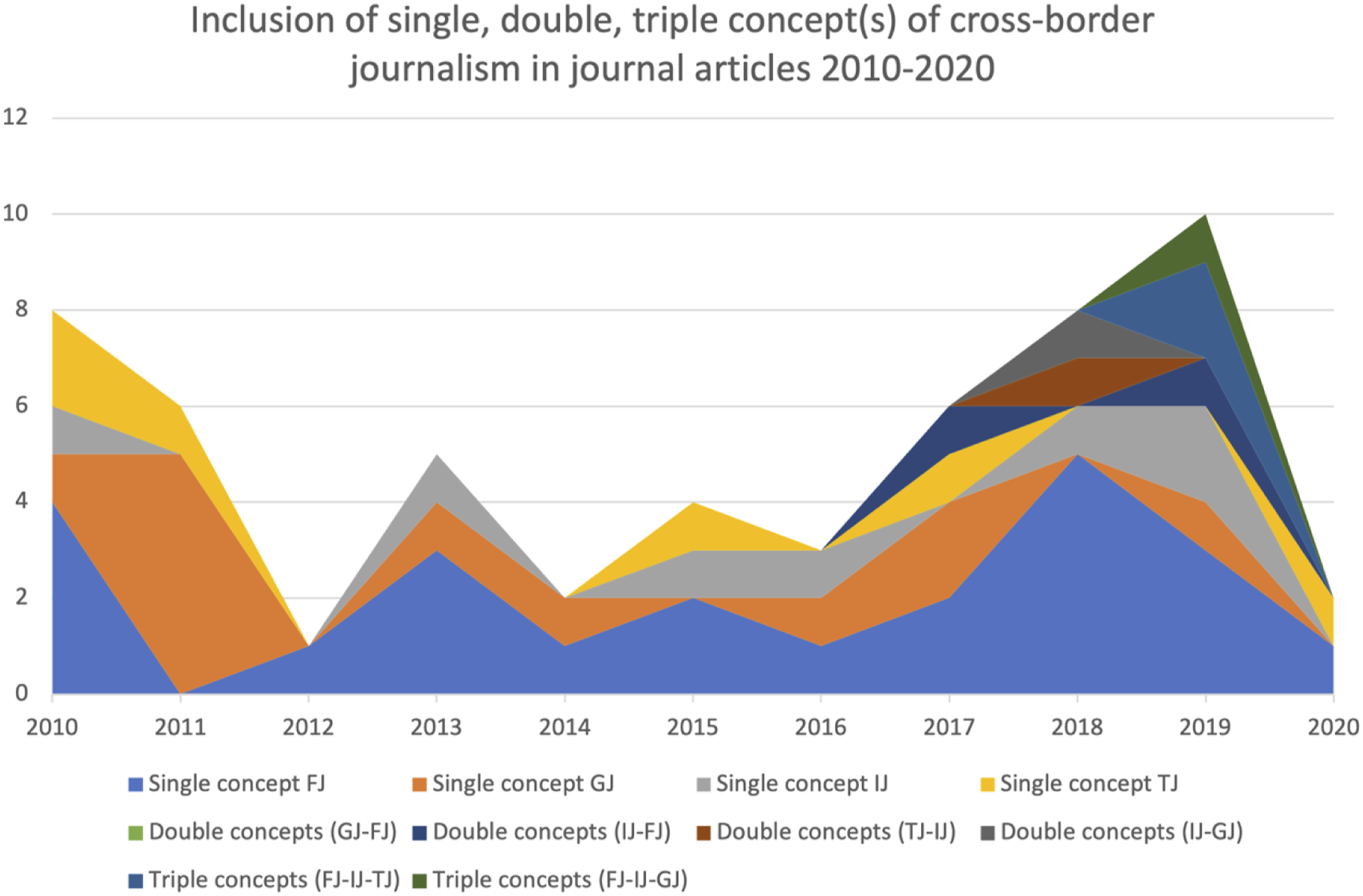
Umbrella vs. theoretical use: the established concepts of foreign and international journalism are less theoretically defined (RQ2)
This observation concerns the contrast between the established concepts (foreign journalism and international journalism) and less established concepts (transnational journalism and global journalism) in terms of their theoretical ambitions. With well-established concepts, the emphasis is mostly on what they “do” or “achieve” in terms of practice, rather than on what they represent ontologically and epistemologically. For example, in Gagliardone and Pal’s (2016) study of Chinese correspondents in Africa, which is presented as a study of “international journalism”, this concept is hardly defined. The analysis focuses on important transformations of journalism practice, yet the understanding of the term international remains fixed, and is thus not associated with transformations. Something similar is found in Jones’s (2018) analysis of the Guardian’s collaboration with, and coverage of, an international aid initiative in Uganda. International journalism is never properly defined in the study, and what it means there is that a UK-based media outlet (The Guardian) is covering an event abroad (in Uganda). Similar patterns can be found in Cheng and Francis’s (2015) analysis of Taiwan-China journalistic relationships and Nothias’s (2018) study of foreign correspondence about Africa.
The same goes for foreign journalism, which is more applied than defined. Most studies are based on surveys or interviews, and thus much of what we know about foreign journalism is filtered through the lived experiences of those who practice it. In addition, the samples of journalists/reporters are based on a traditional understanding of foreign journalism and consist primarily of elite journalists who are stationed abroad and report for their home country. It is only in a few exceptions (see Archetti, 2019) that the sample challenges the very concept of foreign journalism (for instance by citing the example of The Local). Because of the sampling decision to study rather traditional forms of foreign journalism, the research is foremost concerned with examining increasing pressures on foreign correspondents in the context of changing technologies in the newsroom, less financial resources, the restructuring of foreign posts, etc.
This further reinforces the impression that international and foreign journalism are primarily non-transformative phenomena, endowed with less theoretical dynamics than their less-established equivalents (global journalism and transnational journalism). Transformations do occur (the increasing importance of fixers, etc.) but the overall structures in society and in the media sector (involving identity, power, space) seem to remain intact. This also makes them sturdier and more concrete than the often theoretically sprawling definitions of transnational and global journalism. Further, they tend to apply the kinds of concepts that are also more established in the media sector as such; among media practitioners everyone would know what a foreign journalist is, but what is a transnational journalist?
The value of the less-established concepts (global journalism and transnational journalism) is dependent on their ability to propose new theoretical and analytical paths.
As a natural consequence of the theme presented above, we find that the less established concepts of global journalism and transnational journalism are very much meant to offer an alternative to what are explicitly or implicitly understood as the rigid or narrow concepts of international journalism and foreign journalism.
Transnational journalism represents theoretical innovation. Archetti (2019) and Moon (2019) both propose rather advanced definitions of transnational journalism. In the former case (Archetti), transnational journalism is viewed as “…a journalistic genre that spans the local, national, and transnational dimensions at once” (p. 2150) and accordingly as situated in an in-between journalistic space, making it a borderline phenomenon and practice. In the latter case (Moon, 2019), transnational journalism serves as a form of “contact” between local journalism and foreign correspondents; something taking place in their interaction is what makes the practice transnational. Higgins Joyce and Harlow (2020) conceive of transnational journalism as a practice situated beyond traditional forms of journalism and elaborate on how transnational news organizations treat more than one nation as their home audience, which requires thinking about transnational journalism from an interconnectedness perspective as consisting of interdependent units.
In the case of global journalism, De Beer (2010) uses the concept to achieve a more complex understanding of international news flows and relates it to ideas about “global news regimes.” There are also proposals (Cottle 2011), empirical confirmations (Olausson 2014) and critical testing (Lindell and Karlsson, 2016; Tanikawa, 2019) of the idea that global journalism is an emergent form of reporting that transgresses the traditional domestic-foreign dichotomy (cf. ). Handley (2014) explicitly addresses this question by focusing on the difference between national outlooks (international journalism) and global outlooks (global journalism) in connection with stories reporting on WikiLeaks, and the importance of the latter outlook for emphasizing the intercontinental and global coverage and activity area of these stories. In a study (Plaut and Klein, 2019) about the relation between local fixers and international journalists/foreign correspondents, the need to understand the object of research by means of the concept of global journalism is clearly introduced and justified: “Note that, following (Ward, 2010), we have chosen to use the term ‘global journalism’ rather than ‘international reporting’ as ‘international’ will assume a stable center and periphery” (p. 1697). In other words, the inclusion of the word “global” here is meant to convey ideas of transformation and fluidity.
Space as analytical category (RQ3)
This theme includes an orientation toward the idea of space and place in cross-border journalism. We find conceptual differences in how place and space are conceived in relationship to the concepts studied. This is essentially an ontological divide that is crucial to take into consideration, because the way we define a problem (ontology) affects the way we go about researching it (methodology) (Archetti, 2019).
International journalism and foreign journalism are often treated as associated with concrete physical places; the justification for including them in research studies is based on a particular place (i.e., a geographically defined place like a city, country, continent) such as Hong Kong, China, the United States, Europe, etc. For example, Cheng and Lee (2015) have studied foreign correspondents in China, and the focus on China as place is a central ontological argument of their study. They write: “the number of foreign correspondents and news bureaus in China have increased substantially. In 1978, only 43 foreign correspondents worked in China (Li, 2009: 7). The number increased to about 700 from 445 media organizations and 59 nations by the end of 2013 (Ouyang and Wang 2013).” The way place matters relates to the justifications given for engaging in research (e.g., this study is important because of the increase of foreign correspondents in China who shape the image of China in the world). Place can also include geographical hierarchies and Western dominance in the production of news. For example, Nothias (2018) does not define the concept of foreign correspondents, but the way he uses the concept is related to how reporters foreign to the continent of Africa engage in constructing a representation of the continent from a Western perspective (post-colonial critique). Both studies reveal an underlying assumption of place as an absolute and fixed geographical location and as relational, a place where cultural and symbolic meaning is made and expressed (Usher, 2019).
This is set in contrast to space, which is less definable and knowable, and more fluid, as it exists simultaneously in different places. The idea of space can be found in articles conceptualizing transnational journalism (Archetti, 2019). The defining of reality and research problem is shifted to a space-in-between that is mostly unknown (Archetti, 2019). Space stretches beyond any discrete physical location. This ontological distinction might well result from previous studies on transnationalism indicating that transnationalism proposes moving through spaces and across borders, not merely between points (Kraidy, 2005). Space is in essence more abstract, the extension across which capital and commodities flow (Usher, 2019: 1). While physical places make those spaces possible, the ontological differences between the cross-border concepts seem highly relevant for their conceptualization.
Identity and power as analytical categories (RQ3): global and transnational journalism challenge the power and dominant identity-construction of the nation state
In the discussion on foreign journalism, the defining elements of journalistic practice are still nation states and the Westphalian model (Fraser 2007), whereas in the discussion on global journalism, nation states are challenged in determining journalistic discourse by the very notion of globalization. This is often associated with the decline of nation states and hence, “as a result, the nation state is said to erode in journalistic importance” (Handley, 2014: 140).
Whereas the power of the nation state is challenged by various arguments in the work of global and transnational journalism including arguments that the audience is hard to identify as local or national (Archetti, 2019), interconnectedness requires a rethinking of global journalistic epistemology (Cottle, 2011), and there are also voices (Zeng, 2018) that highlight forms of homogenization of professional ideology and practice among journalists across national boundaries.
All these different approaches include the epistemological assumption of an inverse relationship between global journalism and the nation state, e.g., as the nation states decline in power, global journalism becomes more visible and relevant. More specifically, Handley (2014) asks if cross-national partnerships between media organizations and journalists can erode the nation’s influence on narrative construction in news. The author suggests that the interdependence of nations resulting from global journalism undermines the privileged position of any one nation state when it comes to setting patterns of news discourse. Olausson (2014) further articulates the decline of the nation state regarding the de-territorialized nature of today’s globalized risks and crises such as climate change, pandemics, etc. The interconnected, interdependent, and fluid globalized world (Cottle, 2011) is implicitly an outcome of the decreasing power of the nation state and hints at the porous borders of nation states in the age of global journalism. Simultaneously, these kinds of studies also seem to imply that nation states and their citizens “need” global journalism to reclaim power and to promote democracy (by generating new knowledge about how the national is determined by the global).
The interconnected epistemological outlook can also be found in work focusing on transnational journalism; however, it is less explicit there than in the work on global journalism. For example, Archetti (2019) writes about how transnational journalism treats more than one nation as a home audience, i.e., the focus is more on the audiences than on how the nation state shapes news content. She understands the concept of transnational journalism to be important because in today’s world it is not possible to neatly distinguish between “national” and “foreign,” and she calls for a novel methodological approach that does not fall into the national framework trap.
In research on foreign journalism, on the other hand, the central position of the nation state is still highly relevant. Cheng and Francis (2015) write about foreign correspondents who are responsible for reporting on multiple aspects of a country, and thus implicitly make the country and national borders the reference point of journalistic work rather than questioning the interconnectedness of nation states. Another example is Palmer’s (2019) work on fixers, in which she describes challenges that foreign correspondent face. In the study, these challenges are framed/determined by the nation state. Palmer (2019) states that foreign correspondents lack adequate knowledge about the countries they are visiting, and hence the study implicitly frames the boundaries of knowledge by the national boundaries of countries. In other words, foreign journalism supports the status quo rather than challenging or reflecting upon the power dimension of the nation state or the international order, or assuming that globalization is merely a negative force that is threatening national sovereignty in the name of democracy and sovereignty.
The aforementioned epistemological divide about how to understand power spills over into conceptions of identity. In the case of foreign and international journalism, as with national power/sovereignty, national identity is taken for granted both on the production/field-work side (e.g., Chinese journalists covering Taiwan issues in Cheng and Lee, 2015), or the consumption/media-use side (e.g., Chinese citizens’ consumption of news from the African continent, Gagliardone and Pál, 2016). Transnational journalism and to some extent global journalism instead involve transformative notions of identity, both on the production and the consumption/user side. An example is Moon’s (2019) explorations of how local and foreign journalists in Rwanda are building bridges between the local and the transnational. In this process, something transformative tends to happen, both with the identity of foreign journalism/journalists as well as with the way news is framed.
What is the future of cross-border journalism?
For the concluding part, we would like to offer guidance for scholars studying cross-border journalism. While all four concepts are independent and represent conceptual approaches to cross-border journalism realities, they maintain their specificity, as we explain in more detail in this discussion.
Typologies of cross-border journalism based on quantitative and qualitative analysis.
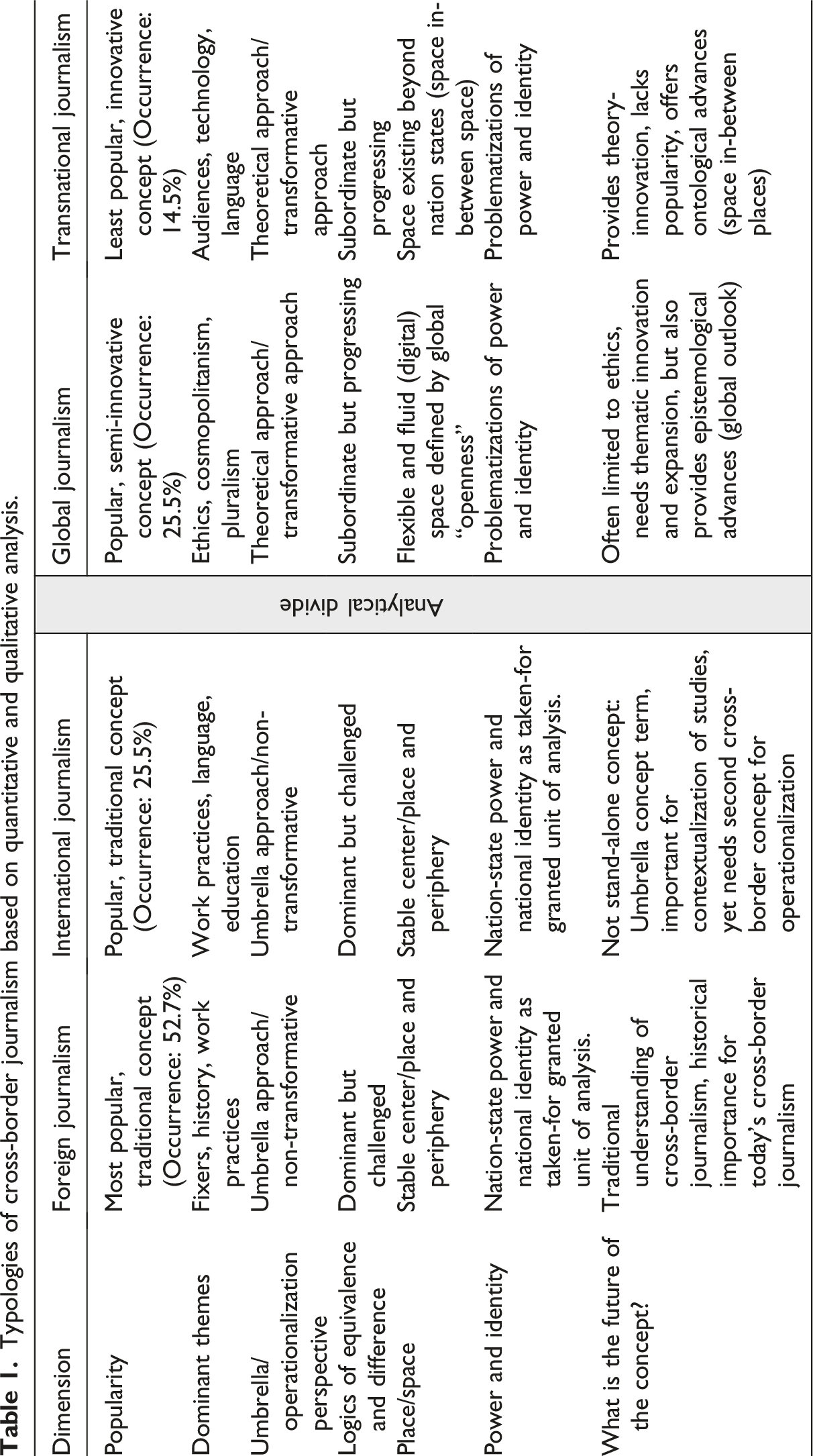
We observe an analytical divide driven by distinct approaches to (1) ontological assumptions (what place/space structures exist in cross-border journalism?) and (2) epistemological assumptions (What do these place/space structures tell us about what we can know about power and identity?).
This divide is further intensified over time. In other words, contexts and continuity provide important pointers in the discussion on the analytical divide. The traditional concepts, including foreign and international journalism (i.e., continuity), are the most popular. As social realities shift in society (i.e., time and context), the less popular concepts (global and transnational journalism) become more visible in scholarly work and the use of multiple concepts in single studies becomes more popular over time.
We also observe a divide between intra-transformative and extra-transformative understandings of journalism development. The earlier is prevalent in the case of the traditional conceptual pair, foreign and international journalism. Here, observed and analyzed transformations (fixers, new work practices, etc.) seem to derive from within the media sector as such. In the use of the less established conceptual pair, transnational and global journalism, scholars are instead more occupied with how journalism is transforming due to external processes (media globalization, globalization as such, transnational cultural flows, etc.), that are visible through transformations of space, power, and identity. This then leads to analyses that are less rooted in established journalism’s descriptions of itself.
The use of the traditional conceptual pair primarily gives proof to the imagined journalists’ (i.e. not the scholars’) observation of journalism through science in which the researcher accepts journalism’s understanding of the world as foreign or international. The less traditional conceptual pair (transnational and global journalism) instead provides proof of “a scholars’ scientific perspective on journalism.” The advantage of the former is that it is in touch with the well-rooted cultural and symbolic traditions of cross-border journalism, i.e. the fact that we all, media practitioners, researchers, publics, audiences, etc., do conceive of cross-journalism primarily in terms of “international” and “foreign” activities, which is not less real or relevant than the scientists’ understanding of what is developing or should develop under the surface (budding transnational journalism and global journalism). The disadvantage of this is, of course, its far-reaching suppression of precisely these new signs of understanding cross-border journalism, which leads to a logic of equivalence in which the terms international and foreign journalism are continually applied to forms of journalism and empirical phenomena that in fact are in the process of transcending or even replacing foreign and international processes.
What to do with the concepts?
One idea would be increasingly to use the term cross-border journalism as a central and connecting concept, thereby paving the way for international, foreign, global, and transnational journalism to be used as sub-concepts that can be combined in different constellations, as they de facto describe different aspects of cross-border reality. Assuming that this is accompanied by detailed definitions and operationalizations rather than the umbrella approach, it could, we think, serve as a general principle for analyzing cross-border journalism, be it in the context of, for example, newsroom studies, field studies, or media content studies regarding various topics such as the China-USA competition, climate change, the refugee crisis, or the power of tech companies such as Facebook and Microsoft. Based on above-presented typology, and our own normative understanding of how to best avoid unfruitful overlappings in research, we suggest that the concepts should be endowed with the following overall definitions, in which the very point is to define each concept with having the remaining three in the back of the head: Foreign journalism is a practice or organizational principle, characterized by the drive to cover and understand a social reality outside the nation-state. International journalism is a practice or organizational principle, characterized by the drive to cover and understand relations between two or more nation-states. Transnational journalism is a practice or organizational principle, characterized by the drive to cover and understand emergent, marginalized and invisible processes of border crossing, beyond the international relations of nation-states. Global journalism is a practice or organizational principle, characterized by a drive to cover and understand the complex relations of the world by developing a global outlook
6
in some respect or respects (economic, political, social, ecological, technological, etc.)
Each definition could then, of course, be developed and refined in relation to different kinds of sub-themes (ethics, agenda-setting, fieldwork, working conditions, etc.).
What aspects are relevant for scholars analyzing cross-border journalisms? What we would suggest is to use theoretically rigorous and carefully constructed combinations of two or even more concepts when studying cross-border journalism. The proposed conceptual definitions will hopefully stimulate some more in-depth discussions of each concepts by keeping in mind its broader environment of cross-border journalism.
In this respect, the increase in double and triple use of the concepts that we have observed (see Figure 2) is the right way to go forward, despite the challenges of unwanted overlaps and confusions of conceptual definitions and operationalizations. Journalism scholars who primarily identify with the use of foreign and/or international journalism also need tools for understanding how the foreign and the international are intertwined with transnational and even global processes. In the same way, those who initially apply the concepts of global and transnational journalism in their research also need to be in conversation with the continuing Westphalian model of cross-border relations, in which national borders and cultures still matter both in positive and negative respects (Flew and Waisbord, 2015), especially when considering the recent growth of right-wing populist movements and challenges to the international order related to the global pandemic (Reese, 2021).
A particular challenge in the work of identifying cross-border journalisms is the need to understand at least some of its elements as impacted by national structures (Sassen, 2006: 3). Such practices are not usually seen when examining global or transnational journalism. They are described in terms of a growing interdependence, the formation of global institutions and the decline of the national state. We argue that the more transformative concepts (global and transnational journalism) are deeply imbricated with the past. We need to consider their connections to the more traditional concepts, foreign and international journalism. In other words, it is not the nation state in its totality that is becoming denationalized, but components of it, such as newly emerging digital spaces that span national borders. These digital spaces are essentially enabled by nation states. The global does not exist in spite of the national, but because of the nation state (Sassen, 2006).
Finally, our research did not cover the full spectrum of journals, books, and edited books in which we can find empirical studies on cross-border journalism. We only covered one decade of work in this area, whereas published scholarship on this topic has a much longer history. Because in these debates the term “global” is often associated with the Global North (Wasserman, 2018), we further suggest expanding our approach to the Global South taking an analytical approach, namely, bringing other conceptual work to the table and integrating it into a holistic framework.
Supplemental Material
Supplemental Material - Future conceptual challenges of cross-border journalism
Supplemental Material for Future conceptual challenges of cross-border journalism by Lea Hellmueller and Peter Berglez in Journalism
Footnotes
Acknowledgements
The authors would like to thank Professor Walid Al-Saqaf at Södertörn University, Sweden for his support with Kumu and the reviewers for their constructive feedback and inputs.
Declaration of conflicting interests
The author(s) declared no potential conflicts of interest with respect to the research, authorship, and/or publication of this article.
Funding
The author(s) received no financial support for the research, authorship, and/or publication of this article.

Supplemental Material
Supplemental material for this article is available online.
Notes
Author biographies
References
Supplementary Material
Please find the following supplemental material available below.
For Open Access articles published under a Creative Commons License, all supplemental material carries the same license as the article it is associated with.
For non-Open Access articles published, all supplemental material carries a non-exclusive license, and permission requests for re-use of supplemental material or any part of supplemental material shall be sent directly to the copyright owner as specified in the copyright notice associated with the article.
