




Abstract
News avoidance, particularly among women, raises potential challenges for democracy. While research shows audiences don’t penalize women reporters or the outlets that employ them, we don’t know whether the presence of women in the newsroom affects such avoidance behaviors, particularly for women audiences. Additionally, the news may communicate gender to the audience in other ways beyond ascriptive characteristics of the reporter. We ask, do reporter gender, source gender, and gender of issues affect readers’ engagements with news, attitudes toward news avoidance, or perceptions about gender bias in journalism? Results from a survey experiment show that newsroom diversity affects “news-is-for-men” perceptions. Upon reading a masculine-issue story, respondents—both men and women—were more willing to read and seek stories from the same news outlet. News stories from male reporters also caused a stronger belief that the newsroom was dominated by men, which boosted “news-is-for-men” perceptions. As such, though reporter gender may not always impact readers directly, its influence is more pervasive than can be directly captured.
Though digital media make news readily available, people in the U.S. are increasingly cutting themselves off from news (Newman et al., 2017). This phenomenon led scholars to revisit the concept of “news avoidance” (see Toff and Kalogeropoulos, 2020; Toff and Palmer, 2019) and identify the reasons behind it (Schrøder and Ørsten, 2016). Notably, women are more prone to limited or non-use of news (Poindexter et al., 2010); and the gender differences persist regardless of the platform (Poindexter, 2010) or readers’ geographic location (Selva and Andi, 2020). One reason for women’s apparent lack of interest in news is the perception that the “news-is-for-men” (Toff and Palmer, 2019: 1566). Women believe that news does not represent them or their interests accurately, and they see no value in engaging with it (Sendén et al., 2015).
Media diversity, particularly the inclusion of more women in newsrooms, more women news sources, and more coverage on issues of importance to women are cited as solutions to address news avoidance among women (Toff and Palmer, 2019). Existing studies have found that audiences do not negatively evaluate female journalists for quoting female sources or writing about so-called feminine issues (Paul et al., 2022). Similarly, audiences’ trust in media remains unaffected by the gender of the issue, source, or journalist (Paul et al., 2022). Beyond normative reasons for a more gender inclusive news agenda, these findings suggest that news organizations are unlikely to suffer a credibility tax when they promote women reporters or women sources. Thus, we argue that there is a case for hiring women reporters, and sourcing women.
This argument is rooted in democratic, economic, and feminist theories. First, an informed citizenry is the backbone of democracy. In addition to the presumed effects of interpersonal conversations (Amsalem and Nir, 2021) and social network sites, news from traditional media remains an effective means in informing citizens of the factual perspectives in politics (Van Erkel and Van Aelst, 2021). News also provides social contact that helps us build status and associations with others (Berelson, 2004). Women’s disengagement with news can also compound mistrust: News avoiders are more likely to distrust the media and perceive media organizations as corrupt (Truyens and Picone, 2021). When public trust in journalism erodes, democracy is threatened (Schudson, 2002). From the feminist perspective, when women are excluded from high-profile public spaces such as newsrooms, they are rendered unable to mobilize for equal opportunities or participate in institution building (Byerly and Ross, 2006). The presence of women editors in top management positions in newsrooms helps challenge the masculine hegemonic culture of news production, which gives women the power to use media to influence democratic processes (Byerly and Padovani, 2017). Lastly, from an economic perspective, failure to attract women audiences means a loss of advertising revenue for media organizations that already face dwindling profit margins (Childers, 2020).
The above reasons for including women in the news may be compelling, but there is little research to support this case as we know little about how manifestations of gender in the news affect audience perceptions beyond credibility. To address this gap, we ask: Can a more gender diverse newsroom act as an antidote to news avoidance? Our results show that relative to feminine-issue stories, masculine and neutral issues cause stronger “news-is-for-men” perceptions and stronger news engagement. Exposure to stories by male reporters also reinforced “news-is-for-men” perceptions, through boosting readers’ beliefs that the newsroom was dominated by men. In addition, stories by female reporters were more likely to alleviate stereotypical perceptions of male journalists being the norm. Together, these indicate that gender diversity could be an effective solution to counteract the masculine culture in the newsroom.
The masculine culture of journalism
The masculine culture of the newsroom privileges issues, interests, and news values that are relevant to men, and marginalizes women’s voices and experiences (Ross and Padovani, 2017). In news-making, beats such as politics, foreign policy, technology, economy, and sports are considered masculine areas of expertise and these stories are overwhelmingly written by male journalists (Global Media Monitoring Project, 2021). On the other hand, so-called women’s issues such as health, social justice, family, and entertainment are mostly written by female reporters (North, 2016). For example, the Women in U.S. Media Report (2019) found that 15% of opinion columns on foreign issues published at the top four U.S. newspapers were written by women; 93% of technology-related stories on newswires had male bylines; and nearly 60% of health news stories published on online news sites were written by women. Women are absent from news production and design, as well as the technical and creative aspects of news making (Byerly, 2013). Huge salary gaps arise between men and women in senior-level jobs; and very few newsrooms have policies for parental leave, gender equity and sexual harassment, which make it harder for women to advance (Byerly, 2018). These reasons contribute to female journalists suffering from burnout and leaving the profession early, thus furthering the masculine culture (Hanitzsch et al., 2019).
The lack of gender equality in the ownership and management of media companies is evident in the media content. Masculine topics are considered prestigious beats. They tend to be written in the hard news format and appear in newspapers’ prominent sections (Boydstun, 2013). So-called women’s topics appear as features or profiles relegated to the less important sections. Fewer female journalists are assigned hard news beats (Hanitzsch et al., 2019); and this gendered issue ownership extends to social media where male political journalists engage almost exclusively with the tweets of their male colleagues and legitimate and amplify male voices more frequently than female voices (Usher et al., 2018). The gendered division of issue ownership and expertise as signaled by the layout of news websites, format of stories, and gatekeeping practices of journalists carry assumptions about value (Ross and Carter, 2011) . They signal to readers that male issues are more important than women’s issues.
These gendered notions extend to journalists’ news sourcing practices as well. Overall, women are less likely to be quoted as expert sources, while cis, male, and white sources enjoy credibility as prominent experts (Artwick, 2014). While men appear as expert sources in hard news stories about defense, war, sports, the legal system, crime, and entertainment, women are more likely to be quoted in stories about education, or stories that reference other women. Women sources mostly tend to be teachers, healthcare workers, and activists who belong to traditionally female occupations. Women are also more likely to be quoted as eyewitnesses or as sources sharing their personal opinions. Even when a story topic directly involves women—such as former president Trump’s misogynistic acts—cable TV and conservative outlets are likely to use twice the number of female than male sources (Blumell, 2019). These differences in sourcing patterns highlight the gendered areas of expertise ascribed to men and women (Shor et al., 2015). Further, by associating the voices of men with authority and knowledge, journalists reinforce gendered binaries of men as professional and reliable sources and women as unimportant.
Gender norms in news avoidance
The number of news avoiders—people “who consume relatively little news, spend almost no time watching cable TV news channels, and avoid news magazines and news websites entirely” (Truyens and Picone, 2021: 265)—has risen across the world (Newman et al., 2021). A large number tends to be women; and there are several reasons for this. Women and men are socialized differently in childhood such that they implicitly subscribe to gendered ideas about appropriate social roles (Fox and Lawless, 2014). Women are associated with communal traits which revolve around caregiving, while men are associated with agentic traits that take shape in leadership roles and values such as toughness (Huddy and Terkildsen, 1993; Eagly and Karau, 2002). As a result, women perceive the public sphere, and public facing professions such as politics, as masculine (Polletta and Chen, 2013). Though news outlets are employing more women with every passing year (Artwick, 2014; Asr et al., 2021), gender disparity in the news such as allotting more space and prominence to masculine issues and citing more male sources, gives women implicit signals that the news is neither relevant to them nor meant for them (Sendén et al., 2015; Toff and Palmer, 2019).
Other factors related to patterns of media usage also affect women’s disengagement with news. Women differ from men in that they seek news to satisfy their daily informational needs related to topics such as weather, local events, and health, which have a direct impact on their daily lives. Men on the other hand, prefer political news, which receives more media attention (Poindexter, 2010).
Women also prefer news presented in entertaining formats. Though they tend to pay more attention to negative news (Maier et al., 2017; Soroka et al., 2016), they find the excessive coverage of conflicts, controversies, and violence depressing, which adds to their news avoidance behaviors (The Pew Research Center for the People and the Press, 2004). Women’s news avoidance behaviors vary depending on factors such as self-efficacy, media literacy, structural inequalities, and socioeconomic status. For example, Benesch (2012) pointed out that women are less likely to report having quality leisure time because they shoulder most childcare and domestic responsibilities in addition to maintaining professional lives (Benesch, 2012). These responsibilities leave women feeling physically and emotionally drained such that they prefer skipping the news altogether to avoid taking on additional emotional burdens from negative news stories (Toff and Palmer, 2019).
Women are also less likely to comment on online news stories or discuss the news face-to-face with their friends or colleagues (Selva and Andi, 2020). These behaviors have important consequences for political participation. Countries that have high gender gaps in news consumption often tend to rank low in gender equality, because women are less equipped to participate in public life and represent themselves politically (Benesch, 2012). News is vital to providing information that can help people cope with crises related to health and natural disasters, which disproportionately affect women and marginalized populations. News also serves as a social function and a source of companionship which can help with mental health and resilience. For all these reasons, news avoidance behaviors among women have the potential to impact their lives negatively.
Newsroom gender diversity as a solution to news avoidance
To remedy news avoidance, researchers have called for a reimagination of the newsroom’s masculine norms and a redefinition of the norms and values that constitute newsworthiness (Toff and Palmer, 2019). A less explored solution is the idea of newsroom gender diversity. A body of work demonstrates that men and women bring a different set of skills and strengths to the profession of journalism. Women tend to quote more female and diverse sources, use personalization techniques to make their stories more relatable to readers, diversify the news agenda by reporting on marginalized issues, and frame stories from a human perspective rather than simply use facts and analysis (Schoch, 2013). The difference in styles occurs due to a gender affinity effect where women journalists share a sense of solidarity with other women because of similar socialization processes and life experiences (Dolan, 2004). Thus, female journalists may try to correct gender imbalances by giving more prominence to female sources and diversify the news agenda by including issues of interest to female readers. However, other studies find that there are no significant gender differences between male and female reporters (Turcotte and Paul, 2015). This body of work theorizes that the masculine culture of newsrooms is so deeply entrenched that women are socialized to adopt the existing norms and routines to succeed in their careers. This pattern persists even in women-majority newsrooms and societies that empower women (Hanitzsch and Hanusch, 2012).
The presence of women in the newsroom could signal to audiences that the news is sensitive to the tastes and interests of women. If true, seeing women in positions of power in the newsroom is likely to affect perceptions of the news as masculine, and increase audience engagement and desire to seek news from the outlet, especially among women. Similarly, the inclusion of more female sources and increased reporting on issues that are relevant to women should attract more female readers and reduce “news-is-for-men” perceptions.
From the discussion above, we hypothesize that the gender of (a) reporter, (b) source, and (c) issue will affect readers’ “news-is-for-men” perceptions (H1), news engagement (H2), perceptions of gender in the newsroom (H3), and perceptions of what constitutes a “reporter” (H4). Moreover, these effects are likely to be changed by a reader’s gender (H5-8).
Method
Data we used to test these hypotheses come from a survey experiment administered on September 25, 2020. We recruited 654 people from an online labor market, yielding a total of 600 respondents (91.74% completion rate). Every respondent was paid $1.75 for participating. Their average age was 40 (SD = 12.71). They were mostly male (55.26%), Democrat (50.50% Democrats, 22.17% Republicans), and white (74.5%).
Procedure
After asking participants questions about media literacy and gender role perceptions, the survey presented a news article where the three gender factors were manipulated. Following this, participants were asked questions relating to the measurement of each outcome of interest.
Stimuli
The experiment was a 2 × 2 × 3 factorial between-subjects design. Our stimuli were developed from actual news articles, where we varied the gender of (a) reporter, (b) expert source, and (c) issue (feminine, masculine, and neutral).
We adopted multiple techniques to facilitate the delivery of the three treatments. For the first factor “reporter gender,” a journalist’s picture was inserted in addition to the byline to maximize the primacy of reporter’s gender (McDermott, 2011). 1 Both images were pre-tested to ensure the two reporters were perceived almost identical in their competencies and other attributes, such that the most significant difference was their gender (see Supplementary Appendix B). Specifically, respondents in the “female reporter” condition saw “Janet Clark” in the byline, along with her picture; and those in the “male reporter” condition saw “Tom Clark” and his photo.
For the second factor “source gender,” we used a pull quote in the text to boost the primacy of source gender. While respondents in the “female source” condition saw quotes from “Jessica Roberts,” those in the “male source” condition were shown quotes from “Chris Roberts.”
For the third factor “gender of issue,” we pre-tested 20 issues that are traditionally identified as masculine or feminine in current literature. For example, abortion, education, and equal rights are often categorized as feminine issues (Carroll and Fox, 2006), while military, national security, and terrorism are labeled as masculine issues (Hayes and Lawless, 2013). Gender-neutral issues include government reform/transparency or campaign finance reform (Hayes and Lawless, 2013). The results of this pilot test are in Supplementary Appendix C. Based on these analyses, this study selected reproductive rights for the feminine issue condition, veterans affairs for the masculine issue condition, and government corruption for the neutral issue condition.
To minimize the impact of confounds, all elements – including the headline, byline, journalist profile picture, main text, and pull-quotes – were formatted in the same way, and the story was kept the same length across all conditions. See Supplementary Appendix A for a full review.
Measures
Unless specified below, all closed-ended outcome variables were measured on a 7-point scale where 1 = strongly disagree and 7 = strongly agree.
Previous research defines the “news-is-for-men” perception as viewers’ belief that news is “more valuable to men and society as a whole, but distasteful and alien to women” (Toff and Palmer, 2019: 5; also see Hobson, 1980; Morley, 2005). Three items from previous studies (see Len-Rios et al., 2005; Toff and Palmer, 2019) were adapted to capture this dependent variable. The factor analyses suggested two separate dimensions. Specifically, the “news-is-for-both” index was comprised of two items: “News is just as likely to be about men as it is likely to be about women” and “There are just as many women as men featured in news” (r = 0.68, M = 3.54, SD = 1.36). In addition, the “more-news-for-men” perceptions were measured using one other item: “News tends to cover things men care about” (M = 4.35, SD = 1.30).
The other set of dependent variables focus on the extent to which respondents engage with the news article, which captured (a) the time they spent on reading the stimulus material, their expressed likelihood they would (b) read another article from the provided news outlet, and (c) seek news from this news outlet in future. For the “time spent reading story” variable, we referred to Qualtrics’ embedded “timing question” to retrieve the total seconds each respondent spent on the stimulus story page before they proceeded to the next page 2 (M = 107.08, SD = 140. 24, min = 30.85, max = 1655.46). And for the latter two measures, we asked respondents to rate their agreement on a 7-point scale (where 1 = very unlikely and 7 = very likely) for two questions: “If you saw another story from this same news outlet, how likely would you be to read it?” (M = 4.69, SD = 1.37) and “Based on the story you saw, how likely would you be to seek out news from this news outlet in the future?” (M = 4.35, SD = 1.44).
To examine perceptions about gender equality in journalism, we used the following prompt from existing literature (see Sanbonmatsu, 2003): “Do you know what percentage of reporters and editors in the U.S. are men? It is OK if you don’t know the exact answer, we’re interested in
Image analysis
To further investigate whether these three gendered dimensions of news could affect perceptions of who is a reporter, we asked respondents an open-ended question that invited them to find an image –via Google Image Search or a search engine of their preference – that they thought best fit their vision of a “reporter.” 3 The respondents turned in URL links of the images. 4
Three trained researchers manually coded every image to capture (a) the reporter’s gender (0 = male, 1 = female, and 99 = unknown/hard to tell) and (b) whether the image was of a real-life reporter or a stock image (0 = stock image, 1 = real-life reporter image, and 99 = unsure). Cohen’s Kappa values of 10% of the images selected randomly from the total showed acceptable intercoder reliability: reporter gender = 0.98 and real-life reporter image = 0.75. See Supplementary Appendix D for more details.
Randomization and manipulation checks
Before performing analyses to test our hypotheses, we first estimated a series of binary logistic and multinomial logistic regression models to ensure the randomization process was effective, as evidenced by the results in Supplementary Appendix E1.
We also checked whether respondents perceived the stimulus to be of high quality, their attitudes toward the three issues, and whether they could accurately recall the gender of the three treatment factors. Descriptive statistics in Supplementary Appendix E2 demonstrate acceptable recall rates on all three factors. The moderate recall rates of reporter and source gender align with existing literature (see Burkhart and Sigelman, 1990). As a result, we used all 600 respondents for the analyses below.
Results
ANOVA models predicting “news-is-for-men” perceptions and news engagements by treatment.
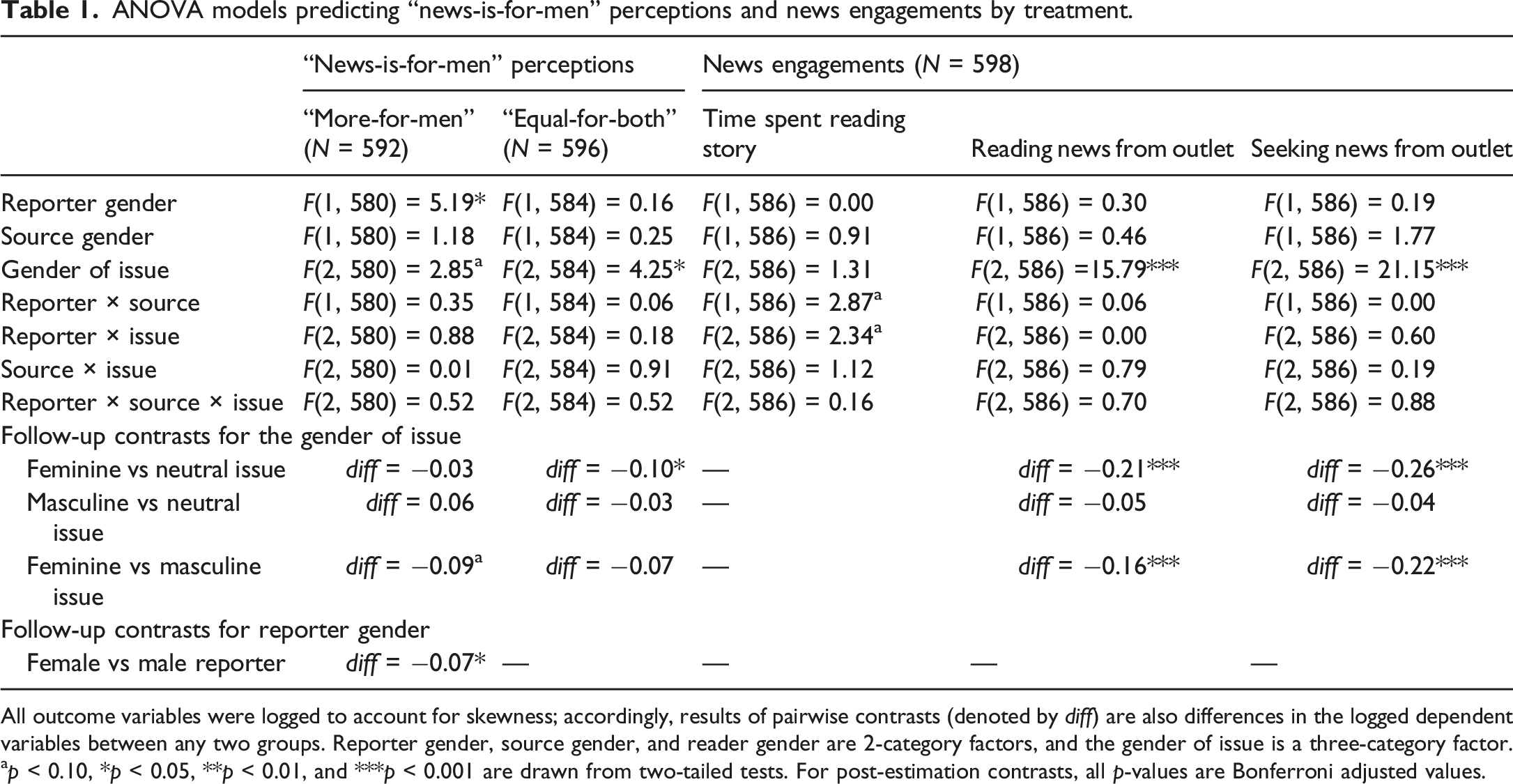
All outcome variables were logged to account for skewness; accordingly, results of pairwise contrasts (denoted by diff) are also differences in the logged dependent variables between any two groups. Reporter gender, source gender, and reader gender are 2-category factors, and the gender of issue is a three-category factor.
ap < 0.10, *p < 0.05, **p < 0.01, and ***p < 0.001 are drawn from two-tailed tests. For post-estimation contrasts, all p-values are Bonferroni adjusted values.
With regard to news engagement, the feminine-issue story led to a weaker willingness to read and seek news from the same outlet than the masculine issue or neutral issue. On the other hand, relative to readers of a feminine-issue story, respondents who read a masculine-issue story demonstrated a stronger belief that the news is more for men (column 1); and in the same vein, news from a male reporter also increased the “news-is-more-for-men” perceptions, compared to stories written by a female reporter.
ANOVA models predicting “news-is-for-men” perceptions and news engagements by treatment and reader gender.
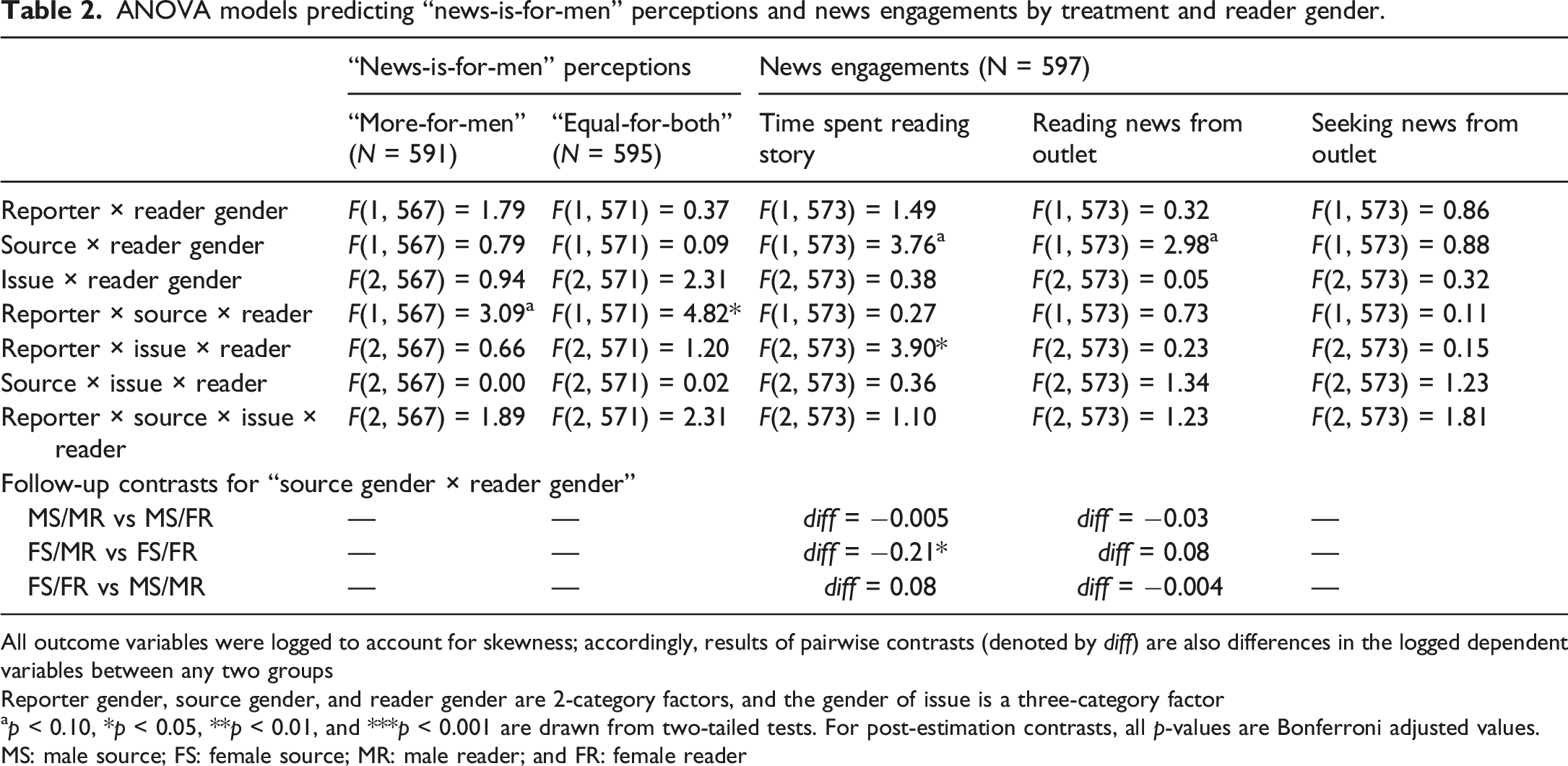
All outcome variables were logged to account for skewness; accordingly, results of pairwise contrasts (denoted by diff) are also differences in the logged dependent variables between any two groups
Reporter gender, source gender, and reader gender are 2-category factors, and the gender of issue is a three-category factor
ap < 0.10, *p < 0.05, **p < 0.01, and ***p < 0.001 are drawn from two-tailed tests. For post-estimation contrasts, all p-values are Bonferroni adjusted values.
MS: male source; FS: female source; MR: male reader; and FR: female reader
ANOVA models predicting perceived % of male reporters/editors in newsroom by treatment.
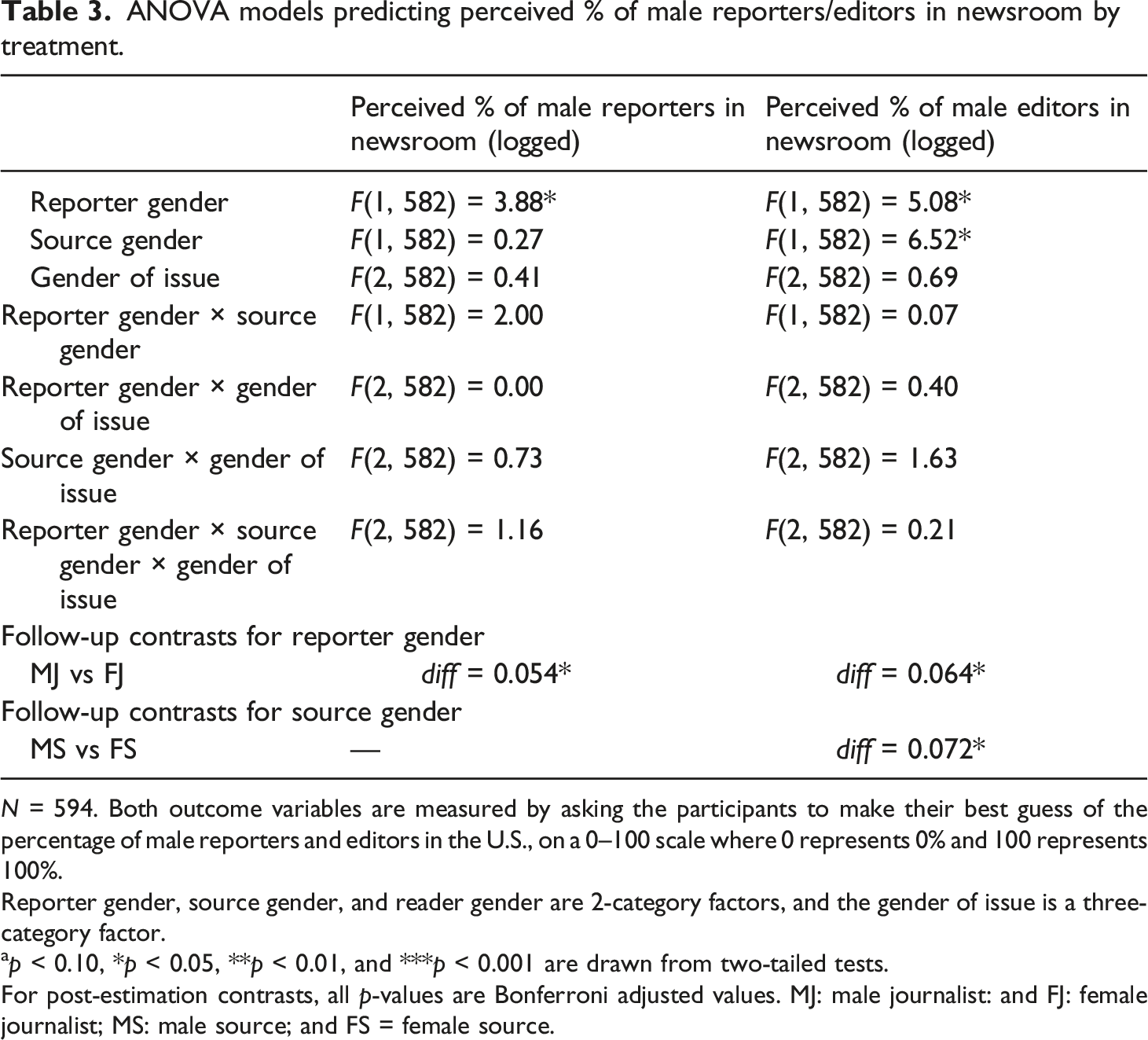
N = 594. Both outcome variables are measured by asking the participants to make their best guess of the percentage of male reporters and editors in the U.S., on a 0–100 scale where 0 represents 0% and 100 represents 100%.
Reporter gender, source gender, and reader gender are 2-category factors, and the gender of issue is a three-category factor.
ap < 0.10, *p < 0.05, **p < 0.01, and ***p < 0.001 are drawn from two-tailed tests.
For post-estimation contrasts, all p-values are Bonferroni adjusted values. MJ: male journalist: and FJ: female journalist; MS: male source; and FS = female source.
The follow-up pairwise comparisons generated more patterns of interest. Relative to respondents who read a story written by a female journalist, those reading stories from a male journalist estimated a significantly larger percentage of male reporters and editors in the newsroom. Consistently, news articles citing male sources led respondents to estimate a higher percentage of male editors in the newsroom than stories that cited female sources.
Contrary to our hypotheses, the effects of these gender factors on gender equality in the newsroom were not moderated by respondents’ gender (H7). For the sake of brevity, these ANOVA models are presented in our online supplement. See Supplementary Appendix F1 for details.
Lastly, we investigated how the gender of reporter, source, and issue primes respondents’ ideas of who a reporter is (H4). We split the respondents’ image responses into two groups containing reporter photos and stock photos, 5 and then estimated two sets of binary logistic regression models to test the hypothesis.
Binary logit regression models predicting the gender of reporters in image search.
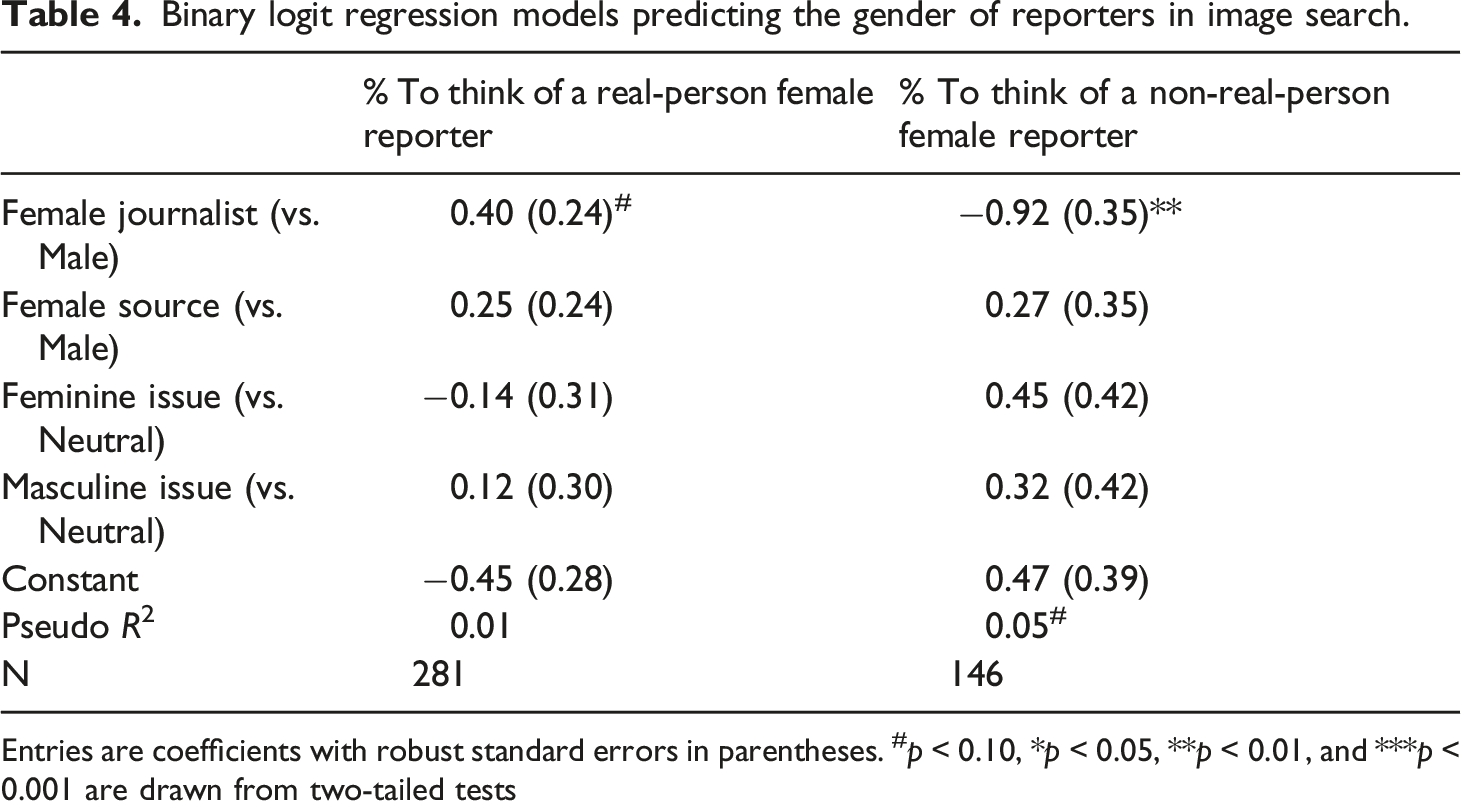
Entries are coefficients with robust standard errors in parentheses. #p < 0.10, *p < 0.05, **p < 0.01, and ***p < 0.001 are drawn from two-tailed tests
The images submitted were not affected by respondents’ gender (H8), with one exception. The coefficient estimate on “Expert X Reader Gender” was statistically significant (b = 1.00, p < 0.05) in the model predicting the gender of real-life reporters in image search (column 1). For male participants, seeing female experts quoted in stories (relative to males) significantly boosted the possibility that they would think of a real-life female reporter by about 18%. However, as plotted in Supplementary Appendix F5, expert gender had minimal impact on female readers. Thus, H8b was supported. These models are presented in Supplementary Appendix F4.
Follow-up analyses
In line with existing studies (Paul et al., 2022), our results uncovered little evidence of direct effects for the reporter’s gender, except on perceptions of newsroom diversity (see Table 3). In supplementary analyses we estimated a mediation model regressing reporter gender on the “news-is-for-men” perception, with “perceived % of male reporters in newsroom” as the mediation path. This path analysis yielded support for the mediation. As displayed in Figure 1, reading a news article written by a female (vs a male) journalist led to a variation in the estimated proportion of male reporters in the newsroom, which in turn affected “news-is-for-men” perceptions. We also found that in Model 1, the indirect effect through “perceived % of male reporters in the newsroom” was b = 0.0066 (SE = 0.004; 95% CI: −0.001–0.014], which constituted about 64% of the total effect. In Model 2, the indirect effect was b = −0.0072 (SE = 0.004; 95% CI: −0.015 to 0.014], which accounted for about 10% of the total effect. As both indirect effects were marginally significant (from two-tailed significance tests), we contend that “perceived % of male reporters in newsroom” is a mediator for the relationship between “reporter gender” and the “news-is-for-men” perceptions. Follow-up mediation analysis. Note: Coefficients are unstandardized coefficients. “Reporter Gender” is a dichotomy (1 = female reporter). “Perceived % of male reporters in newsroom” is a continuous (0–100) with higher values indicating bigger percentages. The “news-is-for-men” perceptions were measured in two dimensions; while the “news-is-for-both” index captured to what extent participants believed that news is about men as much as it is about women (1–7), the “more-news-for-men” item captured participants’ agreement with the statement that “news tends to cover things men care about” (1–7). The other two independent variables “Source Gender” and “Gender of Issue” were also included in these analyses but were not displayed for the sake of brevity. *p < 0.05 and **p < 0.01. All two-tailed significance tests.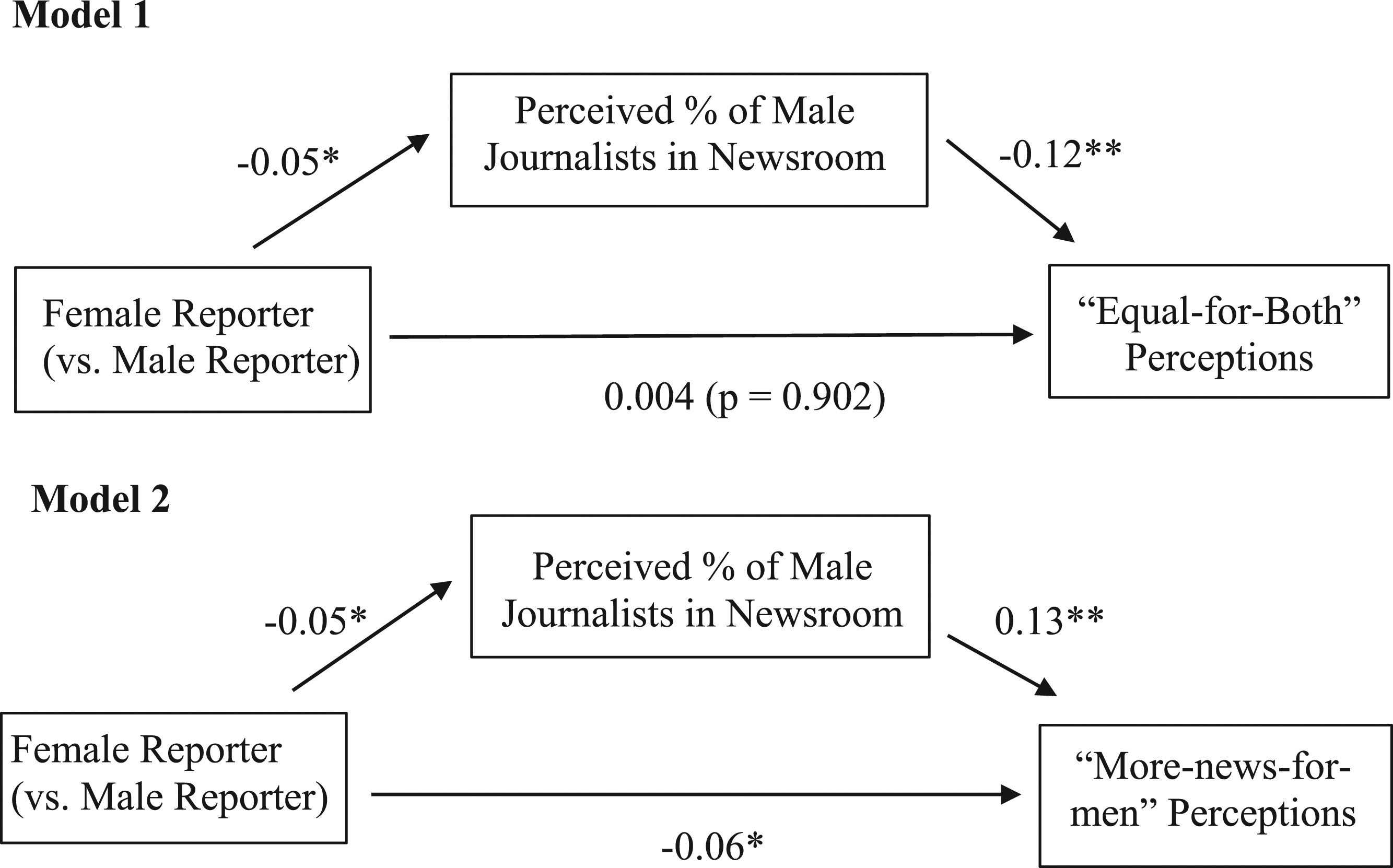
Discussion
Scholars have proposed that news avoidance can be remedied by increasing news efficacy (Park, 2019), interest in politics, and trust in professional news (Goyanes et al., 2021). In addition to these individual-level factors, our study offers newsroom diversity as a possible solution. We find that both men and women perceive that the news is for men. This also explains our finding that people who read stories about a feminine issue are not interested in seeking more information from the outlet. Implicit signals that feminine issues inherently lack value indicate to readers that their finite leisure time and attention is better spent reading about masculine issues, which are presumably more important. These perceptions of news as masculine have implications for democracy. If audiences consider feminine issues unimportant, the issues that affect the lives of a large part of the population could be marginalized. Since politicians rely on public opinion and media cues to determine their legislative agenda, it is likely that such issues will not receive political attention or legislative action.
We also found that gender diversity in the newsroom could be an effective solution to countering the “news-is-for-men” perception. In our study, respondents who read about a masculine issue or read a story written by a male reporter, were more likely to believe that the news is masculine. Increasing the number of female reporters, expanding the number of women sources quoted in the news, and increasing the coverage of women’s issues can help counter these perceptions. By increasing the focus on women as reporters, sources, and as newsworthy topics, the media would provide counter-stereotypic examples, which could affect audiences’ news avoidance behaviors. Existing research on the coverage of racial issues in the media shows that when the media provide positive coverage of outgroups, and depict minorities as multi-dimensional, complex characters, audiences tend to report lower prejudicial attitudes (Ortiz and Harwood, 2007). Merely increasing the number of minority characters is not sufficient; the quality of their depiction also needs to be improved (Ramasubramanian, 2013). In the same way, when newsrooms diversify their staff as well as their news content, they indicate to audiences that they are reflective of the country’s demographics and attentive to audience tastes and needs. These implicit signals could help win back disaffected readers.
In addition, when newsrooms have a high proportion of female editors, there is a difference in terms of what is covered and how it is covered. As Craft and Wanta (2004)found in their analysis of news coverage, a predominantly female-led newsroom tends to encourage positive coverage and distributes assignments and beats equally among male and female reporters. This could naturally increase the visibility of women in terms of bylines and sourcing patterns, which could cause a balanced coverage in terms of issues that men and women find important, thereby attracting more readers.
Another important takeaway is that the “male dominance in newsrooms” perception mediated the effect of reporter gender on the “news-is-for-men” perceptions. Especially with regards to the “news-is-equal-for-both” outcome variable (see Column 2 in Table 1), reporter gender didn’t yield a direct influence. Yet, this does not indicate a null effect; instead, as observed in the mediation analysis models (see Figure 1), reporter gender exerted an indirect impact on “news-is-for-men” perceptions. This finding raises questions about the implications of the null effects uncovered in many studies on reporter gender (Paul et al., 2022). Specifically, the increased availability of such gender cues makes it easier for readers to recall similar scenes and thus enhances the accessibility of these constructs in their mind (see Shrum and Bischak, 2001). The more readers see male journalists’ names in news, the more likely they are to estimate the prevalence of male reporters in the newsroom, which in turn can lead to other attitudinal changes. In this manner, although it is true that reporter gender may not have a direct impact, its function remains important and even more pervasive than can be directly captured.
Several limitations should be acknowledged in this study. First, our findings have focused on readers’ engagement with hard news from online news sites, which may not extend to their consumption of more emotionally charged news such as entertainment, sports and satire, or their use of other news sites such as social media. Given that topics such as family, food, furnishings, and fashion have typically constituted the so-called “women’s page,” in newspapers, seeing stories on these topics may leverage the gender effect. Our measures and stimuli did not separate hard news from soft news, and thus we cannot explore this possibility in this present study. Second, despite our innovative adoptions of two non-self-reported measures i.e., automatically recorded page time and respondents’ provision of image links, we had to remain cautious about what we could validly capture with these measures. With regard to the stark gender discrepancies in the respondents’ likelihood of providing a real-life image versus a stock image, we are unable to figure out if participants were thinking of the person’s gender or other traits when choosing the image. Quite possibly, participants just picked the very first link displayed in their search results using generic terms such as “reporter,” in the absence of a conscious motivation. Another future avenue we propose for research on the gender gap in news avoidance is to investigate other intentional behaviors such as subscribing to news.
Supplemental Material
Supplemental Material - A Is news for men?: Effects of women’s participation in news-making on audience perceptions and behaviors
Supplemental Material for Is news for men?: Effects of women’s participation in news-making on audience perceptions and behaviors by Mingxiao Sui, Newly Paul, Caley Hewitt, Jessica Maki and Kathleen Searles in Journalism
Footnotes
Declaration of conflicting interests
The author(s) declared no potential conflicts of interest with respect to the research, authorship, and/or publication of this article.
Funding
The author(s) received no financial support for the research, authorship, and/or publication of this article.

Supplemental material
Supplemental material for this article is available online.
Notes
Author Biographies
References
Supplementary Material
Please find the following supplemental material available below.
For Open Access articles published under a Creative Commons License, all supplemental material carries the same license as the article it is associated with.
For non-Open Access articles published, all supplemental material carries a non-exclusive license, and permission requests for re-use of supplemental material or any part of supplemental material shall be sent directly to the copyright owner as specified in the copyright notice associated with the article.
