




Abstract
News media in Switzerland are confronted with the challenge of not reaching young people, as youth-specific news platforms and formats are not used by the target group. Our study aims to determine how and where young people can be reached with news. It uses a mixed methods approach to analyze the expectations of young people towards news content and formats and to determine their news consumption patterns. The results show that young people’s news consumption is characterized by four dimensions: 1. duration and times of consumption, 2. news consumption habits and behavior, 3. restrictions, 4. media literacy. The significance of these dimensions varies between three age groups determined through the study. The news consumption of the 12-to-14 year-olds is strongly restricted by parents and school. This group consumes news mainly through media available at home. In the group of 15- to-17 year-olds, parental influence and restrictions decrease, while peer influence increases. This age group spends a lot of time on social media platforms where young people stumble upon news rather accidentally. Between 18 and 20 years of age, news consumption stabilizes, and individual patterns emerge. This age group accesses news via selected apps and social media channels. Young people in Switzerland prefer visual formats like pictures, videos, and memes. When scrolling through social media platforms, they come across news content which arouses their interest in certain information and leads them to search for it on media websites. Swiss Youth wants to be informed about relevant news or topics that are “in vogue”.
Introduction
News media significantly contribute to shaping public opinion and fostering social participation. Media companies in Switzerland are increasingly confronted with the challenge of not reaching younger people. This circumstance is problematic insofar as Switzerland is a direct democracy where citizens play an important part in the decision-making process, because “democracies can flourish only in soil nourished by the news which provides bases for free discussion” (Lazarsfeld, 1940). Almost a third of 12-to-19-year-olds in Switzerland have little or no interest in news (Suter et al., 2018). Traditional formats such as daily news on radio and TV or newspapers have become unattractive for younger generations (Bengtsson and Johansson, 2021). According to the “Yearbook: Quality of the Media”, the group of people “who use news media clearly below average” went up from 21 to 37% between 2009 and 2020 in Switzerland, particularly in the age group of young adults from 20 to 25, where 54.6% can be classified as so-called “news deprived” (Christen et al., 2020). This is in accordance with the results of the JAMES focus study 2019, which suggest daily world events are of secondary importance for one-third of the 12- to-19-year-olds. This group rarely uses news media, and therefore, develops limited literacy in dealing with news, which in turn makes this group vulnerable to disinformation (Waller et al., 2019). Nevertheless, 38% of young people aged 16–25 in Switzerland inform themselves about current events several times a day, 42% several times a week or daily and 19% once a week, less frequently or not at all (gfs.bern, 2018). 1 According to the EU Kids Online study in Switzerland (Hermida, 2019), more than half of the 13- to-16-year-olds are searching for news online at least once a week. The relatively low news consumption of young people contrasts with their media usage. In Switzerland, 99% of people aged 12 years and above have their own smartphone and thus Internet access (Suter et al., 2018). Young people aged 16 to 25 spend an average of 4 hours online every day and attach particularly high importance to the aspects of “being in touch”, “seeking professional/school information” and “fun and entertainment”, followed by “information on leisure and social topics, politics and culture” (Steiner and Heeg, 2019).
The results of the studies show many similarities, although the age range in the different study-samples varies (overall range is 9–25).
News consumption of young people in Switzerland is shaped by the mobile phone and the internet. Social media and apps dominate young people’s news consumption, and traditional news media (newspaper, TV, radio) become more and more irrelevant.
Therefore, the overall aim of the study is to gain insight into what young people understand by news and how they consume news.
Against this background, this paper aims to answer the following research questions: 1. How do young people in Switzerland consume news? 2. Why do young people in Switzerland consume news? 3. What do young people in Switzerland understand by news?
The participants of our study are between 12 and 20 years old. This age range allows us to consider the news consumption at all school levels in Switzerland. 2
We first discuss related research regarding the news consumption of young people in Switzerland, other European countries, the United States and South America. We then explain the research design and methodology of our study, present the results and finally conclude with a discussion of the main findings and their significance.
Literature review and related research
In recent years, several research studies in Switzerland have been conducted regarding media habits and behavior as well as the news consumption of young people. Relevant studies in Switzerland are the James study 3 (Suter et al., 2018), James focus study 4 (Waller et al., 2019), the Credit Suisse Youth Barometer 5 (Gfs.bern, 2018), the IGEM-digiMonitor 6 (IGEM, 2019), the EU Kids online study 7 (Hermida, 2019), “Yearbook: Quality of the Media” (Christen et al., 2020), the media report “Always on” (Steiner and Heeg, 2019) and “Public service: acceptance among young target groups” (Autenrieth et al., 2021).
The results of the Swiss studies show that young people aged 12–25 prefer to consume news digitally, primarily via smartphone (Waller et al., 2019). People aged 13–25 use smartphones to stay informed and share information, stay in touch with friends, share music, pictures, or videos (Hermida, 2019; Steiner and Heeg, 2019). Apps and platforms such as WhatsApp, YouTube and Instagram are among the 10 most popular applications for young people from the age of 12–19 (Suter et al., 2018). Young people aged 20–25 consume news mainly via social media platforms on their smartphones by chance, so news is seen as “an incidental by-product of their social media use” (Christen et al., 2020). These findings are in line with the fact that public service offerings in Switzerland 8 are becoming less important in the media landscape (Leonarz, 2015). Especially the age group of 15-to-29-year-olds uses the news from public service in traditional formats such as daily news on radio and TV less and less (Autenrieth et al., 2021).
Different studies on news consumption in Europe show that young people can be reached mainly via social media (Geers, 2020; Hasebrink et al., 2021). A qualitative study in Austria showed that people aged 18–25 consume news offered exclusively online via social media, news portals, WhatsApp, and other apps. In addition, many of the participants stated that the news finds them rather than they seeking out news themselves (Russmann and Hess, 2020). In terms of social media use, young people aged 16–19 in Sweden acquire news from their feeds and to stay updated about current affairs (Bergström and Jervelycke Belfrage, 2018).
Algorithms embedded in social media enable news items to be indirectly promoted to others just by liking posts or following (news) channels. A Norwegian study revealed that a third of young people aged 16–25 years occasionally read, watch or check news from news aggregators, which typically filter and recycle content from other news sources, making short stories and promoting these through catchy titles and images/videos (Slettemeås and Storm-Mathisen, 2017). The main reason for consuming aggregated news is that they appear automatically in the feed. Another reason is the mix of entertainment news and serious news in combination with a better user experience. In this context, social media are gatekeepers for news, and social media platforms must acknowledge that they play a key role in the way citizens consume news (Cetina Presuel and Martínez Sierra, 2019). This algorithm-driven news consumption has been described with different terms such as “news-grazing”, a phenomenon which promotes a shorter, dispersed news consumption (Molyneux, 2018) or “news snacking” which means users consuming small bits of mobile news to gain a sense of what is going on (Costera Meijer and Groot Kormelink, 2015). As a study of news literacy in the Netherlands suggests (Tamboer et al., 2020) this kind of news consumption behavior seems to be affected by a “predominantly passive” behaviour, which is due to “a lack of intrinsic motivation” of young people (12-to-16 year-olds). The results show further that news is seen as “important, but often as boring, repetitive and negative, and disconnected from youth”. Given that young people check their social media feeds numerous times a day, traditional news organizations have to compete for attention not only with assorted entertainment options but also with the many posts that attract people’s attention (Bergström and Jervelycke Belfrage, 2018).
These findings in Europe are consistent with observations in North and South America. Boczkowski et al. (2018) describe the news consumption of people aged 18–29 in Argentina as “incidental” on their mobile devices as part of their constant connection to media platforms; they encounter the news all the time, rather than looking for it (Boczkowski et al., 2018). In the United States, the news consumption of people aged 18–25 has been described as “exposure” while using the phone (Antunovic et al., 2018).
Methods
The research design of our study is based on a mixed-methods-multistrand-approach (Tashakkori and Teddlie, 2010) of embedded qualitative and quantitative (QUAL + quan) data collection (Creswell and Plano Clark, 2007) and a qualitative multi-method data analysis. The study combined a set of methods starting with pre-interviews and focus groups, followed by two phases of diary studies (during school time/holidays) accompanied by mobile phone tracking (Gnach et al., 2020) combined with trace interviews during the diary study and retrospective interviews afterwards. As a last step, the various data sets were triangulated.
Our study was conducted from June 2019 to February 2020. The participants were Swiss adolescents aged 12–20 in three linguistic regions (German, French, Italian) of Switzerland. The sample had to be as well balanced as possible between males and females. Furthermore, geographical and age characteristics, social and economic background, family type, and social origin were considered in the composition during sampling. 66 adolescents participated in the study. 31 participants were female and 35 were male; they came from both urban and rural areas 9 . To obtain a sample with these specific characteristics, the research teams in three language regions used different methods for contacting potential participants 10 .
In the preparatory work, pre-interviews were carried out and evaluated in the three language regions (German: 5, French: 4, Italian: 2) to gain insight into everyday media behavior and to determine the topics for discussions in the focus groups.
A total of 10 focus group discussions were conducted (German: 4, French: 2, Italian: 4). To better meet the age-specific requirements as seen in other studies before (Suter et al., 2018), the participants were divided into two age groups (Group 1: 12–15 years; Group 2: 16–20 years) of 4–7 people. In the focus group discussion, the participants were asked: “What comes to your mind when you hear the word “news”?” Afterwards, the group talked about subjective news consumption and routine behavior in different everyday situations. Discussions provided information about the participants' understanding of news, attitudes towards news consumption, and news consumption motivations.
Before the diary study began, two free apps (Evernote and Screentime) were installed on the participants’ mobile phones. The participants familiarized themselves 11 with Evernote and received individual training and a contact person (Scholl, 2018). The software 12 Screentime was often already installed by default (Apple systems). The participants received instructions concerning the use of the tool and their task to send the overview of their mobile phone usage, which is automatically recorded by Screentime, every day. For those participants who did not have an Apple operating system, the study leaders were able to call up the data daily via the program itself.
The participants documented their news behavior in standardized digital media diaries with their smartphone. They were asked to document everything that they themselves consider news and to tag their entries with predefined categories of their possible media use behavior (Koch et al., 2021). Specified questions like “Which medium did you use?”, “Why did you consume the news?” 13 etc. guided the participants to give further information about their news consumption. The App Evernote let them select matching tags 14 to answer each question. This gave not only insights into where, with whom, with which medium, how, and why the participants consumed the news, but also what their impression about the news was and how they felt during the news consumption.
The definition of news was therefore left to the young people themselves to gain a better understanding of what they call news. The actual news consumption and news reception of the participants in each language region were recorded and validated during the diary study with trace interviews and retrospective interviews afterwards.
The trace interviews were used to contact each participant once during the study to ask specific questions about peculiarities in their news consumption. For example, when a participant installed a new news app on the phone, trace interviews made it possible to identify patterns to generate deeper insight and to understand the actions of the participants better. With more than half of the diary group (15 of 26), a trace interview was conducted, which took place close to a current entry to be able to follow “the traces of the recording” and to understand the motives for using the news.
Retrospective interviews as a reflexive practice (Budach, 2012) were used to better understand why the participants behaved the way they did. The retrospective approach enabled us to include the participants’ perspective thus enriching the data.
The diary entries (721 entries in 26 diaries) were compared with the Screentime data to validate and supplement the entries. This made it possible to validate whether the entries corresponded to the actual use or not. If there were discrepancies (e.g., long mobile phone use, but no diary entries), the participants concerned were contacted and asked if there were any problems with the app (Koch et al., 2021). If the discrepancies could not be linked to technical problems, they were discussed either in the trace interview or in the retrospective interview. Furthermore, in the retrospective interviews, participants were asked about their experiences with the diary and individual entries were discussed. The first entry was chosen by the participants in the sense of a “typical news item".
The diary entries were linked together with the 41 transcripts from the trace and retrospective interviews and were analyzed qualitatively, using a combination of structuring and summary content analysis (Mayring and Fenzl, 2019). In an iterative process, core categories and codes were developed. All collected data was coded with the software MAXQDA (2020). 15 The main focus was on the participants' news consumption behavior which was captured by nine dimensions. 16 In addition, the transcripts were analyzed in six general dimensions. 17 The iteration in qualitative data analysis is applied as a reflexive process to spark insight and develop continuous meaning-making by revisiting the data and connecting them with emerging insights (Srivastava and Hopwood, 2009).
In this way, personal user dossiers were created, which showed the typical news usage of different age groups (12–14,15–17,18–20). For quality assurance purposes, all researchers from different language regions evaluated their data separately and discussed the interpretation results with each other. High value was placed on data protection in all parts of the study. 18
Findings
Overview of the four dimensions and the related factors of news consumption of young people aged 12–20 in Switzerland.
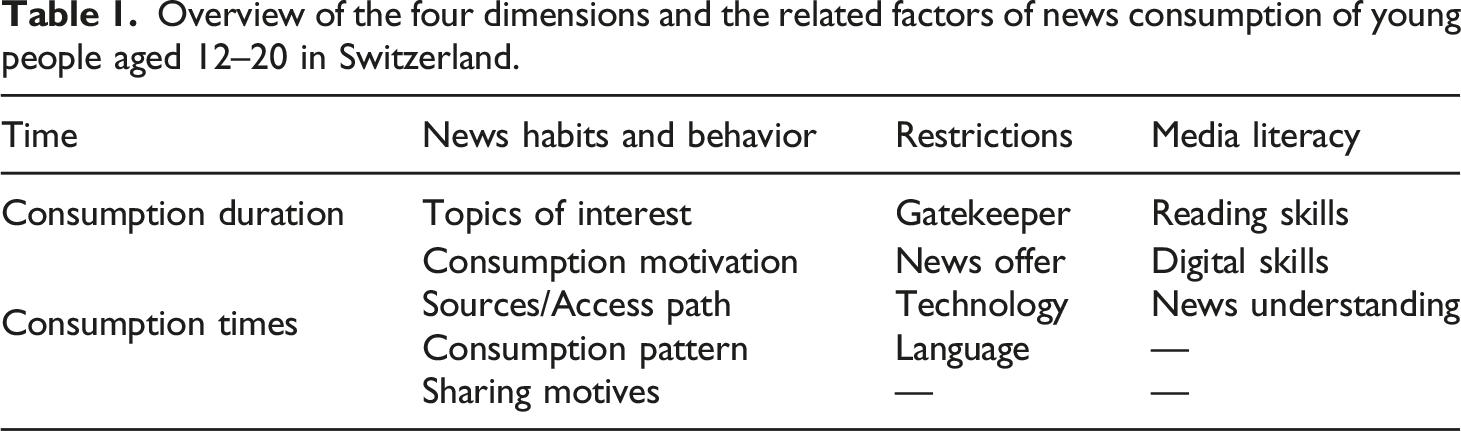
The analysis revealed three age groups (12–14, 15–17, 18–20), which differ regarding how and why they consume news. This stands in contrast to other Swiss studies, which subdivide young media consumers in two age groups (12–14, 15–19) according to their possible addiction in relation to media consumption (Federal Office of Public Health FOPH, 2016) 19 or four age groups (12–13, 14–15, 16–17, 18–19) according to their school level (Suter et al., 2018). In these studies, however, the age groups were determined before the data collection, while in our age groups they are based on significant differences found in the data.
The analysis of the diary showed that 526 of 721 entires were not classical news but had an informative value for the recipient (for example: timetables) and 429 have been news. On average, news is consumed daily across all age groups. News consumption increases as young people get older. In all age groups, traditional news media made up the largest share of diary entries, mostly accessed and consumed online via smartphone.
While the youngest age group (12–14) included posts which were informative but no classical news, the middle age group (15–17) used new news formats such as Instagram posts and consumed mainly short news items, while the oldest study participants (18–20) were most likely to consume traditional news content via news apps including longer formats and background reports.
The value of the four dimensions time, news habits and behavior, restrictions and media literacy vary according to young people’s age. Particularly striking are the differences of the age groups in the dimensions of restrictions and media literacy. While the youngest age group was still strongly restricted by their home in terms of their media and thus also news consumption, the oldest age group is mostly free of restrictions. The situation is similar for young people’s ability to process news content. Here, the youngest show the greatest difficulties and are dependent on the support of family and school to understand complex news, while the oldest age group critically reflects on their news consumption. In the dimension of news habits and news behavior, the differences depend more on the individual development than on a certain age but can be clustered in the major age groups of 12–14-, 15-17- and 18-20-year-olds. News consumption of young people aged 12–14 years is mostly driven by the need to pass the time and the wish for entertainment. With increasing age (15–17), however, peer group topics such as personal interests become the driver of news consumption via social media. At the age 18 and above an essential motivation for news consumption is the ability to share knowledge and opinions with special interest groups. The smallest difference was found in the dimension time: although the time for media and news consumption varies considerably among the age groups, off-peak times are the most popular among all age groups, as are weekends and vacations.
Time
As news is primarily accessed on mobile phones, knowing when and for how long young people access their phones is essential to reach them with news. By time, we mean consumption time and consumption duration (Table 2). Time is the dimension that influences the amount of news consumption the most. It is reflected in the number of “freely available” hours, which can change depending on the daily circumstances. For example, young people have significantly less time for news consumption during exam periods. Clear differences in consumption times and overlaps can be described in the three age groups, as the statement of one participant shows: “I read more (during vacations) because I don’t have much time for reading during school.” (Female, 15). Overview of the dimension time and the related factors in different age groups.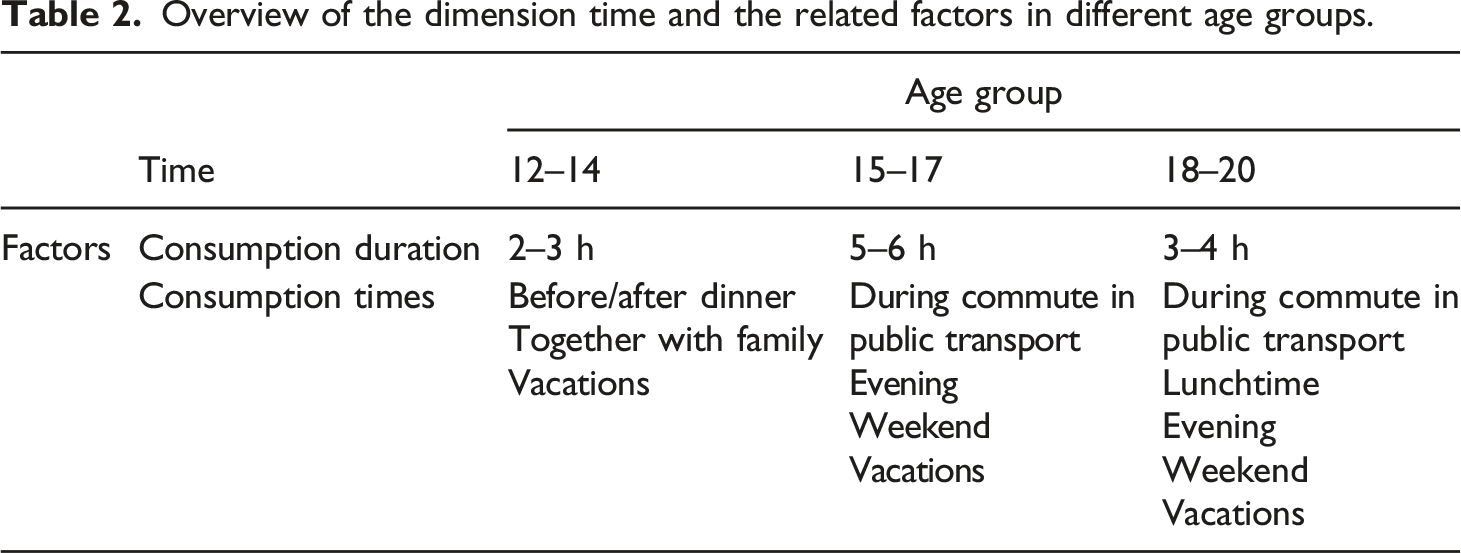
News habits and behaviors
Overview of the dimension news habits and behavior and the related factors in different age groups.
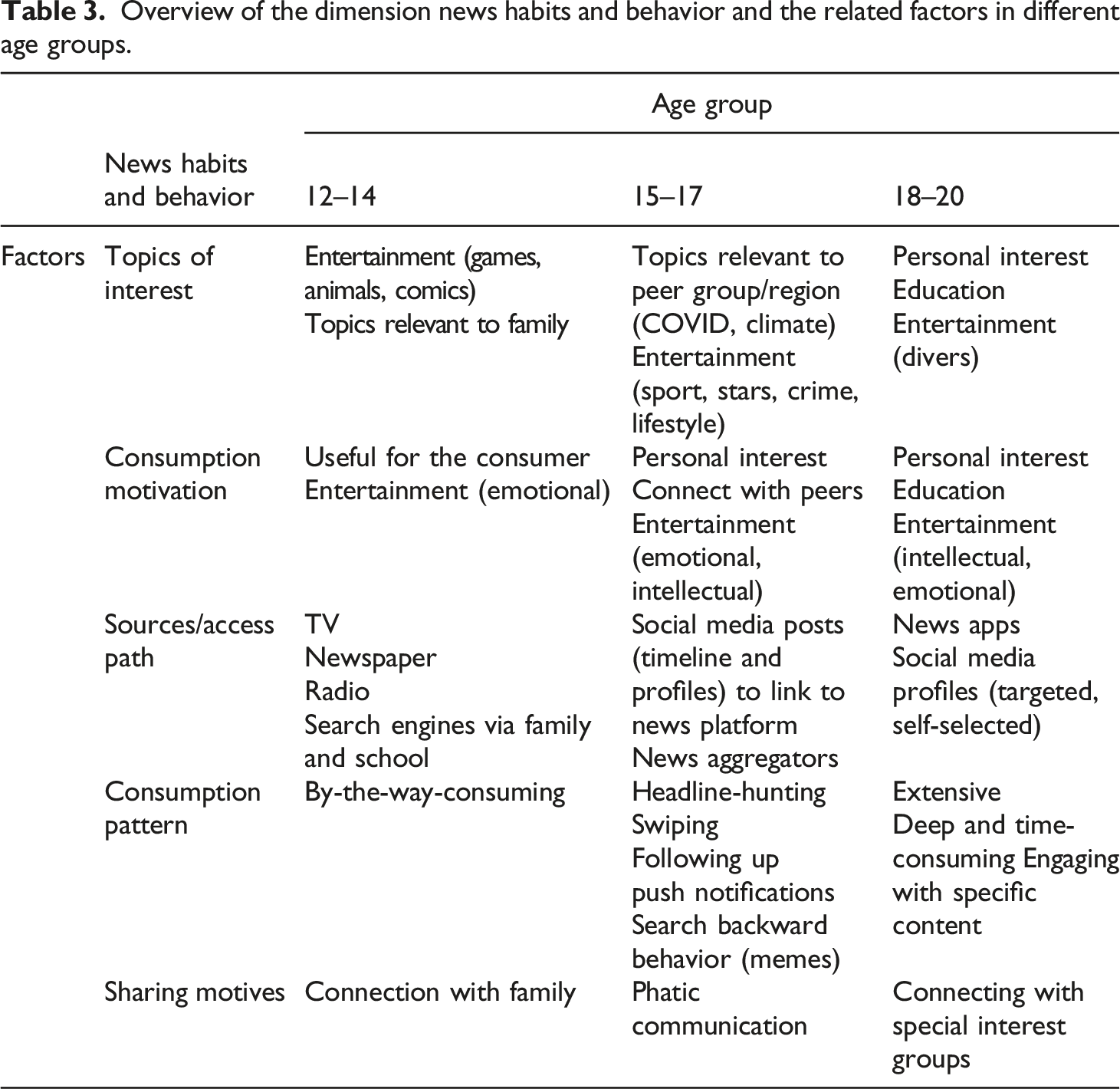
This dimension is important because media routines change between generations, which is not only related to changes in the media landscape, but also to social changes in society such as increasing individualization and mobility (Westlund and Weibull, 2013).The determing factors to this dimension are topics of interest, consumption motivation, sources/access path, consumption pattern and sharing motives.
In topics of interests, the difference between the age groups is not as strong as in other categories. The topics are mostly in relation to the most important reference group of the young people. This was seen in the topic entertainment, which interests all age groups and differs only in terms of interpretation of what is seen as entertaining at the specific age.
The motivation for consumption is driven by searching entertainment but differs if the entertainment takes place on an emotional or intellectual basis. While 12-to-14-year-olds prefer to be entertained emotionally, at the age of 15–17 the intellectual entertainment comes in and becomes the main element of entertainment between the ages of 18 and 20.
Besides entertainment, 12- to-14-year-olds want to see the benefits of news consumption. News must be useful for them: “If Angela Merkel says something or Trump does something, I don’t think it’s important because it has no direct influence on me” (Male, 14).
From the age of 15–17, the personal interest is a strong motivator for consuming news just like the ability to connect with peers. For the 18-to-20-year-olds, not only do their personal interests motivate them to consume news, but they also look for the news to get information for their education.
Besides TV, newspapers, and radio, which the youngest group (12–14) have at home, the sources/access path to news is via search engines at home or in school: “The first thing I would do is google [to find news].” (Male, 14)
Between 15 and 17, social media becomes relevant as a source for news. This age group comes across posts in their social media timeline to news content or sees them in subscribed social media profiles, which then lead them to news platforms.
The older they get, the more they prefer news aggregators as a source before they start using news apps on their mobile phones from the age of 18–20. If they use news apps, they call them up several times a day and consume most of their news via this app. In our sample, the most preferred news apps in this age group were SRF 20 and Watson. 21
This age group supplements the news from the news apps with information from their social media profiles: “I have two apps, Blick
22
and Snap(chat). Both are very important for my news consumption.” (Female, 20)
The kind of news consumption pattern varies between the age groups. While the youngest age-group (12–14) mainly consumes news by-the-way, the 15-to-17-year-olds mainly hunt headlines, swipe through news content, or follow push notifications to news sites. In this consumption behavior, memes in particular must be addressed, because these pictures with - mostly funny - statements are perceived preferentially by this age group and lead the young people to click on the post and thus to news content that is behind the visual presentation in the corresponding meme. In contrast, the oldest age group (18–20) consumes news extensively and in a very deep and time-consuming way if it is specific content that interests them. 22
12-to-14-year-olds share news to connect with their family, while the young people aged 15 to 17 share news to start a conversation with peers. For this age group, the news consumption has a social function and leads to phatic communication: “[I read news] Because there they usually talk after school about topics that are going viral, such as the climate strike.” (Female, 15)
The 18-to-20-year-olds share news in special interest groups to connect with others.
Restrictions
Overview of the dimension restrictions and the related factors in the different age groups.
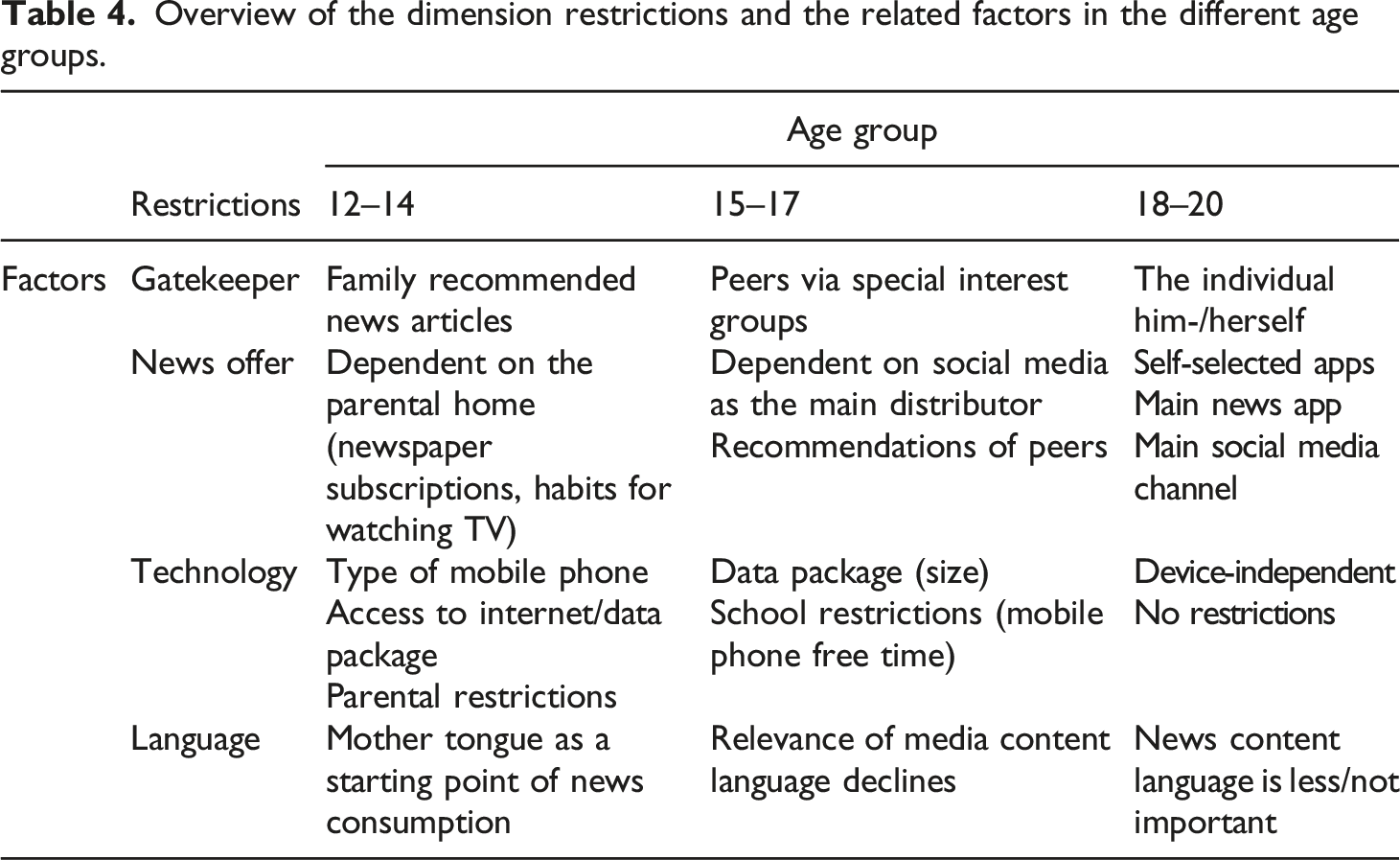
Primary gatekeepers for 12-to-14-year-olds are family-members, who recommend news articles. From the age of 15–17, peers take over this role, especially in special interest groups. At the age of 18–20, the young people individually decide which content they want to consume. The news media in the individual media environment determines access to news content. In other words, the immediate environment of young people shapes their access to news media and therefore their news consumption (Boczkowski et al., 2018). This media environment from the age of 12–14 depends on the parental home and is shaped by newspaper subscriptions or habits for watching TV-shows with the parents. The news media of the 15-to-17-year-olds is influenced by recommendations of peers:
23
“My friend showed me the “20-minute-app”. I installed it afterwards.” (Female, 15)
At the age of 18–20, the young people select news-apps to stay informed and one main social media channel for news distribution.
The factor technology is a major limitation, especially when it comes to access to devices and data. While the youngest age group (12–14) is limited by different types of mobile phones (without mobile data) with limited access to the internet (at home/at school), as well as being restricted by their parents in the use of these devices.
The 15-to-17-year-olds have a smartphone with data access and are no longer restricted by their parents. This age group only experiences restrictions on mobile phone use at school: “I don't take the phone to school. It’s no use, we have to hand it in before class anyway.” (Male, 15)
From the age of 18–20, the news consumption is device independent, and this age-group experiences no restrictions from parents or school.
The factor language skills limits news consumption as the selection of news content is smaller or larger depending on language skills. While the 12-to-14-year-olds use news content in their mother tongue, from the age of 15–17 the relevance of the language declines when choosing news content before becoming less or not important anymore at the age of 18–20, because this age-group has the skills to understand news content in different languages: “I couldn’t tell afterwards if an article was in German or English.” (Female, 18)
Media literacy
Overview of the dimension media literacy and the related factors in the different age groups.
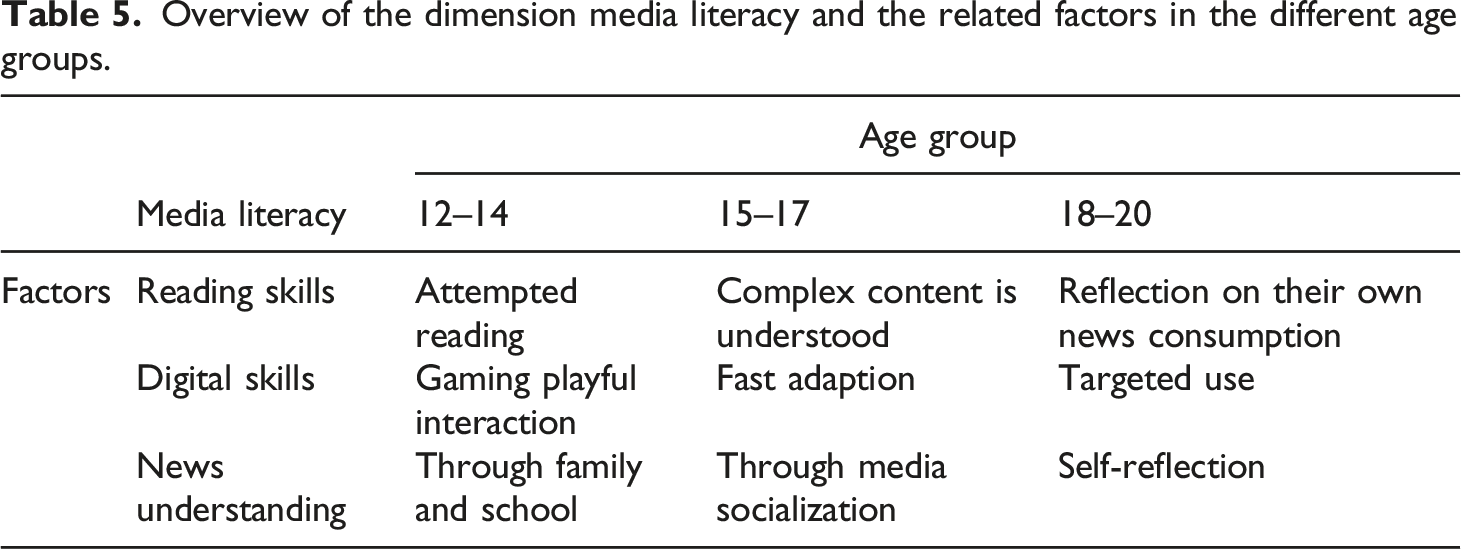
The reading skills of the youngest age-group starts with attempted reading of news content: “…the picture of Santa Claus on the bicycle. I don’t know what it means.” (Female, 13)
From the age of 15–17, the reading skills are improving fast and complex content is understood, before at the age of 18–20 a reflection on their own news consumption takes place.
We identified a similar development in terms of digital skills: At the age of 12–14, the young people have a playful interaction based on gaming with digital devices before in the age-group of 15-to-17-year-olds a fast adaption to different digital tools is taking place. At the age of 18–20, the digital skills lead to a targeted use of digital media. The factor news understanding is strongly related to the other factors reading skills and digital skills and describes the fact that 12-to-14-year-olds understand news mainly only with the help of the family and school. From the age of 15–17, news content is understood through media socialization. At the age of 18–20, one’s own news understanding is critically reflected.
Our findings suggest that young people have a very broad understanding of what news is. They understand by news everything that is currently happening in the world and that is important for their lives, i.e., information that is of personal use, as one participant mentioned: “I think the word news could be divided first into good and bad or personal and non-personal.” (Female, 14)
But it can be understood in the sense of a traditional news definition; news is news if it is relevant: “When it’s about the world, it’s news. It’s important when it is important for everyone and concerns something specific, like climate change.” (Male, 14)
The younger the participants are, the more open and inconsistent is their concept of news. Examples mentioned by the participants are public transport timetables or the weather forecast. The older they become, the more traditional is the concept of news. All age groups were familiar with the term “Fake News”. They were aware that not every piece of news disseminated, especially via social media, is based on facts and that Fake News consists of false information. Mostly they search for other sources on Google for confirmation.
Summary
Our study revealed distinct patterns of Swiss youths’ news consumption, which can be attributed to three age groups (Gnach et al., 2020):
The group of 12-to-14-year-olds accesses news primarily via smartphone, which they use for 2–3 h a day, mostly at home where Internet access via WLAN is available. The parental influence is vital within this age group. Parents are the primary source of information about important global topics or regional events. The young people’s main interest lies in entertaining content like comics, games, animals. Since they are too young to legally have social media profiles, their access to content depends on the formats available at home or accessible through their parents. That is why this age group still gets in touch with TV broadcasts, newspapers, and radio. They consume news by-the-way, in relatively short periods, without giving it too much thought. The primary motivation for their news consumption is the opportunity to talk to parents or at school about news content and to connect with parents through conversations about news. The use of mobile phones is strongly regulated by parents and school. Parents not only restrict news consumption, but also sometimes push it by suggesting news articles for reading or asking their children to watch TV news broadcasts with them. News articles are often too complicated for them to understand. When they encounter an exciting or entertaining headline, they attempt to read the news article but often stop reading after a few lines because of their limited reading skills, which makes them ask their parents or teachers for further explanation.
The group of 15-to-17-year-olds have their own smartphone, data packages and are constantly online (5–6 h daily). They consume news content whenever they can, in free times like weekends, vacations, and when commuting by public transport. Even in school breaks, they look at push-notifications. This age group spends a lot of time on social media, where they get information about current trends and consume news to connect with their peers. When they scroll through social media platforms, they often show interest in memes or Instagram stories with news content. This motivates them to track back the content and find the original news source. An essential motivation for news consumption is phatic communication, i.e., the opportunity to engage in small talk and be part of a discussion, to interact socially and feel integrated. Young people in this age group follow countless social media channels where they get in touch with news media accounts and news content. Their consumption pattern is rather broad and diverse but not very deep. They swipe through feeds and hunt for headlines or look at memes, which leads them to news content. While the parental influence and restrictions decrease, peers' influence increases; thus, the topics of interest shift. Peers set trends and give recommendations for social media channels and strongly influence the news consumption behavior. Restrictions are mostly just set by the school e.g., through rules concerning the smartphone use during lectures. Young people in this age group adapt very fast, and their understanding gets better due to the increased media socialization. They begin to understand more complex news content, but they still prefer small bites of information, delivered by a meme or a short video, which helps them to understand the critical information.
In the group of 18-to-20-year-olds, the news consumption behavior is stabilizing, and individual patterns emerge. News is usually consumed at off-peak times: in the morning during a commute, on the way home, and shortly before bedtime. The daily phone usage time is 3–4 h. The interests and motivations for news consumption become more specific and personal; they are related to education or hobbies, and the influence of peers decreases. The news behavior is more targeted, as young people in this age group know which content they are interested in and where to get it. Therefore, the access paths are specific. They settle for individual news formats and providers. They tend to use one or two pre-eminent news distributor apps and one or two social media platforms. One-third of all participants in this age groupe consume news via apps. On social media they follow fewer accounts than the middle age group. An essential motivation for news consumption is the ability to share knowledge and opinions with special interest groups. Nevertheless, the news is also consumed for entertainment, or to pass time and to relax. The restrictions concerning news consumption become less, as there are no more rules from parents or school. Access to news content becomes broader. The selection of news offer seems to be related to knowing different languages. Becoming more fluent in English and other languages opens up the opportunity to consume more diverse news content. Young people in this age group take their time to read or watch news completely when it comes to special interest content, and they reflect on the content to fully understand it.
Discussion
Our study wanted to gain insight in the question if and how the Swiss Youth inform themselves. The findings provide deep insight into news consumption behavior of young people aged 12–20 in Switzerland with details that have not been revieled by previous studies. The fact that news consumption in adolescence is so highly segmented into three distinct age groups (12–14, 15–17, 18–20) is a new finding.
Young people find it important to be informed and to be able to discuss with peers current and relevant news and topics that are “in vogue” (Gnach et al., 2020). They prefer to consume news digitally, primarily via smartphone, and they can be reached mainly via social media, as seen in other Swiss and European studies (Bergström and Jervelycke Belfrage, 2018; Cetina Presuel and Martínez Sierra, 2019; Geers, 2020; Waller et al., 2019). This is not surprising, as the smartphone continues to be the most important digital device for accessing news (Newman et al., 2022) and the formation of habitual patterns of media consumption is closely connected to specific media characteristics and the context of their use at home (Ghersetti and Westlund, 2018). Regarding the use of smartphones to consume news content, one could say that young people develop the news habit when their parents use that device for news consumption themselves (Edgerly et al., 2018: p. 1277).
Swiss youth prefers visual formats, e.g., a video or pictures which summarize and illustrate the news (Gnach et al., 2020; Kramp and Weichert, 2017). Memes on Social Media Platforms like Instagram, and YouTube videos get the most attention (Gnach et al., 2020; Suter et al., 2018). Younger audiences are significantly more likely to watch news, while older people still prefer to read news online rather than watch it. However, all age groups find it an easier and more engaging way to watch news online (Newman et al., 2022).
News is consumed if it is entertaining (Gnach et al., 2020; Kramp and Weichert, 2017), or if the content is linked to personal interests or has a relation to the audience’s lifeworld (Gnach et al., 2020; Hasebrink et al., 2021). This “lifeworld” includes the interests of peers, current school topics, topics related to hobbies or regional issues that have an influence on the young people’s daily lives. This may be related to the fact that young people today consume more information about their community and give greater weight to this knowledge than to news for the public (Mindich, 2005). They also consume traditional news but have a very different definition of news from that of media producers. Findings suggest that they understand by “news” every piece of information that is of personal use (Gnach et al., 2020). The differences in definition of what constitutes relevant news is evident in different studies (Kramp and Weichert, 2017; Newman et al., 2022) and could be the beginning of a radical audience turn in journalism, in which the focus is shifting from what news is toward what is experienced as “informative” (Swart et al., 2022).
Since young people prefer compact information (Kramp and Weichert, 2017; Newman et al., 2022), push-notifications are very welcome, because they transmit information on the smartphone in a concise way and allow the user to get more information with only one click (Gnach et al., 2020).
In line with the results of the Dutch study of 12–16-year-olds, motivation to consume news for Swiss youth aged 12–14 could be described as “passive” (Tamboer et al., 2020). News consumption is mostly driven by the need to pass time and the wish for entertainment (Gnach et al., 2020). The related pattern of news consumption of 15-to-17-year-old Swiss people identified in our study is described in the literature as “by chance” or “incidental” (Antunovic et al., 2018; Geers, 2020). One crucial insight of the study is the openness of this age group to new news media, new news formats and new news content (Gnach et al., 2020). This effect may appear to be a byproduct of the high social media consumption. Nevertheless, this openness to new news sources is the “entry gate” for media providers. This effect of consuming news primarily passively may be due to the fact that they are confronted with a large selection of media offerings and instead of actively choosing, they fall into a habitual pattern of media consumption in order to conserve mental resources (Diddi and LaRose, 2006). Social media, therefore, are seen as gatekeepers for news consumption, which is increasingly algorithm-driven (Molyneux, 2018).
The incidental news consumption via social media decreases with age. The older young people get, the more they use specific news apps and channels as news distributors. The oldest age group (18–20) tends to use one to two apps on their smartphones from traditional and well-known media providers to consume news and supplement them with social media. It seems that new consumption patterns arise while old ones continue due to persistent news habits and the cross-fertilization of those habits between media channels (Diddi and LaRose, 2006). They build up an “information repertoire” for a given interest area by combining special interest media resources (Reagan, 1996; Taneja et al., 2012). This could be an indication that at the age of 18–20 years, the lifestyle and the social milieu gradually begin to consolidate, which has a decisive influence on building an individual news repertoire (Hasebrink and Popp, 2006). If the news consumption habits are established, they are stable at the individual level (Shehata, 2016). Therefore, it is not surprising that even Swiss Youth quickly establishes habitualized news consumption patterns and rarely changes them, but does so during school transitions (Klopfenstein Frei et al., 2022 (submitted)). “News habits persist until there is a change in other daily routines, for example, when young people leave home to go to college or when a change in information needs occurs.” (Diddi and LaRose, 2006: p. 195).
In contrast to the findings of previous studies in Switzerland, which claim that a third of 12-to-19-years- olds have little or no interest in news and use news media rarely (Waller et al., 2019), our study showes that young people generally find it important to be informed (Gnach et al., 2020). These discrepancies may be due to the fact that previous studies were primarily quantitative and based their research design on a classic definition of news.
To be able to give information about how young people’s news consumption mimics or diverges from that of older generations, future research should replicate the study with the same methods with different age cohorts.
The mixed methods research design made it possible to balance the weaknesses of one method with the strengths of the other through the complementary function of the different data sets. Combinations of methods are conceivable to validate results. This allowed us to concretely construct a picture of the news consumption behavior and to understand the participants’ reactions to meadia content and thoughts about it (Koch et al., 2021).
A limitation of the study design is that participants’ news consumption might get influenced by the diary study. However, this could be elicited via the trace and retrospective interviews and was considered in the evaluation.
A further limitation is the small data sample. The multilingualism of Switzerland and thus the different access to news media and sources in different languages makes it difficult to compare the data and only allows a generalized statement for Switzerland to be made to a limited extent. It should be noted that the authors themselves are part of the research teams of the study presented.
The results presented here are one output of the research project “How to Reach Swiss Digital Natives with News”. 24
Footnotes
Declaration of conflicting interests
The author(s) declared no potential conflicts of interest with respect to the research, authorship, and/or publication of this article.
Funding
The author disclosed receipt of the following financial support for the research, authorship, and/or publication of this article: This work was supported by the Swiss Federal Office of Communications.
Notes
Biography
