




Abstract
The COVID-19 pandemic represented the first real experience of a global crisis for young Australian adults and saw them engage with the news at a heightened level. In this study, we report findings on how COVID-19 affected the way young adults consumed and avoided the news, the composition of their media diets, and factors that shape their news consumption strategies. The data was collected by conducting four focus groups with 15 Queensland-based participants aged 20–23 years. Distinct stages of news consumption were observed, with participants experiencing a saturation of COVID-19 information during the pandemic's early 2020 peak, and subsequent ‘burnout’ around pandemic-related news. Drawing on practice theory, these findings demonstrate the nuance and specificity of participants’ media use and preferences, and the factors that lead to their distinct ‘do-it-yourself’ strategies for filtering information on emergent social media platforms.
Keywords
Introduction
The distinct media use and news preferences of young Australian adults reflect their maturation in a time of immense technological change. Unlike generations from the broadcast and print era, they are more disconnected from traditional institutions and formats of news, with many no longer having a ‘go-to’ source, and increasingly report using social media platforms as the primary way they stay informed (Newman et al., 2021). The current information environment is more complex and fragmented, defined by the murkiness between news and non-news (Schapals, 2022), producers and consumers (Bruns, 2018), and information and misinformation (Waisbord, 2018). With such a simultaneity of media, shared through a multitude of sources, the news consumption habits of young Australian adults in the modern day are unique and vastly different from previous cohorts.
Digital platforms and, more specifically, social media sites, have been criticised in journalism studies for increasing broad disengagement with news brands and encouraging more superficial consumption of news information. Research has consistently pointed to younger audiences embracing a ‘news-finds-me’ approach on social media to how they remain informed about current events, fuelled in-part due to widespread incidental news exposure (INE) across their daily scrolling and proliferated use of mobile platforms (Boczkowski et al., 2018, Gil de Zúñiga et al., 2017). Young Australian adults have developed strategies for news consumption largely on their own terms, and recent work (e.g. Cotter and Thorson, 2022) has highlighted the notable emergence of ‘do-it-yourself’ (DIY) approaches to filtering information on social media platforms.
In fact, both during and after the COVID-19 pandemic, media consumption on social media sites were the focus of much research. Adherence to lockdowns and social distancing, and uptake of COVID-19 vaccines were central to the government's approach for managing the pandemic, and the spread of misinformation and contrary news risked non-compliance, which threatened the mitigation strategy as a whole. As such, research into media use and news consumption on social media during the COVID-19 pandemic skewed its focus towards how misinformation spread, factors related to vaccine hesitancy, and how COVID-19 information affected well-being. This study's approach is centred within media studies, and specifically, a conceptualisation and emphasis of practice theory within the field (Couldry, 2004). It adds to knowledge by using the COVID-19 pandemic and the heightened news engagement (and, often, disengagement) that participants experienced as a backdrop for further investigation into the unique characteristics of young adults’ media consumption on social media.
Literature review
Reliance on social networks
Media studies have long focussed on the role ‘liveness’ plays in television news, and its qualitative improvement over the slower, ‘as-it-happened’ nature of newspapers and film (Couldry, 2004; Feuer, 1983). The evolution in mobile social media, in this sense, could be said to be its ‘aliveness’, that is, the seamless digitisation and integration of real-time interactivity and social pressures into the habitual experience of consuming news content into the platform itself. On traditional news platforms, information has historically been shared in a top-down way, with the authority of a news presenter or journalist dictating the important events of the day to a mass audience. These days, however, young adults oftentimes encounter news on mobile social media incidentally and, crucially, without the editorial context usually afforded in traditional media through a presenter or journalist. As such, they often look to the in-built affordances of social media and their social intuitions to help filter the news and non-news content they encounter. The important role friends, family, and real-life networks play in aiding young adults with their interpretation of news on social media has been highlighted by several authors such as Bergstrom and Belfrage (2018) where they found that ‘friends’ sharing is of greater importance than the news disseminated by the media business’ (p. 593).
Kümpel (2019) conducted 16 in-depth interviews with German Facebook users to understand the multitude of factors that influence a user to engage with news on their social media timeline. She found that while the characteristics of the news content itself are a primary driver of news engagement, ‘this content-based relevance can be overshadowed by perceptions of social relevance, triggered by cues referring to the news curator’ (p. 14). In other words, a person's interest in the news content itself is still the primary factor in their engagement with the story, but as a news platform, social media offers many other cues, especially those given by friends, family, or curators with perceived expertise, which shape news consumption and engagement. The offline trust they have with friends and family is strongly reflected by their influence in shaping their online feeds (Anspach, 2017).
These findings can be viewed in an Australian context through, amongst others, Molitorisz’s (2020) qualitative study which aimed to understand participants’ ideal news source against the context of widespread decreasing trust in the news. Over four workshops, it was found that participants wanted ‘a model of news media in which they can place a blend of institutional and distributed trust’ (p. 120). That is, consumers want news sources to carry a top-down, ‘voice of God’ authority, as this implies a level of credibility and trust in the content itself but want this information to be spread in a familiar, peer-to-peer way that is convenient and a reflection of their real-life networks. Molitorisz's study shows that Australian news consumers do not necessarily want their news sources to sound like a friend but would like the filtering of these sources to occur, in part, by their real-life friends.
Wanting a ‘voice of God’ tone of news is, it seems, not as pronounced amongst younger audiences, who often are motivated to consume news for reasons that are not necessarily about information acquisition. Within the environment of social media, novel news formats have emerged which reflect the underlying incentives for both media outlets and the social media platforms they leverage. As outlined by Hurcombe et al. (2021), audiences on social media want to share content ‘that makes them look knowledgeable or is funny’ (p. 7), and the authors highlight the characteristics of ‘social news’ outlets like Pedestrian.tv, Junkee, and Buzzfeed as similar to that of mid-2000s satirical television news programmes like The Daily Show. This brand of ‘social news’ similarly blends humour and serious reporting, making use of emojis and internet memes, and is popular amongst younger audiences where entertainment often drives their motivation for consuming media. In place of the ‘voice of God’ in Molitorisz's (2020) study, ‘social news’ is more explicitly ‘positional’, delivered with a more conversational tone, and reflective of ‘the convergence of news with the sociable and affective cultures of social media platforms’ (Hurcombe et al., 2021: 13).
Incidental news exposure
INE is a widely reported way that audiences, especially young people (Bergstrom and Belfrage, 2018), stay informed about current events. INE has been shown to negatively impact consumption of traditional and online news (Park et al., 2022), with social media users who often experience INE not needing to actively establish news consumption habits to maintain a sense of being informed. Seminal INE work published by Boczkowski et al. (2018) interviewed 50 participants of 18–29 year olds in Argentina about their use of social media as a news platform and highlighted a significant audience fragmentation and shift towards INE as the way young people gather news. Respondents reported the proliferated exposure of bits and pieces of news across their entire day. Furthermore, they did not have a traditional hierarchy established for evaluating their news sources, often looking to the warranted, real-life trust of friends and acquaintances sharing news items on their feed as much as established outlets.
Much research on INE has focussed on whether it leads to news consumption (Strauß et al., 2020), defined as self-reported engagement with media that results in knowledge gain, and subsequently, an increase in political knowledge or internal political efficacy. Indeed, a large number of studies have demonstrated that INE does in fact lead to higher amounts of political knowledge, and also to more news consumption. For example, Ardèvol-Abreu et al. (2017) outline that ‘people access new information from traditional and online media and gain knowledge of current affairs, regardless of whether exposure was intentional or incidental … individuals may learn about politics either way’ (p. 92). While the factors of political interest and trust in the news are still the biggest mediating factors in whether someone makes ‘the jump’ from INE to news consumption, those who are news avoiders, or with low political interest stand to gain the most from INE.
While INE gives reason for optimism in reducing the polarity of news content and offers a gateway for engagement with traditional news avoiders, scholars have also argued that the prevalence of INE creates a ‘news-finds-me’ mindset amongst many social media users. Young adults who have grown accustomed to social media as a news platform tend to believe that if something ‘big’ happens, they will find out about it somehow. In the context of the COVID-19 pandemic, this ‘news-finds-me’ perception was a common theme amongst young people. For example, a study by Dennis (2024) found that while young people in the UK initially turned to trusted information from mainstream broadcast media, they soon switched to information received from trusted friends and family members on private messaging platforms, citing well-being reasons for their sudden change in media diet (Dennis, 2024). Different stages of news consumption were also highlighted in a case from the Netherlands: here, a study found that young Dutch people first experienced indifference (at the onset of the pandemic, when the virus was still mainly present ‘far away’ in China), then shock (resulting in a phase of constant ‘doomscrolling’ to stay up-to-date), fatigue (switching to a phase of ‘dosing’ only essential information), and finally acceptance (of ‘the new normal’ they eventually became accustomed to) (Groot Kormelink and Klein Gunnewiek, 2022).
The news fatigue stage deserves particular attention. From a normative standpoint, being fatigued by – or even avoidant of – the news could be seen as highly problematic: after all, audiences rely on the news in order to stay informed about current happenings, and resultingly to make informed decisions about their daily lives – not least during times of heightened uncertainty, as was the case during the pandemic. It was therefore particularly noteworthy when public health advice in Australia explicitly recommended limiting news consumption, as excessive consumption could lead to episodes of mental distress. Instead, receiving the news in small doses was seen as a healthier alternative, described as a ‘coping strategy of intermittingly avoiding news’ (Ytre-Arne and Moe, 2021), and, on the part of the audience, as a ‘desire to enact fine-grained control over news consumption’ (Mannell and Meese, 2022).
How precisely this transpired in the news consumption habits of young people in Queensland during the pandemic is the focus of this study. Two research questions were developed: (1) Have young Australian adults changed their news consumption habits as a result of the COVID-19 pandemic? and (2) How does their experience with the news during the COVID-19 pandemic reflect burgeoning news consumption strategies more broadly?
Method
Open-ended discussions with small focus groups or in one-on-one interviews are effective in unpacking the internal processes participants undergo when encountering the often-vague notion of ‘news’. Our approach has its theoretical roots in Nick Couldry's emphasis of studying media as a practice rather than as a text or production process (Couldry, 2004). Looking beyond the conceptualisations of audiences as such, and the institutions of media production, Couldry establishes the value of ‘media-oriented practice, in all its looseness and openness’ (p. 119), further adding that ‘we cannot operate simply by our instinct as media researchers. We must look closely at the categorisations of practice that people make themselves’ (p. 121).
Our application of Couldry's practice-focussed framework in the context of this research project is two-fold: first, in seeing the idiosyncratic media habits and practices of participants as being an important reflection of internalised preferences they might not be fully conscious of and of their relationship to social-practice more broadly; second, that the contemporary media environment is complex and resists analysis by reductivism, being defined by the reflexivity, simultaneity, and audience fragmentation of convergence. Boczkowski et al.'s (2018) influential study on INE similarly utilised Couldry's framework, conducting in-depth interviews with young adults to understand their news consumption as it emerges through their daily practice. Through their qualitative approach and letting participants categorise and reflect on their often-semi-conscious routines, they were able to effectively characterise INE and detail why it is enabled.
With such a framework in place, one of the authors of this study (a post-graduate student) held open-ended discussions in small focus groups. This research undertaking was approved by the host institution's ethics committee (approval LR-4691, 4 July 2023), and all participants have provided informed consent prior to participation. Where a survey questionnaire often lacks context and forces categorisation on multi-dimensional and pluralistic phenomena, focus groups encourage a wider set of responses and for the categories to be emergent from the actual use participants report. Another reason focus groups were chosen was due to the collective nature of how the COVID-19 pandemic was experienced and the inherent socialised ‘collective memory’ associated with them. As outlined by Kamberelis and Dimitriadis (2013: 40) ‘[focus groups] emerge as a confluence of varied perspectives on similar experiences, [because they] often surface eclipsed or invisible connections between and among constitutive social, cultural, and political structures and forces’ The COVID-19 pandemic represents a multitude of different forces to the participants and allows a shared space where the underlying tensions of such a complex event can easily emerge.
Overall, we conducted four focus groups, consisting of three to five participants aged 20–23, with 15 participants in total. At the start of each session, participants were asked to briefly introduce themselves to the group by stating their name and gender; this was noted down verbatim by the researcher. Further sociodemographic data, for example, on the participants’ ethnic background or socioeconomic status, however, was not collected. This is a possible limitation to this study, as doing so may have yielded comparative insights on young adults’ news consumption patterns stratified across additional variables. Another limitation is that, in hindsight, a combination of follow-up one-on-one interviews after our focus group discussions would have led to more specific data as it would have allowed for participants to express their thinking in both a group and non-group setting and therefore given us more nuanced points of reference and comparison.
On average, these group discussions lasted approximately 45 min. They were held at different, mutually agreed upon places convenient for in-person attendance, such as cafés or a participants’ dining room. Most participants were recruited through personal networks, asking acquaintances, friends of friends, and family connections to join in on the focus groups. The snowball technique was also used to recruit participants for the last two focus groups; that is, we asked initial participants for permission to contact someone from their own network who would be willing to join the focus groups and then reached out to them directly. This degree of familiarity led to a deeper level of conversation, allowing for more detail to emerge for analysis.
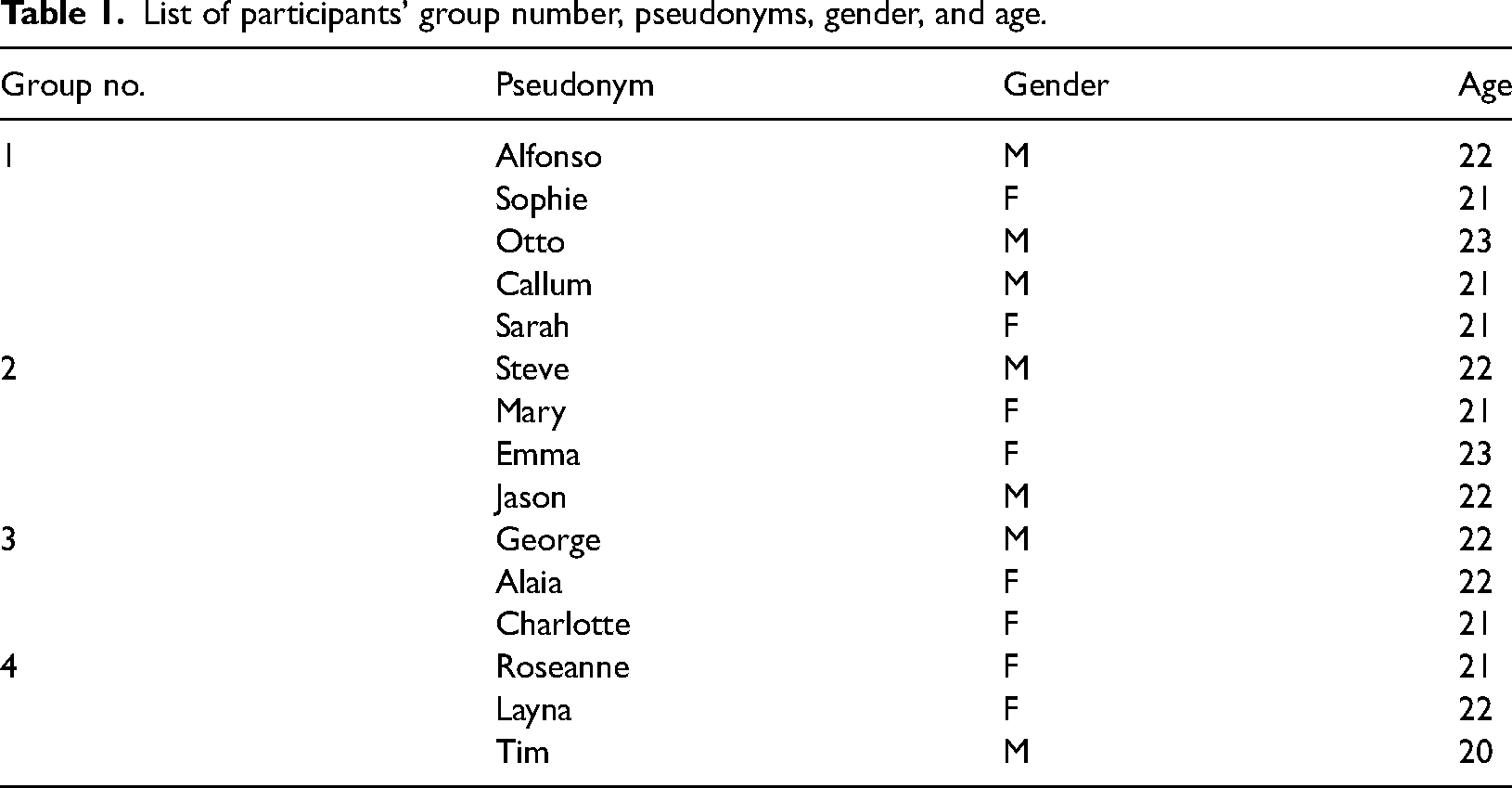
For each participant, on a ‘zoomed in’ level, we were interested in the platforms they used day-to-day, how conscious they were of their news consumption (Couldry, 2004), the role their real-life networks played in keeping them informed about updates in the news, and any novel methods they have for filtering information on their most frequently used platforms. On a more ‘zoomed out’, demographic level, we were interested in the preferences participants have for news versus non-news, how effective they perceive various strategies employed by institutions/platforms in aiding their information consumption during the COVID-19 pandemic, and how they avoided the news, if at all. The list of participants, who have been given pseudonyms to protect their identity, is displayed in Table 1. Following the focus groups, the main researcher (the post-graduate student) listened back to the recordings, transcribed them, and, in a collaborative process with two other researchers (their supervisors), inductively drew out common themes and patterns emerging from the participants’ responses. These themes were: lack of influence from traditional media, importance of social networks, active use of social media affordances, and encountering memes on social media.
List of participants’ group number, pseudonyms, gender, and age.
Findings
Lack of influence from traditional media
Participants rarely engaged with the news through traditional channels, and most common reasons for not engaging with traditional media in the context of COVID-19 were largely pragmatic and could be applied to their news preferences more broadly. In general, those that maintained intentional news consumption habits eschewed news aggregators and outlets for a wide range of familiar sources that were ‘to-the-point’. Notably, no participant cited reading traditional news articles as a significant way in which they were informed, with most of them preferring push notifications, podcasts, social media posts, and videos. Although each participant expressed their own distinct news diets, there were common motivations that saw them avoid traditional media, and were rooted in pursuing the facts, to avoid being inundated by anxiety-inducing analysis or predictions and obtaining this information in a format that was easy to access (see e.g. Westlund and Ghersetti, 2015). The lack of influence they saw in traditional media was exemplified by some of their statements: I still get notifications from the SBS App I have on my phone and if I see something interesting, I’ll go and read that. But yeah, I don’t really read the articles, just the little blurb. (Ruby) I think casually listening based on your individual taste is probably the healthiest way [to consume news], given the kind of intense state of things recently. But yeah, I never find that I go out of my way to really watch or read ‘the news’. (Charlotte) I chuck on podcasts and eventually you get bored of pop culture, and you throw on a news podcast. I hadn’t used that medium before, news podcasts, and I still use them as my go-to source. (Alaia) I think when you read websites like The Guardian, they’re trying to get you to read their article about it rather than just giving you the information as a dot point and that's all you really need. Do I need to wear a mask today? Yes, or no? I don’t think that necessarily requires an article. (Callum)
Callum's response above reflects a generational shift in attitude regarding what constitutes an ideal news source. Our participants were less focussed on notions of trust and any inherent values within the news, or news brands, and more concerned with the convenience and tone of how the news was delivered. In Molitorisz’s (2020) study, he found that there was a strong desire for the news to come from an authoritative ‘voice of God’. Such a preference was present in our younger participants in the context of the pandemic but saw them often go past trusted media sources altogether and go directly to the social media profiles of government officials and institutions. Many participants expressed a distinct preference for watching a short clip of the State Premier from the daily press conference, rather than reading a news story about that press conference.
1
Watching these daily press conferences, and going straight to the feeds of government officials, were the most significant forms of active news consumption many participants reported, even if these habits only temporarily emerged ‘to meet the moment’ of the crisis, as the participants’ statements exemplify: There were those live press conferences the state government would put on, where [former Queensland Premier] Anastacia Palaszczuk would be live streaming … I would watch them. I saw most of those. (Alfonso) If it's directly affecting me, obviously, I’ll seek out news about it. I’ll go to a government website mostly; they also do the press conferences as well, which were actually on Twitter, and I watched those. (Steve)
Participants felt it was easy to understand the clear instructions given by government officials around the pandemic, with no editorial distortions or unnecessary context in their communication to the public. Although traditional media provided a plethora of dot-point style summaries of this information, many participants consistently came back to getting the information directly from the government source. Understanding internal political efficacy as the biggest factor which drives news consumption, implicit in these responses is a higher degree of confidence in participants’ modelling of a government press conference or statement than the media's coverage of it. Where there might have been uncertainty in some participants’ conceptions of the media's analysis of government policy and the consequences of it, there was no ambiguity around the Chief Health Officer tweeting, ‘wear a mask today’: I followed Jeanette [Young], and she was so upfront with what she said, she's like ‘wear a mask today’. She's very direct as opposed to long news stories I didn’t want to read. (Sophie)
The preference for official spokespeople over the media occurred even in spite of participants’ most frequently used social media platforms giving a special status to both traditional media and government sources throughout the pandemic. Terrestrial broadcasters like ABC, Sky News, and Channel 7, 9, and 10, were helped by platforms like YouTube and X who signal-boosted their content in various ways: the ‘news’ sections of both platforms consisted almost entirely of these sources and pushed them to their home page. But in our focus groups, the primary beneficiaries of this signal-boosting of mainstream sources were clearly individual government leaders and officials. Participants might not have been engaged with these figures but would still get notified through social media platforms when they announced news – the supposed prescience of the information transcending whether the audience wants to consume it: They’d be live, and you’d get a notification. I don’t follow Anastasia [Palaszczuk] directly, but it would still come up on my phone. (Steve)
Some also cited the style of delivery from terrestrial broadcasters as adding to their stress in an already tumultuous time. Charlotte pointed to the difference in aesthetic between broadcast media and her community sources as a significant factor that drove her away from traditional media. The COVID-19 pandemic was, as she said, an ‘in-your-face’ story, and the ‘in-your-face’ tone of commercial television was only adding to her associated stress: Especially during the pandemic, everything was just so in your face, and I actually realised I was getting sensory overload from a lot of media sources when I woke up and went on my phone … Everything was plastered with ads and graphics, and I find that really overwhelming. (Charlotte)
Although the ABC was the most successful traditional media outlet in reaching the young adults in our focus groups, when reflecting on how they actively consumed news in crises, they more consistently cited government press conferences and statements, underscoring a sense of compliance in their media practice and the importance of internal political efficacy in characterising news consumption. Participants shared a distinct preference for convenience over context and this manifested in idiosyncratic habits that were often changing and with little personal preference for traditional media.
Importance of social networks
Outside of their family, many participants often pointed out the role their friends and online opinion leaders had in keeping them informed about the pandemic. The mechanism and context behind news sharing was different: participants seeing friends more often making public posts to their social media ‘stories’ rather than having their parents directly share information with them. A pandemic promotes outwards moralising and heightens the importance of prosocial activities – and sharing news to a personal story could be seen as an extension of the motivation for people ‘to do the right thing’ insofar as making potential news avoiders in their circle aware of the state of the pandemic. This finding corroborates Russmann and Hess's qualitative study (2020) into the media diets and trust in news of young adults in Austria, which highlighted the high trust participants placed on news being curated by friends, saying their ‘peers assume a journalistic function. Hence, news becomes ever more a part of social flow’ (p. 3197). Our participants concurred with this: I would get information from other people. For example, on social media … a lot of people are pretty proactive about it, like sharing case numbers and restrictions on that stuff and then I’ll just get it from them and then I’ll just double check with the website. (Otto) I follow people who have politically correct opinions and are really open to expressing their views on their story or timeline. I’ll read what they’re saying and then look up what they’re talking about. (Mary) It's often the same accounts I follow on Facebook who share news about COVID, and I’d find a lot of it through them. If there was a specific thing, I was like looking for I just Google and look at the ABC website or something. (Layna)
Although they might have a ‘news-finds-me’ mentality as mentioned in earlier sections, this did not necessarily mean they took everything that ‘found them’ at face value. In Layna's, Otto's, and Mary's responses, their exposure to news through friends was just the start of their consumption, whereby they sought to actively corroborate the information by ‘googling it’ afterwards. All participants were social media natives, and their more intimate understanding of the platforms than generations who did not grow up with them often resulted in not taking news distributed on social media at face value. This is also consistently reflected in survey data where although young adults are the highest users of social media as a news source, as a demographic they have some of the lowest trust towards it (Newman et al., 2021). Ku et al. (2019) found in their study of adolescents’ critical thinking about news that ‘adolescents who were sceptical about how algorithms select news for them on social media were more proficient in thinking critically when asked to reason about the news’ (p. 9). This finding is in line with our own findings: The problem with Facebook is its targeted algorithm, so it's specific to what you want and what actually you don’t want. So, if you see something very controversial, you will click on it. So, I think it's both the things that you want and the things that you actually despise. Because of that I try to stay away from social media information. (Otto) I feel like pretty much everything I see on social media, I’m like, oh, this could easily be bullshit. (Alfonso) I don’t really experience fake news on social media, more just like clickbait, advertisements and just like shitty articles. I scroll past all the news I see on Facebook. (Steve) I find a lot of news on Instagram because people I know will share things that they are passionate about or interested in and I’ll find out about it that way. But I don’t think that the people who share political posts always know what they’re talking about. (Emma)
The scepticism of participants towards the information they encountered from friends and opinion leaders on social media was further encouraged by routine exposure to partisan information. The vast majority of participants identified as centrist or centre-left, but representative across many of their friends list was a wide set of opinions and politics with their feed containing sometimes extreme material from both sides of the political spectrum. In their seminal study, Flaxman et al. (2016) quantitatively analysed the mediating role mainstream publications play in social media, and direct search in exposing partisan audiences to information from centrist sources. In the context of our focus groups, this dynamic was expressed inversely – the largely centrist participants distinctly remembered with disdain encountering news incidentally that they did not want to read from partisan members of their friends list: I get a lot of my news from Instagram … I’m not that political but it does not matter because I'll see a right-wing post from a member of my family and then I'll see my left-wing old housemate who's an informative activist who is posting things just because it's popular to do so. (Sophie) Yeah, I would say that's pretty common, I get a lot of my news through performative activism as well. I’m not an activist myself, but people will share politically correct things because they want to appear a certain way. (Callum) I always have two or three people that I'm friends with and they always just share, like heinous news stories and they're always opinionated. It's the same people always sharing some super politically charged shit and it always gets a lot of reacts. So that's what always ends up in my newsfeed, even despite the algorithm … It's not specifically what I want to hear. (Alfonso)
Participants’ real-life networks, represented digitally or otherwise, were often the most important starting point for how they consistently found out about the COVID-19 pandemic. Participants might have briefly practised active news consumption in a way they previously had not during the crisis, but for the majority, when the news most often found them, it was through stumbling upon what their friends were posting on social media or parents getting in contact. In their routine interactions on social media, they were saturated in media, and as such, news, and benefitted, as pointed out by Newman et al. (2017), from ‘a greater range of online sources’ (p. 15). They largely outsourced their surveillance of current events to their networks on social media, and sometimes actively investigated information when it raised their interest.
Active use of social media affordances
What constitutes ‘news’ is constantly changing (Schapals, 2022), and on social media platforms, it is not just articles shared by news outlets that inform people about what is going on. For our participants, the comment sections of posts were a valuable avenue for understanding the news and provided a familiar place for them to actively be involved in discussion. In the participatory spaces of social media, different narratives, emotions, and types of discourse occur than in the closed system of traditional media, and can be crucial in interpreting and ‘getting outside’ the story: I'll see the discourse in the comments and sometimes be curious about what's happening, then other times I'll think, ‘oh, I want no part of this’. But regardless, it's very clear to me that I don't know everything that's going on, that the story is all kind of murky. So, I'll often have to work backwards and look up what people are talking about and sometimes I'll go back to the comments and still have no idea – because that's just the internet. (Roseanne) Shit news.com.au articles are always bouncing around Facebook, and there's heaps of sponsored news posts, I’d say I encounter that a lot. I'd be way more likely to look at the comments of something like that. I would like a clickbait headline and not click on it, but I would like to check the comments of it and see what … old people on Facebook say about it just out of amusement. (Callum)
For participants like Callum and Roseanne, the comment sections offered a more organic jumping-off point for filtering and understanding a news post they may have been incidentally exposed to. As pointed out by Reich (2011), the comments and the story itself ‘are inseparable’ (p. 97), with the comment section proving for some users and specific stories ‘no less interesting than the main journalistic texts to which they relate or respond’ (Reich, 2011). On the two most popular social media platforms identified by participants, Instagram and Facebook, although they might not personally know the people in the comment sections, they still have access to information like their profile picture, name, number of likes/reactions on the comment, and its replies. There is a lack of context for audiences who stumble upon news stories on social media, and the comments may be unverified and subjective, but they do provide a more familiar social layer for aiding in interpretation and reducing information overload when encountering the news (Pentina and Tarafdar, 2014): On Facebook I remember I was friends with this person who was really strongly anti-vaxx. They'd post multiple paragraph-long comments responding to someone's pro-vaxx post and trying to figure out who was right was how I found out about some COVID news. (Mary)
For Mary, reading through an online argument was the foot-in-the-door for active investigation into information around the COVID-19 vaccines. Where she might have been uncertain in approaching the topic through a traditional news story, there is an implied level of comfort or preference in her unpacking the topic in the comments of Facebook that is worth analysing. The nature of the content in comments is more reflective of crowd sentiment, with the language often being more colloquial, opinionated, and to-the-point. Within these comments, there are also natural affordances such as the ratio of likes and reacts between comments, and display name and picture of a commenter, which provides a public-facing social dimension to consumption in this way. Although she might only use these comments as a starting point, later backtracking and directly searching for information, when it came to hotly debated, and polarising issues like COVID-19 vaccines, there was value for Mary in the familiarity, accessibility, and socialised nature of the comment sections.
Encountering memes on social media
Amongst our focus groups, participants often mentioned satirical internet memes as a way they remained informed about events, and also as a general content preference when on social media. Studies emanating from the USA have steadily tracked the distinct preference amongst young audiences for consuming news satire over other forms of news media. Yet rather than looking at memes in a societal or political framework, we were more interested in how participants individually perceived and engaged with memes in their day-to-day media practice and sought to unpack any preference they had for memes as a news source over traditional forms of media: The way I first heard about COVID was definitely through a meme. Like ‘Oh, funny, don't get it’. (Alaia) It's very targeted in a way because the content [on Reddit] is made-up of following a bunch of different subreddits. I don't really follow a lot of politicians or politics, but a lot of the content might relate to news through satire, and I’d found out about some COVID news that way. (Jason) I would say most memes I encounter aren’t that political, just really fucking dumb shit. But sometimes they’ll be referencing something in the news I don’t know about … especially in America, their political stuff I don’t really follow but will see jokes about. (Callum)
Entertainment and social reasons are bigger motivators for news consumption amongst young adults than they are for older generations who are more motivated by information-seeking reasons, although it is understood that many of these motivations overlap (Lee, 2013). Young adults, specifically ‘social natives’ as outlined by Eddy (2022), ‘tend to be less inclined to consume Coronavirus coverage. Instead, under 35 s are more likely to be interested in “softer” news topics: entertainment and celebrity news, culture and arts news, and education news’. The preference of ‘hybrid news’ that blends information and entertainment amongst young adults is acutely reflected in Emma's explanations of how satire played a role in her COVID news consumption: It's kind of embarrassing but I feel like I find out about news through satire stuff I see, like The Betoota Advocate articles and think ‘oh, what is this even about?’ and sort-of work backwards from there. (Emma)
As shown in survey data for the last 5 years, young adults have increasingly lower trust towards the news and often express criticism of the information they receive on social media platforms, and as such, the use of satire and memes as a news source (Newman et al., 2021). Emma's initial admission of feeling embarrassed by how much she uses satire as a form of news is set against the context of being in a focus group with three of her peers and highlights the social dimension in consuming ‘the right type’ of news. Her approach reflects a more active strategy of news consumption than many other participants – one in which she is incidentally exposed to a story via a satirical piece of content, and, if she does not understand the subject of the satire, explicitly seeks out information related to the story: I follow The Betoota Advocate pretty closely and honestly find out about most stuff through them. I'll just Google or YouTube the topic they're riffing on. I've been using YouTube more because sometimes I want to actually see footage of the people or event they're talking about. (Emma)
Satirical news is important, especially in the context of crisis as it facilitates meta-discourse during a time when it may be difficult to critically assess the narratives at-play and when government officials are strongly incentivised in defining the narrative and rhetoric around it (Achter, 2008). Although participants did not explicitly point to internet memes or satirical news in general as providing a cynical meta-perspective on the COVID-19 pandemic, their engagement with memes and acknowledgement of the importance they can play in information-gain is reflective of a varied and reflexive media diet that sit distinctly apart from traditional sources.
Conclusion
Through analysing how participants consumed news during the COVID-19 pandemic, a complex picture emerged of a demographic that simultaneously expressed as much a ‘news-finds-me’ mentality as a DIY approach towards filtering for information in the modern information sphere. Traditional media did not play a significant role in the way participants consumed the news. Instead, participants often learnt how to filter for information on social media in their own way, often utilising genres and affordances native to the platform to do so. This sees participants often engaging with information on social media platforms shared by someone they have a pre-existing relationship with and seek extra context in places like the comment section to aid in their interpretation. The motivating forces they hold in their social networks are also present on social media, and this is reflected in the way the content is curated on their feeds, with shareability and entertainment significantly shaping their consumption preferences.
Many of these findings closely align with and corroborate existing research on the COVID-19 pandemic and the way young adults experienced it. Our findings around the temporariness of the increased news consumption and subsequent avoidance strategies adopted as a means for well-being has been highlighted by Mannell and Meese (2022), Ytre-Arne and Moe (2021), and, most explicitly, in Groot Kormelink and Klein Gunnewiek's (2022) conception of the stages of COVID-19 news consumption. These studies effectively outline the explicit changes to broad news consumption as brought on by the pandemic, but this study specifically fills a gap by utilising the COVID-19 pandemic as a lens to see how young adults ‘met the moment’ of crisis, stepping up their news consumption in a way they otherwise would not, and, as a result of this, learning deeper truths about their relationship to the news.
Overall, users, overwhelmed with content choices, are decreasingly looking to once-highly-trusted media brands, particularly where those outlets focus much of their coverage on stories that may provoke fear and outrage (e.g. crime, or political ‘gossip’). Naturally, then, this raises questions for mainstream journalism offerings, too – not just on how to effectively serve young audiences, but particularly during times of heightened uncertainty, when information can appear both negative and repetitive. To counter negative news, research points to novel journalism genres, including so-called ‘constructive’ or ‘solutions’ journalism (Groot Kormelink and Klein Gunnewiek, 2022). Referred to as forms of ‘mental hygiene’ to boost psychological well-being, there is hope that stories that are either more positive in tone or point to specific solutions may help re-engage audiences and counter low media trust, but such genres have yet to see a breakthrough in the market (Nguyen et al., 2023).
Thus, while the COVID-19 pandemic likely did not cause a permanent change in how young people access and process news content, it may have temporarily accelerated a process that preceded it – a process which continues now, whereby people are disengaging from traditional forms of news, and are instead creating their own informational assemblage using the technological affordances of social media. This process may be shaped to a significant extent by the algorithmic moderation decisions made by individual social media sites (e.g. Facebook deciding to close its ‘news’ tab in response to pressures to pay the relevant content providers; Bruns, 2023), which raises questions about the power and transparency of those platforms. Further, given the extent to which even high-quality journalism has lost a significant amount of status in news and informational hierarchies – to the extent that those hierarchies still exist at all – the role of ‘influencers’, and other online-only content creators who do not label themselves as ‘journalists’, is greatly heightened (Schapals, 2024). As such, these phenomena should play a much more central role in how we study contemporary news consumption.
Footnotes
Author note
QUT is the institution where the research was conducted. However, Maxwell Forbes Melit has since moved to RMIT.
Declaration of conflicting interests
The authors declared no potential conflicts of interest with respect to the research, authorship, and/or publication of this article.
Funding
The authors received no financial support for the research, authorship, and/or publication of this article.
Ethical approval
QUT Research Ethics Committee (approval number LR-4691).
