



Abstract
Audiences can now access news anytime, anywhere and news spreads faster than ever before. This gives news a much broader role, amplifying and supporting social connection and knowledge acquisition. This study explores actions New Zealanders take after consuming news through the lens of uses and gratifications theory. Twenty-five participants kept a weekly diary of their news consumption and discussed actions they took following news consumption. Statistical analysis showed all participants took at least one action, including discussing news in person, sharing news online, seeking further information, or making a decision. Younger participants were more likely to share news with their friends or seek further information; the older cohort was more likely to share news publicly. The findings suggest that after consuming news, audiences may have subsequent needs and seek further gratifications, potentially leading to a second order of gratification within uses and gratifications theory.
The digitalisation of news has changed how audiences interact with news and what they do after consuming news. Audiences can now access larger volumes of news across many formats, faster than ever. Audiences have a broad conceptual understanding of news (Ekström and Westlund, 2019; Hendrickx and Vázquez-Herrero, 2024) and can specify items as news, when compared to other information (Edgerly and Vraga, 2020). As such, news can include social media, information sources and news aggregators. Compared to news consumption via newspaper or television, audiences can respond faster to news by taking actions online or in person (Li, 2014; Papathanassopoulos, 2011).
Scholars have explored what motivates audiences to choose media, and to take actions including sharing news, participating in online discussions, researching more on a topic or taking civic actions. Online sharing and commenting allows audiences to participate more in the news process (Heinonen, 2011; Holton et al., 2014; Karlsson et al., 2015; Weber, 2014). This paper explores the actions people take following consuming news, with a focus on the motivations that drive these actions within older and younger cohorts.
Scholars have used uses and gratification theory to study the needs that motivate people to consume news and the gratifications they receive (Dafonte-Gómez, 2023; Pantic, 2020; Van der Wurff, 2011). Studies have examined the sharing of news on social media channels (e.g. Lee, 2013; Segado-Boj et al., 2019) and news consumption by age categories (Boczkowski, 2010; Lee and Ma, 2012). This study used the lens of uses and gratifications theory to explore actions audiences took after news consumption and why they took these actions. Qualitative research was carried out with a sample of New Zealanders, with a focus on comparing actions taken by the younger and older cohorts. This data was gathered in September 2022, at a time of the death of Queen Elizabeth II, the constitutional head of New Zealand. Her passing after a 70-year reign was a significant global news event and resulted in public displays of mourning. Ten days after her death, Queen Elizabeth II's funeral was the most-watched broadcast event ever, watched by 4 billion people in over 200 countries (Jackson, 2022).
Audiences seek news to meet their needs
News has always provided useful information based on people's needs, which is then shared through societies. Audiences notice, receive, find, read, share and store news, which is often factual information produced by journalists (Oh, 2023; Schudson, 2001). Uses and gratifications theory assumes audiences’ media selection is goal-oriented, purposeful and driven by a desire to meet their needs such as surveillance of their environment, seeking information and keeping up with others (Katz et al., 1973; McQuail et al., 1972). The theory focuses on the needs audiences have when they are choosing media choice and that they are aware of their uses of media. Audiences will seek and obtain gratifications from their media use – and the gratifications obtained may not be the same as those sought (Hartmann, 2009).
Uses and gratifications theory can explain how individuals use mass communication to gratify their needs, to establish motives for media use and to identify positive and negative consequences of media use. Media use can serve cognitive needs, affective needs, personal integrative needs, social integrative needs and escape needs or cathartic needs (Katz et al., 1973). If these needs are not being met, audiences may change the source and format of media. Conversely, news sources will create new formats and content to compete against each other to meet people's needs. This competition is evident in today's news environment, where audiences can access many sources and formats of news.
Impacts of sharing news
Audiences consume news and actively participate in it (Purcell et al., 2010) by discussing it in person, sharing, or engaging with the topic online. The sharing of news assists knowledge acquisition and supports public connection, which is defined as: ‘the various shared frames of reference that enable individuals to engage and participate in cultural, social, civic, and political networks in everyday life’ (Swart et al., 2017: 906). Audiences discuss topics they have in common and ‘media-stimulated interpersonal communication’ (Rogers, 2000: 572) describes conversations in which the mass media is the primary stimulus of the conversation.
New technologies enable news to be shared widely and at speed, increasing its value as a social connector. Sharing news online is: ‘the practice of giving a defined set of people access to news content via social media platforms, as by posting or recommending it’ (Kümpel et al., 2015: 2). Social media platforms enable users to identify others, share content, comment on items and communicate privately. Scholars have explored how news sharing meets needs such as: seeking information, staying socially connected (Karnowski et al., 2018; Picone, 2016), changing others’ opinions, presenting themselves positively (Wong and Burkell, 2017), helping others (Boyd et al., 2010; Holton et al., 2014) and for entertainment (Lin and Lu, 2011). News experiences on social media platforms have been described as personalised, incidental, non-exclusive, granulised and social (Kümpel, 2022). The fragmentation of the news environment means not everyone has the same news at the same time, so this has increased the need to share information.
As a social connector, audiences can share news and their reactions for emotional purposes (Choi and Toma, 2014; Harber and Cohen, 2005; Rimé, 2009). Audiences choose communication channels to meet their emotional needs, depending on the valence and intensity of the events they experience. They may receive emotional and cathartic value from their sharing (Ibrahim et al., 2008), leading to a positive benefit to their emotional well-being (Choi and Toma, 2014). The sharing and discussing of news can also be merely to maintain social cohesion (Duffy and Ling, 2020). Phatic news sharing is where news is shared to ‘create social rapport rather than to convey information’ (Rettie, 2009: 1135). The motivation is the process of sharing and forming or maintaining a social connection (Costera Meijer and Groot Kormelink, 2021; Swart et al., 2017), and it includes where audiences share information online without reading or processing it (Ward et al., 2022).
Sharing online can have positive and negative results. Audiences can be more engaged in public forums and policy debates (Vaughan et al., 2018), more active in civic affairs (Gil de Zúñiga et al., 2012) and engage in reciprocal social processes (Holton et al., 2014; Oeldorf-Hirsch and Sundar, 2015). These benefits depend on the perceived credibility of the information, as items considered fake news may lead to negative impacts (Vosoughi et al., 2018). Audiences may also have lower levels of trust in the shared information, when compared to the original news source (Lee, 2020; Newman et al., 2021; Park and Lee, 2020; Park et al., 2021). As well as sharing and reading news from others on their social media platforms, audiences may also have content pushed at them, sorted by algorithms based on their previous news consumption routines. This impacts their consumption of news, as certain types of content may gain more prominence and frequency (Swart, 2021).
Audience needs such as information seeking, socialising and status seeking can increase the likelihood of sharing news on social media platforms (Lee and Ma, 2012; Park and Lee, 2020). A study of YouTube viewing and sharing motivations by Hanson and Haridakis (2008) found sharing was driven by interpersonal motivations. In particular, if the news was in a traditional format, viewers shared it for informational reasons and news that was comedy was shared for entertainment value. When individuals share news they consider their past social media sharing experiences (Lee and Ma, 2012), their desire to interact with the topic (Martin and Dwyer, 2019; Trilling et al., 2017), their needs for social gratifications (Bakshy et al., 2015; Krishnatray et al., 2009) and what they think other people are interested in (Ihm and Kim, 2024). Receivers’ perceptions of trust in news can be influenced by who shared it rather than the original source of the story (Fisher, 2016; Sterrett et al., 2019).
As news outlets compete with each other for audiences, many journalists use viral journalism to promote news stories to gain maximum exposure and sharing (Denisova, 2023: 120). These tactics include using emotional triggers, being relevant and original and using visual clues to highlight articles that can be shared (Bright, 2016). This has also led to shareability as a news value, reflecting how journalists select stories based on their ability to result in sharing and comments (Harcup and O'Neill, 2017). Sharing news has also increased audiences’ expectations for timeliness and relevance of news (Ilan, 2021; Van Damme et al., 2015). A study by Weber (2014) found links between news factors, as defined by Galtung and Ruge (1965), in the news items and the level of engagement and interactivity with the comments on those items. Increased news sharing, both online and in person, amplifies news consumption, enabling news to spread much wider and faster, resulting in further actions.
Different cohorts’ use of sharing news
Younger audiences, such as Gen Z (those born between 1997 and 2013), have had access to the internet and social media throughout their lives, increasing their accessibility to news (Boczkowski, 2010). They seamlessly integrate the digital and physical worlds and receive news from many platforms (Stahl and Literat, 2023). They are less likely to go directly to a news site or app and more likely to use social media or other intermediaries (Newman et al., 2023). They often consume news on more than one device (Lowenstein-Barkai and Lev-on, 2021) and are active media consumers within their social and cultural environments (Lancaster et al., 2012).
The shifts in news consumption habits are related to young people's motivations and stage in life. Lee's (2013) study found age was the most consistent predictor across four motivations for news consumption: information, social needs, entertainment and opinion motivations. This study suggested there was a divide in motivations for news consumption. Older participants were more likely to consume news for information and opinion purposes, and younger adults were more likely to be motivated to consume news for entertainment and social reasons. Young people value current information about their world and want to engage with their peers (Bengtsson, 2022; Tallam, 2021). Klopfenstein Frei et al. (2022) found incidental news consumption via social media decreased with age; people used more specific news apps and channels as they got older. Scholars have examined whether women and men have different needs for sharing information. Women are more likely to express their opinions subjectively, express emotions and emphasise social connections than men (Lin and Wang, 2020; Zhang et al., 2013).
Researching New Zealanders’ actions from news consumption
The ability of news to connect people and communities has significantly increased with new technology forms and social media platforms. This research aims to understand what actions people take following news consumption, with a particular focus on a group under 26 years of age and a group 26 and older. This is because from late teens to early 20s is a time that audiences form media routines (Antunovic et al., 2018; Costera Meijer and Groot Kormelink, 2021).
This study used New Zealand audiences to explore these questions. New Zealand is a Western democracy with approximately five million people. The news media market has several organisations with large audience share (including government-owned television and radio) and many small independent outlets (Baker et al., 2023). New Zealanders are consuming less news from traditional media, more from digital media, and have lowering levels of trust in news (Ministry of Culture and Heritage, 2022; Myllylahti and Treadwell, 2024). New Zealand media organisations are facing increased competition from international news sources, declining revenues from advertising and significant changes to audiences’ news consumption habits (Ministry of Culture and Heritage, 2022). New Zealand was suitable for this study as participants were exposed to the same news media environment.
This study wanted to see if New Zealanders were expanding their news consumption with further actions and why. Thus, the following research questions are put forth:
RQ1: What actions do New Zealanders take after consuming news? RQ2: What needs are being met with these actions? RQ3: What are the differences in these actions between younger and older age groups?
Method
Participants and procedures
This study used focus groups and diaries, alongside open coding, to explore the concepts of news and its uses and to enable a broader discussion. This approach was chosen to explore existing theories but also allow for audiences to discuss widely their approaches to news (Croucher and Cronn-Mills, 2019).
The study had a total of 25 people who participated in focus groups and were asked to complete a media diary for one week. In the focus groups, participants explored their definition of news, the news sources they use, what they do with news and any emotional responses they had to news. The participants, chosen through a research company to achieve a range of participants across ages, gender, geographical locations and ethnicities, had previous experience with online focus groups. The participants received a small incentive to take part in the study.
Data was collected on demographics (age, sex, ethnicity and level of education), time spent on news sources each day, and the most used media source. The focus groups each had older and younger participants. In total, there were 13 men and 12 women, with 9 participants aged 26 years and under, and 16 participants aged over 26 years. The split was chosen to identify differences between the young cohort, who are transitioning to adult life, and the older cohort, who may have more established media habits. The ethnicity makeup was 15 New Zealand European, one British, three Asian, four Māori and two Pasifika. All information was collected in line with the appropriate privacy and ethical standards. This study complied with appropriate university codes of ethics.
The diaries covered the period from 6 am Monday, September 5, 2022 until 11.59 pm Sunday, 11 September 2022 and participants kept a diary of their news consumption in hourly units. Participants recorded what news they used, when and whether they took action as a result of news, and this information was used to support their participation in the focus groups. On the diaries they listed the time, source and topic of their news consumption. The diaries formed the background for the focus groups as they made it easier for participants to recall their media consumption and actions. Two participants were unable to complete the diaries due to changed personal circumstances but still attended the focus groups.
Overall, the diary information was collated by person, time and date and news source. Each item was listed against the specified time, and if more than one source was listed, these were listed at separate times. The categories of news sources used were: traditional media New Zealand, traditional media international, social media and new media. The definition of traditional sources was journalism news sources, in New Zealand and overseas. Social media included platforms where people could connect and comment, and new media included other channels such as YouTube and Telegram. Each time was considered as a unit. The units were totalled for each person, for each news source and for each day. The news sources by person and day were converted to percentages for each person, and then averaged over the week to normalise the data and manage a participant's strong liking for a news source. Items were only analysed if there was a specific news source or type mentioned.
There were five focus groups of five people, with a mix of ages and genders in each group. The focus groups were for 1.5 hours and took place within 2 weeks of the diary collection week. In the sessions, participants were asked what they considered news, where they got news from, the actions they took as a result of the news and what emotions they experienced. All the interviews were recorded and transcribed. The results were sorted into audiences’ definitions of news, actions from news and feelings/emotions from news consumption using statistical analysis. The focus of this study is on the actions that people take after consuming news. From the focus groups, 112 comments were collated and the data were coded by inductive thematic analysis. If a comment had two characteristics (e.g. news was shared in several ways), it was included in two categories. The comments were re-checked against each participant to see how many actions they took as individuals. Finally, the comments were also sorted based on the needs of the uses and gratification theory: cognitive needs, affective needs, personal integrative needs, social integrative needs and escape needs or cathartic needs.
Results
Actions taken following news consumption
The first research question explored what actions New Zealanders took after consuming news. Analysis of the new consumption diaries showed participants listed 63 news sources and 648 units of consumption over the week. When the units of consumption were analysed by the categories of news sources, 73% of the items were from traditional New Zealand and overseas journalistic news sources, 18% of the items were from social media, and 9% of the items were from new media sources. A breakdown by age cohort showed that more than half (56%) of the news consumption by the younger cohort was from non-traditional news sources.
The diaries and focus groups had specific findings in relation to the news coverage of Queen Elizabeth II's death. Many participants discussed how it was a major news event with significance for New Zealand. The results showed high news consumption when this news was announced on the Friday and increased consumption of international news sources from Friday to Sunday, when compared to the other days.
From the focus groups questions on participants’ actions following news consumption resulted in 112 comments. These were coded and grouped into eight categories: discussing news with friends and family, discussing news with other people, seeking more information, sharing news online publicly, sharing news online with friends and family, making a decision, reading comments and contributing to comments (see Table 1). The comments were also categorised by each person. Out of the eight categories of actions found, 15 people took between three and five actions following their news consumption. The other 10 people did either one or two of the actions.
Categories of actions following news consumption.
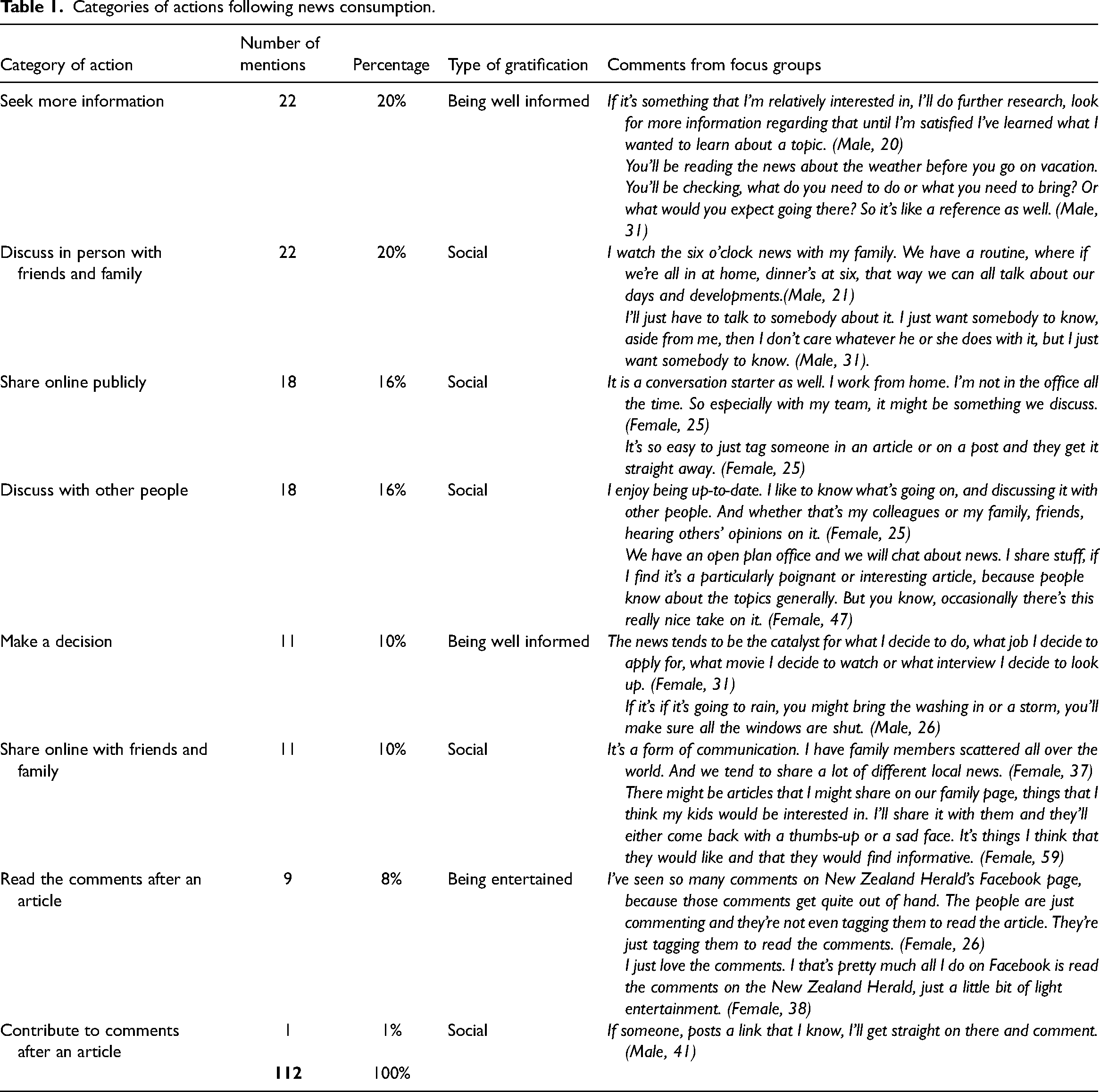
Over one-third (36%) of the comments related to discussing news in person with friends and family (20%) or with other people (16%), showing the role of news in enabling face-to-face communication. The comments reflected motivations for sharing knowledge, building and maintaining social connections, and being altruistic in caring for others. Several comments related to habits formed during the COVID-19 pandemic to pass on news to keep people safe, for example, one participant always checked his father was current with the news because he was not on social media. For dad, it’s making sure. If he misses the six o’clock news, he doesn’t have an outlet, he's not on Instagram, or Facebook, or anything. So I have to tell him things like ‘the rules have changed: you don’t have to wear your mask’. (Male, 24)
As this research was immediately following the news coverage of the death of Queen Elizabeth II, it led to sharing for emotional purposes, for example, one participant shared the news immediately with all of her family to make sure they had heard. Another participant discussed the negative news framing of a segment of Prince Charles’ actions at Queen Elizabeth II's funeral with a friend. He subsequently changed his view on this issue after he and his friend discussed reactions to grief.
Timeliness was a factor, ensuring friends and family had information at the right time. Participants discussed news in person with people outside of their closest social circle, including work colleagues and neighbours. One participant, a healthcare assistant in a retirement home, described reading the news to residents as a way to stimulate discussion. Participants used news for social interaction as phatic communication to assist people with their lives. There are articles I share on our family page that I think my kids would be interested in. I’ll share it with them, and they’ll either come back with a thumbs-up or a sad face. These are things that I think they would like and that they would find informative. (Female, 59)
Approximately one-quarter of the comments (26%) were regarding sharing information online. Participants shared news online on social media platforms, either in public, via a private message, or via a private group chat with selected friends and families. The purpose was to pass on information they thought was relevant and timely for others, based on understanding the recipient's needs and interests. People discussed sharing significant news items as well as items like cooking tips and sports news. One participant discussed how she used sharing for political purposes. Mostly, I share things that might be a political statement about where I sit. If it’s something that's important to me and if I agree with what the person is saying, and I’ve read it thoroughly, I might share it on my Facebook page. So it’s me making a statement that I agree with it. (Female, 47).
Almost a third of the comments concerned knowledge acquisition, with participants doing further research (20%) or making a decision (10%). The motivations were to increase their knowledge, find out if something they had consumed was correct, find other information on that topic (e.g. different viewpoints), or find information to make a decision. There's so much fake stuff on TikTok. That makes you question everything. That’s why I have been doing my own research. When I hear something that’s news to me I consider that news, but I also have to do the research behind it. (Male, 22)
Participants used news to assist with day-to-day activities such as traffic decisions, weather discussions, and participating in activities, as well as for broader society decisions such as who to vote for in elections.
The last 9% of the comments concerned reading or contributing comments at the end of an online news article. Participants said they enjoyed reading the comments to get different perspectives or for entertainment, as they often brought humour to a serious issue. Only one person said they contributed to the comments.
Needs that drive actions following news consumption
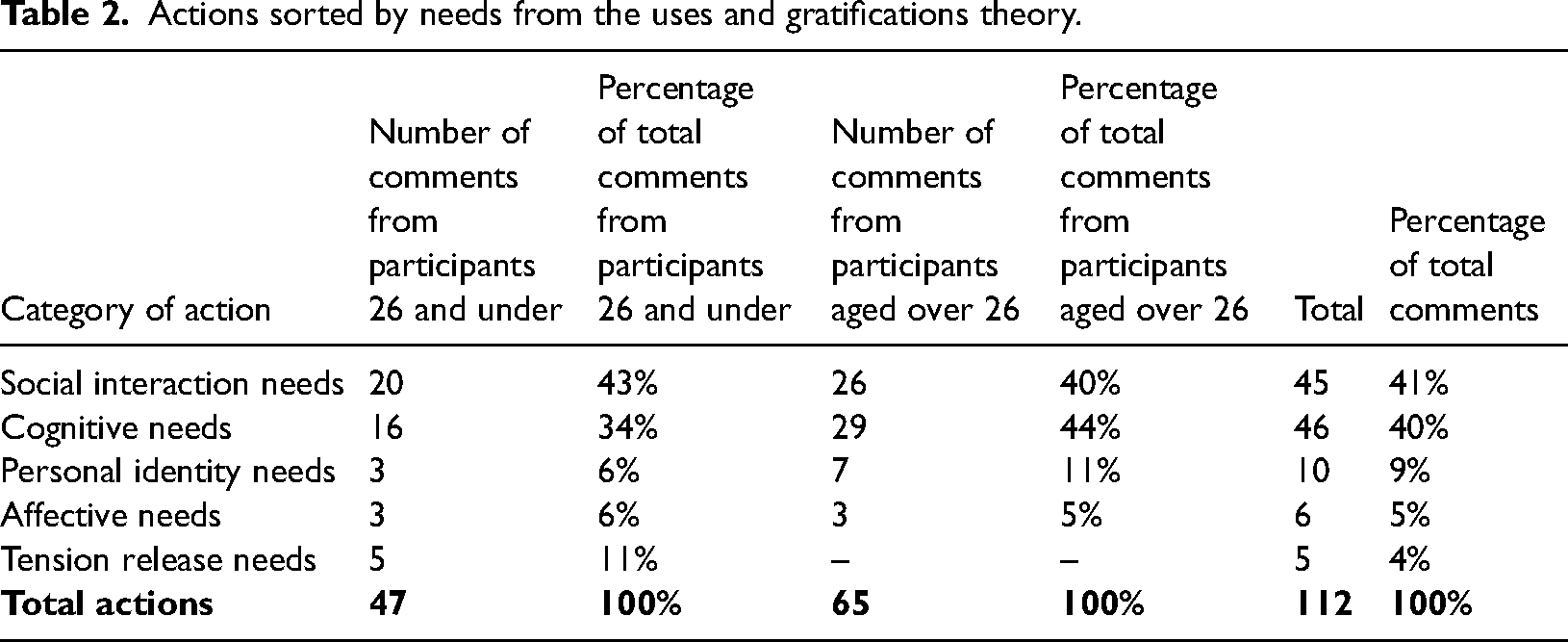
The actions following news consumption were sorted by the needs identified in uses and gratification theory: cognitive, social integrative, personal identity, affective and personal release needs. This showed the actions were predominately based on cognitive and social needs. There were slight differences in the cohorts, with more comments relating to tension release and affective needs mentioned by the younger cohort (Table 2).
Actions sorted by needs from the uses and gratifications theory.
Differences in actions by age and sex
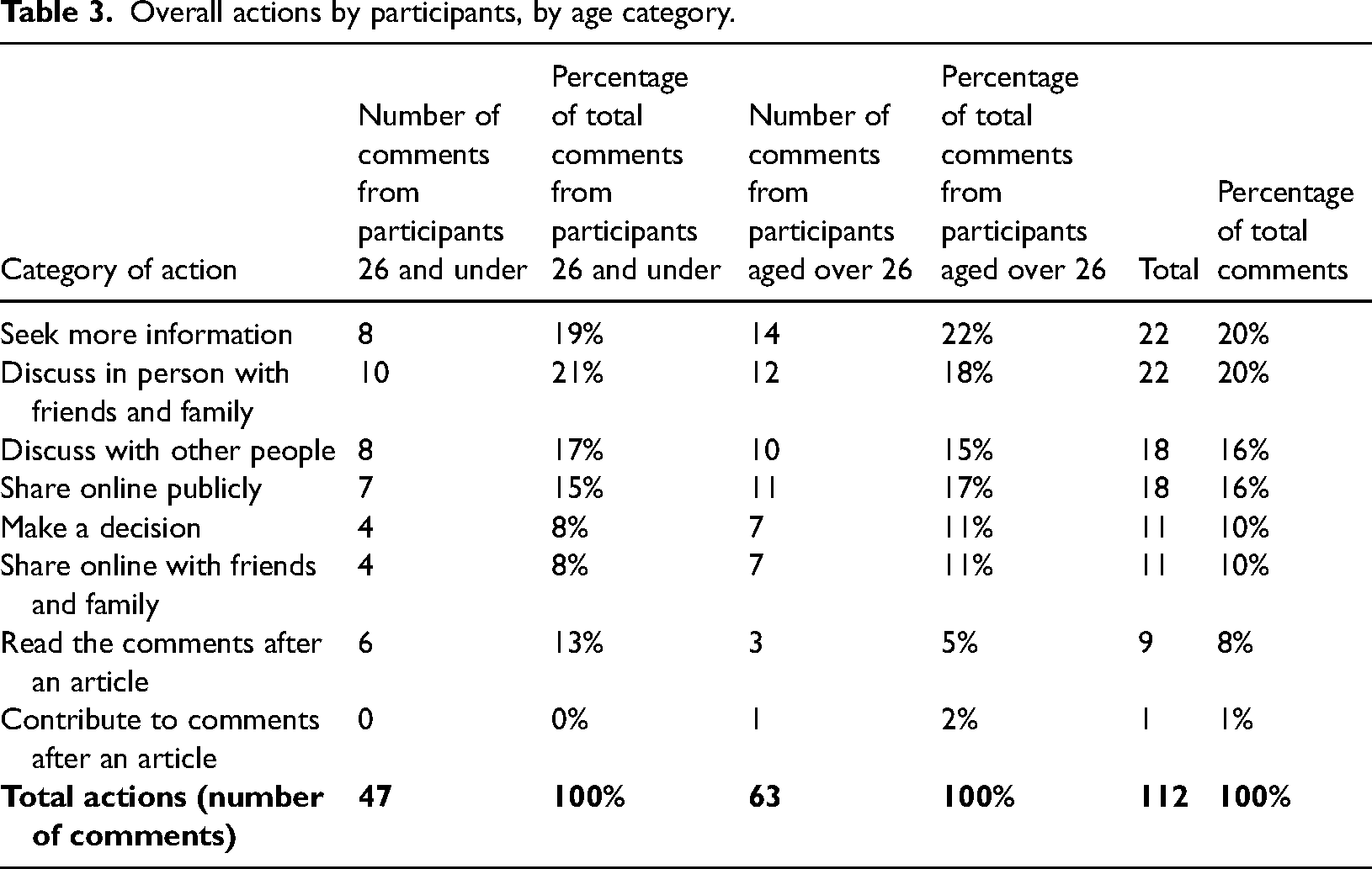
The third research question explored the differences in these actions between younger and older age groups. Analysis by the age groups shows the group aged 26 and over was more likely to share news online publicly and seek out more information. Those aged 26 and under had high percentages for discussing news with friends and family, and with other people (Table 3). They were less likely to share news publicly than the older cohort. This difference was illustrated by this participant who described different groups for sharing online information. The younger ones tend to share more funny social, TikTok items, but then the older ones tend to share more about news that is relevant to our lives. (Female, 37).
Overall actions by participants, by age category.
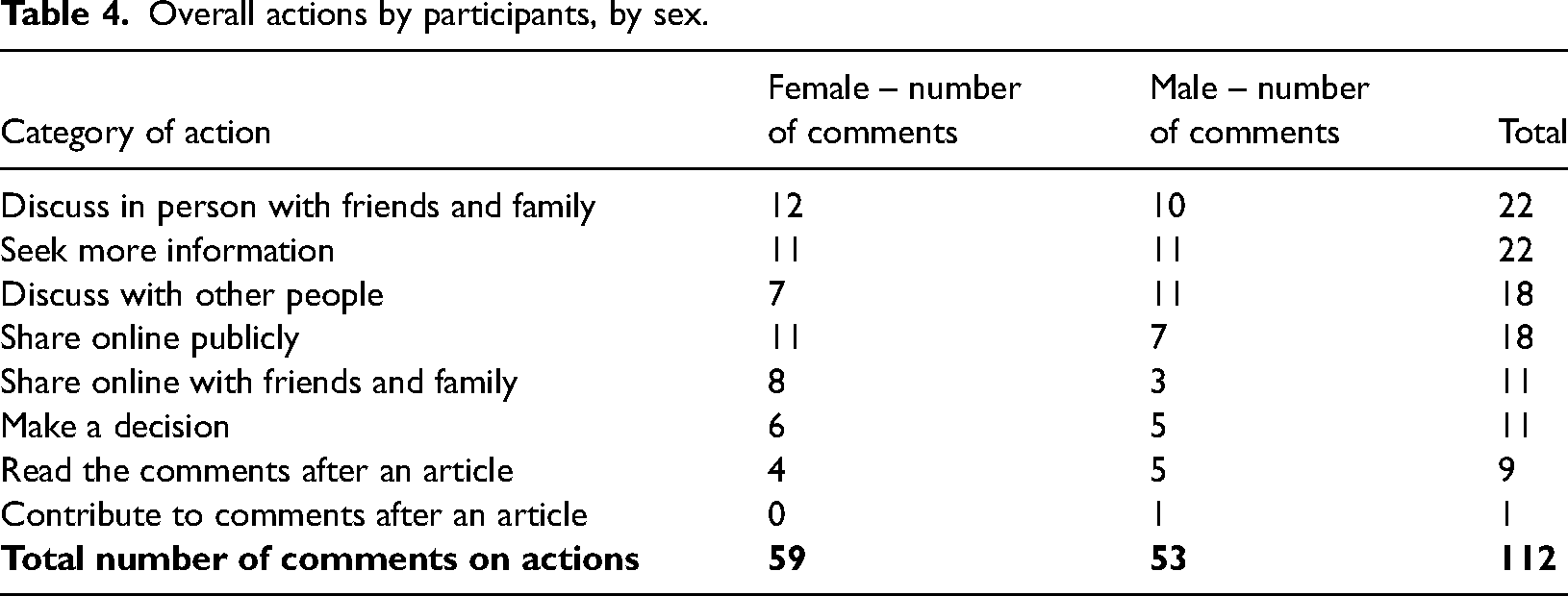
Analysis of the actions by sex (Table 4) shows a higher number for comments on actions to share news with friends and family and to share news online for female participants, when compared to male participants. Overall the results were similar, but the results indicated females shared news more online than male participants.
Overall actions by participants, by sex.
Discussion
The categories of news sources used were: traditional media New Zealand, traditional media international, social media and new media. The definition of traditional sources was journalism news sources, in New Zealand and overseas. Participants were asked to self-define news in their consumption, and the younger cohort's definition included a wide range of non-traditional news sources. This aligns with research that shows younger cohorts have a definition of news that is broader than journalistic sources.
The study indicates overall that news consumption leads to further actions, and, in many cases, supports social connection. All participants took at least one action, and most (19 participants) discussed news in person with other people. These findings align with uses and gratifications theory that users seek out news to meet their needs for information and social connection. However, there were differences in the way the younger and older audiences accessed and used news, reflecting their motivations. The older audiences were more likely to share news publicly, give their opinions and seek out information. Younger audiences were more likely to share news with their friends and family or discuss with other people. This aligns with Lee's (2013) study showing young adults are motivated to consume news for entertainment and social reasons.
This study suggests two findings to extend discussion on needs that drive news consumption. The first is that the need for social connection is the main driver in the sharing of news, particularly for the younger cohort. Audiences’ primary need for using news for information has expanded to seeking information that also supports social relationships. The second finding suggests a second level of interaction can be added to uses and gratifications theory to have a broader view of news consumption.
Social needs drive sharing and discussing of news
Technological advances mean there are now increased ways of using news for social connection needs, for example, in person or online, with people's close family, or with people they have never met but with whom they share a mutual interest. Participants discussed that news gives people something to talk about and helps make people feel part of a community. By sharing news, people could do good in the community, assist with local problems, and ensure people had the information they needed in their lives (e.g. traffic information, safety information). They could also entertain, keep others up with trends, or have an in-depth discussion. Social needs were also met through phatic news sharing (Duffy and Ling, 2020) when people shared news because they thought the recipients would be interested but it did not matter if they read the full item. This sharing was based on the relationships people had with each other and their understanding of why they were receiving information. This relationship impacted the receiver's credibility of the item, aligning with Sterrett et al.'s (2019) study.
Social connection was also evident in answering the second research question of differences between the younger and older age groups in their actions after consuming news. The younger group's highest percentage was with social connection, and they had more actions relating to meeting tension release and affective needs. Younger participants discussed news within their social circles but were less likely to share news publicly. This aligns with Tallam's (2021) study showing young people's greater use of digital and social media platforms means they want to be constantly up-to-date with current news and connect with their peers. Costera Meijer's (2007) study found that young people used news as an incentive for a chat with friends, including bizarre, funny and abnormal events.
Women in the study were more likely to be social with news: sharing it with friends or family, sharing it publicly, and discussing it with friends, whereas men were more likely to discuss news with others outside of their friends and family. This aligns with studies that show women are more likely to share for social connections than men (Lin and Wang, 2020; Zhang et al., 2013).
Proposed secondary order of uses and gratifications process
The second finding of this study is the suggestion that a second level of interaction can be added to uses and gratifications theory to have a broader view of news consumption. This study indicates that audiences may have further needs after consuming news and take actions such as sharing in person, sharing online, seeking more information or making a decision. These needs are similar to the fundamental needs of the uses and gratifications theory and have resulting gratifications. People have always discussed news in person and via other methods, but this has been amplified by the digital changes over the past 20 years. Audiences’ constant connection to mobile devices for many daily activities has made these actions quicker and easier, and expanded the actions people can take. Immediately after news consumption, audiences can share news in person, share or discuss news online, research further information (e.g. a new traffic route following bad weather), or purchase something they have read about. Aside from discussion in person, all of these actions can be done via their mobile devices.
When applied to news consumption, uses and gratifications theory could now be viewed as a two-order process: the first order of gratifications is from the initial news consumption to meet needs, and the second order of gratifications is the actions that follow to meet further needs. For example, people may search for news for cognitive needs, and then need to share that news with others, to maintain and support social connections. This study recommends that the practice of news consumption includes the initial action of consuming news and receiving gratifications, the subsequent audience actions and gratifications and the relationship between these actions. It indicates differences in these actions between younger and older cohorts, meaning audiences’ news consumption habits are evolving with new forms of news and new platforms (Figure 1).
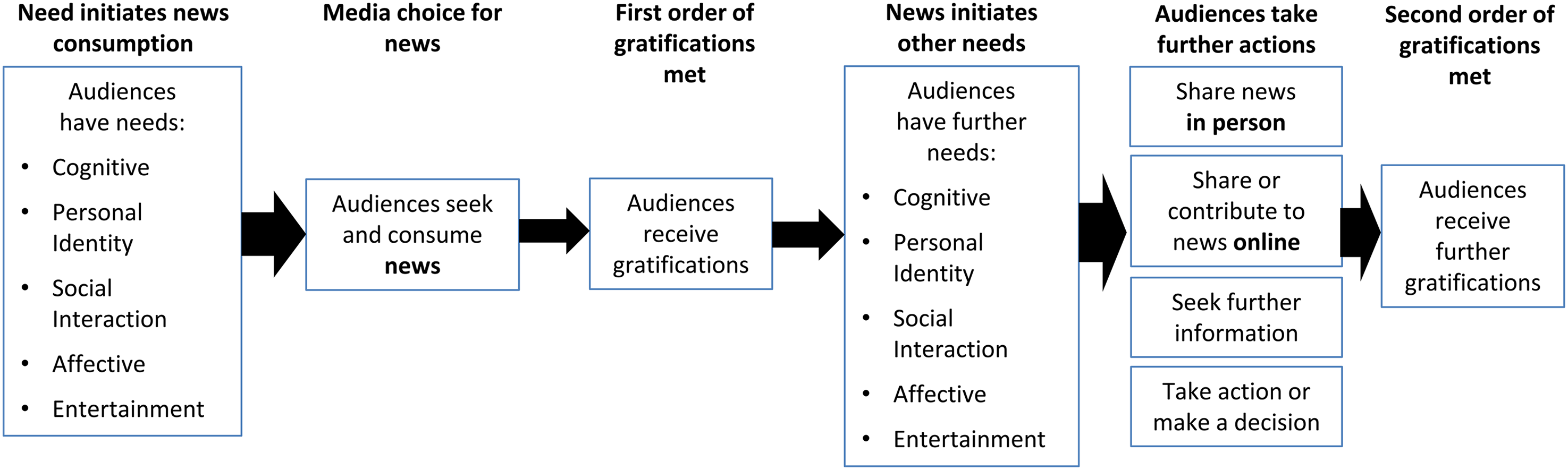
Actions following news consumption.
This finding has implications for journalism in ensuring its information is relevant, digestible, shareable and relevant to people's needs. It also supports news products encompassing a wider range of information and formats to meet people's information and entertainment needs.
Limitations and conclusion
This study explored the actions people take after news consumption and how these actions differ by age cohort. It found that, overall, people took action after news, to look out for others, maintain social connections, seek further information, or make a decision. These categories align with the framework of uses and gratifications: audiences seek out news to meet their needs and receive gratifications, such as being informed and being connected to others. With technological advances and more sharing news online, the news consumption process has become more involved, and is not only the consumption of content but also the actions that follow. This could signal an expansion of the uses and gratification theory so it has two orders: the order of news consumption and the second of the action that follows, where the audience has further needs and seeks further gratifications (e.g. the need to discuss the news with friends and family). Audiences’ needs in the first order may not be the same as the second order.
This study has limitations due to its small sample size of 25 participants living in New Zealand. Participants’ recall of their media consumption may have been impacted by selective memory, misreporting, exaggeration, or different semantic interpretations of the requirements. Given the limitations of this study, further research would be needed with a wider group to analyse how the needs in the first order link to the needs in the second order.
News serves a vital communication purpose in our society by giving people the information they need for their daily lives and for broader participation in society. This study indicates that the news flow has been extended, with many people passing on information to others, in person and online. This alters the concept of news consumption as the news dissemination continues, and the item may change as it continues to be communicated. This study indicates news consumption may be a much broader practice than only receiving news; it enables essential social connection and knowledge acquisition in our societies. These findings have implications for those producing news to make news that is of value to audiences and news that they may want to share and take action on.
Footnotes
Declaration of conflicting interests
The author declared no potential conflicts of interest with respect to the research, authorship and/or publication of this article.
Funding
The author received no financial support for the research, authorship and/or publication of this article.
