




Abstract
Negativity in the news sells, but is such news also perceived as more credible and shareworthy? Given that negative information is more impactful and processed more easily, a positive-negative asymmetry might also exist in news processing. This negativity bias is explored in a two-part experiment (N = 696) where respondents rated (a) multiple positive and negative news items and (b) conflicting news on perceived credibility and shareworthiness. Results reveal no straightforward patterns: Audiences only hold a negativity bias in their credibility assessment under certain conditions, and even less so when it comes to sharing news. When confronted with conflicting information, audiences do not seem to use negativity as a cue to determine which news to believe or share.
Introduction
What makes news credible and shareworthy? This question is ever more relevant in a news environment rife with a practically endless supply of information sources (Van Aelst et al., 2017) where the veracity of information is no longer self-evident due to the spread, either intentional or unintentional, of false information (Bennett and Livingston, 2018). Being able to form accurate beliefs based on credible information is at the heart of the construction of rationality as well as the functioning of democracy (Pennycook et al., 2018). Therefore, it is important to understand how news consumers assess the credibility of news they encounter and why they share certain information.
News value literature has extensively investigated what type of events and stories make it into the news (Galtung and Ruge, 1965). Stories gain most news attention when they, for example, have a negative tone, focus on elites or specific countries, and are geographically and culturally closer. However, we know little about whether such news values also make stories generally more credible and shareworthy in the eyes of news consumers. In a first explorative step, this study focuses on one of the most prevalent and prominent news value, namely a “reference to something negative”. Extant literature has already documented a negativity bias on the supply side of news, where media pay disproportionate attention to negative stories (Van der Meer et al., 2019), as well as the demand side of news, where audiences have the tendency to select negative over positive information (Knobloch-Westerwick et al., 2020). Since negative stories are more likely to be covered in the news and selected by audiences, a learned association between negative valance and subjective credibility might be fostered. However, such a negativity bias in audience’s perceptions of credibility and shareworthiness in the specific context of news has, to our knowledge, not been tested yet.
Negativity plays a role in the processing and transmission of information. Existing research shows how negative, fear-inducing news items are generally seen as more relevant and informative and are processed more thoroughly (Baumeister et al., 2001; Trussler and Soroka, 2014). Negativity in the news not only draws more attention and exerts a stronger influence on people; previous work also shows a negativity bias in the evaluation of the credulity of statement like urban legends and supernatural beliefs (Fessler et al., 2014), statistical statements (Hilbig, 2009), and research findings (Siegrist and Cvetkovich, 2001), while, on the contrary, negativity in online comments decreases message credibility (Waddell, 2018). The current study builds upon this research by studying whether there is a negativity bias in perceived credibility in information environments that are predominantly negative to begin with, namely in the context of news.
A distinct feature of today’s news environment is that sharing news items has never been easier, for example through (semi-)public posts or instant messaging (Trilling et al., 2017). This creates an additional challenge when information is contested – not only the individual news consumer is affected, but potentially also those who the news is shared with. Therefore, we focus on a second important aspect of news evaluation: shareworthiness. While fundamentally distinct concepts, credibility and shareworthiness might be related. Seeing that a peer shared a news story can be an important heuristic for others in the assessment of news credibility (Scholz et al., 2020).
To better understand the potential negativity bias in news evaluation, this study investigates several aspects of it: First, with decreasing trust in traditional news media and concerns about the spread of misinformation (Sterrett et al., 2019), we explore how individuals’ existing beliefs about the news environment play a role. One’s perceptions of news quality and its sensationalization as well as one’s frequency of media use might make audiences more critical, which could determine their level of negativity bias in news processing. Second, we explore whether the valence of the stories might determine what news is trusted and shared in situations in which news consumers encounter contradicting news articles about an issue (Tan et al., 2017).
To explore whether there is a negativity bias in credibility judgements in the context of news, we conduct two studies. First, we test whether a positive-negative asymmetry exists in the assessment of news credibility and shareworthiness in a conjoint experiment. The level of negativity of several news items is varied and respondents are instructed to assess their credibility and shareworthiness. Second, respondents are exposed to conflicting news stories about the same event. By manipulating the valence of both items, this study assesses whether negative news stories are seen as more credible and shareworthy than positive news when presented as conflicting. The findings shed new light on whether negativity plays a role in how audiences process the news.
Theory
Negativity bias
Negativity plays an important role in our news environment. Concerning the supply side of news, the negativity bias highlights how negativity is inherently related to what constitutes news (Buhl et al., 2019). While the level of negativity in information is associated with its newsworthiness, positive or good news play a less salient role on the media agenda when covering current affairs (Trussler and Soroka, 2014; Soroka et al., 2019). That is not to say that we never read about positive events, like sports victories, celebrity marriages, or technological innovation, but overall, it is often negative events that make headlines. News value theory postulates that references to something negative are an instrumental value for journalists to determine what makes it into the news and what not (Galtung and Ruge, 1965). Not only is negativity a decisive value for the selection of news items, the selected items are increasingly molded in form and content in line with media logic – e.g. using negativity to gain the largest audiences (D’Angelo and Esser, 2014). This way of news reporting can be related to how news articles are framed. The central premise of framing theory is that each issue can be viewed from multiple perspectives (Chong and Druckman, 2007) where the process of framing refers to making a persistent selection, emphasis, and exclusion (Gitlin, 1980). Emphasizing certain elements of a topic above others makes these aspects more salient in the communicating text and reveals a speaker’s particular interpretation of an issue (Entman, 1993). Especially the distinction between losses and gains frames, as conceptualized by Kahneman and Tversky (2013), illustrates how the same news event or story that can be framed as both negative and positive in valance, while being formally equivalent messages. Accordingly, disproportionate negativity in news attention and reporting is well-established in empirical research studying (over time) trends in media coverage (Van der Meer et al., 2019).
This negativity bias similarly prevails in the demand side of news as a socio-psychological motivation of audience to select a certain type of information. Fear-inducing negative news is generally judged by audiences to be more relevant and important (Young, 2003). News on negative incidents are more attention-grabbing as they are often perceived as more surprising, dramatic, sensational, and entertaining (Lengauer et al., 2012; Trussler and Soroka, 2014). Previous studies on audiences’ selective exposure to news have confirmed this negativity bias in people’s news preference (Knobloch-Westerwick et al., 2020). Some even refrain from following the news altogether based on a discontent with the predominantly negative focus of news (Skovsgaard and Andersen, 2020). Furthermore, audiences’ opinions and responses are more strongly affected by negative news reports than positive ones (Nguyen and Claus, 2013). These effects are closely related to framing effects. The evaluation of equivalent options is contingent upon whether they are framed negatively or positively (Tversky and Kahneman, 1989). In the context of a decision problem, alternative descriptions, either in terms of loss framing or gains framing, gives rise to different preferences for a risky or safe option.
The negativity bias in the production, selection, and effect of news appears linked to observations of negativity bias in a range of general psychological processes like decision making, capturing attention, impression formation, and memory (Baumeister et al., 2001). First, negative information is more diagnostic than positive information and therefore given greater value (Skowronski and Carlston, 1989). Second, the relative preferences of avoiding losses over achieving gains is offered as an explanation for the greater importance of negative information (Kahneman and Tversky, 2013). Third, by stimulating more activation and attention, negative information may enhance accessibility in memory and allow for faster information processing and easier retrieval of relevant knowledge (Hilbig, 2012; Risen and Gilovich, 2007). Fourth, it is argued that individuals generally pay more attention to information that can potentially be related to risks or threats (Lengauer et al., 2012). As a contribution, the current study explores whether a comparable negativity bias can be observed in how audiences assess news.
News credibility
The credibility of information is arguably one of its most important attributes and – at the same time – a subjective assessment. Therefore, the effort to understand how credibility is assigned to information is a fundamental one. Some scholars (e.g., Tsfati and Cappella, 2003), conceptualize news credibility as a core element of (media) trust, whereas others equate the two. Based on a general conceptualization of trust as the belief that certain expectation of the truster will be fulfilled by the trustee (e.g., Coleman, 1990), credibility can be seen as a central, if not the main, expectation of news consumers towards the news media. Hovland et al. (1959), in an early study on the credibility of news sources, saw trustworthiness, along with expertness, as part of news credibility, but viewed trustworthiness as the absence of persuasive intentions and bias. However, media trust and credibility can also be conceptualized as a more encompassing attitude that also includes elements such as the selectivity of topics and facts, accuracy, and journalistic assessment (Kohring and Matthes, 2007).
The concept of message credibility distinguishes credibility of the message from credibility of the source and credibility of the medium (Appelman and Sundar, 2016). This is a relevant distinction, as credibility can vary between different news outlets, for example newspapers, online news, and television (Kiousis, 2001). Given that the level of negativity is mostly a message characteristic, we focus on message credibility in this study.
Negativity bias in news credibility
Credibility of news can be influenced by a number of factors, including the context; for example, critical user comments can reduce a news article’s perceived credibility (Naab et al., 2020). However, characteristics of a news item itself, and in particular its level of negativity, may influence its credibility. Studies in the field of risk research have shown how people are more likely to believe research reports indicating that products are harmful than when they are found to be safe (Siegrist and Cvetkovich, 2001). Hilbig (2009) revealed how various statistical statements received higher truth ratings when framed negatively (i.e., loss framing) as opposed to positively (i.e., gain framing) and Fessler et al. (2014) found a comparable negativity bias in the evaluation of the credulity of urban legends. A follow-up study showed how ease-of-processing is one possible explanation for this negativity bias in judgment (Hilbig, 2012). The study revealed that, rather than more elaborate processing of negative information, the bias stems from differences in processing fluency by stimulating more activation and attention. Negativity is also associated with enhanced accessibility in memory (Risen and Gilovich, 2007). Subjective veracity of negative information can thus increase due to a different, more fluent processing of this type of information. Against this backdrop we hypothesize that negativity increases credibility of a news article (H1).
News sharing
Despite being conceptually different, the shareworthiness of news and its credibility might be connected since audiences’ might be less likely to share news they assess as uncredible (Fazio, 2020) or use the frequency with which a news item is shared as in indication of its credibility (Scholz et al., 2020). Shareworthiness as a concept has become important in digital settings. In addition to journalists acting as gatekeepers of what makes or does not make the news, news consumers can now amplify this process by sharing news stories with their online networks (Karnowski et al., 2018). News sharing can be motivated by characteristics and needs of the sharer, e.g., status seeking, sociality, and informativeness (Ma et al., 2011). More importantly for this study, it can also be motivated by message characteristics, which somewhat align with news values such as human interest, conflict, geographic/cultural closeness, and controversy (Trilling et al., 2017). Yet, even though negativity is an established news value, it does not seem to uniformly apply to shareworthiness.
Negativity bias in news sharing
The outcomes of several previous studies hint toward higher shareworthiness of negative information. Comparable to how negative information stimulates more activation and attention (Hilbig, 2012; Risen and Gilovich, 2007), negative events are overall found to elicit more arousal (Baumeister et al., 2001). Since arousal is a determinant of transmitting information, and negativity is argued to generally cause higher levels of arousal (Baumeister et al., 2001), other studies point toward a negativity bias in the transmission of information. As argued above for news credibility, people might hold a negativity bias when assessing whether they would share certain news items. For example, rumors concerning undesirable events were found to spread more widely than those reporting on more desirable instances (Walker and Blaine, 1991). In another study, negative information was more likely to pass on rather than information about positive events when recounting information that contained both positive and negative elements (Bebbington et al., 2017).
On the contrary, while content that evokes high-arousal – i.e., both positive (e.g. awe) and negative (e.g. anxiety and anger) emotions – is more “viral”, Berger and Milkman (2012) find that there is a positivity bias when it comes to sharing online news content. Trilling et al. (2017) confirm these results: while news stories with a negative and positive tone are more likely to be shared than neutral news stories, the effect of positive tone is approximately twice as large. Outside of news contexts, Kim (2020) shows that more positive health articles are more likely to be shared. Thus, while negativity may still increase sharing behavior, positivity could be an even stronger driver of shareworthiness at times.
Despite these conflicting findings, but in line with the above theorizing leading up to predicting a negativity bias in credibility assessment of news, this paper hypothesizes a comparable preference for sharing negative over positive news. Given that negativity biases in human cognition and behavior are well documented in extant literature and the general consistency in research showing how audiences are more attentive and react stronger to negative news content (Soroka et al., 2019), we expect that negative news is more likely to be shared (H2).
Moderation of perceived news sensationalism and news use
To better understand negativity bias in news credibility and shareworthiness, the roles of two news-centric factors are included in the current study. Especially given the competing evidence regarding the positive-negative asymmetry in the judgement of information, audiences’ individual characteristics might play an important role. More specifically, we study the role of how individuals perceive media in general (regarding its sensationalism) and their familiarity with news in general (based on their frequency of news use).
First, news sensationalism refers to a journalistic form that aims to elicit attention and arouse response via news content that appeals to emotions (Hendriks Vettehen et al., 2005). Competition for advertising revenues among outlets is believed to lead to low-quality news that is increasingly focused on sensationalism (Arbaoui et al., 2020). Accordingly, sensationalism is considered an undesirable phenomenon as it blurs the lines between traditional journalism and tabloid journalism (Kilgo et al., 2018). Audiences can be aware of media’s general tendency to draw attention with sensational news formats and might use it in their assessment of specific content. When audiences perceive a news story as too strongly focused on sensational elements, they might become more critical in their assessment of its content.
Sensationalism and negativity in the news are closely related. Negative topics and framing are considered an important category of sensationalist news features that help to make news more attention-grabbing (Hendriks Vettehen and Kleemans, 2018). Those with higher critical attitudes regarding news media’s general sensational orientation might view more negative news as more tabloid-like and therewith of lower quality, which may mean that negativity in a news item would decrease its perceived credibility and shareworthiness. Previous research, for example, observed how forms of sensationalism and fear-invoking news coverage are viewed as unreliable (Haw, 2020).
Second, audiences experience and familiarity with news might play an important role in how they assess negative content. Those who use news media more frequently might be more familiar with the type of news formats that media and journalists rely on. Accordingly, when exposed to negative news, their familiarity with such attention-grabbing formats might stimulate more critical and elaborate processing. While normally negative information entails faster information processing (Hilbig, 2012), alarm bells might ring for experienced news audiences when exposed to such news content. In other words, more frequent news users might hold higher levels of news media literacy which might make them aware of biases in both news production and news selection. Such literacy relates to individuals’ knowledge and skills that can help them navigate their information environment in a critical and thoughtful manner (Vraga and Tully, 2015). In sum, we expect the positive-negative asymmetry in how individuals assess news differs based on perceived news sensationalism and their overall media use. We therefore expected that the main effects hypothesized in H1–2 are weaker when people (a) perceive the news media as sensational and (b) when their overall media use is higher (H3).
Contradicting news and negativity bias
News consumers are faced with an overwhelming number of stories, some contradicting others. Inconsistencies in media coverage are unsurprising given the high variety of operating news outlets and the diversity of topics being covered in the news at any given moment (Jensen and Hurley, 2012). Such contradictions can happen when facts or interpretations are not aligned across different sources and actors (Tan et al., 2017), when compatible strategic narratives about international politics are competing for public support (Szostek, 2018), when (mis)information is challenged (Hameleers and Van der Meer, 2020), or due to news media tendency to focus on conflicts or controversies (Jensen and Hurley, 2012).
When different news stories either produce two distinct outcomes or are logically inconsistent with one another, audiences who come across both stories cannot simultaneously believe them to be true (Tan et al., 2017). People may have to weigh information according to the confidence they have in the credibility of the news content. We argue that audiences might hold a negativity bias when weighing the inconsistent stories against one another. Likewise, health research found how conflicting news about harms and benefits resulted in lower beliefs about benefits than when they only saw a positive message (Tan et al., 2017). These findings potentially showcase how negative information is given more weight and considered more credible and shareworthy. We hypothesize that when news stories conflict, respondents are more likely to find the more negative story more credible (H4a) and shareworthy (H4b).
Method and results
We conducted a two-part study. 696 respondents were recruited by the panel company Dynata. The study was fielded in late March 2021 in the USA Quotas were enforced to ensure approximate representation of the American adult population in terms of age and gender (interlocked), and education. Respondents had to complete a pre-stimuli attention check and were removed from the survey if they failed the check. Respondents were on average 47.44 years old (SD = 16.05), 14.40% had a lower level of education, 51.22% a medium level, and 34.38% a higher level. 342 respondents identified as male, 350 as female, and the rest as other or preferred not to say. The study and the hypotheses were https://aspredicted.org/blind.php?x=j6xn28 preregistered and the anonymized data and code are published https://osf.io/2gwsm/?view_only=3d35b54238f040ff8406bef3fcf56a7a here. The study consisted of two parts; the method and results will be separately discussed for each part.
Method Part 1
Design
In the first part, respondents were exposed to three vignettes in random order on the topics of a sexual assault reporting program, an infant mortality reduction program, and a product recall. All vignettes were written in the style of a short news item (headline and subtitle). Respondents were instructed that they would see a number of news items from various news websites (no source information included in stimulus) and should rate the news items’ credibility based purely on the content of the news story.
Manipulation of vignettes
Each vignette had 3 versions: A positive, a negative, and a highly negative version (see Supplemental Appendix A). Respondents were randomly exposed to one of those versions. For the first part of this study, the distinction between negative and positive news is conceptualized along these lines of losses versus gains framing (Tversky and Kahneman, 1989). This approach allows to test whether formally identical information is evaluated differently when reported as negative or positive. Following the general logic of gains versus losses framing for the experimental manipulation is a common method for alternating valence while keeping the actual information consistent (Hilbig, 2009): The positive and negative versions conveyed the same information but are framed differently. Here it needs to be acknowledged that such gains/losses framing is not essentially the same as the news value negativity/positivity. Some news is negative in nature, for example about a massacre, while other news is positive in nature, like a cure to a disease. Yet, for this study we decided to rely on the gains/losses operationalization to isolate the effect of valence and avoid that potentially observed differences are due to other news factors or values (e.g., topic, severity, closeness, relevance, or unexpectedness) in the different news items presented to the respondents.
Thus, the messages shown to respondents differed in valence, but the information remained formally equivalent. For example, the story on the sexual assault reporting program claimed a 25% success rate in the gains/positive-valence condition, whereas it claimed at 75% failure rate in the losses/negative-valence condition. In addition, we introduced a third condition that captures a more intense version of negativity: This third, high losses/negative-valence condition is not equivalent, but conveys stronger negative information in addition to the loss framing. For example, in the sexual assault reporting case, the article claimed a 90% failure rate. We introduced this third, more negative condition in order to be able to assess whether the potential negativity bias relates to the level of negativity of the news item and/or the negative framing. Given that our literature review provides reason to believe that people rather hold a negativity bias, than a positivity bias, in their assessment of news, this study is limited to the focus on different levels of negativity in news (and not positivity). The positively framed condition is therefore primarily included as a means to compare how (different levels of) negative news are evaluated. This approach allows to explore if a potential negativity bias is primarily due to valence framing or the level of severity of negativity. Thus, this empirical endeavor is primarily set out to understand if audiences are biased towards negative news, in the sense that they erroneously perceive it as more credible and shareworthy compared to positive news.
Based on the results of a pilot test amongst 108 MTurk workers, we reduced the number of vignettes from six to four, choosing those that best reflected the intended manipulation of positive and negative framing and seemed realistic to respondents. At a later stage, another vignette about the outbreak of an infectious disease was dropped due to ethical concerns: given the sudden actual outbreak of a global pandemic at the time of data collection, it seemed unwise to expose respondents to news about a fictitious outbreak.
Measures
Dependent variables
For each vignette, respondents were asked to evaluate credibility and shareworthiness of the article. For credibility, we asked “How credible do you think the information in the headline is?”, on a scale from 0 (not at all credible) to 100 (very credible). (M = 56.65, SD = 26.54). For shareworthiness, we asked “How likely would you share this information”, on a scale from 0 (very unlikely) to 100 (very likely) (M = 33.5, SD = 32.11).
Moderators
To measure the moderators, respondents were asked to answer several questions prior to exposure to the vignettes. First, sensationalism was measured with five items on a 7-point Likert scale (M = 5.10, SD = 1.29, Cronbach’s Alpha = 0.90) – e.g., “The news is overly sensational” and “The news mainly cover stories that are attention-grabbing.” Items were inspired by pervious work (Kilgo et al., 2018). Second, to understand how familiar respondents are with negativity in the news, we asked about their frequency of media use. On a 7-point Likert scale (anchored never-always) respondents answered how often they follow the news in an average week (M = 5.19, SD = 1.87).
Control variable
In addition, we measured respondents bad world syndrome as literature showed how this can affect respondents credibility evaluation of positive versus negative statements (Fessler et al., 2014). Respondents’ agreement with 7 items like “There are many dangerous people in our society” was measured on a 7-point Likert scale (M = 4.75, SD = 1.14, Cronbach’s Alpha = 0.88).
Results Part 1
Before we tested the hypotheses, the data had to be reshaped (wide to long) since the responses were clustered within respondents. The responses to each vignette are treated as individual cases. Each respondent rated three vignettes, therefore the observations in the stacked version of the data are not independent. To account for this data structure, a multilevel approach with random intercept was used for the analyses.
Multilevel models predicting credibility and shareworthiness
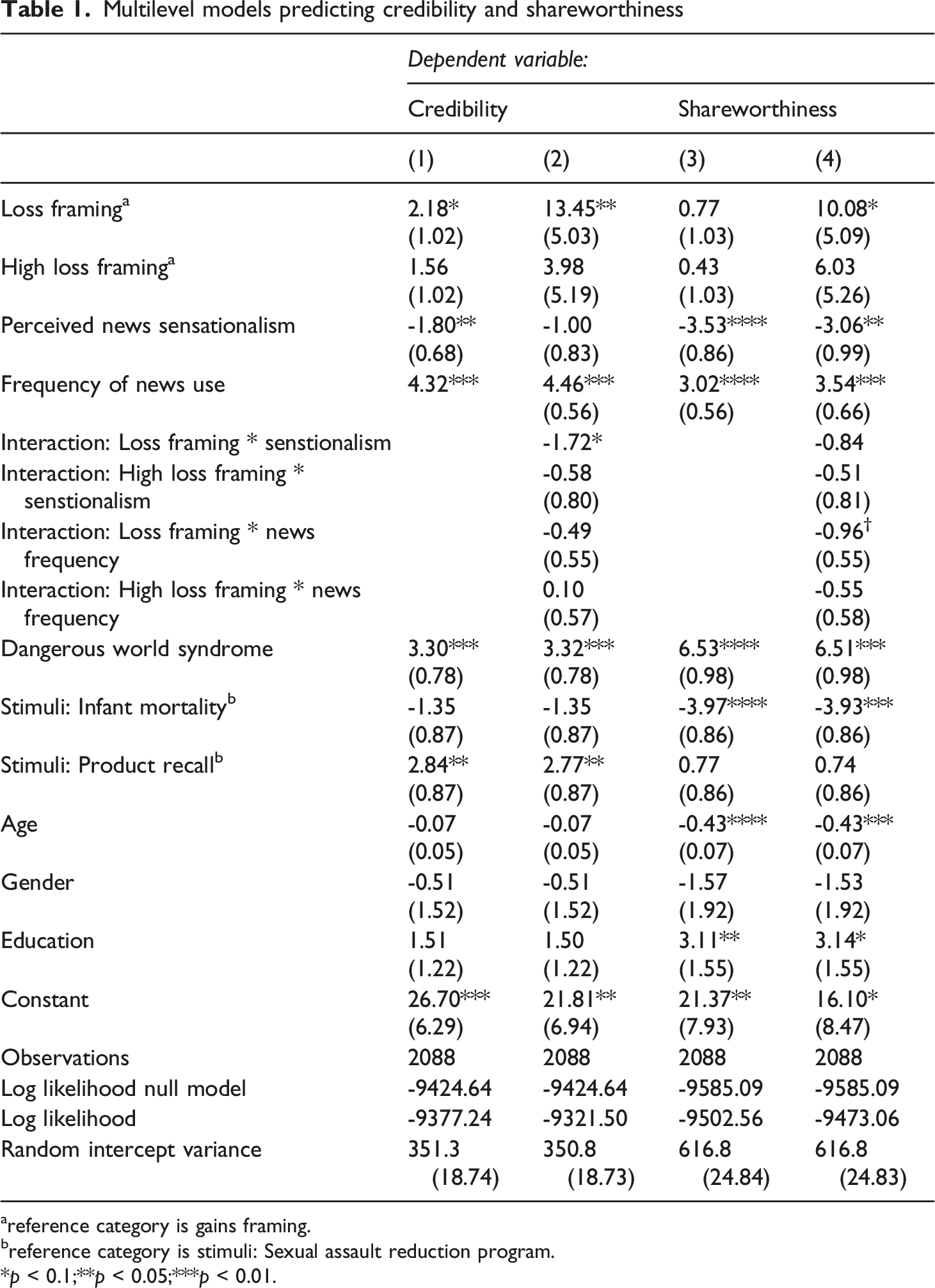
areference category is gains framing.
breference category is stimuli: Sexual assault reduction program.
*p < 0.1;**p < 0.05;***p < 0.01.
Next, we tested whether the intention to share news is affected by the news item’s level of negativity (H2). There are no significant differences across the different valence of the news items in the multilevel analyses, as depicted in Table 1, Model 3. Hypothesis 2 is thus rejected.
predicted that the potential main effects of negativity are moderated by perceived news sensationalism (H3a) and familiarity with (negative) news (H3b). For this purpose, interaction effects were included in the multilevel models between the conditions and sensationalism and frequency of news use. First, in Table 1, Model 2, a significant interaction effect is detected between the negative-valence condition and sensationalism, when explaining news credibility. Those who think the news is generally more sensational are less likely to evaluate the loss-framed news as more credible than the gain-framed news. Supplemental Appendix B shows how respondents that score below the median on sensationalism think the negative-valence and high negative-valence news are more credible than the negative-valence items, while no differences are found for those who score higher on perceived sensationalism. There were no interaction effects for shareworthiness as dependent variable. Therefore, H3a is only partly supported. Second, there was no significant interaction between negative-valence and news frequency for predicting both credibility and shareworthiness. Supplemental Appendix C shows no difference across how those low and high on news frequency assessed negative-valence news. H3b is rejected.
Conclusion Part 1
The first part of the study was designed to determine whether more negative news is also perceived as more credible and shareworthy. The findings indicate that the relationship between negativity and credibility and shareworthiness is not that straightforward. When the same type of information is formulated negative rather than positive, respondents were more likely to evaluate this news as more trustworthy. Potentially this level of negativity makes people lower their guard, in terms of their critical evaluation of news, and tend to more automatically assume the news is credible. Like the fluency hypothesis suggests (Hilbig, 2012), certain levels of negativity in news might entail faster information processing given that it stimulates more attention and enhances retrieval of relevant information. The level of negativity in these news items might speak to people’s built-in mechanism to be cautions to and use negative information to assess risks in their surroundings. It should be noted that these differences are relatively small and do not hold for everyone. We found that especially those who do not consider the news sensational assessed this type of news as credible. Their lower levels of perceived news sensationalism might make them less critical, or skeptical for that matter, when being expose to negative news. Furthermore, no differences were observed for sharing intention across differently valanced news. Neither did audience’s frequency of news use affect how they differently assessed negative news.
Besides the news items that conveyed the same factual information but are framed differently, there was also a third one which reported stronger negative information in addition to the negative valence. Contrary to the negative-valence news, this more intense version of negativity was not assessed as more credible or shareworthy than the positive-valence news items. The higher level of negativity might alarm audiences to not “blindly” trust the news and not to share it with their peers.
Method Part 2
In the second part, we showed respondents contradicting news stories about the same event. The task was introduced by explaining that sometimes, contradictory news stories can be published about the same event and around the same time. We asked respondents to judge the trustworthiness of the two news stories based purely on their content. Respondents were presented one of two pairs of contradicting mock news stories; one concerned with ceasefire negotiations in Libya and one with protests against a labor law in Jakarta (see Supplemental Appendix D). The substantive content of the two stories was similar but they varied in their valence: one was formulated positively (e.g., “peaceful demonstration”) and one negatively (e.g., “violent protest”). The order of the two was randomized. After respondents read both stories, they were asked to indicate how credible they found the two stories and how likely they would share the information (see measures from Part 1).
Rather than the mere manipulation of valence through gains versus losses framing as in Part 1, the manipulation of the contradicting news items also altered small aspects of the information. Since respondents were exposed to both conditions – i.e., the positive and the negative news item – the manipulation of gains versus losses might have become too apparent to the respondents if they had seen identical information presented in two different ways (as was the case in Part 1, where respondents only saw one of the two news stories). The experimental manipulation in Part 2 reflects how different news stories can emphasize different aspects of the same events and make either more positive or negative elements more salient in reporting.
We conducted a pilot test for the different news stories, measuring the valence (positive to negative) of the stories to ensure that respondents perceived the manipulated news articles as positive or negative and that they found the articles realistic.
Results Part 2
The fourth hypothesis assumed that when respondents are exposed to conflicting news stories, that they are more likely to find the more negative story credible and shareworthy. Since all respondents saw both the positively and negatively formulated news items (about either a cease fire or a protest) we rely on paired sample t-test to compare the mean score on both items. Figure 1 visualizes the means for each type of news item. First, for the news topic of the protest (that was described as violent in one story and peaceful in the other), the difference regarding how respondents evaluated the negative news item (M = 50.94, SD = 25.10) as more credible then the positive news item (M = 47.75, SD = 26.30) was insignificant t(334) = 1.80, p = 0.07). For this topic, no significant difference was found for intention to share either (negative news item: M = 32.66, SD = 30.03; positive news item: M = 31.31, SD = 30.42; t(334) = 1.04, n.s.). Second, for the news on a ceasefire (whether it was perceived as an agreement born dead or as a step forward), there was no difference for perceived credibility between the negative news item (M = 50.59, SD = 26.11) with the positive news item (M = 50.57, SD = 25.00, t(343) = 0.02, n.s.). For shareworthiness, the findings were contrary to what was expected, respondents were more likely to share the positive news item (M = 32.48, SD = 30.31) than the negative news item (M = 36.31, SD = 30.23, t(343) = -3.44, p < 0.001). Accordingly, H4a and H4b are rejected. Mean comparison of conflicting news items.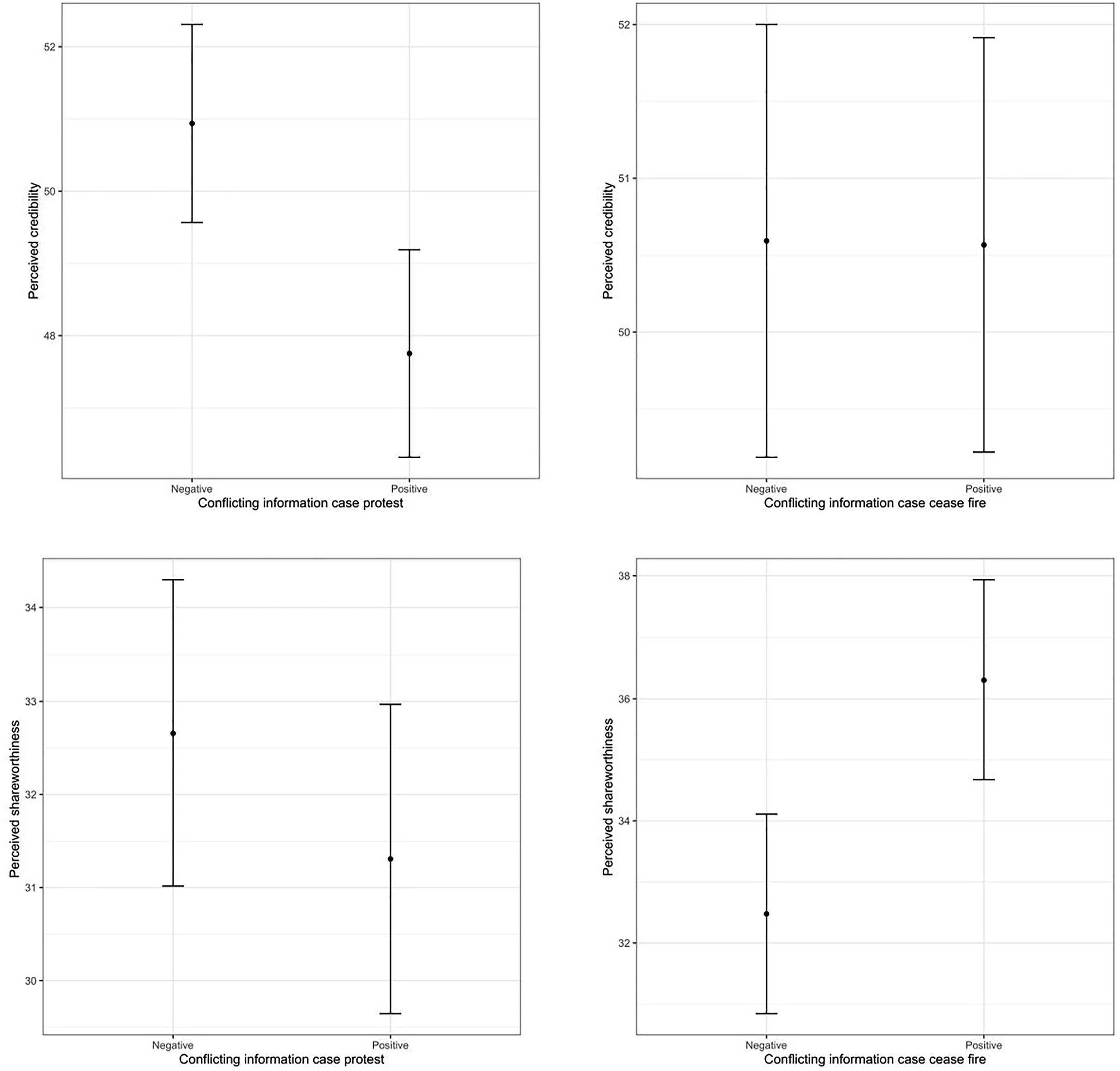
Just like in Part 1 of this study, analyses were conducted with the control variables. The data had to be reshaped (wide to long) to run regression models. Participants’ responses to both news items are treated as individual cases. The multilevel regression Models 1, predicting perceived credibility, and 3, predicting perceived shareworthiness, in Supplemental Appendix E show consistency with the findings from the paired sample t-tests. Models 2 and 4 detail that no interaction effects were present between whether a news item was positive or negative and perceived sensationalism or news use frequency.
Conclusion Part 2
The second part of our empirical study was designed to better understand what happens when people get exposed to conflicting information. To test if audiences are more likely to believe and share negative news, we exposed respondents to both a negative and a positive news item about the same event (either about a protest or a ceasefire). We found no differences in the level of perceived credibility of the positive and negative news items. Hence, when having to decide which news to believe when confronted with conflicting information, audiences do not seem to use negative valence as a cue. There were also no differences regarding the shareworthiness for the news on the protest. However, the positive news item was perceived more shareworthy for the topic of ceasefire. Such unexpected changes in a continuous event – i.e., a conflict situation – might also present another important news value, counterbalancing the negative valence of the other condition.
To conclude, in some cases of conflicting information, the negative news is not automatically perceived as more credible. Additionally, when it comes to intention to share the news, negative news was not found to be perceived more shareworthy. On the contrary, some positive news was found to be assessed as more shareworthy than negative news about the same event.
Joint conclusion and discussion
The overall objective of this study was to explore whether a negativity bias pertains to judgements of credibility and shareworthiness in the specific context of news assessment. Previous empirical work shows how information like urban legends and statistical statements (Fessler et al., 2014; Hilbig, 2009) are seen as more credible when framed negatively. The current study shows that this negativity bias is less straightforward when it comes to how people process news.
First of all, our findings seem to suggest that when the same objective information is formulated negatively rather than positively, this formally equivalent news is more likely to be evaluated as more credible. Expanding existing findings on negativity bias in information assessment (Fessler et al., 2014; Hilbig, 2009) into the realm of news processing. This more fluent evaluation of negative information, in which news is processed less elaborately and credibility is taken for granted, is in line with the argumentation that negativity bias reflects the greater necessity to be attentive to situations having the potential to cause harm. Another possible explanation is that negative news is seen as more credible as it reflects a professional journalistic role. Journalism is normatively charged with casting critical perspective. For example, as a watchdog of powerful elites/institutions and safeguard of democracy, journalism's monitorial role compels journalists to point out problems and issues, which almost inevitably results in focusing on the negative and in negative coverage. Thus, a negative news may be perceived by the audience as more credible also since it fulfils journalists’ role in society.
Within the field of journalism and communication science, research has primarily demonstrated a negativity bias in the selection of news, both on the supply (Van der Meer et al., 2019) and demand side of news (Knobloch-Westerwick et al., 2020). The current study adds to this body of literature that such a negativity bias might, at times, also hold for how the quality of news is assessed. When audiences generally are more attentive to negative news and are more likely to trust such content, the reality they are exposed to via the news might be disproportionally negative.
Second, it is essential to highlight that this negativity bias in credibility assessment is not so straightforward in the context of the complexity of news evaluation. We did observe audiences’ preferences for negative over positive news, but as soon as the news becomes substantially more negative, it is no longer perceived as more credible than positive news. In the condition where we did not only manipulate the negative valence of the news but also the objective intensity of negative occurrence, credibility scores where at a comparable level as the positive news. Pervious research has drawn comparable conclusions. For example, even though news stories with sensationalist features (like strong negativity) promoted memory and enjoyment among audience, most of these features were argued to be detrimental (Hendriks Vettehen and Kleemans, 2018). A potential explanation is that as soon as news becomes too negative, people become more skeptical. Such levels of suspicion might break the fluency with which lighter versions of negative information are processed. Here, individuals might stop and reflect on the content of the news more elaborately which, in turn, results in a more critical evaluation processes and lower credibility assessment. In addition, the negativity bias differed per individual. Those who are generally more skeptical toward the news and its level of sensationalism, were less likely to deem negatively framed news as more credible than positively framed news. Their awareness of the notion that news media, for commercial motives, can be sensational at times might make them more aware that the quality and credibility of news is not by definition higher when it is molded in sensational formats, in this case by framing it more negatively. Contrary to our expectations, we did not observe that those who use the news more frequently are less prone to a negativity bias in their assessment of the credibility of news. More media use does not seem to make audiences more or less critical toward the credibility of negative news. These more experienced news user might be more literate in handling news, yet, with the strong focus on negative events in the news, their news use might have fostered a learned association between negativity and the source of information they tend to trust.
Since the sharing of news can be an important cue for the perceived validity of information (Waddell, 2018), this study also looked at audiences’ sharing intentions of negative versus positive news. In general, we did not find that respondents were more likely to share negative news. Audiences’ perception of credibility and their sharing intention therefore seem to follow different mechanisms, where they are more cautious when it comes to sharing negative information. The sharing of information might come with an extra hurdle where more subjective norms are considered before news is shared with peers.
As an additional contribution, this study tested whether the level of negativity is used as a heuristic to determine what type of information to trust or share when confronted with conflicting information. When having to weigh inconsistent stories about the same events against one another, we found that respondents do not hold a negativity bias. Our findings suggest that when evaluating conflicting information, negative information, compared to positive information, is not by default given more weight and considered more credible. These observations, again, highlight that the negativity bias in news credibility is not as straightforward as previous research might have suggested. Other form and content factors might play a more central role in choosing what news to trust. Moreover, for one of the scenarios, contrary to the expectations, it was even observed that the positively framed news was more likely to be shared. At times, positive and surprising news events, rather than negative information, seem to be more attractive to share with others. Informing others about current events and avoid coming across too negative are potentially normative consideration for audiences when it comes to sharing – but this remains to be determined by future research.
This study is not without limitations. First, in experimental research that studies news, it is generally difficult to fully capture the complexity on the news environment in a simulated design. Not only the negativity of a news article will determine audiences’ evaluation of it, the context also matters. For example, their attention might generally be drawn to other types of news – e.g., entertainment or sports – which prevents them from sharing the type of news presented in this experiment to or they use other cues – e.g., source of information – to assess the credibility of information. Given that our study showed how complex the negativity bias in news assessment is, future research should further assess how different types of news get evaluated by different audience groups. Second, while Part 1 of the study relied on framing to manipulate valence, Part 2 conceptualized valence by also presenting positive or negative pieces of information. Therefore, due to methodological design choices, both parts are partly about related, yet distinct things – namely two aspects of how negativity may play out in the news. Future research should further investigate how different forms of manipulating valence can affect news assessment and how to best test the isolated effects of news valence in an experimental setting. Third, the first part of the experiment was limited to including only different levels of negative news, not positive news. Future research could pay additional attention to different levels of positivity to obtain a more complete understanding of how news is assessed based on different levels of valence. Overall, additional research is needed for a more detailed understanding of a negativity bias in the evaluation of news. The current study provides a first exploration and shows how, under certain circumstances, audiences can hold a negativity bias in their credibility assessment of news, but less so when it comes to their intention to share news. The findings provide a starting point for understanding cues that are used to evaluate news when their veracity is uncertain.
Supplemental Material
Supplemental Material - Credibility and shareworthiness of negative news
Supplemental Material for Credibility and shareworthiness of negative news by Toni G.L.A. van der Meer and Anna Brosius in Journalism
Footnotes
Declaration of conflicting interests
The author(s) declared no potential conflicts of interest with respect to the research, authorship, and/or publication of this article.
Funding
The author(s) disclosed receipt of the following financial support for the research, authorship, and/or publication of this article: This study is supported by VENI grant from the Netherlands Organization for Scientific Research (NWO) under Grant number: 016.Veni.195.067.

Supplemental Material
Supplemental material for this article is available online.
Author Biographies
References
Supplementary Material
Please find the following supplemental material available below.
For Open Access articles published under a Creative Commons License, all supplemental material carries the same license as the article it is associated with.
For non-Open Access articles published, all supplemental material carries a non-exclusive license, and permission requests for re-use of supplemental material or any part of supplemental material shall be sent directly to the copyright owner as specified in the copyright notice associated with the article.
