




Abstract
This study tested how storytelling approaches in a Facebook news post shape perceptions of news credibility. Online experiment participants (n = 921) were randomly assigned to view a post written in one of five styles: quoting only a Republican lawmaker, only a Democratic lawmaker, both partisan lawmakers, contextual information without quotes, or quoting a government official. Results found a partisan hostile media perception where Republicans rated all storytelling approaches as less credible than Democrats.
Introduction
Claims that the “news media are biased” have become ubiquitous today. When interviewed about mainstream news, people time and again bring up their perceptions that national mainstream news is biased or untrustworthy (e.g., Nelson & Lewis, 2023; Palmer et al., 2020; Wilner et al., 2021). Survey data backs this up, showing overall trust in news is at 40%, based on a review of 48 news markets worldwide in the latest Digital News Report (Newman et al., 2025). Trust and perception of bias are connected because people who perceive more bias are less likely to trust mainstream outlets and more likely to turn toward alternative or partisan sources (Ladd, 2012; Ognyanova et al., 2020). Waning trust and perceptions of news bias are certainly global problems (e.g., Gottfried & Liedke, 2021; Newman et al., 2025). However, these problems are particularly pronounced in the United States, which remains at the lower end in terms of news trust—hovering at about 30% since 2015—compared to many other nations (Newman et al., 2025). This is concerning because it can result in a less-informed electorate that is more susceptible to believing false information (Damstra et al., 2023; Zimmermann & Kohring, 2020) and less likely to participate politically (Valeriani & Vaccari, 2016). Indeed, people who believe false information have been found to be less likely to use traditional media (Hameleers et al., 2022).
Yet, while decades of research have documented the problem of perceptions that the news media are biased (e.g., Hameleers et al., 2022; Metzger & Flanagin, 2013; Mont’Alverne et al., 2023; Nelson & Lewis, 2023; Palmer et al., 2020; Wilner et al., 2021), we do not understand how to fix this problem. Accordingly, this study seeks to answer the following overarching question: Do specific storytelling approaches in political news posts shape audience perceptions of news credibility, bias, and partisan fairness? In particular, this study examines whether these journalistic practices differentially structure how Democrats and Republicans evaluate news content and interpret political ingroups and outgroups. This study (n = 912) contributes to the journalism literature by experimentally testing five different approaches to writing a news post—developed based on interviews with conservative Americans (Masullo et al., 2026)—and assessing how people perceive these posts in terms of perceptions of credibility and bias. Our main contribution is to show that Democrats rated all news posts as significantly more credible than Republicans, regardless of storytelling approach. This offers clear evidence of a stronger hostile media perception for Republicans, even when stories did exactly what conservative Americans had suggested to mitigate biased perceptions (Masullo et al., 2026). Hostile media perception offers a psychological explanation for why partisans perceive news bias even when coverage is actually balanced or factually neutral (Vallone et al., 1985). Notably, members of both parties gave the highest credibility ratings to news posts that only quoted a government official, not partisan lawmakers, suggesting that quoting official voices may hold some power to mitigate hostile media perceptions.
Republicans rated three out of the five storytelling approaches as significantly more biased than Democrats (a post that provides context about the topic’s importance but no quotes, a post that quoted only a Democratic lawmaker, and a post that quoted only a government official). However, members of both parties perceived posts that quoted only a Republican lawmaker and posts that quoted both Democratic and Republican lawmakers as similarly biased. Our findings emphasize that Republicans and Democrats perceive news stories very differently and see bias when lawmakers from their political out-group are quoted. These findings offer further evidence that it is challenging to remedy perceptions that mainstream national news is biased and untrustworthy because these perceptions are entrenched, particularly among political conservatives (Cimaglio, 2016; Hemmer, 2017; Lane, 2020; Major, 2020; Masullo et al., 2026; Wilner et al., 2021). The findings offer insight into how journalists and scholars can further address the problem of news distrust and perceptions of bias by being sure to balance partisan quotes.
Literature Review
History of News Bias Perceptions
Perceptions that the news media have a left-leaning bias—meaning coverage and sources that slant toward the political left—are deeply rooted in U.S. culture. Dating to the 1950s, U.S. political conservatives have framed the mainstream news media as a tool of propaganda for a liberal power structure (Lane, 2020; see also, Cimaglio, 2016; Hemmer, 2017; Major, 2015), although some liberals also raise concerns about media bias and untrustworthiness (e.g., Knight Foundation, 2020; Nelson & Lewis, 2023). The strategic deployment of elite rhetoric about a liberal media bias highlights this perception among the American public (Domke et al., 1999). This rhetoric gets amplified through provocative antimedia messages from U.S. President Donald J. Trump (Ross & Rivers, 2018) and through alternative media, podcasters, and influencers (Cushion et al., 2021; Dowling et al., 2022; Wang & Zhang, 2025). Empirical evidence of a systematic partisan bias in the news is mixed (Budak et al., 2016; D’Alessio & Allen, 2000), yet belief in this bias has persisted across decades (Perloff, 2025; Vallone et al., 1985) and become central to the conservative ideology (Major, 2015). In 2017, 84% of Republicans compared to 53% of Democrats felt that news outlets tend to promote one perspective over another (Pew Research Center, 2017). In 2019, a survey found that more than 80% of Americans thought there was “a great deal” or “a fair amount” of political bias in the news (Knight Foundation, 2020). The trend has remained strong in recent years, with a 2024 survey showing that over three-quarters of U.S. adults (77%) believe news organizations favor one side in their reporting, while only about one in five (22%) think they treat all sides fairly (Pew Research Center, 2024). During Trump’s first term, the mainstream national news media received a “Trump bump” (Newman et al., 2017), as Trump attacked the press, and people turned to mainstream national media to make sense of the politicized environment. Since Trump’s election to a second term in 2024, he has continued to attack the press, but, unlike during his first term, people are turning to podcasters, YouTubers and TikTokers, rather than traditional news (Hameleers et al., 2022; Newman et al., 2025).
Hostile Media Perception
Hostile media perception posits that individuals with strong political identities tend to perceive neutral news content as biased against their own side, interpreting identical messages as hostile depending on their partisan orientation (Vallone et al., 1985). Contemporary research confirms that hostile media perception persists in today’s media environment: Partisans exposed to identical neutral news coverage from sources perceived as opposite to their political leaning tend to rate that coverage as biased, even after accounting for prior beliefs about the outlet or content (Lo Iacono & Daniel Dores Cruz, 2022). Building on this work and a broader theoretical synthesis of the hostile media effect literature, scholars describe this effect as a robust perceptual bias in which both Democrats and Republicans judge the same coverage as unfairly slanted against their own side, helping to explain why balanced reporting can nonetheless be seen as partisan (Perloff, 2025).
Importantly, the hostile media perception suggests that journalistic attempts to provide balance, such as quoting opposing political actors, may not reduce perceptions of bias and may even heighten them if audiences interpret out-group voices as evidence of unfairness. This framework helps explain why Republicans and Democrats often diverge profoundly in their evaluations of the same news content and why perceptions of bias may remain resistant regardless of journalistic efforts. Because hostile media perception frames perceived bias as a function of audience interpretation rather than journalist intent, it provides a key link between the long-standing news bias perceptions and declining news trust. Thus, the hostile media perception provides a framework for understanding partisan responses to news posts in this study.
News Trust
News trust is related to perceptions of news bias because bias may result from low trust or distrust, but trust and bias are distinct concepts. News trust refers to whether people perceive that the media will meet their expectations (Metzger & Flanagin, 2013), and it assumes a relationship between the trustees (the news media) and the trustor (the news audience; Strӧmbäck et al., 2020). Trust is a belief in the dependability of the news media to do its job (Tseng & Fogg, 1999), while bias has roots in political economy. Political economy argues that structural factors like corporate ownership and economic facts such as a need to please advertisers can result in media biases that privilege those in power in an effort to keep them in power (Gramsci, 1971). In 2015, 32% of U.S. Americans reported that they trust “most news most of the time” and that proportion has remained roughly the same with small dips and increases since then (Newman et al., 2025). In addition, 73% of U.S. Americans indicated they are concerned about their ability to tell what is true or false in the news, the highest of any country outside of the African continent (Newman et al., 2025).
Why News Bias and News Trust Matter
Perceptions of news bias and distrust have ramifications for both news organizations and society at large. For news organizations, exposure to biased content is linked to a measurable decline in media trust across party lines (Ognyanova et al., 2020). As trust diminishes, traditional platforms such as television and newspapers face shrinking audiences, as people turn to social media and other alternative media, such as nonmainstream outlets, podcasts, and videos (Hameleers et al., 2022; Newman et al., 2025). For news consumers, the perception of bias and distrust contributes to widespread skepticism toward all information sources, making it more difficult to separate credible journalism from misinformation. This skepticism fosters partisan selective exposure, in which people choose outlets that reinforce their preexisting beliefs while avoiding those they perceive as oppositional, which may result in a more fragmented and polarized public (Stroud, 2011).
For society at large, widespread perceptions of bias threaten the shared factual foundation necessary for democratic life. When citizens lose trust in the news, they become overconfident in detecting misinformation yet less motivated to verify content, amplifying the spread of falsehoods and confusion about truth (Van Zoonen et al., 2024). Echo chambers—environments where like-minded people coalesce so misinformed opinions get reinforced—amplify this problem by reinforcing selective exposure and separating audiences into divergent realities (Cinelli et al., 2021). Computational models further suggest that competition among outlets can exacerbate this dynamic, with sensational or misleading content attracting short-term attention at the cost of public trust and factual clarity (Amini et al., 2025). These processes collectively undermine social cohesion, weaken institutional authority, and make unified responses to crises more difficult, ultimately threatening democratic stability.
Solutions to Perceptions of News Bias and Distrust
Certainly, many factors—framing, source diversity and transparency cues—have been examined for effects on news bias perceptions (e.g., Alieva & Bluth, 2023; Hoewe & Barton, 2024; Masullo et al., 2024). However, we focus on quotations for four reasons. First, direct quotations have a long history as “a powerful journalistic tool that can be used to influence news media consumers’ perceptions of reality and judgment of issues” (Gibson & Zillmann, 1993), and, indeed, quotations were a main issue raised by 91 self-identified American political conservatives as contributing to news bias perceptions (Masullo et al., 2026). Second, some of these other factors (e.g., framing and source diversity) are already well established as influencing news bias perceptions (e.g., Alieva & Bluth, 2023; Hoewe & Barton, 2024; Masullo et al., 2024), so we focus on quotations, which have received less study, offering potential for new insights. Third, while transparency cues have been extensively studied in regard to news bias perceptions (e.g., Curry & Stroud, 2021; Hellmueller et al., 2013; Karlsson & Clerwall, 2018; Karlsson et al., 2014, 2017; Masullo et al., 2022), these studies have found limited or null effects of transparency, suggesting other factors may be more influential.
For example, when outlets explain why certain sources were chosen, how evidence was weighed and what editorial decisions guided the story, audiences tend to report higher levels of trust and lower perceptions of partisanship (Karlsson et al., 2017). Curry and Stroud (2021) found that a collection of five transparency items increased news credibility perceptions, but the effect size was small. New credibility perceptions are subjective assessments about whether someone can trust the news (Metzger & Flanagin, 2013). Masullo et al. (2022) found that adding a box that explains how and why a story was done improved credibility perceptions but only if the box was very obvious. Karlsson et al. (2014) manipulated 21 different configurations of transparency indicators, but found few effects on credibility perceptions. Indeed, an experiment, a survey, and focus groups (Karlsson & Clerwall, 2018) found little support for transparency as a solution. Stance labeling, designed to help people explore diverse opinions by presenting liberal and conservative labels, can promote awareness of opposing arguments and thereby reduce selective exposure to information (Gao et al., 2017). However, when presented with ideology-inconsistent opinions, people may engage in counter-arguing and will likely dismiss or downplay them as a way to reduce the psychological stress caused by cognitive dissonance (Festinger, 1962). As a result, people may become even more entrenched in their original beliefs and polarized than before (Dey et al., 1982; Mutz, 2006). Furthermore, labels can even encourage partisan audiences to dismiss coverage outright if the label conflicts with their own identity (Spinde et al., 2022). In some cases, transparency—for example, personal information about the news story author—can undermine credibility perceptions, rather than increase them (Tandoc & Thomas, 2017).
Because transparency research has been such an inconclusive solution to perceptions of news bias and distrust and framing and source cues have been well established as affecting news bias perceptions, we approach the problem from a different perspective. We developed five different ways to report news through short Facebook posts based on qualitative interviews with 91 self-identified American political conservatives (Masullo et al., 2026). In that study, one of the participants’ major points was that they perceived bias in a story if it seemed like “both sides” were not provided equally. While Masullo and colleagues’ (2025) study drew insight from conservatives only, we judged that their insights could hold promise for all news consumers, considering that conservatives tend to have lower news trust and greater bias perceptions than liberals (Lane, 2020; see also, Cimaglio, 2016; Hemmer, 2017; Major, 2015). This current study builds on this work, testing five news post types, which are explained further in the “Method,” that manipulate who is quoted or not quoted in each post as a means to understand how the general public detects whether news tells “both sides” equally. We test whether the posts will lead to differences in perceptions of news bias, direction of that bias (toward the left or right), and credibility. Thus, we ask:
Will there be significant differences in the perception of (1) political news post bias, (2) direction of news post bias or (3) credibility of news post based on post type?
Given that there is such a historic divergence between Democrats and Republicans in terms of perceptions of news bias and distrust (Cimaglio, 2016; Hemmer, 2017; Lane, 2020; Major, 2020; Masullo et al., 2026; Wilner et al., 2021), we also considered whether exposure to the five news posts types will influence how people perceive of their political in-group and out-group. In addition, we considered whether Democrats and Republicans would differ in how they conceptualize news bias and the tone they use to discuss bias.
Will there be significant differences in perceptions of the (1) political out-group or (2) political in-group, dependent on political news post type?
To what extent (if any) did Democrats and Republicans differ in how they (1) conceptualize news bias and (2) the emotional tone with which they discuss the political news topic?
Method
Design and Procedures
The authors’ university granted Institutional Review Board approval on May 28, 2025. The experiment was conducted online through the Qualtrics survey platform from June 2 to June 3, 2025. Participants (n = 912) affirmatively consented and then were randomly assigned to view one news post about politics written in one of five styles that we developed based on findings from a study about how some political conservatives perceive news bias (Masullo et al., 2026). Participants were additionally randomly assigned to view a post either about Defense Secretary Pete Hegseth’s use of the Signal messaging app to share sensitive military information (Ward & Youssef, 2025) or about Trump’s widespread trade tariffs (Whalen, 2025). We used two topics to test the robustness of any potential effects across topics, not because we predicted differences between topics. This resulted in a two (topic) by five (post type) between-subjects design. Notably, we employed political news topics because perceptions of bias are most acute in political news (e.g., Walker & Gottfried, 2020). Also, from a normative standpoint, consuming political news is more important than other types of news (e.g., sports) for informing citizens about their government, encouraging political participation (Valeriani & Vaccari, 2016), and stopping the spread of false information (Damstra et al., 2023; Zimmermann & Kohring, 2020). Thus, it makes sense to center interventions to alleviate news bias on political news.
Random assignment was successful, as evidenced by a series of chi-square tests that found no differences in demographics by any experimental condition. After viewing the post, participants answered the dependent variables. The stimuli and dependent variables are described below. Each participant was paid $1.50 for completing the study, which took 9.92 minutes on average to finish.
Sample Recruitment
We recruited U.S. residents who are 18 years old or older from Prolific, an online platform that explicitly informs participants that the purpose of the survey is for research (Palan & Schitter, 2018). Although online surveys have limitations, such as self-selected participants who may not be typical of the general public, research has shown that samples from platforms like Prolific provide samples that are more representative of the U.S. population than convenience samples, American college student samples, or general web samples (Berinsky et al., 2012; Buhrmester et al., 2011; Carr et al., 2014; Paolacci et al., 2010). Prolific, in particular, offers high-quality data, as evidenced by more participants providing meaningful answers than on other similar platforms (Douglas et al., 2023). For experiments like ours, these online platforms are particularly useful because experiments rely on the power of random assignment to provide unbiased causal inferences without a nationally representative population sample (Mutz, 2011). This provided an opportunity to balance our sample between Democrats and Republicans using quotas, a design that assisted in our main goal of examining partisan differences. Initially, 1,036 people started our experiment, but data were not analyzed for those who may have taken the survey more than once as shown by duplicate IP addresses (n = 42), were younger than 18 (n = 14), failed more than one of the three attention checks (n = 4), finished the survey more quickly than was feasible (3 minutes; n = 27), took too much time to finish the survey (SD = 3 above the mean of 9.92 minutes; n = 19), did not see the post (n = 1) or did not read the post (n = 8). This resulted in n = 921. Participants’ demographic information is presented in Table 1, compared to the U.S. adult population.
Participant Demographics
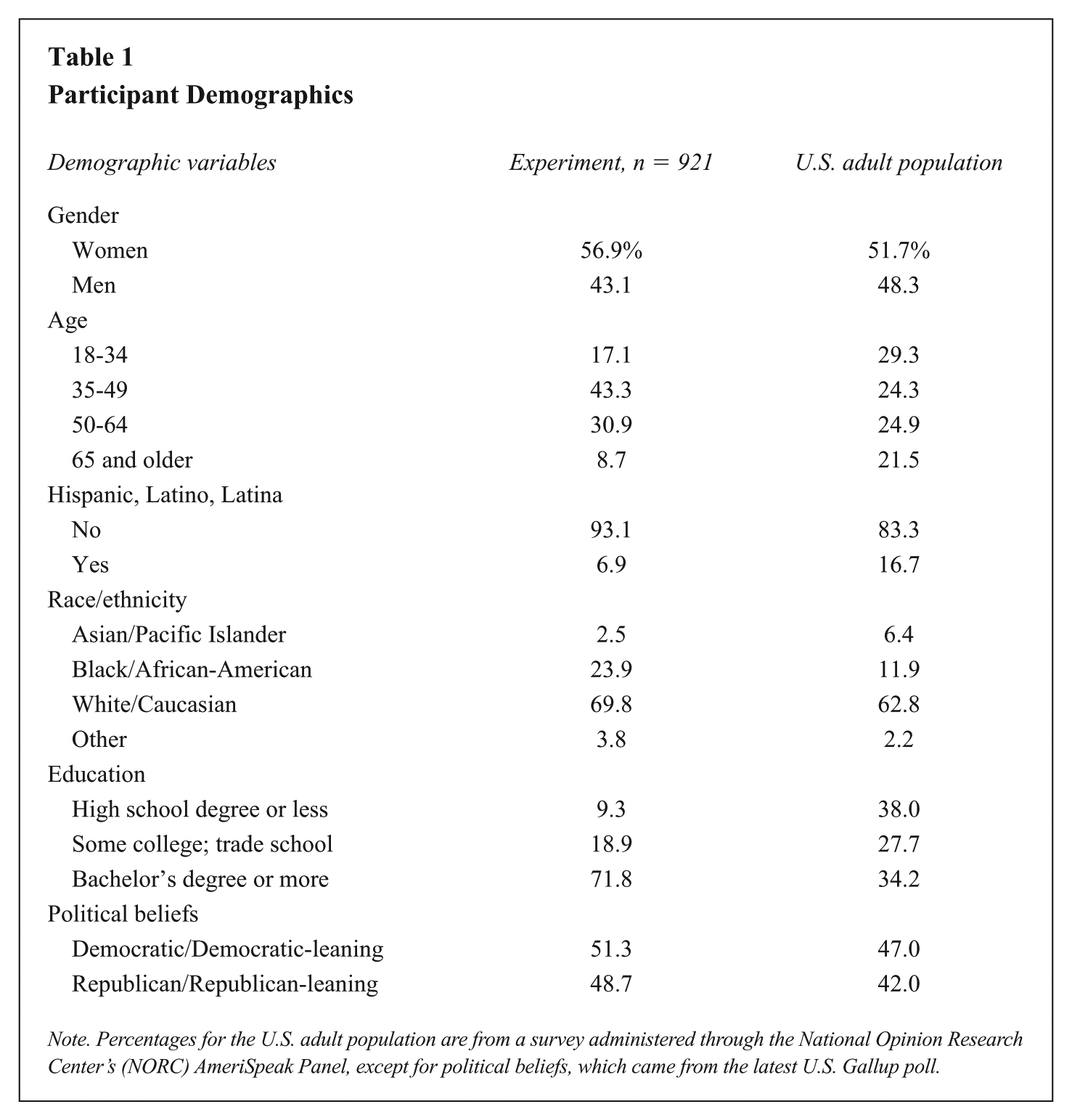
Note. Percentages for the U.S. adult population are from a survey administered through the National Opinion Research Center’s (NORC) AmeriSpeak Panel, except for political beliefs, which came from the latest U.S. Gallup poll.
Stimuli
To create the stimuli, we first collected real news stories about the two topics (15 stories about Hegseth’s potential security breach and 16 stories about Trump’s tariffs) from a variety of sources with both right- and left-leaning audiences (e.g., Breitbart, Fox News, The New York Times, The Wall Street Journal, The Washington Post and USA TODAY). We used content from these stories to inform details in our Facebook news posts, which are the experimental stimuli, with a goal toward face validity and realism. Each post we created had a short headline followed by three paragraphs, where only the last paragraph varied between conditions. The third paragraph varied based on our five conditions: a post that quotes only a Republican lawmaker; a post that quotes only a Democratic lawmaker; a post that provides context about the topic’s importance but no quotes; a post that quotes both Republican and Democratic lawmakers; and a post that quotes a government official, which served as a control condition. The posts were designed to be similar in length (ranging 106-141 words, M = 120.1) and all appeared to participants as if they were Facebook posts from the fictional news organization, The Gazette-Star. Using a mock site was essential to ensure people were reacting to the content of the posts, not to the powerful effects of a known news brand (Hilligoss & Rieh, 2008; Kim & Grabe, 2022; Masullo et al., 2022; Weber et al., 2019) on people’s news media perceptions.
We created the posts using Prankmenot.com, a free Facebook post generator used in research to create realistic Facebook posts that are fully customizable (e.g., Batastini et al., 2021; De Groeve et al., 2019; Masullo & Kim, 2021), and showed participants a static screen capture of the post embedded within the survey experiment. Figure 1 provides an example of what the posts look like, and Table 2 explains the content of each post and the explanation for each condition.
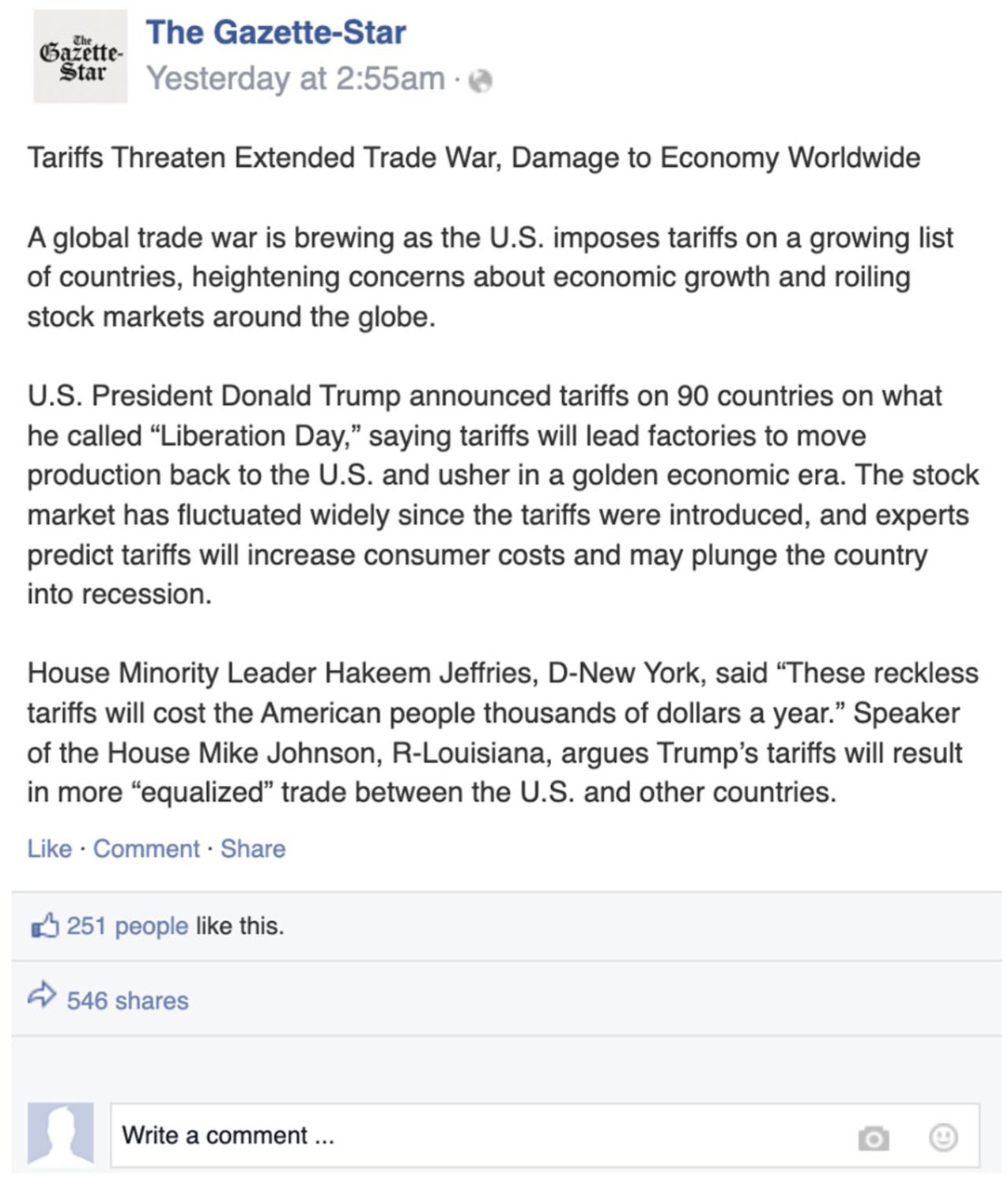
Example of Stimuli
Experimental Stimuli for Each Condition
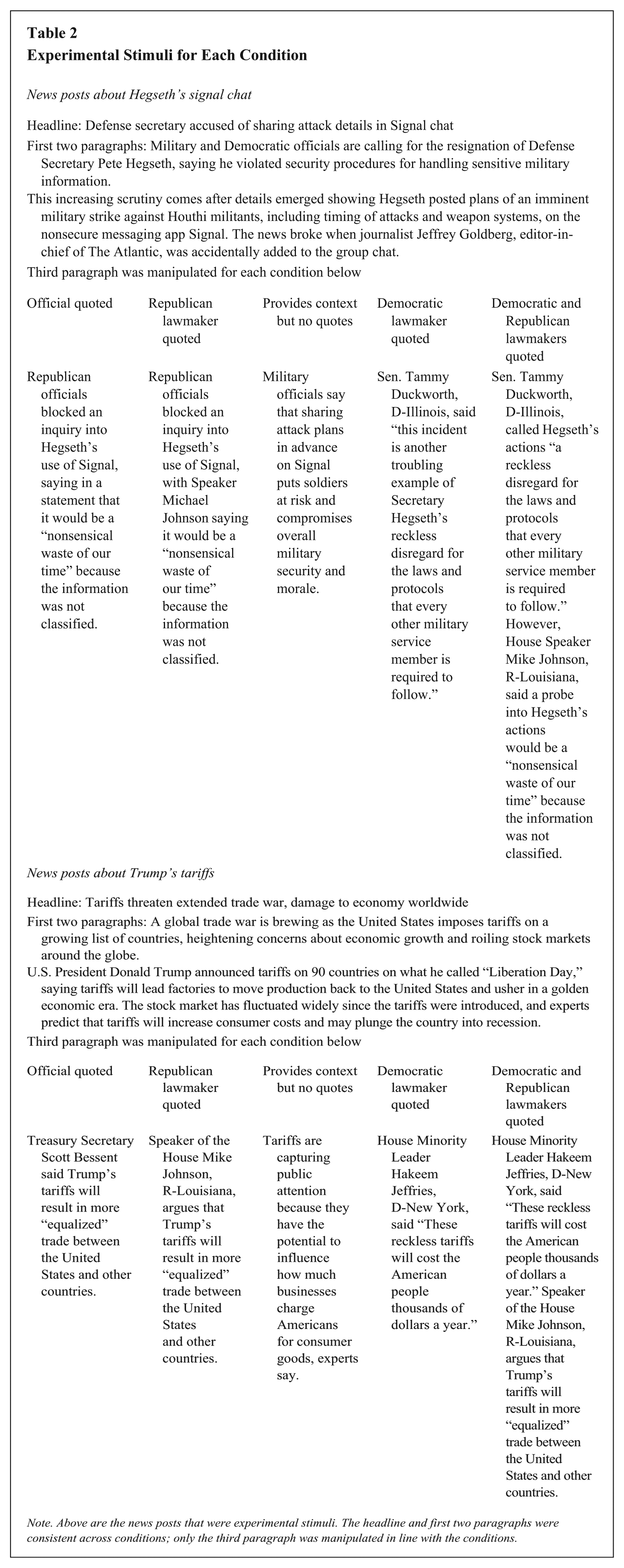
Note. Above are the news posts that were experimental stimuli. The headline and first two paragraphs were consistent across conditions; only the third paragraph was manipulated in line with the conditions.
Dependent Measures
Perception of Bias (Extent)
We assessed this with the question, “Please select a spot on the scale below that best reflects your perception of the level of bias in the news post you just read,” and participants could slide on the scale from left to right (1 = Not at all biased, 4 = Neutral and 7 = Very biased). Participants on average perceived the news post they viewed to be slightly biased, M = 3.98, SD = 1.62.
Perception of Bias (Direction)
For the direction of bias, participants could also slide on a scale from left to right (1 = Biased toward liberals, 4 = Neutral and 7 = Biased toward conservatives) underneath the question, “Please describe the direction of the bias (toward liberals or toward conservatives) on the scale below.” Participants perceived the news post they viewed to be slightly biased toward liberals, M = 3.80, SD = 1.41.
News Credibility Perceptions
Using a measure adapted from Appelman and Sundar (2016), participants rated from 1 (Describes very poorly), 4 (Neutral) to 7 (Describes very well) how “accurate,” “authentic,” “believable” and “trustworthy” the post they viewed was. Psychometric validation research (Appelman & Sundar, 2016) demonstrates that these evaluative adjectives collectively capture the full conceptual domain of message credibility. Responses were averaged together with high reliability, M = 5.00, SD = 1.32, α = .94.
In-group/Out-group Perceptions
To assess participants’ perceptions of their political in-group and out-group, we adapted the measure of Lelkes and Westwood (2017). Democrats rated on a 0 to 100 scale how they felt about their in-party “a typical Democratic voter” (n = 470, M = 78.63, SD = 18.198) and their out-party “a typical Republican voter” (n = 469, M = 29.90, SD = 26.07), with 0 = You feel cold toward the group, 50 = You don’t know much about the group/You don’t feel particularly warm or cold toward the group and 100 = You have warm feelings toward the group. Republicans used the same scale to rate their in-party “a typical Republican voter” (n = 446, M = 79.25, SD = 16.81) and their out-party “a typical Democratic voter” (n = 445, M = 43.10, SD = 24.54).
Covariates
Preexisting Attitudes Toward Mainstream Journalism
Participants rated from 1 (Not at all biased) to 7 (Very biased) the “level of bias that you believe ‘mainstream journalism’ typically has. By mainstream journalism, please consider general interest news that you find online, in a newspaper, on TV, or on the radio.” Participants on average thought the mainstream journalism was biased, M = 4.93, SD = 1.33.
Familiarity With Topic
Participants rated from 1 (Not at all familiar) to 7 (Very familiar) the following: “Before participating in this study, how familiar were you with the topic of the news post you read?” Participants were moderately familiar with the topic of the news post they viewed, M = 4.56, SD = 2.05.
Data Analysis
To answer
For
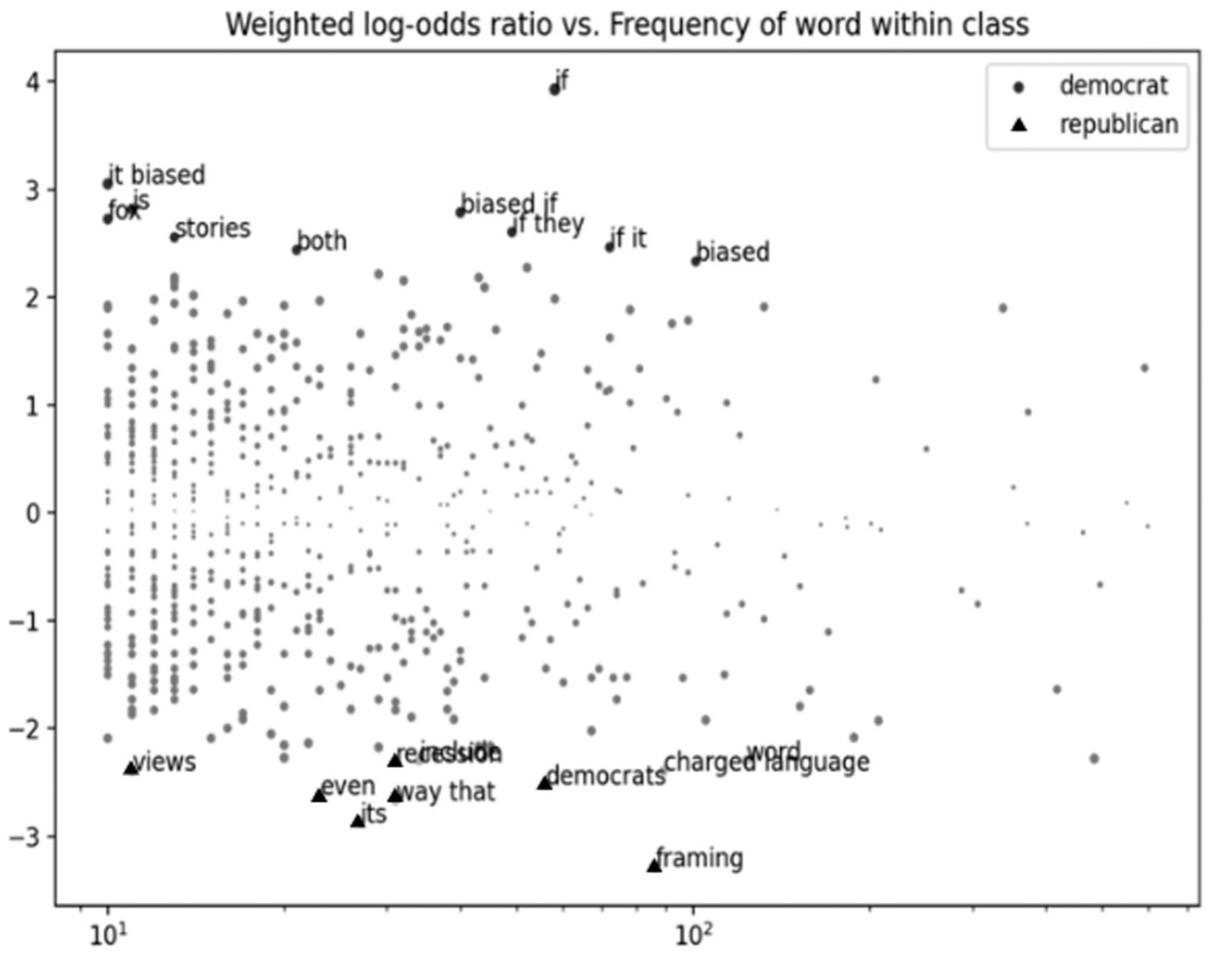
Partisan Language About News Bias
Results
MANCOVA AND ANCOVA Results
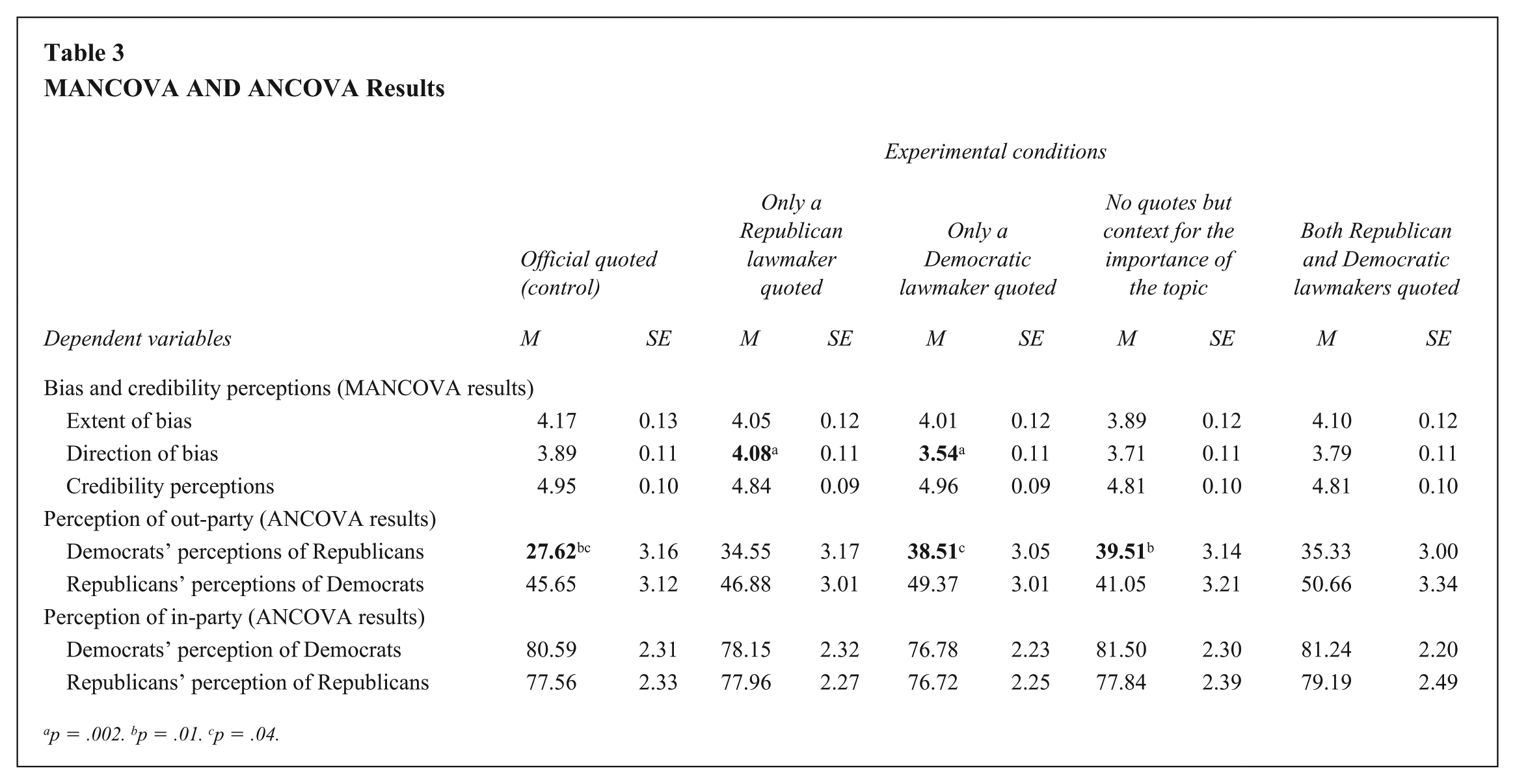
p = .002. bp = .01. cp = .04.
For
To answer
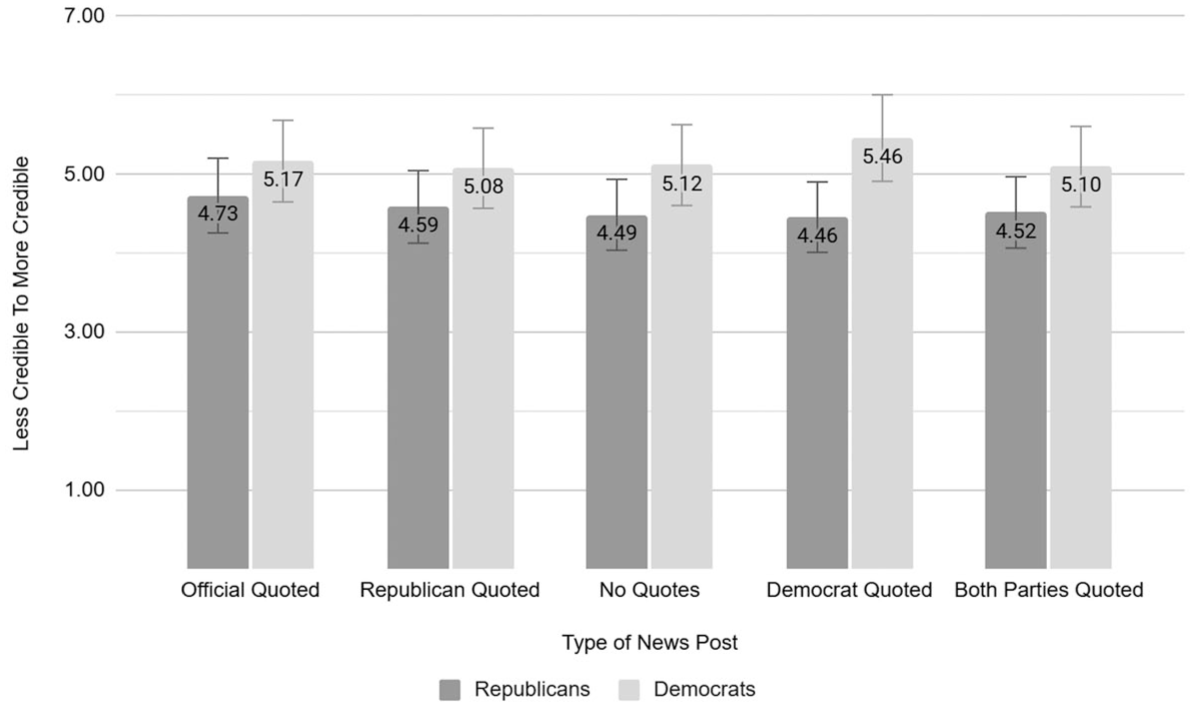
Perception of News Post Credibility
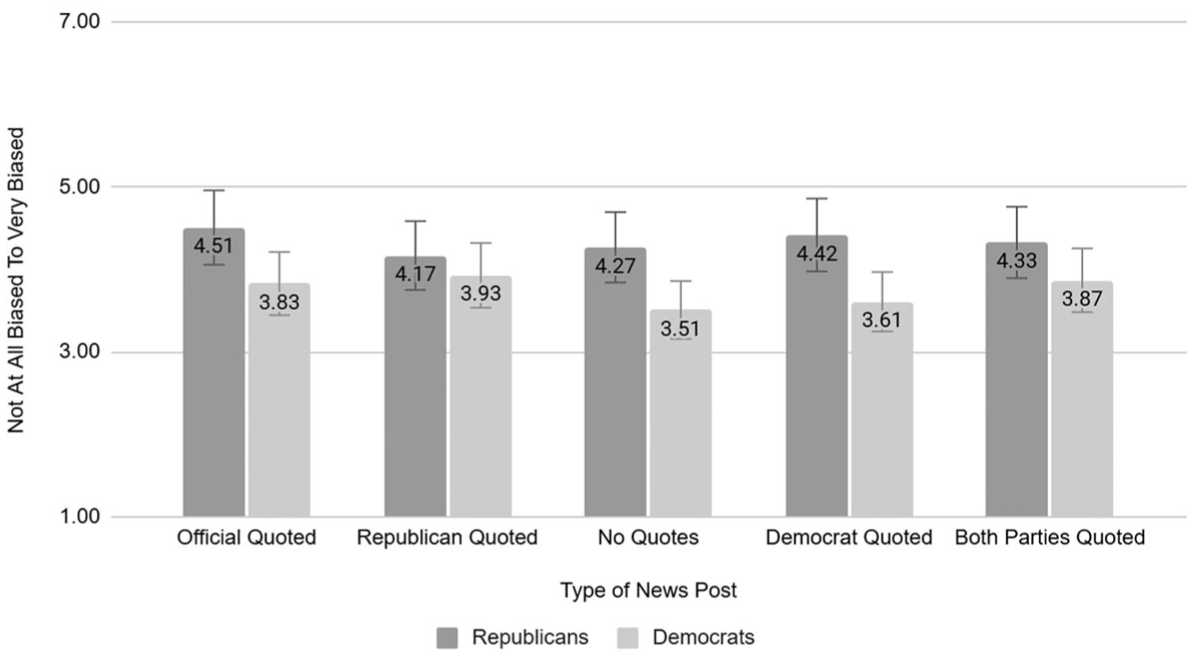
Perception of News Post Bias
To further answer
Topic Modeling Results
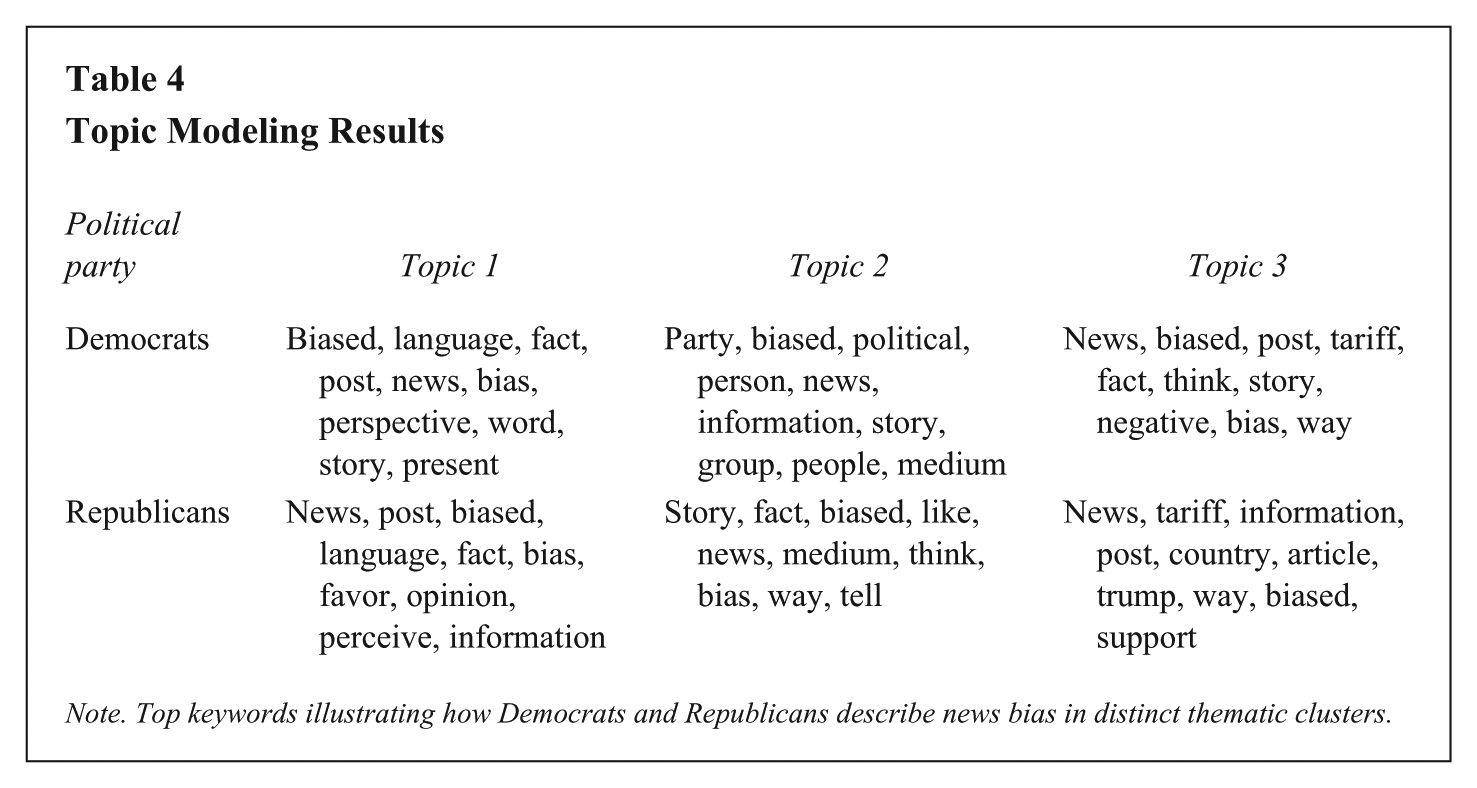
Note. Top keywords illustrating how Democrats and Republicans describe news bias in distinct thematic clusters.
To answer
Across our analyses, results showed few differences across topics (Hegseth’s Signal chat or Trump’s tariffs), offering support that our results are robust across both topics. Overall, participants perceived the news posts about tariffs as more biased than those about Hegseth, regardless of storytelling approach. Also, Democrats who viewed posts about tariffs perceived Republicans as more polarized than those who viewed posts about Hegseth, regardless of storytelling approach. Finally, Democrats rated their own party as more polarized if they viewed posts about Hegseth rather than about tariffs, regardless of storytelling approach. No other significant effects of the news post topic were found.
Discussion
The main goal of this study was to understand more about how U.S. news consumers assess the bias and credibility of news posts, based on who is quoted or not quoted in the stories. Our findings offer strong evidence in support of the hostile media perception that the largest impact on whether people perceive the mainstream news media as biased or distrustful is their political beliefs, not who was quoted or not quoted in the post. Across topics and conditions that varied in who was quoted or not in a news post, Republicans overwhelmingly perceived posts as biased and not credible, compared to Democrats. Our findings show that even balanced or seemingly neutral political content may still be viewed through the lens of the hostile media perception, where people with strong political identities perceive identical neutral news coverage as biased if it uses sources perceived as opposite to their beliefs (Lo Iacono & Daniel Dores Cruz, 2022; Vallone et al., 1985).
Our findings emphasize that Republicans and Democrats perceive news very differently in support of earlier research (Cimaglio, 2016; Hemmer, 2017; Lane, 2020; Major, 2020; Masullo et al., 2026; Wilner et al., 2021). Our main contribution is to show that the use of partisan direct quotations seems a key indicator of how news consumers assess bias and credibility. In essence, our study shows that either quoting a Democrat or a Republican (or both) in a news post can trigger a hostile media effect, particularly among Republicans. Indeed, members of both political parties gave the highest credibility ratings for news posts that only quoted a government official, suggesting that using an official voice has the potential to mute the hostile media effect. This was true regardless of topic or whether the government official was named or not. This is notable because this effect was found during the Trump Administration when the government official was aligned with this administration. Yet, even Democrats perceived news posts that quoted an official as the most credible, even more so than a post that quoted a Democratic lawmaker.
In regard to perceptions of bias, Republicans rated three of the five storytelling approaches as significantly more biased than Democrats did (posts that quoted only a government official, only a Democratic lawmaker, and provided context but no quotes). In other words, the absence of a quotation from an official who is explicitly labeled as Republican was an indicator of bias for Republicans, triggering a hostile media effect. Indeed, Republicans and Democrats perceived posts that quoted only a Republican lawmaker as similarly biased as posts that quoted both Democratic and Republican lawmakers. In sum, these findings suggest that Republicans assess credibility and bias through the lens of the hostile media effect—based on whether a Republican lawmaker is explicitly quoted—while Democrats have more nuanced assessments, suggesting weaker hostile media effects. For scholars, our findings point to future research that examines what specific parts of news posts, beyond the direct quotations tested in this study, trigger credibility and bias perceptions. Furthermore, our analyses of participants’ open-ended responses indicate that Democrats and Republicans use different language to explain how they assess bias. These linguistic patterns reflect deeper ideological frames through which each group interprets the same media environment, with Democrats questioning credibility and bias while Republicans highlight what they perceive as manipulative rhetoric and economic implications.
It is important to note that who was quoted or not quoted in the story did not affect credibility or bias perceptions, as we had hypothesized, regardless of the topic. This may be because a short news post was insufficient to change attitudes. Perhaps posts needed to be longer or the quotes more dominant in the story to produce effects. Future research should consider these alternatives. In addition, across our analyses, results showed few differences across topics (Hegseth’s Signal chat or Trump’s tariffs), offering support that our results are robust across both topics. We urge future research to consider more topics.
Implications for Journalists
For practitioners, our findings highlight the need to overtly quote both Democratic and Republican lawmakers in political news and to give equal space and prominence to those quotes because our findings show that quotations are a strong driver of how people assess news bias and credibility perceptions. Our findings also show that giving equal space to “both sides” is not enough. Both Democrats and Republicans perceived news posts that only quoted a government official as most credible, compared to posts that quoted partisans. Despite this finding, we do not advise that journalists quote only government officials because other research shows that news coverage that relies only on officials may be perceived as less credible by Democrats (Varma et al., 2025). Rather, we urge journalists to attempt to strike a delicate balance by (1) overtly quoting politicians from both parties and identifying them as such, as the identification seems to convey credibility; (2) being cautious to quote a government official without party affiliation unless that affiliation is germane because the affiliation may trigger hostile media perceptions; and (3) ensuring politicians from both parties are quoted in the first few paragraphs to stress their importance.
Limitations and Future Research
Like all studies, this one has limitations. We focused on political news topics (Hegseth’s use of the Signal messaging app to share sensitive military information and Trump’s widespread trade tariffs) because these topics were prominent in the news during the study period. Also, political topics are where perceptions of news bias are most acute (e.g., Walker & Gottfried, 2020) and most normatively problematic (Damstra et al., 2023; Valeriani & Vaccari, 2016; Zimmermann & Kohring, 2020). Future research should examine bias in nonpolitical topics. Furthermore, we used a survey experiment that relies on the power of random assignment to provide unbiased causal inferences (Mutz, 2011), but results may differ with a nationally representative sample. In addition, we used a mock news site for our stimuli to ensure people were reacting to the content of the posts—not the powerful effects of known news brands (Hilligoss & Rieh, 2008; Kim & Grabe, 2022; Masullo et al., 2022; Weber et al., 2019). We urge future research to replicate our experiment with known news brands and a nationally representative sample.
Footnotes
Acknowledgements
This paper is a project of the Center for Media Engagement (CME) in Moody College of Communication at The University of Texas at Austin. The project received financial support from the John S. and James L. Knight Foundation as part of the connective democracy initiative, which seeks to bridge divides between divergent groups, and from the Moody College of Communication at UT Austin. The authors thank members of CME who provided feedback on an earlier version of this manuscript.
