



Abstract
The discussion on sexual violence gained momentum in October 2017 after the Twitter hashtag (#metoo) spread globally highlighting the widespread reality of this problem. While this resulted in extensive media coverage, and naturally informed audiences about societal issues, it can also be problematic regarding the media’s power to reflect and construct reality. Therefore, it is important to research how societal issues like sexual violence are discussed in media settings. The study aimed to investigate how journalists frame sexual violence in the news (RQ1) and whether such practices have changed in the wake of the MeToo movement (RQ2). A quantitative content analysis was conducted for news articles published in four US newspapers, spanning a period of 2 years – from 1 year before to 1 year after the #metoo tweet (N = 612; Oct. 2016 – Oct. 2018). Results indicate that news coverage on sexual violence shifted from straightforward, single-incident reports to broader discussions. This study contributes to scientific research and journalism practices by providing an overarching view of how sexual violence is framed in the news and the potential impact of social movements on reportage.
In early October 2017, widespread sexual abuse allegations against Harvey Weinstein were covered. Shortly thereafter, on 15 October 2017, American actress Alyssa Milano posted on Twitter, “If all the women who have been sexually harassed or assaulted wrote ‘Me too’ as a status, we might give people a sense of the magnitude of the problem” (Milano, 2017). Her tweet reawakened Tarana Burke’s original MeToo movement from 2006, which sought to “reframe and expand the global conversation around sexual violence” and hold perpetrators accountable by creating and implementing strategies to support “long-term, systemic change” (me too, 2020). The viral #metoo tweet brought the original movement’s goals onto a new global and digital center stage.
For months, it seemed like the topic of sexual violence (SV) dominated journalistic news coverage around the world. While journalistic news coverage informs consumers about societal issues, it also poses potential risks regarding the power it has in reflecting and constructing reality (Nelson et al., 1997). Described as the Framing Theory (Entman, 1993), journalists (intentionally or unintentionally) highlight and omit certain aspects of an issue. Since framing has been shown to make information more memorable and assist readers in forming opinions (Powell et al., 2015), the framing of societal issues in news coverage becomes particularly interesting. Through journalists’ choosing of what and how to report, they and the media possess the ability to simultaneously grow and limit the public’s understanding of the need for social change.
According to Banyard and colleagues (2004), SV is a problem prevalent across various communities and can cause serious medical and emotional repercussions for victims. This, in addition to the media’s influence on news consumers, stresses the need for understanding how SV is framed in journalistic reportage. We define SV per the Centers for Disease Control and Prevention (2018) as a “sexual act, which is committed or attempted by another person without freely given consent of the victim, or against someone who is unable to consent or refuse”. Furthermore, without a commonly accepted definition of SV, we address it as an umbrella term for SV, sexual harassment, sexual abuse, sexual assault, and sexual misconduct.
There exists a great variability of excellent research investigating how SV is framed in news coverage (e.g. McDonald & Charlesworth, 2013; Saguy, 2002; Weatherred, 2015). Also, more and more research has been emerging since the wake of the trending #metoo topic. Recent studies, for example, have focused on how #metoo was covered (e.g. De Benedictis et al., 2019) or framed in the news (e.g. Cuklanz, 2020), and the impact of #metoo coverage on survivors (e.g. Boyle, 2019). However, to the best of our knowledge, no study so far has investigated the impact of #metoo on the framing of SV in journalistic news coverage. With the renewed relevance of SV resulting from the viral hashtag #metoo, our study aimed to investigate how journalists frame SV and whether such practices have changed after the #metoo tweet via quantitative content analysis. Furthermore, we aim to give a comprehensive overview depicting the whole range of sexual violence – from verbal to physical incidents – rather than focusing on one aspect in greater detail, like sexual harassment for example.
Research on how SV is framed in the news allows us to monitor potential changes over time, as shifts may represent changing social norms (World Health Organization/London School of Hygiene and Tropical Medicine, 2010). Ultimately, journalistic reporting shapes the public’s and policymakers’ perceptions and understanding of social issues (Johnston et al., 2015), such as SV. This study investigates a mere fragment of the intricate web of research that seeks to expand our understanding of how SV is covered in the news. However, with increased understanding of SV, the potential for crafting new legislation for educational institutions and workplaces is promising and might reflect in pay differences, career opportunities, and shifts in everyday social etiquette.
Journalistic news framing
Frames highlight certain aspects of communication subjects and elevate them in salience (Entman, 1993; Fiske and Taylor, 1991) by making certain pieces of information more noticeable, meaningful, or memorable to audiences (Entman, 1993). Likewise, omitting issues, explanations, evaluations, and author recommendations is just as critical as including them in guiding audiences into making relevant and proper judgments (Entman, 1993). Framing effects persist over time and their duration depends on readers’ knowledge about the subject in question (Lecheler and De Vreese, 2011), highlighting the importance of framing research. From a psychological and sociological perspective, framing reduces issue complexity through the use of individuals’ preexisting cognitive schemas (Gans, 1979; Scheufele and Scheufele, 2010). Therefore, journalism has natural biases even with objectivity as a goal in news reporting (Entman, 2007).
Applying this theory to this study’s context, framing can influence how social issues, like SV, are understood, directly impacting its perceived significance, social acceptance, and law creation (Johnston et al., 2015). As such, we believe that framing analysis is invaluable in examining news structure, although it is contested in literature.
The primary critique of framing studies revolves around the frames’ inconsistent operationalization (as studies often fail to address prior literature) and possible confoundment with message content (Scheufele and Tewksbury, 2007). We acknowledge this issue and attempt to minimize it by creating a new coding manual using frame elements (Matthes and Kohring, 2008). Furthermore, we focused on differences between frames in two periods of time, rather than finding exhaustive frames of SV.
How journalists frame sexual violence
SV is not a novel societal topic and has been addressed in media research long before the MeToo Movement using a variety of scientific approaches. Scholars like Meyers (1997, 2004) and Cuklanz (1995, 2000) investigated SV and reporting in different countries and societal contexts. Their research unveiled structural problems and stereotypes inherent in reporting on this topic, which they found rooted in misogyny, patriarchy, and male supremacy. However, according to Bullock (2007) who focused on framing of domestic violence news, only a few mainstream newspapers address the role of patriarchal structures. Similarly, research has shown that the media typically portrays acts of SV as isolated incidents rather than a systemic issue (Thakker and Durrant, 2006; Weatherred, 2017). In a study on US local newspapers, Sacks and colleagues (2018) conclude that sexual assault incidents were depicted in a sensationalist manner. Weatherred (2015) found that the media usually reports on the most atrocious cases and focuses on individual blame. However, her study focused on the portrayal of child sexual abuse. In American reporting on sexual harassment, Saguy (2002) argued that articles mainly focused on domestic scandals involving political individuals or institutions. McDonald’s and Charlesworth’s (2013) content analysis found that most articles presented sexual harassment in terms of one party’s conduct against another and frequently questioned the truthfulness of the claim. Other news articles covered sexual harassment as a legal/technical issue in a particular country (McDonald and Charlesworth, 2013). Fewer news articles reported it as a broader issue in terms of opportunity or employment loss or sexualization of women and men in society (McDonald and Charlesworth, 2013).
Additionally, journalistic reportage can influence news consumers by placing blame upon certain parties or using specific language. On the one hand, assigning blame is seen through victim-blaming, defined as the act of blaming victims for criminal acts committed against them (US Legal Inc, 2020). However, more subtle forms of victim-blaming – apart from obvious cases such as attributing SV incidents to a short skirt – exist (Olchawski, 2016). For example, Berns (2010) refers to victim empowerment in mainstream media news reports on domestic violence: there are frequent portrayals of what victims can and should do to end their abuse. She argues that this fosters the individualization of the problem by blaming the victim (Berns, 1999, 2001). Furthermore, victim-blaming can belittle survivors and downplay criminal acts, which may consequently contribute to victims choosing to not report the crime (Easteal et al., 2015). On the other hand, if media articles use dehumanizing language when describing perpetrators, the public may be more sympathetic towards victims, leaving the public less sympathetic when justifications for perpetrators’ behaviors are provided (Alat, 2006).
The research gap is twofold. Firstly, quantitative empirical research has focused on certain terminologies (e.g. sexual harassment) excluding other kinds of verbal and physical SV acts. To ensure a comprehensive overview of SV as it is framed in journalism coverage, SV as a broader spectrum of verbal and physical violence needs to be investigated. Therefore, the present study utilizes SV as an umbrella term. The first research question reads as follows: RQ1: How is SV framed in the news?
Secondly, the viral #metoo tweet on 15 October 2017 provides a distinct point in time to examine differences in journalism coverage of news frames. This allows for a deeper understanding of how social campaigns might influence journalism coverage and/or promote social change. Therefore, the present research did not focus on how journalists covered and framed #metoo itself. The second research question of the present study reads as follows: RQ2: Has journalism coverage on SV in terms of framing changed after #metoo was first tweeted, and if so, how has it changed?
To structurally examine this broader research question, Entman’s (1993) dimensions of framing are applied, resulting in the following more specific research questions: RQ2a: Do journalists address different topics and actors after #metoo was first tweeted, and/or has the manner in which topics are addressed changed? RQ2b: Have the actors ascribed responsibility for acts of and matters pertaining to SV changed? RQ2c: Do journalists address different positive and negative aspects of the topic of SV? RQ2d: Have the recommendations being made for society changed? RQ2e: Has the manner in which journalists position themselves within the articles (actively vs. passively) changed?
Methodology
To investigate these research questions, we conducted a quantitative content analysis of news articles by creating and coding news frame elements as recommended by Matthes and Kohring (2008). This method is based on Entman’s (1993) dimensions of framing. Articles published in four online US newspapers 1 year before and 1 year after the viral #metoo tweet in October 2017 (Oct. 2016 – Oct. 2018) were included. After the coding procedure, a hierarchical cluster analysis (Ward’s method; Breckenridge, 2000) of the frame elements revealed the final SV news frames.
Sample
Four leading US online newspapers were chosen based upon the highest circulation numbers (Cision Media Research, 2019) and on availability through the University’s database network. To take political leaning into account, two conservative-leaning newspapers – The New York Post (NYP) and The Wall Street Journal (WSJ) – and two liberal-leaning newspapers – The New York Times (NYT) and The Washington Post (WP) – were chosen. Through the Lexis Nexis University and ABI/INFORM databases, we created a list of all articles from 1 October 2016 to 31 October 2018. A 2-year time frame was chosen allowing for the comparison of the year before to the year after the viral #metoo tweet. This included the most recent articles available at the time. We also sought to correct for seasonal differences in news coverage.
The search terms ‘sexual violence’, ‘sexual misconduct’, ‘sexual abuse’, ‘sexual assault’, and ‘sexual harassment’ were selected after being identified as prominent during coding manual development and after an extensive review of news articles. ‘#metoo’ as a search term was not included since the present research does not focus on how #metoo itself is framed. In total, 21,020 articles fulfilled these keyword criteria in the designated timeframe (NYP = 2721; WSJ = 2091; NYT = 11,884; WP = 4324). We used the artificial week sampling method with a 5-day interval instead of the traditional 7-day interval. Fewer days between the sampling interval allowed for a greater yield in the study’s sample size (i.e. 5-day interval = 153 dates/articles per newspaper for 2-year period vs. seven-day interval = 110). Following the artificial week sampling, the total number of articles matching the criteria was reduced to 4476 (NYP = 618; WSJ = 539; NYT = 2422; WP = 897). If more than one article existed on a particular date, one was randomly selected and the rest discarded. If no article was available for one of the 153 dates, a different article was randomly chosen from articles dated surrounding it, i.e. the closest ‘before’ and ‘after’ dates. These randomly chosen articles, fulfilling both the keyword and selection date, were checked for relevance. Articles were excluded when SV was not a topic (i.e. briefly mentioned). The final sample consisted of 612 articles (153 articles per newspaper ensuring equal coverage). Based upon similar methodology in quantitative content analyses, this seemed appropriate (e.g. Matthes and Kohring, 2008; Sobel, 2015). Entire articles up to 1500 words were coded. We selected a word limit due to economic reasons (i.e. coding timeframe, number of coders, and budget). Selecting the 1500-word limit was an intuitive decision rather than an empirical one. Throughout coder trainings, only few articles significantly exceeded 1500 words, as was the case for our final sample, where only 48 articles (7.84% of the sample) exceeded this limit (for a visualization of this distribution see Figure A1, Appendix). Hence, we hope to have captured the most variance possible under the given circumstances.
Measures and coding procedures
The coding manual was developed through inductive steps. The coding manual was tested for applicability and revised until the final version was developed.
The coding manual consists of two main sections: the descriptives and the frame elements. For descriptives, basic article attributes were coded such as date, newspaper name, article length, and author’s gender (inferred from pronouns on news outlet websites, respective news articles, or journalist’s personal websites; when unavailable, coded as ‘unspecified’; further information in Appendix: Coding Manual). Additionally, story type, journalistic intervention, and type of SV were included. Journalistic intervention was coded when the journalist(s) actively or passively took a position within the articles. This variable was coded as active when the journalists themselves provided an opinion towards, evaluation of, or recommendation concerning the issue. It was coded as passive when journalists solely presented or quoted other’s opinions, evaluations, and recommendations. SV type was coded as either unspecified, verbal, physical, or both verbal and physical, to suitably capture the spectrum of SV.
Frame elements were adapted from Entman’s (1993) framing dimensions, namely problem definition, causal attribution, moral evaluation, and treatment recommendation. As numerous variables were coded, it is beyond the scope of this article to give a comprehensive description for each. Therefore, only variables imperative for the understanding of the results will be discussed. Descriptions for all variables are provided in the Coding Manual (Appendix).
Problem definition
Coders specified the article topics and actors within the article.
Among the topics was assignment of guilt. This frame element was coded when guilt was assigned (either directly or indirectly) to a party other than the perpetrator or victim and/or if the third parties failed to respond or take action regarding the act of SV.
Another frame element was issue development, which was operationalized as either a successful or an unsuccessful development of events, treaties, agreements, systems, policies, and laws.
Raising awareness was coded when articles either already discussed activism or included a call for activism regarding SV.
The gender issues topic was assigned to articles dealing with gender equality or lack thereof, sexual biases, and discrimination.
The topic of societal norms was operationalized as dealing with the issue of SV in connection with society and its cultural norms.
Another frame element within the dimension of the problem definition was false accusation, which was operationalized as a situation where the alleged perpetrator claimed to be or was falsely accused of a crime. Coding this frame element as being present did not indicate that a false accusation took place or was reported, but rather that the possibility of false accusations was discussed.
Another topic coded was the frame element side-topic. This was coded when the main content of the article revolved around a topic other than SV and a case of SV was only mentioned as additional information.
Examples of actors included celebrities, members of the common public, and educational and governmental institutions.
Causal attribution
Attributions of failures or successes for a specific individual or group were coded. For example, this was coded when an external actor, such as an educational institution, was held responsible or the perpetrator or victim was either implicitly or explicitly blamed.
Moral evaluation
Positive, negative, and neutral aspects addressed within the articles were coded as present. Examples include (positive) legal developments or (negative) mishandling of cases.
Treatment recommendation
Calls for or against a specific action were coded. For example, whether the article included a call for action or a legal consequence, such as a change of norms or the system.
All frame elements were coded as present ( = 1) or not present ( = 0). Within each article, up to three of the most prominent topics, actors, and causal attributions were coded as present. If more than three variables were present per frame dimension, the most prominent variables were selected based on the word count. For the moral evaluation and treatment recommendation, all present frame elements were coded.
Reliability
Two coders partook in coder training. 10% of the final sample was used for the inter-coder reliability check between the two coders. The intercoder reliability scores (Krippendorff’s α) are presented in Table A1 (see Appendix). Five out of 40 variables have a value below the recommended threshold of .80 (Krippendorff, 2004). Four scores can be explained by zero-inflation of the data resulting in a low alpha value, even though the agreement among coders is high. Therefore, we evaluated the percentage agreement for these variables, which is above 95.1%. This explanation does not hold for the variable “Topic: Development” (α = .71, percentage agreement = 91.8%). After careful consideration of the difficulty and ambiguity that go along with coding article topics, we extended the threshold to the smallest acceptable alpha value of .667 (Krippendorff, 2004) for variables in the Problem definition: Topic’s category.
Results
To answer the first research question (RQ1), the identified frames are presented in chapters “Framing before #metoo” and “Framing after #metoo”. Subsequently, the second research question (RQ2) will be addressed in chapter “Changes after #metoo”.
Within the time ranges of interest, the dataset was split into two individual samples, one being the year before and the other being the year after the viral #metoo tweet (15 October 2017). For both analysis samples, all frame elements were considered as variables (N = 48). All multi-categorical variables were recoded into binary variables. Variables with less than 5% coding frequency were removed from the individual analysis samples resulting in 37 variables for the ‘before’ phase and 39 variables for the ‘after’ phase. Hierarchical cluster analyses (Ward’s method) were conducted for both periods individually. The final number of clusters in both cases was determined by the elbow criterion.
For the presentation of our results, we strictly refer to the periods under investigation (i.e. 1 year before and 1 year after the tweet) and our sample within this study. Results for all frame elements are presented in Tables A2 and A3 (Appendix).
Framing before #metoo
The analysis of heterogeneity showed the following coefficients: six clusters (1277), five clusters (1316), four clusters (1366), three clusters (1455), and two clusters (1583). We considered the four- and five-cluster solutions. The former was chosen as it was superior in interpretability, clarity, and sample size. Four clusters formed the SV frames for the period before #metoo. For the interpretation of means, high values as well as very low values, in addition to cross-comparisons between the clusters, were examined.
In the period before #metoo, the first Informative frame was present in 31% of articles. Articles containing this frame were coded as reports (M = .78, SD = .41), which described the accusation of SV committed by one party against another. First and foremost, a physical act of SV was reported (M = .97 SD = .18). The public (M = .73, SD = .45) and governmental institutions (M = .43, SD = .50) were prominent actors. While these articles focused on an alleged act of SV, they did not ascribe responsibility to any party (M = .00–.03, SD = .00–.18), evaluate any aspect positively or negatively (M = .01–.18, SD = .10–.39), or include a specific recommendation for future action (M = .00–.10, SD = .00–.30).
The second Informative workplace frame was present in 31% of the articles analyzed in the period before #metoo. When these reports referred to SV, the incident was either ambiguously discussed (violence is unspecified as being either verbal or physical; M = .28, SD = .49) or described as being both verbal and physical (M = .28, SD = .47). These reports concerned themselves with private organizations (M = .73, SD = .45). This frame shares similarities with the first frame (Informative), except that it is specific to workplace environments. Both the Informative and Informative workplace frames are straightforward and come closest to objective reporting or traditional hard news.
The third College rape frame was present in 22% of all the articles in the period before #metoo. This frame was comprised of three article topics: an assignment of guilt to a third party (M = .65, SD = .48), an issue development (M = .47, SD = .50), and/or a report (M = .55, SD = .50). Again, physical SV was the most prominently addressed form (M = .78, SD = .42). The main actors were educational institutions (M = .92, SD = .28), who were held responsible for the events that transpired (M = .67, SD = .47). Articles contained a moral evaluation, either postulating that issues were mishandled (M = .73, SD = .45) or that part of a system (e.g. the educational system; M = .59, SD = .50) was inadequate in dealing with such issues. However, treatment recommendations were rarely provided (M = .04–.31, SD = .20–.47). The College Rape frame also contained active journalistic intervention, where journalists themselves took a position within the articles (M = .43, SD = .50).
The fourth Governmental issue frame accounted for 16% of the articles in the sample before #metoo. The topics in this frame were: an assignment of guilt (M = .56, SD = .50) and/or a report (M = .50, SD = .50) of physical SV (M = .80, SD = .40). Within this frame, the government (M = .71, SD = .46) and the public (M = .50, SD = .50) were the main actors, while governmental institutions were held responsible (M = .50, SD = .50). The moral evaluation shares similarities with that in the third frame (College rape), as either the topic issues are mishandled (M = .79, SD = .41), or the system is deemed inadequate (M = .55, SD = .50). As another similarity, this frame contains only few treatment recommendations (M = .05–.41, SD = .21–.50) but does include active journalistic intervention (M = .53, SD = .50). These articles provided background information similar to the Informative frames but included more commentary and diverse perspectives.
Framing after #metoo
The analysis of heterogeneity for our sample after #metoo presented the following coefficients: six clusters (1387), five clusters (1427), four clusters (1494), three clusters (1574), and two clusters (1,694). We clearly identified a five-cluster solution forming the SV frames for the period after #metoo.
The new frame, #metoo backlash, was present in 35% of articles in this period. The main topics included reports (M = .86, SD = .35) on physical SV (M = .92, SD = .28), where a false accusation was often discussed (M = .27, SD = .44). A false accusation was not mentioned as the main topic in other clusters. Again, these results do not imply that false accusations occurred, but that they were discussed as related issues of SV. False accusations were negatively discussed and portrayed as a danger to society (M = .31, SD = .47). The main actors in this cluster were celebrities (M = .36, SD = .48), the public (M = .36, SD = .48), and/or members of private organizations (M = .41, SD = .50). Articles containing this frame increased on average throughout the year following #metoo (Figure 1). Reportage frequencies of frames before and after #metoo.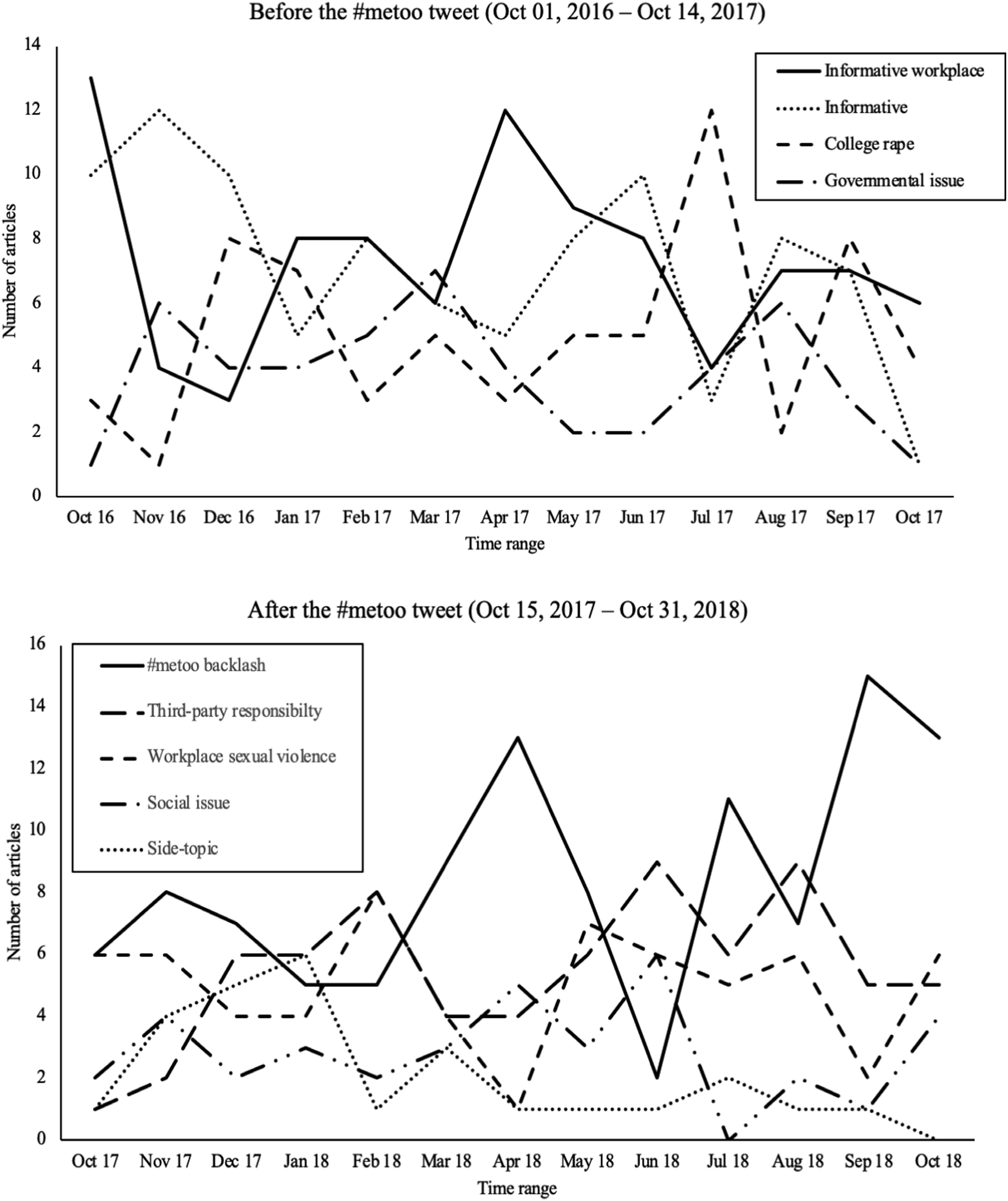
The Third-party responsibility frame was present in 23% of articles in the ‘after’ period. There were two article topics: an assignment of guilt (M = .77, SD = .42) and/or a report (M = .72, SD = .45) of physical violence (M = .73, SD = .45). The main actors were educational (M = .32, SD = .47), and/or governmental institutions and/or individuals (M = .45, SD = .50). The responsibility most often fell upon the perpetrator, either implicitly (M = .30, SD = .46) or explicitly (M = .41, SD = .50). Additionally, educational (M = .27, SD = .45) and governmental institutions (M = .34, SD = .48) were held responsible for lacking an adequate system to deal with cases (e.g. educational policy structure; M = .55, SD = .50) or mishandling issues (M = .80, SD = .40). Treatment recommendations were rarely provided (M = .08–.31, SD = .28–.47). Nevertheless, journalists actively took part in the conversation (M = .38, SD = .49).
The Workplace sexual violence frame accounted for 21% of articles in this period. Articles containing this frame were clearer in indicating whether verbal or physical SV (M = .72, SD = .45) transpired, contrasting with the Informative workplace frame before #metoo (which was often unspecific regarding the type of SV that occurred). Furthermore, the Workplace SV frame showed a clear causal attribution by explicitly (M = .35, SD = .48) and/or implicitly blaming the perpetrator (M = .38, SD = .49). Moral evaluation in these articles focused on positive aspects of awareness (M = .26, SD = .44) and reformed legal policies (M = .25, SD = .43). The main actors were private organizations (M = .60, SD = .49), celebrities (M = .35, SD = .48), and the public (M = .34, SD = .48).
Social issue was a new frame that was present in 12% of articles within this period. Three new topics emerged: raising awareness (M = .84, SD = .37), gender issues (M = .49, SD = .51), and societal norms (M = .49, SD = .51). The actors included celebrities (M = .35, SD = .48), the public (M = .41, SD = .50), and private organizations (M = .57, SD = .50). Attribution of responsibility was distributed amongst multiple actors and occurred less frequently when compared to the other clusters. Moral evaluation and treatment recommendations were present in this frame. In this regard, awareness was described positively (M = .92, SD = .28) and/or the system was described as inadequate (M = .62, SD = .49). A call for norm-change (M = .54, SD = .51) and system-change (M = .41, SD = .50) was given and journalists took an active position in the conversation (M = .65, SD = .48). Articles including this frame did not focus on specific instances of SV such as classic victim-perpetrator scenarios. Rather, implications of SV across different levels of society were discussed.
The Side-topic frame emerged in the ‘after #metoo’ period and was present in 9% of the articles. In this frame, it was not stated whether the sexual act was of verbal or physical nature (M = .96, SD = .19). Furthermore, the main portion of the article was devoted to a topic other than SV, where the act was mentioned as secondary information (M = .41, SD = .50). Private organizations were the most prominent actors (M = .70, SD = .47). The perpetrator was rather implicitly blamed (M = .30, SD = .47) than explicitly blamed for the SV act (M = .11, SD = .32), whereas third parties remained unaddressed (M = .00–.11, SD = .00–.32). This frame was not present in the phase ‘before #metoo’. One could argue that #metoo and the topic of SV found themselves relevant in other subject matters or issues (e.g. articles discussing economic policies) that were not directly related to SV. This interpretation may be supported by the clear negative trend in report frequency throughout the time period after #metoo (Figure 1). In other words, the Side-topic frame can be understood as a journalistic byproduct or topic-trend stemming from the prevalent #metoo issue, rather than a larger change in journalism on SV.
Changes after #metoo
The second research question was whether journalism coverage on SV in terms of framing changed as a result of the #metoo campaign and, if so, how it changed (RQ2). This research question is answered through the subset of research questions (RQ2a-e) and based upon Entman’s (1993) dimensions of framing.
Firstly, we focused on whether journalists addressed other topics and actors after #metoo, and if they discussed reoccurring topics differently (RQ2a). In addition to the topics covered in the ‘before’ phase, the topics of false accusation (#metoo backlash frame) and SV in terms of a larger societal issue (Social issue frame) emerged. Although the main actors remained the same, the topics of the articles diversified. Moreover, how reoccurring topics were covered changed. For example, articles containing frames related to SV in the workplace (Informative workplace, Workplace SV) became more explicit in describing the type of SV acts. In other words, journalists were more ambiguous when describing the SV type before #metoo, and more specific after. These articles also discussed verbal SV more frequently. This is a notable shift, as the main focus of articles before #metoo involved physical acts. An increase in journalistic coverage of verbal SV may suggest an emerging emphasis in reporting on a broader range of SV types.
Secondly, we examined whether responsibility for acts and matters of SV was assigned to different actors than those before #metoo (RQ2b). As such, two concepts need to be distinguished. On the one hand, there is the assignment of blame to an individual or entity for the specific act of SV. On the other hand, there is the assignment of responsibility to third parties that shape the environment in which these acts occur. Regarding blame, victim-blaming was not present in our sample. This contrasts with results found in prior literature, where victim-blaming was a recurring subject (McDonald and Charlesworth, 2013). Here, the variables specific to victim-blaming were coded infrequently as they did not exceed the 5% frequency threshold. Regarding blame on the perpetrator, the perpetrator was implicitly and explicitly blamed for the SV act. This trend slightly increased after #metoo. However, journalists addressed the concept of third-party responsibility less frequently after #metoo.
Thirdly, we examined whether journalists addressed different positive and negative aspects when compared to before #metoo (RQ2c). Not only did the frame element ‘false accusation’ solidify as a topic in the ‘after #metoo’ period, but it was evaluated as a threat and/or a drawback of the increased attention to SV (#metoo backlash frame). This is not to say that false accusations have not been addressed in SV news coverage, nor journalism research, up to this point, but that it (as a topic) only solidified into a frame in our period under investigation after #metoo and not for our sample 1 year prior to #metoo (for further information, see discussion).
Articles dealing with SV in the workplace after #metoo addressed case mishandlings by officials while positively evaluating legal changes through discussion of stricter laws and policies. Across frames, case mishandling was more commonly addressed and evaluated negatively after #metoo. Overall, journalists addressed and evaluated more aspects positively or negatively after #metoo.
Furthermore, we examined whether journalists included recommendations to be implemented by society differently than those before #metoo (RQ2d). Journalists predominantly offered recommendations to audiences that societal norms and various systems (such as educational or legal systems) needed changing. This was present in frames dealing with third-party responsibility before and after #metoo (College rape frame, Governmental issue frame, Third-party responsibility frame). Journalists reported most recommendations in articles containing the Social issue frame, which only emerged after #metoo.
Lastly, we examined whether how journalists positioned themselves within the articles had changed (RQ2e). The active positioning contrasts with traditional ideals of objectivism in journalistic coverage. Active journalism was found within the third-party responsibility frames before and after #metoo and most prominently in the Social issue frame after #metoo.
Altogether, three new frames emerged after #metoo, namely, the #metoo backlash frame, the Social issue frame, and the Side-topic frame. For both time periods, all clusters identified were present throughout the particular year under investigation (see Figure 1).
Discussion
The publicity the MeToo movement gained from the viral #metoo tweet stimulated the conversation on SV, both in news media and public discourse. Although this appears to be a positive development, it is necessary to be aware of how journalists cover SV for two reasons. On the one hand, since the news media represents a crucial source for gathering news and information regarding certain topics, it naturally provides the basis upon which people form their opinions (Carroll and McCombs, 2003). Consequently, providing them with certain information and leaving out others may naturally lead to a distorted view of the addressed topic (Bryant and Oliver, 2009). It is not only the supply of information that may have this effect but also how the information is presented. In this regard, framing news articles has been shown to influence opinions (Powell et al., 2015) and people’s perceptions of an issue’s significance (Nelson et al., 1997). Therefore, this study aimed to investigate how journalists frame SV in the news (RQ1) and whether such practices have changed after the first #metoo tweet (RQ2).
In the year before #metoo, four frames forming two main categories were found. Firstly, the informative news frames (Informative and Informative workplace) communicated general and workplace-specific instances of SV, most resembling traditional hard news. Secondly, discussion-based news frames (College rape and Governmental issue) provided background information on incidents and included commentary and opinions. After #metoo, the informative news frames were notably absent, whereas they comprised most articles in the prior phase (62%). In the period after #metoo, three novel frames emerged (i.e. #metoo backlash, Social issue, Side-topic). Although the Side-topic frame can be disregarded as it vanished 1 year after #metoo, the emergence of the #metoo backlash and Social issue frames is noteworthy. These frames indicate that the journalistic conversation around SV diversified, especially because of a renewed emphasis on issues such as false accusations and SV as a societal issue. While these frame elements were indeed coded in our 1-year sample prior to the #metoo hashtag, they only manifested into distinct frames in our sample dating 1 year after the viral hashtag. In other words, our articles prior to the #metoo hashtag also addressed false accusations and evaluated SV as a societal issue, but these aspects were not the focus of these articles, as was the case for our sample after #metoo.
It is vital to note, that false accusations and SV as a societal issue did not merge as new topics themselves because of #metoo. Both topics have, in fact, been extensively addressed in prior research. For example, McDonald and Charlesworth (2013) described that most articles investigated reported a claim of sexual harassment while simultaneously doubting the claim. As this topic was present in findings from prior literature, one could argue this being less the result of #metoo, but rather the outcome of general changes in journalism over time. Nonetheless, this change is problematic. Research has shown that media coverage of (alleged) false SV accusations is not representative of their actual occurrences (Kelly et al., 2005). This disconnect between media representation and reality may foster the public’s perception that false SV accusations are far more common when they are, in fact, not. These biases become present throughout life and affect how SV survivors are treated by judicial and executive systems, friends, and the media, for example (for a more extensive discussion, see, e.g. Benedict, 1993). Fearing such consequences, many SV offenses are never reported to authorities and if they are, only few end in convictions (Kelly et al., 2005).
Our results also align with prior research regarding other aspects. Previously conducted research showed that journalistic reportage tends to focus on isolated incidents rather than on systemic issues (McDonald and Charlesworth, 2013; Thakker and Durrant, 2006; Weatherred, 2015, 2017). Our results from the period before #metoo support these findings, as most articles were ascribed to informative news frames (62%). Furthermore, the remaining articles ascribed to the College rape and Governmental issue frames also reported on isolated incidents, while connecting them to larger systemic issues surrounding SV. In short, most articles before #metoo focused on single incidents, while few addressed SV as a systemic issue, supporting results from previous studies. After #metoo, articles containing frames other than the Social issue frame increased their focus on single-incident reports. With only 12% of articles after #metoo ascribed to the Social issue frame, the conversation surrounding SV remained about single-incident reports rather than on systemic issues.
Furthermore, another aspect of SV in prior literature is the focus on individual blame and victim-blaming (Day et al., 2004; McDonald and Charlesworth, 2013; Weatherred, 2015, 2017). Our findings, however, do not support the presence of victim-blaming in news coverage before or after #metoo. Rather, blame placed upon perpetrators was present in all frames and increased after #metoo. #metoo was about speaking out against people’s transgressors. As such, journalists’ increase in placing blame on perpetrators might mirror this shift in calling attention to potential offenders. Or, this result could derive from the overall increased reportage on SV incidents after #metoo. While it is a positive development that our study did not find victim-focused blame (implicit or explicit), increased accounts of perpetrator-focused blame may foster individualization of the SV problem (Berns, 1999, 2001, 2010).
Another notable difference to prior literature was the assignment of responsibility to a third party. McDonald and Charlesworth (2013) noted that some articles discussed sexual harassment as a legal issue. This finding shares similarities with frames assigning responsibility to external entities before and after the #metoo tweet (i.e. College rape, Governmental issue, Third-party responsibility). However, while perpetrator-focused blame increased after #metoo, the assignment of responsibility to external entities decreased. This might indicate changes in journalistic coverage from a more even distribution of responsibility among various actors to an emphasis on individual blame. However, individualizing blame makes society blind to the greater problem: SV is not an incidental issue but rather a systemic one (Meyers, 1997, 2004; Cuklanz, 1995, 2000, 2020; Benedict, 1993). This fosters a culture in which the public lacks understanding for the necessity of greater societal change. Another explanation for this result might be its relation to the increased focus on single-incident reports present in all frames other than the Social issue frame after #metoo.
In a nutshell, the results support prior literature in that articles focused on isolated incidents rather than presenting SV as a systemic issue, and blame shifted from a broader to a more specific target.
This study has limitations. The framing theory as a theoretical approach is contested on the grounds of insufficient operationalization (Scheufele and Tewksbury, 2007). If defined and measured too broadly, framing can only vaguely support the understanding of news media. As fine operationalization was important for this study, a quantitative content analysis of frame elements was conducted as it is described as the most reliable and valid method for examining frames in news coverage (Matthes and Kohring, 2008). Nevertheless, this approach has drawbacks. In the present study, inductive steps were taken, as no prior coding manual was available. Even after extensive revisions, we are unable to ensure that all existing variables were captured. Therefore, continued theoretical research is prudent to uncover new variables for coding procedures.
The search terms used in this study were selected during coding manual development and through the extensive review of news articles published in the investigation period. As discourse changes, so might search terms. If this study is repeated for a different period, search terms must be reviewed. Furthermore, as digital articles are ephemeral in nature, articles that initially formed the sample may have since been edited or removed, thus limiting the study’s replicability.
Regarding article sample size (N = 612), we aimed for the largest sample size that could be feasibly coded with the resources available. Articles were coded up until the wordcount threshold of 1500 words. In comparison to prior studies, this is reasonable for a 2-year period (e.g. Saguy, 2002; Weatherred, 2017). For the feasibility of this study, we set a word limit regarding the unit of analysis. While the majority of coded articles fell below 1500 words (i.e. 92.16%) with few exceeding this significantly (see Figure A1 in the Appendix), we cannot guarantee that all nuances for these respective articles were captured. Furthermore, an equal number of articles was investigated per newspaper. While this allowed for newspaper comparison, it restricted the sample’s representativeness for the total news coverage on SV during that period.
Lastly, to assume that the changes found within this study were solely attributable to the rise of the MeToo movement is unwise. For example, with Donald Trump’s 2017 presidential election bringing the topic of SV into global news coverage, journalism coverage on SV may not have been exclusively captured in the year before #metoo. Future research spanning a larger time period with a larger sample size would be key to observing further changes in journalism.
One avenue for future research is further examining the role of race in contemporary journalistic news coverage of SV. SV reports and the issue of racism are historically intertwined and account for the formation of numerous rape myths (e.g. see Benedict, 1993; Meyers, 2004). Such myths not only shape societal views toward discriminated groups but also the social interaction with them. Therefore, their (re)examination in scientific research is key.
This study is only one piece of the puzzle aiming to contribute to the complex conversation around the issue of SV. It does not claim nor intend to provide details on how and why coverage functions the way it does but rather hopes to offer a comprehensive overview of how SV is covered in the news and might have been impacted by a global social movement. This study provides also some understanding of the potential impact of social media on social movements. The #metoo tweet is one example of how social movements benefit from the instantaneous and global interconnection of the digital world. One message can recapture our attention about a long-standing societal issue and reignite conversations, which – as was the case for this study – can reflect in journalistic news coverage. Of course, this is linked to a variety of circumstances one has no true control over, for example, the algorithmic distribution of a tweet. Nevertheless, the potential for impact withstands. More importantly, this study lays a bedrock for future journalism research by providing an overarching view of how SV is framed in the news. Furthermore, this study provides journalists with a macro perspective on the conversation around SV in news media that they decisively shape. Journalists must continuously be aware that single reports manifest into larger trends through frames that have considerable potential in influencing the audience’s perceptions and views on the topic of SV. Journalistic news reporting on societal issues bears consequences – intentional or unintentional; for good and for worse (Berns, 1999, 2001, 2010). It is always a balancing act.
Footnotes
Declaration of conflicting interests
The author(s) declared no potential conflicts of interest with respect to the research, authorship, and/or publication of this article.
Funding
The author(s) received no financial support for the research, authorship, and/or publication of this article.

Author biographies
Selina Noetzel (MSc) is a PhD candidate at the Department of Communication at the University of Vienna. She attained her Master degree in Communication Science at the University of Vienna. Her research interests include media psychology, framing, and political communication. Contact:
Maria Fernanda Barone Mussalem Gentile (MSc) is a Strategic Marketing Specialist. She received her Master of Science degree in Communication Science at the University of Vienna. She attained her undergraduate degree in Business Administration at ESPM, São Paulo, and a post-graduate degree in Marketing Management at INSPER, São Paulo, Brazil. Contact:
Gianna Michelle Lowery (MSc) received her Master of Science degree in Communication Science at the University of Vienna. She attained her undergraduate degree in Psychology and Cognitive Neuroscience at Harvard College in Cambridge, Massachusetts, United States of America. Contact:
Sona Zemanova (M.A.) is a Master Student at the Department of Communication at the University of Vienna. She attained her undergraduate degree in Psychology at the University of Glasgow, Scotland. Her research interests include journalism, social psychology, and strategic communication. Contact:
Sophie Lecheler is Professor of Political Communication at the University of Vienna, Austria. Her research interests include news framing research, experimental methods, journalism, and emotions. Her research has appeared in various international journals, such as Journal of Communication, Communication Research, Political Communication, and Communication Theory. Contact:
Christina Peter (PhD, 2014, LMU Munich) is a Professor of Media and Communication at the Department of Media and Communications at AAU Klagenfurt. She studied Communication Science, Political Science, and Psychology at the LMU Munich. Her research focuses on media usage and effects, political communication, and digitalization. Contact:
Appendix
Mean values and standard deviations for five identified frames (15 Oct 2017 - 31 Oct 2018; After the #metoo tweet).
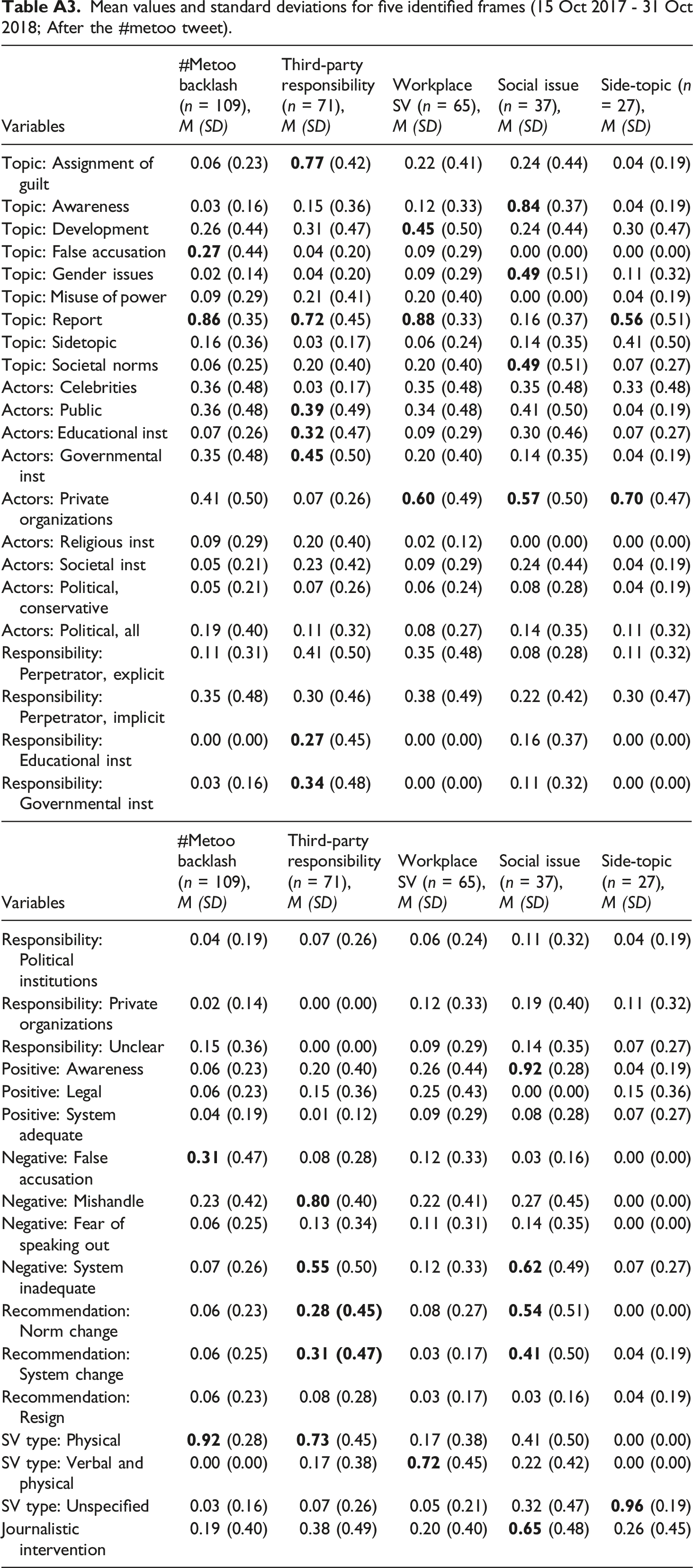
| Variables | #Metoo backlash (n = 109), M (SD) | Third-party responsibility (n = 71), M (SD) | Workplace SV (n = 65), M (SD) | Social issue (n = 37), M (SD) | Side-topic (n = 27), M (SD) |
|---|---|---|---|---|---|
| Topic: Assignment of guilt | 0.06 (0.23) | 0.22 (0.41) | 0.24 (0.44) | 0.04 (0.19) | |
| Topic: Awareness | 0.03 (0.16) | 0.15 (0.36) | 0.12 (0.33) | 0.04 (0.19) | |
| Topic: Development | 0.26 (0.44) | 0.31 (0.47) | 0.24 (0.44) | 0.30 (0.47) | |
| Topic: False accusation | 0.04 (0.20) | 0.09 (0.29) | 0.00 (0.00) | 0.00 (0.00) | |
| Topic: Gender issues | 0.02 (0.14) | 0.04 (0.20) | 0.09 (0.29) | 0.11 (0.32) | |
| Topic: Misuse of power | 0.09 (0.29) | 0.21 (0.41) | 0.20 (0.40) | 0.00 (0.00) | 0.04 (0.19) |
| Topic: Report | 0.16 (0.37) | ||||
| Topic: Sidetopic | 0.16 (0.36) | 0.03 (0.17) | 0.06 (0.24) | 0.14 (0.35) | 0.41 (0.50) |
| Topic: Societal norms | 0.06 (0.25) | 0.20 (0.40) | 0.20 (0.40) | 0.07 (0.27) | |
| Actors: Celebrities | 0.36 (0.48) | 0.03 (0.17) | 0.35 (0.48) | 0.35 (0.48) | 0.33 (0.48) |
| Actors: Public | 0.36 (0.48) | 0.34 (0.48) | 0.41 (0.50) | 0.04 (0.19) | |
| Actors: Educational inst | 0.07 (0.26) | 0.09 (0.29) | 0.30 (0.46) | 0.07 (0.27) | |
| Actors: Governmental inst | 0.35 (0.48) | 0.20 (0.40) | 0.14 (0.35) | 0.04 (0.19) | |
| Actors: Private organizations | 0.41 (0.50) | 0.07 (0.26) | |||
| Actors: Religious inst | 0.09 (0.29) | 0.20 (0.40) | 0.02 (0.12) | 0.00 (0.00) | 0.00 (0.00) |
| Actors: Societal inst | 0.05 (0.21) | 0.23 (0.42) | 0.09 (0.29) | 0.24 (0.44) | 0.04 (0.19) |
| Actors: Political, conservative | 0.05 (0.21) | 0.07 (0.26) | 0.06 (0.24) | 0.08 (0.28) | 0.04 (0.19) |
| Actors: Political, all | 0.19 (0.40) | 0.11 (0.32) | 0.08 (0.27) | 0.14 (0.35) | 0.11 (0.32) |
| Responsibility: Perpetrator, explicit | 0.11 (0.31) | 0.41 (0.50) | 0.35 (0.48) | 0.08 (0.28) | 0.11 (0.32) |
| Responsibility: Perpetrator, implicit | 0.35 (0.48) | 0.30 (0.46) | 0.38 (0.49) | 0.22 (0.42) | 0.30 (0.47) |
| Responsibility: Educational inst | 0.00 (0.00) | 0.00 (0.00) | 0.16 (0.37) | 0.00 (0.00) | |
| Responsibility: Governmental inst | 0.03 (0.16) | 0.00 (0.00) | 0.11 (0.32) | 0.00 (0.00) |
| Variables | #Metoo backlash (n = 109), M (SD) | Third-party responsibility (n = 71), M (SD) | Workplace SV (n = 65), M (SD) | Social issue (n = 37), M (SD) | Side-topic (n = 27), M (SD) |
|---|---|---|---|---|---|
| Responsibility: Political institutions | 0.04 (0.19) | 0.07 (0.26) | 0.06 (0.24) | 0.11 (0.32) | 0.04 (0.19) |
| Responsibility: Private organizations | 0.02 (0.14) | 0.00 (0.00) | 0.12 (0.33) | 0.19 (0.40) | 0.11 (0.32) |
| Responsibility: Unclear | 0.15 (0.36) | 0.00 (0.00) | 0.09 (0.29) | 0.14 (0.35) | 0.07 (0.27) |
| Positive: Awareness | 0.06 (0.23) | 0.20 (0.40) | 0.26 (0.44) | 0.04 (0.19) | |
| Positive: Legal | 0.06 (0.23) | 0.15 (0.36) | 0.25 (0.43) | 0.00 (0.00) | 0.15 (0.36) |
| Positive: System adequate | 0.04 (0.19) | 0.01 (0.12) | 0.09 (0.29) | 0.08 (0.28) | 0.07 (0.27) |
| Negative: False accusation | 0.08 (0.28) | 0.12 (0.33) | 0.03 (0.16) | 0.00 (0.00) | |
| Negative: Mishandle | 0.23 (0.42) | 0.22 (0.41) | 0.27 (0.45) | 0.00 (0.00) | |
| Negative: Fear of speaking out | 0.06 (0.25) | 0.13 (0.34) | 0.11 (0.31) | 0.14 (0.35) | 0.00 (0.00) |
| Negative: System inadequate | 0.07 (0.26) | 0.12 (0.33) | 0.07 (0.27) | ||
| Recommendation: Norm change | 0.06 (0.23) |
|
0.08 (0.27) | 0.00 (0.00) | |
| Recommendation: System change | 0.06 (0.25) |
|
0.03 (0.17) | 0.04 (0.19) | |
| Recommendation: Resign | 0.06 (0.23) | 0.08 (0.28) | 0.03 (0.17) | 0.03 (0.16) | 0.04 (0.19) |
| SV type: Physical | 0.17 (0.38) | 0.41 (0.50) | 0.00 (0.00) | ||
| SV type: Verbal and physical | 0.00 (0.00) | 0.17 (0.38) | 0.22 (0.42) | 0.00 (0.00) | |
| SV type: Unspecified | 0.03 (0.16) | 0.07 (0.26) | 0.05 (0.21) | 0.32 (0.47) | |
| Journalistic intervention | 0.19 (0.40) | 0.38 (0.49) | 0.20 (0.40) | 0.26 (0.45) |