




Abstract
Discussions about Iranian journalism have disproportionately focused upon the restrictive political context of the country. Accordingly, journalism culture and the way journalists construct their roles and identities in the face of constraints in Iran have received scant attention. This study redresses this gap by focusing on Iranian journalists’ role conceptions and perceptions of role enactment. Based on interviews with 26 journalists working in media outlets in Iran, this study found that the role conceptions of Iranian journalists correspond to adversarial advocate, detective watchdog, change agent, educator and informer roles. Although the journalists perceive a large gap between their role ideals and their role performance, they believe they have occasionally been successful in acting out their roles. Journalists’ role conceptions and perceived role enactment serve as journalistic illusio, which not only motivate journalists to continue operating under pressure but also allow the journalistic field to exist and function over time in the restrictive media environment of Iran. These results are discussed in relation to whether and how journalism outside a democratic context is possible.
Keywords
Introduction
The media landscape in Iran is marked with an ongoing struggle between the political field and the journalistic field. The Iranian state attempts to control and use the media for the propagation of its ideology (Sreberny and Mohammadi, 1994). The state is also the leading economic player in the press market, which has resulted in unequal levels of competition between state-owned and privately owned media; this allows the former to take advantage of better financial resources and advertising revenue (Khiabany, 2009; Shahidi, 2007). Rules and regulations regarding the press in Iran are restrictive and emphasize the role of the press in propagating the state ideology. In the introduction of the Constitution of the Islamic Republic of Iran (1979), the general role of mass media is stated as operating ‘in the service of propagating Islamic culture. To this end, it must try to benefit from a healthy encounter of various thoughts and views, and must seriously refrain from propagating destructive and anti-Islamic attitude’. Despite these circumstances, Khiabany (2009) notes that a part of the Iranian press has always ‘acted as agents of modernisation, missionaries for enlightenment, and advocates for social change’ (p. 117). However, such claims in the literature are mostly based on a historical review of the Iranian press, rather than empirical material. This study, using qualitative interviews, provides empirical evidence on how Iran’s journalists understand their roles. The findings, in turn, contribute to an understanding of journalism’s identity and culture in Iran.
In the existing literature, the term journalistic role conception has been commonplace in studying journalists’ understating of professional journalism. The concept of role conception refers to ‘the purposes of the profession that journalists conceive as more important at the individual level, where the locus of role evaluation is not necessarily related to social consensus’ (Mellado et al., 2017: 6). Simply put, role conception is the journalists’ normative ideas of what a journalist should do and what journalism is for (Hanitzsch and Vos, 2018), which is different from other role-related aspects. Hanitzsch and Vos (2017) suggested a model to differentiate between four dimensions of roles: what journalists think they ought to do (normative role orientations), what journalists want to do (cognitive role orientations), what journalists say they do (narrated role performance) and what journalists really do in practice (practised role performance).
Role conceptions are journalists’ ‘aspirations, and/or self-legitimizing expressions’ (Waisbord, 2017: 178) and ‘attempted impact’ (Hellmueller and Mellado, 2015: 1). These do not necessarily correspond to actual role performance (Mellado, 2015; Waisbord, 2017) or role enactment (Tandoc et al., 2013). Recently, scholars have addressed the gap between journalists’ ideals of their roles and their actual performance due to various influences that journalists are exposed to (e.g. Mellado and Van Dalen, 2014; Tandoc et al., 2013). As Raemy et al. (2018) underline, examining the connection between what journalists think they should do and their perception of the possibility of enacting normative role conceptions offers a more comprehensive approach for country-specific analyses. This study, therefore, considers both journalists’ role conceptions (normative role orientations) and their perceptions of role enactment (narrated role performance). I discuss these two role-related aspects through Bourdieu’s concept of illusio (the belief that a game is worth playing), and explain how Iranian journalists’ sense of social influence encourages them to operate under pressure, and consequently allows the journalistic field to function even in a restrictive condition.
Journalistic roles in restrictive contexts
A dominant approach within journalism studies has been examining journalism in relation to democracy (Josephi, 2013; Zelizer, 2013). In 1996, Carey claimed that ‘journalism is another name for democracy or, better, you cannot have journalism without democracy’, and accordingly, he referred to the Soviet Union as a context in which ‘there just wasn’t any journalism because there was no democracy’. More than 20 years since Carey’s claim, biases measuring journalism through the prism of democracy still persist. A case in point of this is human rights organizations, that is, Freedom House, consider democracy as the determinant factor of journalism, which has resulted in classifying two-thirds of the worlds’ countries as partly free or not free (Josephi, 2013). Consequently, the reality of journalism in certain contexts, such as Iran, has been reduced to macro-processes and political oppression, which portrays the journalistic fields in politically restrictive contexts as solid and homogeneous domains in which journalists are passively suppressed by the state. This study goes beyond the focus on the restrictive media system of Iran and draws attention to overlooked aspects of Iranian journalism, namely the way Iranian journalists construct their roles and identities in the face of restrictions.
Aside from the fact that democracy has been understood as a benchmark to measure journalism (Josephi, 2013), journalistic role conception has also been conceptualized from within ‘a Western framework’ and in relation to media contribution to democracy and citizenship (Hanitzsch and Vos, 2018). A large body of studies, have offered a variety of typologies of journalistic roles in more democratic settings (e.g. Cassidy, 2005; Cohen, 1963; Hanitzsch et al., 2011; Weaver and Wilhoit, 1996; Weaver et al., 2007). This literature suggests that journalistic roles are objects of struggle over legitimacy within the journalistic field as well as objects of struggle over the meaning and legitimacy of journalism in society in relation to other fields (e.g. Deuze, 2005; Hanitzsch, 2007).
To go beyond the ‘Western’ biases existing in the literature, Hanitzsch and Vos (2018) proposed a more inclusive framework including 18 normative role orientations within the domain of political life and everyday life, which could exist among journalists around the world. This framework, which I use in this study, tries to connect journalists’ role conceptions with journalism’s realities in ‘non-democratic’ and ‘non-Western contexts’. In line with Hanitzsch and Vos (2018), I look at role conceptions as journalists’ normative understating of their roles, and structures of meaning that are discursively constructed through their narrations and expressions of their points of view.
According to Hanitzsch and Vos (2018), in the realm of everyday life, which has a lower value among journalists around the globe, there are three areas of journalistic function: consumption, identity and emotion. In the domain of political life, they introduce six journalistic functions. The informational-instructive function is associated with disseminator, curator and storyteller roles, which considers journalists to be non-involved reporters; this is similar to the neutral reporter role and the gatekeeper model of journalism (Janowitz, 1975; Johnstone et al., 1972). In the analytical-deliberative dimension, represented by analyst, access provider and mobilizer roles, journalists actively aspire to stimulate the political participation of the audience. This shares features with public journalism (Glasser and Craft, 1998; Voakes, 2004) and the civic role of journalism (Mellado, 2015; Voakes, 2004). The critical-monitorial function, consisting of the monitor, detective and watchdog roles, pertains to the idea of the press as the ‘Fourth Estate’, which defines the press as the primary platform to scrutinize the conduct of power holders (Mellado, 2015; Weaver et al., 2007). The advocative-radical function (encompasses adversary, advocate and missionary roles) signifies the active presence of journalists’ voices in their stories, their participatory role in social and political processes, and distance with the ‘loci of power in society’ (Hanitzsch and Vos, 2018; Mellado, 2015). The developmental-educative aspect considers journalists as participants in social change and includes three roles: change agent, educator and mediator. The collaborative-facilitator function sees journalists as the partners and supporters of the government, comparable to loyal facilitator (Mellado, 2015) or opportunist roles (Hanitzsch et al., 2011).
Comparative studies of journalistic roles indicate that the informer, watchdog, educator, investigator roles and the ideas of ‘detachment’ and ‘non-involvement’ are universal trends among journalists around the world (e.g. Hanitzsch et al., 2011; Standaert et al., 2019). This branch of literature suggests that the informer, watchdog, monitor and entertainer roles are more popular among ‘Western’ journalists, while the opinion guide, change agent, people’s voice and missionary roles are more prevalent among journalists in ‘non-Western’ contexts (Hanitzsch et al., 2011; Standaert et al., 2019). Moreover, country-specific studies have found that journalists, in the ‘Arab’ region and countries such as China and Kenya show the desire to drive political and social changes (e.g. Hassid, 2016; Muchtar et al., 2017; Pintak, 2010; Pintak and Ginges, 2008). Empirical studies also indicate that journalistic roles in a single country often correspond to diverse role conceptions, rather than a monolithic block (e.g. Hassid, 2011; Mwesige, 2004; Relly et al., 2015; Zhang and Su, 2012).
Aside from the fact that Iran has been absent in comparative studies on role conceptions, the existing accounts on Iranian journalism tend to focus on governmental control of the press and political restriction rather than how journalism is possible in such a restrictive context. A quantitative and survey-based study indicated that professional autonomy, job security, compliance with professional norms, honesty and integrity in reporting and contributing to democracy in the country are among the highest-ranked indicators of ‘desirable journalism’ among Iranian journalists (Badiee, 2003: 33). In 2013, a quantitative survey-based report (not scholarly research) briefly addressed Iranian journalists’ institutional roles based on their responses to five aspects of journalistic roles. The journalists’ responses showed that they put value on providing the public with verifiable information, informing the public about important issues, representing the public’s grievances against the authorities, motivating people to participate in civic activity, and covering sensitive or controversial topics that cross so-called ‘red lines’ (Wojcieszak et al., 2013: 13). These studies show that Iranian journalists share a somewhat similar understanding of what journalism should be with many journalists in other countries. However, they do not offer any insights on how Iranian journalists narrate, make meaning of their roles and perceive the likelihood of being able to enact them in their everyday work.
The first aim of this article is to investigate what journalistic roles are important for Iranian journalists and what they think they should do, which is connected to the concepts of normative role orientations and role conceptions within role-related research (e.g. Hanitzsch and Vos, 2017; Mellado et al., 2017). Using Hanitzsch and Vos’ (2018) approach, this article addresses the way Iranian journalists talk about, narrate and thus articulate the discourse of journalistic roles in relation to the broader social context and other actors, such as the general public and political actors. It offers important insights into the extent that Iranian journalists have maintained their autonomy in defining their professional roles and have succeeded at fortifying the boundaries of the journalistic field in a context where journalism is exposed to the imposition of the political field. This aspect, as Hanitzsch and Vos (2018) argue, tells us about ‘the struggle over the preservation or transformation of journalism’s identity’ (p. 151).
The available studies on journalists’ understanding of their functions in politically restrictive contexts mainly focus on role ideals and not on the perception of role enactment. The second aim of this article is to examine how Iranian journalists think about the possibility of performing their roles, which is conceptualized as perceived role enactment and narrated role performance within the role-related literature (Hanitzsch and Vos, 2017; Mellado et al., 2017; Raemy et al., 2018). This aspect helps us to understand how journalists see their roles in connection to the actual restricted practice, particularly in a restrictive media environment where it is assumed that there is a substantial gap between journalists’ role conceptions and their perceived role enactment.
The aspects mentioned above assist in addressing a broader question, which is the third aim of this study: what is the explanatory relevance of professional role conceptions and perceived role enactment for Iranian journalism culture? Much of the role-related research does not go beyond mere description and does not address what is the value of journalists’ role ideals in the contexts where journalists to a great extent are unable to perform their ideals in work lives. A few studies have suggested that journalistic ideals may function as a counteracting and driving force for the journalistic struggle against external constraints, such as political forces, commercialization and organizational restrictions (e.g. Hassid, 2016; Ogongo-Ongong’a and White, 2008; So and Chan, 2007). However, it is unclear how journalists’ role ideals, as driving forces, are related to journalism as a social institution or field. This study fills this gap by discussing the implications of role ideals for the journalistic field in a ‘semi-authoritarian’ environment and answering why role ideals matter for Iranian journalists. For this purpose, I apply Bourdieu’s concept of illusio: ‘emotional investment and cognitive investment in the stakes involved in any particular field, or, simply, the belief that the game [for instance, the journalistic game] is worth playing’ (Benson and Neveu, 2005: 3). Illusio, as ‘interest in the game’, sheds light on the shared consensus over the value and importance of a game, and ‘the fact that what happens matters to those who are engaged in it, who are in the game’ (Bourdieu, 1998: 77). For Bourdieu (1990), a field does not function without ‘aspirations’ and ‘motivations’ (p. 87). He says, [. . .] a field can function only if it can find individuals who are socially predisposed to behave as responsible agents, to risk their money, their time, and sometimes their honour or their life, to pursue the objectives and obtain the profits which the field offers and which, seen from another point of view, may appear illusory [. . .]. (Bourdieu, 1990: 194)
Method
The empirical material for this study includes 26 interviews with journalists working in national media outlets in Iran. I conducted face-to-face interviews with 14 male and 12 female journalists in Tehran in September and October 2016 and in December 2018. Each interview lasted for at least 75 minutes. However, only a select portion of the data is used for this article. Qualitative interviews, and small samples, are identified as appropriate methods of investigating journalists’ roles in detail (e.g. Hellmueller and Mellado, 2015; Mellado et al., 2017). This study focuses on journalists’ perceptions. So, journalists’ narratives are not to be taken at face value, but rather are approached as ‘individual desires, group aspirations, and/or self-legitimizing expressions [. . .] rather than actual commitments or descriptions of news practices’ (Waisbord, 2017: 178).
The interview guide included a set of open-ended questions, and I did not apply pre-existing themes. For instance, the questions included, among others, the following: What roles do you consider for yourself as a journalist (if any)? Why did you decide to become a journalist? What is it that you like/do not like about journalism? How your ideals of journalism differ from the journalism that you are currently doing (if at all)?
Given the dangers to my own safety, as well as trying not to spoil the possibility of conducting this research, I did not include the journalists working for the hard-liner media, which are in fact different from ‘conservative’ media and are closely affiliated with security institutions. The generalizability of the results to all Iranian journalists is thus subject to limitations, and the sample may not represent the entirety of Iranian journalism. Rather, it is an exploratory study that focuses on ‘an in-depth understanding of a few people’ (Creswell and Clark, 2011: 174). I initially relied on my network of journalistic contacts, and expanded the sample through snowball sampling, which has its own well-known problems. For instance, those members of a particular population with more contacts with other members have more chances of being included in the sample. However, this was actually the best possible way to reach participants within the constraints of conducting this kind of study in Iran. Journalism is a politically sensitive domain in Iran, and researching the field, particularly in affiliation with overseas institutions, may pose safety risks for the researcher.
Despite the limitations, the sample includes a variety of journalists with different backgrounds and the experience of working in various news organizations with different forms of ownership, affiliations and political orientations (please see Table 1). This article does not focus on journalists in relation to the organizations in which they were working. Nevertheless, a possible way to ensure maximal variation in the sample was to select journalists working for different news outlets, which play important roles in the media market. These include four privately owned newspapers (three of them affiliated with the reformists and one which has no explicit political orientation), two state-owned conservative newspapers, one privately owned news agency affiliated with the reformists, three state-owned conservative news agencies and two electronic dailies (one affiliated with the reformists and the other has no explicit political orientation).
List of participants.
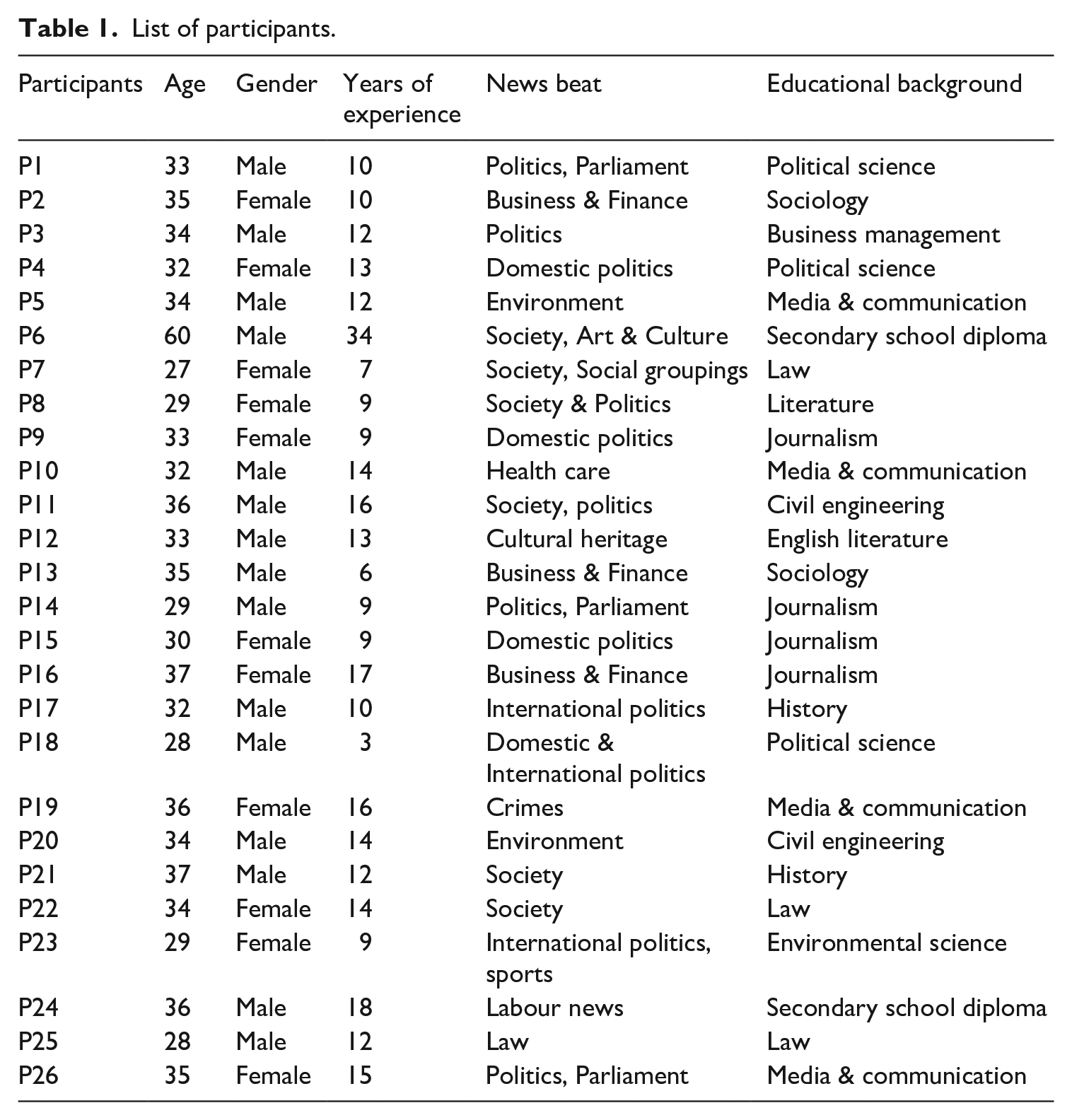
To safeguard the journalists’ safety, I concealed the identity of the interviewees, and excluded the name and information of news organizations in which they are employed. To analyse the interview material, I used the thematic analysis method addressed by Braun and Clarke (2006) including coding the data, looking for patterns of meaning, identifying implicit and explicit ideas or themes, reporting of the content and meaning of patterns in the data.
Findings
Overall, the findings show that the boundaries between the roles related to the political life and the roles related to everyday life, proposed by Hanitzsch and Vos (2018), may not be clear-cut in some circumstances. For the journalists in this study, different dimensions of life are inextricably intertwined with the political domain in the Iranian context. The ‘security outlook’ of the political actors is a recurrent term in the interviews. The journalists say that several issues, which they perceive as a matter of public interest, may be interpreted by authorities as topics threatening the security of the state and causing unrest and disorder in society. P6, who has worked on a range of social issues, art and culture says, ‘art is also understood as a security and political issue here’.
The journalists in this study cover a range of topics including politics, culture, sports, health care and art. However, interestingly, only one journalist (P11), who covers politics and social issues, thought that journalism should be ‘entertaining’ and journalists should cover the topics that are ‘appealing for the middle-class audience’. However, he says that a range of issues that are appealing and entertaining for the audience such as those related to youth and lifestyle are entangled with politics. These findings suggest that those aspects of journalistic roles that fall into the domain of everyday life in a more democratic context, may be connected to the domain of political life in a ‘semi-authoritarian’ setting.
The findings suggest that the journalists’ understanding of their roles map onto adversarial advocate, change agent, educator, detective watchdog and informer roles. Each of the journalists adheres to more than one of these journalistic roles. They perceive a gap between their roles and their actual practice. To a large extent, this could be explained by political pressures from the state, including coercion, crack downs on the media, restricting access to information and making certain topics off-limits. P25 says, ‘I think a reason that I have not been able to achieve my ideals of journalism is self-censorship, fear of possible judicial encounter, and the prices’. The journalists see the relationship of the Iranian state with journalism as being antagonistic. They refer to the discrepancies between their roles, in particular, the press as the Fourth Estate, and what is expected of journalism by the state in Iran. ‘The press is said to be the Fourth Estate, and this is not acceptable here. The power sees the media as an obtrusive element’, says P4 who covers internal politics in a state-owned news agency.
There is also evidence that organizational factors influence the relationship between the journalists’ perceived roles and perceived role performance, which challenges the assumption that political forces define the whole reality of journalism in politically restrictive contexts. The journalists talk about the instrumentalization of the press by those who are affiliated with external, powerful political and economic actors. Consequently, they perceive a conflict between their ideals and the news media’s interests. P4 says, ‘My journalistic ideals are often affected by the news outlet. I wish to act in certain ways, but I know that my news outlet might confront and prevent me, and then I avoid it’.
Among all the journalists, only two journalists (P11 and P15) mention the words ‘informing about truth’ as their role. For them, ‘truth’ means providing the public with truthful information, rather than producing the content that is ‘biased’ from their point of view. The findings suggest that, in a context where there is a high degree of political interference in the journalistic field, there is a low perceived possibility of enacting even the most basic and passive journalistic role. P15, who covers domestic politics, says, I have always been thinking about informing as well as informing the public about truth, but I have often not been able to fulfil these roles [. . .]. For instance, as a journalist, I see my responsibility to inform the public about a certain event related to the government. However, the government orders all journalists not to publish on the issue. I am therefore not able to achieve my role.
The role conceptions of many journalists correspond to the advocate and adversary roles. Two key aspects of adversarial advocate role conception, which are evident in the data are the journalists’ distance to the loci of power in society and speaking on behalf of people, and in particular, the powerless groupings. P19, who covers the crime beat says, ‘There is a large gap between what is important to people and what is important to the government in Iran. I work on the issues that are important to people and are significant concerning people’s interest’.
The interviews show that, for them, ‘people’ mean the ordinary public that are affected by macro-forces. P25, who is involved in the field of legal journalism, refers to his role ideals as ‘The role that I consider for myself is informing people about their rights and defending them, such as political prisoners and religious minorities, although it [performing this role] has sometimes caused me troubles’. They value their access to the media and perceive it as an opportunity to speak for ‘marginalized’ and ‘voiceless’ groupings who otherwise do not have access to the channels of expression. The adversarial advocate role is more common among the journalists who have the experience of covering the society beat and social groupings, if compared to those who cover the political and economic beats.
The findings reveal that the change agent and educator roles also find support among the journalists. I thus call this category change agent-educator role conception. However, the educator role for the journalists much more relates to how a change should be made, rather than the ultimate goal that a journalist may want to achieve. A recurrent term among some journalists is ‘raising awareness’. P22, who covers women’s issues and domestic politics, says, ‘I try to raise awareness among women about their rights through my stories, inform them about the issues that they do not know about, and cover their problems’. The journalists’ role conception is pervaded by a sense of playing an active role in influencing change and contributing to better living conditions in the country: ‘Contributing to a better life in my homeland’, says P5 who covers the environment beat. These changes are not limited to the political domain, and influencing transformations related to the political process, but are related to various aspects of public life. P18, who covers politics, says, ‘As a journalist, in an ideal situation, we should raise public awareness of issues and stimulate the participation of people in political, social, and other aspects of life’. For many of the journalists, journalism is about revealing and solving a variety of problems, ranging from corruption and poverty to restrictions on music concerts. Making a change varies from macro-level changes to small-scale influences on individuals’ conduct. P10, who covers the health beat, mentions an example of a small-scale influence: ‘It is enough for me to be able to change an individual’s opinion on a particular issue, for instance, about animal rights’. An example of a large-scale influence is a female journalist’s (P8) desire to direct a change in the rules and regulations concerning women’s rights.
Other indicators in the data signifying the journalists’ change agent role conception include the following expressions: ‘generating public deliberation’, ‘fostering the participation of the citizens’ and ‘influencing a change towards freedom and enlightenment’. Some of these aspects, such as the desire to involve people in active participation, sit closely with the mobilizer role. However, in the journalists’ narratives, these aspects are often discussed in connection to their desire for direct involvement in bringing a change. P6 who had worked as a journalist for 34 years, says, ‘I see journalism as a means of enlightenment. I think our role is to be able to lead society towards more freedom, development, and citizen participation’.
The journalists’ understandings of their roles also often correspond to the roles of detective and watchdog, and they mention the Fourth Estate model of the press. The indicators that signify the detective watchdog role conception include the journalists’ understanding of their roles as those who should be ‘critical of the power holders’, ‘investigate their claims and statements’, ‘reveal their wrongdoings’, ‘denounce them’ and ‘put pressure on them’. A female journalist (P7), covering a range of social issues, says, ‘we should influence decision-making by the government, and put pressure on the government so that they cannot do anything they want’. In their view, a journalist should ‘actively scrutinize the conduct of authorities’, ‘be critical’, ‘be questioning’, ‘have the courage to speak out’, serve as a means of ‘accountability’ and influence ‘effective actions by policy-makers’.
The journalists put a high value on investigative journalism, and covering sensitive topics such as corruption, and see investigative reporting in connection to providing analysis and discussion of issues. In fact, the analyst role, for the journalists in this study, is seen from within a content-related aspect through which investigative role should be conducted, rather than being a role in itself. In the journalists’ understandings, there is generally a lower possibility to enact the detective watchdog role if compared to other roles. This is because the possibility of putting investigative reporting into practice depends on a variety of factors beyond political freedom, such as financial resources and organizational factors.
The journalistic game is worth playing
The journalists are aware that they are not always able to fulfil their normative roles. However, they think they have been able to act out their roles, to a certain extent, and there is a possibility, however limited, of putting their ideals into practice. The interviews show that the journalists play the journalistic game based on the belief that journalism contributes to society and enables them to play a socially influential role. The journalists share consensus over the significance of the game and what is at stake in the game, that is, journalistic illusio. P26, who works as a parliamentary journalist, says, ‘One may think we are crazy to work under the financial hardship and all the challenges, but it is enjoyable because it is connected to your influence’.
They talk about the instances when officials have reacted to their stories or have promised a change in policies. They also often refer to their cases which they think have contributed to a better life for a group of people or an individual. A high number of journalists are motivated by the fact that the country is facing several issues that journalists should monitor. P7, who works on the society beat, says, ‘It might sometimes seem disappointing when you ask yourself: what has changed so far? Then you tell yourself that if you can change a person’s mind, it [journalism] is worth doing’.
The findings show that the journalists’ role ideals and sense of influence shape their strategies of behaviour against the restrictions. In the interviews, they put a value on preserving their journalistic identity, operating over time and allowing the press to operate, regardless of the pressures. Some of them express that they prefer to adopt less contentious behaviour rather than acting radically, and thus ending up in prison, which deprives them of journalism, and their (however slight) influence. P24, who covers workers’ news, refers to the social implication of the political risks and says, ‘If publishing a story has consequences for me, it also affects the workers who always rely on me to report their news. Sometimes, I do not take risks in order to continue working and give them a voice’. In the journalists’ understandings, the limits to what journalists should do and write is also connected to avoiding the closure of media outlets by the authorities, which is based on their perceptions of the social influence of journalism in the country. The following statement from P18, shows how survival of the press, against the state, as their rival, is valuable: The existence of a publication is similar to the role of a player in a football team who might only walk in the field, but who still has a role. If the player is sent off, it means they have one player less than the other team. The weak player still has a role, even if it is a dim role.
These findings suggest that role conceptions and perceived role enactment are not only a driving force for the journalists to continue playing the journalistic game under the pressures, but also, allow the journalistic field to function over time in the face of constraints. In fact, the journalistic field, even in the restrictive setting of Iran, does not operate without aspirations, ‘the recognition of the value of the game and its stakes’, and the belief that the game is worth playing (Bourdieu, 1990: 110).
Discussion and conclusion
Iran is often discussed as a context with no press freedom and its media system is ranked by human rights organizations as ‘not-free’. These arguments consequently construct a monolithic reality, which depicts Iranian journalism as an absolute subordinated realm. In this view, the main actors, journalists, have no agency and are the victims of the state use of coercion. Within the existing narratives, there are limited, if any, accounts of Iranian journalists as those who are involved in the construction of the domain in which they operate. This study sheds light on other aspects of Iranian journalism, namely journalism’s identity, which have been neglected due to excessively focusing on ‘journalism’s dependency on governments and elites in non-democratic nations’ (Josephi, 2013: 476). A part of the Iranian journalistic field, in an ongoing struggle with political power, has developed and embraced their own views about the purpose of journalism and about what constitutes journalistic work. Although the journalistic field in Iran is highly influenced by the political field, the journalists still maintain a certain degree of autonomy with regard to ascribing certain professional roles to their work. These findings show that journalists’ orientations, aspirations, motivations, senses and values should be integrated into the discussions about journalistic autonomy, even in the most obvious restrictive contexts.
Building on the framework proposed by Hanitzsch and Vos (2018), this study indicates that the perceived roles of journalists in Iran do not correspond to a monolithic bloc, but rather map onto a combination of various roles: adversarial advocate, detective watchdog, change agent, educator and informer. Iranian journalists thus see no contradiction between classic roles of acting as a watchdog – which is said to be the cornerstone of Anglo-American journalism – and acting as agents of change. In fact, various roles are not mutually exclusive, but may coexist in a single context, and even for a single journalist.
Iranian journalists’ normative roles reflect those of journalists in other countries, even in the more democratic contexts, which show that a global understanding of what journalism should be exists, and Iranian journalists’ identity is not an absolute exception to the universal patterns. Journalism in Iran, similar to many other countries, has been under the influence of ‘Western’ traditions and lines of thought from the very beginning (Shahidi, 2007). However, the local connotations of the roles and how Iranian journalists discursively construct and make meaning of them vary in relation to some aspects, which signifies a level of uniqueness in Iranian journalism culture. For Iranian journalists, diverse perceived roles are different manifestations of an ultimate ideal: influencing micro- and macro-level changes, in relation to not only the political realm, but also various aspects of public life including social, cultural, economic and environmental domains. However, different facets of life in a semi-authoritarian context are intertwined with political implication. This is why Iranian journalists, in defining their roles, are more inclined to put it in Brislin’s (2004) words, ‘wear their politics on their sleeves’ (p. 135). In fact, in the discussion of journalistic ‘political roles’, offered by Hanitzsch and Vos (2018), there is a necessity for the elucidation of what ‘political’ entails for journalists in multiple environments, rather than reducing it to the concepts such as governance and citizen participation.
The outcome of this study suggests that attributing specific features to certain journalistic roles might not work in all settings. Some elements that are often ascribed (e.g. by Hanitzsch and Vos, 2018) to the watchdog and advocacy roles, such as power distance and adversarial relationship with the government, may also relate to other journalistic roles depending on the local circumstances. A case in point is how the informer role, which is understood as the most ‘basic’ and ‘passive’ (Hanitzsch and Vos, 2018) and ‘consensus-oriented’ role (Johnstone et al., 1972: 525) in the ‘Western context’, inevitably positions journalists in a conflict relationship with political power in a context with low press autonomy. Moreover, some of the role types addressed in the literature, such as the analyst and educator roles, discussed by Hanitzsch and Vos, are not understood by Iranian journalists as roles, per se, but rather relate to how another (ultimate) goal should be achieved.
While it is commonly assumed that journalists are either able or unable to act out their roles, mainly depending on the level of political freedom, this study suggests that there is a reality in between. The outcome of this study shows that Iranian journalists see a certain level of possibility to enact their roles. They generally think that they are highly constrained to perform their role ideas and perceive a low level of probability to even perform the informational role. Nevertheless, the way they make meaning of the occasional cases of success in achieving their roles, plays a noteworthy part in how they perceive their role enactment. This finding provides empirical evidence for Raemy et al.’s (2019) assumption that even if journalists may not be able to act out a role every day, sporadic success in performing the role is significant in their professional life, and they ‘could still likely state that they are able to enact’ the role (p. 778). This finding also sheds light on the advantage of a qualitative method that offers the possibility of exploring individual explanations.
The finding that journalistic roles in a context that is deemed ‘non-democratic’ are constructed to some extent similar to more democratic contexts, suggests that journalism’s identity can exist somewhat isolated from its practised performance, which is in line with the previous literature (e.g. Raemy et al., 2018; Tandoc et al., 2013). So far, various aspects of journalism, including journalistic roles, have been mainly evaluated in relation to political systems (Altschull, 1997, Zelizer, 2013). This article, however, suggests that ‘journalists should be seen as part of the political system they work in to a lesser degree than they are frequently assumed’, and ‘living in a democracy [or ‘non-democracy’] is not the defining factor on the value system’ (Josephi, 2013: 481, 483). The outcome of this study shows that journalism can exist beyond democracy, which resonates with Zelizer’s (2013) argument that ‘democracy has not been necessary for journalism, and the idea that democracy is the lifeline of journalism has not been supported on the ground’ (p. 465).
The current ‘Western’ dominated scholarship has addressed journalistic roles as the rules, common laws or, put it in Bourdieu’s words, nomos of struggle within the field as well as the principle of separation between the journalistic field and external fields. This study further suggests that another explanatory relevance of journalistic role ideals for the journalistic field, in particular, in restrictive contexts, is their function as journalistic illusio without which, ‘there would be no [journalistic] game’ (Bourdieu, 1981: 308). Shared values behind the journalists’ actions not only inspire journalists to operate in the face of restrictions, but also, allow the journalistic field to continue to exist and function regardless of multiple impositions. In fact, macro-processes and political autonomy are not the only explanatory factors for survival and operation of journalism even in the most obvious politically restrictive contexts. Journalists’ cognitive values and emotional investments are not detachable from journalism as an institution or a field. Similarly, to what Waisbord (2011) says about news values as journalistic doxa, role ideals as both journalistic nomos and illusio could help journalists around the world in maintaining moderate autonomy and stability vis-à-vis external actors.
The sample does not cover all of the journalists that exist in the entire Iranian journalistic field. However, the small sample size of qualitative data resonates with Hanitzsch and Vos (2018) framework used in this study and is appropriate for investigating the way journalists render their work meaningful in a discursive construction (Raemy et al., 2019). Further quantitative research could cover a larger number of journalists and could also perhaps study other groups of journalists in Iran, for instance, those who work in line with the state. This study builds a foundation for an understanding of the similarities and differences between different groups of journalists.
Although this study shows that the journalists think they can enact their roles to a certain point, further studies could systematically evaluate practised role performance through content analysis. Future research could usefully investigate the writing strategies through which journalists produce media content in light of the restrictions. It is beyond the scope of this study to systematically assess what explains the gap between role conceptions and perception of role enactment. Further research could usefully theorize the variables that may explain the relationship between these two aspects of journalistic roles. Although this study reveals that Iranian journalists’ rhetoric of roles reflects the journalistic professional ideals in other contexts, more studies need to be carried out to asses to what extent Iranian journalists’ practices reflect the practices of journalists in other countries.
Footnotes
Funding
The author received no financial support for the research, authorship and/or publication of this article.
