




Abstract
This critical textual analysis examines the symbolic annihilation of race and racisms by the use of hashtags, such as #BBQBecky and #CornerstoreCaroline, in news coverage of White people in the United States who called or threatened to call 911 to report everyday behavior of Black individuals in 2018. This study argues that the use of humorous and virtual hashtags to represent the callers contributed to overall coverage of racially charged incidents in ways that reduced the events’ seriousness in terms of social policing of Black individuals. Collectively, this coverage formed a type of symbolic annihilation of racist interpretations of callers’ acts and Black resistance and meanings embedded within the hashtags themselves.
Introduction
Theresa Klein was standing in line at a Brooklyn bodega in October 2018 when she felt something rub her backside (Shannon, 2018). Klein, a White woman, turned and saw a 9-year-old Black boy with a backpack. Thinking the child had grabbed her, she began yelling and arguing with the child’s mother. Klein walked outside to call 911. ‘I was just sexually assaulted by a child’, Klein told the dispatcher. Citizen-captured video of sidewalk debate about what the child might have done appeared on social media and digital news sites. Klein quickly became known as ‘Cornerstore Caroline’; related news articles frequently used the name #CornerstoreCaroline.
#CornerstoreCaroline joined a growing list of nicknames and hashtags used in news throughout 2018 about a White person calling 911 to report Black individuals performing everyday activities, including #CouponKen, a White man working at a New York dollar store who called 911 because he believed a Black customer was using coupons against store policy (Christmann and King, 2018). As the number of cases grew, news outlets covered the stories as being related, both in terms of the events’ details and the use of hashtags to name callers (Zraick, 2018). The hashtags came on the heels of a rising Black Twitter, the use of Twitter that has been conceptualized as a sort of public sphere in mainstream press that otherwise ignores or allays Black communities in everyday news (Lee, 2017). Although Black Twitter content is not always stamped as such, the use of social media entails coded language (Jackson, 2018) that suggests these hashtags are representative of that movement. We further contend that hashtags were coopted in reporting that diminished the seriousness of racist behavior of the 911 callers, violence inherent in the act of calling 911, and results upon individuals and communities influenced by having 911 called for no reason (i.e. Nash, 2018). We argue that such reporting resulted in symbolic annihilation (Tuchman, 1978) of the racisms and Black resistance at core meanings of these monikers (Mann, 2018).
This critical textual analysis explores the connections between language, ideology, power, and narratives (Durham, 2013). It begins with a discussion about monikers, hashtags, and the power of names – and naming – in journalism before discussing complications surrounding coverage of race and language. We pay particular attention to how language can lead to appropriation and, at times, an overshadowing of ideologies and identities vis-à-vis one group’s adoption of another’s language. We then explain the paper’s methodology and data collection surrounding 11 cases of hashtags used in news to describe White people who either called or threatened to call 911 on Black individuals for everyday behavior. The analysis explores the symbolic annihilation of race, racisms (Coleman and Yochim, 2008), and notions of the hashtags as Black resistance to social policing by White people through the use of humorous hashtags and monikers that reduced the events’ seriousness as representations of social policing of Black individuals. The study ends with a discussion of the ideological power of these hashtags and naming in the act of symbolic annihilation and contributes to understandings of journalists’ boundaries in covering race in a digital age. Importantly, we call attention to the complexities of forms of language – hashtags and monikers – which require more critical analysis, especially in a social media age.
Hashtags, nicknames, and the (racialized) power of naming
Hashtags are short phrases or words preceded by a # that users of Twitter, Facebook, Instagram, and other platforms employ to cluster messages with similar themes. Twitter, home of the hashtag, is a site for social and cultural meaning among users (Bouvier, 2019) and is also a vital element in journalistic reporting and distribution. The platform serves as a space for understanding how and why journalists work in a digital environment. Beyond creating a network and a sense of community, the social media platform assists journalists in finding and spreading news related to specific issues, people, and places, and to brand and promote their work (Masip et al., 2019).
Hashtags rose in popularity following large social actions, particularly in 2011’s Arab Spring (Bruns et al., 2013). The hashtag has also been adopted to discuss race in the United States. #BlackLivesMatter, #ICantBreathe, and #HandsUpDontShoot became common for extending information, activism, and journalism related to the deaths of young Black men beginning in 2014 (Hoyt, 2016). Hashtags related to violence against US Blacks, particularly African Americans, have also become personal, through the use of names, including #TrayvonMartin, #EricGarner, and #SayHerName, the latter used to discuss police violence against Black women who were often ignored in press reports of national, police violence against Blacks (Richardson, 2017).
Beyond their appearance in hashtags related to racial issues, names (and nicknames) have long been associated with racial identity, categorization, and stratification in the United States (Pager and Shepherd, 2008). Studies reveal bias toward hiring applicants that have what are thought to have “white names” than those likely to be associated with a black person (Barlow and Lahey, 2018); ABC News (2006) once even published a list of the ‘Top 20 “Whitest” and “Blackest” names’. Naming has a strong history in societies by which names frequently come to represent meanings of and for culture, history, and societal advancement across communication in popular culture, journalism, and social media (Zulu, 2017). Popular commentators and scholars raise concerns about the appropriation of Black names and language by White audiences, such as in the marketplace of music (Eberhardt and Freeman, 2015), and in the use of slang in conversational and popular culture that ignores the terms’ origins in Black culture. Some aspects of Black culture, however, have also coopted ‘White names’, such as Becky and Stephanie. Becky, for instance, tends to represent ‘a white woman who uses her privilege as a weapon, a ladder or an excuse’ (Harriot, 2017).
Widespread use of racialized hashtags in journalism, such as from those associated with #BlackLivesMatter, emerged since the widely covered murder of Trayvon Martin, a Black youth, in Florida by a White Hispanic security guard in 2012 (Mourão et al., 2018). The hashtag #BlackLivesMatter not only served to rally like-minded participants to a movement but carried with it a popular meaning of racial strife and resistance that reemerged during contemporary debates, setting the stage for discussion and interpretation of future hashtags related to race as journalists covered 911 callers in 2018 (Guynn, 2018). Despite recognizing the symbolic and complex use of names to resist and to recognize cultural and social factors, underlying elements of this discussion rest in racist historical and present-day scenarios of US culture, social policies of governance, policing, education, and entertainment and media messages that result in oppressive conditions for non-White communities (Steiner and Waisbord, 2017). Certainly, racist cultural and societal norms are at the root of the issues of the cases discussed in this study that are hard for the critical scholar to ignore, particularly in terms of the rampant use of White people calling 911 to report perceived social disorder of Black individuals (Lewis, 2015).
Monikers in legacy and digital journalism
Hashtags and monikers, or nicknames in news – similar to the role of metaphors, myth, and language – do not operate outside of the context of deeper narratives and ideologies (Kauffman, 1989). 1 Nicknames and monikers have long been popular for journalists, the single name or phrase categorizing for audiences singular meanings that reinforce dominant ideologies. In journalism, nicknames have commonly appeared in headlines and texts, including ‘The Boston Strangler’ in the 1960s and ‘The Virginia Shooter’ to represent the mass shooter who killed more than 30 people at Virginia Tech in 2007. These names reflected the existence of a person behind the events, but also related fears about personal security and cultural continuity (Berkowitz, 2010). ‘Jihadi John’, a nickname UK media assigned to a British man who was believed to be involved in Islamic extremist activities and videos in 2014 and 2015, for example, came to represent not only the individual but a culture of fear associated with immigration, religion, and terrorism (Usborne, 2015).
To be clear, however, journalism scholarship has indicated the limitations of journalists to address in great detail and depth the complexities of social conditions, identities, issues, and language that appear in the news, explaining events through larger cultural narratives and stereotypes (Gutsche, 2017). Furthermore, journalists are confined to deadlines – perhaps more so in a digital age – within which they must identify, report, and distribute information across expanding numbers of platforms (Appelman, 2019). Yet, in addition to time constraints, audiences continue to influence what digital journalists report in terms of ideas and in the language they use, causing news media outlets to write in more ‘casual’ language than in recent decades (Thurlow and Mroczek, 2011: xii). News user comments, user posts on social media news feeds, and the very information that sources report to journalists become fodder for what may (and what may not) make it into the final news product (Hanusch and Tandoc, 2019). That said, sources communicate layers of meaning beyond words spoken or typed through syntax, vocabulary, ‘street talk’, and colloquialisms that are specific to cultural backgrounds, which can include vernacular that appear in online and offline communication, both in sentences and in single words (Cotter, 2010).
It should be clear, also, that journalists do not always concoct these hashtags and nicknames themselves, such as in the case of US journalists redesigning the FBI’s UNABOM (University and Airline Bomber) to ‘Unabomber’ to refer to Theodore Kaczynski before his identify was known (Hudis, 1996). As with monikers, hashtags are sites of contestation, as they may hold various meanings for various collectives, despite who creates them (Sheffer et al., 2018). The power of ideologies behind words – and the influence of those using them – can lead to the terms being coopted by one group to dominate another. Lee (1999), for instance, writes about the ‘borrowing of black verbal expressions’ (p. 369) and Black slang in television journalism by White news anchors to buy authority and authenticity among audiences – Black and White.
Hashtags also have the ability to help users spread solidarity and resistance, particularly in an age of Black Twitter (Brock, 2020), by connecting online content to deeper discussions of social conditions that are spread through news media (Jiménez, 2016). This project, therefore, is guided by the following questions: (1) What does the coverage of these specific incidents of threatening to call or calling 911 on Black people for no reason look like in both national and local journalism? (2) How were hashtags and monikers applied in the coverage, and for what purposes? and (3) What do the themes associated with the use of hashtags in this coverage suggest about the appearance of symbolic annihilation in a digital news age?
Method: Unpacking the missing in news texts
In this study, we were interested in an absence of cultural context mentioned in the news about hashtags, as discussed above, such as where they came from and their connection to larger racial and social conditions. We subscribe to the idea that ‘the omissions of potential problem definitions, explanations, evaluations, and recommendations be as critical as the inclusions in guiding the audience [to meaning]’ (Entman, 1993, p. 53). Our approach adopts the concept of symbolic annihilation – the omission, underrepresentation, or trivialization of a subject or community, which first emerged to discuss the absence of marginalization of women in media (Harp et al., 2013; Steiner, 2017). Symbolic annihilation has also been applied to the removal of race and racisms in media, particularly through trivialization, condemnation, and absence. Through this study, we argue that the adoption or borrowing of a group’s language can result in linguistic appropriation by which the media producer, while attempting to gain authority and legitimacy with audiences, annihilates original and alternative meanings of the language (Cutler, 2003; Williams, 2015).
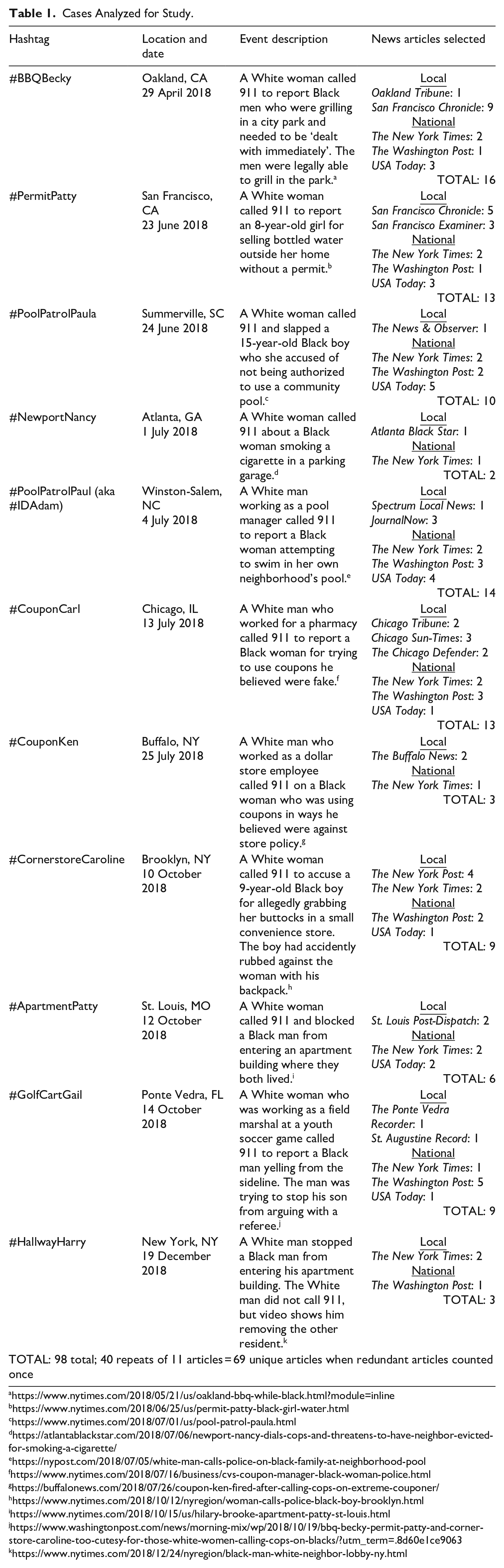
Because of our own racial identities and interests in the influence of news upon society, we were drawn to coverage of White people who threatened to call or called 911 on Black individuals that appeared in national and local media. In selecting the journalism at the center of this study, we turned to news coverage of the hashtags themselves, which provided a variety of hashtags of White people who called 911 on Black individuals that widely appeared in the press (i.e. Nash, 2018). News articles were sought on both the newspapers’ respective websites and, when available, on the Access World News database. Because we were interested in how journalists covered these incidents and debates at national and local levels, we selected texts from what have previously been identified as leading national news outlets, The New York Times, The Washington Post, and USA Today (i.e. Hsianglris et al., 2012). We then identified local newspapers near to the incident to capture local coverage. News website and database searches yielded 69 unique local and national articles that mentioned and described cases under study and used respective hashtags and monikers (see Table 1), 2 beginning with ‘BBQBecky’ on 29 April 2018, and concluding 19 January 2019, one month following the #HallwayHarry incident, which was included because of the threat to involve police.
Cases Analyzed for Study.
In line with previous research, we then examined several elements of journalistic storytelling and narratives in the reporting, reading the news articles multiple times and meeting over the course of several weeks to discuss our interpretations of the texts (Berkowitz and Eko, 2007), and paying particular attention to several elements. First, we were interested in journalistic explanations of incidents and characterizations of those involved, a core function of the profession but is also central to its cultural power and influence (Gutsche and Salkin, 2017). Therefore, we wished to understand what causes of blame were assigned to either the caller or those threatened with or met with police intervention. Second, we examined the depth of meaning and use of naming beyond the conventional journalistic use sources’ legal names (Barnhurst, 2007) to understand how hashtags and monikers may have served as a label or symbol, or as an identity. Third, we wanted to know more about how the hashtags were used in terms of connecting the coverage across the country to local events and/or connecting incidents to larger social conditions. At the core of our reading was the intention to ‘demys[tify] ideologies and power’ within text (Wodak and Meyer, 2009) by paying attention to elements of symbolic annihilation. Therefore, through our readings we reflected on and returned to scholarship on the ideological roles of news explanations, language, vantage point, and descriptions of cases and cultural meanings of the incidents that informed the analysis below.
Analysis and discussion
Below, we address our first two research questions – the overall approach(es) in local and national coverage of White people calling 911 on Black individuals and the use of hashtags and monikers. These questions are addressed together, as our analysis suggests that the explanations for the calls were intertwined with the meanings of the language used to identify and characterize the callers. Here, we analyze and discuss the use of hashtags and monikers, viewing these forms of language used in a process of symbolic annihilation that (1) used hashtags to enhance the sensationalism of the coverage, (2) reduced attention to the racist behaviors of the callers, and (3) ignored narratives within coverage that provided context and complexity of the hashtags and the behaviors at the center of coverage.
Indexing popular stories about bad (but popular) behavior
News coverage across the multiple cases consistently used hashtags and monikers to categorize news stories as related and focused on behaviors of the callers while ignoring deeper meanings of the hashtags as rhetorical devices of Black resistance and commentary. Scholars of symbolic annihilation of race and racisms focus heavily on acts of missing or diminished information and perspectives that identify elements of injustice within news (i.e. Coleman and Yochim, 2008). Coverage in this study, by and large, sensationalized and trivialized the seriousness of the incidents, using humorous and face-less monikers and hashtags as masks that clustered and homogenized racist acts, ideological acts previously associated with these forms of speech (Johnstone, 2004). Another similarity across these stories is that they were presented as being less about racist acts and more about a hashtag about bad behavior.
A San Francisco Examiner article about a White woman who called 911 on a Black 8-year-old girl in San Francisco, California, for selling bottled water outside her home without a permit, for example, noted the mother ‘wrote in a caption to the video to dub the woman “Permit Patty”’. The article did not detail how and why the name was selected or what it ‘meant’ to the mother and child (Waxmann, 2018). Instead, the story connected the case to an earlier one – #BBQBecky, a White woman who called 911 in Oakland, California, to report Black men who were holding a BBQ in a park. While these events happened within close geographic proximity, the newspaper ignored any social conditions that may have led to the confrontations, instead classifying #BBQBecky as a name ‘earned’ by the woman in that case, which ‘inspired a Saturday Night Live skit’.
Other coverage across these cases (i.e. Guynn, 2018; Ioannou, 2018b) also celebrated the viral nature of stories and how callers ‘earned’ their places in the digital spotlight. The New York Post frequently used #CornerstoreCaroline, as mentioned before, to discuss how the story ‘went viral this week’ (Narizhnaya, 2018), ‘earning Klein the nickname “Cornerstore Caroline,” an apparent reference to the moniker given to some other white women who called the cops on African-Americans over apparently minor incidents’. In Buffalo, New York, a Buffalo News (Christmann and King, 2018) article about the firing of a White man who had called 911 after refusing to honor coupons of a Black woman at a dollar store added #CouponKen to a growing list from around the country, making the local story more relevant for local audiences. Even the headline heralded the moniker: ‘Dollar General fires “Coupon Ken” who called police on extreme couponer [sic]’. (Interestingly, the headline of an earlier version of the web article used the manager’s name instead of the nickname.)
In May 2018, a month after the incident that led to #BBQBecky occurred in California, another San Francisco Chronicle article (Kauffman, 2018) provided some depth to the meanings of the moniker by writing that ‘Becky is a snide term for a white woman’ but also diminished the racialized acts of calling 911 by focusing on how the hashtag ‘became a meme on social media’. National newspapers were not absent in the story of social media fame that these news stories created, as well. USA Today’s initial story about #CornerstoreCaroline discussed user views, stating, ‘A video of the incident has been watched more than 5 million times and outraged viewers have dubbed the woman “Cornerstore Caroline”’ (Shannon, 2018). While the article was clear about the video’s popularity – and that widespread use of monikers were ‘designed to shame people’ – the article was less sure about what caused the news events, referring to the cases as ‘alleged racial profiling incidents’. Collectively, news articles cast 911 caller stories as surprising and shocking, but were hesitant, as the USA Today example highlights, to assign a racial cause to the incident, hedging on doing so in writings that either lacked quotes from those effected by the incidents or treading lightly on the issues of race. News stories were about bad behaviors rather than racist ones (Molina, 2018).
A column in The Washington Post (Farzan, 2018), for instance, questioned whether the hashtags being used were – in the words of its headline – ‘Too “cutsey” for those white women calling police on black people?’ and not enough to address the issues of racism. In a rare moment, the article explains that hashtags represented ‘stereotypical white name[s]’. The reporter also refers to Black Twitter in naming and spreading monikers but focuses more on the viral sensation than the seriousness of the racialized roots of the stories. Another article, this one in the Washington Post’s Style section, in attempt to connect the hashtags to issues of racial resistance (Hesse, 2018), started off that hashtags minimize ‘the profound power that white women have had in America’s racial history’ but presented a tongue-in-cheek attitude – it’s single message, ‘Don’t be a Barbecue Becky’. The article’s closing represents largely tone-deaf coverage across the cases in terms of ignoring the violence of calling 911: The reason we can roll our eyes at [hashtags such as] #GolfcartGail is because the story ends with a wah-wahhhh. But plenty of other stories – Tamir Rice, John Crawford – have started out exactly the same way, with a bystander dialing 911, and they have ended in terror. Not with a wah-wahhhh but with a bang-bang. (Italics in original)
In short, news across these cases resisted addressing the racism inherent in the incidents and implications for the victims, instead relying the tales’ ‘what-a-story-ness’ (Berkowitz, 2000). Monikers emerged in communication surrounding cultural and social norms and ideas related to race but also served as potential acknowledgements to disrupt those norms, yet journalists utilized them not to discuss widespread structural racism but as keywords with which to index and entice. In turn, hashtags and monikers became part of what Marks (2008) refers to as ‘methodological elimination’ of race that diminished the tenor of stories where the acts were unlikely to be viewed as violent, which we discuss next.
Reducing racism’s seriousness as violence by situating spectacle
As discussed, hashtags and monikers were used to present stories as viral and popular events of a national scope, a narrative that overshadowed the racial violence and threats of the racist acts – such as surveillance – and reinforced by hashtags that appear without context or complication. Scholarship records long-standing issues of social surveillance of Black individuals and communities in the United States, perpetuated in crime reporting and other news about local communities and national social conditions (Desmond et al., 2016). Yet, White social surveillance of Black people and the calling of 911 as a microaggression – ‘brief and commonplace daily verbal, behavioral, and environmental indignities, whether intentional or unintentional’ that cause harm to one based on racial or other aspects of their identity (Sue, 2010: 5) – was not mentioned across much of the coverage. Furthermore, mentions of police involvement (or the lack thereof) contributed to a seriousness that made the coverage reportable, while the lack of police action removed another level of seriousness that these actions were dangerous and had lasting societal or individual impact.
Even in cases where physical actions occurred – such as blocking someone from entering or exiting a building, as in the cases of #ApartmentPatty and #HallwayHarry – journalists did not discuss the physical elements of the cases as being threatening or harmful, but as a moment of disbelief in the level of conviction by the 911 callers to involve police or take action themselves. A St. Louis Post-Dispatch article about #ApartmentPatty (Heffernan, 2018) quoted the Black resident who was blocked from his home as saying police arrived and ‘treated me like a criminal until they viewed the video recording that I made’, a quote that fed spectacle rather than addressed the influence of those emotions on a person’s life. The Post-Dispatch article also mentioned the story ‘got national attention over the weekend including more than 5 million views on Facebook and coverage in The New York Times’, a boosteristic perspective (Gutsche, 2015) celebrating the elevation of the local community to national prominence.
One St. Augustine (Florida) Record headline connected elements already addressed here – the use of a moniker to identify the wrongdoer and a nod to the sensation of the story void of the wrongdoing: ‘“Golf Cart Gail” youth soccer coach row goes viral, lures in national media’ (Gibson, 2018, emphasis added). While the opening sentence referred to ‘a verbal confrontation . . . that went viral this week’, it merely stated that the event was one which ‘some [are] calling . . . another example of racial profiling’. The victim of the 911 call was mentioned without direct quotes that he was yelling to his son to obey the referee and that ‘Jones (the victim) told First Coast News the club and the field marshal owe him an apology’.
News articles about these cases also relied on police comments to deliver a justification for calling 911 calls, which deepened dramatic storytelling. Whether police were involved in the cases provides a seriousness to the stories (Fishman, 1981); yet, news that police reports were not made, that no charges were filed, and that no one was arrested in all of the cases for their threats or 911 misuse (except for #PoolPatrolPaula, discussed below) contributed to a narrative that these events were absent of enough wrongdoing, threatening behavior, or threats of violence on the callers’ behalf. In the cases of #ApartmentPatty (Gomez, 2018), #BBQBecky (Holson, 2018), and #PermitPatty (Ioannou, 2018a), for example, the role of police was mentioned as side notes that performed the duty of legitimizing the cases as being newsworthy. However, in the case of #CouponCarl – a White man working at a CVS pharmacy in Chicago who in July called 911 to report a Black woman for trying to use coupons he believed to be fake – journalists at The New York Times (Stevens, 2018) noted the story may be serious – but not serious enough for police action. The newspaper quoted extensively from a CVS corporate statement that ‘Police were informed that a female was inside the store threatening the staff and refusing to leave’ and that the ‘victim did not press charges and no police report was filed’.
#CouponCarl also gained attention by The Washington Post, which sensationalized the story with its headline, a quote from the victim – ‘He talked to me like I was a rabid dog’ (Siegel, 2018), while also noting that police had responded to an ‘assault in progress’, that officers did not generate a police report, and that, in the words of a police spokesperson, ‘peace was restored’. Such mention of police intervention showcased a seriousness of the event (Fishman, 1981), but the bringing of ‘peace’ without greater details of the deeds committed – and possible social and cultural reasons for why – dampens the wrongdoing of the racist acts. Indeed, the Post’s story begins to focus not on a telling of the event and its racialized meanings related to #CouponCarl but on the appropriateness of social media commentary related to the case that had emerged.
Evoking the authority of both law enforcement and public interest while casting the social actors involved in the stories as mere monikers and hashtags rather individuals identified more prominently by legal names enhanced the symbolic annihilation of deeper, racialized meanings associated with the cases. Furthermore, the combination of police authority in the coverage of events and the drama surrounding the ‘sparking’ of ‘national outrage’ overshadowed these individual identities and the violence and racism inherent in the incidents.
Disconnecting from the individual acts and outcomes
Using hashtags to name 911 callers who ‘earned’ their digital spotlight and shame, combined with news narratives that lacked links to racial commentary and resistance embedded within the hashtags, led to coverage that distanced the callers from any outcomes of their actions – except for those that directly affected them. How these events and viral stories affected the victims was rarely discussed. For example, articles such as those related to #BBQBecky (Gomez, 2018) and #ApartmentPatty (Hafner, 2018) focused on the callers’ firings and only mentioned the existence of victims. Such was also the case in terms of #PoolPatrolPaul – also known as #IDAdam – who called 911 to report a Black woman attempting to rightfully use a community pool. Beyond discussing the hashtag’s popularity its connection to other monikers, one local news article (Newell and Hinton, 2018) spent several paragraphs detailing #PoolPatrolPaul’s employment: His supervisor was quoted as saying #PoolPatrolPaul ‘resigned his position as the pool’s chairman and as an association’s [sic] board member because he didn’t want the association to receive any negative reaction and publicity from the incident’. The supervisor added, ‘Nothing about his resignation implies that he did anything wrong’.
As with other coverage, journalists spent time explaining how the callers’ actions may not be racist. Related to #GolfCartGail, the St. Augustine Record, for example, quoted a sheriff’s officer as saying, ‘the field marshal (#GolfCartGail) was involved in multiple sporting events that day and had removed white individuals earlier for similar behavior’. A witness ‘confirmed this’, the newspaper stated, ‘but added the woman had a different tone with the black parent’. And while stories, such as this one, included comments from the victim and a witness that an exchange occurred, they were buried in information from law enforcement about what had happened and that the story had made national news (i.e. Arriaga, 2018). In addition, a San Francisco Chronicle editorial about #PermitPatty as being ‘the latest in an ugly crowd’ (Whitney, 2018) opined that reoccurring events of White people calling 911 on Black people held a common reason for which the individuals may not be responsible for their own actions: ‘a sense of entitlement and an abuse of authority over minorities’ (emphasis added). Interestingly, it is the Chronicle example that reveals most overtly elements of power and racial hierarchies that is at play there, hinting to challenges surrounding White dominance, or whiteness (Doane and Bonilla-Silva, 2003), without explicitly naming it as such. As an outlier in providing comments from a victim of whiteness, one New York Times article listing the hashtags following the case of #HallwayHarry focused on the person he blocked (Pager, 2018) but did mention one comment from the victim: He will not sue #HallwayHarry and will re-lease his apartment. He also told reporters he was ‘not going to change how I live my life based on this guy’s inappropriate behavior’.
Another way news coverage distanced blame and negative outcomes to a 911 call or similar behavior was within the inconsistent legal naming of the callers. In another rare mention to the victim post-event that did discuss a negative outcome for the victim of a 911 call, one USA Today story about #IDAdam (also known as #PoolPatrolPaul) published his legal name and quoted the lawyer for the woman removed from the pool as saying, ‘this incident was traumatizing to Mrs. Abhulimen and her entire family’. Yet, the paper spent much time on the details of #IDAdam’s firing (McCarthy, 2018). Yet another local story about #IDAdam headlined, ‘Winston-Salem man loses job after alleged racial-profiling at neighborhood pool’, also focused on the details – and influence of the hashtag – that led to his firing (Balogun, 2018).
Listing the callers by both the hashtags and legal names of #BBQBecky and #PermitPatty, but not discussing the outcomes of any of the cases, one USA Today article merely quoted professors and social media experts (by name) to discuss the hashtags (Guynn, 2018). One story from the News & Observer in South Carolina related to #PoolPatrolPaula, a White woman who hit a young Black man and told him to leave the neighborhood pool where he rightfully belonged, focused on how she was charged with assault. Yet, neither included a discussion about outcomes for the youth, nor the youth’s family name or comments from them (Moody, 2018). Meanwhile, the Atlanta Black Star provided tempered coverage about #NewportNancy, an unnamed White woman in Atlanta who called 911 about an unnamed Black woman smoking a cigarette in a parking garage, with few interviews from either ‘side’ of the case (Berger, 2018). (Newport is a brand of cigarettes.) The article did, however, acknowledge that this was ‘the latest case of “call the police on Black people,” and that “[s]ocial media . . . chimed in on the incident and feel that white people calling the police on Blacks is becoming ridiculous”’.
Left clearly missing in coverage here were stories of victims’ outcomes due to behavior identified as ‘possibly racist’. Stories of job loss and public shaming, while real, do not replace the outcomes of microaggressions against individuals and communities (Sue, 2010). Prominent use of monikers and hashtags to identify the callers – not just their legal names, a conventional practice in journalism (Barnhurst, 2007) – took the brunt of the attention for the calls, releasing the callers from responsibility for their actions (Harriot, 2019). Furthermore, these hashtags and monikers contributed to (1) the trivialization (Moore, 1992) of acts of threatening to call and calling 911, (2) the camouflaging of legal identities of the 911 callers with monikers and hashtags, (3) the almost seeming justification of the calls by journalists who quoted police, and (4) the ignoring of influences these acts and stories (may) have on communities and individuals (Jackson, 2018). Such a process annihilated the racist and violent interpretations of the acts, as well as any forms of resistance that may live within the complexities of the hashtags themselves.
Conclusion
This analysis examines news of White people in the United States who threatened to call or called 911 to report everyday behavior of Black individuals in 2018 that led to widespread use of hashtags and monikers attributed to the callers. We have argued that hashtags and monikers contributed to a process of symbolic annihilation of Black resistance and commentary embedded within the hashtags and supplemented tones of coverage that reduced the events’ seriousness as representations of social policing of Black individuals. More specifically, our analysis suggests a correlation between the use of humorous hashtags and monikers – that journalists shared #BBQBecky, not #BBQBadBecky, which would indicate wrongdoing – and coverage that failed to articulate bigger stories of racial and violent influences relevant and represented in calling 911. While it may not be surprising that coverage was light on deeper social and cultural connections, our analysis serves as further evidence of journalists’ parameters in covering race and social conditions in a digital age. Moreover, the study calls attention to the complexities of social media content that is replicated in news without context and the forms of language – hashtags and monikers – which are deserving of more critical analysis in terms of use and meaning beyond the technological. Whereas the latter interpretation would suggest hashtags connect and provide openings for voices, a critical perspective presented here reveals the form’s ability to silence.
Footnotes
Acknowledgements
The authors wish to thank Dr. Moses Shumow for his assistance is accessing some articles in the U.S. This article is dedicated to his memory.
Funding
The author(s) received no financial support for the research, authorship, and/or publication of this article.
