




Abstract
This study examines how journalists in the Philippines perceive their roles in response to mis- and disinformation. In the country’s current media landscape, journalists find themselves in the spotlight as the media are frequently accused of spreading falsehoods. Drawing from data gathered through 16 semistructured in-depth interviews with Filipino journalists, the findings first of all indicate that the disseminator and watchdog roles are perceived as more important and that journalists see themselves as truth crusaders and advocates of societal reform. Second, journalists identify barriers on different levels of influence that impede the performance of these intended roles. Finally, journalists see the rise of mis- and disinformation as both a challenge and opportunity for journalism to improve as a practice and institution. These findings can be extrapolated to theoretical and practical implications for journalism and democracy in general.
The uncontrolled spread of inaccurate information has taken a new form in the digital era and has created vexing challenges for democracy and journalism. Misinformation can be defined as information that is ‘not supported by clear evidence and expert opinion’ (Nyhan and Reifler, 2010: 305). Disinformation can be defined as the goal-directed spread of incorrect, fabricated, or decontextualized information, for example, to augment polarization or societal distrust (Jackson, 2017; Marwick and Lewis, 2017). While mis- and disinformation have gained popularity under Trump’s administration in the United States, the Philippines offers an equally interesting case on how misinformation can be used to steer public opinion and manipulate media attention. The active online population in the Philippines makes it a vulnerable target for ‘troll armies’ or ‘keyboard warriors’ who share false information to silence dissenting opinions. Disinformation’s reliance on falsehoods deliberately promotes certain ideologies that can lead to confusion, distrust, or paranoia among the public (Jackson, 2017).
The spread of mis- and disinformation can especially be dangerous for deliberative democracy as it undermines an authentic and deliberative political discussion. In the case of the Philippines, multiple fake accounts are used to ‘weaponize the Internet’ (Ressa, 2016) in order to push for propaganda or steer public opinion. Individual journalists and media companies are also vulnerable to misinformation, as they are increasingly accused of spreading disinformation themselves, or in popular terms, Fake News. Against this backdrop, this study aims to answer the following two-fold question: How do journalists perceive their roles in response to misinformation, and how do they defend their profession when being blamed for spreading falsehoods?
This study contributes to the field on journalistic role perceptions and misinformation in at least three important ways. First, in the current age of fragmenting patterns of news consumption, journalists are at a crossroads trying to uphold traditional roles while performing according to the new needs and demands of the public (Tandoc, 2017). As misinformation is produced and disseminated alongside accurate information, journalists have to strengthen and emphasize their roles as objective, truth-oriented disseminators, hereby distinguishing their profession from alternative sources of (mis)information. Second, the phenomenal spread of misinformation poses a challenge to the authority of journalism, which has the societal role of truth-seeking and informing the public on the facts (Kovach and Rosenstiel, 2007). Third, as accusations of Fake News become more prominent in society, journalists need to deal with attacks and critique of the public that blames news producers for disseminating fact-free content. Against this backdrop, this research aims to understand how journalists react to media criticisms and perceived threats on their authority as news providers.
Conducting in-depth qualitative interviews with 16 Filipino journalists, this study offers insights into the challenges and opportunities presented by the digital age as well as personal reflections on journalism as a profession. Taken together, this study is the first to provide insights into the development of journalistic role perceptions in the face of the threat posed in the current era of post-factual relativism (Van Aelst et al., 2017).
The challenge of misinformation in today’s media environment
The fast-paced nature of the digital media environment, and the absence of gatekeepers online, create a supportive platform for misinformation to flourish (Shin et al., 2018). In its essence, misinformation refers to the dissemination of information that is spread as truthful, but later found to be inaccurate (e.g. Shin et al., 2018). Misinformation is strengthened through repetition and continuous transfer (DiFonzo and Bordia, 2007). Disinformation refers to falsehoods spread with a certain goal in mind, for example, to foster political distrust among the public or to blame political opponents while crediting supported parties or issue positions (Jackson, 2017; Wardle, 2017). As investigating the actual intentions or political goals of the communicator reaches beyond the scope of this article, we focus on the role perceptions and threats to the journalistic profession applied to mis- and disinformation in general. Whenever applicable, the term misinformation is used when referring to how journalists perceive their roles in covering accurate information alongside inaccurate information and disinformation is used in the setting of accusations of the deliberate spread of Fake News.
It can be argued that the spread of mis- and disinformation poses a severe challenge to journalism as it is in conflict with the basic roles of fact-checking, truth-telling, and verification procedures of the profession. Given its wide reach, replicability, and potential for virality, misinformation directly rivals the information released by the media, thus posing a threat to journalism as a profession. Overall, these challenges of misinformation may have adverse effects and implications to the duties and responsibilities of journalists, and ultimately, to their roles as media practitioners. The first aim of this article is thus to provide insights into how journalists strengthen and renegotiate their role perceptions in the face of the uncontrolled spread of misinformation in today’s fragmented media settings.
Journalistic role perceptions in the face of misinformation
Journalists gain legitimacy by fulfilling the audience’s need for accurate and balanced information. By practicing their societal role, they contribute to representative democracy and political opinion formation (Strömbäck, 2005). Hence, citizens depend on accurate, balanced reporting to make well-informed political decisions. However, the uncontrolled spread of misinformation by unprofessional communicators threatens the legitimacy of journalism in at least two ways: (1) inaccurate information that feeds off journalism’s legitimacy is spread alongside factual information and (2) the legitimacy of journalism as a profession is attacked by accusing journalists of spreading Fake News.
Here, it is important to stress the gap between role conceptions and performances (e.g. Hanitzsch and Vos, 2017; Mellado and Van Dalen, 2013). Although journalists may perceive it as their normative role to combat misinformation, and to counter-argue accusations of Fake News, they may experience pressures on different levels of influence that limit their capabilities to act on their perceptions. More specifically, factors such as routines, deadlines, extra-media pressures, or editorial decisions can affect the enactment of roles (Tandoc et al., 2012) – which may impede journalists’ capability to combat mis- or disinformation. In this setting, journalists need to maintain and defend their roles in democracy and therefore need to respond to both alternative information and attacks on their legitimacy.
In earlier studies of journalistic roles, role conceptions ranged from the simplest dichotomy of a ‘neutral’ versus ‘participant’ role (Johnstone et al., 1976). More recently, these roles expanded into further categories (Cassidy, 2005; Weaver and Wilhoit, 1991). In line with Cassidy’s classification, professional roles of journalists can be classified as (1) disseminator, (2) interpretive, (3) adversarial, and (4) populist mobilizer (Cassidy, 2005). The disseminator role is mostly concerned in getting the information out there as swiftly as possible while the adversarial role is characterized by constant skepticism against people or institutions of power (Cassidy, 2005). The adversarial role is closely linked to the ‘watchdog role’ in which journalists question and criticize politicians for their actions (Strömbäck, 2005) and tend to support the use of unauthorized documents to report a story. Weaver and Wilhoit (1996) postulate that the adversarial role represents a distinct minority view. The watchdog role more specially relates to journalists’ normative role to hold the political elites accountable (e.g. Mellado and Van Dalen, 2013). The actual execution of this role means that journalists question and criticize political elites – holding them accountable for (political) failures and inaccurate claims made to the public. The watchdog role can also be associated with the performance of more investigative reporting.
The interpretative journalistic role ascribes a central role to journalists’ own frames of reference in covering the news (Patterson, 1993; Salgado and Strömbäck, 2011). Interpretative journalism implies that the meaning of events and journalistic themes transcend the mere dissemination of hard facts and expert or elite sources (Salgado and Strömbäck, 2011). Patterson (1993) even emphasized that hard facts may come after the predefined interpretations of journalists.
Finally, the populist mobilizer is concerned in assembling the public to develop their views, interests, or political agenda (Cassidy, 2005). It focuses on four subcomponents: (1) develop intellectual and cultural interests, (2) encourage people to form opinions, (3) motivate people to get involved, (4) and point to possible solutions (Willnat et al., 2017).
Again, it is important to distinguish between role perceptions and the actual performance of roles (e.g. Mellado and Van Dalen, 2013). Hence, journalists may be faced with different pressures originating from the media, extra-media, or societal level that prevent them from putting their perceived roles into practice (Shoemaker and Reese, 1996). Hence, although journalists may perceive it as an important normative role to criticize the elites (i.e. for spreading disinformation), they may not be able to perform this role when they experience pressure coming from the other factors.
Role perceptions may change according to the type of democracy in which journalists function (Strömbäck, 2005) or to individual, organizational, and societal influences (Shoemaker and Reese, 1996). Indeed, some authors argue that role perceptions are largely dependent on the country’s ‘journalism’s majority culture’ (Weaver and Wilhoit, 1996: 138). For example, in a libertarian paradigm and liberal democracy such as the Philippine media, journalists function as vigilant watchdogs who monitor the use or abuse of power on behalf of the citizens (Strömbäck, 2005) through objective, factual, and accurate reporting (Tuchman, 1972). To understand how Filipino journalists situate and identity themselves, Tandoc (2017) found that external forces such as the composition of the audience, new technology, and institutions like the government are considered to be most noteworthy. By analyzing these factors, journalists are, in a way, legitimizing social issues and institutions by emphasizing their importance in the daily news.
The typology of roles mapped out by Weaver and Wilhoit (1991) and Cassidy (2005) gives an overview of some of the roles that journalists fulfill. However, these roles should not be viewed as separate entities, but should rather be seen as fluid. In the case of the Philippines, where misinformation threatens the democracy by undermining political discussions as well as journalistic authority; journalists may emphasize existing roles or take on a more active role toward challenging misinformation in the public arena. Moreover, they may perceive some roles as important but may experience important barriers in enacting them. Based on the conceptualization of misinformation and role perceptions, the first subquestion (RQ1) is: How do journalistic role perceptions take shape in response to misinformation?
The blame game: The media as ‘peddlers of mis- and disinformation’
Today’s post postfactual era may not only provide more pressure on journalists’ profession as it affects their routines of news making, mis- or disinformation can also be a rhetorical device to silence the media. In the United States, Trump, for example, frequently shifts blame to the ‘Fake News’ media as the ‘enemy of the people’. By doing so, he can discredit media sources that oppose him, while using his own controlled social media channels to provide an unchallenged image of reality. Here, the difference between mis- and disinformation is relevant to highlight: accusations of deliberately distorting reality can be seen as the discursive framing of disinformation, whereas blaming the media for being imprecise or inaccurate does not involve accusations of goal-directed deception or manipulation (misinformation).
In the Philippines, journalists battle against the erosion of public and government trust, often leading to accusations of peddling Fake News or disinformation. Philippine President Rodrigo Duterte himself has accused legacy media Rappler of being ‘fake news’ after releasing an investigative piece targeted at his administration. These sentiments are reflected in the wide array of criticisms thrown at the media by the public, the government, and paid trolls (Johnson, 2018). Accusations of Fake News are thus very common in the Philippines and even institutionalized by the government that cultivates distrust in mainstream journalism.
In the Philippines, death threats targeted at journalists are also quite common. According to the Center for Media Freedom and Responsibility (CMFR), at least 99 cases of direct and indirect assaults against journalist have been documented during the current administration of President Rodrigo Duterte, some of which were attacks calling out journalists as Fake News purveyors. Among these assaults, the CMFR recorded 17 cases of online harassment, 12 cases of death threats, and 9 cases of libel. While not all of these were related to accusations of misinformation, the fact that the President himself openly criticizes the media as being Fake News purveyors, aggravated such instances substantially. This animosity between Duterte and Rappler ultimately led to a coverage ban against the said news agency.
In the context of mis- and disinformation, it is thus not only crucial to investigate how journalists respond to an era of postfactual relativism, it is also important to see how they respond to the challenge of being blamed for contributing to the spread of mis- and disinformation themselves. In cases when media credibility is attacked, such as when accusations of mis- and disinformation abound, journalists may engage in a paradigm repair strategy in order to restore their image and reputation (Berkowitz, 2000). Specifically, studies have demonstrated that journalists restore their authority by focusing on a particular threat, isolating it as an anomalous or deviant occurrence, then reacting to public criticism (Reese, 1990). The practice of paradigm repair also reinforces the concept of an interpretive community in which journalists belong to a community that is governed by certain practices, standards, and ethics (Zelizer, 1993) and also outlines ‘boundaries of the community along the way’ (Berkowitz, 2000: 127). Later studies on paradigm repair focus on a ‘second-order paradigm’ where criticisms are generalized and assessed by the media community according to its significance to the profession (Carlson, 2012). Journalists may thus apply different tactics in dealing with accusations of communicative untruthfulness.
Taken together, we postulate that the relationship between mis- or disinformation and journalistic role perceptions is Janus-faced. First, in an era where reality has become subject to critique and severe mistrust, journalists may emphasize role perceptions directed at covering the truth by disseminating reality as they perceive it. Second, this setting of distrust also means that they can become the target of accusations. Hence, they can be blamed for spreading lies and must fight off attacks targeted at their profession. This creates a tense working environment where different threats and opportunities may be experienced. Against the backdrop of potential strategies that journalists can employ to address criticism, the final research question of this study is: How do journalists respond to being called peddlers of mis-and disinformation, and how do they identify challenges and opportunities in the face of a threat to their profession? (RQ2).
Method
Data collection
This study is based on 16 semistructured interviews (see Appendix 2 for interview guide), which were analyzed using the step-by-step coding procedures and constant comparison of the grounded theory framework (Corbin and Strauss, 1990). Using this method, we explored the development of role perceptions based on the interviewee’s personal and professional history as well as his or her perspective and worldview.
Sampling
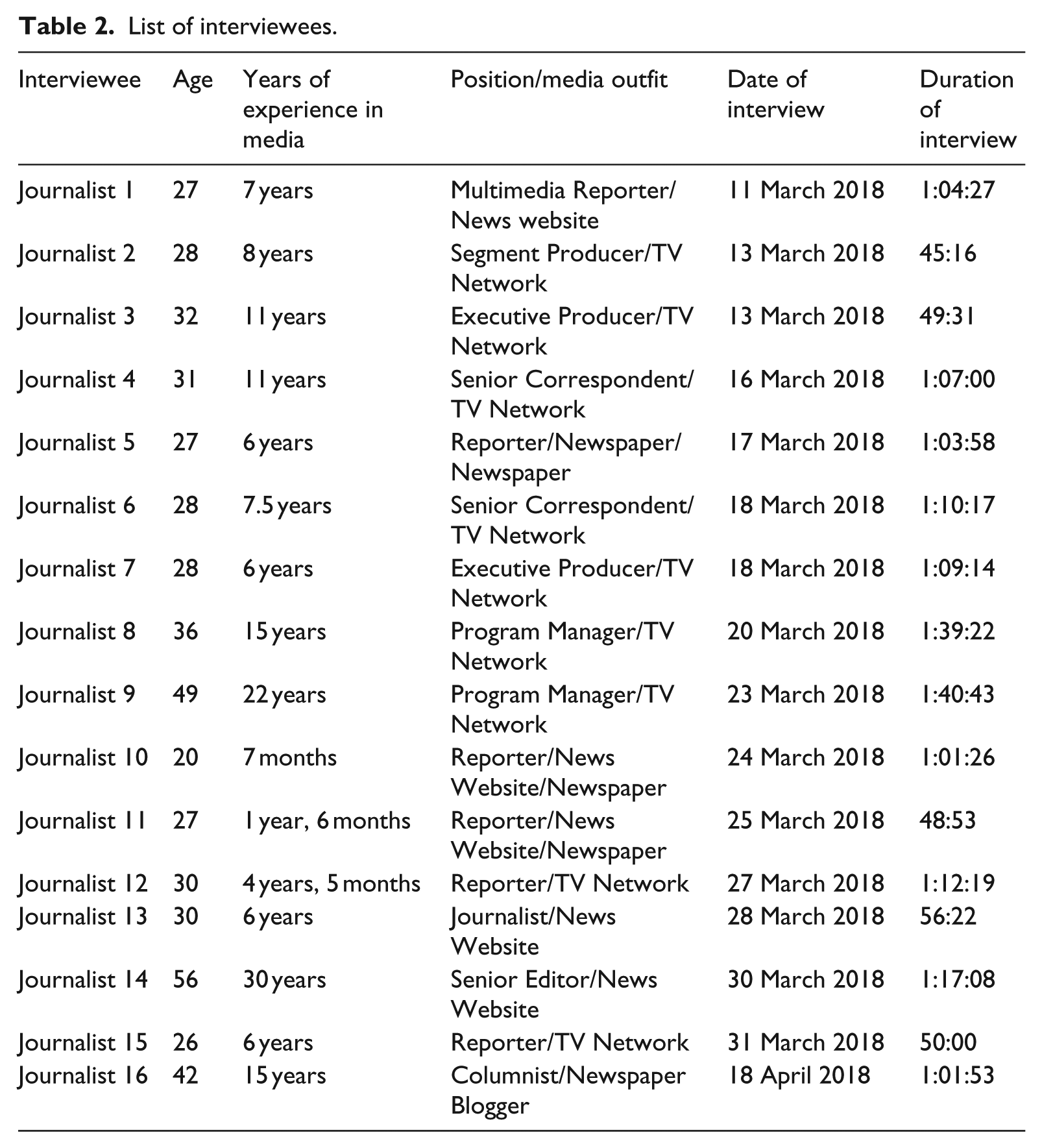
Using purposive and snowball sampling, a total of 16 semistructured interviews were conducted via Skype and Facebook Video Chat. The duration of each interview ranged from 45 minutes to 1 hour and 40 minutes (see Appendix 1 for list of interviewees). The interviewees were selected based on the researcher’s initial contact list. The researcher asked for referrals as the data collection progressed. To ensure a maximum variety of opinions and professional experiences, journalists holding different positions such as program managers, editors, producers, reporters, and columnists were interviewed. Each position has a unique role in the journalistic field and provided rich discussion on how misinformation consequently affects their roles. Since the topic of this study is also largely based on the spread of mis- and disinformation in the digital age, we also purposefully selected young and old journalists with varying years of experience in dealing with mis- and disinformation. We have chosen journalists of television and online media for the following reasons. First, television remains the most dominant form of media in the Philippines and can therefore be powerful in influencing the public about the role of media on misinformation. Journalists of online media counterparts were included because online journalists usually encounter mis- and disinformation going viral on social media (Lewandowsky et al., 2017) and are also usually the subjects of attacks of being called Fake News outlets. The total number of journalists interviewed was determined until saturation of content was reached. This means that additional rounds of data collection did not reveal new insights in the developing categories. This is in line with the principles of grounded theory, emphasizing that ‘representativeness of concepts, not of persons, is crucial’ (Corbin and Strauss, 1990: 9).
Data analysis
All interviews were transcribed and translated for manual coding. The coding process was structured by open coding, axial coding, and selective coding. The first process of open coding formed the basis for the first set of themes and categories. This allowed for a more open-minded interpretation of the data. Next, we looked for recurring and prominent themes and created a codebook to further code the data. The codebook was used for the subsequent phases of focused and axial coding. Similarities and differences of concepts were assessed into specific themes or categories. These overarching concepts are categorized into four major themes: Roles, Challenges, Opportunities, and Solutions. Using these central themes as guide, similar data was clustered under these categories to create new subcodes. If a code did not fit into a certain category or theme, new dimensions were developed. We continued with the same process of analysis until no new codes were generated from the raw data.
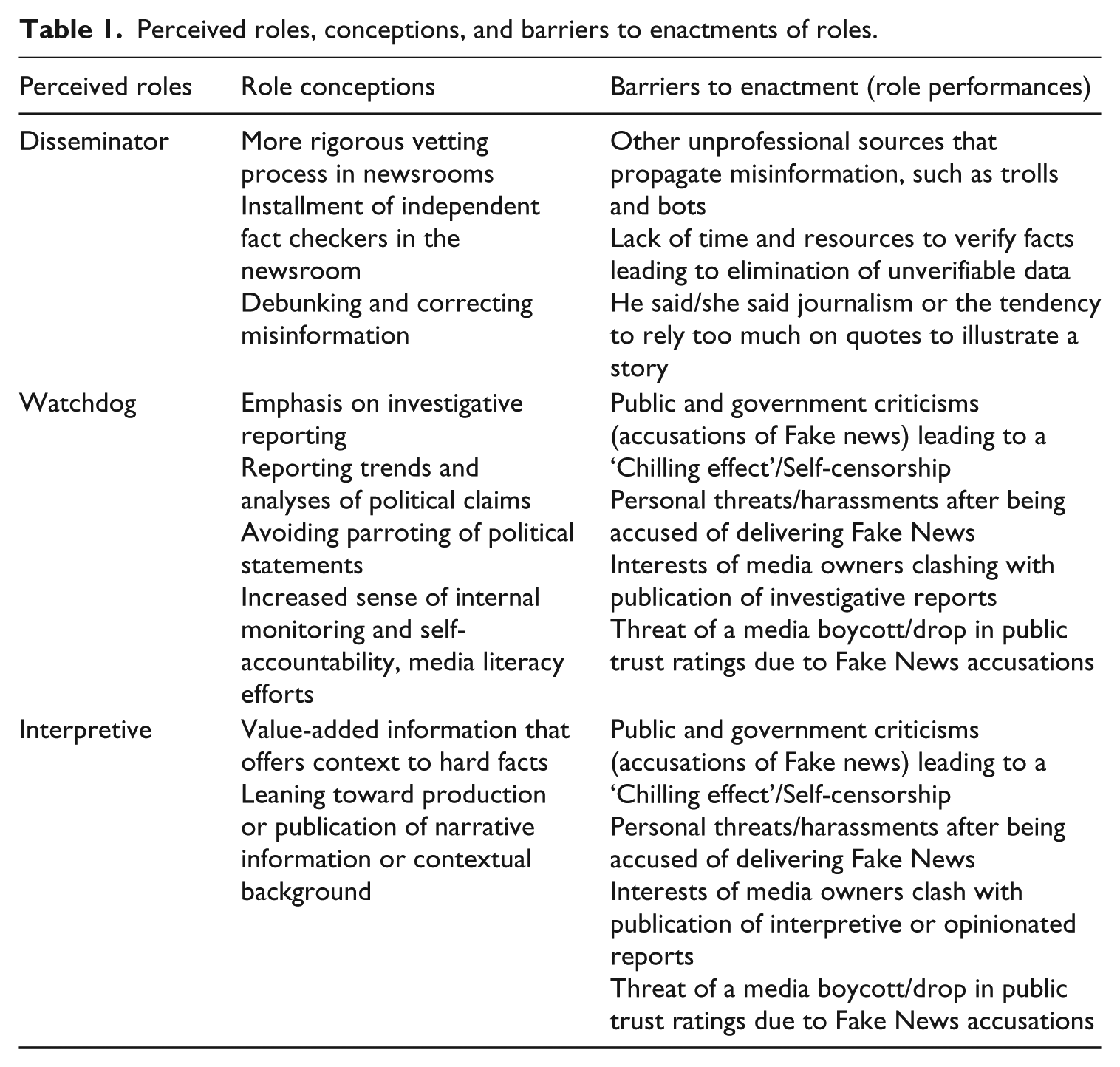
In Table 1, we structured the data based on three major roles that were identified in the interviews: the disseminator, watchdog, and interpretive role. We have presented each role based on two categories derived from the first set of coding and informed by the research questions: conception of roles and challenges or barriers in the enactment of such roles (experienced barriers in performing roles).
Perceived roles, conceptions, and barriers to enactments of roles.
Results
Role perceptions in response to misinformation
The disseminator and the watchdog
Grounded on the traditional practice of objective news reporting, many basic primary roles are cited by journalists as important duties today. In order to protect their legitimacy in the setting of competing flows of inaccurate information, journalists have to defend their societal role of disseminating truthful information while monitoring the elites in power. These roles include the dissemination of factual and accurate information, monitoring people in power, and contributions to social reforms. Journalists who cited these primary roles added that these roles result from a long-standing journalistic practice and the historical relevance of journalism in upholding democracy. When faced with the challenge of misinformation, the disseminator and watchdog roles become more significant in the daily routine of journalists. Many journalists also believe that their roles are changing throughout the years. ‘We started as town criers but journalists became part of the liberation movement and it has since continually evolved’, Journalist 14, a senior editor says. ‘The media should not just be a mouthpiece, nor used for PR’, Journalist 15 says.
Shifting emphasis in existing roles
The disseminator as truth crusader
Amid threats to the legitimacy of journalism in an era of misinformation, all journalists agree that their roles have shifted in emphasis to defend journalism’s role in society. Hence, journalism’s democratic role of disseminating truthful information should be defended in a setting of more dishonest communication. Some roles have been perceived as strengthened while some are confronted with challenges exposing some weaknesses and gaps. ‘These roles have always existed and have always been there. The difference now is that these roles are magnified, and the extent and scope of these roles have changed’, an editor and online journalist said.
All journalists acknowledged that journalism can never be fully stripped of biases in terms of prioritization of stories, priming, and agenda-setting. Their actions inside and outside of the newsroom are thus direct consequences of their own perceptions. ‘No journalist has no bias. What we can do is to be fair’, Journalist 8, a program manager for a newscast says
Some journalists lean more toward interpretive journalism in which journalists take an active role in identifying which stories should be prioritized and by providing a narrative and contextual background to support the story. ‘News should be truthful, not neutral. Journalists should be biased for the truth. There are stories that we, as journalists, should push forward, like stories about inequality or human rights violations’, Journalist 15, a news reporter says. Many journalists interviewed believe that the situation today calls for more courage and initiative from journalists to break through traditional roles and perform a moral duty to give voice to the marginalized sector. Journalists see how crucial their role is in weaving the narrative perceived by the public. ‘In the age of misinformation, the role of a journalist is to give context and make sense of what is happening’, Journalist 5 says. Another journalist (14) says, ‘The biggest misconception in journalism is that we should be detached recorders of news. But if you detach yourself, the tendency is you tend to be the defender of the status quo, wittingly or unwittingly’.
The need to provide a context for factual knowledge
Although many journalists did not directly challenge or attack the elites, the need to provide context for factual information can be regarded as an important component of the interpretative role conception. In the face of increased competition with other sources of information, journalists emphasized the need for ‘value-added’ information. ‘Because we are dealing with other drivers of information, the journalist’s role to inform, provide context, and weave a narrative in our stories has become more important than ever’, one journalist said. Although journalists stayed close to objective reporting, they did move beyond the mere dissemination of hard facts by providing a narrative to present information.
Journalists as fact-checking watchdogs
Strengthened by the need to verify information, the disseminator and watchdog roles have become more salient in an era of falsehoods. While all journalists acknowledge that these practices are part of the routine, the stakes are higher and the consequences are more severe this time. Journalist 4, a TV reporter says ‘It has become more difficult to verify now. You don’t know who to trust and if your sources are telling the truth’. All types of information, even when they come from supposedly reliable or official sources like the government, should undergo scrutiny and verification. Because of the hectic schedule of reporters and the high demands of daily news coverage, many newsrooms see fact-checking as a job that requires extra attention. This has led to the installment of independent fact checkers in the newsroom working alongside writers and producers. However, it remains the duty of the journalists to verify information – and to use these fact checkers as a resource to filter out inaccurate information. Indeed, three journalists who work for large newsrooms have an independent vetting process for information. Most journalists, however, do not have this luxury and must do all the fact-checking on their own. Thus verification can become a tedious duty for many reporters. ‘It takes away time that you should be using to pursue other important stories’, Journalist 1 says.
Debunking falsehoods has become an integral part of the roles that journalists perform today. These tasks include combating mis- and disinformation by calling out lies or inconsistencies. ‘Journalists play a vital role in maintaining a healthy democracy and it is our duty to ensure that people can make judgments using the right information’, Journalist 15 says. Moreover, according to Journalist 6, if journalists do not correct mis- or disinformation, then they also become a complicit in spreading false information which in turn contributes to the legitimization of ‘fake news’. Correcting mis- or disinformation is particularly crucial when government officials are the source of wrong information as they can be taken as ‘gospel truth’ by the public and can lead to dangerous consequences, Journalist 6 explains. This corrective role of the media against mis- and disinformation has become so salient that some journalists admit that debunking fake news can be used as consideration for judging the news value of a story.
Challenges in dealing with mis- and disinformation in a changing media landscape
To defend the legitimacy of the journalistic profession when confronted with accusations of fake news on a regular basis, some journalists claim that the roles of the disseminator and watchdog are strengthened, and in some occasions, challenged (RQ2). The challenges experienced by journalists relate to the discrepancy between role perceptions and role performances (Mellado and Van Dalen, 2013). Hence, although journalists do emphasize certain roles that are important in the context of mis- and disinformation, they perceive barriers to act on these conceptions. An overview of such barriers and challenges in the performance of perceived roles is included in Table 1. Being swamped with loads of misinformation to verify, some journalists opt to delay or even eliminate unverifiable and contestable information in order to reduce the risk of criticism. ‘One error and you can be accused of producing Fake News’, Journalist 8 says. However, some choose to publish at their own cost. ‘We simply do not have the luxury of time to check. Sometimes accuracy is compromised’, Journalist 3, an executive producer admits.
Journalist 3 has experienced being accused of spreading Fake News after releasing a critical news documentary investigating policemen who were accused of extrajudicial killings. ‘We were accused of airing Fake News. I received death threats saying we will be part of the next death toll’, he says. Journalist 16, known for writing analytical reports, also received death threats in conjunction with the accusation of Fake News. ‘They send pictures of my parents threatening they will be the next target’, he says.
All journalists interviewed express a personal and/or emotional response when they were accused of producing mis- or disinformation. ‘It is personal because it is our job on the line’, Journalist 5 says. While not all comments and accusations are addressed personally by these journalists, they check the value of these accusations. Did the journalists actually commit a mistake? If the accusation is purely made on the grounds of propaganda, or is made by trolls or bots, then a journalist’s usual response is to ignore the comment. Some journalists also become vocal on social media regarding mis- and disinformation and even engage in media literacy campaigns in order to educate the public about mis- and disinformation. In that sense, the profession is also strengthened by mobilizing the public amid the challenge of misinformation.
Many journalists also claim to experience a chilling effect on their work. ‘There is something in the air that makes you fearful’, Journalist 9 says. Some journalists doubt their editorial judgment leading to reports that are less critical; some even had to release reports favorable of the government because of threats made by the government against media owners. ‘I think scripts now have less spunk. Personally, I second-guess myself when writing’, Journalist 8 says. Journalist 12 says, she chooses to stay away from controversial issues. ‘I have become more conscious about negative reactions and how the mob will react. I censor myself and consider if I should soften the tone’, she says. This perception is inconsistent with the journalistic role of the watchdog – as journalists cannot function independently of the government to criticize and correct their behavior. These personal impacts, some journalists report, are just a part of a bigger challenge which the media organization faces.
Accusation of peddling mis- and disinformation and the hostility the government against the media contribute to self-censorship which affects the profession on an organizational level and contradicts the watchdog role. Some journalists also claim that media owners are trying to avoid criticism and engage in self-preservation by staying quiet from controversial stories to protect the business and advertising interests of the company. ‘The impact of the stories is lessened. You are not able to deliver the best and sharpest angles’, Journalist 9 says. For example, after receiving a death threat connected to the accusation of spreading Fake News and a possible media boycott from various pro-Duterte groups, Journalist 3 says he refrained from producing critical reports against the government. ‘We are still driven by ratings. You have to understand that those who support Duterte and those who are critical of the media are your audience too’, Journalist 3 says.
In this setting, where journalists receive death threats when being accused of spreading falsehoods, some journalists have also received subtle warnings from the management to water down some issues or change the language or tone of the report in order not to arouse possible criticism. Because of the threat of being called biased, unfair, or misinformed, some journalists emphasize the ‘he said, she said’ routine in order to provide the most balanced, detached reporting. In the larger context of responses to misinformation, some journalists consider their work as a mere reactionary role on misinformation and claim that there is no active resistance to the overall spread of mis- and disinformation. The hostility of the responses to journalists’ roles in society thus create a working environment where journalists refrain from more critical role performances in the fear of being accused of fake news peddlers in extremely hostile ways – which can be seen as an important impediment of the enactment of more critical watchdog roles.
The deliberate attacks of the government against the media, like tagging certain news outlets of being Fake News outlets or threatening critical media organizations of closure, are considered as threats to press freedom. However, some media owners are careful not to brand these attacks as curtailment of press freedom because of the possible effect they may have on their own media businesses. ‘We don’t want to be tagged as Fake News outlets and lose our credibility because our platform is all we have’, Journalist 7, an executive producer for a news show says.
Discussion
The Philippine media are currently undergoing an important transition in history where journalism is challenged by changing news consumption patterns, technology, and criticisms that threaten its authority. Mis- and disinformation are at the center of this battle – and falsehoods may potentially be used for propaganda (Jackson, 2017). In this fragmented media environment, this study aimed to provide an in-depth analysis of the role perceptions and performances of Filipino journalists in response to mis- and disinformation. Two central challenges to the legitimacy of journalism can be identified: (1) journalists have to strengthen their roles to distinguish themselves from disseminators of mis- and disinformation and (2) journalists have to defend themselves against accusations of spreading mis- and disinformation. Amid the threat of misinformation, journalists revert to the primary roles of journalism such as the basic dissemination of factual, accurate, and balanced information and checks and balances of the institutions in power. These roles align with the definition of Strömbäck (2005) in defining roles of journalists as watchdogs in a libertarian and liberal democracy.
The disseminator role is seen as central when responding to an era of postfactual relativism, whereas other functions, such as the watchdog and interpretive roles, despite being perceived as crucial, are not fulfilled successfully as journalists experience important barriers on different levels of influence. Journalists argue that the current environment characterized by the spread of mis- and disinformation calls for a much more active participation of the media in the societal affairs as well as more attention to the quality of facts disseminated among society. As journalists battle against misinformation, the disseminator role is magnified through more rigorous and strict fact-checking and verification from journalists. The task of debunking falsehoods has also become part of a journalist’s daily routine.
The watchdog role has also developed in the face of mis- and disinformation. Journalists need to take on this role to champion certain ideologies such as the campaign against Fake News and propaganda. This role can be connected to disinformation: as various agents of disinformation aim to achieve certain political goals by manipulating the electorate, journalists see it is as their role to point out the unfair reporting of such agents. Yet, this role is confounded by the pressure they experience from political actors, public criticism, and even organizational decisions.
The watchdog role of journalists also paves way for the rise of long-form analyses, trends, and investigative reporting. While most journalists interviewed acknowledge that objectivity may be futile because of their inherent biases, journalists place premium value on fairness and accuracy in their reporting. The operationalization of objectivity as well as journalists’ preference of reporting are influenced primarily because of their individual role perceptions as reflected in the studies made by Skovsgaard et al. (2012) and Scholl and Weischenberg (1998). Not only do journalists perform an active, participative role in societal affairs as watchdogs, journalists are also more aware of the quality of reporting they produce, thus becoming a watchdog of their own profession (and not just politics). Accountability and self-monitoring are more pronounced in the age of mis- and disinformation, especially when they are accused of being Fake News outlets. Thus, journalists see self-accountability as an extension of their role as watchdogs. The results indicate that journalists do not identify strongly with the populist mobilizer role in their responses to mis- and disinformation. They mostly referred to pressures coming from ‘above’ (the established political order) and mostly neglected their role of mobilizing the audience. However, journalists did stress the opportunity to engage more with the audience and to promote media literacy and education in order to reduce perceived biases in journalistic reporting (Vraga et al., 2009).
While the disseminator and watchdog roles may have been strengthened on some dimensions, mis- and disinformation have also made journalists vulnerable to challenges, especially in fulfilling interpretive roles. This finding can be connected to literature that links role conceptions to performances (e.g. Hanitzsch and Vos, 2017; Mellado and Van Dalen, 2013). Journalists may perceive it as important to strengthen some of their roles but may not be able to critically attack the government. Hence, the performance of the watchdog and interpretive role are also at risk as journalists experience boundaries in criticizing the government. Thus, the age of falsehoods has also made a crack in journalism as a profession as stated by some journalists interviewed. For example, in the Philippines, being tagged as ‘fake news peddlers’ is similar to having a scarlet letter on one’s forehead. It can lead to more accusations, a drop in public trust ratings, and in the company’s advertising revenues. Even as journalists struggle with being blamed for spreading falsehoods, such criticisms allow them to reflect on the quality of work they produce.
The struggle of journalists in performing the interpretive role as shown in some journalists’ hesitation to publish more critical reports (self-censorship) because of being tagged as Fake News is coherent with the findings of Tandoc et al. (2012). More specifically, Tandoc et al. (2012) point to a gap between role conceptions and enactments. External factors such as routines (effects of news deadlines, supervisors) influence the performance of journalists. The results of our study further show that corporate interests motivated by ratings can be a factor that impede the enactment of roles amid accusations of mis- or disinformation. In addition, our study shows that the (perceived) hostility of the public’s responses to news production can also be an important factor, as exemplified in numerous interviews where being tagged as Fake News peddlers affect the content journalists produce or, in some cases, not produce. This impediment to the enactment of such roles is congruent with the findings of Tandoc et al., who state that compliance may occur if a journalist believes that it can be instrumental in the production of a satisfying social effect.
Being accused of Fake News by the public or the government is a huge blow to the Philippine media as many journalists report experiencing a chilling effects or discouragement and restraint to publish certain materials because of fear or punishment (Schauer, 1978). This fearful and dangerous environment characterized by bullying, online harassments, and death threats can harm the execution of journalists’ roles, as they experience threats that impede critical reporting and the execution of the watchdog role. These criticisms not only target the media performance but are also seen as part of campaigns to discredit journalists who are being critical. This is in line with the findings of Von Krogh and Svensson (2017) regarding interest-based criticisms.
This can be especially risky in a democracy like the Philippines where journalists are supposed to be acting as watchdogs and measures of accountability of those in power (Strömbäck, 2005). The chilling effect experienced by most journalists may also hinder a healthy, fair, and accurate discussion of societal issues, thus ultimately undermining the role of the media in democracy. Here, it should be stressed that being accused of disseminating fake news is not a sufficient condition for (death) threats targeted at journalists. An uncertain media environment characterized by hostile extra-media and societal pressures, such as in the case of the Philippines, creates a favorable discursive opportunity structure to attack journalists. Open attacks from authorities themselves against critical media, such as in the case of Duterte labeling Rappler as Fake News, also heighten cases of threats, especially online harassments.
The severity of the threats identified in this study may thus not be directly generalizable to (Western) media settings in which journalists have more autonomy, legal protection, and professional agency. However, polarized and partisan opinion climates in the United States and Europe may also shape the public’s hostile media perceptions – and journalists who disagree with people’s perceptual screens are frequently seen as an ‘enemy of the people’ (e.g. Fawzi, 2019). In the European setting, populist voters frequently express hostile sentiments and threats to journalists via social media (Fawzi, 2019). Yet, these attacks and accusations of Fake News may not always result in (death) threats – which may only occur when a hostile public opinion climate and a less well-established democracy are in place.
Given the notoriety of the country’s media’s situation as regards to dealing with Fake News and propaganda, we believe that the Philippine case can be a valuable jump-off point in understanding how journalists in other countries perceive their roles amid mis- or disinformation, the barriers they may encounter in the enactment of these roles, and how they may defend their profession when the public blames them for being dishonest. However, the results are not representative of all journalists in the Philippines and beyond because of the small sample size as well as the overall diversity of interviews. Since this topic is highly personal and emotional for some interviewees, this may ultimately affect their role perceptions. As another limitation, the interviews were conducted via online video chats, thus, some nonverbal cues may be missed. These nonverbal cues are important because they may compliment answers and give more meaning to the discourse of the interview. Here, we should also stress that our inductive results are based on the memory of journalists, which may be colored and biased by existing attitudinal filters and perceptions (Pudney, 2011). Hence, journalists may inaccurately remember more severe threats to their profession as they distrust the establishment, or their existing opposition to media organizations may have had an impact on how they retrospectively perceive the discrepancy between role perceptions and enactment. Although this is a potential limitation of the findings presented in this study, journalists’ preexisting filters and biases are also an important part of how they experience their roles and the potential fears they experience in performing them – irrespective of the factual basis of these perceived threats.
Despite these limitations, this study demonstrates how the current environment of mis- and disinformation puts the media in a unique position where journalists both have the duty to act and react, to report not only the truth but also mistruths and to be critical not only to those in power but also to themselves. Indeed, mis- and disinformation poses both as a challenge and opportunity to journalism today. While this may not be the first time that journalism is put to the test, journalists express the readiness to adapt to the changing times, and in the words of one journalist (1) interviewed, ‘commit to constant vigilance’.
Footnotes
Appendix 1
List of interviewees.
| Interviewee | Age | Years of experience in media | Position/media outfit | Date of interview | Duration of interview |
|---|---|---|---|---|---|
| Journalist 1 | 27 | 7 years | Multimedia Reporter/News website | 11 March 2018 | 1:04:27 |
| Journalist 2 | 28 | 8 years | Segment Producer/TV Network | 13 March 2018 | 45:16 |
| Journalist 3 | 32 | 11 years | Executive Producer/TV Network | 13 March 2018 | 49:31 |
| Journalist 4 | 31 | 11 years | Senior Correspondent/TV Network | 16 March 2018 | 1:07:00 |
| Journalist 5 | 27 | 6 years | Reporter/Newspaper/Newspaper | 17 March 2018 | 1:03:58 |
| Journalist 6 | 28 | 7.5 years | Senior Correspondent/TV Network | 18 March 2018 | 1:10:17 |
| Journalist 7 | 28 | 6 years | Executive Producer/TV Network | 18 March 2018 | 1:09:14 |
| Journalist 8 | 36 | 15 years | Program Manager/TV Network | 20 March 2018 | 1:39:22 |
| Journalist 9 | 49 | 22 years | Program Manager/TV Network | 23 March 2018 | 1:40:43 |
| Journalist 10 | 20 | 7 months | Reporter/News Website/Newspaper | 24 March 2018 | 1:01:26 |
| Journalist 11 | 27 | 1 year, 6 months | Reporter/News Website/Newspaper | 25 March 2018 | 48:53 |
| Journalist 12 | 30 | 4 years, 5 months | Reporter/TV Network | 27 March 2018 | 1:12:19 |
| Journalist 13 | 30 | 6 years | Journalist/News Website | 28 March 2018 | 56:22 |
| Journalist 14 | 56 | 30 years | Senior Editor/News Website | 30 March 2018 | 1:17:08 |
| Journalist 15 | 26 | 6 years | Reporter/TV Network | 31 March 2018 | 50:00 |
| Journalist 16 | 42 | 15 years | Columnist/Newspaper Blogger |
18 April 2018 | 1:01:53 |
Appendix 2
Funding
The author(s) received no financial support for the research, authorship, and/or publication of this article.
