




Abstract
Drawing on interviews with key stakeholders – regulators, editors, party spin-doctors and politicians – supported by a systematic content analysis of television news during the 2015 UK General Election, this study makes an intervention into debates about how impartiality is understood and interpreted. Contrary to recent scholarly interpretations about ‘due impartiality’ being applied with some degree of quantitative precision – a stop-watch approach to balance – according to key stakeholders we interviewed the regulation of UK election news should be viewed as a qualitative judgement about the editorial merit of particular issues, parties or leaders throughout the campaign. Overall, we argue that the United Kingdom has moved from a political system shaping impartiality in recent years towards more of a news value–driven system reliant on editorial judgements. This raises, in our view, serious questions about the accountability of editorial decisions and how impartiality is safeguarded. News values, after all, are not politically neutral and – as our content analysis demonstrates – can lead to parties with a minor status gaining more coverage than some major parties. In order to remain relevant to regulatory and industry debates in journalism, we conclude by suggesting scholars should pay closer attention to how key stakeholders interpret and apply media policy.
Keywords
Exploring whether media coverage of politics is biased in favour of one party over another is one of the most researched areas of journalism studies. It is, after all, of fundamental significance to the democratic system of many Western countries since the media act as the dominant source of information about politics for most citizens. Put simply, if the supply of news is not viewed as fair and balanced, it undermines normative expectations about electoral integrity and democratic accountability (Norris, 2014). The editorial selection of news is largely driven by news values, a set of informal criteria journalists use to select particular stories and issues over others (Brighton and Foy, 2007; Harcup and O’Neill, 2016). But while scholars have long examined news values, little research has explored how they influ-ence the way journalistic balance is understood and applied by regulators and practitioners.
Of course, interpreting political bias or agreeing what constitutes ‘balanced’ news is not empirically straightforward (Hopmann et al., 2012). Moreover, bias and balance are often understood and used interchangeably with concepts such as impartiality and objectivity (Sambrook, 2012). In the United States, objectivity is a more widely used term among practitioners and journalists than impartiality. According to Schudson (2001), objectivity became a professional norm among print journalists over the 19th and 20th centuries in tandem with the rise of positivist intellectual thinking in the United States. In the United Kingdom, by contrast, impartiality is a legal requirement for broadcasters, whereas newspapers are lightly regulated, with many reporting politics in a highly partisan way.
And yet, from the perspective of preventing bias or safeguarding political balance, these terms represent distinctive theoretical positions and empirical goals. While being objective implies it is possible to uncover ‘the truth’ by drawing on empirical evidence, being impartial suggests there is no definitive ‘truth’ but just a relativistic belief that there are conflicting perspectives about an issue or event (Cushion et al., 2016a). But although this draws a conceptual distinction between how impartiality and objectivity might be editorially constructed, how do they work in practice? In the United Kingdom, for example, the term ‘due’ precedes impartiality, which suggests an editorial judgement is necessary to decide upon an appropriate amount of coverage an issue or perspective should receive. But, as Barendt (1998) has observed, ‘it is far from clear what “due impartiality” entails, even if it translated into such terms as “fairness” or “balance”’ (p. 115)
This article puts the concept of ‘due impartiality’ and how it is operationalised under the empirical spotlight. Drawing on a systematic content analysis of television news coverage of the 2015 UK General Election and interviews with some of the United Kingdom’s most senior broadcast news editors, media regulators, politicians and spin-doctors, we explore how impartiality was interpreted during the campaign and in political reporting more generally. At a time when largely unregulated online content and social media platforms are becoming a more pervasive source of political information, we enter into debates about the relevance of an impartial broadcast news service and consider how impartiality is understood, measured and applied by regulators and practitioners.
From quantitative to qualitative understanding of journalistic practice: Interpreting impartiality
Media and communication scholars have long recognised that how journalists understand and interpret their own professional raison d’être – often termed role perception – plays an important part in the production of news (Weaver and Wilhoit, 1986). Although the focus of our study is on understanding the practice of impartiality in a UK context, the following section also explores how objectivity has been conceptualised by journalists because there is a limited supply of academic studies exploring how practitioners understand notions of fairness and balance in the news.
Van Dalen et al. (2012) examined the role conceptions of political journalists in Denmark, Germany, Spain and the United Kingdom with news they produced, identifying considerable cross-national differences that reflected the broader political identity and media systems dominant within a particular nation. So, for example, Spanish journalists viewed their ‘role as sacerdotal rather than pragmatic and partisan rather than impartial’ in contrast to other European journalists (Van Dalen et al., 2012: 916). Nevertheless, according to Hanitzsch et al.’s (2011) comprehensive survey of journalists from 18 countries, ‘impartiality and the reliability of information, as well as adherence to universal ethical principles are considered essential journalistic functions worldwide’ (p. 273). This reinforces previous national and cross-national comparative survey studies that show a broad agreement among journalists that news should be reported fairly and even-handedly (Weaver and Willnat, 2010). But a clear limitation of large-scale cross-national surveys is comparing perceptions between nations because – as already pointed out – terms such as bias, balance, objectivity and impartiality represent different meanings in journalism cultures.
Moreover, even nationally representative surveys have uncovered differences in how objectivity is understood based on the role journalists should play in a democracy. So, for example, in a survey of Danish journalists, those committed to a passive-mirror role that valued conveying information above other journalistic responsibilities were seen as embracing normative goals associated with objectivity (Skovsgaard et al., 2013). But while this and other quantitative surveys represent important contributions to understanding how journalists generally interpret concepts such as objectivity, there is limited research more qualitatively exploring how these meanings are understood, negotiated and applied (cf. Van Dalen et al. 2012: 904). As Skovsgaard et al.’s (2013) study concluded, there is a ‘need for more firmly situated and empirically grounded studies on how objectivity is related to role perception in different journalistic cultures and under different circumstances when it comes to the production, publication, and perception of news’ (p. 38).
Informed by debates about journalistic role perceptions, we would agree with (Van Dalen et al. 2012) that scholars need to move beyond asking abstract survey-based questions about their understanding of concepts and to consider more explicitly ‘what is the relation between the way journalists in a particular country describe their role and the way they do their work?’ (p. 904). The intention of this study is to more qualitatively understand the perceptions of ‘due impartiality’ among leading UK practitioners, but to also consider how it was applied during the 2015 UK General Election campaign.
Within debates about science communication, recent years have seen several studies adopt a more qualitative approach to understanding how journalists use objectivity in news reporting (Hiles and Hinnant, 2014; Tong, 2015). So, for example, Hiles and Hinnant (2014) carried out interviews with 10 experienced environmental journalists in the United States and identified an evolving practice of reporting climate change according to a ‘weight of evidence’ approach. Although most journalists supported the principle of objective journalism, the study found they had modified their construction of balance to reflect the credibility of particular scientific views above industry representatives or even climate change campaigners. However, it was further revealed that stories about politics or policy continued to be treated in a balanced ‘he said, she said’ way, perpetuating the traditional conception of objectivity in routine reporting.
This suggests that there are limits to how far journalism cultures can police the boundaries of reporting in an ‘objective’ or ’impartial’ way. The world of politics, after all, attracts close scrutiny from political elites and media regulators making it more difficult to break free and renegotiate the objectivity norm. Indeed, even when there have been top-down, regulatory efforts to broaden the depth of coverage of politics and public affairs, and redefine an impartial framework, Wahl-Jorgensen et al.’s (2016) case study of BBC reporting in the United Kingdom found that the ‘impartiality-as-balance’ paradigm continued, with political actors dominating coverage and narrowing the context and perspective in which issues were interpreted. But while their study broadly suggested that deeply ingrained institutional conventions and practices limited how far the culture of the BBC’s broadcast and online journalism could be influenced by top-down decision-making, they did not empirically examine the actors involved in overseeing the regulation of coverage, the production of news or the political pressures brought to bear on journalists.
It is in this context our study aims to shed greater empirical light on the range of actors behind the interpretation and policing of impartiality of UK political broadcast news. At present, much of the literature exploring how journalists negotiate their understanding of objectivity and impartiality overlooks the role and voices of regulatory actors and political elites, which – we would argue – contribute to how balance and fairness in political news are editorially applied. As Davis’ (2007) extensive interviewing of media and political elites has revealed, the cosy relationship they enjoy regularly leads to ‘policy solution options’ in debates about media policy and practice (p. 195). The aim of our study is to bring more transparency to how media and political elites negotiate and interpret the regulatory policy of ‘due impartiality’ in a case study of coverage of the 2015 UK General Election and the reporting of politics more generally.
In doing so, we draw on a systematic content analysis of UK television news, which informs our line of questioning to editors, regulators, spin-doctors and politicians about the impartiality of election reporting. The most widely used measure of impartiality is quantifying the time granted to different political parties and leaders, which is known as stop-watch balance (Hopmann et al., 2012). This has also included examining the dominance of particular political parties within news stories (Deacon et al., 2005). Another measure of impartiality is issue balance, which explores whether topics favouring particular parties are balanced in media coverage during the campaign period, such as welfare and education being positively associated with left wing parties or crime and national security being positively associated with more right wing parties (Norris and Sanders, 1998). This relates to the concept of issue ownership, which explores the implications of voters associating issues with certain parties (Green and Hobolt, 2008). The degree of time journalists as opposed to political actors communicate election news can also raise concerns about impartiality in broadcasting. After all, while politicians have some control (before editing) over how they convey their message on television when interviewed, if journalists convey news they exercise their own judgements about the significance of the day’s events (Cushion, 2015). Of course, this is not a breach of impartiality, but relying on reporters to reflect party positions could potentially lead to a more partial account of events and issues than hearing directly from political actors.
UK case study: Scholarly versus regulatory perspectives about ‘due impartiality’ and constructing balance
Writing at the turn of the century about how the United Kingdom applied the ‘due impartiality’ guidelines, Semetko (2000) observed that
To guarantee balance, tradition has it that the coverage of each of the parties in the news is ‘stop-watched’ during the election campaign … So, for example, every five minutes devoted to the Conservatives was matched somewhere in the bulletin with five minutes devoted to Labour and four minutes devoted to the Liberal Democrats. (p. 353)
Similarly, according to Norris (2009), ‘Election news TV and radio broadcasts in Britain display internal diversity, with stop-watch balance regulated and monitored across party coverage’ (p. 8). More recently, a review of academic literature exploring the application of political balance in the news suggested that ‘In the UK, the public service broadcaster, the BBC, is required to balance news coverage of the political parties according to specific shares allocated to the parties’ (Hopmann et al., 2012). Above all, these perspectives appear to promote a balanced and quantitative approach to delivering ‘due impartiality’ (p. 244). As Semetko pointed out, ‘To “balance” the news is to diminish the role of news values as the primary basis for story selection’ (cited in Hopmann et al., 2012: 245).
However, these broad observations do not appear to reflect the changing regulatory practice of UK broadcasting. As far back as 1992, for example, ITN formally announced a move away from stop-watching the amount of airtime different parties received, with the BBC also abandoning this approach in the 2001 election (Harding, 2001). But over the last decade or so, the bodies regulating broadcast media have changed. While commercial broadcasters are regulated by Ofcom (since 2003), the BBC Trust (since 2007) polices the impartiality of BBC journalism (although from 2017 Ofcom will also be responsible for BBC content). Both broadly define ‘due impartiality’ in similar ways, but during election campaigns each body adopts a slightly different approach in their regulatory guidance.
Just before an election campaign begins, for instance, Ofcom – led by Adam Baxter, an Executive in editorial standards – classifies major and minor status to political parties according to a set of criteria such as past electoral support and their current position based on opinion polls. The guidelines state commercial broadcasters should give due weight to major parties during the election campaign, which in 2015 for Great Britain (England, Scotland and Wales) was Labour, Conservatives and Liberal Democrats, and in England and Wales was UKIP. In Great Britain, there were also a number of minor parties, such as the SNP and Greens, which (by implication) suggests they should be given less weight in coverage than major parties. Major and minor status, in this context, should be interpreted within the nations of Great Britain or in England and Wales (after all, the SNP would not be considered a minor party for audiences in Glasgow or Aberdeen). Indeed the SNP was labelled a major party in Scotland by Ofcom. Since people in Great Britain or England and Wales represent the vast majority of UK network news viewers – with England by far the most populous nation – it is likely editors would have considered major parties to be from these geographical locations, with the SNP and Greens viewed as minor parties. Similarly, broadcast editors of Scottish national news programming would have considered the SNP to be a major party in Scotland. But the primary focus of this study is UK network television news coverage of the 2015 General Election campaign. The BBC Trust does not designate a major or minor status, but in similar ways to Ofcom recommends a ‘relative amount of coverage given to political parties in each electoral area … should reflect levels of past and/or current electoral support’ (BBC, 2014), with staff asked to contact the BBC’s advisor, Ric Bailey, for further assistance if necessary.
Our study includes the perspectives of Ofcom’s Adam Baxter and the BBC’s Ric Bailey, allowing us to further explore the application of these impartiality guidelines. Moreover, we can compare the scholarly accounts of how regulation is interpreted in UK broadcasting with how key stakeholders understand and apply ‘due impartiality’ during an election campaign. After all, while the scholarly view implies a quantitative precision to balancing the news, the regulatory guidelines suggest a more qualitative approach that encourages editorial judgements. Our research questions aim not only to explore these conflicting perspectives in detail but also to consider the continued relevance of impartiality in broadcasting since new media operate in a largely unregulated environment. Drawing on either interviews with key stakeholders in UK political reporting and campaigning and/or a content analysis of television news coverage of the 2015 UK General Election, we thus ask the following questions:
How relevant is impartiality to UK political reporting in an increasingly unregulated new media environment?
How impartial was television news coverage of the 2015 UK General Election?
Overall, is ‘due impartiality’ in UK broadcasting interpreted in a more quantitative or qualitative way?
The scope of the study: Method and sample
Semi-structured interviews were conducted with editors, regulators, spin-doctors and politicians, representing a sample size of 16 key stakeholders. The sample of editors included the heads of television news or senior editors from BBC, ITV, Sky and Channel 4 and Channel 5: Paul Royall (Editor of BBC News at Six and Ten), Katy Searle (BBC Westminster editor), Sue Inglish (then Head of BBC political programming), Geoff Hill (Editor of ITV News at Ten), Michael Jermey (Head of ITV news), Ben De Pear (Head of Channel 4 news), Esme Wren (then Head of politics at Sky News) and Cristina Squires (then Head of Channel 5 news).
The sample of party political perspectives was less straightforward to assemble. Our initial aim was to interview the head of communication or media of all the main parties (what we have broadly labelled ‘spin-doctor’). This was achieved in four of the six parties we intended to interview – Chris Luffingham (Greens), Kevin Pringle (SNP), Alex Phillips (UKIP) and James Holt (Liberal Democrats). But for the two biggest political parties – Labour and Conservative – we were not able to gain access to senior spin-doctors. Instead, we interviewed Member of Parliament (MP) Lucy Powell, a Labour Shadow Cabinet Minister and vice-Chair of the party’s Campaign strategy and Conservative MP Craig Williams, who won a key marginal seat in Cardiff North. While we acknowledge politicians may have different perspectives about the regulation of broadcasting than spin-doctors, the aim of our study is not to be representative of any of the sub-sample interviewed but to reflect a range of perspectives from key stakeholders involved in the reporting, campaigning and regulation of the 2015 UK General Election.
The interviews we undertook lasted between 30 minutes and 1 hour. Our four lines of inquiry include the following:
The importance of broadcast media during the election and, in particular, the relevance of due impartiality in an increasingly unregulated new media environment;
The application and fairness of impartiality, especially as it was applied during the campaign;
The issue balance of the election agenda, such as pursuing an agenda that might appear favourable to one party over another;
The increasing interpretation of politics by reporters rather than politicians.
Our sample represents some of the United Kingdom’s leading figures in politics, broadcasting and regulation. However, we were mindful their answers should not be uncritically accepted since interviews explore their perspectives rather than the actual coverage produced during the campaign on evening bulletins. News editors, for example, work in busy newsrooms and may oversee a number of programmes.
Following Van Dalen et al.’s (2012) suggestion of comparing journalistic responses with their output, to support the interview data we draw on a content analysis of television news coverage during the 2015 UK General Election. In doing so, we can provide a more objective yardstick against which to compare interviewee responses and the editorial content produced by the United Kingdom’s flagship evening television bulletins. This sample included BBC News at Ten, ITV News at Ten, Channel 4 News at 7pm, Channel 5 at 5pm and Sky News at Ten, with monitoring between 30 March and 6 May 2015 (including weekends).
We broke down election news by the type of television convention rather than story, which included anchor-only items, reporter packages, studio discussions and live two-ways in the studio or on location. We examined 2177 items over the campaign period, with 38.7 per cent (n = 843) related to the election. Policy-related news items were broken down into topics (health, economy, etc.), and the airtime granted to political parties and their leaders was measured, along with assessing whether one party was dominant within a news item. As previously acknowledged, these represent some of the most long-standing ways of interpreting balance and impartiality in news programming (Norris and Sanders, 1998). According to Krippendorff’s alpha, all variables reached an acceptable level of reliability. 1
The relevance of impartiality and stop-watch balance
Over recent years, increasing attention has been paid to new online and social media platforms, and their ability to influence voters, particularly during election campaigns. We thus began by asking party spin-doctors and politicians which platform was the most influential during the campaign. With the exception of the Green party – perhaps due to its minor party status – all interviewees chose television above other platforms. This was most emphatically put by James Holt, the Liberal Democrat spin-doctor:
In terms of getting your message across … the trustworthiness and the scope and the scale of the main evening news bulletins for the big channels is still by far the pinnacle and I would expect would drive the focus for all of the political parties.
Excluding regulators, we then asked whether broadcast news should continue to be impartial or whether the rules should be relaxed to allow journalists more freedom. Perhaps surprisingly, all interviewees expressed support for maintaining the United Kingdom’s strict ‘due impartiality’ laws. In particular, it was pointed out that impartiality was needed to countenance press partisanship and because of the influence television continues to wield. Labour’s Lucy Powell even argued impartiality ‘should be more closely marshalled’, singling out the BBC and its (perceived lack of) editorial oversight.
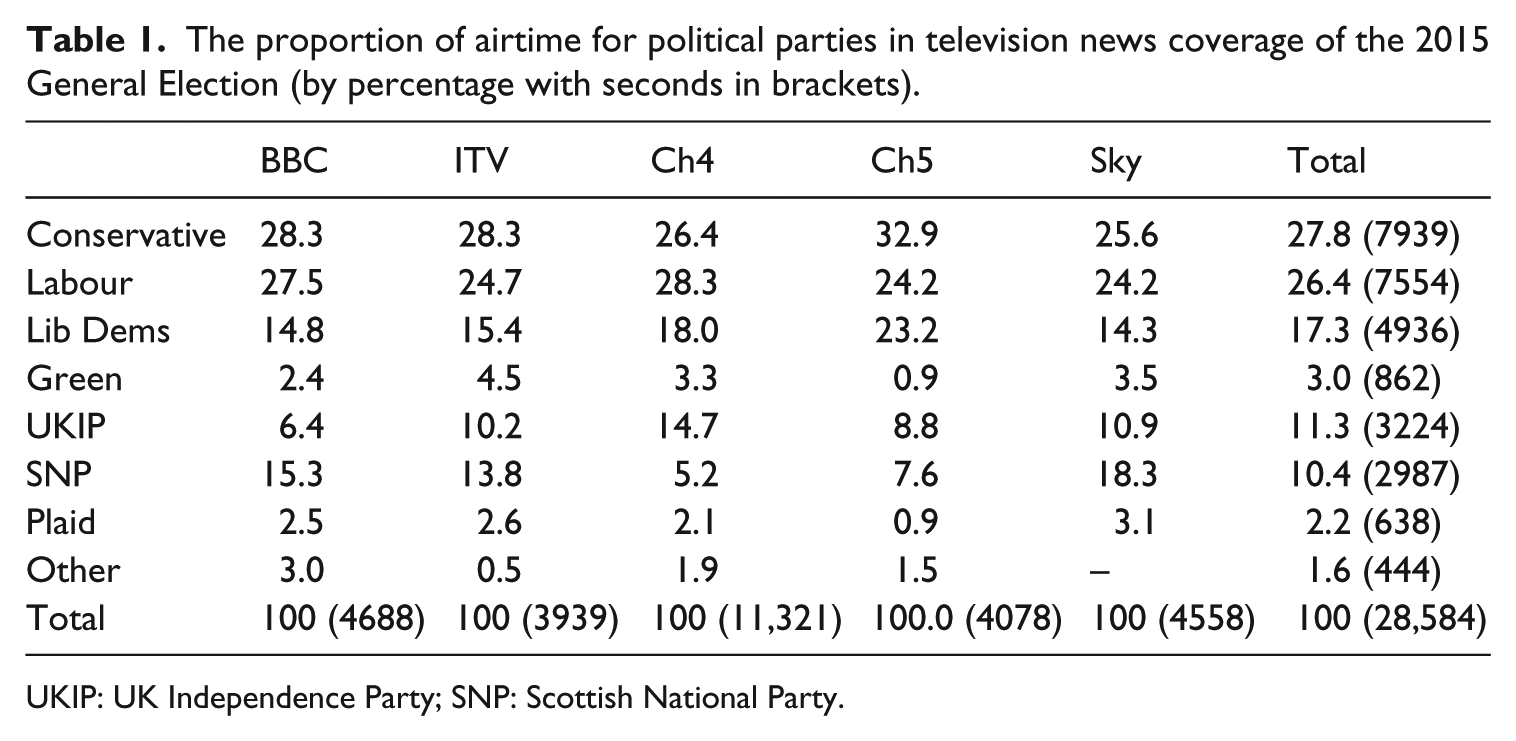
In order to explore the practice of impartiality in a less abstract way, we asked all interviewees about the impartiality of coverage during the 2015 General Election campaign. Our content analysis, in this respect, provided an objective yardstick to consider their responses. Table 1 shows how much airtime was granted to different party political actors in UK television news during the 2015 UK General Election campaign.
The proportion of airtime for political parties in television news coverage of the 2015 General Election (by percentage with seconds in brackets).
UKIP: UK Independence Party; SNP: Scottish National Party.
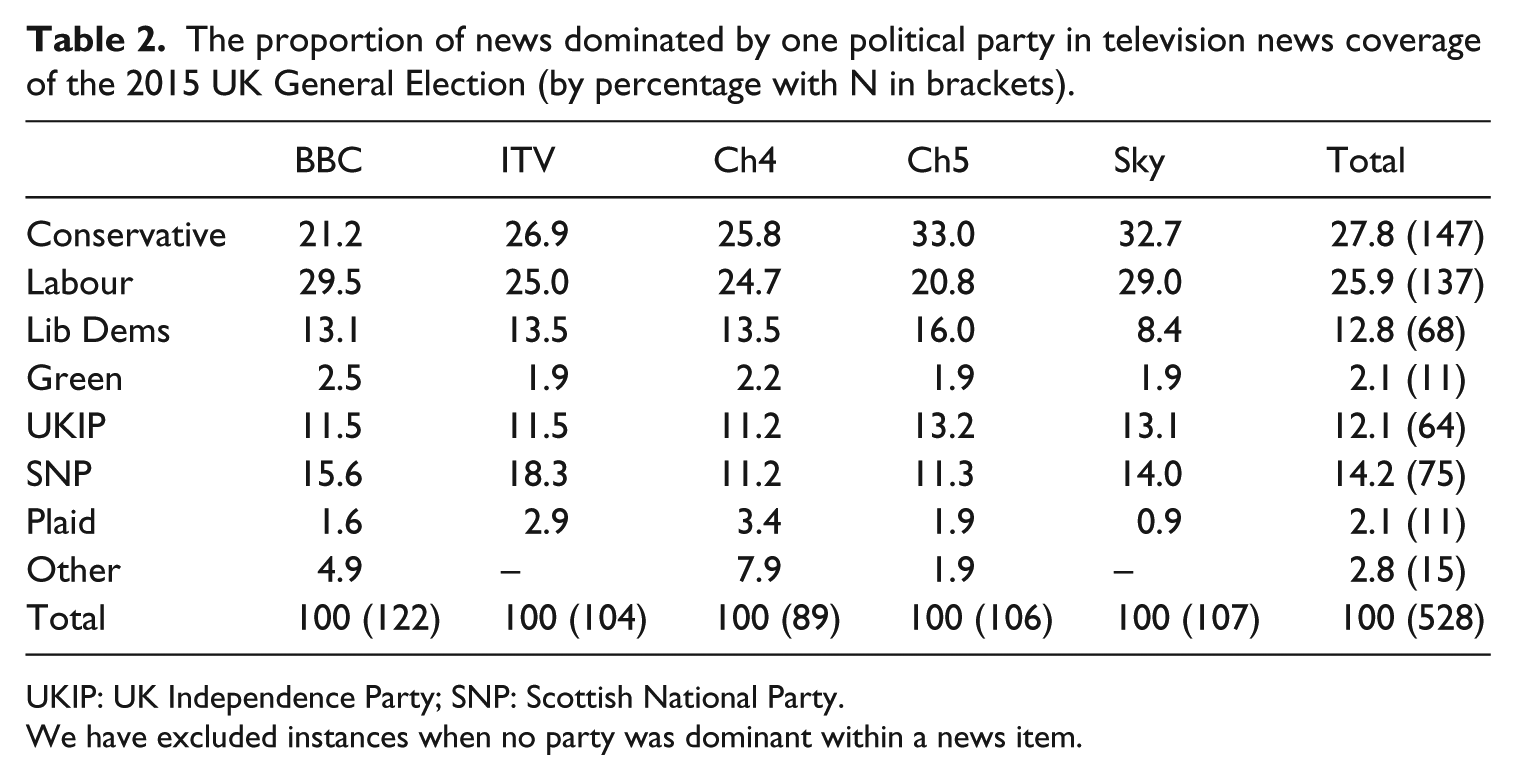
Above all, the two main parties – Labour and Conservative – received the most airtime, but interestingly the SNP (which was given minor party status in a Great British context) had proportionately more coverage than UKIP (a major party in England and Wales) on BBC, ITV and Sky News (and almost the same on Channel 5). Moreover, on BBC and Sky News, the SNP received more airtime than the Liberal Democrats – a party that has long been designated a major party. When we examined which party was the most dominant within a news item – in Table 2 – Labour and Conservative were clearly the leading actors. But, once again, the SNP was the third most dominant party ahead of both the Liberal Democrats and UKIP.
The proportion of news dominated by one political party in television news coverage of the 2015 UK General Election (by percentage with N in brackets).
UKIP: UK Independence Party; SNP: Scottish National Party.
We have excluded instances when no party was dominant within a news item.
In light of the SNP’s prominent coverage despite its minor party status, we thus asked all interviewees whether Ofcom’s major/minor status remained a useful way of safeguarding impartiality during an election campaign and whether the party warranted the amount of airtime. Almost all interviewees did not view the SNP’s prominence as a breach of impartiality, but spin-doctors and politicians gave mixed responses to the issue. UKIP’s Alex Phillips revealed she spent a considerable amount of time lobbying both Ofcom for major party status and the BBC for prominent coverage. James Holt suggested it was his job to compete with the SNP’s news values – ‘that’s the challenge’ – and that it was legitimate for broadcasters to cover the party. Meanwhile, Lucy Powell argued the attention paid to the SNP had political implications. She suggested the focus on the SNP reflected successful Conservative campaign strategy because it was the party’s aim to draw attention to a possible coalition deal with Labour. Powell argued,
it definitely altered the outcome of the election, it definitely had an impact … I don’t think that Ofcom can justify that in saying that [exercising news judgement] because it wasn’t about the SNP talking about themselves … that had a news value. It was about another party [the Conservatives] trying to make the SNP the big story in the election and that was permitted, basically, on quite a large scale.
All editors were comfortable with the amount of coverage the SNP received over the campaign. As literature on news values has long revealed, the editorial focus of the SNP coverage was perhaps understandable since it met criteria such as conflict and novelty. After all, it allowed broadcasters to report the emergence of a new female SNP leader – Nicola Sturgeon – and to consider the possibility of a Labour/SNP coalition, which was a source of much debate and dispute between the two dominant Westminster parties.
With the exception of Channel 4, editors suggested party balance was to some extent internally monitored, but without going into detail such as quantifying the appearances of politicians. Katy Searle indicated that the BBC was, at times, self-correcting and revealed that they had modified coverage in the first week of the campaign after complaints from Liberal Democrats. However, most editors pointed out that regulatory guidance could be broadly interpreted, with news values playing a role in the selection of election stories as the following examples illustrate:
I don’t think we, in a very formulaic way, follow major/ minor parties, but it is a part of what informs us. But actually, OFCOM’s designation in recent elections has pretty well conformed with where the news story and where a sense of fairness would be, even without regulation. (Michael Jermey, ITV) we went into this election with … an approach that if editorially we decide something needs to be done or reported, we will do it, which I think that’s obviously critical and really important. (Paul Royall, BBC) I think obviously they [minor/major status, news value and impartiality] are all meshed in together. (Sue Inglish, BBC)
However, the flexibility of ‘due’ was most explicitly spelt out by the regulators of BBC and commercial news, including the editorial freedom to make judgements based on news values. So, for example, while Ric Bailey acknowledged that interpreting ‘due impartiality’ was ‘not an exact science’, Adam Baxter suggested that ‘it’s [interpreting ‘due impartiality’] more an art than a science’. Both their positions merit being quoted at length because they reveal a shift from a quantitative to a more qualitative approach to regulating ‘due impartiality’ in the United Kingdom:
So what is ‘due’ in an election is to be conscious of the fact that people are voting and that your judgements about impartiality and a reflection of different parties and different parts of the story is within a confined period, it’s a very short period. So it’s not just news values, as in there was an election going on, it’s news values taking into account the particular circumstances that impartiality demands during an election. (Ric Bailey, BBC) due impartiality does not mean equal division and I suppose carrying on with that, having major party status does not mean you give all major parties equal time. Gone are the days when you had people in studios with stopwatches … the major party framework, although you could say isn’t it just a binary – you’re either a major party or you’re not … It doesn’t mean equality of treatment. (Adam Baxter, Ofcom)
In short, according to senior advisers in the regulation of UK broadcasting, applying ‘due impartiality’ in election reporting is not based on quantitative precision but by qualitative editorial judgements.
Agenda balance and live two-way reporting
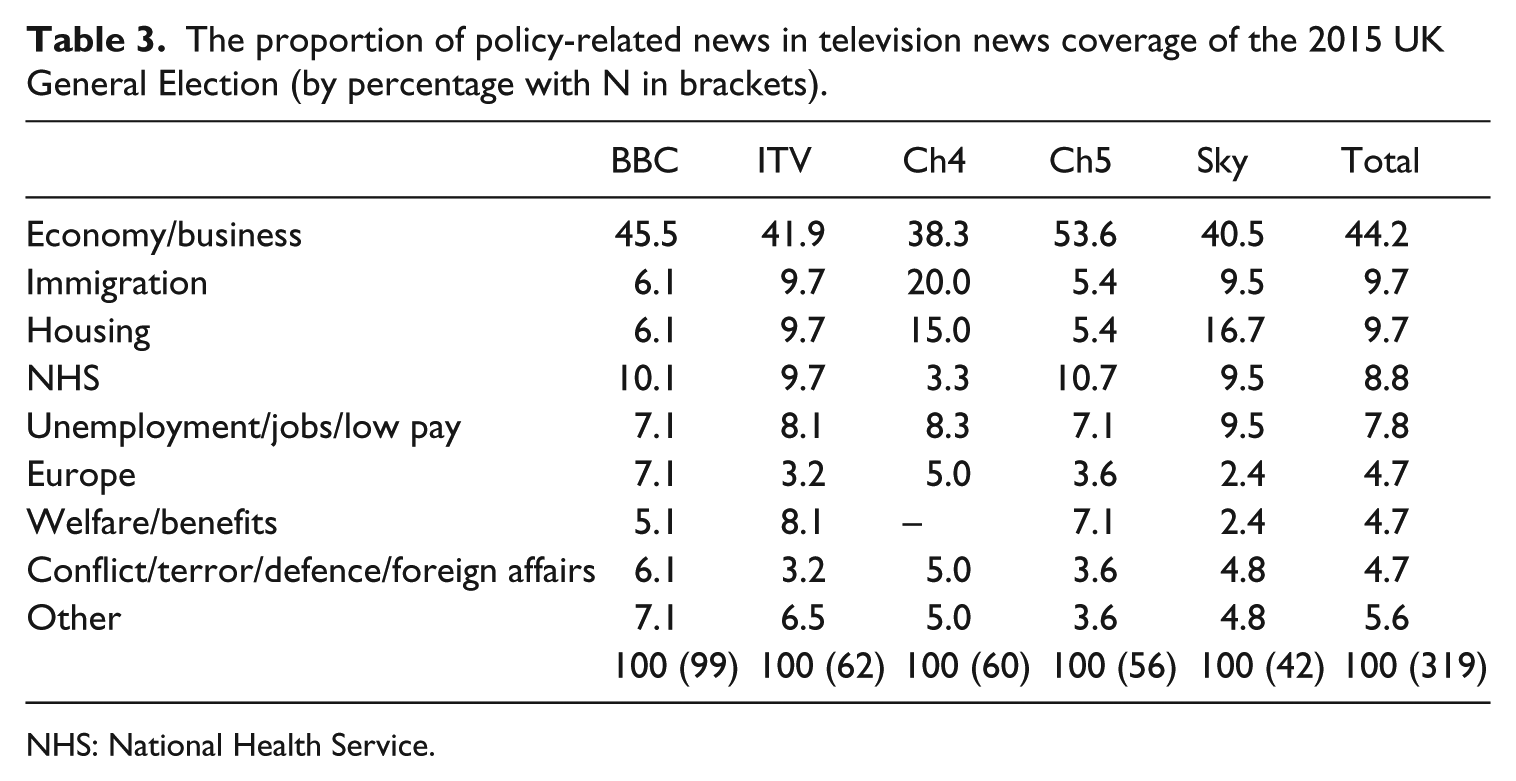
Moving beyond the stop-watch approach to regulation, another measure to interpret impartiality during an election is agenda balance. Much of the literature about agenda balance is based on ‘issue ownership’, with political scientists exploring the relationship between parties’ attempts to campaign on particular issues and whether this has any influence on voting decisions (Green and Hobolt, 2008: 460). Our interest is in asking editors and regulators whether agenda balance – or issue ownership – affects their decision-making in the selection of election news. As Table 3 shows, our content analysis revealed that, by far, the economy and business was the dominant topic, representing 44.2 per cent of all policy-related election news. Of course, this does not mean every economy/business item was pro-Conservative or did not reflect Labour perspectives. But it broadly shows the dominant policy debate of election coverage was fought on the Conservatives’ more favoured policy agenda – managing the economy – which the party championed throughout the campaign (Cowley and Kavanagh, 2016). By contrast, more traditionally Labour-promoted issues – for instance, housing or the National Health Service (NHS) – were far less prominent.
The proportion of policy-related news in television news coverage of the 2015 UK General Election (by percentage with N in brackets).
NHS: National Health Service.
In light of these findings, our aim was to explore whether editors and regulators considered it a threat to impartiality if broadcasters more independently set their own agendas during the campaign, rather than relied on party campaign events and announcements. Or, put another way, would they feel comfortable if broadcasters led on their own election agenda of issues and followed party political agendas to a lesser extent?
All editors pointed out their news teams produced original coverage of the election and broadly felt comfortable with pursing a less party campaign-focussed agenda. It was the BBC and in particular Paul Royall who expressed most concern, revealing that ‘it would be quite a big thing for BBC News to say we’re not going to cover your [party] events and your speeches and everything else’. Ben De Pear indicated Channel 4 had a remit to pursue a more independently minded agenda. Meanwhile, Channel 5’s Cristina Squires stated she had no editorial concerns with focussing on the NHS, say, even though it is seen as a Labour issue. Similarly, Michael Jermey was clear that ‘we can make our own free choices’.
From a regulatory perspective, Ofcom’s Adam Baxter said agenda balance did not fall under the rubric of due impartiality and, in his words, was ‘totally an editorial matter for them [the channels]’. Moreover, he continued it was
very much dependent on the relationship between the broadcaster and the parties and how that relationship sorts itself out, and of course, we shouldn’t have any role in that relationship … It’s a freedom of expression issue really [what the channels cover]. I think it would have to be … [although] we would be concerned clearly if a political editor or commentator was so partial.
Overall, the notion of issue ownership and its potential influence on voters was not an editorial concern of broadcasters or regulators.
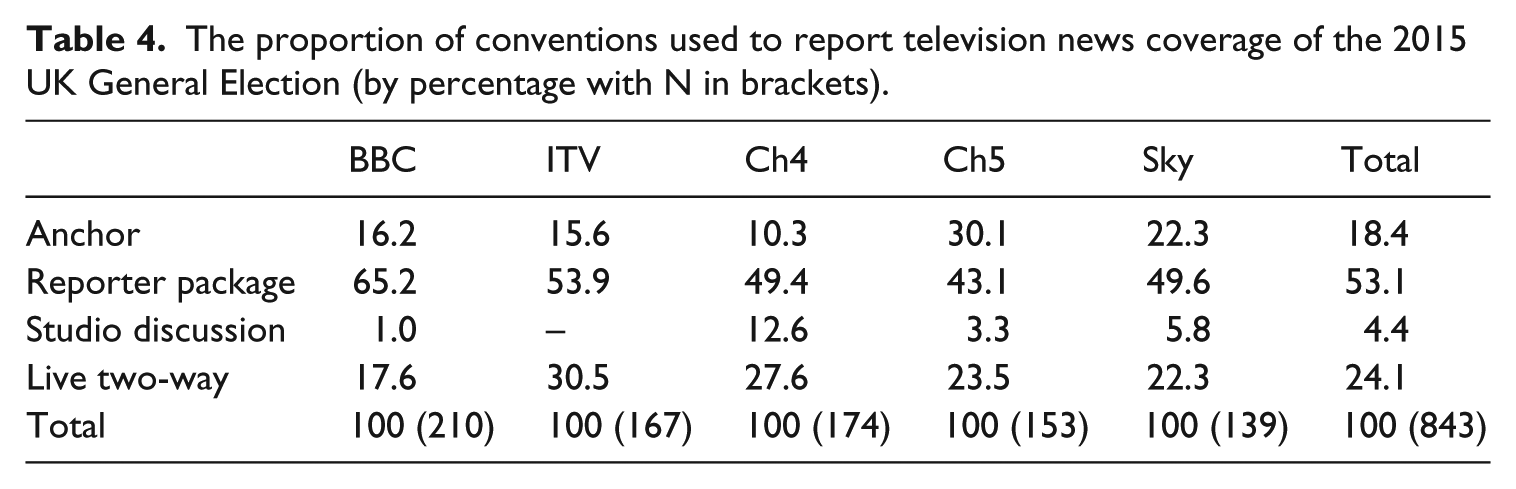
But we did explore a point raised by Ofcom’s Adam Baxter about the role of political editors and commentators in communicating news. In recent years, research has shown the proportion of television news has become increasingly interpretive, with journalists conveying the day’s events in live two-ways rather than relying on politicians in sound bites (Cushion, 2015). Our content analysis examined how far different television conventions were used by broadcasters over the campaign, including anchor-only items, reporter packages, studio discussion and two-ways either on location or within a studio. But we also examined whether one political party was dominant within a news item.
Overall, our study reinforces previous evidence that live two-ways play a major role in political coverage (Cushion, 2015), representing nearly a quarter – 23.1 per cent – of all news items during the campaign. However, commercially driven channels featured more two-ways than the BBC. Three in 10 ITV election items, for example, was a live two-way (Table 4).
The proportion of conventions used to report television news coverage of the 2015 UK General Election (by percentage with N in brackets).
When we isolated which political parties were dominant in live two-ways across all television news bulletins – in Table 5 – Conservative and Labour were the lead protagonists (over 31% for each party). Not far behind was the SNP which accounted for nearly a quarter of all news items – 21.9 per cent – more than four times the prominence granted to the Liberal Democrats (5.2%) and roughly three times more than UKIP (7.3%). Interestingly, Table 5 further reveals that the focus on the SNP within news items was higher in live two-way reporting than it was once in other types of conventions, such as reporter packages. Or, put another way, editorial judgements appeared more news value driven in live two-ways than reporter packages since the SNP attracted greater attention than other parties apart from the Conservatives and Labour.
The proportion of items dominated by one political party by conventions in television news coverage of the 2015 UK General Election (by percentage with N in brackets).
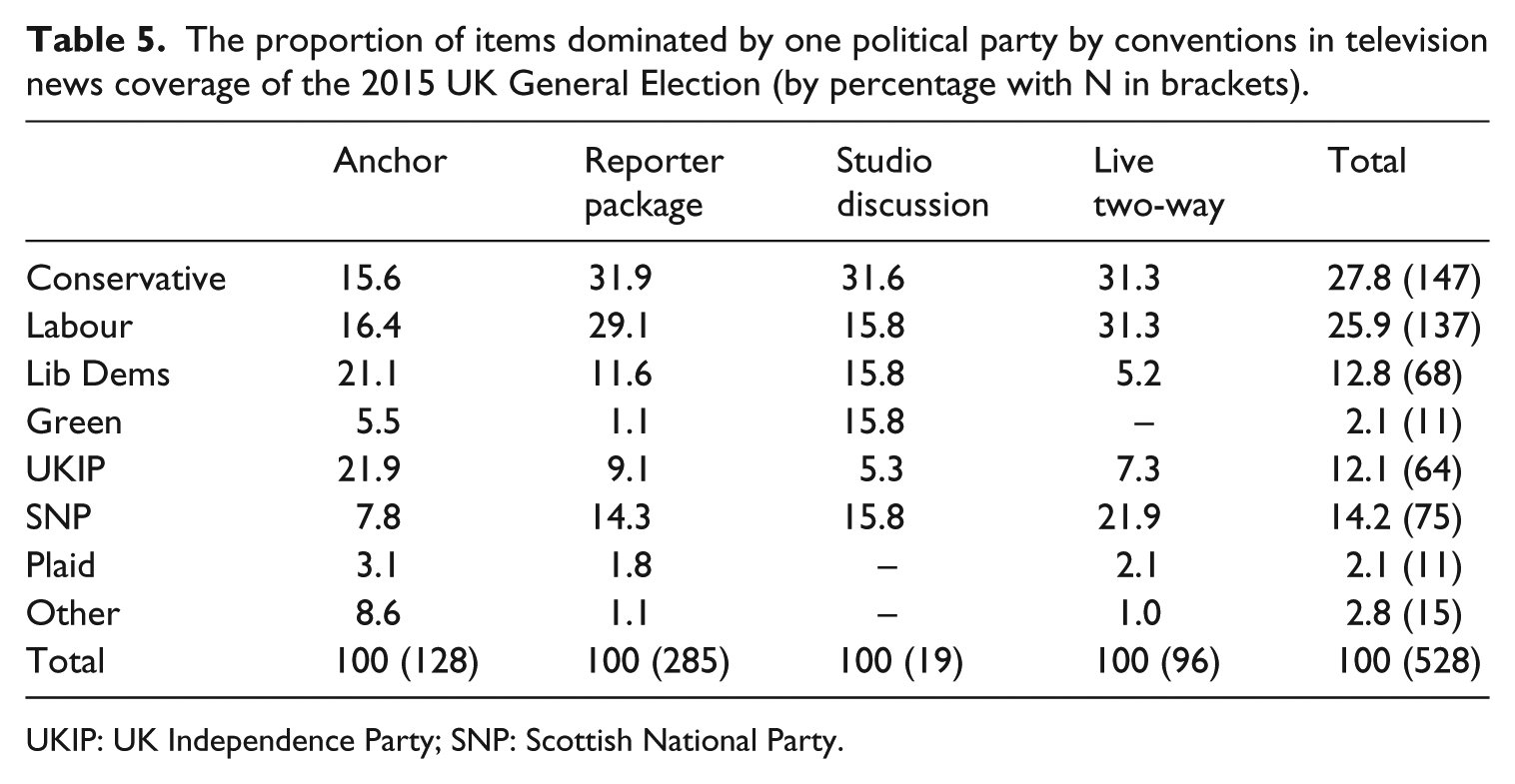
UKIP: UK Independence Party; SNP: Scottish National Party.
In the context of broadcast reporters appearing in live two-ways and interpreting political coverage to a greater degree, we asked all interviewees whether they had any editorial concerns about increasingly seeing and hearing journalists discussing the day’s events rather than politicians. With the exception of Labour and Green representatives that raised issues about impartiality, interviewees were either relaxed about the role played by more judgemental journalists or viewed it in positive terms. Indeed, UKIP’s then campaign manager Alex Phillips considered it
a very good thing because … You give too much power and too much time to the political parties and they’re all going to be using it for their own ends because that is their job. You do need to have that balance with a commentator and someone who can elucidate issues for the public.
Most editors explained the shift towards more live two-way reporting because of the fast changing news cycle and advances in technology. But they also – like Alex Phillips – saw it as a way of de-spinning politicians reluctant to talk openly about their policy positions and a more effective way to communicate politics to audiences. As the BBC’s Katy Searle put it,
the more analysis you have the better really, without making the balance too far. I think we are there partly as others are to contextualise and give the audience a helping hand to understand what the hell it’s all about.
According to the Greens and Labour, at times they felt the balance towards journalists interpreting news about politics had gone too far since they had too much agenda-setting power without sufficent editorial oversight. Labour’s Lucy Powell, in this respect, expressed most concern:
you’ve got to have more checks and balances in there and I don’t believe that happens. For example, the Norman Smith two-ways which is always on the Today programme [a leading radio programme] at 6.30 every morning, we’d all listen to that in the office before we had our first morning call and that would often set the mood of the day. I don’t know. Does anyone in the BBC systematically listen to all those things every day and saying have we got that right, have we got that balance right overall from our coverage? I doubt very much if they do.
However, from a regulatory perspective, once again both our interviewees from Ofcom and the BBC considered this a matter of editorial freedom, rather than any threat to ‘due impartiality’. Adam Baxter said Ofcom would only ‘be concerned clearly if a political editor or commentator was so partial’. Meanwhile, Ric Bailey suggested correspondents are
adding layers of understanding for the audience, but of course they do that from a starting point of impartiality so that they approach the parties in a consistent way. I don’t think that means you have to stand there and kind of say, on the one hand this and on the one hand that, but you’re asking your most expert correspondent and editors to interpret what’s going on, on behalf of the viewer. I don’t think that has any implications for impartiality whatsoever.
Both regulators interpreted impartiality not as representing all sides of a political debate or giving equal time to different perspectives, but for journalists to exercise editorial judgements about what they consider to be the most significant and newsworthy story to report.
From quantitative precision to qualitative judgements about news values: Rethinking the practice of ‘due impartiality’
Although new online and social media platforms have become the focal point in scholarly and industry debates during election campaigns, according to party spin-doctors the most important source for conveying messages in the United Kingdom was television news. Despite new media operating in a largely unregulated media environment, there was little appetite from our interviewees to relax rules governing ‘due impartiality’ for UK broadcasters.
Our content analysis revealed that the SNP (designated a minor party by Ofcom in a Great British context) gained proportionally more airtime and attention than some of the major parties in television news coverage of the 2015 UK General Election. And yet, almost all interviewees were editorially comfortable with the disparity in coverage between minor and major parties. Indeed, Ofcom Adam’s Baxter clearly explained it was a matter of editorial judgement for broadcasters rather than a regulatory concern. Similarly, editors and regulators did not consider agenda balance a necessary requirement for impartiality, despite our content analysis demonstrating a clear imbalance towards more Conservative issues about the economy and business. Regulators pointed out that – irrespective of their political implications – election issues should be determined by editorial judgements. Finally, almost all interviewees did not consider live two-ways a threat to ‘due impartiality’. Although our content analysis revealed live two-ways focussed on the SNP to a greater extent than some major parties, once again editors and regulators considered this a matter of editorial judgement.
Our UK case study, of course, cannot be straightforwardly applied to other countries because the principles and practice of impartiality differ in subtle ways between journalism cultures. But we agree with Rafter’s (2015) observation that communication regulation should be subject to far more public discussion and consultation when achieving balance in the news. Indeed, if journalism scholars want to remain relevant to regulatory and industry debates, we would argue more empirical research is needed about how key stakeholders interpret media policy.
As our study revealed, there is clearly a disjuncture in the theory and practice of ‘due impartiality’ between scholars and practitioners. Contrary to recent scholarly interpretations about ‘due impartiality’ being applied with some degree of quantitative precision in the United Kingdom, according to key stakeholders involved in the regulation of political news during the 2015 General Election, it is a qualitative judgement about the editorial merit of particular issues, parties and leaders throughout the campaign. The case in point was the editorial and regulatory acceptance that it was appropriate for a minor party – the SNP – to receive more airtime and attention than some major parties in the United Kingdom’s flagship television news bulletins. As Ofcom’s Adam Baxter put it, ‘we are deliberately quite flexible or trying to force the greatest possible or the greatest appropriate levels of flexibility in terms of enforcing the due impartiality rules’. Major or minor party status, in the context, could thus be described as broad guidelines for broadcasters to consider rather than representing quantitative instructions for editors to follow. This represents a shift over recent years in the United Kingdom from a political system shaping impartiality towards more of a news value–driven system reliant on editorial judgements.
In our view, this raises serious questions about the accountability of editorial decisions and how impartiality is safeguarded. As scholars have long pointed out, while a common set of news values may be broadly shared within the journalistic profession, they are far from a set of objective criteria used to police the balance of political coverage (Donsbach, 2004). As Harcup and O’Neill (2009) put it, ‘News values are a slippery concept’ to understand and interpret, and their application is ‘often contradictory and incoherent’ (pp. 162–168). In political reporting, research examining the news values of election coverage has shown a tendency to focus on the horse-race narrative and draw attention to conflict between parties (Strömbäck and Lee Kaid, 2008). This helps explain the focus on the SNP in our study of coverage during the 2015 UK general Election campaign, with journalists following the opinion polls that consistently put two main parties neck-and-neck and led to widespread speculation about possible coalition deals (Cushion et al., 2016b).
But in following a news value approach to election reporting, it becomes more difficult to police the balance of political party perspectives, the coverage of leaders and the types of issues addressed. News values, after all, are not politically neutral and – as our content analysis demonstrated – led to minor status parties being covered more than some major parties. In the case of the SNP, it might be argued that they merited coverage because 54 of their MPs were elected – far more than UKIP and the Liberal Democrats – or because the party and its leader could form a coalition with Labour. But the party’s prominence clearly had political implications, with post-election research revealing the prospect of an SNP-Labour coalition may have swayed people in marginal constituencies to vote Conservative (Cowley and Kavanagh, 2016). This could be accounted for by successful Conservative campaigning, which strategically aimed to appeal to a set of news values and gain widespread coverage (Cushion et al., 2016b). But, in our view, the ‘due impartiality’ of news should not be unduly influenced by the political power of spin-doctoring or the news values of broadcasters.
We are not proposing broadcasters should have to subscribe to a rigid quota system when reporting parties at election time or have a top-down regulator prescribing precisely how much time each party should be reported. Far from it, but in abandoning the old stop-watch approach to policing balance it has arguably meant broadcasters do not now have to routinely include all parties according to a ratio (Semetko, 2000) that would have been established well before party political pressures or the excitement of the electoral race had begun to influence editorial decisions. Or, put another way, by generally (not slavishly) subscribing to a stop-watch form of political balance, election reporting is less susceptible to news value–driven reporting or party political influence. In other words, without a broad quantitative sense of balancing party and leader perspectives in election reporting over a campaign, in our view the impartiality of news can be compromised.
More generally, if the impartiality of political reporting is increasingly applied according to editorial judgements it becomes more difficult to empirically measure and interpret whether broadcasters have remained impartial or not. Although media scholarship has long relied on quantitative methods to consider whether broadcast news is fair and balanced, regulators appear to be reinforcing Hall’s (1974) perspective that impartiality is an ‘operational fiction’, with editorial judgements superseding the litany of quantifiable measures academics use to evaluate political balance in the news (Hopmann et al., 2012). If scholars want to interpret the impartiality of political reporting according to the United Kingdom’s formal rules and regulations, future research may need to include more qualitative approaches to understand the context and relevance of editorial judgements.
Footnotes
Funding
The author(s) disclosed receipt of the following financial support for the research, authorship, and/or publication of this article: This work was supported by the Economic and Social Research Council (ESRC) initiator fund administered by Cardiff University and internal funding from Cardiff University and the Cardiff School of Journalism, Media and Cultural Studies.