




Abstract
The news media are often accused of reporting politics in a too narrow and consensual way, excluding certain perspectives and issues that might better reflect the public’s agenda. This study lends weight to this argument by not only demonstrating the party political focus of UK election coverage but also in the misleading way public opinion was, at times, represented. Analysing 6647 items and/or stories in the largest ever content analysis study of 4613 sources across five first- and second-order election campaigns in the United Kingdom, it comprehensively tracks how citizens and journalists appear in television news, as well as developing a finely grained, qualitative assessment of how public opinion was represented during the 2017 election campaign. Overall, the study found that political parties received the most amount of airtime, but in some election campaigns members of the public appeared in coverage more often than politicians. However, they were mostly granted limited airtime to articulate their views in vox pops. During the 2017 election campaign, the study found the editorial construction of public opinion in vox pops and live journalistic two-ways was shaped by a relatively narrow set of assumptions made by political journalists about the public’s ideological views rather than consulting more objective measures of public opinion. So, for example, voters were portrayed as favouring more right- than left-wing policies despite evidence to the contrary. The use of citizens as sources is theorised as serving the pre-conceived narratives of journalists rather than reflecting a representative picture of public opinion. The study reinforces and advances academic debates about journalists and citizen-source interactions. More accurately engaging with people’s concerns, it is concluded, will help move broadcasters beyond the narrow set of assumptions that typically serve their narratives of political coverage.
Keywords
The power the media have to (re)define politics and privilege some views over others is striking during election campaigns. After all, the media assemble the actors involved in the contest and help dramatise it by how they construct campaign coverage. The focus of this study is the role played by citizens and journalists as sources, and the editorial construction of public opinion at election time. It carries out the largest ever study of sources to date across five first- and second-order election campaigns in the United Kingdom between 2009 and 2017, analysing 6647 items and/or stories and isolating 1914 election items with 4613 different actors informing coverage. While most studies about media coverage of politics focus on first-order elections, such as Presidential contests or general elections, second-order campaigns, including the European Union (EU) elections or more localised contests, have received far less scholarly attention. While second-order elections might be viewed as low key electoral events, the outcomes still have important democratic consequences. This study examines television news coverage of the 2009, 2013 and 2014 EU and/or local election campaigns in the United Kingdom and the 2015 and 2017 general election campaigns. It explores the role of sources in different types of contests and compares coverage across public and more commercialised broadcasting systems.
Over recent decades, a voluminous academic literature has documented how journalists largely rely on institutional sources, notably political elites, which produces a top-down perspective of the world. In characterising the relationship between sources and journalists, Gans (1979) famously used a metaphor of a ‘dance’ – leaving open the empirical question about who is leading whom (Strömbäck and Nord, 2006). But this so-called ‘dance’ between sources is often theorised in the context of power relations between journalists and elites, a battle to lead the agenda and legitimise certain perspectives over others. Citizens, by contrast, have often been left out of this tussle in academic debates, despite the increasing presence of ‘the public’ in media discourse (Coleman and Ross, 2010). However, attention towards the role citizens play in news programming has grown, with a particular focus in how they are represented in vox pops, a broadcast convention that constructs ‘the voice of the people’. Broadly speaking, research has shown citizens appear as relatively passive sources in general news reporting, while in coverage of politics they have been characterised as apolitical actors who are often pushed to the margins of policy debates (Brookes et al., 2004; Lewis et al., 2005). Although longitudinal research has suggested the use of vox pops has increased in news coverage (Kleemans et al., 2017), no studies have systematically examined their use over different election campaigns. Nor has much attention centred on how journalists interpret public opinion during election campaigns (with Brookes et al., 2004 as exception) beyond how polls are reported. Since journalists have increasingly been used as sources of knowledge about political affairs over recent decades (Cushion, 2015), they also play a critical role on how the public’s agenda is represented. So, for example, do journalists ideologically construct citizens as favouring right- or left-wing perspectives, or do they tend to avoid any ideological assertions about public opinion?
To develop new empirical and theoretical lines of inquiry, the purpose of this study is twofold: to quantitatively establish how far citizens and journalists appear as sources in different types of election campaigns, and to more closely examine the editorial construction of public opinion and consider the wider implications. While a large-scale content analysis was designed to assess source selection across first- and second-order election campaigns, in the 2017 election campaign a more qualitative analytical framework was developed to interpret how journalists interpreted citizen perspectives and public opinion more generally. Overall, the study reinforces and advances academic debates about journalist and citizen source interactions. In doing so, it proposes a new way in which to theorise how citizens are used as sources, arguing that the public is often (re)constructed to serve journalistic narratives rather than convey a representative picture of public opinion.
Theorising news access: Understanding sources and journalistic voice at election time
Within media and communication studies, scholars have long been concerned with the relationship between journalism and sources. From thinking about journalists as gatekeepers (Gans, 1979) to labelling actors ‘primary definers’ (Hall et al., 1978) or operating as part of an elite ‘index’ (Bennett, 1990), the role of sources has been theorised and empirically examined from a wide range of perspectives (Manning, 2001). This is because, above all, the access sources have to news programming represents a broader symbolic power in society (Cottle, 2000). In other words, whoever regularly informs the news helps represent (and resolve) a social reality about the world. As already acknowledged, there is an established academic literature that empirically shows access to news programming tends to be reserved for elites and institutional actors, drawn largely from the worlds of politics, business, the police and the military. They not only help in constructing the narrative of news they also help legitimatise certain viewpoints, privileging some perspectives while marginalising or silencing many others. Examining television news coverage of the 2015 UK general election campaign, for example, Chadwick et al. (2018) have theorised the source interaction between journalists and elites as representing ‘authority signalling’, elevating experts above other types of ‘ordinary’ sources.
While this might help characterise a large proportion of source judgements, it also excludes many actors, including citizens and public opinion more generally. As Hopmann and Shehata (2011) have observed, ‘it is quite surprising how little attention has been paid to ordinary citizens as actors and sources in news coverage of politics’ (p. 57). There is, however, a small but growing body of scholarship that has examined the representation of citizens in television news. Lewis et al. (2005) have carried out the most systematic study of citizens in the news, which included developing a typology of how public opinion is represented by journalists. In television news the most common was interferences, where journalists inferred what the public think, followed by vox pops, which included the voices of the public. Reporting representative polls or surveys was one of the least referenced ways of reflecting public opinion, despite being one of the most accurate and systematic ways of understanding how the public think about issues (Lewis et al. 2005). Overall, Lewis et al. (2005) concluded that citizens were represented in largely passive ways, with their emotional responses given greater prominence than their views about policy positions or solutions to political issues.
While many studies have examined how polls and protests have been reported – where the public’s view is aggregated – few have focussed on the use of vox pops or inferences during election campaigns, where citizens appear in coverage as sources. Beckers et al. (2016) have studied the use of vox pops in Dutch TV news between 2003 and 2013 and discovered a large majority featured unbalanced political opinions, often excluding minority groups, making them an unreliable measure of public opinion (Beckers, 2017). Brookes et al. (2004) examined both vox pops and inferences during the 2001 UK general election campaign and found while political views were balanced, much of the time the public was largely represented apolitically. Most people’s views were stripped of any ideological opinions, they argued, and were instead often used to symbolically illustrate the horserace between the main political parties.
The power dynamics involved in sourcing citizens are important to theorise in this context. Unlike expert sources, journalists are not ‘signalling authority’ (Chadwick et al., 2018) when invoking the public. Citizens may be used to display a range of opinions that are not necessarily representative but conducive to the narrative of a journalist’s story. In the United Kingdom, for example, broadcasters are well aware that vox pops are not a scientific representation of public opinion. The British Broadcasting Corporation (BBC) has guidelines that state ‘We can either use a spread of opinions, reflecting, in a balanced way, the different strands of argument, OR, where appropriate, present an accurate and proportionate reflection of those whose opinions we have sought’. 1 In other words, reporters have the editorial freedom to use vox pops to serve a journalistic narrative rather than convey a representative picture of public opinion.
While there is evidence the use of vox pops has increased in television news over recent decades (Kleemans et al., 2017), so too has the voice of journalists. So, for example, where once newscasts were largely pre-edited, today broadcasts are increasingly live, with journalists often appearing in two-ways from right around the world (Cushion, 2015). This represents a wider shift towards more interpretive journalism over recent decades, where a ‘greater emphasis on the “meaning” of news beyond the facts and statements of source’ is pursued by reporters (Salgado and Strömbäck, 2012: 145). Longitudinal studies have shown a greater reliance on journalistic opinion and comment, enhancing their editorial power while diminishing that of sources (Cushion, 2015). Norms of objectivity, in this context, are being recast as the old-age convention of relying largely on sources to inform a story is being replaced by journalists own judgements. For the purposes of this study, it would seem that journalists have increasing power to infer what the public think about politics and election campaigns.
The implications of the changing dynamics between journalists and sources are the subject of fierce debate. After all, who sets the media agenda lies at the heart of questions about power and influence in a democracy. The aim of this study is to paint both a quantitative picture of how journalists and sources appear in news across different campaigns, as well as develop a finely grained, qualitative assessment of how journalists represent the public. In doing so, it will theorise how journalists use citizens as sources during election campaigns, establishing what, if any, dominant narratives emerge and then consider the wider implications.
The research questions (RQs) of the study are as follows:
RQ1. To what extent are citizens represented in coverage of first- and second-order elections campaigns?
RQ2. How far do journalists appear as sources in live reporting in coverage of first- and second-order election campaigns?
RQ3. How were vox pops used during the 2017 general election campaign?
RQ4. How was public opinion ideologically constructed in live two-way reporting during the 2017 general election campaign?
Method and sample: Examining UK election campaigns
The study drew on a content analysis of television news coverage ahead of the 2009 and 2014 EU and local elections, the 2013 local election, and the 2015 and 2017 general elections. 2 All news on the UK national evening newscasts – the BBC News at Ten (on a public service broadcaster), ITV News at Ten, Channel 5 at 5 pm, Channel 4 at 7 pm (all on commercial service broadcasters) and Sky News at 10 pm (on a commercial broadcaster) – were examined approximately 6 weeks before each election (with the exception of Sky News during the local/EU elections). There were major differences in the volume of coverage, with far more news about first- than second-order elections.
The unit of analysis was all news and election items in the sample periods. During the 2009 and 2014 EU and local elections, as well as the 2013 local election, 2248 stories were generated, with 231 election news items isolated. Items refer to the type of communication convention editors choose to help convey a news story. This was categorised in four ways: an anchor presenting an item, a reporter edited package, a live two-way with a journalist or a studio discussion with anchor and guests. During the 2015 and 2017 election campaigns, all news coverage was broken down into items (N = 4399) rather than stories, with 1683 election items identified. In total, 6647 items and/or stories were examined, with 1914 election items isolated across five different election campaigns. Within each news item, the type of source was then examined and categorised into party political source, citizen or other types of actor. This included assessing which parties appeared in coverage and categorising non-citizen sources, such as think tanks, academics, business people and pollsters. Overall, 4613 sources were examined over five elections, including 2163 politicians, 1934 citizens and 516 other types of actor.
By interpreting election stories as conventions, it helped convey the role journalists played in reporting the campaign (Cushion, 2015). So, for example, anchor only packages rely primarily on a newsreader summarising an item briefly over an image or moving pictures, while edited packages tend to be lengthier pre-filmed items that typically draw on a range of sources – whether politicians, experts or vox pops – with a journalist narrating and delivering a final piece to camera. Meanwhile, studio discussions generally revolve around a select few sources or a larger audience, with journalists asking citizens to contribute to debates. Live two-ways, by contrast, allow journalists more space and autonomy to interpret the campaign than other types of conventions. It is the last category – live two-ways – where this study will focus on examining how journalists infer what the public thinks.
In order to do this, a more detailed quantitative and qualitative analysis of all citizen sources and live two-ways was carried out during the 2017 election campaign. All types of citizen contributions were examined, which included vox pops but also audience responses after the TV election leaders’ debates or in discussion formats (primarily on Channel 4). This included members of the public who had been targeted by broadcasters for more in-depth insights rather than more randomly asking people to comment in the high street. While these represented different kinds of contributions, of the 953 citizen voices analysed, the vast majority were more typical vox pops. Each of these sources was categorised by gender and age, along with the topic of each contribution and voting preference. Similarly, all 169 live two-ways were subject to further analysis, including whether the item was about campaign process or issues, and the degree of policy detail information. To further explore how the public was represented in live two-ways, every judgement by the reporter was coded for being either supportive or critical of the Labour or Conservative campaigns within each news item.
Approximately 10% of the samples across different strands of the election projects were subject to roust intercoder reliability tests dependent on the number of coders. All source variables and news and election item categories over the five elections reached high reliability scores. 3 In the analysis of vox pops, all variables achieved a level of agreement above 95% and Krippendorff’s alpha scores of above 0.84. Similarly, judgements about political parties in live two-ways had an 86.7% level of agreement and a Cohen’s kappa score of 0.83, while the representation of public opinion in live two-ways reached a level of agreement above 88.2% and Cohen’s kappa result of 0.84.
A quantitative picture of citizens as sources and live two-way reporting in first- and second-order election campaigns
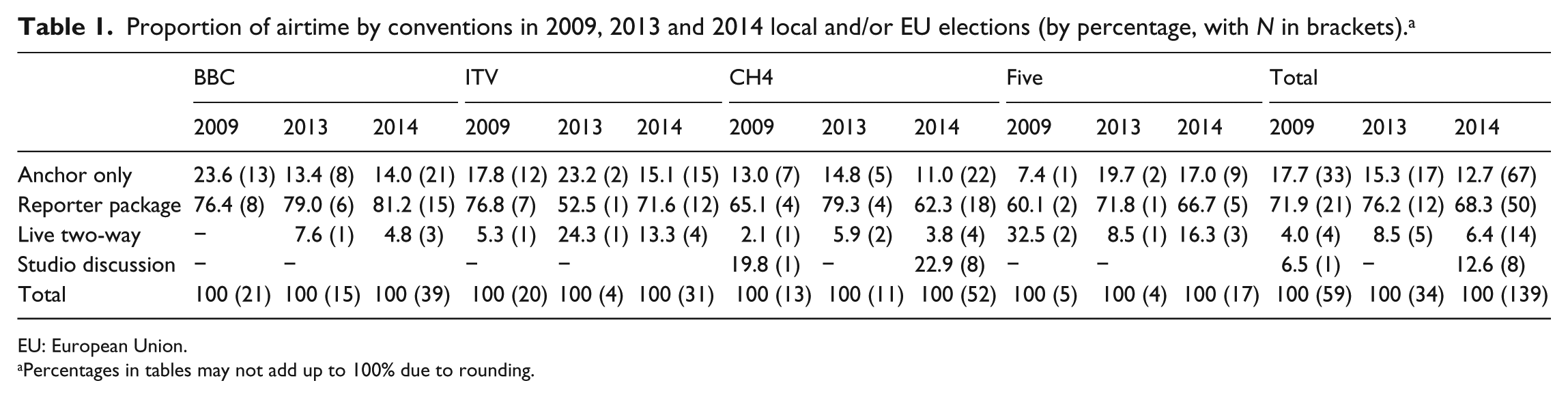
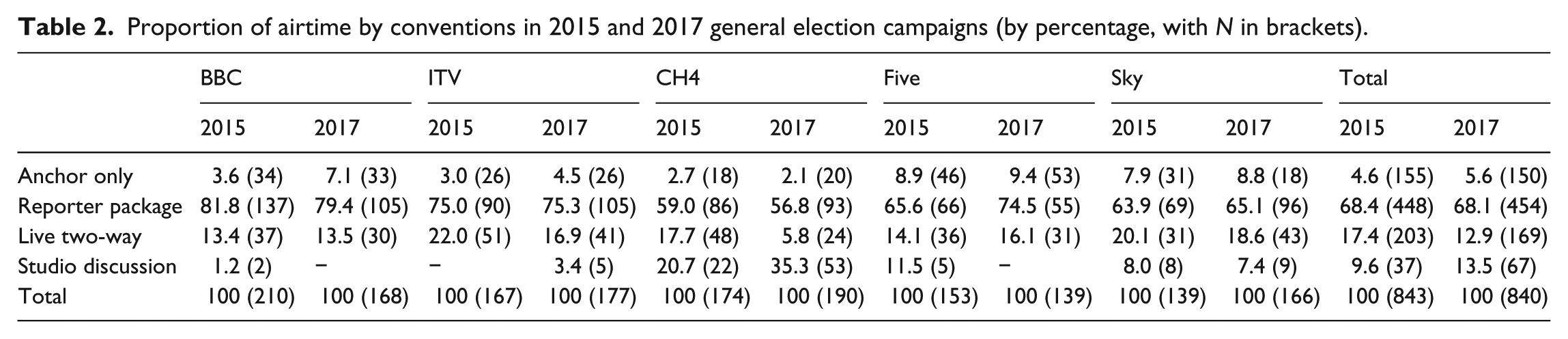
In order to explore how far journalists appeared as sources in election coverage, the study began by examining the proportion of time they report in live two-ways in different types of election campaign (see Tables 1 and 2). With the exception of the 2014 EU election, live two-ways were far less common in second- than first-order elections. A large majority of coverage – notably in the 2013 local elections – relied on reporter edited packages. Excluding Channel 4 in the 2017 election campaign, however, live two-ways were the second most frequent convention across all broadcasters. Commercial newscasts featured more live two-way reporting than the BBC, the United Kingdom’s main public service broadcaster.
Proportion of airtime by conventions in 2009, 2013 and 2014 local and/or EU elections (by percentage, with N in brackets). a
EU: European Union.
Percentages in tables may not add up to 100% due to rounding.
Proportion of airtime by conventions in 2015 and 2017 general election campaigns (by percentage, with N in brackets).
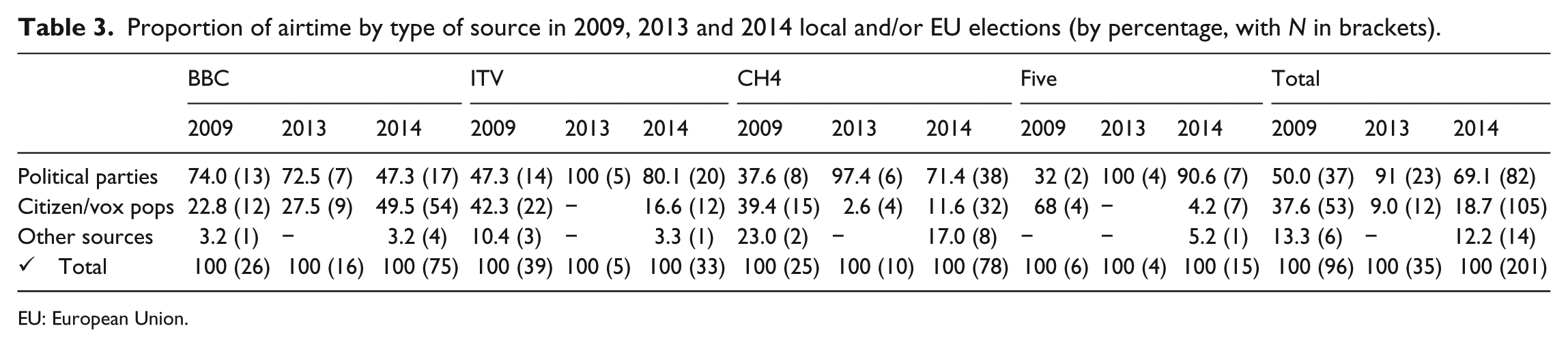
The study then explored how far citizens appeared in first- and second-order election campaigns by looking at all sources. With the exception of the 2009 election, which was barely reported by broadcasters, Tables 3 and 4 show between 66.4% and 90.1% of time was made up by political parties. Members of the public – largely in vox pops – made up the second highest share of time spent on sources in all five elections examined. However, there were more (by frequency) vox pops in the 2009 and 2014 elections than politicians. The high volume of vox pops was often a reflection of their ‘second-order’ status, with citizens often commenting about the relevance and significance of the electoral contest. The balance of sources used in the 2015 and 2017 UK election was remarkably similar, with almost the same proportion of airtime granted to political parties, citizens or other sources. Once again, however, the number of vox pops was close to the amount of political sources, particularly so in the 2017 election campaign (953 vs 956). Commercial newscasts relied on citizens to a greater extent than politicians. In 2015, Channel 4 sourced more vox pops than politicians, as did ITV in 2017, while Channel 5 featured more in both election campaigns.
Proportion of airtime by type of source in 2009, 2013 and 2014 local and/or EU elections (by percentage, with N in brackets).
EU: European Union.
Proportion of airtime by type of source in 2010 and 2015 UK general elections (by percentage, with N in brackets).

Given the dominance of both politicians and citizens, there was limited time for other sources to contribute. Excluding the 2013 election, which only featured politicians and citizens, other actors made up between 10.9% and 13.3% of airtime for sources. When the types of actors appearing on television news were examined more closely, there was a limited range of information sources identified.
The perceived value of different sources is revealed by the mean average soundbite length (in seconds) of different sources. During the 2009, 2013 and 2014 EU and/or local election campaigns, politicians were given more time to articulate their views (16, 39 and 37.6 seconds, respectively) than citizens (8.2, 4.3 and 7.4 seconds, respectively). During the 2015 and 2017 elections, politicians also had longer average soundbites (26.7 and 32.7 seconds, respectively) than citizens (12 and 10.7 seconds, respectively). While citizens made many appearances on television, overall they were granted little time or agency to express their own views. Instead, vox pops tended to be used to respond to the parties’ campaigns or inform the narrative of journalists’ packages.
(Re)constructing citizen voices: The use of vox pops during the 2017 UK general election campaign
During the 2017 UK general election campaign, the received wisdom was that the Conservatives would win comfortably because most pre-campaign polls suggested the Labour leader, Jeremy Corbyn, was unpopular. But although the Labour party was between 16% and 22% behind in the polls when the campaign began, they significantly narrowed the margin in the run up to election day (the final share of the vote was Conservatives 42.4%, while Labour received 40%). By examining how citizens were represented in vox pops during the 2017 UK election campaign, the aim of this part of the study was to explore if any journalistic narratives emerged in the construction of public opinion and to consider the wider impications of this coverage.
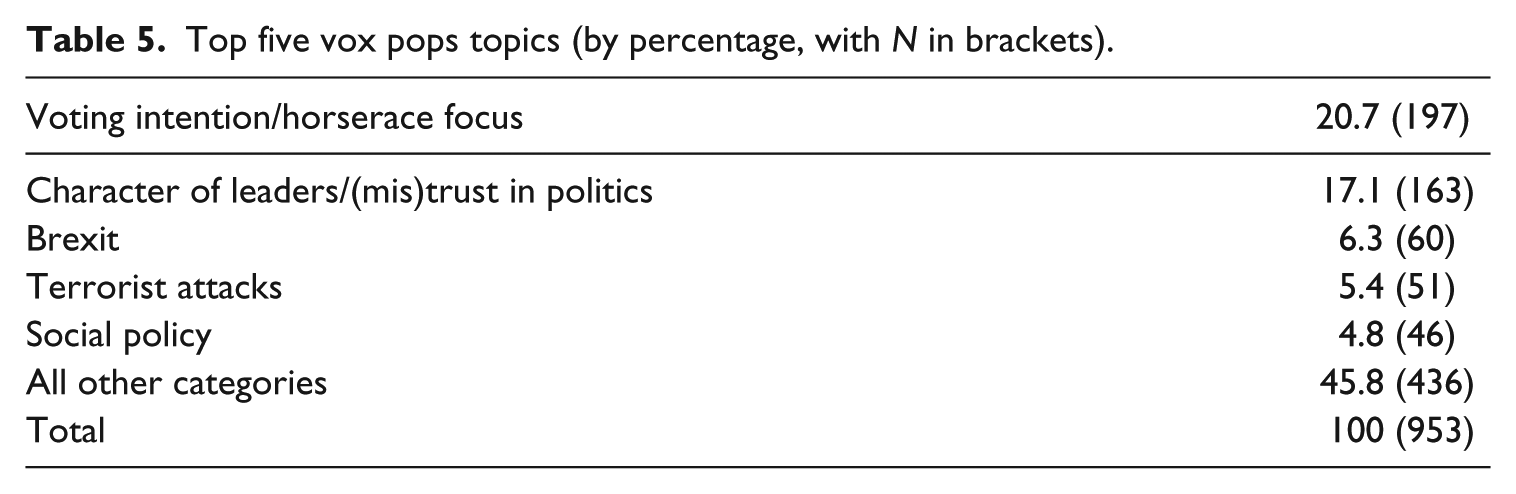
On the face of it, a relatively balanced mix of vox pops was used across all broadcasters, such as an even use of male (54.5%) and female (45.5%) sources. Or in the broad mix of age groups (21.7% of 18–30 seconds, 22.4% of 31–45 seconds, 23.3% of 46–60 seconds and 29.4% of 61+) represented, with some unclear (1.6%) or under 18 (0.8%). Vox pops were used to discuss campaign process (56.8%) more than issues (42.4%) across all broadcasters, particularly so on Sky News where almost a third did not address policy concerns. Indeed, as Table 5 reveals, the two most frequently discussed vox pop topics were voting intention/horserace focus and the character or (mis)trust towards parties or their leaders.
Top five vox pops topics (by percentage, with N in brackets).
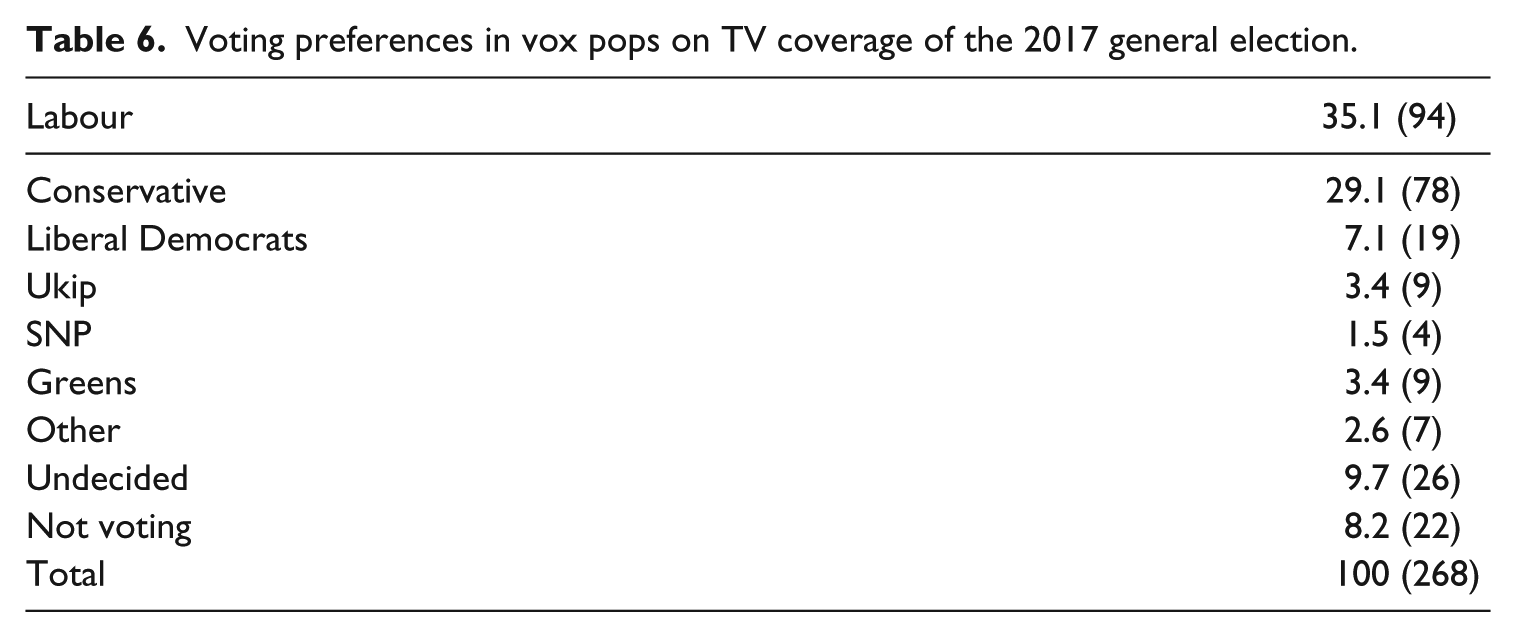
When examining the party political balance of vox pops, 28.1% were identified as expressing a clear voting preference (see Table 6). It showed Labour was the most favoured party, followed by the Conservatives, with other parties referenced far fewer times.
Voting preferences in vox pops on TV coverage of the 2017 general election.
But while Labour had marginally more voter support in vox pops, an imbalance of citizen perspectives emerged when former voting preferences were expressed. As Table 7 reveals, excluding politically unclear views, the majority of these vox pops were about people previously voting Labour but potentially moving away from them in 2017.
Former voting preference in vox pops on TV news during the 2017 election.
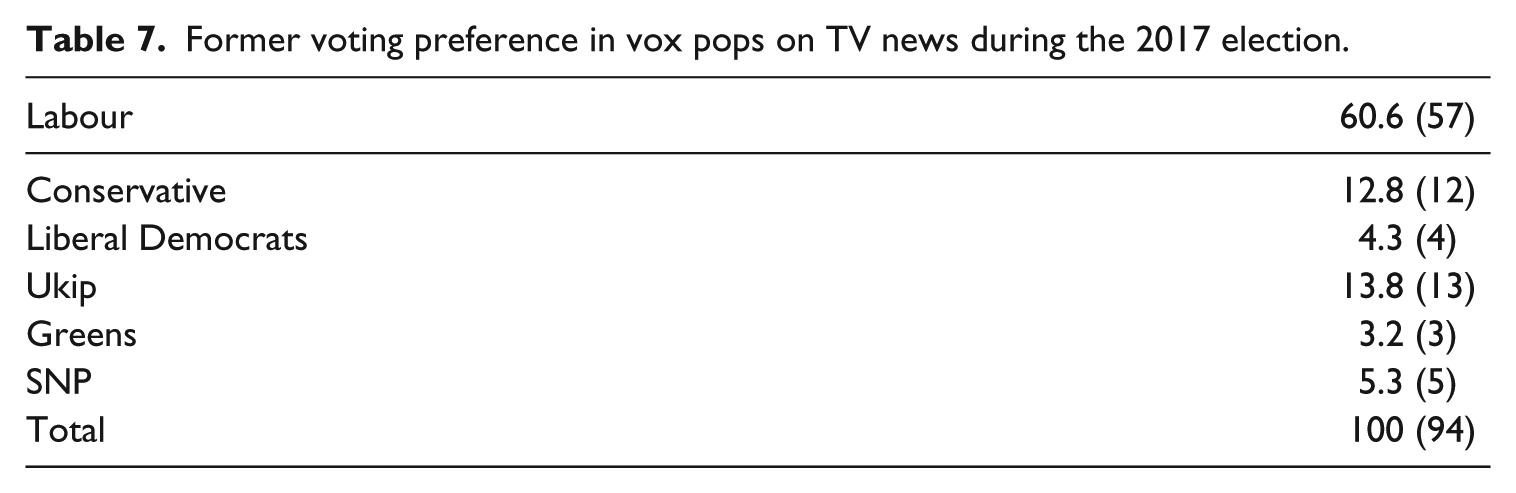
Of the 57 vox pops that indicated they had previously voted Labour, 52.6% (n = 30) said they would not be voting for them again in the 2017 election, 24.6% (n = 14) said that they would and 22.8% (n = 13) did not make it clear either way. For the 12 former Conservative voters, only 2 said they would not be voting Tory again in this election, 6 indicated they would be voting for them again in the 2017 election, while 4 were unclear. In other words, the focus on former Labour voters (who may, but more likely may not cast a vote for the party again) was not balanced with disenchanted Conservative voters. Put another way, this narrative signalled that voters were leaving the Labour party because of disenchantment with its leader.
As the previous section established, members of the public in vox pops were given limited time to articulate their views compared to politicians or expert sources during the 2017 general election campaign. Further analysis shows vox pops were used editorially to react to the salient party political issues of the day, with journalists often asking leading questions that suited their narrative. The following examples reveal how journalists set up the question for vox pops, thus engineering a response about switching parties because of Jeremy Corbyn:
A life-long Labour man, could you bring yourself to vote Tory?
Yes, against this fella [Corbyn]. If he’s my leader, I don’t think he’s good enough to vote for … Tory, Liberal, anything but not for him (ITV, 9 May 2017)
Pete Slaney has voted Labour for 45 years but not anymore.
When you get a man like Jeremy Corbyn, who will put this country back to bankruptcy and let everybody in; he just doesn’t believe in this country at all (Channel 5, 29 May 2017)
Overall, an imbalance in the use of vox pops emerged over the campaign, shaped by a conventional wisdom that the Labour leader was unpopular among voters. This point was acknowledged by one BBC radio journalist after the election – Jonny Dymond 4 – who accepted that his use of vox pops was misleading and overlooked the growing level of support towards Jeremy Corbyn over the campaign. As more representative measures of public opinion showed (Peck, 2017), not long into the campaign the favourability ratings for Labour and Corbyn grew rapidly to almost the same level as the Conservative leader, but this was not a narrative theme in the editorial construction of vox pops.
The ideological construction of voters: The role of live two-ways during the 2017 UK general election campaign
During the 2017 UK election campaign, live two-ways made up 16.9% of airtime or 20.1% of all news items on the main television news bulletins. Excluding Channel 4 (because of its longer and more discussion-based format), live two-ways were the second most used television news convention. They typically lasted under 2 minutes, with the political editor or a correspondent routinely asked to deliver their views about the issues of the day.
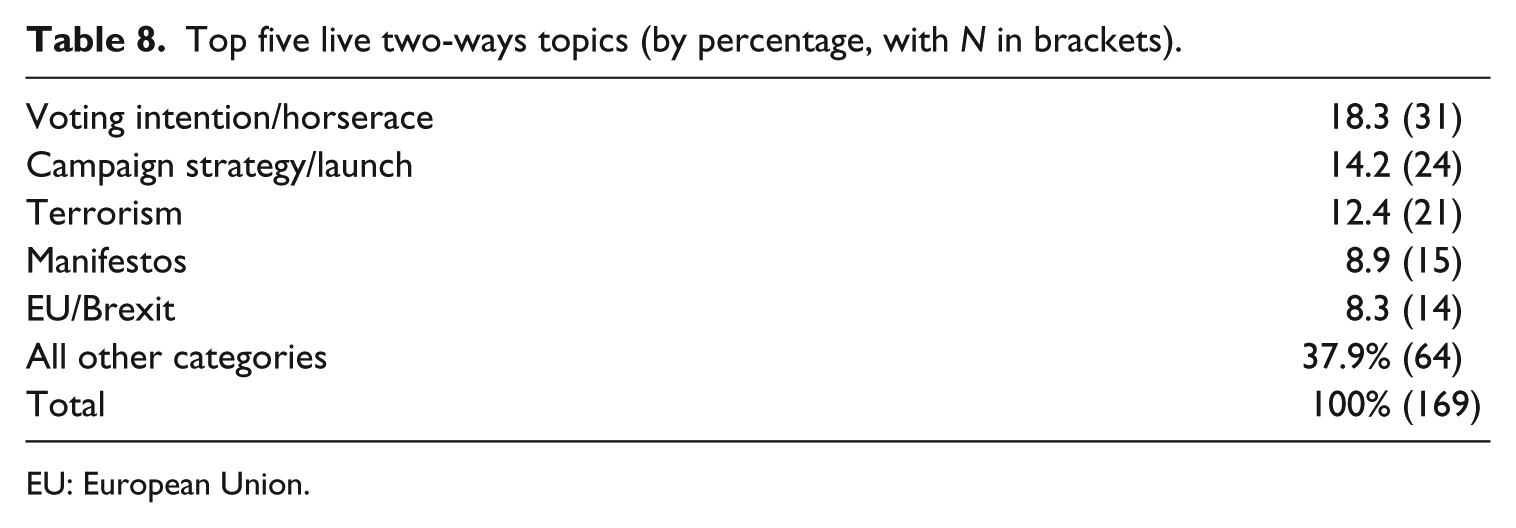
Overall, 54.4% of two-way items were about campaign process, leaving 45.6% focused on policy debates. Table 8 shows the top five issues addressed in live two-ways, with horserace stories and campaign strategy the main focus. While the issue of terrorism was also a key area considered in two-ways, exiting the EU was the main specific policy issue addressed over the campaign.
Top five live two-ways topics (by percentage, with N in brackets).
EU: European Union.
Of the 169 live two-ways examined, a third – 32.5% – contained no policy, while 54.5% had some. This meant just 22 live two-ways – 13% – had detailed analysis of policy issues during the election campaign.
In focussing so much on the campaign, the party leaders and the horserace, a routine part of election coverage was correspondents making judgements about the contest or the public mood. These judgements were difficult to quantify and classify into different themes. No flagrant examples of bias or infringement of the United Kingdom’s impartiality rules were identified. Critical judgements about Labour and Conservative – or their leaders – appeared to be broadly balanced across broadcasters. However, an imbalance was identified in how journalists interpreted public opinion. Of the 79 supportive or critical inferences made by correspondents about public opinion towards the Conservative party leader, 14% were unfavourable. By contrast, of the 100 supportive or critical inferences about public opinion related to the Labour party leader, 43% were critical.
The narrative of negative public attitudes towards the Labour leader contrasted with the way his Conservative counterpart was reported. So, for example, one BBC correspondent questioned Corbyn’s leadership record, while another suggested that Corbyn’s plans were perhaps too ‘radical’ for the British public: Sometimes in an election campaign the problem that an opposition leader faces is that people haven’t really heard of them, they’re a bit of a blank sheet, they don’t really know what to make of them, it’s just about punching through to the public consciousness at all. But when you talk to people inside the Labour Party, in a funny way the problem with Jeremy Corbyn is the opposite. They fear that somehow people have already made their minds up about Jeremy Corbyn because of the controversial things he has said in the time since he’s been in charge. (9 May 2017) In the end, Huw, it comes down to faith, which Jeremy Corbyn has in abundance and in public trust, which as of now he presently lacks and needs to build up, if this whole plan is to become a radical plan for government and not simply end up as a sort of curiosity left over after a failed political experiment on June 8 (BBC, 11 May).
By contrast, after the launch of the Conservative’s manifesto, the claim that the party’s policy agenda appealed to most voters went unchallenged by a BBC reporter: But I think more than anything, this idea of a mainstream politician for the mainstream tells us that she is determined to try to scoop up votes in every corner of the country, whether that’s taking votes from Labour here in Yorkshire, from the SNP in Scotland, holding off the Lib Dem challenge in the southwest, or appealing to Ukip voters everywhere, she wants to take on all comers, and she wants to suggest that in 2017, the Tories can appeal, well, to just about everyone. (BBC, 18 May)
While it might appear reasonable to assume the Conservative party was more popular than Labour (surveys, after all, suggested this pre-campaign), the polling evidence also showed that many of Corbyn’s policies were supported by the public in areas such as taxation, social issues and transport (British Social Attitudes, 2017). And yet, an ITV political correspondent suggested Labour’s policies were out of sync with most people’s political views: … if you look at the kind of policies that they’ve are putting forward, turning vast amounts of power to the trade unions, for example, talking openly about taxing the wealthy and the rich more without actually putting a figure on yet, as it were, on how rich you have to be to be taxed. These are policies that look ideologically pure but wouldn’t traditionally be seen as vote winners. (ITV, 5 May)
Contrary to the reporter’s judgement about what represents traditional vote winning, over 40% of the electorate did cast a vote for Corbyn’s Labour party. While there are many possible reasons explaining voter choice, a dominant narrative in live two-way reporting - that Corbyn lacked electoral appeal and proposed ideologically radical policies - was clearly misleading. Journalists, in effect, had misrepresented public opinion and implied voters were ideologically more right- than left-wing in their policy preferences.
Using public opinion to serve journalistic narratives: Rethinking the role of vox pops and live two-way reporting
The study began by quantitatively showing that citizens extensively appeared as sources in television news coverage of election campaigns, while journalists in live two-way reporting were regularly used in first-order election campaigns. Members of the public, however, were given limited time to articulate their views, often featuring in brief 10-second vox pops. By developing a more finely grained analysis of vox pops and live two-way reporting during the 2017 general election campaign, the study also found public opinion was used to serve journalistic narratives rather than paint a representative picture of voters’ views. There was, for example, an imbalance of former voting preferences in vox pops, with a focus on the public casting doubt on Labour party policies or its leader Jeremy Corbyn. Moreover, journalists, at times, inferred the Labour party was too radical and left-wing for most voters. This was in spite of opinion data showing a majority of people broadly supported many of Labour’s policy proposals (British Social Attitudes, 2017). This use of citizens as sources can be theorised as serving the pre-conceived narratives of journalists rather than portraying a representative picture of public opinion during the campaign. Given the editorial construction of voters was so clearly out of sync with public opinion, it demonstrates the power journalists hold in defining citizen-source access. Overall, the portrayal of citizens in television news was largely shaped by a relatively narrow set of assumptions made by political journalists about the public’s ideological views rather than consulting more objective measures of public opinion. On one level, the study reinforces the findings of long-standing studies documenting the top-down nature of source interaction between journalists and the public, with the views of citizens often represented but largely in passive and limited contexts (Brookes et al., 2004; Kleemans et al., 2017; Lewis et al., 2005). On another level, it shows citizens were not represented apolitically as previously theorised because their ideological perspectives were used to support pre-conceived journalistic narratives about public opinion.
Political journalists have long been accused of living in a ‘Westminster bubble’ or ‘Washington beltway’, which can normalise group thinking. After all, journalists spend far more time following politicians than public opinion. But in more recent years, a disconnect between journalists and voters appears to be growing. Long-standing Channel 4 news anchor, Jon Snow (2017), for example, acknowledged after the 2017 UK general election that ‘we [journalists] are comfortably with the elite, with little awareness, contact, or connection with those not of the elite’. He was responding to broader criticism that the news media have become increasingly distant from the public’s agenda. This has been fuelled by a new brand of partisan politics as well as new alternative online and social media platforms, which more aggressively point out media bias or ‘fake news’. Put simply, the news media stand accused of reporting politics in a too narrow and consensual way, excluding certain perspectives and issues that might better reflect the public’s agenda.
The findings of this study lend weight to this argument by not only demonstrating the relatively narrow party political focus of UK election coverage but also in the misleading way public opinion was, at times, represented. Broadcasters, of course, are highly sensitive about remaining impartial and their source selection is scrupulously balanced between the major parties. But in sticking so rigidly to the party political status quo and their increasingly professionalised campaigns, it limited the space and time for their claims to be questioned or challenged by other information rich sources. Instead citizens – not experts – were regularly ‘vox popped’ in response to the parties’ agendas. While they may be seen as a welcomed contrast to politicians, they bring colour but add little analytical depth to coverage. Moreover, vox pops remain an editorial construction of public opinion, which, in the case of the 2017 election campaign, conveyed a misleading picture of voters’ preferences. Similarly, the reliance on live two-ways enhanced the interpretive role of journalists and led to voters being portrayed as more ideologically in tune with right- than left-wing policies.
The findings, overall, have a broader international relevance in debates about reflecting or reporting public opinion in political journalism. If broadcasters draw heavily on conventions (vox pops and live two-ways) that rely on the editorial judgement of journalists during campaigns, it promotes a form of journalism that can undermine the balance and impartiality of election news. After all, it gives journalists the licence to interpret the positioning of political parties when information rich sources might be better placed to help scrutinise politicians. Similarly, when journalists infer what the people think or turn to vox pops for a selection of views, the editorial construction of public opinion could be contradicted by more systematic and scientific data. So, for example, representative public opinion polls – beyond horserace questioning – open up one potential way of exploring voters’ views and preferences about issues that could shape the media agenda (Cushion and Thomas, 2018). They could help orientate how journalists interpret people’s ideological preferences and convey a more representative picture of public opinion. Since 2010, for instance, the British social attitudes survey (2017) has consistently shown more people support more left- than right-wing policies, but this was not how reporters characterised the public during the 2017 UK general election campaign.
By relying more on scientific data and expert testimony during election campaigns, this does not mean political parties should be marginalised in election coverage. In representative democracies, the parties’ positions should remain central to the news agenda. But they could be subject to more scrutiny and be more responsive to the public’s agenda. More accurately engaging with people’s concerns and drawing on a wider range of expert views might help move broadcasters beyond the narrow set of assumptions that typically serve their narratives of political coverage. And, in doing so, help connect the news media with the public’s agenda.
Footnotes
Funding
The author(s) disclosed receipt of the following financial support for the research, authorship, and/or publication of this article: The study was funded, in part, by an ESRC project ‘Television News and Impartiality: Reporting the 2017 UK General Election Campaign’, which was supported through the ESRC Cardiff University Impact Acceleration Account (ES/M500422/1).