




Abstract
This article's investigation of Barbenheimer demonstrates the importance of feminist engagement with memes. More specifically, it navigates nuclear weapons politics through visual narratives, online participatory culture and fragmented senses of humour, underscoring the significance of popular culture as a reflector and producer of the social world. As everyday knowledge about nuclear weapons becomes increasingly fragmented and intertextual, scholars must turn their attention to the politics of the anecdotal and accidental. Nuclear weapons have a narrative power that exists external to the weapons themselves. These narratives are shown to construct and reconstruct popular imaginings about nuclear weapons and war; their beginnings, middles and ends. Recentring nuclear weapons and war around the Barbie film makes visible those gendered and militarised discourses that may otherwise be backgrounded or normalised. We should encounter those broader questions of feminism and militarisation with attention to the fragmented aspects of world politics; the parts of politics that live and breathe, move and bend, confront and challenge us. The Barbiefication of the images of nuclear war make visible the characters, settings and plot of nuclear weapons as they exist in the popular imagination. The making and sharing of memes demonstrates those aspects of the nuclear story that seem fixed, as well as those that can be edited, distorted and played with. Discourses of gender and militarism exist not only within the ‘high’ politics of technostrategic defence planning or policymaking but also as fragments of humour, sentiment and affect scattered across the internet and approached as play – not politics.
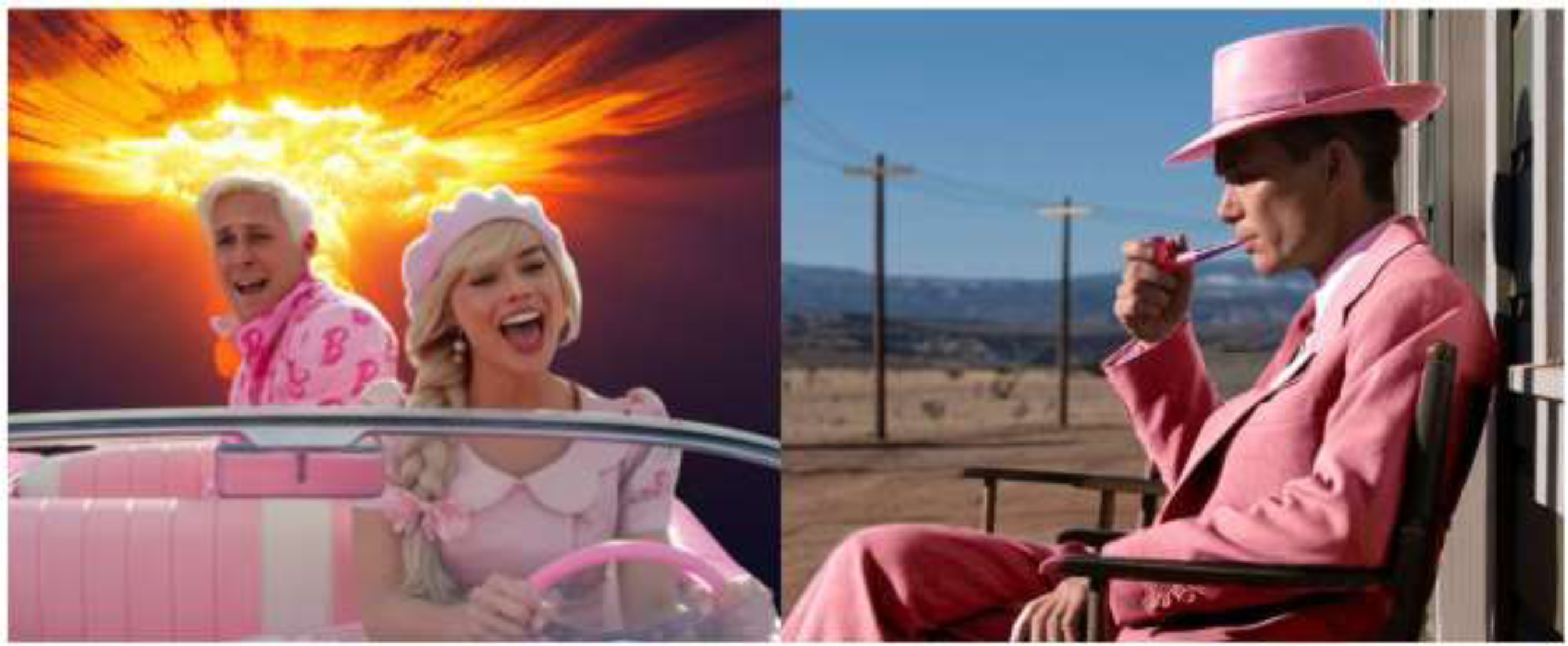
Barbenheimer. Sources: https://www.Instagram.com/p/CuXDQmCsxEh/ and https://twitter.com/Bolverk15/status/1682392622340403201.
On 21 July 2023, the global release of two highly anticipated films aligned: Greta Gerwig's Barbie and Christopher Nolan's Oppenheimer. The date became known as Barbenheimer Day, a day on which cinemagoers dressed up, planned events and celebrated the double feature. In the months leading up to Barbenheimer Day, an online cultural movement found humour in referencing the coming together of these two films and the ideas they each represent. The unlikely meet-cute of Mattel's plastic toy and nuclear physicist J. Robert Oppenheimer led to a wave of fan-driven internet memes, threads, TikToks and film poster mashups. These reactions, textual and visual, play on the perceived radical differences between the two films. Whilst Barbie is a satirical fiction and fantasy about a hyper-feminine doll, Oppenheimer is a historical biopic about the scientist behind a very real weapon of mass destruction. Since Barbenheimer emerged before the release of the films, there is significance in the fact that its meanings derived from pre-existing, shared cultural associations. Much of the humour found in Barbenheimer memes plays with the notion that Barbie was for girls and Oppenheimer was for boys. As such, the memes provide a significant site (and sight) for the study of this gender binary.
The coming together of Barbie and Oppenheimer affords insight into the changing interactions between social media and cinema in popular culture and, most significantly, is a contemporary site of encounter for gender politics and militarisation. Militarisation is the process by which military values are naturalised and legitimised within a group or society; it is the ‘social process in which civil society organises itself for the production of violence’ (Geyer, 1989: 1). Barbenheimer is a particularly interesting opportunity to study Militarisation 2.0 which looks beyond the state, concerned with how militarisation is produced by social relations and new digital technologies (Jackson et al., 2021). Militarisation is an ‘everyday modality of war’, and thus of essential interest to feminist attitudes to the politics of the everyday (Basham, 2024: 142). Although militarisation is always and everywhere a feminist issue, in and through Barbenheimer militarisation is rendered explicit and entangled with gendered stereotypes. The ‘Barbiefictation’ of nuclear war reveals contradictions and tensions that will be significant to feminist scholars across disciplines, revealing the complex web of relations between gender identity, militarisation and popular culture.
I am interested in the story of nuclear weapons and war: the visual and textual narratives that sustain or challenge their continued existence. Although nuclear weapons continue to dictate foreign policy and international relations, there is an observable ‘erasure of the nuclear economy from public view’ (Masco, 2006: 4) whereby the nuclear state has been all but ‘rendered invisible’ since 1990 (Hogg, 2016: 159). The same trend is observable in popular culture. There are particular ‘aesthetic gestures’ that allow us to imagine nuclear war as actually possible: (i) showing the beginning of nuclear war, (ii) showing the aftermath of nuclear war, (iii) presenting nuclear war as inevitable and (iv) presenting complacency in the face of possible nuclear war (Pelopidas, 2021a: 182–184). These gestures disappeared in popular culture after the 1990s, replaced largely by representations of the ‘war on terror’, resulting in an ‘invisibilization of nuclear war that reproduces the illusion of its impossibility’ (Pelopidas, 2021a: 180). Oppenheimer, in presenting the beginning of ‘a chain reaction that would destroy the entire world’, 1 brings a renewed attention to the possibility of nuclear war through gesturing its already-started, too-late-to-stop inevitability (Faux, 2023). As such, it could be seen to challenge this ‘illusion of impossibility’ and bring renewed attention to the threat of nuclear war (Pelopidas, 2021a: 193). Russia's invasion of Ukraine in February 2022 situated the release of Oppenheimer amid nuclear-armed conflict, making it ever more important to understand the dominant narratives and popular imagination of nuclear weapons and war as they exist today.
In much the same way as Stuart Hall's (2024) argument that the navigation of quantum mechanics in Barbie can reveal more about the science-political-power nexus than focusing on the more overtly related Oppenheimer, the Barbiefication of the images of nuclear war make visible the characters, settings and plot of nuclear weapons as they exist in the popular imagination. The making and sharing of memes demonstrates those aspects of the nuclear story that seem fixed, as well as those that can be edited, distorted and played with. This can reveal what narratives and discourse have become hegemonic, such that ‘both sides of a debate become subject to the truths of a dominant mode of thinking and talking’ (Holland, 2019: 84). If we can find what is stuck, perhaps we can understand the glue, and better yet, find a dissolvent. Barbenheimer memes are a site (and sight) of fragments of the nuclear story. They permit exploration of nuclear discourse and narrative, not as coherent and common-sensical, but as constructed and strange. This story is rewritten in intertextual dialogue with discourses of gender and consumerism associated with Barbie. Everyday online encounters with textual and visual fragments of world politics have implications for what is known about nuclear weapons and war at the level of the everyday (Särmä, 2016, 2018). In approaching the ‘seriousness’ that is weapons of mass destruction, through the lens of the ‘frivolousness’ that is memes, we encounter questions central to the politics of nuclear weapons: What does it do to tell stories about nuclear weapons? What does it mean to render something inherently violent ‘entertaining’? And what does the Barbiefication of images of nuclear war, specifically, imply for the study of nuclear war and for the study of memes? Barbenheimer memes offer a unique insight into the popular imagination of nuclear weapons and war. Though easily dismissed as frivolous, these memes should be read as deeply political. They can reveal what is assumed, what is feared and what is unknown about nuclear weapons. In encountering Barbenheimer memes, discourses which otherwise may seem natural and stable are rendered uncanny: both strange and familiar, unknown and known.
Situating Barbenheimer
The relationship between feminism and the everyday calls for close attention to popular culture, which is consumed (and in the case of memes, produced) at the level of the ‘ordinary’, the ‘banal’ and the ‘domestic’. Feminists have long asked questions about how feminism itself is represented in popular culture (Rabinovitz, 1989; McRobbie, 2007; Griffin, 2015). To some, popular culture reflects hegemonic discourses, beliefs, attitudes and ideologies, able to reinforce and perpetuate gender roles and norms. To others, popular culture does more than reflect monolithic top-down discourses – it can also be an everyday site of resistance and subversion. As a site of feminist enquiry, Barbenheimer memes encourage critical thinking about how cultural narratives and symbols both reflect and shape our understanding of gender roles and the broader political landscape. Navigating the complexities of intertextuality, humour and participatory culture, memes invite scholars to use ‘the pop as a launching point to the political’ (Milner, 2012: 305). Academic enquiry into the relationship between nuclear politics and popular imagination tends either to be a product of the Cold War or to look back to artefacts of the Cold War. There is a lack of engagement with contemporary popular culture created for a post-Cold War audience, and even less with memes and internet cultures. 2 Academic enquiry into the relationship between popular culture and nuclear politics has declined alongside the decreasing nuclear fear since the end of the Cold War, with scholars turning their attention to the war on terror. Re-centring nuclear weapons and war around Barbie makes visible those gendered and militarised discourses that may otherwise be backgrounded or normalised.
Internet memes are ‘remixed images and videos circulated online, inviting participation through the creation of derivatives’ (Huntington, 2013: 1). Memes are an especially interesting political process since they are often created and shared by everyday people, spreading rapidly as part of a participatory digital culture (Wiggins and Bowers, 2015). As such, memes blur the producer/consumer binary. This has led some scholars to conclude that memes are inherently a form of subversive communication (Huntington, 2013) – responding to, appropriating and transforming dominant communication in unexpected ways. Memes have played significant roles in framing democratic elections, becoming a key site of democratic participation (Yao, 2016). They can even be a source of will-to-fight, and a lifeline for coping with the horrors of war (Hesse, 2023). Memes rely heavily on intertextuality (knowledge of multiple cultural referents) and humour (usually via anomalous juxtapositions of images). Appearing frequently and randomly, and constantly evolving, memes contribute to an increasingly fragmented everyday political knowledge in the digital age (Särmä, 2016). Engaging with this fragmented way of knowing world politics, a way that is ever changing, and finding new senses of humour requires working with research material that is somewhat nonsensical or random. It is therefore impossible, and thus not desirable, to collect a systematic and objective sample of internet memes – a data population that moves and bends. I have followed a sampling method described by Saara Särmä as reverse snowballing. Reverse snowballing makes methodological use of everyday and habitual web-searching and web-scrolling behaviours. What makes it reverse is that ‘the metaphorical snowball has rolled towards me’ (Särmä, 2016: 178), i.e. I have not relied only on finding or locating data of interest but rather have given most significant attention to the data (here, memes) that found me. When the research topic evolves and changes in the way that memes do, this sampling technique permits authentic examination of online encounters, whilst always acknowledging that online culture is inherently fragmented and that the material analysed in this article represents only fragments of that fragment.
Predating internet culture, the Barbie doll seems to possess a memetic quality – there is something about the doll that encourages appropriating and transforming the dominant communication in unexpected ways. Initial feminist concerns saw Barbie as conveying hegemonic and stereotypical messages about gender and body image to unwitting children (Mitchell, 1973; Bulger, 1988). However, cultural studies scholars remind us to reflect not only on the message but also on its audience reception (see: Neumann, 1991; Lunt and Livingstone, 1996). Many feminists emphasise women's agency in ‘reading against the grain’ to find resistance and empowerment in popular texts; for example, Angela McRobbie's (2004) work speaks to how young women often engage with popular culture as a means of negotiating their own identities. For instance, many women recall rejecting and even mutilating their childhood Barbie dolls (Rand, 1998) – a phenomenon so common it inspired Weird Barbie. Indeed, Shirley Steinberg observed that the effect of Barbie ‘is idiosyncratic: for some it facilitates conformity; for others it inspires resistance’ (2010: 174–182). In many ways, Barbie is such a stark cultural symbol of whiteness and femininity that she forces a confrontation with questions of the patriarchy. 3 Barbie occupies a liminal space, straddling popular misogyny and feminist resistance in a strange and seemingly memetic way. The doll takes on new forms in the phenomenon of Barbenheimer, acting as a semiotic referent for the cultural and political entanglement of gender and militarisation.
Box office battle or epic double bill?
As Director of the Manhattan Project and ‘father of the bomb’, Oppenheimer embodies American hard power, or power exerted through coercion: weapons and warfighting capabilities. A child's plaything and fictional ‘It Girl’, Barbie embodies American soft power, or power exerted through co-option: shaping cultures through attraction and appeal. Often, and certainly originally, the play on stark differences between Barbie and Oppenheimer in Barbenheimer memes was an expression of perceived incompatibility and a reproduction of the gender binary. Where meaning is constructed through binary opposition, the relationship is not simply oppositional but hierarchical, and it is well established in feminist literature that these hierarchies are gendered, with strength and reason associated with masculinity and emotion and weakness with femininity, a gender binary we can see in expressions of Barbie and Oppenheimer as existing ‘at odds’ (conceptualised here as a box office ‘battle’). Here, colour is a key semiotic resource for the communication of difference and gender binary. Barbenheimer memes leveraged radical difference as an expression of humour: hyper-femininity and hyper-masculinity, playfulness and seriousness, hot pink and ash black.
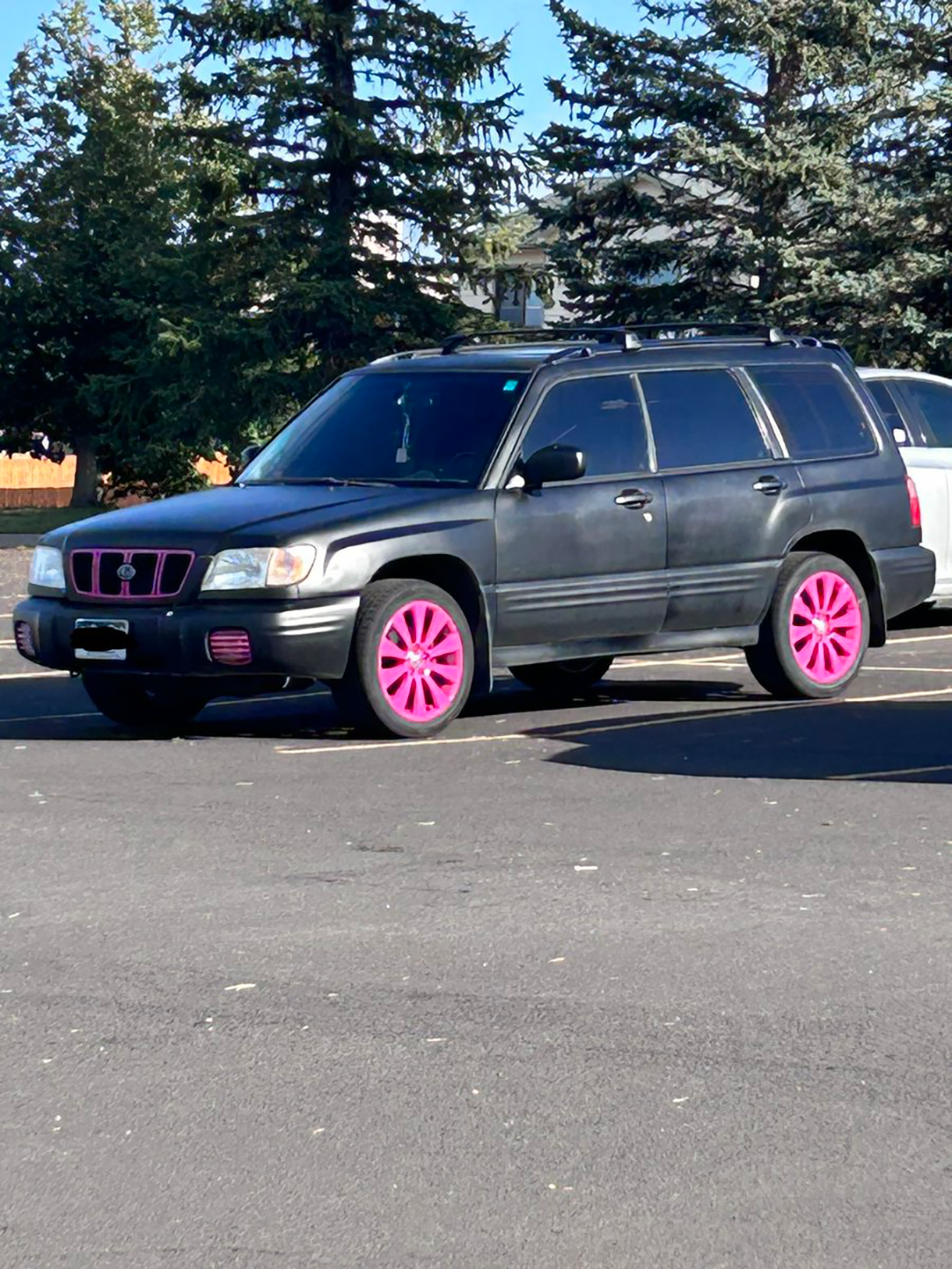
Barbenheimer car. Source: https://twitter.com/gwiss/status/1682028968701222912.
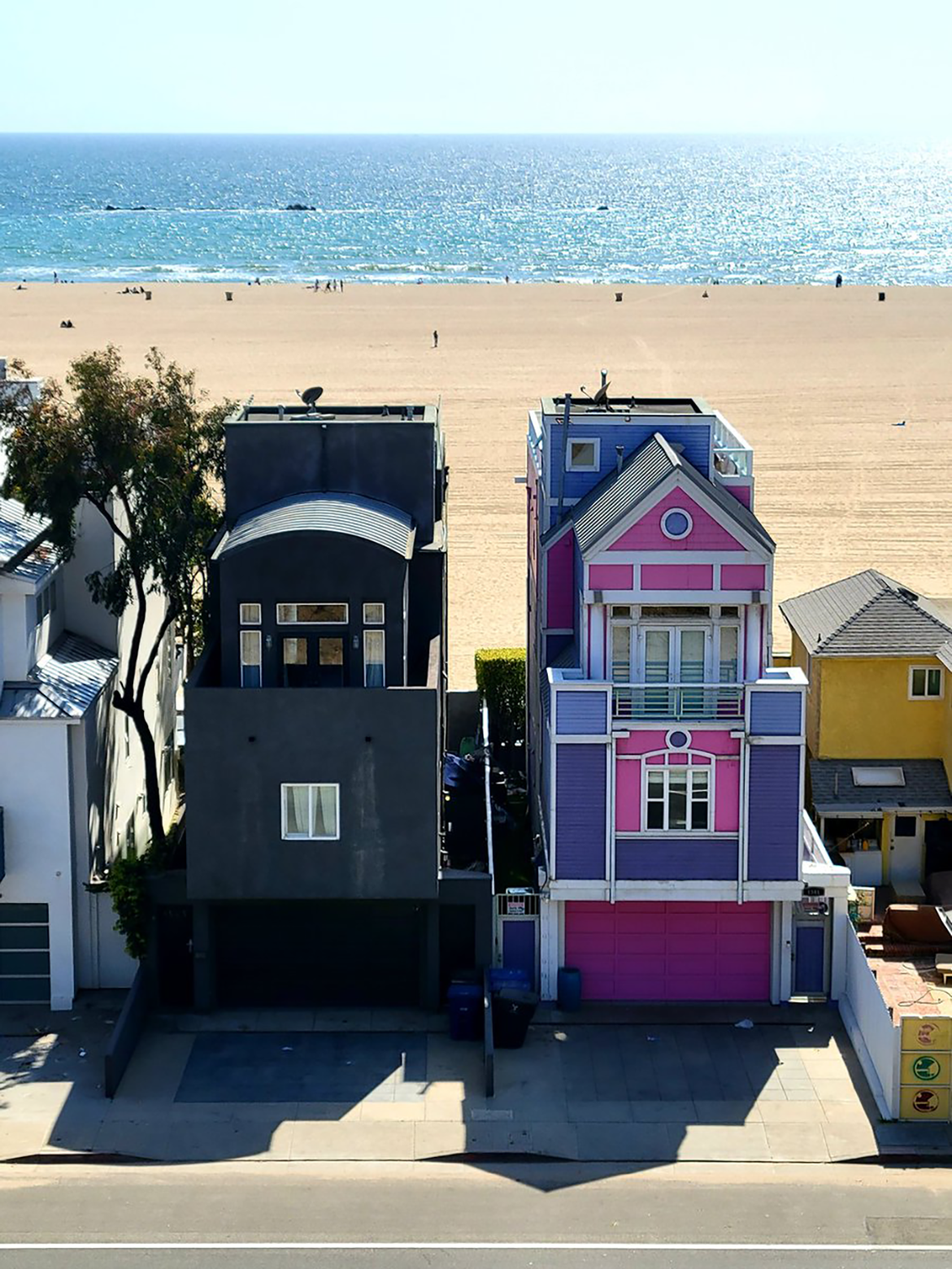
Barbenheimer houses. Source: https://twitter.com/ZackMorrisonn18/status/1678568776860676096.
Hot pink is a signifier for the Barbie brand. Brands that have successfully utilised colour can often host successful marketing campaigns without using language at all: Coca-Cola red, Cadbury purple, McDonald's yellow and red. The colour associated with Barbie is so powerful that it holds meaning even when the surrounding context has no relevance to the Barbie brand. The strong and shared societal understandings of Barbie pink permitted another manifestation of Barbenheimer online. Partakers would define an object as ‘Barbenheimer’ if it was both pink and black, as in Figures 2 and 3. The stark juxtaposition of hot pink with black is enough to represent the memetic phenomenon when no other visual cue contained relevance to either film. These objects usually derived their humour from seeming strange or out of place, reinforcing the notion that Barbie and Oppenheimer represent radically incompatible ideas. Encountering the strange coupling of pink and black feels unsettling and out of place, and many people found humour in highlighting the incompatibility of the paradoxical pairing. Colour is an important and neglected visual modality in the construction of security (Anderson et al., 2015). Though colours are natural, their meanings are socially constructed. The significations attached to colours by shared visibility and modes of perception mean that colours do things; ‘colour-use shapes and participates in social imaginaries’ (Guillaume et al., 2016: 50). The power of colour to produce meaning has been demonstrated in literature on gender (i.e. the – relatively recent – culturally constructed notion that pink is for girls and blue is for boys; see: Cunningham and Macrae, 2011), and in literature on colonialism and race (i.e. the aesthetic of colour avoidance among former colonial powers; see: Batchelor, 2000). Colours thus shape many human practices in ways that relate to power and politics, and yet colour has been significantly neglected in visual studies, and, more specifically, in the study of nuclear politics.
Unlike Barbie, deliberately and elaborately marketed using hot pink, Oppenheimer is not a brand. Black is so commonly associated with Oppenheimer, but one could just as easily imagine a fiery red or radioactive green. This is particularly notable given that black is not the most striking colour in the film's promotional campaigns or marketing (which draw more upon fiery red imagery of flames and furnaces – see Figure 6). The prominence of black in Barbenheimer memes seems to come from fan-driven meanings outside of the film itself; with black better connoting the associated seriousness or perceived morbidity of the Manhattan Project – a visual symbol of mourning or grief. Or perhaps it is more likely that black is a symptom of having no immediate associations or perceptions at all. Black is thus a manifestation of the black hole, the black box, the dark pit in public knowledge about nuclear weapons. Neither fire nor radioactivity immediately come to mind. Instead, there is a deep abyss – an absence of the ability to imagine nuclear weapons and war. The coupling of black and Oppenheimer could well be a visualisation of the lack of public knowledge about nuclear weapons, especially among younger generations. Black, and muted colours in general, exist in a cultural system intertwined with militarisation and colonial power. Xavier Guillaume et al. explore how the use of colours in military battlefield uniforms has evolved from one of bright colours to colours that render the soldier out of sight. Applying their analysis to nuclear politics, black enables us to make nuclear institutions, individuals, ideas and practices unintelligible to those who view (Guillaume et al., 2016). Colour has a capacity to simultaneously invoke and construct meaning, here backgrounding or hiding nuclear war in ways that make it difficult to see, let alone understand or scrutinise.
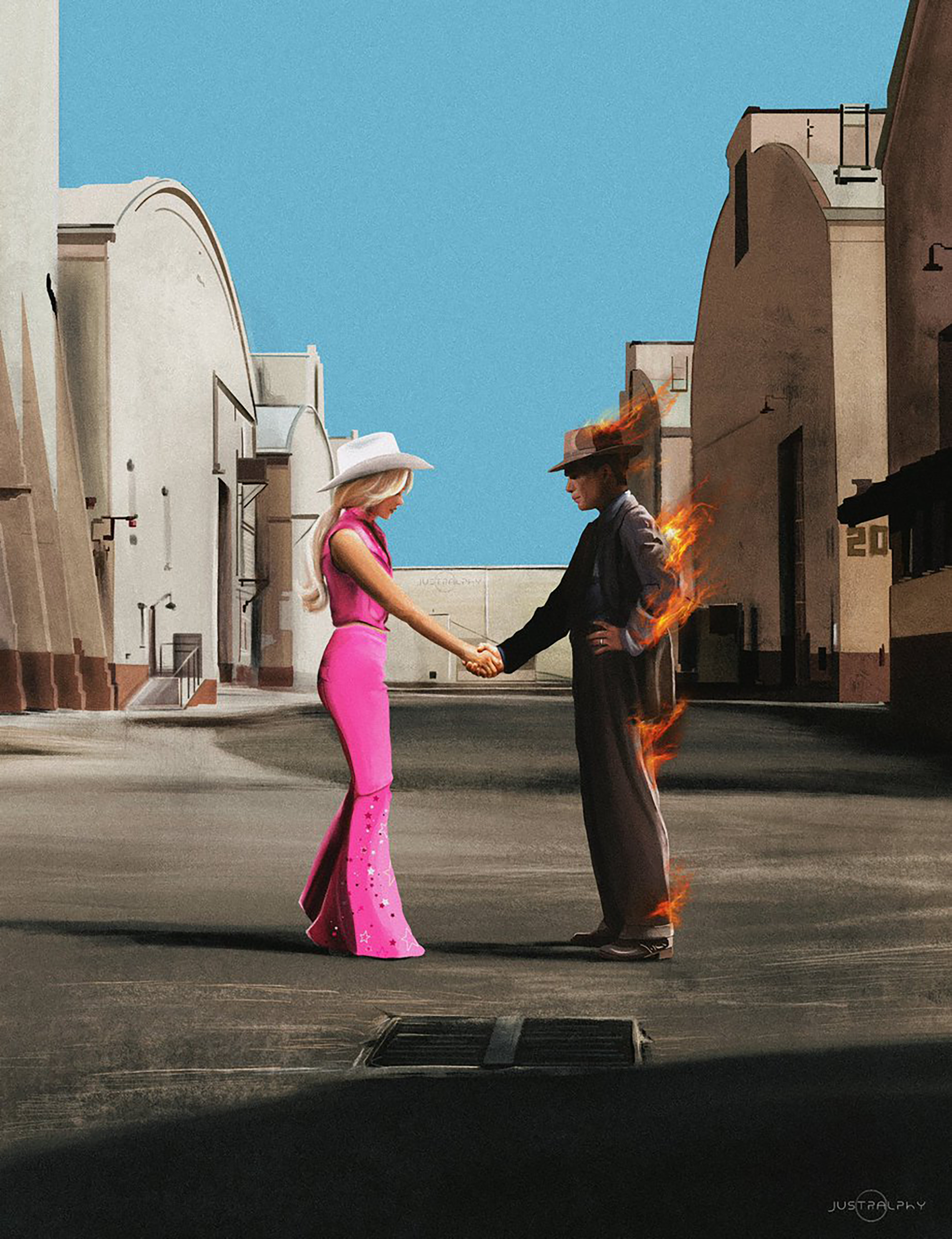
Barbenheimer album covers.
Barbenheimer as a memetic object contains multiple meanings which change and evolve, able to subject and invert original narratives. There are, for example, versions of Barbenheimer that seem to challenge the notion that Barbie and Oppenheimer are incompatible. Here, Barbenheimer can be conceptualised as a ‘double bill’ rather than a ‘box office battle’. The images in Figure 4 have taken Barbie (Margot Robbie) and Oppenheimer (Cillian Murphy) and placed them into iconic settings seemingly unrelated to either character: here album covers. In literally taking the place of iconic musicians (The Beatles and Pink Floyd), Barbie and Oppenheimer are constructed as an iconic duo. 4 These images do not construct the same gender binary as the Barbenheimer schedules or colour juxtapositions. Rather than relying on difference, these images construct similarities and suggest an equality of status. Visual metaphors connote the characters’ shared positionality; they mirror each other's movements, shake hands and are presented as a ‘band’ – a musical ensemble made up of individuals who are better together. This operation of the Barbenheimer memes ironically speaks more to the making of the double feature than to Barbenheimer Day schedules – a phenomenon to be unpacked later in the article. Rather than playing on opposition, these images can be seen to represent ‘the internet's refusal to accept that Barbie was for girls and Oppenheimer was for boys’ (Crilley, 2023). Physicists in pink, dolls in front of mushroom clouds and smiles in place of seriousness could be read as the visible manifestations of an internet-wide refusal to contain gendered stereotypes. The Barbenheimer phenomenon is at once described as a box office battle (Masud, 2023; Virgin Radio UK, 2023; Walsh, 2023) and as an epic double feature (Heritage, 2023; Klee, 2023; Wilson, 2023). The films are framed as going head to head whilst attracting a huge, shared audience. Barbenheimer at once plays on radical incompatibility and demonstrates the possibility of unification. The meanings assigned to each film separately through decades of cultural associations, storytelling and marketing campaigns are subverted by the merging of Barbie and Oppenheimer. When these two worlds collide, masculinities and femininities previously rigid come to seem blurred, negotiable and strange. Barbenheimer memes have the potential to subvert – even invert – the dominant narrative pairing of masculinity and militarisation in the story of nuclear weapons.
Seriousness is serious
While Barbenheimer is an example of a portmanteau, it is also a paradox: it is at once the union of Barbie and Oppenheimer and a deliberate play on the difference between them. Portmanteaux rely upon a shared understanding of two existing concepts (breakfast and lunch; Britain and exit; Barbie and Oppenheimer), which together make a new concept (brunch, Brexit, Barbenheimer). Despite relying on the meanings of the words from which it is made, the end result holds an entirely new meaning. The strong brand image and preconceptions associated with Barbie did not exist in the same sense for J. Robert Oppenheimer. Unlike J. Robert Oppenheimer, Barbie is one of the most identifiable icons in the world – the global brand sells approximately 100 dolls every minute (Lucero, 2023). Given this difference in popular knowledges, in the Barbenheimer pairing Oppenheimer is assigned meaning through opposition to Barbie, not vice versa. This meaning-making process relies upon the construction of opposition and hierarchy whereby we understand one ‘thing’ only in relation to the other. If we already know that Barbie is fun, frivolous and feminine, then by opposition Oppenheimer is serious, significant and masculine. However, the gendering of this hierarchy is not simple. As a far more global brand, Barbie constitutes the dominant element in the binary pairing, in relation to which Oppenheimer is constituted as ‘other’. In the normal organisation of gender binaries, this dominance aligns with the ‘masculine’ position. With Barbie as the dominant entity in this pairing, Barbenheimer disrupts the traditional gender binary by presenting Oppenheimer as lesser-than. Nonetheless, before celebrating this as an expression of feminine power, we must contextualise where the ‘power’ of the Barbie brand came from: the patriarchal powers and masculine forces of capitalism.

Barbenheimer schedule. Source: https://twitter.com/ultragloss/status/1673139352669495296.
The complexity of the gender binary (re)produced in Barbenheimer memes is demonstrated in the way they play with notions of ‘seriousness’ to construct humour. Figure 5 is an example of a popular trend in Barbenheimer online culture, wherein fans would share their ideal Barbenheimer Day viewing schedules. This trend invited online debates over whether one should watch Barbie and then Oppenheimer, or the reverse. Barbenheimer schedules associated the mood and connotations of different foods, drinks and activities with each film – for example, ‘black coffee and Oppenheimer’ in the morning, followed by ‘Barbie and cocktails’ to end the day. The humour here relies upon shared cultural associations and conventions; for instance, the consensus that black coffee is a strong and serious drink while cocktails are fun and flippant. Comparing the mood and tone associated with Barbie and Oppenheimer in this way produces a femininity associated with a lack of seriousness and a masculinity constructed as opposite and incompatible.

Barbenheimer film posters. Image credit: Rahal Nejraoui. Available at: https://www.artstation.com.
In another Barbenheimer trend, where fans create mashups of the official film posters (see Figure 6), ‘seriousness’ is played with in a different way. What the portmanteau does linguistically, these images do visually. Stereotypical Barbie (Margot Robbie) is seen posed and smiling in front of a fiery nuclear weapon, happily carried away by Oppenheimer (a common visual trope for a rescued damsel) and gleefully singing in her convertible car (a classic cinematic trope for freedom and youth) whilst a mushroom cloud ignites the sky behind her. It is Stereotypical Barbie who is transposed and rendered out of place; she is placed in Oppenheimer's world – not vice versa. Oppenheimer is not mocked or made strange by existing in Barbie Land. Instead, Barbie is made to appear naive and comically cheerful in the face of the dangers of the ‘real world’. Why is it that we find it easier to make fun of Barbie than of Oppenheimer? In the original Barbie posters, she is foregrounded and centred, her direct gaze demands our attention and she is bestowed a sense of power and control. Whilst Beach Ken (Ryan Gosling) is in these posters, he is behind or beneath Barbie, and his ‘offer’ gaze 5 draws the audience's eye to her (a visual meaning reinforced by the film's slogan: She's Everything. He's Just Ken). This power and sense of control is stripped from Barbie in these ‘mashup’ posters as she appears to have no awareness of the world around her. Barbie – in being/resembling a woman – is decentred. In a reversal of the hierarchy discussed above (where Oppenheimer is somewhat ‘other’ to Barbie), these memes restore a traditional gender binary.
To observe what is taken seriously – and what is not – is to recognise power and be able to challenge it, as Stacy Gillis (2024) argues in relation to Barbie and Jane Austen. In different ways, both of these Barbenheimer trends render the feminine unserious and incompatible with the nuclear realm. Of course, it is welcomed that a film about the invention of a weapon of mass destruction is seen as serious. The concern here lies with the coupling of seriousness and masculinity. Feminists have long navigated the intersections between gender and militarisation, including nuclear weapons and war. As Carol Cohn observed, nuclear decision-making looks a lot like ‘white men in ties discussing missile size’ (1987: 692). In relying on the juxtaposition of difference, Barbenheimer constructs a clear binary between what is deemed feminine and what is deemed masculine. Femininity is represented as incompatible with the seriousness necessary for nuclear warfighting and planning. Barbenheimer discourses demonstrate the continuation of these gendered power relations beyond the Cold War and beyond elite defence planners, into the contemporary moment and our collective imagination. These memes in these forms risk reinforcing larger discourses of gender, sexuality and identity, whereby the nuclear realm is rendered masculine. In presenting the hyper-feminine at odds with the hyper-masculine, the concern is that femininity is represented as out of place. Given that the harms of nuclear weapons have been shown to disproportionately impact women and that everyone is at risk of nuclear annihilation, it is important to problematise narratives that excuse, or even encourage, women to turn away from these issues. 6
There is an irony observable in state reactions to the two films. Whilst Barbenheimer memes seem to situate Barbie as fun and inconsequential and Oppenheimer as serious and important, geopolitical state reactions have taken a different perspective. It is not the film that centres weapons of mass destruction that has been censored across the world; rather, Barbie has been deemed the more serious threat. Barbie has been banned in Vietnam, Kuwait, Lebanon and Algeria. Vietnam disputed (what they deemed) the Nine-Dash-Line in a child-like drawing of the world map shown in the film. The South China Sea has long been contested, and Barbie sparked concerns that China's claim over the marine territory was being legitimised and naturalised (see: Rothwell, 2023). The Kuwaiti government found Barbie to promote ‘ideas and beliefs alien to the Kuwaiti society and public order’, whilst Lebanon and Algeria accused the film of promoting homosexuality (Crilley, 2023). The reactions of these states are demonstrative of how popular culture is very much inseparable from world politics and ideology. Even a film marketed as fun and frivolous like Barbie has a very real power to subvert or challenge state control and ideologies. At the level of both the popular and the state, it is important to pay serious scholarly attention to those things easily dismissed as unserious.
Beyond memes: movies and materiality
Whether in relation to microplastics or radioactive isotopes, Barbie and Oppenheimer are both part of the story of how humans have become the most significant influence on Earth's natural environment – markers of the Anthropocene. For Tyler Austin Harper (2023), Barbenheimer mashups are the perfect visualisation of living in ‘the age of nukes and plastic’, where both increasing militarism and boundless consumerism mark our planet. Both Barbie and Oppenheimer represent ‘ideas that may outlive our species in the form of plastic and plutonium's lingering traces’ (Harper, 2023). The strange coming together of Barbie and Oppenheimer visualises this paradoxical time in which we live; a time marked by the crisis both of the exceptional and of the everyday. At once we face a spectacular and apocalyptic death caused by mushroom clouds, fireballs and radiation, and we face a slow and gradual death caused by rising sea levels, changing weather systems and a warming planet. We fear a sublime death – and a planet that burns out in nuclear war. And we fear an unexceptional death – a planet that fades away, choking on oil-saturated plastics. We must pay attention not only to how Barbie and Oppenheimer are encountered as symbolic representations but also to how they intersect with the material world.
Barbie is an icon of materiality. She is literally plastic, tactile and tangible. She is a material girl; her character is defined by her objects, shoes and outfits. She is a material good, part of our own consumer identities. Although her character has been reimagined as a textual object, Barbie is inescapably ‘manifested within an objectified economy of plastic, principally as a doll’ (Phillips, 2002: 124). Oppenheimer, on the other hand, seems immaterial. He is dead; unable to be an embodied representation of himself. His character is assigned status through the unobservable, top-secret and subatomic. What he created we cannot own, we cannot touch, we cannot even fully know. This (imagined) sense of immateriality renders the nuclear mysterious, reverent and sublime. Shampa Biswas’ (2023) ethnographic research observed that, more so than any object or artifact, what tourists to the Trinity Test site had come to see was immateriality: ‘A fenced-in expanse of land. A void or an absence’. This mystifies the weapons, gifting them an aura that bestows a certain otherworldly power. Oppenheimer comes to embody the same immateriality, imagined as a gatekeeper to that which is beyond human recognition – to that which is otherworldly. Like with Prometheus, 7 the mythology upon which Oppenheimer's biography and biopic both explicitly draw, he straddles Earth and the Heavens.
That Oppenheimer (and the nuclear sublime in general) is assigned meaning through immateriality is starkly ironic given the material power of nuclear weapons. In reality, nuclear weapons exist as part of a heavily institutionalised network of military, commercial and cultural management and funding, with thousands of constituent parts that take millions of personnel to maintain. The labour and intentional will that go into the continued existence of nuclear weapons are erased from the narrative of immateriality; instead, they are discursively presented as the product of some otherworldly power. James Masco observed that ‘to make something “unthinkable” is to place it outside of language, to deny its comprehensibility and elevate it into the realm of the sublime’ (2006: 4). Rather than sedentary metallic weapons of human invention, the myth of immateriality likely leads us to accept the bomb as something beyond human responsibility and control (see: Chilton, 1985). Whilst Barbie is a physical object to be physically manipulated, Oppenheimer embodies mystery, myth and immateriality. Barbie is to be controlled and held in our hands. In this myth of immateriality, Oppenheimer represents something wholly different – something presented as beyond human senses and thus beyond human control. Nuclear weapons come to exist not as a technology subject to scientific challenge but instead as a powerful cultural construct. Laura Considine (2022) asks us to consider, if humanity is not responsible for the bomb's creation, how are we to be responsible for its future control?
Here, materiality is rendered female – ‘you can touch, you can play’ – whilst masculinity and militarism is elevated to something otherworldly. Whilst the feminine figure of Barbie is wholly tactile, purchasable and ownable, the myth of immateriality upholds nuclear weapons as existing outside of human control. This contributes to a broader discourse of ‘nuclear eternity’, a termed coined by Benoît Pelopidas (2021b) to point to the belief and acceptance (even amid attempts at arms control and disarmament) that a future without nuclear weapons is not possible. Nuclear eternity has a shrinking effect when it comes to the choices and decisions that seem possible or impossible, defining rigid boundaries of how nuclear weapons can (and here, must) exist in the future. Comparing and contrasting Barbie (the doll) and Oppenheimer (the man) highlights the gendered dynamics of the myth both of immateriality and of nuclear eternity. However, the unification of Barbie and Oppenheimer in Barbenheimer memes can also afford the opportunity to contest these myths. The immateriality of both man and bomb is challenged in juxtaposing Oppenheimer with Barbie, rendering nuclear weapons more material and less exceptional in occupying the same space and frame as an ordinary object – a toy. Perhaps even more dangerous than imagining nuclear weapons as out of this world is imagining them as a plaything.
Conclusion
Memes can reflect and reveal political currents, narratives and moods, producing and shaping global politics in unforeseen and unsanctioned ways. As everyday knowledge about nuclear weapons becomes increasingly fragmented and intertextual, scholars must turn their attention to the politics of the anecdotal and accidental. Nuclear weapons have a narrative power that exists external to the weapons themselves. These narratives have been shown to construct and reconstruct popular imaginings about nuclear weapons and war; their beginnings, middles and ends. Recentring nuclear weapons and war around Barbie makes visible those gendered and militarised discourses that may otherwise be backgrounded or normalised. We should encounter those broader questions of feminism and militarisation with attention to the fragmented aspects of world politics; the parts of politics that live and breathe, move and bend, confront and challenge us. The Barbiefication of the images of nuclear war make visible the characters, settings and plot of nuclear weapons as they exist in the popular imagination. The making and sharing of memes demonstrates those aspects of the nuclear story that seem fixed, as well as those that can be edited, distorted and played with. Discourses of gender and militarism exist not only within the ‘high’ politics of technostrategic defence planning or policymaking but also as fragments of humour, sentiment and affect scattered across the internet and approached as play – not politics.
Whether presented as a box office battle or an epic double bill, Barbenheimer memes have the potential to subvert – even invert – the dominant narrative pairing of masculinity and militarism in the story of nuclear weapons. The Barbenheimer phenomenon also offers a window into the general public's lack of knowledge about nuclear weapons and their ongoing role in the world. Black becomes a manifestation of the lack of public knowledge about nuclear weapons, serving here to background or hide nuclear weapons and war in ways that make them difficult to see, let alone understand or scrutinise. Similarly, J. Robert Oppenheimer comes to embody immateriality, imagined as a gatekeeper to that which is otherworldly. This myth of immateriality encourages us to accept the bomb as something beyond human responsibility and control, contributing to our nuclear eternity. And yet, at the same time, Barbenheimer rendered nuclear weapons more material and less exceptional – a toy. Nuclear weapons are at once imagined as outside of human influence, and a human plaything. Barbenheimer proved to be far more than a humorous collision of seemingly opposite stories. A portmanteau and a paradox, Barbenheimer memes both challenge and reinforce gender stereotypes, revealing the underlying gendered hierarchies that persist in our collective imagination and highlighting the complex relation between participatory media and concepts of masculinity and femininity. Barbenheimer memes remind us that even in the most unexpected collisions of ideas, there are profound insights to be gained about our society, our values and our future. When these two worlds collide, masculinities and femininities previously rigid come to seem blurred, negotiable and strange. Ultimately, encountering Barbenheimer means encountering a mesh of narratives – socially and culturally constructed stories of gender, war and militarism – that easily mask themselves as natural or common sense. These memes make nuclear weapons more palatable; they make the unimaginable easier to encounter, explore and play with.