




Abstract
This mixed-methods analysis seeks to understand the shifting visibility of drag performance in the wake of RuPaul’s Drag Race and increasing mainstream exposure. Using a publics/counterpublics framing popularized by Michael Warner, this work argues that RuPaul’s Drag Race has become a drag “public,” while drag at the local level has shifted from insular subculture to counterpublic. This shift is marked by both a new and different hierarchy of drag performance that has altered the drag scene on all levels. This hierarchy imposes standards and expectations about how drag, as an embodied art on the local level, “should” look which influences drag’s reception.
“Even straight venues now are having shows… It’s money. They’ve seen how successful a drag show is and how it can bring people in, so now every little place is trying to have a drag show. It’s a mainstream novelty… it’s like a double-edged sword. It kills it for the drag bars who have been doing this for so long.” -Arianna DuPree
Since RuPaul’s Drag Race’s (RPDR) 2009 LogoTV 1 debut, drag has steadily grown in public visibility, crystallized by the show’s 2016 move to Vh1, a Viacom network with a much broader reach. Drag is no longer a niche LGBTQ subculture. RPDR has propelled drag queens to international celebrity status and has irreversibly thrust drag into a mainstream spotlight through the vehicle of reality television. RPDR has created a bigger market for drag, which, combined with greater mass visibility, suggests a shift in the configuration of the drag scene itself. With this change in visibility, how does drag itself change, particularly for drag artists living and working outside the direct spotlight of RPDR? In other words, how is drag-as-subculture impacted by its interfacing with a mainstream public—in essence, a “stranger” that has been exposed to it only recently, through a reality television show?
This work seeks to understand how drag’s heightened visibility and increasing mainstream exposure impact the landscape of drag at the local level 2 . This study includes a discursive analysis parsing out public or “mainstream” drag discourses (dictated through RPDR and RPDR: All Stars) and in-group discourses (dictated through podcasts Grizzly Kiki and Hey Qween) since RPDR moved to Vh1. I supplement this with in-depth interviews with 12 local drag performers to further investigate how these discourses shape and influence drag performance. Drawing on the framework of subcultures, publics, and counterpublics popularized by Michael Warner (2005), I show that drag presents an insightful case to challenge conventional understandings of how subcultures fare, post-mainstream exposure. Rather than fizzling out, drag has instead proliferated both within and outside of mainstream view. I argue that RPDR, as a “public,” dictates both a new and different hierarchy of drag performance that has influenced drag on all levels. This hierarchy imposes standards and expectations about how drag, as an embodied art on the local level, “should” look which, in turn, influence drag’s reception.
Drag research
Drag has captivated researchers for decades and can be understood in three eras, the first of which is focused on individual lives of “female impersonators” or “female illusionists,” bookended by Mother Camp (Newton, 1972) and Gender Trouble (Butler, 1990). Newton’s ethnography—the first of its kind—set a high bar for drag ethnographies to follow. Butler’s theory of gender performativity situates drag as a social project, namely one which can extend beyond an individual’s identity construction into the realm of political significance, solidifying the potential for drag to serve as a site of protest and challenge to heteronormativity. 3 The scope of drag, however, has extended beyond that narrow definition (and thus, narrow impact) that Butler posits.
The second era, written post-Gender Trouble, focuses similarly on individual lives and identities, but interrogates drag’s political protest potential. These works see drag as a site of subversive political resistance at the individual level through audience/performer interactions (Bailey, 2011; Berkowitz and Belgrave, 2010; Brown, 2001; Hopkins, 2004; Rupp and Taylor, 2003; Schacht and Underwood, 2004; Taylor et al., 2004). These works are important in understanding the nuances of individual drag performance and audience reception, yet they overlook the world of drag outside the respective populations of interest.
The third era of scholarship encompasses works on drag written post-RPDR (2009 and later) that begin to investigate questions of exclusion and belonging within drag communities, both off and (primarily) on RPDR, following the trend of Jose Esteban Muñoz’s Disidentification (1999) which was among the first pieces to raise concerns about sanitization and commodification regarding drag. Muñoz’s line of inquiry continues in Emer O’Toole’s work (2019) on Irish drag artist/activist Panti Bliss, as well as a notable collection of articles comprising a special issue of Celebrity Studies (Vol. 11, issue 4) devoted to RPDR. This collection considers the mainstream visibility of drag vis-à-vis RPDR against contemporary celebrity culture, furthering Muñoz’s discussion of drag’s fusion with mass “celebrified” (meaning “professionalized, commercially-viable, brand-oriented and mainstream.” (Feldman and Hakim, 2020: p. 386)) culture juxtaposed against its punk, camp, and anti-establishment history (Andrews, 2020; Collie and Commane, 2020; Feldman and Hakim, 2020; Ferreday, 2020; Mercer and Sarson, 2020; Mercer et al., 2020; Middlemost, 2020; O’Connell, 2020). Another pertinent volume is a collection of essays titled RuPaul’s Drag Race and the Shifting Visibility of Drag Culture (2017). These essays address the replication of hegemony on the show (Darnell and Tabatabai, 2017; Jenkins, 2017; McIntyre and Riggs, 2017; Pomeranz, 2017), including race and ethnicity, size, and gender presentation. Some essays also discuss belonging within drag communities, within the US (Brennan, 2017) and abroad (Castellano and Machado, 2017; Chronaki, 2017; Villarreal et al., 2017). Additionally, several articles investigate inequality on RPDR (Brown, 2018; Collins, 2017; Edgar, 2011; Hermes and Kardolus, 2019; Uphadyay, 2019; Wilson, 2018) as well as capitalism and industry as it is reflected on the show (Chetwynd, 2020; Hankins, 2015; Vesey, 2017). Notably missing from these works is the question of what kind of impact this visibility has for drag communities outside of RPDR, and the broader landscape of drag as a collectivity or “scene” with its own norms and codes. This paper examines the boundaries of the drag scene itself and analyzes performer-audiences dynamics against a newer discursive “public drag” to determine public or mass impact on the subcultural (local) level.
Subcultures and counterpublics
Whether expressions of marginalization due to class (Hebdige, 1979), race (Belle, 2014), sexuality (Barrett, 2017; Drdovà and Saxonberg, 2020; Mattson, 2015) gender (Wilkins, 2008), or expressions of fandom (Kendall, 2000; Peck-Suzuki, 2016), subcultures exist as bounded collectivities with group-sanctioned norms that, to some extent, express resistance to a normative status quo (Hall and Jefferson, 2006; Hebdige, 1979; Thornton, 1995). Counterhegemonic subcultures are often considered a phenomenon of youth—significant insofar as it implies that subculture membership is fleeting, and one often “ages out” 4 (Haenfler, 2014; Hebdige, 1979; Muggleton and Weinzierl, 2003; Simões and Campos, 2017) 5 .
The counterhegemonic nature of the subculture rests on its relative invisibility from mainstream view and opposition to mainstream norms. Thus, when a subculture is taken up by the masses, its practices risk sanitization to the point of death—“death,” that is, in terms of oppositionality. Beyond subcultures, concerns about the impact of mass culture have long been present in sociology (Benjamin, 1935; Horkheimer and Adorno, 1944; Lazarsfeld and Merton, 1948), and many of these critiques about the sanitizing effect of mass consumption (Muñoz 1999) remain central debates in the field. Relatedly, some works on subcultures have questioned their lasting power as counterhegemonic in any configuration (Muggleton and Weinzierl eds., 2003). In an age with increasingly vast global networks and infoglut, can the oppositional subculture still exist in any configuration—can anything truly be hidden from mainstream view? The precarity of the subculture’s subversive status thus allows for little life post-mainstream exposure. With drag’s current moment in the spotlight, a subversive drag subculture should already be fizzling out. Instead, a dramatic shift has taken place in which drag has proliferated.
If drag were simply another example of mainstream cooptation, RPDR would likely be one of, if not the only, form of drag available for consumption. Instead, at the local level drag is thriving—there is more drag happening in more places and in increasingly diverse arenas. Previously, drag was largely relegated to LGBTQ-marked spaces, like gay bars and clubs, and rarely happened outside of that narrow niche. With the show airing on Vh1, newer fans may have found out about drag through RPDR. Local drag has thus expanded beyond LGBTQ venues. Now, restaurants and bars may have a few nights a month where they host drag shows or drag brunches. These expansions introduce new audiences to local drag and increase performance opportunities for local entertainers.
We can shift our thinking about drag from insular subculture to subculture-turned-counterpublic by adopting Michael Warner’s framing from Publics and Counterpublics (2005). A key distinction between subcultures and counterpublics is the introduction of the “stranger” to the subcultural fabric, necessitating a shift towards becoming a counterpublic. The introduction of the stranger alters how the subculture is done as well as who it is done for. In sum, the counterpublic is a mediating space between the insular, niche subculture and a mainstream public, insofar as the counterpublic is in dialogue with a new entity (a “stranger”), yet still retains some level of counterhegemonic status.
However, treating drag as a counterpublic rather than a subculture necessitates further discussion of publics, or the public sphere, particularly in a digitized age. Publics can be understood as spaces of collective opinion or aim (Livingstone 2000, 2005a, 2005b), often assumed to (ideally) grant all citizens access to participate (Habermas, 1974). This “collective” aim, though, need not be stagnant nor uniform (Sobieraj, 2011). There are competing concerns and aims of citizens and thus, as much as the public can appear homogeneous and stable, it is also heterogenous and potentially a site of conflict and debate. For drag (and particularly for RPDR), danah boyd’s (2014) conception of the “networked public”—a new, digitally mediated public that comes out of the affordances of digital technologies—is particularly useful. These networked publics are marked by their persistence (the enduring nature of the communication), visibility (the capabilities of reaching much wider audiences), spreadability (the ease of sharing), and searchability (the ease with which one can find previous instances of communication). Particularly in this digital era, the relative “neutrality” of the public posited by Habermas ignores the social world, of which the public is a product. Further, as publics become increasingly subsumed by consumption and capitalism (alongside increasingly digitized communication), inequality within them, as it persists in the social world, is allowed to thrive. By their very nature, publics are always already infused with the dominant cultural norms. Thus, publics are never entirely neutral as they will always be, to a degree, exclusionary (Cavalcante, 2016; Cho, 2018). For those marginalized by the normative social order, then, publics can become yet another site of marginalization.
In the case of drag, we may consider the subculture to be drag at the local level, pre-RPDR—a configuration which, in the current moment, no longer exists as it used to, since mainstream exposure has altered the subcultural terrain. The counterpublic is what local drag has become due to mass exposure—a liminal space in dialogue with mainstream drag, but not entirely subsumed by it. The public here is a networked (boyd, 2014) one, consisting of mainstream drag, represented almost exclusively by the drag shown on RPDR. This public is, importantly, also subject to the norms of dominant culture, further solidifying how a public iteration of drag may also entail perpetuation of marginalization. Warner’s framework helps us understand the mechanism of subcultural shift, including how mainstream norms alter the landscape of the subculture by interfacing with the stranger. With the push to appeal to a wider audience comes (some) complicity with mainstream, or public, norms. The “stranger” is not just a new audience exposed to drag, but also the norms they carry with them, which become woven into the fiber of the subculture. Ultimately, the transition from subculture to counterpublic entails a fundamental change in how drag performance is enacted—it must change to be palatable to mainstream audiences.
Publics and counterpublics of drag
It is thus useful to further contextualize local drag’s shift from subculture to counterpublic, as well as the increasingly commodified, celebrified (Feldman and Hakim, 2020) mass drag that constitutes “public” drag. In its pre-mainstream, subcultural configuration, drag, or “female impersonation 6 ” had long been a fringe sect of the entertainment industry, rarely achieving legitimacy in mainstream 7 popular culture on its own artistic merit. Instead, drag found a stable home in LGBTQ nightlife. In the United States prior to RPDR, drag was relegated largely to nightclubs and bars. “Doing” drag in this context had a relatively narrow focus 8 —most drag performers would dress in high-femme attire and lip sync to songs well known by (predominantly gay) audiences/spaces, who reward performers with tips. While the typical drag performance is a lip sync and dance number, some performers deviate and incorporate live singing or stand-up comedy, similarly targeted to a largely gay audience. Historically speaking, drag-as-subculture occupied a specific niche and, with few exceptions, has remained virtually invisible to public view (Newton, 1979).
The standards for nightlife drag performances during this era were clear. Successful queens headlined nightlife sets with top billing on fliers. Some queens also competed in drag pageants—the lucky ones were titleholders, affording them rare opportunities for bookings outside their hometowns. Live singing or stand-up comedy performers had regular bookings at small, intimate spaces that catered to a similarly predominantly gay audience, particularly in big cities. The following quote from RPDR alumnus Mimi Imfurst (in Winifred, 2016b) highlights the pre-RPDR understanding of what it meant to be a successful drag queen: I started doing drag professionally, full-time, back in 2001 or 2002 when I moved to New York. Someone offered me a gig and that turned into two gigs and then three gigs. It was such a different time, you know? Back then there was no Drag Race, so that was never even a goal. There was no consequence to what we were doing. There was never pressure to be for anything, because the biggest thing you could hope for was to get a job working at Barracuda. That was the goal in New York City. That was the number one drag bar at the time.
Drag received little mainstream exposure pre-RPDR, but when it did, it usually did so in films. An assortment of films from the late 20th century and early aughts 9 featured drag queens, but these films were few and far between. When drag was shown in more mainstream films like Mrs. Doubtfire (1996) and Tootsie (1982), drag was presented as freakish farce and comedy—not as legitimate performance, certainly not as art. These accounts of a pre-RPDR 10 drag subculture remind us that drag was once relegated to designated spaces like Barracuda and other bars, and that it also served as the object of mockery in its scant mainstream appearances. Drag existed, then, as a counter or subaltern practice with norms and codes that resisted heteronormative capitalist society—in other words, to do drag at all was to occupy and embody a performance which was fundamentally incompatible with mainstream norms. One notable outlier, however, defied norms of drag on both a mainstream and subcultural level: RuPaul Charles.
RuPaul, the self-proclaimed supermodel of the world, has achieved international success for decades as a drag queen. RuPaul has, in many ways, defied the odds—even when drag was largely understood as farce and systematically devalued by mainstream audiences in the 1990’s and 2000’s, RuPaul managed to continually occupy a position of relative fame. While his roots were indisputably linked to a kind of punk, anti-establishment subcultural drag, he is now largely responsible for drag’s rapid and recent rise to mainstream prominence. With cameos in cult and mainstream films, television appearances, and guest-host bookings, RuPaul has built a virtual empire of drag throughout his almost 40-year career, culminating in the 2009 creation of RuPaul’s Drag Race
RPDR showcases drag queen contestants, hand-picked from audition tapes by RuPaul himself 11 , competing for the title of “America’s Next Drag Superstar,” cash, and prizes. 12 The format of the show is standard for reality television; contestants compete in challenges that result in one winner and a bottom two who “lip sync for their lives” to a song of RuPaul’s choosing, at which point the winner remains in the competition (“Shantay, you stay.”) and the loser is eliminated and asked to, “Sashay away.” The competition continues until 3 or 4 contestants remain, at which point a finale is filmed before a live audience (months after the initial filming of the show) to crown a winner.
In many ways, RPDR marks a considerable change in drag. Since it debuted in 2009, the show has rapidly propelled drag into the mainstream, fundamentally changing both how drag is done, and who it is done for, underscoring the subculture-turned-counterpublic shift detailed previously. The publicizing of drag has opened doors that expand both scope and reach of drag entertainers. Drag queens have corporate sponsorships with companies like Skyy Vodka and JetBlue. Drag merchandise is available at Hot Topic stores in shopping malls across America. Taylor Swift featured RPDR alumni in her 2019 “You Need to Calm Down” music video. The terrain of the drag scene has changed in substantial ways, both in how and where it is done, and who is watching.
Not everyone is happy about these changes. There have been conflicts between RPDR alumni and local drag queens who have not been cast on the show (Bonet, 2016; Winifred, 2016a). Older drag queens with established careers pre-RPDR (Jackie Beat, Lady Bunny, Coco Peru, among many others) have, to varying degrees, viewed RPDR and drag’s mainstream popularity with skepticism, evident in the following quote (Winifred, 2016b) from Coco Peru: You had to work your ass off to create something special that people were gonna love so that you could get a review in the paper and word of mouth. So it’s different nowadays. Nowadays, you have the internet – which is fabulous – you can create your own YouTube channel, and then you have RuPaul’s Drag Race if you’re lucky enough to get on that show. That really just puts you on a whole ‘nother stratosphere. I’m friends with a lot of contestants of the show, and I tell a lot of the young queens that by all means they should go on the show and take advantage of it. But I would also add that they should really work hard… This is my point: I get a lot of young queens asking me, “How do I become famous?” That’s not the real goal. Maybe it is for some, but that was never the goal for me. The goal for me was to be able to entertain, be in the arts, to surround myself with other artists and get inspired. I feel that for the girls who want to be in it long term, they have to figure out why they are doing it and what they want.
While Coco Peru’s account is mostly positive (albeit ambivalent), she and others agree that, for better or worse, the world of drag is changing, and fast. Scholars have also echoed these concerns, beginning with Muñoz (1999), and continuing with other more recent works investigating RPDR specifically (Collie and Commane, 2020; Vesey, 2017). These critiques stem, in part, from capitalism’s fundamental incompatibility with a queer, radical imaginary that frames drag as anti-establishment at its roots. In what ways, then, does a mainstream, celebrified, public drag change the landscape of the scene itself? How has this change impacted the lives of drag performers both on and, more importantly, off RPDR? Thus, I ask: How has mainstream visibility altered the terrain of drag-as-subculture (turned counterpublic)?
Data and methods
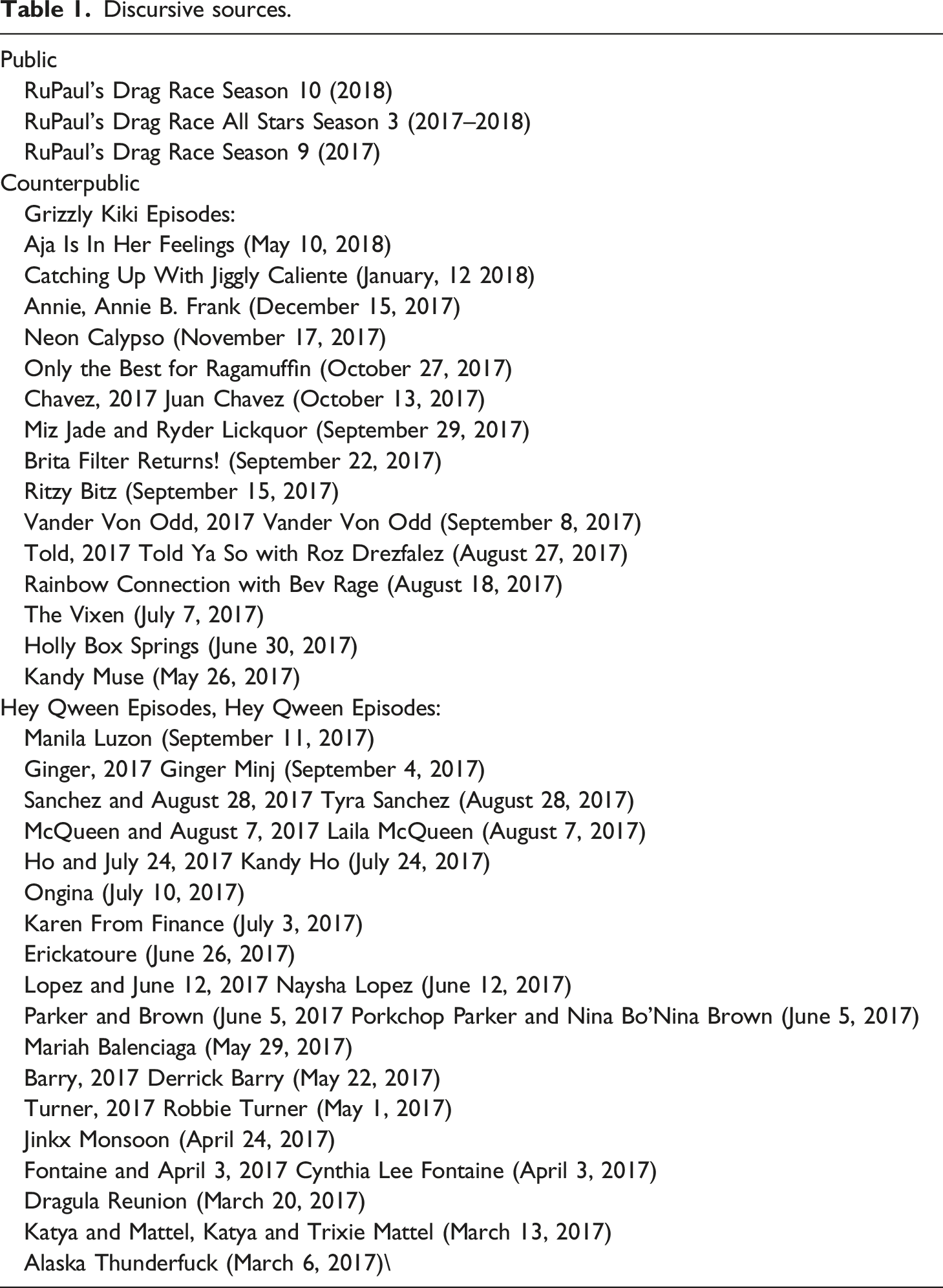
Discursive sources.
Interview participant demographics.
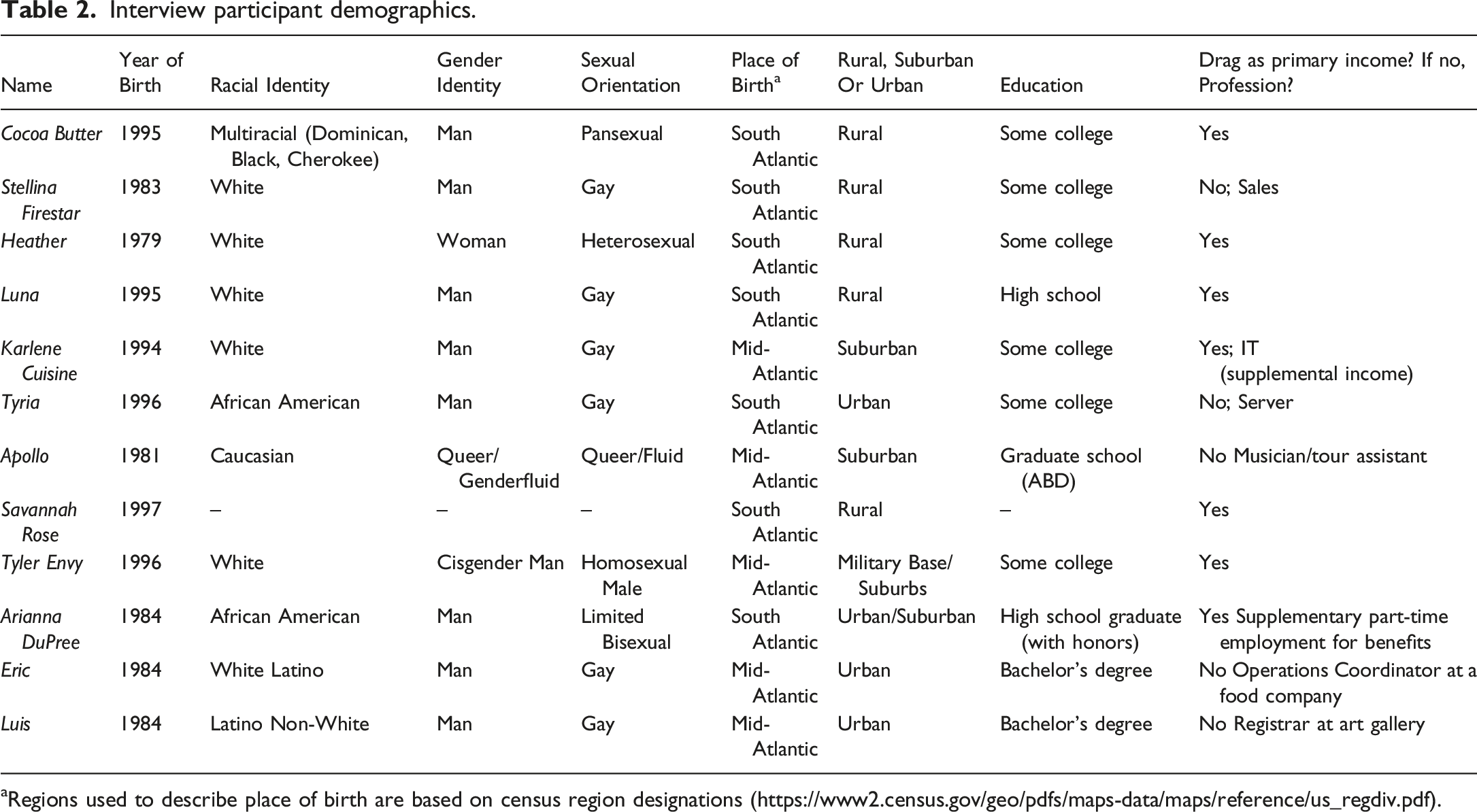
aRegions used to describe place of birth are based on census region designations (https://www2.census.gov/geo/pdfs/maps-data/maps/reference/us_regdiv.pdf).
Findings
Public-imposed standards for (successful) drag
RuPaul’s Drag Race, as a drag “public,” establishes drag performance standards, enforced explicitly through the judge’s critiques. These standards also impact drag performers at the local level, regardless of whether they have been (or want to be) on RPDR themselves. To consider RPDR queens as the unequivocal “best of the best” is debatable, yet there remains a baseline caliber of polish expected of contestants.
RPDR solidifies its standards most obviously in judges’ runway critiques. Each episode, contestants present fully realized looks fitting a runway theme 13 and are then critiqued by core judges (RuPaul, Michelle Visage, Ross Mathews, and Carson Kressley) and celebrity guests. Critiques center around how well the runway assignment was executed, but often extend further to the queens’ performances in the week’s main challenge and cumulatively throughout the competition. The judging portion of each episode is the clearest place where standards for successful drag on RPDR are explicitly stated.
During the season 10 premiere, New York City contestant Dusty Ray Bottoms questions aloud whether she should do her signature makeup for this first challenge—"Drag On A Dime: construct a look from items sold at a $0.99 store.” Dusty explains that she learned to use dots to draw on her eyebrows but was inspired by the way the dots themselves looked, incorporating dots-as-eyebrows into her standard look.
On the runway, Dusty is critiqued negatively for her outfit but the critiques extend beyond that. Known for her blunt criticisms, judge Michelle Visage prompts Dusty to, “Tell me about the dots on your face.” Upon explanation, Michelle asks, “So do you do other looks as well?” Dusty replies yes, of course, but she wanted to show her signature look for the first runway. Michelle responds with a snippy, “Looking forward to a dot-free face, Dusty.” Below is an image of Dusty Ray Bottoms, which, while not from RPDR, still shows her signature makeup (Figure 1). Dusty Ray Bottoms sporting signature makeup.
14
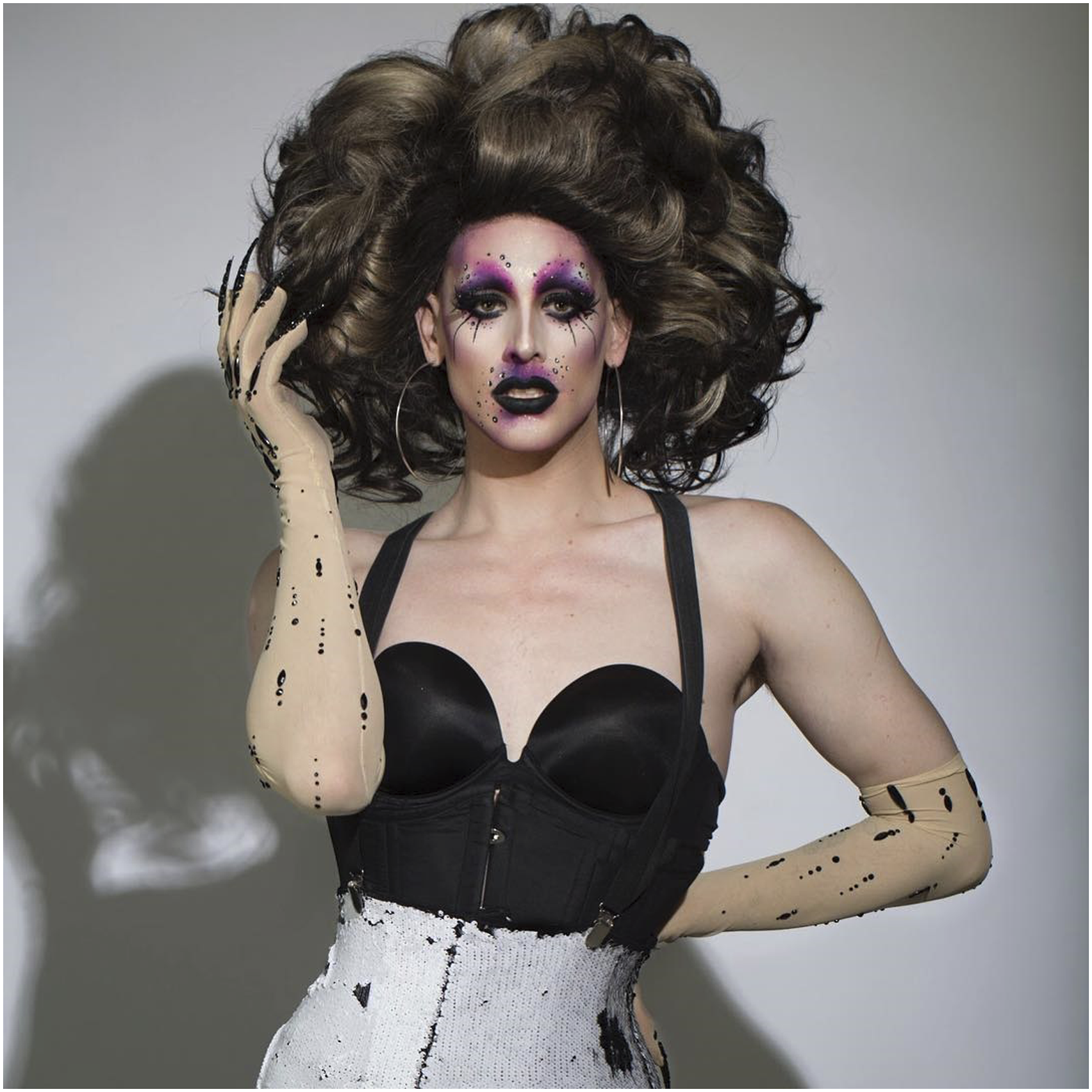
Amidst more conventional drag styling (coiffed hair, hoop earrings, and stoned gloves with fake nails), Dusty’s makeup is a notable departure from convention. She is wearing a dark purple-black lip color and exaggerated black eyeliner with black tear stains. Smudges of bright purple accent her brows and upper lip as do the signature dots she was critiqued for. The dots are strategically placed, varying in size and evoking imagery of her face as an artistic canvas, with dots as splatter paint accents. There is no elementary haphazardness or lack of finesse in Dusty’s makeup—the look is a deliberate, non-conventional artistic statement. This is not the first time a contestant’s signature (non-conventional) look has been criticized on RPDR: Season 4’s Sharon Needles’ white contact lenses, season 5’s Detox’s lip syncing style, and fellow season 10 contestant Monét X Change’s signature body suit and “pussycat” wig have all been harshly critiqued by the judges, despite it being crucial for queens to develop a distinct, recognizable look—a “brand”—for their drag persona. Particularly in the age of Instagram and digital celebrity where exposure, branding, and creating a unique identity are expected of reality tv stars (Collie and Commane, 2020), these critiques are paradoxical, especially when one considers RuPaul’s own enduring brand and signature look and style.
Notably each of these contestants maintained their signature looks post-RPDR, but the discursive impact of the critiques remains: the underlying message signals standards for acceptable versus sub-par drag. While the judges’ comments are aimed at individual contestants, RPDR’s international reach has discursive consequences for the broader drag scene. Put simply, these critiques set the standards for the field of drag itself, on and off RPDR. In response to my question about how drag has changed in her 15 years in the industry, Arianna, a 34-year-old seasoned pageant winner said The dynamic of things have changed. Even the style of drag and stuff has changed really, really drastically. When I first started [at my home bar], it was always all about the over-the-top kind of costumes, the over-the-top-looks, the over-the-top-hair, the creativity of it—big, feathered back pieces and all kinds of things like that. And now that RuPaul’s Drag Race has come along, the world kind of sees [drag on RPDR] as the norm of drag because that’s all they can really relate to.
In Arianna’s response, the discursive impact of RPDR comes through clearly: what is shown (and said) on the show is both felt by local performers and is enforced at the local level. Arianna’s experience further illustrates the inherent hegemony in publics (Cavalcante, 2016; Cho, 2017). By interfacing with a mainstream public, the counterpublic necessarily comes up against the very norms that, in its subculture configuration, it sought to challenge. These tensions that Arianna mentions—the necessity on the part of the audiences to see a RPDR-sanctioned drag aesthetic—sit directly in the fraught space that the counterpublic inhabits, between public and subculture.
Public-constructed hierarchies of drag
One way that RPDR reinforces standards for success is in the creation of a hierarchy of drag styles. Judges often critique contestants for not “stepping it up” on the runway, implying that their outfits are reminiscent of standard bar performance attire, rather than fashion. Season 10’s Kalorie Karbdashian Williams (Figure 2) and season 9’s Trinity Taylor (Figure 3) were both critiqued this way by Michelle Visage. Michelle criticized Trinity of, “giving us ‘bar Trinity’ from back home.” Included here are images of each contestant in the looks that sparked the judges’ criticisms. Kalorie Karbdashian-Williams’ “Best Drag” look.
15
Trinity “The Tuck” Taylor’s rainbow look, part of the “Gayest Ball Ever” challenge.
16
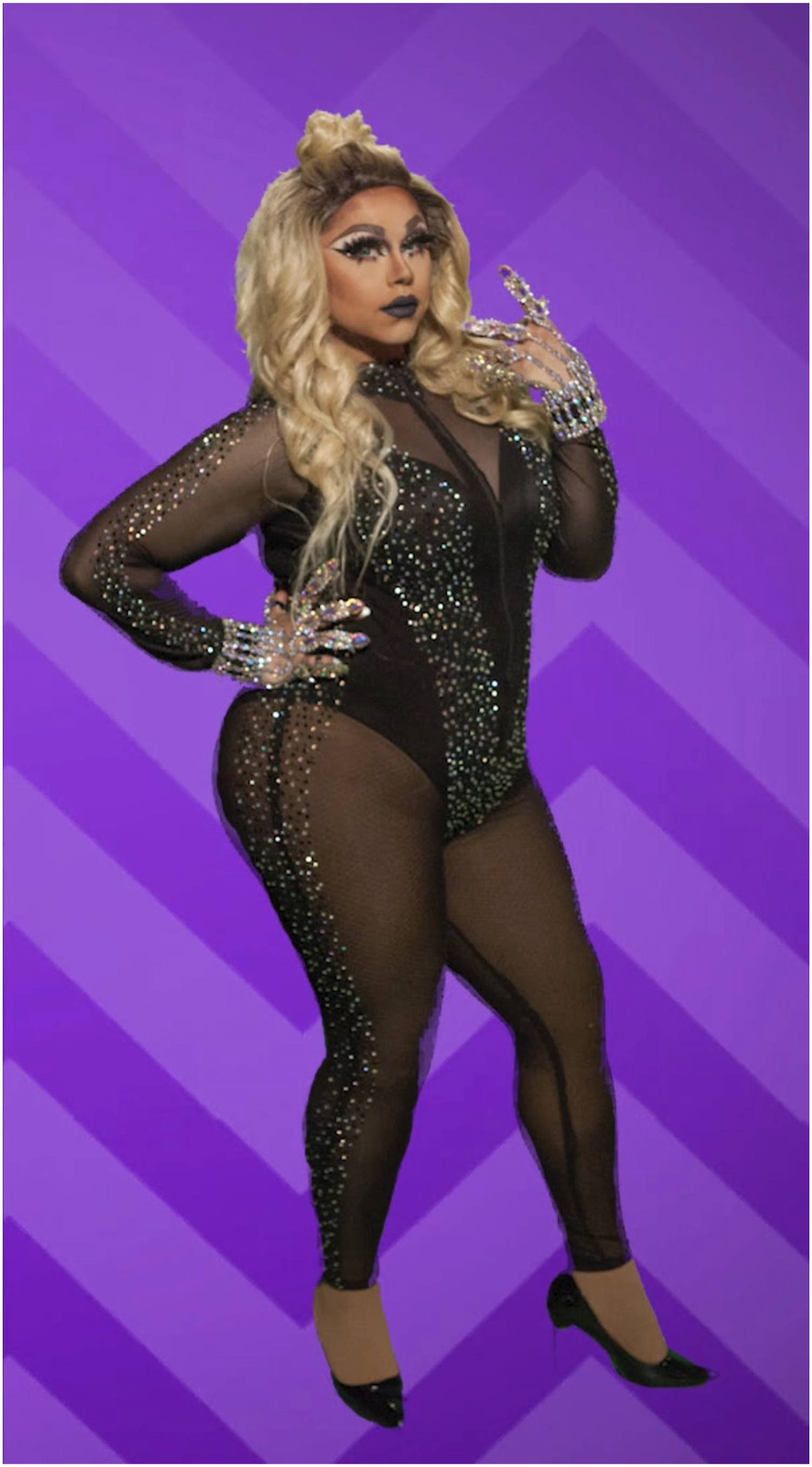
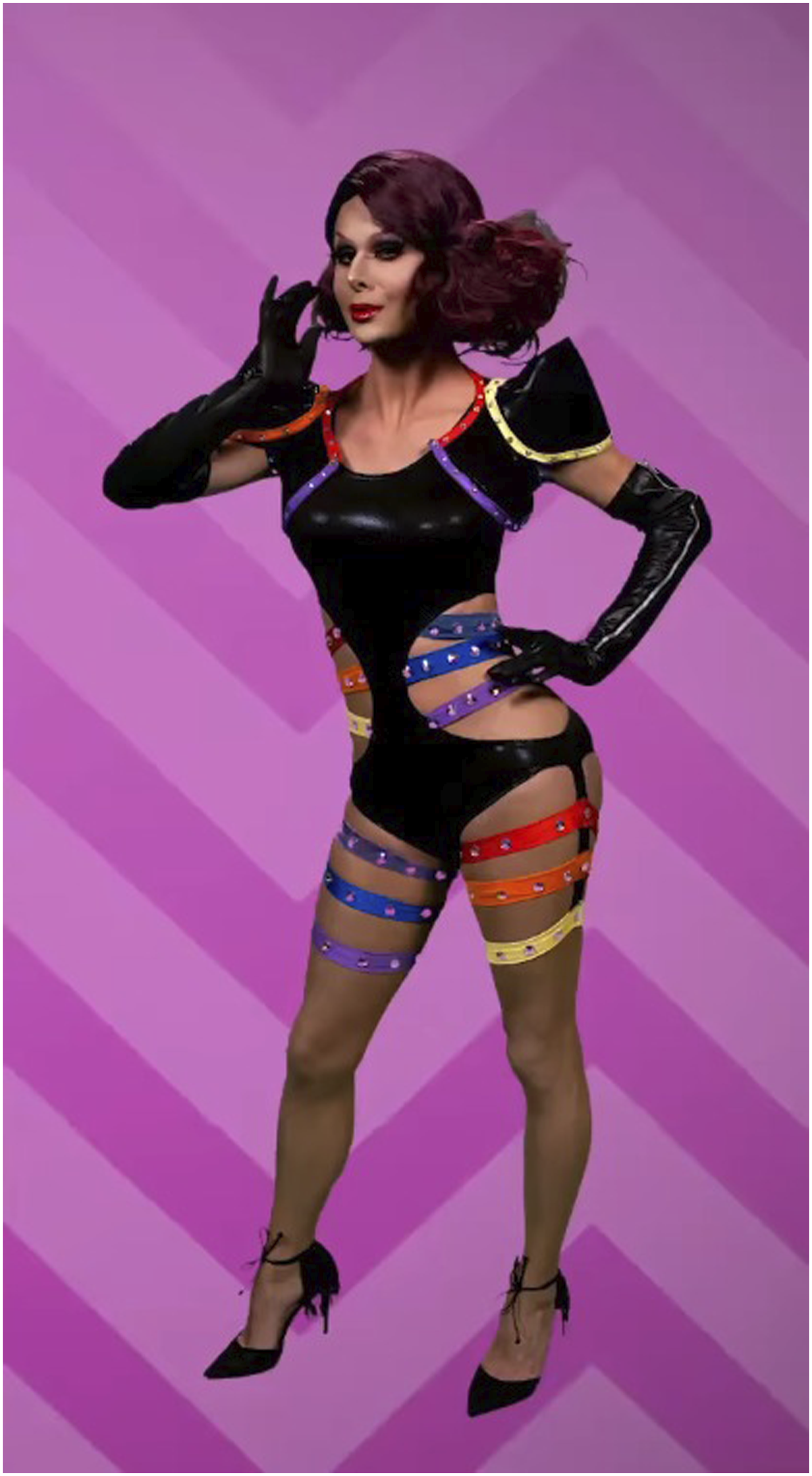
Kalorie’s outfit—with a pattern formed in stones down the legs, arms, and across the body of the leotard—is reminiscent of a standard bar/club look, though the hand/wrist jewelry create some added interest. The outfit is easy to move in which for Kalorie, as a dancer, is likely an important requirement for a performance look. Trinity’s outfit offers a similar leotard body but has some structural elements that make the silhouette unique—the pointed shoulders, scooped neck and side cutouts, for example. The addition of the rainbow belts on the legs, waist, and as trim on the shoulder pads are a creative way of fulfilling the “rainbow” prompt while giving a look that is performance-ready.
While Trinity’s outfit may, subjectively, be more fashion-forward, both looks could certainly be described as “nightclub outfits.” Yet when performing in nightclubs is the basic bread-and-butter of drag performance, one is left to wonder why such a descriptor is used negatively on RPDR. The effect of this critique draws a firm line between drag on RPDR versus local bars. By using “nightclub outfit” as a point of critique, public/mainstream drag (what is shown on RPDR) is positioned as better than local drag, solidifying a new hierarchy in which the local is second-rate.
Importantly, these RPDR-imposed expectations are arguably out of touch with what local drag actually is. Monèt X Change, having been criticized for her “pussycat” wig (short hair) and bodysuits, was asked by RuPaul why she had not worn any “big hair” on the show yet. In response, Monèt stated that she does wear big hair, but only when “the occasion calls for it.” The following exchange transpired: RuPaul: “So what you’re saying is, the occasion of this competition, you’re calling is a pussycat wig.” Monèt: “You know what? Honestly, Ru, in New York City I work 6 nights a week so sometimes it is like, getting out the door and not worrying about fluffing my hair when I’m on stage.”
In the featured image (Figure 4) from an early episode of RPDR season 10, Monèt wore a signature bodysuit and pussycat wig to represent her “signature drag.” The wig is short, choppy, and blonde, with messy bangs and long sideburns. Short hair is notoriously difficult for drag queens to execute, yet this wig frames her face well and manages to achieve a feminine style. The bodysuit is a form-fitting, fully rhinestoned dark burgundy color. A wide neck with a shallow v-cut highlight her collarbones, while the slightly pointed shoulders give the bodysuit a distinctly fashionable silhouette. With how fitted the bodysuit is, there’s little room to hide imperfections—she is cinched, padded, and tucked to achieve the seamless silhouette for which the body suit allows. The look is overall effective in not only showcasing a signature Monèt look at her finest, but also in delivering a fully realized fashion moment in a put-together, polished outfit. Monèt X Change’s “Signature Drag” look.
17
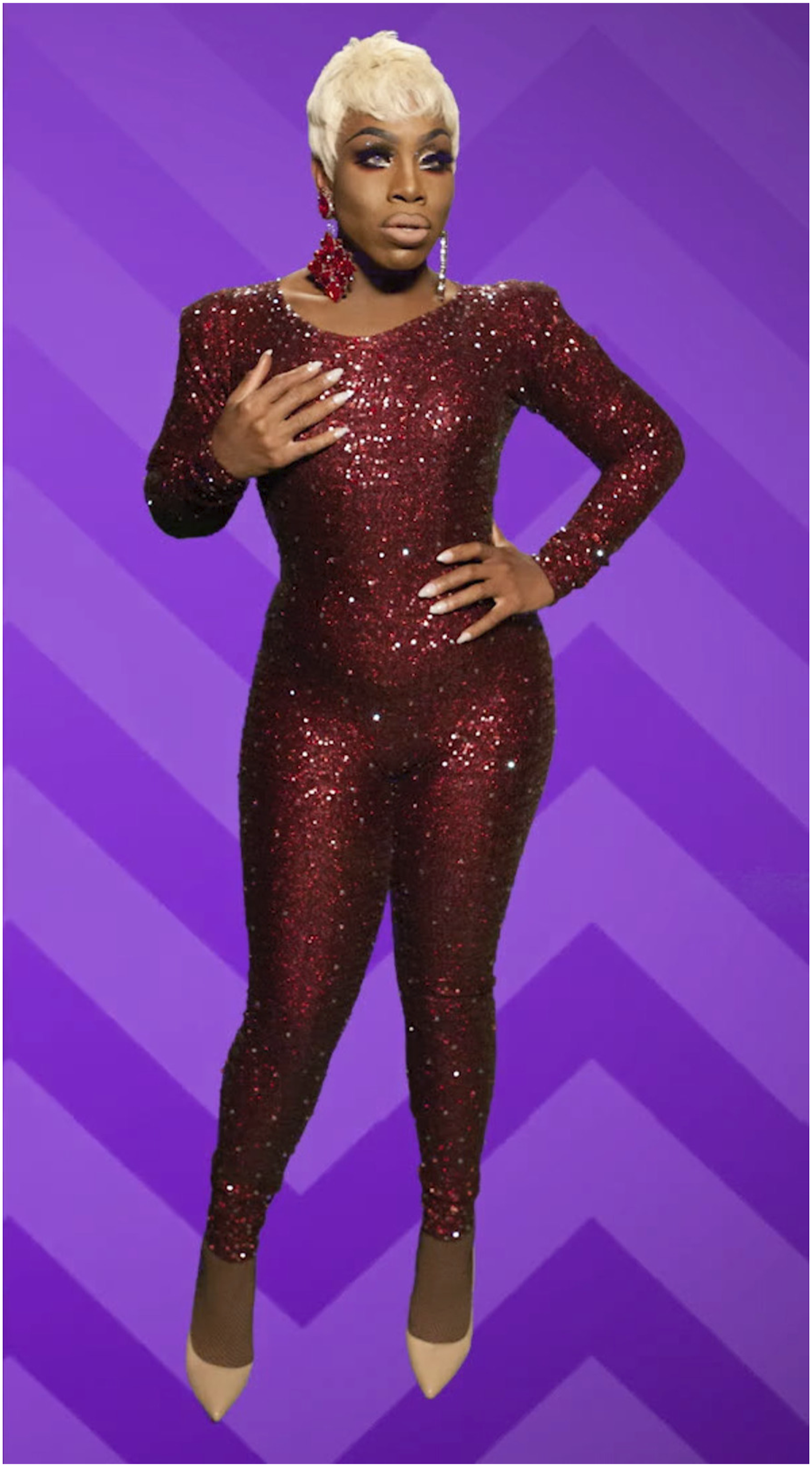
Next, fellow New Yorker and season 10 contestant Miz Cracker (with whom Monèt has worked with regularly pre-RPDR) says the following: “Monèt shows up in a romper, no tuck, no wig, and audiences eat her up, so no one can blame Monèt for relying on personality. But this is Drag Race—it’s not gonna fly.” A clear disparity between how Monet looks (pictured) and how her fellow contestant describes her emerges, solidifying the distinction between mass and local, with the mass being unequivocally better. Further, this disparity highlights how RPDR norms are not aligned with the aesthetic norms of live drag performance. Monèt’s “Best Drag” look successfully combines her signature aesthetic at its peak with performance-ready attire, yet this is somehow insufficient per RPDR standards. The takeaway, then, is if a contestant looks too “nightclub”—arguably code for “local”—then her drag is not RPDR-quality—conversely, it is sub-par.
Additionally, the racialized nature of these critiques is not unnoticed. Branding is deeply important in the current age (Collie and Commane, 2020; O’Connell, 2020), yet the expectations for what, and how, a drag artist chooses to “brand” are not treated uniformly. Specifically, queens of color are more often accused of “relying on personality” for their brand/image (in lieu of an identifiable aesthetic) than white queens. Of the seasons included in this analysis, five queens have consistently had this critique leveraged against them: Eureka! (Season 9), Shangela (All Stars 3), Monèt X Change, Monique Heart, and Vanessa Vanjie Mateo (Season 10). Of these five contestants, all but one are queens of color, and of those four, three are Black. This is not the only way in which critiques are racialized and leveraged differently at contestants of color—RPDR has a long and documented history of problematic behavior concerning race (Ferreday, 2020; Jenkins 2017; McIntyre and Riggs, 2017; Upadhyay, 2019).
A further impact of this hierarchy is the systematic devaluing of pageant-style drag. Most of my participants either wanted to, or had previously, competed in pageants. Most interviewees, particularly more seasoned pageant queens, agreed that in a pre-RPDR world, pageantry was virtually the only path to prestige for drag queens. Pageant titles afforded performers touring opportunities, which, while commonplace in the RPDR age, used to be unusual.
There was a title-holding pageant queen among the finalists of each season of RPDR in this analysis: Season 9’s Trinity “The Tuck” Taylor; All Stars 3’s Kennedy Davenport; and Season 10’s Asia O’Hara. Asia, upon first werkroom entrance, states, “I’m known for being a pageant queen
For example, Asia O’Hara’s Madame Butterface character on Season 10 Episode 3’s dating app challenge relied on humor and excess to deliver the joke. During critiques, Michelle Visage is quick to tell Asia that her comedy was surprising, given that she is a pageant girl. With a whimsical Tweety Bird-inspired runway that week, Asia successfully broke out of the pageant stereotype and ended up winning for her performance. Yet Asia’s (temporary) disavowal of pageantry is ultimately what garnered the win, per the judges’ critiques, further solidifying RPDR’s stigma against pageantry—ironically, a key marker of prestige in the pre-RPDR drag world. RuPaul has created a drag empire with RPDR, and he sits undisputed at the helm (Collie and Commane, 2020). Arguably, then, an additional outcome of this construction of empire is the explicit way in which RPDR disavows any other avenues to prestige in terms of success as a drag artist. In this way, it could be argued that RuPaul is less of a mentor and Gu-Ru (pun intended), and more of a gatekeeper over the art of drag.
Local hierarchies of drag
RPDR creates an insular fantasy by situating itself, with RuPaul’s blessing, as the dictator of acceptable, successful forms of drag. By positioning drag on RPDR as the unequivocal best, other forms of drag—specifically, those that happen outside the public realm—are viewed as second rate. This was underscored by Cocoa Butter, a young but experienced drag performer I interviewed who has worked with multiple RPDR alumni. One of the effects of mainstream visibility is the ability for past contestants to substantially increase their booking fees. For local queens, fees range from $25 to $200, depending on venue, location/travel expenses, and (to an extent) performer prestige. Pageant title holders may garner slightly higher booking fees, but usually no more than $300. Queens cast on RPDR, however, can charge well over $1,000, regardless of how they fared on the show. For some more popular queens, particularly season winners or RPDR: All Stars alumni, fees can exceed $5000. Additionally, meet and greet packages can run upwards of $100 for a chance to meet and take a photo with a RPDR alumnus. Meet and greets for local queens are never advertised, nor are they paid for by audience members. There is, in other words, a stark and dramatic difference in premiums placed on booking a RPDR queen versus a local queen.
Importantly, this premium has little to do with how a queen performs, and more to do with her “celebrity” status, as Cocoa Butter says here: With Drag Race, you lose the excellence. You lose the quality. And don’t get me wrong, that’s a very vague statement—and I’m not speaking for all queens—but in my experience with some of the queens I’ve worked with that show up with one outfit for the entire weekend? First of all, I don’t want to be in the same outfit all weekend. They’re allowed to do that, but you book me and if I show up and I don’t have nails on, you take $50 off my check.
Cocoa Butter’s sentiments were shared among other participants too. Even though RPDR may be redefining the standards for local queens, RPDR alumni themselves are not held to those same standards post-RPDR, due largely to their celebrity status within the drag scene. Cocoa Butter implied that venues would pay considerably more for a RPDR queen than they would for any local queen, and they justify doing so because it gets customers in the door—it has little to do with a queen’s talent. On the local level, RPDR’s effect is a hierarchy with RPDR alumni held in higher esteem for reasons that have little to do with performance caliber, and everything to do with public visibility. 18 But this public visibility—or more specifically, proximity to it—can also benefit local queens. When I asked about her encounters with RPDR alumni, Tyler Envy told me, “Meeting and being close to a Ru Girl 19 is one of the best things you can do as a local drag queen. A Ru Girl I performed with posted a picture with me and I got 60 followers on Instagram. In a day.” Thus, while the celebrity status of RPDR alumni can, however minimally, trickle down to local queens, the path to success in the drag scene is quite clear: there is no quicker way to boost a drag queen’s prestige than to get cast on RPDR.
As RPDR sets the standards for the drag community at large, the mechanisms by which it is done obscure the level of preparation (money, time, networking, and resources involved) necessary for success on the show. This is largely due to contestants signing mandatory non-disclosure agreements at the time of casting. Drag is an expensive art. In our interview, Cocoa Butter mentioned that she spends about $500 monthly on outfits and accessories (makeup, hair, nails) which she describes simply as “maintenance costs.” While other participants did not share dollar amounts, all unanimously agreed that drag is expensive—much more so than they originally anticipated, and so much so that several queens I interviewed were unable to pursue a full-time drag career, needing to supplement their drag income with other employment.
RuPaul’s Drag Race’s necessitates a certain caliber of drag which carries hefty price tag. There are elements of access and privilege that go virtually unacknowledged by RPDR judges, despite it being widely known among other drag performers and those involved in drag-adjacent industries. 20 There is, in other words, a necessary level of both cultural and social capital (Bourdieu, 1986; Lamont and Lareau, 1988) needed to fare well on RPDR, in addition to a hefty financial investment.
In a Grizzly Kiki interview, New York City queen Holly Box Springs (who has worked with many NYC-based RPDR alumni), stated that, “It takes a village for that show to happen.” The “village” is not only the production team behind the show, but also the “production team” of sorts that queens enlist to help prepare for the competition. Grizzly Kiki interview with Juan Chavez, for example, reveals that Season 8 top-three contestant Naomi Smalls came to the werkroom with custom-designed outfits Chavez had made for her in preparation for RPDR. Similarly, on many episodes of Hey Qween, RPDR alumni have joked about frantic phone calls made to wig stylists, fashion designers, and makeup artists to ready themselves for the show.
As Lamont and Lareau (1988:156) posit, the kind of cultural capital at play is, “institutionalized, i.e., widely shared, high status cultural signals (attitudes, preferences, formal knowledge, behaviors, goods and credentials) use for social and cultural exclusion.” Thus, while RPDR may obscure the mechanisms behind getting “RPDR ready,” it also illustrates what happens when a contestant will not (or cannot) engage in this expensive, invisible labor. Season 10’s Monique Heart mentions her electricity was almost shut off due to the financial strain she endured to prepare for the show. During a particularly challenging week, Monique had to make an outfit from scratch while other contestants had ready-made outfits they had brought with them. Monique stated the following about her looks on RPDR: A lot of my works are having to be made in the werkroom and it’s because of the lack of money. Honey, I am the MacGyver of drag. I will jimmy rig that bitch right before it is time for me to get on stage, whether it’s hot glue, safety pin, bobby pin. I came to this competition with glitter and Jesus, and bitch, I am making it work, okay?
Similarly to late, great, season 8 contestant Chi Chi Devayne (who also discussed living in poverty and making outfits from scratch on the show), Monique Heart illustrates the necessary capital required for RPDR drag. The preparatory labor for the show is virtually invisible and relies largely on existing networks. The consequences from not having the capital (economic, cultural, or social) to adequately prepare are abundantly clear. It is not insignificant that the two queens who have been the most open about their financial struggles on the show are both Black queens from places besides the urban, coastal US. There are, in other words, deeply racialized and regionalized components that contribute to these vast disparities in ability to adequately prepare for RPDR.
As Heather, a 39-year-old queen who began doing drag in 2001 stated during our interview, “RuPaul’s Drag Race is a reality show that happens to star drag queens; it’s not anything about drag.” Heather’s profound statement underscores one of the key findings of this project: RPDR dictates a new and different hierarchy that privileges mainstream drag which, as these findings show, is arguably out of touch with what working drag queens do in practice. By devaluing the local, RPDR serves to both distance itself from the day-to-day practices of working drag artists and to position its own construction of drag as peak drag excellence. RPDR’s devaluing of drag pageantry—a longtime marker of prestige and excellent within a pre-RPDR drag scene—further cements the hierarchy. Alongside this hierarchy which privileges RPDR drag, the prestige given to past contestants has little to do with a contestant’s performance ability, and much more to do with the celebrity status that comes with appearing on a reality TV show—hence Heather’s remarks, the sentiments of which were shared by other participants I interviewed.
Beyond the creation and imposition of a drag hierarchy, the mainstreamification of drag through reality television has also obscured the amount of capital—social, cultural, and economic—that is required of contestants to be “RPDR ready.” Contestants like Monique Heart show the uphill battle constants face without access to wealth and resources to prepare adequately for the show. With drag scenes in New York City and Los Angeles that are saturated with drag artists and makers in adjacent industries, contestants from these cities arguably have an advantage from the get-go. With non-disclosure agreements that forbid contestants from discussing their casting on RPDR publicly prior to the airing of the show, much of the preparation goes unnoticed by outsiders. By rendering these processes invisible, the RPDR hierarchy is given further weight, exacerbating existing inequalities and access to capital.
Conclusion
This research, first and foremost, provides an important addition to the ongoing canon of works studying drag performance in the wake of mainstream visibility by considering the impact on local drag artists, or those doing drag outside the RPDR spotlight. These findings show how RPDR has become, essentially, the “public” drag. Drag at the local level—namely that which is not on RPDR—is thus a subculture-turned-counterpublic. A crucial marker of this shift is the hierarchy constructed by RPDR that is imposed on both the public and counterpublic levels, underscoring how drag in all forms is necessarily “in dialogue with” the public/mainstream. Importantly, the enforcing of this hierarchy has not happened without acknowledgment or contention on the part of local drag artists and RPDR alumni alike, providing an important counterclaim to the argument that mainstream exposure necessitates death of the subversive subculture. While the subcultural configuration may not exist as it once did, this research illustrates how local drag, even in its counterpublic configuration, is still at odds with mainstream drag. The counterpublic, in other words, is always in tension with the public. Much of the existing works taking up tensions between publics and counterpublics often interrogate such conflicts in terms of state power (Alexander, 2006; Habermas, 1974). Yet this project, particularly vis-à-vis Warner’s framing, allows for a deeper understanding of publics/counterpublics in the realm of cultural power. The case of drag shows the extent to which public authority (RuPaul and RPDR) and norms (as enforced on RPDR) shape power relations and dictate norms on the counterpublic (local drag scenes) level, but only to an extent. The counterhegemony of the counterpublic lies in both the collective acknowledgment of counter- or subaltern status, and in the pushback against the publics’ norms, which is becoming increasingly prevalent in local drag scenes. I conclude this piece by highlighting two such examples that have come to light since data entry has concluded for this project, underscoring how tensions between mass and local drag continue to evolve and grow.
In the exchange pictured in Figure 5 from March 2019, Venus Envy (a local drag artist in Orlando, FL) publicly acknowledges the admirable behavior of RPDR alumni Shea Couleè during a tour performance. In response, Shea Couleè directly challenges the “Ru Girl” and “local queen” hierarchy, discursively imposed by RPDR, discussed in this paper. Twitter exchange between Venus Envy and Shea Couleè.
21
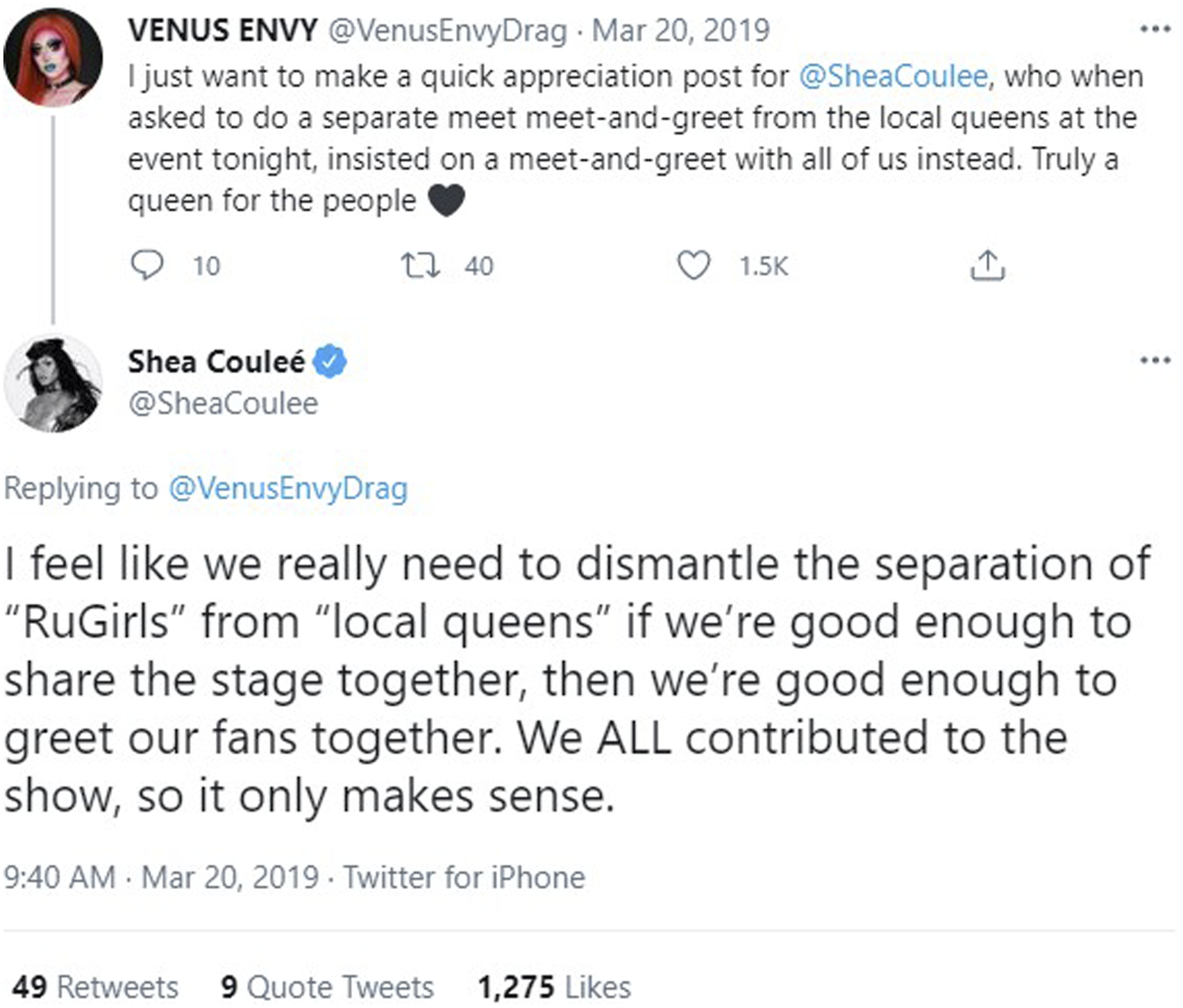
This exchange highlights how RPDR alumni and local entertainers alike acknowledge and challenge the discursive consequences of RPDR. RPDR alumni do not necessarily condone the attitudes and implications of the show itself. The drag community’s relationship with RPDR becomes increasingly complicated and strained as the discursive impacts of the hierarchy intensify, and as RPDR raises the expectations of “RPDR ready” drag.
Further, while the changes resulting from mainstream visibility are likely irreversible, they are not immune from further change. In a 2018 article in The Guardian, RuPaul was asked explicitly whether or not he believed that women could do drag, and furthermore, how he felt about casting transgender women on RPDR in the wake of season 9 contestant Peppermint being cast while openly identifying as transgender. 22 Regarding cisgender women doing feminine drag 23 RuPaul (in Aitkenhead, 2018) argues, “Drag loses its sense of danger and its sense of irony once it’s not men doing it, because at its core it’s a social statement and a big f-you to male-dominated culture. So for men to do it, it’s really punk rock, because it’s a real rejection of masculinity.” Regarding transgender women being drag queens, RuPaul (in Aitkenhead, 2018) replied, “Mmmm. It’s an interesting area. Peppermint didn’t get breast implants until after she left our show; she was identifying as a woman, but she hadn’t really transitioned.” Additionally, when asked if he would accept a contestant who had begun the process of medical transition, he indicated that he likely would not, saying, “You can identify as a woman and say you’re transitioning, but it changes once you start changing your body. It takes on a different thing; it changes the whole concept of what we’re doing. We’ve had some girls who’ve had some injections in the face and maybe a little bit in the butt here and there, but they haven’t transitioned.”
RuPaul’s comments were met with outspoken disavowal by many members of the drag community, including both cisgender and transgender RPDR alumni. Thus, while RuPaul’s standards of “acceptable” drag may be met with minimal criticism on RPDR, his standards about who can do drag (rather than how they do it) is not met with the same complicity. This division between trans women and cis men drag artists is, importantly, something created by RPDR that did not exist to this degree in the subculture configuration of the drag world pre-mainstream exposure. Yet the discursive impact of this discrimination is felt within drag communities and has very real effects on the pathways to success for trans versus drag queens.
Regardless of who does it and where it happens, there is some level of complicity with discursive drag norms that cannot be escaped. But does that mean drag loses its subversiveness or its edge? Does it lose its significance as an historically important expression of community solidarity, art, and resistance? If the tensions discussed here are any indication, drag’s remaining subversive potential is, at the very least, a battle that the drag scene collectively deems worth fighting for.
Footnotes
Declaration of conflicting interests
The author(s) declared no potential conflicts of interest with respect to the research, authorship, and/or publication of this article.
Funding
The author(s) received no financial support for the research, authorship, and/or publication of this article.

Notes
Shayne Zaslow is a PhD candidate in Sociology at the University of Virginia. Prior to studying at the University of Virginia, Shayne spent 5 years working in LGBTQ public health research and informatics. Shayne’s current dissertation project analyzes drag performance as queer political art in a changing social world, incorporating performance studies, sociology of art and culture, and intersectional gender and sexuality studies. Shayne also holds a Masters in Gender and Cultural Studies from Simmons University.