




Abstract
We consider what genealogical links, kinship and sociality are promised through the marketing of assisted reproductive technologies (ARTs). Using a mixed method of formal analysis of Facebook's algorithmic architectures and textual analysis of twenty-eight adverts for egg donation drawn from the Facebook Ad Library, we analyse the ways in which the figure of the ‘fertile woman’ is constituted both within the text and at the level of Facebook's targeted advertising systems. We critically examine the ways in which ART clinics address those women whose eggs they wish to harvest and exchange, in combination with the ways in which Facebook's architecture identifies, and sorts those women deemed of ‘relevance’ to the commercial ART industry. We find that women variously appear in these adverts as empowered consumers, generous girlfriends, potential mothers and essentialised bodies who provide free-floating eggs. The genealogical and fertility possibility offered through ART is represented with banal ambiguity wherein potentially disruptive forms of biogenetic relatedness and arrangements of kinship are derisked by an overarching narrative of simplicity and sameness which excludes men, messy genealogies and explicitly queer forms of kinship. This rationalisation is supported by the simplicity and certainty of the Facebook targeted advertising algorithm which produces a coherent audience and interpellates users as fertile subjects whose choices are both biologically determined and only available through clinical intervention.
Keywords
Introduction
In March 2019, we noticed a new type of advert appearing in our Facebook feeds. We had become accustomed to prompts to take control of our reproductive endeavours with products such as ClearBlue (Kant, 2019), and had come to terms with being followed across platforms by adverts for products we had already bought (Turow, 2012; Cohn, 2019; Kant, 2020). Instead, we were now being asked to donate something. No longer encouraged to pee on hormone-monitoring sticks whilst wearing ten versions of the same blouse, we were shown adverts inviting us to offer up something of ourselves; our eggs, by donating them to one of the UK's commercial egg banks. Clicking on Facebook's link attached to ‘Sponsored’ News Feed posts for egg donation, to discover ‘why am I seeing this?’, told us that the promoter of the advert wanted to ‘reach people who are interested in shopping and fashion [and are] women aged 18 to 35, who live or have recently been near Brighton, England’. This information confirmed that we exist as fertile women to this advertiser: constituted as such through an algorithm which has determined us to be cisgender women of child-bearing age, located within ninety minutes of the egg bank clinic. The selections, exclusions and which data are involved in categorising us in this way remain undisclosed in Facebook's brief explanation.
In contemplating the content of the adverts, we felt inclined to question what other information about our choices and lives had been involved. Had membership of ‘parents-to-be and want to be’ groups and a ticked box indicating ‘single’ marked Elizabeth out as an untapped and highly motivated source of genetic material? Had Tanya's virtual window shopping, tracked back to Facebook through cookies, flagged her as a consumer in need of a new source of income? The appearance of egg donation adverts from UK ART clinics is, of course, not an experience unique to us; appeals for healthy eggs are routinely delivered to Facebook users algorithmically assigned to the categories ‘fertile’ and ‘female’. Such users are also delivered other adverts for other products. However, the emphasis on the biologically essentialised ‘female body’ in these targeted adverts prompts us as ‘situated subjects’ – researchers embedded in identity positions that entangle us in Facebook's fertility constitutions – to a ‘Kafkaesque experience’ of algorithmic targeting (Haraway, 1988; Christl and Spiekermann, 2016). As users, we do not and cannot fully grasp the myriad ways we are identified, anticipated and managed in and through data (Christl and Spiekermann, 2016: 129); confronting these egg donation adverts represents an encounter with algorithms entangled with technology that disregards our profoundly different digital, cultural and social subjectivities.
The Facebook algorithm had placed us in the same box. Our attempts to make sense of what the adverts wanted us to do, or offered us, did not point to the coherence of our categorisation, of clear boundaries of that box, but to its ambiguity and breadth. We were both ‘women aged 18 to 35’ but we are also more than this; why was this advert for us? Who else was it for? And who, conversely, was excluded from this call? As Ruckenstein and Granroth (2020) note, targeted social media advertising initiates a highly intimate and individualised encounter between social media user and advert, and it is our intimate personal reflections which inspire this project. However, it is not our intimate encounters that constitute the focus of the article: though auto-ethnographic enquiries into targeted advertising processes are certainly possible (and we invite future research that does so), our encounters offer a way into formal and widespread computational architectures that inform the marketised engagements of social media users far beyond our own experience. Indeed, given that the opacity of targeted advertising systems makes it hard for users to encounter adverts targeted to anyone but themselves, our intimacies act as a necessary starting point to undertake this formal analysis.
Computational targeting of users for their eggs warrants distinct critical investigation. Advertising by gender or for egg donors is not new; there is a wealth of scholarship on gender-targeted advertising (Millum, 1975; Winship, 1980; Cortese, 2008) and a small body of research has considered the content of adverts for egg donors (Levine, 2010; Nowoweiski et al., 2011). While sometimes considering online recruitment of donors (Holster, 2008; Daniels and Heidt-Forsythe, 2012; Keehn et al., 2012), the scope of these studies excludes examination of the implications of targeted advertising in eliciting new egg donors. Some studies speak to ‘targeted’ advertising in print publications, such as US college newspapers and parenting magazine classifieds (Levine, 2010; Nowoweiski et al., 2011), but these print-based adverts differ significantly from the technologically driven targeting of Facebook adverts. The ‘niche’ (Turow, 1997, 2012) or ‘narrowcast’ (Smith-Shomade, 2004) targeting of certain demographics (such as women interested in pregnancy) has existed for many decades, but the adverts we focus on here can be considered distinct because the micro-targeting of social media users through algorithms is a relatively new practice that relies on computational mechanisms to anticipate and separate users into abstract, mass, correlational data sets (Bolin and Andersson Schwarz, 2015; Cheney-Lippold, 2017).
Facebook has been hailed and critiqued as creating one of the most complex and commercially successful forms of media targeting currently in existence (White, 2017; Raphael, 2018). The largely unregulated Facebook advertising platform represents a new dimension in targeting which has not yet been subject to sustained scrutiny. Targeting by gender is a widespread and normalised practice on most commercial web platforms (Bivens and Haimson, 2016). For a fertility industry facing a chronic undersupply of eggs (Purewal and van den Akker, 2006; Waldby, 2019), Facebook provides a uniquely well-designed platform to address women who fit the broad demographic allowed for egg donation in the UK. As Skeggs (2017) has highlighted, targeting data is notoriously hard to access. Instead, we critically analyse the computational systems deployed by Facebook to algorithmically constitute advertising audiences by categories such as age, location and gender. We call this commercially driven, algorithmically targeted delivery process ‘algotargeting’.
In this context of individualised, ubiquitous data tracking and gendered algotargeting, Kylie Baldwin (2017) called for research on social egg freezing to include a critical examination of the conditions which constrain and frame the suggestion of choice in adverts for egg freezing, donation and sharing. We seek to understand: (1) how egg donation, sharing and freezing adverts by ART clinics represent the anticipated users of their services; (2) how the meaning of these representations is enhanced or changed by their delivery through algotargeting; and (3) what imaginative, genealogical and relational possibilities and choice associated with ART are foreclosed or endorsed as a result of the use of algotargeting in delivering these adverts.
Through our analysis, we show that beneath a veneer of apparently flexible textual content regarding reproductive choice, feminised personal freedom and kin-networked self-determination, is a rigorously regimented algotargeted system that by textual and structural design only recognises gender-essentialised women's bodies. We find that through the banality and bluntness of its delivery, targeted egg donation adverts contribute to the disciplining of subjects into coherent and inherently normative categories. We explore the mechanisms which produce the target audience for these adverts and examine the structural restrictions of possible meaning-making. We conclude by suggesting that the constricted narrative of who ART is for and who it involves represents a derisking of the genealogically, queerly disruptive potential of ART in the relentless service of a profitable rationalisation of a complex market.
Methodology
This article draws on a data set of fertility clinic adverts which were active and visible on the Facebook Ad Library on 30 May 2019. The Facebook Ad Library was launched in October 2018 1 in response to criticism that targeted advertising – especially that undertaken by political parties – was opaque and unaccountable (BBC, 2017; Ram, 2018). According to Facebook, The Ad Library ‘provides advertising transparency by offering a comprehensive, searchable collection of all adverts currently running from across the Facebook Products’ (Facebook, 2019a). All adverts currently active on Facebook should appear when a branded service or product is searched in the Ad Library, though the information available on the targeting of an advert depends on it being flagged as pertaining to ‘politics or issues of national importance’ (Facebook, 2019a). 2 At the time of data collection, none of the fertility clinics’ adverts were flagged in this way, so only active adverts were available.
To identify advertisers for egg collection, we used the clinic search tool on the Human Fertilisation and Embryology Authority (HFEA) website to identify all licensed UK clinics who offered ‘fertility preservation’ and/or ‘recruit donors’. This delivered sixty-three clinics: twenty did not have a Facebook page, and a further fifteen shared a page as part of a larger organisation (such as the Bourn Hall Clinic which had four listings on the HFEA for different locations but a single Facebook page). From the remaining twenty-eight pages, twenty-three either did not have any active adverts on the Ad Library or did not have any active adverts which referred to egg freezing, egg donation or egg sharing. Adverts were collected from the remaining five clinics: Bourn Hall Clinic (one advert); Bristol Centre for Reproductive Medicine (hereafter BCRM) (one advert); Centre for Reproduction & Gynaecology Wales (hereafter CRGW) (one advert); Jessop Fertility (one advert); and the London Egg Bank (a part of the London Women's Clinic through which it is licensed by the HFEA) (twenty-four adverts).
Our engagement with this topic necessarily began with a reflection on our individualised and intimate orientation to these adverts. However, our approach to collecting advert data through the Facebook Ad Library represents formal analysis exploring the range of adverts which were, at that time, targeted to Facebook users in the UK. In our approach to textual analysis, we used word frequency searches and coding of image content to establish the patterns in the texts before moving to further analysis and interpretation structured through an emphasis on the algotargeted context in which audiences encounter these adverts.
Findings
ART has been described as offering reproductive hope within traditionally heterosexual familial paradigms (Franklin, 2006, 2013), and as creating opportunities for new genealogies, prompting diverse kinship arrangements, a disruption of orderly biogenetic inheritances and different ways of producing families (Davies and Robinson, 2013; Mamo, 2013; Blake et al., 2016; Epstein, 2018). Social media platforms have been described as spaces which open routes to attach new meanings to biogenetic relationality, reconfigure reproductive roles and create connected communities of kinship networks (Baym, 2010; Mamo, 2013; Andreassen, 2017). However, our analysis shows that when ART services are delivered to social media users through targeted adverts, these supposed limitless possibilities of interactions, kinship networks and relationships are heavily curtailed, and imaginative possibilities are restricted, through the narrowness of the images used, and the isolating and isolated advert delivery.
Altruistic femininity and girlfriend culture
In a London Egg Bank advert, two white women with long brown hair press their faces together as they drink one another's brightly coloured drinks. The text overlaid on the image reads ‘care to share’, whilst the caption asks: ‘not ready for a family yet but want to preserve your chance of having a baby in the future? Concerned that it's not an option you can afford? Freeze and Share could be the answer’ (London Egg Bank, 17 May 2019).
In another London Egg Bank advert, two slim, white, long-haired women sit on a set of swings in a public playground, facing each other, laughing and smiling. This image is accompanied by an appeal: ‘Your eggs are needed to help couples become a family. Sign up today’ (London Egg Bank, 8 May 2019a). In both adverts, the relationship between the two women pictured is unclear; does this represent a snapshot of the woman who is ‘not ready for a family’? Do these women depict the sharing, sisterly relationship between an egg recipient and the ‘not ready’ woman who freezes and shares her eggs? Are these women in a romantic relationship and seeking an egg donor so they can jointly make ‘a family’? The ambiguity of the relationships between women in the adverts variously invokes sisterhood, friendship and lesbian relationships, ensuring a broad audience appeal, without explicit naming, which could alienate any one group of women (Um, 2012; Ginder and Byun, 2015).
In all the adverts collected, the appearance of the women depicted conformed to dominant visual codes of femininity; featuring slim bodies, coiffured long hair, manicured nails and neat pastel-coloured clothing. Their activities of shopping, sharing exotic drinks and traversing hilltops (see Figure 1) ‘transcend the banalities of femininity’ (Skeggs, 1997: 111) and with it, the mundane tasks associated with childcare and motherhood. Further, the women visually represented in these adverts are anchored in the accompanying text as generous gift-givers. After ‘egg’ and ‘donor’, ‘help’ was the most frequently occurring word featured in the adverts. ‘Help’ features alongside similarly altruistic words that ask the audience to be ‘selfless’ because they are ‘needed’, suggesting they ‘share’ their eggs with other women as ‘gifts’. The London Egg Bank makes the stakes of such selflessness clear: ‘Your generosity will give another woman the chance of having a family of her own’ (London Egg Bank, 8 May 2019b).

London egg bank - take control of your future fertility.
These adverts describe a gift which is not simply material. Matter and discourse are entangled in both the image and textual content of the adverts (Lykke, 2008); in the advert for CRGW (see Figure 2), the gift of matter (egg) is transformed into a figurative handing-off of a pink heart. This is not a transfer of genetic material but of love. Similarly, the London Egg Bank captions a picture of a chubby white baby: ‘I’m made with one donor egg, an IVF cycle and a large dollop of love. Help a woman be a mum’ (London Egg Bank, 4 March 2019). The baby ‘speaks’ in this advert, transforming biological technological processes into a discourse of ‘love’ which ‘makes’ a mother. The choice that these adverts offer is not about the transfer of matter, but of investment in a discourse of caring femininity and relationships to other women which sustain the heteronormative context of reproduction (Luce, 2010: 158–159). Or, as the London Egg Bank puts it: an opportunity to ‘be part of something special’ (8 May 2019b).
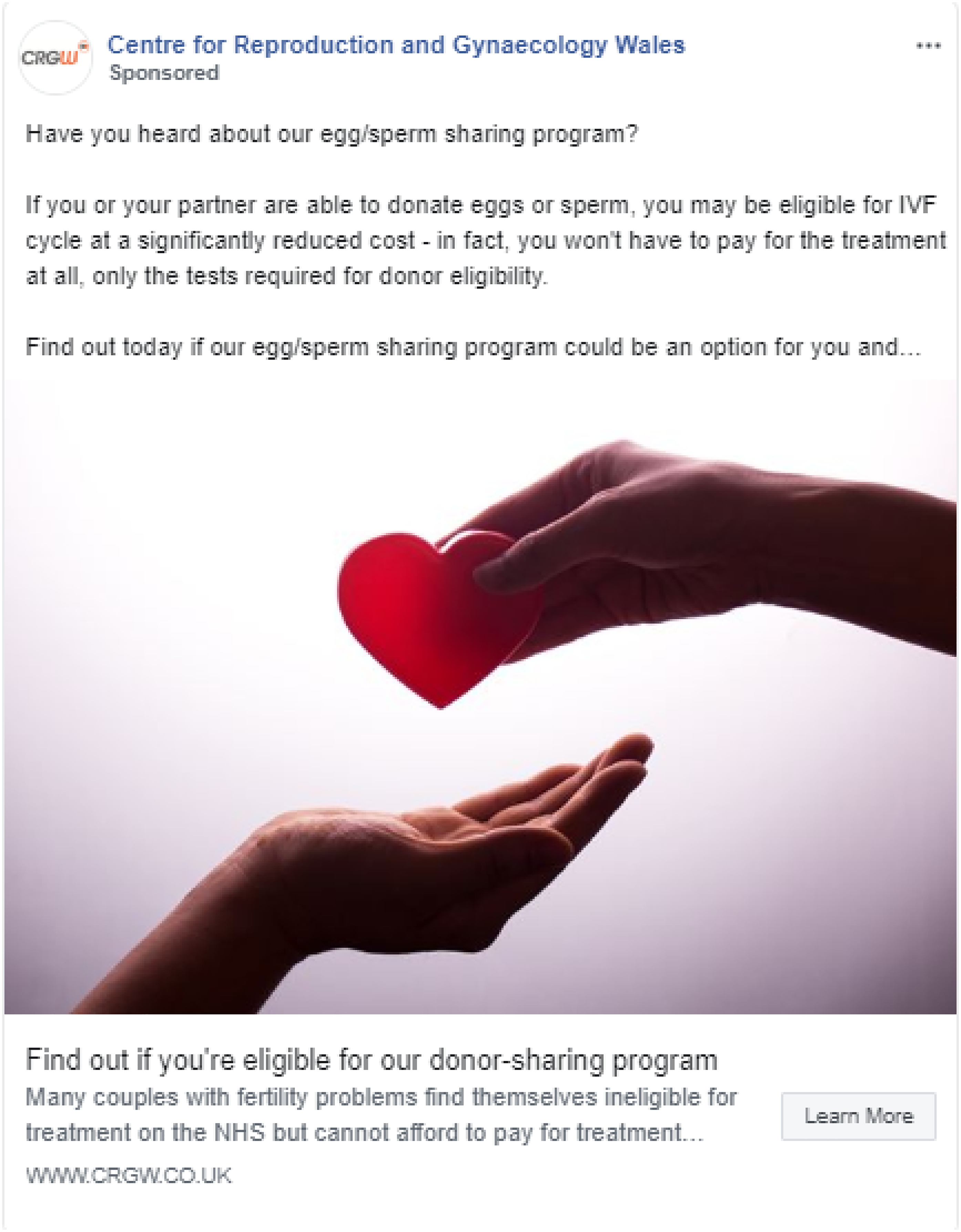
Centre for reproduction and gynaecology wales - egg/sperm sharing program.
The women imaged inhabit cafes and kitchens, parks and playgrounds, and go on casual walks and runs with other women, emphasising a life of leisure and ease which is underpinned by a traditionally feminine moral character, which is generous, altruistic and strongly associated with good motherhood (Rich, [1976] 1986; Almeling, 2006; Daniels and Heidt-Forsythe, 2012; Malacrida and Boulton, 2012). These adverts describe a space of homosocial intimacy, representing ‘girlfriend culture’: a distinctively feminised space which overwhelmingly features women in social interaction with other women where ‘shared knowledge of feminine popular cultures, rules, conduct and sociality’ facilitates relations of affect and prompts feelings of relationality (Kanai, 2019: 6; Winch, 2013).
Though such feminised relations have been celebrated for fostering queer sisterhoods (Rich, 1980; Driver, 2007; Bilić, 2019), we situate these imageries within Kanai's formulation of girlfriend culture precisely because the sisterly intimacy represented in such spaces ‘feels as though it closes down distances between women’ but is more ‘proximate to a girlfriend norm in which whiteness and middle class belonging’ function as the key connectors in these configurations (2019: 6). Importantly, Kanai situates girlfriend culture as most prominent in the affective networks facilitated and monetised by social media sites such as Tumblr and Facebook. The homogeneity of the adverts’ images and the language used to describe access to reproductive technologies and choices about fertility-time emphasise that it is only through engagement with a commercial agency that users can participate in this affective network and reap its various rewards.
These adverts present a framing of how one should perform femininity as a donor, recipient or woman engaged in social egg freezing which is narrowly structured by ideological market drivers for ‘marketable donors’ (Thompson, 2005; Almeling, 2006: 150, 154; Ringrose and Walkerdine, 2008; Curtis, 2010: 95; Kenney and McGowan, 2010; Almeling, 2011). Women may choose freedom from matter and biological time and renegotiate their bodies through biological matter that is separable via reproductive technologies; these ‘bits of life’ (Smelik and Lykke, 2008: xi), once mobile, carry layered meanings of empowerment, love, care and sisterhood. Traditional banalities of motherhood – such as food preparation or domestic labour – are not represented, but the inevitability of the end of carefree, consumer-driven sociality is implicit in the language of the adverts (‘not ready to start a family yet?’, London Egg Bank, 20 May 2019, 22 May 2019; emphasis ours) and is explicit in five adverts which represent women with babes in arms, with repeated reference to the becoming of women as mothers. Therefore, while many of the adverts make reference to ‘becoming’ or ‘having a family’ (BCRM, 12 July 2018; Jessop Fertility, 14 November 2018; London Egg Bank, 5 March 2019a, 2019b, 8 May 2019c) – a term which might conceivably include a new sisterly relationship with the recipient of a donated egg or another type of same-sex bond, including non-mother roles – there is a smoothing or flattening of the diverse possibilities of how that might play out. This is not a queerly flexible, always deferred becoming, but a clear path to an end point of properly heteronormative maternity. Rather than a space for disassembling and reassembling narratives of conception to fit a less rigidly heterosexual, dyadic parenting framework of conventional kinship (Thompson, 2005), these adverts repeat a corporatised vision of ‘girlfriend’ relationality made through conformity to a dominant classed femininity which is committed to the production of maternity.
These representations are compliant with post-feminist notions of liberation in which women are directed to act as ‘active, freely choosing, self-reinventing subjects’ (Gill, 2007: 164) through the act of ‘consumption as [a] means to fulfil one's desires, identities, and life goals’ (Mamo, 2010: 189–190). Through gift-giving, the would-be donor is promised a route to become an active, flexible, multiple subject: a sister to the imagined infertile woman longing to be a mother; a self-possessed career woman who can transcend her biological fertility-time; and a good proto-mother who has utilised her consumer choice to signal her procreative intent, accessing egg freezing to prove her commitment to future maternity. For example, while the adverts appear to minimise the value of biogenetic relationality (‘your donor egg will make another woman into a mother’), the very same adverts also present social egg freezing as desirable because it will ‘preserve your chance of having a baby in the future’ (London Egg Bank, 17 May 2019; emphasis ours): biogenetic relatedness remains the preferred option for motherhood.
These adverts represent a gift relationship, emphasised as driven by a ‘natural’ altruism, anchored in a feminine relationality which, as others have noted, works to legitimise motherhood achieved via ART (Ragone, 1994; Almeling, 2011). But this narrative is balanced by reminders of consumption in the lifestyles imaged, the specific version of relationality offered and the promised access to self-reinvention as future-mothers with its ‘continued expression of heterosexual individuality’ (Kanai, 2019: 129). The ‘selfless’ gift of biogenetic material is tempered by a discursive promise of a heteronormative future of genetic motherhood, and of individualised rewards for the would-be donor. This is a ‘de-kinning’ where the relations between donor and recipient are carefully managed, framed within a consumption-based girlfriend culture, with co-parenting or extended kinship discursively placed outside of the services on offer (Thompson, 2005: 171). This representational work frames exchange and relationships such that the possibilities of engagement with ART are structured through self-determination and the necessity of the clinic. This tempers more expanded notions of kinship (Gamson, 2018: 3; Smietana et al., 2018: 115).
Banal choices and dequeering of genealogical possibility
The adverts we examined offer a single story for egg donation: via performance of an altruistic femininity, women can access an idealised, effortless motherhood with individualised rewards of personal empowerment and safe heterosexual intimacies with other women. This clean, unentangled vision of engagement with egg donation and sharing is, as others have noted, something of an industry standard which works to smooth possibilities of ART, contain the ‘threat’ of non-heteronormative constructions of family and silence ‘the voices of ‘unauthorized’ users’ (Luce, 2010: 159).
Davies and Robinson suggest that ARTs are disruptive of the orderly narrative of ‘heteronormative reproduction’ (2013: 42); language used to describe conception which involves ART therefore seeks to (re)naturalise this process to (re)stabilise the reproductive primacy of heterosexuality (M’Charek and Keller, 2008; Franklin, 2013). However, in the adverts we collected, the commitment to this narrative project was not straightforward. None of the adverts referred to a father, and only one advert explicitly identified the necessity of sperm to fertilise an egg in order to ‘give someone the chance of becoming a family’ (BCRM, 12 July 2018). Only two adverts (London Egg Bank, 22 May 2019, 29 May 2019a) represent figures readable as fathers or men, and in both cases they are presented in pairings most readily understood as heterosexual. But the decentring of visibly heterosexual pairings and the absence of ‘fathers’ in these adverts do not indicate a straightforward deprioritising of traditional family forms.
Mamo suggests that the connections made as individuals seek access to genetic material are ‘producing and expanding the possibilities for the queer intimacies that consolidate into new family forms […] producing social relationships that may not have existed materially (although, relations so exist in imaginaries)’ (2013: 232).
These possibilities are not reflected in the adverts, which consistently represent and narrate egg donation as an exchange between two women, contrasting with other patterns of distribution of donor eggs to multiple parties (Jadva et al., 2016; Seed Trust, n.d.), and gay men seeking eggs for gestational surrogacy (Blake et al., 2016; Nebeling Petersen, 2018). The narrative of a ‘unique’ gift (London Egg Bank, 23 May 2019, 29 May 2019b) obscures the likelihood of egg donors finding they are part of a more complex web of biogenetic relations, or participants in the making of queered families. The emphasis on ‘uniqueness’ similarly obscures the prospect that donors might, for example, be invited into a constellation of family arrangements when children conceived with donor eggs choose to use social media sites, including Facebook, to find their ‘donor siblings’ (with whom they share half their genetic material) and build extended kin networks (see: Mamo, 2013; Andreassen, 2017).
Further, the framing of egg donation as ‘unique’ does not extend to the imagined outcomes of this gift's receipt. There is no suggestion of a sparkling community of diverse, unique relationalities, consolidating into a range of self-determined family forms; they offer instead a ‘normative sameness’ which disciplines subjects into, rather than challenging, dominant classed, raced and (hetero)sexualised forms of respectability (Skeggs, 1997; Luce, 2010; Almeling, 2011; Daniels and Heidt-Forsythe, 2012; Gamson, 2018; Kanai, 2019: 6). This is exemplified in the visual similarity of the adverts collected, which use a muted colour range, shallow depth of field and feature smiling women looking directly into the camera (see Figure 3, for example). The adverts examined here do sometimes exceed the boundaries of white and heterosexualised representations, offering representation of black women (both alone and with white women in seven adverts) – informed by market drivers for more donors from minority ethnic backgrounds (HFEA, 2019; Carter, 2020) – and ambiguously coded social/romantic relationships between women (see Figure 4 for example). But these subject positions are incorporated back into a regulating sameness which refuses to explicitly label non-heterosexual and non-dyadic parenting arrangements.
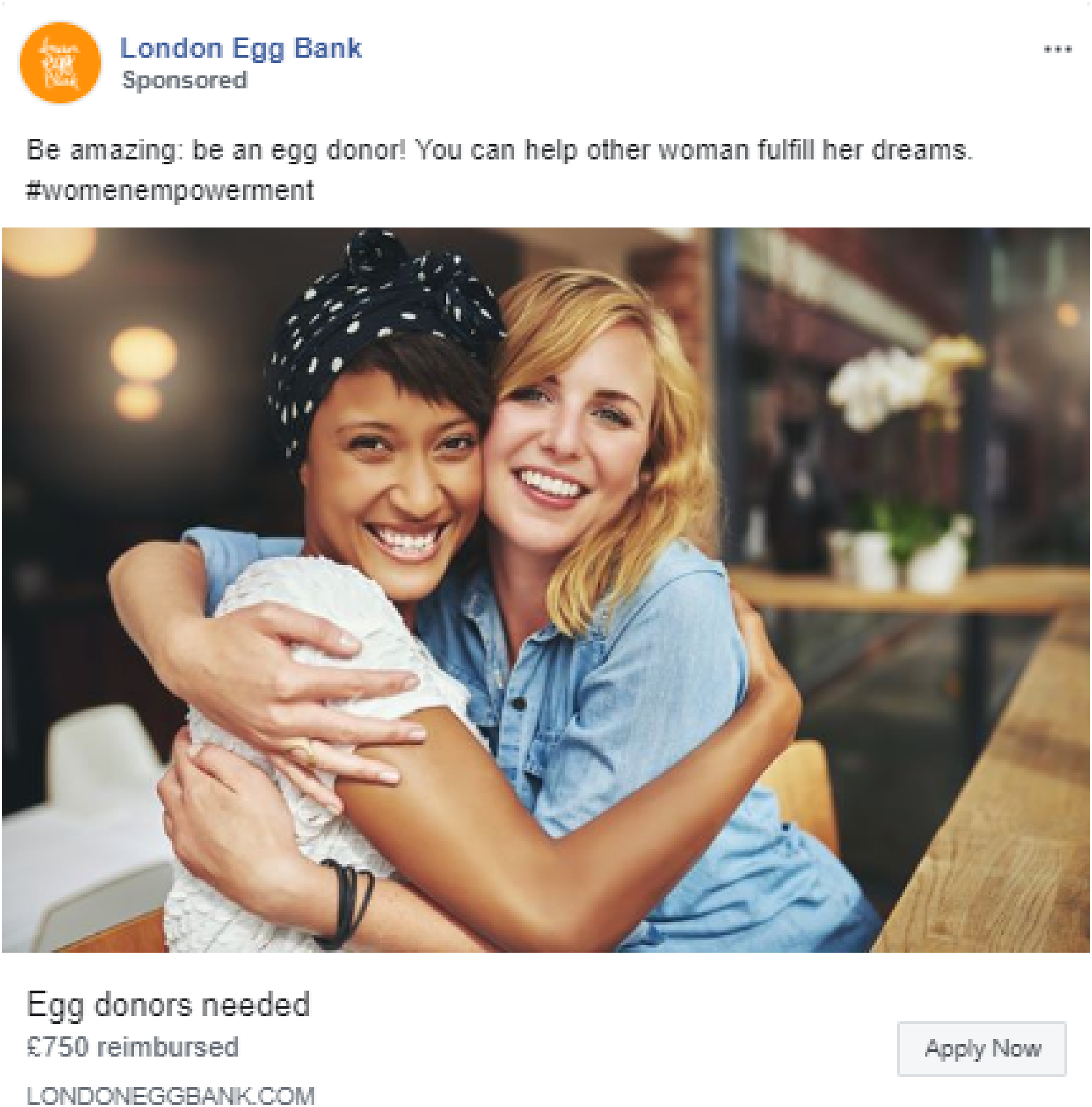
London egg bank - Be amazing: be an egg donor!

London egg bank - fertility assessments.
This flattening of difference and rigid emphasis on biologically neat exchanges between women represents a derisking of ART as potentially disruptive technology and a folding in of women to a single coherent subject position (Richardson, 2005) where biological matter can be exchanged discretely between two female bodies, without reference to other reproductive or donor partners. This emphasis on the ‘genetic similarity’ of egg donor and recipient, achieved through the homogeneity of the images, is key in naturalising genetic transfer to produce a ‘natural’ mother (Thompson, 2005: 156). In these adverts, genetic similarity is coded through a shared performance of femininity. Queer arrangements of family, and performances of different and disruptively non-essentialised femininity, are excluded to protect the ‘naturalness’ of ART as a form of heteronormative reproduction. The increasingly expanded and genealogically messy families facilitated through ART, and the kin and reproductive arrangements of non-heterosexual parents (Vaccaro, 2010; Mamo and Alston-Stepnitz, 2015; Blake et al., 2016; Reed, 2018), are carefully and specifically excluded in these adverts in favour of a ‘utopia of sameness’ (Kanai, 2019: 4), where donation of eggs is from and to gender-essentialised women's bodies.
These adverts represent a corporatisation of the queer intimacies which Mamo suggests ART can allow; a colonisation of the reflexive and critical imaginative processes which consolidate into new kinship structures and provide new genealogies. Thompson outlines how ‘procreative intent’ is used to naturalise ART as part of heteronormative reproductive scripts; it ‘propels the sorting and classifying of some things and not others as the biological facts of relevance’ (2005: 177). This sorting and classifying extends to social relationships and characteristics; producing mothers comes not just from genetic material, but from inheritances of heterosexual femininity which naturalise and legitimise the mother/child produced through technologically mediated reproduction. Although the visual coding of relationships between women is sometimes ambiguous, the lack of discursive clarity (otherwise achieved by explicit naming and representation) ensures that queered genealogies and expanded kinship are not represented as a legitimate choice or core outcome of engagement with these technologies. A specific type of femininity codes for an always heterosexualised motherhood. We therefore characterise the representations’ content as indicative of a banal ambiguity wherein the symbolic flexibility and description of types of relationships which might be built through engagement with ART appear to offer space for choice, but the adverts ultimately remain rigidly narrow in the kinship and genealogical possibilities which are endorsed.
Genealogical possibility is de-queered, and flattened in the framings offered in these adverts, at least partly as a way to secure ‘reliable’ donors (Curtis, 2010) who ensure clinics can assure their commercial success by presenting themselves as the most reliable, or only, route to conception (Mamo, 2013). In achieving this, the complexity of gendered bodies is also flattened (Thompson, 2001; Epstein, 2018: 1047): the logic of the heterosexual matrix is deployed to guarantee ‘natural’ motherhood, uncontaminated by queer and/or unnatural technological intervention, and making choices about fertility-time is only available to people with ovaries who perform proper femininity. In the final section, we consider how this essentialising of bodies in the service of naturalising ART is supported by the algotargeting framework which delivers these adverts.
Gender targeting by design and the essentialising of bodies
In the discussion so far, we have largely focused on what is present or absent in these adverts as media texts. In this final analysis section, we turn to ART processes and algotargeting mechanisms that produce and deliver these textual representations to the social subjects deemed of interest to egg donation companies.
The use of data indicating a user's gender to target adverts for all manner of goods and services on social media platforms is ubiquitous, and Facebook is no exception. Bivens and Haimson argue that gender is not only regarded as an unproblematic way to utilise users’ data and deliver content but is actively ‘baked into platform design’, concluding that both advertisers and social media platforms are ‘demographically obsessed with gender’ (2016: 7, 1). By targeting ‘women, aged 18–35’ with adverts promoting egg freezing, donation and sharing, Facebook anchors the algorithmically inferred woman to essentialist constructs of a ‘female’ body that name and constitute ‘woman’ as fertile, child-bearing, and innately interested in such formations.
What are the consequences of such a biologically and technologically narrow address on imagining different genealogies and familial arrangements? Bucher (2016) describes the encounter between a user and content which is algotargeted to them as mediated by the ‘algorithmic imaginary’. The algorithmic imaginary describes the imaginative leap users must make after recognising they have been identified as the ‘anticipated user’ of a technology, good or service and the work they must then do to reconcile this external, apparently objective evaluation of them with their own sense of self (Gillespie, 2014; Bucher, 2016: 34–40). As Bucher states, ‘what the algorithm does is not necessarily “in” the algorithm as such’ but is constituted partly by users in their encounter with it (2016: 40). On being delivered these adverts, Facebook users confront a specific narrative. Potential transgressions of biogenetic connections, orderly reproductive narratives and biological time made possible by these biotechnologies are partially blocked. The explanations for women's relationality, the presumption of reproductive participation and the particular value of their bodies limit other possibilities. At the moment of meeting these adverts, the targeted user must negotiate their algorithmically determined location as ‘woman’ and interpret the set of choices presented as for them. Cohn equates this to a form of Althussurian interpellation, arguing that algorithmically recommended content (such as being marked as ‘interested’ in egg donation campaigns and therefore exposed to them) interpellates us as subjects ‘by asking us to continually consider not just whether we want what they offer but also why they imagine that we are the kinds of subjects that could conceivably desire their options’ (2019: 8). This form of interpellation occurs simultaneously, and in isolation from other subjects who are being algorithmically hailed as fertile women by the adverts. The adverts are uniquely and ephemerally placed in individuals’ newsfeeds in ways that are ‘narrow’-cast (‘female’ and ‘18–35’) but decoded in the highly individualised setting of a personal newsfeed, from a black-boxed delivery system which cannot be tracked or confidently connected to other users’ viewing experiences. Furthermore, because the adverts are not deemed of political or national importance, the Facebook Ad Library does not disclose any impression or targeting statistics about egg donation, so users do not and cannot know who else is subject to this algorithmic interpellation.
The reproductive technologies which background the procedures promoted in these adverts allow for the physical separation of the egg from the body. Such a separation is mirrored in the technology used to target users to receive these adverts whose logic insists gender is binary and ‘women’ can be easily distinguished from ‘men’. Of course, neither technology is as straightforward or as precise as imaginaries around them suggest; Facebook targeting is blunt and even if it successfully serves these adverts to women who are, for example, aged 18–35, it has no capacity to target only women who are willing or able to donate eggs or who seek fertility preservation procedures. Facebook's bluntness should not be considered an ‘error’ (Cheney-Lippold, 2017; Cohn, 2019); it represents a choice to dismiss other ways of being which do not fit the algorithmic system. This acutely isolated hailing seems at first to be at odds with the grammatisation of users’ relational labour that Facebook employs to make profit (Jarrett, 2015; Baym, 2018). However, the categorisations imposed on users through targeting mark the moment where the expansive and networked social media subject is isolated and reduced to the fixed, knowable consumer (Bolin and Andersson Schwarz, 2015). The data generated via users’ relational labour (the click-throughs, ‘likes’ and comments that identify users as ‘women interested in egg donation’) become the advertising ‘target’ that easily anchors the consumer to blunt and binary market-driven identifiers. Similarly, egg collection, sharing and freezing are far from guaranteed to produce ‘mothers’ or ‘families’ (HFEA, n.d.), to reliably preserve fertility for women considering a reproductive future (Petropanagos et al., 2015) or to play out as a one-to-one transfer between two women, as the adverts suggest. The egg holds together this broad imaginative scope and its promise is anchored in reproductive hope (Franklin, 2006). This core narrative is circulated through social media advertising technologies which are designed to reliably dividuate users into coherent and discrete categories.
Like any media audience, web users find myriad ways to ‘critique, ignore, laugh at, negotiate with and otherwise respond to [the] recommendations’ of algorithms (Cohn, 2019: 8). We call at this point for research into egg donation advertising that can empirically engage with the nuances that might be produced in the computationally structured but not necessarily determined encounters with algotargeting. Resistant or oppositional readings are of course always possible for audiences of any media texts; such critical responses do not negate the processes by which targeted advertising algorithms attempt to fix identity to to an essentialised body, and an essentialised body to ‘inevitable’ fertility choices. Algotargeting prompts users to navigate egg-bearing or not egg-bearing, properly reproductive or incomprehensibly non-reproductive, female or unintelligibly non-cisgender, non-fertile subjectivity. Choices in how to decode the adverts are made following a process that has first rationalised, separated and isolated the targeted user as the correct subject for this (limited) range of options. The essentialising and isolating way in which women are algotargeted represents a pulling up of the drawbridges around women's bodies and sociality to exclude even the possibility of kinship or alliances with men and people whose gender does not fit the algorithmic categorisations.
Conclusions
This article sought to understand representations in advertising of egg-sharing and donation within a wider political, economic and structural context of algotargeting. In our analysis, we found that a banal ambiguity underscored the images and narratives on offer – egg donors are positioned as empowered consumers, gift-giving girlfriends and post-feminist subjects who transfer eggs to the ‘same’ bodies. The queer promise of the spaces imaged (free from the nuclear family, the banalities of motherhood or the presence of fathers) is subject to a de-queering that excludes other ways of making a family through the rigid logic of ART marketing and Facebook's structural architecture.
Messy subjectivities are not accommodated by Facebook's targeting algorithms and kinship solidarities are imagined as ultimately dissolved by the individualised rewards accessed by gift-giving. The narrative of exchange presented in these adverts is simple and straightforward. In this respect, it echoes the uncomplicatedness of Facebook's targeting algorithm which makes binary choices about a user’s gender (man or woman), age (fits the range or doesn’t) and fertility (automatically fertile by virtue of fitting the previous two criteria). It is a symbiotic relationship in which the certainty of the algorithm used to select which users receive these adverts functions as a guarantee of the simplicity of the exchange proposed. Egg donation, freezing and sharing are presented as emotionally disentangled, disembodied, clean exchanges. The clarity in the narrative of who this is between (two women with a common biology) is reinforced through the users’ algorithmic imaginary which provides an awareness of the algorithm isolating them from the general population, and their new primary location as within a group of ‘women aged 18–35’. Isolating women in this way clarifies the market for the services these clinics offer; narrates a straightforward exchange without life-long kinship and biogenetic entanglements with a web of players; and rationalises egg sharing and donation as a more typical commercial exchange in which something is offered, a compensatory payment is received and the association of all parties is concluded.
The rigidity and exclusion in the way these adverts present egg donation and freezing services are tempered, somewhat, by the ambiguity of the images, as discussed above. But whilst both the technology at play and the biogenetic relations created may hint at a queering of genealogy, the selection and targeting of women and the restrictions in who is narrated as entangled in these processes represents an attempt to control and rein in an uncontainable, messy and, above all, non-commercial vision of kinship and genealogy. The cleanness of the algorithm which separates women from men, and bodies from an entanglement with social and cultural meanings of gender, is the ideal technology to support the rationalisation, derisking and marketisation of the genealogical possibilities opened by ART.
