




Abstract
For lesbian, gay, bisexual, transgender and queer + people, family and peer support are often important in their identity development during early adulthood. Young queer adults who have moved out of the family to pursue university education often seek out a sense of community and a feeling of kinship with other LGBTQ+ individuals as they journey through their identity transition. Based on semi-structured interviews with eight self-identified queer female students in a public university in New Zealand, this study examines their experience of ‘stretched kinship’ – moving out from the family (‘leaving home’), building peer connections in shared student accommodations (‘making home’) and developing more independent identities (‘coming out’) in relation to their original and alternative families. This paper helps us make sense of young queer people’s experiences transitioning from the family to university towards independence and adulthood.
Along with the increased social acceptance of lesbian, gay, bisexual, transgender and queer + (LGBTQ+) people in recent decades, queer people’s kinship structures concerning family and peer relationships have caught wide attention in gender and sexuality studies, expanding the concept of kinship from biological and legal (bio-legal) connections to various ‘family-like’ social connections and peer support networks built by and for queer people (Furstenberg, 2020; Levin et al., 2020). That said, how queer female university students negotiate ‘family’ and ‘kinship’ in relation to their nonconforming sexualities remains an underexplored territory. This paper focuses on how young queer women in New Zealand transition out of the parental family to pursue university education, and how they build peer connections at the university as a form of alternative family, to examine their identity development as a formative process during early adulthood.
First, the process of leaving home is arguably an important part of the transition from adolescence to adulthood that often shapes the direction of young people’s lives. This experience offers many young people their first opportunity to structure their lives away from their families and childhood/adolescent communities (Gierveld et al., 1991; Pustulka et al., 2021). This process presents a marker towards adulthood, independence and identity development (Holdsworth, 2009; see Asakura and Craig, 2014) that young people often associate with ‘freedom’, ‘transgression’ and ‘life itself’ (Creswell, 2006: 3). Second, making home refers to how students build and share an independent ‘home’ with their peers, often housemates and flatmates in shared accommodations during their study, forming an ‘alternative kinship’ or ‘family of their own’, particularly for university students whose time studying is often perceived as transitional and temporary. While the ‘family home’ is more permanent, both as an abstract concept (a family that one can return to) and as a physical place of abode (a house that hosts one’s family and childhood memory), the ‘student home’ is more transient but nonetheless offers structural and family-like social support at a significant time of young people’s identity formation and transition. Henceforth, the experience of leaving home and making alternative homes is often a fluid process of becoming (Pustulka et al., 2021) that brings together two types of home – one original and one alternative – and entails a dual lens for analysis.
Third, we use ‘coming out’ as shorthand for the formation and transition of young queer people’s sexual identity. Previous international research on the identity formation of queer students indicates that many of them come to terms with their sexualities at university after moving out from home (Brandon-Friedman and Kim, 2016; Evans and D’Augelli, 1996; Legg et al., 2020; Rhoads, 1995). Evans et al. (2010) have noted that students who left home for education tend to find the university a more inclusive and safer environment than the family, as a result of different expectations and beliefs in student communities compared to that in the original family and community (Brandon-Friedman and Kim, 2016; Evans, 2001). Students’ access to supportive social networks correlates with their success at university, particularly in their first year out of the family (Thompson et al., 2021). Forming compatible relationships and family-like peer connections among students also leads to better overall mental health outcomes (Wilcox et al., 2005). In short, existing scholarship has connected coming out with leaving home and making home in a dynamic process of becoming to understand young queer students’ identity.
Our point of departure lies in our focus on the conceptual and practical issue of the ‘family’ in young queer people’s identity formation and transition. Early kinship studies often saw kinship as ‘grounded in the division between the order of nature (i.e. shared biogenetic substances) and the order of law (i.e. code of conduct)’ (Levin et al., 2020: 2), before scholars came to recognize the cultural influence of what constitutes a kin group (Shapiro, 2016). The emergence of queer studies saw the reconceptualization of the institution of the family, leading to such theories as Kath Weston’s ‘chosen family’ (1991) that delineates family-like social groups constructed by queer people (Levin et al., 2020). Considering the shared experience of family denouncement and abandonment among queer people (Hull and Ortyl, 2019), Weston has discussed how close friends, partners and ex-partners form a kind of chosen family. She takes the family as ‘not… an institution, but a contested concept’ (Lewin, 1993: 975), denouncing ‘the permanence culturally attributed to blood ties’ in favour of ‘choice and love’ through queer people’s agency in building their own families (Weston, 1991: 505).
Recent research conducted in North America and Europe suggests that the chosen family often comes into being around three themes: emotional support, mutual understanding and identity affirmation (Kaufman and Johnson, 2004; Levin et al., 2020; Nelson, 2020). Other scholars have argued that the university setting is often the first point of intimate peer contact for many queer people (Brickell et al., 2018; Lewis, 2014; Rhoads, 1995; Ueno et al., 2014), potentially leading to improved self-perceptions and general health and wellbeing through peer support that may not be available at home (see Blockett, 2017; Braithwaite et al., 2010; Petrocchi et al., 2020). Adjusting to tertiary education, independent living and identity construction can be greatly assisted through peer support groups (Brandon-Friedman and Kim, 2016; Schmitz and Tyler, 2018b). Meanwhile, the emotional and economic supports from the original family still play an important role, and today’s young queer people often maintain their family connections while transitioning towards freedom and autonomy (Holdsworth, 2009; Krzaklewska, 2019; Wei, 2020). Recent studies in Asia and North America have also shown that young queer people’s socioeconomic background is directly linked to how their families respond to their identity disclosure (Schmitz and Tyler, 2018c; Wei, 2022).
Extending and deviating from the concept of ‘chosen family’, one of us (Wei, 2020, 2022) has developed the concept of ‘stretched kinship’ to understand the relationship between young queer people and their families of origin. We argue that queer people’s mobility for education and employment often leaves their family relationships physically and emotionally detached yet still in a resilient connection, as young people negotiate their sexuality across a distance with their family (2020: 33). The term ‘stretched’ refers to the tension embedded in these relationships and the physical/emotional separations between queer people and their original family across time and space, as many young adults still have not or cannot come out to the family. The term illustrates both the physical extension of kin ties stretched through the geographical distance and the emotional strains and stretched feelings in the process of kinship negotiations, when the nonconforming sexuality is hidden away from the family. Likening this situation to stretching a flour dough, we argue that the constant negotiation, or ‘kneading’ of the stretched kinship (Wei, 2020: 154), is a dynamic and resilient process that often leads to uncertain outcomes as both parties must carefully balance and navigate a precarious situation when disclosure or open discussions of sexualities are often difficult, if not impossible, in the family. The process of leaving home, making home and coming out often constitutes the three key pillars in the conceptualization and practices of stretched queer kinship – a concept that we engage in this paper as an analytical framework to consider how young people negotiate nonconforming sexualities with their families through peer support at university.
The New Zealand context
Aotearoa New Zealand, where the research was set, is generally a progressive country in terms of gay rights as seen in the same-sex marriage legislation in 2013 and the current government efforts to ban conversion therapy, although it is never short of pockets of conservative communities and families, as we see in this study. Despite the positive social changes, queer people in New Zealand are still subject to ‘ongoing marginalisations and discriminations’ (Browne and Nash, 2013: 203). In terms of young queer people and students, New Zealand researchers have overwhelmingly directed their attention towards the experiences of secondary school pupils, such as victimization of queer and gender-queer youth, inclusivity through school support systems and curriculum-based representations of queer persons and history in the classroom (Allen, 2015; Bruce and Horsley, 2018; Quinlivan, 2012; Sexton, 2012). For queer students at universities, there has been an emphasis on student experiences of homophobia, heterosexism and support in the university environment, including the classroom and residential halls (Allen et al., 2020; Joule, 2015). However, very few scholars have considered how queer students negotiate their identity through various forms of ‘family’ as emerging adults in New Zealand.
Further, through the lens of stretched kinship, the distance (‘moving out’) and the separation (‘leaving home’) from the family are both a blessing and a misfortune for young queer people in New Zealand. On the one hand, they can explore and come to terms with their identity and sexuality away from the watchful eyes and the immediate pressure for conformity in the family and the community. On the other, young people are also deprived of close family care/support, which adds to the ‘stretched’ feelings of kinship as one’s sexuality and identity may be isolated from the family and difficult to be negotiated and reconciled within the original kinship structure, especially when the original family is less tolerant to accept nonconforming gender and sexuality. Making peer connections, or ‘chosen families’, is hence important for young people for mutual support and understanding. Further, following Wei (2020), we believe that ‘chosen families’ may be better reframed as ‘alternative families’ established through shared accommodations and living spaces, as young generations today are often driven into shared flats and houses by circumstance (i.e. high rent and housing cost in New Zealand), not by choice, and may stay in such ‘alternative families’ for a long time at the start of their career as many of them cannot afford to buy a house in major urban areas. This reframing of ‘family by choice’ to ‘family by circumstance’ is to highlight the plight facing young people in today’s New Zealand after a decade’s surge in housing costs that has intensified existing socioeconomic and intergenerational inequality, making ‘alternative families’ even more important and inevitable for many young people as they moved out from the family.
It is against this context that we situate the current study. Almost a decade after New Zealand legalized same-sex marriage, and at a time when queer issues are once again making headlines in this country through the government’s efforts to ban conversion therapy, we are curious about how today’s young queer people experience their identity formation during early adulthood at university through different forms of family. We believe that this is a timely and important topic when the young generation is going through rapid social, economic and political changes concerning gender and sexual diversity, especially when queer students’ experience is not often examined through the lens of kinship and family both in New Zealand and beyond. In this pilot study, we focus on female students because this is also an under-researched group based on our review of current literature, and also because the lead author’s identity as a queer woman has made it easier for her to recruit participants and build rapport. We continue to discuss our research methods in the section below.
Method
We adopted a qualitative method to collect data through semi-structured, in-depth interviews. Patton (2015) argues that a qualitative approach works well when inquiring how people and groups make meaning of their experiences, enabling a rich insight into the participants’ behaviours (Creswell and Poth, 2018; Merriam, 2002). More precisely, we adopted a narrative interview method as it allows the participants to articulate their stories as coherent narratives of their experiences (McAlpine, 2016), which helped us better understand and examine their process of transition from home to university. We have chosen this method to answer our research question: how do queer female students experience the process of leaving home, building alternative families and forming more independent identities at university, or what we have synthesized as ‘stretched queer kinship’ in which identity development (‘coming out’) is inseparable from ‘leaving home’ and ‘making home’ for today’s young queer people.
Participant information.
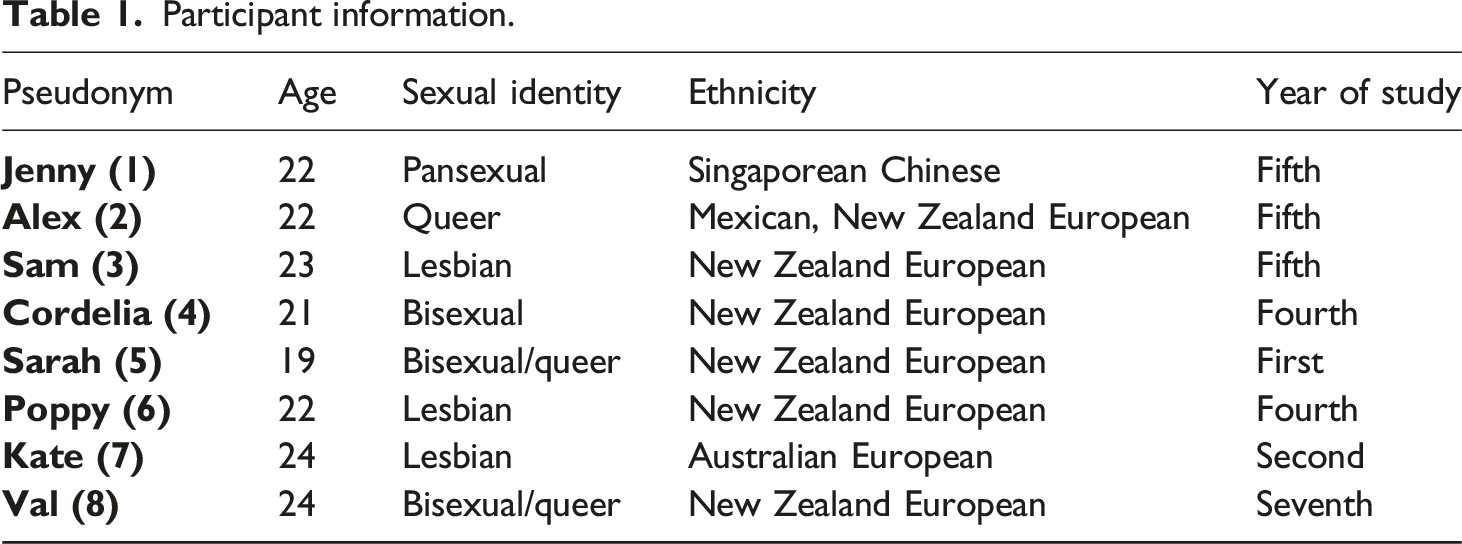
The interview data were coded through an interpretive approach (Chun Tie et al., 2019) and processed using NVivo for thematic analysis to ‘capture complex, messy, and contradictory relationships’ in the data (Damayanthi, 2019: 2). Interpretive research assumes that individual human experiences and social contexts shape their social reality (Adorjan and Kelly, 2016), which helps us understand the students’ experiences. Drawing on Riessman’s (2008) considerations of researcher biases in interpretive research, the lead author carefully reserved the analysis to how the participants themselves constructed the meaning of their everyday experiences to ensure reliability, as she was potentially an ‘insider’ in the targeted research group based on her own identity. The second author (an ‘outsider’ to the female student community) had overseen the process and checked the analysis for validity, and contributed towards the discussion and led this paper towards publication. The analysis stopped at the point of saturation when no new data would bring additional insights to the research question (Patton, 2015) and no additional properties or relationships emerged from the data (Bloor and Wood, 2006). The findings from our study are presented and discussed below.
Leaving home: Moving out as coming out?
All the participants had noted the significance of their mobility (from home to university) during their sexual identity development and transition into adulthood, with positive and negative implications attached to the issue of leaving home and moving out. For them, leaving home acted as a symbolic process to gain freedom as emerging adults. Sam, for example, said she was ‘incredibly excited’ and ‘could not wait to move out of home’, as she felt ‘restricted’ in her family due to the lack of acceptance of her queer identity. Another participant, Jenny, had a similar experience in which she felt that leaving home allowed her to be ‘free to do what [she] wants’, and it was ‘really nice to be able to be an adult’.
Also, Jenny emphasized how gaining significant distance represented an escape from the family. Leaving home helped alleviate the pressures she felt from her family to conform to their expectations about her sexuality, the friends she made and how she chose to spend her time outside of school and work: I wanted to move out to have more freedom… It was a really liberating feeling… I think I associate that [feeling of] distance… that you do not have to adhere to these societal roles or the pressures [family] put upon you. I just know that you can kind of … be true to yourself.
Val expressed a similar sentiment that her choice of a university in another part of the country was to keep her separated from the immediate family pressure. Val described her parents as ‘conservative’, particularly towards the queer community, and judgemental and unsupportive of her pursuing her degree. She explains: I was trying to get as far away from my parents as possible… my decision to stay [in this part of the country] contributed a huge amount to [the escape from the family].
However, some other participants prefer to live close to their families. Cordelia, for instance, likes her family’s proximity to the university, visiting home several times during the year. Cordelia mentioned that it was the distance from her conservative community, rather than her family, that was more significant for her to gain independence and a ‘greater sense of self’. Leaving her community allowed her to ‘meet people who are similarly minded’ regarding gender and sexuality, which helped her develop a greater sense of herself as a queer person and an adult with independent beliefs from the environment she grew up in.
For all participants, their mobility (moving out) is also a journey of identity formation (coming out) in a safer and more affirming environment. The link between mobility and identity is made apparent by Jenny, who felt that she could finally ‘explore [her] sexuality’, which she could not do safely and openly at home. Sam also recognized moving out as a chance to explore her queer identity, recalling feelings of ‘hope’ and ‘excitement’, expecting the university community to be less judgemental of her being queer: I remember distinctly thinking: ‘Oh, this [leaving home] is going to be the first time in my life where I can be “out”’… I researched how [the University] had their queer support network available… and [books on queer issues] in the library. That made me super excited.
Current literature on queer university students indicates a close relationship between the journey of identity formation and the students’ mobility (Evans and D’Augelli, 1996; Evans et al., 2010; Rhoads, 1995), or ‘a rite of passage’ that has significant positive impacts on students (Downing, 2012: 138) ranging from academic success to freedom and peer support (Downing, 2012; Mulder and Clark, 2002; Holdsworth, 2009). The last part, peer support, was also a motivator for some of the participants to move to the university: … at home, I was in a slightly conservative environment … like I always felt kind of repressed being in the Christian environment, just because I did not get a lot of [their] views, especially around things like… being gay, and then I think when it came to university many my friends that I gravitated towards were more open-minded… (Jenny). I always kind of thought that [the University] has a reputation. There might be a lot of queer people. There may be my first relationship down here… (Sarah).
However, feelings of freedom and liberation often come with anxiety and apprehension. At any rate, the rite of passage from leaving home to coming out involves a strong emotional dimension. Students are often anxious about whether they would fit in and be successful at university, as well as about their queer identity. For all but one participant, moving out for study was the first time they had left home for an extended period. They described this experience as daunting. For instance, Val regarded her transition from the family into independent living as challenging: I was quite nervous as well; I think because my parents are pretty involved in my life, I think I was a little bit worried about living on my own, and like being self-sufficient for the first time because I did not really know how to do a lot of things myself…
The apprehension of leaving home and coming out also involves feelings of uncertainty, in addition to self-doubt and second-guessing of one’s ability to adapt to a new environment: I just felt like it was a standard kind of living away from home when you are like, oh I'm free to do what I want, but also, I am too young to know what I want, so I am just gonna do random things to spend my time and this is what being an adult is (Jenny). It was scary… It is like, first time going away… and you need to make new friends and live your life… (Alex).
While anxiety about change and separation was a shared experience among the participants, they also thought that freedom outweighed the negative aspects of leaving home. Cordelia noted that, although apprehension was part of her experience, it was not significant enough to hold her back from undertaking the journey. The excitement of being able to explore the university community and meet new people more aptly defined Cordelia’s experience, compared to her concerns of moving from a rural community to a university in the city: I was very anxious … But I think it was exciting because I was never a rural person [albeit from a rural background]. I mean, like, I could start to be myself.
The participants illustrated the emotional complexity in the leaving home process with mixed feelings of liberation and anxiety – a ‘trade-off’ that they were generally willing to accept as the benefit outweighs the risk for them to explore and express their sexualities. This process is further supported and complemented by their ‘alternative families’ and peer connections with other queer students at the university, which constitute another important dimension of their identity-journey and the transition from home to ‘freedom’, as discussed below.
Making home: Young people’s alternative families
Once arriving at university, particularly when they began flatting with other students, the participants noted that they discussed their sexual identities, mental health and general life stressors more openly with their peers. Alex, who had not disclosed her queer identity before university, stressed how the close relationships she formed with other queer and questioning students helped her come out and made her feel more comfortable with herself. She noted how talking about queer issues such as struggling with internalized homophobia and identity uncertainty – issues she had faced ‘alone all throughout high school’ – were reconciled in her peer group in her first year of study: I distinctly remember [in] my first year, me and my [hall of residence] floor were sitting in the hallway late one night, and one of my friends was like, ‘Hey guys, you know, I am bisexual, right?’ and then all my other friends were like, ‘Oh me too’. I knew that this is my time to say it, so I said, ‘Yeah, me too!’… it was fantastic… it feels really freeing to be able to talk about that.
Shared experiences of being queer alleviated stress and uncertainty relating to coming out and helped build peer connection and camaraderie, providing a foundation of comfort not necessarily felt in their original family. For Jenny, forming close relationships with other queer students, particularly other queer women at university, was like having ‘a beacon of safety’ and ‘open-mindedness’ in these relationships: I feel like the shared experience is a big thing. That is what bonds people… when I meet up with queer friends, I feel like you can talk to them about a lot of different things, not just gender identity and sexuality, but in general, they tend to listen and engage with you about those kinds of conversations that might be difficult to have with other people.
The participants framed these ‘alternative kinships’ as generally safer and more open, which helped them feel more accepted. This sentiment is highlighted by Poppy in particular: … [we] just have a lot of the same things in common because we all tend to like the same stuff and [have] gone through the same experiences, and we tend to have the same political opinions… So, you never really have to try altering yourself in [these] spaces.
Interestingly, over half of the participants explicitly used the term ‘chosen family’ to describe the alternative queer kinships they have established with their newly made friends in shared accommodations at university. The relationship functions more like a ‘family’ because of the shared feelings of unconditional acceptance and understanding; if such acceptance and openness are not accessible at home, then ‘alternative families’ will become the place where queer students find the all-important sense of belonging and kinship-like structural support, as shown by the interviewees.
However, the family-like connections with other queer peers cannot be generalized to account for queer female students’ experiences in the university. Alex, for instance, said that she could not discuss issues of sexual diversity with non-queer people due to their lack of ‘unmediated’ understanding of being queer. When she brought up issues relating to her queer identity with non-queer friends, Alex felt that they were ‘disinterested’ and ‘disengaged’ as they could not relate to it first-hand. For Alex, the added stress of explaining the nuances of the queer experience, including internalized homophobia and family rejection, stopped her from initiating these conversations in the first place. Another participant, Sam, shared a similar experience with non-queer students, who often failed to offer that kind of family-like support and understanding as other queer students had done in their alternative families.
Both Alex’s and Sam’s experiences support current literature on alternative kinships that ‘peer support [is] the most significant resource’ (Blockett, 2017: 802) for minority students as they navigate independent living in a traditionally heteropatriarchal institution. Levin et al. (2020) noted how unmediated understanding of identity struggles between queer friends/flatmates played a significant role in building and maintaining alternative queer kinships, particularly when the biological family is absent. In this sense, unmediated understandings of the ‘queer experience’, including hiding one’s sexuality from the family prior to moving out/coming out at university, is a common aspect of building and sustaining peer-based kinships between queer female students in alternative families.
However, the participants also brought up how they maintained and even strengthened their relationships with their families while living out of home. As shown in the interviews, the participants have to constantly balance their alternative families with the original ones while coming to terms with their sexual identities – a form of stretched and distanced kinship. That is to say, ‘making home’ at university not only led to the development of new alternative kinships and growing independence but also gave the students a space to reflect upon their family and kinship connections. All the participants had remained in contact with their families since moving to the university, paying regular visits back home and/or calling often. For several students, particularly in their earlier years at university, maintaining these relationships meant that they still had access to emotional and financial support from their parents, which helped immensely with their transition to independence.
Here, alternative kinships and peer support can also help with the stretched kinship negotiation with the parental family (Wei, 2020: 33–41). Among the participants in this study, Sarah mentioned that her mother had ‘not been open to talking’ about her identity, forcing her to navigate her sexuality alone while living at home. However, since moving to university, she had built a supportive relationship with her flatmates, all of whom were queer. Through her flatmates’ encouragement, Sarah eventually came out to her mother over the phone, which was an overall positive experience for her. Although Sarah’s mother did not react strongly to her coming out, appearing to ‘not care’ about her sexuality, Sarah’s coming out made room for her to bring up conversations around her queer relationships and experiences with her family, which had had a massive impact on her self-acceptance and identity development.
Kate, a student from Australia, had a similar experience with her father when she came out to him over the phone. Kate mentioned that her relationship with her parents had two ‘very separate dynamics’, with her being closer with her mother, the primary caregiver in her family. After moving to New Zealand and starting university, Kate met another student and entered her first relationship, which she felt helped ‘solidif[y]’ her queer identity and pushed her to ‘be more open to [herself]’. Kate’s experience at university encouraged her to tell her father about her identity and her partner. In Kate’s opinion, this conversation helped grow her relationship with her father: Being in my first ‘proper’ queer relationship … pushed me further out of the closet… telling my dad that I had a girlfriend, I think solidified in his mind as well that I was queer…We talked about queer issues in the past but it never really came back to how I am linked to that… me coming out I think helped centre myself in those conversations…
Negotiating queerness was common in the participants’ stretched kinship as they worked to ‘make home’ at university and reconcile with the family. As seen in Wei (2020), alternative families often helped young queer people explore their sexual identities in more queer-friendly settings with the help of other queer people. These queer ‘kinships’ have given the students the space and support to develop and negotiate their identities in alternative families before doing so in their real family, as further discussed below.
Coming out versus coming home?
Part of how the students conceptualized ‘family’ involves their experiences of returning home. Although the participants can come out at university, which is a significant part of their independent identity formation and transition, many of them noted a shared experience of ‘retreating’ into their younger selves when they visit home during study breaks. This aspect of homecoming can be emotionally challenging, as Sam demonstrates: … going back home, I felt like I was [turning] back into my 15-year-old self… I act and talk like how I did back then… I am not sure if that is because I have lived in the same home since I was around six years old. I went through my queer identity crisis… in that home and in that room.
Alex had a similar experience, emphasizing her ‘loss of independence’ when she visited her family: I feel like myself here at university completely because… I am open about who I am. I feel really comfortable with that, but … I go back home, and I am the child, like the younger me again, and it just [feels] so strange.
The students made it clear that undergoing queer identity development was more comfortable when they lived out of the family, who had often framed the university as a refuge from their negative experiences of growing up as queer. But their positive self-perception at university and the negative perception of returning home have complicated their journey to become more independent queer adults, in which returning home may lead to the temporary retreat of their positive and open queer identity.
Thus, until they can come out to their parents with the latter’s acceptance, their queer identities are not part of their relationship with their family. Hiding their identity creates tension, or a continuously ‘stretched’ and stressed feeling, when their true identity is isolated and insulated from the family. Although the physical distance provided an escape from the conservative family, and the alternative kinships have helped the students establish a more independent identity, the ‘stretched’ family relationship cannot be easily reconciled. For instance, Jenny and Poppy emphasized how the difference in spiritual and cultural beliefs between themselves and their families impacted their experiences at home. Their families have made apparent that being out as queer was somewhat forfeited to ensure the child-parent relationship remained intact. Jenny recalled that: … to maintain [the family] relationship, I think you kind of have to at least consider that they have really different views. Because I know there are a lot of things, which, if I said to them, [would be seen as] quite offensive or really kind of an ‘affront’ to the morality of society.
Poppy had similar experiences with her family when going back during study breaks. Although she did not describe her family as religious, she considered them ‘conservative’ and ‘more traditional’, a difference she noted to cause tension in the relationship. Although Poppy felt that her family did not necessarily challenge or disapprove her queer identity, other queer-related issues were more sensitive. For example, Poppy’s family often negatively discussed her long-term relationship with her girlfriend, as well as the recent parliamentary discussions to ban conversion therapy and the previous legalization of marriage equality. The tension in Poppy’s relationship with her family caused her immense stress when visiting home or speaking with her family; despite being out to her family, she still felt that not all aspects of her queer identity were accepted. Poppy often deliberately avoided bringing up issues that might not ‘sit right’ with her parents.
Jenny and Poppy found it essential to recognize what their parents deem appropriate. Albeit feeling ‘a little upset’ about this arrangement, as Jenny remarked, they thought that it was in everyone’s best interest to respect established family values and expectations. In other words, they chose to keep a stretched but connected relationship with the family filled with ongoing tensions and emotions that needs strategic balance and rebalance, and constant negotiation and renegotiation, to carefully maintain and sustain. In this case, even when the physical distance diminished during the students’ homecoming process, the existing mental and emotional gap still exists between young queer people and their parents, where both sides are still ‘stretched’ in a long journey to reconcile nonconforming sexualities within the family (Wei, 2020: 34–38), as seen among the participants in this study.
Here, some participants felt they needed to keep their queer identity separated from the family, instigating a duality of identity outside and inside the family. For some students, this means navigating from being a newly yet comfortably ‘out’ queer person at university to a once again closeted child in the family when they return home. The participants explained that having to closely manage their identities in different contexts caused them significant emotional stress. Both Jenny and Val expressed how cautious they needed to be when they visited their families, such as choosing not to ‘speak about [their] dating experiences’ (Jenny) or not to refute negative comments made by family members about queer people to ‘save the peace’ (Val). ‘Coming home’ has hence become incompatible with ‘coming out’, temporarily reversing the progress of identity development as young queer people retreat into the closet in the family, at least for some of our interviewees.
On the other hand, although some participants reported adverse experiences when returning home, others noted that they had seen an improvement in their family relationships after they had lived out of the family. Some students found that the geographical distance between themselves and their families meant more respect for each other’s emotional and personal boundaries, including academic and life decisions and, most importantly, their queer identities. For example, Sarah found that leaving home had made conversations around her queer identity easier to have with her family. She noted that moving out of home had given her space and time to come to terms with her identity, leading to her eventual coming out to her family. Both Sarah and her family saw her gaining further independence and responsibility to ‘grow up a little more’ as she navigated independent living and identity transition.
Home-leaving, because of its cultural and emotional association with independence and freedom, means young people’s relationship with their parents also adapts and changes during the separation, and both sides have to accept this transition and learn to renegotiate their relationship and patterns of interaction (White and Rogers, 1997). In our study, the students typically saw their relationships with their families before leaving home as ‘tense’ due to their struggles with their queer identities and their desire to gain independence during their transition from adolescence to adulthood. The mobility for education has granted the students the emotional and physical distance from their family, giving them time and space to grow into independent young adults with the help of the alternative families, which in turn helped with the stretched kinship negotiations with the original family (see Wei, 2020: 39, 51). Leaving home and making alternative homes have paradoxically made it easier for some young queer people to come out to their original family, as we have seen in the cases of Sarah and Kate, even though such family acceptance and reconciliation is not available to all in our data.
Concluding discussion
In this study, our data indicate that queer students’ experiences of leaving home, making home and coming out are closely interwoven. Firstly, leaving home allowed them to experience and navigate newfound freedom, independence and personal growth as they gained both geographic and emotional distance from the family, albeit feeling anxious and apprehensive facing uncertainties and self-doubt towards an independent life. In addition, for queer students, this independence was associated with negotiating their queer identity in a more accepting and affirmative space (the university community) outside the family. Forming alternative kinships with other queer and supportive students was essential for young people as they entered independent living and navigated their queer identity. By building family-like connections and support networks, students can more comfortably transition to an open queer identity as these alternative families provide much-needed support, especially if their family did not.
The combination of moving to the university, gaining access to support networks and coming out with the help of alternative families can help alleviate the stress and isolation during students’ identity development and transition. However, the process of coming out is often complicated by that of coming home in stretched kinship negotiations, where young queer people may have to continue hiding their queer identity and sexuality from the family to avoid conflicts, adopting a conscious identity management strategy to retreat into their younger self and family home – temporarily back to the closet, in short. Here, our findings echo international studies on young queer people’s identity management strategies (Brainer, 2018; Orne, 2011; Schmitz and Tyler, 2018a). That said, our study has also shown some students have been able to achieve self and family growth through the process of leaving home and making alternative families, and the latter may help them come out to the parents and hence ease the tensions embedded in stretched kinship negotiations from home-leaving to homecoming. This finding has offered an addition to the stretched kinship and alternative family framework.
For policymakers, university administration and student service providers, our study has indicated the importance of peer support networks in shared accommodations among the queer student population. While further research is still needed, we suggest that universities can proactively create policies and environments to enable and facilitate students to build their ‘alternative families’ by offering guidance and support to highlight such opportunities and potential benefits for queer and supportive students in the university community. Overall, this research has shed further light on the complexity of the leaving home, making home and coming out process among queer female university students, or what we have summarized as ‘stretched kinship’ in understanding the experiences of young queer people in New Zealand. This project helps make sense of an important stage in young people’s lives, centring on the issue of the family and identity.
That said, there are several limitations in this study. First, the sample size is small, and we hope this pilot study will lead to a larger project. Second, the participants are rather homogenous in ethnicity, with only two non-white interviewees. We regret that no Māori or Pacific students responded to our advert during the recruiting process and hope to include indigenous people and ethnic monitories (including international students) in future studies by recruiting participants directly from ethnic and immigrant communities. A larger project will also enable us to compare local and international students, whose experiences can be different as seen in relevant research conducted in Australia (e.g. Martin, 2022), and to directly compare male, female and non-binary queer students’ experiences, rather than having to limit our scope to queer women. We hope this project can open further discussions and opportunities for us and other researchers to continue critical investigations to understand the young generation in today’s everchanging social, economic and political landscape locally and internationally.
Footnotes
Declaration of conflicting interests
The author(s) declared no potential conflicts of interest with respect to the research, authorship, and/or publication of this article.
Funding
The author(s) received no financial support for the research, authorship, and/or publication of this article.
