



Abstract
Digital resources permeate today's society and are everyday objects in many children's lives. As there is a need for more studies about children's rights concerning issues of protection as well as influence and participation in relation to digital resources, this article explores preschool practitioners’ reflections on children's rights in the context of their digital teaching practices. We examine possibilities and constraints in practice, using affordances as an analytical lens. The data comprise 13 individual interviews with Swedish preschool practitioners, based on video stimulated reflection on digital activities observed in their preschool setting. The findings suggest that practitioners see digital resources as having the potential to support children's rights, particularly in promoting participation and transcending physical boundaries. However, they emphasise the importance of being active and critical practitioners, noting that digital resources alone do not automatically facilitate children's rights. In conclusion, our contribution lies in unpacking the affordances of digital tools in preschool settings through the lens of children's rights, while also offering concrete examples of how this work can be applied in practice. Hence, the study offers practical implications for educators, policymakers and curriculum developers seeking to integrate digital resources in preschool education while upholding children's rights.
Keywords
Introduction
As digital resources permeate today's society, they are everyday objects in many children's lives (Stephen and Edwards, 2018), raising questions about children's rights in relation to issues of protection as well as influence and participation (Livingstone et al., 2024). In Sweden, digital resources are common in educational settings, starting from preschool. The term digital resources includes both physical and digital artefacts. Some common varieties in preschool settings are computers, tablets, projectors, digital microscopes, programmable robots (e.g. BlueBots), green screens and the use of digital media such as videos and apps.
The Swedish preschool system is politically governed, with the Curriculum for the Preschool (Swedish National Agency for Education, 2019) as the framework from which practice is to be shaped. Its goals are designed to guide practice rather than provide formalised learning objectives that children must meet. The curriculum is based on the United Nations Convention on the Rights of the Child (UNCRC) (United Nations International Children’s Emergency Fund (UNICEF), 1989), meaning that children's rights should be the foundation of practice (Swedish National Agency for Education, 2019). How is this then related to the use of digital resources? Currently, the use of digital resources is mandatory according to the curriculum (Swedish National Agency for Education, 2019). However, drastic shifts in the discourse around children's use of digital resources shape a complicated field for preschool practitioners to navigate (Sanders and George, 2017). Between 2017 and 2022, the Government of Sweden implemented a National Digitalisation Strategy for Education, in which it was stated that Sweden should be world-leading at utilising the potentials of digitalisation (Government of Sweden, 2017). This was in line with the dominant discourse on the digitalisation of education, which positioned digital competence as crucial for active citizenship in both current and future societies, emphasising the need for children to cultivate it from an early age (see e.g. Council of the European Union, 2018). However, by the time the digitalisation strategy was up for revision, the discourse had shifted. Concerns over children's screen time and its effects on physical and mental health had become central, both locally and globally (The Swedish Paediatric Society, 2023; World Health Organization (WHO), 2019). Today, the government advocates against the use of digital resources in preschool and plans to revise the curriculum to reflect this stance (Government of Sweden Ministry of Labour and Ministry of Education, 2023). These fluctuations in policy and public debate lead to conflicting messages and demands, resulting in complex issues to which practitioners need to relate their professional approach. As a result, differing views on digital resources often coexist within the same preschool setting.
Children's rights are multifaceted in relation to digital resources. Balancing considerations of what is deemed best for the child with their rights to participation, identity and information can be complex. Equally challenging is weighing up the risks and opportunities of online engagement, as well as considering the rights in relation to each other. Complicating things further, adults are responsible for ensuring that children can exercise their rights (Livingstone and Third, 2017). This demonstrates inherent tensions between different rights as well as between different actors. Stephen and Edwards (2018) suggest that children's use of digital resources should not be ignored, but rather integrated into a cultural and critical approach to digital resources in education. Therefore, research and implementation should focus on how digital resources support specific pedagogical activities and children's rights, rather than merely their frequency of use or ‘screen time’. Thus, as Yoo (2010) points out, digital resources are tools embedded in various activities, not activities in themselves. Simplifying this into usage time overlooks their flexibility and context-dependent impact. Hence, it is essential to unpack the activities facilitated by digital resources (Pareto and Willermark, 2019) and the opportunities these resources afford for children's rights. Against this backdrop, the aim of this article is to explore preschool practitioners’ reflections on children's rights in relation to their digital teaching practices. We address the following research question: What affordances can be identified in preschool practitioners’ reflections on children's rights in relation to digital resources?
Mapping the research field
To support development of creative and critical thinking in digital activities, practitioners should provide opportunities for reflection and critical discussion (Shengjergji, 2024). Affordance theory has been used to examine preschool teachers’ views on digital resources. Dong and Mertala (2021) found that Chinese preservice teachers saw these tools as efficient but as limiting physical experiences, emphasising the need for diverse experiences and social influences in shaping perceptions. Leung and Choi (2024) explored preschool teachers’ views in relation to visual arts, noting benefits for learning and interaction but gaps in pedagogical and technical skills regarding implementation. While digital resources can support children's rights under the UNCRC, their use requires thoughtful implementation. This article addresses the less-explored connection between children's rights and digital teaching, highlighting practical examples and how digital resources facilitate or constrain these rights.
Previous research has explored digital resources in preschool by way of learning subject content (Fridberg and Redfors, 2021; Gulz et al., 2020), language development and literacy (Magnusson, 2024; Nilsen et al., 2023) and implications of preschool teachers’ perceptions (Enochsson and Ribaeus, 2021; Johnston et al., 2018; Marklund, 2020). In relation to children's rights, privacy issues and potential threats of harm have been highlighted, where scholars argue that companies and policymakers need to include children's rights in the regulations and designs of digital resources (Lievens, 2021; Pangrazio and Sefton-Green, 2021; Stadniczeńko, 2022). Additionally, researchers have focused on digital competence and its connections to democracy and participation in preschool and society. It is implicated that practitioners’ approaches and norms affect children's access to digital resources, and thereby their opportunities to develop digital competence (Enochsson and Ribaeus, 2021; Marklund, 2020; Pangrazio and Sefton-Green, 2021).
The connection between digital resources and facilitation or hindrance of children's agency and participation has also been studied, as well as what kinds of agency and participation become possible in digital activities (Magnusson, 2018; Olsson and Lindgren, 2019; Petersen, 2018). Children tend to use their agency to shape and reshape digital activities, including adult-initiated ones (Kjällander and Moinian, 2014; Petersen, 2015; Shengjergji, 2024; Wernholm et al., 2023). Further, the aims and intentions of using digital resources might differ between children and adults (Sørenssen, 2024; Walldén Hillström, 2020). Vangsnes et al. (2012) call this didactic dissonance. This raises questions about which aims should be prioritised, and how to balance children's and practitioners’ aims in preschool practice. Scholars argue that exploring children's perspectives on digital resources can help preschool practitioners critically reflect on their practice, guiding the development of their digital pedagogy (Dunn et al., 2018; Magnusson, 2018; Mertala, 2016).
Digital resources are often integrated into children's play, both as artefacts and sources of inspiration (Marsh, 2017). Digital play can support identity exploration, social interaction and the development of interests, but also carries potential risks, such as exposure to harmful content and commercial influences, which may negatively impact children's well-being and rights (Livingstone and Pothong, 2022). Sørenssen (2024) highlights that meaningful use of digital resources arises from joint, interactive use, rather than from individual engagement. Multimodal features like sound-to-text and touchscreens can enhance agency, participation and digital competence, especially in tasks that may otherwise be cognitively or motorically challenging (Buskqvist and Johansson, 2024; Petersen, 2015). Although digital resources can offer flexibility to blend physical and digital play, fostering agency, interaction and learning (Buskqvist and Johansson, 2024; Magnusson, 2023; Petersen, 2018), the impact depends on how they facilitate interaction, content manipulation and accessible use (Nilsen et al., 2021; Palmér, 2015; Petersen, 2015; Sørenssen, 2024; Wernholm et al., 2023). Open-ended resources, which allow for exploration to a high degree, may better support children's opportunities to exercise their rights, as they are more likely to allow for testing outside-the-box ideas (Palmér, 2015; Petersen, 2018). In addition, practitioners’ approaches influence whether multimodal affordances are attainable for children. Adult-initiated activities might be planned in such a way that children's agency is hindered or unwanted in relation to the intended aim (Sørenssen, 2024; Walldén Hillström, 2020).
Theoretical framework
In this study, practitioners’ reflections on children's rights in digital activities are studied through the concept of affordances. The concept stems from Gibson's (1979) theory of affordances, which aims to describe the relationship between human and environment, and how actions therein are made possible or constrained. Norman (1988) adopted the term affordances in the context of human–computer interaction to describe action possibilities that are easily perceivable by a user. The potential uses of objects (or artefacts) are perceived differently by individuals, influenced by social and cultural factors such as their understanding of the artefact, self-perception of abilities and previous experiences (Norman, 2013). Hence, children and adults in preschool might have different perceptions of the affordances of a digital resource. At the same time, artefacts also have actual properties that affect action possibilities, in the sense that the designers had specific design intentions (Norman, 1988).
Analytical concepts
Like Norman (2013), Carr (2000) argues that social and historical factors, such as social identity, norms and power, affect how people perceive artefacts. Carr (2000) introduced three concepts related to technologies in early childhood education: transparency, challenge and accessibility, which are used as analytical concepts in this article. Transparency concerns whether a technology's learning goals can be clearly understood. That is, if the intended learning content is presented understandably so that learning is actually facilitated. Technology with low transparency requires a lot of teacher support to facilitate understanding of its content, concepts and areas of use. Challenge refers to whether a technology provides challenging content for different levels of knowledge and experience. In addition, challenge can lie elsewhere than intended by design. The concept of challenge also relates to the flexibility of a technology, meaning that its physical characteristics create possibilities and constraints regarding potential use (Carr, 2000). Accessibility concerns participation, meaning that technologies might afford different levels of interaction or inclusion. Carr (2000) argues that accessibility and transparency are connected, given that inclusion can support understanding, while physical characteristics can cause exclusion.
Methodology
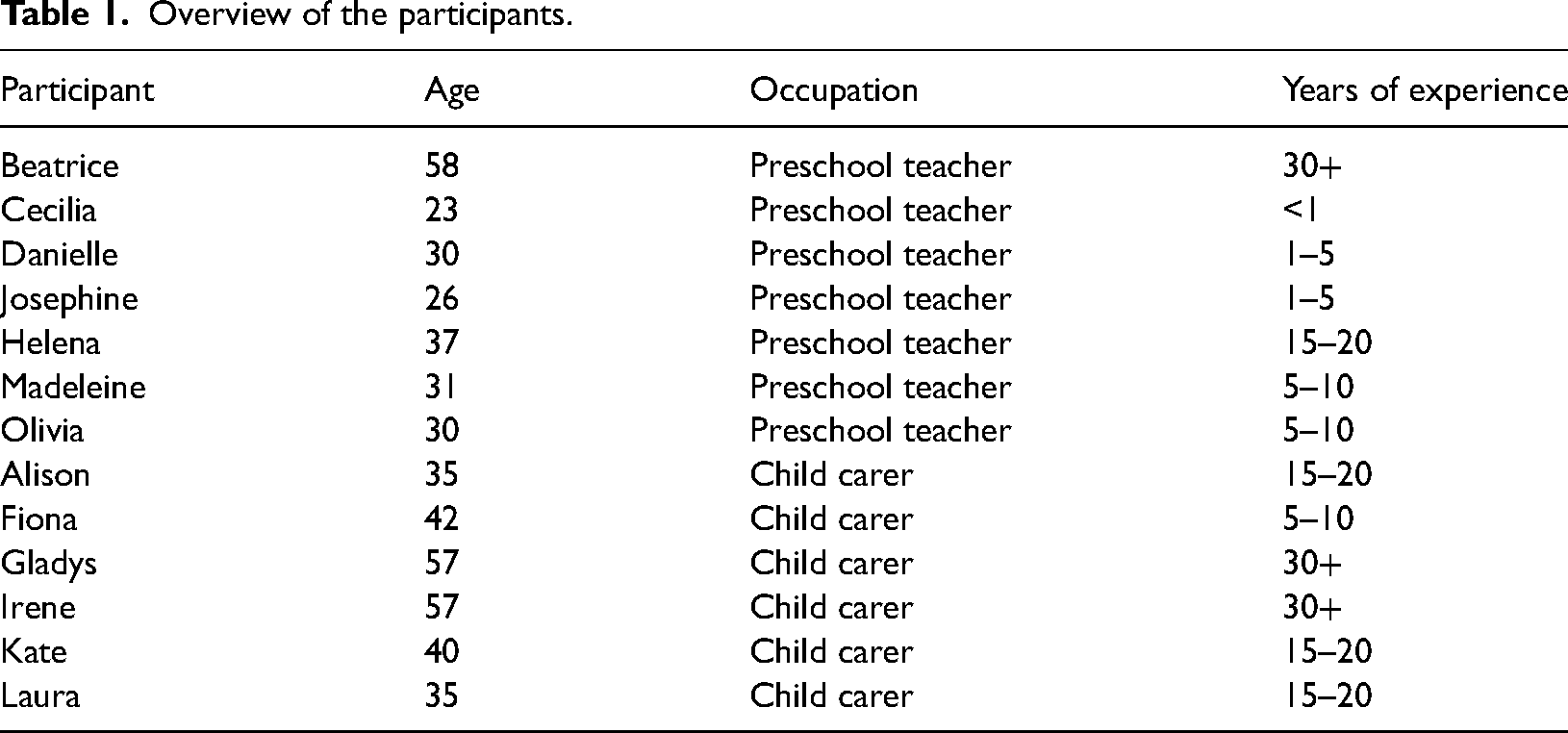
This study is part of a broader action research project examining children's rights in digital teaching practices. The project is conducted in a relatively large city in Sweden, at one preschool with four homerooms and 14 practitioners as participants. Those who work at the preschool have different educational backgrounds (see Table 1) but are in this text collectively referred to as practitioners. The preschool teachers have university degrees in education, and the child carers have upper secondary level education in pedagogy. Thirteen interviews are included in the analysis, as the 14th practitioner was not interviewed until the action research intervention had already been underway for a month. The practitioners’ ages range between 23 and 58, and their professional experience ranges from newly hired individuals with just a few months of experience to the most experienced individual with 38 years in the profession. All names have been pseudonymised.
Overview of the participants.
Video stimulated reflection
This study utilised video stimulated reflection (VSR) to facilitate reflection upon the practitioners’ own practices, including professional views, preconceptions, intentions and sense-making (Van Braak et al., 2018). The intention was to highlight the collective digital teaching practices in the preschool and capture each practitioner's reflections on children's rights. During November and December 2023, video observations of digital activities were recorded at the preschool. The intention was to record two video observations per homeroom. In discussion with the practitioners, it was decided that one activity would include several homerooms, resulting in a total of seven observations. Two of the observations were excluded from the VSR; one due to a practitioner's wish, and one due to two homerooms performing the same activity, where one had an alternative activity that could be included. Therefore, the VSR included five observations; one per homeroom and one in which several homerooms participated (see Table 2). As Van Braak et al. (2018) note, it is important to use clips that have relevance for the aim and research question(s) of a study. The chosen clips portray moments where the children interact to varying degrees with digital resources, the practitioner(s) and their peers. For some observations, several clips were used to showcase all parts of the activity (see Table 2).
The study’s observations.
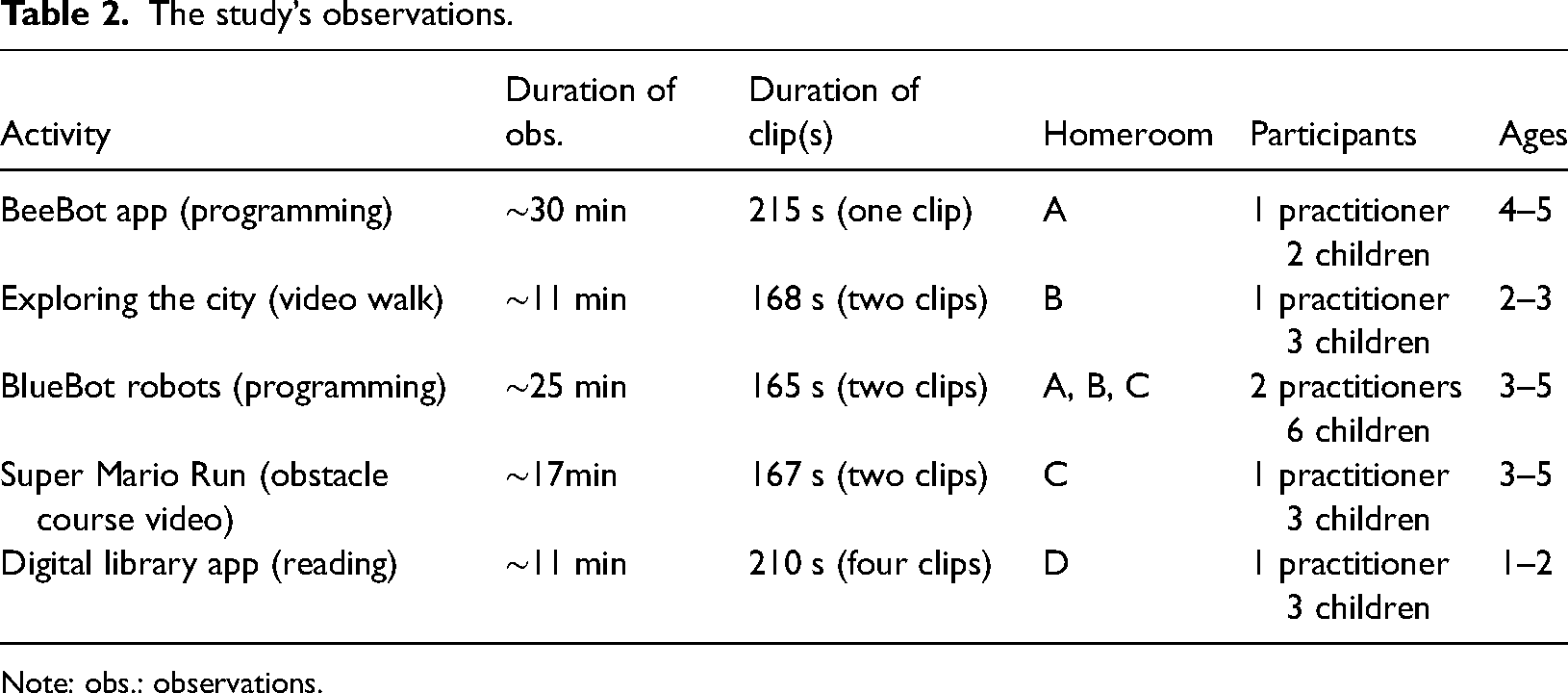
Note: obs.: observations.
The interviews were performed in January and February 2024. The interviews lasted for 46–79 min and were audio recorded. In the interviews, the clips were shown sequentially, followed by open-ended questions to encourage reflection. The first question after each clip was, ‘What are your spontaneous reflections?’ The other questions were specifically aimed at children's rights and the roles of the actors and digital resources in the activities. Follow-up questions were asked to support further reflection or get clarifications.
This study has been approved by the Swedish Ethical Review Authority (Reference number 2023-04487-01). Written consent was gathered from the practitioners and the children's legal guardians. The children were orally informed about the study before each observation, and were given the opportunity to agree to or decline participation. The role of the video camera was explained, and they got to explore the camera to gain a basic understanding of how it works. Given the children's young age, particular attention was paid to eventual signs of resistance (verbal and non-verbal) during the observations, as suggested by Larsson et al. (2021). As an example, children who walked out of frame or wanted to leave an activity were neither followed with the camera nor coaxed into rejoining.
Analysis method
A thematic analysis was conducted, following the six steps outlined by Braun and Clarke (2022). The data were transcribed verbatim and coded in the qualitative data analysis software NVivo14. Each interview was coded inductively by the first author, considering aspects such as digital resources, teaching strategies and children's rights. The subsequent process of generating themes was guided by the concept of affordances. To create an initial thematisation, the codes were sorted, merged, reduced and grouped. Following Braun and Clarke's (2022) recommendations, the initial themes were then reviewed extensively. This involved multiple regroupings of codes to develop a final thematisation that reflect prominent patterns in the empirical material in relation to the study's aim and research question. The process was a collaborative effort where the themes were extensively discussed and revised to ensure that a common interpretation was reached. As thematic analysis is done through interpretation, this analysis yields one possible result, while others may also exist (Braun and Clarke, 2022). Carr's (2000) concepts of transparency, challenge and accessibility were used to analyse the material in relation to digital resources and children's rights. Ultimately, two distinct themes were produced, each requiring subthemes to capture their complexity.
Findings
The findings indicate that the practitioners view digital resources as having the potential to support children's opportunities to exercise their rights. At the same time, they consistently highlight the importance of being active and critical, suggesting that digital resources do not automatically facilitate children's rights. In the following, the findings are presented through two themes: opportunities for participation and transcending physical boundaries.
Opportunities for participation
This theme consists of three subthemes which explore participatory affordances that the practitioners describe as enabled or limited by digital resources.
Agency and inclusion in preschool and society
According to the UNCRC, every child's right to inclusion and participation is paramount (UNICEF, 1989). The interviews reveal a commitment to support equal opportunity, as practitioners discuss how digital resources can empower, give more room for child agency, enable children to influence their play and learning and foster independence in using digital tools. Furthermore, the practitioners emphasise the importance of addressing each child's unique needs and circumstances. What I think is good with digital resources is that you can read books in several languages … Before, we borrowed books in other languages and we read them, but it becomes entirely different with digital resources. Those who do not understand, for example Somali, they have read this book in Swedish, and they’re like ‘yes, I know what will happen now, and I know what they are saying’. Because they know in their language. I believe that [digital resources] will help a lot with language, with those children who speak other languages than Swedish. (Fiona, child carer)
Besides language, connections between digital resources and agency for children with different capabilities are discussed. Danielle focuses on exploring the city via digital resources: You engage the children in experiencing in a way that's different from simply going outside. It provides a different perspective on the world. I think it becomes more accessible … It really provides opportunities for inclusion, also for those that might have difficulties walking far, or that cannot walk far. (Danielle, preschool teacher)
The practitioners also direct attention to providing opportunities for children to use digital resources independently, where the digital resources are as self-evident in the environment as other materials. Just something like, you know, ‘now I feel like programming’ or ‘now I feel like sitting down to read a book in my language’. Like that. We are not there yet, but that is where I would like to end up. Just that it should be accessible in the environments and that it not be seen as something forbidden or ‘no, they get so much screen time anyway’. But that you wholeheartedly use it as a tool … And that they actually can do it all by themselves. Then, to me, it becomes a tool for real. (Helena, preschool teacher)
A conflicting viewpoint in the interviews is that digital resources should be used ‘in the right way’, implying that there is also a wrong way. Concerns are raised that digital resources might afford passive engagement rather than active use. Laura emphasises the importance of ‘guided access’ (a function that restricts device use to a single app which cannot be shut down without a password), which can be interpreted as a view that adult-initiated activities should take precedence over child-initiated ones. Further, it implies a concern that digital resources might afford too much accessibility, giving children the opportunity to access content that is not deemed pedagogical or appropriate.
Interaction and collaboration
According to the UNCRC, children have the right to freedom of expression, which includes the right to speak their mind and express ideas (UNICEF, 1989). The practitioners seem to view digital resources positively if they are deemed supportive of interaction and collaboration. Both physical artefacts and digital programmes are mentioned as affording opportunities for interaction, both among children and between children and practitioners. The practitioners explain that digital activities can create opportunities for children to collaborate and discuss ideas. We mainly use the projector for [accessibility in activities]. Then we have the opportunity to lower or raise [the screen] so the children can reach [it]. If they play a game on the wall … One child sits on the sofa and plays on the iPad, while the rest, several children, can be by the wall and play together, collaborating and interacting with each other. (Fiona, child carer)
Citizenship in current and future society
Children's rights to education and preparation for their future life, as well as participation in current society, and the contexts within which they act are highlighted in the UNCRC (UNICEF, 1989). The practitioners highlight that digital resources can bring about opportunities for the practitioners to access children's interests and perspectives, giving the children more influence here and now. This implies that digital resources might afford children direct and indirect influence on preschool practice. Thoughts on preparation for future life are present in the material, as the practitioners reflect and draw attention to being a citizen in future society. For example, Laura has a strong focus on digital competence, saying that ‘they [children] need it when they grow older’, referring to future school and work life. In contrast, Olivia problematises whether children actually develop digital competence in preschool: Do the children develop digital competence by playing a game on a wall? Or do they achieve an understanding that it is something digital? Do children connect to ‘digital’ when they sit alone and use an iPad? Or, in connection to the BlueBots, have the children developed an understanding that this is also a digital resource? Or is it only when it is an iPad or projector that it becomes digital? (Olivia, preschool teacher)
Transcending physical boundaries
This theme consists of two subthemes in which the practitioners describe how digital resources make it possible to bring the outside world into the preschool, affording access to new experiences and opportunities for self-expression.
Identity expression through digital activities
The UNCRC states that all children have the right to their identity (UNICEF, 1989). The practitioners point out that digital activities can afford opportunities for identity expression as well as understanding others’ perspectives. Cecilia gives an example of using an online map service to support children's dialogues about family members, experiences and memories. The concrete visual support that the online map or street view brings can afford facilitation of children's reflection beyond the here-and-now. Using digital resources to explore children's everyday lives is also talked about as potentially inclusive for children with different backgrounds. All children have the right to experience their world and show who they are, feel a sense of belonging. The children, or we, can show something from the city they are from. Because someone might have moved, might be new in the city. To show, like with multilingualism, that the children can feel that it is okay to not feel a sense of belonging to something or that it is okay to feel a sense of belonging to several [places] … That they feel a sense of belonging, and through that can express their identity. (Olivia, preschool teacher)
New environments for playing and learning
According to the UNCRC, it is stated that all children have the right to play, perform leisure activities and rest. In addition, children should be able to learn about society, including its norms, values and conventions (UNICEF, 1989). The practitioners highlight ways that digital resources can bring about creative additions to practice, especially focusing on connections between the digital and the physical. Kate states that if organisational issues (such as staff shortages) create hindrances for traditional activities, digital resources can still make, for instance, excursions possible. Alison says that digital excursions can bring about opportunities to talk about the surroundings, real life situations and social customs, for example how to cross a street or experiences with riding a bus. This can be seen as bringing about both challenges and accessibility for children, as it can provide opportunities to safely learn about situations and customs that are often learnt through experience but might be difficult for a homeroom to actualise physically.
In addition, digital resources are also talked about as providing opportunities for playful cognitive development. As an example, Helena mentions how they have projected a sledding hill from nearby and used that to talk about emotions: How does it feel to go down the hill? They immerse themselves in the activity, like ‘yay!’ or when they fall off ‘oh no!’. Fantasy, emotions. To use the digital like, what should I say … We have so many senses that we can work with. Kind of like, when we didn’t have snow, well, instead we projected it and were like ‘it's snowing in here. How does it feel?’ To immerse oneself into that in a way. (Helena, preschool teacher)
Discussion
This article explores preschool practitioners’ reflections on children's rights in relation to their digital teaching practices. The concepts of accessibility, challenge and transparency have been used to analyse the practitioners’ reflections. These concepts concern levels of participation in relation to digital activities (accessibility), what kinds of flexibility and challenge levels the digital resources may or may not provide (challenge) and the user-friendliness of different digital resources (transparency). The key finding is that practitioners view digital resources as providing opportunities for participation in and equal access to preschool activities and society. However, they also recognise that digital resources do not guarantee the fulfilment of rights, emphasising the need for intentional planning to avoid limiting interaction and agency. The findings highlight that digital resources are discussed as offering both possibilities and constraints, with physical affordances and design choices impacting children's agency and interaction. This indicates that the practitioners are aware of the limitations that digital resources might have, and that opportunities for different kinds of interaction need to be facilitated by practitioners’ initiatives.
Hybrid activities for agency and participation
In terms of accessibility (Carr, 2000), the results show that digital resources can support multiple kinds of participation through the creation of collaborative activity spaces, where children's interests and experiences can influence and reshape practice. According to Sørenssen (2024), collaborative use of digital resources is important for creating meaningful activities where children can interact and learn together. Similar views can be seen in our study, as the practitioners continuously return to the importance of facilitating activities where children can interplay around a digital resource. In both themes – opportunities for participation and transcending physical boundaries – the practitioners discuss how digital resources provide access to children's thoughts, interests and experiences. Our results suggest that the practitioners do not express any clear lines between the physical and the digital, but rather a preference for designing hybrid experiences in which the children can act. This suggests the intention to engage with children's expressions through digital resources, which is in line with studies on hybrid play as agentic opportunities for children (Buskqvist and Johansson, 2024; Magnusson, 2023). To practitioners, this approach resonates with children's rights, particularly the right to participation, where children are encouraged to express themselves and actively engage in their learning environment. Concurrently, a concern is raised that digital resources might be used incorrectly, where children become passive consumers or miss opportunities to engage in more traditional preschool activities. In line with previous studies showing that digital activities do not automatically foster agency, participation or learning (Nilsen et al., 2021; Petersen, 2015), the practitioners highlight the importance of critically assessing their use of digital resources. The emphasis on avoiding uncritical use, particularly without pedagogical intentions, suggests that they regard digital resources as tools for facilitating participation, not as solutions in themselves.
As for challenges (Carr, 2000), digital resources are reflected upon as making it possible for all children to be challenged based on their individual abilities and circumstances. This goes in line with the intentions of both the Swedish preschool curriculum (Swedish National Agency for Education, 2019) and the UNCRC (UNICEF, 1989). The practitioners describe digital resources as providing visual and physical aid that afford opportunities for children's rights to be met. This is discussed as supporting opportunities for children to take the lead through language, identity expression and play, for example. However, as Shengjergji (2024) argues, children should not only be seen as having agency or being active agents, but also as developing their sense of agency. This implies that designing opportunities to discover and explore agency is important in a digital teaching practice. The practitioners state that digital resources can be used for understanding and adapting practice to each child's unique circumstances and needs. In alignment with Magnusson (2018), the practitioners regard accessing children's perspectives as a means to refine practice in accordance with children's rights. This approach is reflected upon as facilitating children's influence, allowing for them to obtain and develop their sense of agency through inclusion. On the other hand, and in regard to transparency (Carr, 2000), the practitioners express that it can be difficult for children to actively use digital resources without prior experiences of using them. This points toward a complexity in designing for agency in digital activities, as prerequisites in the form of digital competence are implied as necessary. The practitioners also highlight a concern that children might not necessarily develop digital competence in digital activities. This suggests that designing for agency in digital activities might require consideration of how to concurrently design activities that be transparent and challenging in alignment with each child's level of digital competence.
Opening doors to society and democracy
The results suggest that the practitioners are conscious of their role as facilitators of and educators for children's rights. Children's rights were seen as an obvious part of preschool practice. However, during the interviews, it was difficult for them to pinpoint what children's rights entail in their digital teaching practices. They tended to hesitate in their responses and conveyed uncertainty on the subject. There was a strong emphasis on the right to participation in their statements, even when the interview question did not address the topic of participation directly. Other rights (such as the rights to education, identity and play) were also highlighted, but oftentimes this was done in relation to participation. It seems as though it was easier for the practitioners to reflect in close alignment with the curriculum. Participation is highly significant in the Swedish preschool curriculum (Swedish National Agency for Education, 2019), which can serve as an explanation as to why it was most prevalent in the practitioners’ reflections.
The results reveal that digital resources are seen as supportive of knowledge development about society as well as development of social and emotional competence, including exploration of intangible aspects of life. In relation to children's rights, this implies that digital resources might be able to afford participation and influence in democratic processes. However, achieving this requires intentional and reflective use (Nilsen et al., 2021). Our study highlights that practitioners need to design their digital teaching practice with a focus on democratic aspects. In turn, this can enable a teaching practice that align with children's rights from a nuanced understanding of their everyday life as citizens in society. At the same time, previous research suggests that preschool practitioners seldom perceive themselves as having enough professional digital competence to design and enact a high-quality digital teaching practice (Dong and Mertala, 2021; Leung and Choi, 2024; Marklund, 2020). Expressions of self-doubt regarding technical skills are present in our results as well, suggesting that it might be difficult for preschool practitioners to perceive their digital teaching practices as of high quality if they do not perceive themselves as technically competent enough to implement digital resources pedagogically.
The practitioners in the present study highlight many practical examples of activities that utilise digital resources. Previous research shows that the aims and intentions of users (i.e. both children and practitioners) shape and transform digital activities as they happen (e.g. Kjällander and Moinian, 2014; Petersen, 2015; Sørenssen, 2024; Walldén Hillström, 2020). Consistently, our results demonstrate that the affordances of digital resources are shaped by the user, varying according their perspectives, experiences and intentions. Simultaneously, previous research shows that child-initiated digital activities often give children more opportunities for agentic use and collaboration than adult-initiated ones (Kjällander and Moinian, 2014; Petersen, 2015; Sørenssen, 2024; Walldén Hillström, 2020). In this study, the practitioners express the desire for a practice where the digital resources be transparent for children, so that they can use them independently in a pedagogical manner. This, however, implies that there is a normatively ‘correct’ way for children to use digital resources, suggesting that a certain kind of agency (fitting into their view of what preschool practice should consist of) might be premiered as appropriate. This can be interpreted as the didactic dissonance suggested by Vangsnes et al. (2012), creating complex issues around when agency and participation are desired, especially due to the asymmetrical power relations between children and adults (Livingstone and Third, 2017). Children's participation risks becoming conditional, only realised when deemed suitable according to norms, rules and policy, rather than as a means to give children participation in forming the rules and norms for practice (Hart, 1992). Moreover, children's rights sometimes partly contradict each other. The right to protection contra the right to participation is one example, where adult views can affect which right gets precedence in practice (Livingstone and Third, 2017). This highlights a dilemma in how to design a digital teaching practice that balances adult aims with children's intentions, implying a tension between normativity, children's rights and curriculum, as practitioners have a responsibility to follow the curriculum as well as the UNCRC, while concurrently being affected by norms and current debates. In line with previous research (Livingstone and Pothong, 2022), our results point toward a need for critical reflection around the use of digital resources for play and participation in line with children's rights.
Limitations and future directions
This study has limitations due to its small sample size and the fact that participants were drawn from a single preschool in Sweden. Consequently, future research could explore the applicability of these findings in other contexts. Nonetheless, the results offer valuable insights into children's rights in preschool digital teaching, amplifying practitioners’ voices in the use of digital resources. This study offers practical implications for educators, policymakers and curriculum developers seeking to integrate digital resources into preschool education while upholding children's rights. By moving beyond binary debates, it highlights the need for a reflective, context-sensitive and child-centred approach that carefully balance possibilities and constraints. Concrete examples illustrate how digital resources can be effectively applied to foster meaningful and inclusive learning environments that support children's rights.
Conclusions
In conclusion, the practitioners express a nuanced view of digital resources, pointing out both possibilities and constraints in relation to children's rights. This suggests that the use of digital resources in preschool education is far more complex than the often-binary societal debate implies. A significantly more refined discussion and reflection encompassing trade-offs, appropriateness and context-specific application of digital resources in preschool practice is paramount. This study contributes by unpacking the affordances of digital resources in preschool settings through the lens of children's rights, while also offering concrete examples of how this work can be applied in practice.
Footnotes
Acknowledgements
We wish to thank the participants who took part in this research for their willingness to share their perspectives and insights. Additionally, we are grateful to The Swedish National Graduate School for Digital Technologies in Education (GRADE) consortium for providing an intellectually stimulating environment that encouraged the development of this study.
Data availability
Data are available upon reasonable request.
Ethical approval and informed consent statements
This study has been approved by the Swedish Ethical Review Authority (Reference number 2023-04487-01). Written consent was obtained from the practitioners and the children's legal guardians. The children were informed orally about the study before each observation and were given the opportunity to agree to or decline participation.
Funding
The authors received no financial support for the research, authorship, and/or publication of this article.
