




Abstract
Digitalisation has changed communications dramatically over the last 20 years. This has entailed that preschool documentation of children and their activities, previously communicated with enrolled families, have become part of a mass distribution of social images. Thereby photographs, which initially aimed to involve the families in their children's education, are made visible to larger groups in society. This article examines digitally circulated photographs from three preschools in Sweden and, using critical image analyses, relates them to visibility, transparency and participation. The results show that digitally circulated photographs mediate a normative image of a universal preschool child, where the extended visibility of the preschool does not seem to make children's different interests, characteristics and standpoints visible. In fact, the children themselves are, in order to protect them, almost made invisible in the photographs. The discussion of this article concerns the ethics of a mass distribution of images where children are portrayed as a uniform group, and raises the fact that children become dependent on adults to interact with the photographs. Aims of marketing seem to become superior to aims of involvement, and preschools are able to tailor their communications to reach certain audiences. Thereby digital communication seems to contribute to increasing rather than decreasing inequalities among children.
Introduction
According to the Swedish preschool curriculum (Swedish National Agency for Education, 2018: 5), ‘education should be characterised by openness and respect for differences in people's perceptions and ways of life’. The word ‘difference/different’ is mentioned 35 times in the curriculum. This article takes an interest in how preschool children's multi-dimensionalities are represented and communicated through Swedish preschool documentation photographs. Photographs are regarded as visual language, which, from a social constructivist view, constitutes a tool that helps people to recognise and construct themselves and others.
In Sweden, about 95% of all children aged between 1 and 5 years are enrolled in preschools. Documentation is a prescribed tool in the preschool curriculum (Swedish National Agency for Education, 2018). Aims of documentation include enhancing children's participation and educating democratic citizens. Most preschools in Sweden handle a lot of documentation photographs in their everyday practice.
The Nordic early childhood curricula are strongly influenced by ideas of the competent child (Einarsdottir and Ólafsdóttir, 2019), participating in planning and evaluating their own education. Further, the Swedish documentation practices are inspired by the Reggio Emilia pedagogy, which considers documentation a tool for making children’s ideas visible as a work of democratisation. However, the common Swedish documentation practice, which is examined in this study, is not to be confused with dedicated Reggio Emilia pedagogy.
Preschool documentation in Sweden often consists of photographs, and as they are legible to children themselves, this study focuses on content and circulations of photographs. The photographs are used for joint reflections in child groups, but also in communication with enrolled families (Olsson, 2019; Vallberg Roth, 2009).
In recent decades, the development of digital equipment has increased visual communication within and outside the preschool. From the 1980s, when I started working in preschool, to just a few years ago, the sharing of documentation with families was conducted analogously by means of weekly letters and individual folders. Making paper copies of photographs was connected to costs, and the teachers had to choose which photographs to print with care. Digitalisation has thus appeared to simplify and optimise the work of preschool teachers. The accessibility of digital devices, and the fact that they are relatively simple to use, has led to an explosion of photographs circulated amongst large groups of people; also referred to as massification (Pollen, 2016).
Photographs are part of visual language, which includes visual representations, in this case of children and preschools. Spencer (2022) argues that visual representations are intimately connected to the cultural politics of childhood and therefore need to be problematised. Preschool photographs are circulated as so-called social photographs of everyday life (Jurgenson, 2019). Mass distribution has changed the visibility of the preschool and, according to Grady (1996), can be assumed to contribute to society's perception of preschool children and their practices, that is, contribute to the cultural politics of childhood (Spencer, 2022).
About ten years ago, two Swedish government reports pointed out that more insight into preschool practice would help families to choose high-quality education and thereby lead to increased equity amongst children (e g Swedish Government Office, 2016). To achieve increased transparency towards society, circulation of preschool documentation in larger groups and applications has become common practice. To share photographs of everyday life with guardians and society has become a sign of quality for Swedish preschools.
However, communication and documentation are affected by EU regulations for the use of personal data (GDPR = General Data Protection Regulation, May 2018). The stricter requirements for the handling of personal information (GDPR) have contributed to the protection of children's integrity and the prevention of criminal acts, which has been debated for some time in documentation practice spheres (Lindgren and Sparrman, 2003). In conjunction with these new regulations, many preschools have stopped sharing photographs. Teachers have pronounced uncertainty over how to document and communicate photographs (Lindgren Eneflo, 2014).
On the whole, digitalisation offers possibilities to reach large groups of people at the same time, but legal and ethical restrictions limit what is possible to share. How the preschool is made visible is crucial for how it is perceived and whether the aims of increased transparency are achieved. Posts on social media and websites communicate to a wider range of society than just the child and the family. Efforts to achieve equity and democratisation can, however, be questioned as children themselves are dependent on someone else providing a digital device in order to interact with the digital photographs.
Little is known about which ideas about the child are created through the massification of preschool photographs, and how digital communication is perceived by families outside the preschool. In this study the following question is posed:
How does the digitalisation of preschool communications affect the portrayal of children and preschool activities in relation to ideas of participation, visibility and transparency?
Theory
Foucault (1993) states that how we use language governs how we perceive and view the world. Photographs that are mass distributed become part of a normalising power (Foucault, 1993) by repeating (re)presentations of what is normal (and desirable) for preschool children and preschool practices. Consequently, the digitally circulated photographs challenge or maintain the dominating discourses on preschool children and the preschool.
Jurgenson (2019) describes photographs of everyday life distributed online as social photos that communicate something. Social photos should be considered in the light of the digital flow and not simply as standalone media objects. In this article, the mass distribution of photographs is interpreted as a repetition of certain performances that contribute to the construction of aligned behaviours and normalising powers (Foucault, 1993). The photographs become joint stories about the preschool, create expectations of what preschool is and should be and how preschool children ought to behave. This article approaches circulated social photos as visualisations of the desirable child.
Background
Making the right choice
In Sweden, the number of private preschools has increased since the 1990s, and today, about 20% of all children in preschool attend a private preschool (Swedish National Agency for Education, 2014). About ten years ago, some government reports highlighted a lack of transparency from preschools, towards families, which made it difficult for families to make good choices and was thereby interpreted as contributing to inequality. It was suggested that increased transparency in educational institutions would help families to always choose high-quality education for their children (Swedish Government Office, 2016).
Here, preschool documentation was connected to ideas about transparency. By sharing documentation, the practice become transparent to principals, political decision-makers and families.
Preschool documentation and participation
Documentation of children has been carried out throughout the twentieth century. Previously, documentation was primarily used to discover deviations from normality in order to make adjustment to individual children's development (Lenz Taguchi, 2013). Since the 1980s, preschool documentation in Sweden often consists of photographs, and the aims of documentation are influenced by the Reggio Emilia ideas, recognising children as citizens with rights to their own voices (Dahlberg et al., 1999; Krechevsky et al., 2016; United Nations, 1998). Research shows that documentation, including joint reflections, can enable children's own thoughts and make their ideas visible (Olsson, 2019; Unga, 2013). Internationally, including Sweden, there are specific Reggio Emilia–profiled preschools and projects (i.e. Krechevsky et al., 2016), which include active work of involvement, more than just circulation of photographs. The phenomenon examined in this study is thereby defined as existing in the diaspora of Reggio Emilia pedagogy.
Issues of participation have been central in the educational governing documents and practices of the Western world since the late twentieth century (Masschelein and Quaghebeur, 2005). According to Elfström Pettersson (2015), securing children's possibilities to participate is coherent with teaching children democracy. Some researchers have even considered preschool documentation with potentials to scrutinise norms and power structures in order to achieve an equal education for all (Dahlberg et al., 1999; Elfström Pettersson, 2015; Lenz Taguchi, 2013).
With aims of involving children and families in planning and evaluating educational practices, photographs of preschool activities are shared with children, colleagues and families on preschool walls, in folders and in weekly letters, and today, also digitally, as a part of democratisation and involvement.
Digitalisation and possibilities to market the preschool
According to Vallberg Roth (2009), the documentation photographs are also frequently used for communication with families. The availability of digital devices and the ease of capturing and sharing daily life have increased the production and distribution of photographs (Pollen, 2016), and the possibilities for preschools to communicate with families. Digital applications have replaced the analogue weekly letters as they offer simplified, fast, interactive communications. According to Lim and Cho (2019), educators see this as a potential to improve communication with families and increase transparency and participation.
While photographs are circulated amongst larger groups in society, the purpose of communication with families is extended to marketing the preschool by making it visible to new families. Gabbidon (2020) studied private preschools’ use of social media in the US. The results showed that about 60% used social media to communicate with families and 70% used social media to advertise and enrol more children.
The increase of private preschools in Sweden has resulted in competition for families. Burst and Kim (2014) state that, along with the upsurge of individual choice and accountability standards, assessment of children and their activities has become important for educational decisions and recommendations. According to Mustafa et al. (2014), preschools today need to develop marketing strategies, which often includes social media. This involves producing positive images of the preschool tailored for specific audience (Koyama and Kania, 2016). Koyama and Kania (2016) highlight that the concept of transparency contributes to illuminating, as well as concealing, certain information, which affects the power dynamics, relations and questions about what is considered proper education.
Visibility
Images, like photographs, make certain things visible to certain audiences. Previous research shows how photographs contribute to making selected preschool activities visible to the children themselves as well as to others, depending on where the photographs are circulated (Wahlgren and Andersson, 2022). According to Grady (1996), what becomes visible and noticed by people is also important for understanding culture and social life. Spencer (2022) describes how representations make certain ways of being and becoming a child possible, while alternative ways are made invisible, that is, representations of children's differences are lacking.
According to Wahlgren and Andersson (2022), who studied analogue photographs in four Swedish preschools, children are most commonly made visible in teaching situations. This aligns with Liljestrand and Hammarberg (2017), who found that children, in Swedish preschool documentation, were portrayed as competent. In both studies, the photographs were taken and chosen by the teachers and can therefore be regarded as an expression of teachers’ ideas about children (Liljestrand and Hammarberg, 2017; Wahlgren and Andersson, 2022). In short, adult norms influence the kinds of images they produce; the visibility of children within photographs is a direct result of teachers’ normative views of children.
This is relevant while teachers tend to perceive children’s competences in different ways (Gullberg et al., 2018; Olsson, 2019), often associated with ideas about the desirable child (Emilson, 2008), and expectations of children and their competences related to categories like ethnicity, class and gender (Andersson, 2012; Bundgaard and Gulløv, 2006; Eidevald, 2009; Gitz-Johansen, 2004; Hellman, 2010).
Even when preschool photographs are only used for communication with enrolled families and shared in closed digital applications, the images are somehow moved from their context and put into new ones outside the preschool (Birkin, 2021; Jurgenson, 2019). Regardless of application for sharing, the photographs are viewed on a smartphone or computer and in the same flow as exercising bodies, food or sunsets (Jurgenson, 2019). In this flow, the value of the single image decreases as it becomes a part of this massification (Jurgenson, 2019; Pollen, 2016; Steyerl, 2009). This means that the flow of images will impress the receiver more than a single one. Thereby, digitalisation changes the contexts in which the preschool photographs are understood.
Representation and recognition
Fraser (2008) describes social injustice in three dimensions: the political dimension of representation, the economic dimension of distribution and the cultural dimension of recognition. All these dimensions are important when representations of the preschool are distributed and recognised by an outside audience. Here, transparency is assumed to put the responsibility on families to judge good from bad, and possibly also change attitudes (Fauske et al., 2018). According to Fauske et al. (2018), working-class families feel ‘powerless’ and sometimes hostile in their contacts with authorities and commonly experience that they are required to change their approaches to how they foster their children.
Ideas of visibility and transparency put documentation photographs in an audit culture that is tightly connected to a marketing of education that requires self-regulation and self-evaluation (Rinehart, 2016). Images that are made visible contribute to accountability and become ‘evidence’ of good practice and proper education. Thereby, teachers and children become framed as malleable subjects (Rinehart, 2016).
Koyama and Kania (2016) show that transparency does not guarantee an equal education for all children, as certain images are made visible while others are not. Certain images will be recognised by certain audiences, and recognition will be connected to social and cultural dimensions (Fraser, 2008) that sort children and families in the educational market. Issues other than dealing with personal data also need to be considered when circulating preschool photographs.
Material and methods
The dataset for this article comes from a larger empirical material containing some 1,600 photographs from ongoing documentation, and field notes from some 40 visits to four different preschools (A, B, C, D) collected 2018–2019 in Sweden. The preschools are located in different socioeconomic residential areas and have different ethnic compositions of children. Classes with children aged 1–3 years and 4–6 years are included.
For this article, two subsets of digital photographs are used; (i) 195 digital photographs from four preschool classes (B1, B2, C, D) shared with families via closed digital applications and (ii) 43 digital photographs shared in one preschool's Instagram account (D). The subsets of digital photographs were collected within a time span from December 2018 to February 2019. The photographs were analysed to answer questions relating to mainstream patterns of how children and their activities are displayed in preschool digital communication. Field notes were used to understand how the practice of digital communication was arranged.
To safeguard the correct handling of the data, the study was approved by the Ethics Review Board in Uppsala. All the data were dealt with confidentially and the photographs used in presentations or publications have been anonymised. Issues of anonymisation are specifically discussed in the discussion part of the article.
The studied preschools used photographs for both analogue and digital communication. The analogue photographs were available to the children during their time at the preschool, while the digital photographs were expected to be accessible to the children via their guardians.
Analysis
Critical image analysis (Rose, 2016) concerns the content of the image as well as who the producers and consumers are. Therefore, the circulation of photographs and their content is dealt with in the analyses.
The digital photographs are circulated to people outside preschool, which differentiates them from analogue photographs that have been shared with enrolled children and their families. Ideas that are mediated through massification are perceived differently depending on the receiver (Fraser, 2008; Jurgenson, 2019; Pollen, 2016; Rose, 2016), and affect the cultural understanding of subjects or practices (Grady, 1996).
The first step of the critical image analysis was therefore to map how and to whom the documentation was circulated. This was done by interpreting the field notes, in which I had noted who produced the photographs, where and to whom they were communicated and how often. The mapping informed me that only certain images were digitally circulated within larger groups of people.
In the second step, NVivo was used to code and sort the photographs into thematical categories. The analysis was conducted separately in the two subsets. Categories involved how children were made visible and which activities and performances were repeated (Foucault, 1993) and coded quantitatively (Figure 2, Figure 5). The critical image analysis noted whether the photographs showed faces (Spencer, 2022) or whether children were centrally or peripherally placed. The third step involved comparisons between the photographs from the two subsets and between the photographs from the different preschools. These comparisons mapped the differences in the photographs’ purposes and messages.
After thematising the photographs into quantitative categories, representative images from the larger categories were chosen for qualitative critical image analysis. Here, questions were posed about the cultural ideas of the child and the preschool practice, how these ideas were expressed and how the communication of these ideas could affect the perception of the preschool and the preschool child in society (Figure 1).
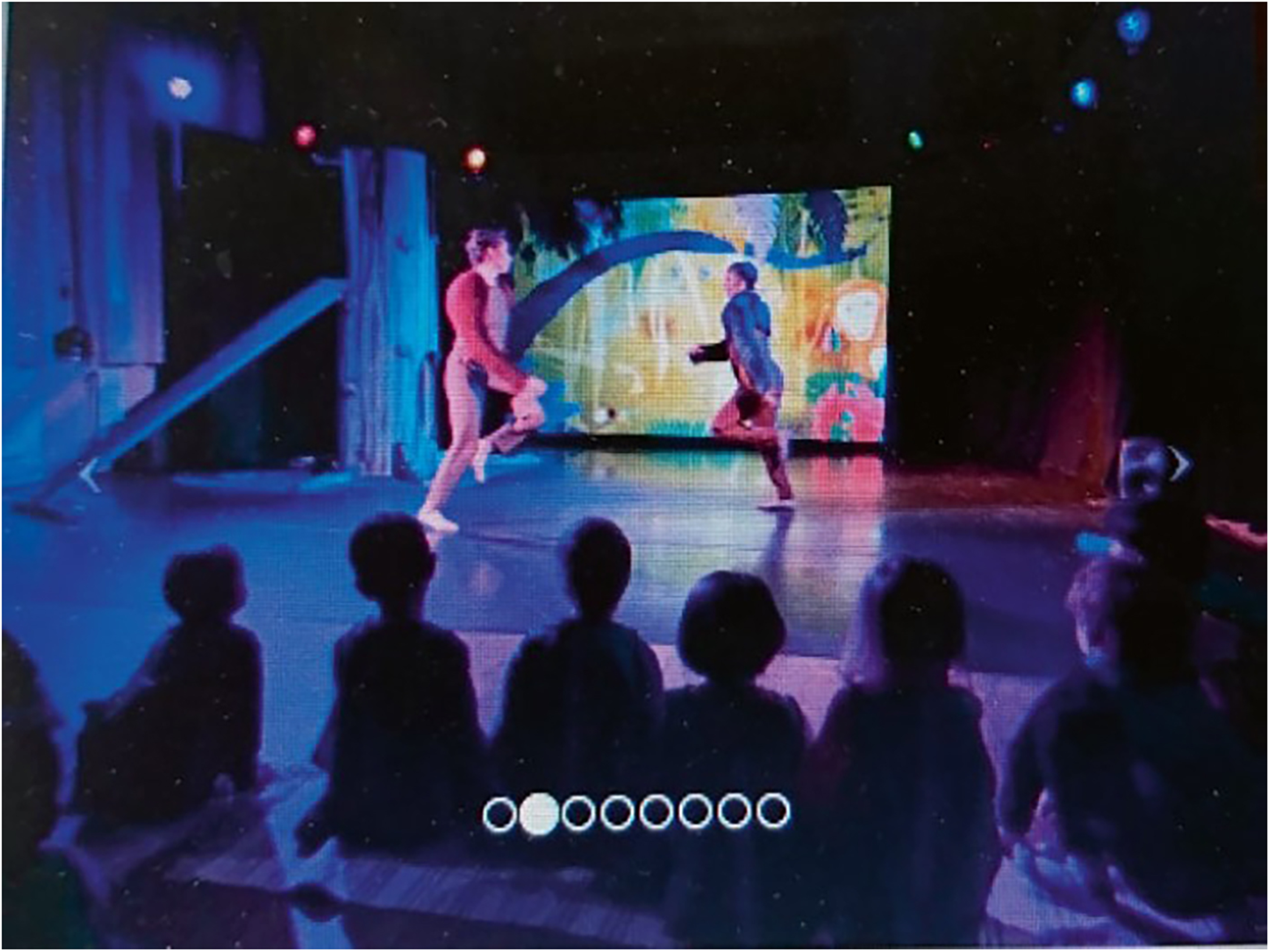
A digitally circulated image of children watching a play.
An example of the qualitative analysis comes from the photograph in Figure 1 collected from the category ‘trips’ (see Figure 5). The image portrays children as consumers of culture and the preschool is displayed as an active participant in society's cultural life. The children are shown as being attentive to the play and sitting passively without the presence of adults, which makes them appear as disciplined and self-regulating subjects (Foucault, 1993) who are able to behave in social and cultural contexts outside the preschool. Ideas about a collective upbringing into adulthood are also made visible, which indicates the preschool as an important actor in the governance of future desirable citizens. No faces of the children are visible, which makes it impossible to tell if the children are enjoying the show or not. The children are portrayed as a homogenous group.
Results
The results are presented in three sections: describing the new digital applications, how the children are made (in)visible and how preschools can profile themselves through digital communication.
Preschool teacher's uncertainty of what, when and why
The results show that certain photographs were chosen by the teachers to circulate analogously within the preschool and other photographs were chosen to circulate digitally.
When the data collection started, all the studied preschools had recently been introduced to new digital applications, which affected their work with, and circulation of, photographs. The applications were used for documentation, registration and communication. The preschools had different directives about how often they should communicate digitally, and how or whether the children (or their faces) should be made visible in the circulated photographs.
All the teachers experienced difficulties with the applications due to technical issues or a lack of knowledge. The directives were often mentioned in connection with GDPR (General Data Protection Regulation, May 2018), which led to uncertainties about what was legal to circulate and to whom. The staff were unsure whether the directions were the same for digital and analogue photographs. For example, when a childminder photographed the children doing a given task, they had to remind themselves, ‘Oh, now I got the faces, there shouldn’t be any faces. Well, I guess we’ll need some photographs to put on the wall as well’ (field notes, February 2019). The quote shows that different directives were given for the digitally circulated photographs and the analogue photographs.
The following quote indicates that the staff were unsure about the purpose of digital communication, but that at the same time they were able to control whether the families had opened the circulated documents or not: ‘Yes, I really don’t know why, for example, one parent has not visited [the digital folder] at all since October’ (Field notes, December 2018). In all the studied preschool classes, it was common for the teachers to discuss the circulated documents in relation to how often they circulated material and how often the families opened the folders.
Visible activities: Invisible children
The quantitative analyses of how children were made visible in the digitally circulated photographs resulted in four categories (Figure 2): no children, children at a distance, unrecognisable children and children with visible faces, of which the last was the most uncommon. In short, children were portrayed as non-recognisable.
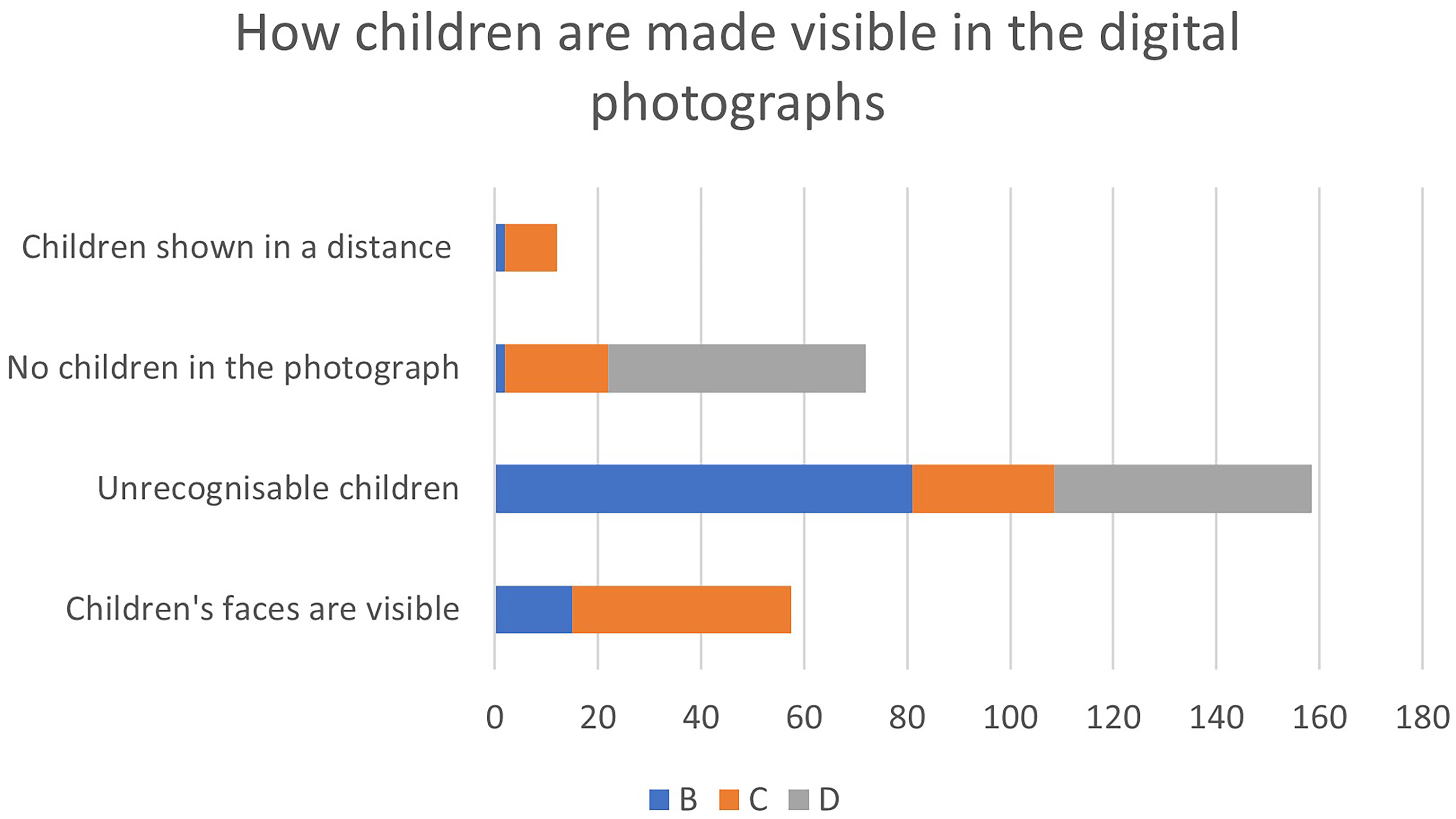
This graph shows how the children were portrayed in the digital photographs.
Further, the critical image analyses of the photographs’ content revealed that the technique to make children unrecognisable often was by only making some parts of their bodies visible, portraying their arms and hands occupied with some activity. Outdoors, or at sites outside the preschool areas, the children were depicted from behind (Figure 1), from a distance or from above.
However, there were differences between the preschools. The photographs from preschool B often portrayed non recognisable children, while preschool C more frequently showed children's faces, and preschool D did not show children's faces at all. The photographs from preschool D did not always include children, but rather focused on materials or nature (Figure 2).
The photographs focused on children's activities and materials. The two most common activities in the photographs were children's common activities, such as painting or working with coloured paper and glue, and planned teacher-led activities connected to the preschool project (Figure 5). The technique of picturing children's body parts occupied with activities was similar in these two categories. The photograph in Figure 3 shows a white cloth with several bowls containing paint. The viewer can imagine two children sitting opposite each other actively using the paint. The arms of the children are blurred by movement. Clearly, an activity is made visible, but the viewer cannot tell which children participated or what their emotions might have been. Photographs that do not show faces, expressions of joy, fear or boredom render the children invisible, in that it is not possible to guess their age, gender, ethnicity or identity.
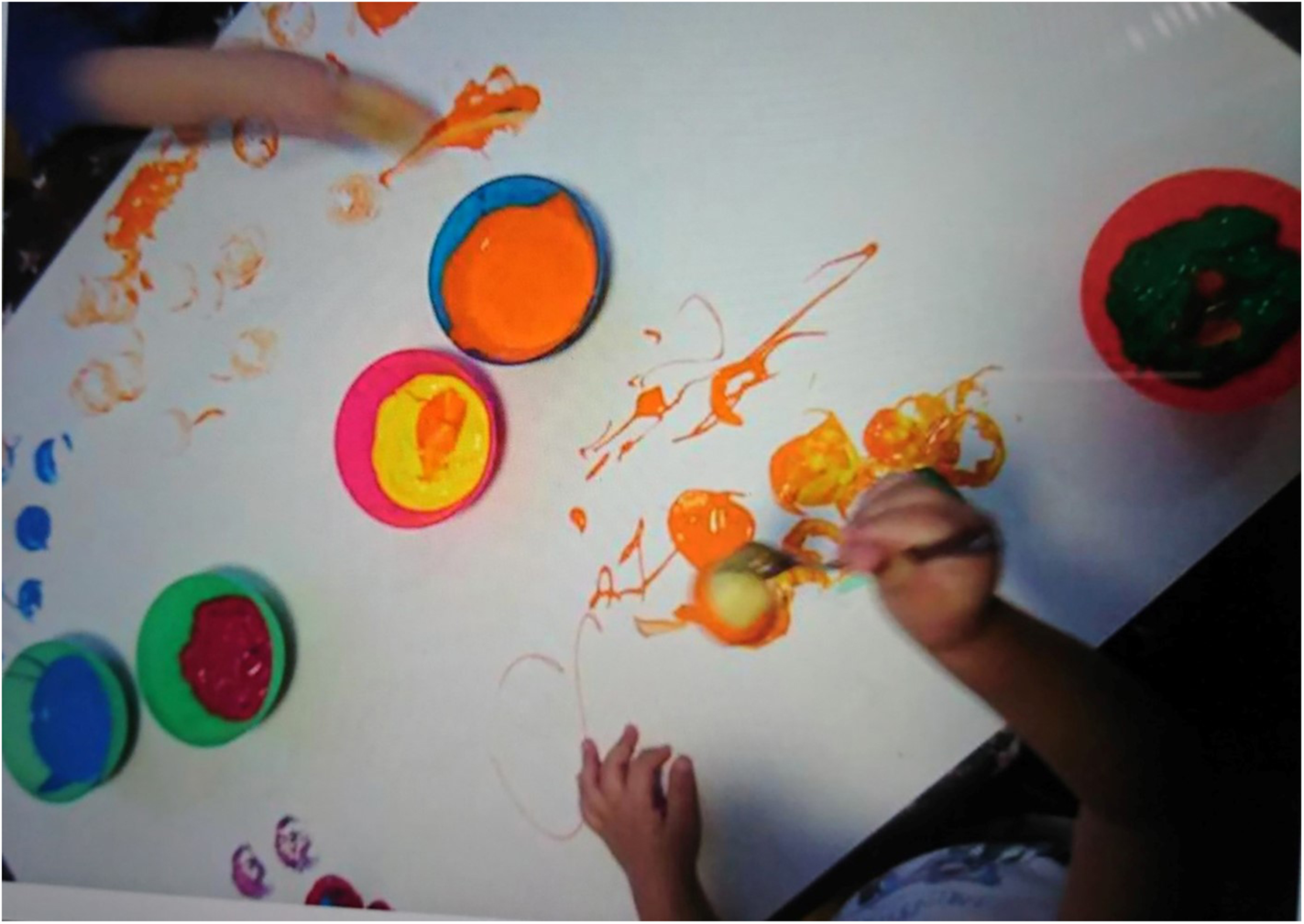
A representative photograph of children's common activities.
In Figure 4, the bodies of the children are made visible from behind, which apart from their clothing make them unrecognisable. Featuring children from behind or at a distance was a common technique outdoors. Photographs from the forest sometimes only showed the natural environment.
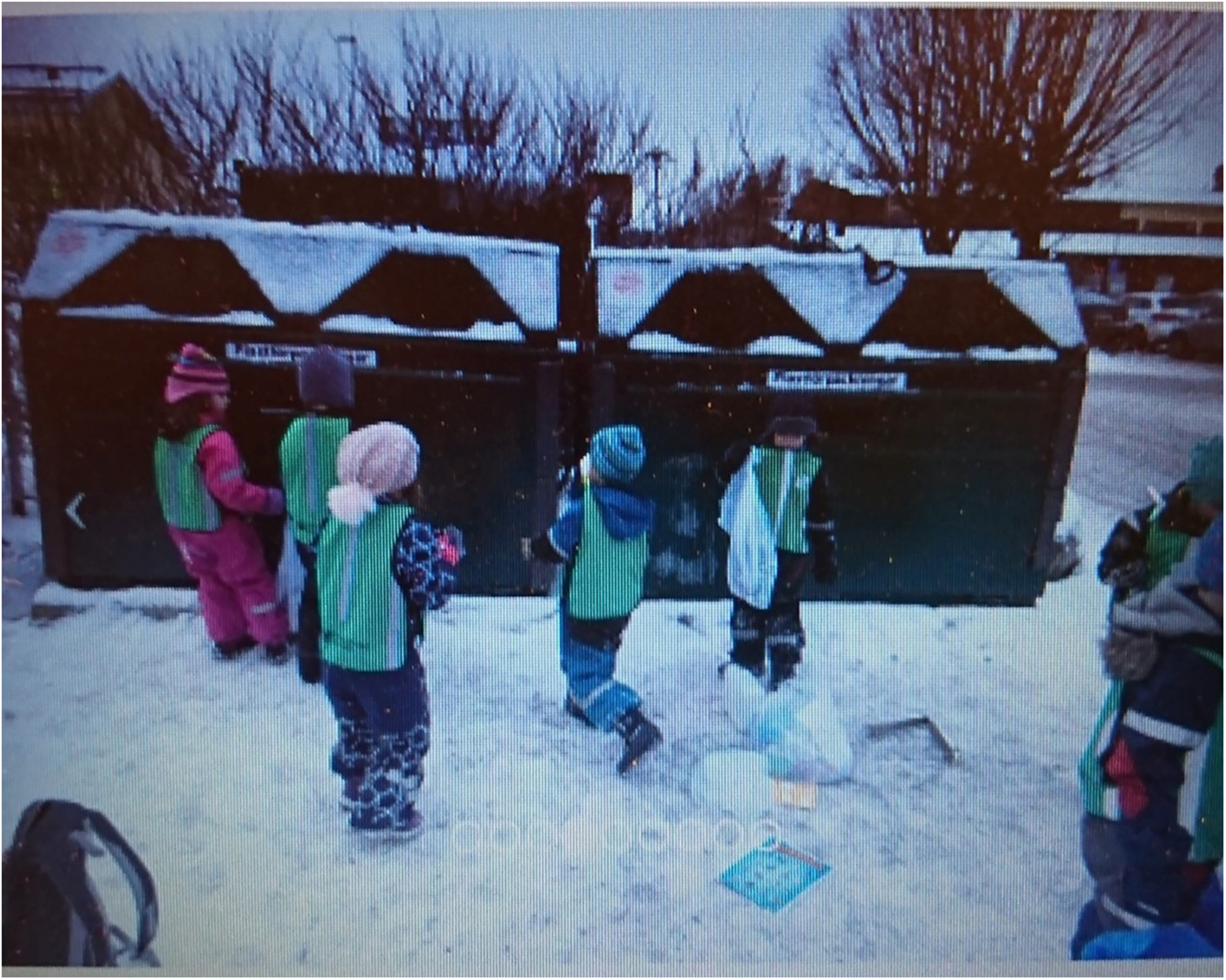
Children are depicted at the recycling station. They seem engaged in putting things into the proper containers, but it is impossible to see the expressions on their faces.
Visible differences: Profiled preschools
The preschools choose to circulate photographs with slightly different content. Six larger groups of activities could be categorised out of the quantitative analyses (Figure 5). The digital flow was dominated by displays of children's common activities, such as painting and crafts with paper, glue and glitter and the preschool project work, but it was also possible to define some differences between the classes. Preschool B displayed comparatively many photographs of children's play, such as using Lego or kitchen utensils. The younger children (B2) were to a greater extent made visible in the common activities, while the older children (B1) were pictured in project work.
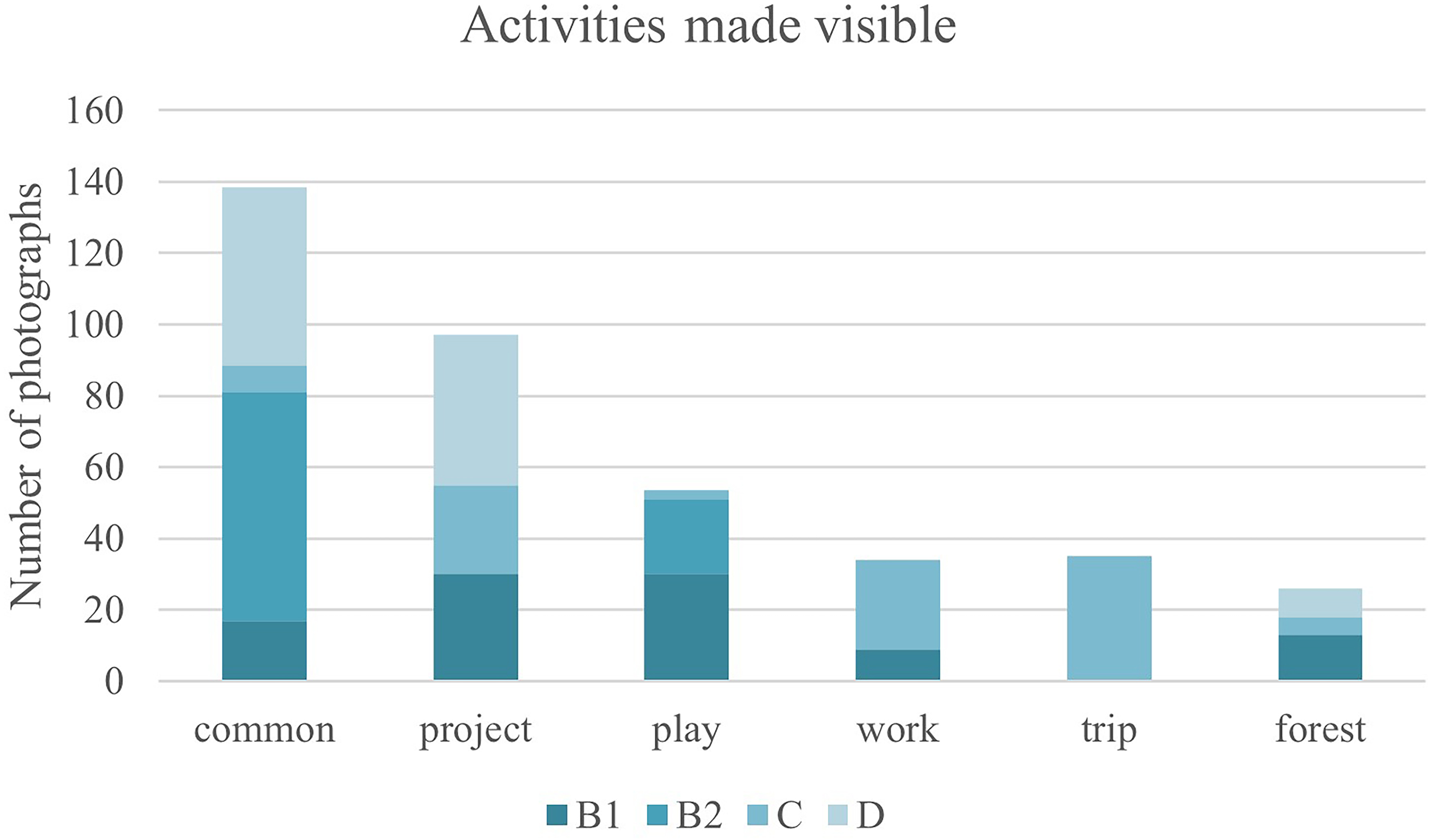
The preschools chose to circulate photographs of slightly different activities. Photographs in the forest category showed no specific activity.
Preschool C chose to portray children in work situations, such as laying the table or sorting recycling materials (Figure 4), more often than the other preschools. Preschool C also shared photographs of joint trips to institutions, such as libraries and theatre performances (Figure 1), to a greater extent than the other preschools. The circulated photographs from preschool C also showed the children's faces more often than the other preschools (Figure 2).
In preschool D, the activities that were made visible were spread evenly between children's common activities and preschool project work. No faces were displayed in the photographs, which were circulated in a closed application and an Instagram account. The Instagram photographs displayed slightly more children's common activities and less project work.
Discussion
Conforming notions of the visibility of preschool children
The digitalisation of preschool documentation has radically changed the visibility of the preschool. Since digital images became common currency as part of preschool documentation, perceptions of preschool and preschool children might change. The mass distribution of images portraying preschool children and their activities make certain images of the preschool and its activities more visible to society at large. As the photographs are similar rather than different and mediate conforming notions of preschools and preschool children, questions of representations of children can be addressed.
When images are circulated en masse, the individual photograph becomes less important as understandings are constructed from the entire flow (Jurgenson, 2019). The empirical material for this article focuses on activities and materials and making them impersonal. Focusing on activities and materials makes children's friendships, care and slow time invisible, which is also shown in Wahlgren and Andersson*s (2022) study of analogue preschool documentation photographs. Further, impersonal photographs contribute to a normative perception of preschool children and preschool practices, which in turn makes it difficult for families to see the photographs as part of their own child's everyday practice. This may result in some families never opening the circulated documents. Lim and Cho (2019) assumed that digitally circulated information could increase interest in the preschool's work, especially amongst fathers, but their results showed no differences in interest in preschool documentation due to digitalisation.
According to Wagner (2006) the visualisations of something, constructed by mass-distributed photographs, always relate to dimensions of understanding: the audience's pre-understandings, knowledge and imagination, all of which contribute to the construction of the arenas in which children participate and what their emotions in the activity might be.
Portraying children as unrecognisable makes it possible to imagine the photographs as featuring any child in any Swedish preschool. The activities and environments that are made visible are similar, and the ideas of the preschool child appear to follow a norm. The photographs communicate an image of a universal child, or at least a representation of all preschool children in Sweden. Thereby, the photographs have a strong normalising power, which becomes difficult to question (Foucault 1993). Images of children's personalities, emotions and diversity are made invisible. The same critique about setting universal standards for normality has been raised towards the TS gold assessment system, which uses documentation materials as photographs and videotapes to assess children's learning and development (Vitiello and Williford, 2021).
Visibility does not guarantee transparency
The extended visibility of preschool children does not necessarily include extended transparency, while preschool teachers choose which activities to make visible. According to Koyama and Kania (2016), transparency is supposed to ensure quality and an equal education for all children, where families can become more involved in their children's everyday experiences. Instead, these mainstream photographs of unrecognisable children mediate conforming images of a universal child, which is not coherent with transparency. For example, the fact that the children's faces are seldom shown leaves the viewer to imagine what their expressions of emotions might be.
Critical image analysis pays attention to the receiver of the images (Rose, 2016). Due to their cultural understandings, some families will recognise certain photographs (Fraser, 2008), while other families will neither recognise nor relate to them. For some families, the photographs are experienced in joint communications, whereas for others the images will remain unnoticed in that they are never opened or looked at. This study shows that the staff know who has or has not opened the circulated material. This is a reciprocal control function, in that families are made visible to the preschool at the same time as the preschool chooses to make itself visible to the families. From a critical image analysis perspective, this makes the staff both the senders and receivers of the images. The families that have not opened the circulated documents are often commented on by the staff.
In families that talk about the photographs at home, the child can contribute details that turn the images into personal experiences. With engaged guardians, the photographs might entail enhanced participation in the same way as the analogue photographs do with teachers in preschool (Olsson, 2019; Unga, 2013). The photographs are discussed, and the children can tell their own stories (Wahlgren et al., 2022)).
However, how or whether the photographs are communicated at home depends on the families, and the access to digital devices and applications. The circulation of digital photographs therefore renders children dependent on others, rather than being competent to participate on their own terms. Instead of an increased equity amongst children, digital circulation makes participation dependent on the children's home circumstances.
How the portrayal of children as unrecognisable affects their inclusion can be discussed from different angles. Wahlgren et al. (2022) shows that preschool children, in interaction with documentation photographs, are capable of producing stories that include themselves, even if they cannot identify themselves in the images. The children are also capable of excluding themselves from the photographs and explaining why they are unable to identify themselves (Wahlgren et al., 2022). Drawing on these capabilities, the portrayed unrecognisable children may enable any child to reflect on and include or exclude themselves from participation in the activities that are made visible. In this, the photographs and the children become interchangeable.
In contrast, Korkiamäki and Kaukko (2022) show how children perceive their visual participation as a possibility to represent themselves beyond using their voices, whereas the unrecognisability in the portrayals raises ethical questions about voice. The children want to identify themselves and their friends (Wahlgren et al., 2022), and according to Nutbrown (2010), making children unrecognisable to protect them is also a way of silencing their voices. Spencer (2022) claims that the demands for anonymisation, in order to protect children, contradict the need for representation in the visual language, which also affects how preschool children are perceived in society. Moreover, Spencer (2022) argues that challenging the taken-for-granted rule to pixelate children's faces in visual representations could create engagement in the child's standpoint or interest.
The Convention of the Rights of the Child directs that children have rights of protection, and the right to make their voices heard (United Nations, 1998). The results of this study highlight the dilemma of protecting children by making them unrecognisable in the photographs, as they simultaneously are put at risk of becoming invisible and voiceless.
A flow of images adapted to a different audience
Previous research has shown that analogue photographs posted on preschool walls almost exclusively portray children as participating in teaching situations (Wahlgren and Andersson, 2022). These photographs can be interacted with by the children, and teachers can include them in reflections and development of children's ideas (Olsson, 2019; Unga, 2013). Children show interest in telling stories about themselves and their friends when interacting with the photographs (Wahlgren et al., 2022). The focus on making education visible could be linked to the ongoing schoolification of the preschool (Liljestrand, 2020) and an endeavour on the part of the teachers to portray the preschool as education in order to show compliance with the revised curriculum (Wahlgren and Andersson, 2022).
However, when preschool photographs are used in digital communications, they seem to be adjusted to different audiences. Most of the digitally circulated photographs show children doing children's common activities, such as painting, using glue and coloured paper and playing with toys, which align with ideas about the preschool as the children's arena and a child-centred view of childhood (James and James, 2004). These activities can be related to an adult norm and what is commonly understood as children's interests and the best for the child, and therefore appear as familiar to most adults outside preschool.
Preschool C, which was situated in a wealthy area, circulated photographs showing a mix of project work, fostering activities and trips to libraries and theatres (Figure 5), which helped the audience to construct an image of a participating and learning child, as well as a disciplined subject becoming a responsible citizen. The image of preschool children as well-behaving pupils may be a response to guardians' demands for the preschool to be an arena of education, which is an important class marker (Walkerdine et al., 2001).
As Fraser (2008) puts it, some images become culturally recognised by groups with certain cultural capital. Therefore, knowledge about the receiver of the images is important to the sender in critical image analysis. In Sweden, most children attend preschool, but attendance is higher in wealthy areas, and can be as low as 40% in areas populated by low-income migrants (Swedish National Agency for Education, 2018b). Several international studies (Heckman et al., 2010; Lazzari and Vandenbroeck, 2013) show that attendance at preschool in the early years is linked to success at elementary school and throughout life. Preschool is specifically effective for children from poor circumstances (Yoshikawa et al. 2013), and therefore, raised attendance in low-income areas is desirable.
Preschool B, situated in a multi-ethnic residential area, circulated a larger number of photographs featuring children at play or doing children's common activities (Figure 5). The featured trips were those made to the nearby forest. According to Molina (2005), migrant families are often supposed to need to be trained in how to be Swedish, which includes learning to appreciate and attend preschool. Circulating photographs of activities that are often perceived as being joyful for children can be assumed to contribute to a positive view of the preschool, which in turn attracts more families to enrol their children in them.
In the US, private preschools mainly use social media to advertise their work and activities (Gabbidon, 2020). This study shows that digital communication in Swedish preschools partly can be interpreted as advertisements for potential new families. Overall, the differences in the photographs from the studied preschools cannot be generalised in terms of residential areas or social class. However, the results do show that preschools can, and do, select slightly different material to circulate, which could be due to adapting to the type of families they want to attract.
Conclusions
The mainstream digital circulation of photographs from the preschools could serve to attract families to enrol their children in the preschool in general or in specific preschools by using a slightly different focus on activities. However, these photographs do not meet the expectations of transparency or participation of individual children or families. The digitalisation of preschool communication makes the families themselves responsible for participation. In that sense, digitalised communication reduces equity rather than increases it.
To increase equity, the circulation of documentation should really represent all the children, their differences, ideas and their activities. When using analogue documentation, within the preschool context, teachers can use photographs where children's faces and their expressions of joy or boredom are visible and, in that way, give all children a voice.
Otherwise, the digital circulation of preschool documentation needs representations of all children and their activities. Teachers need to be held responsible for all children's possibilities to reflections, and for making all children's ideas visible rather than put the responsibility on the families.
Footnotes
Funding
The author received no financial support for the research, authorship and/or publication of this article.
