




Abstract
‘It's not, it's not random’ is a quote from a kaiako (teacher) of infants and toddlers as she describes her teacher decision-making processes taking into consideration all the various influences and interrelationships within the activity system of her early childhood setting. This article draws from an qualitative study that utilised narrative data and Cultural Historical Activity Theory (CHAT) to illuminate and illustrate how two kaiako use their specialised knowledges and specialised practices to respond to the care and learning of very young tamariki (children). The article concludes with a provocation to guide future thinking regarding what has been referred to as misunderstood, undervalued, hidden and taken-for-granted work of these education professionals.
Keywords
It's not, it's not random.
These are words spoken by Abigail, 1 an early childhood kaiako (teacher) who works with infants and toddlers in a community-based early childhood setting on Te Waipounamu Aotearoa the South Island of New Zealand. Abigail makes this statement during a Video-Stimulated Recall Interview (VSRI) as she describes why she is sorting through various baskets and boxes looking for just the right materials to include in the children's playspace of her early childhood setting. Abigail is calling attention to the explicit planning for tamariki (children's) engagement, well-being and learning as an intentional teaching act driven by how she has assessed children's care needs, their interests and aspirations for their learning. This article draws from a qualitative study that illustrates how two kaiako describe their decision-making for the care and teaching of very young tamariki as they respond to the multiple demands and the interactions in their early childhood settings.
Despite the kaiako decision-making process in which Abigail is engaged, the teaching and professional care-work of kaiako of infants and toddlers is often misunderstood, undervalued, hidden and taken for granted (Cannella, 2002; May, 2013; Rockel, 2009). Yet many early childhood teachers are continuing to fight for pay-equity and pay-parity and for recognition of their work as ‘professional’ educators alongside their primary and secondary school colleagues holding the same teaching qualifications.
Kaiako who work with infants and toddlers are particularly impacted. Many kindergartens in Aotearoa New Zealand, for children two to five years old, long ago established pay-parity through collective agreement with the government due to their historical non-profit status (Bidwell, 2023). While the historical division of early childhood services is beyond the scope of this article (see May, 2013), early childhood settings for children under two years old are generally community-funded or for-profit centres, primarily relying on family-paid tuitions with small governmental subsidies based upon number of hours tamariki attend. Kaiako in these settings are at the mercy of their setting's business plan with few collective agreements for pay or work conditions. Recent governments have attempted to address these disparities, but grave systemic issues of pay-parity and work conditions remain (Ministry of Education [MoE], 2024).
Furthermore, Davis and Dunn (2019) reported that kaiako of tamariki under-twos felt their professional expertise was not even acknowledged by their own early childhood teaching peers or their own families. Oftentimes what appears as ‘just playing’ with the tamariki or routinely going about daily caregiving practices, such as feeding of children and nappy changing, masks the professional knowledge and decision-making that is involved in those interactions.
However, prior research has indicated kaiako of infants and toddlers need specialised knowledge and awareness of specialised practices to ensure quality environments for the learning and care of under-threes (Cooper, 2018; Dalli, 2012; Dalli et al., 2011; Education Review Office, 2015). While some specific pedagogical practices for infants and toddlers have been identified in an Aotearoa me Te Waipounamu 2 context (Aspden et al. 2021), little is documented about how kaiako are using these specialised knowledges and practices to guide their interactions with these very young tamariki (Gould in Peters et al., 2020). The intent of this article's research was to make these pedagogical practices explicit by having teachers themselves describe what they are doing and why as they watch videos of their interactions with tamariki.
While visiting student teachers, mentoring kaiako shared frustrations of not being taken seriously as teaching professionals and issues of pay-equity/pay-parity. Yet, during these visits, some incredible teaching and learning with these youngest of tamariki was very apparent, as kaiako balanced not only the complexities of care, teaching and learning but also the multiple demands from others in the setting, from policies regulating what can and should be done and so much more. It was clear that the disconnect between public discourses of childcare workers and the specialised knowledges and professionalism evident in centres had to be addressed. These often hidden, taken-for-granted knowledges and practices needed to be revealed and the kaiako decision-making involved needed to be made explicit for others (Gould 2020). Thus, a qualitative study was undertaken with kaiako of very young tamariki seeking to make evident their teaching and care practices, asking
From kaiako perspectives, how is teaching/learning occurring in early childhood settings for children under three years old?
What are the points of tension and/or harmony with the activity system of the setting towards an outcome of kaiako and tamariki care and learning? What takes precedence in kaiako interactions in these settings?
This article will first describe the theoretical perspective and research methods that guided this investigation. Common themes that were evident in the teachers’ narratives will be presented and then one narrative excerpt from each of the two kaiako will be presented in more detail through a Cultural Historical Activity Theory (CHAT) framework analysis (Barab et al., 2004; Engeström, 1999; Roth and Lee, 2007) to illustrate the multiple influences and complexities in kaiako decision-making. The article will conclude with summary remarks and a provocation to guide our future thinking.
Theoretical framing and research methods
A Cultural Historical Activity Theory (CHAT) framework provided a mechanism by which to highlight various aspects and interrelationships influencing what was happening throughout the early childhood setting. Engstrom and others referred to these various aspects as ‘nodes’ upon the activity system triangle (Barab et al., 2004; Engeström, 1999; Roth and Lee, 2007). CHAT theory builds upon work by Vygotsky and Leont’ev to view learning as embedded within systems that are culturally constructed over and within periods of time. Thus, within this early childhood setting, kaiako and tamariki would utilise various forms of language, verbal and non-verbal, to communicate with each other for the outcomes of care and learning. Engeström (1999) then further extended this theory, and Vygotsky's relational triangle, to include additional nodes of rules, community and division of labour. Rules might include Te Whāriki, childcare licensing regulations and specific early childhood setting's policies. The community could include others in the early childhood setting, parents, whānau (family) and then reach into the greater community. Division of labour would include the work within the early childhood setting (e.g., care-giving routines, setting up of the physical environment, paperwork etc.) and even in the lives of kaiako outside the setting (e.g., care for their own families, external professional development, etc.). Second-generation CHAT acknowledges that these activity systems are dynamic and always changing, within that system and as that system interacts with other systems (Barab et al., 2004; Roth and Lee, 2007). When analysing a system from this perspective, points of conflict or tension between nodes are analysed as are relationships between and amongst the nodes that appear to be beneficial for the activity system's functioning and the outcomes of care and learning. (See Figure 1.)
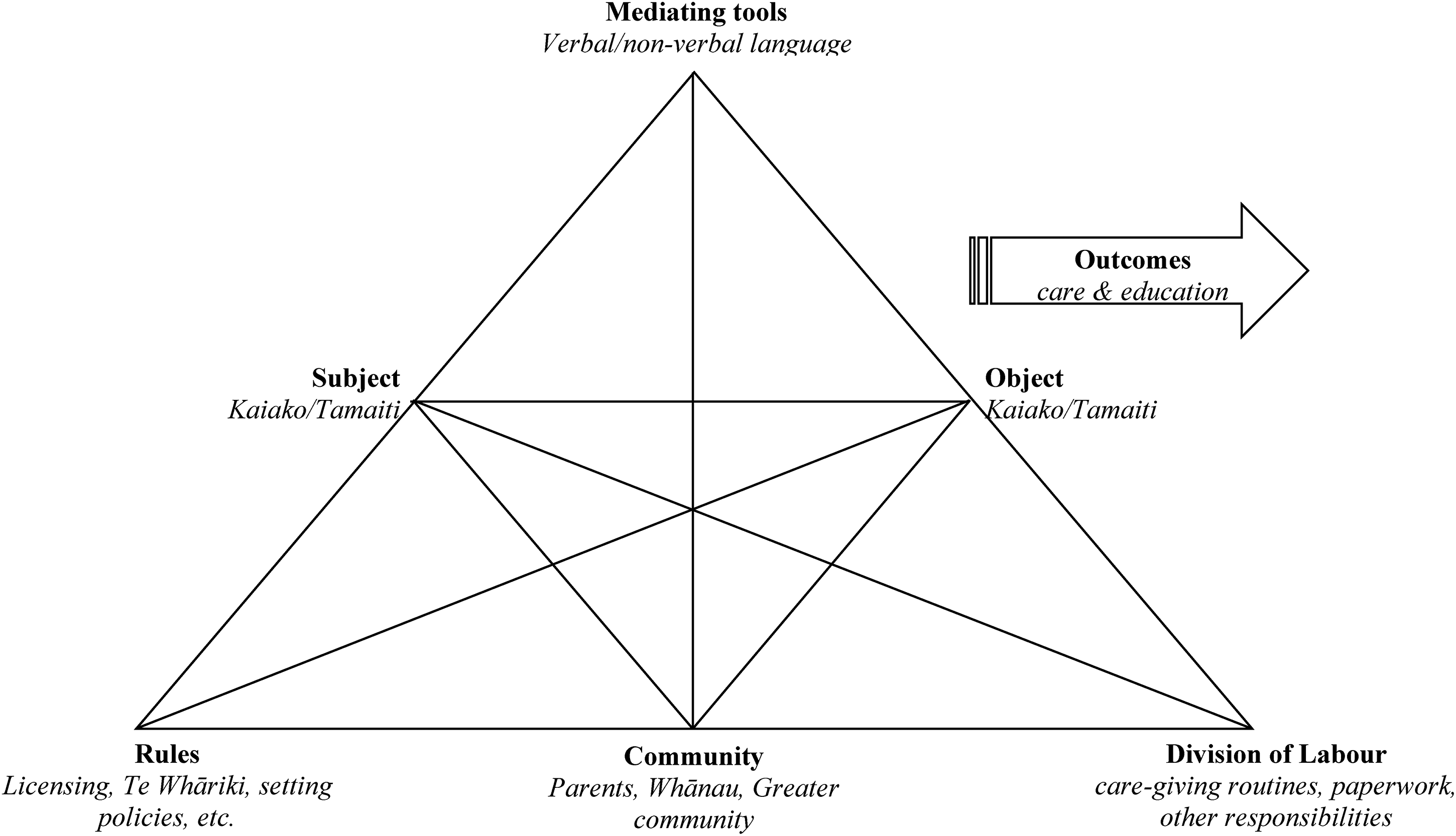
The activity system of the ECE setting.
Since this research sought to describe and analyse the perspectives of early childhood kaiako of infants and toddlers throughout their day in their activity system, qualitative methods were utilised (Clandinin and Connelly, 2000; Erickson, 2024). However, traditional qualitative methods, such as field notes of observations and interviews, would limit insights to the mental processes of kaiako decision-making. Furthermore, one of the underlying issues being addressed in this research is that there are multiple complex demands being made of teachers throughout their day. Thus, it can be challenging for kaiako to remember all that has happened in each day and what factors may have led to particular actions, decisions and prioritisations. Cherrington (2018: 321) noted that Video-Stimulated Recall Interviews (VSRI) are particularly helpful in these instances ‘due to the cognitive load and highly verbal nature of the teaching task itself’. As kaiako view the video, they are able to return to that moment of their interactions and better describe their thinking and in-the-moment decision-making.
Two kaiako of tamariki under two years old volunteered to take part in this research. Each kaiako holds a full teaching certificate and works in a different community-based (non-profit) early childhood education and care setting. Anne had been working in her setting for over ten years, while Abigail had been working in her centre for over five years, the day of the third VSRI being her last day teaching (as will be discussed later).
To prepare for the VSRI, kaiako wore a Go-Pro camera on a chest harness recording audio and video for an entire day minus any breaks the kaiako had (a little over 6 and a half hours each day). During sensitive care moments, such as nappy changes or very upset tamariki, the kaiako used a low-tech, attached, piece of black tape to cover the camera lens. This researcher was also present throughout the day as a participant researcher, interacting as a visitor with adults in the setting and with tamariki when they approached for playful interactions. Notes of observed potential moments for later discussion and routines of the day were discretely recorded in a small notebook by this researcher.
The researcher then viewed the day-long video and documented each interaction and episode of interactions on a spreadsheet. Key episodes and illustrative moments of teaching, learning and care from the day, particularly those that had been recorded in field notes, were highlighted. From this data a video of around 45 min. was created that included interactions and/or moments that appeared particularly meaningful, were indicative of several other smaller moments of the day, or perhaps a theme that ran throughout the day. While a 45-min. video cannot capture all significant moments of the day, kaiako were also informed that the entire video was also available so that other moments could be viewed and discussed if they so desired in the interview that followed.
Generally, within a week of the day-long recording, the Video Stimulated Recording Interview (VSRI) took place. As the kaiako and researcher viewed the shorter video together either the kaiako would stop the video to discuss what was happening or the researcher would stop the video to ask about what was happening in that moment and the kaiako decision-making. These sessions were audio recorded and transcribed and then sent to the kaiako for their review, revisions and anything additional they might want to add. This process of day-long video recording, VSRI and transcript review was conducted three times on three separate weeks with each of the two participating kaiako.
Once all three of the transcripts were approved and modified by the kaiako, the transcripts were analysed deductively using the research questions as a guide (Hatch, 2023; 2002). Thus, transcripts were coded for instances of kaiako describing: the teaching/learning occurring, how those moments related to nodes of their activity system, and what was taking precedence in their interactions. Themes across the narratives were then identified.
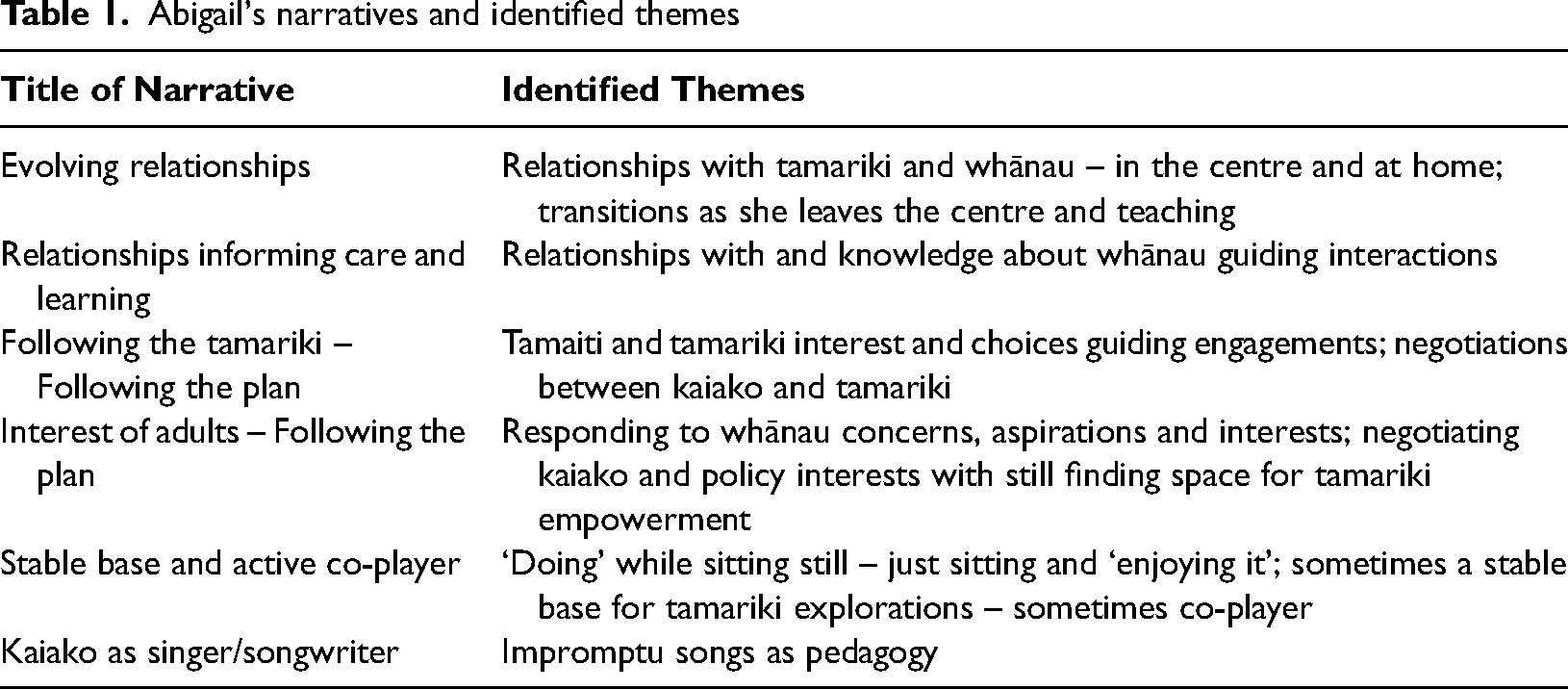
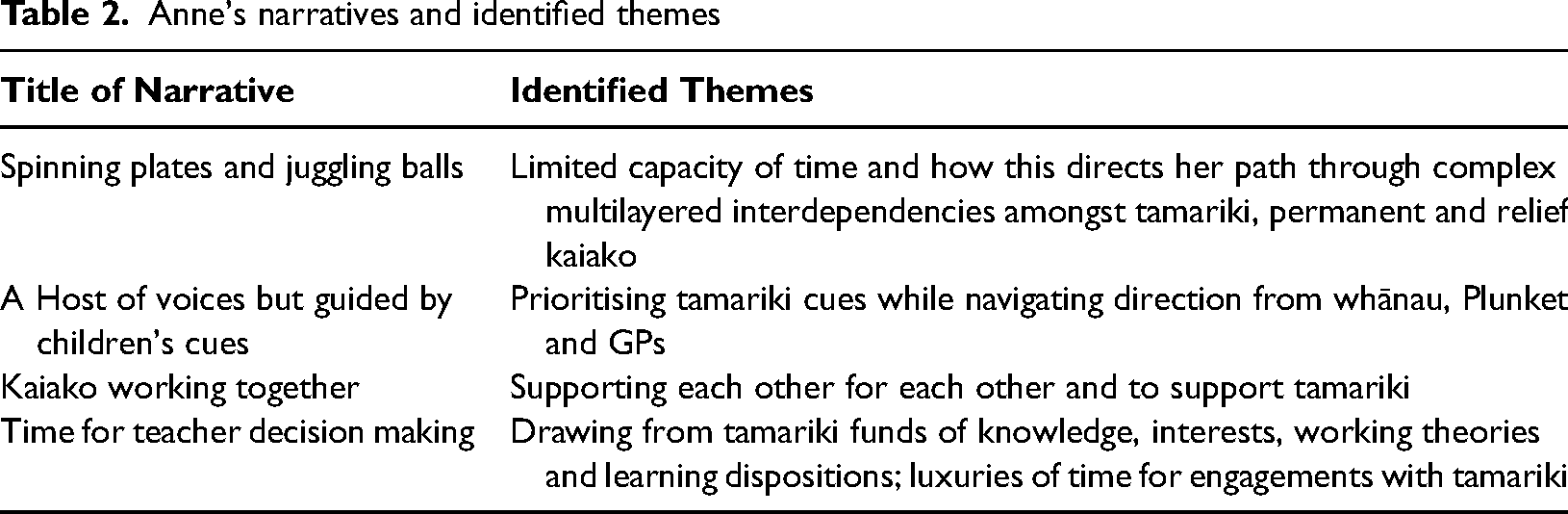
This research used storytelling as meaning-making through a further narrative research paradigm (Barone, 2001; Clandinin and Connelly, 2000). This type of narrative analysis is very familiar to early childhood kaiako in Aotearoa New Zealand since assessment of and planning for tamariki learning regularly takes place through narratives in the form of narrative learning stories (Carr and Lee, 2012). Therefore, based upon themes identified across the research questions in the preliminary deductive analysis, narratives were created with the kaiako experiences, voices, thinking and their own stories woven together with the researcher-interpreted emerging analysis. Kaiako then had the opportunity to review and revise the narratives. The narratives then became rather co-written stories as data for further analysis, consideration and publication. The themes drawing these narratives together along with titles of the narratives for each kaiako are presented in Tables 1 and 2.
Abigail's narratives and identified themes
Anne's narratives and identified themes
A deeper CHAT analysis was then undertaken with each narrative. As a narrative was reviewed, relationships between nodes of the activity system that were supportive of each other were recorded and mapped on a CHAT diagram in green and relationships that were indicative of tensions or challenges were recorded and mapped in orange. Two examples of this analysis will be presented later in this article.
Kaiako narrative themes and discussion
The narratives created for each kaiako, based upon themes in their three VSRI, are a combination of direct quotes from the kaiako and the researcher's emerging analysis drawing these quotes into a unified narrative. Kaiako had to opportunity to read, review, revise and respond to these narratives providing some reassurances that the narratives and the ensuing analyses represented their thinking and experiences. In the section that follows these narratives will be further explored with the goal of making more evident and explicit the taken-for-granted decision-making occurring rather than making certain evaluative claims about kaiako actions. It must be acknowledged that the analyses are researcher interpretations, albeit with some reassurances following the kaiako reviews of the narratives (Barone, 2001). Nonetheless they are interpretations and as such the analyses and related discussion will be interwoven throughout the section.
While each day in the life of an early childhood setting can be quite different from any other, looking across these three days for commonalities and themes provided some broad insights into kaiako decision-making and what takes precedence in these interactions. First, overall themes emerging from the narratives are presented, highlighting what appear to be guiding the teaching and caregiving decisions of these kaiako. Then excerpts from two narratives, one from each kaiako, will be more deeply explored through a CHAT analysis to illustrate complex influences and interrelationships within this kaiako decision-making.
Overall titles and related themes
Tables 1 and 2 provide the titles and related themes for the narratives of each kaiako. The number of narratives is based upon the number of different themes and how these themes related to each other. While limitations of space do not permit a full accounting of each of the narratives, a few key points are worth noting.
Looking at the narratives as a whole, multiple influences and their complex interactions within teaching and care practices are apparent. Narratives from both kaiako highlight the influence of Te Whāriki, the national bi-cultural early childhood curriculum framework (MoE, 2017) which is built upon the principles of Empowerment|Whakamana, Holistic Development|Kotahitanga, Family and Community|Whānau Tangata, and Relationships|Ngā Hononga and views tamariki learning through the strands of Well-being|Mana Atua, Belonging|Mana Whenua, Contribution|Mana Tangata, Communication|Mana Reo and Exploration|Mana Aotūroa. While an extensive, detailed analysis of the curriculum framework's influence is beyond the scope of this article, it is important to note the connections that kaiako are making here to the curriculum, particularly in regard to relationships and how tamariki are empowered through play-based learning related to their interests, working theories, learning dispositions and their families’ funds of knowledge (González et al., 2006; Hedges, Cullen & Jordan, 2011).
Additionally, while Anne highlights the luxuries of having segments of time to be present and engaged with tamariki, Abigail's attention is on remembering tamariki learning plans and using those plans to inform her decision-making. Both kaiako also provided several examples and details describing the complexities of how adults' interests both guided and challenged their decision-making. These complex interrelationships will be further discussed in the following section as two narratives will be discussed through a CHAT analysis, although Anne's narrative of ‘Spinning Plates and Juggling Balls’ also does an excellent job highlighting these points (see Gaches, in press for further discussion of this narrative). Relationships with tamariki, whānau and other kaiako are also key themes in these kaiako narratives. While relationships inform care and learning of tamariki, Anne provides insight as to how relationships also include how kaiako work together.
It is worth noting that a powerful portion of Abigail's narratives related to the reasons she was leaving teaching. She stated that while ‘I still love [the children]. I still care and nurture them’, she has found ‘the challenge of this work, the time, the energy, and most especially the emotional energies she expended with the tamariki in the centre was leaving little for her to provide for her son's needs and interests at the end of the day’ (Evolving Relationships narrative).
CHAT analysis of two narrative excerpts
A CHAT analysis provided further insights into the complex influences and interrelationships that were guiding kaiako decision-making. Each decision kaiako made included connections to several of the activity system nodes. Some of these relationships were supportive, working together for a positive outcome of tamariki care and learning, while other connections were indicative of tensions or challenges that kaiako had to address for positive child experiences. Particular excerpts from one narrative from each kaiako have been selected for discussion for two reasons. First, they are representative of the complex interdependencies found in other narratives. Secondly, in each of these narratives kaiako specifically discuss assessment and planning for tamariki learning, elements frequently associated with ‘teaching’ but often not associated to interweaving of care, teaching and learning work with infants and toddlers.
Abigail's toy selecting
As mentioned previously, Abigail frequently explains how she follows the interests of the child but also follows the learning plans that have been developed in partnership between whānau and kaiako on behalf of these very young children. The decisions she makes for the care and learning of tamariki not only vacillate between these interests, but also wherever possible she brings them together. In the following passage from the narrative entitled, ‘Following the tamariki – Following the plan’, which contains the quote from which this article derives its title, Abigail discusses her thinking as she was looking for particular toys (or with the CHAT framework, tools) to bring into the play-area for the tamariki: I think it was Isla playing with a little, it's like a little doll's house, but it's not because it doesn’t have levels. It just opens up and it's like a pet shop. And Mila's got two dogs at home. And then Nikki loves her (stuffed) black puppy. And I was just kind of like, what else? Where can we go? I was just trying to think of a way to go with some of the learning and I’m just trying to play with Mila's communication at the moment. And that was her plan. And I hadn’t really done much on it. And I was like, what brief am I going to do, because I hadn’t brought anything down yet. So, I just thought, let's swap the animals out. We’ve had the sea creatures down for quite a while. We’ve had the dinosaurs down. Now's the chance to maybe switch them and bring down those pets. And we’ve got a lot of books at the moment with farm animals. Got The Snore and we’ve got Cows in the Kitchen and the Farmyard Hullabaloo, I think it is, and just kind of get the animals down to match with that … Well, that's kind of picked up because, I mean, it's that's part of the teaching and learning really, because I’ll come to that in a minute. But you know the decision-making as to exactly which resources you’re going to include in there, and why. It's not, it's not random.
Abigail continues her decision-making further describing how she envisions the tamariki engaging with the tools (their division of labour) for the desired outcome of learning through role playing/interacting with the puppets: I just think I wanted – like I was going for the small like handheld animals for the kids to play with. And I knew the older ones were going to probably most likely role-play with them. So, I was looking for the smaller puppets that can pretty much just fill out like one or two of their fingers. They’re small enough that they can carry a couple of them around. And the big puppets are great. But they get used downstairs more if the teachers are actually using them as a puppet and next, one the kids quite want. But I kind of didn’t want that. I wanted them to take the animals off and kind of do that role-play by themselves, because that's what they had been doing.
Anne's engagements with two tamariki
Two learning episodes are presented in Anne's narrative entitled, ‘Time for Teacher Decision Making’. The first episode in this narrative focuses upon her interactions with Liam and a big blue riding truck, another toy-tool. In the narrative, Anne's kaiako decision-making is described in this way: Her intentionality in setting up this engagement was discussed as well as her thinking about how certain tamariki might interact with the boy as well as possibilities to build his perseverance and resilience. She knew that other tamariki might challenge him but that with her support he could respond more confidently and appropriately. Anne also made connections to his home life thinking about his stories of a truck being stuck in the mud. Yet she was surprised at how instead he chose to be on the grass but that perhaps that was part of reliving this family's event. Am I supporting them in their learning? Or is what I’m doing determining where they are going? Or if we are providing more, do we then create more of an interest. How do you know? … [A]nd then actually what happens next is that you’ll get feedback from the family and they say, ‘Ah, that's what it meant when he was doing this at home’ or talking about this with the truck or the dogs … because they don’t know and he doesn’t necessarily verbalise it.
Another episode of sustained engagements with a child also highlighted Anne's kaiako decision-making and the impact of sustained time (division of labour) with a not-yet-walking child, Andrew. In this episode Anne had noticed Andrew's deep interest in what other tamariki were doing: So yeah, I noticed over a few days … I think we’ve been going outside around three o’clock in the afternoon and he’d noticed the kids on the bikes and he would just sit on his knees and go (making a look of amazement). Watching them go backwards and forwards. (VSRI #2)
This is the starting point for Anne's kaiako decision-making. She has noticed Andrew's interest in other tamariki as they engage with the tool-toys of toy trucks, then small push trikes, and finally a small trolley for the child. Anne's teaching actions supporting Andrew's interest resulted in around 40 minutes of engagement for this child. Because of what I’ve noticed for him in previous days and I think I’ve given him, maybe little trucks because I’m thinking, is it the actual bike? Is it motion? What is it? So yeah, for him different things and figuring that out before he was into the wheels, like tipping the trucks upside down and playing with the wheels. But then he was still watching those children. And then I had to make a judgment call because everyone wants to have a pink plastic bike and not so much a red bike; that it didn’t seem to matter which bike I tried to offer Andrew, some toddler wanted it. I think that whole sequence of events from him watching these bikes to me offering him wheels to then being very interested in figuring out how the thing works. Because he does some interesting things. He tips it over. He's … in my mind … are you … of course I’m fast forwarding because that's what I do. Is his intention going to be, to try and ride the bike or is he still interested in the wheels, you know, you just have to wait and see where he goes with it …
Additionally, staying in a moment of engagement wasn’t always a possibility, as Anne often needed to divide her labour amongst many. While Anne was stepping in and out of Andrew's engagement, she was also involved in the learning and care episodes of other tamariki in the area. One child had given her a stick for her to ‘take care of for me’ and several times other kaiako came to her asking her about the needs of other tamariki or routines in the setting.
Concluding thoughts and provocation for future thinking
What becomes apparent throughout these narratives is the complexity of kaiako thinking and how they are often responding sensitively and reflectively to a myriad of influences, demands and possibilities at any one moment. The narratives discussed here are but just a small sample of what these kaiako have shared during their VSRI. The CHAT analysis for each narrative listed in Tables 1 and 2 demonstrated similar complexities and kaiako decision-making responses as kaiako weave together care and learning for these very young tamariki. While the focus of the CHAT analysis in this article has been on narratives that illustrate the ‘teaching’ acts of assessing and planning, narratives from this research published elsewhere also focus on other complex interdependencies in the weaving of tamariki well-being, care and learning (Gaches, in press).
Care, teaching and learning are interwoven throughout the interrelationships in the activity systems of the early childhood setting. Kaiako decision-making responds to these influences through intentionally pre-planned or in-the-moment pedagogical choices. Furthermore, kaiako of these very young tamariki must use their specialised knowledge of tamariki of this age, their unique ways of being, doing, knowing and communicating and the specialised knowledge of each tamaiti (child) and their whānau to facilitate responsive care, learning, teaching and environments. Abigail utilised her knowledge of how tamariki were interested in animals at home, with other toys, and as the characters in the centre's books to create opportunities for tamariki to engage in role-play, exploring their animal–world connections and finding more ways to communicate. Anne utilised her specialised skills of intently watching tamariki non-verbal language to notice Andrew's deep interest in the other tamariki use of bikes and trolleys. She then drew upon her specialised knowledge of how infants and toddlers engage with their world to support Andrew's investigations of wheels, bikes and trolleys, how these toys work, and what he can do with them.
Additionally, it must be acknowledged that the early childhood setting activity system of each of these kaiako is not isolated as an independent activity system (Engeström, 1999). They exist alongside and interact with other activity systems and the nodes of those activity systems, which then impact back upon this early childhood setting's activity system. For example, if something happens in Mila's home activity system affecting the well-being of her two dogs, the impact of that will be felt in the early childhood setting as Mila comes to understand what happens at home, likely influencing (supportively and/or with tensions) how she interacts with the toy dogs Abigail has included in the playspace. On a more macro-scale, discourses and attitudes in the activity setting of the greater community of kaiako pay-equity/pay-parity may cause tensions between the activity systems affecting teachers’ division of labour and community support of kaiako work. Changes in licensing rules and curriculum initiatives may be made with a lack of understanding of the complex everyday work of kaiako. As one node of the activity system becomes affected, other nodes, including tamariki, their care and their learning, are also affected.
This article began with the quote from Abigail, ‘It's not, it's not random.’ This statement is made almost as a challenge. She is challenging others to notice the work she does as a teacher. The decisions she is making are not random. They are decisions that take into consideration many elements, influences and complexities. She has utilised her knowledges, her professional judgements and she is skilfully and care-fully selecting potential options for tamariki care and learning. Anne acknowledges that this thinking may not always be exactly right, that she may be reading more into tamariki actions than intended, but that this is also a starting point upon which she can ‘wait and see where he goes with it’. She must reflect and use her professional knowledge and judgement as kaiako to continue their decision-making. Her actions aren’t random, they are thoughtful, considered and take into account the many influences and interrelationships affecting the tamariki in the setting.
Again, Abigail is provoking all of us to look beyond the surface of kaiko playing with and caring for infants and toddlers. We are provoked to look beyond what appears to be random actions and to recognise, acknowledge and value the specialised knowledges and specialised practices of infant and toddler kaiako.
Footnotes
Acknowledgements
I would like to acknowledge the kaiako who shared their experiences, thoughts and time to provide these insights. I would also like to acknowledge the tamariki, kaiako and whānau who welcomed me into their early childhood settings so graciously.
Declaration of conflicting interests
The author declared no potential conflicts of interest with respect to the research, authorship and/or publication of this article.
Ethical approval and informed consent statement
This research was approved by the Ōtākou Whakaihu Waka University of Otago Ethics Committee and informed consent was obtained for all participants.
Funding
The author received no financial support for the research, authorship and/or publication of this article.
