




Abstract
Despite education discourses promoting risk-taking as a positive character trait, Australia has been identified as one of the most risk-averse countries in the developed world. This begs the question, why are Australians so risk averse? One reason may be a lack of common language and understanding about risk-taking, and an absence of risk-taking culture, in Australian educational settings. In this article, I continue an ongoing conversation about risk and risk-taking in educational contexts. I explore use of these terms in general education discourse and formal Australian education documents, revealing some positive inclusions and concerning silences. To help address the silences, I introduce the terms pedagogical risk-taking and pedagogies of courage. I propose these terms and their associated accounts as a framework for helping build a culture of risk-taking in educational settings – a shift that will help more Australian's embrace risk-taking for the benefit of individuals, the environment and society.
Introduction
Australians are among the most risk averse in the developed world.
The statement above has been made with increasing regularity in Australian media over recent years – and it is not just media commentary. A 2022 study identified that Australian parents are among the most risk averse in the world, surpassing New Zealand, the UK and Canada (Jerebine et al., 2022). This is despite increased attention on risk-taking as a desirable character trait in Western cultures (Ball et al., 2012; Bialostok and Kamberelis, 2010; Gleeve, 2008; Little and Wyver, 2010; Sandseter, 2009b). This contradiction raises the question: what are the barriers to Australians embracing risk-taking? One barrier may be a lack of common language and understanding about risk-taking and an absence of risk-taking culture in Australian educational settings. The concepts of risk and risk-taking are complex. At the core is the possibility of negative consequences, and hence the words alone often lead to fear and avoidance. In many situations this is warranted. Yet in educational contexts certain kinds of risk and risk-taking can be beneficial (e.g., Awopetu, 2023; Beresford-Dey et al., 2024; Little and Stapleton, 2021; Nikiforidou, 2017; Robinson, 2005; Cooke et al., 2020b). In education, where learning is central, specific terms and understandings are needed to reduce fear and avoidance and promote beneficial risk-taking.
Several articles published in this journal in recent years have explored the concept of risk and discourses on risk-taking in early childhood education (ECE) (Cooke et al., 2019; Bialostok and Kamberelis, 2010; Nikiforidou, 2017; Saltmarsh and Davies, 2010; Sandseter, 2009b). Here, the conversation continues. Drawing on evidence and silences in educational risk research and literature, and formal Australian education documents, I present the terms pedagogical risk-taking and pedagogies of courage. These terms provide a common language and account for risk-taking in educational contexts. Application of these terms across all education sectors would support collaborative engagement in risk-taking, for both children 1 and educators, 2 and contribute towards moving Australia past the inglorious position of being the most risk averse nation in the developed world.
Discourses on risk-taking in education research and literature
… if there were some risk we still ought not to hesitate … since there are risks inseparable from human life.
Although belief in the value of risk-taking in education is not new, the discourse on risk-taking as a desirable character trait for children and educators has blossomed in recent years. Often listed as a ‘twenty-first century’ skill (Experiential Learning Depot, 2023; Lamb et al., 2017) linked to innovation (Couture, 2014; Howard et al., 2018), creativity (Beghetto, 2018; Henriksen, 2016) and learning (Awopetu, 2023; Little and Stapleton, 2021; Nikiforidou, 2017), the disposition to take risks is increasingly included in education setting values and philosophy statements. For example, the International Baccalaureate Organisation (International Baccalaureate, 2013) and Round Square Schools (Round Square, 2020) include risk-taking and courage (respectively) in their learner profiles. In the tertiary sector, several Australian universities include terms such as brave, dare, step out of your comfort zone and risk-taking in their values statements (e.g., Deakin University, 2023; University of Canberra, 2023; University of Sydney, 2023). Moreover, risk-taking (often referred to as risky play) has become a common feature of the growing number of outdoor and bush/forest schools globally (e.g., Elliott and Chancellor, 2014; Little, 2019; Speldewinde, 2024). There has been an increase in scholarly literature related to the benefits of risk-taking for children, particularly in the ECE sector. Literature identifies benefits for learning and development, such as building resilience and confidence, and the development of risk assessment and management skills (Awopetu, 2023; Bundy et al., 2009; Dweck, 2012; Gill, 2007; Ingram, 2017; Madge and Barker, 2007; Cooke et al., 2020b). It is increasingly recognised that taking risks can ‘have positive implications in terms of children's developmental, social and emotional needs, as well as their overall health’ (Gleeve, 2008: 3) and that learning to overcome ‘challenging situations is an essential part of living a meaningful and satisfying life’ (Gill, 2007: 16).
Some may view risk-taking as the new ‘buzz word in education’ focused on developing children's entrepreneurial skills for a capitalist society (Bialostok et al., 2012: 8). Yet many educators and scholars view risk-taking as an inherently unavoidable part of life (e.g., Biesta, 2014) and a necessary disposition/mechanism for educators to both work within and push back against neoliberal policies and agendas (such as certainty of outcomes, as will be discussed subsequently). Risk-taking has been identified as an important aspect of leadership and leading (Beresford-Dey et al., 2024; Gibbs, 2020; Gul and Gul, 2023), professional growth (Amozadeh et al., 2023; Gul and Gul, 2023; Cooke et al., 2020a), and the creation of innovative and responsive educational programmes (Figueira et al., 2018; Grieshaber and McArdle, 2014; Howard et al., 2018; Jones and Le Fevre, 2018; Cooke et al., 2020a; McLeod and Giardiello, 2019). Several recent articles within this journal identify the risks educators take in everyday practices, such as providing opportunities for children to take risks (Little et al., 2010; Little et al., 2012), making curriculum decisions within the context of conflicting policies, documents and beliefs (Davies et al., 2023; Ruscoe et al., 2023), upholding children's rights within discursive tensions about what is best (Cooke et al., 2023), promoting social justice (Hard et al., 2013), and exploring new theoretical approaches (Murris and Osgood, 2022).
Despite these positive views of risk-taking in education research and literature, there remains a lack of clarity and consistency around the terms risk and risk-taking, and associated practices, in formal Australian education documents. Teaching and learning in Australia are governed by a range of documents. In ECE, the National Quality Framework (NQF), which includes the National Quality Standard (NQS) (Australian Children's Education and Care Quality Authority [ACECQA], 2017) and the Early Years Learning Framework (EYLF) (Australian Government Department of Education [AGDE], 2022), provides guidance on regulations, teaching principles and practices, and child learning outcomes. For primary and secondary schools, each state provides a curriculum stating expected learner outcomes e.g. The Victorian Curriculum for Foundation – Year 10 3 (The Victorian Curriculum and Assessment Authority [VCAA], 2023). Additionally, all registered teachers are governed by the Australian Professional Standards for Teachers (Australian Institute for Teaching and School Leadership [AITSL], 2017), which describe the professional expectations for teachers working with children aged four and up. 4 Within these documents, there are some positive inclusions about risk-taking and some problematic omissions and silences, as will be discussed below with a focus on the ECE sector.
Australian curriculum documents: Inclusions and omissions
The terms risk, risk-taking and risky play have been included in the NQS (ACECQA, 2017) and EYLF (AGDE, 2022) since their first iteration in 2009. The term risk is used with two distinct meanings: (1) negative: something that should be avoided, and (2) positive: something that should be encouraged. Largely, the term risk is applied with negative meaning, often in relation to the notion of being ‘at risk’ (the vulnerable position of being at risk of harm). The NQS states that educators have a responsibility ‘protect children from foreseeable risk of harm’ (144). Concurrently, the term risk, along with risk-taking and risky play, are used to describe something positive that educators should promote. For example, in the EYLF educators are encouraged to create learning environments that ‘encourage risk-taking and risky play experiences’ (47) and allow children to ‘take appropriate risks’ (53). The inclusion of risk-taking and risky play as something that children should be encouraged to do is positive and recognises the benefits for learning and development. Yet the interchangeable use of risk as something to be encouraged and avoided can cause confusion for educators (Hanrahan, 2023). The possibility for confusion is evident in the following statement: ‘[children are] supported to make choices and to experience the consequences of these where there is no risk of physical or emotional harm to themselves or another person’ (ACECQA, 2017: 237). Risk and risk-taking both involve a complex nexus of possible rewards, inherent and perceived danger, probability, history, culture, time and place (Adams, 2016; Burgess et al., 2016; Madge and Barker, 2007), and the tension between harm and opportunities for learning and development is unavoidable (Adams, 1995; Hanrahan, 2023; Niehues et al., 2016; Cooke et al., 2020a). Yet, the notion of allowing children to take risks at the same time as protecting them from the inherent risk involved is problematic. Propensity towards protection is usually stronger than the disposition to take risks (Csikszentmihalyi, 2000), and therefore clarity and guidance on what risk-taking looks like in educational settings, including what kind of negative consequences are acceptable, is needed.
Both the NQS and EYLF have attempted to provide some clarity and guidance. The guide to the NQS states that although services need to take reasonable precaution to protect children from harm, they do not need to ‘eliminate all risk and challenge from children's play environments’ (ACECQA, 2017: 68). The guide also indicates that educators should ‘offer opportunities [for children] to take manageable risks’ and ‘it is important to understand that risky play can be acceptable where the benefit to children's learning outweighs the risks’ (158). In both the guide and the EYLF, the terms ‘appropriate’ and ‘calculated’ are used to describe the kinds of risks educators should allow children to take. Use of these terms suggests trust for educators’ skills, knowledge and professional judgement, which is positive. Yet whilst educators work within a culture of risk aversion, more information and clarity are required to help educators and families have a common understanding of risk and risk-taking in an educational context. Both the EYLF and NQS have a glossary containing definitions for terms such as outcome, parent, routines and numeracy. Yet the terms risk, risk-taking and risky play are not included. These glossaries are the ideal place to include education-specific terms and accounts related to risk and risk-taking, and would contribute towards strengthening both the documents and ECE risk-taking practices.
The positive messaging about the value of risk-taking for children in the EYLF/NQS is not evident in the Victorian Curriculum. Despite outlining ‘the knowledge and skills required by students for life-long learning, social development and active and informed citizenship’ (VCAA, 2023: 1), the Victorian Curriculum does not make any reference to risk-taking as a positive action or character trait. The 69 references to risk and one reference to risk-taking in the document all refer to these as something negative that should be avoided. There are 19 references to learners developing risk-assessment/management skills. However, these all relate to managing possible negative outcomes (rather that balancing positive and negative) and occur at Level 5 and above, and predominantly within STEM outcomes. There is no continuation of the outcomes related to risk-taking that are promoted in the EYLF/NQS. This contrasting narrative between the ECE and primary/secondary sector is discouraging. When there is clear acknowledgement in ECE that providing opportunities for children to assess, manage and take appropriate and calculated risks is beneficial for learning and development, what message is being sent to children when they reach primary school? Is risk-taking no longer beneficial? Is risk suddenly only viewed in the negative? And is learning to assess and manage risks only valuable for older children? Inclusion and application of the terms risk, risk-taking and risky play in the Victorian Curriculum would provide appropriate scaffolding from ECE through to primary/secondary, and bring the Victorian Curriculum in line with contemporary discourses on risk-taking in education.
Educator risk-taking: A significant silence
In addition to the absence of education specific terms and accounts for children's risk-taking across formal curriculum documents, there is also a significant silence regarding educator risk-taking. Although the NQS and EYLF provide explicit reference to children taking risks, and some guidance for educators to enable this, there is no acknowledgement of the value and place of educator risk-taking in ECE practice. This silence is mirrored in the Australian Professional Standards for Teachers (AITSL, 2017). Across the seven standards for professional knowledge, professional practice and professional engagement, there is no encouragement for educators to take risks. This silence is despite the existence of practices within these documents that may require educators to step out of their comfort zone, try new things and take risks, such as the encouragement that educators should ‘offer opportunities for children to take manageable risks’ (ACECQA, 2017: 158) and ‘evaluate personal teaching and learning programs using evidence, including feedback from students and student assessment data, to inform planning’ (AITSL, 2017: 6), both of which have been identified in research as potentially risky for educators (e.g., Cooke et al., 2020a). The lack of acknowledgement that educator risk-taking can be beneficial and necessary to achieve the practices outlined in the EYLF/NQS and the AITSL standards is in stark contrast to literature encouraging educators to embrace risk-taking in teaching and learning.
This contrast highlights a conflicting narrative in Australian educational discourse. Whilst educational and scholarly literature promote educators taking risks by, for example, standing up for their beliefs (Baker-Doyle et al., 2018; Cooke et al., 2020a), implementing new ideas (Beghetto, 2018; Howard and Gigliotti, 2016; Cooke et al., 2020a) and engaging in ‘tricky’ conversations (Cooke et al., 2020a; Robinson, 2005), formal curriculum documents largely reflect a prevailing neoliberal agenda of certainty in educational practice. Where the discourse on risk-taking acknowledges that a perfect match between teacher input and student outcomes cannot be guaranteed (Biesta, 2014), the neoliberal agenda promotes evidence-based practice, standardised curricula and testing, and other such policies and structures aimed at ensuring outcomes (Biesta, 2014; Grieshaber and McArdle, 2014; McLeod and Giardiello, 2019). This neoliberal agenda puts educators in a position where they feel pressured to demonstrate confidence in their practices and certainty in outcomes, and fearful of the repercussions if they do not deliver (with ongoing talk of teacher-performance pay, this fear is increased). For educators who embrace risk-taking, their practices are often constrained by the neoliberal agenda (Bialostok and Kamberelis, 2010) and they can be subject to judgement (perceived or real) from colleagues or families who expect certainty (Cooke et al., 2020a).
As educators and scholars increasingly recognise the benefits of educator risk-taking for innovation, creativity, leadership, professional growth and education itself (Biesta, 2014), the silence around educator risk-taking in formal education documents is concerning. If educators are to be innovative and transformational in exploring the contested notion of what is ‘best’ for individual children, classrooms and communities, both now and in the future, then it must be acknowledged that this comes with uncertainty. As Biesta (2014) says, ‘if we take the risk out of education, there is a real chance that we take out education altogether’ (1). If education is to be a democratic and socially just endeavour (Grieshaber and McArdle, 2014; McLeod and Giardiello, 2019) and ‘educational’ in ways that help learners develop the skills, knowledge and values to be active participants in society now and in the future (Biesta, 2014; Kemmis et al., 2014; Reimer et al., 2023), educator risk-taking needs to be encouraged through the inclusion of explicit terms and accounts in curriculum documents and teacher professional standards. The concepts of pedagogical risk-taking and pedagogies of courage provide a useful starting point for amending the concerning omissions and silences. These terms, and associated accounts, counter the neoliberal agenda by providing the cultural-discursive (Kemmis et al., 2014) conditions for a shared understanding of risk-taking in education settings.
Pedagogical risk-taking
Pedagogical risk-taking
5
provides an education-specific term to describe risk-taking for children and educators within education contexts. Pedagogical risk-taking builds on previous terms and definitions, including Sandseter (2009a), Kleppe et al. (2017) and Little's (2010) definitions of risky play, Beghetto's (2018) description of bad, good and beautiful risk-taking, Cooke et al.'s (2019) definition of beneficial risk-taking, and Ohki's (2021) explanation of pedagogic risk. Whilst these terms provide useful descriptions of specific kinds of risk-taking, pedagogical risk-taking is an all-encompassing term, with individual accounts for children and educators. I define pedagogical risk-taking as: Deliberately courageous practices with uncertain and possibly negative outcomes, intended to achieve benefit(s) for an individual, group, or the environment.
Educator pedagogical risk-taking
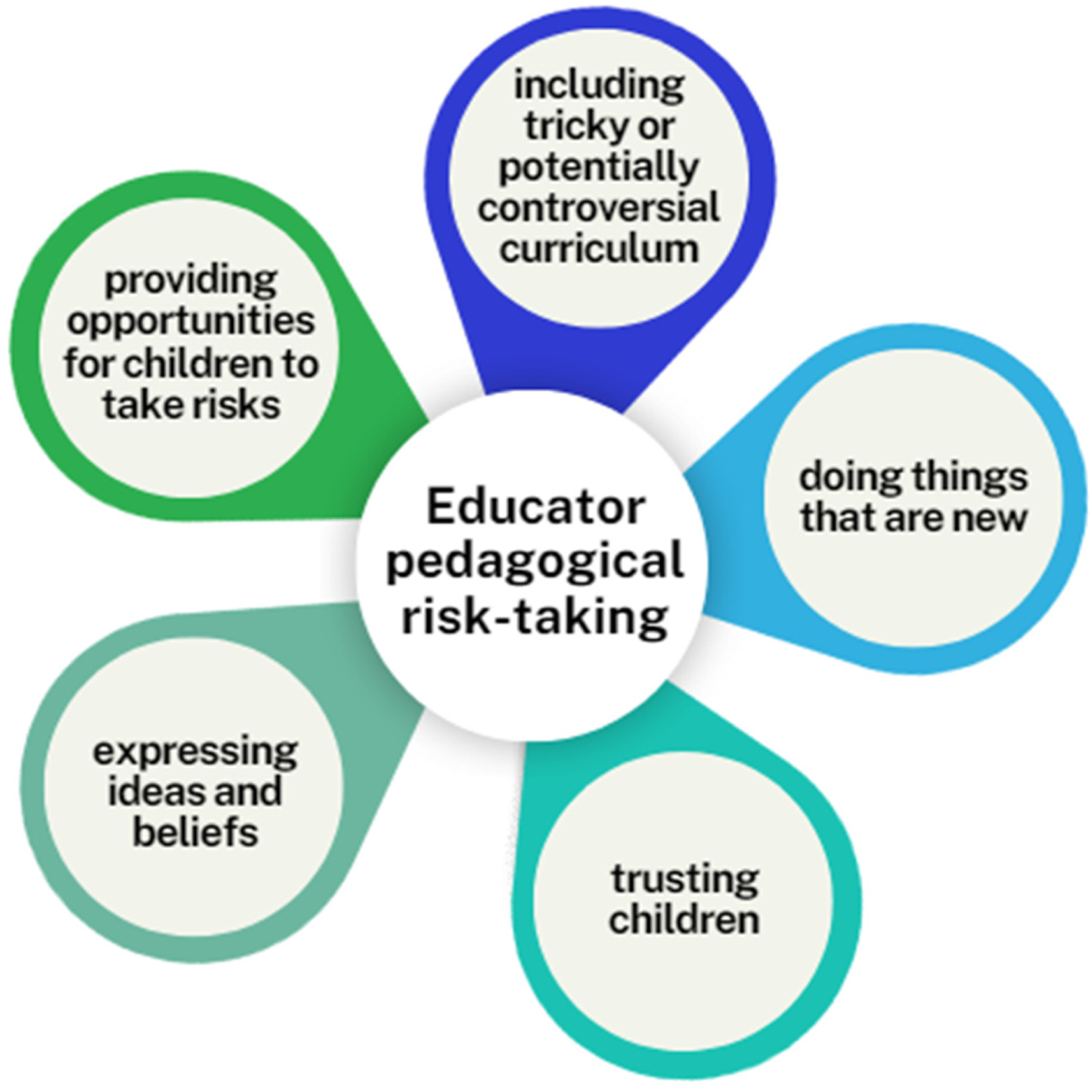
Educator pedagogical risk-taking is considered, thoughtful and intentional. Educators carefully assess possible positive and negative outcomes for themselves and others, and the likelihood of these outcomes. Educators are motivated to take risks to provide opportunities for children to take risks, for their own learning and development, and as acts of advocacy and activism (Cooke et al., 2020a). Educator risk-taking is largely social, emotional and/or cognitive. Although educators may take some small physical risks, the kinds of physical thrill seeking risk-taking that educators may do in their personal lives are not part of their professional risk-taking practice. As illustrated in Figure 1, educator risk-taking includes:
Doing things that are new (Cooke et al., 2020a; Doyle-Jones, 2015; Figueira et al., 2018; Howard et al., 2018; Ohki, 2021). Providing opportunities for children to take risks (Cooke et al., 2020a; Bundy et al., 2009; Howard et al., 2018; New et al., 2005). Including tricky or potentially controversial curriculum (Cooke et al., 2020a; Davies et al., 2023; Robinson, 2005; Ruscoe et al., 2023). Trusting children (Cooke et al., 2020a). Expressing ideas and beliefs (Cooke et al., 2020a; Hard et al., 2013; Robinson, 2005).
Children's pedagogical risk-taking
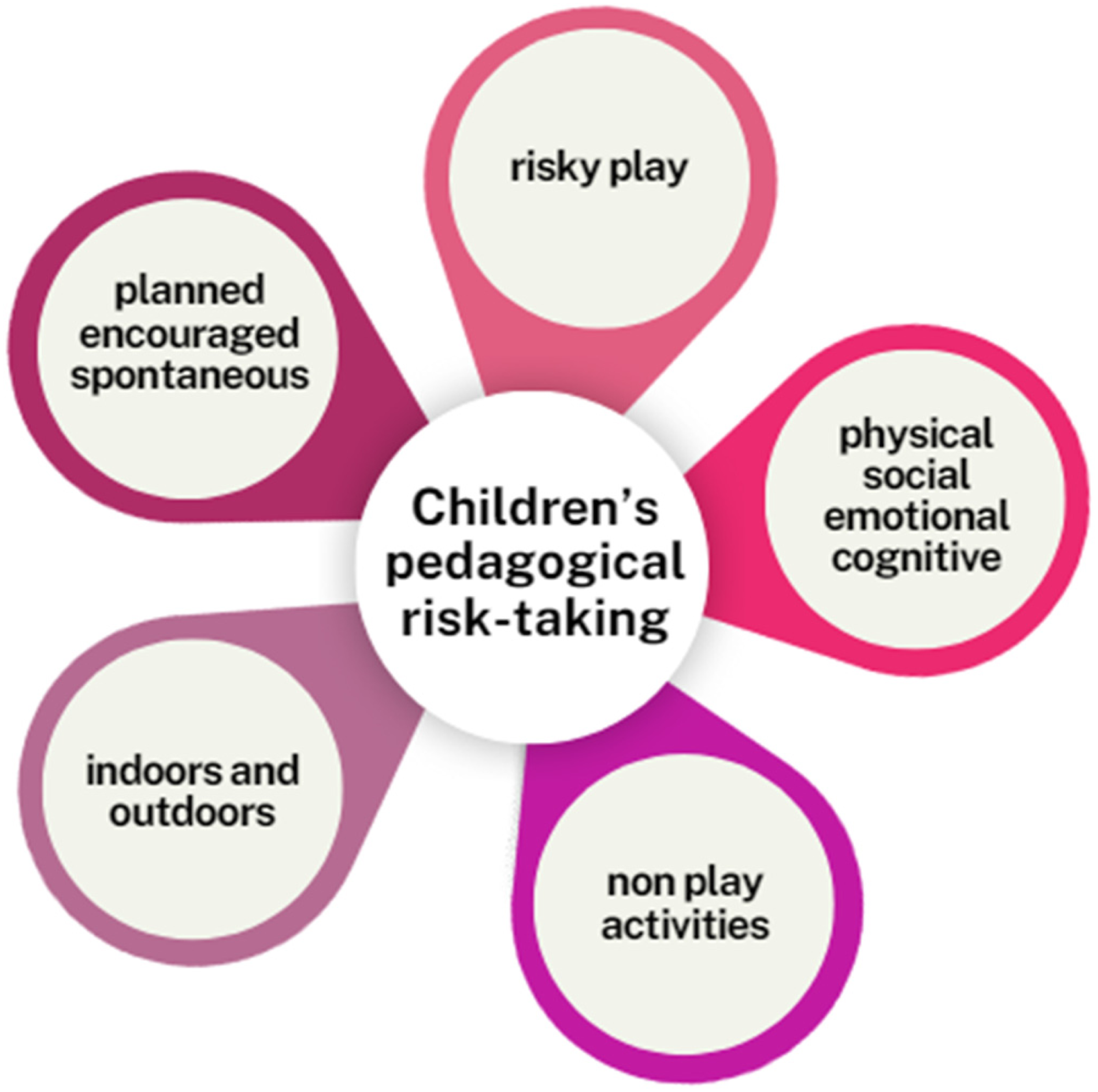
Children's pedagogical risk-taking, in contrast to educator risk-taking, is not always thoughtful and considered. Children often take risks spontaneously, usually driven by curiosity and the desire for fun or excitement (Adams, 1995; Sandseter, 2010). Children may also take risks for the purpose of personal gain, learning or advocacy. Children may plan for risk-taking themselves or with encouragement from educators. Children's pedagogical risk-taking is undertaken within environments that are thoughtfully prepared by educators who have assessed the possible positive and negative consequences of opportunities for risk-taking (through either formal or dynamic risk assessment) and have taken measures to eliminate hazards and avoid significant or long-term harm. Educator's may intentionally construct opportunities for children to take risks commensurate with their risk competence, provide guidance on risk assessment and support children in responding to both positive and negative outcomes. Children generally (neurodiversity notwithstanding) choose to take risks within their capacity and skill level and will withdraw from risky activities if the risk is too great (Little and Eager, 2010; Sandseter, 2009c). Within prepared and supportive environments, children can become more thoughtful and deliberate about risk-taking as their risk competence grows. As illustrated in Figure 2, children's risk-taking can encompass:
Risky play (including playing with height, speed, impact, rough and tumble, tools, elements, out of adult sight and vicarious risk (Kleppe et al., 2017)). Non-play activities, such as skill acquisition and self-help tasks (Cooke et al., 2020b). Physical, social, emotional and cognitive risk-taking (Cooke et al., 2020b). Planned, spontaneous and encouraged risk-taking. Indoor and outdoor activities (Cooke et al., 2020b).
A pedagogy of courage
A pedagogy of courage draws on a view of pedagogy as articulated by practice theorists, including Schatzki (1996); Kemmis et al. (2014); Wilkinson (2017, 2021); and Edwards-Groves (2018). In Anglo society, the term pedagogy is often employed in a narrow sense, described in technical terms as the art or science of teaching (Wilkinson, 2021). In European (particularly Germanic/Nordic) traditions, pedagogy is viewed more broadly as a shared responsibility to support the formation of individuals for participation in a moral and civil society (Edwards-Groves, 2018; Wilkinson, 2017). Taking on this broader view, Edwards-Groves (2018) describes pedagogy as a constellation of shifting and interacting social practices that are shaped by mediating conditions as they are enacted and unfold in particular sites. By foregrounding the social aspect of practices, pedagogy is something not solely enacted by a teacher, but a social interaction between teachers and learners (Edwards-Groves, 2018). In ECE, pedagogy also involves the interactions and practices of families (Salamon et al., 2023). This view of pedagogy is embedded within the theory of practice architectures – an education-focused transformational theory aimed at helping people to ‘live well in a world worth living in’ (Kemmis et al., 2014: 25).
In keeping with this view of pedagogy, a pedagogy of courage is defined as: An approach to education that fosters collaborative pedagogical risk-taking for the formation of morally and ethically courageous individuals and communities for a socially just society.
In a pedagogy of courage educators, children and families engage in what might be perceived as small individually focused pedagogical risks (akin to Beghetto's (2018) ‘good risk-taking’), such as trying something new. A pedagogy of courage also inspires substantive outwardly focused risk-taking (akin to Beghetto's (2018) ‘beautiful risk-taking’), such as disrupting dominant or taken-for-granted narratives (Epley and Souto-Manning, 2023; Gleim et al., 2020), ‘resisting dominant power structures’ (Michael-Luna and Castner, 2023: 500) and speaking back to the certainty of neoliberalism (Moss and Roberts-Holmes, 2022). As encouraged by Moss (2016), it is important to find ways to reignite ‘our ability to think, criticise and explore’ (14) – practices that have been shut down by neoliberal policies and practices. Pedagogies of courage provides a framework for new narratives, that move beyond the neoliberal story of certainty and outcomes to a story of ‘democracy, experimentation and potentiality’ where possibilities, uncertainty, wonder, democracy and experimentation are embraced (Moss, 2014: 14). Because the mix of small everyday risks and substantive culture-changing risks in a pedagogy of courage are taken within a collaborative and supportive environment, some practices deemed risk-taking may become ‘normalised’, meaning they are no longer perceived as risky (Cooke et al., 2020a). When this happens, individuals and groups may feel empowered to expand their capacity for risk-taking, thus increasing the possibility for new narratives and positive transformation.
A pedagogy of courage recognises that risk-taking is inseparable from education and life (Biesta, 2014; Rousseau, 1762). It is about acknowledging, enabling and celebrating risk-taking for learning and development, and for individual and collective good. Biesta (2014) proposed the notion of ‘a pedagogy of the event’ (139) where risk-taking and uncertainty are embraced. A pedagogy of courage builds upon this idea. It is not just about embracing uncertainty and risk-taking, but encouraging a courageous movement that advocates for the freedom and right to do so. Within a pedagogy of courage, teaching is not just a technical process of input and output; it is a brave collaboration of ethically and morally wise practices that promote and uphold democracy, social justice and education that is worthy of the name (Biesta, 2014; Hard et al., 2013; Kemmis, 2018; Kemmis et al., 2014; Reimer et al., 2023; Salamon et al., 2023).
Conclusion
Despite risk-taking being increasingly recognised as a positive character trait in Western culture, Australia has been identified as one of the most risk-averse countries in the developed world. Understanding the barriers to risk-taking in education is an important starting point for understanding how risk-taking is viewed in broader society. One barrier may be a lack of common language and understanding about risk-taking, and an absence of risk-taking culture, in Australian educational settings. Whilst general education and scholarly literature indicate a positive attitude toward risk-taking for both children and educators, this is not consistently reflected in formal Australian education documents. Positively, the NQS and EYLF for ECE encourage educators to provide opportunities for children to take risks and develop skills in risk assessment. Disappointingly, there is no continuation of these outcomes in the Victorian Curriculum. The NQS/EYLF and Australian Professional Standards for Teachers all neglect to acknowledge the place of educator risk-taking in the development of innovative and responsive educational programmes. I have identified conflicting narratives of neoliberal certainty vs inherent uncertainty in educational practices as a possible reason for this. To counter the impossible neoliberal certainty, and promote positive transformation through education specific risk-taking, I have introduced the concepts of pedagogical risk-taking and pedagogies of courage. These terms and their associated accounts can work together to provide a framework of common language and understanding that, if used throughout the education sector, can enable a culture of risk-taking in Australian educational contexts – and provide a solid foundation for Australians being heralded as courageous contributors to a socially just society.
Postscript
In the year that this article was being written we heard the devastating news about 1160 counts of child sexual abuse by an Australian educator. This horrendous happening indicates that now, more than ever, collective courage is needed. I believe educators are scared. Scared to stand up for what they believe, scared to speak out against practices they don’t agree with, and scared to advocate for themselves and for children. I believe this fear is largely a result of the compliance-driven landscape of ECE education and a lack of professional identity and trust for ECE educators (which is fuelled by poor pay and conditions). Let's work together to help create the conditions for children to be free to live and learn, and for us all to live well in a world worth living in (Kemmis et al., 2014).
Adapted from Cooke (2021).
Adapted from Cooke (2021).
Footnotes
Declaration of conflicting interests
The authors declared no potential conflicts of interest with respect to the research, authorship and/or publication of this article.
Funding
The author received no financial support for the research, authorship and/or publication of this article.

Notes
Author biography
Mandy Cooke is a lecturer in Early Childhood in the School of Education at Deakin University. She is the course director for the undergraduate Early Childhood Education courses and teaches in both undergraduate and postgraduate units. Her research and teaching interests focus on understanding and developing sustainable pedagogical practices in early childhood and higher education that enable happy, engaged and thriving individuals and communities. She has a particular interest in risk-taking practices for both children and educators.