



Abstract
Neo-liberalism continues to expand its grip on education, despite fierce opposition. As an economic and political hegemony, neo-liberalism silences alternative viewpoints and neutralises resistance. Using an example of integrating Australian Indigenous pedagogy in early childhood initial teacher education, this article puts forward a typology for examining and evaluating various forms of resistant and counter-hegemonic endeavours. Taking a Gramscian perspective of hegemonic struggles as multifaceted and dynamic, the proposed model comprises three levels: practical, critical and political. Neo-liberalism has intricate linkages to the colonial past. The current domination of Northern theory expounds knowledge primarily from the industrial West in the Global North. In contrast, Indigenous knowledge from the marginalised Global South is envisioned as a counter-hegemonic force. Within this context, the authors illustrate how the proposed model could be used to evaluate resistant practices in the case of practising Australian Indigenous pedagogies of dadirri and yarning circles in early childhood initial teacher education.
Keywords
Introduction
‘We cannot continue as we are’, Moss (2010: 8) exclaimed more than a decade ago when lamenting the neo-liberal situation in early childhood education and care (ECEC). The neo-liberal project is economic and political. It silences alternative voices and neutralises social justice through marketisation (Doberty, 2007; Moss, 2010; Richardson et al., 2020). This article examines hegemonic struggles in early childhood initial teacher education (ITE) by using the example of integrating the Australian Indigenous 1 pedagogies of dadirri and yarning circles in mainstream education. The university, responsible for running and certifying ITE programmes, is a neo-liberal institution (Ball, 2015). Sotiris (2014) argues that the university is a hegemonic apparatus. From a Gramscian perspective, a hegemonic apparatus is not a solid unity. Rather, it is a bloc with contradictions, tensions and resistance. In this light, the neo-liberal university can also be a fertile ground for resistance and transformation (Sotiris, 2014). As an integral part of the university, ITE is an ideal site to study hegemonic power and resistance.
Examining the impacts of neo-liberal reforms on ITE, Sleeter (2008) observes three major shifts: (1) moving away from an emphasis on social justice towards teachers as technocrats; (2) reducing holistic and complex professional knowledge to measurable techniques; and (3) shortening or sidestepping teacher preparation. These changes echo neo-liberal technologies that aim to make citizens governable in a cost-effective manner, and it follows that teachers become self-entrepreneurial while governments reduce social and material support (Davies and Bansel, 2007). Despite vehement resistance (e.g. Angus, 2017; Apple, 2001; Doberty, 2007; Moss, 2010; Shahjahan, 2011; Sleeter, 2008), neo-liberal reforms continue to intensify in education (Ball, 2015; Connell, 2017). Situated within early childhood ITE, this article probes two questions: ‘Does resistance work?’ and ‘How can we evaluate resistant practices?’
‘Wherever there is power, there is always resistance’ (Foucault, 1978: 95). Not all resistant practices, however, are counter-hegemonic (Filc, 2021). This article examines resistant and counter-hegemonic practices in early childhood ITE through a Gramscian (1999) lens. Following Filc (2021), we propose a modified typology to systematically evaluate various forms of resistant endeavours. Although anchored in early childhood ITE, the proposed model applies to other sectors. We use the Australian Indigenous pedagogical approaches of dadirri and yarning circles as examples to demonstrate what resistance may look like in practice and how to analyse them using the typology. The remainder of the article is organised as follows. We first review hegemonic power and resistance in three contexts: the university, the broader field of ECEC, and ITE. Following this, we discuss hegemony and resistance from a Gramscian perspective and then present the typology. Finally, we illustrate how the proposed model could be used in the case of practising dadirri and yarning circles.
Hegemony and resistance
Hegemony is not a singular entity or merely a top-down power (Filc, 2021). Hegemony refers to a ‘historical bloc’ – ‘unity between nature and spirit (structure and superstructure), unity of opposites and of distincts’ (Gramsci, 1999: 337). Filc (2021) posits hegemony ‘as a state of affairs and as a political process’ (25) . The ‘state of affairs’ is relatively stable, referring to ‘a certain model of society’ encompassing material and symbolic structures. It contains the material systems of ‘producing, distributing and consuming’, as well as symbolic arrangements such as ‘ways of thinking and understanding’ that are taken for granted (25). To use a Gramscian (1999: 625) term, such ‘ways of thinking and understanding’ refer to the ‘common sense’ that is seldom questioned. The political process is concerned with continuous struggles among different forces in attaining hegemonic power. This section reviews hegemony and resistance in three interconnected realms: the university, the broader community of ECEC, and early childhood ITE.
At the centre of ITE is the university, an institution in charge of licensing and certificating credentials under government accreditation requirements. The university, a neo-liberal organisation (Ball, 2015), is part of the hegemonic apparatus (Sotiris, 2014). The rise of neo-liberalism does not happen in a vacuum. Neo-liberalism has intricate linkages to the colonial past. While there have been criticisms against neo-liberalism, ‘little is said about the parallels, overlaps, and continuities between old and new colonial forms of epistemic violence in Australian universities today’ (Rangan, 2022: 68). Historically, some of the most prestigious Western universities assisted and directly benefited from colonial power and slavery (Pietsch, 2013; Smith and Ellis, 2017). Moving forward, universities nowadays are more diverse compared to the past. However, diversity per se does not lead to a fundamental transformation (Anderson and Riley, 2021). Universities have always been knowledge producers and disseminators in the knowledge economy (Temple, 2012). In neo-liberal times, knowledge is commodified and sold for profit in competitive markets (Cowan, 2006). Nonetheless, this rupture does not indicate the eradication of the past. Unsurprisingly, today's Australian universities’ ‘elite knowledge production status’ in the global rankings is a result of the claim of ‘European racial and civilisational superiority’ – the same claim that enabled Western universities’ ascendancy in the colonial era (Rangan, 2022: 68). In this sense, neo-liberalism is not only entrenched with colonialism, but it also depends and thrives on it. In neo-liberal times, with rankings and tightened financial control, the scope of knowledge is more restricted, and universities have become more stratified than before (Connell, 2017). In addition, many decolonial and anti-liberal studies rely on the body of dominant knowledge produced primarily in the West. In other words, decolonisation movements in universities use ideas of liberal education and liberalism that paradoxically legitimise the colonial legacy (Rangan, 2022). Connell (2007) has coined the term ‘Northern theory’ to describe dominant knowledge from the Global North – the industrial West and its alliance. On the other hand, ‘Southern theory’ presents knowledge that is marginalised or ignored. Connell (2017) advocates using Southern perspectives to decolonise the university curriculum and transform higher education.
Beyond the university, the broad context of ECEC is another arena where ITE is situated. ECEC, a female-dominated field peripheralised by mainstream society, has a long history of advocacy, resistance and struggles for equal rights (May, 2013; Press and Wong, 2013). The early childhood movement was connected to the 19th-century women's suffrage, subverting the gender order (May, 1993). However, the hand that rocked the boat had also lent a hand to the boat's smooth sailing. Despite revolting against patriarchal power, women formed alliances with the empire in its encounter with Indigenous women and children (Jacobs, 2005; Mohanty, 2006; Wanhalla, 2001). Different subaltern groups react to a hegemonic power differently (Lears, 1985). During the process, responses may chanllenge, reproduce and strengthen the hegemony.
Over the past three decades, ECEC has been moving up on the government's reform agenda for social and commercial purposes. Children are viewed as human capital to be invested in for a ‘smarter’ future (PricewaterhouseCoopers, 2019: 1). Ideologically, ECEC is meant to uphold the democratic values of an equal society by assisting the poor and the disadvantaged. In tandem, early interventions are projected to save money and generate long-term returns (Hurley et al., 2019). Furthermore, ECEC services enable parents, especially women, to work, raising tax revenues and reducing welfare dependency (PricewaterhouseCoopers, 2014). This new positioning of ECEC brings opportunities for the sector to ask for better pay and equal status to teachers working in schools. At the same time, it puts ECEC under government surveillance (Cannella, 2002). In Australia, early childhood ITE is now subjected to a series of regulations. A national framework for children under the age of five, the Early Years Learning Framework for Australia (EYLF; Department of Education and Training, 2019), came into effect in 2009. The National Quality Framework, setting benchmarks for quality early childhood services, was released in 2012 (Australian Children’s Education and Care Quality Authority, 2020). All ITE programmes, including early childhood education, must be accredited and meet national standards and procedures. One of the key accreditation standards is the Australian Professional Standards for Teachers (Australian Institute for Teaching and School Leadership, 2017). Published in 2011, the document, originally intended for schoolteachers, is now for all ITE graduates.
Broadly, early childhood ITE's responses to neo-liberal reforms have centred around a few areas: resistance under the regulatory gaze; the deconstruction of content knowledge; reflective and critical thinking; and, more broadly, the issue of social justice and social change. Jovanovic and Fane (2016) examine how pre-service teachers could remain autonomous while navigating the regulatory landscape. There are also discussions about facilitating pre-service teachers’ reflective skills to improve practice (Grossman and Williston, 2001; McFarland et al., 2009). Western developmental perspectives have been a predominant influence in ECEC's curricular subjects and practices. Efforts have been made to deconstruct developmentalist views, moving towards postmodernist, post-structuralist and critical perspectives as a part of the decolonisation initiative (Cannella, 2002). With this objective in mind, Ryan and Grieshaber (2005) delineate the strategies of ‘situated knowledge’, ‘multiple readings’ and ‘engaging with images’ in early childhood ITE programmes. A similar approach is narrative inquiry (Meier and Stremmel, 2010). All aim to deconstruct the dominant bodies of knowledge. There have been calls to look beyond immediate teaching and learning. Schoorman (2011) argues that early childhood ITE is a social justice undertaking. Hackman (2005: 104) summarises five essential tools for teaching social justice in tertiary classroom: content mastery, critical analysis, social change, personal reflection and an awareness of multicultural group dynamics. Similarly, Richardson et al. (2020) contend that university programmes should cultivate ECEC pre-service educators to be political actors. Being a political actor means positioning oneself within the broader society connecting the personal and the professional, and actively participating in informed and unbiased ‘democratic deliberation’ (Richardson et al., 2020: 44). The authors (Richardson et al., 2020: 51) remind us that nurturing a political identity requires ‘a great deal of time, energy and work’. The demand of time and energy is at odds with the neo-liberal mantra of cost-effectiveness.
A brief survey of the literature above shows that hegemonic struggles are fluid and complex. Resistant practices vary and have different effects. Filc (2021) points out that resistance, in general, suggests subalterns’ agency, while counter-hegemony seeks an alternative sociopolitical system in both material and symbolic dimensions. ‘If we want to assess the impact of different practices of opposition it is vital to differentiate which of them, within the spectrum of resistance practices, are counter-hegemonic’ (Filc, 2021: 25). To understand the nuances of resistance, we draw on the Gramscian perspective of hegemony and elaborate on Filc’s (2021) typology in the following section.
Forms of resistance
Hegemony is not a singular entity but a bloc of different currents (Gramsci, 1999). As mentioned, neo-liberalism is associated with the colonial past. The neo-liberal reforms in education also draw on multiple ideologies and agendas: ‘Neoliberal market-based reforms, neoconservative reforms involving strong central cultural authority, and new middle-class emphases on technical and managerial solutions to moral and political problems’ (Apple, 2001: 183). Neo-liberalism is not inherently ‘Western’. It was championed in Chile before being ushered in by the Thatcher and Reagan administrations in the UK and the USA, respectively, and eventually spread across the globe. ‘Neoliberalism is not a projection of Northern ideology or policy, but a re-weaving of worldwide economic and social relationships’ (Connell and Dados, 2014: 124), where ideas may be pruned, tamed or absorbed into the hegemonic bloc. The amalgamation of different ideologies and forces is to serve hegemonic interests and power.
Like hegemony, which is formed through alliances of various forces and fraught with internal tensions and contradictions, a resistant coalition is not seamlessly unified all the time. ‘Resistance may be defined as a set of plural and complex practices that oppose or contradict dominant ideologies, cultural codes, structures, or power relations, thus opposing hegemony’ (Filc, 2021: 24). While resistance may be hither and thither, counter-hegemony consolidates diverse forces, desires and perspectives aiming at changing the superstructure. Sotiris explicates: The struggle for hegemony means a struggle for the formation of a new historical bloc. This means a new articulation among social forces, alternative economic forms in rupture with capitalist social relations of production, new forms of political organization and participatory democratic decision-making. It is in this sense that the historical bloc refers to a unity between structure and superstructures. (Sotiris, 2018: 95)
Filc (2021) disagrees with a romantic perception of resistance that oversimplifies hegemonic power as mere top-down manipulation. Putting the complexity into perspective, he develops a three-tiered typology to differentiate resistance from counter-hegemonic struggles. The first tier is whether resistance can operate within the hegemonic system without dismantling the existing structure. Resistance alleviates subalterns’ situations but is incorporated into the hegemonic narrative. Resistance at the second tier is about challenging the symbolic power and/or its material basis – the social and production systems, relationships and resources. At this level, symbolic challenges do not always match resistant practices in a material sense, and vice versa. A reason for this could be that ‘subordinate groups may participate in maintaining a symbolic universe … [and] share a kind of half-conscious complicity in their own victimization’ (Lears, 1985: 573). It is only when resistance is both material and symbolic that a counter-hegemonic process begins. At the third tier, resistance becomes a counter-hegemony project, putting forward alternative ideologies and forging a new political power (Filc, 2021). The alternative system or process connects the symbolic and material dimensions and unifies diverse resistant struggles. The diverse nature of ECEC suggests that the resistance movement involves ‘many actors impelled by many different desires, perspectives, values and interests. It occupies many different spaces, and finds expression in many different forums’ (Moss, 2017: 20). For a new ‘historical bloc’ to be formed, individual agencies and efforts need to be mobilised and transformed. We have briefly outlined Filc’s (2021) typology here, and what follows is a proposed modified model situated in early childhood ITE.
An evaluative model for assessing resistance in ECEC
Extending Filc’s (2021) model, we propose a modified typology in the context of early childhood ITE (Figure 1). The model comprises three levels: practical, critical and political. These levels overlap and oscillate from one to the other. Each level starts with an overarching probing question and then subquestions can be developed to suit specific contexts or objectives. It can then work backwards to outline the means towards the ends. The model can incorporate a range of existing strategies, pedagogies and tools.
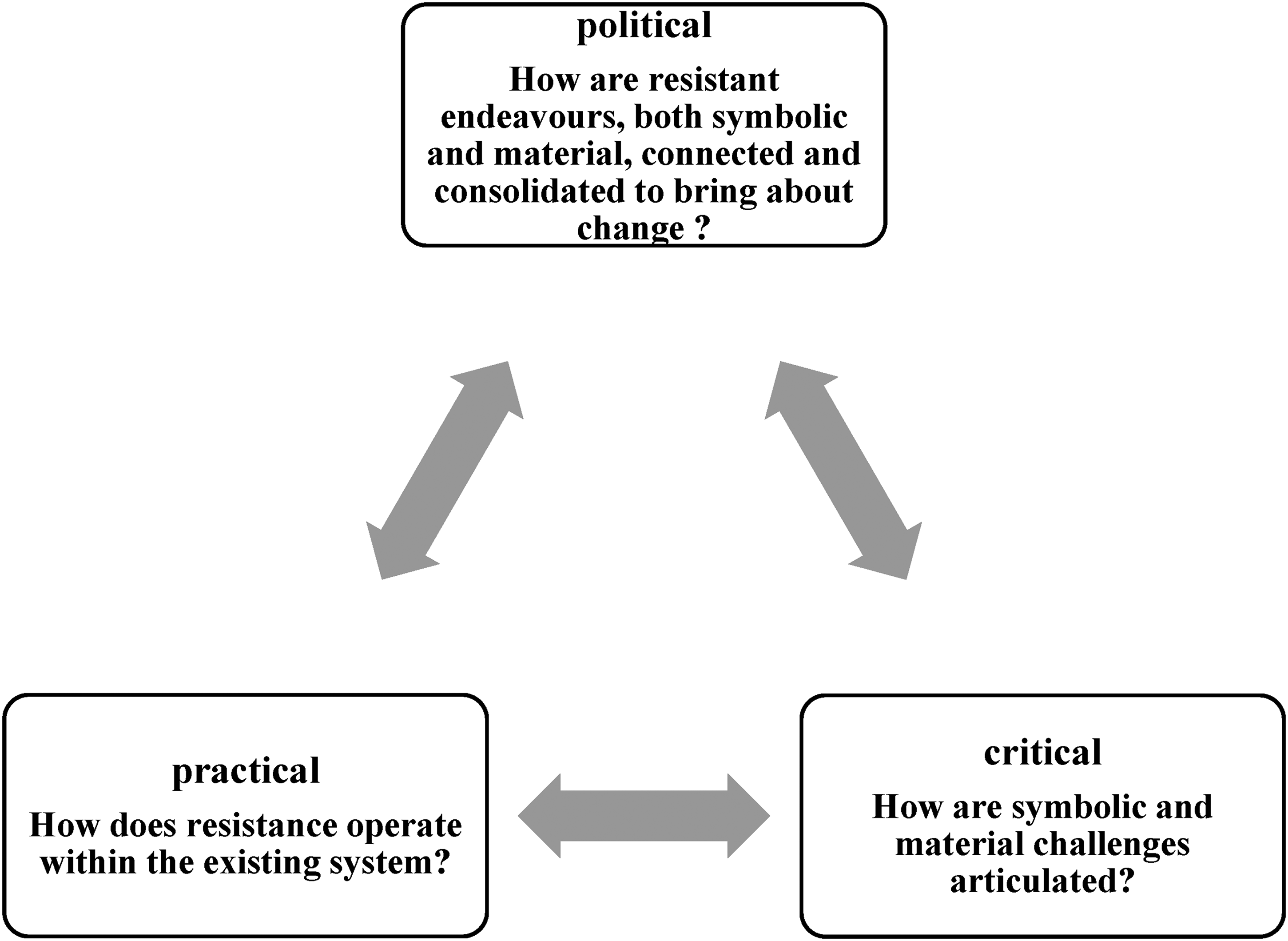
An evaluative model for assessing resistance.
The practical level is concerned with ‘How does resistance operate within the existing system?’ Subquestions could include: ‘What tools are available for content mastery?’ (Hackman, 2005 ); ‘What are pre-service teachers expected to learn?’; or ‘How can the learning be assessed?’ Overall, resistance is at the personal and practical levels – resistance is within the permission of norms and standards. The priorities are personal interests, well-being and benefits. This could include aspects such as completing assignments, demonstrating competence and achieving higher grades. The key is to balance resistance for personal interests while fulfilling external accreditation, existing academic standards and conventional practices in the context of ITE and broader ECEC.
At the critical level, the overarching question is: ‘How are symbolic and material challenges articulated?’ At this level, resistant practices start moving beyond the immediate and personal vicinity. Oppositions occur in the symbolic and material dimensions, but they are not well coordinated. Subquestions could include: ‘What tools are available for critical analysis and personal reflection?’; ‘What tools can cultivate an awareness of multiple group dynamics?’ (Hackman, 2005 ); ‘How may one make sense of one's position in society through connecting one's experiences to the broader structural political/social/economic context?’; ‘How can one facilitate making “critical connections between the socio-political order and one's personal and professional identity”?’ (Richardson et al., 2020: 40); ‘How can practices be changed?’; or ‘How can existing systems be improved or changed?’ Symbolic challenges entail using critical thinking and analytical tools to unsettle dominant knowledge that is established as ‘natural’. In this regard, personal and practical concerns start to connect with an understanding of social justice in a broader sense. Here, individuals become aware of the connections and different social groups, and consider issues interplaying with ethnicity, sexuality, gender, class and professionalism, and start seeing how these factors impact others’, as well as their own, lives.
At the political level, actions are oriented towards advocacy and social change, moving from a micro level of learning and assessment to collective political consciousness. The overall question is: ‘How are resistant endeavours, both symbolic and material, connected and consolidated to bring about change?’ Some related subquestions could be: ‘What are the tools for social change?’ (Hackman, 2005 ) or ‘What are the possibilities for “active participation in democratic deliberation from an informed place with an open mind”?’ (Richardson et al., 2020: 44). Political resistance requires a process to achieve a certain degree of solidarity. This process may involve stakeholders within and beyond the university – for example, faculties, ECEC services, policymakers, governments and other professionals.
The practical, critical and political levels are interrelated and cyclic, even though the ultimate goal is to forge counter-hegemony. It is likely that one may be at different levels across different situations. For example, a pre-service teacher may have mastered all the critical skills and yet reverts to the practical level when it comes to completing an assessment. The proposed framework does not present a linear progression, nor it is a panacea. The aim is to provide a parameter for assessing resistant practices to coordinate different actions and perspectives. We will illustrate how the model could be used in practice by using examples of Indigenous knowledge in ITE.
Indigenous knowledge as a counter-hegemonic force
Indigenous education in Australia has had a chequered history since the beginning of colonisation. Before 1788, when the British colonised the continent, Indigenous peoples had their own approaches to educating their children in traditions and life skills. Throughout the past 200 years, multiple federal and state governments have attempted to manage the education of many Indigenous children, including taking Indigenous children away from their parents to assimilate them into mainstream society. These practices continued until the early 1970s, causing immense suffering, trauma and loss for Indigenous peoples and communities. The historical devastation still affects Indigenous communities and peoples, who are underachieving in many areas such as health, education and employment compared to non-Indigenous Australians (Broome, 2010). The Social Justice Report of 2005 urged the Australian government to achieve equity for Indigenous peoples. In 2008, the prime minister of Australia, Kevin Rudd, delivered a national apology, responding to years of calls to address injustice towards Indigenous peoples. Thereafter, the Closing the Gap framework was launched to improve Indigenous peoples’ lives and outcomes. Since then, consecutive Australian governments have delivered annual reports on the project (Australian Government, 2020a). Access to early childhood education and equal educational opportunities are targeted in the Closing the Gap reports (Australian Government, 2020b. Compared to the settler governments in early colonial times, which used physical exclusion and forced assimilation (Broome, 2010), today's neo-liberal governance technologies seem ‘benign’. Nevertheless, despite the rhetoric and promises to Indigenous communities, and some marked improvements since 2008, inequalities in health, education and employment prevail. Although aull review of this situation is beyond the scope of this article, it is important to acknowledge that neo-liberal tactics are subtle and complex.
As part of the reconciliation process, Australian Indigenous traditions, educational achievements and well-being are written into the early childhood ITE curriculum and professional standards. The EYLF states that the government ‘is committed to closing the gap in educational achievement between Indigenous and non-Indigenous’ (Department of Education and Training, 2019: 5). In the Australian Professional Standards for Teachers, two focus areas are directly associated with Indigenous education: ‘1.4 – Strategies for teaching Aboriginal and Torres Strait Islander students’ and ‘2.4 – Understand and respect Aboriginal and Torres Strait Islander people to promote reconciliation between Indigenous and non-Indigenous Australians’ (Australian Institute for Teaching and School Leadership, 2017).
The inclusion of Indigenous knowledge and culture in government mandates presents opportunities and constraints. Indigenous knowledge, with its rich history differing from the Northern knowledge base, offers a pathway to unsettle the status quo (Sharma, 2021), and Indigenous principles ‘could inform or transform’ teacher education (Sanford et al., 2012: 18). Embedding Indigenous knowledge in mainstream ITE contests ‘epistemic imperialism’ – it questions the notion of scientific and objective Western knowledge as the only truth (Sharma, 2021: 25). Indigenous knowledge could counter the ‘neoliberalist discourse – valuing linear over cyclical progression, competition over collaboration, dualism over complexity, and product over process’ (Sanford et al., 2012: 20). Indigenous traditions were established long before the birth of modernity. Connecting with this time-honoured tradition is a way to reconnect with humanity (Wilson, 2005) and deepen the process of decolonisation. Valuing ancient cultural practices and beliefs destabilises the notion of progress as ‘destiny' and recognises that a rich and well-developed world existed long before Western modernity (Sharma, 2021: 26). Orienting towards the collective and communal, Indigenous approaches to knowledge and understanding (Bessarab and Ng’andu, 2010) challenge the technocrat notion in teacher preparation (Kerr, 2018). These approaches also enrich our understanding of ‘belonging, being and becoming’, which the EYLF (Department of Education and Training, 2019) espouses.
In juxtaposition with opportunities are constraints. The practice of Indigenous knowledge in mainstream classrooms is situated within the entanglement of power and resistance. Nakata (2007) describes the complex and contested space between Indigenous and Western knowledge systems as ‘the cultural interface’; it ‘represents a space of tension that generates the conditions of possibility for a multitude of positions between Indigenous and non-Indigenous subjects, between colonised people and colonial power structures' (McGloin, 2009: 39). The concept of ‘cultural interface’ resonates with Gramsci's (1999) understanding of hegemony as a process of continuing struggle, negotiation and adaption. In this way, the Southern and Northern theories are not static dichotomies. They are, instead, two forces engaged in continuous hegemonic struggles. Writing Indigenous peoples and cultures into government regulations and official agendas does not necessarily equate with equity (Pybus and Moore, 2019). Indigenous culture and knowledge in Australian education are predominantly understood through the lenses of the dominant power. Miller (2015: 561–562) concurs that these ‘The capacity to identify and respond to imbalanced relations in consultation processes requires educators to far exceed current policy directives and standards’. Likewise, Baloy (2016: 209) states that the hegemonic perspective assigns Indigeneity a place that is ‘cultural not political, visual not otherwise sensorial, passively observed not participatory’. In addition, government policies of Indigenous education may not have Indigenous peoples’ best interests at heart. Rhetorically, reconciliation with the Indigenous people implies moral righteousness, a critical element in legitimising liberal governance – claiming the moral high ground to bolster symbolic hegemonic power. Taking a human capital approach to closing the gap (Biddle, 2010), the project could boost human productivity. At the micro level, Indigenous approaches could be ceremonially ‘inserted’ into ‘a metropole-dominated curriculum’ (Connell, 2017: 11) or become another achievement of neo-liberal innovation – a key element of neo-liberalism that entails constant renewal to remain competitive in the market (Bröckling, 2016). Subsequently, Indigenous knowledge could be appropriated and become another branding in a competitive higher education market. At the extreme, readdressing the colonial ills might stir up backlashes (Pedersen et al., 2011). Indigenous education in Australia is situated in such a web of power relationships. All these elements, coexisting and interacting with each other, shape and reshape hegemonic struggles alongside a continuum of conflict and dialogue (Maurial, 1999) in a volatile and multidimensional arena.
Assessing practice
This section uses the proposed model to illustrate the complexity and fluidity of resistance in the case of implementing Indigenous approaches to teaching and learning – dadirri and yarning circles. Dadirri refers to ‘deep listening’ in the sense that you are fully present and aware of all that you are connected to – this may be people, as well as country and spirit. Dadirri may be considered a non-verbal pedagogy (Stronger Smarter Institute, 2020; Ungunmerr, 2017). Miriam-Rose Ungunmerr, an Indigenous Australian elder and educator, who was Senior Australian of the Year in 2021, describes the deep-listening practice of dadirri as follows: In our Aboriginal way, we learnt to listen from our earliest days. We could not live good and useful lives unless we listened. This was the normal way for us to learn – not by asking questions. We learnt by watching and listening, waiting, and then acting. (Ungunmerr, 2017: 14)
At the practical level, the primary question is: ‘How does resistance operate within the existing system?’ The knowledge and practice of dadirri and yarning circles are artefacts for resistance because they present multiple ways of learning and being – an alternative to Northern knowledge. A subquestion could be: ‘How can pre-service teachers be supported to understand and master the skills of dadirri and yarning circles?’ Pre-service teachers could undertake assessment tasks that incorporate dadirri and yarning circles. They could demonstrate the practices of dadirri and yarning circles during their field practice. They could also incorporate these Indigenous approaches in their final portfolio addressing the requirements in the Australian Professional Standards for Teachers (Australian Institute for Teaching and School Leadership, 2017). The mentors and assessors of pre-service teachers in ECEC may focus solely on adhering to the guidelines of the Australian Professional Standards for Teachers and the EYLF. The practical level addresses pre-service teachers’ immediate concerns, such as grasping mandated skills and knowledge, passing a course, and meeting assessment criteria and accreditation requirements. Acknowledgement and some understanding of Indigenous pedagogical practices is always motivated by personal concerns. Pre-service teachers’ content and skills mastery may be skewed towards technical concerns, and the practice might be tokenistic. Notwithstanding these obstacles, an awareness or appreciation of Indigenous culture, history and struggle could sow the seeds of further resistance.
At the critical level, the overarching question is: ‘How are symbolic and material challenges articulated?’ This question could be broken down into several subquestions, such as: ‘How can pre-service teachers be guided to see the injustice and inequality in the broader context that intersect with gender, sexuality, ethnicity and class?’ and ‘How are the injustice and inequality connected to their personal and professional experiences?’ Another subquestion could be related to resistance in a material sense: ‘How can pre-service teachers be supported to challenge the production systems and relationships?’ The crux of this question lies in connecting theories (symbols) to practice (material). Implementing theories in the real world allows pre-service teachers to see how their efforts could make meaningful changes in real-life situations. This will ‘help move students from cynicism and despair to hope and possibilities’ (Hackman, 2005: 106). For example, dadirri could be embedded regularly in practice with the objective that this deep-listening process that values connection will strengthen the bonds of family and community, and help children and families feel more of a sense of belonging (Stronger Smarter Institute, 2020). The pre-service teacher could begin to advocate for changes that would benefit Indigenous people and other groups, including themselves and the ECEC sector. The yarning circle time could be used to support Indigenous children and their families when pre-service teachers are on practicum. For example, in the Northern Territory, which has the highest proportion of Indigenous people per capita of the population in Australia (Australian Government, 2021), the yarning circle is specifically designed to meet the needs of Indigenous children and their families to connect with each other, country, culture and language. Yarning circles could also be adopted as a normative practice in ECEC throughout centres in Australia, by both non-Indigenous and Indigenous children and their families. Nonetheless, when it comes to assessment tasks, all of the practices and understandings are presented as individual competence fulfilling prescriptive indicators, which undermines the authenticity of dadirri and yarning circles. As a result, the Indigenous knowledge might be appropriated and subsumed into the neo-liberal fabric (Baloy, 2016).
At the political level, the overall question is: ‘How are resistant endeavours, both symbolic and material, connected and consolidated to bring about change?’ To consolidate symbolic and material challenges, Indigenous education needs to move beyond acknowledgement, tolerance and understanding to a space where Indigenous perspectives become a central point of reference for the educational foundations of policy, curriculum and practice. Southern knowledge and theory should not be treated just as ‘traditions’, but should be the ‘sources of intellectual authority in the present’ (Connell, 2007: xi). Such ‘intellectual authority’ needs structural changes beyond the coalface of learning and teaching. For instance, faculty could advocate for changes in assessment, timetables and schedules. To move beyond assessing pre-service teachers’ mastery of content and skills from a Northern lens, the questions should be: ‘How can the existing academic assessment that favours verbal/written communication and rationale be changed to reflect the Indigenous ways of learning?’; ‘How can teaching schedules allow time for all to genuinely listen and talk to each other?’; ‘How can learning be assessed in light of human connections rather than graded outcomes?’; ‘How can the definition of professionalism and standards of profession and professional be rewritten to advocate such values?’; and ‘What social and material support is needed?’ It entails a transformation of the university's structure and leadership. Forging counter-hegemony at the political level requires a shift of perception to appreciate the human being as opposed to the human doing. The realisation that the Indigenous way of knowing and being does indeed help us all to reconnect to humanity (Sharma, 2021) could be a rallying point for mobilising diverse groups. Nonetheless, this realisation needs to go beyond symbolism. It requires achieving material benefits for all involved. For example, human being rather than human doing will be given merits and rewarded. At the political level, symbolic resistance connecting with material change will require social and material support on a large scale, which becomes increasingly difficult in neo-liberal austerity. One of ‘the most serious intellectual consequences of neoliberalism is the degrading of conditions for supporting and resourcing the workforce’ (Connell, 2017: 12). This is an obstacle to be overcome before a new political power can be formed.
The proposed typology is an ideal type for evaluating resistant and counter-hegemonic practices in early childhood ITE. The model could also be used in other contexts for the same purpose. Various forms of resistance in the existing literature can be identified in the proposed typology. The ways they are categorised, however, offer a practical parameter to analyse resistance systematically and consolidate various forms of resistance. In practice, all three levels could overlap and happen simultaneously, as discussed. To elaborate, let us study some possible scenarios. In a competitive ITE market, faculties may promote Indigenous approaches as a way of branding. Moreover, even when diverse groups come together to form a political force, there will always be differing purposes and agendas (Lears, 1985). Existing social divisions and discriminations will not be automatically ironed out within these political groups. Therefore, the three levels – practical, critical and political – may coexist even when a new political force is consolidated. The typology should be understood as in motion. Hegemony as a process (Filc, 2021) means that struggles do not remain the same. Nevertheless, the typology may be used to coordinate, consolidate or advance different existing practices. For instance, the teaching strategies in Ryan and Grieshaber's (2005) tool kit – ‘situated knowledge’, ‘multiple readings’ and ‘engaging with images’ – could be used to facilitate critical thinking and analytical skills to understand the embeddedness of developmental perspectives and power attached to knowledge. With the proposed typology, we could assess where the practice is at and where to go next. We could ask if a new understanding is operating within the performativity regime, since ‘critical thinking’ is now routinely a criterion in assessments, spatulated by government accreditation such as the Australian Qualifications Framework (2013) for assessing tertiary academic skills. We could also analyse how the knowledge could be linked to practice so that the resistance is more than symbolic. To sum up, the typology simplifies and crystallises the complex hegemonic struggles whilst capturing the dynamic and fluid nature of the process. The model assists a nuanced understanding of a range of resistant and counter-hegemonic practices during the process.
Concluding comments
This article is premised on the conviction that neo-liberalism is detrimental to education (Moss, 2010). The university, a host of ITE programmes, can be both a forebearer of neo-liberal tenets (Ball, 2015) and a fertile ground for cultivating resistance (Sotiris, 2014). Hence, ITE is an ideal site for studying hegemonic struggles. Situated in early childhood ITE, we have raised two questions: ‘Does resistance work?’ and ‘How can we evaluate resistant practices?’ For the first question, the explanation is that resistant practices have different effects and not all resistance is counter-hegemonic (Filc, 2021). The hegemonic struggle is a complex process in which outcomes are not always tangible. From a Gramscian (1999) perspective, hegemonic power is realised through consent and coercion. Resistance pertains to multiple facets and dimensions. Although individual agencies, critical thinking skills, contents and strategies are essential for resistance, they do not spontaneously become counter-hegemonic. A counter-hegemony project demands building a collective subjectivity in political, symbolic and material dimensions. To answer the second question, we have presented a typology for assessing various resistant struggles following Filc's (2021) model. In this article, the proposed model is situated in the field of early childhood ITE. However, it may be used in other sectors. The proposed model comprises three levels: practical, critical and political. Each level starts with an overarching probing question. Subquestions could be designed according to specific situations or global aims. Answering these questions could help identify the means for the ends. The typology organises and simplifies different forms of resistance while bringing to the fore the fluid and dynamic nature of hegemonic struggles. We have illustrated this point in the case of integrating Indigenous pedagogies in ITE. Indigenous knowledge as Southern theory (Connell, 2007) ontologically challenges the dominant notion of modernity and progression. As such, the Australian Indigenous pedagogies of dadirri and yarning circles are viewed as constituting a counter-hegemonic force. Inclusion, deep understanding and connection lie at the heart of dadirri and yarning circles, and these are also pathways to a society that reconciles its past. The proposed model illustrates the complexity of counter-hegemonic struggles. All hegemonic power collapses eventually. Let us envision that the replacement is less repressive and more equitable.
Footnotes
Declaration of conflicting interests
The authors declared no potential conflicts of interest with respect to the research, authorship and/or publication of this article.
Funding
The authors received no financial support for the research, authorship and/or publication of this article.
