



Abstract
New materialism has the potential to deepen critical engagement between vibrant things, everyday places and intra-actions between humans and non-humans in early childhood education. This article explores Australian pre-service teachers’ understandings of children and childhood when encountering the vibrant forces of things and places. The authors explore Jane Bennett's ‘circuits of sympathy’ to analyse the atmospheric forces encountered in pre-service teachers’ engagement with new materialism in their final year of study. Their research is guided by the following question: What happens when pre-service teachers conceptualise the posthuman child, things and places as related through circuits of sympathy? The authors suggest that sympathy, considered as a transformative agentic force, can generate connectivity across ideas, matter and practices, and adds depth and new perspectives to understandings of the posthuman child, with the result that new figurations of childhood emerge in this investigation. They conclude by discussing the implications of their study for posthuman research and how circuits of sympathy bring new atmospheric forces to childhood. The posthuman child, embedded in circuits of sympathy, is neither individualised nor collectivised but immersed in, and produced by, the circuit and its flows and disruptions. The modes and qualities of sympathy in the circuit shape what happens next: encounters that are sympathetically charged, are set to create new circuits of sympathy in their next encounters.
Introduction
Bennett’s (2010) exploration of the liveliness and vibrancy of matter has found its way into new materialist thinking in education to problematise the long-held tradition of animate humans in an inanimate world of matter (Taylor & Ivinson, 2016). As educational research has demonstrated, the relationships we have with more-than-humans can be unsettling, concerning and inspiring (Blaise, 2016; Tesar & Arndt, 2016). A focus on the more-than-human in educational encounters can lead to an awareness of forces, intensities, forms of control and governmentalities that can deepen children's and educators’ critical engagement with places (Banerjee & Blaise, 2013; Duhn, 2012).
The posthuman child is in a state of entanglement with material human and non-human forces, and in a relationship with material-discursive forces that coalesce (Murris, 2016) – that is, the child ‘is more than a body, always connected, embedded and embodied, dynamic and active’ (Murris & Borcherds, 2019: 205). Considering posthuman childhood and its vitality in early childhood settings invites attention to complex bodies of non-human vibrant forces, things and places. The child is always in-motion, in-relation, in-between encounters, albeit under the close surveillance and intense governance that the very concept of ‘child’ evokes (Tesar & Arndt, 2016).
The posthuman child has the potential to challenge the idea of modern childhood. In this article, we propose that ‘circuits of sympathy’ (Bennett, 2020) enable considerations of childhood that are neither centric nor decentred; rather, the child is part of the dynamic, active atmosphere that carries with it endless potential for further circuitries. We speculate that the child, plugged into these atmospheric flows, is less of an object of surveillance and governance and more of a contributor to the quality of the entire encounter. Instead of individual observation, teachers and pedagogues may become more attentive to a holistic diagnostic of the atmosphere that is created in encounters. Speculatively speaking, this would change the politics of childhood by dispersing attention from the individual child towards finely tuned senses of moods, affects and atmospheres (Adey, 2013). Children's worldly relations include their attribution of ‘liveliness to non human things’ (Merewether, 2020: 10), such as planetary forces, animals, plants and water. Being open-minded towards the vibrancy of matter in early childhood education may also mean being open-minded and attentive to the diverse ways children perceive ‘reality’.
We provide an account of Bennett’s (2020) ‘circuits of sympathy’ as a possible path towards understanding sympathy as a more-than-human force in education that opens pathways into perceptions of vibrancy. We ask: What happens when pre-service teachers conceptualise children, things and places as related through circuits of sympathy?
For the analysis, we focus on Bennett's modes of sympathy guiding the (un)certain and (im)possible analysis of atmospheric forces’ encounters with everyday places, things and people (children and pre-service teachers). Sympathy incorporates different modes, which are examined in pre-service teachers’ documented perceptions via images and words. We consider ‘sympathy’ as an atmospheric force that shapes posthuman childhoods.
Bennett's ‘vital materialism’
This article draws on Bennett’s (2010, 2020) ‘vital materialism’, placing particular emphasis on her more recent work on the influx and efflux of the vitality of non-human bodies and vibrant things. Bennett (2010) invites us to become attentive to the aesthetics of things, to find possibilities in the world of objects and acknowledge that there are forces in place that are active, lively and present in all encounters. Vibrant matter (things, non-human bodies, forces) alters and affects bodies. Vital materialism is an assemblage of all sorts of vibrant materials and forces, with creative capacity.
Bennett’s (2010: 3) vital materialism opens the awareness that, as humans, we tend to overlook the force of things and ‘what they can do’; therefore, she proposes to focus on the power of things or ‘thing-power’. In vital materialism, actants and bodies form an assemblage of forces of vibrant matter. These forces and materialities are lively, affecting each other and ‘continually doing things’ (Bennett, 2010: 122), as well as ‘affording voice to vibrant materials whose first language is not words’ (Bennett, 2020: xxiv). Bennett (2020: 78) reminds us of some people being ‘better than others at detecting this thing-power’. Citing the example of hoarding and people having a special relationship with things, Bennett (2020) explains the fascination humans have with things in late capitalism; things, as well as bodies, are attuned, affected and impressed by thing-power and at times thing-power – for instance, in the case of hoarding – can overwhelm.
Bennett's ‘circuits of sympathy’
We focus on Bennett’s (2020) ‘circuits of sympathy’, in which sympathy, as a more-than-human physical and atmospheric force, takes a path of influx and efflux. Influx and efflux evokes the metaphoric idea of breathing in and out, of coming and going, and of tides that ebb and flow in varying degrees of intensity. Bennett (2020: x) explains the vital materialism of human and non-human processes, giving the example of ‘Impression-and-Expression, Ingestion-and-Excretion, Immigration-and-Emigration … And the interval between influx and efflux’.
Bennett (2020: 29) invites us to attest that sympathy is not only a moral sentiment, linked to people, but also an emerging physical force, a ‘vital force operating upon bodies from without’ and ‘a more-than-human atmospheric force’. Bennett (2020) argues that sympathy that emerges as a physical force and within the larger cosmos is interwoven with a political project. This political project involves ‘earth's utterly impartial acceptance of each and every one of its elements or inhabitants’ (Bennett, 2020: xv) – for example, human biological organs such as the lungs or heart and how the physical forces of sunlight or gravity act on us as a joined force and a ‘circuit of contagion’ (Bennett, 2020: 28). Sympathy generates sensations, forces and affections that circulate through beings, things and atmospheres, connecting each other (Bennett, 2020). Children and their relationships are embedded in these sympathetic circuits and atmospheric flows; in this study, pre-service teachers were encouraged to document their perceptions of these flows in words and images, with the aim of opening up posthuman perspectives of teaching and learning.
Bennett's figures, or modes, of sympathy
Bennett’s (2020) latest book, Influx and Efflux, focuses on the porosity of self and the influx and efflux that remakes self and other in constant exchange. Sympathy is one of the wavelike movements that ebb and flow across matter, leaving affective traces that connect one with the other. Bennett (2020) outlines five figures, or modes, of sympathy; we centre our discussion on three of the modes, which seem most relevant to a first attempt at thinking with sympathetic circuits in early childhood education.
Bennett (2020: 31) explains ‘sympathy’ as a connection between the body and the external – that is, ‘a body touched and infused by a painful suffering arriving from’. Pain is affectively contagious, a vital force touching bodies, and there are ‘atmospheric currents that jump across space to connect bodies’ (Bennett, 2020: 32), as someone else's pain can be experienced empathetically, as response, in one's own body. As another example, Bennett describes the atmospheric flows in poetry as an act of contagious imagination that evokes bodily responses to these poetic influences from the outside. Describing sympathy as an atmospheric force that generates performative external pressure, Bennett (2020) suggests that sympathy has many circuits that are conceived by explicit feelings such as pain, love and suffering, all of which are forces that transmit, via sympathy, across living bodies.
Bennett (2020: 43) argues that forces of attraction are earthly and natural, and sympathy is ‘rooted as deeply as the geologic of gravity’. The atmospheric currents are physically embodied by forces that can be non-benevolent or benevolent.
Circuits of sympathy encompass a physical, performative and attractive force towards things and places – an agentic physical force. As researchers, we became curious and affected by physical atmospheric forces in our pre-service teachers’ work, which became part of a larger circuit of sympathy. Inspired by Bennett's exploration of sympathy, this analysis focuses on the perceived forces that visual images and words have, opening up to new sympathies through pre-service teachers’ documentation.
Pedagogical documentation of children's attractions and encounters with bodies and matter
The pre-service teachers in this study were enrolled in their last year of a Bachelor of Education in Early Childhood. The first author (Gloria) taught the unit ‘Understanding Place and Space’ and provided these pre-service teachers with opportunities to explore their understandings with relational and new materialist approaches. This was the first time that Gloria and the pre-service teachers had encountered these ideas. Over an intense weekend of teaching, the pre-service teachers were introduced to the idea of changing their gaze, using Lenz Taguchi’s (2010) ideas about noticing matter as not passive but alive and active, and Bennett’s (2010) pondering on paying attention to when we feel something else to capture a glimpse of vitality in things and places.
The pre-service teachers were asked to document encounters with the posthuman child – their perceptions of intra-actions and entanglements between places, matter, human and non-human atmospheres. The early childhood pre-service teachers’ documentation narrates encounters with things and people. Pedagogical documentation is both an active process and a product, and is materialised through the act of observation, photographs, words and children's work (Merewether, 2018). According to Merewether (2018: 259), in pedagogical documentation, ‘children, adults and non-human elements work together in an interconnected and ever-changing assemblage which does not result in definitive conclusions but instead leads to more questions’. Pedagogical documentation allows us to perceive new forms of sympathies between pre-service teachers and what is actively documented to unfold the vibrant forces that make up childhood at a precise moment in time.
Specifically, the pre-service teachers documented their responses to Lenz Taguchi’s (2010: 34) question of ‘how did matter – the material – come to matter’. Their documentation focused on children's everyday encounters with people, places and things, with emphasis on how matter came to matter. The study explored the unexpected connections and encounters that affect pedagogical practice, pre-service teachers, children and researchers in unpredictable ways. The students documented and analysed their insights through journaling as an assignment task. In reading the assignments, Gloria noticed that the pre-service teachers articulated new ideas of childhood, their own practice and the forces affecting them. It is through the pedagogical documentation – in this case, in the form of an assignment – that ideas of a more-than-human childhood came alive to the pre-service teachers. One of the pre-service teachers commented: ‘It [the unit] has given me a completely different theoretical perspective to work with going forward … the theory behind the unit. It was great to get different perspectives to view our pedagogy’. This feedback generated sympathetic forces to deepen our own political project of looking at the world with sympathy.
Before ethics approval, informal discussions took place with the pre-service teachers about the possible study of their assignments. Sympathy connected the pre-service teachers and Gloria, who taught the students. It was through sympathy that the students entrusted their words and images to Gloria. As the pre-service teachers were in their last year of study, co-authoring was not possible because of loss of contact with them. However, the trust created in class generated a sympathetic circuit that allowed Gloria to approach some of the students with a request to include their work in this study. Of course, the students were able to decide not to contribute or to withdraw their work. The generosity of the pre-service teachers flows through this text and enlivens it with the vibrancy of their perceptions and documentation.
Ethical permission was granted by Monash University (CF16/2307–2016001154) and, once the pre-service teachers’ grades were finalised, Gloria invited them to volunteer their assignments (i.e. their words and images) as a form of material sympathy. As researchers, we are aware that the pre-service teachers trusted us, and we took great care to honour this trust. The pre-service teachers’ generosity leads us to treat their contributions as gifts, and we feel ourselves to be sympathisers, joining forces with the pre-service teachers’ words and images. These were carefully curated for this article, creating in us as researchers new forces and intensities as we thought with our pre-service teachers’ images and words.
Circuits of sympathy
The pre-service teachers were Quincy, Fiona, May, Cassie and Greg (pseudonyms), and their words and images are explored in the context of ‘circuits of sympathy’ (Bennett, 2020). The analysis of the words and images describes the influences of humans and matter as performative bodies. We include the pre-service teachers’ words as a circuit of sympathy – that is, as the unconscious gravitational and atmospheric forces and currents that are infused in places, things and people. Bennett (2020: 44) describes these as ‘forces of attraction that are profoundly natural – deeply embedded in flesh – and yet not providential’ (original emphasis). Sympathy is an affective and atmospheric force connecting childhood with lively matter. The pre-service teachers’ words and images show us the journey as the pre-service teachers encounter with children vibrant forces, places and things. Interpretation is undertaken using Bennett’s (2020) ‘circuits of sympathy’.
Atmospheric forces
The atmospheric forces encountered by adults are embraced by sympathetic forces. We discuss sympathy as an atmospheric force that lives in vibrant places and things in the context of early childhood education and care. Sympathy incorporates different modes, which are examined in the pre-service teachers’ lasting impressions and expression via images and words.
We focus on the pre-service teachers’ encounters with different places, their words and images constituting new openings and the sympathetic possibilities that matter offers to childhood. All children names are pseudonyms.
Tutu, music, ribbons, mirror, cat: sympathy as performance of vibrant forces
In the following, Quincy describes an encounter between Allison (a child) and things (a tutu, ribbons and a cat), and atmospheric forces such as music and a mirror. Quincy's gaze focuses on Allison's and the tutu's movement and dancing. Quincy begins her exploration of the tutu by explaining: ‘consider the way the tutu has dictated to Allison what music she would listen to and the style of dance’. Figures 1 and 2 portray Allison's dance, with many affective elements performing together – that is, dance, music, tutu, child, ribbons, pillows and peers – as part of the larger assemblage of people, places and things.
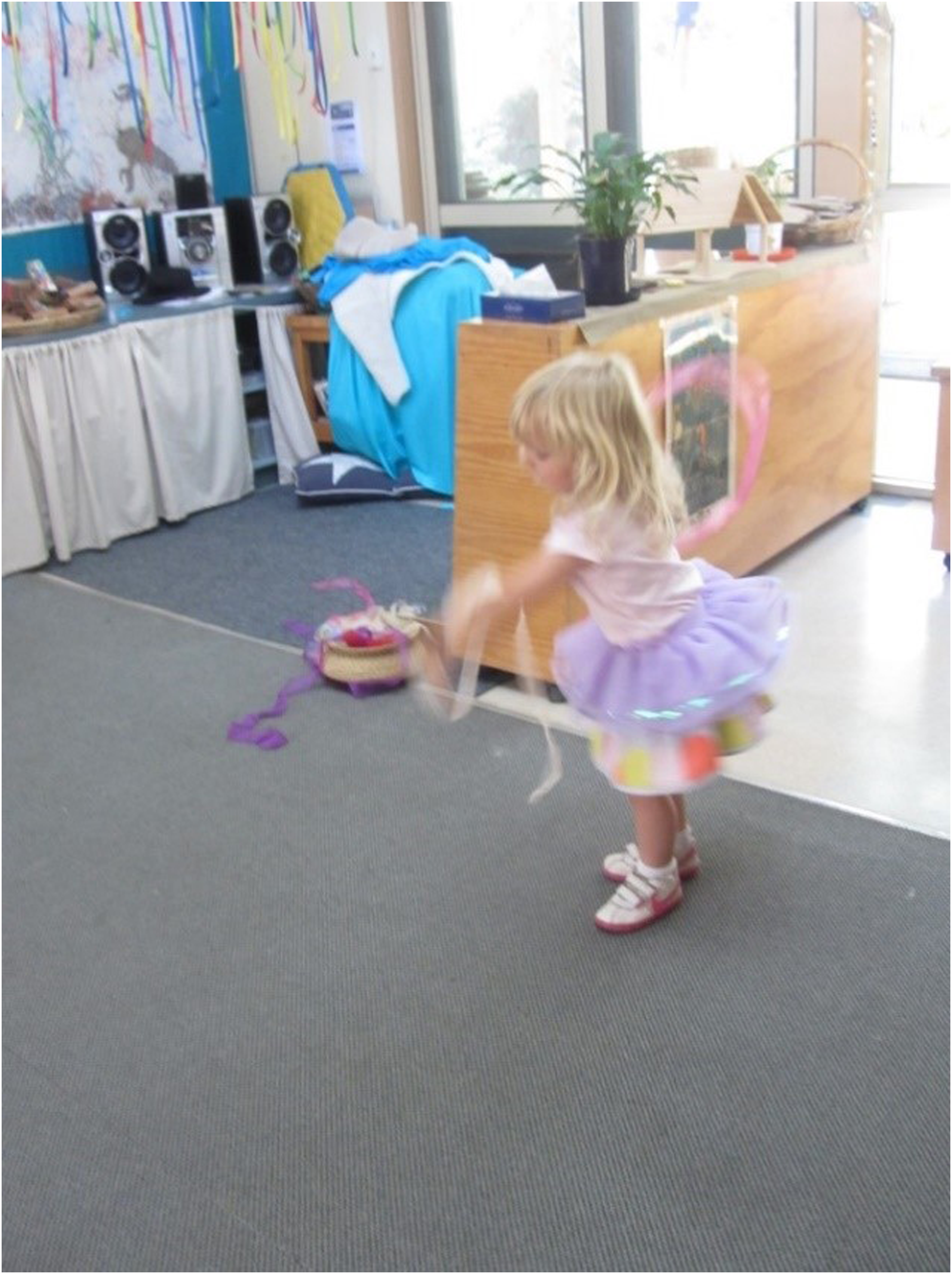
Sympathy as performing vibrant forces: dance, music, tutu, child and ribbons.

Sympathy as performing vibrant forces: cushions, cat and mirror.
Allison was aware the tutu made her feel happy (fig. 1); Peers were aware that the ribbons would entice us [the pre-service teacher - Quincy] to dance.
Entanglement of the tutu, the music and intra-actions from other assemblage at her dance lessons made Allison at one with the music, embodying her in the forces of assemblage.
Another child added another dimension to the space when placing the cat in front of the mirror (fig. 2).
When reflecting on the experience and the documentation taken, it was obvious to me that I had to be conscious of not placing the human in a dominant position.
I had to concentrate on seeing and highlighting the agency of the non-human elements.
The children did not have the same problem. Allison was aware the tutu made her feel happy. Other peers were aware that ribbons would entice us to dance. One peer demonstrated that she may be seeing agency from the mirror when she placed the cat audience in front of the mirror. (Quincy)
Bennett (2020) describes sympathy as a physical force and attraction to earthly matter, representing current forces that are non-benevolent or benevolent. Thus, sympathy as a strongforce, with the atmospheric currents in this dancing place – together as an assemblage of music, dance, bodies and matter – representing forces of attraction that pull children and vibrant matter together. Quincy (the pre-service teacher) attunes to the feelings of Allison (the child) with respect to the tutu making Allison happy and Allison using the ribbons as an invitation, representing an attractive force to dance. Quincy highlights the invitation to dance offered by the ribbons, which entice and seduce Allison’s peers and herself into joining the assemblage and the forces of music and dance.
Quincy's attunement to her own ‘concentration of seeing and highlighting the agency of the non-human elements’ reveals a circuit of sympathy as nature's capacity for impartial love. Sympathy as an influx effect, through which many forces are emerging, adds a twist, inflects and induces Quincy to be part of the forces of the assemblage. However, Quincy makes an effort towards this attractive force and focuses on vibrant matter, stating: ‘it was obvious to me that I had to be conscious of not placing the human in a dominant position. I had to concentrate on seeing and highlighting the agency of the non-human elements’. As Quincy encounters the children's benevolent ease with connecting to and forming special relationships with matter, Quincy becomes induced and inflected by the vibrant and atmospheric external forces of the music, tutu and ribbon attracting children's performances. In this fusion of performance, the children's sympathy for others to be part of the infusion (e.g. the cat in Figure 2) becomes part of the larger circuit of sympathy, in which people, places and things are part of the larger atmospheric forces in place. The dance represents an active performative sympathy through which the children adore the effervescence of everyone and everything coming together as one.
Fence: a curious kind of sympathy
The pre-service teachers Fiona and Cassie focused on exploring the agency of a fence (Figure 3) and the intra-actions between children and the environment.
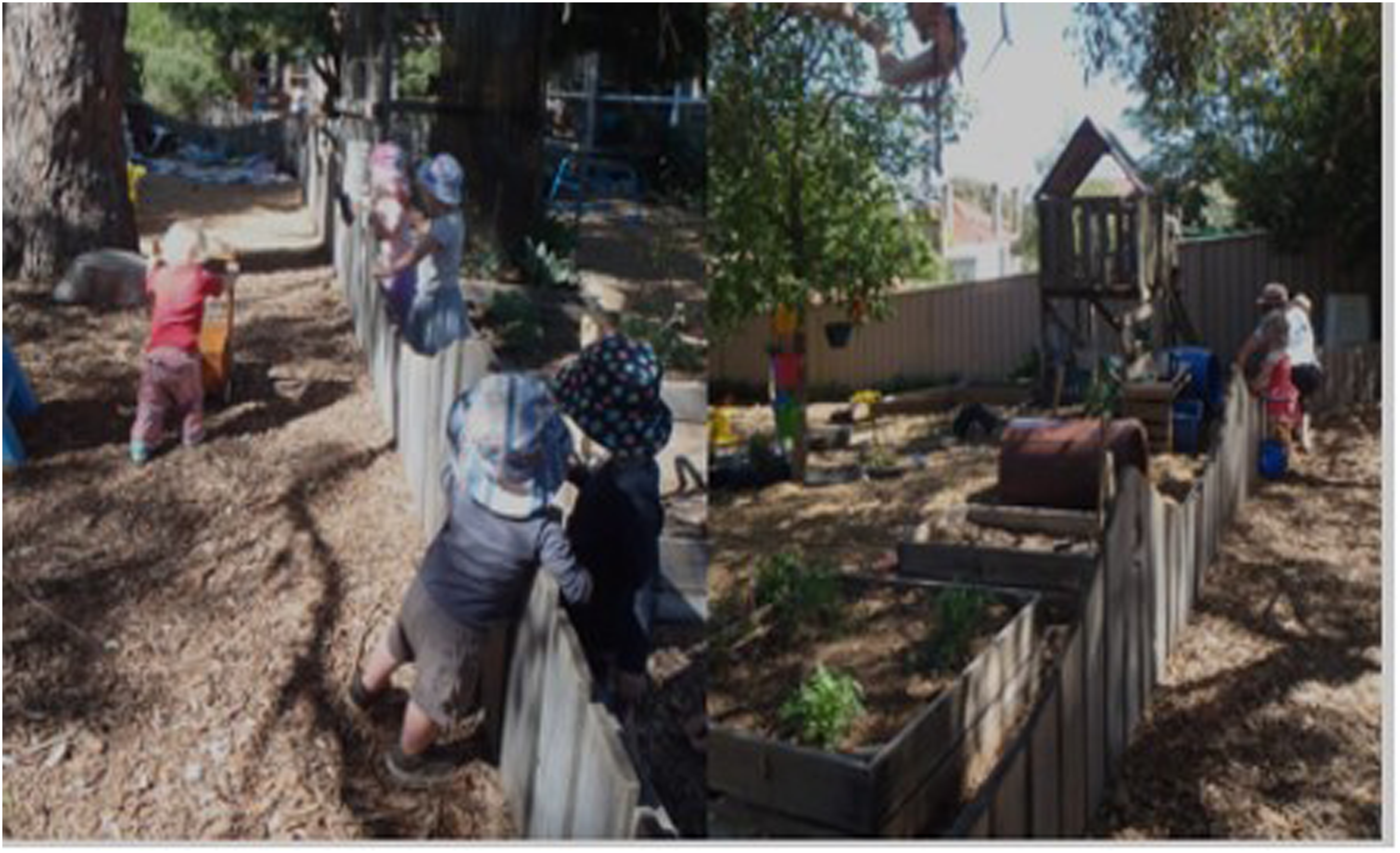
The fence.
Fiona and Cassie explore what the vibrant thing is – the wooden fence. As they express it, the fence ‘encourages’ and has ‘unique vibrant characteristics’: Deeper insights into the intra-actions between the wooden fence and the unique possibilities it provides: the interplay. The unique design of the fence also encourages engagement such as climbing over, throwing balls over to each other, meeting others, driving toy cars on it and observing the vast yard across it. These unique vibrant characteristics have made it possible for children to learn many skills while intra-acting with the fence. (Fiona and Cassie)
Fiona and Cassie discuss the fence in relation to its vibrant characteristics and the possibilities it offers for children's intra-actions. The fence brings liveliness (Merewether, 2020) and facilitates the development of relationships between children and things. The vitality of the fence is discussed in relation to what it allows the children to do, thus providing an account of things having power (Bennett, 2010). In this example, the attraction of the fence lies in how it attracts sympathies in the children by hugging and leaning on the fence (Figure 3), without boundaries and ‘continually doing things’ (Bennett, 2010: 122) – the fence is present, intra-acting with endless possibilities for the children to climb and throw balls over it, and meet with others. This changed Fiona and Cassie's views about the fence acting as a barrier that created inclusion and exclusion strategies.
According to Duhn (2012: 102), places can include and exclude: ‘a pedagogical lens emphasises that territory is constantly remade through the politics of inclusion and exclusion which determines who has a right to a place and belonging, and who does not’. When employing the place-based approach in critically examining the image and its space, it becomes clear that the preconceived assumption that the fence alone creates the territory and acts as a barrier is flawed. Fiona and Cassie see the fence as a central, vibrant presence in the outdoor area and recognise the possibilities for relating with children: It is evident when observing children that they have begun to create their own inclusion and exclusion strategies, not depending on the fence, instead on things such as their age or relationships. It is also observed that it [the fence] is being used to reciprocally engage in games; fence being the central matter. This observation assists us to understand that children are capable of re-creating new territories; throwing balls to and from, using the fence as ‘the net’ allowing children to share the space. (Fiona and Cassie)
The fence acts as a more-the-human vital force, interweaving politics (the fence acting as a barrier) and moral sentiments (children and the fence sharing space) (Bennett, 2020). The fence acts as a space for the politics of inclusion and exclusion, and creates a territory that can determine who belongs and who does not. The fence brings new openings by forming a reciprocal relationship with the children, which goes beyond ideas of the fence facilitating inclusion and exclusion. The fence is part of the circuit of sympathy, which recreates territories with porous borders that ebb and flow.
Bennett (2020) states that a curious kind of sympathy in everyday objects has an effect and exerts forces on people. The fence is a vibrant object that plays as a net, as a player and as curious sympathy with children. When the fence's liveliness is appreciated, and when Fiona and Cassie are affected by its vibrant force, we can infer that the fence is another significant member of the children's everyday encounters. In Bennett’s (2020) discussion of sympathy as nature's capacity for impartial love, she discusses how sympathy is not exclusive to humans but to all atmospheric forces of nature. The fence is a benevolent force in nature in this encounter, facilitating and mutually constituted within children's everyday play and relationships.
Sympathetic forces between people, places and things as attractive, affective forces, such as the fence, are intra-acting, touching bodies (fence–child(ren)) that gravitate to games and the meeting of bodies. The fence–child(ren) belongs and plays games, is included and is a strong, vibrant force in children's everyday encounters. By considering the fence-as-presence rather than the fence-as-object, we can develop a greater appreciation of the capacity of the fence to affect the child(ren).
Cornflour, water, sun: benevolent forces of attraction
The pre-service teacher May focused on exploring the various forces of child and cornflour, water and sun (please note that the pre-service teachers were on placement and the use of food in this description was at the discretion of the childcare service).
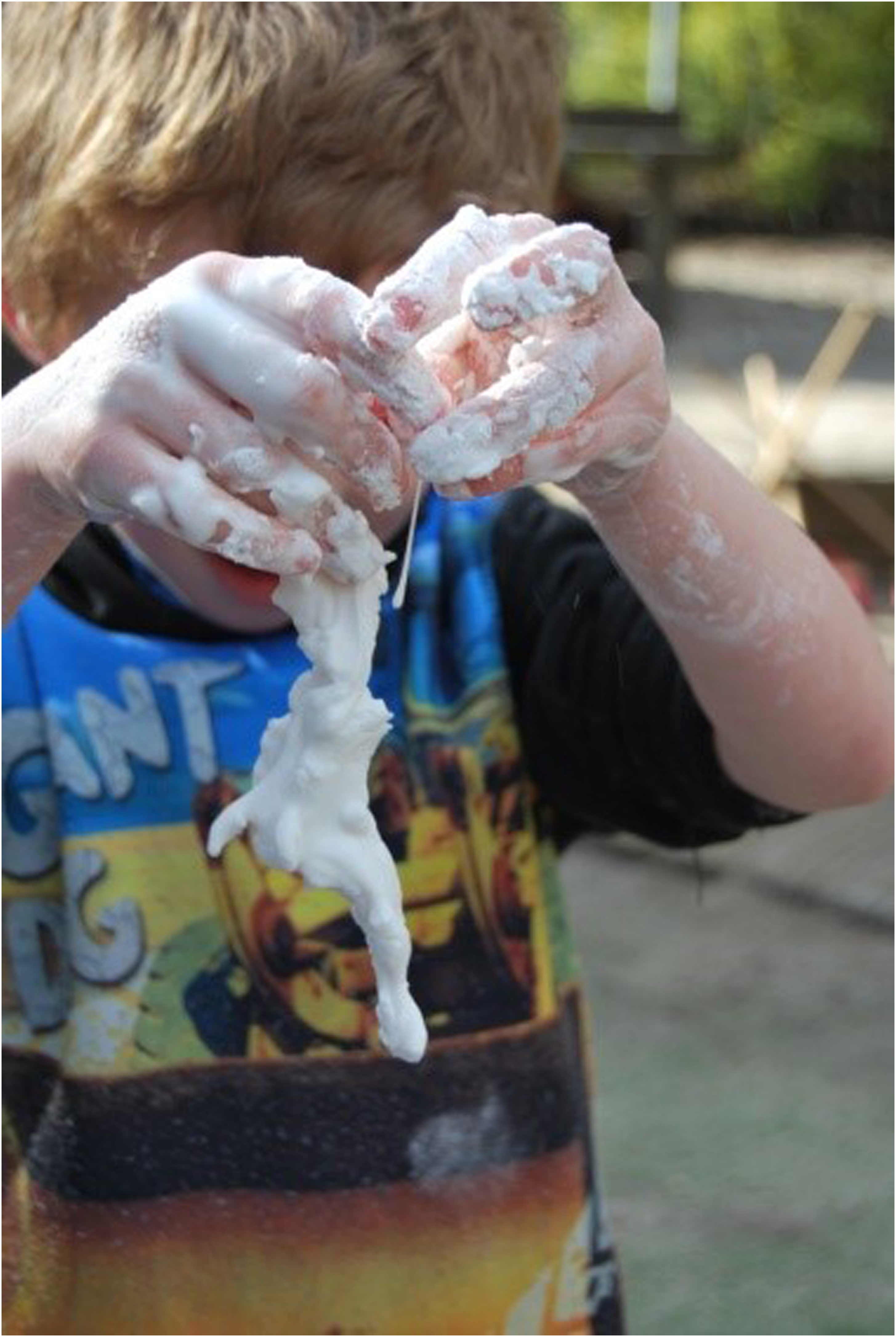
Atmospheric forces: child–cornflour, water and sun.
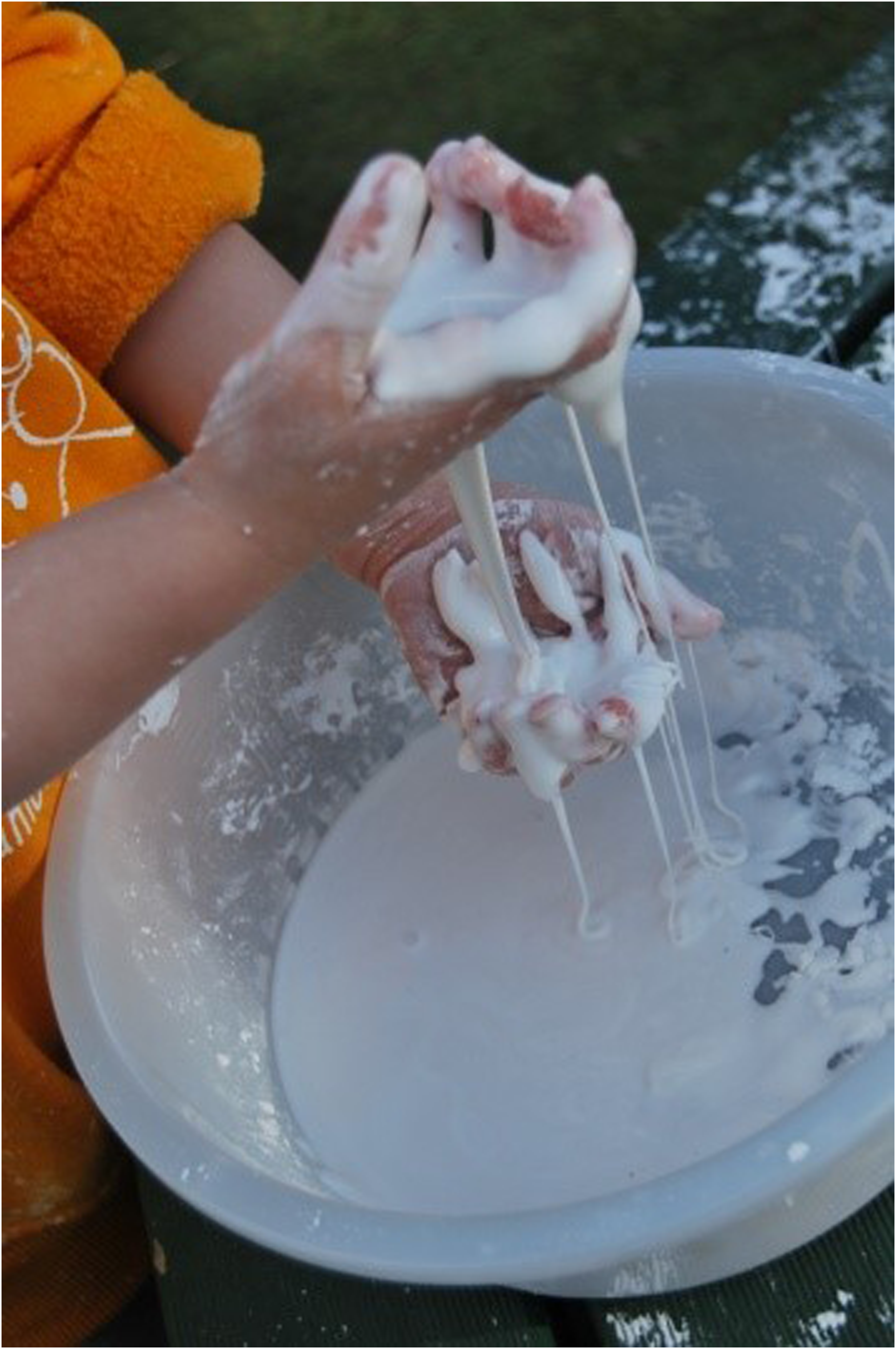
Atmospheric forces: hands–cornflour, water and sun.
May provided some images of children with cornflour (Figures 4 and 5). May describes the cornflour as ‘soft and powdery’, and when it is altered with various forces, it can become a benevolent force of attraction for the child: The various forces such as the soft and powdery cornflour, the water, the texture of the wet mixture, and the warmth of the sun are porous with no boundaries … As such, [they] intra-act with each other, affecting each other's relationship between the human and non-human elements … he [the child] looked towards the other children and observed how they were interacting with their vibrant matter. Pouring it from hand to hand, he began to scoop the mixture as well; however, altering the schema (event) to instead scoop up the matter, the non-Newtonian mixture into his hand … thereby creating a new reality. (May)
May explains how these forces affect and attract each other – that is, the child with the cornflour, water and the warmth of the sun. These forces intra-act, as a form of alliance and alteration. Bennett (2010: 22) explains this as bodies being creatively altered, ‘modified by others’. The mixture is described through child–hand–heat, alterations that are changed as they encounter or intra-act with each other.
There is sympathy in such physical forces. As Bennett (2020) refers to the sympathy of physical forces and their gravitational pull, she explains that these physical forces can become non-benevolent or benevolent. These forces of attraction merge together, ‘invoking a sympathy rooted as deeply as the geologic of gravity’ (Bennett, 2020: 43). Such sympathy and the benevolent forces of attraction represent a geologic movement of forces through the heat of the hands and everything else in a benevolent way, a way of experimentation, exploration and learning, ‘intensifying … capacity for sympathy qua benevolent affection’ (Bennett, 2020: 43; original emphasis). The altering ‘schema (event)’ and the new reality described by May are composed of a multiplicity of active and vibrant components: cornflour, water and the touch of child hands. Why are these forces benevolent to the child's hands? Mesmerising and devoted to the play, and the absence of boundaries in the warmth of the experiment – there is a sense of delight emanating from the description. Thus, benevolent forces of attraction have characteristics such as being joyful, loving, warm and soft to the child.
For May to witness the event and for the researchers to find the words that speak to Bennett's concept of sympathetic forces in the atmosphere, and speak for themselves, requires affective tones composed by ‘words, images, emotions and moods’ (Bennett, 2020: 51). As described by May, this new reality is an influx and efflux; the images (Figures 4 and 5) capture the process of countless realities, a dance between hands and the non-Newtonian mixture – influx and efflux of cornflour, water, sun, air and heat. This dance affords ‘voice to vibrant materials whose first language is not words’ (Bennett, 2020: xxiv). May's use of adjectives (words providing attributes to nouns) represents a partial act of giving voice to all the benevolent atmospheric forces of attraction between the child and matter.
The planter box: sympathetic synergy
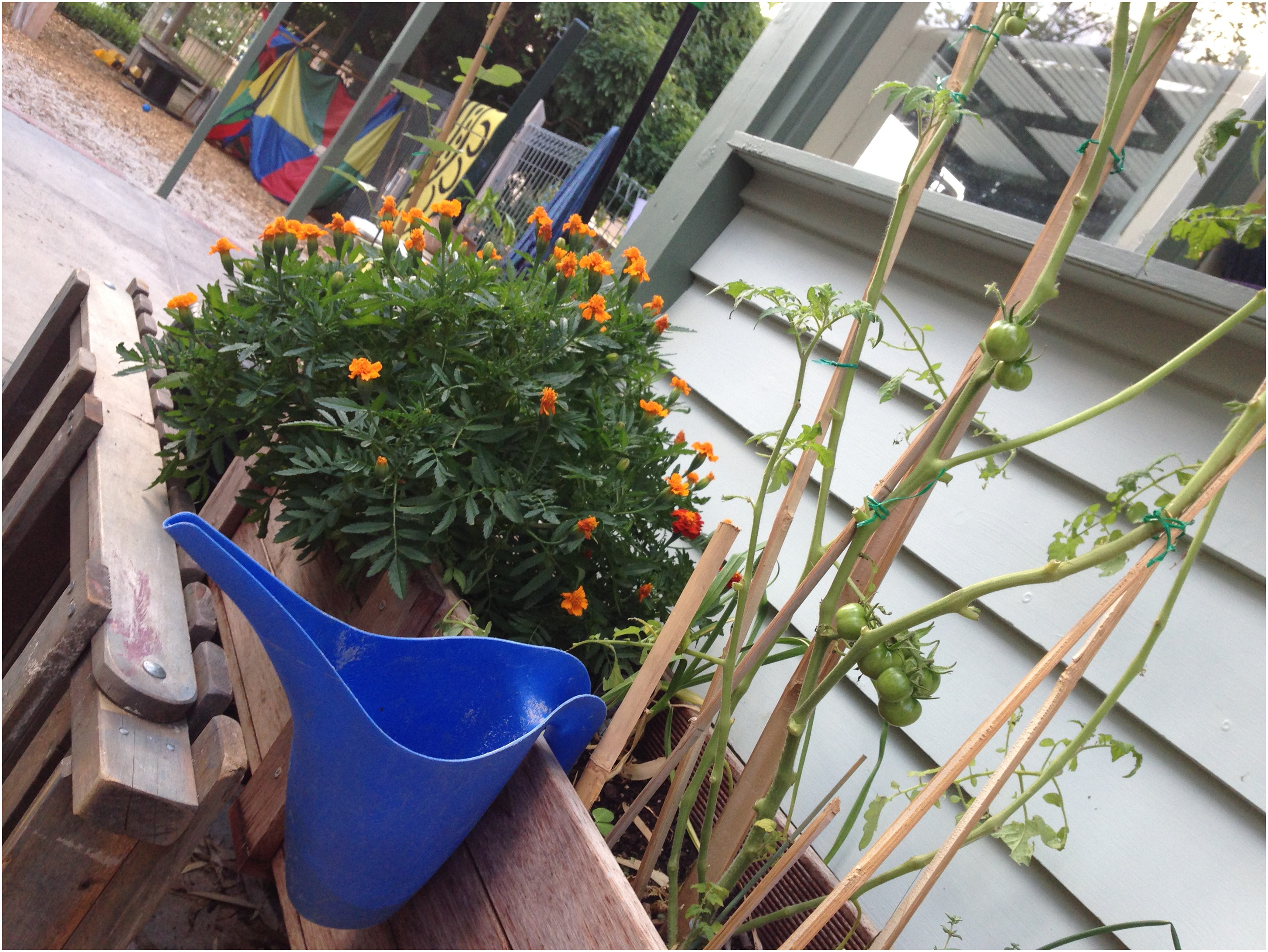
The planter box: inviting and creating synergies.
Greg focused on describing a space in the early childhood centre where there is a planter box that has tomato plants and herbs, and the aroma of mint, rosemary and dirt (Figure 6):
I believe that this is a reason why this space works very well, as it engages with the children on their eye level and almost invites the children to come in. This has various herbs and gives off aromas of mint and rosemary; children are immediately drawn to this.
It also allows them to view our huge tomato plants that get bigger on a daily basis.
As planter boxes are on the same level for the children, this promotes various opportunities of learning for the children.
There are some children who are ready to get in there and pick out tomatoes and get their hands dirty; some children are happy to sit back and watch from afar and discuss the physical transformations.
What all of this means is that when the children intra-act with the non-human elements, it creates a synergy, an ecstasy type feeling when all of the pieces come together at once.
When humans and non-humans collaborate to create synergy, the experience creates a greater understanding for children and brings to existence an embodiment with the experience. (Greg)
The equal position (i.e. ‘same level’) of the planter box and the children generates new currents – sympathy as atmospheric currents that connect bodies (Bennett, 2020). The equal positioning between place and children is significant in allowing the flows of the more-than-human atmospheric forces to invite the children to gravitate towards these forces (i.e. all the growing things in the planter box).
Greg describes how the sympathetic forces are joined together in a synergy. Bennett (2020) emphasises that sympathy generates forces, sensations and affections that circulate in beings, vibrant things and atmospheres, which are all connected with each other. In equal positioning, the outside forces of the planter box (i.e. the tomato plants, herbs, and aromas of mint, rosemary and dirt) affectively infuse each other in a child's embodiment of place.
Here, sympathy generates an affective force transfer between children, place and things (Bennett, 2020). As Greg states, this attraction promotes learning, physical transformations and synergy – becoming together. The attraction to the planter box and the felt affection between the human touch, the dirt, the aromas of mint and rosemary, and the future taste of the tomatoes attract each other. The planter box attracts the children, these creates new transformative sympathetic synergies, providing new opportunities to learn from each other by meeting together to ‘get their hands dirty’ or appreciate by ‘sitt[ing] back and watch[ing] from afar’.
The human learning experience goes beyond the human touch – the influx – to the influx and efflux of becoming and meeting bodies and creating new atmospheric sympathies.
(In)conclusion
Bennett’s (2020) modes of sympathy provide a new way of conceiving atmospheric forces, the posthuman child involves appreciation of pre-service teachers seeing-more, being affected-more in their everyday encounters with vibrant forces, things and places. Through looking at the world with sympathy, Bennett (2020) poetically, ethically and politically encourages us to see, perceive, understand and feel taken-for-granted everyday encounters, daily practices and early childhood institutions themselves in more sympathetic tones. The posthuman child is affected by the benevolence of everyday entanglements with things and places (e.g. the tutu, ribbons, fence and planter box).
Early childhood everyday practices commonly consist of words and dialogue, an invitation to see and document words with vital forces and sympathetic tones, forming part of the larger circuit of sympathy. The affective adjective tones used by the pre-service teachers in our study in relation to the posthuman child and their sympathetic entanglements with things – for example, the tutu making the child happy; ribbons enticing the children; the cat as a participant in the dance; the fence being playful and facilitating reciprocal relationships; the cornflour being soft and warm; and the planter box creating new synergies, aromas and feelings.
While there are tensions in pre-service teachers looking-beyond the child, by embracing the posthuman child involves not only redirected our attention to thing or places but creating sympathetic synergies and being pulled by these vibrant forces. The pre-service teachers described these intra-actions in benevolent tones, forces and sensations that made it possible for them and for us to notice the vibrancy of matter, powered by the flow of sympathy as a more-than-human force.
The potential for a posthuman childhood lies in the more-than-human nature of sympathy. This is not the sympathy of reformers for street urchins, so beautifully described by early childhood historian Helen May (2006), but sympathy as a planetary force that pulls together/apart. There is an element of trust at play here too – trust in the vibrant nature of things and trust in evolution as change, adaption and differentiation. Humans as nature are thrown into the ebbs and flows, and even though as humans we prefer to control these influx and efflux forces, they will not let us. Trust in sympathy as a planetary force enables perspectives that may allow humans to ride the ebbs and flows with more ease, perhaps. Learning to trust in the more-than-human sympathetic influx and efflux forces is something that posthuman children may benefit from in uncertain times.
The pre-service teachers who participated in this study were open to the uncertainty and contemplation of the new affections of the power of things. Teaching new materialist theories and using pedagogical documentation enables pre-service teachers to think differently, and speculatively and imaginatively, about posthumanchildhoods. As they mention, it gave them a new way to think about pedagogy as less human-centric. The study appreciates the pre-service teachers’ new forms of attentiveness to the atmospheric and sympathetic forces that ebb and flow and circuit in early childhood. Circuits of sympathy bring new critical attention to the atmospheric forces that are entangled in new posthuman childhoods.
Footnotes
Acknowledgements
We are grateful to the EDF4028 early childhood pre-service teachers for participating in this research and gifting to us their words and images.
Declaration of conflicting interests
The authors declared no potential conflicts of interest with respect to the research, authorship and/or publication of this article.
Funding
The authors received no financial support for the research, authorship and/or publication of this article.
