



Abstract
This study aimed to explore the relationships between Finnish early childhood pre-service teachers’ (N = 274; aged 20–49; 92% female) self-reported physical activity (PA) and perceptions of their own enjoyment of schooltime physical education (PE), self-evaluation of the content of their current PE studies, perceived importance of PE, and perceived competencies in PE. The one-way analysis of variance revealed that pre-service teachers with higher self-reported levels of PA reported higher scores for perceived importance of PE in supporting a child's physical functionality (p = 0.004), and perceived competencies to support a child's PA (p = 0.017) and teach PE (p = 0.023). Results of independent sample t-tests indicated that pre-service teachers meeting daily PA guidelines reported higher scores for enjoyment of schooltime PE (p = 0.001) and perceived competence to teach PE (p = 0.001). Findings highlighted that pre-service teachers’ self-reported PA was positively related to their perceptions of PE, supporting the recommendation within early childhood teacher education to encourage pre-service teachers to engage in PA.
Keywords
Introduction
Every child has the right to progress towards their full potential in all areas of education, social and emotional well-being, and physical health (UNICEF UK, 1989). Early childhood education and care (ECEC) plays a crucial role in implementing early childhood policies into practice and supporting children's sustainable development goals (see Richter et al., 2020). Therefore, an essential need exists to invest in social sustainability, such as equality, inclusion, physical activity (PA), and overall well-being within families and young children.
Children must have appropriate knowledge, skills, and habits to support their engagement in movement to maintain a healthy lifestyle (World Health Organization [WHO], 2019). While it has been noted that high-quality ECEC can positively affect the PA levels and well-being of children (Bower et al., 2008; Dowda et al., 2004; Mavilidi et al., 2021), relatively little attention has been placed on developing ECEC teachers’ pedagogical skills for teaching physical education (PE) (e.g. Stork and Sanders, 2008; Tsangaridou et al., 2023). According to Niemistö et al. (2023), skilled teachers serve a critical role as they may have significant input in fostering a child's perceived motor competence in early childhood. A recent study by Tsangaridou et al. (2023) noted that ECEC teachers must be taught how to develop quality PE content. Investing in the professional competence of ECEC teachers is an important element in achieving this goal. Therefore, it is essential to make sure ECEC teachers are adequately qualified and meet the basic occupational requirements (Mak et al., 2021; Martyniuk and Tucker, 2014). In particular, the shortage of training has most often occurred during early childhood teacher education (Bruijns et al., 2020; Sevimli-Celik, 2020). Consequently, universities are uniquely positioned to create circumstances where early childhood pre-service teachers can implement their own ideas into practice and prepare new learning for the distinct context (Cochran-Smith, 2002). Moreover, developing early childhood teacher education makes education and working in ECEC attractive and motivates teachers in ECEC to remain working in the sector (Ministry of Education and Culture, 2021).
Previous research has shown that PA can influence children's well-being and health (Timmons et al., 2012), high-level cognition, relevant holistic development in multiple life domains (Bidzan-Bluma and Lipowska, 2018; Johnstone et al., 2022; Pesce et al., 2021), and academic learning outcomes (Nielsen-Rodríquez et al., 2022). Furthermore, it is important to acknowledge that the physically active lifestyles and PA patterns adopted in the early years are more likely to be maintained throughout life (Aira et al., 2021; Corder et al., 2019; Lounassalo et al., 2019; Telama et al., 2014; WHO, 2019). PE in ECEC can provide all children with regular and goal-oriented PA and thus, support children's health and well-being to become physically active adults (Brown et al., 2009). In guiding children towards a physically active lifestyle, PE experiences in early childhood must include (a) the learning of developmentally appropriate skills, (b) personnel trained in appropriate instructional practices for PA, (c) promotion of a positive and safe PA environment, including child-sized equipment, and (d) an inclusive curriculum based on an understanding of moving concepts and skill themes (Stork and Sanders, 2008).
In Finland, ECEC teachers are obligated to support the child's development (i.e. physical, motor, socio-emotional, cognitive, psychological, and ethical–moral) and learning as required by the regulatory expectations of the needs of the children (Finnish Recommendations for PA in Early Childhood, 2016; The Finnish National Agency for Education, 2022). According to the Finnish National Agency for Education (2022), ECEC teachers are expected to deliver compulsory PA and teaching curricula associated with personal health and well-being (e.g. creating a safe environment for physically active play, teaching children fundamental motor skills, providing children the opportunity to participate in the planning, implementation, and evaluation of the PA) (see also Soini et al., 2023).1 Finnish Recommendations for PA in Early Childhood (2016) suggest that children in ECEC should be offered guided PE daily concerning on an individual basis and weekly with a group of children. Besides guided PE, goal-oriented PE is also delivered by offering children daily opportunities for free play and time outdoors. Staff are encouraged to plan the daily activities so that children can meet the PA recommendations in ECEC. Furthermore, ECEC teachers must also regularly observe, assess, and document children's PA and motor skills (The Finnish National Agency for Education, 2022). Despite PE being delivered in ECEC settings, many Finnish children may not have additional opportunities for daily vigorous PA (Finnish Recommendations for PA in Early Childhood, 2016; Repo et al., 2019; Sääkslahti et al., 2021). Moreover, recent studies conducted with preschool-aged children have shown low levels of PA, particularly at the moderate- to vigorous-intensity level, and also unacceptably high levels of engagement in screen time (Finland's Report Card 2022 on Physical Activity for Children and Youth, 2022).
In considering Bandura's social cognitive theory (1977), it can be proposed that teachers act as role models influencing children's behaviours (see, e.g. Bruijns et al., 2021; Cheung, 2020; Hesketh et al., 2017). Hu et al.'s (2021) systematic review highlighted that teachers could proactively shape school-aged children's PA participation. Similarly, Ellis et al. (2018) reported that it is essential to acknowledge that ECEC teachers’ positive perceptions towards PA are fundamental for promoting young children's PA participation. Furthermore, it is more likely for physically active teachers to support children's PA and motor skills than physically inactive teachers. For instance, Cheung (2020) indicated that preschool children had higher PA levels in PE classes taught by more active teachers than those taught by less active teachers. Also, Smuka (2012) reported that physically active teachers provide role-modelling that increases school-aged children's PA levels. Comparable findings were found in Bruijns et al.'s (2020) study, where personal PA habits positively influenced early childhood pre-service teachers’ values and perceptions of their role in promoting PA in childcare. In addition, the pre-service teachers who met the Canadian PA guidelines had significantly higher levels of PA-related self-efficacy (Bruijns et al., 2019) and took personal responsibility for and placed greater importance on items related to promoting PA than those not meeting the PA guidelines (Bruijns et al., 2020). While it may not be necessary for ECEC teachers to meet PA recommendations, they must be aware of their strong influence on young children's PA behaviours (Bruijns et al., 2019). Therefore, emphasising the health benefits of PA might be significant, considering pre-service teachers’ low self-reported PA levels (see also Martyniuk and Tucker, 2014).
Previous research regarding professional development in PE has typically focused on in-service teachers (Wang and Ha, 2008). However, early childhood pre-service teachers must also be targeted during their teacher education years to ensure that they enter the workforce with sufficient PA-related knowledge, skills, and training (Martyniuk and Tucker, 2014; Niemistö et al., 2023). Sevimli-Celik's (2020) investigation indicated that pre-service teachers who held negative attitudes regarding PE from previous PE experiences reversed their attitudes after participating in a practice-based course of PE in early childhood teacher education. Indeed, existing research evidence underscores the benefit of PA-related training's positive influence on pre-service teachers’ values and perceptions (Bruijns et al., 2019, 2020, 2021; Mavilidi et al., 2021). Therefore, this study aimed to examine the relationships between Finnish early childhood pre-service teachers’ self-reported PA and perceptions of their own enjoyment of schooltime PE, self-evaluation of the content of their current PE studies, perceived importance of PE, and perceived competencies in PE.
Materials and methods
Participants
The study took place in all seven universities providing early childhood teacher education in Finland. All Finnish pre-service teachers in their final year of a bachelor's degree in early childhood education, of which there were 509 at the time of data collection, were invited to participate in the study. During the academic year 2019–2020, 289 completed the self-report questionnaire. The eligibility for involvement in the research required completing compulsory PE studies included in their early childhood teacher education. A group of 13 respondents were excluded from the final data due to incomplete PE studies, and two respondents did not fully complete the questionnaire. The pre-service teachers were given the choice of whether to answer an online or paper version of the questionnaire to provide them with the best possible form to participate in the study.
In total, 274 (response rate of 54%) participants provided responses either online (49%, n = 134) using digital devices or in paper form (51%, n = 140). Responses were provided using Finnish (98%, n = 269) or English (2%, n = 5). Participants took approximately 15 minutes to complete the questionnaire. Pre-service teachers responded to the questionnaire as part of their ordinary early childhood teacher education course of study or in their leisure time. All the pre-service teachers involved in the survey had completed their PE studies before COVID-19. The pre-service teachers were aged 20–49 (mean [M] = 26; standard deviation [SD] = 6.26), 92% were female (Mage = 26; SD = 6.20), and 8% were male (Mage = 28; SD = 6.85).
The questionnaire
The questions in the current instrument were developed to examine the pre-service teachers’ perceptions of their PE studies in early childhood teacher education programmes. The question content precisely reflected the objectives and requirements of The National Core Curriculum for Early Childhood Education and Care (2018) and Recommendations for PA in Early Childhood (2016).
The questionnaire consisted of four parts, as follows: (1) respondent's background information (nine items, e.g. age, gender, university, and enjoyment of schooltime PE), (2) respondent's PA behaviour (six items, The International PA Questionnaire-Short Form [IPAQ-SF]), (3) respondent's teacher education and PE studies (eight items), and (4) perceived importance of PE aims and perceived competence implementing PE (four items). The questionnaire included 27 questions, of which nine were multiple-choice, three were yes/no, and six were Likert scale. In addition, nine questions were open-ended; however, these questions were not examined or reported in the current study (see Soini et al., 2023). The questionnaire (in English or Finnish) is available on request from the corresponding author. The examined items were as follows:
Pre-service teachers’ self-reported PA. IPAQ-SF: Six items required participants to report the frequency and duration of their walking, moderate and vigorous PA performed in bouts greater than 10 minutes in length. The IPAQ sitting question was not included in this assessment. It is an additional indicator variable of time spent in sedentary activity and does not comprise part of any summary score of PA (IPAQ Group, 2005). Weekly minutes of walking and moderate- and vigorous-intensity PA were calculated separately by multiplying the number of days per week by the duration on an average day. To determine a total PA, Metabolic Equivalent of Task (MET) – minutes per week was calculated (sum of walking [3.3 × walking minutes × walking days] + moderate [4.0 × moderate-intensity activity minutes × moderate days] + vigorous [8.0 × vigorous-intensity activity minutes × vigorous days] scores) as recommended in the guidelines for data processing and analysis of the IPAQ (2005). The IPAQ questionnaire was selected because of its global validation, strong correlation with device-based PA measures, and capacity to classify individuals achieving current PA guidelines (Ekelund et al., 2006).
Based on their responses, the pre-service teachers were grouped into three IPAQ (2005) categories: low, moderate, and high levels of PA. This approach is commonly implemented to classify populations in PA studies (e.g. Bauman et al., 2009). Those individuals who did not meet the criteria for moderate or high PA levels were considered to have low levels of PA. Individuals who were meeting (a) three or more days of vigorous-intensity activity of at least 20 minutes per day or (b) five or more days of moderate-intensity activity and/or walking at least 30 minutes per day or (c) five or more days of any combination of walking, moderate-intensity or vigorous-intensity activities achieving a minimum total PA of at least 600 MET – minutes per week were defined as accumulating a minimum level of activity and therefore, were classified as moderately active. Individuals who engaged in vigorous-intensity activity on at least (a) three days achieving a minimum total PA of at least 1500 MET – minutes per week or (b) seven or more days of any combination of walking, moderate-intensity or vigorous-intensity activities achieving a minimum total PA of at least 3000 MET – minutes per week were considered to be highly active (IPAQ Group, 2005).
A final assessment was completed to determine if participants met the current WHO (2020) guidelines on PA and sedentary behaviour. Participants who reported they had (a) at least 150–300 minutes of moderate PA per week or (b) at least 75–150 minutes of vigorous PA per week were considered to meet the recommended levels of daily PA. Due to incomplete answers to the IPAQ questions, cohorts of missing cases for IPAQ categories (7.7%) and PA guidelines (6.9%) were identified.
Enjoyment of schooltime PE. Participants’ perceived enjoyment of their own previous experiences in mandatory schooltime PE was assessed using a 10-point (1 = not enjoyable at all; 10 = extremely enjoyable) Likert scale. Subsequent reference to this variable will be used to label enjoyment of schooltime PE.
The adequacy of PE studies. Participants were asked to evaluate, from 1 = completely disagree to 5 = completely agree, their experience of the adequacy of the PE studies in their early childhood teacher education (11 sub-items, e.g. ‘I have adequate training in my PE studies to teach PE in ECEC’). The subscale for the adequacy of PE studies showed satisfactory reliability (Cronbach's alpha coefficient [α] 0.80).
The value of PE. Pre-service teachers' values regarding PE were assessed using a modified version of the Task-Perception Scale, initially developed by Eccles et al. (1983) (see Wigfield and Eccles, 2000). The respondents were asked to answer two questions: (a) ‘How important/useful/interesting do you think PE is in early childhood teacher education?’ and (b) ‘How important/useful/interesting do you think PE is in ECEC?’ Respondents rated their responses from one (completely disagree) to five (completely agree) in regard to separate perceptions of importance, usefulness and interest. In this study, the M of two item sets of questions was calculated and taken as the pre-service teachers’ PE attainment and intrinsic interest. The alpha coefficient for the subscale of the value of PE (six items) was 0.84, indicating the items had relatively high internal consistency.
The perceived importance of PE aims. Participants were required to respond to the question: ‘How important are the following aims of PE in ECEC? Please select the number that best corresponds to your view’ using a five-point Likert scale (1 = not important at all; 5 = extremely important). The question included 36 sub-items; however, 35 were used in the analyses. The following sub scales were developed: supporting a child's physical functionality (sub-items 7, 13, 18, 24, 29, 33, and 36, e.g. ‘Improving children's respiratory and circulatory function’) (α = 0.89); motor development (sub-items 2, 8, 14, and 19, e.g. ‘Teaching children fundamental motor skills’) (α = 0.61); socio-emotional development (sub-items 3, 9, 15, 20, 25, and 30, e.g. ‘Teaching children co-operation and interaction skills’) (α = 0.81); cognitive development (sub-items 4, 10, 21, 26, 31, and 35, e.g. ‘Supporting children's development of language’) (α = 0.79); psychological development (sub-items 5, 11, 16, 22, 27, 32, and 34, e.g. ‘Providing children with opportunities to be independent [autonomy]’) (α = 0.75); and ethical–moral development (sub-items 6, 12, 17, 23, and 28, e.g. ‘Teaching children the spirit of fair play’) (α = 0.83).
Perceived competence in PE. Information regarding participants’ perceived skills and competencies in PE were assessed using a five-point Likert scale (1 = not competent at all; 5 = highly competent) and the following question: ‘What are your views of your skills/competence when teaching PE in ECEC?’ The question included 16 sub-items that have been highlighted in the Finnish National Core Curriculum for Early Childhood Education and Care (2018). The Cronbach's alpha coefficients indicated that the perceived competence in PE had satisfactory subscale reliability. Results were as follows: supporting a child's PA (sub-items 1, 2, and 3, e.g. ‘Supporting a child's physically active free play’) (α = 0.56); teaching PE (sub-items 4, 5, 6, 7, 8, 9, 10, 11, and 12, e.g. ‘Teaching physically active games based on rules’) (α = 0.76); observing and assessing a child's motor skills and PA (sub-items 13, 14, 15, and 16, e.g. ‘Observing children's fundamental motor skills’) (α = 0.88).
Trustworthiness of the questionnaire
Firstly, to ensure the data's trustworthiness, the existing PE questionnaires in ECEC and schools were reviewed (see, e.g. Mäkelä, 2014; Nieminen and Salminen, 2010; Valtonen, 2016), and suitable items were selected for the current study. Next, six professionals with research and applied experience in early childhood or PE teacher education programmes inspected and approved the questions developed for this study. Furthermore, the questionnaire was test–retested with 27 pre-service teachers outside the study. Overall, the test–retest for the questionnaire variables intraclass correlation coefficients resulted in a moderate agreement (range 0.55–0.92) for most items.
Statistical analysis
All analyses were performed using SPSS Version 26. The normality of the data and descriptive statistics was assessed. Descriptive statistics are expressed as Ms with SDs or 95% confidence intervals (CIs) and counts with percentages. The independent and dependent variables used within each analysis were as follows:
Independent variables (two items): IPAQ categorical PA levels (0 = missing case; 1 = low; 2 = moderate; 3 = high), and meeting the WHO guidelines on PA and sedentary behaviour (2020) (no was coded 0, yes 1, and missing case 2). Dependent variables (13 items): pre-service teachers’ perceptions of their enjoyment of schooltime PE (1 = not enjoyable at all; 10 = extremely enjoyable), the adequacy of PE studies in early childhood teacher education (1 = completely disagree; 5 = completely agree), and the value of PE (1 = completely disagree; 5 = completely agree). The pre-service teachers’ perceived importance of PE aims variable comprised the following scored sub-scales: supporting a child's physical functionality, motor development, socio-emotional development, cognitive development, psychological development, and ethical–moral development (1 = not important at all; 5 = extremely important). Finally, the pre-service teachers’ perceived competence in PE variable comprised the following scored sub scales: supporting a child's PA, teaching PE, and observing and assessing a child's motor skills and PA (1 = not competent at all; 5 = highly competent). An overview of the independent and dependent variables of the study is presented in Table 1.
Overview of independent and dependent variables of study.
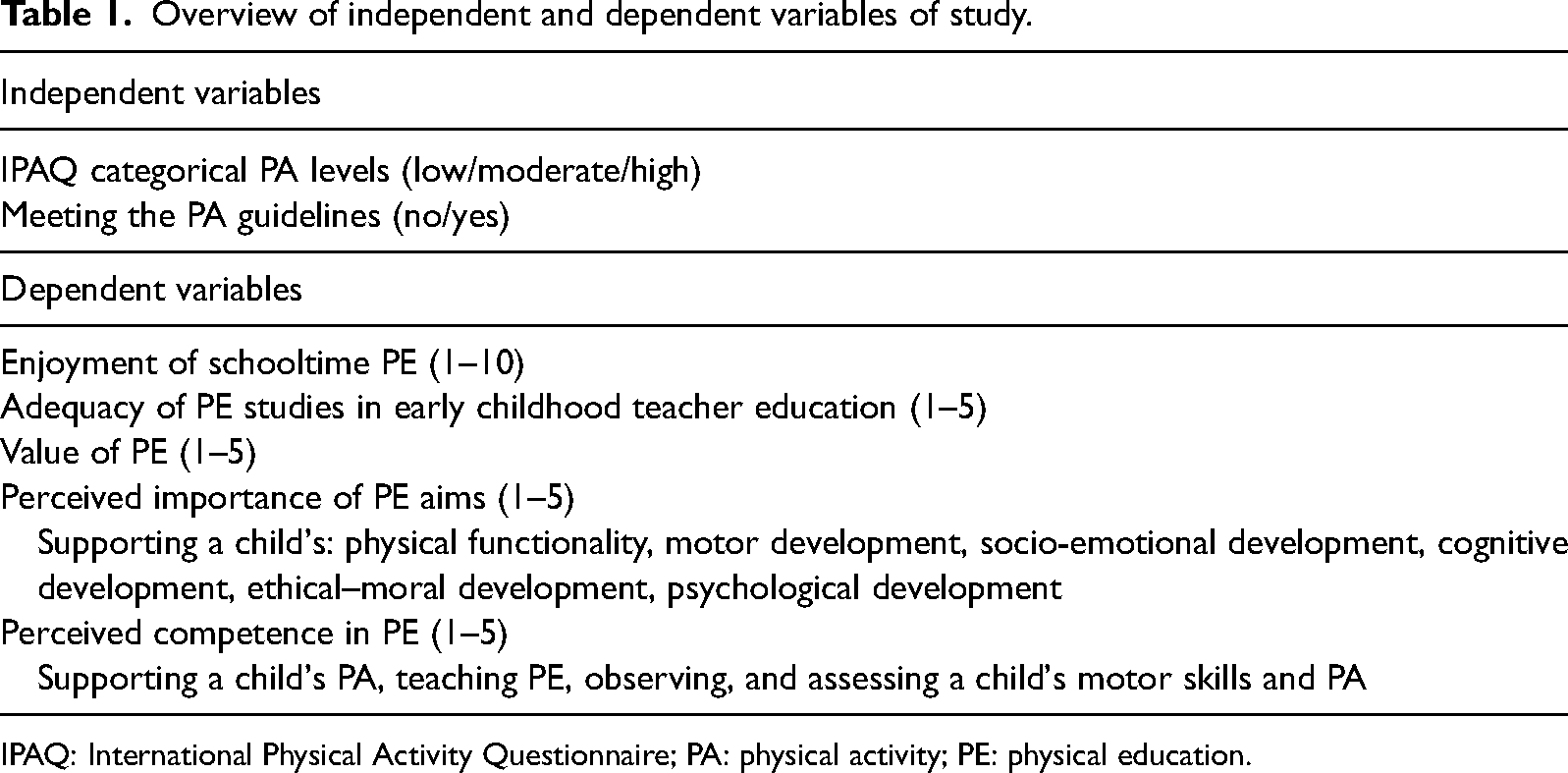
IPAQ: International Physical Activity Questionnaire; PA: physical activity; PE: physical education.
A one-way analysis of variance (ANOVA) was used when dependent variables were compared with participants’ categorical PA levels, and an independent sample t-test was used for comparisons between dependent variables and participants meeting the PA guidelines. Effect sizes were determined using the eta squared (η2) for one-way ANOVA analysis and Cohen's d for independent sample t-test. Cronbach's alpha was used to report subscale reliability. The p-value for this analysis was <0.05.
Ethical considerations
In Finland, research with human participants must comply with the guidelines of the Finnish National Board on Research Integrity (2019). Ethical reviews from the universities were not required based on the policies regarding anonymised data. Instead, heads of departments from all seven universities provided permission for data collection. Before the data collection, participants were informed about the research objectives and the participants’ rights. In addition, respondents were encouraged to explore the privacy statement provided and approved by the University of Jyväskylä, where the study was based. By answering the questionnaire, the respondents gave their consent to the study. Participation in the survey was voluntary, and participants could withdraw at any time. No personal information, except age, gender, and nationality, was requested within the questionnaire. All material was collected, stored, analysed, and reported so that no participants were identifiable. Researchers used and handled the material's storage on the University of Jyväskylä's password-protected server.
Results
Approximately 13% of the pre-service teachers (N = 253) reported engaging in low levels of daily activity, 43% in moderate levels of daily PA, and 44% in high levels of daily PA. Most (73%) of the pre-service teachers (N = 255) reported that they met the daily PA recommendations of at least 150 minutes of moderate PA per week or at least 75 minutes of vigorous PA per week. In contrast, nearly a third (27%) of the pre-service teachers did not fulfil the current PA recommendations.
Pre-service teachers’ perceptions of PE
When the pre-service teachers were asked about their enjoyment of schooltime PE, the scores varied substantially (M = 7.36, SD = 2.10, range = 9). The scores for the adequacy of PE studies in early childhood teacher education (M = 3.27, SD = 0.50) were the lowest, whereas the value of PE (M = 4.76, SD = 0.37) was the highest.
Additionally, the pre-service teachers reported high scores for the perceived importance of PE aims in ECEC. Across the six PE aims, the pre-service teachers rated their perceptions of the importance of supporting a child's psychological development the highest (M = 4.67, SD = 0.36) and supporting a child's socio-emotional development (M = 4.50, SD = 0.47) the second highest. The third highest score was rated for supporting a child's ethical–moral development (M = 4.42, SD = 0.58). Supporting a child's cognitive development (M = 4.40, SD = 0.52) was fourth, and fifth was supporting a child's motor development (M = 4.35, SD = 0.52). The lowest mean score was reported for supporting a child's physical functionality (M = 4.21, SD = 0.67).
The highest mean score was recorded for pre-service teachers’ perceived skills to support a child's PA (M = 3.86, SD = 0.51). The second-highest M was scored for their perceived skills to teach PE (M = 3.63, SD = 0.50). The lowest mean score was recorded for pre-service teachers’ perceived skills for observing and assessing children's motor skills and PA (M = 3.42, SD = 0.69) (see Table 2).
The relationships between early childhood pre-service teachers’ self-reported PA and their perceived importance of PE aims and perceived PE competencies.
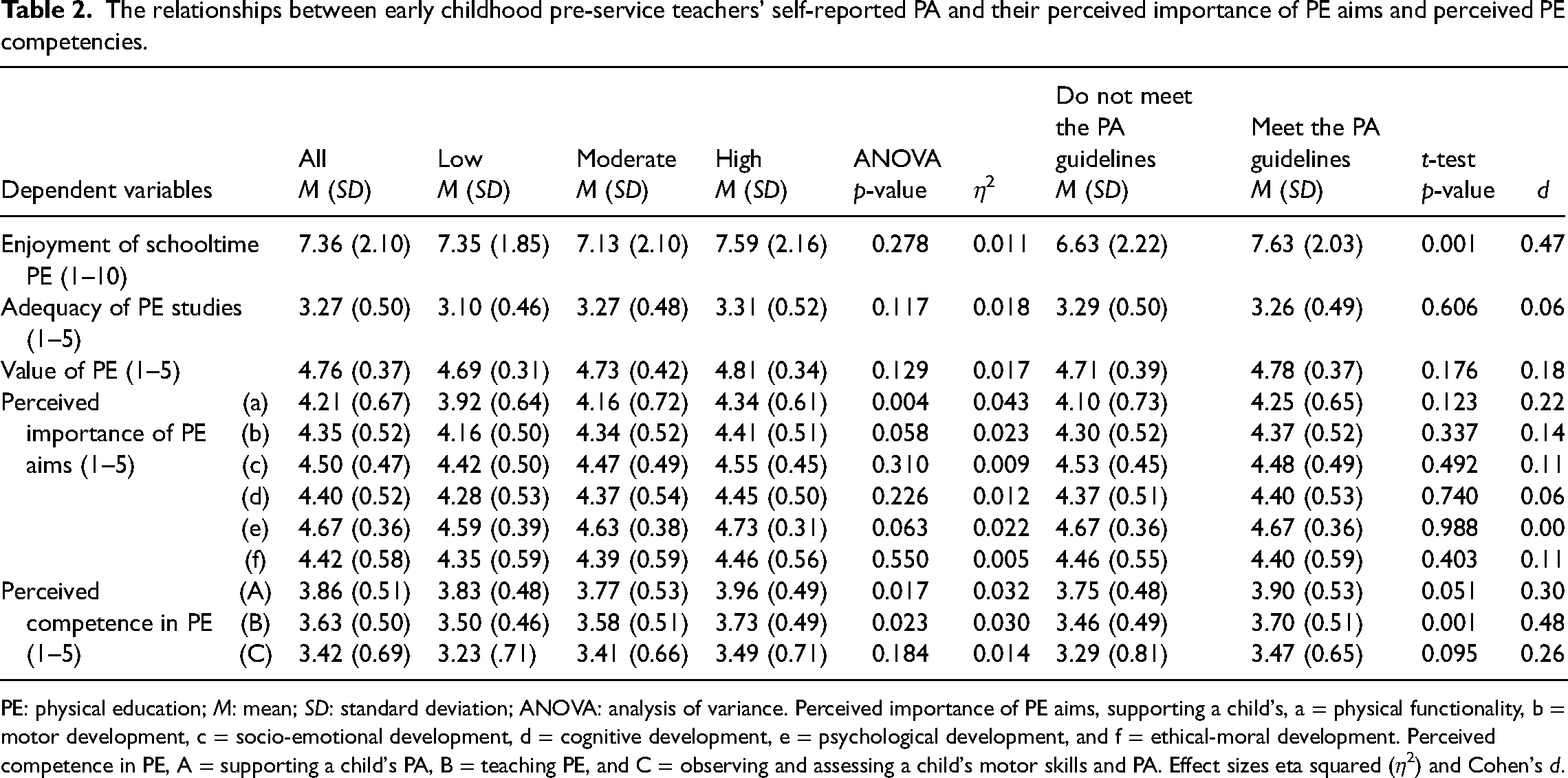
PE: physical education; M: mean; SD: standard deviation; ANOVA: analysis of variance. Perceived importance of PE aims, supporting a child's, a = physical functionality, b = motor development, c = socio-emotional development, d = cognitive development, e = psychological development, and f = ethical-moral development. Perceived competence in PE, A = supporting a child's PA, B = teaching PE, and C = observing and assessing a child's motor skills and PA. Effect sizes eta squared (η2) and Cohen's d.
Self-reported PA in relation to perceptions and competencies
A one-way ANOVA was performed to compare the effect of the IPAQ categorical PA levels (low/moderate/high) on the dependent variables of the study. Independent sample t-tests were conducted to compare the relationships between participants’ self-reported attainment of the WHO (2020) guidelines on PA and sedentary behaviour (no/yes) and the dependent variables of the study (see Table 1).
The analysis revealed that there was a statistically significant difference in the pre-service teachers’ self-evaluated mean scores for perceived importance of PE in supporting a child's physical functionality, F(2, 248) = [5.616], p = 0.004, η2 = 0.043, and perceived competence of supporting a child's PA, F(2, 249) = [4.166], p = 0.017, η2 = 0.032, and teaching PE, F(2, 249) = [3.851], p = 0.023, η2 = 0.030, between at least two groups. Tukey's honestly significant difference test for multiple comparisons found that the mean values of perceived importance of supporting a child's physical functionality were significantly different between the low and high categories (p = 0.005, 95% CI = [−0.73, −0.11]) and perceived competence supporting a child's PA was significantly different between the moderate and high categories (p = 0.013, 95% CI = [−0.36, −0.0344]). There was no statistically significant difference in mean perceived competence of teaching PE between the low and high categories (p = 0.078 and p = 0.061, respectively) or between the moderate and high categories (p = 0.160 and p = 0.065, respectively).
Independent sample t-test results revealed a statistically significant difference in enjoyment of schooltime PE scores for pre-service teachers who fulfilled the PA guidelines (M = 7.63, SD = 2.03) and did not fulfil the PA guidelines (M = 6.63, SD = 2.22) conditions (t(245) = −3.34, p = 0.001, d = 0.47). A statistically significant difference was also observed in perceived competence to teach PE scores for pre-service teachers meeting the PA guidelines (M = 3.70, SD = 0.51) and not meeting the PA guidelines (M = 3.46, SD = 0.49) conditions (t(252) = −3.40, p = 0.001, d = 0.48). The power results of the inferential comparisons were typically small; however, the variations in enjoyment of schooltime PE and perceived competence to teach PE showed a medium effect (see Cohen, 1988). The relationships between early childhood pre-service teachers' self-reported PA and their perceived importance of PE aims and perceived PE competencies are presented in Table 2.
Discussion
In this study, we examined the relationships between Finnish early childhood pre-service teachers’ self-reported PA and perceptions of their own enjoyment of schooltime PE, self-evaluation of the content of their current PE studies, perceived importance of PE, and perceived competencies in PE. Overall, pre-service teachers’ perceptions of all variables examined were indicative of a positive experience. However, pre-service teachers gave relatively low assessments of the adequacy of their PE studies, in contrast to their higher scores for the value of PE (in ECEC and early childhood teacher education programmes). Pre-service teachers’ self-reported PA levels were high, indicative of meeting the WHO (2020) guidelines on PA and sedentary behaviour. Nevertheless, some differences between pre-service teachers' self-reported PA and their perceived competencies in PE were found.
Pre-service teachers’ self-reported PA levels
According to the WHO (2020) guidelines on PA and sedentary behaviour, all adults should do at least 150–300 minutes of moderate-intensity PA or at least 75–150 minutes of vigorous-intensity PA daily. A substantial number of the early childhood pre-service teachers participating in the study reported high PA levels, and approximately 73% of them indicated that they engaged in the daily PA recommendations. However, 13% of the pre-service teachers reported engaging in low levels of daily PA, and approximately one in four (27%) of all participants did not fulfil the current PA guidelines, which is in line with global estimates (Guthold et al., 2018). The high PA levels in the present study could be justified by the fact that the participants in the study were university-level pre-service teachers. Indeed, previous research indicates that higher educational attainment is linked to higher levels of PA and that education may lead to healthier lifestyle choices (Kari et al., 2020).
Teachers’ fitness levels play an important role in their participation in children's physically active play (Cheung, 2020; Rink et al., 2010; Smuka, 2012). In addition, adequate levels of daily PA and physical fitness engagement may also assist ECEC teachers in coping with physically demanding work within the ECEC profession. For instance, frequent lifting, stooping, squatting, and carrying children pose constant ergonomic challenges, especially for teachers’ musculoskeletal health (Gratz et al., 2002; King et al., 2006). However, a cohort of the teachers in Smuka's (2012) study did not engage in PA with their school-aged students. Therefore, given the possible association between teacher PA behaviour and children's PA participation, it is important to support the enhancement of health and fitness knowledge in teacher education (Bruijns et al., 2021; Cheung, 2020; Martyniuk and Tucker, 2014; Mavilidi et al., 2021). Indeed, early childhood teacher education courses should, therefore, continue providing opportunities that foster the desire for early childhood pre-service teachers to be curious and self-motivated in PE (see Ryan and Deci, 2000).
Self-reported PA and perceived importance of PE
This study supports previous research, showing that when teachers are physically active, have positive attitudes towards movement, or feel competent in PE, they implement PE and support children's activity in their work. For instance, Bruijns et al. (2020) highlighted that pre-service teachers meeting the PA guidelines reported higher agreement for the importance of, and personal responsibility for, promoting children's PA in childcare. Similarly, the current results demonstrated that participants’ higher self-reported PA levels were related to a higher perceived importance of supporting a child's physical functionality than those with low self-reported levels of PA. However, it should be acknowledged that the importance of supporting a child's psychological, socio-emotional, ethical–moral, and cognitive development through PE revealed the highest mean scores. In the spirit of Finnish ECEC curricula (Finnish National Agency for Education, 2014, 2022), the present positive findings highlighted that participants may see PE as a way to support a child's overall growth and development. Pre-service teachers’ attitudes toward PA may translate into their teaching practices. Indeed, opportunities to engage in PA for young children may only be provided in ECEC settings if teachers feel interested and personally responsible (Bruijns et al., 2020; see also Wigfield and Eccles, 2000). Therefore, it could be assumed that participants in this study with the high perceived importance of PE aims may perform well when implementing PE within the ECEC workforce.
In this study, pre-service teachers who did not meet PA recommendations reported significantly lower scores for their enjoyment of schooltime PE than those who achieved the PA recommendations. It is unclear whether teachers form their values related to PA and PE during their own school experiences, within their teacher education studies, or are shaped by the setting in which they are employed. Nevertheless, it is crucial to be aware that previous negative PE experiences or low levels of PA do not entirely define what kind of teacher a person will be in the future. Several previous studies have shown that early childhood teacher education programmes can have a positive effect on pre-service teachers’ negative PE perceptions (see, e.g. Bruijns et al., 2021; Martyniuk and Tucker, 2014; Mavilidi et al., 2021). In fact, Sevimli-Celik (2020) reported that pre-service teachers’ negative attitudes changed during their teacher education training. Integrating PA-related education into early childhood teacher education programmes is essential because it has been shown to positively contribute to pre-service teachers’ PA-related self-efficacy to engage preschoolers in PA (see also Bruijns et al., 2021).
Relationship of self-reported PA with perceived competencies
This investigation showed that pre-service teachers’ perceived competencies in PE were typically high. However, some variations between pre-service teachers’ perceived competence in PE were observed based on the participants’ self-reported PA. First, the pre-service teachers who met the daily PA recommendations or reported high levels of PA also perceived higher competencies to teach PE compared to those who reported lower self-reported PA levels. Furthermore, pre-service teachers with higher self-reported levels of PA had higher perceived competence in supporting a child's PA. Similarly, Canadian pre-service teachers meeting the PA guidelines had greater confidence in facilitating and encouraging young children's active play than those not meeting the guidelines (Bruijns et al., 2019). A possible explanation for the pre-service teachers’ relatively congruent perceptions and high perceived competencies in PE may be an outcome of the comparable implementation of the early childhood teacher education programmes in Finland. For instance, mandated professional studies, including PE studies, are delivered in all seven Finnish universities that offer three years of bachelor's degree education. Although there is no specific PE curriculum specification, and universities can independently decide on the total amount and content of PE studies, no significant variations exist in the current PE subjects implemented in universities (see Soini et al., 2023). It is important to continue sharing professional knowledge, objectives, and course content throughout the Finnish universities’ early childhood teacher education networks.
Limitations and future directions
Although the research produced valuable information for developing PE in early childhood teacher education programmes, some limitations must be acknowledged. Firstly, due to the exploratory design of this cross-sectional study, causal relationships could not be identified. Secondly, even though the study aimed to recruit as many early childhood pre-service teachers as possible, and achieved a 54% response rate, this group of voluntary participants may have been those who are already physically active or demonstrate positive perceptions towards PA. However, we are confident that the sample size incorporated is representative of the population of final-year early childhood pre-service teachers in Finland. Thirdly, although the IPAQ has been commonly used and seen as valuable in improving PA information based on self-reports among adults in diverse settings (Craig et al., 2003), some limitations have been identified. For instance, as with similar PA measures, self-report bias is demonstrated through the IPAQ-SF, typically overestimating PA compared to data collected using objective measures (Ekelund et al., 2006; Lee et al., 2011). In the future, exploring early childhood teacher education programmes’ PE syllabi and content, determining the best PE practices, and comparing pre-service teachers’ PE perceptions to their objectively measured PA levels between different countries and cultures would be stimulating and assist the development of the PE studies in early childhood teacher education.
Conclusion
Policies of early childhood teacher education programmes, PE curricula, and professional requirements of an ECEC teacher vary from country to country; therefore, international comparisons across the subject domain have been warranted (see Howells and Sääkslahti, 2019). A strength of this study was that all Finnish universities providing early childhood teacher education were involved. Furthermore, the findings provided comparable information to support new investigations of the role of PE in early childhood teacher education internationally.
The current findings demonstrated that Finnish early childhood pre-service teachers’ self-reported PA was associated with higher perceived competence in PE. The results also underscored the important role of the PE curriculum in early childhood teacher education programmes in facilitating pre-service teachers’ awareness of the importance of PA in their own lives. This goal could be achieved through future programme development in early childhood teacher education, incorporating an extension to the number of hours pre-service teachers engage in the PE curriculum. It is hoped that the research results will have implications for developing early childhood teacher education programmes whereby pre-service teachers, regardless of their previous experiences, have equal opportunities to develop their pedagogical skills in PE, (re)evaluate their perceptions towards PA, and become competent PE teachers in the early years. Finally, the findings reinforce the importance of pre-service teachers adopting an active lifestyle that contributes to their physical and emotional well-being and, consequently, supports the positive PA engagement of the children they teach.
Footnotes
Acknowledgements
The research team would like to thank the pre-service teachers for participating in this study, and the people in the universities who helped with the data collection.
Declaration of conflicting interests
The authors declared no potential conflicts of interest with respect to the research, authorship, and/or publication of this article.
Funding
The authors received no financial support for the research, authorship, and/or publication of this article.
