



Abstract
In response to the call for papers for this special issue and the questions it poses, the authors show how the ontological posthumanist shift of agential realism does not erase but keeps the child human of colour in play, despite the inclusion of the other-than-(Adult)human in its methodologies. Through a montaging technique, the authors explore the philosophical complexity of ‘decentering without erasure’ by re-turning to data from a large international research project – Children, Technology and Play (2019–2020). Through an agential realist reading of interview data ‘of’ ‘seven-year-old’ Henry when visiting him at home in an informal settlement in Cape Town, they show what else is going on, and the politically radical and subtle philosophical difference this makes for reconfiguring child subjectivity. To do more justice to the complexity of reality, the analysis bounces around like Henry's sack ball and zooms in on the role apparatuses such as GoPros play in research. The authors ‘follow the child’ literally but differently, without excluding or erasing the more-than-(Adult)human. In meeting Henry, they also meet Eshal, who introduces the GoPro(blem). By diffractively reading Karen Barad's scholarship through visual and aural texts, the authors respond to the question of how posthumanist research makes a difference to childhood studies. They show how the agential realist move(ment) from Object and Subject to Phenomenon explodes ageist, ableist, racist, extractive and settler-colonial logics in education research.
Re-turning: following sticky traces in and through the complex phenomenon
This article is an invitation to join us on a journey where we put ourselves as storytellers ‘at risk’, which comes with a trigger warning. For readers who are not so un/familiar with agential realism, this transmodal text requires us, readers and authors (who are also readers), to stay with the dis/comfort triggered by not being able to grasp ‘the’ meaning with certainty.
1
Reading with us in a non-linear way is a seriously playful invitation to disrupt chronological ways of storytelling. Our storying responds to the call for papers for this special issue, entitled ‘Risking erasure? Posthumanist research practices and figurations of (the) child’, and the three questions it asked authors to address:
How can/do we keep our childhood studies political? How do posthumanist researchers keep the child in play when they neither ‘follow the child’ nor make ‘child’ central to their investigations? How can posthumanist research make a difference to childhood (in the broadest, worldly sense)?
In their introduction, the co-editors invite contributors to show how posthumanist research can be conducted that refuses erasure of the child human. 2 Our response to this important ethico-political concern (and the three questions above) is threefold: (1) we critically engage with the concepts of ‘child human’ and ‘child human of colour’; 3 (2) we explore the concept of ‘erasure’; and (3) we then enact these conceptual wanderings in our analysis of an example from research that both of us are still engaged with/in. By re-turning to some of the data co-created as part of this project, we enact Karen Barad's agential realism. The analysis keeps the child of colour in play, despite decentring the child human – yet without erasure.
Inspired by the complex everyday practices of an earthworm, quantum physicist and feminist philosopher Karen Barad proposes re-turning as a non-prescriptive methodology that involves a ‘multiplicity of processes’, such as the kinds earthworms revel in while helping to make compost or otherwise being busy at work and at play: turning the soil over and over – ingesting and excreting it, tunnelling through it, burrowing, all means of aerating the soil, allowing oxygen in, opening it up and breathing new life into it. (Barad, 2014: 168)
This often-used quote breathes new life into the methodologies we have at our disposal as researchers, offering refreshing, down-to-earth imaginaries of doing research differently, but not just for the sake of it. The shift profoundly matters. As a composting methodology (Hamilton & Neimanis, 2018), re-turning to short video clips recorded by Joanne's hand-GoPro aims to do justice to the intricate detail of specific connectivity. 4 This Slow methodology is not necessarily about doing things more slowly, but about doing justice (ethics) to the complexity (epistemological) of the world of which we are a part (ontological). As authors, we linger, ingest and burrow in an attempt to aerate the concept of ‘child human of colour’ by thinking together differently, ethically, aesthetically, ecologically and with ‘a willingness to engage across differences of discipline and ideas’ (Liebowitz & Bozalek, 2018: 982–983). Yet this playful work is not just done by us as authors – a job finished with the last reference at the end of an article. The analysis we offer remains temporally open, drawing our ‘own’ attention to it again and again (as it has done for the last two years) and also connecting with the readers. This ‘meeting’ of sorts will leave permanent traces with/in the world (not just in their, or our, minds or brains). In this ongoing worlding process, the past is never closed. Each re-turning is a differentiating world-making process that ‘we’ as writers, readers, editors and publishers are simply part of and cannot oversee from a distance and then ‘map’. Moreover, such iterative and diffractive engagement with ‘the’ interview data involves not only cognition, but also a be(com)ing æffected by the experiences of bodies always already in relation. This cannot be contained, is not always articulable or expressible, and may even be beyond words.
Staying with/in the sticky complexities, we move our way through the open, dispersed/diffracted moments of the GoPro clips – the iterative practice of a making of worlds. The world and its possibilities for becoming are remade in each ‘meeting’ – justice is not a state or an endpoint that can be achieved once and for all. The taken-for-granted role of the GoPro and the ethico-political problems it causes are introduced below when we meet Eshal – one of the children in the project we re-turn to in this article. 5 Researching and learning are about ongoing practices of ‘being open and alive to each meeting, each intra-action, so that we might use our ability to respond, our responsibility, to help awaken, to breathe life into ever new possibilities for living justly’ (Barad, 2007: x). The tracing of the video clip as a Baradian phenomenon is the throbbing heart of ‘our’ analysis, and the veins that feed the heart are our meetings with/in and in between ‘seven-year-olds’, Henry, Eshal, the GoPro and much more. Meetings are response-able practices that stick and leave traces (Murris et al., 2022), and not only in research. With each meeting, with each re-turning, new transdisciplinary questions cascade. As we worm through, make compost and tell the non-unilinear story – a story – in the doing, we move from a substance ontology to an intra-active relational ontology. 6 Some readers might object to what might be perceived as an unfortunate use of “mixed metaphors’. But this is deliberate! We have invited a multiplicity of more-than-(Adult)humans to join us at the same time in this storying: sticking, sliding, burrowing, composting with/in “us” as a worlding process. This kind of storytelling with ‘matterphors’ (Barad & Gandorfer, 2021) disrupts many binaries and representational writing practices in its materiality.
We meet the GoPro clips not as Objects, nor as representations of what really happened in time and space, but as ‘sensuous materiality’ (Barad, 2017: 30), deeply æffecting the analyses. It could be argued that using images in this way is colonial in that readers are invited to look in’ or down’ on the human participants involved, but it is dangerous to believe that we can undo our own authority and colonial gaze as researchers. However, we propose that we can un/do our own subjectivity through showing visually that our images are not representations of subjects and objects but diffractive engagements with phenomena. We show this visually by diffracting our own presence and the questions (research instruments), as well as the rest, as part of the phenomenon. Agential realist research is not ethnographic, nor is it about the child as object or subject. What is signified is the subject always already in relation and it is the relationality that is shown (articulated) and what we are response-able for. In this sense, we do not meet Henry and Eshal as (child) Subjects. Like the GoPro, as a Baradian phenomenon, our analysis is an articulation of a ‘strange topology’ where past, present and future are inside one another, exploding ageist, ableist, racist, extractive and settler-colonial logics in education.
More-than-(child)subject: no erasure of the child human of colour
Children and their identity stories profoundly matter, but when analysed as phenomena, stories are multiplied and amplified. They are non-unilinear stories that trouble binaries such as Adult/child, Male/female, White/black, Rich/poor, Old/young and Human/more-than-(Adult)human, making us think differently about erasure (see below). 7 These binaries are power-producing in the sense that what is conceptualised (and performed) on the left-hand side of the forward slash has power over the right-hand side (e.g. Adult over child). Already assumed in these dichotomies is the philosophical Culture/nature binary of western metaphysics, 8 with teaching and learning as the medium that civilises and tames the wild child human. 9 Barad invites us to critically walk around in our conceptual distinctions (Barad & Gandorfer, 2021: 31) without holding any of them as foundational. The Culture/nature binary has produced educational interventions (read: Culture) that are (so-called) required in the natural processes that have left ‘child’ found wanting (Murris, 2016, 2022; Murris & Reynolds, 2018). 10 Intricately interwoven with the construction of the concept of ‘child human’, the ontologies of gender, race, class and place put chronological child outside of what it means to be Adult human as a feature of the world (Kromidas, 2019). This is even more the case when ‘child’ is Black, lives in poverty (as in Henry's case) and is also female (as in Eshal's case). Of course, the (western) figurations of child human that position children as fragile, vulnerable and innocent are routinely denied to young bodies of colour. Refusing to accept ‘white’ child human as the norm for what counts as (universal) ‘child’ opens up decolonising opportunities to reconfigure both concepts: ‘child human’ and ‘Adult human’ (Kromidas, 2019). 11 With historicity (Barad, 2017) and injustice written into the core of the concept of the child human, we turn to Robinson and Osgood’s (2019: 43) important reminder that new materialism and posthumanism need to keep and attend to their political edge in ‘addressing diversity and difference, oppression and inequalities associated with aspects of identity (race, class, gender, sexuality, dis(ability) and so on)’. Although materiality and inequality are entwined and mutually elaborated in early childhood practices, Hackett et al. point to what they call a continuing dilemma’:
by drawing attention to the micro, the in-the-moment, the contingent and the situated nature of subject positions, posthuman and new materialist readings of young children's literacies risk separating the child and their immediate surroundings from the political, historical, biographical and intersectional elements with which we are all, always, inextricably tangled … The challenge is to follow the ramifications of these entwinements, without retreating to a binary position that would once again champion the material versus the ideal, the political versus the personal, or vice versa. (Hackett et al., 2020: 4–5)
It is possible to work with these binaries productively and to keep one's child/hood research political. The challenge and opportunity that agential realism offers is to ask the prior questions – that is, the questions that expose the binaries of our outworn concepts such as ‘human’ and ‘child’ (even ‘child human’) that they thrive on and maintain. Moreover, these concepts also assume the Subject/object binary and particular notions of time (unilinear) and space (as a Newtonian container). We need to restructure our relationship to time itself: the past is not given, closed and fixed but ‘remains before us’ (Schrader, in Juelskjær et al., 2021: 49). For an agential realist, a child human is neither an Object nor a Subject but a more-than-(child)Subject – a phenomenon that disrupts the Culture/nature binary altogether. Natureculture ontologies trouble all western power-producing binaries, including those between ‘West’ and ‘East’, and ‘North’ and ‘South’ (Haraway, 2016). Donna Haraway (2016: 175 ftn 12) suggests staying with the complexity of ontological relationality and avoiding the danger of generalising groups of individuals by focusing on identities.
As we have seen, ‘child’ and ‘childhood’ as concepts ground the epistemologies and methodologies of early childhood education and childhood studies. We wonder about the conditions for the possibility of their very existence. Opening up the concepts of ‘child’ and ‘childhood’ and letting them breathe is the conceptual work we need (to continue) to do as we think and feel our way through the dilemma. This conceptual work is always already material (Barad & Gandorfer, 2021) and ‘by drawing attention to the micro, the in-the-moment, the contingent’ (Hackett et al., 2020: 4) in our analysis of a GoPro clip in its specificity, we engage in the political posthumanist work of decentring the child human of colour – but without erasure.
Unzipping the skins of bodies: montaging with the bouncing ball
Koro-Ljungberg et al. (2020: 282) offer a brief genealogy of the onto-epistemological move(ment)s of the conceptual work involved in the posthumanist decentring of the child human. They argue that, at first, with the child at the centre of the enquiry, ‘the focus shifted from researching on a child to researching with a child and by a child’ (Koro-Ljungberg et al. 2020 282; our emphasis). Then, both child human and Adult human were removed from their ‘ontological pedestal’ and theorised in ‘post’ philosophies as ‘relational subjects, becoming intra-active elements of inquiry’ (Koro-Ljungberg et al. 2020 282).
Child-human bodies do indeed matter, but always already in relation with the other-than-(Adult)human. For example, in Figure One, our Adult human eyes are drawn (at first) to the three human bodies. As education researchers, we are so trained to foreground the human in our research practices that we wonder what the humans are looking at. We have both been involved as researchers in a large international research project, Children, Technology and Play (CTAP; 2019–2020), and we now re-turn to the South African data for this project and, in particular, to audio and video clips of’ seven-year-old’ Henry as part of the home visits. 12 The possibility of repeatedly playing back the recordings provides material-discursive opportunities to explore ‘in detail the effects of specific ways of seeing with a camera’ (Mengis & Nicolini, 2016: 4) and to de/colonise childhood through videography (see Murris & Menning, 2019). Intrigued by Barad's diffractive reading of Walter Benjamin's work, we trouble the Human/more-than-(Adult)human binary by adopting montage as a diffractive and non/representational methodology (Murris & Zhao, 2022: 92–93).
Figure
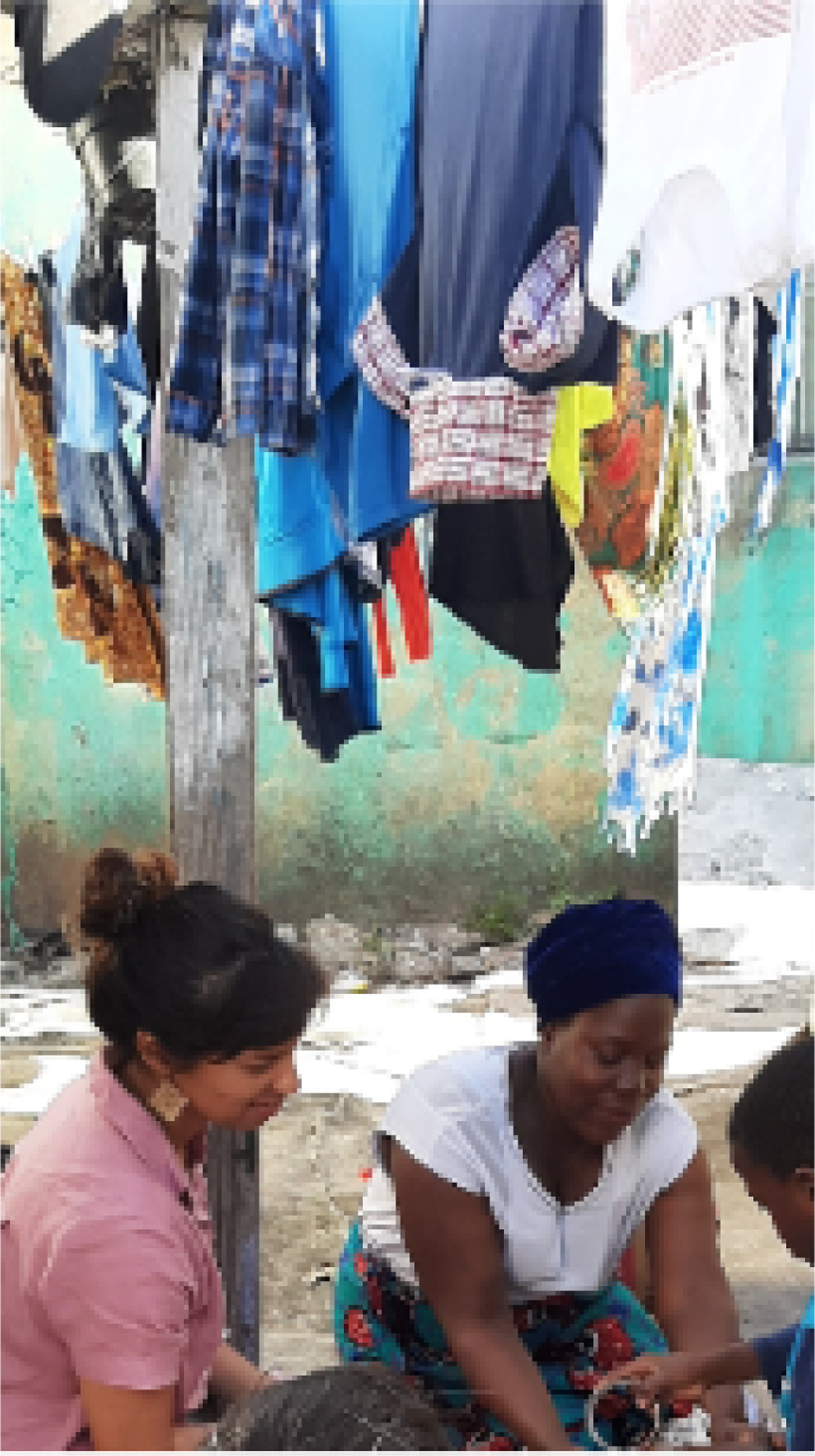
Because the photograph is included in the Google folder as ‘research data’, we assume that what the boy is looking at must be significant for our digital play research when writing with the interview data. We do not notice the sticky tape. Cheered on by Barad's earthworm, we aerate the photograph, which is never ‘data’ that is ‘set’. Like other bodies, the image is not a bounded, zipped ‘thing’ but always already ontologically an ‘intra-active host of others’ (Barad, 2017: 36). As we munch our composting way through ‘it’, which is always more than it represents, we become profoundly æffected and excited by the political implications of the multiplying sticky threads that are in the making as we deliberately disrupt spacetime continuities.
For example, the clothes drying on the washing line are not merely in the background of what is ‘really’ going on. Concepts such as ‘foreground’ and ‘background’ make it possible to use space and time as apparatuses to include or exclude what ‘really’ matters in knowledge production. 14 The clothes are not merely hanging there. They have their own stories to tell, as we notice later (Figure One). The clothing hanging on the lines and on bodies is part of the matter that matters. Tracing Henry in his pyjama top tells the story of being unable to attend school because of safety concerns during the service protests (Ntongana, 2018). Foregrounding pyjamas on bodies and not on the clothes line in the afternoon is part of the threads that stick.
Posthumanist and multispecies theorist Pauliina Rautio (2013) argues that humans are not just related to the environment but constituted by it. The clothes–women’s-labour–childcare entanglement is profoundly political. As Barad eloquently puts it: Entanglements are not just a name for the interconnectedness of all being as one, but rather specific material relations of the ongoing differentiating of the world. Entanglements are relations of obligation – being bound to the other – enfolded traces of othering … Othering, the constitution of an ‘Other,’ entails an indebtedness to the ‘Other,’ who is irreducibly and materially bound to, threaded through, the ‘self’ – a diffraction/dispersion of identity. (Barad, 2017: 48; our emphasis)
The clothes – the more-than-(Adult)human – draw our attention to the Othering when only noticing the three humans. Arculus and MacRae (2022) use the term ‘more-than-Adult’ in ways similar to the eco-philosophical term ‘more-than-human’. Inspired by their use, in this article we continue to use expressions such as ‘(Adult)human’ and ‘Adult human’ to emphasise our ‘relations of obligation’. We should not take for granted that the concept of ‘human’ refers to child human (including when posthumanists use it (see Murris, 2021)). The capital ‘A’ in Adults is similar to Wynter's (2003) use of the capital ‘M’ in ‘Man’ (Arculus & MacRae, 2022). By exposing and disrupting the normative concept of the child human there is the challenge and opportunity to reconfigure research and to move ‘beyond stable, fixed, objective, or even subjective methodological thinking and imagine methodologies that are possibly porous, fluid, and brut’ (Koro-Ljungberg et al., 2020: 282). We take up our colleagues’ invitation by exploring through a short diffractive series of ‘montages’ (Barad, 2017) a more porous way of researching-with the porous bodies of both child humans of colour and other-than-(Adult)human bodies in their specific material-discursive realities, such as zinc, sack ball, languages, money, dust, GoPros, shop, washing, shoes, brown skin, black skin and land.
Thinking-with Neimanis (2017: 65), we embrace bodies as ‘neither stagnant, nor separate, nor zipped up in some kind of impermeable sac of skin’. Identity is dispersed, diffracted and materially threaded through the self, but it does not follow that identity is erased. Our reading of interview data’ unzips the zipped skins of bodies – or at least the latter is how western Adult philosophers have positioned bodies of all kinds, both individualised and bounded. 15 Importantly, these skins are of colour, and with the movement of the GoPro we let ourselves be moved away from the anthropocentric inclination to gaze at children's black and brown bodies as containers of thought, intention and mental states – conceptualised as beings with (or without) agency. Instead, we turn to transmodal montages of visual and aural texts that bounce like ‘Henry's’ sticky sack ball and perform without a need for too elaborate (cognitive) explanations by the Adult human. When meeting the diffractive text, or rather our compos(i)t(ion), its significance is what readers have ‘to find for themselves, by drawing them into correspondence with their own experience and life histories’ (Ingold, 2018: 12).
Disrupting western binary logic involves learning from, through and with movements (children's, a ball's, sound frequencies, etc.). When we dis/continuously re-play Joanne's interview with Henry, we un/learn through the bouncing montages as part of Henry's making-of-a-sack-ball entanglement. The montaging technique assists in the removal of the ‘ontological pedestal’ (Koro-Ljungberg et al., 2020: 282) and can help us (Adults) rediscover childlike ways of living and relating to the other-than-(Adult)human (see also Kromidas, 2019). We illustrate the politically radical and subtle philosophical difference it makes to adopt this diffractive technique when analysing ‘data’ differently and how it keeps the child human of colour in play without erasure.
Montaging without erasure
As an alternative to representationalism, montaging as a methodology breaks with the temporality of progress and developmentalism. Diffracting through Benjamin, Barad (2017: 30) proposes that the use of montages helps to flash up in the ‘thick-now’ of a moment with/in the ‘data’ historical forces ‘condensed on a reduced scale, making up the interior of the object’. These montages are neither causally linked nor analogous. But – we suggest – they need to be picked up as balls and bounced around. 16 With/in the movements, connections are made that show overall patterns, even ‘if only momentarily’ (Barad, 2017: 48).
For Barad (2007), the quantum eraser experiment in quantum physics evidences that the past is open and can be changed. But in what way is it possible for the past to be changed, and why is this relevant for our enquiry about erasure? As mentioned above, the challenge for us western Adult scientists is to see the past ‘in front of us’. Each re-turning is a differentiating world-making process, sedimenting the world in its iterative becoming (Barad, 2007). The past and futures are bleeding through one another with/in the present (Barad, 2017: 21–23). When rereading data’ (e.g. through replaying videos over and over again), ‘marks on bodies’ are not erased because they are already ‘written into the flesh of the world’ (Barad, 2017: 49). So, in that sense, the trace of all that has happened cannot be erased (Barad, 2017: 33). However, by drawing attention to the specificity of the object or subject, in its relationality, we trace bodies of any kind and size, ontologically and deliberately. Diffractive montaging as a methodology ‘unzips’ bodies as it bounces along in all directions, gently breaking up the continuum of time. In this sense, montaging disrupts unilinearity in knowledge production, producing ‘new conditions of possibility’ (Barad, 2017: 50) and, with/in that process, articulates relational be(com)ings otherwise ignored. The methodology makes us stop and think and re-turn. More compos(t)ing is required. Working Slowly through con/texts, we pay (more) attention to the specificity of what matters (differently) and for whom. Montaging disrupts what we have come to understand as ‘normal’ causality – intra-active relationality as an articulation of ‘an entanglement of here-there now-then’ (Barad, 2017: 44). Quantum field theory evidences that ‘an object can be in a superposition of times … hauntologically coexisting’ (Barad, 2017: 47). So, how does this work in practice?
For example, torn with/in relations, the interview questions (left-hand corner in Figure 2) are coexisting in the haunted here-there-now-then moment in Figure One, the clothes, carpet, newspaper, the GoPro and infinitely more.
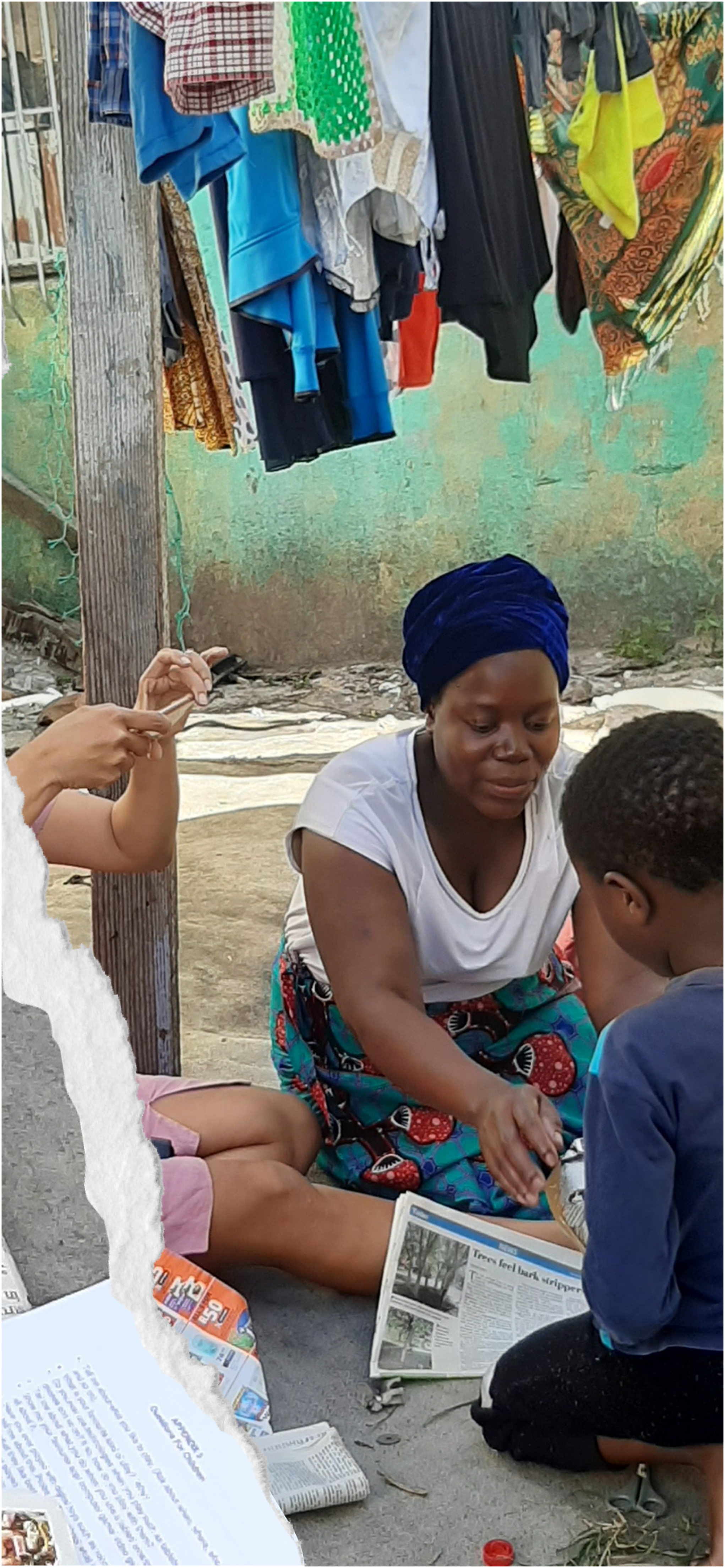
The interview questions as part of the apparatus that differentiates and entangles and is torn with/in relations.
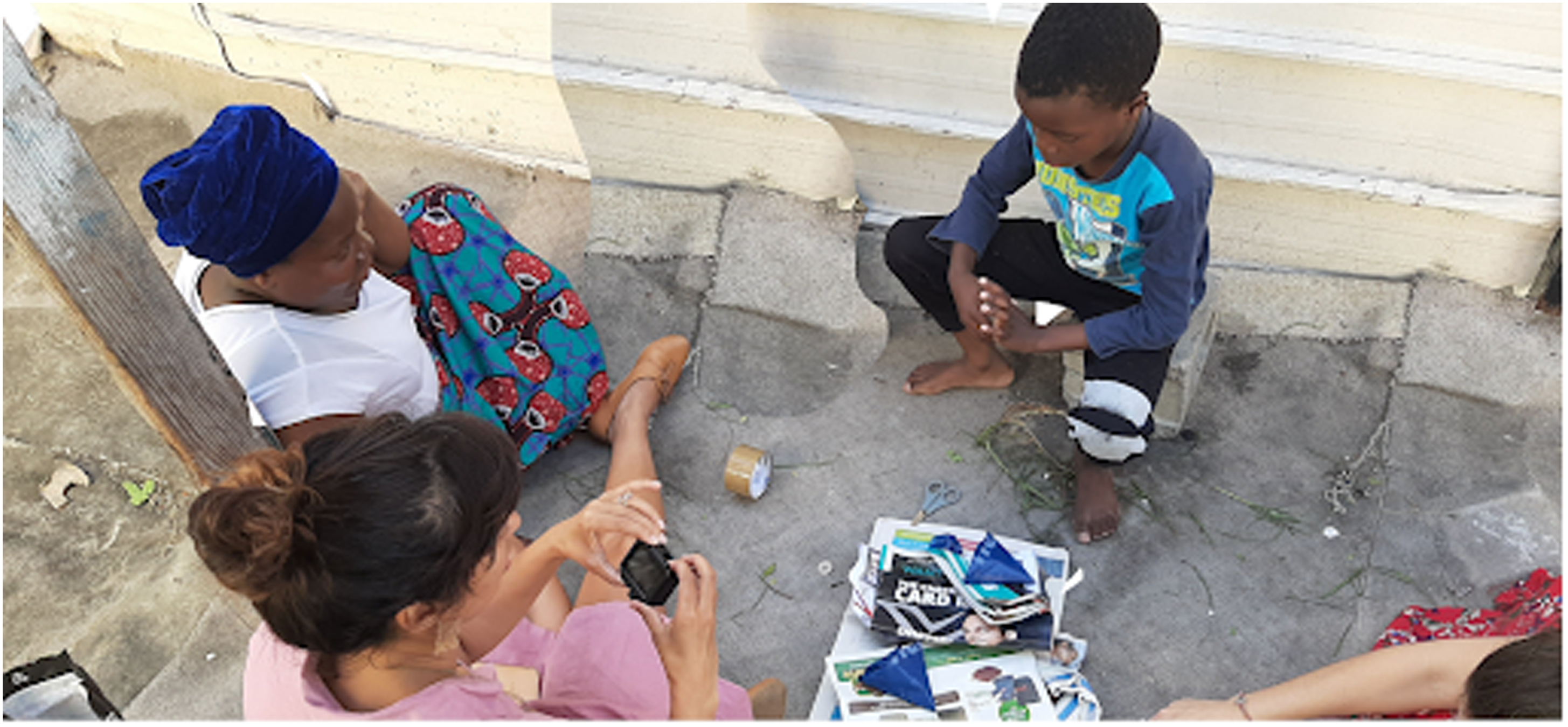
The fieldwork with Henry in the Vrygrond informal settlement, Cape Town, 2019.
Designed to find out about children's (and their parents’) experiences of digital play in their home, the questions are out of place in a place like Vrygrond, an informal settlement near the city of Cape Town (Figure 2). The land is also part of the ‘here-there now-then’ entanglement. In her doctoral thesis, Crowther (2021) explores this ‘settlement’ (which feels far from ‘settled’) in much depth, researching some children's literacy practices – children with additional needs and who are failing mainstream education (or a mainstream education system that is failing these children). As one of the oldest informal settlements near the sea (False Bay), it spontaneously developed in the 1970s, although it already existed as a fishing community. One way of describing Vrygrond is that it is land people live on who have occupied it illegally, and the houses and shacks they have built do not comply with official planning and regulations. In contrast, Crowther's (2021: 98–100) geopolitical story amplifies the area's historicity of segregation and forced removals (the Group Areas Act of 1966) on the grounds of race (‘African’ and ‘Coloured’) by the apartheid government. Economic hardship, gang violence, housing backlogs, high crime levels and migrancy are entangled with/in the research site. Huge income disparity, deep inequalities, high unemployment, lack of safe public transportation and gender violence pose profound challenges to doing research in Vrygrond. So, why were the interview questions so out of place in Vrygrond?
Joanne, as an Adult researcher, had to assume that the parents could record data with a GoPro and transfer it to her laptop. She then had to ask questions about what it meant to the parent/child and so on. The questions prompted by the research instrument included:
What technologies foster particularly joyful play? Did your child try out new things? If so, what? Has your child tried those things since? Does your child set themselves challenges in their play? When your child plays with technologies, how far do they take an independent approach?
For the most part, these questions were directed at the parents, who then answered on behalf of the child. Children were asked to show their favourite toy. And if the toy was not related to technology, they were asked to identify their favourite play activity using technology. In some cases, these questions may not have been out of place, but, certainly in Henry's case, they were. The taken-for-granted role of the GoPro in generating data caused profound ethical problems. Eshal, Henry's classmate in a nearby school, caused some ‘sticky’ ethical dilemmas. Both in Grade 1, they took part in this project and participated together in focus groups at the school led by Joanne. Eshal does not live in Vrygrond. She attends school there, but lives not far away, near Muizenberg beach. Let us now meet Eshal.
Meeting Eshal: Introducing the GoPro(blem)
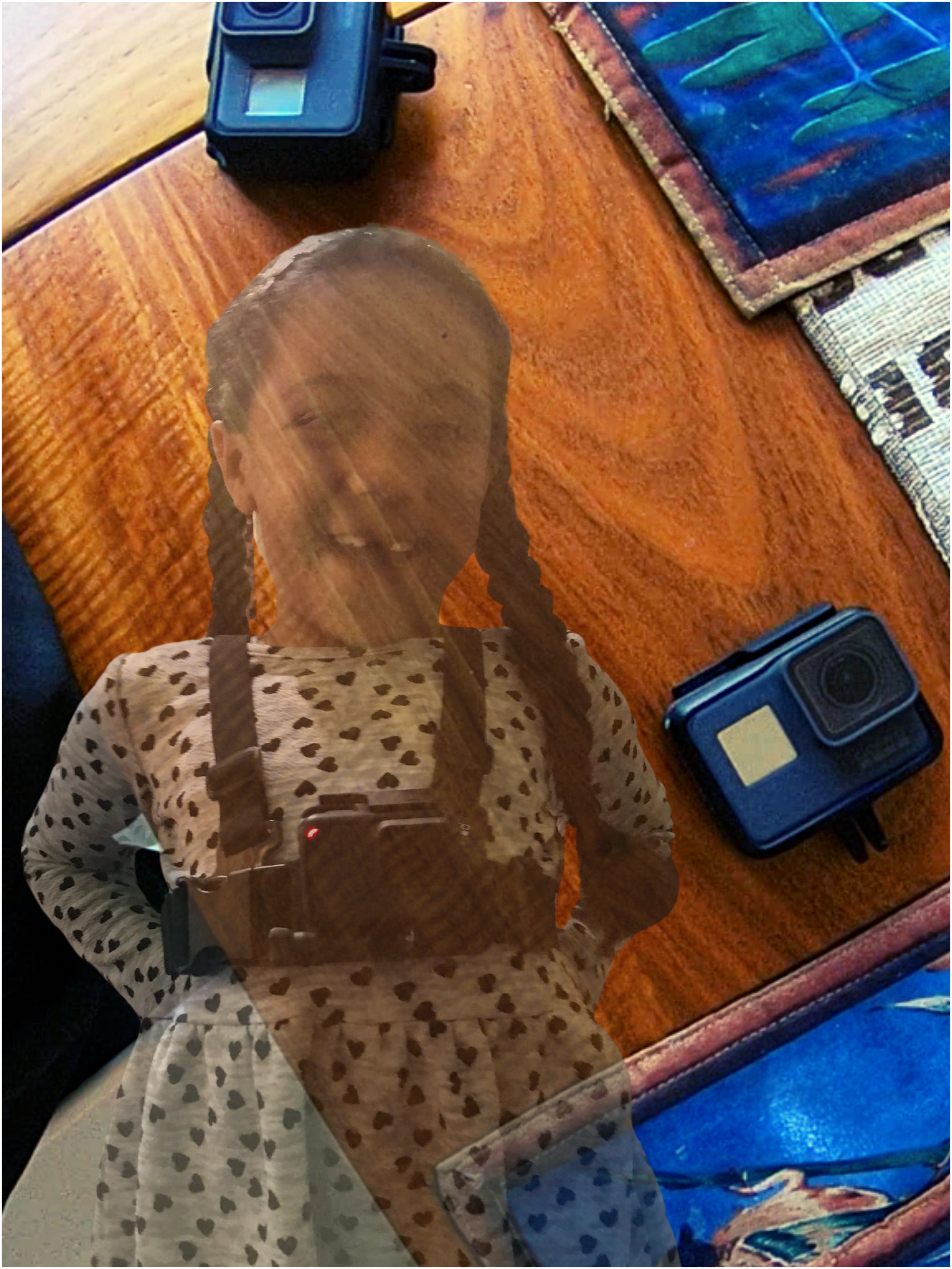
The GoPro(blem).
Do you have lots of GoPros? For all of them?
No, so …
How many do you have?
We don't have GoPros for everyone. We only have GoPros for, um, the children who were able to use the GoPro, or if we were going to be visiting them for long enough.
How many GoPros do you have?
I don't know. I think there were 11 children. I think there's probably about six families. Ja. One in Joburg. So, some children are using GoPro, some people are using their phones. Uhh, some of them use the GoPro when we visit them.
So, do you have for Henry? Henry says he has a GoPro.
Yes, so, when we go to Henry …
Wednesday, and then another Wednesday.
Yes, that's right.
He says so. Then he says, ‘Miss Peers is coming’ [laughs].
Eshal exposes differences through her questions and disrupts the taken-for-granted perceptions of the research design. The participant children were considered as individual, zipped bodies participating separately in the project. Eshal de/composes the taken-for-granted separation of GoPro–child relations and multiplies entangled sticky stories. Making marks on paper between Eshal and Henry together during the school day included conversations with GoPros as part of mark-making, producing interview questions from Eshal. Eshal threads through the complexity that the GoPro comes to Henry's home for four visits and leaves in Joanne's bag, whilst the GoPro stays in her home and hangs in a harness on her body in/between visits (see Figure 4). Issues of safety, protection and unfamiliar technology devices form part of the profound ethical GoPro(blem) with Joanne and Henry. As a research team, we discussed at great length the GoPro(blem) posed by Eshal and decided that in future digital play research projects in South Africa, we would not use GoPros at all. It would be unfair to offer the opportunity to some and not others.
On the afternoon of the final visit with Henry and his parents, he was unable to attend school. There was a community protest about a lack of service delivery (Ntongana, 2018). We playfully reconfigure Figure 3 to articulate the sticky affect of smells, fears, a car side mirror and the noise of protest, which is wrapped in and through Henry's making of a ball (see Figure 5). But what ball? We have kept the ball and the sticky tape out of the picture and the story (so far).
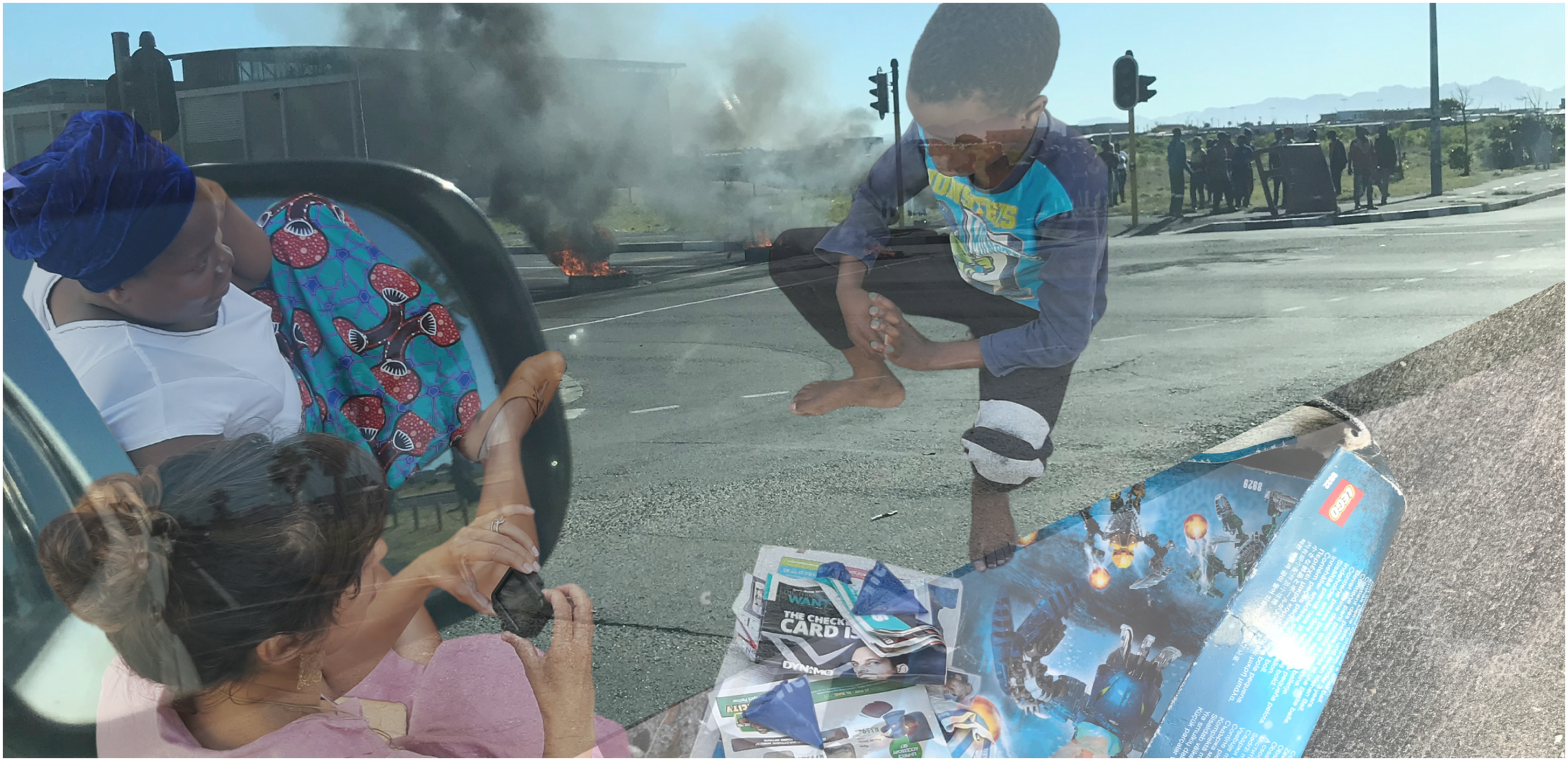
The sticky affect of smells, fears and the noise of community protest in Vrygrond during the interview. 17
We dis/continue the story and bounce ‘backwards in time’ in order to tell it differently through other transmodal montages. What were the humans and clothes on the washing line looking at in Figure One? Let us meet ‘Henry's’ soccer ball.
Meeting the sticky sack ball
Henry's father shares stories about how balls are made in the community by using items like plastic bags, paper and tape. These balls are often referred to as a ‘sack ball’. For them, the ball is not a plastic object or soccer ball. It becomes a sack ball as its softness and flexibility make soccer something different on the dusty, rough and uneven ground. The research team arrives for the last visit with a few items for making a soccer ball with Henry and with no knowledge of how to turn newspaper, sticky tape and newspaper into one. The ball-making takes place outside the front door in/between the lanes (Figure 6).
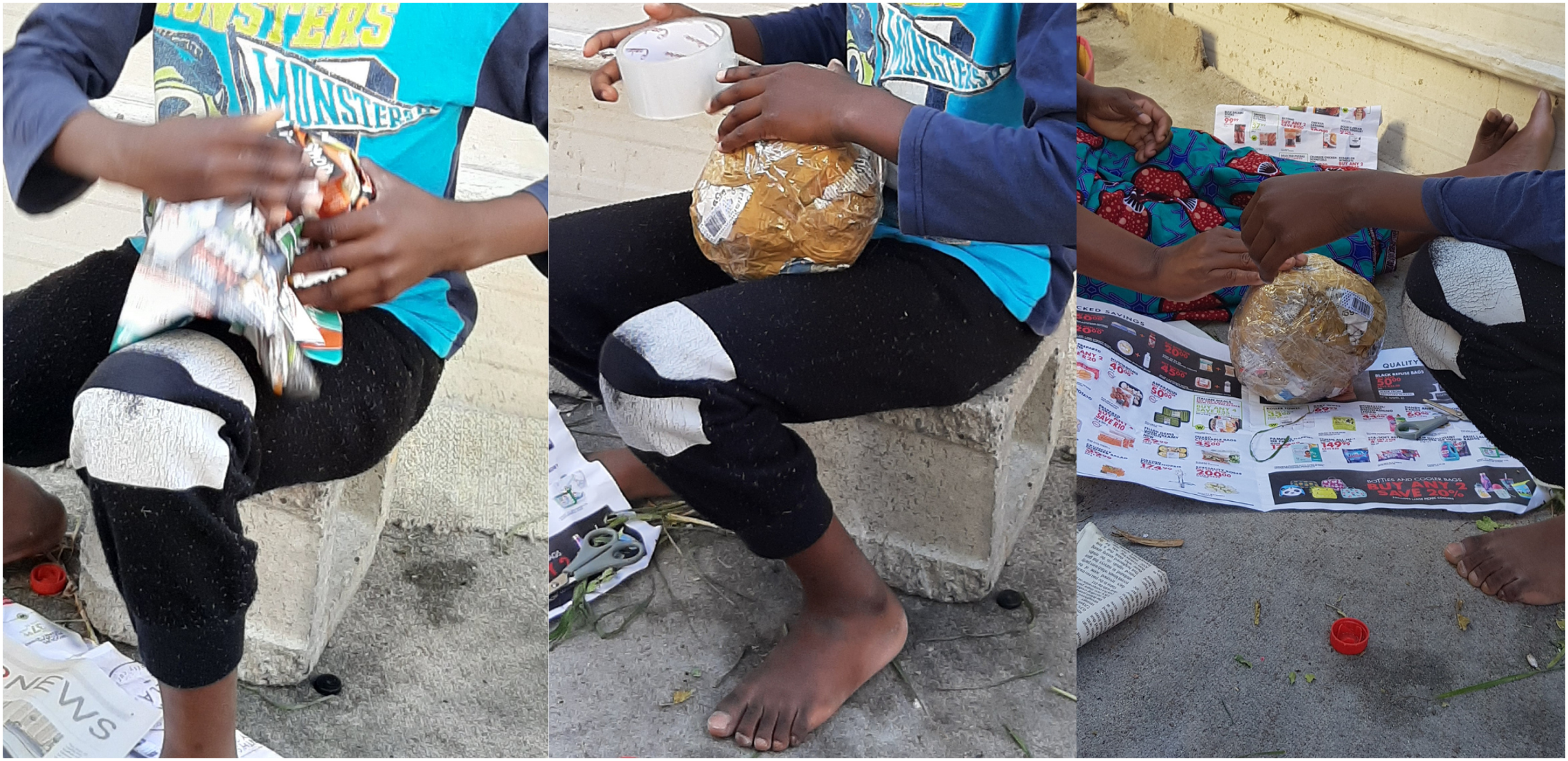
Meeting the sticky soccer ball.
In bouncing along, we are not following ‘the child’ or ‘the sticky tape’ or ‘the sack ball’ or the humans in the photograph as such. Instead, we bounce deeper into the complexities of the ‘now’ by following the concepts (e.g. ‘erasure’, ‘child’, ‘time lapse’) to attune to ‘the data’. They are taking us for a walk in the relational spacetime entanglements that bring particular bodies (human, child, ball, whale) into existence.
What was – or better, is – the GoPro doing in this sticky story? Let us go and meet the GoPro.
Meeting the GoPro: Opportunities for bouncing deeper into the complexities of the ‘now’
Joanne's hand holds the GoPro to film the interview that Henry's ball-making is a part of (Figure 7). The GoPro also holds Joanne's hand (Figures 2, 3 and 5).
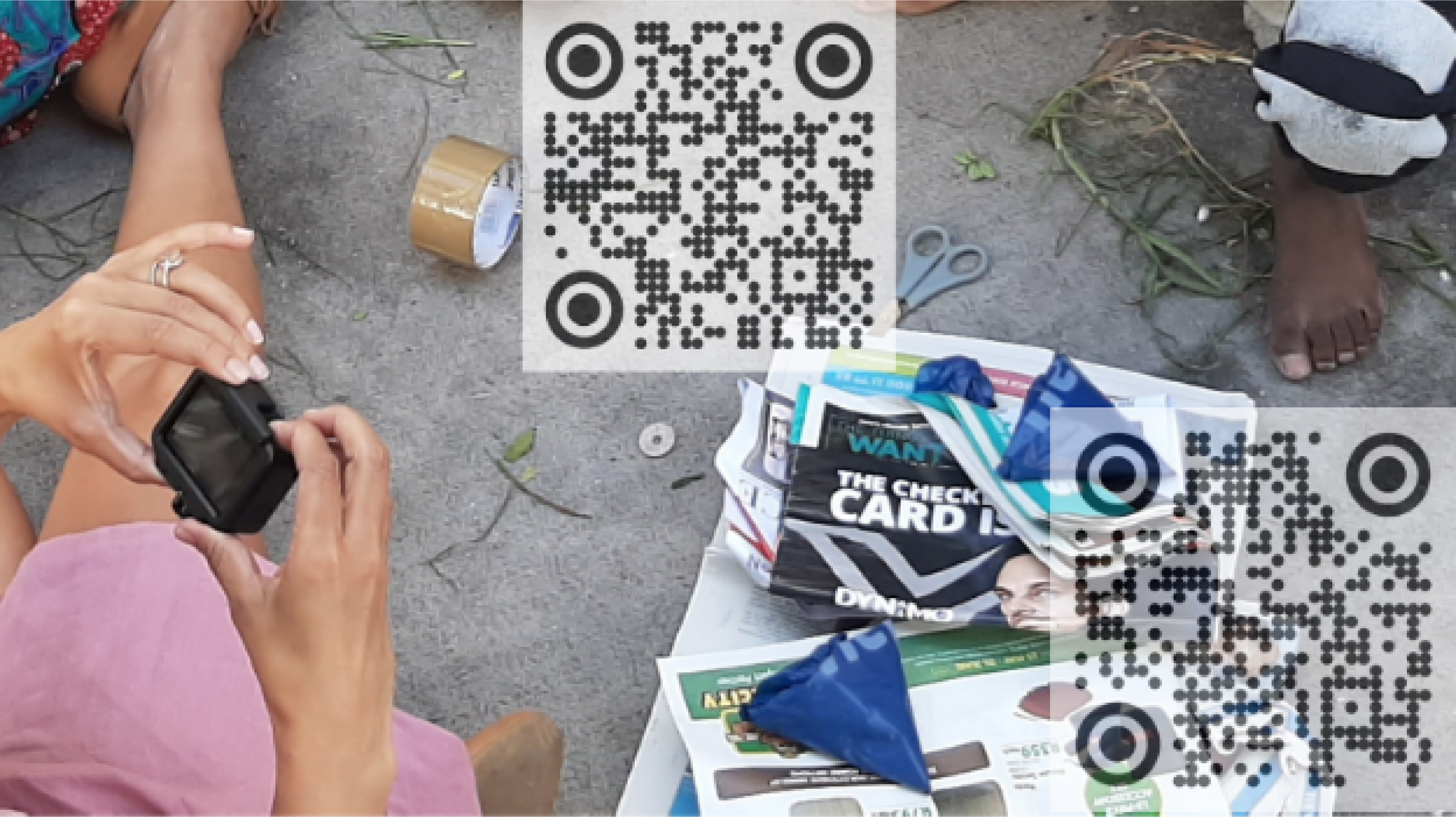
Sticky-questions-taping-ball-mattering.
The sound of the hand–plastic bags–wrapping-with-sticky-tape entanglement in the making of the soccer ball irritated us at first when accessing the video recording. It seemed to get in the way of hearing Henry correctly and disrupted the interview. But it was when we turned it into an audio recording that we realised how the sound brought the soccer ball in-the-making to our attention as an essential part of the interview.
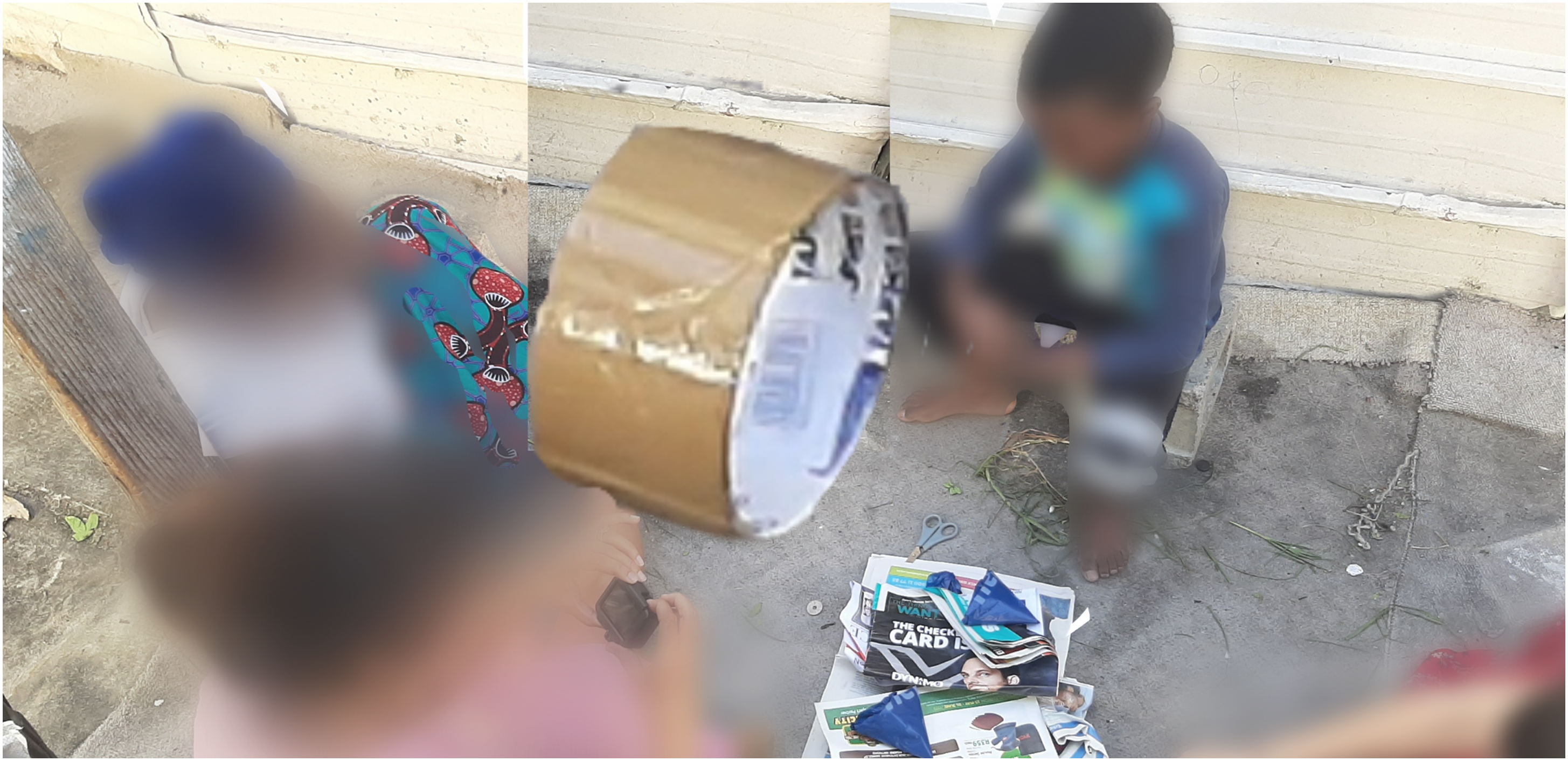
Taping the sack ball.
The sound frequencies of the sticky tape burst us into enlivened, bouncy sack-ball-making (see Figure 8). Henry's hands, sticky-taping and memory of sack-ball-making lead the storying. Through the movement of sticky fingers and tape, Henry and his mother, Lily, have a conversation in their home language, Chichewa, which was originally omitted in the interview transcript. After Henry and Lily's conversation, the group is suddenly confronted with a problem: Joanne did not bring enough sticky tape! Henry springs into action and asks his mother for money to buy tape at the local store.
Tape's finish.
The only tape I had.
I’m going to buy other tape.
Have you got other tape?
I want to buy it there.
Where?
There, the Somalia shop.
Henry's mother, who is ready to get the money for the sticky tape, is stopped by Joanne, who coincidentally had her purse in the bag with the sack-ball materials she brought along.
No. Wait. I got … look here. I ended up having my purse here anyway.
Okay.
But what would they sell? How much would it be?
Ten rand.
Ten rand. Should we go buy it quickly?
Ja.
Okay. Come. You and I can go. Is that okay? Can Henry and I go?
Ja.
Okay.
Joanne hands the 20-rand note to Henry. Henry leads Joanne, her hand and the GoPro through the lanes towards the Somalian shop. They take the 20 rands and there they go! Off to buy tape. The 20-rand note is unable to change hands at the Somalian shop as they have no sticky tape for Henry. Joanne's hand and the GoPro follow Henry as he tunnels through a lane onto the street and swiftly travels to the next store. The 20-rand note is swapped for a new full sticky-tape roll. A 10-rand note and the sticky tape move back to the lane to meet Joanne and the GoPro (Figure 9).
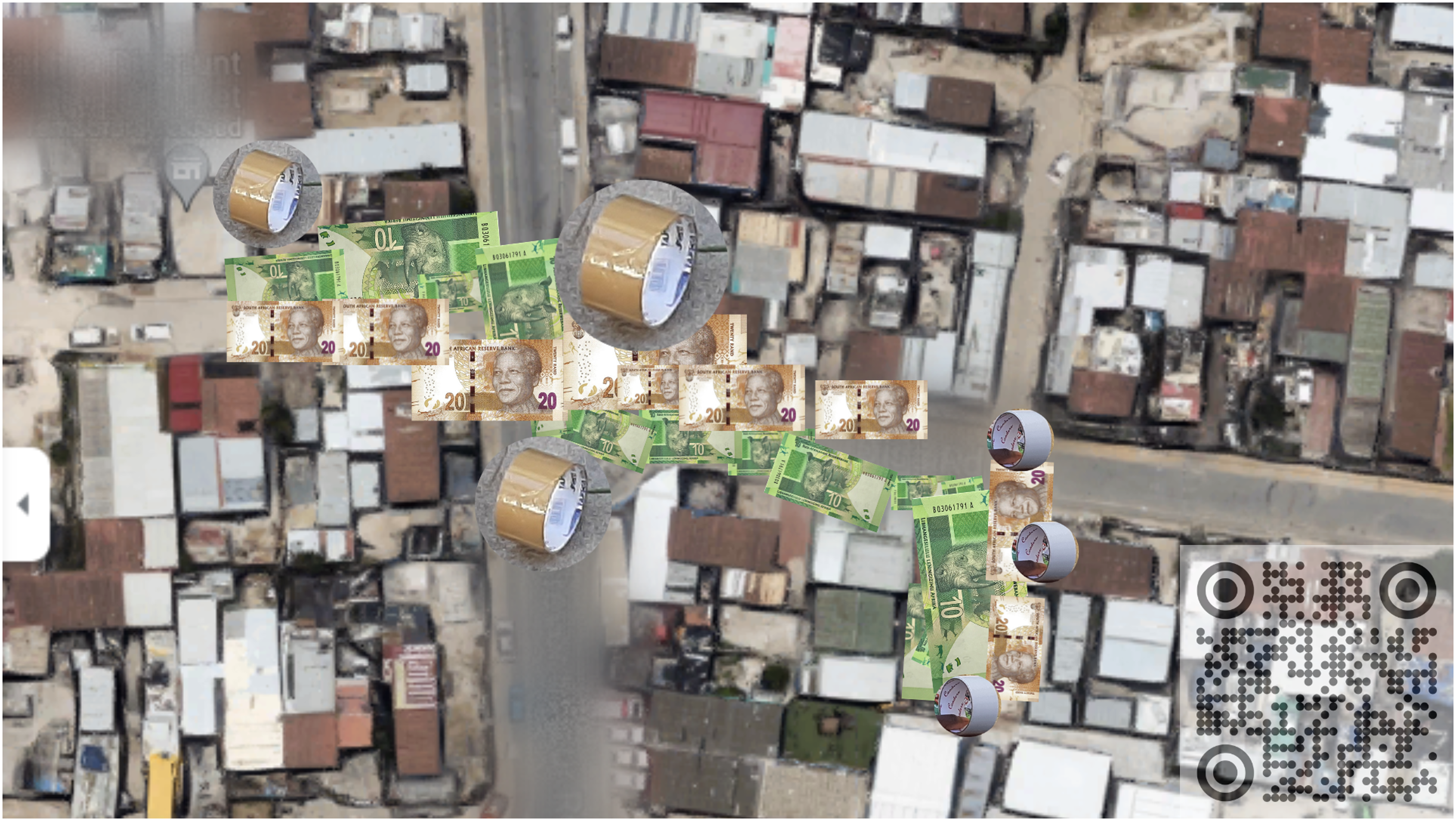
Sticky movements in and through the lanes.
Through the relational technology–human–more-than-human entanglement with the sack ball, we are able to trouble reductive narrations of Henry's family being economic migrants from Malawi, living in an informal settlement with limited space. It enables us to trace a multiplicity of stories, not by regarding the sack ball as an object in Newtonian space and time but by reading it as a Baradian phenomenon. The ball is profoundly political. Craftily created with newspaper, plastic bags and sticky tape, it enables Henry to play with the other boys in the informal settlement and allows him to be(come) a player on the neo-liberal, capitalist international soccer stage. It is difficult to resist pitying him for not having ‘the real thing’ – a ‘genuine’ soccer ball. And maybe you experience it as ‘cute’ or endearing, rather than rich and resourceful. It is indeed terribly difficult to move away from deficit interpretations and discourses that position black children living in poverty as ‘less-than’. It requires considerable unlearning because the dominant western positioning of children as vulnerable, innocent and ignorant is deeply ingrained (Murris, 2016). Henry's relation with the sack ball multiplies and oscillates beyond the meeting on the ground outside his home. Henry brings his sack ball to school and plays with his peers, shows it to his teacher and eagerly demonstrates its durability to the research team a week later (Figure 10).
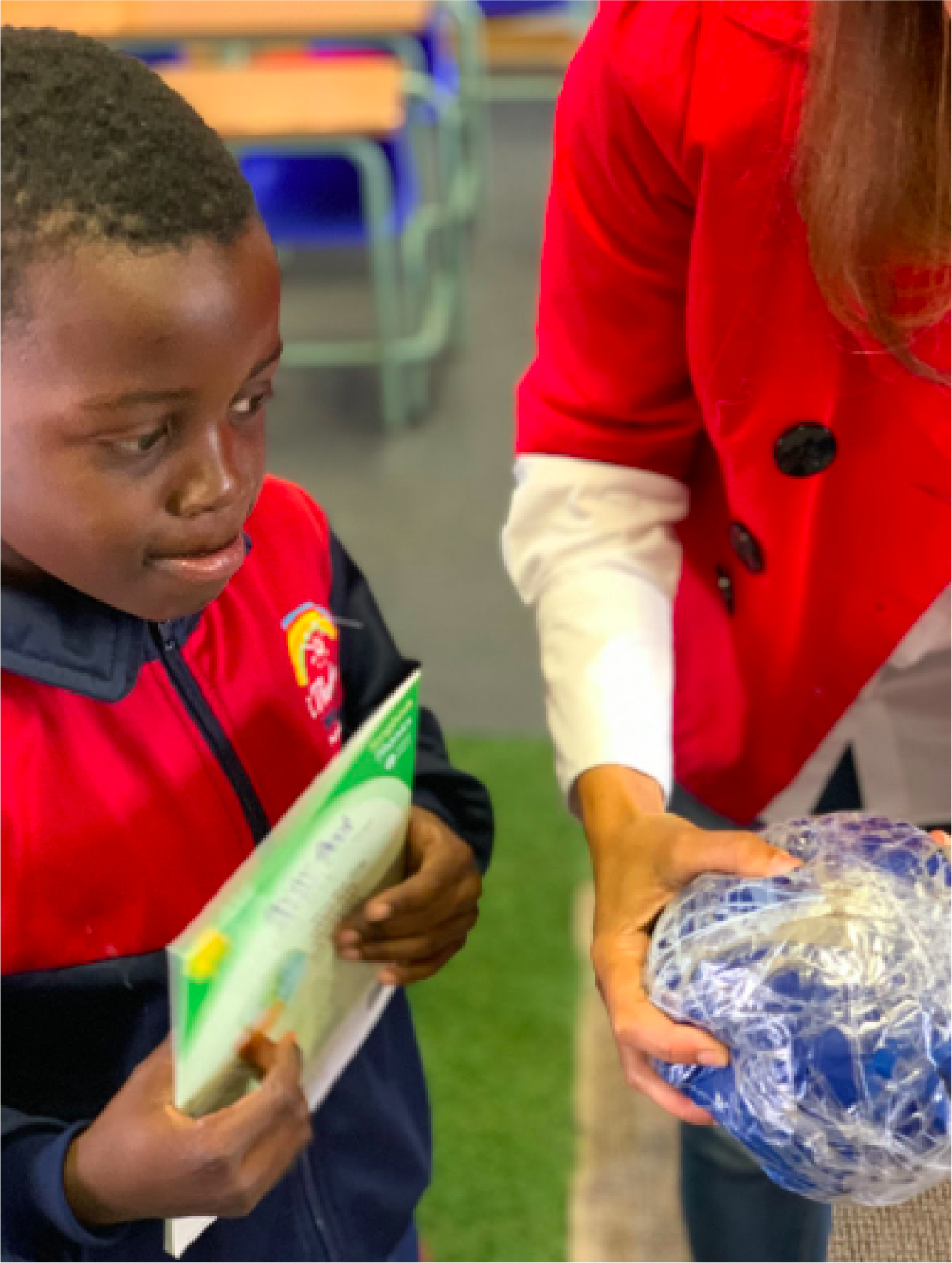
Henry's relation with the sack ball multiplies.
The audio (accessed via the QR code in Figure 11) draws attention to the material conditions of the production and creation of research data, and allows us to be touched by the ball and how it bounces deeper into the complexities of the ‘now’ moment of the interview. With/in the example of the sticky tape, newspaper and plastic bags in the ball's production, sound works to draw attention to what else is going on and what we miss when we focus only on the human of any age or size. Here, sound frequencies do some other interesting work, which brings erased animals into existence in the haunted ‘thick-now’ when and where multiple spacetimes bleed through one another. The GoPro is an unfamiliar device for Joanne's hand so it takes control of the sticky-taping and stories with its time-lapse mode, which makes us aware of what might not be present to the human senses but is still sedimented in the flesh of the world. 18
The time-lapse function, which slows down the audio on a GoPro, produces a burst of images, which are churned and give the impression of a video. In Figure 11, a series of images from the CTAP data cut-together-apart from the slow time lapse of the lane are diffracted through one another. We meet the southern right whales in the sound that echoes in the QR code – a deep resonance of the ghostly presence of whales being hunted in False Bay. The whales are drowned out when we listen only to the sounds outside Henry's home, and we are only able to tune into the sound of the ocean close to his home.
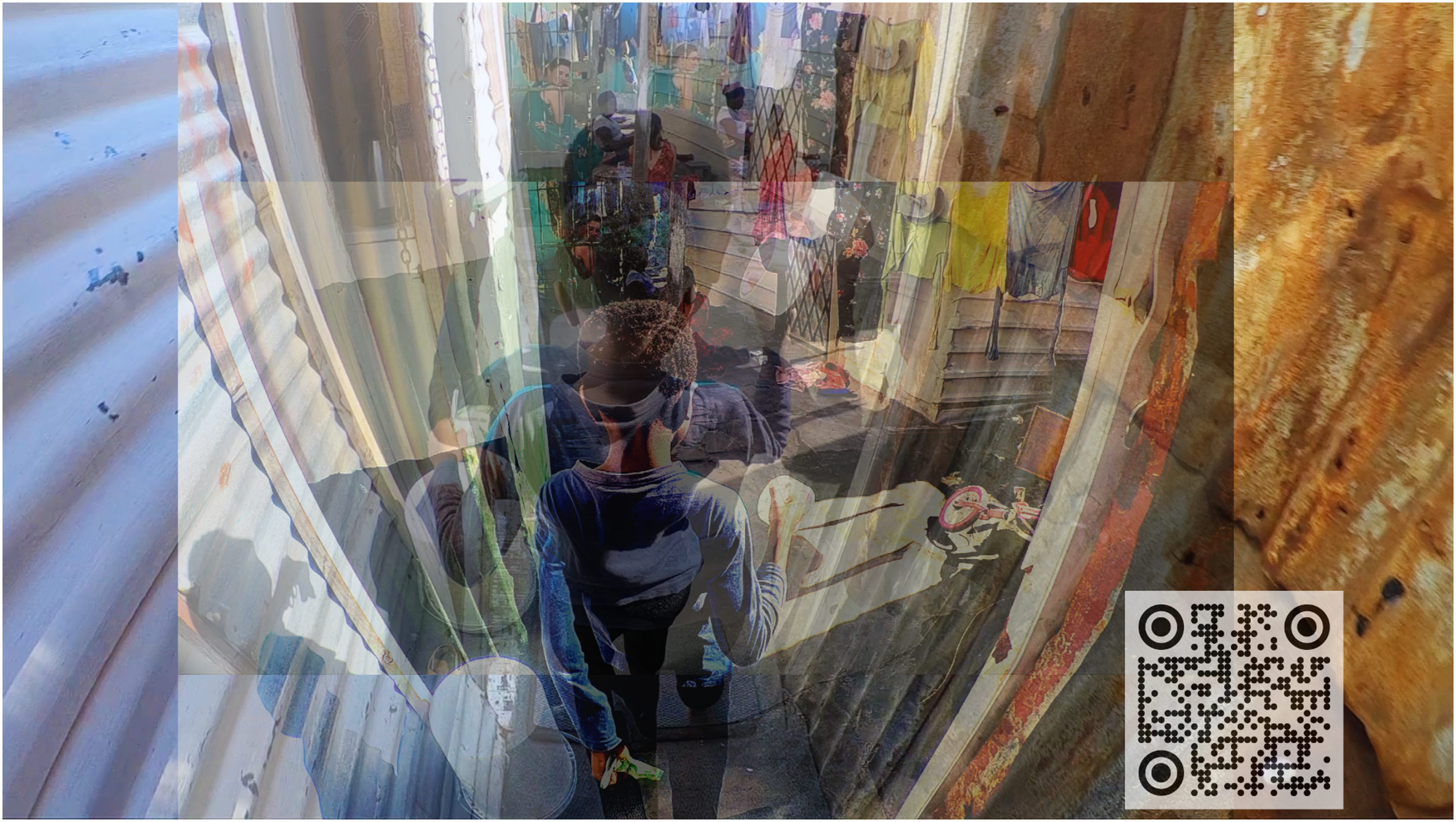
Time-lapsing matters.

Whaling frequencies in the lanes.
Henry's father, through his broad smile and joyful memories of watery places in Malawi, talks about fishing. We do not hear whales at first, only the sounds of the ocean. We smell the stench of protests and burning tyres. The wind gently brings a light smell of clothing drying, hanging on the line. The whales are here; their call is in the lane in the time-lapse taping (Figure 12).
As a montage, crossing out the narrative by putting a line through the text is not about erasing the humans signified in the text, but draws attention to the human-centredness of the description. The ‘post’ in posthumanist or post-qualitative research is not about going ‘beyond’ other kinds of humanist and qualitative research practices. On the contrary, the kind of posthumanist research we embrace is deeply indebted to qualitative, post-structuralist and more human-centred philosophies and theories. Ironically, what our re-turning to ‘the data’ brings to the fore is the even more significantly important role the Adult human plays in knowledge production. Agential realism exposes the ethico-political nature of the apparatuses that researchers use and the ontologies they assume.
The apparatus of case-study descriptions’ privileges Henry, his mum and dad, their age, the size of their home, their jobs, their modes of transport, and so on. Yet other stories can and should be told (Haraway, 2016; Tsing, 2015), and this is crucially important for keeping our childhood studies political (the first question above in the call for papers). Narrating stories as authors has implications for what we include and exclude. We write stories with textures (e.g. text, images, QR codes, editing, sound), which means that the stories are material entities in the world, which makes us accountable within them and not at a distance from them (Haraway, 1988). This is the work all of us need to do, but we are not alone in that endeavour. We are assisted in this article by humans and other-than-(Adult)human ‘others’: cells, water, sand, sticky tape, GoPro, newspaper, burning tyres, ash, zinc, smoke, biscuits, pyjamas, barbed wire, washing, scissors, and so on.
Re-turning: worming our way through and back’ again
Diffractively reading the past through the present in the ‘thick-now’ as we re-turn to the interview data reveals the potential for justice – not by pinning hopes on some utopian future, but by rupturing the continuum of time and bringing the energetics of the past into the present and the present into the past (Barad, 2017: 21–23). Henry's and Eshal's unzipped bodies and dis/embodied materiality are part of the phenomenon we trace as researchers (Barad, 2017: 45) – a post-qualitative move that keeps the child human of colour in play through thinking-with concepts such as child’, erasure’ and time lapse’. Through a non-unilinear series of montages, we have shown what else is going on when zooming in on the role the more-than-(Adult)human (e.g. GoPro, sticky tape, sack ball, land) played in this digital play project in its specificity. What our analysis exposes is not the erasure of the human when decentring the human in posthumanist research; on the contrary, it shows first of all how the apparatuses introduced by the Adult human researcher as research instruments’ profoundly matter to how to keep our childhood studies political (the answer to the first question of the call for papers).
Secondly, to do more justice to the complexity of reality, we do follow the child human of colour literally, but also differently – without excluding or erasing the more-than-(Adult)human (and thereby answer the second question in the call for papers). In meeting Henry, we also meet Eshal, who introduces the GoPro(blem). Through the apparatus of video technology and the (accidental) slowing down of the recording of Henry's movements, we respond to the question of how posthumanist research makes a difference to childhood in the broadest, worldly sense (the third question in the call for papers for this special issue). The inclusion of a transdisciplinary tracing of the more-than-(Adult)human in the example does not erase Henry or Eshal, despite removing the white child human and the Adult human from their ontological pedestal. In fact, the analysis disrupts the Human/more-than-(Adult)human binary altogether.
The posthuman child is always already in relation, a porous, ‘unzipped’, watery body (Neimanis, 2017) consisting of more-than-(Adult)human matter, drinking, leaking, weeping, pooing and always already connected with the other’. In agential realism, these ‘nesting’ relationships are not understood as geometrical but as topological manifolds – a ‘strange topology’ (Barad, 2007: 246). The shift from bounded, individual, zipped bodies to posthumanist subjectivity decentres, but does not erase, humans when adopting agential realism. In the decentring of Henry, by focusing on the more-than-(Adult) human, we amplify Henry as a phenomenon. Our playful digital play research does not separate child’ ontologically from her’ context’.
Troubling matters of scale, our playing with scale shows the profound difference small’ matters make, such as children's bodies of colour, sound frequencies, sack balls, sticky tape and GoPros, when doing justice to the complexity of reality in its specificity (Figure 13).
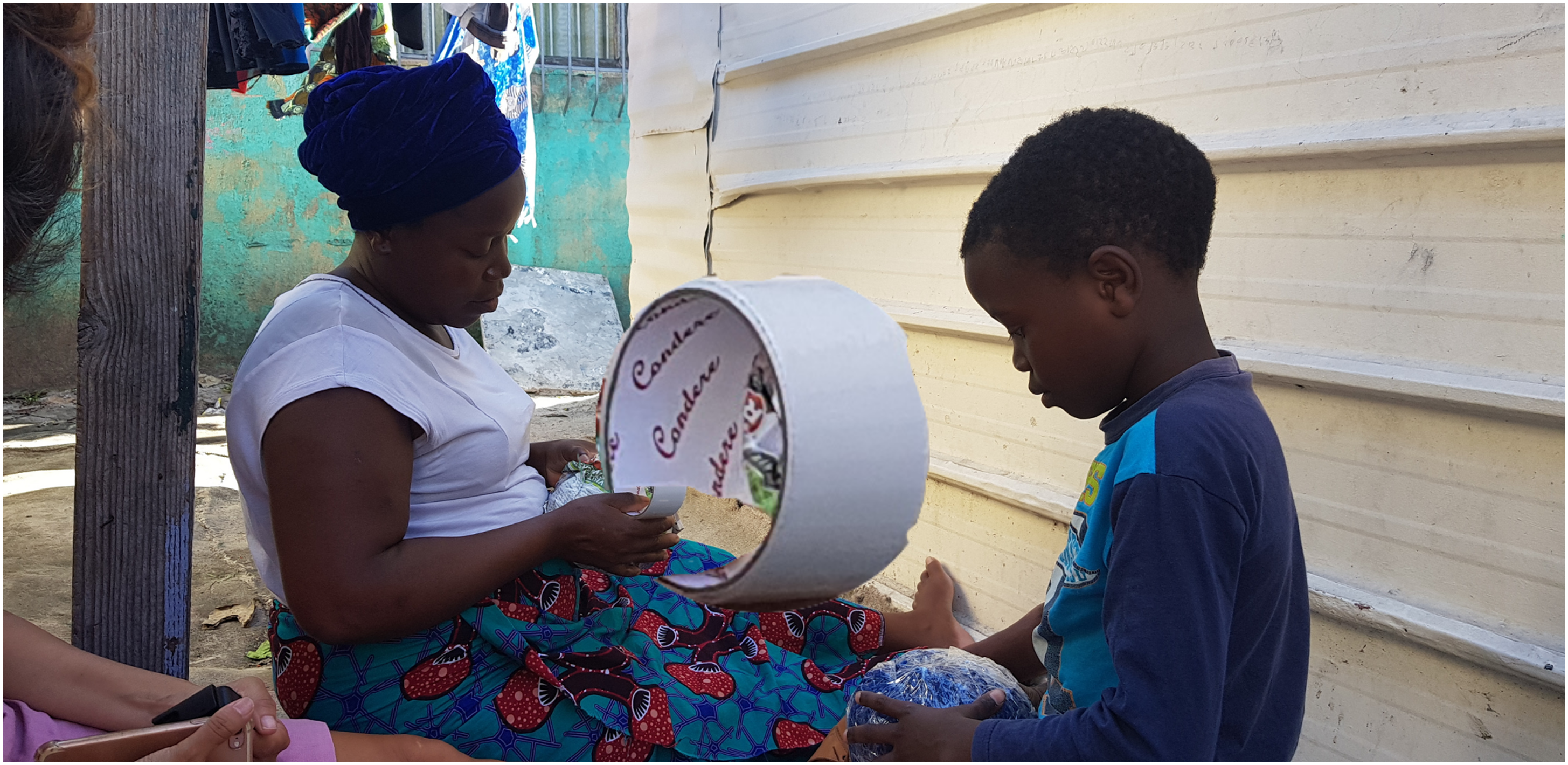
Unfinished sticky-taping.
Footnotes
Acknowledgements
We would like to thank the following human members of the South African research team for our ongoing academic conversations and friendship, which greatly benefited the writing of this article: Kerryn Dixon, Theresa Giorza and Chanique Lawrence. We would also like to thank the children, parents, teachers, principals and other-than-human involved in the CTAP project, and Simon Geschwindt for editing and supporting the writing of this article. Finally, without our weekly Posthumanism Reading Group, this writing would not have been possible (see  ).
).
Declaration of conflicting interests
The authors declared no potential conflicts of interest with respect to the research, authorship and/or publication of this article.
Funding
The CTAP project was funded by the LEGO Foundation. The work in this article was supported by the National Research Foundation of South Africa (grant number 129306).