



Abstract
This article concerns itself with the everyday politics of childhood and the ways research might continue to attend to inequities while simultaneously engaging in an ontological flattening of the child subject. To do so, the author employs thinking with theory as an analytic process to make sense of a world where humans and more-than-humans are seen as commodities for economic gain. Focusing on a tweet sent out by a US state-led organization during Pre-K Week, the author uses Barad’s concept of the material-discursive apparatus and Bennett’s concept of vibrant matter to explore the phenomenon of neoliberal childhoods. Understood as a political event, the author analyzes the tweet as a public phenomenon etched into a digital socio-material archive that tends to have a life of its own. In doing so, she unravels three threads of capaciousness (the capacity to make boundaries and possibilities) in the tweet: visual aesthetics, discursive movements, and virtual reverberations. These threads of capaciousness can be seen as co-constitutive agents, collectively producing the phenomenon of the neoliberal child. In other words, the visual, the discursive, and the virtual work collectively to ravel and unravel material consequences regarding being a child-human living in the USA well beyond the pre-kindergarten years. The article concludes by inviting those concerned with the politics of childhood to consider the ways that posthumanism offers a theoretical and practical conduit for rethinking, reconfiguring, and reimagining child–world relations while continuing to keep childhood studies focused on issues of equity and justice.
Keywords
It was Twitter that first drew my attention to the ways neoliberalism was producing pre-kindergarten (pre-K) children across the state of Georgia (USA). Every October, Georgia commemorates Pre-K Week. It is a week when early childcare is celebrated and special attention is given to the state’s early childhood educators, childcare centers, and the children and families they serve. Children are greeted with special guest readers; federal, state, and local leaders make rare appearances at community pre-K sites; and a host of virtual events and resources are made available to educators of the very young. The intent is to bring attention to the importance of early learning in the state and the nearly 1.6 million youth who have been part of the Georgia pre-K program since it was developed in 1992, and it is certainly worthy of celebration. As an educational researcher who concerns herself with early childhood studies, I have made it my responsibility to keep up with the goings-on of statewide events such as Georgia Pre-K Week, and learned quite early on that the best way to keep abreast of these activities is through social media, specifically using the hashtag #GAPREKWEEK. As I took the time to look through all the events unfolding over the week, I noticed an alarming trend—neoliberal ideologies in relation with Pre-K Week.
In hindsight, I suppose it seems naive to assume that pre-K had mostly remained untouched by capitalist forces, especially given my ontological perspective that everyone and everything always exists within a reciprocally affective relationship. Besides, pre-K is part of the educational institution, and the world for that matter. But perhaps I wanted to believe that pre-K as an educational construct could escape neoliberalism’s clutches due largely to the fact that it is so often “under the radar” in the US political landscape: not mandated, not prioritized, and not funded in many states. And while these things emanate their own issues (low wages, high costs, accessibility, resources), overall, pre-K felt like it grew a bit more wildly, a bit more precariously, a bit more rogue than K–12 (kindergarten to 12th grade) and higher education did.
That is, until the tweets.
My foray into the exploration of #GAPREKWEEK did not start as an inquiry into neoliberalism as a phenomenon affecting early childcare. Rather, it was the celebration of young people and their teachers (teachers who mostly make minimum wage and rarely get acknowledged) that drew me in. The celebrating of communities and childcare is certainly not unique to the state of Georgia, or to the USA for that matter, but I remember feeling grateful for the celebration when so often pre-K in the USA is not given its due.
Accounting for its accessibility and far reach, it is understandable why these celebrations were being shared across social media. It allows quick and easy access, as well as a way to digitally jump across landscapes where people far and wide can collectively be a part of #GAPREKWEEK, despite the hour, day, event, moment, location, and otherwise. While I know that heavy curation decides who and what get posted on social media pages, I admit that there is much pleasure in seeing the happiness the Pre-K Week activities created for children, teachers, families, and community organizers, and I could not help smiling as I scrolled, flooded with images of the day’s events. At first, I was overcome with a sense of joy and possibility as I scrolled through the Twitter feed, making a mental note of what was posted:
picture books [scroll], baby chicks [scroll], children’s art [scroll], community workers [scroll], nap mats [scroll], dancing [scroll], playgrounds [scroll], colorful rugs [scroll], loose parts [scroll], economic activity. [FULL STOP!] Better early care Every $1 spent in the early care industry = $1 generated in related economic activity #GaPreKWeek
Reverberating from that sigh I let out several years ago, this article serves as a moment of grappling with the political in childhood. Using the neoliberal Pre-K Week tweet, I suggest that children and childhoods are also part of an intra-active material-discursive phenomenon of economic production, or what I have coined the neoliberal child. Understood as a political event, I analyze the tweet as a public phenomenon etched into a digital socio-material archive that tends to have a life of its own. With far-reaching tentacles, such tweets have the potential to create multiple happenings, evolving into very real consequences for human and more-than-human bodies alike.
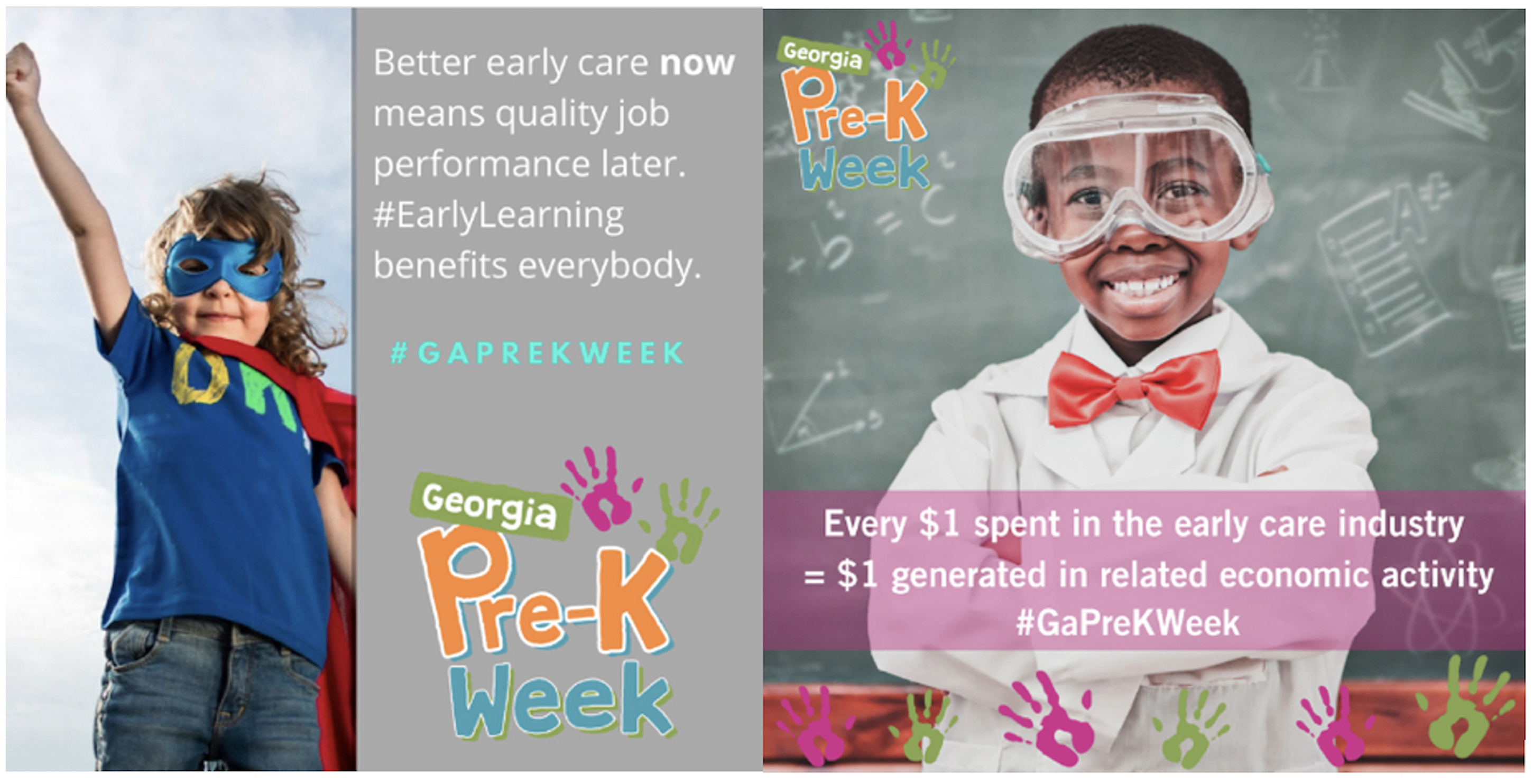
A Twitter production of the neoliberal child.1
The embracing of neoliberal concepts and terminology in early childhood communities (online or otherwise) prompts the treatise of this article—an ongoing examination of the ways children, and thus the conceptualization of being a child, are always already part of our economic, political, and social world-making practices (Kraftl, 2020; Spyrou, 2017; Thomas, 2019) and can never truly be erased. With a particular interest in Murris’s (2016) ideation of the posthuman child, I therefore engage with this special issue’s invitation to “explore how posthumanist research has the potential to make a difference to childhood (in the broadest, worldly sense)” (Murris and Osgood, 2020) while grappling with the following questions: How can we decenter the child-human while remaining political in our research practices? How do we attend to the posthuman child while still attending to issues of equity, such as social class, race, gender, disability, and otherwise?
Critical posthumanism (Braidotti, 2013, 2019), agential realism (Barad, 2007), and vibrant matter (Bennett, 2010) guide this article’s analysis. Ultimately finding synergy with Braidotti’s (2019) call for a posthuman approach to the humanities (or what she refers to as the “posthumanities”), I think with Barad (2001) alongside Bennett (2010) to consider the ways a tweet functions as vibrant matter within a larger material-discursive apparatus (Twitter) producing neoliberalism. Neoliberalism—political and economic practices encouraging commodification above all else under the guise of freedom, rights, and rugged individualism (Harvey, 2007b)—has very real consequences for all the earth and beyond (i.e. space travel), including children, who are always already entangled with the human and nonhuman world, and thus political happenings (Murris, 2021). Seeing neoliberal principles as something acquired and enacted through material-discursive intra-actions (Barad, 2001), I try to make sense of the vibrancy (Bennett, 2010) of the tweet by engaging in a post-qualitative approach to research practice (Lather and St Pierre, 2013; St Pierre, 2021). More specifically, I employ thinking with theory (Jackson and Mazzei, 2012) as an analytic process to make sense of a world where humans, nonhumans, and more-than-humans are seen as commodities for economic gain. This includes children, who are one thread of a larger, complex knotting that is historically and dynamically situated (Haraway, 2016; Murris, 2021) and, in the events of Pre-K Week, are being performed as neoliberal subjects by and through the material-discursive apparatus of Twitter.
When exploring knotty articulations, Haraway (2016) calls us to disrupt habitual and unquestioned practices of knowing by engaging in a metaphorical game of cat’s cradle (string figuring/SF philosophy) to think with and alongside a variety of sociocultural relations and affects. Following other feminist scholars (Niccolini et al., 2018; Osgood, 2019; Osgood and Giugni, 2015; Osgood and Mohandas, 2020; Truman, 2018; Tsing, 2015; Zarabadi et al., 2019) who have used the same or a similar approach to explore the generative and agentic nature of everyday material-discursive happenings (such as tweeting), I pick up and pull at the threads of this tweet to participate more considerately and effusively in the phenomenon of neoliberalism as it relates to being a preschooler. Therefore, as Osgood (2019) starts with Lego to explore gendering in early childhood and Tsing (2015) starts with mushrooms to explore life in capitalist ruins, I start with the preschool-aged child as a fleshy being, knowing that gnarly fraying lies ahead. I pull at the strings in the hopes of making the argument that children and childhoods can never be ignored or erased from the political landscape when reconfigured as posthuman because, as Murris (2018) explains, humans (no matter their age) are always entangled with the happenings of the world (politically, socially, economically, and otherwise). Furthermore, focusing on the ways in which the political and young people are emmeshed can mitigate and circumvent the risks of erasure (and the continued marginalization of the child-human) so often associated with posthuman research.
Shall we pull the threads together?
A return to the high-pitched echoes of a tweet: neoliberal boundary-drawing practices
Neoliberalism devours. Over time, many bodies have become casualties—bodies of land, bodies of water, bodies of color, bodies of women, bodies of the working poor, all pillaged, marked, usurped, used, abused, cast off, cheated out of their dwellings and their resources. And as the tweet in this article’s introduction illustrate, children are not excluded from the list of casualties.
The neoliberal tweet sent out during Georgia’s Pre-K Week participates in “boundary-drawing practices” (Barad, 2007: 179), or performative practices that shape realities and have very real consequences for humans and otherwise, bringing pleasure for some and suffering to others (including the more-than-human). The tweet is part of a larger material-discursive apparatus (Twitter)—a device that crafts realities while simultaneously barring and rejecting other realities from existence. As Barad (2007: 148) explains: “apparatuses are the material conditions of possibility and impossibility of mattering; they enact what matters and what is excluded from mattering.” As such, an apparatus (like Twitter) informs the ways in which knowledge, power, and relationships are created and distributed across cultural, social, political, and economic networks.
Murris (2018) teaches us that boundary-drawing practices configuring (and reconfiguring) children are prevalent across institutional spaces such as schooling. These configurations stick and twist and turn and lodge themselves into the sociopolitical landscape, making it hard for humans to think with much else. Material-discursive boundaries (such as developmental theories) have long since created unequal power relations between young people and just about everything else in the world (too innocent to be informed, too evil to be trusted, too irrational to be taken seriously, etc.). Conceptually, childhood can be seen as a material-discursive apparatus, too. As a construct, childhood itself has always circulated as a political phenomenon. Child labor, child protection, child behaviors, child proof, child health, child welfare—to attempt to create an exhaustive list of the ways childhood has been used as a political, cultural, and social force would be futile.
These boundaries have been the treatise for laws, education, parenting, medicine, labor, and many other things concerning children and childhood. Negotiating what is and is not acceptable, is and is not right, and/or is and is not possible for a child, these boundaries have been in place so long that they often go unquestioned and tend to be reiterated repeatedly in practices where children are foregrounded (such as schooling). As such, [m]odern schooling positions children as knowledge consumers, not producers, because it is assumed that they are (still) developing, (still) innocent, (still) fragile, (still) immature, (still) irrational, and so forth. (Murris, 2018: 2)
If we are to better understand material-discursive practices like this one and the way they work politically in relation to the child, it is important to attend to the ways material is lively and vibrant in the first place. As Bennett (2010: xvi) posits: “thing-power gestures towards the strange ability of ordinary, man-made items to exceed their status as objects and to manifest traces of independence or aliveness.” In other words, nonhuman objects contain sparks of energy with the vitality and capacity to make things move, shift, change, or feel. While created digitally, the tweet serves as documentation or an “actant” that possesses “thing-power,” encouraging people either to invest in and support preschool for the sake of our economy and/or, in my case, to consider the material consequences of commodifying children and thus crafting the neoliberal child. While the commodification of children is not new to the USA—advertising companies knew children had buying power and started marketing directly to them at the beginning of the 20th century (Chudacoff, 2007) and, before that time, children were actively part of the workforce (US Bureau of Labor Statistics, 2017)—this particular conception of the child as commodity is fairly young (beginning of the 21st century); its nestling into pre-K is relatively new.
What can be learned from the boundary-making practices of neoliberal childhoods? To explore this tweet’s vibrancy (Bennett, 2010), as well as neoliberalism’s capacity as a material-discursive apparatus of production of children and childhoods, the next section of this article concerns itself with tugging at the strings of the forces and flows that the tweet has the potential to create, not only for childhood but for worlding itself. As I do so, I unravel three threads of capaciousness (the capacity to make boundaries and possibilities) in the tweet: visual aesthetics, discursive movements, and virtual reverberations. These threads of capaciousness can be seen as co-constitutive agents, collectively producing the phenomenon of the neoliberal child. In other words, the visual, the discursive, and the virtual work collectively to ravel and unravel material consequences regarding being a child-human living in the USA well beyond the pre-K years. By considering the “beyondness” (or potentialities the tweet might have outside of Pre-K Week and across timespace), I am also able to consider what newness posthumanism might offer us in the wake of neoliberal childhoods.
Let’s grab a frayed end and pull.
Co-constitutive agents: visual aesthetics
As a researcher concerned with the politics of childhood studies and how posthumanism can make a difference in our understanding of those politics, I am acutely interested in the ways neoliberalism is embedded in and functions as a material-discursive apparatus through the tweet’s aesthetics. One of the most striking things about the tweet is how the stock photographs craft images of children and conceptualizations of childhood. A quick Internet search brings up dozens of ways these images have moved across the Internet: school websites, STEM (science, technology, engineering, and mathematics) project work, motivational quotes, and superhero-themed endeavors, to name a few. Boasting bright colors, sharp lines, defined spaces, and happy faces, the images work as an affective force or actant (Bennett, 2010), working in and through bodies (computer bodies, human bodies), demanding attention. Producing children as happy subjects, the vibrancy of the image invites one to sit awhile, which actually can be hard to do on social media platforms due to the speed at which one is encouraged to consume content. Simply scrolling past the images does not seem like an option.
Attending to the materiality of the images as an aesthetic affective force (Sullivan, 2001) opens their capacity to be seen as pulsating with liveliness that is contingently distributed across multiple political, economic, social, and cultural networks. Like Niccolini’s (2019) analysis of reading acts during a political rally, the coming together of tweets, preschoolers, digital tools, and social media users causes something, or rather some things, to happen, becoming ontologically inseparable (Barad, 2007: 139) through their material arrangements. Rather than inert representations of children permeating with human intent, the stock photographs have the capacity to activate realities on the move. As Colebrook (2002) asserts, art (in this case, stock photographs) is not what we see but what we feel. Art’s capacity to affect the other—that is, to leak into other bodies and cause a reaction—is what makes it art.
While we often engage the spoken or written word as discursive events, images also function as part of the material-discursive (Barad, 2007) apparatus. Boundary-making practices are visual as well. In other words, what we see (not just hear or read) also has the power to materialize realities—the discursive and nondiscursive cannot be parsed out from one another. Actual materializations are dependent on many things. For one, the way one configures the world and constructs childhood plays a role but, simultaneously, childhood is being configured through the image as well. It is a mutually constitutive process. For some, this tweet embraces children engaged in superhero play and constructs children as curious. For some onlookers, seeing a child in a lab coat holding a beaker might invoke feelings of success but, for others, a lab coat may conjure up feelings of distrust in the scientific community. Or perhaps the tweet provides a way for onlookers to see children as more capable than they may once have thought. If viewers see superhero play as a childlike activity that fosters imagination, they might see the tweet as developmentally appropriate practice that encourages creativity and human growth. After all, “educators are trained to regard preschools as places of learning for human development and achievement” (Giorza and Murris, 2021: 1). If someone finds superhero play “too rough” and childish, it might also conjure up affects of disapproval, lacking rigor and seriousness. As Barad (2007) explains, seeing does not happen from the outside but rather is co-constitutively produced through our engagements with what we see and feel and touch and taste and breathe and think. The eyes cannot be trusted to see and know. Knowing and understanding come into being through intra-actions that are not bounded or contained within a body but are continually performing, materializing, and reconfiguring.
Controlled by capitalist interests, these images configure labor networks through images of the child as a future worker, manufacturing ramifications that reach well beyond human interpretations. Technology’s agentic capacity diverges across a wide range of ontological modes (Bennett, 2010: 9), well beyond human ontology alone. Resources (land, air, water, etc.) are also affected by neoliberal tweets because when economic activity and job performance become the goal of education, the use (and misuse) of any nonhuman supply is not only justified but encouraged above all else. The overuse or misuse of resources and materials starts right away. It does not wait for children to get older and become part of the workforce. Instead, images such as these encourage resources and materials to be used at all costs and by whatever means necessary to push a child into the labor force, thus making the labor force and economy stronger. The overuse or misuse of resources and materials upsets other living things—trees, animals, minerals—altering environmental well-being for all but, ultimately, the urgency crafted by these images justifies any and all more-than-human/environmental sacrifices for the good of the child.
Labor conditions are not immune to the affective forces of a tweet, either. Health, safety, work–life balance, types of training, and work activities, for example, are reconfigured through a neoliberal material-discursive apparatus such as this tweet. One example in the USA is the industrial testing complex, which has opened the door for classrooms to become more cramped, curriculums to become more scripted, and funding (including salaries) to become more dependent on performance (Davies and Bansel, 2007; Moss, 2014). Not only are teachers’ livelihoods predicated on test scores, but also administrators’. A school’s livelihood is impacted as well; if school performance is low over a consecutive number of years, the state has the authority to take control of the school (US Department of Education, 2017). Labor conditions such as these generate fear—fear of losing jobs, fear of losing control, fear of failing. In turn, fear affects the child, as it is a child’s labor that is required to take state-mandated, high-stakes tests. In essence, a new form of child labor is created. Yet, at the same time, images like this tweet induce fear at a societal level that children must be educated (and educated in certain ways) or else the economy might collapse.
Given the political and social context driving schooling in the USA, these images potentially produce the neoliberal child, encouraging a hyper-focus on leaving childhood behind as quickly as possible so that one can move into the workforce. It may also be seen as producing privileged narratives about what work gets to count in a hyper-capitalist society (scientist, doctor, technology, mathematics), especially one that embraces college readiness at a young age. Perhaps, side by side, the images in the tweet (left to right) might be read as a before and after—before pre-K, children engage in childlike things but after they will become scientists. Narrowly defining the purpose of children as playful but also as a future worker normalizes and essentializes childhood as a process of becoming more human, perhaps even seeing the child as becoming a better human once they can contribute to profitable progress. Thus, the images from this tweet are embedded in larger social, cultural, and political constructions of childhood, what it means to be childlike, and how one gets to be a child in relation to economic forces.
Co-constitutive agents: discursive movements
While a lab coat is often associated with a certain kind of economic attainment and societal standing in the USA, the images in this tweet, coupled with the text, take on an entirely new “vitality” or “thing-power” (Bennett, 2010: viii, xvi), exceeding object status by expressing tinges of aliveness. As the tweet resounds and reverberates, it highlights Pre-K Week, but it does so in a way that constitutes pre-K as necessary for economic growth. It serves as a reminder that neoliberalism has not finished its job—consuming younger and younger bodies in order to continue its project. The text accompanying these images is not neutral, and the tweet is not an inanimate object; rather, it oozes affective energies (Thiel, 2015) that cannot be contained in Twitter feeds and have the potential to create worlds where humans, land, animals, air, and so much more are gobbled up by neoliberal forces, regardless of age or classification. Barad (2007: 183) explains that “discursive practices are not human-based activities but specific material (re)configurings of the world through which boundaries, properties, and meanings are differentially enacted.” Something as seemingly simple as a tweet has the potential to open a chain of events, creating boundaries where some practices are accepted as necessary, often going unquestioned, while others become unthinkable in a market-driven economy.
As a boundary-producer, this tweet has what Bennett (2010: 21) calls “distributive agency” when materializing children as commodities-to-be, future subjects who are not yet enough (Moss, 2014; Sims, 2017; Thiel, 2020). Being seen as future commodities materializes as children being constantly compared to others and asked to prepare for something in the future rather than live in the right now. Furthermore, discourses such as these often locate problems in individuals rather than investigate the agential forces (Barad, 2007) of the neoliberal child that produce and are being produced by very particular world-making practices. For example, in the USA, the affectual forces of neoliberalism permeate school buildings through federally mandated policies (such as No Child Left Behind, Race to the Top, and the Every Student Succeeds Act) that target certain children as “struggling” and in need of remediation. These remedial ideations are premised on a need to compete on a global scale but typically only materialize in monetary gains for large testing corporations. Many states have adopted what are called College and Career Readiness Standards, which must be met by children as young as four years of age. Public schools are then measured on a performance index as part of an accountability measure that constantly asks if children are prepared for the next level (Ravitch, 2013).
Using words and phrases like “quality,” “job performance,” “industry,” and “economic activity,” the tweet also engages in neoliberal discourses that constitute the everyday realities of living on the earth and thus our understanding of being one of its many residents (Massey, 2013). Economic forces are leaky, and while these words and phrases were once used to deregulate trade markets, they can now be found in many educational documents, including US federal policies and practices in compulsory schooling that are engrossed in standardization, testing, and the need for privatization and school choice (Blakely, 2017). As such, traces of neoliberalism are not relegated to one tweet, one classroom, one school, one community, one state, or even one country. Neoliberal ideologies unfold across the world (the UK, Australia, Canada, etc.) and are ever present in the aftermath of colonization and places where landscapes are blasted (Tsing, 2015) repeatedly by “multiple waves of capitalism” (Kirksey, 2012: 46).
While tweets like this one “speak to” certain groups of people and corporations that have political pull and can funnel more monies into pre-K, they also perform as dangerous discourses to sink one’s teeth into. Passivity is not the nature of the tweet and to see it as such only “feeds human hubris and our earth-destroying fantasies of conquest and consumption” (Bennett, 2010: 10). The tweet possesses movement and breathes life into ideologies of neoliberalism. In the time it takes to send a tweet,
particular kinds of power relationships have been made possible: imperial and colonial exploitation of land, resources, animals, certain categories of humans (e.g. young, black, labourer, peasant, nomad, rural dweller, ghetto dweller, township inhabitant, infant, child, homosexual, homeless, female, elderly, disabled, disturbed, addict)—complex global networks of political and economic domination. (Murris, 2018: 7)
The irony is that neoliberal childhoods fail to see humanness at all. Rather, these productive forces seek the potential labor one might produce and consume in relation to monetary gains. However, a sole focus on bodies as a commodity is a far cry from considering someone human, as neoliberalism attempts to disorient, exploit, and disembody the human from their humanness in exchange for economic growth. A strange mix of human exceptionalism, human disregard, and human performativity dehumanizes childhood, while at the same time claiming that one can never be fully human unless one finds fulfilment and purpose through work relations.
Co-constitutive agents: virtual reverberations
As explained by Braidotti (2013), paying attention to affective forces that powerfully shape everyday practices, such as how one gets to be a child and how childhood is being produced, is necessary if we are to better understand our role in creating boundaries and how we might reconfigure our co-productions in order to shift the conditions of possibility (Barad, 2007) and thus material happenings. As such, digital world-making cannot be ignored as a material-discursive apparatus in the production of neoliberal childhoods, and more specifically how these tweets are part of that apparatus.
Within the boundedness of neoliberalism (bounded not in reach but in what is produced), there is an unboundedness found in social media. Tweeting carries with it active and participatory forces just through the act of sending out a tweet. Infinite in reach, agency is no longer isolated to one particular moment in time or one particular place, but is shared and distributed across multiple bodies in multiple time zones, within multiple geographical landscapes, with multiple people on multiple screens—all acted on and all agentic. Through Twitter, the text and images collectively expand their relational capacity to include folks outside of the governing office where the tweet originated. Through digital worlds, the tweet is animated (Chen, 2012)—influencing and shaping what others are doing and becoming (parents, teachers, policymakers, and, ultimately, children) in relation with the tweet. For if we are to become different in relation to one another, surely children and childhood itself become different in relation to neoliberalism. As Barad (2007: 128) theorizes: A phenomenon is a specific intra-action of an “object”; and the “measuring agencies”; the object and the measuring agencies emerge from, rather than precede, the intra-action that produces them.
After a while, the productions of neoliberal principles (tweets and otherwise) become lodged in our bodies and constitute part of our everyday, unchecked practices (Thiel, 2021). When human, nonhuman, and more-than-human bodies collide with capitalism, they assemble threads from the many different and available cultural, political, and social forces creating various neoliberal materialities. These forces become embodied—or part of the way bodies learn to be and respond with the world. I have written elsewhere of locks and chains and bars on windows, and how these things seem to produce embodied literacies which can be both playful and harmful (Thiel and Jones, 2017)—playful in the ways young people were engaged in reconfiguring an imaginative world and harmful in the ways these literacies have the potential to keep bodies in and out in raced, classed, and gendered ways.
Locks are never just locks and tweets are never just tweets.
Embedded in the tweet I have shared in this article are not only words and celebrations of Pre-K Week but also the ways neoliberalism has crafted a new child labor market where the economic gains of schools, states, and the country rest on the backs of test performance and childhood futures (Klein, 2007). When schools pick up the threads of such tweets, to continue the production of neoliberalism through their own embodied practices (such as linking pre-K with quality job performance and economic advancement), they craft a particular way of becoming, as well as a particular way of understanding childhood. Meanwhile, objects such as curriculums, tests, and national standards also make lots of monies for those crafting them, packaging them, and selling them. So, while the digital world materializes neoliberal childhoods through tweets like the one in this article, children are always already being seen and used as neoliberal subjects—hence becoming the neoliberal child.
Reconfiguring neoliberal childhoods
Returning to the provocations that Murris and Osgood (2020) propose in the call for papers for this special issue, I ask again: How can/do we keep our childhood studies political? Attending to the inequities that an apparatus produces is one way to keep our research political while also decentering the child and keeping in mind that children, too, are political agents (Hackett, 2021; Millei and Kallio, 2018). As Thomas (2019: 329) reminds us: “childhood is a relational concept. This means that when we learn about childhood we also learn about adulthood.” By tracing the phenomenon of neoliberalism and its multiple ghosts (past, present, and future), multiple implications, and multiple entry points in pre-K contexts (such as Twitter posts), those who study childhood (including educators) may have a better understanding of the ways neoliberal forces craft young bodies and schooling as commodities and economic subjects, as well as how these forces become embodied and lived out over time. As this tweet illustrates, technology has made it so that the politics of schooling reaches far outside the walls of a classroom. No longer can we see school as apolitical (although I think I could make a case that it never was) and no longer can we see children as apolitical either. While paying attention to our relations with the more-than-human (i.e. technology, tweets, etc.) can be unsettling at times and fraught with contradictions, it is necessary if we are to live in more just and responsible ways (Blaise, 2016; Taylor, 2013).
Theoretical blindness to the actual position of children may serve to reinforce the practical exclusion of children from many aspects of social, political and economic life, and part of our responsibility as scholars of childhood studies is to address those gaps in understanding. (Thomas, 2019: 329)
Neoliberalism does not remain still or static. It perverts and manipulates. It reaches in and grabs us while we are young and holds onto us throughout adulthood, tethering to all within its pathway. It exploits and distorts all of us (regardless of age and subjectivities) as unable to be fully human unless we are contributing to a larger global economy. Therefore, we cannot exclude childhood from the economic forces that constitute and reconstitute worlding, nor can childhood studies be apolitical. Besides, it would be dangerous if it were otherwise. As Braidotti (2013: 100) posits, we engage in posthuman ethics by “acknowledging the ties that bind us to the multiple ‘others’ in a vital web of complex interrelations.” In short, the ways in which one “makes knowledge” affect the ways in which the world gets made (Barad, 2007: 381). As knowledge is produced, so are realities.
So, how does one in today’s time reconfigure neoliberal childhoods? Perhaps posthumanism can help. Posthumanist theories not only assist us in noticing the ways neoliberal forces work in and through our lives and common worlds, but also can guide thinking about childhood as otherwise, beyond human exceptionalism and towards a new understanding of childhood relations. Posthumanism forces us to acknowledge the “relational interdependence between the child and the world” (Lindgren, 2020: 922). To borrow the words of Osgood and Andersen, posthumanism invites us to thinkfeeldo differently in the world, and so engage in constant reappraisals of our image of the child, and their material-semiotic entanglements with the world. This involves recognizing the world-making practices that children actively participate in, and crucially, what we might learn with and from them. (Osgood and Andersen, 2019: 377)
Footnotes
Acknowledgements
I would like to thank Karin Murris and Jayne Osgood for their continued support and encouragement through the process of writing this article.
Declaration of conflicting interests
The author declared no potential conflicts of interest with respect to the research, authorship, and/or publication of this article.
Funding
The author received no financial support for the research, authorship, and/or publication of this article.
Note
1. The images presented in this article are from a Twitter account that is openly accessible to the public. The images used to create the tweet are stock images.