




Abstract
In this article, we examine young children’s narrative play as posthuman, collaborative composing assemblages. Thinking with Tsing (2015), we re/consider collaboration as that which benefits from contamination and unruly edges as lively and generative places can help educators to notice and nurture that which easily goes unnoticed. We are guided by the question of what could be learned about generating literacy learning opportunities for young children in an outdoor program focused on setting up conditions for collaborative, narrative play. Posthuman perspectives deriving from the philosophical work of Deleuze and Guattari, often utilize the concept of the rhizome. However, following the scholarship of posthuman philosopher Anna Tsing and mycologist, Merlin Sheldrake, we turn to another more-than-human lifeform and introduce the construct of mycelial networks for posthuman literacy studies. For this study of children’s collaborative composing, we work with Tsing’s concepts of unruly edges and contamination as collaboration and introduce the concept of the in/visible. Taking up Tsing’s invitation to think differently about the construction of knowledge practices, we map and examine children’s collaborative storying by providing two vignettes, which together, comprise a rush of troubled stories. The troubled stories were part of an awakening for program facilitators, a space of four weeks in which they came to see that by attuning to the liveliness of the children’s movements, their understanding of collaborative narrative play was transformed. As relations between the human children and facilitators and the more-than-human vividly animate in this study, the in/visible moments that erupt along the interface between the domesticated and the wild can guide educators in planning and enacting young children’s literacy learning. To foster children’s collaborative composing, we assert, it is necessary to trust that storying occurs, for many children, in the underground, in/visible spaces that underpin the stories they play.
Keywords
Introduction
“We are contaminated by our encounters; they change who we are as we make way for others.” (Tsing, 2015: 27)
Contamination: typically a pejorative term, a word rife with connotations of invasion, harm, disease. In The Mushroom at the End of the World, posthuman philosopher, Anna Tsing (2015) turns these associations on their metaphorical head, inviting consideration of contamination as a generative force, an important aspect of living in assemblage. Tsing writes, How does a gathering become a “happening,” that is, greater than the sum of its parts? One answer is contamination. We are contaminated by our encounters; they change who we are as we make way for others. As contamination changes world-making projects, mutual worlds – and new directions – may emerge. Everyone carries a history of contamination. (p. 27)
In an assembled world, Tsing argues, a gathering becomes more than the sum total of its individual participants through contamination: that is, infection has the potential to transform a gathering into something more than a mere collection of individuals. Contamination is a catalyst that sparks new directions for mutually beneficial worlds. In this article, we extend this concept, noting that contamination may also prompt retraction – rethinking, reconsidering, withdrawing from practices in an assemblage that no longer serve its functioning. By retracting certain practices, the movement of new, mutually beneficial directions is enabled within an assemblage.
It is the transformative quality of contamination that makes it a powerful concept for re-imagining the concept of collaboration. Unlike the negative baggage typically associated with the word contamination, collaboration tends toward the opposite, carrying with it a sense of harmony, ease, and conviviality. However, framing collaboration in this way denies the less than easeful aspects of some, if not many, encounters. It can also render invisible some of the happenings that emerge in gatherings, as particular members of the human and more-than-human come into close association. Furthermore, such framing ignores that which is always already occurring in the background of our lives in support of life and living. That is, we are already in relationship to many beings (e.g., the sun, water, earth, wind, gravity, air): connections that may be invisible but without which, life would cease.
In this article, inspired by Anna Tsing (2015) and mycologist, Merlin Sheldrake (2020), we introduce the construct of mycelial networks as a means for engaging in posthuman literacy studies. We frame young children’s narrative play as posthuman collaborative composing assemblages, and use Tsing’s concepts of contamination as collaboration and unruly edges to examine them. As we hope to animate, viewing narrative play in this way provided us (program facilitators and university researchers) with important openings to expand children’s collaborative narrative play in an adult-envisioned early literacy program. Contamination prompted us to look again at what children brought forth beneath and between the adults’ planning and coaching of collaborative playing with story.
Our posthuman sociomaterial approach to this work rests uneasily with a typical approach to educational programing. We acknowledge the difficulty, perhaps even the impossibility, of knowing in advance the outcome of activities in any educational assemblage and the dilemma this poses for educational programming whose envisioning attempts to carefully plan out, control, and monitor children’s learning. As Pacini-Ketchebaw and Nxumalo (2014) state, a posthuman approach to education “embraces mutuality, mess, multiplicity, and contradiction” (p. 134). Herein lies an inherent tension for educational scholars and providers informed by posthumanism: how do we engage sociomateriality to conceptualize literacy learning in program spaces to allow for emergent and unpredictable learning, and recognize each child’s unique learning trajectory, while simultaneously attending to the useful aspects of developmental milestones? Moreover, how might such emergence-focused programs be seen as more than simple gatherings of the human and more-than-human?
We explore these matters in the context of a summer-long venture of an urban public library program called Pop Up Play Stations (PUPS). The aim of those funding and conceptualizing the program was to engage families of preschool children, in communities whose residents were not regular users of library services, in literate activity. By taking the program outdoors, the institution endeavored to make visible their ongoing commitment to making the library more than just a place to house books. The PUPS program ran twice a week at two different sites and was originally conceived to invite young children into storied play through quests initiated by the program leader, known as the Play Professor, and supported by one or two librarian facilitators.
In what follows, we are guided by the question of what can be learned about generating literacy learning opportunities for young children through an outdoor program focused on setting up conditions for collaborative, narrative play. In particular, how did children’s contaminating movements, the in/visible underground and the unruly give new direction to the PUPS program. As we spent time in the PUPS assemblage, both during its emergence and later as we intra-acted with the empirical materials, our attention was drawn, again and again, to that which ran beneath the surface and on the edges of the status quo. These contaminations had much to teach the program facilitators, us as scholars, and the wider educational community. We begin with a review of the literature, connecting young children’s play with literacy and collaborative composing. Next, we discuss in more depth our theoretical framing and our methodological process. Following these sections, we present our findings in the form of “a rush of troubled stories” (Tsing, 2015) and subsequently examine those findings by thinking with the mycelial concepts of unruly edges and collaboration as contamination (Tsing, 2012, 2015).
Collaboration in children’s narrative play
By the time young children enter preschool, they are already skilled storytellers and storyactors. (Bentley and Souto-Manning, 2019: 15)
In this statement, Bentley and Souto-Manning highlight young children’s propensity for and agility with engaging in narrative play. Likewise, as decades of research have demonstrated, children’s play and narrative play are literacy matters that should be recognized and engaged in educational programming (Cremin and Flewitt, 2017; Genishi and Dyson, 2009; Feagans and Appelbaum, 1986; Griffen et al., 2004; Pellegrini and Galda, 1993; Rowe, 1998; Wellman et al., 2011; Wohlwend, 2011). However, institutionalized educational settings may not easily recognize children’s capacities for storying. As they progress through their preschool years and move into formal school settings, children eventually receive the message that the narrative play in which they have long engaged does not relate to authoring. Bentley & Souto-Manning, argue that this comes about through adult failure to recognize young children’s “brilliance or appreciate their language repertoires and communicative patterns” (p. 15).
Vivian Paley (1991) famously stated that, “Any approach to language and thought that eliminates dramatic play, and its underlying themes of friendship and safety lost and found, ignores the greatest incentive to the creative process.” (p. 6). In addition to providing a means for children to have their stories heard and shared with peers through her storytelling and story acting practice, one of the important aspects of Paley’s approach to play and storying is collaboration. As a teacher-researcher, Paley made it a point to sit amongst a group of children as she transcribed each child’s story, thereby encouraging the contributions of those listening in. She described the evolution of her practice as follows, In storytelling, as in play, the social interactions we call interruptions usually improve the narrative. Yet I can recall a time when I would say, “Please don’t interrupt. Let people tell their own stories.” That was when I missed the main point of storytelling. I did not understand it to be a shared process, a primary cultural institution, the social art of language. (p. 23)
Swann (2017) describes this shared process of storytelling and story acting as “an extended process of collaborative creativity” (p. 101) involving both child and adult. The child’s story is first scribed by an adult, collaborating with the child to co-create the narration. Other children may be present during the narration and offer their contributions to the story. And finally, collaboration takes place “in acting out the story, [with] the adult managing the activity, children acting out roles, and children and adults who make up the audience” (p. 101).
From a very young age, children are highly aware of social interaction and audience in their collaborative story productions. For example, in an examination of narrative meaning making with three-to five-year-olds in a program that engaged Paley’s storytelling and story acting pedagogy, Faulkner (2017) analyzed a large collection of children’s collaborative stories (350 stories, from 147 children). One of her main findings was that “what children appear to be learning is how to construct narratives that will prove popular with their immediate peer group” (p. 87).
The pedagogical affordances of a storytelling and story acting approach to collaborative composing are well-documented (see Nicolopoulou, 2017). In addition to a firm grounding in children’s play, these approaches all have in common an explicit connection between children’s collaborative storytelling and the act of creating both written and embodied versions of those stories. In another research trajectory, Lindfors (2008) focuses on the connections between reading, writing, and talk, noting that collaboration is crucial for children’s oral language development and a significant contributor to their literacy development. Lindfors frames collaboration as “enabling partnerships” (p. 54) between children and those people in their lives who are more advanced in their language and literacy use.
The literature reviewed here is grounded in a Vygotskian notion of collaboration that views the adult as the more-capable other in the collaborative dyad (see Vygotsky, 1978). While, in no way disputing the important role of the adult in children’s learning, posthuman sociomaterialists, engage less hierarchically with adult-child relationships and broaden the list of those considered to be collaborators (Hackett and Somerville, 2017; Murris, 2016; Kuby et al., 2019). In this way, objects and adults are viewed, not as mediators of the collaboration but rather as equal participants. Direct collaboration with more-than-human beings intensifies and broadens the emergent storying when the assemblage includes the outdoors. Hackett and Somerville (2017) draw attention to how different places enable different repertoires since natural elements call on humans to move differently in connection to what is already going on. As such, they reiterate a caution to “resist arriving too quickly to ‘common sense’ representation or interpretation of what young children’s literacy practices are or mean.” (p. 387). Attending to children’s movements and sounds, what the more-than-human asks of children, and how children respond, can provide access points for adults to move with the collaborative world-making of children.
In our work, we take both the importance of children’s storying in their language and literacy development and their deep capacities for storied play as givens and advocate for educational programming that does likewise. We understand collaborative composing to be those durations in children’s narrative play when they are creating story together with peers, adults, and/or a host of more-than-human associates. With this posthuman view of collaborative composing in mind, this article explores what children’s movements in the PUPS narrative play had to teach us as educators and literacy researchers.
Mycelial networks and entangled encounters as contaminated collaboration
Our posthuman sociomaterial examination is informed by poststructural relationality (e.g., Deleuze & Guattari, 2004; Latour, 2005), which maintains that it is through relations or associations (i.e., assemblages) that bodies continually come to be, to do, and to know. This relational ontology positions us to inquire into the capacities of these bodies, understanding that assemblages and the individual bodies within them are continually transforming through mutually affective, polyphonous relations in non-hierarchical assemblages, in which human and more-than-human entities all play a role in the functioning of the assemblage.
Recent critiques of posthumanism note that, while assemblage theories informed by it (e.g., Braidotti’s critical posthumanism) are grounded in “an enlarged sense of inter-connection between self and others, including the non-human or ‘earth’ others” (Braidotti, 2013: pp. 49–50), “the human” is not a monolithic category. Humans are too frequently considered hierarchically. For example, children are often afforded an inferior, not-yet-human status in societal assemblages (Hackett et al., 2020; Murris, 2016). As Jokinin and Murris (2020) note, “even in critical posthumanist literature, the child is (still) absent and feminist scholars are curiously silent about age as a category of exclusion as to what tends to count as ‘human’” (p. 54). We move with these critiques, seeking to see, hear, and feel what the children in the PUPS program could teach through their participation.
Mycelial networks
Posthuman perspectives deriving from the philosophical work of Gilles Deleuze and Felix Guattari (e.g., 2004), often utilize the concept of the rhizome. In the botanical world, rhizomes are subterranean plant stems that produce shoots above ground and roots below (Merriam-Webster, 2022). With its capacity for multiplicity, the rhizome has been a helpful concept for assemblage theorists (e.g., De Landa, 2006; Grosz, 1994). However, in this work, following the work of posthuman philosopher Anna Tsing (2015) and mycologist, Merlin Sheldrake (2020), we turn to thinking with another more-than-human lifeform – mycelial networks – introducing it as a construct with great potential for exploring the in/visible.
Mycelia, the networks of fungi that underpin the totality of earth’s surface, are a widespread lifeform that exceed plant-based rhizomes by several orders of magnitude. In fact, “The total length of mychorrhizal mycelium in the top 10 cm of soil is around 450 quadrillion kilometers: around half the width of our galaxy” (Society for the Protection of Underground Networks, n.d). Sheldrake (2020) illustrates the vastness of mycelial networks in somewhat more approachable terms: Mycelium is ecological connective tissue, the living seam by which much of the world is stitched into relation. …sprawling interlaced webs strung through the soil, through sulfurous sediments hundreds of meters below the surface of the ocean, along coral reefs, through plant and animal bodies, both alive and dead, in rubbish dumps, carpets, floorboards, old books in libraries, specks of house dust, and in canvases of old master paintings hanging in museums. …In practice it is impossible to measure the extent to which mycelium perfuses the Earth’s structures, systems, and inhabitants—its weave is too tight. Mycelium is a way of life that challenges our animal imaginations. (p. 46)
In addition to providing a supporting structure under the entirety of Earth’s surface, mycelial networks are in a constant process of growing outward and retracting, continually responding to the conditions that encourage their growth and to those that inhibit. The countless types of mushrooms we see above the surface of the ground constitute the fruiting bodies, the visible productions of earth’s ubiquitous mycelial networks (Sheldrake, 2020).
The often hidden, embodied intelligence of mycelial networking makes it an intriguing concept for considering that which takes place in relational assemblages of the human and more-than-human—those relations that appear to the human senses of sight and sound, and those that are not as apparent. The concept carries with it an assumption that, while not always visibly or audibly detectable, subterranean, in/visible networks of relations are always present and at work. With their in/visible ubiquity, underground flows, symbiotic relationality, and capacity to reach out and to retract, mycelial networks provide intriguing and infinite possibilities for posthuman literacy studies.
In her examination of the polyphonic assemblages of matsutake mushrooms, post-industrial pine forests, mushroom foragers, and global markets, Tsing (2015) provides several concepts that are helpful for thinking with mycelial networks in posthuman studies. For this study of children’s collaborative narrative play, we work with her concepts of unruly edges and contamination as collaboration.
Unruly edges and the in/visible
The concept of unruly edges draws attention to the idea that productivity in an assemblage is not necessarily found in the places where conditions seem “just right” for growth, nor the spaces that have been carefully managed to ensure fecundity. As we work with the concept of unruly edges, we introduce the notion of the in/visible: that which goes on right “under our noses” but is so often missed because it does not look, sound, or feel like that which we expected. The in/visible may be apparent to the human eye, ear, or touch, it may be “hiding in plain sight”, or it may be completely hidden until such a time as it chooses to appear.
Directing our gaze to the unruly edges of an assemblage, the “disordered but productive edges” (Tsing, 2012: 151) can bring into view that which has been in/visible, quietly growing underground, whilst waiting for or, perhaps even seeking, the right time to emerge. For example, in fungal assemblages Tsing (2012) states, “Many favoured mushrooms flourish in agrarian seams: between fields and forest, …at the margins of zones of cultivation” (p. 151), and at “the roadside margins” (2015, p. 141). By attuning to the liveliness of the margins, edges, and seams, mushroom hunters and educators alike are positioned to find the priceless fruiting bodies in their respective human and more-than-human assemblages. In educational assemblages, by looking to the margins – the mundane, forgotten, overlooked, lonely, and the seemingly unengaged – in classrooms and programs, rather than only at the things, times, places, and children with whom all seems to be going according to plan, educators may be pleasantly surprised to find children (along with more-than-human companions) who are ingeniously engaged in learning exploits that have much to offer to our pedagogical endeavours.
Early childhood scholars in North America and Europe are realizing the potential of the concept of unruly edges. Thiel (2020) uses it to introduce the idea of “unruly placemaking” as she examines the ways in which a young boy’s ongoing and unconventional use of a red marker constitutes a form of placemaking. Thiel states, “Unruly placemaking can be seen as that which doesn’t follow traditional norms or momentary expectations, placemaking that falls slightly out of step with the original commodified intentions of a place or thing and therefore outside of a neoliberal context while also entangled within it” (p. 11). Hackett (2021) uses the concept of unruly edges to examine the “unruly edges of literacies”, that is, the “overlooked characteristics of young children’s literacies that resist scalability (because they are difficult to describe in words or attribute a logic to)” (n. p). Jokinin and Murris (2020) also use the concept to present four “unruly encounters” that lead us to re/consider the role of touch in educational settings. By looking to children’s unruly placemaking, the unruly edges of literacies, and unruly encounters, these scholars all propose that we are better enabled to notice that which late-stage capitalist educational policies may cause us to miss, that which “has been ignored because it never fit the time line of progress” (Tsing, 2015: 21).
Contamination as collaboration
In our opening to this article, we introduced the notion of contamination as collaboration and elaborated on some of the possibilities it holds for educators. Tsing identifies the concept of relational contamination as “transformation through encounter” (p. 28) and notes that all of us – human and more-than-human – are “mixed-up with others before we even begin any new collaboration.” She goes on to say that we are all entangled with projects that carry “histories of extermination, imperialism, and all the rest” (p. 29). In educational settings, one such difficult, contaminating mixture is found in the history of developmentalism (Boldt et al., 2009), a process that sets “measurable” outcomes for children, even the very young – benchmarks to be achieved by a certain age in order to be counted as intellectually, emotionally, and physically progressing. Here, the helpful aspects of markers for child development, which can provide guidance for parents and educators, are contaminated by normativizing societal progress narratives that work to erase difference (Hackett, 2021; Jokinin and Murris, 2020; Thiel, 2020).
Next, we outline the methodology employed in the research study and then move to exploring collaborative contaminations and unruly edges of collaborative composing in the PUPS program.
Methodology
Context
The context in which the PUPS program and our research occurred contains its own unruly edges, points of encounter, and mutual contamination. The story of the PUPS program is complicated in a number of ways, including its funding by an anonymous donor, whose interest was to improve young children’s future “success” with school through preschool literacy programing, and a partnership between the library and university researchers (Lenters, Mosher, and MacDonald) interested in play and literacy that developed around the program. It is furthermore entangled with seemingly age-old debates in educational settings that frame learning and play in terms of binary oppositions: free-play versus guided play; child-centered learning versus explicit pedagogies and the search to find and define a place within them.
The neighbourhood in which the program played out is both enriched and challenged by the meeting of people from diverse linguistic, cultural, and socio-economic backgrounds. The most recent census profile indicates that more than 25% of the neighbourhood’s residents are new Canadians and speak languages other than English at home. In the naming and narrating of many city residents, the neighbourhood boundaries mark a division between what is thought to be established and new, literate and illiterate, even safe and dangerous. The outdoor space in which the program was located was also a point of encounter between the unruly and the domesticated. Playing out in a small green space squeezed alongside a paved path and between a playground and a wire-enclosed tennis court, the invitation of its trees and grass were interrupted in some way each day by refuse, urban noises, ground squirrels, dogs, and on one occasion, by an overnight sleeper and responding police presence. The playground and path along the perimeter marked the boundary of the space, yet also served as places from which families and children were invited to join the day’s adventures.
In our examination of collaborative narrative play in outdoor spaces and the local library’s desire to open out the walls traditionally associated with the library as an institution, we note their concern that the PUPS program not simply reproduce indoor library programming, such as children’s story hour. Working with all that the outdoor space could bring to the PUPS program meant asking how the polyphony of more-than-human elements such as sound, light, and texture in the natural and human-made aspects of the space were part of the learning assemblage. These considerations were part of the original vision of the program but took on increasing importance for both facilitators and researchers as we observed the children’s intra-actions (Barad, 2007) with the play space. Shifting to the out-of-doors did not automatically ensure a whole new approach. Nonetheless, the outdoors provided a dynamic and vibrant space that played a significant role in assisting the program facilitators as they sought expansive ways to work with young children’s collaborative narrative play. The move prompted challenging and important questions for the facilitators, such as “What is the place of the book in this space?” and “What kinds of other materials, and how many of them, are needed to create conditions for narrative play amongst groups of children, who may or may not be familiar with each other or the library facilitators?”
Participants in the pop up play station assemblage
Assemblage approaches recognize the participation of human and more-than-human entities’ social and material configurations as non-hierarchically arranged participants – each plays a role in the relational ontology of the assemblage. Our human participants included: fluid groups of children ranging in age from two to six years; their parents or caregivers; Anne, the Play Professor; and Krystal and another librarian assisting Anne; in addition to our research team consisting of four white, cisgender women (two university researchers, one graduate and one undergraduate student). Over the course of two months, there were nine PUPS gatherings and our study is located in the last four of these. At any of the given gatherings, numbers of children ranged from three to ten. At times the children knew each (siblings or members of the same day-home) and at other times, the group was largely comprised of children who did not know each other. The children, their families and caregivers, and the other adults present, drew on multiple backgrounds, experiences, and identities as they encountered one another, the stories, and other participants in the assemblage. More-than-human participants in the assemblage included: fish and animal cut-outs, and animal masks, all made from used corrugated cardboard; a “boat”, consisting of a wooden platform mounted on wheels and sporting a mast and towrope; adhesive and gauze bandages; a giant parachute; picture frames; an asphalt walking path; a concrete sidewalk; grassy spaces; trees, young and old; fresh herbs; the wind; and the sun. The assemblage was also comprised of those we could not always see: air, gravity, moisture, birds, ants and insects.
Empirical materials
Our empirical materials (Taylor, 2016) took many forms: audio recordings; photographs; samples of children’s art; email discussions, and fieldnotes (from the Play Professor (Anne) and the researcher team). From an assemblage perspective, the artefacts produced during the pop up play stations are considered participants in both the learning assemblage as it unfolded in the outdoor space and the research assemblage under examination.
Analysis of the empirical materials
To analyze the empirical materials, we employed Bruno Latour’s (2005) Actor-Network-Theory. In this assemblage approach, Latour insists that the research must follow the participants, not getting ahead of them with a priori decisions about what they are doing or should be doing. This is accomplished through the careful mapping and examination of the assemblage. Once the mapping and examination have been completed, the researcher is then free to discuss what all of it might mean.
Following Latour’s three stages, our analysis involves: (1) Mapping the movements of the human and more-than-human participants in the PUPS assemblage, as it unfolded over four of the program’s ten-week duration; (2) Examining the assemblage by asking, “What are the associations or relations between the participants? What are their movements and trajectories? Where/What are the salient moments or “hotspots” (MacLure, 2013) in which those trajectories cluster? What is happening in those salient moments? and (3) Addressing the relevance of these findings. Stages one and two will be found in the next section; and three will be found in the Discussion section that follows. In each of stages two and three, we employ the practice of “thinking with theory” (Jackson and Mazzei, 2011), engaging with the concept of mycelial networks (Sheldrake, 2020), and associated concepts of unruly edges and contamination as collaboration (Tsing, 2015), as outlined in the theoretical framework above.
Collaborative composing in contaminated polyphonic assemblage
…contaminated diversity is recalcitrant to the kind of ‘summing up’ that has become the hallmark of modern knowledge. Contaminated diversity is not only particular and historical, ever changing, but also relational. It has no self-contained units; its units are encounter-based collaborations. …If a rush of troubled stories is the best way to tell about contaminated diversity, then it’s time to make that rush part of our knowledge practices. (Tsing, 2015: 33–34)
Taking up Tsing’s invitation to think differently about the construction of knowledge practices, we map and examine children’s entanglements with collaborative storying through two vignettes, spliced with recollections from two of the program facilitators, Krystal and Anne. Together, they comprise a rush of troubled stories: the first from a particular morning and the second stretching across three mornings. These four PUPS gatherings, the last four of the summer-long program, stand out as salient moments, hotspots (MacLure, 2013), times when gatherings unfolded into happenings (Tsing).
In the five weeks previous, the PUPS facilitators had been working to find their way into providing opportunities for young children to engage in group narrative play in outdoor spaces. Earlier attempts, involving writing a story-plan (a quest) prior to the session and inviting the children to play with/in it, experienced mixed success. Some of the children seemed to “get it” but many appeared reluctant to join or seemed to get lost within it. The troubled stories we provide here are part of an awakening for the facilitators, a space of four weeks in which they came to see that by paring back their preparations and attuning to the liveliness of the children’s movements, their own understanding of collaborative narrative play was transformed.
Trout and beaver go camping
It was a bright and sunny day in mid-August and the PUPS facilitators had arrived early to set the scene for the week’s narrative play. The quest prompt they had in mind for the day had Trout and Beaver taking shelter on higher ground with the other animals because there had been a flood. The swollen river (an asphalt walking path) was receding, and the animals could now use the boat for their anticipated camping trip. Prior to the children’s arrival, they placed cardboard cut-outs of Beaver and Trout (along with other woodland creatures) in and near a group of pine trees, positioned a collection of plastic farm animals in the grass nearby, and dragged the “boat” into the enclave (Figure 1). When the children (aged two–six) arrived, the facilitators shared the flood-animals-dispersal opening with them and invited the children to help find the animals. From this point, the older children in the group carried the story forward. That day’s lead facilitator, Krystal, recollected, …they found the animals. They put them on the boat. They brought them somewhere. They decided where they were bringing them. They set them up at camp. They decided they needed food. They went and got them food. (They tore up a baby tree, getting leaves off of it. Just destroyed it. I turned around and they'd taken all the leaves of this little tree.) They fed their animals. They put them to bed. It just took one sentence …, ‘We're playing a game where the animals are lost.’ Done. Ready to go. Camping with trout and beaver.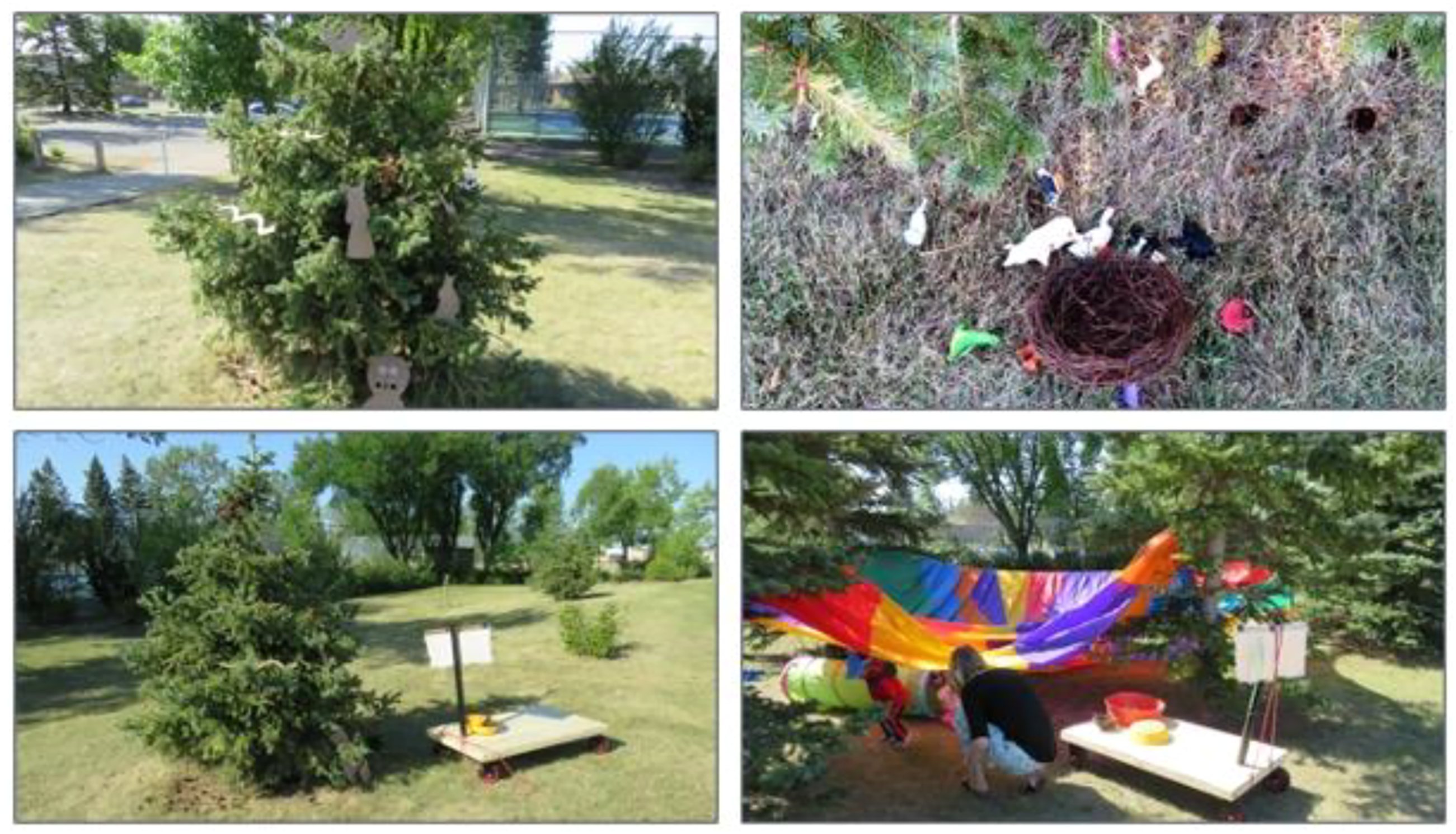
Continuing with a description of the morning, Krystal noted that when it was time for the day’s programming to end, The older [five- and six-year-old] kids had come and gone. They had been running and pulling the boat as fast as they could, up and down the [asphalt river] path. And they had moved on and were doing chalk and all the other stuff. And right at the end, as we were leaving, a little boy, like three/four years old, took the two-year-olds. He sat them up on the boat. He put all the animals on the boat and he took them all the way down, all the way down the [asphalt river] path to the far end, … and to the little tree at the end of the path. And he took them all off and he set up camps. So, he gathered the animals and the kids and he brought them to a new place and he set up camp, which was the narrative that we had prescribed, but he hadn't been participating when it was a group thing. He's the little one. He didn't feel part of it, or whatever. Or he was still observing. (I'm not sure if he really noticed that that's what we were doing. He was off doing other stuff.) But that narrative was either intuitive enough or he'd observed it. And once he felt like he wasn't being watched, he was like, “Okay, now, it's my turn.” And he like took the slightly younger kids with him and he set it all up. … That was fun. Because it felt like [the earlier narrative prompt] maybe was a bit beyond that age group. But they did it, just not while they were being watched.
Looking back over the summer, Krystal noted, …the whole time was like a practice. Almost like each week, we were trying it slightly different and practicing the skill of getting the kids to engage in narrative play as a group, as quickly as possible, and how much structure to give them, and how much information to give them because if you just gave them the materials, a lot of the time, group narrative play didn't happen.
Krystal went on to say that the facilitators’ learning trajectory was one of, “figuring out that balance of like, ‘We’re guiding but not leading.’”
Beaver gets bandaged
The second vignette, with its rush of troubled stories, as with all polyphonic assemblages, had no definable beginning or end. In conventional, linear time, it took place in the first, second, and third week after Trout and Beaver went camping. Our entry into the assemblage begins with Anne, the lead facilitator, sharing a storybook with the children. The Busy Beaver (Oldland, 2011) tells the story of a beaver whose “careless” tree-felling wreaks havoc in his forest home. Eventually Beaver is struck by one of his falling trees, incurring multiple injuries that send him to the hospital. His time in rehabilitation provides him the opportunity to consider how he will make amends with his forest friends and, once healed, he returns to the forest to do so.
Anne brought cardboard beaver, moose, and bear masks, herbs from her garden, gauze and adhesive bandages, the camping materials (“tent”, logs, and sticks) that were part of the assemblage in previous weeks, as well as the animal cut-outs, and a variety of art materials. She encouraged the children to play the story with all of these materials (the herbs, in part, a response to the previous de-leafing event). However, it was Beaver’s injuries that seemed to provide the main catalyst for the children’s narrative play that day and over the next two weeks (Figure 2). Krystal provided an overview of the Beaver-bandage encounters: In week one, Beaver has a tiny scratch on his head. And week two, he's covered in blood because the kids were painting him and then bandaging him up. And so then, the next week [week three], he comes half-bandaged and half-bloody and they're like, “Hey, the beaver's hurt.” And now, we don't even have to say, “Hey, beaver's hurt, help him, because they look at it and they're like, “Hey, do you have more bandages?” And then, now, other things [other cardboard animal cut-outs] are getting bandaged. Now, we're playing hospital or now we're playing whatever else. And it's so much more fun. And to let what happened the week before, inform what's next, rather than have like, “This is the narrative we want to play,” because you just never know what's going to be interesting to the kids and how they're going to want to keep playing. Bandaging wounded beaver and the other animals.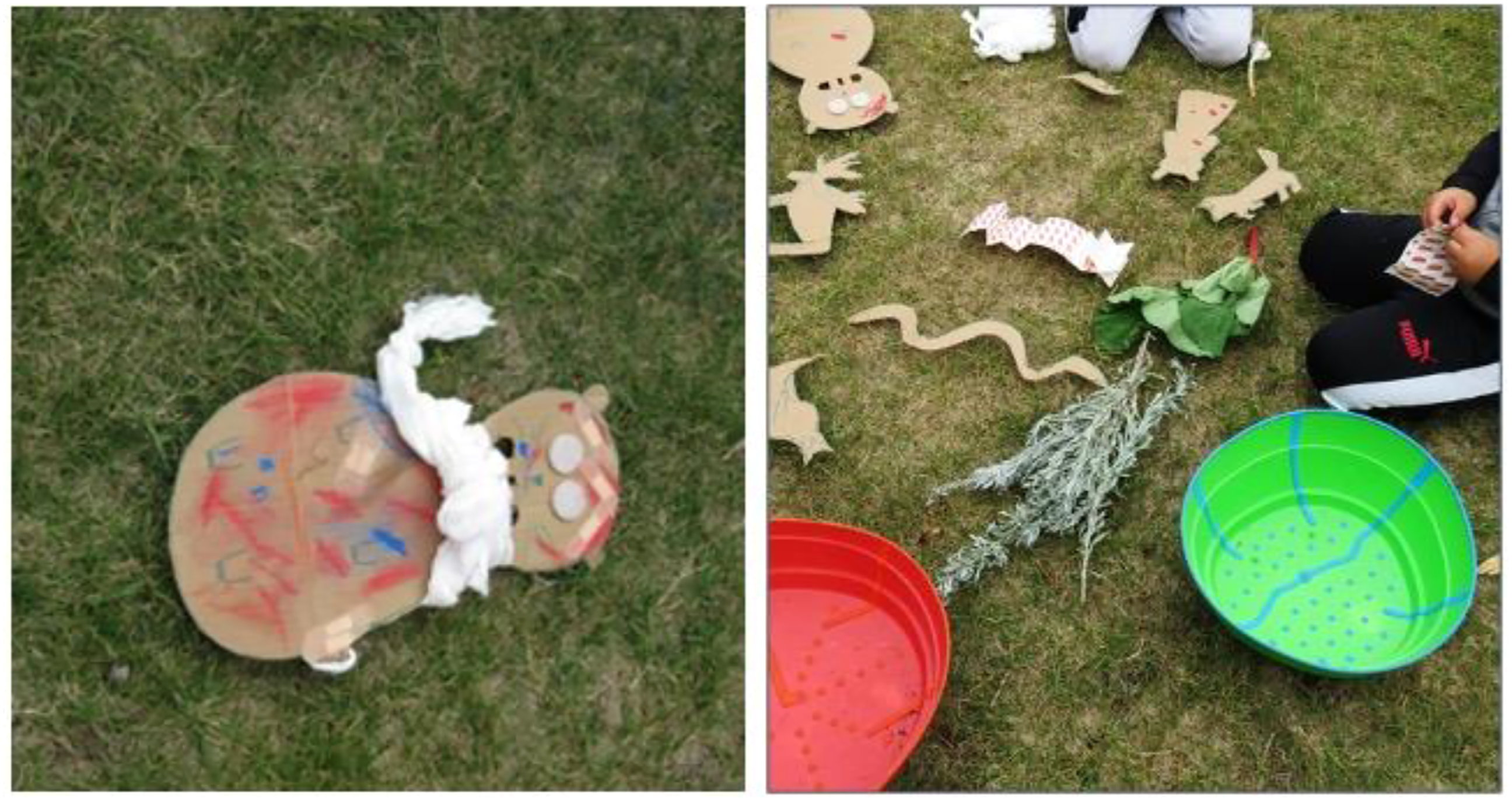
Allowing that which captivated the children to guide her pedagogical moves over the duration of the remaining weeks, Anne introduced three innovations to the storied play – all responses to her attunement to the children’s movements.
Becoming animal
In week one, Anne had begun her transformation to becoming Beaver (donning a cardboard mask). Following the children’s trajectory, in week two, she continued the metamorphosis with mask, tail, and bandaged leg. As she reflected in a later interview, up until that time, when she set up a structured story and narrated/animated it, “the children would be sort of lost in that narrative.” However, the move to becoming Beaver provided … space for the children to relate to the character. Because if you're being the narrator of the story, it's maybe almost too abstract or it's too much up in the air. Then if you're the character, [the children] can really relate to you as being the pilot or the beaver, in my case. And also, I think it leaves a lot of freedom to be who they are. And then a lot of freedom in their imagination. They can become. Some of the kids were willing to have the mask of a beaver and then we were both beavers. So, they can really play around without [the facilitator] imposing [the idea] that you're expected to accomplish that role. And then you were expected to do that in the narrative.
In week two, as injured Beaver, Anne invited the children to join her in the story by using the bear and moose masks. The children participating in the assemblage that week were all very young (two–four years old), as the older children who had been present in week one were absent. Anne observed that the younger ones seemed to enjoy looking through the masks but were reluctant to become part of the story. Rather than, in her words, “taking them by the hand” to follow her down an actual pathway she had earlier created, Anne-Injured Beaver decided to just see what might happen. She watched as some of the children took up play with the masks and camping materials, and as some continued the story of the injured animals, painting new injuries into being (see Figure 2).
Framing moves
At the tail end of their time together in week two, Anne noticed one of the four-year-old boys engaging with a wooden picture frame (newly introduced to the collection of art materials she always brought to the PUPS gatherings). As she watched, he held the frame aloft to the sky, then put it by his side, climbing into the frame’s centre and out again. Anne watched as the boy and frame danced, playing with the light and shadow falling on the sidewalk beneath the frame-boy. Recalling this moment of solitary play that no one else seemed to notice in the midst of bodies preparing to go home and materials needing to be cleaned and packed away, Anne reflected: I have to say that this young boy never said any words. I still don’t know the sound of his voice, but I did see that he had a lot to say with the light and the shadows. … We didn’t do any stories, but this young boy who played with the light and the shadows maybe showed me the path.
Following the trajectory the young boy opened to her, in the weeks that followed the frame-sunlight-boy assemblage, Anne began incorporating the frame in her invitations to the children to enter and engage with the storied worlds they were collaboratively composing.
Chalkboard encounters
The following week (week three), Anne-Beaver played with the children as they took the lead in the storying, focusing the narrative on providing medical care to the animals. She also introduced another innovation: a large chalkboard. Towards the end of their time together, Anne, now herself, invited the children to sit with her and record their story of the day’s gathering on the chalkboard, so they could remember what happened. The story they drew together mapped the morning’s storied world-making (Figure 3). The chalkboard also provided glimpses into what Anne describes as the “underground” participation of some children. One of the young children, part of a group that seemed less aware of the narratives the older children were playing, insisted that particular details be added as Anne drew the beaver. Anne later reminisced, “I was drawing…the beaver who got hurt and then one of the little ones said, ‘But there was a bandage just right here.’ And they had to draw the bandage. Yeah. That’s how much they paid attention.” (see Figure 3) Chalkboarding the collaborative composing.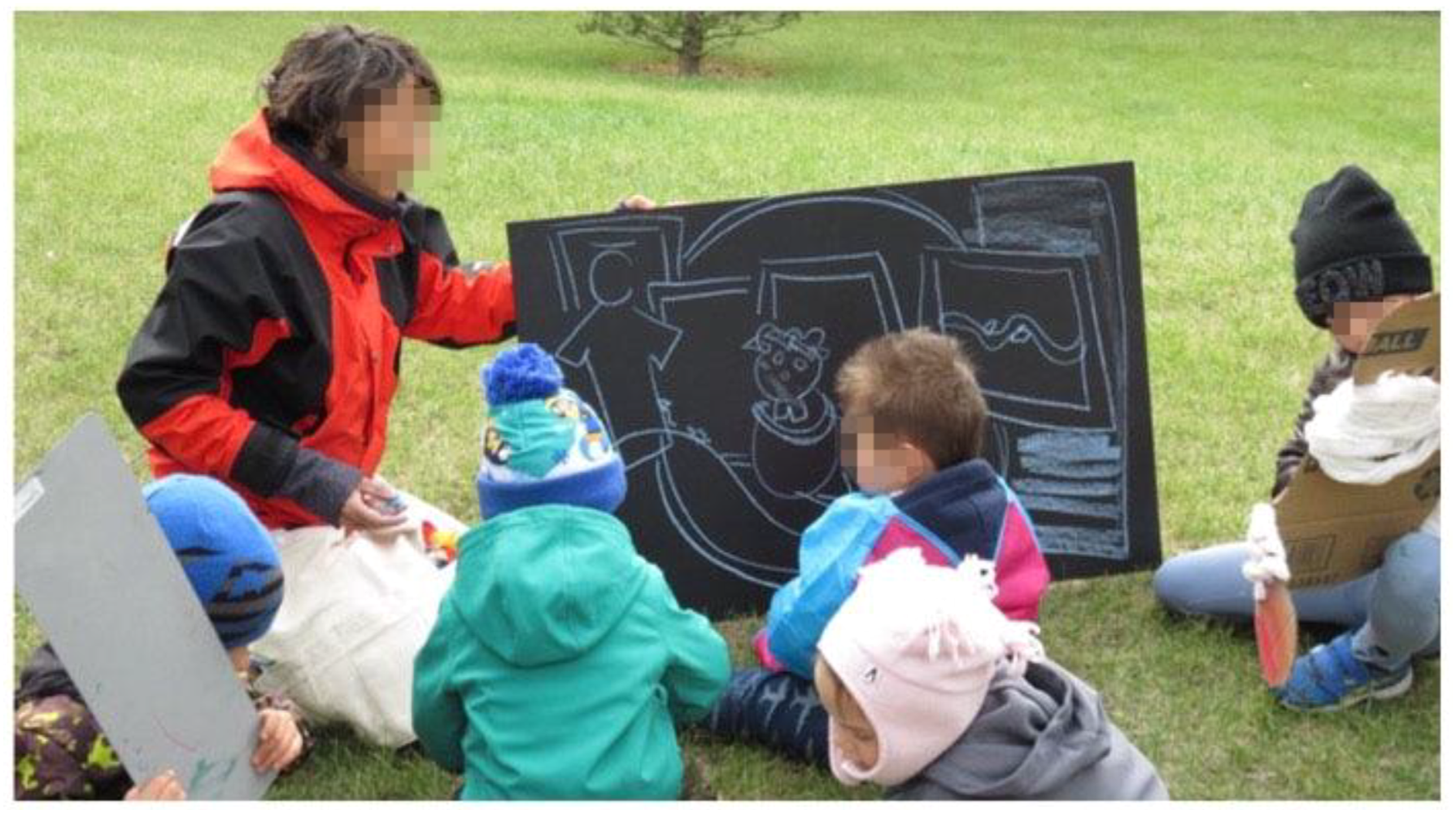
In an email exchange regarding the chalkboard, Anne described the chalkboard as “a medium for dialogue…a time for me to acknowledge that [the children’s] story is important and that I’m proud of being…part of this adventure.” She went on to say, It is so interesting to witness that they do have a narrative structure when they retell the play, they usually start with the character, [then] the event, and [then] situate elements of place. I also try to challenge them sometimes when I ask the question: “Where did we go?” instead of only asking, “And then what did we do?” They become author-geographers…and I’m their illustrator in a way, until at some point, they take over completely and they become both author-geographers and illustrators….”
The moments collected within the Beaver and Trout Go Camping and the Beaver Gets Bandaged stories provide a glimpse into the way in which the program facilitators moved with the human and more-than-human assemblage, leaving aside their preconceived notions of how collaborative narrative play should be facilitated. In the next section, we consider what all of this may have to say with regard to literacy programming with young children.
Heeding the in/visible at the unruly edges in contaminated collaborations
The encounter-based collaborations of the polyphonic assemblage provided moments of pause – times to consider the PUPS program’s emerging ideas on how to expand opportunity for children’s group narrative play. The assemblage’s multiple histories (e.g., children’s and facilitator’s prior life and program experiences, the facilitators’ emerging ideas about program practices) and the unfolding relations (e.g., previous aspects of the emerging Trout-Beaver story, the children’s diverse intra-actions with returning materials such as the animals, boat, bandages, chalk and paint) are but a few examples of its polyphony.
To examine this polyphonous assemblage in more depth, here we consider the multiple trajectories of Trout and Beaver Go Camping and Beaver Gets Bandaged, discussing the unruly edges of some of the simultaneously emerging encounters that, through contaminated diversity, shifted this gathering to the status of a happening. As with the Trout and Beaver camping adventure, the entangled encounters that emerged as Beaver got bandaged animate the way that contamination of the original plan – the troubling of stories – produced energetic engagement in the storied world for both children and facilitators, ultimately providing the facilitators with important directions for fostering more truly collaborative composing assemblages.
Gatherings becoming happenings along seamed eruptions
Amongst the polyphony – the diverse temporal rhythms of the Trout and Beaver Go Camping assemblage – the in/visible erupted along the unruly edges. While the older children seemed first to connect with the adventure of finding the animals and taking them camping, the emergence of the morning’s narrative play unearthed the hidden or underground participation of the three/four-year old boy. Seemingly refraining from engagement with the storied world as the older children played it into being, with his late-in-the-game repetition (gathering the animals onto the boat and taking them camping), this boy contaminated the story with his own eleventh-hour innovations (loading the two-year olds onto the boat with the animals and taking them two hundred meters away to a new camping spot). He had clearly been part of the earlier networked storying, participating in in/visible ways, retracting and advancing, until the moment he was ready for more visible participation.
In the rush of troubled stories we have called Beaver Gets Bandaged, multiple possibilities for playing the story were imagined by the facilitators as they brought new materials – more-than-human participants – to the assemblage (the book, masks, herbs, camping materials, adhesive and cloth bandages, various art supplies). However, it was Beaver’s injuries that emerged to captivate many of the children and catalyze their narrative play in the following gatherings. Beaver was given further injuries via paintbrush, and other animals came to be included in the cadre of the injured. Woodland relations came to be focused on the need to bandage and care for the injured animals.
Similarly, the boy who silently danced with the frame, as the Pop Up Play Station was wrapping up, provides another sighting of the in/visible. Noticing the eruption of the boy’s play with the frame and lingering with the wonder of what Anne had seen, along with considering him a member of the assemblage with valuable contributions for the assemblage’s functioning, sparked a new direction for the facilitators’ planning. The very next week, and in subsequent weeks, the set of frames became integral to the narrative play, as objects enjoined to invite the children into storied worlds, by entering through the frame, and animate elements of the unfolding story.
The unanticipated emergence of the rogue camping adventure, the injury narrative, and the frame dancing – erupting along the “disordered but productive edges,” the “seam,” between the domesticated and the wild (Tsing, 2012: p. 151) – are dynamic reminders that the generative spaces for collaborative storying with these children were to be found in the in-between, the interface between the facilitators’ planned-for possibilities and the children’s desires. They offer possibilities for pedagogical noticing of language repertoires and communicative patterns (Bentley and Souto-Manning, 2019) that appear in temporal and spatial encounters and extend understanding of the collaborative creativity of children’s storytelling (Lindfors, 2008; Paley, 1991; Swann, 2017).
Making way for others to take the lead
Prior to the day when Trout and Beaver went camping, the facilitators were beginning to realize the stories they brought to each play assemblage, no matter how creative, connected to the land, and well-supported by play props and loose parts, seemed too complicated and perhaps uninviting for many of the children. Overall, the children seemed to be simply following along as the facilitator narrated and led the story.
On the day when they started off by providing the children with a simple story prompt (the animals have scattered because of the flood) and materials (animal cutouts, animal figurines, and the boat), and then allowed the children to take the lead from there (with some engaging from the start and others doing so when they were ready), the facilitators (and observing researchers) felt an energetic hum amongst the children. This buzz of agency, created in the relational spaces in-between human and human, human and more-than-human, was something both the facilitators and the research team had not previously sensed. The innovation of a very simple story prompt that contaminated the original program plan provided important information to the facilitators in their own quest to create opportunities for narrative play. As they, paraphrasing Tsing (2015: 27), made way for others to take the lead in building the storied world, new directions for the program emerged.
Over the three weeks of beaver’s bandaging, roles in the storied world continued to shift. Rather than narrating a story about Beaver and his world, Anne became Beaver. While initially telling the story and leading the children to follow her in the narrated moments she had pre-planned, by the second week of her transformation, becoming Beaver allowed Anne to participate with the children in their storied world. By inviting the children to form relationships with her, Anne-Beaver made space for them to become-animal-storytellers, to participate imaginatively and freely in the storied world. Once again, allowing and then inviting the original plan to be contaminated with this innovation – and thereby deliberately breaking from a typical adult-child hierarchy – diversified the program’s quest for productive openings for collaborative composing.
Just as it provided a space for viewing the “underground” or in/visible participation of the boy who insisted on accurately mapping Beaver’s injuries, the chalkboard’s participation in the narrative play also yields a glimpse into the shifting roles of the humans in the assemblage.
While opening a space for in/visible storying to surface, the chalkboard also invited both Anne and the children to transform from story players to geographers who map, and authors who re/tell. Anne’s positioning of the children as author-geographers, through her encouragement to approach the authoring as a mapping, moves the re-telling from a focus on human activity to a focus on the children’s intra-activity with place in the storied world-making. When story authors become author-geographers, elements of the natural world – holes in the ground, sticks, trees, sun, and wind – shift from their typical designation as mere contextual features, to become important participants/leaders in the story.
Contaminated story worlds
Krystal’s delight in the way the older children enthusiastically wrote themselves into the storied world of Trout and Beaver by seeking food for the fish-animal clan is sharply intersected by her surprise and dismay at where that food came from. Even as the buzz of the excited swarm of human and more-than-human – engaged together in collaborative narrative play – prompted the children to seek life-giving food for their fish-animal clan, destruction contaminated the storied world at another unruly edge. The de-leafing was an assault on an earth-other (Braidotti, 2013) that, in all likelihood, endangered the young tree’s health that hot and dry summer. The de-leafed tree, a cruel remainder in the diverse and competing lifeways of this polyphonic assemblage: the children’s deep engagement with the storied world they were playing into being now contaminated by the tree’s possible demise.
An adhesive bandage and the events that surround its application are often dramatic moments in the lives of young children. The affect created in an assemblage in which the allure of liberal access to materials that were perhaps scarce at home (such as band-aids/plasters and gauze rolls), memories of excitement attendant to incurring their own scrapes and bruises, followed by the loving attention of receiving a bandage for those injuries, may well have played a role in the narrative play that eventually led to bandaging all of the animals. By noticing the children’s attunement to Beaver’s minimal bandaging in week one, the enthusiasm with which they played hospital with all the animals (entangling themselves in the contaminated play of both harming and healing them), and subsequently ensuring a good supply of the bandaging vibrant matter (Bennett, 2010), the facilitators assisted the Beaver Gets Bandaged trajectory to take flight.
The fluid movement from play to destruction and back to play, from pain to pleasure, from victim to perpetrator found in these two troubled stories, provide important reminders that contamination, while opening new collaborative pathways, may or may not always be tolerable, bearable, or acceptable. Either way: these matters just are.
Openings for collaborative composing, program development, and literacy research
In this article, we have attempted to weave three exploratory threads: the first, asking what the movements of children and program facilitators can tell us about children as leaders in collaborative composing; the second, taking seriously children’s potential for guiding literacy program development; and the third, introducing the use of the mycelial network as an analytical construct for posthuman literacy studies. We briefly address each of these, as we bring this article to a close.
Taking the lead from children in collaborative composing
The troubled stories we provide here were part of an awakening for the facilitators. Over the space of four weeks – in which they came to see that by paring back their preparations and attuning to the liveliness of the children’s movements – their understanding of collaborative narrative play was transformed. The recollected stories were selected for all they had to teach about young children’s collaborative composing (Nicolopoulou, 2017; Lindfors, 2008; Paley, 1991; Swann, 2017) and what their assemblages had to teach us (the facilitators, the researchers, and you, the audience of this article) about the ontology of such a program. Such an assemblage was messy indeed but within that diversity lies its strength, and the learning it generates, we argue, furthers the important matter of resisting singular pathways for children’s literacy learning in educational settings (Hackett and Somerville, 2017). In this case, the productive openings for collaborative composing that the troubled stories produced, demonstrate the important contributions children make in a pedagogical space in which adults could do less leading and more attuned following.
(De) programming children’s literacies
Earlier, we noted the tensions associated with bringing an agenda of emergent learning into association with publicly funded learning programs, which are often subject to adhering to pre-specified learning outcomes for the children who attend. Educators are often left with vexing questions: What are they to do with the messiness associated with learning, when educational programs are supposed to be neat, tidy, and well-managed experiences that purportedly signal good and proper use of public funds? Is there room for planning and desired outcomes to co-exist with emergence and unpredictability in educational programming? An acknowledgement of contamination as collaboration helps address these matters, providing a pedagogical space for holding contradiction in productive tension.
Even as we consider the affordances of contaminated assemblage, we are also reminded of its worrisome aspects – contamination can permanently spoil. Nonetheless, if indeed, contamination is what drives diversity; the educator’s task is to notice the “patterns of unintentional coordination” that develop in educational assemblages. As Tsing states, “To notice such patterns means watching the interplay of temporal rhythms and scales in the divergent lifeways that gather” (p. 23). In this way, educators can not only identify and withdraw from that which may be unbearable, intolerable, and/or unfruitful in the polyphonic assemblage of literacy programs but equally important, notice and nurture that which is generative, that which has the potential to transform a gathering into a happening.
As the relations between the human children and facilitators and the more-than-human playthings, books, bandages, trees, grass, and air in the PUPS collaborative composing assemblage so vividly animated, the in/visible moments that erupt along the interface between the domesticated and the wild can guide educators in planning and enacting young children’s literacy learning. In programs such as these, where there is an expectation that educators do something more than simply gather children to play, working with contaminated diversity provides a way forward for transforming these gatherings into happenings.
Mycelial networks as methodological innovation
In this article, we have introduced the idea of utilizing mycelial networks as a construct for engaging with posthuman literacy studies. We have argued that the often hidden, embodied intelligence of mycelial networking encourages new forms of curiosity and new forms of attention to that which takes place in relational assemblages of the human and more-than-human—those relations readily visible and audible to the human senses and the less apparent, subterranean networks of relations that are also always present and at work. With their in/visible ubiquity and temporal, spatial, and relational processes of exploration and withdrawal, mycelial networks offer intriguing and infinite possibilities for posthuman studies. Thinking with mycelial networks to re/consider collaboration as that which benefits from contamination and unruly edges as lively and generative spaces can help educators to notice and nurture that which easily goes unnoticed. Working with these concepts can also guide educators to welcome and learn from the difficulties – the missteps, the intrusions, the unexpected – rather than actively working to avoid them in educational gatherings.
Returning to the analogy of the mushroom: while we cannot see the intensity of growth in its underground mycelia, this does not mean growth is not taking place. A mushroom forager’s job is to attune to that invisible intensity by knowing the conditions in which a mushroom might be produced. However, the forager must not remain bound by that knowledge. Instead, they must open their senses to indications a mushroom is about to erupt – a smell, a disturbance of the earth, other mushrooms nearby (Tsing, 2015). To find a good mushroom, I need all my senses. For there is a secret to matsutake mushroom picking: one rarely looks for mushrooms. Every now and then one spots a whole mushroom—probably discarded by animals or so old that worms have consumed it. Good mushrooms, however, are under the ground. (Tsing, 2015: 241)
The attunement between forager and the in/visible in dynamic assemblage describes well the most fruitful moments of our storying gatherings – the times when the gathering became a happening – and we propose, many of the learning moments that take place in educational spaces. To foster children’s collaborative composing, we assert, it is necessary to trust that storying occurs, for many children, in the underground, in/visible spaces that underpin the stories they play.
Footnotes
Declaration of conflicting interests
The author(s) declared no potential conflicts of interest with respect to the research, authorship, and/or publication of this article.
Funding
The author(s) disclosed receipt of the following financial support for the research, authorship, and/or publication of this article: This project was funded by the Social Sciences and Humanities Research Council (SSHRC) of Canada (430-2020-00492).
