



Abstract
Australian educators teaching in the early years of formal schooling find themselves grappling with the dilemmas of preparing learners to sit performance-based assessments in later years and their sense of pedagogic responsibility towards designing competency-based assessment. Studies have explored this tension in the primary and middle years where learners sit national standardised assessments, but there is limited research in the earliest years. Therefore, this article aims to share an educator's experience of using an inquiry-based approach named LAUNCH to act agentically within government assessment systems. Design-based research in an exploratory case study of an Australian Preparatory classroom investigates an educator's pedagogic orientations to the assessment of 14 five- and six-year-old learners’ writing and text production. Qualitative data generated from video and audio recordings and learner-generated artefacts captures these pedagogies over a four-week time frame. Sociologist Basil Bernstein's two pedagogic orientations to assessment – competence and performance – provide the theoretical framework for the study. The findings reveal that a mix of orientations allows learners to achieve the expected knowledge and skills that they need to do well in performance-based assessments, as well as unexpected knowledge and skills. For those committed to discussions about professional ethics and assessments, it is crucial that archetypes of pedagogic orientations to assessment are shared to illuminate a close study of practice.
Introduction
The Australian study reported in this article explores the writing and text production experiences of 14 five- and six-year-old learners during LAUNCH, an inquiry-based pedagogic approach. LAUNCH is the acronym for: Latch on an idea (L), Ask questions and search for answers (A), Use your creativity (U), Never be afraid to fail (N), Collaborate and cooperate (C), and Have a blast (H). Developed specifically for this study, LAUNCH allows the literacy practice of writing and text production to grow out of the classroom context and the learners within that context (see Brosseuk , 2019). It starts with an idea, a thought or a problem that needs attention. Learners are gifted time to explore ways to solve their chosen problem. As they do, learners are afforded opportunities to give form to and produce everyday text such as drawing and writing, whilst experimenting with new, novel forms of text. By investigating an educator's practice, this article reveals that a mix of performance and competence orientations is possible, and therefore it is time to reconsider a binary type of thinking between a performance orientation, on the one hand, and an inquiry-led competence orientation, on the other. This is significant as early years educators must have contemporary evidence-based ways of seeing and understanding broader assessment practice. Basil Bernstein's (2000) theorisations of performance and competence orientations to assessment frame the Australian educator's mixing or orientations.
Writing, text production and performativity in current times
Early years pedagogic beliefs are typically underpinned by learners’ ideas, interests, inherent strengths and competences. However, with the seemingly burgeoning focus on performance, the ways in which learners engage with and experience writing and text production are changing (Baroutsis, 2018; Jaeger, 2019 ). For some early years educators, there is pressure to teach and tick off literacy knowledge and skills in a timely manner, often via paper-based means (Jay and Knaus, 2018). This leaves less time for learner-initiated and play-based activities (Roberts et al., 2019). Furthermore, as learners engage in writing using tools such as paper, pencils, worksheets and exercise books at desks, they come to the see writing and text production as a linguistic, performance-based form of communication (Baroutsis, 2020; Baroutsis et al., 2019 ). Learners also come to see that writing is largely an individual act, where they are a long way away from anyone else (Baroutsis et al., 2019). This sort of experience, according to Baroutsis et al. ( 2019), has the potential to quickly develop into a standard idea of what text is, and where and how text is produced. This becomes problematic when standardised, performance-based experiences limit learners’ understandings of what it means to be a capable writer and text producer and, importantly, a lover of writing and producing text.
Further complicating matters is the proliferation of mandated standardised assessments aimed at observing and measuring the performance of ‘whole populations as a part of school and system-wide audits’ (Comber, 2012: 120) . In Australia, for instance, the annual National Assessment Program – Literacy and Numeracy (NAPLAN) assesses learners’ literacy and numeracy in Years 3, 5, 7 and 9 (Australian Curriculum, Assessment and Reporting Authority, 2016). NAPLAN represents a significant part of the Australian government's drive to increase transparency and the accountability of schools. It is widely accepted in the literature that an unintended consequence of this standardised assessment is test stress and pressure to perform well in tests (see Gannon and Dove, 2021 ; Gray and Seiki, 2020; Macqueen et al., 2019; Rogers et al., 2016, 2018; Swain et al., 2018). Pressure to perform comes at the hands of a national analysis of NAPLAN school results, which are available for public review on the My School website (https://www.myschool.edu.au) . Along with school NAPLAN data, this public resource provides educators, parents and communities with school profile information and population data to assist with inter-school comparisons. Thus, pressure to do well on NAPLAN has led educators away from inquiry-based, learner-led practices towards more instructional, educator-led practices, as revealed in Australian studies by Spina (2020) and Swain et al. (2018).
Much of the research relating to performativity pressure, and the ensuing pedagogic shift, has focused on educators who teach in the years in which learners sit for NAPLAN tests. More recently, however, educators who teach in the earliest years have reported similar pressures (see Barblett et al., 2016; Jay and Knaus, 2018; Roberts et al., 2019; Rogers et al., 2016, 2018). In Roberts et al.’s (2019) Australian study, for example, early years educators talk about pressure to prepare learners to sit NAPLAN in three or four years' time. They express unease about ‘being blamed’ if learners are ill-prepared and do not perform well in later years (313) . To combat this, educators report using more instructional pedagogic practices to teach writing genres much earlier than they would have previously. A Year 2 educator tells of ‘doing English … just so that they could get the kids ready for [testing] and doing it for an hour and a half’ (316) . Jay and Knaus’s (2018: 121) interviews with Year 1 and Year 2 Australian educators reveal similar worries about ‘being held accountable’ for later NAPLAN performance. Against this backdrop, it appears that the drive to improve performance in the primary years has a bearing on the whole school, even in the earliest years of formal schooling in Australia.
Launching the research study
This article draws from case study data generated as part of an Australian study involving 14 preparatory learners, their educator Miss Nickleby and myself, in the role of co-educator and researcher. 1 By way of background, in Australia, learners starting preparatory are five years of age in the year they enrol at school. As co-educator and researcher, I developed and taught an inquiry-based pedagogic approach – LAUNCH – alongside Miss Nickleby. LAUNCH, a new approach developed specifically for this study, is the acronym for: Latch on an idea (L), Ask questions and search for answers (A), Use your creativity (U), Never be afraid to fail (N), Collaborate and cooperate (C), and Have a blast (H) (see Brosseuk, 2019 ) . These key actions are underpinned by the principles governing Google’s innovation strategy. The principles encourage Google employees to be ambitious, take risks, aim big and embrace the notion of encountering failure (Schmidt and Rosenburg, 2014).
The philosophy of LAUNCH finds its forebears in the work of the American educational reformer John Dewey (1938, 1964) and New Zealand educational pioneer Sylvia Ashton-Warner (1963). The inquiry similarly reflects Dewey's and Ashton-Warner's idea that learning experiences are had, and not given, via key elements: permitting active discovery; recognising and valuing learners’ interests, abilities and inherent strengths; acknowledging learners’ lifeworlds; offering multiple ways to demonstrate thinking and learning; and including discovery-to-guided-to-structured pedagogy to meet learners’ needs. Educational contexts that mobilise quality educator–learner interactions through inquiry-based frameworks, like that of LAUNCH, are often cited as the standard of quality (Murdoch, 2015).
LAUNCH asks learners to take on a question, issue, problem or challenge with a social, moral or humanitarian dynamic and give it attention, to nurture it and let it grow . Through active inquiry and discovery, learners come to understand the problem better. In this study, LAUNCH ran for approximately 60 to 80 minutes, three or four days per week, over a four-week time frame. A problem was identified by the learners based on their interests and an eager desire to know more. The pace was often self-directed, giving the learners time to think and tinker. They worked in a mix of individual and collaborative learning. As the learners asked questions, made discoveries and tested those discoveries in search for new understanding, they met different ways and different forms of writing and text production. LAUNCH therefore offered a varied text experience, whether it was digital, paper-based or live. At this point, it is important to say that LAUNCH is unlike inquiry-based programs that include fixed problems to investigate, printable worksheets and templates, and standardised checklists and assessment rubrics. This type of inquiry can be found on the Australian website Scootle, a multidisciplinary curriculum resource aligned to the Australian Curriculum and designed for use by educators (Australian Curriculum, Assessment and Reporting Authority, 2022). 2 Inquiring in such a cookie-cutter way, devoid of discovery, dialogic interaction and collaboration, is, according to Ashton-Warner (1963: 33), an ‘interruption in the natural expression of life’.
The study's three research questions were derived from Bernstein’s (2000) theoretical conceptualisations of curriculum, pedagogy and assessment. The work reported in this article focuses on the study's third research question, which asks: Which knowledge and skills, framed by performance and competence pedagogies, are assessed during learners’ writing and text production? To help answer this question, the study utilised Bernstein's (2000) two models of pedagogic practice – performance and competence – to describe and better understand Miss Nickleby's orientation to assessment. In doing so, the study provides a close portrait of assessment practice. The article is presented in three parts. First, I provide an overview of Bernstein's notions of performance and competence, and explain how they differ in terms of pedagogic orientation to assessment. Next come the particulars of the study, including its research design, participants, analytic methods and findings. Finally, the important considerations are offered, highlighting the potential of a mix of competence and performance orientations to assessment in the early years of formal schooling.
Competence and performance
Bernstein’s (2000) two models of pedagogic practice – competence and performance – provide the study's theoretical framework. By way of background, performance and competence take up the core perspectives of visible and invisible pedagogies. A distinct educator–learner pedagogic relationship, influenced by explicit control, represents a visible pedagogy. Here, it is the educator who acts as the ‘author of the practice and even the authority’ by making it explicit to learners what knowledge and skills are to be acquired (Bernstein, 2000: 10). The practices of visible pedagogy place emphasis on the learner's performance (Bernstein, 2003). Contrastingly, implicit control forms an indistinct educator–learner pedagogic relationship, which infers an invisible pedagogy. The practices of invisible pedagogy are attributed to competence. The philosophies of Dewey (1938) and Ashton-Warner (1963) resonate with Bernstein's invisible pedagogy. Through invisible pedagogy, or implicit control, learners can actively explore, inquire, discover and focus on interesting and important issues that are meaningful to them. Bernstein uses the concept of ‘framing’ to distinguish visible and invisible pedagogies. Framing is defined as ‘the degree of control teacher and pupil possess’ in the pedagogic relationship (Bernstein, 1975: 88 ). Framing can be strong (explicit and visible) or weak (implicit and invisible). Bernsteinian researchers use relative indicators of framing (F) strength to signify the degree of control: F− − (very weak), F− (weak), F+ (strong) and F++ (very strong) (see Brosseuk, 2021 ; Exley et al., 2016; Morais and Neves, 2018; Simpson Reeves et al., 2018).
Performance and competence orientations to assessment
Performance and competence differ when it comes to the pedagogic orientation to assessment. An educator who holds to a performance orientation to assessment is more inclined towards visible pedagogies to explicitly teach what must be learned to produce a text. A learner's text is assessed according to predetermined criteria. This leaves learners with very little control over what is produced, and limited opportunities to show their thinking and learning in multiple ways and various forms (Sanders-Smith, 2015). When assessing the text produced, educators are more likely to look for what is absent or missing, and assign a grade that best matches the standard of performance relative to the criteria (Bernstein, 2000; Diehl and Olovsson, 2017; Neaum, 2016). Thus, the criteria are made explicit in testing through test correction and marking (Morais, 2002). It is made clear what learners have not achieved and what they need to achieve in the future. Australia's standardised NAPLAN assessment is an example of a performance orientation to assessment.
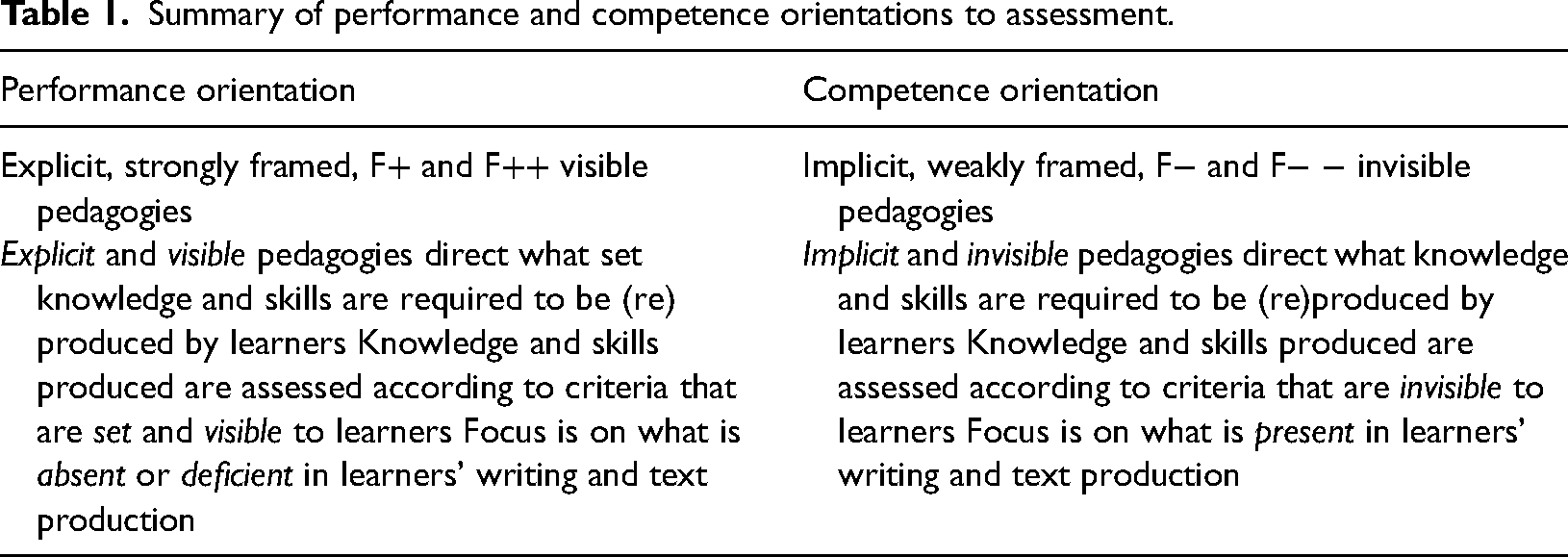
A competence orientation to assessment, on the other hand, sees educators using invisible pedagogies. There is more of an emphasis on what learners already know and what they can do. Learners’ interests and abilities drive what text is produced. The criteria for assessment are implicit, and not externally defined but personalised, permitting learners to show cognitive abilities, as well as social and emotional skills, and affective learning competences (Bernstein, 2000; Sanders-Smith, 2015). The criteria, therefore, consider the individual learner (Morais, 2002). Educators are more likely to look for what is present in the produced text (Neaum, 2016). A competence orientation to assessment supports the notion that learners can demonstrate their learning in numerous ways and different forms (Cordoba and Sanders-Smith, 2018). Competence has an inquiry-based framework, such as LAUNCH. Table 1 provides a summary of performance and competence pedagogic orientations to assessment.
Summary of performance and competence orientations to assessment.
Research site and ethical considerations
The research site was a metropolitan all-boys’ school, with an enrolment of approximately 405 preparatory to Year 12 boys. This site was suitable due to the school being a proponent of the Australian Early Years Learning Framework’s age-appropriate pedagogies (Department of Education and Training, 2019) and the Early Years Learning Framework (Department of Education, Employment and Workplace Relations, 2009). Developed with advice from the early childhood sector and early childhood academic experts, these frameworks ask educators to use a repertoire of pedagogic practices, which include weakly framed invisible practices (active, agentic, collaborative, creative, playful) along with strongly framed visible practices (explicit, instructional, intentional). School visits involving discussions with Miss Nickleby and the school principal, explaining the potential study and answering questions, were conducted in Term 1, 2018. Informal meetups with parents/caregivers involved meeting in the classroom prior to the beginning of school to clarify information about what the learners would do and how the data would be used. The parents/caregivers were assured that participation was voluntary and that they could withdraw their child from the study at any time.
Informed written consent, setting forth the study's overarching aims, benefits and risks, and other study information, was obtained from Miss Nickleby and the parents/caregivers of the 14 preparatory learners. Ethics approval was obtained from Griffith University, Human Research Ethics Committee and the research school's board of governors. To help the preparatory learners understand the purpose of the study and their role in the research, the picture book What Do You Do with a Problem? (Tan, 2018) was introduced. Tan’s (2018) picture book promoted meaningful discussion with the learners of hard-to-conceptualise ideas such as ‘What is research?’, ‘How do we investigate something?’, ‘Where do we look for answers?’ and ‘What if we fail?’. I explained to the learners that I wanted to investigate a problem and asked whether they would like to join the investigation. The learners were invited to ask questions and share their thoughts. All 14 learners voiced their willingness to participate. To ensure ongoing assent throughout the study, I asked questions such as ‘Can I work with you now?’, ‘Would you like to tell me about what you’ve done?’ and ‘Can you show me?’. In doing so, the study acknowledged the learners’ right to voice their thoughts and ideas, raise questions and be listened to in things that involved them (United Nations, 1989 ).
Data collection
In the first four weeks of Term 2, two types of qualitative data were generated. First, video and audio recordings captured LAUNCH four days a week over a four-week time frame. The learners were tasked with finding a problem with a social, moral or humanitarian dynamic. Four tripod-mounted iPads, with attachable external microphones designed for professional applications within video and television productions, captured approximately 64 hours of recorded data. Second, learners’ artefacts provided a significant resource of words, images and sounds to describe and better understand what was produced. Examples of the artefacts collected included, but were not limited to, a video-recorded community service announcement, custom-designed invitations and Thank You cards, three-dimensional models, a video-recorded interview, sketches, game instructions and a drone video recording. A qualitative orientation was employed, aligned with the study's epistemological stance that understands human beings as interpreters of meaning. Qualitative data permitted the ‘understanding and describing’ of multiple in situ perspectives through the subjective experiences of the study's participants (Bernstein and Solomon, 1999: 276).
Analytic work
Using Bernstein's (2000) existing theoretical constructs, a deductive strategy was used to subject the data to three levels of analysis. The first level involved preparing the data for analysis. The data from the audio and video recordings was converted into 104 pages of transcription. To ensure anonymity in the transcription, the participants’ names were removed and replaced with pseudonyms. The data was optically scanned multiple times to make sense of it (Ravitch and Carl, 2020). The second level involved organising the data related to Bernstein’s (2000) three analytic codes of curriculum, pedagogy and assessment (this article focuses only on the analytic codes of pedagogy and assessment). The theoretical descriptions for the pedagogy and assessment codes were adapted to suit the aims of the study. The third level involved looking within each analytic code to establish categories of analysis. Tables 2 and 3 provide an outline of the study's analytic framework.
Relative indicators and theoretical descriptions for pedagogy.
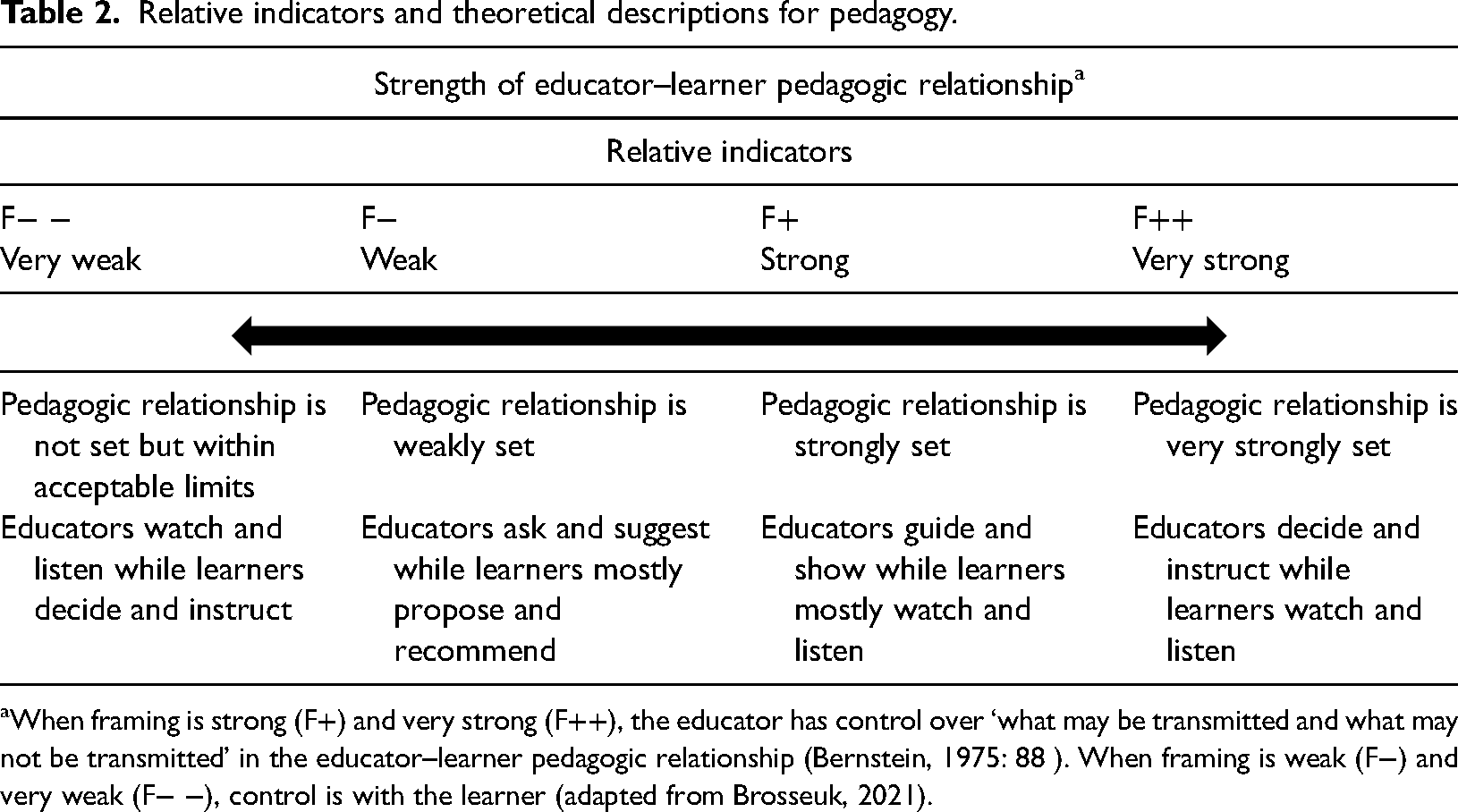
When framing is strong (F+) and very strong (F++), the educator has control over ‘what may be transmitted and what may not be transmitted’ in the educator–learner pedagogic relationship (Bernstein, 1975: 88 ). When framing is weak (F−) and very weak (F− −), control is with the learner (adapted from Brosseuk, 2021).
Relative indicators and theoretical descriptions for assessment.
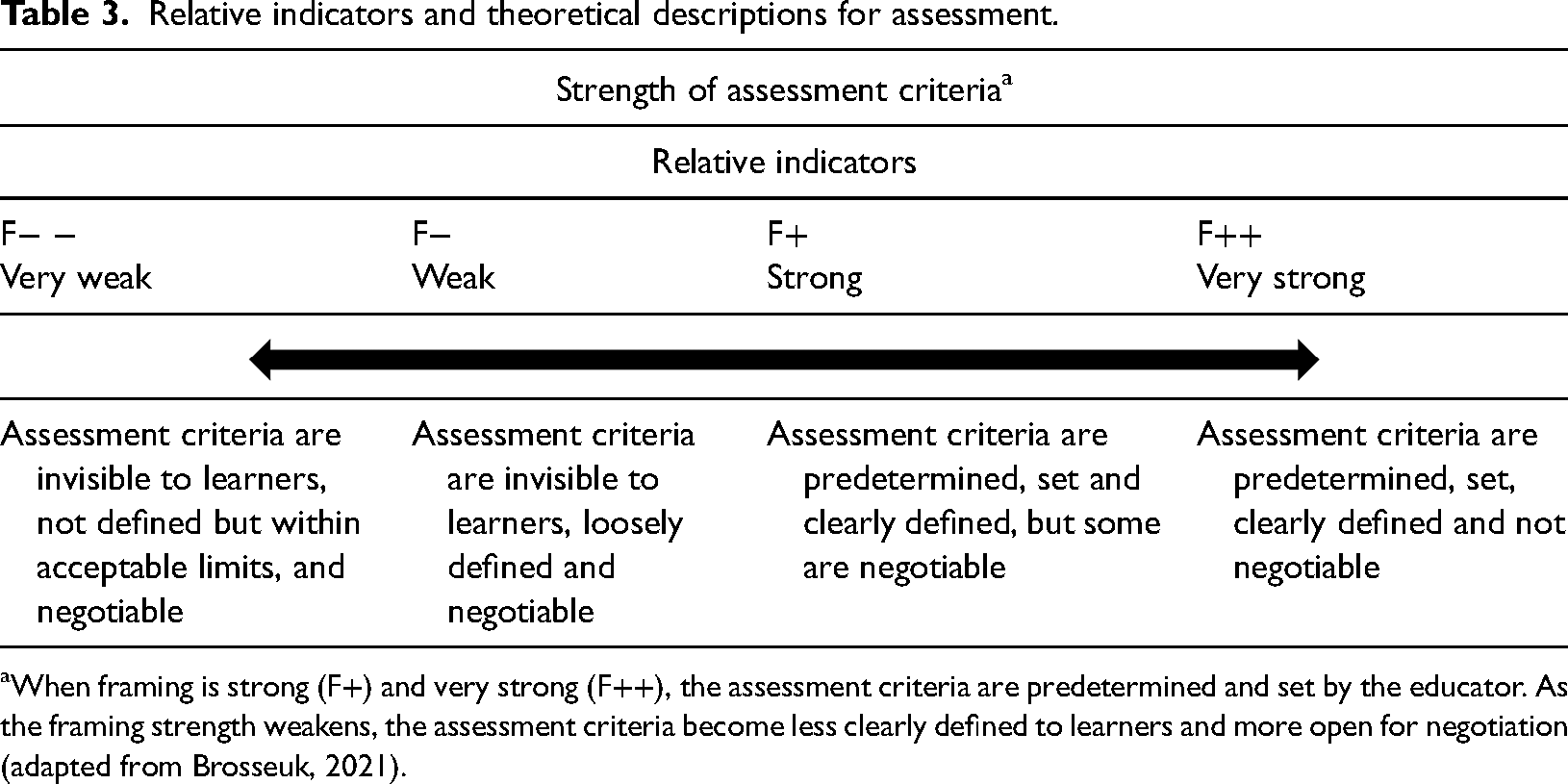
When framing is strong (F+) and very strong (F++), the assessment criteria are predetermined and set by the educator. As the framing strength weakens, the assessment criteria become less clearly defined to learners and more open for negotiation (adapted from Brosseuk, 2021).
Findings: what did the learners produce?
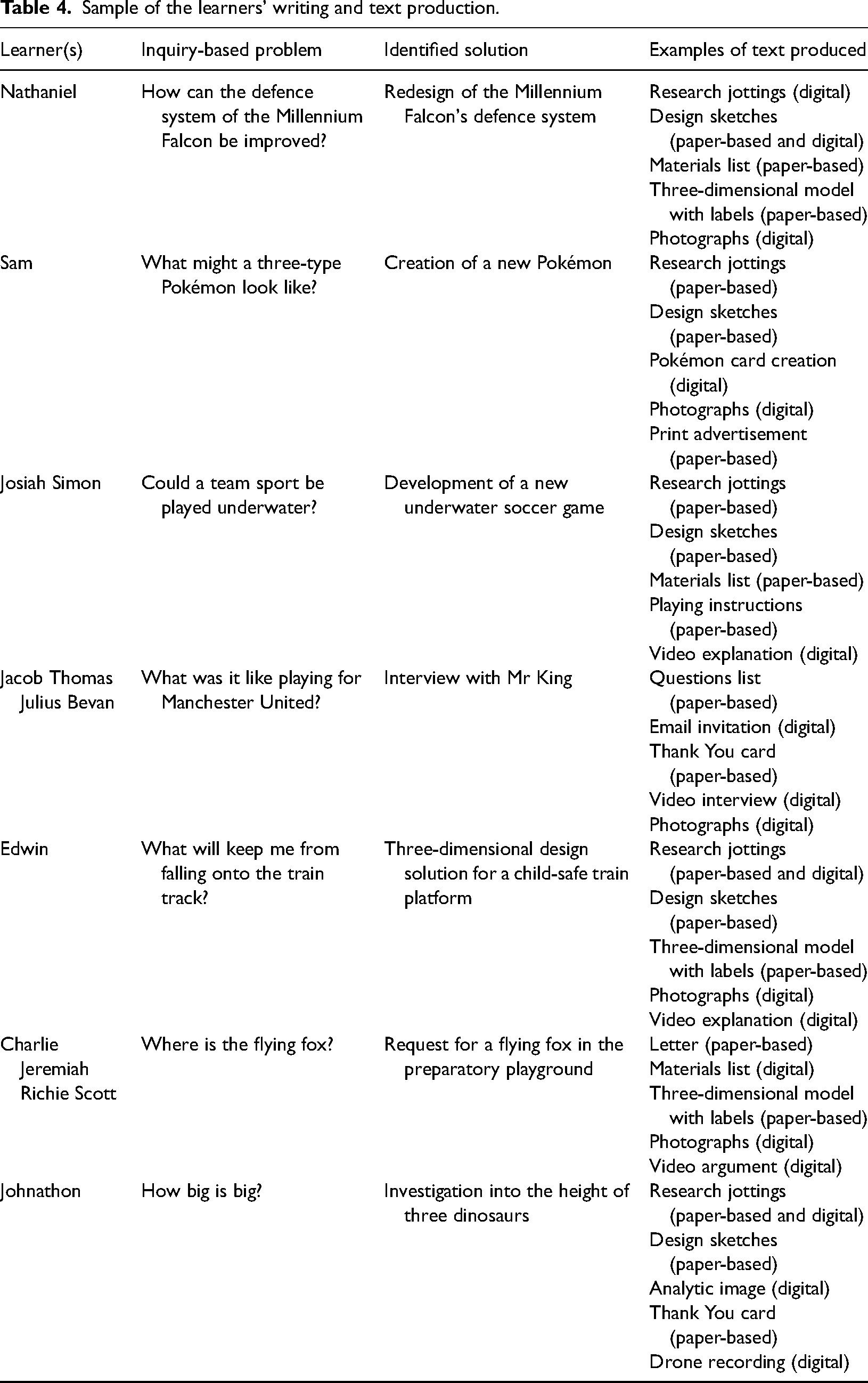
The data provided insight to describe and better understand Miss Nickleby's pedagogic orientation to the assessment of 14 preparatory learners’ writing and text production during the inquiry-based pedagogic approach LAUNCH. Table 4 provides a snapshot of the social, moral and humanitarian inquiry-based problems chosen by the preparatory learners, together with samples of what they produced.
In the context of LAUNCH, the findings indicate that Miss Nickleby used both performance and competence orientations to assessment. Through performance and competence, the learners met expected and unexpected knowledge and skills from Australia's national curriculum. This situation typifies the limitations of binary-type thinking between an educator-led performance orientation, on the one hand, and an inquiry-led competence orientation, on the other. The value of these findings lies in what they can illuminate about assessment practice, not just in the early years, but also across the primary and middle years of schooling.
Sample of the learners’ writing and text production.
Meeting expected knowledge and skills through performance
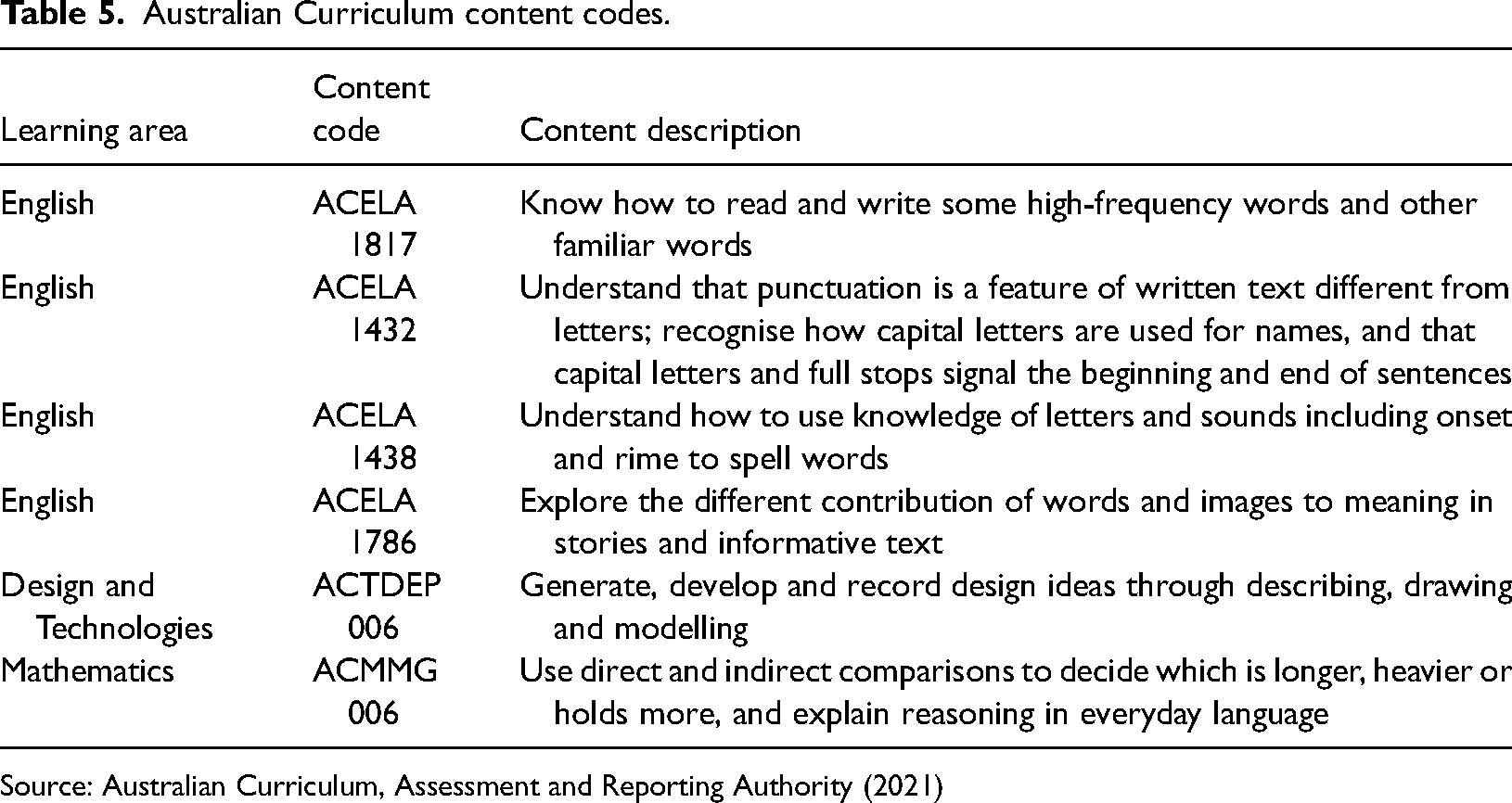
The learners met expected knowledge and skills through a performance orientation to assessment. Visible pedagogies saw Miss Nickleby explicitly teach the Australian Curriculum knowledge and skills (strength of educator–learner pedagogic relationship: F++) that were required to be (re)produced by learners in a predetermined text (strength of assessment criteria: F++). To assess what was produced, Miss Nickleby used predetermined performance criteria to note what was absent or missing. For instance, Miss Nickleby voiced surprise when she saw that, despite explicit teaching, Edwin had not accurately written high-frequency words (‘come’, ‘was’, ‘over’) or subject-specific words (‘train’, ‘track’, ‘safe’) in his research jottings. This was clear in comments such as ‘I don't see the “ck” here’, ‘What's missing?’ and ‘Um, this word is missing the “n”’. So, a performance orientation saw Miss Nickleby note what was missing from Edwin's research jottings based on set English content (ACELA 1817; for descriptions of the Australian Curriculum content codes, see Table 5 ). At this moment, Miss Nickleby decided what needed to come next. Comments such as ‘Okay, we need to go back to look at the word wall’ and ‘Let's look at this again’ were illustrative. A very strongly framed educator–learner pedagogic relationship (F++) saw Miss Nickleby explicitly (re)teach set phonemic awareness knowledge. Here, Miss Nickleby instructed while Edwin watched and listened. Miss Nickleby circled back to Edwin later and commented ‘Great!’ when she noted that he had met the criteria.
Jacob, Thomas, Julius and Bevan also met expected knowledge and skills through performance. When they chose to compile a list of questions asking Mr King, the physical education teacher, about his Manchester United football experience, visible pedagogies saw Miss Nickleby explicitly teach punctuation as a feature of a question (ACELA 1432). Punctuation marks, including full stops and question marks, were explicitly modelled, as were capital letters for proper nouns such as ‘
Australian Curriculum content codes.
Source: Australian Curriculum, Assessment and Reporting Authority (2021)
Meeting unexpected knowledge and skills through competence
Through a competence orientation to assessment, the learners met unexpected knowledge and skills from the Australian Curriculum. The knowledge and skills were not limited to English, but extended into other learning areas such as Science, Mathematics, Design and Technologies, and The Arts. Invisible pedagogies allowed Miss Nickleby to develop the learners’ knowledge and skills in more creative, authentic ways to meet their individual learning needs. As an example, Miss Nickleby championed the notion of Johnathon as active and creative in deciding to use the app Explain Everything to produce analytic images depicting a Tyrannosaurus rex, a Brachiosaurus and a Nothosaurus. Invisible pedagogies saw Miss Nickleby ask open-ended questions, such as ‘What is this?’ and ‘How will I know that this is a T. rex?’ (strength of educator–learner pedagogic relationship: F−). The criteria for the analytic images were loosely defined and negotiable, and not tied to performance criteria (strength of assessment criteria: F−). The criteria were invisible to Johnathon. His comments affirmed this through expression of personal choice: ‘Yeah, I’ll put the words here’, ‘Nah, I think claws go here’ and ‘I can change the colour too. I like blue’. A competence orientation to assessment saw Miss Nickleby look for what was present. Examples of comments reflecting this included, ‘Oh, wow, these [labels] look good’ and ‘Good job on the digraph “aw”’. From this, Miss Nickleby noted that Johnathon met unexpected English content (ACELA 1438 and ACELA 1786).
Furthermore, Johnathon met unexpected knowledge and skills from learning areas other than English. Rather than focus solely on English knowledge and skills, Miss Nickleby's invisible pedagogies permitted Johnathon to ‘explore ways of knowing, solve problems, and create personal meanings’ (Tan, 2018: 241 ; strength of educator–learner pedagogic relationship: F− −). So, when Johnathon decided to copy and paste images of a Tyrannosaurus rex, a Brachiosaurus and a Nothosaurus from Google, the assumption was that he already possessed competences around design and technological knowledge and skills. As Johnathon pinched his fingers to relocate, resize, crop and play around with exposure and brightness, he met unexpected Design and Technologies content (ACTDEP 006). When asked ‘Where did you learn that?’, Johnathon said, ‘I take photos all the time at home. Mum lets me. She showed me how. I use her phone’. Further, the different dinosaur sizes showed that Johnathon met unexpected Mathematics content (ACMMG 006). Comments such as ‘Oh, wow, look at that!’ were indicative of the priority being to observe what was present in Johnathon's produced text (strength of assessment criteria: F− −).
Important considerations
There are two important considerations. The first comes from illuminating the intention and outcome of a mix of performance and competence pedagogic orientations to assessment. For Bernstein (2000: 56), a mix ‘may give rise to what could be called a pedagogic pallet’. A ‘pedagogic pallet’, therefore, permits both performance (educator-led, standardised, visible criteria) and competence (learner-led, open-ended, inquiry-based, invisible criteria) orientations. Visible and invisible pedagogies are vehicles for performance and competence assessment orientations (Bernstein, 2000). Logic, therefore, suggests that a pedagogic model that embraces visible and invisible pedagogies should have a reasonable chance of facilitating performance, with its predetermined, outcome-focused and visible criteria, as well as competence, in which criteria are fluid, learner-led and diffuse. A pedagogic mix of performance and competence, permitted by strengthening and weakening frames, aligns with Luke et al.'s (2005) and Cazden's (2006) theoretical conception of pedagogic weaving. Weaving between pedagogic orientations gives rise to a sophisticated pedagogic fabric that responds to the needs of learners. Importantly, it can be argued that holding one assessment orientation does not mean that the other needs to be abandoned. On the contrary, this study shows that performance and competence orientations do not need to be viewed as mutually exclusive, but rather as complementary. There is evidence to indicate that a complementary mix of performance and competence pedagogic orientations to assessment can prepare learners to sit performance-based assessments in later years, while also cultivating agentic, creative and capable learners via inquiry-based learning.
Early years educators in Australia are grappling with the dilemmas of preparing learners to sit performance-based assessments in later years and their sense of pedagogic responsibility towards designing competency-based assessment. It is critical, therefore, that educators, school administrators and education policymakers encounter ways of seeing and understanding (a) what is a mix of performance and competence and (b) how a mix can be enacted. This is important because if we want learners to show us the breadth and depth of what they know, understand and can do, we must provide evidence of what a rich assemblage of performance-based and competence-based assessments looks like in a learning environment. However, there are reality barriers to gathering such evidence. A growing performance-orientated culture limits opportunities for educators to think deeply about, and pedagogically explore, Bernstein's (2000) idea that mixes can take place. So, this puts educators in a place of tension and precariousness. What can be seen is significant potential for early years educators to default to a performance orientation to assessment, fuelled by a political pursuit of public accountability and transparency. This then becomes most worrying when performativity pressures begin to consistently, and continually, inform understandings of assessment practice.
The second consideration comes from the study's research question, which asks: Which knowledge and skills, framed by performance and competence pedagogies, are assessed during learners’ writing and text production? For Bernstein (1975: 132 ), performance and competence orientations can observe and assess ‘covert and overt’ knowledge and skills. This study revealed the dynamic and, at times, unpredictable interplay between overt (expected, explicit, distinct) and covert (unexpected, implicit, indistinct) assessment. By looking for what was missing or absent from the learners’ texts, Miss Nickleby assessed expected knowledge and skills against set criteria. Unexpected knowledge and skills were also assessed – however, by looking for what was present. Pedagogically, this required flexibility and a willingness to allow the learners to construct different knowledge and skills, in different ways and in different text forms. The effect of this was a significant opportunity for the learners to share what they knew and what they could do within disciplines such as English, Mathematics, Science, Humanities and Social Sciences, Design and Technologies, and The Arts. Such circulation between and within disciplines indicates that the demand to prepare learners for performance-based assessments does not need to result in the abandonment or marginalisation of cross-disciplinary knowledge and skills.
Final thoughts
Design-based research in a case study of an Australian classroom revealed that a mix of assessment orientations allowed 14 five- and six-year-old learners to meet the expected knowledge and skills needed to do well in performance-based assessments and unexpected knowledge and skills. While the study profiled in this article does not aim to generalise findings to other preparatory classroom contexts, it does offer insight into a close study of early years assessment practice. This article adds to current debate, in which educators, school administrators and policymakers recognise the significance of learners’ interests, inherent strengths and competences, but differ greatly in seeing how they can be manifested in assessment practice. So, it seems that the issue of assessment practice in Australia puts the early years of formal schooling in a place of tension. Therefore, it is critical that educators have time and space to pedagogically see and understand that Bernstein’s (2000) idea that a mix of performance and competence orientations to assessment is not only doable but also offers a more expansive idea of what learners know, understand and can do. When educators share their archetypes of mixing pedagogic orientations to assessment, we can build a strong case for change. Therefore, it is hoped that this article contributes to wider international debates about politically driven changes to assessment and their impact on pedagogic change in the early years of formal schooling.
Footnotes
Declaration of conflicting interests
The author declared no potential conflicts of interest with respect to the research, authorship and/or publication of this article.
Funding
The author received no financial support for the research, authorship and/or publication of this article.
