




Abstract
In this article, the focus is on the entangled relations between digital technology, art activities, mathematics, literacy and children in Swedish preschool ateliers. As part of an ethnographic study, the researcher follows how children use digital technologies and non-digital materials (such as shells, pens, paper, wood, bubble wrap and light) to create and make the visual and aesthetic aspects of the technology seen. In the analysis of the children’s play-based and art-oriented activities in the atelier, the subjects of literacy and mathematics become visible. The analytical approach includes the use of sociocultural theory and multimodal theory, and looking at mathematics in accordance with the six organising principles described by Alan Bishop. The results show that the children’s activities with digital technology and non-digital artefacts appear to activate, expand and transform their understanding and use of literacy and mathematics.
Introduction
This article presents some of the results from an ethnographic study of what digital technology – such as projectors, tablets, computers, webcams, digital microscopes and digital voice recorders – and non-digital materials and artefacts can do together with children in Swedish preschool art rooms – here called the school’s ‘atelier’. In Sweden, preschools engage and educate children between the ages of one and five, after which they start preparation class, which is the first step in Sweden’s 10 years of compulsory schooling.
The focus in the main study has been on how the use of digital technology and non-digital materials and artefacts corresponds with visuality, creativity and aesthetic expression. However, in this article, the focus is on the results relating to the specific events in which mathematics and literacy became visible in the art activities in the preschool ateliers, and the following question is central: How does the multimodal encounter between non-digital artefacts, digital technology and art activities in the atelier support children’s literacy and mathematical thinking?
The main study was based on two prerequisites, both of which can be seen as preconditions for the teaching that is conducted in the Swedish preschool today. One is the inheritance and inspiration from preschools in Reggio Emilia, Italy; the other is a change in the curriculum in which ‘digitalisation’, ‘adequate digital skills’ (Swedish National Agency for Education, 2018: 10) and the use of digital technology should now be included in preschool education. The concept of digital competence is also associated with creativity, aesthetic expression and learning in the curriculum (Swedish National Agency for Education, 2018: 9) – something that further links the study’s two main prerequisites.
Reggio Emilia and the aesthetic
For some 40 years, education in the Swedish preschool has been inspired by the work conducted in preschools in the Reggio Emilia region (Reggio nell’ Emilia) of Italy. The philosophical and pedagogical approach of Reggio Emilia focuses on how children experience and explore relations in the world. This approach starts with the child and is child-centred. By following how children relate to humans and non-humans, and by listening to children’s voices and trusting their capacity to become democratic citizens, new and altered modes of knowledge production have occurred. Learning is here acknowledged as an outcome of children’s competencies, play and exploration, rather than an outcome of pre-given instruction and teaching (Giudici et al., 2011; Häikiö, 2007; Karlsson Häikiö, 2018; Rinaldi, 2006; Vecchi, 1993, 2010; Vecchi and Giudici, 2004). In both Italy and Sweden, children’s work in the arts is used to show aesthetic aspects and dimensions of learning, and indicate their knowledge development and ability to express opinions (Giudici et al., 2011; Karlsson Häikiö, 2018; Vecchi, 2010; Vecchi and Giudici, 2004). The heritage from Reggio Emilia (i.e. the Swedish interpretation of the work in Reggio Emilia) can be seen in the preschool curriculum (Swedish National Agency for Education, 2018) and in the daily work in many preschools.
Working with the arts concerns creativity and is central to the development of new knowledge (Hunter-Doniger and Sydow, 2016). An education that includes working with the arts and aesthetic expression also offers ‘the ability to open up new ways of seeing, thinking and learning’ (Bahrum et al., 2017: 645).
Mapping the field
Research on digital competence and the use of digital technology in the preschool takes one of its starting points in discussions about digital competence as a key competence for lifelong learning (Letnes, 2016). It also focuses on the development of digital skills through play activities and how this can affect learning, knowledge development and/or different aspects of learning support (Arnott, 2017; Arnott et al., 2019; Burke and Marsh, 2013; Danby et al., 2018; Kjällander and Moinian, 2014; Letnes, 2016; Yelland, 2011, 2018).
Digitalisation strategies and the societal focus on digital competence are transforming the education system as a whole, and require new educational strategies and skills in digital technology. Digital competence also needs to be seen as broad and multidimensional in education research (Danby et al., 2018; Yelland, 2018). The Swedish national strategy for digitalisation (Swedish Government, 2017) states that children and young people need adequate digital skills; that all children in every part of the school system must be given opportunities to develop digital skills; and that preschool children should be encouraged to work with the appropriate digital tools. In the study presented in this article, the two aspects of appropriate and adequate use are in focus.
Digitalisation and play
Digital technology is already part of the education offered in many of the world’s preschools. Preschool children’s everyday lives are in many ways already technology-rich, digital and visual. Even very young children take part in digital and virtual worlds, virtual spaces and digital platforms, use applications on digital screens, and play games on computers and tablets (Arnott, 2017; Danby et al., 2018; Fleer, 2018; Kjällander and Moinian, 2014; Plowman et al., 2010).
Games on tablets can facilitate the development of a minority language and stimulate and develop learning in the area of mathematics (Petersen, 2018; Schacter et al., 2016). Children’s artwork can encourage communication and thereby become part of their learning processes in the area of literacy (Bendroth Karlsson et al., 2018). The use of tablets can reveal and develop writing competence that is not apparent in more conventional writing activities (Flewitt et al., 2015). Using different applications and software with a focus on learning in mathematics can stimulate preschool children to share experiences and facilitate the collective learning of mathematical concepts in the areas of geometry, quantity and counting (Jung and Conderman, 2015; Özçakir et al., 2019). In this way, mathematics and literacy development go hand in hand in the preschool’s educational practices when using digital software.
The techniques and applications offer innovative solutions and use a range of modalities to communicate, inspire and instruct children. Digital technology thus has a central place in the visual culture that is constructed and that constructs our perceptions and understanding of preschool children’s lives. Children become media producers by taking photographs, creating books and producing films (Dezuanni, 2015; Magnusson, 2018; Mertala, 2016). The digital products that result from the technology can combine the real world with the virtual (Stephen and Plowman, 2014). Digital technology is both a tool that works with the visual and a tool for visualisation – and sometimes these work simultaneously. However, when it comes to previous research, it would seem that the capabilities and capacities inherent in the technology, beyond applications and games, have been less explored.
The activities in the preschool are traditionally understood as play-based. Education in early childhood settings is also less formalised than that in the later school years. This also affects the use of digital technology (Bird and Edwards, 2015; Danby et al., 2018; Fleer, 2018; Marsh et al., 2018; Verenikina and Kervin, 2011; Yelland, 2018). According to Edwards (2013), in the preschool, digital technology can challenge educators in their daily practices and can be seen to compete with more traditional play activities. In contrast, Plowman et al. (2010) found that children do not differentiate between digital play and non-digital play, which means that digital play can support activities in non-digital play, and vice versa. Following this thread, it may be possible to assert that there is no given division between virtual play and more traditional play.
Children can use non-gaming applications to play, and turn them into games by using their own former experience of play and gaming. By doing this, children act as competent users of digital technology and can incorporate the technology into their everyday contexts (Huh, 2017). In this way, children can also negotiate the didactic design of games and change their content or goals (Kjällander and Moinian, 2014). The idea that play and play-based learning are associated with the use of digital technology is essential when it comes to answering the research question in this study. Another essential prerequisite is that different types of digital technology are used in connection with the artwork and aesthetic activities in the preschool ateliers.
Theoretical framework and analytical approach
The theoretical point of departure framing the analysis conducted in this study is based on a sociocultural understanding of the events taking place between the children, the digital technology and the art activities carried out in the atelier. A central premise in a sociocultural perspective is that human activity is always situated in a cultural and historical environment or, as in this study, in an institutional environment (e.g. Wertsch, 1991). This implies that children develop a social and cultural understanding of the world, where language and other cultural communication activities play a central role (Säljö, 2005; Vygotsky, 1978). Communication and interaction are critical factors in children’s social and cultural learning (Rogoff, 2003; Säljö, 2005; Vygotsky, 1978). Children use artefacts, non-human objects and elements to communicate with each other and with adults, which means that their communications are based not only on the spoken language, but also on their interactions with objects and artefacts.
According to Vygotsky (1978), learning takes place through an internalising process, first at a social level (interpsychological) and then at an individual level (intrapsychological). In this way, learning is mediated through human relations and the sociocultural tools and signs that the child accesses. These tools can be artistic, bodily and intellectual (Miller, 2011; Vygotsky, 1978), and are visible in the teaching and learning settings in Reggio Emilia, based on, among other things, their influence in Vygotsky’s work. Children’s learning takes place in meaning-making processes in a sociocultural context, and it is here that Vygotsky’s concept of the zone of proximal development is central. Children learn and develop knowledge and thinking in collaboration with more competent peers and under the guidance of adults. The zone of proximal development is the potentiality in the children’s learning processes, the next level in knowledge-building, the span between a child’s ‘actual developmental level . . . and the higher level of potential development’ (Vygotsky, 1978: 86).
The theoretical framework of a sociocultural perspective provides an opportunity to follow children’s ‘playful exploration’ (Yelland, 2011: 6) of mathematics and literacy in their art practices in the ateliers.
Analytical tools
The sociocultural perspective is the foundation on which Bishop’s (1991) idea of six universal mathematical activities, together with multimodal theory (Jewitt, 2011; Jewitt and Kress, 2003; Kress, 1997, 2010; Kress and Van Leeuwen, 2006), structures the analytical apparatus. Bishop’s (1991) six mathematical activities are applied in order to analyse the events in the data concerning the mathematical aspects of the children’s use of digital technology. Multimodal theory is applied to analyse and highlight the literacy events. In the analytical work, this is an entangled analytical process, in that the events involving mathematics and literacy are not always distinct.
Bishop (1991) saw a link between mathematical thinking and the development of language. In this way, mathematics becomes cross-cultural and should be seen in connection with other cultural and social activities. Bishop’s (1991: 100–103) six mathematical activities are counting, locating, measuring, designing, playing and explaining. Counting includes what we often think of as mathematics and thinking based on probability and chance (100). Locating concerns spatial geometry, such as the making or reading of a map, and conceptualising by making models or diagrams. Measuring is about comparing and arranging by size or quantity, while designing concerns geometric shapes, scaling up and down, and identifying and repeating patterns. Designing also includes working with symmetry and proportions (102). Playing includes the use of fun and imagination in connection with the development of mathematical thinking, and can also mean following the rules or renegotiating them, thereby enhancing the development of hypothetical reasoning. Moreover, children can develop implicit knowledge about aspects of mathematics while playing. Explaining includes explaining and describing mathematical events with mathematical language and making logical connections and classifications (103).
In research using multimodal theory, spoken and written language are just two of several ways that humans communicate. Kress (2010: 32) states that ‘communication is multimodal’ and that multimodal communication has an increasingly widespread place in our society. Different modes, signs, symbols, pictures, character systems and gestures are resources that acquire meaning in the social and cultural context (Jewitt, 2011; Jewitt and Kress, 2003; Kress, 2010). Various modes offer diverse ways of communicating and also offer various communication potentials in that different modes always work together in ‘modal ensembles’ (Kress, 2010: 28).
In a broad sense, language is seen as a combination of different signs, gestures and character systems. Language as a communication act is therefore complex and can be expressed in many different ways (Kress, 1997, 2010; Kress and Van Leeuwen, 2006). In research that includes young children, spoken language and written language are often the less used modes of communication. In research conducted together with young children, bodily gestures, sounds and pictures are more active and essential forms of communication. Due to this, the multimodal theory works particularly well in research involving younger children.
Data production and methodological strategies
An ethnographic method has been used to produce data in the study and is a combination of long-term ethnography (Atkinson and Morriss, 2016; Hammersley and Atkinson, 2007) and short-term ethnography (Pink and Morgan, 2013). The long-term approach was conducted in one preschool’s atelier and the short-term approach in four different preschool ateliers. The five ateliers are located in preschools in city and rural areas of Sweden. The term ‘atelier’ is a common concept in the Reggio Emilia context and has also now been adopted by Swedish preschools to describe and name the room in which creative aesthetic processes and work with the arts take place (Karlsson Häikiö, 2018; Vecchi, 2010).
Participants and data production
The study was designed so that I, as the researcher, followed and observed different groups of children in one atelier for 18 months. The visits occurred at least twice a month and the observations lasted for about two hours on each occasion. In the first year, I also visited four other ateliers to do what Pink and Morgan (2013) call ‘short-term ethnography’. In this study, the short-term visits included one or two visits to each of the four ateliers. The events in all five ateliers were implemented and led by a specialised educator – that is, an atelierista. An atelierista is an artist or a preschool educator with a professional interest in arts education, and has competence in working with arts and aesthetic expression (Häikiö, 2007; Vecchi, 2010). The study as a whole involved around 50 children and 5 atelieristas, and all of the data produced focused on and followed events that included digital technology and non-digital artefacts in different ways.
The data that was produced in the short-term ethnography was collected with four atelieristas who I had met as an educator in art education at university. This data was a convenience sample (Cohen et al., 2011) based on my interest in the ongoing project in the four different ateliers. I came across the long-term-ethnography atelier via a gatekeeper working as a central atelierista at the municipality level in a metropolitan region of Sweden.
A handheld digital camcorder was used to produce the data and to follow the visual events, the ongoing relationships between the children, the technology and the non-digital materials in the ateliers. The visual data that was produced also consisted of photographs taken on a mobile phone. The use of photography and digital video recordings made it possible to revisit the data on repeated occasions (Fleer and Ridgeway, 2014). In all, about 40 hours of video data and some 300 photographs were produced in the study as a whole.
The design of the study and the formulation of the research problem were ethically approved by the regional ethics review board and followed the ethical guidelines for research with young children (CODEX). As the study was conducted with young children aged three to four, their guardians approved the children’s participation. However, as young children do not sign consent forms, the ethics when producing data with young children is seen as an ongoing relationship between the children, adults, place and artefacts in the ateliers (Magnusson, 2018).
Analytical approach
In an ethnographic approach, there are no pre-given steps for the analytical work, and the analyses can start during the fieldwork (Cohen et al., 2011; Hammersley and Atkinson, 2007). In this study, the analysis started during the production of the data. The literacy and mathematics events surprised me and made me curious in that they seemed to ‘glimmer’ and ‘glow’, as MacLure (2010: 282) puts it. They attracted my attention and made me want to follow them more intensely.
The data presented as narratives under the following heading comes from the analysis that was conducted while looking at the video recordings (e.g. Cohen et al., 2011). Some of these events already ‘glimmered’ during the fieldwork, while others only became visible in the analytical work when looking at the visual data.
Results and analysis
The goal of presenting the results of the study is to show the learning that occurs when the children move with and towards the digital technology, non-digital materials and artefacts. In this way, aspects of possible knowledge development in the subjects of literacy and mathematics are seen in the social and cultural communication between the children, the non-digital artefacts and the digital technology in the atelier.
Narration 1. Transformation of shadows in the light of a projector
In one atelier, MaryAnn and Elsa (fictitious names) are looking at a visual projection of a microworld on a large screen. The microworld consists of things that have been placed and arranged by the children on a low table. The world is then visually reproduced on the screen by a webcam connected to a projector. After a while, MaryAnn and Elsa move their bodies into the open space between the screen and the table. They move their bodies slowly, as if they were dancing (Figure 1). Elsa says: ‘I’m taller than you’. MaryAnn looks at the two shadows on the screen and says that Elsa is not. Elsa stops moving and looks troubled. She then places her hand on MaryAnn’s shoulder (Figure 2). Elsa discovers that MaryAnn is right; she is not as tall as MaryAnn. Elsa tries to solve the problem of their discrepancy in height by taking one step away from the screen while at the same time moving her body closer to MaryAnn’s. Then, they both start to laugh while looking at the screen, and exclaim in unison: ‘We are the same height!’
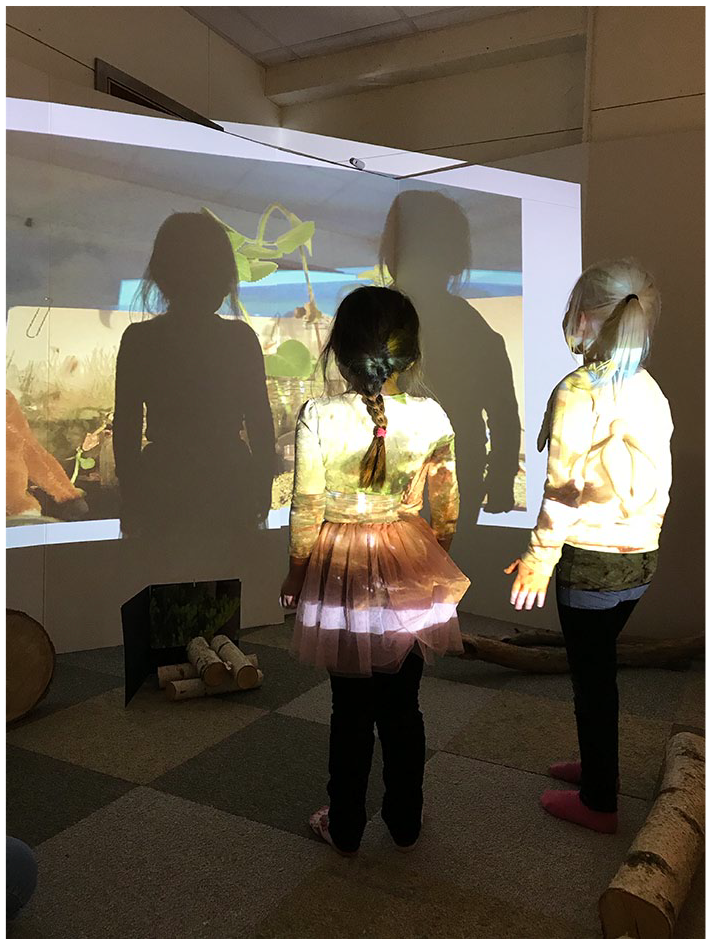
MaryAnn is taller than Elsa.
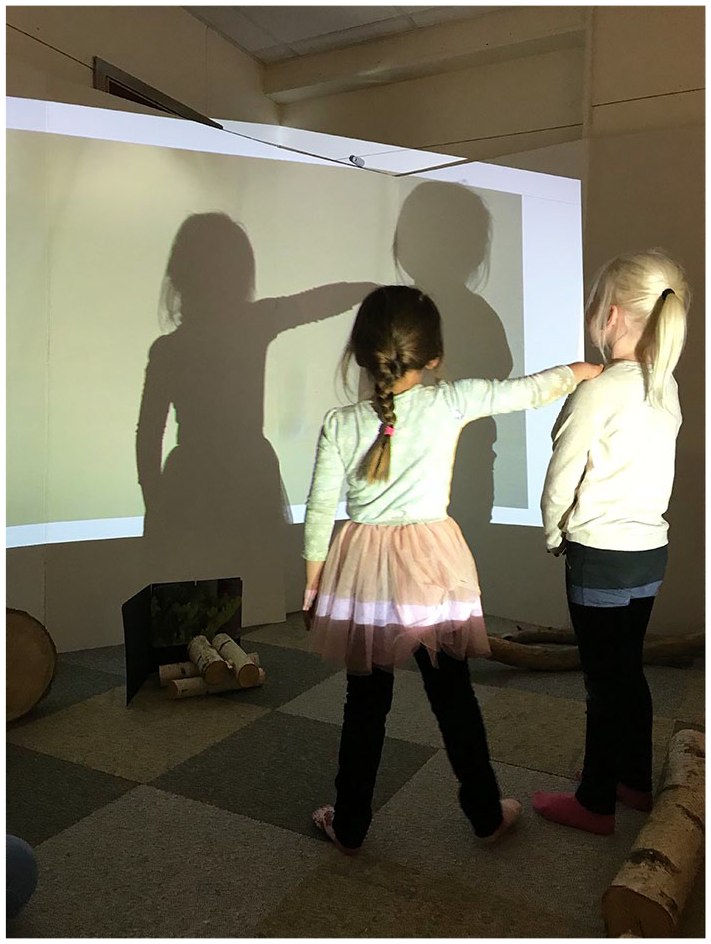
Elsa tries to find out if they are the same height.
The two children continue to move back and forth, and discuss the fact that their shadows change in form and length. After a while, they call out to a peer, Thomas. He has been watching the girls and following their movements. Now, MaryAnn and Elsa try to explain their insights about form, height, width and their consequences. Thomas starts to take part in the transformation of shadows and the mapping of height.
Narration 2. Seeing the world through a webcam
Five children have just entered one of the ateliers and are looking at a table on which there are computers, a webcam and digital microscopes. The webcam is connected to a projector, which in turn reproduces the images from the webcam on a screen on one of the atelier’s walls. The atelierista invites the children to try out the technology. One of the children, Isak, who has not yet mastered the Swedish language, looks at the table and then grabs the webcam without saying anything. He walks around the atelier pointing the webcam at the different artefacts and materials related to the children’s work with aesthetic expression. The rest of us can now see the artefacts that the webcam directs onto the screen. The children and the teacher start to name them: a book, stamps, a brush, pearls, moss, wood, a dinosaur and a skeleton. Isak turns around, smiling, and continues to direct the webcam at the objects on the atelier’s shelves. At the same time, he very quietly repeats what the others are saying.
Narration 3. The writing and capturing of sound
A table in the middle of one of the ateliers is surrounded by bookshelves on which there are different types of materials, such as the more traditional artists materials of watercolours and brushes, and recycling material like bubble wrap. There are also different kinds of materials on the table – cellophane, pieces of wood, shells, pen and paper – as well as a piece of digital recording equipment with a speaker and a microphone. The atelierista tells the four participating children and their teacher that she has a plan for today’s activity, which has to do with sound. The atelierista then invites and encourages the children to become sound producers. All the children have brought a drawn fantasy figure with them. The atelierista says that first they are going to invent a sound for their figure and then they are going to record it with the help of the digital equipment. She encourages the children to find something in the room that sounds like the figure in their drawing, to try the sound out and then come back so that they can draw a sound map for how the sound is to be recorded.
The children walk around, looking, touching, tapping and holding different things. They also try out sound combinations with different objects and make different series of sounds. After a while, one of the children, Patayk, finds a relatively large piece of bubble wrap with the help of another child. He starts to jump on the bubble wrap, which makes a loud noise every time the bubbles burst. Patayk stops and looks around. He finds additional wrapping material with bigger bubbles and starts to jump on this as well (Figure 3). He notices that the bursting sound from the big bubbles is different than that from the smaller ones. He returns to the table to draw his sound map.
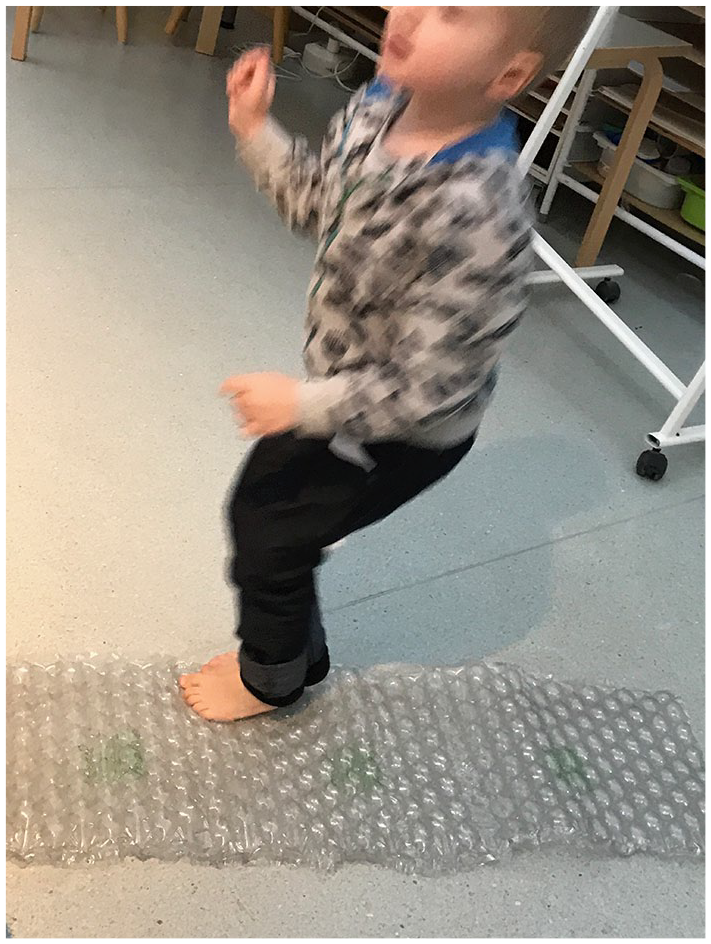
Patayk jumping on bubble wrap.
The atelierista tells Patayk to divide his piece of paper by drawing a line down the middle. He then starts to draw large circles on one side of the paper. He counts from 1 to 12 when drawing the big circles. Then he moves back to the floor and starts jumping on the bubble wrap consisting of small bubbles. He jumps and then looks up. He jumps again. Then he returns to the table and starts to draw lots of tiny dots on the paper (Figure 4). This time, he does not count but instead moves the pen up and down, up and down.
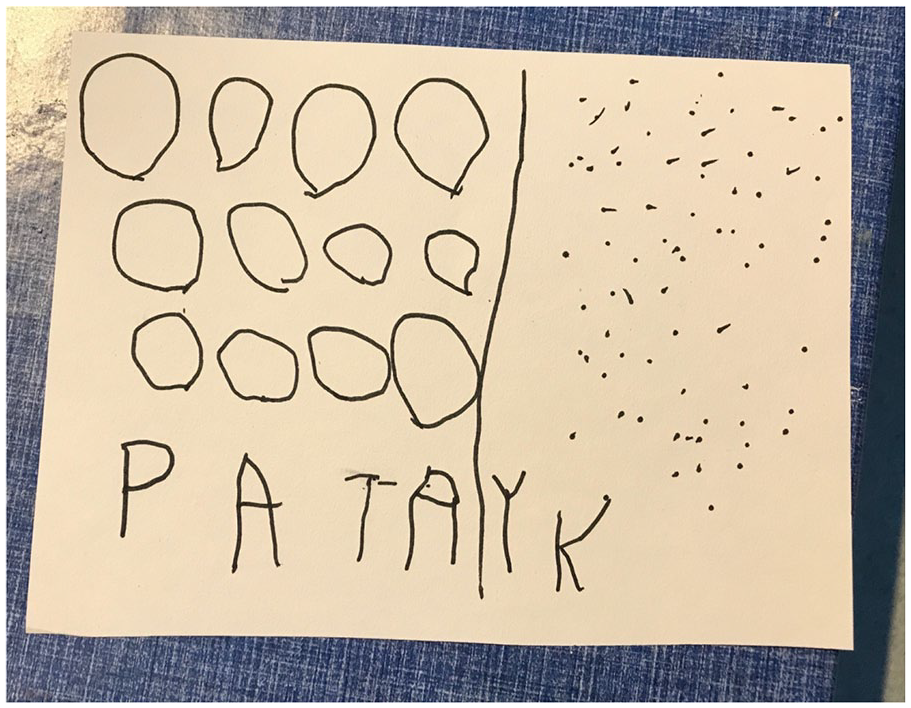
Patayk’s sound map.
An analytical approach to the presented data
In the three narrated examples above, the children, their bodies, their senses, different artefacts, the digital technology, the children’s interactions, curiosity, and their way of showing competence and interest are in focus. The development of possible learning takes place in the children’s interactions with digital technology and the non-digital artefacts. The possible learning is situated in the social, cultural and institutional environment (Säljö, 2005; Vygotsky, 1978; Wertsch, 1991).
When MaryAnn and Elsa (Narration 1) move with their shadows, they examine together the production of knowledge in three areas of mathematical activity (Bishop, 1991) by comparing size and height, designing, and scaling their shadows up and down and experimenting with proportions. By playing, they develop hypothetical thinking. The children combine and explore the mathematical activities using gestures and words (e.g. Özçakir et al., 2019). In this way, the mathematical activities are articulated and communicated in various modes (Bishop, 1991; Jewitt, 2011; Kress, 2003, 2010). By using these modes, the children also awaken Thomas’s curiosity and they all, in different ways, move within the zone of proximal development from actual knowing to a higher level of knowing (Vygotsky, 1978). This can also be said to be happening in the events in Narration 2, where Isak, with the support of the technology and together with more capable peers and the teacher, develops literacy competence by using the webcam as a visual mode of communication (Jewitt, 2011; Kress, 1997, 2003, 2010).
In both Narration 1 and Narration 2, an internalising process takes place from the social to the individual level. The process of learning is mediated through human relations and the use of different sociocultural tools (Miller, 2011; Vygotsky, 1978). In both narrations, the outcome of the visualising capacity in digital technology is in focus. Here, the use of digital technology in the atelier facilitates creative thinking and opens up for possible knowledge development in both mathematics and literacy.
In the third narration, the aspects of sound, digital recording and map-making are central. Patayk explores the different sounds made by jumping on the large and small bubbles. He then makes a sound map to visualise his plan for the upcoming recording. When drawing the circles and tiny dots, Patayk uses his bodily experience of sound and transforms it into a visualising map. While doing this, he connects different modalities in an ensemble of modes (Kress, 2010). In this way, he acquires knowledge about the mathematical activities of counting, locating and designing (Bishop, 1991), and also experiences how the creation of a sound map is important for recording a sound. As he prepares his map, he connects different modes of communication: the body, the sounds and the making of the sound map. He explores in a playful way (Yelland, 2011), encouraged by a peer and the upcoming recording of the popping bubbles. The aesthetic expression of making sounds and drawing a map leads to new and creative ways of thinking (Bahrum et al., 2017; Vecchi, 2010), in that Patayk combines bodily movement, sound and mathematical thinking with a communication act that includes drawing. In the three narrations, MaryAnn, Elsa, Isak and Patayk combine intellectual, bodily and artistic tools in the atelier (Miller, 2011; Vygotsky, 1978).
Concluding remarks: moving through light, literacy, mathematics, sound and projections
The atelierista engages the children in their encounters between the non-digital materials (artefacts) and the digital medium (technology) by challenging them to explore the digital technology as capturing sound and as a visualising and visual medium in their aesthetic explorations and processes. Knowledge development is thus made possible without a pre-given expectation of what is to be taught or learned (e.g. Häikiö, 2007; Karlsson Häikiö, 2018; Vecchi, 2010; Vecchi and Giudici, 2004).
In the atelier, digital and non-digital forms of expression have an opportunity to meet. In the results, I distinguish between the non-digital and the digital by assuming that the former consists of certain preconditions and expressions – for example, with a red chalk you can draw a red line. Digital technology, in turn, brings possible meanings and expressions into the context. In this way, the capacity in the digital technology takes part in the transformation of the work carried out in the atelier. The encounter between digital and non-digital forms of expression provides opportunities for aesthetic transformations to emerge.
One of the main results is that when children are engaged in aesthetic activities in the atelier, they acquire knowledge about literacy and mathematics by using digital technology and non-digital artefacts. The results also show that digital technology can be used as a medium that develops and transforms knowledge in the areas of mathematics and literacy. The aesthetic practices in the atelier thus stimulate aspects of knowledge development other than those in the aesthetic field. These results align with studies that have been conducted in preschools associated with Reggio Emilia (Häikiö, 2007; Karlsson Häikiö, 2018; Vecchi, 2010; Vecchi and Giudici, 2004).
That learning whilst using digital applications and games contributes to mathematical and literacy competence has been confirmed by previous research on the use of digital technology in preschools (Flewitt et al., 2015; Jung and Conderman, 2015; Özçakir et al., 2019; Petersen, 2018; Schacter et al., 2016). However, a significant difference in this study is that the games or other applications that are usually pre-programmed in the technology are not in use. In this way, play-based explorations of other capacities in the technology are in focus.
The children negotiate the more common use of digital technology in the preschool ateliers by developing new competencies. They develop adequate digital skills (Swedish National Agency for Education, 2018) and examine what the digital can be and contribute in the atelier by using creative play and playful explorations (Giudici et al., 2011; Hunter-Doniger and Sydow, 2016; Karlsson Häikiö, 2018; Vecchi, 2010; Vecchi and Giudici, 2004; Yelland, 2011). Digital technology and non-digital artefacts thus support learning in new ways.
In the three narrated examples, the aesthetic events activate ‘the ability to open up new ways of seeing, thinking and learning’ (Bahrum et al., 2017: 645) in the subjects of mathematics and literacy. Here, the creation of new knowledge is entangled with the children’s creativity (Bahrum et al., 2017; Hunter-Doniger and Sydow, 2016), and their capacity to acknowledge new abilities occurs first at a social and then at an individual level (Miller, 2011; Vygotsky, 1978).
The children make use of digital technology as a multimodal (Jewitt, 2011; Kress, 2010) and multidimensional functionality that broadens the capacity of and within the technology. In this way, the children extend the boundaries of digital technology in early childhood education. The playful access to digital technology enables the children to become both users and producers, and the lively use of digital technology in the atelier develops their capacity to learn and develop knowledge.
Footnotes
Funding
This research has been founded by University of Gävle, Sweden.
