




Abstract
Traditional games are commonly understood for their long establishment, passed down over generations and characterised by the simplicity of their materials. The aim of this article is to explore traditional games where materials are at the centre, focusing on games with stones. Through a new-materialist perspective, using Barad’s concept of ‘intra-activity’ and Lenz Taguchi’s notion of ‘performative agency’, stones are not seen as passive things or objects for play. Rather, they are considered as an active player of the games. A case study of a multi-age classroom in a primary school in Yogyakarta, Indonesia, is analysed. Different encounters with stones are read diffractively to create a space for new ideas to emerge. Through this reading, performative understanding as a new way of looking at traditional games is explored by addressing the complex relations with stones and the continuous intra-activity that takes place in the games. The implications of this research are the consideration of materials and how they are used in traditional games. This, in turn, affects pedagogical practices in which children and materials are coexisting and affecting each other in a learning process.
Introduction
Children’s games are a subject of great interest among researchers (Iswinarti, 2015; Kovačevič and Opić, 2014; Louth and Jamieson-Proctor, 2019). This includes traditional games, which have been widely studied with a focus on their characteristics of having existed for a long time, transmission across generations, and embeddedness in a particular social and cultural context (Howard, 2005; Kovačevič and Opić, 2014; Mawere, 2012; Pramanik and Bhattacharya, 2018; Sierra and Kaminski, 1995; Sujarno et al., 2013). Substantial studies have provided details of traditional games, including the types and procedures of games, objects and tools used in games, and cultural relevance attached to games. However, the knowledge generated from these studies has mainly focused on what games are and overlooked what games do or perform. This article, therefore, offers performative understanding as a new way of looking at what games can do by bringing forward material aspects – stones in particular. Drawing on a new-materialist perspective (Barad, 2012; Coole and Frost, 2010; Lenz Taguchi, 2014), it foregrounds and extends the body of work that views both stones and children as part of nature and equally constituting each other in their relations (Merewether, 2019; Rautio, 2013; Somerville, 2020). In her important article about children’s autotelic play with stones, Rautio (2013: 395) makes the point that ‘most humans, regardless of cultural or geographical determinants, if physically able to do so, pick up stones every now and then’. In this research, encounters with stones happened in the context of traditional games – a more structured aspect of material practice than that discussed by Rautio.
Stones hold a particular attraction for children. They can fascinate children spontaneously and make them engage in repeated encounters (Merewether, 2019; Rautio, 2013). This engagement in everyday life is intrinsically motivating and rewarding, since the acts of picking up, collecting, cleaning, carrying, stacking, throwing or moving stones are an end and the goal itself (Rautio, 2013, 2014). Stones are not seen as inert and passive things in any encounter in the abovementioned acts, but instead are active and agential (Bennett, 2010). In this research, stones play a significant role in the activity (Rautio, 2013), and they are considered as an active player of the games, having power and agency to act on others and the world (Lenz Taguchi, 2010). Recognition of the active role of stones becomes the underpinning notion on which the discussion in this article draws. This may potentially contribute to the literature of traditional games, since the material world, although widely acknowledged, is often positioned as peripheral or in the background of human action (Duhn and Grieshaber, 2016; Hultman and Lenz Taguchi, 2010). Like in the game of dakon, the Javanese version of mancala, stones are commonly seen as objects used by children who are playing the games.
Adopting the new-materialist concepts of ‘intra-activity’ (Barad, 2007, 2008) and ‘performative agency’ (Lenz Taguchi, 2010), the discussion focuses on acts that stones perform, which can blur the boundaries among different elements of traditional games. This allows agency to be distributed in between children and the materials (Duhn and Grieshaber, 2016), as well as the surroundings (Rautio, 2013) and different bodies (Hultman and Lenz Taguchi, 2010). This agency emerges through mutual engagements and relations during encounters in the games. A diffractive reading of different encounters with stones is done to bring together seemingly random unrelated and multilayered subjects and ideas (Bone, 2019b; Fox and Alldred, 2015), including the cultural significance attached to stones in a particular context. Unlike in western culture where stones are often perceived as mundane and inactive (Merewether, 2019), in Indonesian culture, stones are considered to have a ‘vital force’ (Janowski, 2020: 114) that is powerful and significant to their surroundings. Establishing connections between different ideas is an experimentation in thinking with new-materialist concepts to open up unlimited possibilities for new thinking to emerge (Rautio, 2013; Somerville, 2020), particularly in conceptualising and understanding traditional games. This article therefore asks: What can stones do to children and what can they make children do? We wonder how this explorative question might disrupt and unsettle the firm and long-established understanding of traditional games.
A new-materialist perspective: uncovering new thinking about traditional games
The saturation of a common understanding of traditional games is evident in the existing literature. Research about games predominantly discusses cultural aspects of games and how they change or remain the same across time (Pramanik and Bhattacharya, 2018; Sujarno et al., 2013), and their function to facilitate children’s learning and development (Fang et al., 2016; Iswinarti, 2015; Kovačevič and Opić, 2014). This familiar conceptualisation of traditional games has been established for a long time and remains unquestioned. As a consequence, what is known about games tends to tell approximately the same story. The danger of a single story is that it ‘creates stereotypes, and the problem with stereotypes is not that they are untrue, but that they are incomplete’ (Adichie, 2009). In a learning context, while this aspect of games is still important, it potentially overlooks the complexity of children’s relationships with nature in learning (Alcock and Ritchie, 2018).
New materialism goes beyond categorisations or binaries in educational inquiry (Lenz Taguchi, 2010, 2014) – such as theory/practice, human/non-human, animate/inanimate, nature/culture, matter/discourse – while simultaneously exploring new ways of understanding and embracing the complexity of the issues being studied (Coole and Frost, 2010; Rautio, 2013). In the context of education for young children, a number of scholars have adopted the perspective of investigating the entanglement of relationality among children with non-human and more-than-human elements (Hackett and Rautio, 2019; Iorio et al., 2017; Rautio and Jokinen, 2016; Somerville, 2020), which unsettles the taken-for-granted notion of human power and agency as the only driving force of learning. Taking the perspective of the material is particularly important to make visible that objects and materials have the capacity to act on and play with children, and make children act or perform in certain ways. Rautio (2013: 400) claims that ‘the evident inability of human language to fully capture a perceived and felt relation to environment [is] proven relevant’. Materials, unlike language and signs, can basically uncover and provide an unlimited potential of meanings (Rautio and Jokinen, 2016). Therefore, the new-materialist concepts of intra-activity, performative agency and diffraction are particularly important in this article as analytical tools in looking at the material aspects of games, as further explained in the following sections.
Intra-activity
Developed from the notion of Karen Barad’s (2007, 2008) intra-action, intra-activity reflects ongoing interconnections and mutual influence among different components throughout the playing of traditional games. As Barad (2007) explains, intra-action is a concept that denotes the entanglement of agencies that mutually constitute each other. Unlike the commonly known ‘interaction’, in which the comprising elements are distinct individual agencies that come before the interaction, intra-active agencies do not exist separately beforehand; rather, they emerge through the intra-action (Barad, 2007). A significant conceptual shift in thinking with this concept in educational research is that it flattens out the hierarchy among different components of the phenomenon being explored. Intra-action sees all components as equally important in constituting a phenomenon and simultaneously constituting each other (Barad, 2007). Further, Barad (2008: 141; our emphasis) highlights that ‘[a]ll bodies, not merely “human” bodies, come to matter through the world’s iterative intra-activity – its performativity’. It lays the foundation for a performative understanding that focuses on the importance of practice, doings and actions (Barad, 2008).
Applying intra-activity in the context of the game of dakon, attention should be given to both the children and the materials of the game – the stones. As Lenz Taguchi (2010) argues, an understanding of multiple materials and children’s relations with those materials makes visible the agency of materials in the learning process that emerges in continuous intra-active processes. This intra-active approach to learning offers a new insight into understanding a learning process which is open to possibilities that are never singular but always multiple. It also creates a space for unpredictability about what might come next in any encounter in the playing of a game.
Performative agency
From a new-materialist perspective, agency is formed in complex relations between the human, non-human and more-than-human, and is ‘about response-ability, about the possibilities of mutual response’ (Barad, 2012: 55). Instead of being attached as a fixed attribute or possession, agency emerges through relations, flows, and is subject to change and transformation. Agency in the context of traditional games emerges through interconnection and interdependency among things, organisms and entities of any kind (Rautio, 2013).
Acknowledging all living organisms and the material environment as important in the learning process, Lenz Taguchi (2010) introduces the notion of ‘performative agency’. This notion views all existences, things and artefacts, spaces and places, as well as children and educators, as performative agents. Their agency is ‘emergent within moving assemblages in which bodies and other elements are intra-actively entangled’ (Ivinson and Renold, 2013: 717). Adopting this concept makes it possible to highlight the capacity of stones to be an active player in a game of dakon – not only paying attention to what they are and how they emerge in the game, but also looking at what they do and how they connect intra-actively with other components of the game.
Diffraction
Diffraction is a key concept of knowledge production described by Barad (2007, 2014), the basic understanding of which can be gained through comparison to reflection. Reflection, simply put, is a process of mirroring an object that results in a similar object, with a focus on sameness (Bozalek and Zembylas, 2017). Diffraction, on the other hand, is characterised as waves that are continuously rolling, pushing and transforming, like the waves of the sea, light or sound (Lenz Taguchi, 2010). As waves proceed, they overlap as they spread and combine, and this is what diffraction is about (Barad, 2007).
Applying such a conceptualisation of diffraction in research practice focuses on illuminating overlapping patterns rather than mirroring the sameness of an object and considering it as a representation of reality. These patterns are a series of differences in the ongoing process of intra-actions. The difference is not in comparison with others or in negative ways, but is a ‘[d]ifference in itself’ (Lenz Taguchi, 2010: 58; original emphasis). In this way, diffractive research practice is not working from a distance, but experiencing from within (Barad, 2007; Bozalek and Zembylas, 2017). In this article, diffraction is adopted as a basis for working with data in a diffractive reading. Barad (2014: 168) describes ‘diffract’ as ‘to break apart, in different directions’, so a diffractive reading means ‘to open up data, to diffract it, and to imagine what newness might be incited from it’ (Lenz Taguchi, 2012: 270; original emphasis). From this process, new insights and ideas are expected to emerge. The newness in this article is generated from illuminating the overlapping of encounters, things, artefacts and other materials of traditional games.
Encounters with stones
The following sections are built on events from a case study of a multi-age classroom in a primary school in Yogyakarta, Indonesia. With 20 child participants, aged 6 to 7, observations, interviews, group discussions, visual recordings and artefacts were used as methods of generating data. During three months of fieldwork, the first author, Ririn, conducted observations of children playing traditional games. With ethical permission from the children, as well as their parents and educators, visuals in the form of video recording and photographs were taken on some occasions during the observations. Some of these visuals were then used as materials for group discussions with the children to invite their opinions, feelings and impressions related to their experiences of playing traditional games. In addition, interviews with educators and parents were conducted to support the findings from the observations, visuals and group discussions.
Focusing on the process of materialisation, the following sections aim to explicate the way in which the stones, which initially seem to be mundane and passive beings on the school playground, transform into active players in the game of dakon. Stones are read diffractively, meet and connect with elements from elsewhere (Bone, 2019a), and are stirred up using new-materialist conceptual tools to illuminate the ‘thing-power’ (Bennett, 2010) of stones in these encounters. With this visual emphasis, Ririn notices and becomes entangled in the events in front of her, as described in the following narratives.
The stones are there
The school environment was mesmerising; the air was fresh after pouring rain the night before. I walked from the parking area to the classroom and found the schoolyard was very quiet. The smell of damp ground after heavy rain the night before enthralled me; it felt nourishing and refreshing. I looked at the ground; the dark-brown soil looked so wet, with stones scattered on its surface. The stones looked fresh, as they had been washed thoroughly by the rain. Some spots on the ground held small puddles clumped together from water dropping from leaves above. Each drop of water created circular waves on the puddles, centred at the dropping point, then getting bigger and bigger until the waves disappeared at the edge of the puddles. But before the waves got to the edge, another drop came, making another circular wave sequence, overlapping the previous waves. Then, the next drops kept coming, repeatedly, and they all formed continuous, overlapping, beautiful waves of water – they were diffracted. It was fascinating. Despite a strong feeling during one moment of my short walk that morning, with the whole entanglement of the environment and its elements, I was not really aware of either ‘the scent’ (Bennett, 2010: xiii) or ‘the vitality’ (Jones and Hoskins, 2016: 84) of the things and beings I encountered. I was completely inattentive to the individual existence of the air, ground, stones, puddles, trees, leaves and waves, and even ignored them as an assemblage (Bennett, 2010; Taylor and Hughes, 2016). While fascinated by the scenery of the schoolyard that morning, my senses and whole body could not access the call from these seemingly at-rest and inactive objects and creatures. This call was an invitation to follow, in the sense of ‘always to be in response’ to them (Taylor, 2016: 18). The inaccessibility of this call, therefore, did not move me ‘towards accessing how to notice the things around [me]’, then ‘work out how to share [the] world equitably with them’ (Bennett, 2016: 65). The human-centredness caused me to fail to notice that it was also ‘nature in relation to and constituted by all other animate or non-animate co-existing entities’ (Rautio, 2013: 394). So, I passed them by and kept on walking to the classroom. The class had just begun. The classroom teacher opened the class and told the children that she would introduce them to dakon at the beginning of the Boso Jowo (Javanese language) lesson that day. She had with her two sets of dakon boards – one was a wooden board and the other was made of plastic – along with their game pieces or counters, known as kecik – a Javanese term for the seeds of the fruit from a small tree that are used for children’s games (Robson and Wibisono, 2002). The teacher explained that the number of kecik was not enough to play dakon, so she asked the children to collect some stones from the schoolyard. The children then went out to collect stones from the yard. I followed them to see how they collected the stones and took some pictures (see Figures 1 and 2). As shown in Figures 1 and 2, the children were in the schoolyard with their sandals on, squatting down to pick up stones from the ground. Looking at this moment closely, I realised that the stones I saw earlier when I passed by on my way to class did something with the children. They started to play.
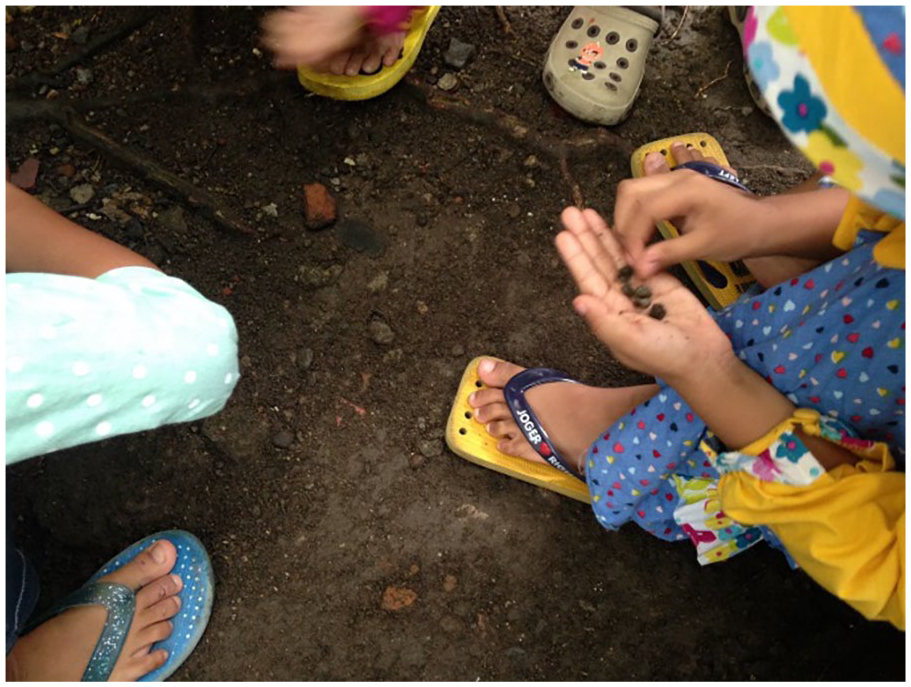
Collecting stones as kecik.
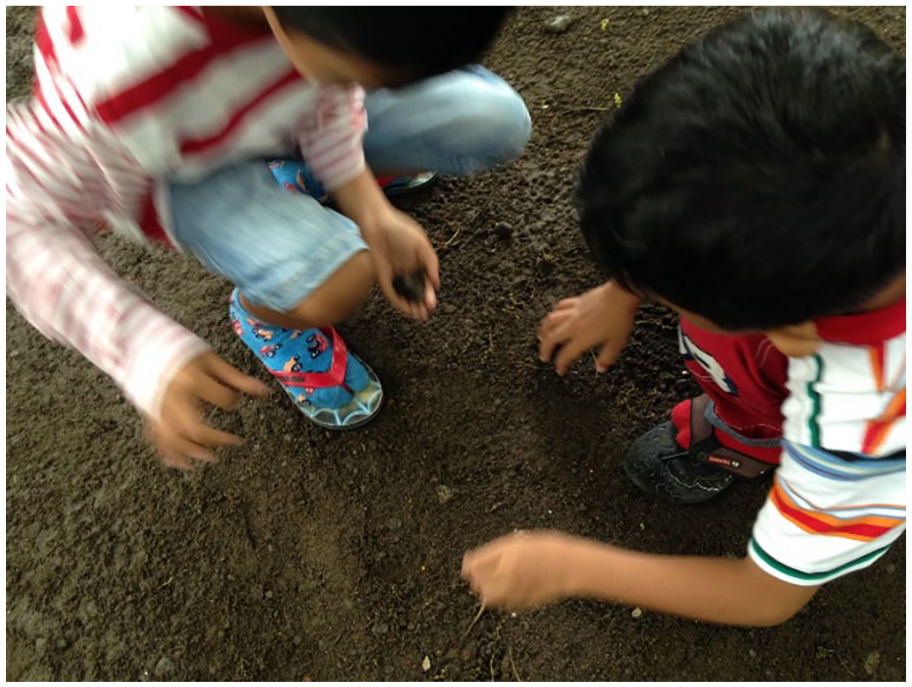
Picking up stones.
The stones start to play
As seen in Figures 1 and 2, stones were picked up carefully from the ground and were not chosen at random. The stones were picked with care, one by one, wiped clean and placed in the children’s palms. Something happened during this encounter: the stones that were scattered around the schoolyard, looking inactive and at-rest, suddenly transformed into counterparts with which the children played and had a joyful encounter. Here, an intra-activity took place in the children’s encounter with stones in the schoolyard.
The ‘stones [did] things’ to the children and with the children; they had the children ‘pick them up, feel them . . . or hold them between [their] thumb and forefinger’ (Rautio, 2013: 404). There was enchantment in the stones, which attracted the children to have ‘an intimate relationship, something to get to know – their affordances, their touch, their qualities, their ability to act back’ (Merewether, 2019: 243). The stones showed thing-power (Bennett, 2010: 354), which enabled them ‘to shift or vibrate between different states of being, to go from trash/inanimate/resting to treasure/animate/alert’. This power not only changed the stones themselves, but also had a performative effect on the surroundings. As seen in Figures 1 and 2, the children played with the stones and the stones played back with the children and their surroundings. Here, stones as materials revealed a new potential meaning of ‘a whole vibrant child-thing ensemble that came into being as more than the sum of its parts’ (Rautio and Jokinen, 2016: 45). The stones became significant players in the pre-activity of dakon, as performative agents (Lenz Taguchi, 2010), without which the game could not be performed. The stones and the children found and were found by each other, in a relational existence that emerged through intra-actions – ‘the mutual constitution of entangled agencies’ (Barad, 2007: 33; original emphasis) – that continuously took place at different stages of the game. Together, they were involved in ‘play(ful) encounters’ (Rautio and Winston, 2015: 15).
From these multiple encounters, five stones made children pick them up, keep them in their fists and then bring them to the classroom. All of the stones collected by the children were gathered on the carpet, next to the dakon boards. The teacher then explained the rules of dakon. She told the children to put seven kecik in each hole of the board and highlighted the use of Javanese words in counting the kecik – siji, loro, telu, papat, limo, enem, pitu (‘one’, ‘two’, ‘three’, ‘four’, ‘five’, ‘six’, ‘seven’) – which confirmed that dakon as a traditional game had a function in developing numerical and language skills (Purwaningsih, 2006). The children enthusiastically counted the kecik and at the same time practised the Javanese language. Two girls, as shown in Figure 3, carefully counted stones as kecik for the game. These stones made the girls hold them with their thumbs and forefingers, then place them in the holes of the dakon board.
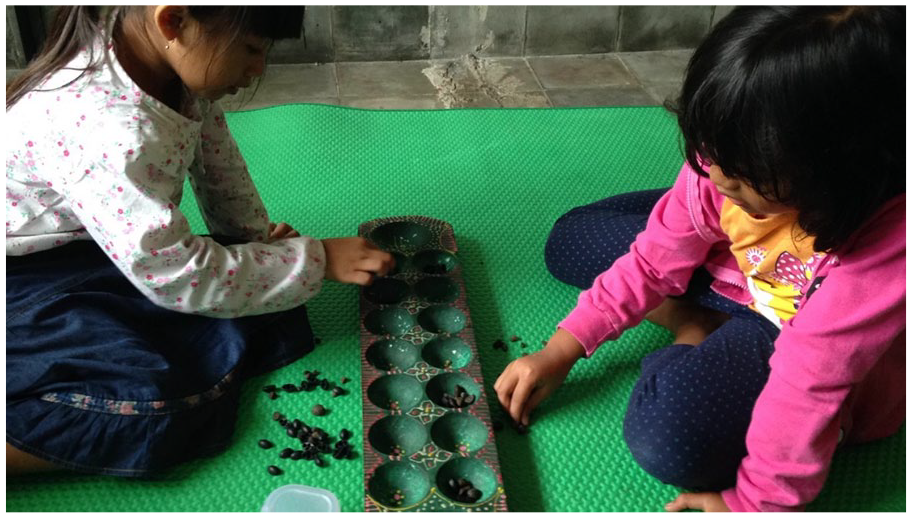
Counting stones as kecik.
They – the stones and the girls – did this repeatedly, over and over again, but were never the same in each moment. They were differentiating in each moment of multiple entanglements (Barad, 2014), in continuous intra-active cooperation in getting kecik into the dakon board. Moments of the stones called the girls to follow them, pick them up and put them in the holes, in a series of mutual constitution of performative production (Lenz Taguchi, 2010). This looked like a dance performance, which became a flow of movements (Ivinson and Renold, 2016). This was another instance of intra-active play involving the stones and the children, within which the stones, children and dakon board were mutually affected and affected by each other. Not only did the children play with the stones, but the stones also played with the children, so that ‘the playing [was] taking place in-between [them]’ (Lenz Taguchi, 2011: 38; original emphasis). In this playing, the children, stones and other elements were equally important parts without a hierarchy in their active and ongoing relations (Barad, 2007), as proposed by a new-materialist approach.
In this situation, it was evident that the stones were an essential part of the game. The stones got the game started; dakon could not be performed without them. As kecik, the stones showed ‘thing-power’ (Bennett, 2010), which refers to the vivacity of things that may have a valiant impact on their surroundings. This power could transform stones that seemed inert, motionless and lifeless into being active, moving and alive. As Bennett (2010: 6) describes, the thing-power was ‘the curious ability of inanimate things to animate, to act, to produce effects dramatic and subtle’. The stones, when activated with thing-power, could transform and act as kecik, and became the main players in the game of dakon.
The moment when the stones called the children to lift them up from the ground, as seen in Figures 1 and 2, showed a power and force that made the children perform in certain ways in picking them up from the schoolyard. Here, the stones can be seen as ‘performative agents’ (Lenz Taguchi, 2010) which actively took part in the performative production of dakon together with other elements of the game – the dakon board in which the stones were placed; the ground from which the stones were taken; the children’s fingers, which wiped dust from the stones; and the children’s hands, with which the stones were counted and placed in the holes of the board. The stones showed their performative agency – ‘the possibility of intervening and acting upon others and the world’ (Lenz Taguchi, 2010: 4). This performative agency of the stones was not manifested independently and separately from other elements of the game. Rather, it emerged in interconnections with other things, organisms and matter. As Barad (2012: 55) argues, agency is not the possession of individuals or things, but is about ‘response-ability’ – that is, the possibilities for all elements, organisms and matter to respond mutually to each other and reconfigure their entanglements.
The entanglements of all the elements at each moment in the dakon game were never static. Lenz Taguchi (2010) states that all parts of a performative production are continuously intertwined and act on each other in intra-active relationships. In the playing of dakon, these relationships were established among the stones as kecik, dakon board, green carpet, concrete floor, children’s hands and free-activity time after the children finished their worksheets. Here, the thing-power of the materials in the dakon game was situated in an assemblage, within which each element was merged in relations with others.
The stones are a part of the world
A feature that characterises traditional games across cultures is the simplicity of the games in terms of their rules and the tools or materials used to play them (Kovačevič and Opić, 2014; Pramanik and Bhattacharya, 2018; Sierra and Kaminski, 1995). A material that is easily found in any place in Indonesia is stones, known as kerikil or batu in the Indonesian language. Stones also play significant cultural roles among Indonesian communities and people. There is a cultural tradition in which stones are believed to be ‘a source of power and life’ and ‘to house spirits’ (Janowski, 2020: 105, 114), particularly small stones. In some communities, oddly shaped stones are kept as protection for their owners, and are known as mustika or buntat (‘charms’ or ‘amulets’; Janowski, 2020).
Historically, stones have participated actively in Indonesian games, such as in dakon, which is known globally as mancala. In Javanese society, despite the fun nature of dakon, there is noble wisdom and values attached to the game. Hidayat (2015) discusses the values embedded in dakon both from the materials used in the game and the performance of the game. The seven holes in the dakon board signify the seven days of the week, and seven kecik are placed in each of the holes. These kecik symbolise resources such as food, money or materials. The way stones as kecik move and are distributed, one by one in each hole, conveys the message that we need to be wise and not be excessive in using resources. In each cycle of the stones’ distribution, one should save one stone in the large storage hole and, if there are any extra, the rest of the stones can be distributed in the opponent’s holes. This exemplifies that, in using resources, we need to think about the future by saving some of our resources or sharing them with others.
All of the messages conveyed through the game, with the stones as both material entities (Rautio, 2013) or things (Bennett, 2010) and performance (Jackson and Mazzei, 2016) or movement (Olsson, 2009) in the playing of dakon, closely relate to central principles of Javanese ethics and the Javanese world view. These principles are rukun (‘a state of harmony’) and respect, which guide Javanese people in all situations (Magnis-Suseno, 1997). Although these principles are generally discussed in the context of the social environment or interpersonal relations among humans, through a new-materialist view they could be extended to the ‘material world’ (Barad, 2008; Bennett, 2016; Lenz Taguchi, 2010). This opportunity can be achieved through an understanding that, as humans, we are not external observers of the world; rather, ‘we are part of the world in its ongoing intra-activity’ (Barad, 2007: 184; original emphasis), therefore ‘it becomes an ethical obligation to engage intra-actively with materials’ (Bone, 2019b: 674).
Discussion: a diffractive reading of different encounters with stones
Stones as materials initiate different encounters throughout the playing of traditional games. The encounters in our case study were read diffractively with different texts from classic and contemporary literature on traditional games, education in the context of Indonesia, and Javanese ethics and culture. Theoretical concepts from a new-materialist perspective were ‘plugged into’ (Jackson and Mazzei, 2012: 1) the data to ‘stir things up’ (Bone, 2019b: 674) and stretch the thinking with the data. Through diffractive reading, these encounters traversed and intersected each other to open up a space for creative thinking and to understand things differently – in this case, traditional games.
As the flow of encounters unfolded, different insights emerged through re-turning, as in ‘turning it over and over again’ (Barad, 2014: 168), which allowed us to revisit understandings about the notion of tradition attached to traditional games. This notion of tradition is supported by the literature that defines traditional games as games that have existed for a long time and have been passed down over generations (Howard, 2005; Sierra and Kaminski, 1995; Sujarno et al., 2013). While the attributes of traditional games from this view are evident in this study, there was also a new and unpredicted discovery of the notion of an intra-active tradition in relation to children’s games.
This notion creates an account for understanding that tradition is ‘never static’ and always in ‘continuity and change’ (Factor, 2005: 9). This dynamic view of tradition in the context of traditional games, however, was previously situated in the process of passing games across generations. In this process, traditional games are often changed, adapted or modified in accordance with the times and circumstances (Factor, 2005). Far from rejecting this view, a new-materialist perspective extends its horizons by giving attention to material elements and their intra-active encounters in games. This attention, however, is different from the dominant humanistic view in material culture studies that looks at materials from the values and cultural inscriptions attached to them, and reaffirms the perceived nature–culture divide. Rather, a new-materialist approach aims to blur this divide by looking at practices that involve encounters with materials such as stones (Merewether, 2019; Rautio, 2013). This view allows a focus on the particularity of the relations and interconnections among the participating subjects in each encounter (Davies and Gannon, 2009; Gannon, 2011). Rather than seeking a general view or pattern of playing traditional games, we can now look at each play as a specific space of encounter. In the context of children’s games, a focus on the particularity of each intra-active encounter creates the possibility to view tradition as a multifaceted notion that is specific in each play and goes beyond the common understanding of tradition as a general term attached to any game-playing.
The notion of an intra-active tradition in Javanese society is relevant to the spirit of Javanese culture, which is open to any encounters. This open characteristic of Javanese culture has been discussed by Magnis-Suseno (1997), who claims that the culture has not been built and is not progressing in isolation. Conversely, he adds, continuous encounters with others – including other cultures and perspectives – enrich Javanese culture without it losing its core values and spirit. The notion of an intra-active tradition, therefore, offers an alternative to mainstream public opinion that preserving tradition is imperative to avoid external influences and contamination, and to retain its purity. In the context of traditional games, this notion is a possible new way for young children to reinvent games amidst the common anxiety that they no longer have access to traditional games and traditional games will cease to exist.
Implications
In the context of traditional games, the notion of tradition has been firmly established and remains uncontested in research and the literature, positioning games as a way through which traditions and culture are passed across generations (Hidayat, 2015; Pramanik and Bhattacharya, 2018). This notion has been the main consideration for pedagogical practices to include traditional games in educational settings. Through a diffractive reading of different encounters with stones in the game of dakon and the use of new-materialist concepts in this article, this firm notion of tradition is challenged and disrupted to create space for a new way of understanding games.
As different encounters with stones traverse each other, the image of stones as passive inanimate objects shifts to active and powerful entities, where performative agency emerges through intra-actions with other components. This performative agency of stones activates the capacity of other elements to respond through continuous intra-active relations in unpredictable ways (Lenz Taguchi, 2010). The notion of tradition is reconfigured through the continuous non-linear performativity of the stones in the games. This performative understanding of games allows tradition to become intra-active, open to flows of complex and unpredictable entanglements. Tradition, in the context of traditional games, has shifted from a fixed and stable feature of games to become a dynamic and vibrant space for games. This space makes it possible for stones and other elements of traditional games to interact responsively in lively relationalities in their encounters.
From the process of unsettling the established view about traditional games, some implications can be generated for pedagogical practices in educational settings. The notion of the performative agency of materials, such as stones in dakon, can inform educators to give more attention to different materials in different learning activities. Looking at materials as a performative agent in a learning event can shift practice that commonly focuses on individual children’s cognitive processes towards distributed attention to different aspects of learning, human/non-human, materials and the environment. Also, the diffractive reading of seemingly unrelated stories in this article can be applied to different events taking place in educational settings. Making space for discussions with children about their encounters with different materials can open up new insights into and ideas about their learning processes.
Footnotes
Funding
The authors received no financial support for the research, authorship and/or publication of this article.
