




Abstract
This philosophically driven work is intended to trouble the position of the small chair in early childhood settings. It is theoretically driven by an aspect of sociological and cultural theory called hauntology, and by the theories of new feminist materialism. The work of Sara Ahmed influences the direction taken here. An assemblage of personal narratives, memories, works of fiction, history, conversations and media reports, along with the documentation of a performative act, is produced. The methodological approach is intra-active and diffractive. The article argues that the small chair is a contentious and ambiguous artefact, which is taken for granted in early childhood settings, but also problematic when considered from different perspectives – an apparatus that both supports and betrays the body/ies that are in contact with it. Chairs, as objects that furnish human lives, can also haunt those lives and give contradictory messages of power, comfort and suffering. Now and to come, the chair is a trace, a symbol, an instrument of torture and object of desire.
Introduction
Ghosts haunt educational contexts and, in this article, hauntology, an aspect of sociology, together with new materialist theory, is used to explore the way an object from the past can continue to haunt the present. I am drawn towards this approach by a personal experience of being haunted by an object from the material and everyday world. There is always a story attached to a ghost. Before telling the story, it is worth pointing out that despite this focus on the supernatural, I have an interest in everyday life (Bone, 2008) and am attracted by what Stewart (2007: 29) calls ‘the pull of the ordinary’. While the language and ideas of new materialist theories might be deeply philosophical (Dolphijn and Van der Tuin, 2012), the objects that fill up the world and that mediate relationships and ways of life are often mundane and taken for granted. The artefacts that become part of collective histories and individual life stories constitute an ambiguity that is worth exploring – sliding between the binaries of life and death, animate and inanimate, a space of ‘haunting, ghosts and gaps, seething absences and muted presences’ (Gordon, 1997: 21). This account starts with a narrative and then turns to the role of an ordinary piece of furniture in early childhood settings, follows some surprising threads, and finally presents a critique of what is so often unquestioned in terms of the use of this artefact and its ethical implications.
The material world
Coole and Frost state that: As human beings we inhabit an ineluctably material world. We live our everyday lives surrounded by, immersed in, matter. We are ourselves composed of matter … At every turn we encounter physical objects fashioned by human design and endure natural forces whose imperatives structure our daily routines for survival. (Coole and Frost, 2010: 1)
This acknowledgement of the material world encouraged work that focuses not on ‘the child’ or child development and psychology, but on aspects of the world where everything is connected through its materiality: people, things and animals. Influential literature that has driven this turn to the material in early childhood includes work by Barad (2007: 170) about how matter comes to matter as ‘a dynamic intra-active becoming’. Lenz Taguchi (2010) describes the intra-activity of children and objects; Davis (2014) writes about strong emotion and play with material objects; Rautio (2013) presents an analysis of a stone in the pocket; Jones (2013) writes about ‘things’ in the early childhood classroom; and Jones et al. (2012: 51) discuss objects in the classroom in terms of their power to ‘disrupt boundaries’ – just to give some examples from the literature. In this article, I am influenced by the work of Ahmed (2010a) and draw attention to her critique of a focus on new materialism as not so ‘new’ (see also Rautio, 2013). Ahmed (2010a) thinks of this perspective as an aspect of phenomenology, and I was encouraged by her chapter about a table because it affirms that furniture matters. Ahmed (2010b: 30) describes ‘how we are touched by what we are near’. It is possible to be touched by what is near in many senses beyond the physical, and I am moving the discussion into another, but related, area – that of ‘hauntology’. Hauntology is concerned not so much with distance and proximity as with temporality.
Hauntology
Blanco and Peeren (2013: 11) say that it is the haunting of the present by the past that ‘emerges as the most insistent narrative’. This is complex because hauntings are not always about loss or grief for the past in the present. LaCapra (2014), for example, separates loss from absence and discusses the link between loss and nostalgia and yearning. Nostalgia emerges from the person as a subjective longing for what has gone, and yearning connects to feelings of grief and mourning. An involuntary aspect to haunting emerges from these aspects of experience, and what one is haunted by is often surprising and comes and goes unexpectedly. There is a lack of control about hauntings; they remain in the present as often unwanted reminders of the past and resist attempts to make them cease or leave.
A way of thinking about the past is that it infects the present. Like any infection, it is carried silently and is only shown in its consequences and affects. Affect carries over time and may appear to be momentary, but may also be remembered forever. Ahmed (2010b: 29) says that ‘affect is what sticks’. The intra-activity of the material and the body produces affective moments. Ahmed (2010b: 41) discusses happiness and suggests that happiness may be ‘promised by certain objects’. An example may be through a feeling when I see some fabric and remember a summer dress. The pattern and colour make me remember wearing it; my embodied knowing in the feel of the fabric may take me to another place and time. The moment of noticing the fabric is the affective moment, as in that instant it makes me who I am in the world with the memories of the pattern, the place and the weather, because ‘we are moved by things’ (Ahmed, 2010b: 33). Or, I might run my hand over a polished surface and remember how this felt in the past, even while I am completing the action in the present moment. I am aware that this surface has its own life; it is not merely waiting for me to touch it. These sensory feelings and memories emerge through bodily movement and sensation, and they carry affect as an intensity of feeling (Gregg and Seigworth, 2010).
Haunting is sometimes thought to be illusory and the ghost is regarded as the ultimate disembodied being, nebulous and unfixed. Derrida’s work Spectres of Marx, first published in 1993, suggests that the spectre (ghost or phantom) is the ‘becoming body’, a kind of spirit that is ‘neither soul nor body, and both one and the other’ (Derrida, 2006: 5). Haunting takes place in and through bodies and with and without bodies, and happens when something is both present and not present. It is not possible to foresee what is haunted or who is haunting. Like the affective moment that follows the touch or the smell or the movement, it is often unexpected or involuntary. Like a virus, hauntings flow and multiply; they are outside time and place and are present only in the affect they give rise to.
Returning to the furniture, the following ghost story features a chair and, in this narrative, time has become unstable. In this first story, I return to the role of daughter and reinhabit child status. In hauntings, age becomes irrelevant, and ghosts themselves usually stay the same age forever. For Derrida (2006: 14), an important aspect of haunting ‘reshapes history by disrupting its conventional structure of chronology’. So, now I no longer know if I thought about chairs because of being haunted or if the haunting happened because of the chair. This enmeshment with materiality is inevitable, as Ahmed (2010a: 235) notes about a different piece of furniture: ‘if we do things on tables, then tables are effects of what we do’. I resisted the urge to stop thinking about these objects because of the mundane nature of furniture – after all, we are in fairly constant contact with furniture; we adjust our bodies in relation to it, look at it, collect it, move it, appreciate its design, give value to it, and fill our houses, classrooms and offices with it. We have furniture in our preschools, although the attention paid to it is minimal. A search of the literature turned up nothing significant, except some European Union reports on the specifications of furniture and research with a focus on health and safety. An exception is the introduction by Lenz Taguchi (2010) to her book about an intra-active pedagogy. Writing about embodied knowing, Lenz Taguchi described her feelings when sitting on a high wooden chair in an official interview at the university: ‘the chair embraced me as I leaned back and put my arms on the generous armrests, giving me a feeling of authoritarian comfort, excitement and inferiority’ (1). Lenz Taguchi’s words evoke the powerful sensations of embodied knowing and the memories that resulted from this intra-active experience.
Methodology
My methodological approach involves the creation of an assemblage (Bone, 2014; Fox and Alldred, 2015). This is not necessarily logical but rather a bringing together of disparate issues and ideas that are multilayered and often ‘unpredictable’ (Fox and Alldred, 2015: 401). This assemblage includes personal narratives, visual data, fiction, media reports, memory work, historical evidence, health research, embodied knowing, notes from conversations, information from websites, and more. Elements from the past were brought in, including novels and different literature. The assemblage reflects a specific cultural background, but also cuts across time and place through movement and hybridity. As is usual with this kind of work, I am starting in the middle – as Deleuze and Guattari (1987) noted, anything rhizomic in nature, as this uneasy assemblage undoubtedly is, will always begin in the middle, with connections that are not immediately obvious. The creation of an assemblage as a research approach means being aware of the assemblage as the ‘and … and … and …’ (Deleuze and Guattari, 1987). This means also not being afraid to add in elements from elsewhere. It becomes possible to read elements through each other in the search for fresh insights – a diffractive reading (Barad, 2007). This piece of writing shows what a diffractive approach is in its constitutive force. It shows how one experience can gather energy and move into new spaces in surprising ways while not following prescribed pathways. Through diffraction, it becomes possible to think about the chair through what Barad (2007: 88) calls ‘socialnatural practices in a performative rather than representationalist mode’, activating ‘a way of understanding the world from within and as part of it’.
This intra-active process moved me as a researcher beyond being a narrator in a static position to being shifted and becoming entangled. Jackson and Mazzei (2012: 135) point out that subjectivity becomes understood as ‘a set of linkages and connections with other things and other bodies, both human and nonhuman’. Also, in this approach, writing is an important way of managing elements that can become unruly but that contribute to knowing in its complexity (Richardson, 2014). The haunting, being haunted, made for ‘a strange opening’ (MacLure, 2011: 1004), and the ghost called to the wonder that MacLure advocates for in qualitative research. A haunting, a ghost story, issues about furniture in relation to children and education – there are many layers, intricacies and experiences available to be included when the methodological approach is unbounded and limitless.
A ghost story
This story describes something I was not deliberately focused on at all, but it has been haunting me. It was a spectre on the periphery, appearing at unexpected times, floating and yet present, solid and always reminding me of a bad decision. This haunting was a powerful experience, a heightened affective moment that was unmanageable, unwanted and entangled with grief: The chair is on the edge of my mind; it floats there and turns up unexpectedly. It is my mother’s chair and she seems in my mind to have been sitting in it forever. I can see her opening post (opening post! Who does that?). She has a paperknife and gold-rimmed glasses, and these objects remain next to a pile of letters, cards, notebooks and the newspaper. She sits in the chair, drinking tea or coffee, reading the paper, engaged in the rituals of everyday life. Eventually, after her death, it became my responsibility to make decisions about the fate of the chair(s) and an assortment of furniture, clothes, china and books – the objects of a lifetime. I didn’t keep the chair because of a fear that if I had the chair and sat in it, I would become my mother before it is time to become my mother, as we all will (or father, of course) … However, despite my not owning it and despite my watching it go off with house clearers in the back of a van, that chair still makes me feel guilty. I feel it left me, but reluctantly. A few weeks afterwards, a young woman, who was exceptionally fond of my mother, asked for the chair. I was horrified; it was gone; it was having another life, but it mocked me and my inability to make the right decision. In this way, it remains with me. I may as well have kept it or given it to this family friend. It now has its own life, its own agency. I hope it is in another country home with another person sitting on it. The chair was made of elm – a special wood, traditional, a timeless design. The seat was moulded and comfortable; the flat cushion was pretty, floral, slightly worn. I always think of this as an English chair – it reminds me that my past in a different place and time is still present. It haunts me; it still has affective power and it is obvious that I let it go but it didn’t let go of me.
After the death of my mother, the time came to do what is called ‘clear the house’. At this time, I discovered the truth of Derrida’s (2006: 67) statement that ‘inheritance is never a given, it is always a task’. Sometimes clearing has to happen; it is something that becomes a duty of children, no matter what their age, and it might happen after the occupants of a house die, or move, or have to be cared for elsewhere. In this process, loved objects are dispersed, given to family members and friends, sent to auction rooms or charity shops, or thrown away as rubbish. Bell and Bell (2012) say that dealing with this ‘stuff’ is so complex that they used a storage unit as a neutral space to do this work, pulling out treasures and sharing memories and stories while they sorted through possessions that had accumulated over a lifetime.
When dealing with this process, I felt incapable of making ordinary decisions. I wanted it all to go away. Eventually, the furniture, china and glass disappeared in their actual solid form, but they also remained behind, stubbornly refusing to leave. The door was open, the house was empty, but they remain, not so much as they were, but more as a reproach of some sort. Although I left these things to return to the other side of the world, they refuse to leave me. After a death, there is often talk about being ‘left’ things by people; their possessions are a legacy and sometimes a burden. In fact, the person may have left but sometimes it is the objects that refuse to go. My focus is on the affect and agency of the object, although I also know that, as Lutz (2015: xx) states, the meaning of an object comes from ‘our own desires and passions, the shadows we let play over it’.
Shadows from the past
Lutz (2015), a historian who explores lives through objects, says that ‘even ordinary objects can carry us to other times and places’ (xxi). She says: ‘we, too, will leave behind things we have nicked with incident, warmed with wearing. Will they carry our history, abide in our place without us? Will our clothing still bear our gestures?’ (xxi). Older objects carry their own energies; they have their own spiritual vitality, despite being trapped in layers of time. Artefacts and antiquities, which ironically often increase in value as they become rarer and more fragile, acquire a ‘patina’ of age that indicates their past and whether they have been treasured or neglected.
The focus of Lutz’s (2015) interest is the Brontë sisters. I will focus here on the work of Charlotte Brontë (Jane Eyre) and Emily Brontë (Wuthering Heights). In their work, they show that they know about childhood, and about furniture and haunting. The passages in Jane Eyre about the suffering of the girls at school (Lowood Hall) are memorable and distressing, as are the descriptions of Jane as a child, orphaned and at the mercy of an aunt who locks her in a room with oppressive furniture. Shut in the Red Room, Jane describes how My seat, to which Bessie and the bitter Miss Abbot had left me riveted, was a low ottoman near the marble chimney-piece; the bed rose before me; to my right hand there was the high, dark wardrobe, with subdued, broken reflections varying the gloss of its panels; to my left were the muffled windows; a great looking-glass between them repeated the vacant majesty of the bed and room. (Brontë, 2006: 17)
Jane imagines that this dark room, with its imposing furniture, is haunted by the ghost of her uncle, as ‘it was in this chamber he breathed his last; here he lay in state’ (17). Both Charlotte and Emily Brontë thought of furniture as a portal to other worlds and, in their lives and the lives of their child protagonists, death and a sense of impermanence were ever present. In turn, Lutz (2015: ix) states that ‘the strange bed in Emily Brontë’s Wuthering Heights has always haunted me’. This bed was described as being like an oak box, and Catherine Earnshaw, the heroine of Wuthering Heights, could crawl inside it to read and hide (Brontë, 2009). Heathcliff, who loved Catherine and found comfort in her ghost, believed the bed to be the connection between this world and the next. Lutz (2015: xx) says: ‘the bed provides a portal to another sphere, the one of ghosts’. Lutz tries to resurrect the Brontës through the artefacts that they surrounded themselves with; she is concerned with ‘the daily living and breathing, their material presence’ (xx). The work of the Brontë sisters, with their descriptions of childhood in Victorian England and the privations of boarding schools, challenged the respectable middle classes in England, and readers of their novels have ever since been haunted by the work of these writers, who were so attuned to childhood, suffering and death.
Haunting continues and threads its way into the present. It works as a spiral of activity, prompting exploration of the past, sifting through memories to produce new ideas. It influences writing and research directions because researchers become haunted by certain questions and find that these questions do not let them go.
Ghosts in early childhood education
In early childhood education, ghosts are always present. In terms of theory, early childhood education is haunted by the dead white males who still whisper their theories in the classrooms of the present, and inhabit thoughts and conceptualisations about children and their lives (Aldridge and Christensen, 2013; MacNaughton, 2005). I have recently been haunted by the ghost of Maria Montessori – not often, but just enough to note that there is a certain injustice in the way she is remembered (Bone, 2017). Some educators acknowledge her contribution to the world of early childhood because of her educational method (Montessori, 1967), but mainly she lives on through the ‘child-sized’ furniture that she introduced. The ghost of Maria beckoned, and encouraged me to turn my gaze to the chair she bequeathed to preschools all over the world: the small chair.
I have been looking at images of chairs that I am familiar with in relation to young children. There is the high chair, conventional and designed to last, plastic, wooden, ugly, functional or smart, sometimes a design triumph but also a child restraint. Then there is the ordinary chair, with a seat, back and four legs, usually arranged around a circular table. The arrangement is inviting; it implies that working and talking together is valued and also gives the message that the size of the child has been considered and counts in this setting. This chair is ubiquitous. I rarely go into an early childhood environment where there is not some version of this chair. Designed for children, it is sometimes metal and sometimes wooden, either painted or plain, but always – and this is my main point – small.
This chair haunts the early childhood space; it is as if a collective agreed with one voice that, while not persuaded of the excellence of Maria Montessori’s pedagogical ideas, they were prepared to admit that she was right about the furniture. It was one of her innovations that children deserved to have ‘child-sized’ furniture, suited to their height and weight. I am not sure that she envisaged that this child-sized chair would take over nearly all environments where children learn. It is difficult to enter a preschool without immediately seeing the small chair. Because of this, the small chair, in its ubiquity, has become taken for granted.
In my first intra-active encounter with the small chair, I felt that it talked back to me about the preschool as a workplace that is gendered, feminised, child-focused and ultimately disempowering. The small chair passes on a very important commandment to teachers: ‘Thou shalt not sit down’ – you are here to work and, like women in retail, hospitality and catering, and at home, you will run around after others and not focus on what you might need for yourself. If a chair that fits the adult body is needed, it probably will not be found in the average preschool. The small chair that stalks the kindergarten has its effect on the body, as the following anecdotal evidence shows: I was in a meeting the other day at a very high-end private (expensive) school. The two people from the university sat on ordinary chairs, the manager sat on a normal office chair and the hard-working teacher who came to talk to us got a tiny chair and perched on it for about 45 minutes. (Researcher observation) As a childcare worker, you work in an environment designed for children, so everything is designed for them and is on a much smaller scale. You will find that you have to stoop or crunch up. (Early childhood teacher in conversation) I asked early childhood education students if they have meetings and sit on small chairs, and they said ‘yes’, and, yes, they do feel a bit odd sometimes, infantilised, disempowered, but they also ‘quite like it’. (Informal conversation)
The students’ words encouraged me to meet the small chair again in a different place and with a fresh perspective. The students picked up on the nostalgia for childhood that pervades early childhood. In its affective power, the small chair is about being a child; it supports an onto-epistemological moment of knowing. The chair can be conceptualised in this sense as an apparatus for remembering. I can think of no other reason why so many early childhood professional educators in Australia and New Zealand, and elsewhere, put up with this furniture and continue to sit on seats that are not a good match with the adult body. To be more explicit: why small chairs when most adult bottoms are large?
The feminised workplace and bodies
The furniture in early childhood settings may be symbolic of a particular workplace, and maybe what happens with chairs in early childhood is only possible in a feminised workplace. Women work in places designed for the comfort of children, not themselves. Educational contexts are seen as places for children, and teachers are very often not counted or their needs are minimised. The small chair symbolises the undervalued nature of teaching young children and the lack of respect that haunts the professions connected to caring. The chair haunts this educational context and, according to Derrida (2006: 9), as a spectre from the past it has the potential to offer insight ‘especially into those matters that are commonly considered not to matter’. The chair is a reminder that some things do matter, including the body of the teacher. I ask a question of the chair, the small chair that haunts, and am encouraged by Derrida (2006: 61), who asks of the spectre or ghost: ‘How can it be there, again, when its time is no longer there?’
In order to recapture this time, and bearing the students’ words in mind, I went to IKEA to sit on some small chairs. It was a reminder that ghosts have a sense of humour (see Figure 1).
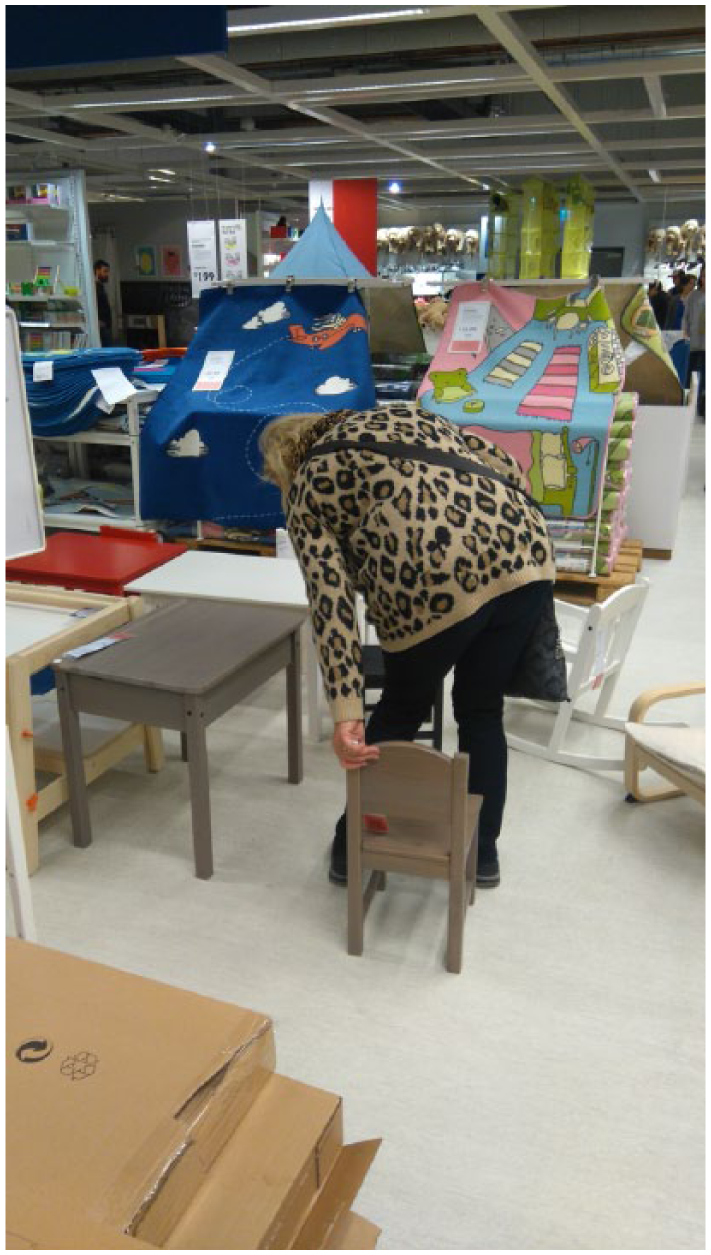
The researcher sits on a small chair.
The chairs were extremely small and, in the context of the furniture store, no adults were sitting on them. Unlike in the preschool, it seemed that adults did not feel that it was appropriate to perch on tiny chairs. IKEA is a Scandinavian store, and I remembered that in Norway, when visiting a kindergarten in Oslo, it was a pleasant surprise to see adult-sized chairs as well as smaller chairs for children. In the interests of research, I documented my trip to IKEA as follows: I decided to go to the popular Swedish store IKEA to check out chairs for children. Once there, I just had to sit on them. It is almost a requirement of being in contact with chairs – that invitation to sit, it is sometimes irresistible. In early childhood I reflected on the role of the sofa, a far more problematic piece of furniture in the preschool – such an object of desire. For years, students and teachers were told not to sit on sofas. Desire turned in on itself. In this instance, the chairs beckoned and in IKEA I could try them out. There was a definite disparity between my anatomy and the seat of the chair … I lowered myself into a small wooden chair; once in position my knees were up by my chin and for some reason I felt like a young child. I was that young child again. Onlookers in the store were amused and looked at me with surprise as I tried out the small chairs – obviously, an adult sitting in small chairs is only taken for granted in early childhood settings. Despite the audience, I felt quite enlivened in this position – not at all subordinate or disempowered. Supported by the small chair, my body returned to a purely childlike state. The small chairs all had the same affective magic, transporting me back to a different time and state. This only happened when I was in contact with the chair. It felt relaxing and as if any responsibilities dropped away as I folded into position.
Haunting is contradictory and part of the nature of being haunted is that you cannot get rid of it, but also maybe the small chair was teaching me to value the ghosts of the past. For example, when I sat on the seat, I was also feeling the joy of being a child in my body (see Figure 2). It might be very important for adults who teach to remember what it is like to be a child. Adults can never be a child again, but bodies remember through the material objects they remain in contact with. Jones et al. (2012: 51) suggest that objects ‘can disturb and offend as well as delight and comfort’, and these ambiguities persist. My position on the chair in the furniture store was fleeting, momentary, and I did not have to sit on that chair while interacting with children for any length of time or while having a meeting. This reminder of the importance of duration, an aspect of temporality, directed my thoughts towards the action associated with chairs – the issues with ‘sitting’.
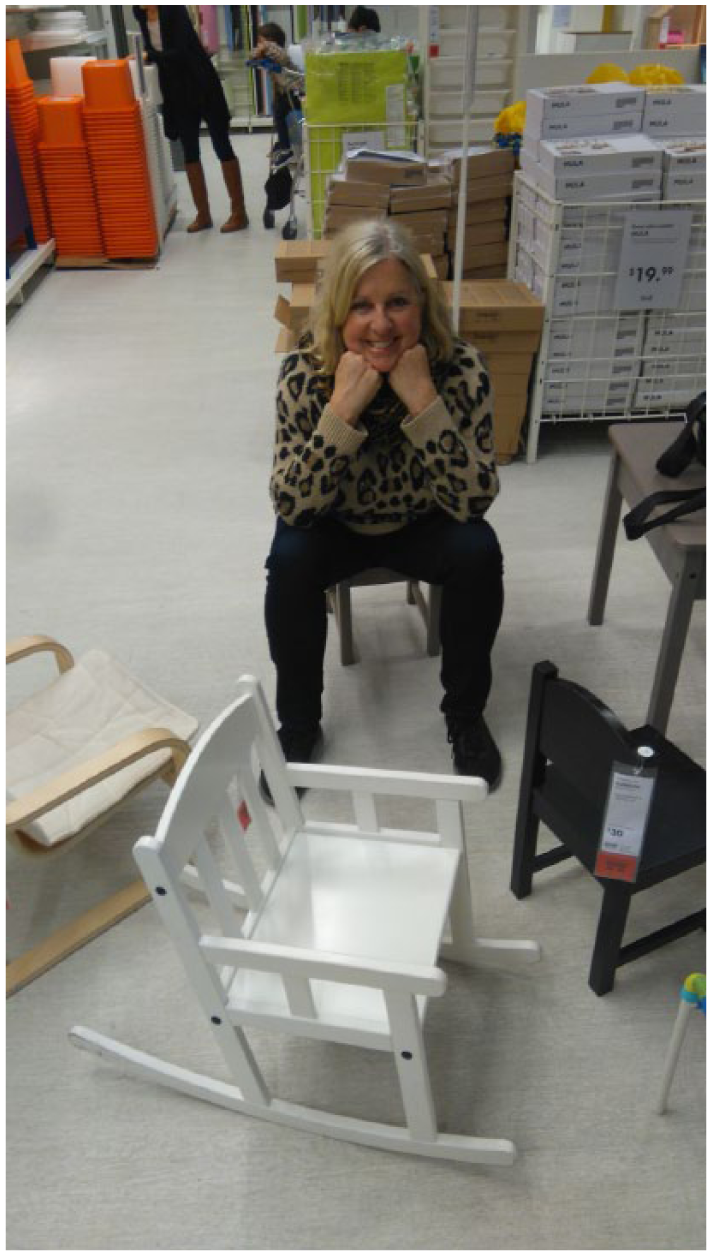
The body of the researcher as a child.
Sitting and the ‘killer chair’
Research is finding that sitting is in itself a toxic practice, and the chair has been presented as a ‘killer chair’ (Levine, 2014). According to research (Biswas et al., 2015; Lynch and Owen, 2015), more than half of the average person’s waking hours are spent sitting: watching television, working at a computer, commuting or doing other physically inactive pursuits. But all that sitting is turning people into ghosts too early, and this includes those who try to offset their sitting by exercising for up to an hour a day. Biswas et al. (2015) looked at the health effects of sedentary behaviour across 47 research studies. Over the course of these studies, people who sat for prolonged periods of time had a higher risk of dying from all causes, and the researchers allowed for movement, from leisure-time activities to vigorous exercise. Sitting is dangerous for those who exercise regularly, and the negative effects are shown in these studies to be more pronounced in people who do little or no exercise.
In this case, early childhood teachers should be grateful to the small chair, as it may prevent sitting for long periods. Alternatively, maybe they should be more aware of possible damage to their backs. Some of the health issues for teachers of young children include detrimental exposure to noise (Grebennikov and Wiggins, 2006), back problems (McGrath and Huntington, 2007) and stress (Dooney, 2016). These same things also impact on children and their behaviour. Children are required to sit, and to sit still. Sitting still is often equated with listening and good behaviour. Being able to sit (or stand) for long periods of time shows that the body is under control and, as Jones (2013: 605) expresses it, ‘schooling’ the body happens through these normalising practices. In most cases, the teacher sits in a small, uncomfortable chair to read a story and do ‘circle time’, while the children sit on the floor. The chair is a mediator of power in these spaces. Lenz Taguchi (2010: 2) says that in her first preschool, her teacher said that this was what preschool was for: ‘learning how to sit still on your dot’. The hierarchical nature of education means that teachers are in control of children for long periods of time, and bullying happens and can go unquestioned in contexts where children are controlled in specific ways. As Lenz Taguchi (2010: 5) points out, the kind of space brings forward certain actions: ‘all spaces, and certainly pedagogical spaces, call upon us and demand specific ways of sitting or moving’. A space that is both educational and intended to punish or ‘correct’ will make certain demands. In the following example, a report from the Don Dale home, a correctional facility in Australia, showed that the chair is still used as a device for punishment.
The Don Dale inquiry (Zillman, 2016), which reported on an incident with a chair used as a restraint in Australia, is a reminder that the chair is not a neutral and benign object. Complaints about this institution filtered through to the media (ABC Backstory, 2017), and the practice of putting young men in chairs, placing a hood over their heads and tying them there for up to 24 hours as a punishment was exposed. This is an extreme example of the work that chairs do. In educational contexts, children are often exhorted to sit still in their chairs or on the mat, and are requested not to move. The act of listening is often connected to sitting still, despite no evidence that movement impairs children’s hearing and listening abilities. There are still places that value not just sitting but sitting still, and young children are encouraged to be inactive for long periods as a discipline of the body (Foucault, 1977; Jones, 2013). The configuration of chairs around tables instead of in rows looks more user-friendly, but the outcome during the average school day may be the same as in the past, and some educators may continue to think that stillness of the body will mean concentration of the mind. People who meditate can tell a different story and, despite sitting for long periods, the ‘monkey mind’, restless and unfocused, may still be evident. The chair, as a piece of furniture, is a reflection of the body – it has legs, a back, a seat and sometimes arms. It is both a support mechanism and a trap.
The chair as a symbol of power
I was in Dublin for a large early childhood conference and visited Dublin Castle. The guide took us through a series of grand rooms, and one had the throne of Queen Victoria. A symbol of colonial power, it was huge and golden. The chair is not in all cases suited to the body that will sit in it. In this case, the chair was so large that the Queen had to be lifted into it and her feet did not touch the ground when she sat on the throne. She must have looked like a doll but, even so, only the Queen was allowed to sit on the throne, and the chair did all the work for a small female body. It is now a tourist attraction, and people were very keen to have a photograph taken of themselves with the throne. The throne is still a potent reminder that a specific chair may be a symbol of power and, even when empty, is an echo of British rule in Ireland and all that this meant for the Irish people over a long period of time. (Author journal)
Terrible deeds also give rise to various hauntings, and Blanco and Peeren (2013: 15) note that, in terms of colonial violence, ‘events and memories … may give rise to vastly different hauntings’. In the case of this huge gilded chair, it remains empty, even on state occasions; it is too blatant a symbol of power and oppression. It is the only piece of furniture in the room, roped off and inaccessible today as it was then.
The throne is unique, one of a kind, designed to reflect the special status of the sovereign. The ordinary preschool chair is a product of capitalism, turned out by the thousands and a mass-produced commodity. This is the spectre of Marx in action – the production of millions of identical pieces of furniture causing identical bodily adjustments and encouraging similar movement. This may say something about the desire for sameness and uniformity that threads through education. At the same time, mass production discourages innovation. Derrida (2006: 189) attributes a great deal of agency to production processes and says that wood, for example, remains wood as a table and then becomes a commodity that haunts as ‘this woody and headstrong denseness is metamorphosed into a supernatural thing’. He goes on to say that the table has feet, the table has a head, its body comes alive, it erects its whole self like an institution, it stands up and addresses itself to others, first of all to other commodities, its fellow beings in phantomality, it faces them or opposes them. (190)
He emphasises the force of this object, this piece of furniture – its bodily presence, its correspondence to the human and its reach into the world.
Conclusion
In ethical educational practice, objects are part of daily encounters, and, in this account, the focus of my haunting was on a piece of furniture that is often taken for granted. In order to indicate that something is commonplace, there is an expression in English that one ‘becomes part of the furniture’ – that is, overlooked and unquestioned. Hauntings, like furniture, are inescapably part of the entanglements of everyday life and, as Gordon (1997: 206) noted, when haunted and when a ghost appears, it will ‘inaugurate the necessity of doing something about it’. By becoming aware of the past, it is more likely to be aware of the present and move forward to make changes for the future. It is not possible to predict what will haunt, and this will be different for different people and in different places. The power of hauntology as an approach is that it combines personal orientations towards the ghosts that are sometimes uncomfortable company and the spectres that thread through society and its institutions.
The small chair is a potent marker of the early childhood educational environment; it is one of the ways I always know that I am in an educational space for young children. It is imposed on the adult body. The body of the educator has to conform to the small chair, and one of the questions it leads me to ask here is if this is a means of keeping educators in their place and not according them their full value. It may be that the small chair also offers a way to remember childhood ways of sitting, and supports embodied knowing and affective moments. The small chair is a material sign of the shift from children always adjusting to the adult world towards child-centred environments. The small chair does its work in multiple ways. It forces a continued awareness of child and adult bodies in their similarities and differences; juxtaposes past and present; gives value to sitting over activity in educational spaces; makes the link between the chair and comfort less certain; and challenges the image of the professional educator in early childhood settings. This chair invites me to critique what is done to children as they are prepared to enter the world of sitting: in class; with technology; in front of screens; while eating, working, writing and reading; while driving, flying or on the train; while in the cinema or watching television or movies; while meditating; in church; in public places; or while waiting or relaxing.
Meanwhile, time goes on. The small chair is very much an artefact with a history and something that indicates continuity more than change. It exists in reality and as a haunting reminder of the past. Ghosts challenge complacency and disrupt the idea that what has always been done must continue to be done. The ghost is a reminder that it is easy to become used to what hovers at the edge of consciousness. It is a challenge to call out the phantom, confront it, discover its meaning, listen to the message and then, as Gordon (1997) recommends, do something about it.
Footnotes
Funding
The author received no financial support for the research, authorship, and/or publication of this article.