




Abstract
Currently, little research exists on social studies within the context of Norwegian early childhood education and care, and how early childhood teachers work to familiarise children with social studies contexts . This article is a scoping literature review offering a preliminary research agenda. Its aim is to explore the ways in which the early childhood teacher can work to ensure young learners’ social studies education with a specific focus on cultural diversity and subsequent educational challenges. The research question guiding the article asks: How does previous educational research show that early childhood teachers can use social studies to address diversity with and amongst children? The analysis uncovers 4 scopes of research across 26 international and national studies. Previous research has contributed with knowledge in the areas of cultural diversity, anti-discrimination, human rights, and community and society as a means to familiarise children with diversity and related matters. Each scope addresses the knowledge status and opportunities for future research within each area. Based on the analysis, the author discusses the critical educational challenge of a paradox in familiarising children with diversity, where the early childhood teacher risks conveying biased information and stereotypical views, and highlighting cultures in discriminatory ways.
Keywords
Introduction
From an early age, children are introduced through various experiences to the society in which they participate. In the Norwegian educational context, social studies experiences begin in early childhood education and care (ECEC). Currently, little research exists on social studies in the Norwegian ECEC context. This article offers a preliminary research agenda for future social studies research related to ways to use the learning area of social studies to address diversity with and amongst young children. Accordingly, the research question guiding the review asks: How does previous educational research show that ECEC teachers can use social studies to address diversity with and amongst children? I use Norwegian ECEC centres’ learning area of social studies as a starting point. Since little research exists in the Norwegian context, I turn my gaze outwards to explore international educational research contributions, since educating young children in social matters is an international educative area (see Taguma et al., 2013).
The Norwegian ECEC institution is a place where all children, irrespective of their background, meet other children and adults from their local community, and is thus an important site of integration for children. The Norwegian ‘Framework Plan for the Content and Tasks for Kindergartens’ (hereafter, Framework Plan) encompasses seven learning areas for children aged zero to six. ‘Local Community and Society’ (LCS) contains specific teaching for social studies (Kunnskapsdepartementet, 2017). 1 A specific intention of LCS is to familiarise children with the multicultural society they shall be a part of and in which they presently participate. The Framework Plan (Kunnskapsdepartementet, 2017) highlights diversity, mutual respect and equality as core values within ECEC institutions. While LCS mediates between children and Norwegian society, familiarising children with society’s functions and meanings is relevant for all children across all nations.
Increased migration and diversification lead to changes in the skills and knowledge that ECEC teachers need to comply with the Framework Plan’s understanding of diversity. According to Vertovec (2007, 2019), countries around the world are experiencing ‘new’ migration patterns or ‘superdiversity’. Vertovec contends that diversity is equivalent to ethnicity, but includes various elements like different legal status, gender, age and transnationalism. He further states that new patterns generate new forms of prejudice and inequality.
The Norwegian government has initiated a resource-oriented approach to linguistic and cultural diversity (Kunnskapsdepartementet, 2006). The resource-oriented approach entails ECEC personnel seeing cultural, linguistic and religious diversity as enriching for the community, where multiculturalism is an integral part of the work of ECEC centres (Gjervan, 2006). 2 The understandings and patterns brought by superdiversity affect ECEC teachers’ professional duty to educate the youngest children in ethical and non-discriminatory ways, supporting various nationhoods, identities and gender constellations. Consequently, it is important for ECEC teachers to be skilled in the subject and equipped to tackle the educational challenges and possibilities which superdiversity brings.
Method
This article applies a traditional critical review methodology mainly based on a systematic search (Jesson et al., 2011). Unlike a systematic review, where one aim is to summarise a field comprehensively, a traditional review adopts a critical approach to established knowledge (Jesson et al., 2011). The critical approach varies depending on the type of review the researcher chooses. This article is a scoping review, which sets a preliminary research stage for future research based on established knowledge, without providing a complete overview of the field. Specifically, this review provides an agenda for future explorations of diversity in social studies research within the ECEC field by using LCS as a starting point.
It is challenging to gain a complete overview of the social studies education field within ECEC. Several challenges, such as the inconsistent use of keywords, unstructured databases and inaccessible articles in databases, excluded a systematic review. However, conducting a systematic search with selected search words enabled me to find a sense of structure in this unstructured field.
Before I began my search, I listed the necessary inclusion and exclusion criteria: the study must concern the educational level of ECEC – that is, children under the age of six; the study must be a peer-reviewed report of research; the study must have been published between 2000 and 2020; and social studies and issues related to diversity must be central issues or explicitly mentioned in the text. In order to target studies addressing social studies education in ECEC settings, I initially read a Norwegian platform of knowledge from Børhaug et al. (2018). The report only mentioned five publications targeting LCS, resulting in two relevant studies. Following this, I conducted searches on ORIA (a Norwegian bibliographic database), which yielded anthologies and subject-specific and practice-oriented textbooks. 3 I included one chapter from an anthology, as none of the others reported original research.
The main findings are based on a systematic search. I conducted a systematic search of peer-reviewed articles in the Education Resources Information Center’s online library (ERIC) and the Nordic Base of Early Childhood Education and Care (NB-ECEC) in October 2019. I combined the educational level with the search words ‘civic education’, ‘cultural diversity’, ‘social studies’ and ‘social studies education’, and searched in both English and Norwegian. The searches yielded 337 articles. Over an extended period, I reduced the number of articles from 337 to 14, as most concerned the school context or children aged above six, or did not relate explicitly to issues of social studies or diversity.
The choice of search words may be a limiting factor. While I chose these words because they would yield many studies to set a research stage, I also undertook a snowball search based on the included studies in the first quarter of 2020, which yielded 10 publications . An extensive search period risks giving an outdated picture. However, 23 of the 27 studies were published within the last decade, and thus I conclude that the review provides an up-to-date picture.
A specific focus on identifying methods or activities that ECEC teachers can use to familiarise children with diversity and highlight diversity amongst the age group informed the analysis, before leading me to a critical educational challenge. The elements of cultural diversity, human rights, equality and equity, and community and society (Kunnskapsdepartementet, 2017) are the social studies areas within LCS. In the analysis, I focused on the studies’ relevance to these elements and interpreted them as knowledge contributions. I undertook the analysis in the following four steps:
I screened the studies for their relevance to ECEC and LCS. The screening resulted in discarding several articles as many were related to children above the age of six or the research field of language. 4
In the second reading, I posed the following analytical question: ‘Which diversity-related matter does this article address?’ I then wrote a summary of the articles’ identified social studies issue and contribution.
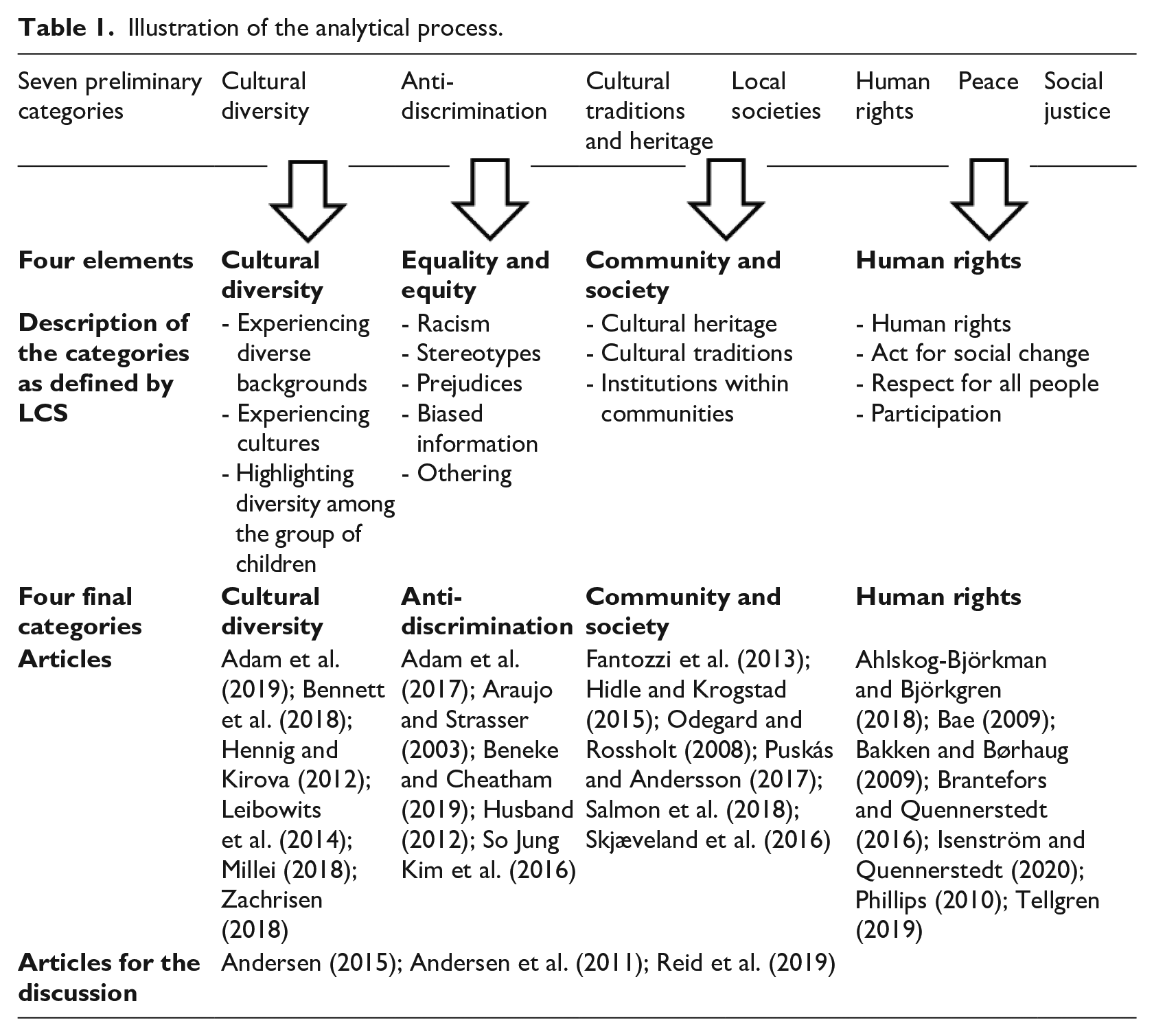
I grouped the articles into seven preliminary categories: cultural diversity, human rights, social justice, peace, anti-discrimination, cultural heritage and traditions, and local societies.
By bringing in the Framework Plan’s aforementioned social studies elements, I scrutinised the seven preliminary categories for their relevance and contributions. I posed the following analytical question: ‘How does this knowledge relate to the chosen elements and contribute to that area?’ This led me to reduce the number of preliminary categories – for example, the categories of ‘cultural heritage and traditions’ and ‘local societies’ both related to the element ‘community and society’ (see Table 1). This resulted in four categories, with each contributing to a scope of research addressing methods, critique and educational challenges. Three of the 27 studies did not fit into the categories but offered valuable perspectives to the discussion (Table 1).
Illustration of the analytical process.
Findings
Based on the social studies elements, I separated the studies into the following four categories: cultural diversity, anti-discrimination, community and society, and human rights (see Figure 1). Each category is a scope of research addressing ways in which ECEC teachers can use LCS to familiarise children with diversity and highlight diversity amongst them. The categories provide knowledge on working methods, critical perspectives or educational challenges. In my definition of each category, I used the definitions delimited in LCS (see Table 1) of the terms ‘cultural diversity’, ‘anti-discrimination’, ‘community and society’ and ‘human rights’. I have done this to secure the international articles’ relevance to LCS.
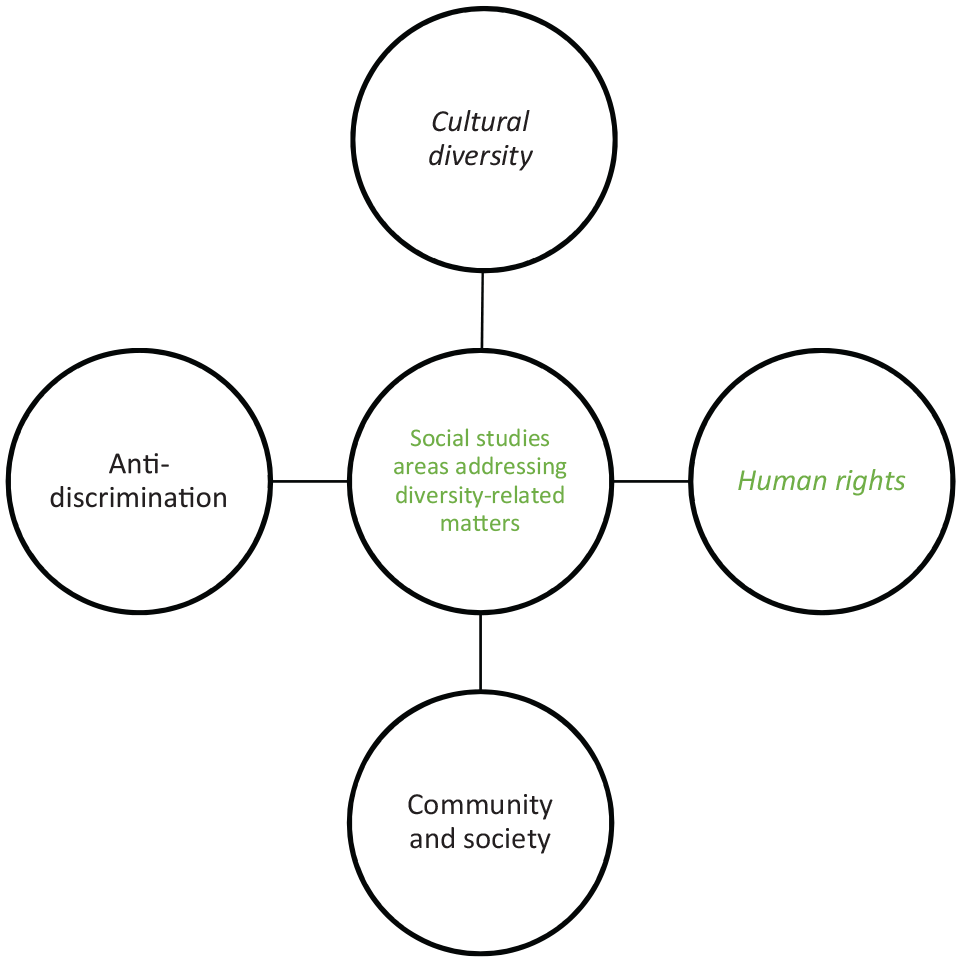
Illustration of the final categories of social studies areas addressing diversity-related matters.
Cultural diversity
The first social studies area where ECEC teachers can work with diversity is the element of cultural diversity. It relates to offering children experiences with different backgrounds, ethnicities, cultures, national minorities, indigenous groups, and ways of living and thinking (Kunnskapsdepartementet, 2017). I chose to apply a general view; accordingly, children becoming familiarised with particular ethnicities or indigenous people is not a matter of concern in the following findings. A recurring perspective is that of recontextualising a cultural artefact, or topics in the wrong context leading to discrimination and the exclusion of particular children. In the following, the focus is on methods for highlighting children’s diverse backgrounds in resourceful and non-discriminatory ways with critical perspectives.
One method for highlighting children’s diverse backgrounds is to use cultural artefacts. Studies conducted in the USA (Hennig and Kirova, 2012) and Australia (Millei, 2018) show examples of how to avoid a superficial representation of cultural diversity within a group of children. Hennig and Kirova (2012) argue that for a child’s culture to appear as the dominant culture, ECEC teachers must present realistic and functioning cultural artefacts to children. Pseudo-objects or plastic replicas (play props) occupy the space as unfamiliar items to children and become contextualised in a western framework. However, in such cases, Millei (2018) argues that ECEC teachers should critically engage to avoid prejudiced attitudes manifesting. She further argues that it is difficult to act out authentic representations of culture in imaginary play, and recontextualisation of cultural artefacts might create stereotypical representations. In this sense, the artefacts should be culturally situated when they are presented, ideally by a person originating from the culture in question (Hennig and Kirova, 2012).
While these authors found cultural artefacts to be a method for promoting different cultures, Leibowits et al. (2014) show that home visits are another approach for educating American children about diversity. In their article, a home visit is an exceptional activity for a group of children to become familiar with other ways of living and other cultures. The authors describe a guided tour with a child as the tour guide. Leibowits et al. further indicate that this is an impactful activity – they spoke to teenagers who had participated in the activity as children, who indicated that they had learned a lot about their peers from this experience.
In accordance with the aforementioned authors, Adam et al. (2019) find that books are a method for highlighting diversity within a group of children. However, this demands that ECEC teachers have specific skills and a broad knowledge of the issues under discussion. For example, in Adam et al.’s (2019) study, Australian ECEC teachers used books to develop literacy, language, and emotional and social outcomes rather than to promote the diverse cultures within the group. The authors suggest that this was because of the ECEC teachers’ limited understanding of using books to promote and value diversity, and a narrow definition of cultural diversity. The teachers’ understanding of diversity related to visual differences and cultures, and not to a broad definition including race, social class, religion, gender and family structures (Bennett et al., 2018). Also, when the ECEC teachers mentioned culture, it rarely related to the children’s backgrounds. Instead, it concerned other cultures from around the world, constructing diversity as something outside of the children’s lived experiences (Adam et al., 2019).
The previous authors show examples of resourceful methods for highlighting cultural diversity and point out some critical aspects. Zachrisen (2018), on the other hand, demonstrates how the unreflective contextualisation of a topic can exclude some children’s cultural identity. According to Zachrisen, unreflective attitudes and values play a disruptive role in the acknowledgement of and learning around cultural diversity. In her Norwegian study in a culturally diverse ECEC centre, the ECEC teachers frequently used a unilateral approach in pedagogical encounters, as opposed to a multilateral approach. 5 Zachrisen shows how the universal method of drawing and the universal topic of firefighting with boys and girls of different ethnicites were contextualised with white skin tones and the ECEC centres majority culture consiting of ethnic Norwegians. She also notes that when using a multilateral approach, none of the ECEC teachers highlighted metacognitive perspectives with the children.
Summary
These articles, taken together, point towards the issue of recontextualising topics, cultural artefacts or other activities with a diverse group of children. These findings have implications for situations where ECEC teachers recontextualise any cultural belonging with a homogenous group of children. Conducted in an imprecise way, it might reproduce biased and prejudiced attitudes, which, in turn, could lead to excluding behaviour later in life. Future research could focus on the issue of recontextualising cultural belongings and the implications for children’s identities, attitudes or learning environments.
Anti-discrimination
The second area is equality and equity, and refers to ECEC teachers treating all children equally and offering them equal experiences. ECEC teachers should, therefore, counteract discrimination, prejudices, biased attitudes, stereotypes and racism (Kunnskapsdepartementet, 2017). The following findings show how ECEC teachers can familiarise children within these issues.
From his experiences of researching and educating young children with anti-racist pedagogy in the USA, Husband (2012) suggests five reasons for anti-racist education in ECEC social studies. First, children constantly construct understandings and meanings about race in their interactions with other children and adults. Second, integrating anti-racist education in the early years allows children to see and experience racial inequality as an abnormal part of life. Third, children become empowered to identify racially biased information and prejudices. Fourth, children take on an active role to combat these injustices. And, finally, it aids ECEC teachers, as anti-racist education demands teachers to reflect on and confront issues about race and racism in both historical and contemporary contexts.
Other researchers have explored the use of books in teaching children about racial diversity and countering biased attitudes and prejudice (Araujo and Strasser, 2003; Beneke and Cheatham, 2019; So Jung Kim et al., 2016). In their study, So Jung Kim et al. (2016) observed that the participating five-year-old Korean children changed their attitude. After about five months of reading and discussing discrimination, equality, racism and stereotypes, alongside activities like drawing and poem-making, none of the children exhibited biased attitudes.
Beneke and Cheatham’s (2019) study resembles So Jung Kim et al.’s (2016) research. However, they observed a reading session turning into an engagement with literacy readiness instead of engaging in critical discussion about skin colour as an element in racism. Beneke and Cheatham argue that it might be difficult for ECEC teachers to discuss race and racial injustices when books depict race as skin colour. While books serve as an important tool for educating children about these issues, they might lack a complete representation of racial diversity and misrepresent non-dominant cultures through outdated perspectives and stereotypical images (Adam et al., 2017).
Summary
These articles highlight the importance of ECEC teachers having a strong and broad theoretical academic base when working with anti-discriminatory topics. The researchers point to ECEC teachers who dare to engage children in a critical dialogue about what books say. On the other hand, if teachers do not have a strong theoretical base, they will depend on the explicit text within books. In turn, reading between the lines, such texts can convey prejudiced and exclusionary attitudes if the reader is unable to be critical of their implicit message. Therefore, the anti-racist education in itself does not aid ECEC teachers with a low theoretical base there is also an element of critical thinking in which is needed. Future research could aim to strengthen ECEC teachers’ theoretical academic base with anti-discriminatory and inclusive practice.
Community and society
The third area is community and society, which provides children with experiences of different traditions, cultural heritages and institutions in their local community and society (Kunnskapsdepartementet, 2017). Some studies in this area offer methods for children to experience their diverse local community and the wider society, while others criticise ECEC teachers’ lack of competence and knowledge in educating children about these issues.
A Norwegian local community formed the central focus in Odegard and Rossholt’s (2008) study. They show how ECEC centres can work with social studies using an uncomplicated method. A field trip to a local cement factory, for example, offered valuable insights into the working life of factory workers. It provided the children with knowledge about the various social roles within the factory, gender equality, and occupations grounded in their local community as it entailed learning about different occupational roles within the factory, gender equality in a workspace, and the factory’s function in their community, where the factory employed many of the children’s family members.
Unlike Odegard and Rossholt’s (2008) study where an institution’s functioning is the focal point, Fantozzi et al. (2013) describe a mapping activity in the USA where children recreated their local community. The authors do not address the community’s population, buildings or institutions’ functions in their six-page article. Therefore, this activity only presents what a local community looked like structurally. While children mapping their community offers great learning experiences, it is difficult to relate it to learning about diverse societies and their functions and meanings when the structure is the focus – unless the focus is on architectural diversity.
Similarly, the American authors Salmon et al. (2018) present an interactive online mapping platform: Out of Eden Learn. This platform invites children to explore and document their neighbourhood, heritage and culture, and to investigate global issues. Children share their knowledge with online peers, as the platform matches students of the same age from around the world. Based on a questionnaire administered to the children, Salmon et al. (2018) argue that the children became more aware of intricate details in their community and gained the ability to look beyond first impressions. Their curiosity to learn more about unfamiliar places and people, and their ability to define themselves in a broader global context, increased.
In their analysis of selected Norwegian ECEC centres’ lack of celebrating religious festivals other than Christian traditions, Hidle and Krogstad (2015) problematise what it means to be Norwegian and what belongs to the Norwegian culture – for example, if minority religions belong to the Norwegian culture. The authors claim that ECEC centres tolerate minority religions as being part of Norwegian culture and the ECEC’s programme without acknowledging them as belonging. They thus consider minority religions as a family’s private matter. In turn, it is possible to ask if othering begins in ECEC. The authors suggest that ECEC centres emphasise work on three represented religious or spiritual beliefs as a starting point for children to learn about the religious backgrounds of others.
Similarly, the Norwegian authors Skjæveland et al. (2016) emphasis the need to avoid creating artificial borders between cultural groups. They argue that developing competence and placing a strong emphasis on the common elements shared by multiple cultures could strengthen ECEC centres’ work in teaching about heritage and cultural traditions. They show ECEC teachers lacking a firm conceptualisation of cultural heritage. While the ECEC centre in their study had established several methods and tools for conveying heritage education, the teachers chose the content arbitrarily, without selection criteria or principles. Skjæveland et al. assert that this was because the ECEC teachers lacked theoretical knowledge and competence, and thus based their conceptualisations on personal values, memories and beliefs.
Puskás and Andersson (2017) also focus on ECEC teachers’ limited competence in teaching about cultural traditions. They explored how Swedish ECEC teachers and children filled the traditions of Easter, Christmas and Valentine’s Day with meaning in a centre with diverse ethnicities. While the teachers discussed sensitive issues of love without hesitation, they passed on with uncertainty culturally sensitive narratives with religious connotations of Jesus’s birth and death. Puskás and Andersson identify three explanations for this uncertainty: the Swedish curriculum does not specify religion as part of cultural heritage; the teachers might have lacked knowledge because their teacher education does not include religion; and the teachers might have been knowledgeable in the matter but considered it too complicated for the children, and were thus uncertain of how to explain it to them. The scholars argue that connecting curricular content with children’s experiences and views remains an educational challenge.
Summary
It is apparent from these findings that the method in itself does not necessarily need to be challenging – a simple activity can result in rich experiences. However, the challenge of offering these rich experiences seems to be associated with ECEC teachers’ knowledge, competence and self-reflection. In particular, there are concerns with the issue of conveying cultural and religious content to a diverse group of children, with some of the researchers pointing to a deficit in the curriculum or professional preparation (Puskás and Andersson, 2017; Skjæveland et al., 2016). Future research could explore these challenges further by investigating ECEC teachers’ perceptions of how to offer a rich experience and what ECEC teachers consider to be rich experiences within the element of community and society.
Human rights
The fourth area that ECEC teachers can work with to familiarise children with diversity is human rights. Norway’s ratification of the International Covenant on Economic, Social and Cultural Rights (United Nations, 1966: Article 13) and Convention on the Rights of the Child (United Nations, 1989: Article 29) lawfully obliges ECEC centres to enable children to tolerate, respect and create friendships, irrespective of race, ethnicity, gender or religion. Within LCS, children should experience respectful engagements with people, understand that their actions matter and that they can take action in wrongful situations, and learn to negotiate and discuss as means to foster peace and prosperity (Kunnskapsdepartementet, 2017). This scope offers an understanding of how ECEC teachers can use LCS’s area of human rights to address and work with diversity. Some scholars would say that it touches on the field of human rights education. This field is not, however, the focus of my study as it does not explicitly focus on rights teaching, and I did not search for human rights research.
Bakken and Børhaug (2009) found that Norwegian ECEC teachers portrayed Eurocentric ideologies. The ECEC teachers in their study presented ‘us’ in the western part of the world as superior to people from the southern part, and expressed that people in the West needed to provide solidarity for poor people in the South – using poverty as a tool for othering. Solidarity projects can function as a gateway to discuss and highlight diversity and equality around the world and within one own’s country. On the other hand, the pitfall of portraying Eurocentric ideologies might create fertile ground for discrimination. Young children need to understand that all people have equal value, irrespective of their socio-economic status, and that people living in the West can equally learn from people living in the South (Bakken and Børhaug, 2009).
In the Australian context, Phillips (2010: 373) argues for the method of storytelling to actively engage five- and six-year-old children in issues of social justice: ‘using storytelling to provoke critical awareness of others’ positions offered a way to engage young children as active citizens’. She told stories about child labour, poaching and deforestation, during which the children’s diverse responses became prominent. On the other hand, Ahlskog-Björkman and Björkgren (2018) illustrate how a small group of Finnish six-year-olds conceptualised peace. Their preliminary findings show the children’s substantial understanding of peace. One of the understandings connected to peace is peace as being meaningful in meeting and creating relations with people from other cultures. The children saw peace as a prerequisite for good actions to occur, and that it was necessary to become acquainted with each other to accept differences.
While the above studies draw attention to children’s active engagement in matters of social justice, solidarity and peace, other studies (Bae, 2009; Brantefors and Quennerstedt, 2016; Tellgren, 2019) show that ECEC teachers predominantly focused on participation, the interpersonal relationship between teacher and child, and children’s relationships with each other when it came to addressing human rights. The two rationalities of ‘children’s competence is insufficient for human rights’ and ‘teaching children’s human rights challenges traditional values and ideas’ (Isenström and Quennerstedt, 2020: 9) might be one explanation why participation dominates in this area, although diversity and active engagement in combating discrimination, to create respectful engagement between people, are both implicit and explicit components in LCS.
Summary
These findings show that the task of familiarising children with diversity through the area of human rights demands knowledgeable and skilled ECEC teachers who can balance between familiarising children with and discussing these matters without conveying underlying intolerance or one-sided attitudes. These teachers must also be aware of the other obligations which come with Norway’s ratification of the United Nations conventions besides participation. Research attention on ECEC teacher education’s and the Framework Plan’s weighting of human rights, and ECEC teachers’ understanding of using human rights to work with diversity and its value, could broaden understanding of why participation is predominant.
Discussion
This article has explored four elements from the learning area of LCS that the ECEC teacher can use to address diversity with and amongst children, setting a preliminary research stage for future studies. From the four elements within LCS, the analysis shows four scopes of research addressing diversity-related matters: cultural diversity, anti-discrimination, community and society, and human rights. In answering the research question, the analysis shows various methods that the ECEC teacher can use. However, the analysis points to the implication of a discriminating practice, not related to the method but to the underlying knowledge and understanding of the ECEC teacher.
The intention of familiarising children with diversity as a means to promoting equality and respect, either through cultural artefacts, books, matters connected to human rights or a drawing activity, may, paradoxically, lead to the opposite of the expected outcome, such as children adopting stereotypical and biased attitudes. In turn, this creates a non-inclusive learning environment where some children experience that their background or culture does not belong with the rest of the group. This became evident in Zachrisen’s (2018) findings in contextualising firefighters as white for an ethnically diverse group of children, and Hidle and Krogstad’s (2015) findings, where some children experienced that their religious traditions were not important enough to celebrate and thus did not belong in the ECEC centre. These findings exemplify othering, where not all children are accepted and included, and a breach with the Framework Plan’s core values and LCS.
Superdiversity (Vertovec, 2007, 2019) illuminates further challenges relating to children’s various identities or nationhood, backgrounds and feelings of belonging to a community. There is reason to believe that more children with various cultural backgrounds will attend ECEC centres in the future. According to Statistics Norway (2017, 2020), Norway’s immigrant population increased from 10.2% in 2010 to 18.2% in 2020. It is highly likely that immigration will increase in the future, and ECEC teachers will face the task of facilitating a care and learning environment for these children from various cultural backgrounds.
Reid et al. (2019) state that the research literature challenges the idea of assigning children to discrete cultural categories. However, the analysis in this article points to a discriminating practice and low competence in familiarising children with cultural-diversity-related matters. This is in line with Andersen’s (2015) findings where ECEC teachers lacked the tools for widening a discussion about race, inequality and discrimination within their practice, and her earlier work where she documents ECEC teachers’ self-reported need for knowledge development in issues related to multiculturalism, inclusion and anti-discrimination practices (Andersen et al., 2011). It also accords with findings showing that what ECEC teachers learn does not necessarily equip them to deal with the multicultural society they meet in practice (Krogstad, 2016; Lauritsen, 2017). Consequently, it becomes essential to focus on matters belonging to the subject of social studies, such as issues of diversity, cultural features and inclusivity, in ECEC teacher education and future ECEC teacher competence development. Superdiversity could, therefore, offer broader perspectives and theoretical understanding, where ECEC teachers cannot assign children to discrete categories.
Concluding remarks
This article has shown several methods, pointed out some critical perspectives and highlighted areas for future research. ECEC teachers have multiple opportunities to experience children with diversity and related matters. In the future, researchers could draw attention to how the chosen areas in this review could further familiarise children with specific social studies themes, such as indigenous groups. However, an implication of these findings is that working with diversity-related matters requires critical thinking, anti-discriminatory perspectives, and sensitivity towards what attitudes and values are portrayed, which, in turn, requires introspection about one’s attitudes and values. A lack of such skills could potentially create a discriminating and excluding learning environment.
It is therefore important to focus on the area of human rights within Norwegian ECEC in future research in order to combat and counter discriminating behaviour and attitudes. The implication of a discriminating practice in ECEC is a contravention of what education should be directed towards and does not offer a learning environment where professionals prepare children for tolerance, equality, friendship and respect among all people (United Nations, 1966: Article 13; 1989: Article 29).
Footnotes
Declaration of conflicting interests
The author declared no potential conflicts of interest with respect to the research, authorship and/or publication of this article.
Funding
The author received no financial support for the research, authorship and/or publication of this article.
