



Abstract
Partnering with families is an explicit regulatory and role requirement for early childhood educators, yet the emotional labour involved is implicit and relatively unacknowledged. While research has found that complex work demands jeopardise educator wellbeing – resulting in unprecedented turnover and attrition in Australia and internationally – little research has investigated emotional labour and associated educator wellbeing in relation to partnering with families. This article argues that the limited research on educators’ emotional labour with families and its ensuing invisibility may pertain to both its positioning within social constructivist and interpretivist paradigms that render such work as naturally inherent and to conceptualisations of emotional labour theory that entrench this work in maternalistic discourses. The article positions emotional labour theory within a critical feminist lens and as a worthwhile line of inquiry to extend this body of research and disrupt maternalistic discourses that diminish educators’ skilful labour. The potential affordances pertaining to the illumination of this work as skilful for early childhood workforce policy are considered.
Keywords
Introduction
Australia and many countries around the world are experiencing an early childhood education and care (ECEC) workforce crisis, evident in the unprecedentedly high turnover and attrition levels of educators (i.e.,degree-qualified teachers and vocationally trained practitioners who work with children birth-to-five years) (Cumming et al., 2020; Organisation for Economic Co-operation and Development [OECD], 2020; Schaack et al., 2022). This crisis is attributed to structural and workplace challenges, notably low pay, poor professional recognition and workload burden (McKinlay et al., 2018; McMullen et al., 2020). The COVID-19 pandemic amplified these stressors (Berger et al., 2022), resulting in increased rates of educator burnout (Saracho, 2022) and contributing further to the challenge of sustaining a high-quality workforce (Fenech et al., 2021). Such turnover can deleteriously impact the quality of ECEC services through the disruption of relationships between educators, children and their families, and the loss of knowledgeable and experienced educators (OECD, 2022).
Australian and international governments and regulatory authorities are initiating recovery and support plans, calling for evidence-based research to address the wellbeing, turnover and attrition issues that jeopardise quality ECEC (Kulakiewicz et al., 2022; Australian Children's Education and Care Quality Authority [ACECQA], 2021; United States Department of Health and Human Services’ Administration for Children and Families, 2022). Australia's Early Childhood Workforce Strategy (ACECQA, 2021), for example, aims to investigate and resource educator wellbeing and practice-based initiatives for a sustainable, quality workforce where educators have supportive working conditions, wellbeing provisions, career progression, competitive remuneration and professional status. Such initiatives signify the critical need to investigate educators’ work-related wellbeing, understood in this article as encompassing psychological and physiological wellness, influenced by ‘the interaction of individual, relational, work–environmental, and sociocultural– political’ dimensions (Cumming and Wong, 2019: 276).
One area of educators’ work-related wellbeing that warrants investigation is partnering with families. Policies set expectations for educators to collaborate with and support families in Australia (ACECQA, 2020) and internationally, including in New Zealand (Ministry of Education, 2017), the United States (United States Department of Health and Human Services & United States Department of Education, 2016), the United Kingdom (Department for Education, 2021), China (Guo and Kilderry, 2018), Canada (Canadian Government, 2017) and Norway (Ministry of Education and Research, 2005). These regulatory expectations are evidence-based, recognising that when educators and families collaborate, families’ strengths, cultures and values are supported and included within educational programmes (Trute and Hiebert-Murphy, 2018). Family involvement and shared decision-making promote the child's inclusion and continuity of learning, thereby provisioning lifelong benefits for the child (ACECQA, 2020; Department for Education, 2021), particularly for families experiencing disadvantage (Fenech and Skattebol, 2021; Hadley and Rouse, 2021; Tobin, 2020).
While research has identified that partnering with families is emotional work for educators (Andrew, 2015; Davis and Dunn, 2018; Elfer, 2015; Osgood, 2010), this article will show that empirical evidence regarding the emotions educators utilise in their work with families and the ensuing impact on educator wellbeing is limited. This silence in ECEC may in part be attributable to maternalism discourses that ascribe ‘natural’ mothering instincts to ECEC educators (Ailwood, 2007). Predominantly female, educators are viewed as innately caring and emotional in their work (Ailwood, 2007), and more capable of managing emotions and expressions, doing so more frequently than men (Hochschild, 2012). One implication of this discourse is the positioning of educators’ emotional work as innate and therefore unskilled (Malhotra, 2022). Such positioning devalues educators’ skills and professionalism (Ailwood, 2007), rendering such work invisible (Taggart, 2011) and potentially unworthy of investigation.
Bringing a critical lens to educators’ emotional labour with families has scope to disrupt maternalistic views by illuminating both this undervalued and unrecognised work and its potential impact on educator wellbeing. Drawing on the work of Hochschild (2012), ‘emotional labour’ is an employee's regulation of emotions and expressions that meet professional expectations or norms. The article explores the potential of emotional labour theory to provision understandings about, and make more visible, the complex emotional work and wellbeing implications of educators’ work with families. In doing so, the article addresses the question of whether a focus on educators’ exercising of emotional labour in their work with families can help disrupt entrenched views that ECEC work is maternalistic and therefore natural and unskilled.
The article begins by outlining emotional labour theory and in so doing, maintains that the social constructivist and interpretivist paradigms, within which emotional labour theory predominantly sits, may reinforce maternal views of educators’ work. A literature review of educators’ emotional labour with families follows. Using a critical feminist lens to review the four studies that have to date explored educators’ emotional labour with families, the article argues that without a critical stance, educators’ emotional labour remains entrenched within deficit, maternalist discourses. A discussion of the limitations of this body of research follows, before the potential affordances of future explorations of ECEC educators’ emotional labour with families, through a critical feminist paradigm, are highlighted.
Emotional labour theory
Emotional labour theory offers a framework from which to investigate and expose the complex, nuanced emotion skills and strategies necessary for working in ECEC and in particular, with families. Emotional labour requires an employee to regulate or manage their feelings to display an outward expression or behaviour that induces feelings or a state-of-mind in others to achieve work-related goals and expectations (Hochschild, 2012). Grandey et al.'s (2013) three-dimensional conceptualisation of emotional labour, encompassing occupational requirements, emotional displays and intrapsychic experiences, provides an additional lens through which educators’ work with families may be explored.
Emotional labour's three-dimensional framework
Occupational requirements refer to occupations in which employees have frequent interactions with others, and where emotional display rules dictate the emotions deemed necessary for inducing feelings or states-of-mind in others to meet role expectations (Grandey et al., 2013; Hochschild, 2012). Emotional display rules are the social norms that define how employees should interact with others to meet occupational requirements (Grandey et al., 2013; Hochschild, 2012). The workplace or role's emotional display rules dictate the second dimension of the framework, emotional displays, which are the outward expressions and behaviours of employees that are intended to induce feelings or states-of-mind in others (Grandey et al., 2013; Hochschild, 2012).
Emotional displays include three display strategies. First, surface acting involves deliberate suppression or exaggeration of emotion to outwardly display the expression necessary for occupational requirements (Brotheridge and Lee, 2003; Hochschild, 2012). For example, an educator may supress feelings of stress, exaggerate a smile and express a calm demeanour to reassure families that they are leaving their child with a capable, happy educator. The second strategy, deep acting, involves cognitive modification of feelings such that the dissonance between experienced and expressed emotions is resolved (Brotheridge and Lee, 2003; Hochschild, 2012), and therefore may be authentic (Grandey et al., 2013). For example, an educator frustrated that a family seems unconcerned about their child's behaviour will internally manage thoughts and emotions to feel and express genuine compassion and understanding, securing the family's state-of-mind that they are well supported. Natural/genuine expressions are the third strategy in which the individual does not need to modify, suppress or artificially display expressions different from their feelings (Ashforth and Humphrey, 1993), such as when an educator's genuine smile and cheerfulness reflects their enjoyment and passion for their work.
The third and final dimension, intrapsychic experiences, refers to the internal processes requiring ‘effort, planning and control’ (Morris and Feldman, 1996: 987) to ‘regulate feelings and expressions’ (Grandey, 2000: 97). Generally, the greater the effort of these internal processes the greater the negative wellbeing impact (Grandey et al., 2013). Surface acting has tended to correlate positively with exhaustion and burnout, whereas deep acting and genuine expressions have tended to elicit mixed results (Delgado et al., 2017; Hülsheger and Schewe, 2011; Kariou et al., 2021; Lee and Madera, 2019; Yang and Chen, 2020).
Emotional labour's social constructivist positioning
Given that educators exercise emotional labour through emotional displays influenced by their occupational context, emotional labour theory can be seen to be positioned in a social constructivist framing that is limiting. Social constructivism pertains to the unique ways of meaning-making and knowing through individual lived experiences (Crotty, 2020). The limitation of socially constructed meanings is that they resist a ‘critical spirit’ (Crotty, 2020: 58). Therefore, while each educator may exercise and experience emotional labour according to their unique occupational and contextual factors, when investigated without an additional critical lens, limitations to how emotional labour is portrayed exist.
Firstly, emotional labour becomes relegated to descriptions and interpretations of how and why it is exercised according to constructivist and interpretivist constructs. Therefore, instead of articulating the professional and skilful effort required to manage one's emotions in ever-changing and complex contexts to meet workplace, family or educator expectations (Taggart, 2011), educators’ emotional labour may appear implicitly natural and therefore ‘socially constructed as a non-skill’ (Bolton, 2004: p.3). Secondly, discursive display rules tend to be implicitly inherent in ECEC, thus taken for granted and exploitative (Malhotra, 2022) rather than explicitly acknowledged and questioned. Thirdly, without a lens that critiques emotional display rules, illuminates skills and efforts involved in exercising emotional labour, and makes educators’ wellbeing visible, the development of educator supports for effectively exercising emotional labour and sustaining educator wellbeing may be inhibited. In turn, research framed by social constructivist or interpretivist paradigms that keep educators’ professional and skilful emotion work invisible ensure that related wellbeing implications remain relatively unacknowledged in workplaces, policy, curriculum and training programmes (Cumming et al., 2020; Purper et al., 2023).
Notably, emotional labour has been described in other female-dominated professions such as nursing, aged care, social work and primary teaching as skilled work, with wellbeing implications (Nixon, 2009; Winter et al., 2019; Bolton, 2004; Howard and Timmons, 2012; Payne, 2009). The research on social workers and nurses’ emotional labour with families makes visible the technical and complex emotional skills used in practice, with safeguarding techniques for wellbeing also identified (Howard and Timmons, 2012; Lavee and Strier, 2018; Winter et al., 2019). For example, knowing ‘when to push the discussion further or back away, knowing what feelings to suppress to avoid igniting the situation and knowing when and where to leave to maintain personal safety’ (Winter et al., 2019: p.228). The skilful management of emotions for self-preservation purposes (Lavee and Strier, 2018) without compromising emotional attachments to children and families (Howard and Timmons, 2012; Winter et al., 2019) is also highlighted in this literature.
Included in this body of work are ideas that effectively challenge a social constructivist positioning of the work of health and welfare professionals, and which are relevant to educators. First is a critique of the notion that the shaping of men's and women's emotion behaviours and the stigma around work skills that are typically viewed as feminised or masculinised are due to gender socialisation (Nixon, 2009; Bolton, 2004). Second is the argument that identifying specific skills relevant to a profession's emotional labour demands requires differentiating between socially expected emotions such as politeness, from the technical application of emotion for specific labour purposes (Payne, 2009). These ideas suggest that a more critical framing of emotional labour such as that offered by critical feminism may enable space for the skills and wellbeing implications of emotional labour to be made visible.
Emotional labour through a critical feminist lens
Critical feminist approaches invoke change, empower, emancipate, challenge and disrupt outdated and patriarchal ideologies about women's work, particularly emotion work in ECEC (Boler and Zembylas, 2016; Merriam and Tisdell, 2016). The educator role requires frequent, sustained interactions with families to support child learning and development and individual family needs, and to secure families’ satisfaction, trust and ongoing enrolment, most often through positive emotion displays such as cheerfulness, calmness and confidence (Malhotra, 2022). The expectation for positive displays to meet the occupational requirements for working with families implicitly marks the educator as nurturer, pleaser and comforter to meet the needs of others. Moreover, conceptualisations of emotional labour theory have potential to entrench notions of ‘mothering’ whereby educator emotions are constructed as an innate and inherent response to the support, care and emotional needs of families that are necessary for meeting educator–family partnership requirements. The idea that ECEC is women's work, consisting of women's skills will then continue to manifest societal thinking, reinforcing the view that certain professions require skills and dispositions that are typically feminised. To ascertain whether the existing research on educators’ emotional labour with families entrenches or disrupts notions that educators’ work is maternalistic, a review of these empirical studies through a critical feminist lens was necessary.
Empirical investigations of emotional labour with families
To ascertain what ECEC research on educators’ emotional labour with families exists, and through which paradigm this research has been undertaken, a literature search was conducted using the terms early childhood teachers/educators/preschool teachers/kindergarten teachers/early years/day care AND emotional labour/emotional labor in the EBSCOHOST (Education), Taylor & Francis, ProQuest, Wiley Online, SpringerLink and SAGE databases. Date-range limitations were not applied. This search strategy generated 36 peer-reviewed publications. Four publications made only general reference to emotional labour in relation to educators’ care ethics and emotion work (Elfer, 2015; Osgood, 2010; Taggart, 2011, 2015), and so were excluded. The 32 peer-reviewed publications comprised two conceptual papers and 30 empirical studies (Appendix 1). Surprisingly, only four publications focused on educators’ emotional labour while working with families (Brown et al., 2022; Lee and Brotheridge, 2011; Morris, 2018; Quiñones et al., 2022).
Critical analysis of the four studies was grounded in both inductive and deductive thematic analysis (Braun and Clarke, 2006). Inductively, analysis of research methods and theoretical underpinnings of the following was undertaken: who the investigation included (i.e., vocationally trained or teacher-qualified educators, children, families and/or colleagues); what setting the investigation occurred in; and the justification for research decisions. Questions that guided subsequent analysis emerged as the literature was reviewed, including how educators exercise emotional labour in ECEC, particularly in their efforts to partner with families; what influences educators’ exercising of emotional labour, particularly with families; what educators’ perceptions of the impact of emotional labour on their wellbeing are; and whether any factors for safeguarding educator wellbeing had been identified. A deductive analysis considered whether the literature positioned emotional labour in deficit maternalist discourses, and reinforced or disrupted maternalistic positionings of educators and the work they do with families.
What follows is a critical review of educators’ emotional labour while working with families, and the wellbeing implications of this work, as reported in Brown et al. (2022); Lee and Brotheridge (2011); Morris (2018); and Quiñones et al. (2022). The review first presents the key findings of the four studies, before considering if and how these investigations reinforce or disrupt maternalistic positionings of educators’ emotional labour.
Educators’ emotional labour with families
A key finding of this literature review was that only four studies have to date specifically explored educators’ emotional labour with families (Brown et al., 2022; Lee and Brotheridge, 2011; Morris, 2018; Quiñones et al., 2022). Lee and Brotheridge (2011) used an interpretivist approach to their cross-sectional survey (n = 198) of Canadian educators’ experiences of emotional labour with parents. Morris’s (2018) phenomenologically framed doctoral study explored United Kingdom university-qualified early childhood teachers’ (n = 18) emotional labour – with children, families, colleagues and leaders – through five focus groups, followed by individual interviews. Brown et al. (2022) investigated preschool teachers’ (n = 27) emotional labour across all school-based relationships in the United States through individual interviews, providing descriptive and interpretivist accounts of participant experiences. In the only Australian study, Quiñones et al. (2022) explored, through interviews, educators’ (n = 30) increased emotional labour with families and ensuing burnout during the COVID-19 pandemic. Both Brown et al. (2022) and Quiñones et al. (2022) utilised interpretative paradigms to articulate educators’ experiences of emotional labour, whilst also adopting social constructivist positioning of emotional labour as influenced by others (i.e., the relationship) and events (i.e., COVID-19 pandemic).
While there is a lack of in-depth understanding of educators’ emotional labour and wellbeing implications while working with families, the limited extant research nonetheless offers some insights. The four studies identified three key influences on how educators exercise and experience emotional labour: firstly, based on the nature of their individual relationships with families; secondly, to benefit the educator–family partnership; and thirdly, with variable professional and wellbeing implications. As the discussion that follows will show, reviewing these four studies through a critical feminist lens highlights that interpretivist and constructivist framings of some findings entrenches educators’ emotional labour within existing maternalistic positionings while only a few findings, when critically reframed, offer the potential to contradict and disrupt such notions.
Influence of individual relationships on emotional labour
The literature suggests educators’ exercising and experiences of emotional labour are influenced by the individual relationships they have with families. As such, the purpose, practice and meaning of educators’ emotional labour is constructed in accordance with the demands of each families’ needs. For example, Brown et al., depict preschool teachers’ emotional labour as based upon understandings of parents’ needs, how well they knew families, and the trust, ‘strength and intimacy of their relationships’ (2022: 8). Emotional displays provide each family with support to meet their needs or as a self-preservation strategy to hide educator uncertainty, thereby meeting family expectations through securing families’ confidence in the educator (Brown et al., 2022; Lee and Brotheridge, 2011; Morris, 2018; Quiñones et al., 2022).
Educators’ emotional labour positioned as providing for the individual needs of families resonates with depictions of women having intuitive capacities for the physical and psychological needs of others based on their ‘mothering’ predispositions (Hochschild, 2012). Both Morris's (2018) interpretation of participant experiences of surface acting as a ‘moral technique for helping those who are more vulnerable’ (2018: 182), and Lee and Brotheridge's (2011) interpretation of the socially constructed ‘nurture and care’ nature of ECEC and educators socialisation to behave as such, detracts from ideas that such work is skilled, professional labour. Further implying the innate capacity for emotion work, Lee and Brotheridge described educators’ emotional labour with families as ‘spontaneous and emergent’ rather than skilled practices of emotional labour.
Educators may also exercise and experience emotional labour with families in a professional and skilful way that not only supports families’ needs, but also ensures collaborations and partnerships. Emotional labour strategies were generally found to be chosen based on the ‘emotionally complex interactions in the moment’ (Brown et al., 2022: 8), as seen in Quiñones et al., where ‘the nature of communication between families and educators changed in light of the pandemic’ (2022: 98). Morris (2018) also points out that educators need the skill to balance nurture-and-care with professional detachment while collaborating with families who may not view educators’ professional skills as highly as their own parenting capacities. There is opportunity to explicitly reveal, through a critical feminist lens, how educators flexibly and skilfully navigate individual family needs in constantly changing circumstances, while also managing professional boundaries to support families.
Benefits of educators’ emotional labour with families
How educators exercise emotional labour has educator–family relationship benefits. Lee and Brotheridge (2011) identified that the requirement for positive displays with parents (i.e., cheerful, welcoming, calm) through surface acting, over time led to deep acting with parents, with beneficial relationship outcomes. They also acknowledged that surface acting's ‘faking’ display was utilised least, potentially due to its ability ‘to undermine their credibility in the parents’ eyes’ (2011: 414). Similar findings of surface acting's relational benefits through protecting the teacher–family relationship when genuine emotions would not, were found in Brown et al. (2022). Educators were also described as concealing and regulating their emotion displays to mitigate family concerns over the care of their child, such as masking their stress to protect themselves, appear competent and engage professionally with families (Morris, 2018). Educators working with families whose children have additional needs, for example, may utilise genuine expressions of empathy, but may surface act to benefit the relationship by saying ‘the things parents want to hear because you don’t want to hurt their feelings’ (Morris, 2018: 122).
The descriptions and interpretations above construct the purpose of educators’ emotional labour as being naturally accommodating, caring, and a provider for others’ needs for relational benefits (Smith et al., 2017), thus entrenching this labour within existing maternalistic positionings. Brown et al. consistently extracted evidence such as ‘ensuring families felt heard’ (2022: 6) to make this point, rather than offer evidence that details the skill and professional practice teachers exercised through emotional labour to ‘ensure families were heard’. The provision for families’ needs at the expense of their own occurs in Quiñones et al. (2022) and is evident in Morris’s (2018) participants who exercise strategies that ‘concealed’, ‘regulated’ and ‘masked’ feelings. Quiñones et al. (2022) articulated that by providing additional emotional support and communication to families during the pandemic, educator–family relationships were improved and sustained. Such a finding indicates that educators acted in a way that served the requirements of the occupation.
Educators’ skilful exercising of emotional labour practices to benefit educator–family relationships, tend to be only implicitly discussed. For example, Brown et al.'s identifying of preschool teachers as occasionally masking emotions to ‘create space in the moment to sustain and bridge challenging relationships’ (2022: 9) implies a level of skilful emotion regulation for strategic relational purposes. The skilful and effective use of ‘hiding’ correlates with Lee and Brotheridge's (2011) findings that ‘hiding’ tended to be exercised by more experienced and older educators. Through a critical lens, these descriptions implicitly refute naturalist notions of educators’ work by inferring that educators employ nuanced skills to regulate their own emotions to mitigate conflict and manage complex relationships with families. Thus, through varied emotional labour strategies with different families and in different situations, educators can skilfully and professionally exercise emotional labour in their work with families.
Wellbeing implications of educators’ emotional labour
Emotional labour may have positive wellbeing implications for educators that are implicitly evidenced as well as explicitly stated within the family investigations. Brown et al. (2022) cautioned against the idea that surface acting has only negative outcomes for educators as it supported the development of relationships or acted as a buffer for when educators did not yet know families or their child very well (Lee and Brotheridge, 2011; Morris, 2018). Deep acting also facilitated educator interactions with families, despite requiring some effort that may in turn have wellbeing implications. The ‘common ground, mutual understanding, and practical, situated interests with the parents’ (Lee and Brotheridge, 2011: 415) through deep acting supported educators’ work with families.
Potentially, surface and deep acting may offer short-term strategies to share information and build relationships that may eventually lead to more genuine emotional displays with families. As such, there may be short-term negative wellbeing implications, such as exhaustion and anxiety, due to the effort in exercising emotional labour in, and concern for, new or difficult relationships and contexts. However, these strategies may lead to better relational and professional outcomes over time that positively influence educator wellbeing in the long-term. For example, the professionally rewarding aspect of supporting families, their home-life challenges, parenting needs and collaborating on child development and learning (Morris, 2018) indicates the potential for professional satisfaction to positively influence educators’ wellbeing. Positive wellbeing outcomes for educators may occur when emotional labour is thoughtfully and skilfully exercised to sustain quality educator–family interactions. Detailed evidence of the positive outcomes and skills used, as outlined in the preceding discussions, potentially offers a professional and skilful framing of educators’ emotional labour, rejecting notions that this labour is inherent to educators’ work.
However, emotional labour while working with families may also have deleterious wellbeing implications for educators, which may further contribute to the ‘mothering’ nature of giving to others’ needs at the expense of oneself, adding to maternal positionings of educators’ work. Educators who exercise emotional labour with families may experience emotional exhaustion and burnout in relation to this work (Lee and Brotheridge, 2011). Australian educators’ emotional labour during the COVID-19 pandemic may have ensured they supported families and achieved role-related responsibilities. However, educators experienced emotional distress and job burnout as a result (Quiñones et al., 2022). The extent to which exercising emotional labour with families influences educator wellbeing remains unknown. For example, it is unclear what wellbeing implications exist when emotional labour is exercised to support families during times of crisis, as seen in Quiñones et al., compared with emotional labour being exercised to collaborate with families.
Limitations of the educator-family emotional labour research
Emotional labour investigations lack a critical lens
Notwithstanding the value of the existing findings, limitations exist, particularly when investigations adopt interpretivist and/or social constructivist paradigms that reinforce naturalist framings of educators’ emotional labour, keeping their effort and expertise hidden. Emotional labour investigations must extend beyond interpretivist and constructivist-only paradigms that may unintentionally contribute to the low social and political status of ECEC by not illuminating the professionalism within educators’ emotional labour. Incorporating critical framings may identify not only educators’ emotional labour, but also the constructs which keep such labour unacknowledged and entrenched in deficit positionings. Evidence suggests that the feminised stigma to emotional labour and ECEC as women's work inhibits men from entering the workforce (Nixon, 2009) at a time when workforce shortages could benefit from increased numbers of male employees. A critical feminist paradigm offers the potential to frame research findings in powerful ways that may challenge the deficit discourses of naturalism and gender pertaining to ECEC and emotional labour, thereby emancipating educators’ emotional labour from its skill-less branding and engendered social stigma (Merriam and Tisdell, 2016).
Emotional labour with families is under-researched
There is much scope to better understand emotional labour and ensuing wellbeing implications in the context of working with families in ECEC, as evidenced in the social work and nursing investigations (Delgado et al., 2017; Howard and Timmons, 2012; Lavee and Strier, 2018; Winter et al., 2019). There exists a paucity of research in this area, and the four explorations of educators’ emotional labour with families are limited in scope. First, none of the four studies addressed, in depth, the individual and/or contextual influences on how, or why, emotional labour was exercised with families. Second, two studies (Brown et al. (2022) and Morris (2018)) investigated emotional labour with children, families and colleagues rather than specifically with families. Third, Quiñones et al.’s study (2022) explored educators’ emotional labour within the context of a global pandemic, rather than the day-to-day of educators’ emotional labour with families. Fourth, since the four studies generally focused on educators’ exercising of emotional labour to support families, what wellbeing implications exist when emotional labour is exercised to collaborate with families remains unclear. There is scope for researchers to critically explore individual and contextual factors relative to the relationships with families in which emotional labour is being exercised within ECEC.
Inattention to educator–family barriers
The perception that emotion work with families is innate and is not labour requiring support means that little attention has been paid to three key structural and workplace barriers of such work. These barriers limit emotionally safe spaces for educators to prepare for and engage in complex and sensitive conversations and collaborations with families (Almendingen et al., 2022; Harrison et al., 2019). First, time constraints and busy, noisy environments in which educators multitask heavy workloads pressure educators to engage in important, confidential discussions quickly, in disruptive environments. Such conditions may require surface acting to conceal stress, display positive expressions, mitigate conflict or reflect professionalism.
Second, limited access to and support from service leaders and colleagues impedes educator capacity to navigate complex family partnerships (Kambouri et al., 2022; Murphy et al., 2021). While evidence indicates that collaboration with leaders and colleagues supports educators’ emotional labour (Brown et al., 2022; Yin et al., 2022; Zheng et al., 2022), such opportunities remain scarce (Malhotra, 2022; Monrad, 2017). Staffing inconsistencies due to high turnover, rotating-rosters, part-time educators and/or absenteeism also inhibit the development, over time, of collaborative collegial relationships and strong, trusting educator–family partnerships (Kambouri et al., 2022; Murphy et al., 2021).
Third, insufficient or inaccessible pre-service training and ongoing professional development inhibit educators from acquiring requisite interpersonal, communication, and emotional skills necessary for on-the-job demands of educator–family partnerships (Boyd et al., 2020; Fenech and Ribarovski, 2020; Winship et al., 2021). Yet, families often need emotional support and reassurance that is highly skilled, challenging and sensitive work (Mikuska and Fairchild, 2020). Limited training may exist due to perceptions that women are natural ‘carers’, diminishing the need for skills and training critical for ECEC work (OECD, 2019). Many Australian and international educators articulate low confidence and feeling unprepared for these intense, on-the-job partnership demands (Kambouri et al., 2022; Murphy et al., 2021) and this may correlate with the limited representation of emotional labour in pre-service training programmes, policy and workplaces (Malhotra, 2022). Limited preparedness coupled with language barriers and difficulties relating to and supporting multiple perspectives and diverse families hinder educator understandings of family culture, socio-economic status, religion, values, beliefs, expectations and abilities (Hadley and Rouse, 2021; Wilson, 2016).
Wellbeing implications remain unknown
Since research on educators’ emotional labour with families is limited, and at times may reinforce deficit maternalistic ideas, educator wellbeing implications remain unclear and require investigation. While educator–family relationship benefits of emotional labour exist (Lee and Brotheridge, 2011; Brown et al., 2022; Morris, 2018), whether these benefits have positive wellbeing implications for educators remains unclear. Quiñones et al. (2022) focused only on the negative wellbeing implications of emotional labour, and in the context of a global pandemic. The link between emotional labour and mental and physical health remains, overall, relatively unclear within the emotional labour scholarship (Gabriel et al., 2023). Further explorations of which strategies and whether emotional labour itself can mitigate or manage how this labour with families is experienced, as suggested in the social work and nursing investigations (Delgado et al., 2017; Howard and Timmons, 2012; Lavee and Strier, 2018; Winter et al., 2019), may help support educator wellbeing and retention.
Methodological limitations
The four family studies collected data either at one point in time (Lee and Brotheridge, 2011) or within a short period of time (Brown et al., 2022; Morris, 2018; Quiñones et al., 2022). Thus, it is impossible to consider the ‘transient nature of emotions’ and comprehend ‘why and when emotional labour is harmful or beneficial’ (Grandey et al., 2020: 154), both for professional and wellbeing purposes. Research exploring educators’ day-to-day emotional labour and how these may change or develop over the period of time in which educators and families usually interact (typically a 12-month duration of the child's age-group attendance) requires methods that collect rich data at various time points across the period of the educator–family relationship. Critical analyses of such data may identify the skilful exercising of emotions in the relational context over the duration of the relationship.
Future longitudinal investigations of emotional labour, adopting a critical paradigm to challenge the maternalistic discourses that undermine such work as innately ‘women's work’, could explore unfolding dynamics within and between relationships, interactions or events, and educators’ wellbeing, performance and job satisfaction changes over time. Moreover, they could have the added benefit of understanding these changes in context (Diefendorff et al., 2020). In-depth knowledge of educator–family relationship dynamics, the changes over the duration of the relationship and how frequency and variability of emotional labour impacts educator wellbeing and relational work, may enhance understandings about educator practices with families, and associated wellbeing implications.
Potential affordances of future critical investigations of emotional labour in educator–family partnerships
The limited ECEC investigations of emotional labour, especially in relation to educators’ working with families, and their inadvertent contributions to existing maternalistic positionings of educators’ work, keep emotional labour and its wellbeing implications relatively hidden and unacknowledged in policy, research, pre-service training programmes, and workplaces (Boyer et al., 2013; Colley, 2006; Fairchild and Mikuska, 2021; Malhotra, 2022; Monrad, 2017; Morris, 2018; Purper et al., 2023; Vincent and Braun, 2013; Zhang et al., 2020b). The long-held positioning of the work of ECEC professionals as predominantly women's work (Colley, 2006; Fairchild and Mikuska, 2021; Malhotra, 2022; Monrad, 2017) maintains the idea that ‘mothering’ innately includes care, thereby rendering the highly professional skills necessary for emotional labour in ECEC invisible and exploitative (Malhotra, 2022; Mikuska and Fairchild, 2020; Monrad, 2017). Additionally, such notions entrench gender inequalities and social stigmas pertaining to ECEC work that position men as unsuitable workforce employees due to a lack of innate emotional capacities (Nixon, 2009; Payne, 2009). A critical component in identifying the specific skills within ECEC's relational work is to separate skills from engendered notions that emotional labour within ECEC is innate for women.
While the review of existing emotional labour research in educator–family relationships made some reference to the skills necessary for such work, most often the reference to professional and skilled aspects of emotional labour were implicit, keeping the professional work of emotional labour invisible. Transparent evidence of the emotional labour skills educators utilise to meet requirements for partnering with families, through a critical feminist lens, may: (i) identify that this necessary labour is difficult, skilled work that warrants appropriate remuneration; (ii) illuminate wellbeing implications; (iii) identify and clarify that emotional labour is not merely innate but can be acquired and successfully utilised through training and support; and (iv) inform the planning and delivery of relevant pre-service and ongoing professional training (Malhotra, 2022; Vincent and Braun, 2013). Lines of enquiry that acknowledge educators’ skilled work can shift the rhetoric that ECEC work is natural and thus unskilled.
Pre-service training for social workers and nurses based on evidence of emotional labour practices, particularly with families in extenuating circumstances, has been shown to support workers’ capacity to balance the emotions they moderate with the emotions they need for their work (Howard and Timmons, 2012; Lavee and Strier, 2018; Winter et al., 2019). Additionally, ongoing support for these professionals’ reflections on their everyday emotions while working with families, at an individual, collegial and organisational level, has been highlighted as critical (Howard and Timmons, 2012; Lavee and Strier, 2018; Winter et al., 2019). These investigations are instructive for how educators might be better prepared and subsequently supported in the workplace. Acknowledging educators’ emotional labour in their work with families as skilled labour could help address current workforce challenges. The development of government and provider workforce policies that identify and stipulate necessary supports for effective practices and partnerships with families may have positive wellbeing implications and mitigate educator turnover (Molyneux, 2021).
There is also scope to advance emotional labour theoretical conceptualisations and methodology, through a critical feminist lens that critiques, challenges and transforms current maternalistic discourses keeping emotional labour in ECEC invisible and devalued. Advancing emotional labour theory calls for longitudinal studies exploring emotion regulation as it develops within different relationships over time (Kariou et al., 2021; Diefendorff et al., 2020; Grandey et al., 2020). As such, research design recommendations include investigating employee experiences of emotional labour in and between events or interactions in their work over time through mixed-methods that include, for example, interviewing at multiple points-in-time, diary-based procedures, unobtrusive observations or experience-sampling (Diefendorff et al., 2020). Analysing experiences of emotional labour through a critical feminist lens may support understandings of how participants frame their emotional labour with families and whether accounts of experiences have gendered underpinnings.
Theoretical advancement requires methods that consider the contextual, relational, workplace and individual influences and their inter-relatedness on this labour (Grandey and Melloy, 2017). Furthermore, the advancement of emotional labour theoretically and methodologically requires researchers to compare, contrast and critically analyse emotional labour within various theoretical paradigms to ‘not only test the framework, but compare theoretical ideas’ (Grandey and Melloy, 2017: 417). Critical theories may challenge the status quo (Merriam and Tisdell, 2016), such as a critical feminist theory that disrupts notions of maternalism keeping emotional labour invisible and undervalued.
In ECEC, where emotions may be more momentary, frequent and interchangeable, dependent on the social-cultural-organisational context and the relationship-based nature of the profession, new ways of conceptualising emotional labour may emerge. Hochschild (2012) acknowledged that the work involved in some professions, such as that of an educator, may not align with the dimensions of emotional labour as she conceptualised it. Thus, investigating emotional labour may lead to new conceptualisations according to the unique relationships and requirements of the profession. There is scope to re-conceptualise emotional labour for the ECEC context through multiple theoretical lenses that may acknowledge the professional, skilled work educators do with families, disrupt discourses that undervalue this work and support workforce wellbeing challenges. As such, social perceptions of educators’ work and skills may improve, reinforcing the importance of pre-service and ongoing training and bridging the gender gap within the workforce (OECD, 2019).
Conclusion
This article draws attention to both the limited evidence on educators’ emotional labour while working with families, which remains implicit, and the critical perspective needed for future research to disrupt the gendered and maternal discourses devaluing educators’ emotion practices. Associated implications for educators’ wellbeing thus remain unclear. The limited and often-times implicit interpretations of educators’ emotion skills necessary for working with families fails to identify emotional labour as a core professional component in ECEC's relational demands, rendering the necessary skills invisible. Explicitly illuminating the complex skills and supports required to navigate complex relational engagements in flexible and nuanced ways may shift maternalistic rhetoric and unveil educator wellbeing implications.
Acknowledging the use of emotions and the exercising of emotional labour should not diminish educators’ professionalism, but rather advocate for the skilled complexity of the work educators do with families and shift outdated maternalistic discourses dominating ECEC. While these views on educators’ work remain socially entrenched in Australia and elsewhere, ‘the naturalisation of their work undermines their struggle for professional status’ (Ailwood, 2007: 162), keeping remuneration low (Fairchild and Mikuska, 2021; Malhotra, 2022) and contributing to ongoing workforce turnover and attrition challenges. Research-based evidence that acknowledges educators’ emotional labour when working with families, particularly through a theoretically critical feminist lens, may inform initiatives intended to address the current international workforce crisis. Doing so requires providing transparency of why and how educators’ work and wellbeing are intertwined, how maternalistic discourses socially and politically diminish educators’ work and wellbeing, and where support is needed. Initiatives based on a multi-theoretical, critical inquiry of educators’ practice-based experiences will be better positioned for successfully shifting antiquated notions around the work of educators, understanding family partnerships work through the lens of emotional labour and sustaining high-quality ECEC (Cumming et al., 2020).
Footnotes
Ethical approval
The University of Sydney’s Human Research Ethics Committee (#2022-750) for the entire PhD project.
Funding
The authors received no financial support for the research, authorship and/or publication of this article.

Author biography
Melanie Kate Dickerson is a Doctor of Philosophy candidate at The University of Sydney, NSW, Australia. She is an early childhood teacher with experience in Australian and Singaporean early childhood contexts, and in South Korean elementary schools. Melanie is interested in the emotional labour that early childhood educators and teachers use in their work with families, and the potential implications of this labour on educator and teacher wellbeing.
Associate Professor Marianne Fenech is Director of the Bachelor of Education (Early Childhood) program at the University of Sydney. She has published extensively on the governing of early childhood services, initial teacher education, and teachers, and the impact this governance has on the provision of quality, accessible, and inclusive early childhood education (ECE). Marianne is a strong advocate for children and the early childhood teaching profession.
Dr Tina Stratigos is a lecturer in Early Childhood Education at the University of Sydney. She is an early childhood teacher with experience in early childhood settings, the early years of primary school, and out of school hours services. Tina is interested in the learning and development of infants and toddlers in early childhood settings, and the preparation of early childhood teachers to work with this age group.
Appendix 1: Summary table of ECEC emotional labour literature review articles
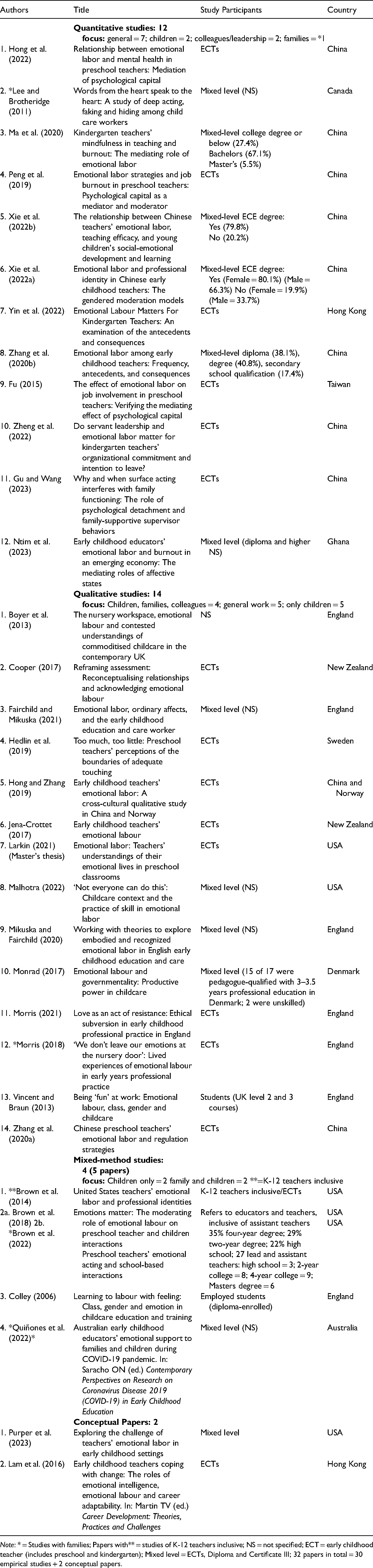
| Authors | Title | Study Participants | Country |
|---|---|---|---|
| 1. Hong et al. (2022) | Relationship between emotional labor and mental health in preschool teachers: Mediation of psychological capital | ECTs | China |
| 2. *Lee and Brotheridge (2011) | Words from the heart speak to the heart: A study of deep acting, faking and hiding among child care workers | Mixed level (NS) | Canada |
| 3. Ma et al. (2020) | Kindergarten teachers’ mindfulness in teaching and burnout: The mediating role of emotional labor | Mixed-level college degree or below (27.4%) |
China |
| 4. Peng et al. (2019) | Emotional labor strategies and job burnout in preschool teachers: Psychological capital as a mediator and moderator | ECTs | China |
| 5. Xie et al. (2022b) | The relationship between Chinese teachers’ emotional labor, teaching efficacy, and young children's social-emotional development and learning | Mixed-level ECE degree: |
China |
| 6. Xie et al. (2022a) | Emotional labor and professional identity in Chinese early childhood teachers: The gendered moderation models | Mixed-level ECE degree: |
China |
| 7. Yin et al. (2022) | Emotional Labour Matters For Kindergarten Teachers: An examination of the antecedents and consequences | ECTs | Hong Kong |
| 8. Zhang et al. (2020b) | Emotional labor among early childhood teachers: Frequency, antecedents, and consequences | Mixed-level diploma (38.1%), degree (40.8%), secondary school qualification (17.4%) | China |
| 9. Fu (2015) | The effect of emotional labor on job involvement in preschool teachers: Verifying the mediating effect of psychological capital | ECTs | Taiwan |
| 10. Zheng et al. (2022) | Do servant leadership and emotional labor matter for kindergarten teachers’ organizational commitment and intention to leave? | ECTs | China |
| 11. Gu and Wang (2023) | Why and when surface acting interferes with family functioning: The role of psychological detachment and family-supportive supervisor behaviors | ECTs | China |
| 12. Ntim et al. (2023) | Early childhood educators’ emotional labor and burnout in an emerging economy: The mediating roles of affective states | Mixed level (diploma and higher NS) | Ghana |
| 1. Boyer et al. (2013) | The nursery workspace, emotional labour and contested understandings of commoditised childcare in the contemporary UK | NS | England |
| 2. Cooper (2017) | Reframing assessment: Reconceptualising relationships and acknowledging emotional labour | ECTs | New Zealand |
| 3. Fairchild and Mikuska (2021) | Emotional labor, ordinary affects, and the early childhood education and care worker | Mixed level (NS) | England |
| 4. Hedlin et al. (2019) | Too much, too little: Preschool teachers’ perceptions of the boundaries of adequate touching | ECTs | Sweden |
| 5. Hong and Zhang (2019) | Early childhood teachers’ emotional labor: A cross-cultural qualitative study in China and Norway | ECTs | China and Norway |
| 6. Jena-Crottet (2017) | Early childhood teachers’ emotional labour | ECTs | New Zealand |
| 7. Larkin (2021) (Master's thesis) | Emotional labor: Teachers’ understandings of their emotional lives in preschool classrooms | ECTs | USA |
| 8. Malhotra (2022) | ‘Not everyone can do this’: Childcare context and the practice of skill in emotional labor | Mixed level (NS) | USA |
| 9. Mikuska and Fairchild (2020) | Working with theories to explore embodied and recognized emotional labor in English early childhood education and care | Mixed level (NS) | England |
| 10. Monrad (2017) | Emotional labour and governmentality: Productive power in childcare | Mixed level (15 of 17 were pedagogue-qualified with 3–3.5 years professional education in Denmark; 2 were unskilled) | Denmark |
| 11. Morris (2021) | Love as an act of resistance: Ethical subversion in early childhood professional practice in England | ECTs | England |
| 12. *Morris (2018) | ‘We don’t leave our emotions at the nursery door’: Lived experiences of emotional labour in early years professional practice | ECTs | England |
| 13. Vincent and Braun (2013) | Being ‘fun’ at work: Emotional labour, class, gender and childcare | Students (UK level 2 and 3 courses) | England |
| 14. Zhang et al. (2020a) | Chinese preschool teachers’ emotional labor and regulation strategies | ECTs | China |
| 1. **Brown et al. (2014) | United States teachers’ emotional labor and professional identities | K-12 teachers inclusive/ECTs | USA |
| 2a. Brown et al. (2018) 2b. *Brown et al. (2022) | Emotions matter: The moderating role of emotional labour on preschool teacher and children interactions |
Refers to educators and teachers, inclusive of assistant teachers 35% four-year degree; 29% two-year degree; 22% high school; 27 lead and assistant teachers: high school = 3; 2-year college = 8; 4-year college = 9; Masters degree = 6 | USA |
| 3. Colley (2006) | Learning to labour with feeling: Class, gender and emotion in childcare education and training | Employed students (diploma-enrolled) | England |
| 4. *Quiñones et al. (2022)* | Australian early childhood educators’ emotional support to families and children during COVID-19 pandemic. In: Saracho ON (ed.) Contemporary Perspectives on Research on Coronavirus Disease 2019 (COVID-19) in Early Childhood Education | Mixed level (NS) | Australia |
|
|
|||
| 1. Purper et al. (2023) | Exploring the challenge of teachers’ emotional labor in early childhood settings | Mixed level | USA |
| 2. Lam et al. (2016) | Early childhood teachers coping with change: The roles of emotional intelligence, emotional labour and career adaptability. In: Martin TV (ed.) Career Development: Theories, Practices and Challenges | ECTs | Hong Kong |
Note: * = Studies with families; Papers with** = studies of K-12 teachers inclusive; NS = not specified; ECT = early childhood teacher (includes preschool and kindergarten); Mixed level = ECTs, Diploma and Certificate III; 32 papers in total = 30 empirical studies + 2 conceptual papers.